

- Industry Size (2026)
- USD 0.8 Bn
- Forecast (2036)
- USD 1.5 Bn
- CAGR (2026 to 2036)
- 6.6%
Telemetry Test Equipment Market Forecast and Outlook 2026 to 2036
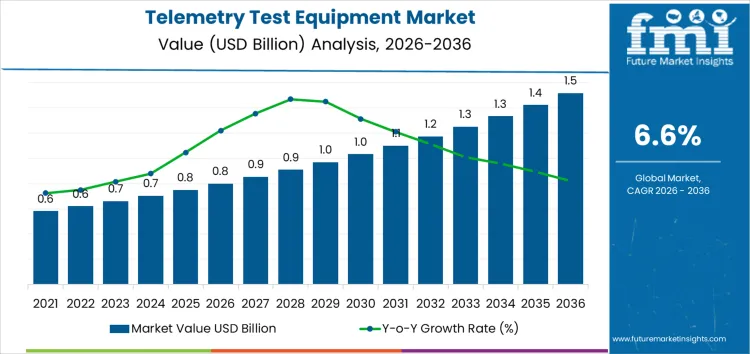
The telemetry test equipment market, valued at USD 0.8 billion in 2026 and projected to reach USD 1.5 billion by 2036, is growing at a CAGR of 6.6%. Equipment types such as telemetry receivers & decommutators, which play a critical role in decoding telemetry signals, hold the largest market share. Recorders & playback systems, essential for data storage and retrieval, capture a significant share, while antennas/tracking & RF front-end systems are vital for maintaining strong communication links. The analysis software segment is also growing, supporting real-time data processing and performance evaluation. Among link types, RF telemetry (L/S/C bands) dominates with 54% market share, largely due to its widespread use in defense, aerospace, and telecommunications. Other link types like Ethernet/IP telemetry and optical/IR links follow, catering to industries requiring high-speed data transmission.
Quick Stats for Telemetry Test Equipment Market
- Telemetry Test Equipment Market Value (2026): USD 0.8 Billion
- Telemetry Test Equipment Market Forecast Value (2036): USD 1.5 Billion
- Telemetry Test Equipment Market Forecast CAGR (2026-2036): 6.6%
- Leading Segment in Telemetry Test Equipment Market: RF Telemetry (L/S/C bands)
- Key Players in Telemetry Test Equipment Market: Curtiss-Wright, Safran Data Systems, TE Connectivity, Spirent, Keysight, Rohde & Schwarz, VIAVI, Anritsu, dSPACE, National Instruments (NI)
End-users in defense test ranges and aerospace OEMs dominate the market, with defense test ranges capturing 34% of the market share. The high demand for telemetry solutions in satellite communications, missile tracking, and aircraft diagnostics is driving growth in this sector. Aerospace OEMs also hold a significant share, fueled by the adoption of telemetry systems for flight testing and vehicle diagnostics. Additionally, space programs and research or academia sectors contribute to the market as telemetry solutions are increasingly used for monitoring and validating systems in these areas. These trends highlight the broadening applications of telemetry test equipment across various industries.
Telemetry Test Equipment Market Key Takeaways
| Metric | Value |
|---|---|
| Industry Value (2026) | USD 0.8 Billion |
| Forecast Value (2036) | USD 1.5 Billion |
| Forecast CAGR (2026-2036) | 6.6% |
How Is the Global Telemetry Test Equipment Market Advancing?
The global telemetry test equipment market is expanding as the demand for accurate and real-time data monitoring and diagnostics in various sectors such as aerospace, automotive, healthcare, and industrial automation continues to rise. Telemetry test equipment is crucial for testing and validating telemetry systems that collect, transmit, and analyze data remotely. These systems are increasingly used in applications such as satellite communications, remote patient monitoring, vehicle telemetry, and industrial equipment performance monitoring.
As industries adopt more complex systems requiring remote monitoring, the need for advanced telemetry test equipment has grown. These test tools enable operators to ensure that telemetry systems function optimally, providing accurate data and reliable performance over long distances. In particular, industries such as space exploration, defense, and automotive are seeing increased use of telemetry systems for real-time communication, diagnostics, and performance assessments.
The market is being driven by the advancement in wireless communication technologies, particularly in IoT, which enables more efficient data transfer. Additionally, the growing emphasis on predictive maintenance, operational efficiency, and safety is increasing the need for telemetry systems that can provide insights into machine performance, environmental conditions, and other critical parameters.
The growing integration of AI and machine learning into telemetry test equipment is another key trend, allowing for enhanced data analytics, better fault detection, and predictive insights. Furthermore, the adoption of cloud-based solutions is enabling remote diagnostics and management, making telemetry test equipment even more essential for industries operating on a global scale.
What is the Segment-Wise Analysis for the Telemetry Test Equipment Market?
Telemetry test equipment market is segmented by link type and end user. RF Telemetry (L/S/C bands) leads the market with a 54% share, followed by Ethernet or IP Telemetry, Optical or IR Links, and Other or Hybrid links. These link types play a vital role in ensuring reliable data transmission for various applications. In terms of end users, Defense Test Ranges dominate with a 34% market share, driven by the need for advanced telemetry test solutions in defense and military operations.
How Does RF Telemetry (L/S/C bands) Lead the Telemetry Test Equipment Market?
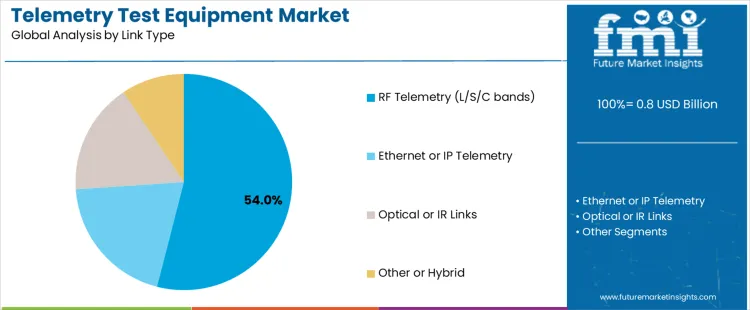
RF Telemetry (L/S/C bands) leads the telemetry test equipment market with a 54% share due to its extensive use in military, aerospace, and space applications. RF telemetry offers high-frequency capabilities and wide bandwidth, enabling robust data transmission over long distances, which is essential for testing systems in defense, satellite communication, and remote monitoring. The demand for RF telemetry is driven by its reliable performance in complex environments, where real-time data accuracy is critical for system evaluation and troubleshooting. With the continued expansion of space programs and defense technologies, RF telemetry is expected to maintain its dominant position, supporting a range of advanced applications in testing and communication systems.
How Do Defense Test Ranges Contribute to the Telemetry Test Equipment Market?
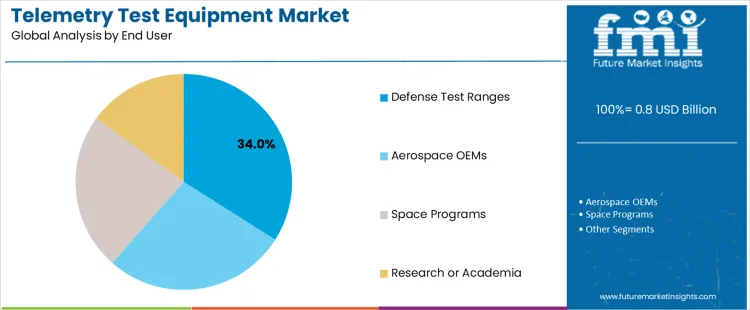
Defense Test Ranges account for 34% of the telemetry test equipment market share, reflecting their critical role in the defense sector. Test ranges are used to evaluate and validate the performance of military systems, weapons, and communication devices. Telemetry test equipment is essential for collecting real-time data during field tests, ensuring that military assets meet required operational standards. The growth in defense-related investments and the increasing complexity of defense technologies drive the need for accurate, reliable telemetry solutions. This ongoing demand from defense test ranges supports a significant portion of the telemetry test equipment market, making it a key driver in the sector.
What Are the Key Dynamics for the Telemetry Test Equipment Market?
The telemetry test equipment market is shaped by the expanding deployment of remote monitoring systems across key industries such as aerospace, defense, automotive, healthcare, and utilities. As more organizations rely on real time data transmission for system performance, safety monitoring, and predictive maintenance, the demand for reliable test and measurement solutions that validate telemetry system accuracy continues to rise. Growing complexity in telemetry technologies from RF and wireless systems to satellite and IoT enabled networks drives the need for advanced test equipment.
What Are the Key Drivers for the Telemetry Test Equipment Market?
A major driver is the widespread adoption of remote monitoring and data communication systems in critical applications. Industries such as aerospace and defense require precise telemetry testing to ensure safe and reliable operation of aircraft, missiles, and spacecraft. In healthcare, wearable and remote patient monitoring systems have increased the need for accurate telemetry validation. Utility and automotive sectors are integrating telemetry for system diagnostics and performance optimization. Advancements in wireless communication technologies and rising demand for predictive maintenance solutions are further propelling investments in telemetry test equipment.
What Are the Key Trends Shaping the Telemetry Test Equipment Market?
A notable trend is the integration of software defined and virtual test platforms, enabling greater flexibility and faster updates to support evolving telemetry standards. There is also a movement toward automated and AI assisted testing, which improves test throughput and reduces human error. Test equipment that supports multi protocol and multi band telemetry systems is becoming more prevalent as industries adopt diverse communication technologies. Growing emphasis on remote and cloud based test management is enabling real time data insights and collaboration across distributed teams, aligning with broader digital transformation initiatives.
What is the Growth Outlook for the Telemetry Test Equipment Market by Country?
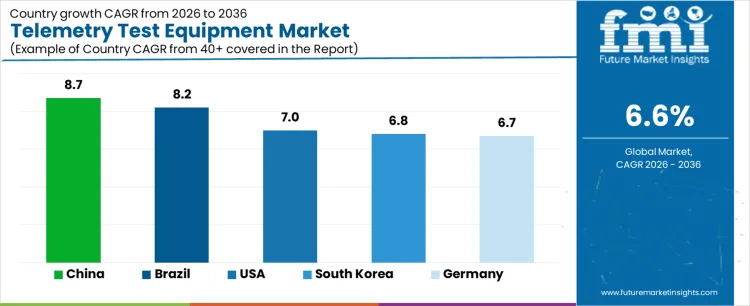
| Country | CAGR (%) |
|---|---|
| USA | 7% |
| South Korea | 6.8% |
| Germany | 6.7% |
| China | 8.7% |
| Brazil | 8.2% |
The telemetry test equipment market is experiencing steady growth, with China leading at an 8.7% CAGR, driven by the country’s rapid advancements in telecommunications, 5G network deployment, and smart city initiatives. Brazil follows with 8.2%, supported by the expansion of telecommunications and IoT adoption. The USA’s market grows at 7%, fueled by investments in 5G technology and the aerospace and defense sectors. South Korea’s market grows at 6.8%, supported by the country’s leadership in electronics, automotive, and IoT infrastructure. Germany’s market grows at 6.7%, backed by strong industrial automation and digitalization efforts, alongside a focus on high-quality communication infrastructure.
Why is the telemetry test equipment market growing in China?
China’s telemetry test equipment market is growing at 8.7%, driven by rapid advancements in telecommunications and technology infrastructure. The country is heavily investing in its digital transformation, including the rollout of 5G networks and smart city initiatives, which require sophisticated telemetry test equipment to ensure network performance and reliability. As the Chinese government continues to expand its telecommunications infrastructure, there is an increased need for testing solutions to monitor, validate, and optimize network operations. China’s growing demand for internet of things (IoT) devices and connected systems further fuels the need for telemetry equipment in various sectors such as healthcare, automotive, and industrial automation. With continuous technological development, the market for telemetry test equipment in China is expected to expand significantly, ensuring high-quality and efficient communication systems.
What is contributing to the growth of the telemetry test equipment market in Brazil?
Brazil’s telemetry test equipment market is growing at 8.2%, supported by investments in telecommunications and infrastructure modernization. As the country works to improve its communication networks and expand its digital services, the demand for advanced testing equipment to monitor and maintain network performance is on the rise. Brazil’s increasing adoption of IoT technologies and smart city initiatives also drives the need for telemetry solutions to ensure that connected systems operate efficiently and reliably. The market is further bolstered by the expansion of sectors like healthcare, automotive, and logistics, where telemetry is essential for real-time monitoring and data collection. Brazil’s focus on strengthening its communication infrastructure and embracing digitalization contributes significantly to the growth of telemetry test equipment in the country.
How is the telemetry test equipment market expanding in the USA?
The USA’s telemetry test equipment market is growing at 7%, fueled by increasing demand for advanced testing solutions in telecommunications, aerospace, and defense sectors. The USA’s continuous investment in 5G network deployment and other high-performance communications technologies drives the need for precise telemetry testing equipment to validate the functionality and reliability of networks. The expansion of IoT applications in industries such as healthcare, automotive, and industrial automation further enhances the demand for telemetry solutions to monitor and manage network operations. The ongoing technological advancements and increased focus on maintaining high-quality communication systems in the USA ensure a steady demand for telemetry test equipment, which is expected to continue to grow.
Why is the telemetry test equipment market growing in South Korea?
South Korea’s telemetry test equipment market is growing at 6.8%, driven by the country’s leadership in telecommunications and technology development. As South Korea continues to expand its 5G networks and IoT infrastructure, the need for advanced telemetry test equipment to ensure optimal performance and reliability of these systems is increasing. South Korea’s highly developed electronics and automotive industries also contribute to the demand for precise telemetry testing solutions to support real-time monitoring and system validation. The country’s growing focus on smart city development, healthcare, and industrial automation further amplifies the need for telemetry test equipment across various sectors. With South Korea's commitment to innovation and high-quality standards, the market for telemetry test equipment is expected to continue expanding.
What is driving the growth of the telemetry test equipment market in Germany?
Germany’s telemetry test equipment market is growing at 6.7%, driven by the country’s commitment to digitalization and technological advancements in communication infrastructure. As Germany deploys its 5G networks and embraces smart city solutions, the demand for telemetry testing solutions to ensure system performance and connectivity is increasing. Germany’s strong manufacturing base and its leadership in automotive and industrial automation sectors contribute to the growing need for telemetry equipment to monitor and optimize these industries’ operations. The country’s focus on high-quality standards and its commitment to maintaining reliable communication systems further support the growth of the telemetry test equipment market. Germany’s focus on innovation and infrastructure development ensures the continued expansion of the market.
How Do Key Players Compete in Telemetry Test Equipment?
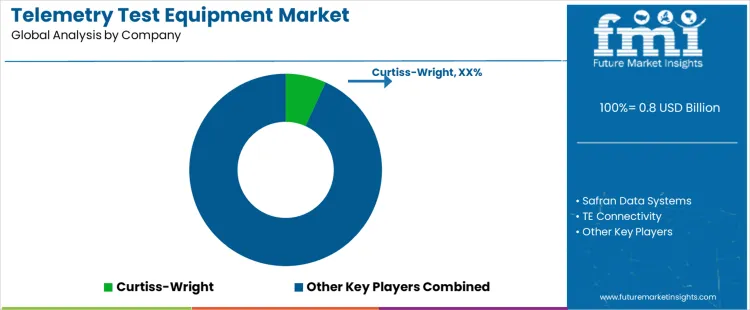
Competition revolves around precision, integration, breadth of test portfolios, and customer centric product documentation. Curtiss Wright leverages specialised aerospace and defense telemetry solutions that combine ruggedised telemetry test hardware with validation systems tailored for mission critical environments. Safran Data Systems focuses on high reliability telemetry and data acquisition products, emphasising modularity and adaptability in its brochures to attract aerospace and space sector clients. TE Connectivity differentiates through sensor to system telemetry connectivity products used to transmit accurate data under extreme conditions, with product collateral highlighting rugged connectors and integrated test modules.
Spirent and Keysight are rooted in communication and network test excellence where telemetry testing intersects with next gen networks and automation; their brochures showcase protocol emulation, 5G/6G ready telemetry test suites, and automation toolchains. Recent industry moves show intense competitive pressure between these two in telecom testing domains. Rohde & Schwarz and VIAVI emphasise comprehensive RF, wireless, and telemetry test instruments with highly detailed datasheets that support broad industry compliance and performance testing requirements. Anritsu adds value with compact telemetry and communication analyzers designed for field and lab use. dSPACE positions itself with hardware in the loop (HIL) simulation and telemetry test rigs for embedded systems validation. National Instruments (NI) brings software defined test platforms (e.g., LabVIEW driven telemetry acquisition and analysis) with product brochures stressing flexibility and integration across test workflows.
Key Players in Telemetry Test Equipment Market
- Curtiss-Wright
- Safran Data Systems
- TE Connectivity
- Spirent
- Keysight
- Rohde & Schwarz
- VIAVI
- Anritsu
- dSPACE
- National Instruments (NI)
Scope of Report
| Items | Values |
|---|---|
| Quantitative Unit (2026) | USD billion |
| Equipment Type | Telemetry Receivers & Decommutators, Recorders & Playback Systems, Antennas or Tracking & RF Front-End, Analysis Software |
| Link Type | RF Telemetry (L/S/C bands), Ethernet or IP Telemetry, Optical or IR Links, Other or Hybrid |
| End User | Defense Test Ranges, Aerospace OEMs, Space Programs, Research or Academia |
| Regions Covered | Asia Pacific, Europe, North America, Latin America, Middle East & Africa |
| Countries Covered | USA, China, Japan, South Korea, India, Australia & New Zealand, ASEAN, Germany, UK, France, Italy, Spain, Nordic, BENELUX, Brazil, Chile, Mexico, Saudi Arabia, Other GCC Countries, Turkey, South Africa, Other African Union |
| Key Companies Profiled | Curtiss-Wright, Safran Data Systems, TE Connectivity, Spirent, Keysight, Rohde & Schwarz, VIAVI, Anritsu, dSPACE, National Instruments (NI) |
| Additional Attributes | Dollar sales by equipment type, link type, end user, and region; regional CAGR and growth outlook. |
Telemetry Test Equipment Market by Segments
Equipment Type
- Telemetry Receivers & Decommutators
- Recorders & Playback Systems
- Antennas or Tracking & RF Front-End
- Analysis Software
Link Type
- RF Telemetry (L/S/C bands)
- Ethernet or IP Telemetry
- Optical or IR Links
- Other or Hybrid
End User
- Defense Test Ranges
- Aerospace OEMs
- Space Programs
- Research or Academia
Region
- Asia Pacific
- China
- Japan
- South Korea
- India
- Australia & New Zealand
- ASEAN
- Rest of Asia Pacific
- Europe
- Germany
- United Kingdom
- France
- Italy
- Spain
- Nordic
- BENELUX
- Rest of Europe
- North America
- United States
- Canada
- Mexico
- Latin America
- Brazil
- Chile
- Rest of Latin America
- Middle East & Africa
- Kingdom of Saudi Arabia
- Other GCC Countries
- Turkey
- South Africa
- Other African Union
- Rest of Middle East & Africa
Frequently Asked Questions
How big is the telemetry test equipment market in 2026?
The global telemetry test equipment market is estimated to be valued at USD 0.8 billion in 2026.
What will be the size of telemetry test equipment market in 2036?
The market size for the telemetry test equipment market is projected to reach USD 1.5 billion by 2036.
How much will be the telemetry test equipment market growth between 2026 and 2036?
The telemetry test equipment market is expected to grow at a 6.6% CAGR between 2026 and 2036.
What are the key equipment types in the telemetry test equipment market?
The key equipment types in telemetry test equipment market are telemetry receivers & decommutators, recorders & playback systems, antennas or tracking & rf front-end and analysis software .
Which link type segment to contribute significant share in the telemetry test equipment market in 2026?
In terms of link type, RF Telemetry (L/S/C bands) segment to command 54.0% share in the telemetry test equipment market in 2026.
Preview the report firsthand - request a free sample
Get SampleGet the brochure for pricing and purchase details.
Get PDFTable of Content
- Executive Summary
- Global Market Outlook
- Demand-side Trends
- Supply-side Trends
- Technology Roadmap Analysis
- Analysis and Recommendations
- Market Overview
- Market Coverage / Taxonomy
- Market Definition / Scope / Limitations
- Market Background
- Market Dynamics
- Drivers
- Restraints
- Opportunity
- Trends
- Scenario Forecast
- Demand in Optimistic Scenario
- Demand in Likely Scenario
- Demand in Conservative Scenario
- Opportunity Map Analysis
- Product Life Cycle Analysis
- Supply Chain Analysis
- Investment Feasibility Matrix
- Value Chain Analysis
- PESTLE and Porter’s Analysis
- Regulatory Landscape
- Regional Parent Market Outlook
- Production and Consumption Statistics
- Import and Export Statistics
- Market Dynamics
- Global Market Analysis 2021 to 2025 and Forecast, 2026 to 2036
- Historical Market Size Value (USD Million) Analysis, 2021 to 2025
- Current and Future Market Size Value (USD Million) Projections, 2026 to 2036
- Y-o-Y Growth Trend Analysis
- Absolute $ Opportunity Analysis
- Global Market Pricing Analysis 2021 to 2025 and Forecast 2026 to 2036
- Global Market Analysis 2021 to 2025 and Forecast 2026 to 2036, By Equipment Type
- Introduction / Key Findings
- Historical Market Size Value (USD Million) Analysis By Equipment Type , 2021 to 2025
- Current and Future Market Size Value (USD Million) Analysis and Forecast By Equipment Type , 2026 to 2036
- Telemetry Receivers & Decommutators
- Recorders & Playback Systems
- Antennas or Tracking & RF Front-End
- Analysis Software
- Telemetry Receivers & Decommutators
- Y-o-Y Growth Trend Analysis By Equipment Type , 2021 to 2025
- Absolute $ Opportunity Analysis By Equipment Type , 2026 to 2036
- Global Market Analysis 2021 to 2025 and Forecast 2026 to 2036, By Link Type
- Introduction / Key Findings
- Historical Market Size Value (USD Million) Analysis By Link Type, 2021 to 2025
- Current and Future Market Size Value (USD Million) Analysis and Forecast By Link Type, 2026 to 2036
- RF Telemetry (L/S/C bands)
- Ethernet or IP Telemetry
- Optical or IR Links
- Other or Hybrid
- RF Telemetry (L/S/C bands)
- Y-o-Y Growth Trend Analysis By Link Type, 2021 to 2025
- Absolute $ Opportunity Analysis By Link Type, 2026 to 2036
- Global Market Analysis 2021 to 2025 and Forecast 2026 to 2036, By End User
- Introduction / Key Findings
- Historical Market Size Value (USD Million) Analysis By End User, 2021 to 2025
- Current and Future Market Size Value (USD Million) Analysis and Forecast By End User, 2026 to 2036
- Defense Test Ranges
- Aerospace OEMs
- Space Programs
- Research or Academia
- Defense Test Ranges
- Y-o-Y Growth Trend Analysis By End User, 2021 to 2025
- Absolute $ Opportunity Analysis By End User, 2026 to 2036
- Global Market Analysis 2021 to 2025 and Forecast 2026 to 2036, By Region
- Introduction
- Historical Market Size Value (USD Million) Analysis By Region, 2021 to 2025
- Current Market Size Value (USD Million) Analysis and Forecast By Region, 2026 to 2036
- North America
- Latin America
- Western Europe
- Eastern Europe
- East Asia
- South Asia and Pacific
- Middle East & Africa
- Market Attractiveness Analysis By Region
- North America Market Analysis 2021 to 2025 and Forecast 2026 to 2036, By Country
- Historical Market Size Value (USD Million) Trend Analysis By Market Taxonomy, 2021 to 2025
- Market Size Value (USD Million) Forecast By Market Taxonomy, 2026 to 2036
- By Country
- USA
- Canada
- Mexico
- By Equipment Type
- By Link Type
- By End User
- By Country
- Market Attractiveness Analysis
- By Country
- By Equipment Type
- By Link Type
- By End User
- Key Takeaways
- Latin America Market Analysis 2021 to 2025 and Forecast 2026 to 2036, By Country
- Historical Market Size Value (USD Million) Trend Analysis By Market Taxonomy, 2021 to 2025
- Market Size Value (USD Million) Forecast By Market Taxonomy, 2026 to 2036
- By Country
- Brazil
- Chile
- Rest of Latin America
- By Equipment Type
- By Link Type
- By End User
- By Country
- Market Attractiveness Analysis
- By Country
- By Equipment Type
- By Link Type
- By End User
- Key Takeaways
- Western Europe Market Analysis 2021 to 2025 and Forecast 2026 to 2036, By Country
- Historical Market Size Value (USD Million) Trend Analysis By Market Taxonomy, 2021 to 2025
- Market Size Value (USD Million) Forecast By Market Taxonomy, 2026 to 2036
- By Country
- Germany
- UK
- Italy
- Spain
- France
- Nordic
- BENELUX
- Rest of Western Europe
- By Equipment Type
- By Link Type
- By End User
- By Country
- Market Attractiveness Analysis
- By Country
- By Equipment Type
- By Link Type
- By End User
- Key Takeaways
- Eastern Europe Market Analysis 2021 to 2025 and Forecast 2026 to 2036, By Country
- Historical Market Size Value (USD Million) Trend Analysis By Market Taxonomy, 2021 to 2025
- Market Size Value (USD Million) Forecast By Market Taxonomy, 2026 to 2036
- By Country
- Russia
- Poland
- Hungary
- Balkan & Baltic
- Rest of Eastern Europe
- By Equipment Type
- By Link Type
- By End User
- By Country
- Market Attractiveness Analysis
- By Country
- By Equipment Type
- By Link Type
- By End User
- Key Takeaways
- East Asia Market Analysis 2021 to 2025 and Forecast 2026 to 2036, By Country
- Historical Market Size Value (USD Million) Trend Analysis By Market Taxonomy, 2021 to 2025
- Market Size Value (USD Million) Forecast By Market Taxonomy, 2026 to 2036
- By Country
- China
- Japan
- South Korea
- By Equipment Type
- By Link Type
- By End User
- By Country
- Market Attractiveness Analysis
- By Country
- By Equipment Type
- By Link Type
- By End User
- Key Takeaways
- South Asia and Pacific Market Analysis 2021 to 2025 and Forecast 2026 to 2036, By Country
- Historical Market Size Value (USD Million) Trend Analysis By Market Taxonomy, 2021 to 2025
- Market Size Value (USD Million) Forecast By Market Taxonomy, 2026 to 2036
- By Country
- India
- ASEAN
- Australia & New Zealand
- Rest of South Asia and Pacific
- By Equipment Type
- By Link Type
- By End User
- By Country
- Market Attractiveness Analysis
- By Country
- By Equipment Type
- By Link Type
- By End User
- Key Takeaways
- Middle East & Africa Market Analysis 2021 to 2025 and Forecast 2026 to 2036, By Country
- Historical Market Size Value (USD Million) Trend Analysis By Market Taxonomy, 2021 to 2025
- Market Size Value (USD Million) Forecast By Market Taxonomy, 2026 to 2036
- By Country
- Kingdom of Saudi Arabia
- Other GCC Countries
- Turkiye
- South Africa
- Other African Union
- Rest of Middle East & Africa
- By Equipment Type
- By Link Type
- By End User
- By Country
- Market Attractiveness Analysis
- By Country
- By Equipment Type
- By Link Type
- By End User
- Key Takeaways
- Key Countries Market Analysis
- USA
- Pricing Analysis
- Market Share Analysis, 2025
- By Equipment Type
- By Link Type
- By End User
- Canada
- Pricing Analysis
- Market Share Analysis, 2025
- By Equipment Type
- By Link Type
- By End User
- Mexico
- Pricing Analysis
- Market Share Analysis, 2025
- By Equipment Type
- By Link Type
- By End User
- Brazil
- Pricing Analysis
- Market Share Analysis, 2025
- By Equipment Type
- By Link Type
- By End User
- Chile
- Pricing Analysis
- Market Share Analysis, 2025
- By Equipment Type
- By Link Type
- By End User
- Germany
- Pricing Analysis
- Market Share Analysis, 2025
- By Equipment Type
- By Link Type
- By End User
- UK
- Pricing Analysis
- Market Share Analysis, 2025
- By Equipment Type
- By Link Type
- By End User
- Italy
- Pricing Analysis
- Market Share Analysis, 2025
- By Equipment Type
- By Link Type
- By End User
- Spain
- Pricing Analysis
- Market Share Analysis, 2025
- By Equipment Type
- By Link Type
- By End User
- France
- Pricing Analysis
- Market Share Analysis, 2025
- By Equipment Type
- By Link Type
- By End User
- India
- Pricing Analysis
- Market Share Analysis, 2025
- By Equipment Type
- By Link Type
- By End User
- ASEAN
- Pricing Analysis
- Market Share Analysis, 2025
- By Equipment Type
- By Link Type
- By End User
- Australia & New Zealand
- Pricing Analysis
- Market Share Analysis, 2025
- By Equipment Type
- By Link Type
- By End User
- China
- Pricing Analysis
- Market Share Analysis, 2025
- By Equipment Type
- By Link Type
- By End User
- Japan
- Pricing Analysis
- Market Share Analysis, 2025
- By Equipment Type
- By Link Type
- By End User
- South Korea
- Pricing Analysis
- Market Share Analysis, 2025
- By Equipment Type
- By Link Type
- By End User
- Russia
- Pricing Analysis
- Market Share Analysis, 2025
- By Equipment Type
- By Link Type
- By End User
- Poland
- Pricing Analysis
- Market Share Analysis, 2025
- By Equipment Type
- By Link Type
- By End User
- Hungary
- Pricing Analysis
- Market Share Analysis, 2025
- By Equipment Type
- By Link Type
- By End User
- Kingdom of Saudi Arabia
- Pricing Analysis
- Market Share Analysis, 2025
- By Equipment Type
- By Link Type
- By End User
- Turkiye
- Pricing Analysis
- Market Share Analysis, 2025
- By Equipment Type
- By Link Type
- By End User
- South Africa
- Pricing Analysis
- Market Share Analysis, 2025
- By Equipment Type
- By Link Type
- By End User
- USA
- Market Structure Analysis
- Competition Dashboard
- Competition Benchmarking
- Market Share Analysis of Top Players
- By Regional
- By Equipment Type
- By Link Type
- By End User
- Competition Analysis
- Competition Deep Dive
- Curtiss-Wright
- Overview
- Product Portfolio
- Profitability by Market Segments (Product/Age /Sales Channel/Region)
- Sales Footprint
- Strategy Overview
- Marketing Strategy
- Product Strategy
- Channel Strategy
- Safran Data Systems
- TE Connectivity
- Spirent
- Keysight
- Rohde & Schwarz
- VIAVI
- Anritsu
- dSPACE
- National Instruments (NI)
- Curtiss-Wright
- Competition Deep Dive
- Assumptions & Acronyms Used
- Research Methodology


