

- Industry Size (2026)
- USD 391.0 Mn
- Forecast (2036)
- USD 892.2 Mn
- CAGR (2026 to 2036)
- 8.6%
UPS & Supercapacitor Health Test Equipment Market Forecast and Outlook 2026 to 2036
The UPS & supercapacitor health test equipment market is valued at USD 391.0 million in 2026 and is forecasted to reach USD 892.2 million by 2036, expanding at a CAGR of 8.6%. Growth is driven by increasing dependence on uninterrupted power systems across data centers, telecom networks, industrial automation, and critical infrastructure. Reliability requirements push operators to implement routine health diagnostics that assess capacity fade, internal resistance, charge-discharge efficiency, and failure risk. Rising integration of supercapacitors alongside batteries further reinforces need for advanced testing platforms capable of handling mixed energy-storage architectures.
UPS batteries represent leading storage-type demand, reflecting their dominant role in backup power applications. Regular health testing of UPS batteries supports predictive maintenance strategies, lifecycle optimization, and compliance with uptime service-level requirements. Supercapacitor testing adoption continues to expand due to their use in fast-response power buffering, although battery-focused platforms remain priority investments. Segment structure indicates preference for equipment supporting high-current cycling, accelerated aging analysis, and precise measurement under simulated load conditions representative of real-world operating environments.
China, Brazil, South Korea, USA, and Germany emerge as fastest-growing countries, supported by expansion of digital infrastructure and industrial electrification. Competitive landscape includes Chroma ATE, Arbin Instruments, AMETEK, Digatron, and Bitrode. These companies focus on scalable test channels, high-accuracy diagnostics, and automation-ready platforms aligned with evolving backup power reliability requirements.
Quick Stats for UPS & Supercapacitor Health Test Equipment Market
- UPS & Supercapacitor Health Test Equipment Market Value (2026): USD 391.0 million
- UPS & Supercapacitor Health Test Equipment Market Forecast Value (2036): USD 892.2 million
- UPS & Supercapacitor Health Test Equipment Market Forecast CAGR (2026-2036): 8.6%
- Leading Storage Type in Global Demand: UPS Batteries
- Fastest-Growing Countries: China, Brazil, South Korea, USA, Germany
- Top Players in Global Demand: Chroma ATE, Arbin Instruments, AMETEK, Digatron, Bitrode, Maccor, Neware, Hioki, Keysight Technologies, BioLogic
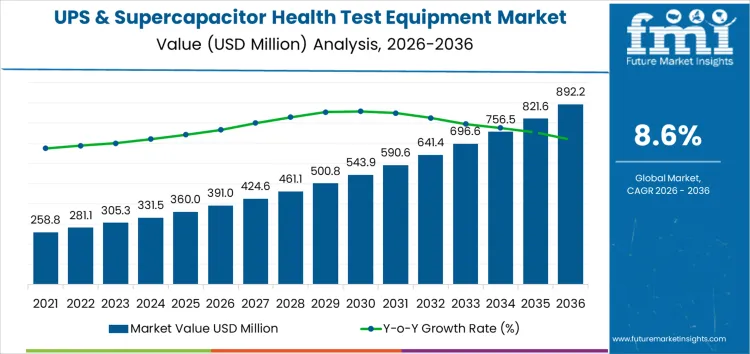
UPS & Supercapacitor Health Test Equipment Market Key Takeaways
| Metric | Value |
|---|---|
| Market Value (2026) | USD 391.0 million |
| Market Forecast Value (2036) | USD 892.2 million |
| Forecast CAGR (2026-2036) | 8.6% |
Why is the Demand for UPS & Supercapacitor Health Test Equipment Market Growing?
Demand for UPS and supercapacitor health test equipment is growing globally due to expanding requirements for reliable backup power and energy storage validation across critical infrastructure sectors. Data centers, telecommunications networks, transportation hubs, and industrial facilities rely on uninterruptible power supply systems and supercapacitor modules to maintain continuity during grid disturbances, transient events, and peak load fluctuations. Growth in digital services, cloud computing, and smart grid integration increases the volume of installed energy storage assets that require periodic health assessment to prevent unexpected failures.
Test platforms enable evaluation of state of charge, capacitance retention, internal resistance, and degradation trends under controlled conditions, which supports predictive maintenance and lifecycle management. Expansion of renewable energy and hybrid power systems reinforces need for equipment that verifies interaction between UPS units and supercapacitor banks under transient loads. Equipment manufacturers and service providers adopt standardized testing to ensure compliance with international performance and safety criteria. Research institutions and certification labs invest in diagnostic tools to support development of next generation energy storage materials and system designs. Operational priorities tied to uptime, safety, and cost control sustain adoption of health test equipment across diverse application environments worldwide.
How Are the Segments Classified in the UPS and Supercapacitor Health Test Equipment Market?
Demand for UPS and supercapacitor health test equipment globally is shaped by uptime assurance requirements, energy storage diversification, and lifecycle management priorities. Operators assess state-of-health visibility, predictive failure detection, test repeatability, and integration with asset management systems. Adoption patterns reflect increased reliance on hybrid storage architectures across data centers, telecom infrastructure, industrial operations, and transport-linked power systems requiring continuous availability.
Which Storage Type Accounts for the Largest Share of Global Demand?
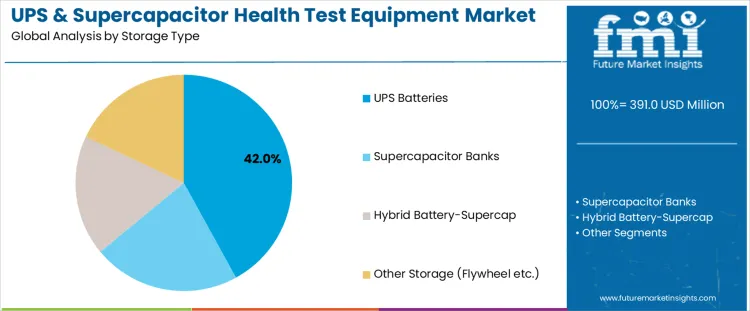
UPS batteries hold 42.0%, accounting for the largest share of global demand. These systems underpin backup power continuity and require regular health assessment to prevent unexpected outages. Supercapacitor banks hold 22.0%, supporting rapid charge-discharge applications where power density and cycle life dominate. Hybrid battery-supercapacitor systems account for 18.0%, combining energy and power advantages requiring coordinated testing approaches. Other storage types, including flywheels, hold 18.0%, supporting niche applications with mechanical or kinetic storage characteristics. Storage-type distribution reflects dominance of battery-backed continuity systems with growing diversification.
Key Points
- UPS batteries lead due to widespread backup deployment.
- Supercapacitors support high-cycle, high-power use.
- Hybrid and alternative storage expand testing complexity.
Which Test Method Drives the Highest Share of Global Testing Activity?
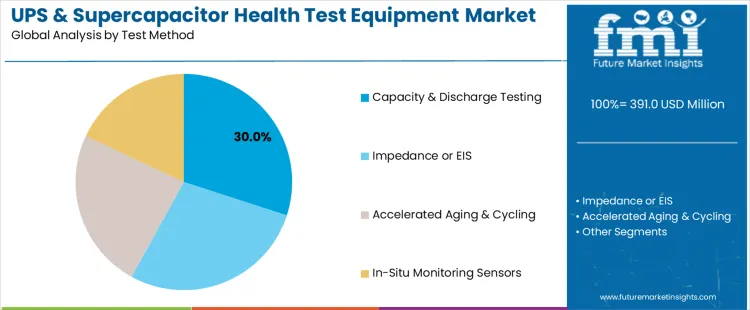
Capacity and discharge testing holds 30.0%, driving the highest share of global testing activity. These tests establish usable energy, runtime predictability, and degradation trends under load. Impedance or EIS testing holds 28.0%, enabling non-invasive assessment of internal resistance and early fault indicators. Accelerated aging and cycling account for 24.0%, supporting lifetime modeling and maintenance planning. In-situ monitoring sensors hold 18.0%, enabling continuous condition tracking during operation. Test-method distribution reflects emphasis on actionable health metrics and predictive maintenance.
Key Points
- Capacity testing leads due to direct runtime validation.
- Impedance methods enable early fault detection.
- Aging tests support lifecycle forecasting.
Which End-Use Sector Represents the Largest Share of Global Demand?
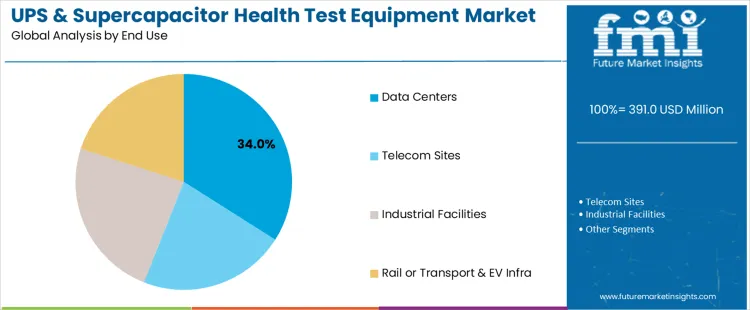
Data centers hold 34.0%, representing the largest share of global demand. These facilities require stringent backup reliability to protect compute workloads and service availability. Industrial facilities account for 24.0%, supporting process continuity and safety systems. Telecom sites hold 22.0%, requiring distributed backup verification across network nodes. Rail, transport, and EV infrastructure account for 20.0%, supporting traction power buffering and charging resilience. End-use distribution reflects concentration of health testing where downtime risk carries high operational impact.
Key Points
- Data centers dominate due to uptime criticality.
- Industrial sites require continuity and safety assurance.
- Telecom and transport rely on distributed storage health.
What are the Key Dynamics in the UPS & Supercapacitor Health Test Equipment Market?
Global demand rises as data centers, industrial facilities, transportation systems, and renewable energy installations adopt test equipment to assess health, performance, and lifecycle status of uninterruptible power supplies (UPS) and supercapacitor energy storage modules. Health test systems measure parameters such as capacitance, equivalent series resistance, charge–discharge efficiency, and degradation trends under operational profiles. Adoption aligns with increased reliance on power resilience, rapid load acceptance, and hybrid storage architectures in critical infrastructure worldwide. Usage spans commercial test labs, in-house maintenance teams, and OEM qualification facilities.
How do power reliability requirements and lifecycle management priorities shape global demand?
Organizations across industries depend on UPS and supercapacitors to maintain continuity during grid disturbances, brownouts, and transient events. Data center operators integrate health test equipment to schedule preventative maintenance, avoid unexpected failures, and optimize replacement timing for batteries and supercapacitor modules. Industrial automation and telecom facilities use diagnostic systems to benchmark energy storage performance and detect early signs of deterioration. Renewable energy installations incorporate hybrid storage with supercapacitors to manage load cycling, requiring reliable health assessment tools. OEMs qualify new designs and ensure quality consistency across production batches. Stakeholders value actionable insights into aging mechanisms, performance drift, and capacity fade to support resilient operations.
How do capital investment, technical complexity, and standardization challenges influence market scalability?
UPS and supercapacitor health test platforms involve investment in precision measurement, controlled load cycling, and environmental conditioning to replicate real-world stressors. Integration with existing maintenance workflows requires skilled technicians capable of interpreting complex diagnostic data. Supercapacitor chemistries and form factors vary, necessitating adaptable test fixtures and configurable measurement protocols. Standards for performance thresholds and pass/fail criteria continue to evolve across industries and regions, complicating universal benchmarking. Smaller facilities may defer adoption due to cost and perceived complexity, relying on service providers or external labs. Supply chain variability for test components affects equipment availability and delivery timelines. Global market growth depends on modular, cost-effective test solutions and harmonized health assessment criteria supporting diverse critical infrastructure and industrial applications worldwide.
How Is Demand for UPS and Supercapacitor Health Test Equipment Evolving?
Demand for UPS and supercapacitor health test equipment is increasing globally due to higher uptime expectations, distributed energy storage adoption, and critical infrastructure protection. China leads with a 10.4% CAGR, supported by rapid expansion of data centers and telecom networks. Brazil follows at 10.0%, driven by grid variability management and infrastructure resilience programs. South Korea records an 8.6% CAGR, shaped by electronics reliability standards and dense urban deployments. USA posts 8.5%, reflecting lifecycle testing across a large installed base. Germany records 8.3%, supported by compliance-driven maintenance and industrial energy storage use. Growth reflects need for predictive diagnostics, capacity verification, and failure prevention worldwide.
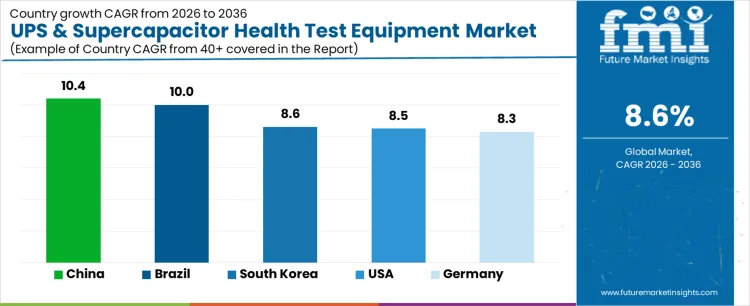
| Country | CAGR (%) |
|---|---|
| China | 10.4% |
| Brazil | 10.0% |
| South Korea | 8.6% |
| USA | 8.5% |
| Germany | 8.3% |
What factors are accelerating adoption of UPS and supercapacitor health testing in China?
China drives demand through large-scale deployment of UPS systems and supercapacitors across data centers, telecom sites, and industrial facilities. Country’s CAGR of 10.4% reflects extensive testing of capacity fade, internal resistance, and charge discharge efficiency. Operators validate health under thermal stress, partial load cycling, and rapid discharge events. In-house testing reduces outage risk and supports preventive maintenance. Platforms emphasize automation, parallel channel testing, and long-duration trend analysis. Government-backed digital infrastructure programs sustain equipment adoption. Growth remains scale-driven and operations-focused, aligned with aggressive capacity expansion and reliability targets.
- Large-scale UPS and supercapacitor deployment
- Capacity and internal resistance diagnostics
- Automated multi-channel health testing
- Government-supported digital infrastructure programs
Why is Brazil showing strong growth in health test equipment demand?
Brazil demand is shaped by grid instability, infrastructure modernization, and resilience planning. Country’s CAGR of 10.0% reflects increasing use of health testing to predict failures and extend asset life. Operators test battery strings and supercapacitors supporting telecom, transport, and public facilities. Shared service providers enable cost-efficient access to advanced diagnostics. Collaboration with global vendors supports adoption of standardized health metrics. Demand favors portable and modular testers suitable for field use. Growth remains capability-building focused, aligned with improving reliability under variable grid conditions.
- Grid variability and resilience requirements
- Predictive diagnostics for critical infrastructure
- Shared testing services and field deployment
- Portable and modular test equipment
How do reliability standards influence testing demand in South Korea?
South Korea demand reflects strict electronics reliability expectations and dense deployment of backup power systems. Country’s CAGR of 8.6% is supported by health testing of UPS and supercapacitors used in telecom, manufacturing, and transportation. Operators emphasize precision measurement, repeatability, and fast fault identification. Government-backed initiatives promote standardized maintenance practices. Test systems prioritize compact design and high accuracy. Growth remains technology-driven, aligned with service continuity requirements and high availability standards.
- Strict reliability and service continuity standards
- Precision health diagnostics and repeatability
- Standardized maintenance practices
- Compact, high-accuracy test systems
What dynamics sustain steady growth of health testing in the USA?
USA demand is driven by a large installed base of UPS systems requiring lifecycle monitoring and replacement planning. Country’s CAGR of 8.5% reflects adoption of health testing to support data centers, healthcare, and critical facilities. Operators assess degradation trends to optimize maintenance and capital planning. Test platforms integrate data logging and analytics. Procurement emphasizes interoperability and standards compliance. Growth remains lifecycle-driven, aligned with preventive maintenance strategies and uptime assurance.
- Large installed base lifecycle management
- Degradation trend analysis and planning
- Analytics-integrated test platforms
- Standards-compliant testing solutions
How is Germany positioned within the global UPS health test equipment landscape?
Germany demand reflects strong compliance culture, industrial automation, and energy storage integration. Country’s CAGR of 8.3% is supported by health testing to meet safety, reliability, and regulatory requirements. Operators validate performance of UPS and supercapacitors across factories and critical infrastructure. Shared research institutes expand access to diagnostic expertise. Procurement favors documentation, traceability, and repeatable results. Growth remains engineering-led, aligned with durability, compliance, and long-term operational reliability expectations.
- Compliance-driven maintenance requirements
- Industrial and critical infrastructure applications
- Access to shared diagnostic expertise
- Emphasis on documentation and traceability
What is the competitive landscape of demand for UPS and supercapacitor health test equipment?
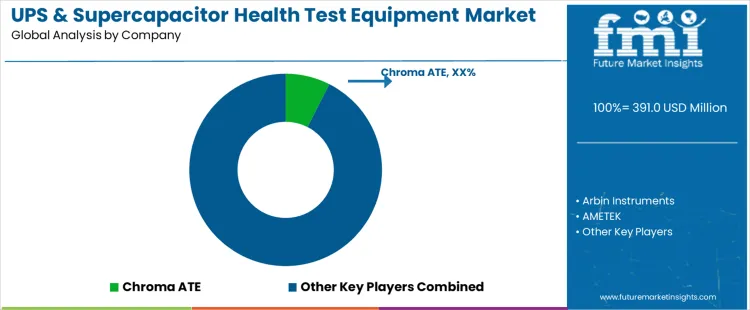
Demand for UPS and supercapacitor health test equipment is driven by critical power reliability requirements across data centers, telecom networks, rail systems, and industrial automation. Testing activities focus on charge-discharge cycling, capacity fade analysis, internal resistance measurement, thermal behavior, and lifetime degradation under real operating profiles. Buyers require high-current accuracy, long-duration stability, and synchronized electrical and thermal measurement supporting predictive maintenance strategies. Procurement teams assess scalability from laboratory validation to field-deployed monitoring, automation capability, and compatibility with lithium-ion batteries, lead-acid systems, and supercapacitor modules. Trend in the global market reflects increasing deployment of hybrid energy storage, tighter uptime requirements, and higher emphasis on condition-based maintenance.
Chroma ATE maintains strong positioning through integrated power test systems used widely for UPS validation and supercapacitor cycling at system level. Arbin Instruments, Digatron, Bitrode, Maccor, and Neware supply battery and capacitor cyclers supporting detailed life-cycle and performance testing. AMETEK contributes programmable power sources and loads used in endurance and fault simulation workflows. Hioki supports high-precision electrical measurement for resistance, impedance, and long-term monitoring. Keysight Technologies provides advanced instrumentation and data acquisition for dynamic characterization and reliability analysis. BioLogic supplies electrochemical analysis platforms supporting research-grade and qualification testing. Competitive differentiation depends on current handling capability, measurement fidelity, automation depth, and proven reliability in long-duration test environments.
Key Players in the UPS & Supercapacitor Health Test Equipment Market
- Chroma ATE
- Arbin Instruments
- AMETEK
- Digatron
- Bitrode
- Maccor
- Neware
- Hioki
- Keysight Technologies
- BioLogic
Scope of the Report
| Items | Values |
|---|---|
| Quantitative Units | USD million |
| Storage Type | UPS Batteries; Supercapacitor Banks; Hybrid Battery–Supercapacitor Systems; Other Energy Storage Systems including Flywheels |
| Test Method | Impedance or Electrochemical Impedance Spectroscopy (EIS); Capacity and Discharge Testing; Accelerated Aging and Cycling Tests; In-Situ Monitoring and Embedded Sensor Diagnostics |
| End Use | Data Centers; Telecom Sites; Industrial Facilities; Rail Infrastructure, Transport Systems, and EV Charging Infrastructure |
| Buyer | UPS OEMs; Maintenance and Service Providers; Large Infrastructure Operators; Independent Laboratories and Certification Bodies |
| Regions Covered | Asia Pacific; Europe; North America; Latin America; Middle East & Africa |
| Countries Covered | China; USA; Germany; Brazil; South Korea; and 40+ countries |
| Key Companies Profiled | Chroma ATE; Arbin Instruments; AMETEK; Digatron; Bitrode; Maccor; Neware; Hioki; Keysight Technologies; BioLogic |
| Additional Attributes | Demand is supported by rising reliance on UPS systems, supercapacitor buffering, and hybrid storage for mission-critical uptime. Testing emphasizes degradation detection, predictive maintenance, and lifecycle validation. Adoption increases across data centers, telecom infrastructure, and transport electrification programs requiring verified reliability and safety compliance. |
UPS & Supercapacitor Health Test Equipment Market by Segment
Storage Type:
- UPS Batteries
- Supercapacitor Banks
- Hybrid Battery-Supercap
- Other Storage (Flywheel etc.)
Test Method:
- Impedance or EIS
- Capacity & Discharge Testing
- Accelerated Aging & Cycling
- In-Situ Monitoring Sensors
End Use:
- Data Centers
- Telecom Sites
- Industrial Facilities
- Rail or Transport & EV Infra
Buyer:
- UPS OEMs
- Maintenance or Service Providers
- Large Operators
- Labs or Certification Bodies
Region:
- Asia Pacific
- China
- Japan
- South Korea
- India
- Australia & New Zealand
- ASEAN
- Rest of Asia Pacific
- Europe
- Germany
- United Kingdom
- France
- Italy
- Spain
- Nordic
- BENELUX
- Rest of Europe
- North America
- United States
- Canada
- Mexico
- Latin America
- Brazil
- Chile
- Rest of Latin America
- Middle East & Africa
- Kingdom of Saudi Arabia
- Other GCC Countries
- Turkey
- South Africa
- Other African Union
- Rest of Middle East & Africa
Frequently Asked Questions
How big is the UPS & supercapacitor health test equipment market in 2026?
The global UPS & supercapacitor health test equipment market is estimated to be valued at USD 391.0 million in 2026.
What will be the size of UPS & supercapacitor health test equipment market in 2036?
The market size for the UPS & supercapacitor health test equipment market is projected to reach USD 892.2 million by 2036.
How much will be the UPS & supercapacitor health test equipment market growth between 2026 and 2036?
The UPS & supercapacitor health test equipment market is expected to grow at a 8.6% CAGR between 2026 and 2036.
What are the key storage types in the ups & supercapacitor health test equipment market?
The key storage types in ups & supercapacitor health test equipment market are ups batteries, supercapacitor banks, hybrid battery-supercap and other storage (flywheel etc.).
Which test method segment to contribute significant share in the ups & supercapacitor health test equipment market in 2026?
In terms of test method, capacity & discharge testing segment to command 30.0% share in the ups & supercapacitor health test equipment market in 2026.
Preview the report firsthand - request a free sample
Get SampleGet the brochure for pricing and purchase details.
Get PDFTable of Content
- Executive Summary
- Global Market Outlook
- Demand-side Trends
- Supply-side Trends
- Technology Roadmap Analysis
- Analysis and Recommendations
- Market Overview
- Market Coverage / Taxonomy
- Market Definition / Scope / Limitations
- Market Background
- Market Dynamics
- Drivers
- Restraints
- Opportunity
- Trends
- Scenario Forecast
- Demand in Optimistic Scenario
- Demand in Likely Scenario
- Demand in Conservative Scenario
- Opportunity Map Analysis
- Product Life Cycle Analysis
- Supply Chain Analysis
- Investment Feasibility Matrix
- Value Chain Analysis
- PESTLE and Porter’s Analysis
- Regulatory Landscape
- Regional Parent Market Outlook
- Production and Consumption Statistics
- Import and Export Statistics
- Market Dynamics
- Global Market Analysis 2021 to 2025 and Forecast, 2026 to 2036
- Historical Market Size Value (USD Million) Analysis, 2021 to 2025
- Current and Future Market Size Value (USD Million) Projections, 2026 to 2036
- Y-o-Y Growth Trend Analysis
- Absolute $ Opportunity Analysis
- Global Market Pricing Analysis 2021 to 2025 and Forecast 2026 to 2036
- Global Market Analysis 2021 to 2025 and Forecast 2026 to 2036, By Storage Type
- Introduction / Key Findings
- Historical Market Size Value (USD Million) Analysis By Storage Type , 2021 to 2025
- Current and Future Market Size Value (USD Million) Analysis and Forecast By Storage Type , 2026 to 2036
- UPS Batteries
- Supercapacitor Banks
- Hybrid Battery-Supercap
- Other Storage (Flywheel etc.)
- UPS Batteries
- Y-o-Y Growth Trend Analysis By Storage Type , 2021 to 2025
- Absolute $ Opportunity Analysis By Storage Type , 2026 to 2036
- Global Market Analysis 2021 to 2025 and Forecast 2026 to 2036, By Test Method
- Introduction / Key Findings
- Historical Market Size Value (USD Million) Analysis By Test Method, 2021 to 2025
- Current and Future Market Size Value (USD Million) Analysis and Forecast By Test Method, 2026 to 2036
- Capacity & Discharge Testing
- Impedance or EIS
- Accelerated Aging & Cycling
- In-Situ Monitoring Sensors
- Capacity & Discharge Testing
- Y-o-Y Growth Trend Analysis By Test Method, 2021 to 2025
- Absolute $ Opportunity Analysis By Test Method, 2026 to 2036
- Global Market Analysis 2021 to 2025 and Forecast 2026 to 2036, By End Use
- Introduction / Key Findings
- Historical Market Size Value (USD Million) Analysis By End Use, 2021 to 2025
- Current and Future Market Size Value (USD Million) Analysis and Forecast By End Use, 2026 to 2036
- Data Centers
- Telecom Sites
- Industrial Facilities
- Rail or Transport & EV Infra
- Data Centers
- Y-o-Y Growth Trend Analysis By End Use, 2021 to 2025
- Absolute $ Opportunity Analysis By End Use, 2026 to 2036
- Global Market Analysis 2021 to 2025 and Forecast 2026 to 2036, By Buyer
- Introduction / Key Findings
- Historical Market Size Value (USD Million) Analysis By Buyer, 2021 to 2025
- Current and Future Market Size Value (USD Million) Analysis and Forecast By Buyer, 2026 to 2036
- UPS OEMs
- Maintenance or Service Providers
- Large Operators
- Labs or Certification Bodies
- UPS OEMs
- Y-o-Y Growth Trend Analysis By Buyer, 2021 to 2025
- Absolute $ Opportunity Analysis By Buyer, 2026 to 2036
- Global Market Analysis 2021 to 2025 and Forecast 2026 to 2036, By Region
- Introduction
- Historical Market Size Value (USD Million) Analysis By Region, 2021 to 2025
- Current Market Size Value (USD Million) Analysis and Forecast By Region, 2026 to 2036
- North America
- Latin America
- Western Europe
- Eastern Europe
- East Asia
- South Asia and Pacific
- Middle East & Africa
- Market Attractiveness Analysis By Region
- North America Market Analysis 2021 to 2025 and Forecast 2026 to 2036, By Country
- Historical Market Size Value (USD Million) Trend Analysis By Market Taxonomy, 2021 to 2025
- Market Size Value (USD Million) Forecast By Market Taxonomy, 2026 to 2036
- By Country
- USA
- Canada
- Mexico
- By Storage Type
- By Test Method
- By End Use
- By Buyer
- By Country
- Market Attractiveness Analysis
- By Country
- By Storage Type
- By Test Method
- By End Use
- By Buyer
- Key Takeaways
- Latin America Market Analysis 2021 to 2025 and Forecast 2026 to 2036, By Country
- Historical Market Size Value (USD Million) Trend Analysis By Market Taxonomy, 2021 to 2025
- Market Size Value (USD Million) Forecast By Market Taxonomy, 2026 to 2036
- By Country
- Brazil
- Chile
- Rest of Latin America
- By Storage Type
- By Test Method
- By End Use
- By Buyer
- By Country
- Market Attractiveness Analysis
- By Country
- By Storage Type
- By Test Method
- By End Use
- By Buyer
- Key Takeaways
- Western Europe Market Analysis 2021 to 2025 and Forecast 2026 to 2036, By Country
- Historical Market Size Value (USD Million) Trend Analysis By Market Taxonomy, 2021 to 2025
- Market Size Value (USD Million) Forecast By Market Taxonomy, 2026 to 2036
- By Country
- Germany
- UK
- Italy
- Spain
- France
- Nordic
- BENELUX
- Rest of Western Europe
- By Storage Type
- By Test Method
- By End Use
- By Buyer
- By Country
- Market Attractiveness Analysis
- By Country
- By Storage Type
- By Test Method
- By End Use
- By Buyer
- Key Takeaways
- Eastern Europe Market Analysis 2021 to 2025 and Forecast 2026 to 2036, By Country
- Historical Market Size Value (USD Million) Trend Analysis By Market Taxonomy, 2021 to 2025
- Market Size Value (USD Million) Forecast By Market Taxonomy, 2026 to 2036
- By Country
- Russia
- Poland
- Hungary
- Balkan & Baltic
- Rest of Eastern Europe
- By Storage Type
- By Test Method
- By End Use
- By Buyer
- By Country
- Market Attractiveness Analysis
- By Country
- By Storage Type
- By Test Method
- By End Use
- By Buyer
- Key Takeaways
- East Asia Market Analysis 2021 to 2025 and Forecast 2026 to 2036, By Country
- Historical Market Size Value (USD Million) Trend Analysis By Market Taxonomy, 2021 to 2025
- Market Size Value (USD Million) Forecast By Market Taxonomy, 2026 to 2036
- By Country
- China
- Japan
- South Korea
- By Storage Type
- By Test Method
- By End Use
- By Buyer
- By Country
- Market Attractiveness Analysis
- By Country
- By Storage Type
- By Test Method
- By End Use
- By Buyer
- Key Takeaways
- South Asia and Pacific Market Analysis 2021 to 2025 and Forecast 2026 to 2036, By Country
- Historical Market Size Value (USD Million) Trend Analysis By Market Taxonomy, 2021 to 2025
- Market Size Value (USD Million) Forecast By Market Taxonomy, 2026 to 2036
- By Country
- India
- ASEAN
- Australia & New Zealand
- Rest of South Asia and Pacific
- By Storage Type
- By Test Method
- By End Use
- By Buyer
- By Country
- Market Attractiveness Analysis
- By Country
- By Storage Type
- By Test Method
- By End Use
- By Buyer
- Key Takeaways
- Middle East & Africa Market Analysis 2021 to 2025 and Forecast 2026 to 2036, By Country
- Historical Market Size Value (USD Million) Trend Analysis By Market Taxonomy, 2021 to 2025
- Market Size Value (USD Million) Forecast By Market Taxonomy, 2026 to 2036
- By Country
- Kingdom of Saudi Arabia
- Other GCC Countries
- Turkiye
- South Africa
- Other African Union
- Rest of Middle East & Africa
- By Storage Type
- By Test Method
- By End Use
- By Buyer
- By Country
- Market Attractiveness Analysis
- By Country
- By Storage Type
- By Test Method
- By End Use
- By Buyer
- Key Takeaways
- Key Countries Market Analysis
- USA
- Pricing Analysis
- Market Share Analysis, 2025
- By Storage Type
- By Test Method
- By End Use
- By Buyer
- Canada
- Pricing Analysis
- Market Share Analysis, 2025
- By Storage Type
- By Test Method
- By End Use
- By Buyer
- Mexico
- Pricing Analysis
- Market Share Analysis, 2025
- By Storage Type
- By Test Method
- By End Use
- By Buyer
- Brazil
- Pricing Analysis
- Market Share Analysis, 2025
- By Storage Type
- By Test Method
- By End Use
- By Buyer
- Chile
- Pricing Analysis
- Market Share Analysis, 2025
- By Storage Type
- By Test Method
- By End Use
- By Buyer
- Germany
- Pricing Analysis
- Market Share Analysis, 2025
- By Storage Type
- By Test Method
- By End Use
- By Buyer
- UK
- Pricing Analysis
- Market Share Analysis, 2025
- By Storage Type
- By Test Method
- By End Use
- By Buyer
- Italy
- Pricing Analysis
- Market Share Analysis, 2025
- By Storage Type
- By Test Method
- By End Use
- By Buyer
- Spain
- Pricing Analysis
- Market Share Analysis, 2025
- By Storage Type
- By Test Method
- By End Use
- By Buyer
- France
- Pricing Analysis
- Market Share Analysis, 2025
- By Storage Type
- By Test Method
- By End Use
- By Buyer
- India
- Pricing Analysis
- Market Share Analysis, 2025
- By Storage Type
- By Test Method
- By End Use
- By Buyer
- ASEAN
- Pricing Analysis
- Market Share Analysis, 2025
- By Storage Type
- By Test Method
- By End Use
- By Buyer
- Australia & New Zealand
- Pricing Analysis
- Market Share Analysis, 2025
- By Storage Type
- By Test Method
- By End Use
- By Buyer
- China
- Pricing Analysis
- Market Share Analysis, 2025
- By Storage Type
- By Test Method
- By End Use
- By Buyer
- Japan
- Pricing Analysis
- Market Share Analysis, 2025
- By Storage Type
- By Test Method
- By End Use
- By Buyer
- South Korea
- Pricing Analysis
- Market Share Analysis, 2025
- By Storage Type
- By Test Method
- By End Use
- By Buyer
- Russia
- Pricing Analysis
- Market Share Analysis, 2025
- By Storage Type
- By Test Method
- By End Use
- By Buyer
- Poland
- Pricing Analysis
- Market Share Analysis, 2025
- By Storage Type
- By Test Method
- By End Use
- By Buyer
- Hungary
- Pricing Analysis
- Market Share Analysis, 2025
- By Storage Type
- By Test Method
- By End Use
- By Buyer
- Kingdom of Saudi Arabia
- Pricing Analysis
- Market Share Analysis, 2025
- By Storage Type
- By Test Method
- By End Use
- By Buyer
- Turkiye
- Pricing Analysis
- Market Share Analysis, 2025
- By Storage Type
- By Test Method
- By End Use
- By Buyer
- South Africa
- Pricing Analysis
- Market Share Analysis, 2025
- By Storage Type
- By Test Method
- By End Use
- By Buyer
- USA
- Market Structure Analysis
- Competition Dashboard
- Competition Benchmarking
- Market Share Analysis of Top Players
- By Regional
- By Storage Type
- By Test Method
- By End Use
- By Buyer
- Competition Analysis
- Competition Deep Dive
- Chroma ATE
- Overview
- Product Portfolio
- Profitability by Market Segments (Product/Age /Sales Channel/Region)
- Sales Footprint
- Strategy Overview
- Marketing Strategy
- Product Strategy
- Channel Strategy
- Arbin Instruments
- AMETEK
- Digatron
- Bitrode
- Maccor
- Neware
- Hioki
- Keysight Technologies
- BioLogic
- Chroma ATE
- Competition Deep Dive
- Assumptions & Acronyms Used
- Research Methodology


