

- Industry Size (2026)
- USD 991.7 Mn
- Forecast (2036)
- USD 1694 Mn
- CAGR (2026 to 2036)
- 5.5%
Fiber Network Latency & Sync Test Equipment Market Forecast and Outlook 2026 to 2036
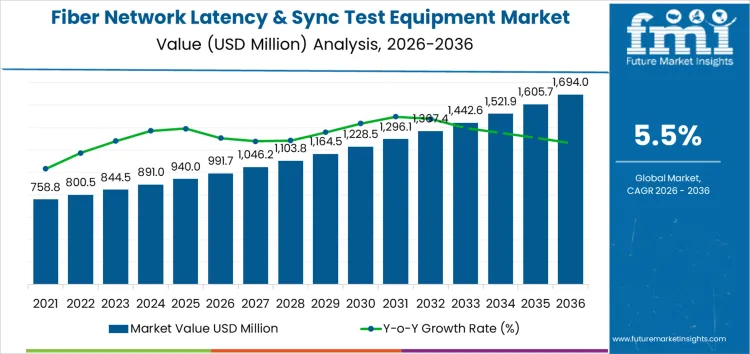
The fiber network latency & sync test equipment market is valued at USD 991.7 million in 2026 and is projected to reach USD 1,694 million by 2036, expanding at a CAGR of 5.5%. Growth is driven by densification of fiber infrastructure, rollout of 5G fronthaul and midhaul, and rising dependence on time-sensitive applications such as cloud services, industrial automation, and financial trading. Accurate measurement of latency, jitter, and synchronization performance has become essential to maintain service quality across high-capacity optical networks.
Quick Stats for Fiber Network Latency & Sync Test Equipment Market
- Fiber Network Latency & Sync Test Equipment Market Value (2026): USD 991.7 million
- Fiber Network Latency & Sync Test Equipment Market Forecast Value (2036): USD 1,694 million
- Fiber Network Latency & Sync Test Equipment Market Forecast CAGR (2026 to 2036): 5.5%
- Leading Network Layer in Global Demand: Metro or Access Networks
- Leading Form Factor in Global Demand: Portable Field Testers
- Fastest-Growing Countries: China, Brazil, South Korea, USA, Germany
- Top Players in Global Demand: VIAVI Solutions, EXFO, Spirent Communications, Keysight Technologies, Anritsu, Calnex Solutions, Rohde & Schwarz, VeEX, Aukua, NetScout.
Metro and access networks represent leading network-layer demand, reflecting focus on last-mile performance, aggregation points, and synchronization between distributed radio units. Deployment at these layers requires frequent field validation to ensure compliance with tight timing budgets defined by mobile and enterprise service standards. Portable field testers account for leading form-factor demand, as operators prioritize mobility, rapid diagnostics, and reduced downtime during installation, maintenance, and fault isolation. Segment structure reflects preference for flexible instruments capable of validating performance directly in live network environments.
China, Brazil, South Korea, USA, and Germany emerge as fastest-growing countries, supported by continued fiber expansion and next-generation mobile deployments. Competitive landscape includes VIAVI Solutions, EXFO, Spirent Communications, Keysight Technologies, and Anritsu, each focusing on high-precision timing, synchronization analytics, and scalable field-testing platforms aligned with evolving network architectures.
Fiber Network Latency & Sync Test Equipment Market Key Takeaways
| Metric | Value |
|---|---|
| Market Value (2026) | USD 991.7 million |
| Market Forecast Value (2036) | USD 1,694 million |
| Forecast CAGR (2026 to 2036) | 5.5% |
Why is the Demand for Fiber Network Latency & Sync Test Equipment Market Growing?
Demand for fiber network latency and synchronization test equipment is growing globally due to expanding deployment of high speed optical networks that support data center interconnects, 5G backhaul, financial services trading systems, and cloud based services. Network operators require precise measurement of latency, jitter, and timing alignment to ensure quality of service, real time application performance, and synchronized data delivery across distributed infrastructure. Expansion of 5G mobile networks increases pressure on transport links to provide ultra-low latency and strict synchronization for time sensitive applications such as autonomous driving, industrial automation, and remote robotics.
Telecommunications carriers and service providers adopt advanced test solutions to validate performance during rollout and maintenance of dense wavelength division multiplexing, coherent optics, and packet based synchronization protocols. Data centers and hyperscale cloud platforms invest in latency and sync testing to optimize inter rack and inter site connectivity. Equipment manufacturers integrate standardized measurement practices to reduce field failures and support interoperable deployments across multi-vendor environments. Research institutions and certification bodies expand use of test equipment to develop benchmarks tied to emerging network standards. Global emphasis on network resilience and performance optimization reinforces the need for structured latency and sync evaluation across fiber infrastructure worldwide.
How Are the Segments Classified in the Fiber Network Latency and Sync Test Equipment Market?
Demand for fiber network latency and synchronization test equipment globally is shaped by tighter timing requirements, traffic growth, and multi-layer network architectures. Buyers evaluate timestamp accuracy, synchronization fidelity, scalability across distances, and field deployability. Adoption patterns reflect validation needs across access, metro, data center, and core networks supporting time-sensitive applications and performance assurance.
Which Network Layer Accounts for the Largest Share of Global Demand?
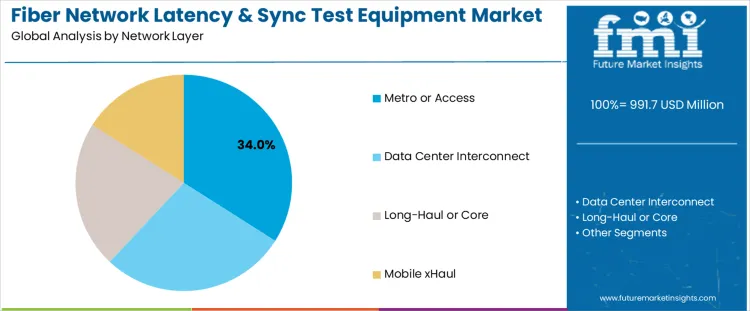
Metro or access networks hold 34.0%, accounting for the largest share of global demand. These layers require precise latency and synchronization validation to support aggregation of traffic and service-level compliance. Data center interconnect holds 28.0%, supporting low-latency links between distributed compute facilities. Long-haul or core networks account for 22.0%, requiring end-to-end timing accuracy over extended distances. Mobile xHaul holds 16.0%, addressing fronthaul, midhaul, and backhaul synchronization for radio networks. Network-layer distribution reflects concentration of timing sensitivity at aggregation points.
Key Points
- Metro and access layers lead due to aggregation timing needs.
- DCI requires low latency between compute facilities.
- Core and xHaul address long-distance and radio sync.
Which Form Factor Represents the Largest Share of Global Demand?
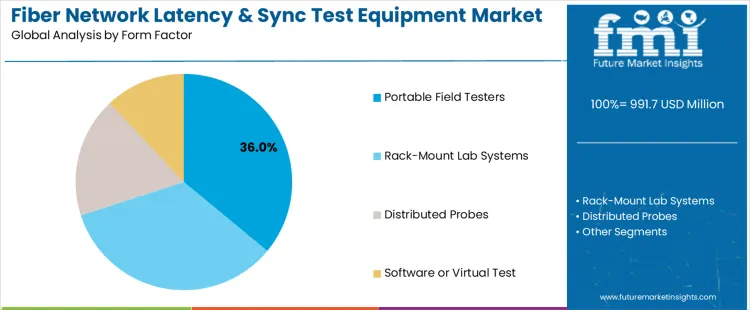
Portable field testers hold 36.0%, representing the largest share of global demand. These testers enable on-site validation, commissioning, and troubleshooting across distributed fiber infrastructure. Rack-mount lab systems hold 34.0%, supporting controlled testing, development, and regression analysis. Distributed probes account for 18.0%, enabling continuous monitoring across live networks. Software or virtual test solutions hold 12.0%, supporting simulation and analytics-based validation. Form-factor distribution reflects balance between field deployment and laboratory validation requirements.
Key Points
- Portable testers lead due to field deployment flexibility.
- Rack systems support controlled lab validation.
- Probes and software enable continuous monitoring.
Which Buyer Segment Drives the Highest Share of Global Demand?
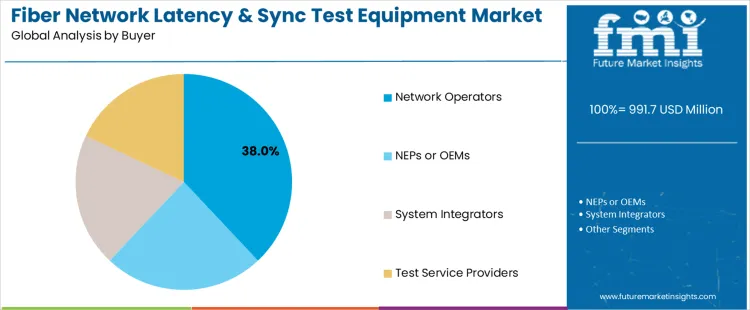
Network operators hold 38.0%, driving the highest share of global demand. Operators require timing validation to maintain service quality and regulatory compliance across network layers. NEPs or OEMs hold 24.0%, validating equipment performance before deployment. System integrators account for 20.0%, supporting multi-vendor network integration. Test service providers hold 18.0%, offering outsourced validation and monitoring. Buyer distribution reflects primary responsibility of operators for network timing performance.
Key Points
- Operators lead due to service-level accountability.
- OEMs validate equipment performance.
- Integrators and service providers support deployment and monitoring.
What are the Key Dynamics in the Fiber Network Latency & Sync Test Equipment Market?
Global demand rises as telecommunications operators, data center networks, and enterprise service providers adopt latency and synchronization test equipment to validate performance of optical fiber networks under high throughput and time-sensitive conditions. Test solutions measure delay, jitter, packet timing, and synchronization accuracy crucial for 5G transport, financial trading, cloud services, and industrial automation. Adoption aligns with rapid expansion of high-capacity networks, strict service-level expectations, and deployment of timing-critical applications across global digital infrastructure.
How do high-capacity network demands and time-sensitive application requirements shape global demand?
Operators increasingly quantify fiber latency and synchronization performance to support services requiring deterministic timing and minimal delay. 5G backhaul and fronthaul networks demand sub-microsecond timing accuracy and tight frequency sync to maintain radio coordination and seamless mobility. Financial trading platforms depend on precise timestamping to minimize transaction latency across global exchanges. Cloud providers and enterprise networks require low jitter and latency metrics to support real-time collaboration, video distribution, and edge computing. Test equipment captures one-way delay, round-trip time, and synchronization discrepancies under varying load and configuration scenarios. Standardized measurement practices support consistent evaluation across vendors and network segments.
How do capital intensity, evolving standards, and technical complexity influence market scalability?
Latency and synchronization test systems involve investment in high-precision timing references, optical measurement modules, and real-time analysis tools capable of sub-nanosecond resolution. Evolving timing standards such as PTP, SyncE, and OTN synchronization frameworks require test solutions to adapt to multiple protocol layers. Integration complexity increases when evaluating heterogeneous transport layers and clock domains within large-scale networks. Skilled test engineers are essential to interpret timing anomalies and plan optimization strategies. Regional differences in testing infrastructure and access to calibrated timing references affect test execution consistency. Global growth depends on modular, scalable test platforms and harmonized benchmarking criteria that address diverse network speeds, sync protocols, and quality of service requirements across global fiber deployments.
How Is Demand for Fiber Network Latency and Synchronization Test Equipment Evolving?
Demand for fiber network latency and synchronization test equipment is increasing globally due to 5G transport expansion, time-sensitive networking, and cloud interconnection growth. China leads with a 6.8% CAGR, supported by nationwide fiber densification and mobile fronthaul deployment. Brazil follows at 6.5%, driven by backbone upgrades and regional connectivity programs. South Korea records a 5.4% CAGR, shaped by ultra-low latency service requirements and dense urban networks. USA posts 5.3%, reflecting lifecycle testing for upgraded metro and data center links. Germany records 5.2%, supported by industrial networking and compliance-driven validation. Growth reflects stricter timing accuracy, synchronization assurance, and service-level verification worldwide.
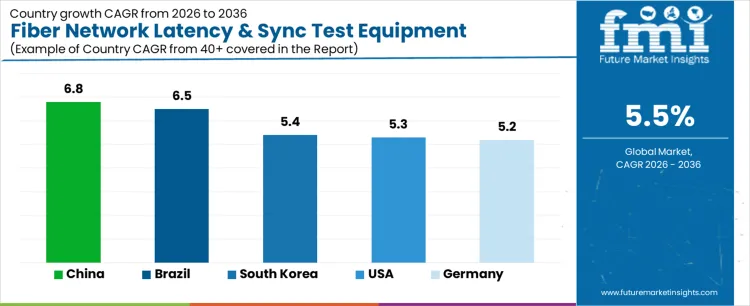
| Country | CAGR (%) |
|---|---|
| China | 6.8% |
| Brazil | 6.5% |
| South Korea | 5.4% |
| USA | 5.3% |
| Germany | 5.2% |
What factors are accelerating fiber latency and sync testing adoption in China?
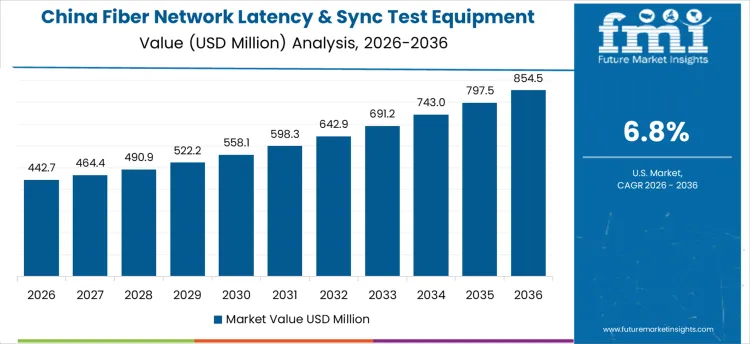
China drives demand through large-scale fiber rollout for 5G transport, data centers, and industrial connectivity. Country’s CAGR of 6.8% reflects extensive testing of latency, packet delay variation, and time synchronization accuracy. Operators validate fronthaul and midhaul links supporting massive MIMO and coordinated radio functions. In-house testing reduces deployment risk and accelerates network expansion. Test platforms emphasize high timestamp accuracy, automation, and scalability. Government-backed digital infrastructure programs sustain testing volumes. Growth remains rollout-aligned and scale-driven, supported by strict timing requirements across nationwide fiber networks.
- Nationwide 5G fronthaul and midhaul deployment
- Validation of latency and time synchronization accuracy
- In-house automated testing capability
- Government-supported digital infrastructure programs
Why is Brazil showing steady growth in fiber latency and sync testing demand?
Brazil demand is shaped by backbone modernization, regional fiber expansion, and service quality assurance needs. Country’s CAGR of 6.5% reflects increased testing of metro and long-haul fiber links for latency and clock synchronization. Operators validate network performance to support mobile backhaul and enterprise services. Shared laboratories and service providers enable cost-efficient access to advanced test equipment. Collaboration with global vendors supports adoption of standardized testing methodologies. Demand favors portable and modular systems. Growth remains capability-building focused, aligned with gradual improvement of national fiber infrastructure.
- Backbone and metro fiber network upgrades
- Mobile backhaul and enterprise service validation
- Shared access to advanced test platforms
- Modular and portable test equipment preference
How do ultra-low latency requirements influence testing demand in South Korea?
South Korea demand reflects dense urban fiber networks, advanced mobile services, and real-time application requirements. Country’s CAGR of 5.4% is supported by testing for precise time alignment and minimal latency variation. Operators validate synchronization for 5G, cloud gaming, and financial trading applications. Test systems emphasize nanosecond-level accuracy and repeatability. Government-backed initiatives promote standardized timing verification. Facilities prioritize compact systems suitable for space-constrained environments. Growth remains technology-driven, aligned with performance-critical network services and high user expectations.
- Dense urban fiber and mobile transport networks
- Nanosecond-level synchronization validation
- Support for real-time and latency-sensitive services
- Standardized timing verification initiatives
What dynamics sustain stable growth of fiber sync testing in the USA?
USA demand is driven by a large installed fiber base undergoing upgrades for higher capacity and precision timing. Country’s CAGR of 5.3% reflects lifecycle testing for metro networks, data center interconnects, and 5G transport. Operators validate synchronization during equipment replacement and network reconfiguration. Test platforms integrate performance monitoring and correlation with field telemetry. Procurement emphasizes accuracy, portability, and standards compliance. Growth remains lifecycle-driven, aligned with phased network upgrades and reliability assurance.
- Installed base upgrades and lifecycle testing
- Data center and 5G transport validation
- Telemetry-correlated performance testing
- Standards-aligned test solutions
How is Germany positioned within the global fiber sync test equipment landscape?
Germany demand reflects industrial networking, critical infrastructure connectivity, and strong compliance culture. Country’s CAGR of 5.2% is supported by testing fiber networks for deterministic latency and synchronization in factories and utilities. Operators validate performance under combined stress conditions. Shared research institutes expand access to precision timing equipment. Procurement favors documentation, traceability, and adherence to international standards. Growth remains engineering-led, aligned with reliability and compliance requirements across industrial and public networks.
- Industrial and critical infrastructure networking
- Deterministic latency and sync validation
- Strong documentation and compliance focus
- Shared research and testing facilities
What is the competitive landscape of demand for fiber network latency and synchronization test equipment?
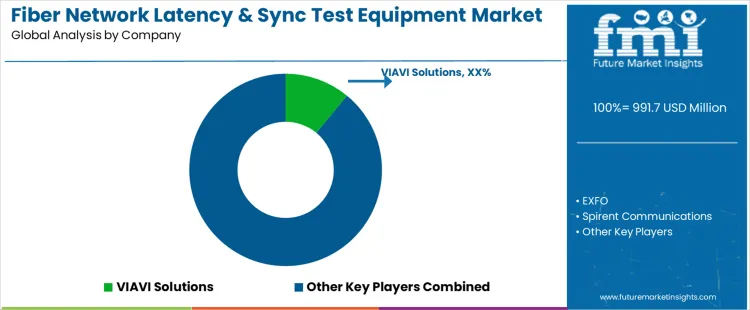
Demand for fiber network latency and synchronization test equipment is driven by 5G and 5G Advanced rollout, time-sensitive networking, and cloud-scale data center interconnects. Testing focuses on end-to-end latency, packet delay variation, time error, phase alignment, and synchronization accuracy across optical transport and Ethernet networks. Buyers require nanosecond-level precision, support for PTP, SyncE, and GNSS-referenced timing, and repeatable measurement under live traffic conditions. Procurement teams evaluate protocol coverage, automation for field and lab testing, correlation between network layers, and reliability during long-duration monitoring. Trend in the global market reflects stricter synchronization budgets for fronthaul and edge networks, increased virtualization, and higher dependence on deterministic network performance.
VIAVI Solutions and EXFO maintain strong positioning through comprehensive fiber test portfolios covering latency, timing, and synchronization validation across access, metro, and core networks. Spirent Communications and Keysight Technologies support advanced lab and system-level testing with high-precision traffic generation and time-aware measurement platforms. Anritsu and Rohde & Schwarz contribute optical and packet-based test solutions used for synchronization assurance and transport verification. Calnex Solutions specializes in PTP, SyncE, and timing resilience testing adopted by operators and equipment vendors. VeEX and Aukua support field-oriented and Ethernet-focused latency validation, while NetScout provides network performance monitoring platforms integrating latency and timing analytics. Competitive differentiation depends on timing accuracy, standards alignment, automation capability, and ability to validate synchronization across heterogeneous network architectures.
Key Players in the Fiber Network Latency & Sync Test Equipment Market
- VIAVI Solutions
- EXFO
- Spirent Communications
- Keysight Technologies
- Anritsu
- Calnex Solutions
- Rohde & Schwarz
- VeEX
- Aukua
- NetScout
Scope of the Report
| Items | Values |
|---|---|
| Quantitative Units | USD million |
| Network Layer | Metro or Access Networks; Data Center Interconnect Links; Long-Haul or Core Fiber Networks; Mobile xHaul including fronthaul, midhaul, and backhaul |
| Form Factor | Portable Field Testers; Rack-Mount Laboratory Systems; Distributed Network Probes; Software-Based or Virtualized Test Platforms |
| Buyer | Network Operators; Network Equipment Providers (NEPs) or OEMs; System Integrators; Independent Test and Measurement Service Providers |
| Regions Covered | Asia Pacific; Europe; North America; Latin America; Middle East & Africa |
| Countries Covered | China; USA; Germany; Brazil; South Korea; and 40+ countries |
| Key Companies Profiled | VIAVI Solutions; EXFO; Spirent Communications; Keysight Technologies; Anritsu; Calnex Solutions; Rohde & Schwarz; VeEX; Aukua; NetScout |
| Additional Attributes | Demand tracks precision timing validation for 5G, cloud, and data center networks; adoption driven by sub-microsecond latency requirements; synchronization testing for PTP and SyncE; increasing use of software-based probes; validation of SLA compliance across metro, core, and xHaul fiber infrastructures. |
Fiber Network Latency & Sync Test Equipment Market by Segment
Network Layer:
- Metro or Access
- Data Center Interconnect
- Long-Haul or Core
- Mobile xHaul
Form Factor:
- Portable Field Testers
- Rack-Mount Lab Systems
- Distributed Probes
- Software or Virtual Test
Buyer:
- Sub-Segment
- Network Operators
- NEPs or OEMs
- System Integrators
- Test Service Providers
Region:
- Asia Pacific
- China
- Japan
- South Korea
- India
- Australia & New Zealand
- ASEAN
- Rest of Asia Pacific
- Europe
- Germany
- United Kingdom
- France
- Italy
- Spain
- Nordic
- BENELUX
- Rest of Europe
- North America
- United States
- Canada
- Mexico
- Latin America
- Brazil
- Chile
- Rest of Latin America
- Middle East & Africa
- Kingdom of Saudi Arabia
- Other GCC Countries
- Turkey
- South Africa
- Other African Union
- Rest of Middle East & Africa
Frequently Asked Questions
How big is the fiber network latency & sync test equipment market in 2026?
The global fiber network latency & sync test equipment market is estimated to be valued at USD 991.7 million in 2026.
What will be the size of fiber network latency & sync test equipment market in 2036?
The market size for the fiber network latency & sync test equipment market is projected to reach USD 1,694.0 million by 2036.
How much will be the fiber network latency & sync test equipment market growth between 2026 and 2036?
The fiber network latency & sync test equipment market is expected to grow at a 5.5% CAGR between 2026 and 2036.
What are the key product types in the fiber network latency & sync test equipment market?
The key product types in fiber network latency & sync test equipment market are metro or access, data center interconnect, long-haul or core and mobile xhaul.
Which form factor segment to contribute significant share in the fiber network latency & sync test equipment market in 2026?
In terms of form factor, portable field testers segment to command 36.0% share in the fiber network latency & sync test equipment market in 2026.
Preview the report firsthand - request a free sample
Get SampleGet the brochure for pricing and purchase details.
Get PDFTable of Content
- Executive Summary
- Global Market Outlook
- Demand-side Trends
- Supply-side Trends
- Technology Roadmap Analysis
- Analysis and Recommendations
- Market Overview
- Market Coverage / Taxonomy
- Market Definition / Scope / Limitations
- Market Background
- Market Dynamics
- Drivers
- Restraints
- Opportunity
- Trends
- Scenario Forecast
- Demand in Optimistic Scenario
- Demand in Likely Scenario
- Demand in Conservative Scenario
- Opportunity Map Analysis
- Product Life Cycle Analysis
- Supply Chain Analysis
- Investment Feasibility Matrix
- Value Chain Analysis
- PESTLE and Porter’s Analysis
- Regulatory Landscape
- Regional Parent Market Outlook
- Production and Consumption Statistics
- Import and Export Statistics
- Market Dynamics
- Global Market Analysis 2021 to 2025 and Forecast, 2026 to 2036
- Historical Market Size Value (USD Million) Analysis, 2021 to 2025
- Current and Future Market Size Value (USD Million) Projections, 2026 to 2036
- Y-o-Y Growth Trend Analysis
- Absolute $ Opportunity Analysis
- Global Market Pricing Analysis 2021 to 2025 and Forecast 2026 to 2036
- Global Market Analysis 2021 to 2025 and Forecast 2026 to 2036, By Network Layer
- Introduction / Key Findings
- Historical Market Size Value (USD Million) Analysis By Network Layer , 2021 to 2025
- Current and Future Market Size Value (USD Million) Analysis and Forecast By Network Layer , 2026 to 2036
- Metro or Access
- Data Center Interconnect
- Long-Haul or Core
- Mobile xHaul
- Metro or Access
- Y-o-Y Growth Trend Analysis By Network Layer , 2021 to 2025
- Absolute $ Opportunity Analysis By Network Layer , 2026 to 2036
- Global Market Analysis 2021 to 2025 and Forecast 2026 to 2036, By Form Factor
- Introduction / Key Findings
- Historical Market Size Value (USD Million) Analysis By Form Factor, 2021 to 2025
- Current and Future Market Size Value (USD Million) Analysis and Forecast By Form Factor, 2026 to 2036
- Portable Field Testers
- Rack-Mount Lab Systems
- Distributed Probes
- Software or Virtual Test
- Portable Field Testers
- Y-o-Y Growth Trend Analysis By Form Factor, 2021 to 2025
- Absolute $ Opportunity Analysis By Form Factor, 2026 to 2036
- Global Market Analysis 2021 to 2025 and Forecast 2026 to 2036, By Buyer
- Introduction / Key Findings
- Historical Market Size Value (USD Million) Analysis By Buyer, 2021 to 2025
- Current and Future Market Size Value (USD Million) Analysis and Forecast By Buyer, 2026 to 2036
- Network Operators
- NEPs or OEMs
- System Integrators
- Test Service Providers
- Network Operators
- Y-o-Y Growth Trend Analysis By Buyer, 2021 to 2025
- Absolute $ Opportunity Analysis By Buyer, 2026 to 2036
- Global Market Analysis 2021 to 2025 and Forecast 2026 to 2036, By Region
- Introduction
- Historical Market Size Value (USD Million) Analysis By Region, 2021 to 2025
- Current Market Size Value (USD Million) Analysis and Forecast By Region, 2026 to 2036
- North America
- Latin America
- Western Europe
- Eastern Europe
- East Asia
- South Asia and Pacific
- Middle East & Africa
- Market Attractiveness Analysis By Region
- North America Market Analysis 2021 to 2025 and Forecast 2026 to 2036, By Country
- Historical Market Size Value (USD Million) Trend Analysis By Market Taxonomy, 2021 to 2025
- Market Size Value (USD Million) Forecast By Market Taxonomy, 2026 to 2036
- By Country
- USA
- Canada
- Mexico
- By Network Layer
- By Form Factor
- By Buyer
- By Country
- Market Attractiveness Analysis
- By Country
- By Network Layer
- By Form Factor
- By Buyer
- Key Takeaways
- Latin America Market Analysis 2021 to 2025 and Forecast 2026 to 2036, By Country
- Historical Market Size Value (USD Million) Trend Analysis By Market Taxonomy, 2021 to 2025
- Market Size Value (USD Million) Forecast By Market Taxonomy, 2026 to 2036
- By Country
- Brazil
- Chile
- Rest of Latin America
- By Network Layer
- By Form Factor
- By Buyer
- By Country
- Market Attractiveness Analysis
- By Country
- By Network Layer
- By Form Factor
- By Buyer
- Key Takeaways
- Western Europe Market Analysis 2021 to 2025 and Forecast 2026 to 2036, By Country
- Historical Market Size Value (USD Million) Trend Analysis By Market Taxonomy, 2021 to 2025
- Market Size Value (USD Million) Forecast By Market Taxonomy, 2026 to 2036
- By Country
- Germany
- UK
- Italy
- Spain
- France
- Nordic
- BENELUX
- Rest of Western Europe
- By Network Layer
- By Form Factor
- By Buyer
- By Country
- Market Attractiveness Analysis
- By Country
- By Network Layer
- By Form Factor
- By Buyer
- Key Takeaways
- Eastern Europe Market Analysis 2021 to 2025 and Forecast 2026 to 2036, By Country
- Historical Market Size Value (USD Million) Trend Analysis By Market Taxonomy, 2021 to 2025
- Market Size Value (USD Million) Forecast By Market Taxonomy, 2026 to 2036
- By Country
- Russia
- Poland
- Hungary
- Balkan & Baltic
- Rest of Eastern Europe
- By Network Layer
- By Form Factor
- By Buyer
- By Country
- Market Attractiveness Analysis
- By Country
- By Network Layer
- By Form Factor
- By Buyer
- Key Takeaways
- East Asia Market Analysis 2021 to 2025 and Forecast 2026 to 2036, By Country
- Historical Market Size Value (USD Million) Trend Analysis By Market Taxonomy, 2021 to 2025
- Market Size Value (USD Million) Forecast By Market Taxonomy, 2026 to 2036
- By Country
- China
- Japan
- South Korea
- By Network Layer
- By Form Factor
- By Buyer
- By Country
- Market Attractiveness Analysis
- By Country
- By Network Layer
- By Form Factor
- By Buyer
- Key Takeaways
- South Asia and Pacific Market Analysis 2021 to 2025 and Forecast 2026 to 2036, By Country
- Historical Market Size Value (USD Million) Trend Analysis By Market Taxonomy, 2021 to 2025
- Market Size Value (USD Million) Forecast By Market Taxonomy, 2026 to 2036
- By Country
- India
- ASEAN
- Australia & New Zealand
- Rest of South Asia and Pacific
- By Network Layer
- By Form Factor
- By Buyer
- By Country
- Market Attractiveness Analysis
- By Country
- By Network Layer
- By Form Factor
- By Buyer
- Key Takeaways
- Middle East & Africa Market Analysis 2021 to 2025 and Forecast 2026 to 2036, By Country
- Historical Market Size Value (USD Million) Trend Analysis By Market Taxonomy, 2021 to 2025
- Market Size Value (USD Million) Forecast By Market Taxonomy, 2026 to 2036
- By Country
- Kingdom of Saudi Arabia
- Other GCC Countries
- Turkiye
- South Africa
- Other African Union
- Rest of Middle East & Africa
- By Network Layer
- By Form Factor
- By Buyer
- By Country
- Market Attractiveness Analysis
- By Country
- By Network Layer
- By Form Factor
- By Buyer
- Key Takeaways
- Key Countries Market Analysis
- USA
- Pricing Analysis
- Market Share Analysis, 2025
- By Network Layer
- By Form Factor
- By Buyer
- Canada
- Pricing Analysis
- Market Share Analysis, 2025
- By Network Layer
- By Form Factor
- By Buyer
- Mexico
- Pricing Analysis
- Market Share Analysis, 2025
- By Network Layer
- By Form Factor
- By Buyer
- Brazil
- Pricing Analysis
- Market Share Analysis, 2025
- By Network Layer
- By Form Factor
- By Buyer
- Chile
- Pricing Analysis
- Market Share Analysis, 2025
- By Network Layer
- By Form Factor
- By Buyer
- Germany
- Pricing Analysis
- Market Share Analysis, 2025
- By Network Layer
- By Form Factor
- By Buyer
- UK
- Pricing Analysis
- Market Share Analysis, 2025
- By Network Layer
- By Form Factor
- By Buyer
- Italy
- Pricing Analysis
- Market Share Analysis, 2025
- By Network Layer
- By Form Factor
- By Buyer
- Spain
- Pricing Analysis
- Market Share Analysis, 2025
- By Network Layer
- By Form Factor
- By Buyer
- France
- Pricing Analysis
- Market Share Analysis, 2025
- By Network Layer
- By Form Factor
- By Buyer
- India
- Pricing Analysis
- Market Share Analysis, 2025
- By Network Layer
- By Form Factor
- By Buyer
- ASEAN
- Pricing Analysis
- Market Share Analysis, 2025
- By Network Layer
- By Form Factor
- By Buyer
- Australia & New Zealand
- Pricing Analysis
- Market Share Analysis, 2025
- By Network Layer
- By Form Factor
- By Buyer
- China
- Pricing Analysis
- Market Share Analysis, 2025
- By Network Layer
- By Form Factor
- By Buyer
- Japan
- Pricing Analysis
- Market Share Analysis, 2025
- By Network Layer
- By Form Factor
- By Buyer
- South Korea
- Pricing Analysis
- Market Share Analysis, 2025
- By Network Layer
- By Form Factor
- By Buyer
- Russia
- Pricing Analysis
- Market Share Analysis, 2025
- By Network Layer
- By Form Factor
- By Buyer
- Poland
- Pricing Analysis
- Market Share Analysis, 2025
- By Network Layer
- By Form Factor
- By Buyer
- Hungary
- Pricing Analysis
- Market Share Analysis, 2025
- By Network Layer
- By Form Factor
- By Buyer
- Kingdom of Saudi Arabia
- Pricing Analysis
- Market Share Analysis, 2025
- By Network Layer
- By Form Factor
- By Buyer
- Turkiye
- Pricing Analysis
- Market Share Analysis, 2025
- By Network Layer
- By Form Factor
- By Buyer
- South Africa
- Pricing Analysis
- Market Share Analysis, 2025
- By Network Layer
- By Form Factor
- By Buyer
- USA
- Market Structure Analysis
- Competition Dashboard
- Competition Benchmarking
- Market Share Analysis of Top Players
- By Regional
- By Network Layer
- By Form Factor
- By Buyer
- Competition Analysis
- Competition Deep Dive
- VIAVI Solutions
- Overview
- Product Portfolio
- Profitability by Market Segments (Product/Age /Sales Channel/Region)
- Sales Footprint
- Strategy Overview
- Marketing Strategy
- Product Strategy
- Channel Strategy
- EXFO
- Spirent Communications
- Keysight Technologies
- Anritsu
- Calnex Solutions
- Rohde & Schwarz
- VeEX
- Aukua
- NetScout
- VIAVI Solutions
- Competition Deep Dive
- Assumptions & Acronyms Used
- Research Methodology


