

- Industry Size (2026)
- USD 391.0 Mn
- Forecast (2036)
- USD 892.2 Mn
- CAGR (2026 to 2036)
- 8.6%
UPS Battery and Supercapacitor Health Diagnostics Test Equipment Market size, market forecast and outlook by FMI
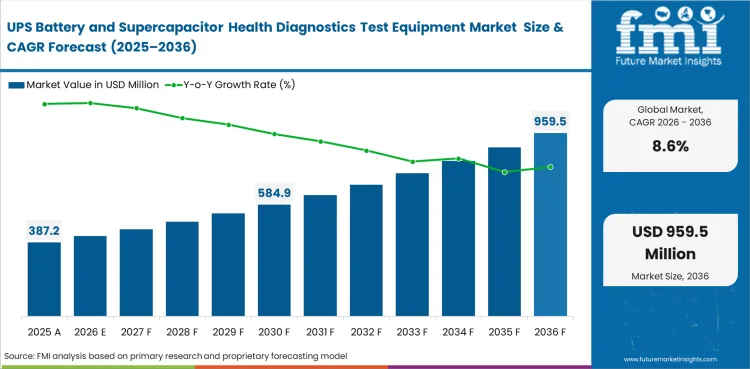
The UPS Battery and Supercapacitor Health Diagnostics Test Equipment Market was valued at USD 360.0 million in 2025, is projected to reach USD 391.0 million in 2026, and is forecast to rise to USD 892.2 million by 2036 at a 8.6% CAGR. Based on Future Market Insights analysis, the market is expected to create an incremental opportunity of USD 501.2 million during 2026 to 2036. As per FMI, demand is driven by rising protected-load infrastructure, stronger live verification needs, and broader use of battery and supercapacitor diagnostics across critical power sites.
Summary of the UPS Battery and Supercapacitor Health Diagnostics Test Equipment Market
- Demand and Growth Drivers
- Data center load expansion is increasing the installed base of protected battery strings and this raises routine demand for health verification equipment.
- Service teams are placing more weight on live testing tools because shutdown windows are tighter in uptime-sensitive facilities.
- Supercapacitor-backed ride-through designs are widening the need for ESR measurement and broader diagnostic coverage.
- Product and Segment View
- Battery Impedance Testers are likely to remain the leading Equipment Type with 34.0% share due to faster field screening.
- Lead-acid is projected to lead Storage Chemistry with 42.0% share because established UPS fleets still rely on large legacy battery banks.
- Data Centers are expected to lead End Use with 31.0% share as runtime assurance and reporting discipline remain stronger in digital infrastructure sites.
- Online Testing is set to lead Test Mode with 46.0% share since it reduces shutdown exposure during routine verification.
- Geography and Competitive Outlook
- India and China are expected to post the fastest expansion as new digital and storage infrastructure is being added at a faster pace.
- The United States remains a large demand center due to its large installed base and rising AI-linked rack density.
- Chroma ATE leads the supplier field remains spread across several active specialists.
- Hioki E.E. Corporation, Arbin Instruments, NH Research, DIGATRON, Eagle Eye Power Solutions, and Midtronics remain visible competitors in this field.
- Analyst Opinion
- Nikhil Kaitwade, Principal Consultant at FMI says, “Demand for UPS battery and supercapacitor health diagnostics test equipment is moving toward live verification, stronger reporting depth, and wider chemistry coverage across critical power sites.”
- UPS Battery and Supercapacitor Health Diagnostics Test Equipment Market Value Analysis
- The market is moving from periodic maintenance support toward a more defined uptime-assurance equipment segment.
- Demand is being supported by larger protected loads inside data centers and other critical facilities.
- Product preference is shifting toward tools that improve traceability, service speed, and safer live diagnostics.
- Revenue is likely to benefit from broader chemistry coverage as battery and capacitor configurations diversify.
Key Takeaways
- The UPS battery and supercapacitor health diagnostics test equipment market reached USD 360.0 million in 2025 and reflects a specialized installed-base driven maintenance category.
- By 2036, the industry is projected to reach USD 892.2 million as backup power monitoring requirements rise across critical infrastructure sites.
- Demand is forecast to rise at an 8.6% CAGR between 2026 and 2036 as live verification and reporting needs increase.
- Incremental opportunity is estimated at USD 501.2 million through the forecast period as testing routines expand beyond occasional maintenance checks.
- Direct Sales is expected to lead with 58.0% share in 2026 because technical support and setup guidance remain important in this equipment class.
- India at 10.2% and China at 9.4% are the fastest growing countries due to faster digital capacity expansion.
UPS Battery and Supercapacitor Health Diagnostics Test Equipment Market Definition
The UPS battery and supercapacitor health diagnostics test equipment market includes instruments and software used to assess the condition, reliability, and serviceability of batteries and supercapacitors installed in uninterruptible power supply systems and related short-duration backup architectures. The scope covers impedance and resistance testers, discharge and capacity test systems, ESR and capacitance analyzers, online monitoring units, battery cyclers, and software platforms used for stationary backup asset diagnostics.
UPS Battery and Supercapacitor Health Diagnostics Test Equipment Market Inclusions
Market scope includes portable and bench-top test instruments used on lead-acid, lithium-ion, nickel-based, lithium-ion capacitor, and EDLC supercapacitor systems that support UPS and ride-through functions. Scope includes online monitoring hardware, channelized analyzers, logging modules, software for health trend review, accessories tied directly to diagnostics, and calibration or firmware functions sold with these platforms.
UPS Battery and Supercapacitor Health Diagnostics Test Equipment Market Exclusions
The scope does not include complete UPS systems, rectifiers, inverters, generic multimeters without battery-health focus, automotive cell development platforms, battery manufacturing equipment, or broad grid commissioning systems not sold for backup power health assessment. Third-party inspection-only services and general building software remain outside scope unless they include direct battery or capacitor diagnostic functions.
UPS Battery and Supercapacitor Health Diagnostics Test Equipment Market Research Methodology
- Primary research reviewed active product offerings, public specifications, and maintenance practice across stationary backup applications.
- Desk research used non-commercial evidence on data center electricity demand, storage deployment, and infrastructure policy trends.
- Market sizing and forecasting combined installed-base expansion, tester penetration, replacement cycles, software attachment, and pricing tiers.
- Data validation checked country growth, segment shares, and supplier presence against current site activity and visible product direction.
Why is the UPS Battery and Supercapacitor Health Diagnostics Test Equipment Market Growing?
- Expansion in digital infrastructure is increasing the number of protected battery strings that require repeat health checks.
- Live testing tools are gaining more demand because uptime-sensitive facilities want faster verification without longer outages.
- India leads growth at 10.2% because data center expansion and AI compute additions are widening protected-load infrastructure.
The UPS battery and supercapacitor health diagnostics test equipment market is growing steadily because operators are treating battery verification as part of uptime assurance instead of a routine maintenance formality. Demand is rising for impedance testers, battery cyclers, ESR testers, analyzers, and monitoring software because these tools help service teams detect weak strings earlier, improve reporting quality, and reduce the risk of backup failure across critical facilities. Wider use of mixed battery and capacitor-backed backup designs is also increasing the need for broader diagnostic coverage.
Data centers are the largest end-use segment because runtime failure carries direct commercial and operational cost in digital infrastructure environments. Lead-acid remains the biggest storage chemistry segment since many installed UPS fleets still rely on large legacy battery banks, which keeps recurring diagnostic demand firm. Online testing is also gaining stronger traction because operators want useful health readings without taking protected systems offline, especially in facilities where shutdown planning is difficult and service windows are tight.
A broader shift toward software-linked maintenance is adding further support to market expansion. Buyers are placing more value on tools that combine field measurement, health-history tracking, calibration support, and wider chemistry coverage in one workflow. As battery rooms grow larger and backup architectures become more complex, suppliers that can improve traceability, shorten maintenance time, and support both legacy lead-acid systems and newer supercapacitor-backed designs are likely to see stronger demand over the forecast period.
Market Segmentation Analysis
- Battery Impedance Testers are projected to hold 34.0% share in Equipment Type because fast field screening remains central in routine service work.
- Lead-acid is expected to account for 42.0% of the Storage Chemistry segment due to the size of the installed legacy UPS base.
- Data Centers are likely to contribute 31.0% share in End Use as uptime exposure keeps diagnostic budgets firmer than many other applications.
- Online Testing is set to represent 46.0% share in Test Mode because it reduces shutdown exposure during regular checks.
- Direct Sales is forecast to reach 58.0% share in Sales Channel since technical guidance remains important during deployment and calibration.
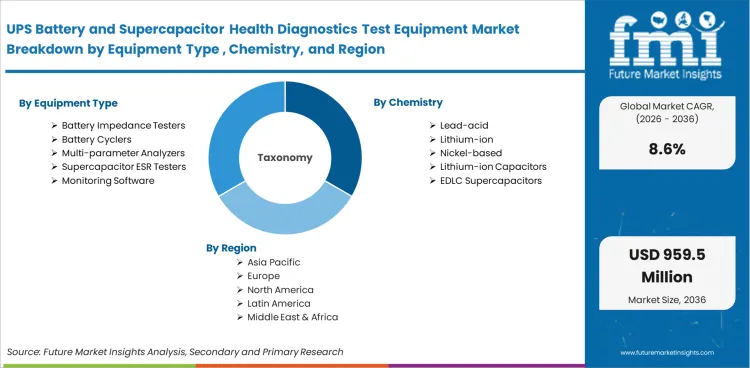
The market is segmented by equipment type, storage chemistry, end use, test mode, and sales channel. Equipment Type includes Battery Impedance Testers, Battery Cyclers, Multi-parameter Analyzers, Supercapacitor ESR Testers, and Monitoring Software. Storage Chemistry includes Lead-acid, Lithium-ion, Nickel-based, Lithium-ion Capacitors, and EDLC Supercapacitors. End Use includes Data Centers, Telecom Networks, Industrial Facilities, Healthcare Sites, and Transport Infrastructure. Test Mode includes Online Testing, Offline Testing, Periodic Maintenance, and Continuous Monitoring. Sales Channel includes Direct Sales, Distributors, System Integrators, OEM Partnerships, and Service Contracts.
Insights into the Battery Impedance Testers Equipment Type Segment
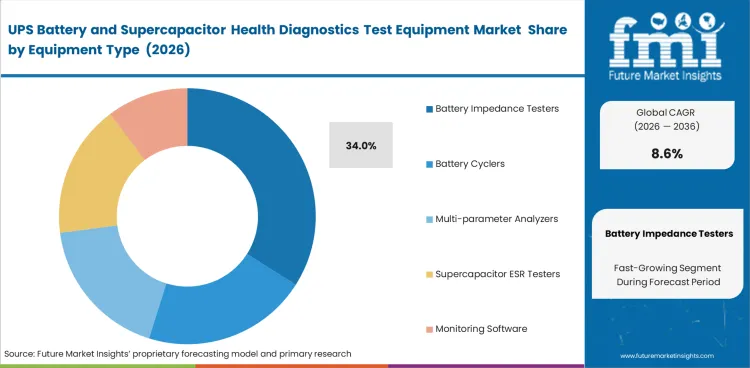
- In 2026, battery impedance testers are expected to account for 34.0% of the equipment type segment. Their lead comes from faster routine field checks, repeatable readings, and lower disruption during maintenance across protected power systems.
- These tools are widely used as a first screening layer before deeper follow-up testing. Demand stays firm in facilities that prioritize service speed, documented battery condition review, and shorter shutdown planning.
Insights into the Lead-acid Storage Chemistry Segment
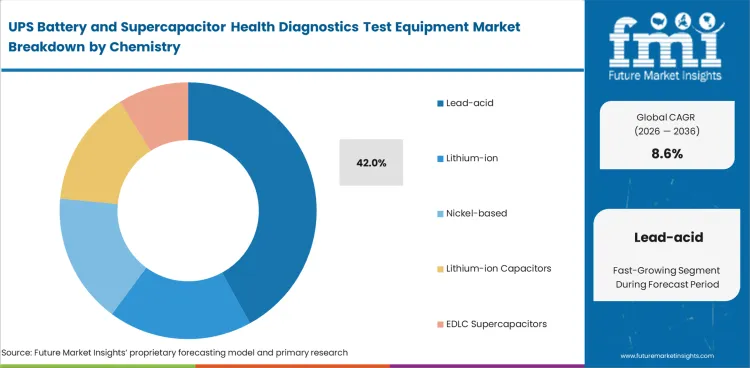
- Lead-acid is projected to hold 42.0% of the storage chemistry segment in 2026. Large installed UPS fleets still depend on established lead-acid battery banks, which keeps recurring diagnostic demand steady across critical sites.
- Service routines for this chemistry are well understood, and replacement of legacy fleets remains gradual in many facilities. This supports continued demand for instruments aligned with traditional maintenance workflows.
Insights into the Data Centers End Use Segment
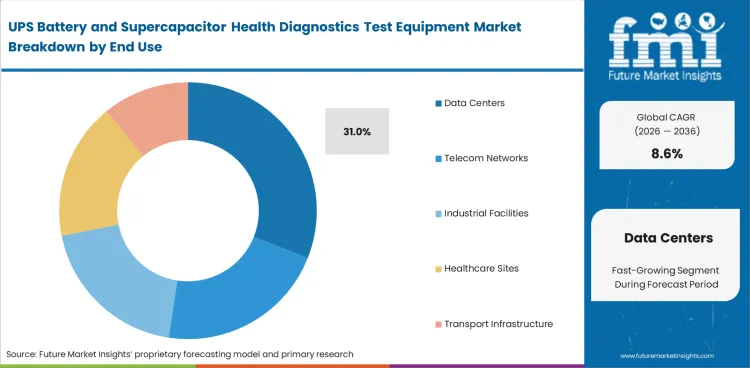
- In 2026, data centers are expected to contribute 31.0% of end-use demand. Runtime failure carries direct commercial cost in digital infrastructure, which keeps battery verification budgets firmer than in many other applications.
- Demand remains strongest for online monitors, handheld testers, and reporting software in facilities with larger protected loads, tighter maintenance discipline, and stronger uptime exposure.
Insights into the Online Testing Test Mode Segment
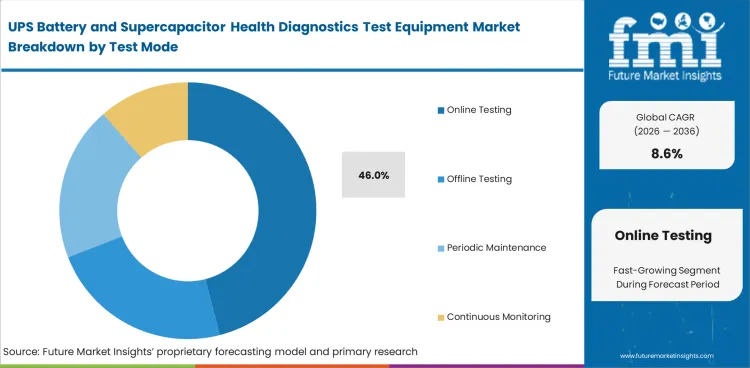
- Online testing is forecast to secure 46.0% of the test mode segment in 2026. Operators prefer this mode because it provides useful readings without taking protected systems offline during routine verification.
- Live diagnostics reduce shutdown exposure and support faster maintenance workflows. Preference is rising further as battery rooms become larger and access windows grow tighter in uptime-sensitive facilities.
Insights into the Direct Sales Channel Segment
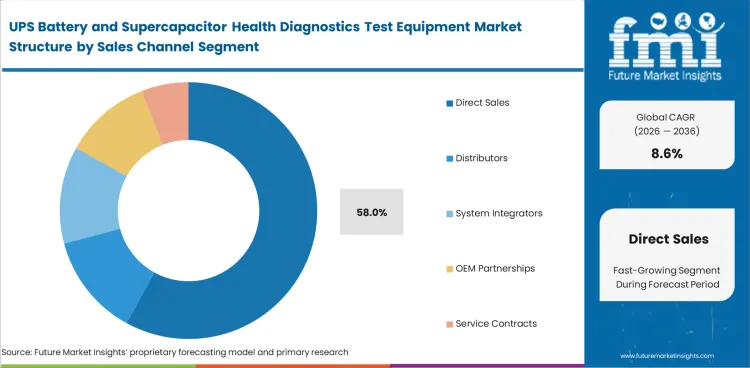
- Direct sales are projected to represent 58.0% of the sales channel segment in 2026. Buyers often need setup guidance, calibration support, and product selection help, which makes direct supplier engagement commercially important.
- This pattern remains stronger in higher-value accounts where field usability, software setup, and chemistry coverage need technical discussion before purchase.
UPS Battery and Supercapacitor Health Diagnostics Test Equipment Market Drivers, Restraints, and Opportunities
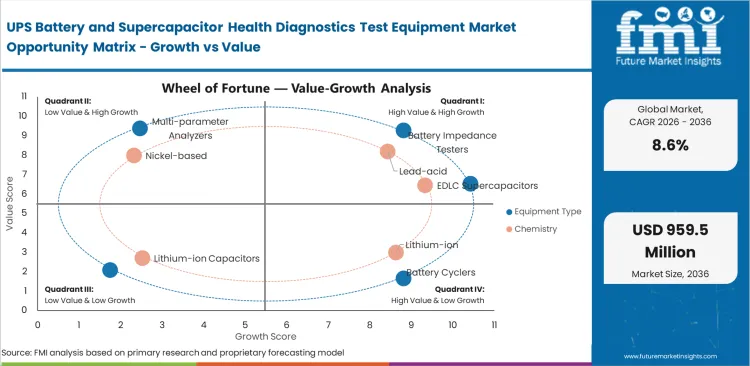
- Rising digital infrastructure and larger protected battery rooms are creating a structured need for regular battery and supercapacitor health verification across uptime-sensitive sites.
- Long replacement cycles for test instruments make adoption slower in facilities that still rely on older tools with acceptable calibration for routine checks. This keeps upgrade demand more measured in cost-conscious maintenance environments.
- Software-linked diagnostics, online testing, and broader chemistry support are opening stronger upgrade opportunities as operators want better traceability, faster fault visibility, and wider coverage across mixed backup-power systems.
The UPS battery and supercapacitor health diagnostics test equipment market is growing because operators are moving away from occasional maintenance routines and treating diagnostics as part of uptime assurance. Demand is being supported by rising digital load, tighter reporting requirements, and the growing need to verify battery and capacitor condition before backup failure risk becomes more serious. Even though upgrade cycles can stay slow in some installed bases, the market continues to find expansion opportunities in data centers, telecom networks, industrial facilities, and other critical infrastructure environments.
Digital Infrastructure and Uptime-linked Maintenance
Demand reflects the expansion of protected digital infrastructure. Larger data centers, telecom sites, and other uptime-sensitive facilities are increasing the number of UPS battery strings and capacitor-backed systems that need repeat health checks. Operators are giving more value to impedance testers, ESR analyzers, and online monitoring tools because these products help identify weak assets earlier, improve service planning, and reduce the risk of runtime disruption.
Long Replacement Cycles and Budget Discipline
Adoption is constrained by the conservative replacement pattern of diagnostic instruments. Many facilities already use older testers and continue with them as long as calibration remains acceptable for routine service work. This slows fresh equipment purchases, especially in accounts where maintenance teams need a clearer service, reporting, or usability gain before replacing legacy tools. Growth therefore remains stronger in larger and more demanding sites than in cost-sensitive installed bases.
Analysis of UPS Battery and Supercapacitor Health Diagnostics Test Equipment Market by Key Countries
.webp "Top Country Growth Comparison Ups Battery And Supercapacitor Health Diagnostics Test Equipment Market Cagr (2026 2036)")
| Country | CAGR |
|---|---|
| India | 10.2% |
| China | 9.4% |
| United States | 8.8% |
| South Korea | 8.3% |
| Japan | 7.6% |
| Germany | 7.1% |
| United Kingdom | 6.8% |
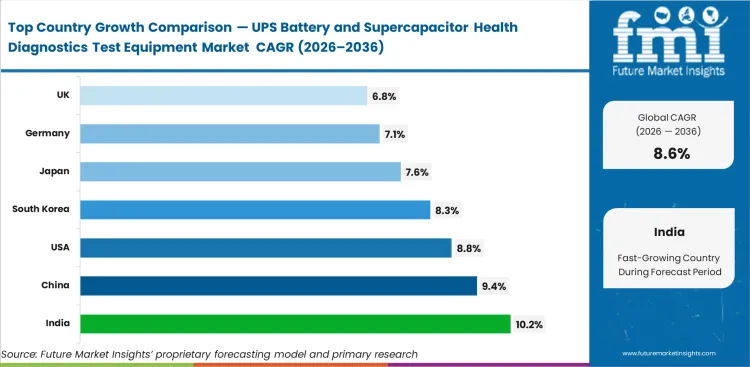
Source: FMI analysis based on uploaded source material.
UPS Battery and Supercapacitor Health Diagnostics Test Equipment Market CAGR Analysis by Country
- India leads at 10.2% because rapid data center expansion and AI infrastructure additions are widening the protected-load base faster than mature regions.
- China at 9.4% reflects large digital load growth and strong storage deployment that support deeper diagnostic routines.
- The United States at 8.8% shows strong demand due to its large installed base and rising AI-heavy rack density.
- South Korea at 8.3% and Japan at 7.6% remain important due to advanced digital infrastructure and disciplined maintenance practice.
- Germany at 7.1% and the United Kingdom at 6.8% show steady demand due to mature data center estates and stronger documentation needs.
- The global market is expected to grow at an 8.6% CAGR from 2026 to 2036. The study covers several countries, and the main growth markets are listed below.
Demand Outlook for UPS Battery and Supercapacitor Health Diagnostics Test Equipment Market in the United States
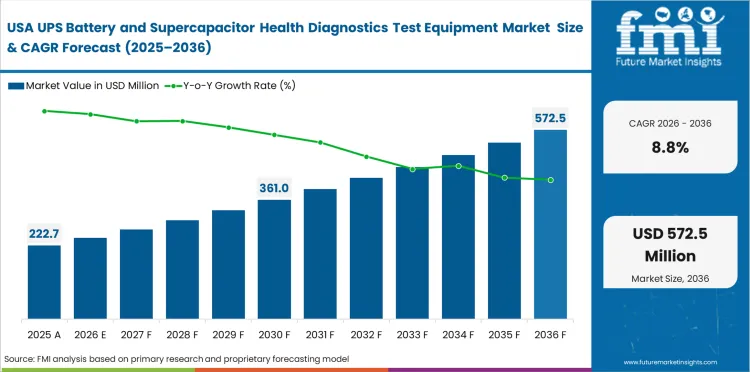
The United States UPS battery and supercapacitor health diagnostics test equipment market is projected to grow at a CAGR of 8.8% through 2036. This is because of the large installed base of data centers, rising AI-linked rack density, and stronger demand for dependable battery verification across uptime-sensitive facilities.
- Rising protected-load density is driving stronger demand for live diagnostics.
- Software-linked reporting remains important in larger site portfolios.
- Replacement demand is supported by tighter uptime expectations.
Future Outlook for UPS Battery and Supercapacitor Health Diagnostics Test Equipment Market in the United Kingdom
The U.K. UPS battery and supercapacitor health diagnostics test equipment market is projected to grow at a CAGR of 6.8% through 2036, supported by colocation data center density, mature maintenance programs, and recurring demand for runtime-assurance tools.
- Colocation density supports repeat spending on verification tools.
- Software upgrades remain important in mature maintenance programs.
- Accurate reporting tools remain attractive in service-led accounts.
Opportunity Analysis of UPS Battery and Supercapacitor Health Diagnostics Test Equipment Market in Germany
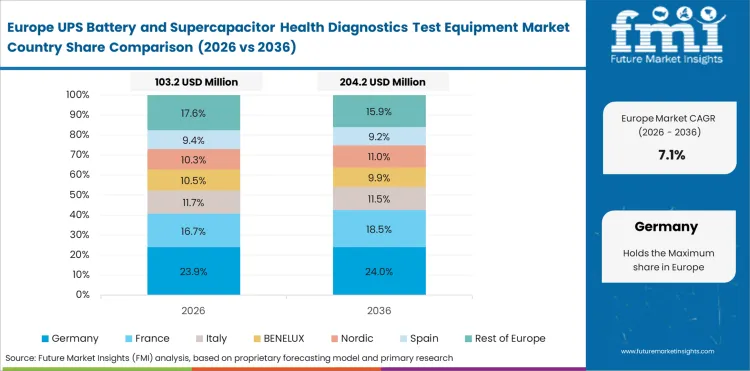
The Germany UPS battery and supercapacitor health diagnostics test equipment market is projected to grow at a CAGR of 7.1% through 2036. This is because of its large technical installed base, structured maintenance practices, and stronger demand for documented battery-health verification.
- Large installed technical base supports recurring service demand.
- Product preference remains stronger for accurate field measurement.
- Calibration support remains commercially important in this country.
In-depth Analysis of UPS Battery and Supercapacitor Health Diagnostics Test Equipment Market in Japan
The Japan UPS battery and supercapacitor health diagnostics test equipment market is projected to grow at a CAGR of 7.6% through 2036. This is due to dense data center concentration, disciplined maintenance culture, and stronger preference for repeatable and accurate test routines.
- Dense facility concentration supports more structured maintenance routines.
- Accuracy and repeatability remain important purchase factors.
- Replacement demand is stronger than broad greenfield expansion.
Sales Analysis of UPS Battery and Supercapacitor Health Diagnostics Test Equipment Market in China
The China UPS battery and supercapacitor health diagnostics test equipment market is projected to grow at a CAGR of 9.4% through 2036. This is because of strong digital load growth, wider storage deployment, and rising demand for richer battery and capacitor diagnostics.
- Storage expansion supports deeper diagnostic routines.
- Digital load growth is lifting the protected-load base quickly.
- Demand remains strong for software-linked analyzers and monitors.
In-depth Analysis of UPS Battery and Supercapacitor Health Diagnostics Test Equipment Market in India
The India UPS battery and supercapacitor health diagnostics test equipment market is projected to grow at a CAGR of 10.2% through 2036. This is due to rapid data center expansion, AI compute additions, and a growing protected-load base that needs stronger battery-health verification.
- New digital capacity is expanding the installed maintenance base.
- AI compute additions are increasing uptime sensitivity.
- Direct technical support remains important in scaling accounts.
Competitive Landscape and Strategic Positioning
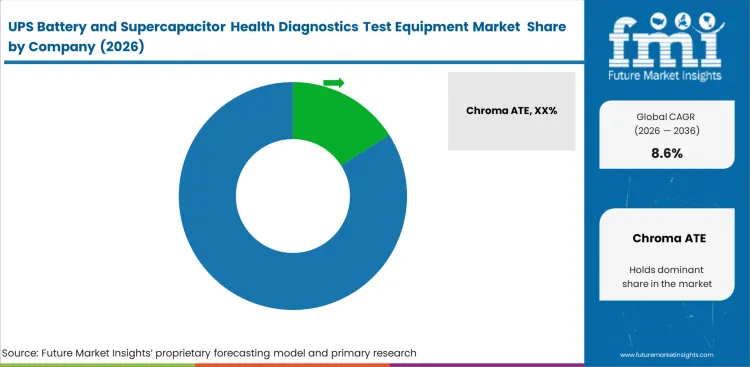
- Chroma ATE is the leading company due to visible product activity and broad test capability.
- Hioki E.E. Corporation, Arbin Instruments, DIGATRON, NH Research, Eagle Eye Power Solutions, and Midtronics remain active across this field.
- Competition is shaped by measurement accuracy, reporting depth, safety features, and service support only by hardware range.
Chroma ATE leads because it remains visible in recent product additions tied to battery and capacitor-health workflows. Hioki E.E. Corporation offers strong field-oriented instruments, and DIGATRON remains active in software-supported test systems. Arbin Instruments and NH Research continue to serve advanced test environments, while Eagle Eye Power Solutions and Midtronics hold presence in stationary battery diagnostics. The supplier field remains fragmented because buyers compare usability, calibration credibility, software functions, and chemistry coverage over selecting on one feature alone.
Barriers include long instrument replacement cycles, careful upgrade timing in some facilities, and the need for stronger technical support in specification-heavy accounts. Strategic focus remains on improving live diagnostics, shortening maintenance windows, and expanding software-linked analysis for mixed backup-power configurations.
Key Companies in the UPS Battery and Supercapacitor Health Diagnostics Test Equipment Market
Key global companies leading the UPS battery and supercapacitor health diagnostics test equipment market include:
- Chroma ATE, Hioki E.E. Corporation, and DIGATRON all maintain visible product direction in battery and capacitor-focused diagnostic workflows.
- Arbin Instruments, NH Research, and Midtronics remain active across battery testing and stationary power diagnostic applications.
- Eagle Eye Power Solutions remains a visible name in stationary battery health diagnostics and related service routines.
Competitive Benchmarking: UPS Battery and Supercapacitor Health Diagnostics Test Equipment Market
| Company | Product Breadth | Software Support | Stationary Backup Focus | Geographic Footprint |
|---|---|---|---|---|
| Chroma ATE | High | Strong | Strong | Global |
| Hioki E.E. Corporation | Medium to High | Strong | Moderate | Global |
| Arbin Instruments | Medium | Moderate | Moderate | Global |
| NH Research | Medium | Moderate | Moderate | North America / Global |
| DIGATRON | High | Strong | Moderate | Europe / Global |
| Eagle Eye Power Solutions | Medium | Moderate | Strong | North America |
| Midtronics | Medium | Moderate | Strong | Global |
Source: Future Market Insights analysis based on uploaded source data.
Key Developments in UPS Battery and Supercapacitor Health Diagnostics Test Equipment Market
- In June 2025: Lithium-ion battery cell performance testing with integrated EIS measurement solution addressed the complexity, error risks, and scalability limits linked to traditional EIS testing processes.
- In March 2026: Hioki launched the Thermistor Module U8557 and Wireless Thermistor Module LR8537 for fast, multi-channel temperature measurement in EV and energy development.
Key Players in the UPS Battery and Supercapacitor Health Diagnostics Test Equipment Market
Major Global Players
- Chroma ATE
- Hioki E.E. Corporation
- Arbin Instruments
- NH Research
- DIGATRON
- Eagle Eye Power Solutions
- Midtronics
Emerging and Adjacent Active Names
- DV Power
- Maccor
- NEWARE
Report Scope and Coverage
| Parameter | Details |
|---|---|
| Quantitative Units | USD 391.0 million to USD 892.2 million, at a CAGR of 8.6% |
| Market Definition | The UPS battery and supercapacitor health diagnostics test equipment market includes instruments and software used to diagnose the condition, reliability, and serviceability of batteries and supercapacitors used in UPS systems and related short-duration backup power architectures. |
| Regions Covered | North America, Europe, East Asia, South Asia and Pacific |
| Countries Covered | United States, United Kingdom, Germany, Japan, China, India, South Korea |
| Key Companies Profiled | Chroma ATE, Hioki E.E. Corporation, Arbin Instruments, NH Research, DIGATRON, Eagle Eye Power Solutions, Midtronics |
| Forecast Period | 2026 to 2036 |
| Approach | Bottom-up installed-base proxy using non-commercial demand anchors, tester penetration, replacement cycles, software attachment, and pricing tiers. |
UPS Battery and Supercapacitor Health Diagnostics Test Equipment Market by Segments
UPS Battery and Supercapacitor Health Diagnostics Test Equipment Market Segmented by Equipment Type:
- Battery Impedance Testers
- Battery Cyclers
- Multi-parameter Analyzers
- Supercapacitor ESR Testers
- Monitoring Software
UPS Battery and Supercapacitor Health Diagnostics Test Equipment Market Segmented by Storage Chemistry:
- Lead-acid
- Lithium-ion
- Nickel-based
- Lithium-ion Capacitors
- EDLC Supercapacitors
UPS Battery and Supercapacitor Health Diagnostics Test Equipment Market Segmented by End Use:
- Data Centers
- Telecom Networks
- Industrial Facilities
- Healthcare Sites
- Transport Infrastructure
UPS Battery and Supercapacitor Health Diagnostics Test Equipment Market Segmented by Test Mode:
- Online Testing
- Offline Testing
- Periodic Maintenance
- Continuous Monitoring
UPS Battery and Supercapacitor Health Diagnostics Test Equipment Market Segmented by Sales Channel:
- Direct Sales
- Distributors
- System Integrators
- OEM Partnerships
- Service Contracts
UPS Battery and Supercapacitor Health Diagnostics Test Equipment Market by Region:
- North America
- USA
- Canada
- Mexico
- Latin America
- Brazil
- Chile
- Rest of Latin America
- Western Europe
- Germany
- UK
- Italy
- Spain
- France
- Nordic
- BENELUX
- Rest of Western Europe
- Eastern Europe
- Russia
- Poland
- Hungary
- Balkan & Baltic
- Rest of Eastern Europe
- East Asia
- China
- Japan
- South Korea
- South Asia and Pacific
- India
- ASEAN
- Australia & New Zealand
- Rest of South Asia and Pacific
- Middle East & Africa
- Kingdom of Saudi Arabia
- Other GCC Countries
- Turkiye
- South Africa
- Other African Union
- Rest of Middle East & Africa
Research Sources and Bibliography
- Chroma ATE Inc. (2025, June 16). Lithium-ion battery cell performance testing with integrated EIS measurement solution.
- HIOKI E.E. Corporation. (2026, March 10). Hioki launches high-speed thermistor modules U8557 and LR8537: Fast, multi-channel temperature measurement for EV and energy development.
- Lawrence Berkeley National Laboratory. (2025, January 15). Berkeley Lab report evaluates increase in electricity demand from data centers.
- Press Information Bureau, Government of India. (2026, March 13). Data centre capacity in the country has increased from about 375 MW in 2020 to around 1500 MW by 2025.
- UK Government. (2025, May 1). Estimate of data centre capacity: Great Britain 2024.
This Report Answers
- What is the current and future size of the UPS battery and supercapacitor health diagnostics test equipment market?
- How fast is the market expected to grow between 2026 and 2036?
- Which equipment type is likely to lead the market by 2026?
- Which storage chemistry is expected to account for the largest installed diagnostic base by 2026?
- What factors are driving demand for UPS battery and supercapacitor health diagnostics test equipment globally?
- How are data center expansion and AI compute additions influencing adoption?
- Why is online testing becoming a major demand center in this equipment space?
- Which countries are projected to show the fastest growth through 2036?
- What is driving expansion in India and China?
- Who are the key companies active in the market?
- How does FMI estimate and validate the market forecast?
Frequently Asked Questions
What is the global market demand in 2026?
In 2026, the global market for UPS battery and supercapacitor health diagnostics test equipment is expected to be worth USD 391.0 million.
How big will the market be in 2036?
By 2036, the market is expected to be worth USD 892.2 million.
How much will demand grow between 2026 and 2036?
Between 2026 and 2036, demand is expected to grow at a CAGR of 8.6%.
Which equipment type is likely to be the best seller by 2026?
Battery Impedance Testers are expected to account for 34.0% of the Equipment Type segment in 2026 due to their faster routine field use.
What is causing demand to rise in India?
India is projected to grow at 10.2% CAGR through 2036 due to rapid data center expansion and rising AI compute additions.
What is causing demand to rise in China?
China is projected to grow at 9.4% CAGR through 2036 due to strong digital load growth and wider storage deployment.
What does this report mean by market definition?
The market includes equipment and software used to diagnose the condition and serviceability of UPS batteries and supercapacitors in backup-power systems.
How does FMI make the forecast and check it?
Forecasting uses a bottom-up installed-base model checked against non-commercial demand anchors, segment shares, country growth, and active supplier presence.
Preview the report firsthand - request a free sample
Get SampleGet the brochure for pricing and purchase details.
Get PDFTable of Content
- Executive Summary
- Global Market Outlook
- Demand-side Trends
- Supply-side Trends
- Technology Roadmap Analysis
- Analysis and Recommendations
- Market Overview
- Market Coverage / Taxonomy
- Market Definition / Scope / Limitations
- Research Methodology
- Chapter Orientation
- Analytical Lens and Working Hypotheses
- Market Structure, Signals, and Trend Drivers
- Benchmarking and Cross-market Comparability
- Market Sizing, Forecasting, and Opportunity Mapping
- Research Design and Evidence Framework
- Desk Research Programme (Secondary Evidence)
- Company Annual and Sustainability Reports
- Peer-reviewed Journals and Academic Literature
- Corporate Websites, Product Literature, and Technical Notes
- Earnings Decks and Investor Briefings
- Statutory Filings and Regulatory Disclosures
- Technical White Papers and Standards Notes
- Trade Journals, Industry Magazines, and Analyst Briefs
- Conference Proceedings, Webinars, and Seminar Materials
- Government Statistics Portals and Public Data Releases
- Press Releases and Reputable Media Coverage
- Specialist Newsletters and Curated Briefings
- Sector Databases and Reference Repositories
- FMI Internal Proprietary Databases and Historical Market Datasets
- Subscription Datasets and Paid Sources
- Social Channels, Communities, and Digital Listening Inputs
- Additional Desk Sources
- Expert Input and Fieldwork (Primary Evidence)
- Primary Modes
- Qualitative Interviews and Expert Elicitation
- Quantitative Surveys and Structured Data Capture
- Blended Approach
- Why Primary Evidence is Used
- Field Techniques
- Interviews
- Surveys
- Focus Groups
- Observational and In-context Research
- Social and Community Interactions
- Stakeholder Universe Engaged
- C-suite Leaders
- Board Members
- Presidents and Vice Presidents
- R&D and Innovation Heads
- Technical Specialists
- Domain Subject-matter Experts
- Scientists
- Physicians and Other Healthcare Professionals
- Governance, Ethics, and Data Stewardship
- Research Ethics
- Data Integrity and Handling
- Primary Modes
- Tooling, Models, and Reference Databases
- Desk Research Programme (Secondary Evidence)
- Data Engineering and Model Build
- Data Acquisition and Ingestion
- Cleaning, Normalisation, and Verification
- Synthesis, Triangulation, and Analysis
- Quality Assurance and Audit Trail
- Market Background
- Market Dynamics
- Drivers
- Restraints
- Opportunity
- Trends
- Scenario Forecast
- Demand in Optimistic Scenario
- Demand in Likely Scenario
- Demand in Conservative Scenario
- Opportunity Map Analysis
- Product Life Cycle Analysis
- Supply Chain Analysis
- Investment Feasibility Matrix
- Value Chain Analysis
- PESTLE and Porter’s Analysis
- Regulatory Landscape
- Regional Parent Market Outlook
- Production and Consumption Statistics
- Import and Export Statistics
- Market Dynamics
- Global Market Analysis 2021 to 2025 and Forecast, 2026 to 2036
- Historical Market Size Value (USD Million) Analysis, 2021 to 2025
- Current and Future Market Size Value (USD Million) Projections, 2026 to 2036
- Y-o-Y Growth Trend Analysis
- Absolute $ Opportunity Analysis
- Global Market Pricing Analysis 2021 to 2025 and Forecast 2026 to 2036
- Global Market Analysis 2021 to 2025 and Forecast 2026 to 2036, By Equipment Type
- Introduction / Key Findings
- Historical Market Size Value (USD Million) Analysis By Equipment Type , 2021 to 2025
- Current and Future Market Size Value (USD Million) Analysis and Forecast By Equipment Type , 2026 to 2036
- Battery Impedance Testers
- Battery Cyclers
- Multi-parameter Analyzers
- Supercapacitor ESR Testers
- Monitoring Software
- Battery Impedance Testers
- Y-o-Y Growth Trend Analysis By Equipment Type , 2021 to 2025
- Absolute $ Opportunity Analysis By Equipment Type , 2026 to 2036
- Global Market Analysis 2021 to 2025 and Forecast 2026 to 2036, By Chemistry
- Introduction / Key Findings
- Historical Market Size Value (USD Million) Analysis By Chemistry, 2021 to 2025
- Current and Future Market Size Value (USD Million) Analysis and Forecast By Chemistry, 2026 to 2036
- Lead-acid
- Lithium-ion
- Nickel-based
- Lithium-ion Capacitors
- EDLC Supercapacitors
- Lead-acid
- Y-o-Y Growth Trend Analysis By Chemistry, 2021 to 2025
- Absolute $ Opportunity Analysis By Chemistry, 2026 to 2036
- Global Market Analysis 2021 to 2025 and Forecast 2026 to 2036, By End Use
- Introduction / Key Findings
- Historical Market Size Value (USD Million) Analysis By End Use, 2021 to 2025
- Current and Future Market Size Value (USD Million) Analysis and Forecast By End Use, 2026 to 2036
- Data Centers
- Telecom Networks
- Industrial Facilities
- Healthcare Sites
- Transport Infrastructure
- Data Centers
- Y-o-Y Growth Trend Analysis By End Use, 2021 to 2025
- Absolute $ Opportunity Analysis By End Use, 2026 to 2036
- Global Market Analysis 2021 to 2025 and Forecast 2026 to 2036, By Test Mode
- Introduction / Key Findings
- Historical Market Size Value (USD Million) Analysis By Test Mode, 2021 to 2025
- Current and Future Market Size Value (USD Million) Analysis and Forecast By Test Mode, 2026 to 2036
- Online Testing
- Offline Testing
- Periodic Maintenance
- Continuous Monitoring
- Online Testing
- Y-o-Y Growth Trend Analysis By Test Mode, 2021 to 2025
- Absolute $ Opportunity Analysis By Test Mode, 2026 to 2036
- Global Market Analysis 2021 to 2025 and Forecast 2026 to 2036, By Sales Channel
- Introduction / Key Findings
- Historical Market Size Value (USD Million) Analysis By Sales Channel, 2021 to 2025
- Current and Future Market Size Value (USD Million) Analysis and Forecast By Sales Channel, 2026 to 2036
- Direct Sales
- Distributors
- System Integrators
- OEM Partnerships
- Service Contracts
- Direct Sales
- Y-o-Y Growth Trend Analysis By Sales Channel, 2021 to 2025
- Absolute $ Opportunity Analysis By Sales Channel, 2026 to 2036
- Global Market Analysis 2021 to 2025 and Forecast 2026 to 2036, By Region
- Introduction
- Historical Market Size Value (USD Million) Analysis By Region, 2021 to 2025
- Current Market Size Value (USD Million) Analysis and Forecast By Region, 2026 to 2036
- North America
- Latin America
- Western Europe
- Eastern Europe
- East Asia
- South Asia and Pacific
- Middle East & Africa
- Market Attractiveness Analysis By Region
- North America Market Analysis 2021 to 2025 and Forecast 2026 to 2036, By Country
- Historical Market Size Value (USD Million) Trend Analysis By Market Taxonomy, 2021 to 2025
- Market Size Value (USD Million) Forecast By Market Taxonomy, 2026 to 2036
- By Country
- USA
- Canada
- Mexico
- By Equipment Type
- By Chemistry
- By End Use
- By Test Mode
- By Sales Channel
- By Country
- Market Attractiveness Analysis
- By Country
- By Equipment Type
- By Chemistry
- By End Use
- By Test Mode
- By Sales Channel
- Key Takeaways
- Latin America Market Analysis 2021 to 2025 and Forecast 2026 to 2036, By Country
- Historical Market Size Value (USD Million) Trend Analysis By Market Taxonomy, 2021 to 2025
- Market Size Value (USD Million) Forecast By Market Taxonomy, 2026 to 2036
- By Country
- Brazil
- Chile
- Rest of Latin America
- By Equipment Type
- By Chemistry
- By End Use
- By Test Mode
- By Sales Channel
- By Country
- Market Attractiveness Analysis
- By Country
- By Equipment Type
- By Chemistry
- By End Use
- By Test Mode
- By Sales Channel
- Key Takeaways
- Western Europe Market Analysis 2021 to 2025 and Forecast 2026 to 2036, By Country
- Historical Market Size Value (USD Million) Trend Analysis By Market Taxonomy, 2021 to 2025
- Market Size Value (USD Million) Forecast By Market Taxonomy, 2026 to 2036
- By Country
- Germany
- UK
- Italy
- Spain
- France
- Nordic
- BENELUX
- Rest of Western Europe
- By Equipment Type
- By Chemistry
- By End Use
- By Test Mode
- By Sales Channel
- By Country
- Market Attractiveness Analysis
- By Country
- By Equipment Type
- By Chemistry
- By End Use
- By Test Mode
- By Sales Channel
- Key Takeaways
- Eastern Europe Market Analysis 2021 to 2025 and Forecast 2026 to 2036, By Country
- Historical Market Size Value (USD Million) Trend Analysis By Market Taxonomy, 2021 to 2025
- Market Size Value (USD Million) Forecast By Market Taxonomy, 2026 to 2036
- By Country
- Russia
- Poland
- Hungary
- Balkan & Baltic
- Rest of Eastern Europe
- By Equipment Type
- By Chemistry
- By End Use
- By Test Mode
- By Sales Channel
- By Country
- Market Attractiveness Analysis
- By Country
- By Equipment Type
- By Chemistry
- By End Use
- By Test Mode
- By Sales Channel
- Key Takeaways
- East Asia Market Analysis 2021 to 2025 and Forecast 2026 to 2036, By Country
- Historical Market Size Value (USD Million) Trend Analysis By Market Taxonomy, 2021 to 2025
- Market Size Value (USD Million) Forecast By Market Taxonomy, 2026 to 2036
- By Country
- China
- Japan
- South Korea
- By Equipment Type
- By Chemistry
- By End Use
- By Test Mode
- By Sales Channel
- By Country
- Market Attractiveness Analysis
- By Country
- By Equipment Type
- By Chemistry
- By End Use
- By Test Mode
- By Sales Channel
- Key Takeaways
- South Asia and Pacific Market Analysis 2021 to 2025 and Forecast 2026 to 2036, By Country
- Historical Market Size Value (USD Million) Trend Analysis By Market Taxonomy, 2021 to 2025
- Market Size Value (USD Million) Forecast By Market Taxonomy, 2026 to 2036
- By Country
- India
- ASEAN
- Australia & New Zealand
- Rest of South Asia and Pacific
- By Equipment Type
- By Chemistry
- By End Use
- By Test Mode
- By Sales Channel
- By Country
- Market Attractiveness Analysis
- By Country
- By Equipment Type
- By Chemistry
- By End Use
- By Test Mode
- By Sales Channel
- Key Takeaways
- Middle East & Africa Market Analysis 2021 to 2025 and Forecast 2026 to 2036, By Country
- Historical Market Size Value (USD Million) Trend Analysis By Market Taxonomy, 2021 to 2025
- Market Size Value (USD Million) Forecast By Market Taxonomy, 2026 to 2036
- By Country
- Kingdom of Saudi Arabia
- Other GCC Countries
- Turkiye
- South Africa
- Other African Union
- Rest of Middle East & Africa
- By Equipment Type
- By Chemistry
- By End Use
- By Test Mode
- By Sales Channel
- By Country
- Market Attractiveness Analysis
- By Country
- By Equipment Type
- By Chemistry
- By End Use
- By Test Mode
- By Sales Channel
- Key Takeaways
- Key Countries Market Analysis
- USA
- Pricing Analysis
- Market Share Analysis, 2025
- By Equipment Type
- By Chemistry
- By End Use
- By Test Mode
- By Sales Channel
- Canada
- Pricing Analysis
- Market Share Analysis, 2025
- By Equipment Type
- By Chemistry
- By End Use
- By Test Mode
- By Sales Channel
- Mexico
- Pricing Analysis
- Market Share Analysis, 2025
- By Equipment Type
- By Chemistry
- By End Use
- By Test Mode
- By Sales Channel
- Brazil
- Pricing Analysis
- Market Share Analysis, 2025
- By Equipment Type
- By Chemistry
- By End Use
- By Test Mode
- By Sales Channel
- Chile
- Pricing Analysis
- Market Share Analysis, 2025
- By Equipment Type
- By Chemistry
- By End Use
- By Test Mode
- By Sales Channel
- Germany
- Pricing Analysis
- Market Share Analysis, 2025
- By Equipment Type
- By Chemistry
- By End Use
- By Test Mode
- By Sales Channel
- UK
- Pricing Analysis
- Market Share Analysis, 2025
- By Equipment Type
- By Chemistry
- By End Use
- By Test Mode
- By Sales Channel
- Italy
- Pricing Analysis
- Market Share Analysis, 2025
- By Equipment Type
- By Chemistry
- By End Use
- By Test Mode
- By Sales Channel
- Spain
- Pricing Analysis
- Market Share Analysis, 2025
- By Equipment Type
- By Chemistry
- By End Use
- By Test Mode
- By Sales Channel
- France
- Pricing Analysis
- Market Share Analysis, 2025
- By Equipment Type
- By Chemistry
- By End Use
- By Test Mode
- By Sales Channel
- India
- Pricing Analysis
- Market Share Analysis, 2025
- By Equipment Type
- By Chemistry
- By End Use
- By Test Mode
- By Sales Channel
- ASEAN
- Pricing Analysis
- Market Share Analysis, 2025
- By Equipment Type
- By Chemistry
- By End Use
- By Test Mode
- By Sales Channel
- Australia & New Zealand
- Pricing Analysis
- Market Share Analysis, 2025
- By Equipment Type
- By Chemistry
- By End Use
- By Test Mode
- By Sales Channel
- China
- Pricing Analysis
- Market Share Analysis, 2025
- By Equipment Type
- By Chemistry
- By End Use
- By Test Mode
- By Sales Channel
- Japan
- Pricing Analysis
- Market Share Analysis, 2025
- By Equipment Type
- By Chemistry
- By End Use
- By Test Mode
- By Sales Channel
- South Korea
- Pricing Analysis
- Market Share Analysis, 2025
- By Equipment Type
- By Chemistry
- By End Use
- By Test Mode
- By Sales Channel
- Russia
- Pricing Analysis
- Market Share Analysis, 2025
- By Equipment Type
- By Chemistry
- By End Use
- By Test Mode
- By Sales Channel
- Poland
- Pricing Analysis
- Market Share Analysis, 2025
- By Equipment Type
- By Chemistry
- By End Use
- By Test Mode
- By Sales Channel
- Hungary
- Pricing Analysis
- Market Share Analysis, 2025
- By Equipment Type
- By Chemistry
- By End Use
- By Test Mode
- By Sales Channel
- Kingdom of Saudi Arabia
- Pricing Analysis
- Market Share Analysis, 2025
- By Equipment Type
- By Chemistry
- By End Use
- By Test Mode
- By Sales Channel
- Turkiye
- Pricing Analysis
- Market Share Analysis, 2025
- By Equipment Type
- By Chemistry
- By End Use
- By Test Mode
- By Sales Channel
- South Africa
- Pricing Analysis
- Market Share Analysis, 2025
- By Equipment Type
- By Chemistry
- By End Use
- By Test Mode
- By Sales Channel
- USA
- Market Structure Analysis
- Competition Dashboard
- Competition Benchmarking
- Market Share Analysis of Top Players
- By Regional
- By Equipment Type
- By Chemistry
- By End Use
- By Test Mode
- By Sales Channel
- Competition Analysis
- Competition Deep Dive
- Chroma ATE
- Overview
- Product Portfolio
- Profitability by Market Segments (Product/Age /Sales Channel/Region)
- Sales Footprint
- Strategy Overview
- Marketing Strategy
- Product Strategy
- Channel Strategy
- Hioki E.E. Corporation
- Arbin Instruments
- NH Research
- DIGATRON
- Eagle Eye Power Solutions
- Midtronics
- DV Power
- Maccor
- NEWARE
- Chroma ATE
- Competition Deep Dive
- Assumptions & Acronyms Used


