

- Industry Size (2026)
- USD 58.6 Mn
- Forecast (2036)
- USD 237.1 Mn
- CAGR (2026 to 2036)
- 15.0%
Solid-State Battery Mechanical and Safety Test Equipment Market Size, Market Forecast and Outlook By FMI
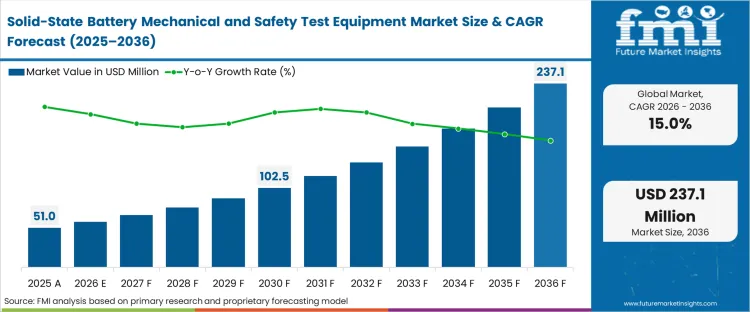
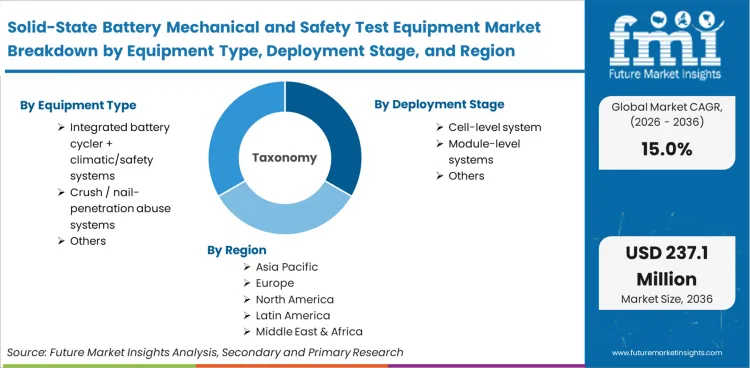
The solid-state battery mechanical and safety test equipment market crossed a valuation of USD 51.0 million in 2025. The industry is expected to reach USD 58.6 million in 2026 at a CAGR of 15.0% during the forecast period. Demand outlook carries the market valuation to USD 237.1 million by 2036 as automotive OEMs transition validation protocols from liquid-electrolyte containment toward solid ceramic fracture limits.
Procurement directors at cell manufacturers face an immediate structural forcing condition regarding physical validation. Traditional testing setups focus heavily on managing catastrophic venting rather than observing subtle separator coatings degradation under stress. Engineers require highly specific solid-state battery safety testing equipment because new architectures change this threat profile entirely. They must quantify internal dendrite propagation under extreme mechanical pressure rather than simple thermal expansion. Delaying infrastructure upgrades means pilot lines cannot certify new geometries for vehicle integration. Existing explosion chambers remain insufficient because solid failures manifest as sudden voltage drops from micro-cracking.
Once Tier-1 pack integrators mandate dynamic pressure monitoring during cycling, advanced solid-state battery abuse testing adoption becomes self-reinforcing. Pack builders cannot validate module lifespan without proving continuous physical contact across interfaces under shock loads. Crossing this threshold forces suppliers to abandon isolated mechanical fixtures in favor of fully integrated electro-mechanical validation cells.
Summary of Solid-State Battery Mechanical and Safety Test Equipment Market
- Solid-State Battery Mechanical and Safety Test Equipment Market Definition
- This sector provides specialized hardware to stress, fracture, and validate solid-electrolyte cells under simultaneous mechanical, thermal, and electrical loads, determining precise safety limits before automotive deployment.
- Demand Drivers in the Market
- High-pressure cycling requirements compel R&D directors to replace passive environmental chambers with active compression fixtures.
- Evolving homologation standards force Tier-1 integrators to procure EV battery safety validation equipment to document specific failure modes like ceramic shattering.
- Fast-charging validation pushes cell engineers to deploy high-frequency diagnostic platforms capable of detecting internal micro-shorts instantly, far beyond what traditional pack busbars testing requires.
- Key Segments Analyzed in the FMI Report
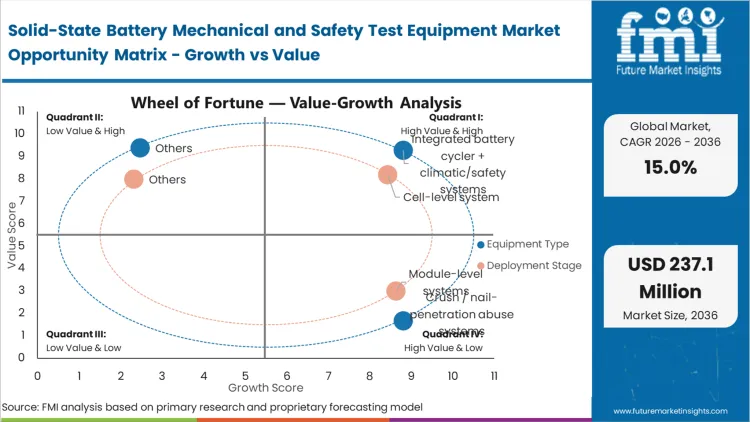
- Equipment type: Integrated battery cycler + climatic/safety systems are poised to grab 31.0% share in 2026, driven by procurement preference for single-vendor turnkey validation cells.
- Deployment Stage: Cell-level system is anticipated to account for 42.0% share in 2026, as manufacturers prioritize fundamental interface stability before scaling to module integration.
- End User: Mechanical abuse testing projected to record 29.0% share in 2026 due to urgent necessity for characterizing separator brittleness.
- China: 17.8% compound growth, reflecting massive concentrated capital deployment by major solid-state battery validation equipment manufacturers.
- Analyst Opinion at FMI
- Nikhil Kaitwade, Principal Analyst for Testing Equipment at FMI, points out, "Standard metrics capture thermal propagation delays perfectly, but they miss interface delamination entirely. Solid developers currently face a massive measurement gap. Liquid cells fail violently; solid cells fail quietly when ceramic layers crack, causing sudden high-resistance barriers. Equipment buyers initially assumed they could adapt existing thermal chambers by simply adding pressure plates. Real-world validation proved that static pressure cannot simulate vehicle vibration while cycling. Test lab directors are realizing that proving safety for these new chemistries requires equipment that can dynamically adjust micrometer-level compression during thermal shifts, turning physical test rigs into highly sophisticated mechatronic systems rather than simple crush machines."
- Strategic Implications / Executive Takeaways
- Test equipment designers must integrate acoustic emission sensors into physical crush rigs to capture early-stage ceramic cracking.
- Lab facility managers face significant infrastructure redesigns to route massive power requirements for simultaneous electro-mechanical testing.
- Procurement teams prioritizing modular hardware avoid stranding capital when exact solid form factors pivot unexpectedly.
- Methodology
- Primary Research: Direct consultation with reliability engineering directors to map physical test pain points.
- Desk Research: Aggregation of OEM safety testing protocols and regional certification mandates.
- Market-Sizing and Forecasting: Baseline established via capital expenditure tracking for pilot line build-outs.
- Data Validation and Update Cycle: Forecasts calibrated against public earnings reports of dominant testing instrumentation providers.
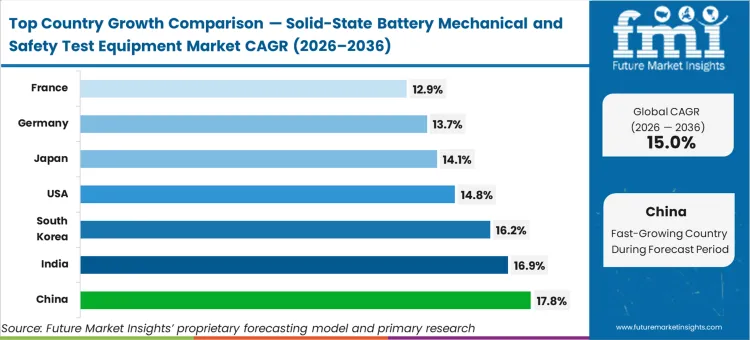
China advances at 17.8% as domestic battery giants aggressively build gigawatt-scale pilot lines demanding high-throughput automated validation. Accelerating state-sponsored localization programs push India to follow at 16.9%. South Korea expands at 16.2% driven by massive chaebol investments in next-generation cell formats. Federal grants targeting domestic supply chain independence support the United States tracking at 14.8%. Japan grows at 14.1% via heavy legacy OEM commitment to sulfide chemistries. Premium automakers retooling R&D centers help Germany record 13.7% growth. Strategic European cell alliances allow France to register 12.9%. Examining the solid-state battery test equipment forecast 2036 reveals a geographic divergence centering largely on whether validation infrastructure prioritizes consumer electronics scale or heavy automotive compliance.
Solid-State Battery Mechanical and Safety Test Equipment Market Key Takeaways
| Metric | Details |
|---|---|
| Industry Size (2026) | USD 58.6 million |
| Industry Value (2036) | USD 237.1 million |
| CAGR (2026 to 2036) | 15.0% |
Source: Future Market Insights (FMI) analysis, based on proprietary forecasting model and primary research
Solid-State Battery Mechanical and Safety Test Equipment Market Definition
Specialized validation hardware designed explicitly to evaluate physical integrity, failure thresholds, and operational boundaries of next-generation solid-electrolyte cells defines this sector. Equipment in this category applies controlled mechanical force, extreme temperature variations, and electrical cycling simultaneously to measure interface degradation. Core capabilities include isolating specific failure modes like dendrite penetration, ceramic separator micro-cracking, and interface delamination under dynamic pressure states.
Solid-State Battery Mechanical and Safety Test Equipment Market Inclusions
Hardware systems directly executing physical abuse, thermal boundary testing, and cycle-life conditioning with mechanical stress fall within scope. Environmental chambers equipped with integrated cyclers, precision solid-state battery crush test equipment with high-frequency voltage monitoring, and vibration tables engineered for live module testing involving rigid pack sealants are covered. Software platforms executing control logic for these specific physical test sequences are included. FMI's assessment incorporates third-party battery testing inspection hardware procured by independent labs for certification protocols.
Solid-State Battery Mechanical and Safety Test Equipment Market Exclusions
Standard electrical cyclers lacking mechanical force application capabilities sit outside this boundary because they cannot validate solid interface stability. Standalone manufacturing tools like calendaring machines or basic battery pilot line safety validation equipment used purely for stacking automation fall outside this tracking boundary. Chemical synthesis monitoring tools used purely for material formulation rather than finished cell abuse testing are omitted. General-purpose environmental chambers without battery-specific safety venting or blast protection are not counted in these figures.
Solid-State Battery Mechanical and Safety Test Equipment Market Research Methodology
- Primary Research: Reliability engineering directors, safety certification managers, and equipment procurement heads at major cell pilot facilities.
- Desk Research: UN 38.3 test lab certification databases, patent filings for solid test fixtures, and OEM vendor qualification requirements.
- Market-Sizing and Forecasting: Capital expenditure allocations for validation lab upgrades among the top ten battery manufacturers globally.
- Data Validation and Update Cycle: Independent cross-referencing against quarterly equipment shipment logs from tier-one instrumentation suppliers.
Segmental Analysis
Solid-State Battery Mechanical and Safety Test Equipment Market Analysis by Equipment type
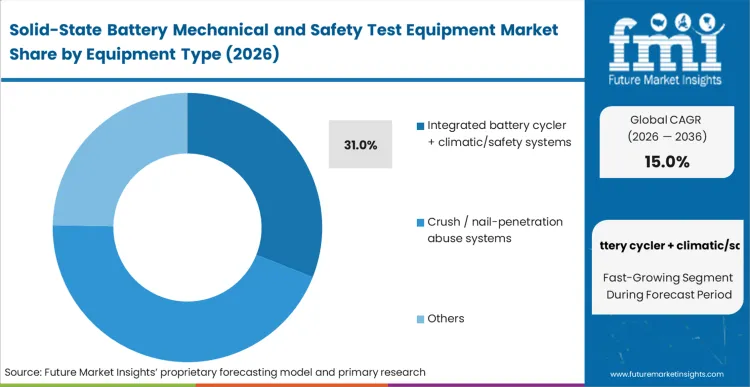
Integrated battery cycler and climatic or safety systems hold a 31.0% share because many labs prefer a single coordinated setup over piecemeal test architecture. Reliability teams often avoid separate mechanical presses and standalone electrical cyclers since even small synchronization gaps can affect high-frequency failure data. Unified systems help reduce that problem by enabling faster power cutoff during fracture events and tighter control over abuse testing conditions. This makes turnkey battery abuse testing labs more attractive in formation and failure-analysis environments where timing precision matters. The trade-off is that integrated platforms can make future hardware expansion more difficult, since testing protocols often become closely tied to one vendor’s software environment. Standalone systems may lower upfront capital needs, though they usually require more internal scripting and integration work as test standards evolve.
- Hardware synchronization gaps: Separated cyclers and crush rigs miss millisecond-level voltage drops during physical impact. Certification managers must deploy unified systems to capture exact failure timing accurately.
- Data latency artifacts: Independent logging streams require manual timestamp alignment after destructive events. Test engineers face weeks of delayed analysis unless operating natively synchronized platforms.
- Software ecosystem lock-in: Procuring fully integrated chambers restricts buyers to proprietary programming languages. R&D directors must negotiate open-API access during initial contracts to ensure long-term usability.
Solid-State Battery Mechanical and Safety Test Equipment Market Analysis by Battery level
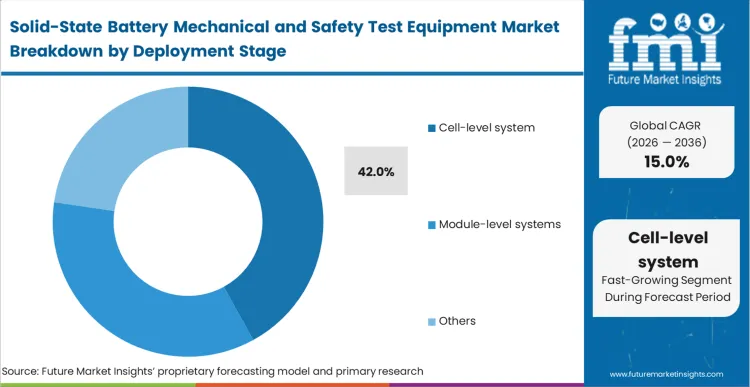
Validation focus will remain overwhelmingly concentrated on cell-level safety test equipment for solid-state batteries over the next three years. Automotive OEMs cannot begin designing module enclosures until individual solid pouches prove interface stability across thousands of cycles. Cell-level testers command 42.0% share because current electric vehicle test regimes require statistically massive sample sizes to identify edge-case defects in novel ceramic layers. According to FMI's estimates, these smaller fixtures allow rapid iteration of applied pressure parameters. Interestingly, cell-level test volume actually peaks just before a chemistry enters mass production, dropping sharply once module-level characterization begins. Lab managers who over-provision cell-level capacity face stranded assets when validation requirements inevitably shift toward larger pack-level abuse chambers equipped with robust thermal runaway shields.
- Throughput density advantages: Smaller fixtures allow stacking dozens of test channels within minimal floor space. Facility managers reduce square-footage costs significantly while maintaining high statistical confidence.
- Scrap material expenses: Destructive testing consumes physical product continuously. Cell manufacturers lower consumable budgets drastically by breaking individual units rather than fully assembled modules.
- Retrofit capital requirements: Upgrading cell testers to accommodate slightly thicker pouch designs costs minimally. Operations directors avoid massive re-tooling expenditures compared to modifying heavy pack-level vibration tables.
Solid-State Battery Mechanical and Safety Test Equipment Market Analysis by Test mode
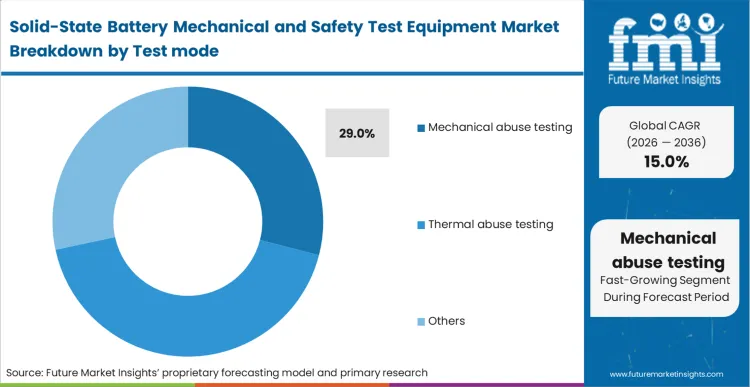
Safety certification engineers are prioritizing mechanical abuse testing hardware to address unique brittleness inherent to solid electrolytes. This specific test mode accounts for 29.0% share because liquid automotive battery testers cannot replicate localized shear forces that shatter internal ceramic separators, rendering standard runaway sensor modules ineffective. Evaluators need highly controlled solid-state battery nail penetration test chamber platforms that measure resistance changes in real-time as pressure increases. Based on FMI's assessment, traditional nail penetration tests often yield false passes with solid designs because nail structures act as conductive bridges. Practitioners know that true mechanical vulnerability in these cells lies in continuous variable compression, not isolated punctures. Delaying investment in precision compression fixtures leaves battery developers blind to long-term physical fatigue mechanisms.
- Initial diagnostic limits: Engineers initially select crush testers to satisfy mandatory UN safety shipping requirements. Procurement focuses entirely on meeting basic physical force generation specifications.
- Resolution validation hurdles: During qualification, technical buyers realize basic hydraulic presses lack necessary precision. Testing departments switch evaluations to servomotor-driven rigs capable of micron-level position control.
- High-throughput scaling: Continuous R&D demands multiple identical testing bays. Lab directors authorize fleet purchases based on software interface usability rather than peak mechanical output.
Solid-State Battery Mechanical and Safety Test Equipment Market Analysis by End user
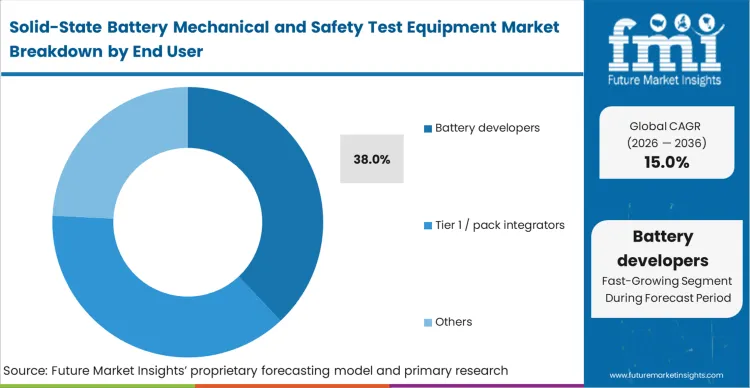
Outsourced certification cannot keep pace with internal iteration cycles at major cell manufacturers. Battery developers capture 38.0% share because shipping unstable prototype cells to third-party labs introduces unacceptable delays. In-house engineering teams require immediate feedback on how physical changes to battery management systems affect physical stress tolerances, especially when testing novel precursor free cathodes. Setting up dedicated testing lines is a priority for these facilities. FMI analysts note that maintaining internal physical abuse capabilities prevents IP leakage regarding proprietary ceramic formulations. A widely overlooked reality is that OEMs often run test equipment far outside manufacturer-specified operating limits to find true edge cases, voiding equipment warranties systematically. Companies relying entirely on external labs face a massive knowledge deficit regarding nuanced failure acoustics.
- Pilot facility acceleration: Cell developers acquire specialized abuse chambers first to validate basic chemistry viability. R&D heads gain complete control over proprietary testing methodologies.
- OEM integration mimicking: Automotive manufacturers purchase identical equipment models shortly afterward to verify supplier claims. Validation engineers ensure baseline comparability across different cell vendors.
- Third-party standardization: Independent labs finally adopt these specific architectures once global standards solidify. Certification directors update testing catalogs to attract overflow volume from capacity-constrained OEMs.
Solid-State Battery Mechanical and Safety Test Equipment Market Drivers, Restraints, and Opportunities
Automotive manufacturers require immediate undeniable proof that brittle solid electrolytes can survive extreme vehicle vibration profiles over a ten-year lifespan. This durability mandate forces reliability engineering directors to abandon static environmental chambers and aggressively buy battery abuse test chamber for solid-state cells equipped with dynamic electro-mechanical vibration tables. If OEMs fail to validate physical integrity under continuous cycling, they face catastrophic warranty liabilities when road-shock causes internal ceramic fracturing. Pressure stems from an urgent need to homologate vehicles featuring these advanced power sources ahead of competing automakers. Waiting for standardized testing protocols is no longer commercially viable. Testing equipment capable of simulating real-world physical abuse while monitoring millisecond-level electrochemical responses becomes primary gateway hardware to mass production.
Multi-department capital approval processes severely bottleneck advanced physical abuse systems acquisition. Testing hardware capable of extreme force generation, precise atmospheric control, and high-frequency electrical cycling costs exponentially more than traditional cyclers. Facility managers mapping the battery safety lab setup cost for solid-state cells struggle to justify these massive expenditures when exact solid form factors remain unsettled. Purchasing specialized crush rigs designed for pouch cells represents massive financial risk if production suddenly pivots to cylindrical formats. Until cell geometry standardizes, procurement teams hesitate, creating structural friction where engineering desperately needs data but finance refuses to fund highly specific, potentially obsolete hardware. Modular test platforms with interchangeable physical fixtures offer a partial, though mechanically complex, solution.
Opportunities in the Solid-State Battery Mechanical and Safety Test Equipment Market
- Acoustic emission integration: Equipment vendors can embed high-frequency microphones into crush plates. Test engineers gain ability to hear ceramic micro-cracks before voltage drops occur.
- Variable-pressure cycling platforms: Designing pneumatic rigs that adjust physical compression during electrical charge cycles allows researchers to mimic actual automotive pack expansion, which is especially critical for evolving lithium sulfur batteries. Formulation scientists acquire highly realistic operational data.
- Streamlined vendor qualification: Creating automated transfer mechanisms that move failed cells into inert gloveboxes without air exposure helps chemists analyze precise degradation states. Quality teams drafting an RFQ for solid-state battery safety testing system identify root causes much faster using advanced battery materials handling.
Regional Analysis
Based on regional analysis, solid-state battery mechanical and safety test equipment market is segmented into North America, Latin America, Western Europe, Eastern Europe, East Asia, South Asia and Pacific, and Middle East and Africa across 40 plus countries.
.webp "Top Country Growth Comparison Solid State Battery Mechanical And Safety Test Equipment Market Cagr (2026 2036)")
| Country | CAGR (2026 to 2036) |
|---|---|
| China | 17.8% |
| India | 16.9% |
| South Korea | 16.2% |
| United States | 14.8% |
| Japan | 14.1% |
| Germany | 13.7% |
| France | 12.9% |
Source: Future Market Insights (FMI) analysis, based on proprietary forecasting model and primary research
East Asia Solid-State Battery Mechanical and Safety Test Equipment Market Analysis
East Asia Solid-State Battery Mechanical and Safety Test Equipment Market Analysis Based on FMI's assessment, local testing hardware providers are scaling rapidly to meet localized demand, often integrating safe handling protocols for advanced fluorine free electrolytes directly into the chambers. Massive centralized capital deployment toward gigawatt-scale solid commercialization defines testing infrastructure requirements across East Asia. These facilities demand high-throughput, highly automated mechanical abuse systems capable of running thousands of destruct tests weekly. Domestic cell manufacturers are transitioning aggressively from fundamental material research directly into pilot production, requiring entirely new validation pipelines.
- China: China is growing at a 17.8% rate as domestic battery leaders expand their testing practices beyond the local market and help shape wider equipment expectations. State-backed battery manufacturers are setting demanding specification standards, which is pushing vendors to develop larger multi-chamber validation lines. This scale also gives buyers more leverage when securing advanced solid-state battery safety testing platforms.
- South Korea: In South Korea, large chaebol-backed electronics groups are placing strong emphasis on precision, especially in tracking interface delamination under changing temperature conditions. The market is advancing at a 16.2% CAGR, with early technical leadership offering clear licensing and development advantages. Cell engineering teams are also pushing suppliers toward testing rigs with much finer pressure-control sensitivity.
- Japan: Japan is expanding at 14.1%, supported by continued focus on sulfide-based chemistries that require tighter physical containment during testing. Safety teams are asking for custom environmental chambers that can manage toxic gas risks more effectively. This is encouraging local equipment vendors to build deeper specialization in advanced battery safety testing.
South Asia and Pacific Solid-State Battery Mechanical and Safety Test Equipment Market Analysis
Regional cell developers rely heavily on imported testing platforms to meet stringent international shipping regulations. FMI analysts observe that cost-sensitive procurement teams prioritize modular, upgradeable hardware rather than massive turnkey automation lines. Accelerating state-sponsored localization programs push battery manufacturers toward rapid testing infrastructure build-outs.
- India: India is expanding at 16.9%, reflecting a clear shift from basic cyclers to more comprehensive electro-mechanical validation platforms. Original equipment manufacturers are investing in specialized crush testers to meet safety and shipping requirements in export markets. At the same time, facility directors remain focused on achieving required physical force specifications while working within tight capital budgets.
North America Solid-State Battery Mechanical and Safety Test Equipment Market Analysis
Startups developing novel solid architectures utilize government grants to build independent validation laboratories. FMI analysts note that this environment heavily favors modular equipment designs. Federal funding initiatives aimed at securing domestic energy supply chains fundamentally reshape North American procurement strategies. Unlike established Asian giants, these smaller firms require highly versatile, multi-purpose testing rigs rather than dedicated high-throughput lines.
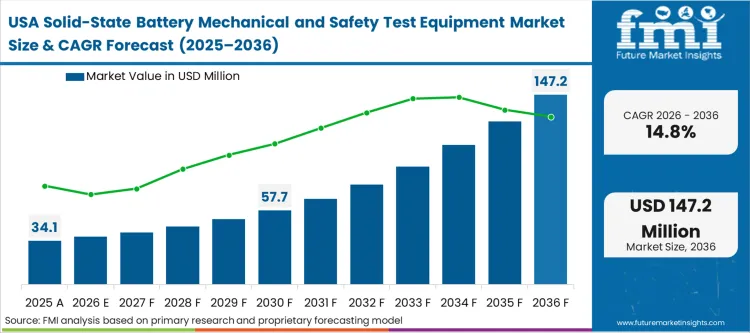
- United States: The United States is growing at 14.8%, driven by strict automotive safety homologation requirements that push startups to invest in solid-state battery validation equipment early in development. This is also supporting a broader ecosystem of specialized third-party testing consultants who help interpret complex mechanical failure data. Certification teams use these localized test results to strengthen technical credibility and improve investor confidence.
Western Europe Solid-State Battery Mechanical and Safety Test Equipment Market Analysis
FMI observes that European testing standards increasingly emphasize holistic electro-thermal-mechanical simulations rather than isolated physical abuse events. Premium automotive manufacturers attempting to leapfrog current technological paradigms drive European testing equipment demand. These automakers mandate that cell suppliers prove absolute mechanical resilience before considering integration into high-performance vehicle chassis.
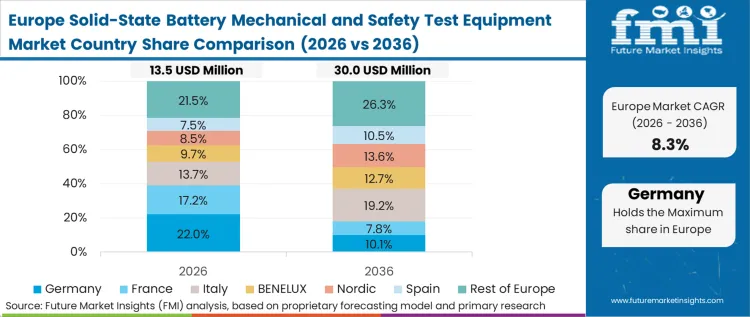
- Germany: Germany is seeing growth because its automotive R&D teams need battery test systems that can recreate tough vibration conditions while running fast-charging cycles at the same time. That is pushing validation teams toward more advanced mechatronic setups and creating closer working relationships between equipment suppliers and vehicle design groups. This demand is helping the market grow by 13.7%.
- France: France is moving in a slightly different direction, with more emphasis on shared testing infrastructure and better use of centralized facilities. Cross-border manufacturing partnerships are helping spread the cost of large testing centers across multiple programs and brands. That shift is making procurement more coordinated and is supporting 12.9% growth in the market.
FMI's report includes detailed testing capacity analyses for United Kingdom, Italy, and Scandinavia. Nordic regions display unique requirements regarding extreme low-temperature mechanical fracture testing.
Competitive Aligners for Market Players
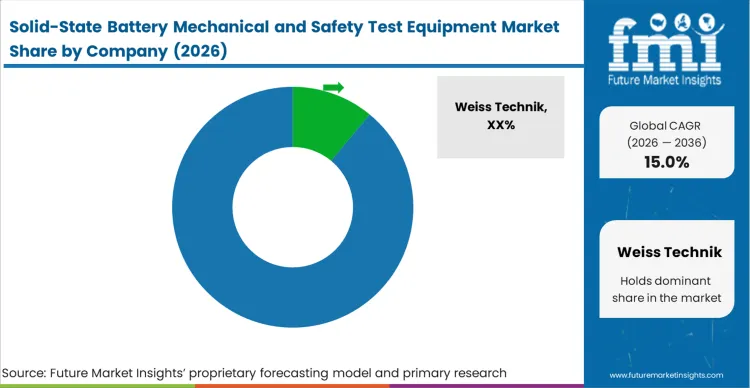
Competition in this space is highly specialized. Some companies are stronger in environmental testing, while others are better known for electrical cycling. For most buyers, the real concern is how smoothly these systems work together during failure testing. That matters more than the strength of any single machine on its own. This is why large battery plants usually prefer suppliers whose software can connect crush rigs, thermal chambers, and electrical loads without creating workflow gaps.
Established players have an edge because they already have mature software environments and a large base of pre-programmed test methods. That makes it harder for newer companies to compete, especially when labs are working with UN or IEC procedures that require accurate sequencing. New tools such as acoustic sensors or optical diagnostics may still struggle to gain traction if they add another isolated data stream inside the lab. Buyers are more comfortable when new hardware fits easily into the control systems they already use for solid-state battery validation.
At the same time, many large test labs do not want to depend too heavily on one supplier. Automotive OEMs often build their own control layer so they can pull raw data from different machines and manage testing more independently. This gives them more freedom to replace or upgrade equipment without changing the full setup. Suppliers that offer open API access and clean raw data are usually better received in these environments.
Key Players in Solid-State Battery Mechanical and Safety Test Equipment Market
- Weiss Technik
- Chroma ATE
- ESPEC
- Maccor
- Arbin Instruments
- Keysight Technologies (Scienlab)
- HORIBA
Scope of the Report
| Metric | Value |
|---|---|
| Quantitative Units | USD 58.6 million to USD 237.1 million, at a CAGR of 15.0% |
| Market Definition | This sector provides specialized hardware to stress, fracture, and validate solid-electrolyte cells under simultaneous mechanical, thermal, and electrical loads, determining precise safety limits before automotive deployment. |
| Segmentation | Equipment type, Battery level, Test mode, End user, Automation architecture, and Region |
| Regions Covered | North America, Latin America, Western Europe, Eastern Europe, East Asia, South Asia and Pacific, Middle East and Africa |
| Countries Covered | China, India, South Korea, United States, Japan, Germany, France |
| Key Companies Profiled | Weiss Technik, Chroma ATE, ESPEC, Maccor, Arbin Instruments, Keysight Technologies (Scienlab), HORIBA |
| Forecast Period | 2026 to 2036 |
| Approach | Capital expenditure allocations for validation lab upgrades among top ten battery manufacturers |
Source: Future Market Insights (FMI) analysis, based on proprietary forecasting model and primary research
Solid-State Battery Mechanical and Safety Test Equipment Market Analysis by Segments
-
Equipment type
- Integrated battery cycler + climatic/safety systems
- Crush / nail-penetration abuse systems
- Thermal runaway / explosion-protection chambers
- Shock / vibration and structural rigs
- Failure-analysis and post-event diagnostic systems
-
Battery level
- Cell-level systems
- Module-level systems
- Pack-level systems
- Material / interface coupon test fixtures
-
Test mode
- Mechanical abuse testing
- Thermal abuse testing
- Combined electro-thermal-mechanical validation
- Cycle-life plus safety preconditioning
- Forensic / post-failure characterization
-
End user
- Battery developers and OEM pilot lines
- Independent testing labs / certification centers
- Research institutes and universities
- Tier 1 / pack integrators
- Defense, aerospace, and specialty mobility programs
-
Automation architecture
- Chamber-integrated automated systems
- Standalone benchtop systems
- Data-logging and digital integration platforms
- Robotic sample handling cells
- Custom turnkey validation lines
-
Region
- North America
- United States
- Canada
- Latin America
- Brazil
- Mexico
- Rest of Latin America
- Western Europe
- Germany
- United Kingdom
- France
- Spain
- Italy
- BENELUX
- Rest of Western Europe
- Eastern Europe
- Poland
- Czech Republic
- Rest of Eastern Europe
- East Asia
- China
- Japan
- South Korea
- South Asia and Pacific
- India
- ASEAN
- ANZ
- Rest of South Asia and Pacific
- Middle East and Africa
- GCC Countries
- South Africa
- North Africa
- Rest of Middle East and Africa
- North America
Bibliography
- International Energy Agency. (2025). Electric vehicle batteries. In Global EV outlook 2025. IEA.
- U.S. Department of Energy. (2025). 2024 Annual Merit Review Vehicle Technologies Office Results Report.
- Karimi, E., Iglauer, S., Azhar, M. R., Wan, L. F., & others. (2025). Interface engineering and safety in solid-state batteries: Advancing from human-centered insights to AI-driven innovations. Advances in Colloid and Interface Science, 346, 103686.
- Pesaran, A. (2025). Defining the state of safety (SOS) for lithium-ion batteries in EVs: A discussion.
This bibliography is provided for reader reference. The full FMI report contains the complete reference list with primary source documentation.
This Report Addresses
- Specific capital expenditure patterns for cell-level abuse testing among major automotive OEMs.
- Software integration challenges between mechanical crush rigs and high-frequency electrical cycling platforms.
- A comprehensive solid-state battery test equipment procurement checklist utilized by leading pilot facilities.
- True failure mechanisms characterizing rigid ceramic electrolytes under dynamic vehicle vibration profiles.
- Throughput bottlenecks forcing test lab directors toward fully autonomous sample handling.
- Acoustic diagnostic integration requirements for detecting early-stage micro-cracks during thermal shifts.
- Shifting preferences away from static environmental chambers toward unified electro-mechanical validation cells.
- Competitive positioning among legacy instrumentation providers versus specialized solid hardware startups.
Frequently Asked Questions
How large is the demand for Solid-State Battery Mechanical and Safety Test Equipment in the global market in 2026?
Demand for Solid-State Battery Mechanical and Safety Test Equipment in the global market is estimated to be valued at USD 58.6 million in 2026.
What will be the market size of Solid-State Battery Mechanical and Safety Test Equipment in the global market by 2036?
Market size for Solid-State Battery Mechanical and Safety Test Equipment is projected to reach USD 237.1 million by 2036.
What is the expected demand growth for Solid-State Battery Mechanical and Safety Test Equipment in the global market between 2026 and 2036?
Demand for Solid-State Battery Mechanical and Safety Test Equipment is expected to grow at a CAGR of 15.0% between 2026 and 2036.
Which Equipment Type is poised to lead global sales by 2026?
Integrated battery cycler + climatic/safety systems account for 31.0% in 2026 as buyers prefer single-vendor validation cells with synchronized electrical, thermal, and safety testing.
Which Battery Level is expected to dominate demand by 2026?
Cell-level systems account for 42.0% in 2026 as manufacturers focus on interface stabilityand ceramic-layer validation before scaling to modules and packs.
Which Test Mode is strategically important in 2026?
Mechanical abuse testing is projected to hold 29.0% share in 2026 due to urgent demand for characterizing separator brittleness and compression-induced failure behavior.
What is driving demand in China?
China is expanding validation capacity as domestic battery giants build gigawatt-scale pilot lines and demand high-throughput automated abuse and safety testing systems.
What is the China growth outlook in this report?
China is projected to grow at a CAGR of 17.8% during 2026 to 2036.
What is India's growth outlook in this report?
India is projected to expand at a CAGR of 16.9% during 2026 to 2036.
Why is South Korea an important market in this report?
South Korea is seeing strong demand due to major chaebol-backed investments in next-generation cell formats and rising emphasis on precision interface-delamination testing.
What is the South Korea growth outlook in this report?
South Korea is projected to grow at a CAGR of 16.2% during 2026 to 2036.
Why is the United States described as a priority market in this report?
Federal grants supporting domestic battery supply chain independence and strict automotive homologation requirements are pushing early investment in advanced validation infrastructure.
What is the United States growth outlook in this report?
The United States is projected to grow at a CAGR of 14.8% during 2026 to 2036.
What is Japan's growth outlook in this report?
Japan is projected to grow at a CAGR of 14.1% during 2026 to 2036.
What is Germany's growth outlook in this report?
Germany is projected to grow at a CAGR of 13.7% during 2026 to 2036.
What is France's growth outlook in this report?
France is projected to grow at a CAGR of 12.9% during 2026 to 2036.
Why does demand remain concentrated at the cell level?
Cell-level validation remains dominant because OEMs must prove interface stability, ceramic durability, and early-stage defect behavior before moving toward larger module and pack architectures.
Why are integrated validation systems gaining importance?
Labs prefer integrated platforms because separated cyclers and crush rigs can miss millisecond-level voltage drops and create timing gaps during destructive events.
Why is mechanical abuse testing so critical for this market?
Solid-state batteries fail through ceramic cracking, interface delamination, and pressure-driven internal damage, making precision mechanical abuse validation essential.
Does the report cover the United States in its regional analysis?
Yes, the United States is included within North America under the regional scope of analysis.
Does the report cover Germany and France in its regional analysis?
Yes, Germany and France are included within Western Europe under the regional coverage framework.
What is Solid-State Battery Mechanical and Safety Test Equipment and what is it mainly used for?
It refers to specialized validation hardware used to test the physical integrity, safety limits, and failure thresholds of solid-electrolyte batteries under combined mechanical, thermal, and electrical loads.
What does Solid-State Battery Mechanical and Safety Test Equipment mean in this report?
The scope covers systems designed specifically to evaluate dendrite penetration, ceramic separator micro-cracking, interface delamination, and related solid-state battery failure modes.
What is included in the scope of this Solid-State Battery Mechanical and Safety Test Equipment report?
The market covers integrated cycler and chamber systems, crush and nail-penetration abuse systems, thermal runaway chambers, vibration rigs, post-event diagnostic systems, and associated software for these test sequences.
What is excluded from the scope of this report?
Standard electrical cyclers without mechanical-force capability, standalone manufacturing tools, chemical synthesis monitoring equipment, and general-purpose environmental chambers without battery-specific safety protection are excluded.
What does market forecast mean on this page?
The market forecast represents a model-based projection of future demand using defined capital expenditure, validation, and battery commercialization assumptions.
How does FMI build and validate the Solid-State Battery Mechanical and Safety Test Equipment forecast?
FMI builds the forecast using capital expenditure allocations for lab upgrades, pilot-line validation investments, primary interviews, and cross-validation against equipment shipment data from major suppliers.
What does independent cross-referencing against supplier shipment logs mean here?
It means forecast assumptions are checked against actual quarterly equipment shipment patterns from tier-one instrumentation providers rather than relying only on theoretical demand models.
What is the main demand theme linked to this market?
The main demand theme is the shift from liquid-electrolyte safety validation toward testing brittle solid-electrolyte interfaces under real mechanical, thermal, and electrochemical stress conditions.
Preview the report firsthand - request a free sample
Get SampleGet the brochure for pricing and purchase details.
Get PDFTable of Content
- Executive Summary
- Global Market Outlook
- Demand-side Trends
- Supply-side Trends
- Technology Roadmap Analysis
- Analysis and Recommendations
- Market Overview
- Market Coverage / Taxonomy
- Market Definition / Scope / Limitations
- Research Methodology
- Chapter Orientation
- Analytical Lens and Working Hypotheses
- Market Structure, Signals, and Trend Drivers
- Benchmarking and Cross-market Comparability
- Market Sizing, Forecasting, and Opportunity Mapping
- Research Design and Evidence Framework
- Desk Research Programme (Secondary Evidence)
- Company Annual and Sustainability Reports
- Peer-reviewed Journals and Academic Literature
- Corporate Websites, Product Literature, and Technical Notes
- Earnings Decks and Investor Briefings
- Statutory Filings and Regulatory Disclosures
- Technical White Papers and Standards Notes
- Trade Journals, Industry Magazines, and Analyst Briefs
- Conference Proceedings, Webinars, and Seminar Materials
- Government Statistics Portals and Public Data Releases
- Press Releases and Reputable Media Coverage
- Specialist Newsletters and Curated Briefings
- Sector Databases and Reference Repositories
- FMI Internal Proprietary Databases and Historical Market Datasets
- Subscription Datasets and Paid Sources
- Social Channels, Communities, and Digital Listening Inputs
- Additional Desk Sources
- Expert Input and Fieldwork (Primary Evidence)
- Primary Modes
- Qualitative Interviews and Expert Elicitation
- Quantitative Surveys and Structured Data Capture
- Blended Approach
- Why Primary Evidence is Used
- Field Techniques
- Interviews
- Surveys
- Focus Groups
- Observational and In-context Research
- Social and Community Interactions
- Stakeholder Universe Engaged
- C-suite Leaders
- Board Members
- Presidents and Vice Presidents
- R&D and Innovation Heads
- Technical Specialists
- Domain Subject-matter Experts
- Scientists
- Physicians and Other Healthcare Professionals
- Governance, Ethics, and Data Stewardship
- Research Ethics
- Data Integrity and Handling
- Primary Modes
- Tooling, Models, and Reference Databases
- Desk Research Programme (Secondary Evidence)
- Data Engineering and Model Build
- Data Acquisition and Ingestion
- Cleaning, Normalisation, and Verification
- Synthesis, Triangulation, and Analysis
- Quality Assurance and Audit Trail
- Market Background
- Market Dynamics
- Drivers
- Restraints
- Opportunity
- Trends
- Scenario Forecast
- Demand in Optimistic Scenario
- Demand in Likely Scenario
- Demand in Conservative Scenario
- Opportunity Map Analysis
- Product Life Cycle Analysis
- Supply Chain Analysis
- Investment Feasibility Matrix
- Value Chain Analysis
- PESTLE and Porter’s Analysis
- Regulatory Landscape
- Regional Parent Market Outlook
- Production and Consumption Statistics
- Import and Export Statistics
- Market Dynamics
- Global Market Analysis 2021 to 2025 and Forecast, 2026 to 2036
- Historical Market Size Value (USD Million) Analysis, 2021 to 2025
- Current and Future Market Size Value (USD Million) Projections, 2026 to 2036
- Y-o-Y Growth Trend Analysis
- Absolute $ Opportunity Analysis
- Global Market Pricing Analysis 2021 to 2025 and Forecast 2026 to 2036
- Global Market Analysis 2021 to 2025 and Forecast 2026 to 2036, By Equipment Type
- Introduction / Key Findings
- Historical Market Size Value (USD Million) Analysis By Equipment Type , 2021 to 2025
- Current and Future Market Size Value (USD Million) Analysis and Forecast By Equipment Type , 2026 to 2036
- Integrated battery cycler + climatic/safety systems
- Crush / nail-penetration abuse systems
- Others
- Integrated battery cycler + climatic/safety systems
- Y-o-Y Growth Trend Analysis By Equipment Type , 2021 to 2025
- Absolute $ Opportunity Analysis By Equipment Type , 2026 to 2036
- Global Market Analysis 2021 to 2025 and Forecast 2026 to 2036, By Deployment Stage
- Introduction / Key Findings
- Historical Market Size Value (USD Million) Analysis By Deployment Stage, 2021 to 2025
- Current and Future Market Size Value (USD Million) Analysis and Forecast By Deployment Stage, 2026 to 2036
- Cell-level system
- Module-level systems
- Others
- Cell-level system
- Y-o-Y Growth Trend Analysis By Deployment Stage, 2021 to 2025
- Absolute $ Opportunity Analysis By Deployment Stage, 2026 to 2036
- Global Market Analysis 2021 to 2025 and Forecast 2026 to 2036, By Test mode
- Introduction / Key Findings
- Historical Market Size Value (USD Million) Analysis By Test mode, 2021 to 2025
- Current and Future Market Size Value (USD Million) Analysis and Forecast By Test mode, 2026 to 2036
- Mechanical abuse testing
- Thermal abuse testing
- Others
- Mechanical abuse testing
- Y-o-Y Growth Trend Analysis By Test mode, 2021 to 2025
- Absolute $ Opportunity Analysis By Test mode, 2026 to 2036
- Global Market Analysis 2021 to 2025 and Forecast 2026 to 2036, By End User
- Introduction / Key Findings
- Historical Market Size Value (USD Million) Analysis By End User, 2021 to 2025
- Current and Future Market Size Value (USD Million) Analysis and Forecast By End User, 2026 to 2036
- Battery developers
- Tier 1 / pack integrators
- Others
- Battery developers
- Y-o-Y Growth Trend Analysis By End User, 2021 to 2025
- Absolute $ Opportunity Analysis By End User, 2026 to 2036
- Global Market Analysis 2021 to 2025 and Forecast 2026 to 2036, By Region
- Introduction
- Historical Market Size Value (USD Million) Analysis By Region, 2021 to 2025
- Current Market Size Value (USD Million) Analysis and Forecast By Region, 2026 to 2036
- North America
- Latin America
- Western Europe
- Eastern Europe
- East Asia
- South Asia and Pacific
- Middle East & Africa
- Market Attractiveness Analysis By Region
- North America Market Analysis 2021 to 2025 and Forecast 2026 to 2036, By Country
- Historical Market Size Value (USD Million) Trend Analysis By Market Taxonomy, 2021 to 2025
- Market Size Value (USD Million) Forecast By Market Taxonomy, 2026 to 2036
- By Country
- USA
- Canada
- Mexico
- By Equipment Type
- By Deployment Stage
- By Test mode
- By End User
- By Country
- Market Attractiveness Analysis
- By Country
- By Equipment Type
- By Deployment Stage
- By Test mode
- By End User
- Key Takeaways
- Latin America Market Analysis 2021 to 2025 and Forecast 2026 to 2036, By Country
- Historical Market Size Value (USD Million) Trend Analysis By Market Taxonomy, 2021 to 2025
- Market Size Value (USD Million) Forecast By Market Taxonomy, 2026 to 2036
- By Country
- Brazil
- Chile
- Rest of Latin America
- By Equipment Type
- By Deployment Stage
- By Test mode
- By End User
- By Country
- Market Attractiveness Analysis
- By Country
- By Equipment Type
- By Deployment Stage
- By Test mode
- By End User
- Key Takeaways
- Western Europe Market Analysis 2021 to 2025 and Forecast 2026 to 2036, By Country
- Historical Market Size Value (USD Million) Trend Analysis By Market Taxonomy, 2021 to 2025
- Market Size Value (USD Million) Forecast By Market Taxonomy, 2026 to 2036
- By Country
- Germany
- UK
- Italy
- Spain
- France
- Nordic
- BENELUX
- Rest of Western Europe
- By Equipment Type
- By Deployment Stage
- By Test mode
- By End User
- By Country
- Market Attractiveness Analysis
- By Country
- By Equipment Type
- By Deployment Stage
- By Test mode
- By End User
- Key Takeaways
- Eastern Europe Market Analysis 2021 to 2025 and Forecast 2026 to 2036, By Country
- Historical Market Size Value (USD Million) Trend Analysis By Market Taxonomy, 2021 to 2025
- Market Size Value (USD Million) Forecast By Market Taxonomy, 2026 to 2036
- By Country
- Russia
- Poland
- Hungary
- Balkan & Baltic
- Rest of Eastern Europe
- By Equipment Type
- By Deployment Stage
- By Test mode
- By End User
- By Country
- Market Attractiveness Analysis
- By Country
- By Equipment Type
- By Deployment Stage
- By Test mode
- By End User
- Key Takeaways
- East Asia Market Analysis 2021 to 2025 and Forecast 2026 to 2036, By Country
- Historical Market Size Value (USD Million) Trend Analysis By Market Taxonomy, 2021 to 2025
- Market Size Value (USD Million) Forecast By Market Taxonomy, 2026 to 2036
- By Country
- China
- Japan
- South Korea
- By Equipment Type
- By Deployment Stage
- By Test mode
- By End User
- By Country
- Market Attractiveness Analysis
- By Country
- By Equipment Type
- By Deployment Stage
- By Test mode
- By End User
- Key Takeaways
- South Asia and Pacific Market Analysis 2021 to 2025 and Forecast 2026 to 2036, By Country
- Historical Market Size Value (USD Million) Trend Analysis By Market Taxonomy, 2021 to 2025
- Market Size Value (USD Million) Forecast By Market Taxonomy, 2026 to 2036
- By Country
- India
- ASEAN
- Australia & New Zealand
- Rest of South Asia and Pacific
- By Equipment Type
- By Deployment Stage
- By Test mode
- By End User
- By Country
- Market Attractiveness Analysis
- By Country
- By Equipment Type
- By Deployment Stage
- By Test mode
- By End User
- Key Takeaways
- Middle East & Africa Market Analysis 2021 to 2025 and Forecast 2026 to 2036, By Country
- Historical Market Size Value (USD Million) Trend Analysis By Market Taxonomy, 2021 to 2025
- Market Size Value (USD Million) Forecast By Market Taxonomy, 2026 to 2036
- By Country
- Kingdom of Saudi Arabia
- Other GCC Countries
- Turkiye
- South Africa
- Other African Union
- Rest of Middle East & Africa
- By Equipment Type
- By Deployment Stage
- By Test mode
- By End User
- By Country
- Market Attractiveness Analysis
- By Country
- By Equipment Type
- By Deployment Stage
- By Test mode
- By End User
- Key Takeaways
- Key Countries Market Analysis
- USA
- Pricing Analysis
- Market Share Analysis, 2025
- By Equipment Type
- By Deployment Stage
- By Test mode
- By End User
- Canada
- Pricing Analysis
- Market Share Analysis, 2025
- By Equipment Type
- By Deployment Stage
- By Test mode
- By End User
- Mexico
- Pricing Analysis
- Market Share Analysis, 2025
- By Equipment Type
- By Deployment Stage
- By Test mode
- By End User
- Brazil
- Pricing Analysis
- Market Share Analysis, 2025
- By Equipment Type
- By Deployment Stage
- By Test mode
- By End User
- Chile
- Pricing Analysis
- Market Share Analysis, 2025
- By Equipment Type
- By Deployment Stage
- By Test mode
- By End User
- Germany
- Pricing Analysis
- Market Share Analysis, 2025
- By Equipment Type
- By Deployment Stage
- By Test mode
- By End User
- UK
- Pricing Analysis
- Market Share Analysis, 2025
- By Equipment Type
- By Deployment Stage
- By Test mode
- By End User
- Italy
- Pricing Analysis
- Market Share Analysis, 2025
- By Equipment Type
- By Deployment Stage
- By Test mode
- By End User
- Spain
- Pricing Analysis
- Market Share Analysis, 2025
- By Equipment Type
- By Deployment Stage
- By Test mode
- By End User
- France
- Pricing Analysis
- Market Share Analysis, 2025
- By Equipment Type
- By Deployment Stage
- By Test mode
- By End User
- India
- Pricing Analysis
- Market Share Analysis, 2025
- By Equipment Type
- By Deployment Stage
- By Test mode
- By End User
- ASEAN
- Pricing Analysis
- Market Share Analysis, 2025
- By Equipment Type
- By Deployment Stage
- By Test mode
- By End User
- Australia & New Zealand
- Pricing Analysis
- Market Share Analysis, 2025
- By Equipment Type
- By Deployment Stage
- By Test mode
- By End User
- China
- Pricing Analysis
- Market Share Analysis, 2025
- By Equipment Type
- By Deployment Stage
- By Test mode
- By End User
- Japan
- Pricing Analysis
- Market Share Analysis, 2025
- By Equipment Type
- By Deployment Stage
- By Test mode
- By End User
- South Korea
- Pricing Analysis
- Market Share Analysis, 2025
- By Equipment Type
- By Deployment Stage
- By Test mode
- By End User
- Russia
- Pricing Analysis
- Market Share Analysis, 2025
- By Equipment Type
- By Deployment Stage
- By Test mode
- By End User
- Poland
- Pricing Analysis
- Market Share Analysis, 2025
- By Equipment Type
- By Deployment Stage
- By Test mode
- By End User
- Hungary
- Pricing Analysis
- Market Share Analysis, 2025
- By Equipment Type
- By Deployment Stage
- By Test mode
- By End User
- Kingdom of Saudi Arabia
- Pricing Analysis
- Market Share Analysis, 2025
- By Equipment Type
- By Deployment Stage
- By Test mode
- By End User
- Turkiye
- Pricing Analysis
- Market Share Analysis, 2025
- By Equipment Type
- By Deployment Stage
- By Test mode
- By End User
- South Africa
- Pricing Analysis
- Market Share Analysis, 2025
- By Equipment Type
- By Deployment Stage
- By Test mode
- By End User
- USA
- Market Structure Analysis
- Competition Dashboard
- Competition Benchmarking
- Market Share Analysis of Top Players
- By Regional
- By Equipment Type
- By Deployment Stage
- By Test mode
- By End User
- Competition Analysis
- Competition Deep Dive
- Weiss Technik
- Overview
- Product Portfolio
- Profitability by Market Segments (Product/Age /Sales Channel/Region)
- Sales Footprint
- Strategy Overview
- Marketing Strategy
- Product Strategy
- Channel Strategy
- Chroma ATE
- ESPEC
- Maccor
- Arbin Instruments
- Weiss Technik
- Competition Deep Dive
- Assumptions & Acronyms Used


