

- Market Size (2026)
- USD 68.5 Mn
- Forecast (2036)
- USD 136.1 Mn
- CAGR (2026 to 2036)
- 7.1%
Hybrid Supercapacitor Lifetime and Safety Test Equipment Market Size, Market Forecast and Outlook By FMI
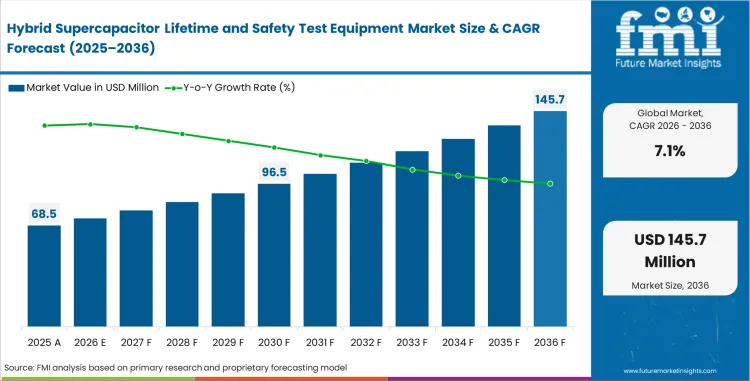
The hybrid supercapacitor lifetime and safety test equipment market was valued at USD 64.0 million in 2025. The sector is estimated to reach USD 68.5 million in 2026, reflecting steady demand for specialized validation systems. The market is projected to reach 7.1% CAGR from 2026 to 2036, with total revenue expected to reach USD 136.1 million by 2036. Growth is linked to increasing requirements for extended cycle testing, stricter safety validation, and improved failure traceability before deployment.
Summary of Hybrid Supercapacitor Lifetime and Safety Test Equipment Market
- Hybrid Supercapacitor Lifetime and Safety Test Equipment Market Market Snapshot
- The hybrid supercapacitor lifetime and safety test equipment market was valued at USD 64.0 million in 2025 and is projected to reach USD 136.1 million by 2036.
- Industry revenue is expected to rise at 7.1% CAGR from 2026 to 2036, creating an incremental opportunity of USD 67.6 million over the period.
- This category remains a specification-driven test equipment segment where channel stability, safety controls, and repeatable electrochemical data shape vendor selection.
- Scope centers on equipment used to validate hybrid supercapacitors and lithium-ion capacitors for lifetime, abuse, impedance, and chamber-linked performance work.
- Hybrid Supercapacitor Lifetime and Safety Test Equipment Market Demand and Growth Drivers
- Demand is increasing as hybrid supercapacitor programs require longer cycle datasets and clearer failure tracking before deployment in transport, UPS, and industrial applications.
- Safety-capable test benches are gaining attention as heating behavior, abuse response, and electrical drift must be measured within a single setup rather than across separate systems.
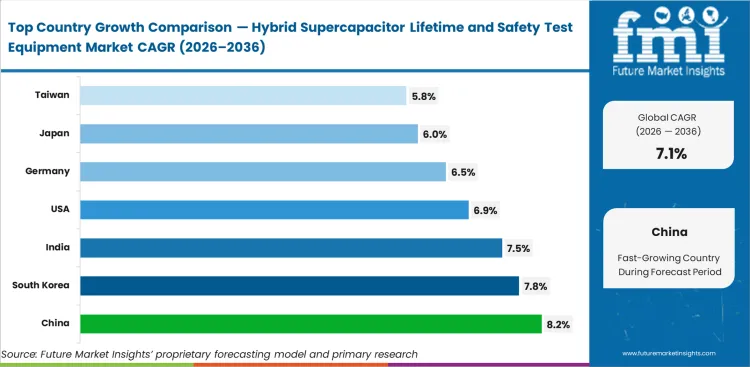
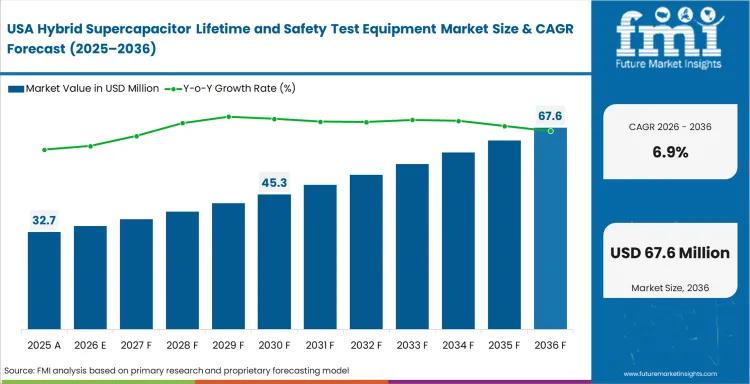
- China is projected to expand at 8.2% CAGR in the hybrid supercapacitor lifetime and safety test equipment market from 2026 to 2036, followed by South Korea at 7.8% CAGR and India at 7.5% CAGR. The United States is expected to record 6.9% CAGR, while Germany posts 6.5% CAGR, Japan 6.0% CAGR, and Taiwan 5.8% CAGR over the same period.
- China, South Korea, and India support higher demand through stronger activity in electronics and energy storage hardware, while mature markets continue to invest in precision validation systems.
- Adoption slows when general battery testing platforms are used beyond their intended scope, as this creates data gaps and increases the need for repeat testing.
- Hybrid Supercapacitor Lifetime and Safety Test Equipment Market Product and Segment View
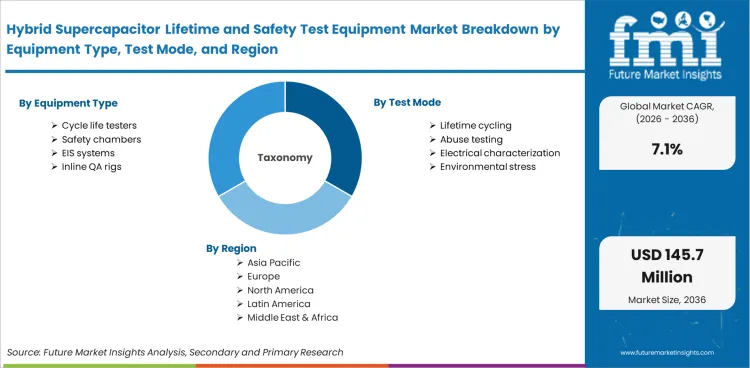
- The market is estimated to include cycle life testers, safety chambers, EIS systems, and inline QA rigs used to measure capacitance retention, ESR behavior, temperature response, and cycling durability.
- Applications are expected across cell development, module integration, research programs, UPS qualification, and certification workflows tied to electrochemical reliability.
- Cycle life testers are projected to account for 41.0% share of the equipment type segment in 2026, as long-duration durability testing forms the basis of most validation programs.
- Lifetime cycling is anticipated to represent 46.0% share of the test mode segment in 2026, since retention and degradation data determine the relevance of further safety and environmental testing.
- Cell manufacturers are expected to hold 34.0% share of the end use segment in 2026, reflecting the concentration of validation activity at early development stages.
- Cells are projected to account for 52.0% share of the form factor segment in 2026, as initial testing demand remains highest at the electrode and cell level.
- Multi-channel automated systems are anticipated to capture 58.0% share of the automation segment in 2026, as synchronized long-duration testing improves consistency and reduces operator effort.
- The scope is estimated to include dedicated supercapacitor and lithium-ion capacitor validation equipment, while excluding general-purpose passive component testers and testing services without integrated hardware.
- Hybrid Supercapacitor Lifetime and Safety Test Equipment Market Geography and Competitive Outlook
- China, South Korea, and India are the fastest-growing national demand centers, while the United States, Germany, Japan, and Taiwan provide steadier high-specification purchasing bases.
- Competition is shaped by the ability to combine cycling, safety, chamber integration, and analytics in one platform rather than by single-box hardware alone.
- Chroma ATE, Arbin Instruments, Maccor, Digatron, BioLogic, Neware, and Keysight Technologies remain visible suppliers across this niche.
Key Takeaways, Market Size, and Forecast
- Hybrid Supercapacitor Lifetime and Safety Test Equipment Market is projected to grow from USD 68.5 million in 2026 to USD 136.1 million by 2036, at a CAGR of 7.1%.
- The hybrid supercapacitor lifetime and safety test equipment market was valued at USD 64.0 million in 2025.
- By 2036, the Hybrid Supercapacitor Lifetime and Safety Test Equipment Market is expected to be worth USD 136.1 million.
- Over the 2026 to 2036 period, the market is forecast to advance at a CAGR of 7.1%.
- The market is likely to generate an incremental opportunity of USD 67.6 million during the forecast period.
- In 2026, Cycle life testers are projected to account for 41.0% of the equipment type segment.
- China (8.2% CAGR) and South Korea (7.8% CAGR) are expected to be two of the fastest growing markets.
Testing teams are shifting away from adapting standard battery cyclers for capacitor applications. Equipment selection now depends on the ability to capture lifetime, safety, impedance, and environmental data within a single controlled setup. Separate test benches create inconsistencies and increase validation time. Integrated systems improve data comparability and reduce rework during product qualification.
Demand increases when development programs move from early-stage testing to repeatable validation across multiple conditions. At this stage, dedicated equipment becomes necessary to maintain consistency across channels and test environments. This transition is typically driven by internal validation requirements, as teams need reliable datasets for approval decisions.
China is projected to reach a CAGR of 8.2% in the hybrid supercapacitor lifetime and safety test equipment market from 2026 to 2036, supported by expansion in electronics manufacturing and energy storage development. South Korea is expected to expand at a CAGR of 7.8% over the same period, followed by India at 7.5%. The United States is anticipated to grow at a CAGR of 6.9% from 2026 to 2036, while Germany is forecast to grow at 6.5%. Japan is expected to expand at a CAGR of 6.0%, and Taiwan at 5.8% during the same period. Growth in these markets reflects steady validation demand supported by established industrial and electronics sectors.
Hybrid Supercapacitor Lifetime and Safety Test Equipment Market Key Takeaways
| Metric | Details |
|---|---|
| Industry Size (2026) | USD 68.5 million |
| Industry Value (2036) | USD 136.1 million |
| CAGR (2026-2036) | 7.1% |
Source: Future Market Insights analysis, based on proprietary forecasting model and primary research
Segmental Analysis
Hybrid Supercapacitor Lifetime and Safety Test Equipment Market Analysis by Equipment Type
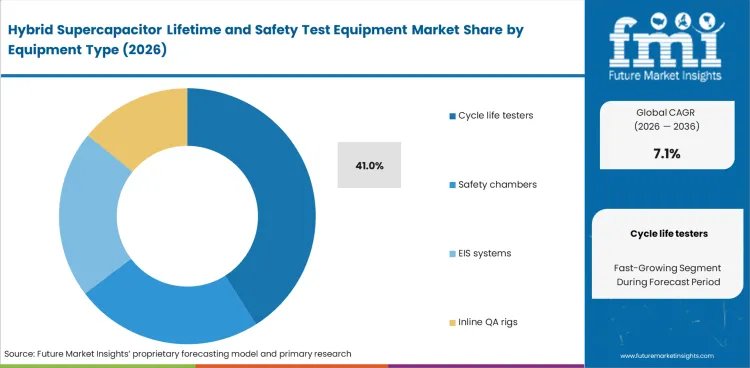
Validation teams prioritize investment in systems that establish retention performance over time. Cycle life testers are expected to account for 41.0% share of the equipment type segment in 2026, as durability data forms the basis for release decisions in hybrid capacitor programs. These systems are selected for their ability to manage multiple channels under stable current control and generate comparable datasets across different chemistries and form factors. Safety chambers and EIS systems remain important but are typically introduced after core cycling infrastructure is in place. Equipment selection that does not support consistent long-duration testing often leads to repeated test cycles, fragmented data, and delays in design validation. Increasing use of advanced supercapacitor materials further strengthens the need for controlled and reliable characterization systems.
- Channel stability: Stable long-run control keeps datasets comparable across extended qualification cycles. Quality teams lose time quickly when drift forces repeated validation.
- Retention evidence: Durability curves help cell-development teams decide whether later safety work is worth scaling. Weak evidence leaves release meetings unresolved.
- Data continuity: One consistent cycling workflow reduces file breaks between early studies and formal sign-off. Fragmented records make audit review harder.
Hybrid Supercapacitor Lifetime and Safety Test Equipment Market Analysis by Test Mode
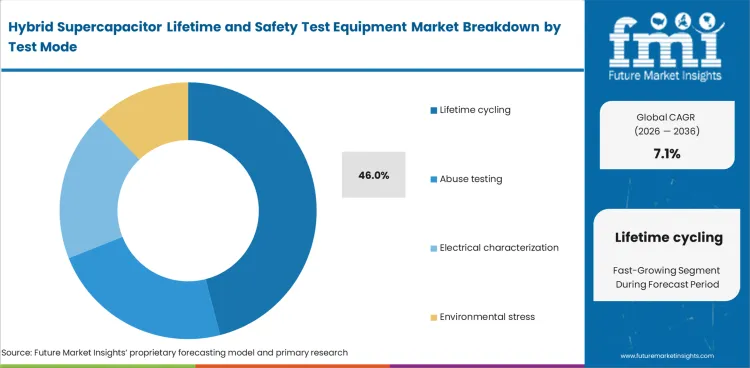
Program owners rarely start with abuse work alone when hybrid capacitor designs are still being screened. Lifetime cycling is projected to contribute 46.0% share in 2026 as retention, ESR movement, and repeatability usually decide whether a design deserves deeper safety investment. Buyers use this mode to compare electrode builds, process changes, and packaging decisions under long-duration conditions that generic bench tools handle poorly. FMI attributes this lead to a simple operating reality: once durability evidence is weak, later safety data carries less commercial weight. Abuse testing and environmental stress rigs gain importance later, but lifecycle data still sets the testing sequence and the spending order. UPS health testing strengthens that read across adjacent FMI coverage of supercapacitor-related validation demand.
- Aging sequence: Long-run cycling gives design teams an early read on whether drift is manageable. Poor sequence design can hide failure modes until late-stage review.
- Comparison discipline: Like-for-like cycling makes chemistry and packaging comparisons easier to defend. Procurement teams need that clarity before expanding platform spend.
- Release timing: Durability results guide when a program moves into chamber work and broader validation. Delayed cycling pushes the whole approval path back.
Hybrid Supercapacitor Lifetime and Safety Test Equipment Market Analysis by End Use
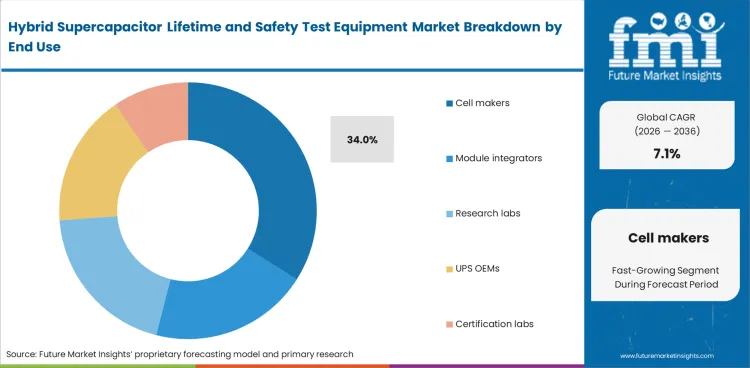
Cell manufacturers are expected to represent 34.0% share of the end use segment in 2026, as most validation work begins at the early development stage before module design and integration decisions are finalized. Testing demand is highest during formulation and cell-level evaluation, where systems must support both exploratory work and repeatable qualification within the same software environment. Research labs and certification centers follow this demand, as their testing frameworks often align with methods established during initial development. Cell developers carry the primary responsibility for data consistency and validation accuracy. Weak internal testing setups lead to delays in downstream integration, extended validation cycles, and additional requalification work. Reliable early-stage testing reduces these risks and supports smoother transition across the development process.
- Formulation screening: Cell makers use dedicated benches to compare electrode and electrolyte choices under controlled cycling. Bad early screening passes uncertainty downstream.
- Transfer readiness: Data generated upstream needs to hold up when module teams take over. Weak transfer standards slow cooperation between groups.
- Workflow ownership: Early-stage buyers choose the software and test logic many later users must accept. Poor choices create long-lived switching costs.
Hybrid Supercapacitor Lifetime and Safety Test Equipment Market Analysis by Form Factor Tested
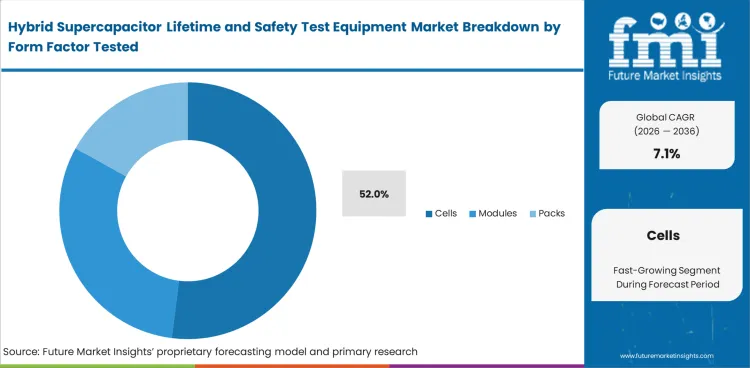
Cell-level testing remains the primary focus in this category because early validation depends on isolating chemistry performance before scaling. Buyers prefer cell-level systems when they need high sample throughput, quick setup changes, and clear separation between material behavior and packaging effects. Module and pack testing become relevant at later stages, but initial cell data determines whether further investment is justified. Cells are expected to account for 52.0% share of the form factor segment in 2026, reflecting this priority. Moving too quickly to larger assemblies can obscure degradation sources and increase correction time and cost, making early-stage precision testing essential.
- Sample density: Cell rigs let engineers test more variants without consuming full module hardware. Thin sample coverage weakens design selection.
- Failure isolation: Smaller test units show whether drift comes from chemistry or assembly. Mixed failure signals delay corrective work.
- Budget control: Cell-level qualification keeps early validation spend tied to the highest-learning stage. Oversized setups can trap budget too early.
Hybrid Supercapacitor Lifetime and Safety Test Equipment Market Analysis by Automation Level
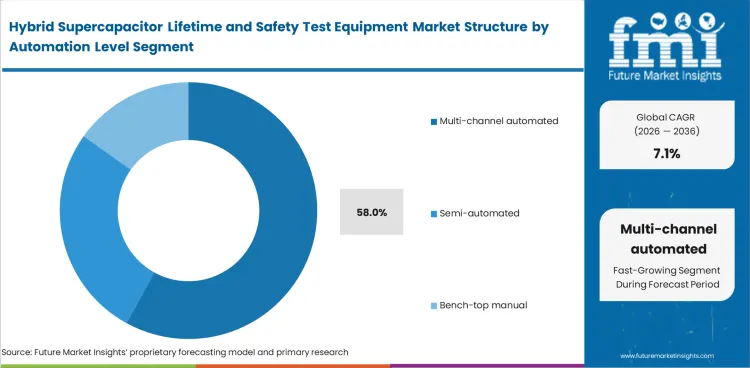
Operator time becomes a real cost once cycling windows stretch and comparison sets widen. Multi-channel automated systems are forecast to account for 58.0% share in 2026 because they reduce manual intervention, improve timing consistency, and keep long-duration tests moving through nights and weekends without constant resets. Bench-top manual setups still have a place in exploratory work, yet buyers scaling formal validation usually need synchronized runs that produce cleaner cross-sample analysis. FMI sees automation leading here because labor discipline and data discipline are connected. Teams that rely too long on manual handling often end up with uneven sampling windows, more logging mistakes, and less confidence when program reviews turn contentious. EV formation testing offers a nearby FMI example of how automation depth becomes part of equipment choice once electrochemical programs scale.
- Scheduling control: Automated channels keep run timing consistent across long tests. Irregular scheduling weakens cross-sample comparison.
- Operator relief: Less manual intervention lowers the burden on lab staff during extended studies. Frequent touchpoints raise the risk of handling errors.
- Portfolio throughput: Higher channel counts let validation teams move more designs through one platform. Low throughput slows portfolio decisions.
Hybrid Supercapacitor Lifetime and Safety Test Equipment Market Drivers, Restraints, and Opportunities
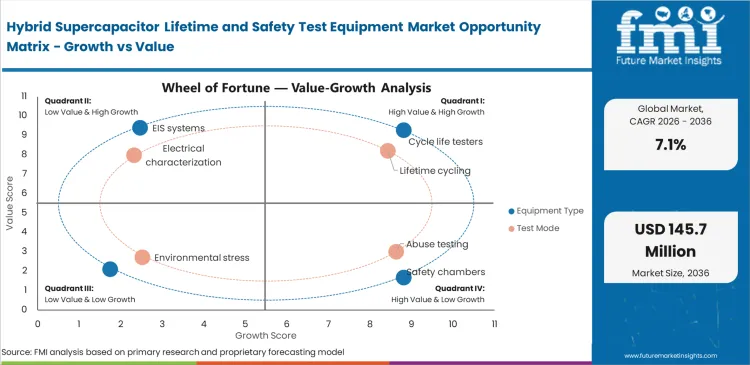
Qualification teams are deciding earlier whether hybrid supercapacitor programs require dedicated validation systems or can continue on adapted battery platforms. This decision has become more critical as lifetime, impedance, thermal response, and safety data need to remain within a single traceable workflow from early testing to final approval. Integrated systems reduce repeated setup changes and improve data consistency across validation stages. Testing requirements are increasingly influencing equipment investment decisions as electrochemical technologies demand tighter validation control.
Internal alignment remains the main constraint on adoption. Engineering, quality, and budget teams often recognize the need for improved testing capability but move at different speeds. Existing battery systems with unused capacity delay new investment decisions, even when they do not fully meet testing requirements. Software upgrades and modular additions provide partial relief but do not resolve the need for dedicated systems. Delayed alignment leads to extended use of suboptimal setups, which eventually results in inconsistent data and slower validation timelines.
Opportunities in the Hybrid Supercapacitor Lifetime and Safety Test Equipment Market
- Platform consolidation: Vendors that combine cycling, EIS, safety controls, and chamber connectivity can win earlier in the buying cycle. Lab managers value fewer handoffs when programs move from exploratory work into formal validation. Automotive BMS adds a related FMI signal that electrochemical monitoring stacks are gaining more integrated decision weight.
- Service calibration: Suppliers that can support periodic calibration, software continuity, and fast issue response gain ground with labs running long-duration tests. Equipment value falls quickly when support gaps interrupt multi-week studies.
- Application specialization: UPS, transport, and industrial buyers create room for test workflows tailored to their own duty patterns. Vendors that map those use cases clearly can defend pricing better than sellers offering only generic channel counts.
Regional Analysis
Based on the regional analysis, the Hybrid Supercapacitor Lifetime and Safety Test Equipment Market is segmented into North America, Latin America, Western Europe, Eastern Europe, South Asia and Pacific, East Asia, and the Middle East and Africa across 40 plus countries.
.webp "Top Country Growth Comparison Hybrid Supercapacitor Lifetime And Safety Test Equipment Market Cagr (2026 2036)")
| Country | CAGR (2026 to 2036) |
|---|---|
| China | 8.2% |
| South Korea | 7.8% |
| India | 7.5% |
| United States | 6.9% |
| Germany | 6.5% |
| Japan | 6.0% |
| Taiwan | 5.8% |
Source: Future Market Insights analysis, based on proprietary forecasting model and primary research
North America Hybrid Supercapacitor Lifetime and Safety Test Equipment Market Analysis
Qualification spending in North America tends to follow accountability requirements inside engineering and quality organizations rather than quick volume pushes. Buyers usually want equipment that can survive audit-style review, preserve historical datasets, and connect cleanly with chamber and analytics workflows already in use. That preference keeps the region important for high-specification purchases even when volume growth is not the fastest. Battery testing equipment and solid-state battery safety mirror that FMI pattern in adjacent validation categories where precision and traceability matter as much as hardware throughput.
- United States: The United States shows steady progression, with growth aligned at 6.9% from 2026 to 2036, supported by demand from advanced electronics and critical power applications. Testing programs require systems that maintain consistent records across cycling, impedance measurement, and safety validation. Generic setups often struggle to produce clean datasets across multiple test stages. Buyers therefore invest in dedicated platforms that support synchronized testing workflows. Integration with existing lab infrastructure remains essential. These conditions support demand for high-specification and audit-ready testing systems.
FMI’s report also covers Canada and additional countries in the region. Purchasing patterns there tend to favor careful platform selection over rushed bench expansion, which keeps support quality and software continuity visible in supplier discussions.
Western Europe Hybrid Supercapacitor Lifetime and Safety Test Equipment Market Analysis
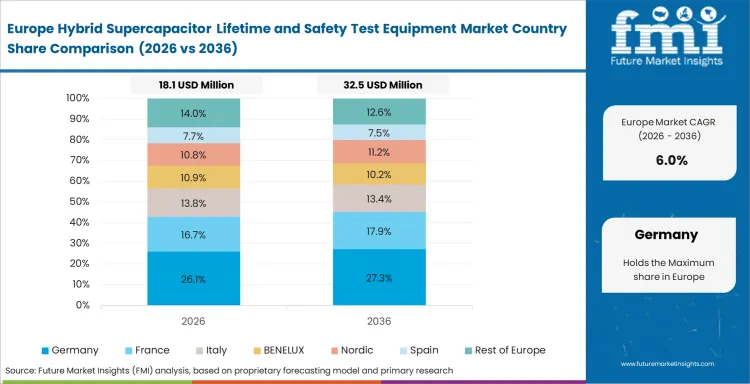
Western Europe remains valuable because electronics, automotive, and industrial buyers often put more weight on repeatability before they widen program scale. Labs in this region tend to treat validation equipment as part of release discipline rather than as an experimental convenience, which supports steady demand for systems that can hold stable data across long runs. Electric capacitor, high voltage capacitors, and power capacitors help frame FMI’s analysis of how capacitor-related equipment demand follows specification depth and application rigor.
- Germany: Automotive electronics, industrial power systems, and methodical validation culture give Germany a strong position in this niche. The market for hybrid supercapacitor lifetime and safety test equipment in Germany is forecast to register a CAGR of 6.5% through 2036. Buyers that stay with loosely integrated setups often carry a longer documentation burden when internal reviewers ask for clearer comparability across test stages.
Additional Western European countries covered in FMI’s study show a similar preference for controlled validation, though pace varies by local manufacturing concentration and budget timing. That pattern supports durable demand, yet it also raises the bar for vendors that cannot back hardware with responsive service.
East Asia and South Asia Pacific Hybrid Supercapacitor Lifetime and Safety Test Equipment Market Analysis
Manufacturing density changes the pace of adoption across Asia. Buyers in faster-growing countries are not only adding programs; they are also moving more quickly from exploratory testing into repeatable qualification, which lifts the need for automated channels, cleaner software control, and tighter chamber integration. Ultracapacitors, automotive ultracapacitor, battery energy storage, and advanced energy storage together support FMI’s view that device adoption and validation demand are scaling in the same broad direction across Asian manufacturing hubs.
- China: China leads the growth range, with the hybrid supercapacitor lifetime and safety test equipment market projected to expand at 8.2% CAGR through 2026 to 2036. Rapid transition from pilot testing to full qualification increases pressure on lab infrastructure. Facilities that rely on shared or generic equipment often face scheduling conflicts and data overlap issues. Buyers prioritize automated systems that allow parallel testing with clear data separation. Equipment must support high program throughput without compromising record integrity. These conditions drive continued investment in advanced validation platforms.
- South Korea: South Korea benefits from dense electronics capability and a buyer base that tends to value high-control instrumentation early in product development. Sales of hybrid supercapacitor lifetime and safety test equipment in South Korea are on track to record a CAGR of 7.8% through 2036. Delayed investment usually shows up as bottlenecks when several candidate designs need synchronized comparison under the same validation logic.
- India: India continues to expand its testing capabilities as new energy storage programs emerge. The market is expected to move at 7.5% CAGR through 2036, supported by increasing demand for formalized validation frameworks. Labs that rely on fragmented setups often face delays during data consolidation and reporting. Buyers prioritize systems that streamline test execution and data handling. Equipment must support evolving validation standards. These conditions support steady adoption across developing testing ecosystems.
- Japan: Japan maintains a steady pace, where growth remains close to 6.0% through 2036, shaped by structured engineering practices and careful capital allocation. Testing systems are evaluated based on stability and long-term performance rather than rapid scalability. Buyers require precise control over test parameters across extended durations. Equipment must integrate without disrupting existing workflows. These factors sustain demand for reliable and well-calibrated validation systems.
- Taiwan: Taiwan’s role in electronics and component manufacturing supports continued demand for precise validation tools, especially where clean comparability matters more than sheer volume. The Taiwan market for hybrid supercapacitor lifetime and safety test equipment is likely to post a CAGR of 5.8% during the study period. Buyers that treat the category as a simple add-on risk longer troubleshooting cycles when data records need to stand up across multiple product iterations.
FMI’s report includes additional countries across Asia Pacific beyond the ones listed above. Shared momentum comes from a wider manufacturing base, but supplier success still depends on how well systems fit local service expectations and lab operating routines.
Competitive Aligners for Market Players
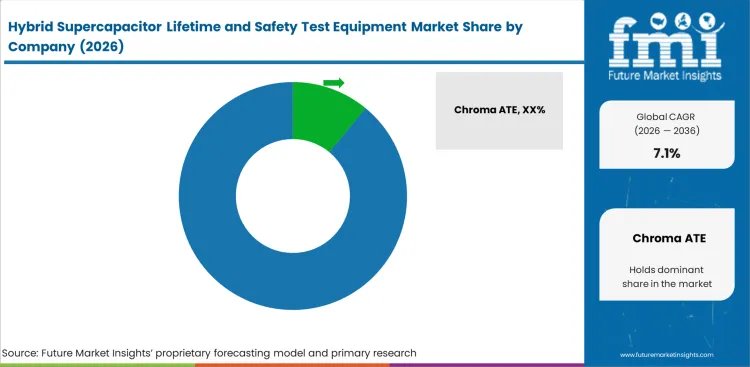
Competition remains moderately fragmented because selection depends on performance and workflow fit rather than brand visibility. Buyers focus on long-duration control stability, integration with environmental chambers, data usability, and response time when test campaigns face issues. Suppliers such as Chroma ATE, Arbin Instruments, Maccor, Digatron, BioLogic, Neware, and Keysight Technologies compete across different combinations of these requirements in research, production, and validation settings. Equipment choice reflects the need for precise and repeatable measurement rather than general capability.
Established suppliers hold an advantage through mature software, reliable control systems, and service practices already familiar to testing labs. New entrants can compete when they offer faster customization, clearer alignment with hybrid capacitor workflows, and strong technical support during setup and operation. Pricing alone is not sufficient to win, as buyers prioritize system performance and support quality.
Large organizations aim to avoid dependence on a single platform by requiring exportable data formats, adaptable software, and service models that support evolving validation needs. Suppliers benefit when customers standardize on their systems, but switching flexibility remains an important consideration. This balance is expected to keep the market open to specialized providers while favoring those that reduce transition effort without compromising support.
Key Players in Hybrid Supercapacitor Lifetime and Safety Test Equipment Market
- Chroma ATE
- Arbin Instruments
- Maccor
- Digatron
- BioLogic
- Neware
- Keysight Technologies
Scope of the Report
| Metric | Value |
|---|---|
| Quantitative Units | USD 68.5 million to USD 136.1 million, at a CAGR of 7.1% |
| Market Definition | Dedicated equipment used to evaluate hybrid supercapacitors and lithium-ion capacitors for lifetime, safety, impedance, and validation consistency across laboratory and qualification workflows. |
| Equipment Type Segmentation | Cycle life testers, Safety chambers, EIS systems, Inline QA rigs |
| Test Mode Segmentation | Lifetime cycling, Abuse testing, Electrical characterization, Environmental stress |
| End Use Segmentation | Cell makers, Module integrators, Research labs, UPS OEMs, Certification labs |
| Form Factor Tested | Cells, Modules, Packs |
| Regions Covered | North America, Latin America, Western Europe, Eastern Europe, South Asia and Pacific, East Asia, Middle East and Africa |
| Countries Covered | China, South Korea, India, United States, Germany, Japan, Taiwan, and 40 plus countries |
| Key Companies Profiled | Chroma ATE; Arbin Instruments; Maccor; Digatron; BioLogic; Neware; Keysight Technologies |
| Forecast Period | 2026 to 2036 |
Source: Future Market Insights analysis, based on proprietary forecasting model and primary research
Hybrid Supercapacitor Lifetime and Safety Test Equipment Market Analysis by Segments
Equipment Type
- Cycle life testers
- Safety chambers
- EIS systems
- Inline QA rigs
Test Mode
- Lifetime cycling
- Abuse testing
- Electrical characterization
- Environmental stress
End Use
- Cell makers
- Module integrators
- Research labs
- UPS OEMs
- Certification labs
Form Factor Tested
- Cells
- Modules
- Packs
Automation Level
- Multi-channel automated
- Semi-automated
- Bench-top manual
Region:
- North America
- United States
- Canada
- Europe
- Germany
- United Kingdom
- France
- Italy
- Spain
- Asia Pacific
- China
- Japan
- South Korea
- Taiwan
- Singapore
- Latin America
- Brazil
- Mexico
- Argentina
- Middle East & Africa
- GCC Countries
- South Africa
- Israel
Bibliography
- USA Department of Energy. (2024, August). Achieving the Promise of Low-Cost Long Duration Energy Storage. USA Department of Energy.
- Mazloomian, K., Atwa, Y. M., Gualous, H., & El Baghdadi, M. (2025). Supercapacitor safety: Temperature driven instability and impact of repeated heating on electrochemical performance. Heliyon.
- Doucet, T., Coquery, G., Vivier, S., et al. (2025). Multiphysics measurement method for supercapacitors: From ageing characterization to state of health monitoring through casing mechanical deformation. Micromachines, 16(11), 1295.
- Min, F., Cui, Y., Li, H., et al. (2026). Simple deep neural network model for accurate state of health estimation and degradation trajectory prediction of Li-ion capacitor and supercapacitor. Energy & Fuels.
- Landi, G., Sorrentino, A., et al. (2026). A design strategy to significantly improve the lifetime of sustainable supercapacitors. Communications Materials.
This Report Addresses
- Where hybrid supercapacitor lifetime and safety test equipment demand stands in 2025, 2026, and 2036.
- Which equipment type, test mode, end-use group, form factor, and automation level lead current demand.
- Why lifetime cycling remains the main purchasing anchor in hybrid capacitor validation workflows.
- How buyer requirements differ across cell makers, module integrators, labs, UPS OEMs, and certification teams.
- Which countries are expanding faster and what operating conditions explain those differences.
- How competitive structure remains open enough for specialist suppliers despite established incumbents.
- What is included in market scope and which adjacent categories remain outside the boundary.
- How FMI interprets the commercial logic shaping procurement, qualification, and vendor selection in this category.
Frequently Asked Questions
What is hybrid supercapacitor lifetime and safety test equipment?
It is dedicated hardware and software used to validate hybrid supercapacitors and lithium-ion capacitors for lifetime, abuse response, impedance behavior, and repeatable release data.
How large is the market in 2025?
How large is the market in 2025?
What is the 2026 industry value?
Industry value is expected to reach USD 68.5 million in 2026.
How large could the category become by 2036?
FMI projects the market to reach USD 136.1 million by 2036.
What CAGR is expected from 2026 to 2036?
The forecast points to 7.1% CAGR over the period.
Which equipment type leads the market?
Cycle life testers lead equipment type with an estimated 41.0% share in 2026.
Which test mode carries the largest share?
Lifetime cycling leads test mode with 46.0% share in 2026.
Which end-use group leads demand?
Cell makers are expected to represent 34.0% share in 2026.
Which form factor tested remains dominant?
Cells lead form factor tested with 52.0% share in 2026.
Which automation level leads purchasing?
Multi-channel automated systems are projected to account for 58.0% share in 2026.
Why do buyers favor cycle life testers first?
Durability evidence usually decides whether a hybrid capacitor design deserves broader safety and qualification spending.
Why does automation matter in this category?
Long-duration testing creates operator burden, and automation improves timing consistency and dataset quality.
Why is China the fastest-growing country in the forecast?
China combines manufacturing depth, program density, and faster movement from pilot work into repeatable qualification, which supports 8.2% CAGR.
How fast is South Korea expected to grow?
South Korea is projected to grow at 7.8% CAGR through 2036.
What is the outlook for India?
India is expected to post 7.5% CAGR through 2036 as new programs and storage-related hardware activity expand.
How fast is the United States market expected to expand?
The United States is expected to grow at 6.9% CAGR through 2036.
What is Germany’s forecast growth rate?
Germany is forecast to expand at 6.5% CAGR over the study period.
How fast are Japan and Taiwan expected to grow?
Japan is expected to grow at 6.0% CAGR, while Taiwan is projected at 5.8% CAGR.
What is the main buyer challenge in this market?
Internal qualification cycles slow purchases because engineering, quality, and budget owners often approve at different speeds.
How concentrated is competition?
Competition remains moderately fragmented, with the leading supplier estimated at 11.4% share.
Which companies are visible in this market?
Chroma ATE, Arbin Instruments, Maccor, Digatron, BioLogic, Neware, and Keysight Technologies are among the visible suppliers.
What is included in the market scope?
Scope includes dedicated cycle-life, safety, EIS, and QA systems used for hybrid supercapacitor and LIC validation.
Preview the report firsthand - request a free sample
Get SampleGet the brochure for pricing and purchase details.
Get PDFTable of Content
- Executive Summary
- Global Market Outlook
- Demand-side Trends
- Supply-side Trends
- Technology Roadmap Analysis
- Analysis and Recommendations
- Market Overview
- Market Coverage / Taxonomy
- Market Definition / Scope / Limitations
- Research Methodology
- Chapter Orientation
- Analytical Lens and Working Hypotheses
- Market Structure, Signals, and Trend Drivers
- Benchmarking and Cross-market Comparability
- Market Sizing, Forecasting, and Opportunity Mapping
- Research Design and Evidence Framework
- Desk Research Programme (Secondary Evidence)
- Company Annual and Sustainability Reports
- Peer-reviewed Journals and Academic Literature
- Corporate Websites, Product Literature, and Technical Notes
- Earnings Decks and Investor Briefings
- Statutory Filings and Regulatory Disclosures
- Technical White Papers and Standards Notes
- Trade Journals, Industry Magazines, and Analyst Briefs
- Conference Proceedings, Webinars, and Seminar Materials
- Government Statistics Portals and Public Data Releases
- Press Releases and Reputable Media Coverage
- Specialist Newsletters and Curated Briefings
- Sector Databases and Reference Repositories
- FMI Internal Proprietary Databases and Historical Market Datasets
- Subscription Datasets and Paid Sources
- Social Channels, Communities, and Digital Listening Inputs
- Additional Desk Sources
- Expert Input and Fieldwork (Primary Evidence)
- Primary Modes
- Qualitative Interviews and Expert Elicitation
- Quantitative Surveys and Structured Data Capture
- Blended Approach
- Why Primary Evidence is Used
- Field Techniques
- Interviews
- Surveys
- Focus Groups
- Observational and In-context Research
- Social and Community Interactions
- Stakeholder Universe Engaged
- C-suite Leaders
- Board Members
- Presidents and Vice Presidents
- R&D and Innovation Heads
- Technical Specialists
- Domain Subject-matter Experts
- Scientists
- Physicians and Other Healthcare Professionals
- Governance, Ethics, and Data Stewardship
- Research Ethics
- Data Integrity and Handling
- Primary Modes
- Tooling, Models, and Reference Databases
- Desk Research Programme (Secondary Evidence)
- Data Engineering and Model Build
- Data Acquisition and Ingestion
- Cleaning, Normalisation, and Verification
- Synthesis, Triangulation, and Analysis
- Quality Assurance and Audit Trail
- Market Background
- Market Dynamics
- Drivers
- Restraints
- Opportunity
- Trends
- Scenario Forecast
- Demand in Optimistic Scenario
- Demand in Likely Scenario
- Demand in Conservative Scenario
- Opportunity Map Analysis
- Product Life Cycle Analysis
- Supply Chain Analysis
- Investment Feasibility Matrix
- Value Chain Analysis
- PESTLE and Porter’s Analysis
- Regulatory Landscape
- Regional Parent Market Outlook
- Production and Consumption Statistics
- Import and Export Statistics
- Market Dynamics
- Global Market Analysis 2021 to 2025 and Forecast, 2026 to 2036
- Historical Market Size Value (USD Million) Analysis, 2021 to 2025
- Current and Future Market Size Value (USD Million) Projections, 2026 to 2036
- Y-o-Y Growth Trend Analysis
- Absolute $ Opportunity Analysis
- Global Market Pricing Analysis 2021 to 2025 and Forecast 2026 to 2036
- Global Market Analysis 2021 to 2025 and Forecast 2026 to 2036, By Equipment Type
- Introduction / Key Findings
- Historical Market Size Value (USD Million) Analysis By Equipment Type , 2021 to 2025
- Current and Future Market Size Value (USD Million) Analysis and Forecast By Equipment Type , 2026 to 2036
- Cycle life testers
- Safety chambers
- EIS systems
- Inline QA rigs
- Cycle life testers
- Y-o-Y Growth Trend Analysis By Equipment Type , 2021 to 2025
- Absolute $ Opportunity Analysis By Equipment Type , 2026 to 2036
- Global Market Analysis 2021 to 2025 and Forecast 2026 to 2036, By Test Mode
- Introduction / Key Findings
- Historical Market Size Value (USD Million) Analysis By Test Mode, 2021 to 2025
- Current and Future Market Size Value (USD Million) Analysis and Forecast By Test Mode, 2026 to 2036
- Lifetime cycling
- Abuse testing
- Electrical characterization
- Environmental stress
- Lifetime cycling
- Y-o-Y Growth Trend Analysis By Test Mode, 2021 to 2025
- Absolute $ Opportunity Analysis By Test Mode, 2026 to 2036
- Global Market Analysis 2021 to 2025 and Forecast 2026 to 2036, By End Use
- Introduction / Key Findings
- Historical Market Size Value (USD Million) Analysis By End Use, 2021 to 2025
- Current and Future Market Size Value (USD Million) Analysis and Forecast By End Use, 2026 to 2036
- Cell makers
- Module integrators
- Research labs
- UPS OEMs
- Certification labs
- Cell makers
- Y-o-Y Growth Trend Analysis By End Use, 2021 to 2025
- Absolute $ Opportunity Analysis By End Use, 2026 to 2036
- Global Market Analysis 2021 to 2025 and Forecast 2026 to 2036, By Form Factor Tested
- Introduction / Key Findings
- Historical Market Size Value (USD Million) Analysis By Form Factor Tested, 2021 to 2025
- Current and Future Market Size Value (USD Million) Analysis and Forecast By Form Factor Tested, 2026 to 2036
- Cells
- Modules
- Packs
- Cells
- Y-o-Y Growth Trend Analysis By Form Factor Tested, 2021 to 2025
- Absolute $ Opportunity Analysis By Form Factor Tested, 2026 to 2036
- Global Market Analysis 2021 to 2025 and Forecast 2026 to 2036, By Automation Level
- Introduction / Key Findings
- Historical Market Size Value (USD Million) Analysis By Automation Level, 2021 to 2025
- Current and Future Market Size Value (USD Million) Analysis and Forecast By Automation Level, 2026 to 2036
- Multi-channel automated
- Semi-automated
- Bench-top manual
- Multi-channel automated
- Y-o-Y Growth Trend Analysis By Automation Level, 2021 to 2025
- Absolute $ Opportunity Analysis By Automation Level, 2026 to 2036
- Global Market Analysis 2021 to 2025 and Forecast 2026 to 2036, By Region
- Introduction
- Historical Market Size Value (USD Million) Analysis By Region, 2021 to 2025
- Current Market Size Value (USD Million) Analysis and Forecast By Region, 2026 to 2036
- North America
- Latin America
- Western Europe
- Eastern Europe
- East Asia
- South Asia and Pacific
- Middle East & Africa
- Market Attractiveness Analysis By Region
- North America Market Analysis 2021 to 2025 and Forecast 2026 to 2036, By Country
- Historical Market Size Value (USD Million) Trend Analysis By Market Taxonomy, 2021 to 2025
- Market Size Value (USD Million) Forecast By Market Taxonomy, 2026 to 2036
- By Country
- USA
- Canada
- Mexico
- By Equipment Type
- By Test Mode
- By End Use
- By Form Factor Tested
- By Automation Level
- By Country
- Market Attractiveness Analysis
- By Country
- By Equipment Type
- By Test Mode
- By End Use
- By Form Factor Tested
- By Automation Level
- Key Takeaways
- Latin America Market Analysis 2021 to 2025 and Forecast 2026 to 2036, By Country
- Historical Market Size Value (USD Million) Trend Analysis By Market Taxonomy, 2021 to 2025
- Market Size Value (USD Million) Forecast By Market Taxonomy, 2026 to 2036
- By Country
- Brazil
- Chile
- Rest of Latin America
- By Equipment Type
- By Test Mode
- By End Use
- By Form Factor Tested
- By Automation Level
- By Country
- Market Attractiveness Analysis
- By Country
- By Equipment Type
- By Test Mode
- By End Use
- By Form Factor Tested
- By Automation Level
- Key Takeaways
- Western Europe Market Analysis 2021 to 2025 and Forecast 2026 to 2036, By Country
- Historical Market Size Value (USD Million) Trend Analysis By Market Taxonomy, 2021 to 2025
- Market Size Value (USD Million) Forecast By Market Taxonomy, 2026 to 2036
- By Country
- Germany
- UK
- Italy
- Spain
- France
- Nordic
- BENELUX
- Rest of Western Europe
- By Equipment Type
- By Test Mode
- By End Use
- By Form Factor Tested
- By Automation Level
- By Country
- Market Attractiveness Analysis
- By Country
- By Equipment Type
- By Test Mode
- By End Use
- By Form Factor Tested
- By Automation Level
- Key Takeaways
- Eastern Europe Market Analysis 2021 to 2025 and Forecast 2026 to 2036, By Country
- Historical Market Size Value (USD Million) Trend Analysis By Market Taxonomy, 2021 to 2025
- Market Size Value (USD Million) Forecast By Market Taxonomy, 2026 to 2036
- By Country
- Russia
- Poland
- Hungary
- Balkan & Baltic
- Rest of Eastern Europe
- By Equipment Type
- By Test Mode
- By End Use
- By Form Factor Tested
- By Automation Level
- By Country
- Market Attractiveness Analysis
- By Country
- By Equipment Type
- By Test Mode
- By End Use
- By Form Factor Tested
- By Automation Level
- Key Takeaways
- East Asia Market Analysis 2021 to 2025 and Forecast 2026 to 2036, By Country
- Historical Market Size Value (USD Million) Trend Analysis By Market Taxonomy, 2021 to 2025
- Market Size Value (USD Million) Forecast By Market Taxonomy, 2026 to 2036
- By Country
- China
- Japan
- South Korea
- By Equipment Type
- By Test Mode
- By End Use
- By Form Factor Tested
- By Automation Level
- By Country
- Market Attractiveness Analysis
- By Country
- By Equipment Type
- By Test Mode
- By End Use
- By Form Factor Tested
- By Automation Level
- Key Takeaways
- South Asia and Pacific Market Analysis 2021 to 2025 and Forecast 2026 to 2036, By Country
- Historical Market Size Value (USD Million) Trend Analysis By Market Taxonomy, 2021 to 2025
- Market Size Value (USD Million) Forecast By Market Taxonomy, 2026 to 2036
- By Country
- India
- ASEAN
- Australia & New Zealand
- Rest of South Asia and Pacific
- By Equipment Type
- By Test Mode
- By End Use
- By Form Factor Tested
- By Automation Level
- By Country
- Market Attractiveness Analysis
- By Country
- By Equipment Type
- By Test Mode
- By End Use
- By Form Factor Tested
- By Automation Level
- Key Takeaways
- Middle East & Africa Market Analysis 2021 to 2025 and Forecast 2026 to 2036, By Country
- Historical Market Size Value (USD Million) Trend Analysis By Market Taxonomy, 2021 to 2025
- Market Size Value (USD Million) Forecast By Market Taxonomy, 2026 to 2036
- By Country
- Kingdom of Saudi Arabia
- Other GCC Countries
- Turkiye
- South Africa
- Other African Union
- Rest of Middle East & Africa
- By Equipment Type
- By Test Mode
- By End Use
- By Form Factor Tested
- By Automation Level
- By Country
- Market Attractiveness Analysis
- By Country
- By Equipment Type
- By Test Mode
- By End Use
- By Form Factor Tested
- By Automation Level
- Key Takeaways
- Key Countries Market Analysis
- USA
- Pricing Analysis
- Market Share Analysis, 2025
- By Equipment Type
- By Test Mode
- By End Use
- By Form Factor Tested
- By Automation Level
- Canada
- Pricing Analysis
- Market Share Analysis, 2025
- By Equipment Type
- By Test Mode
- By End Use
- By Form Factor Tested
- By Automation Level
- Mexico
- Pricing Analysis
- Market Share Analysis, 2025
- By Equipment Type
- By Test Mode
- By End Use
- By Form Factor Tested
- By Automation Level
- Brazil
- Pricing Analysis
- Market Share Analysis, 2025
- By Equipment Type
- By Test Mode
- By End Use
- By Form Factor Tested
- By Automation Level
- Chile
- Pricing Analysis
- Market Share Analysis, 2025
- By Equipment Type
- By Test Mode
- By End Use
- By Form Factor Tested
- By Automation Level
- Germany
- Pricing Analysis
- Market Share Analysis, 2025
- By Equipment Type
- By Test Mode
- By End Use
- By Form Factor Tested
- By Automation Level
- UK
- Pricing Analysis
- Market Share Analysis, 2025
- By Equipment Type
- By Test Mode
- By End Use
- By Form Factor Tested
- By Automation Level
- Italy
- Pricing Analysis
- Market Share Analysis, 2025
- By Equipment Type
- By Test Mode
- By End Use
- By Form Factor Tested
- By Automation Level
- Spain
- Pricing Analysis
- Market Share Analysis, 2025
- By Equipment Type
- By Test Mode
- By End Use
- By Form Factor Tested
- By Automation Level
- France
- Pricing Analysis
- Market Share Analysis, 2025
- By Equipment Type
- By Test Mode
- By End Use
- By Form Factor Tested
- By Automation Level
- India
- Pricing Analysis
- Market Share Analysis, 2025
- By Equipment Type
- By Test Mode
- By End Use
- By Form Factor Tested
- By Automation Level
- ASEAN
- Pricing Analysis
- Market Share Analysis, 2025
- By Equipment Type
- By Test Mode
- By End Use
- By Form Factor Tested
- By Automation Level
- Australia & New Zealand
- Pricing Analysis
- Market Share Analysis, 2025
- By Equipment Type
- By Test Mode
- By End Use
- By Form Factor Tested
- By Automation Level
- China
- Pricing Analysis
- Market Share Analysis, 2025
- By Equipment Type
- By Test Mode
- By End Use
- By Form Factor Tested
- By Automation Level
- Japan
- Pricing Analysis
- Market Share Analysis, 2025
- By Equipment Type
- By Test Mode
- By End Use
- By Form Factor Tested
- By Automation Level
- South Korea
- Pricing Analysis
- Market Share Analysis, 2025
- By Equipment Type
- By Test Mode
- By End Use
- By Form Factor Tested
- By Automation Level
- Russia
- Pricing Analysis
- Market Share Analysis, 2025
- By Equipment Type
- By Test Mode
- By End Use
- By Form Factor Tested
- By Automation Level
- Poland
- Pricing Analysis
- Market Share Analysis, 2025
- By Equipment Type
- By Test Mode
- By End Use
- By Form Factor Tested
- By Automation Level
- Hungary
- Pricing Analysis
- Market Share Analysis, 2025
- By Equipment Type
- By Test Mode
- By End Use
- By Form Factor Tested
- By Automation Level
- Kingdom of Saudi Arabia
- Pricing Analysis
- Market Share Analysis, 2025
- By Equipment Type
- By Test Mode
- By End Use
- By Form Factor Tested
- By Automation Level
- Turkiye
- Pricing Analysis
- Market Share Analysis, 2025
- By Equipment Type
- By Test Mode
- By End Use
- By Form Factor Tested
- By Automation Level
- South Africa
- Pricing Analysis
- Market Share Analysis, 2025
- By Equipment Type
- By Test Mode
- By End Use
- By Form Factor Tested
- By Automation Level
- USA
- Market Structure Analysis
- Competition Dashboard
- Competition Benchmarking
- Market Share Analysis of Top Players
- By Regional
- By Equipment Type
- By Test Mode
- By End Use
- By Form Factor Tested
- By Automation Level
- Competition Analysis
- Competition Deep Dive
- Chroma ATE
- Overview
- Product Portfolio
- Profitability by Market Segments (Product/Age /Sales Channel/Region)
- Sales Footprint
- Strategy Overview
- Marketing Strategy
- Product Strategy
- Channel Strategy
- Arbin Instruments
- Maccor
- Digatron
- BioLogic
- Neware
- Keysight Technologies
- Chroma ATE
- Competition Deep Dive
- Assumptions & Acronyms Used


