

- Industry Size (2026):
- USD 1850.0 Mn
- Forecast (2036):
- USD 4543 Mn
- CAGR (2026 to 2036)
- 9.4%
Battery Testing Inspection And Certification Market Forecast and Outlook 2026 to 2036
The battery testing inspection and certification market is likely to be valued at USD 1,850.0 million in 2026 and is forecasted to reach USD 4,543 million by 2036 at a CAGR of 9.4%. Value behavior is shaped by mandatory third-party validation embedded within battery commercialization pathways rather than discretionary quality assurance spending. Demand formation reflects regulatory requirements governing transport safety, abuse tolerance, and lifecycle reliability for high-energy battery systems. Capital allocation by manufacturers prioritizes testing programs that enable market access across multiple jurisdictions. Investment decisions align with battery chemistry complexity, production scale, and exposure to safety liability associated with thermal runaway, degradation, and recall risk. Demand persistence concentrates where certification gates directly determine product launch timelines and eligibility for incentives or export.
Testing and certification economics are constrained by capital intensity of laboratory infrastructure and limited availability of accredited capacity. Fire propagation chambers, environmental cycling systems, and abuse testing equipment require sustained investment and long commissioning periods. Skilled engineer shortages increase turnaround time sensitivity during peak qualification cycles. Divergent regional standards create duplicative testing burdens for globally marketed battery systems. Rapid evolution of cell formats and chemistries frequently outpaces standard updates, increasing interpretive risk. Destructive testing elevates material cost for manufacturers during validation. Data security obligations complicate third-party handling of proprietary designs. Capacity bottlenecks intensify during regulatory revisions and large-scale vehicle launch programs.

Quick Stats for Battery Testing Inspection And Certification Market
- Battery Testing Inspection And Certification Market Value (2026): USD 1,850.0 million
- Battery Testing Inspection And Certification Market Forecast Value (2036): USD 4,543 million
- Battery Testing Inspection And Certification Market Forecast CAGR 2026 to 2036: 9.4%
- Leading Service Type by Demand Share: Testing
- Fastest-Growing Countries: China, India, USA, Germany, Japan
- Top Players in Global Demand: UL Solutions, SGS, TÜV SÜD, Bureau Veritas, Intertek
Battery Testing Inspection And Certification Market Key Takeaways
| Metric | Value |
|---|---|
| Market Value (2026) | USD 1,850.0 million |
| Market Forecast Value (2036) | USD 4,543 million |
| Forecast CAGR 2026 to 2036 | 9.4% |
Why is the Demand for Battery Testing Inspection And Certification Market Growing?
Demand for battery testing inspection and certification services is rising as adoption of electric vehicles battery escalates across major automotive markets. Manufacturers implement rigorous testing protocols to validate performance, safety, and longevity of high voltage battery packs under varied operating conditions. Regulatory agencies mandate compliance with safety and environmental standards that require independent inspection and certification before vehicles enter markets. Industrial equipment producers deploy battery systems in material handling and logistics applications that require documented reliability. Safety concerns related to thermal runaway and cell degradation motivate ecosystem participants to engage qualified laboratories that can assess design integrity and manufacturing consistency.
Demand from stationary energy storage and portable consumer electronics sectors contributes to market growth because stakeholders prioritize verified performance metrics and compliance documentation. Renewable energy project developers integrate battery storage units that must meet grid interconnection standards and performance warranties. Electronics brands subject battery modules in handheld devices to certification to ensure user safety and reduce recall risk. Service providers expand capacity of accredited testing facilities to address diverse chemistries and form factors. Research institutions conducting advanced battery development require standardized evaluation to support commercialization strategies.
How Are the Segments Classified in the Battery Testing Inspection And Certification Market?
Demand for battery testing inspection and certification services increases due to safety compliance enforcement, performance validation needs, and regulatory scrutiny across electrified systems. Manufacturers prioritize independent verification to manage failure risk and liability exposure. Accelerated deployment of energy storage and mobility platforms intensifies validation requirements across development and production stages. Standard harmonization across regions also drives recurring assessment activity throughout product lifecycles.
Which service type represents the largest share of demand?
Testing dominates service activity with a 44.0% share, reflecting central importance of performance and safety validation. Validation protocols assess thermal stability, electrical behavior, and mechanical resilience under controlled conditions. Developers rely on testing outcomes to qualify designs before inspection or certification stages. Frequency of testing remains high across prototype iterations and production batches. Integration of new chemistries and form factors increases reliance on laboratory based evaluation. Testing also supports compliance documentation required by downstream approval bodies and customers.
Key Points
- Validates performance and safety under controlled conditions
- Supports iterative development and production quality control
- Generates data required for regulatory and customer approval
Which battery type accounts for the highest share of demand?
Lithium ion battery systems lead battery type demand at 58.0% due to widespread deployment across high energy applications. Elevated energy density and thermal sensitivity increase the need for rigorous verification protocols. Safety testing focuses on abuse conditions, lifecycle stability, and failure containment. Rapid innovation cycles drive repeated evaluation across new cell designs. Broad use across mobility and storage platforms sustains continuous testing and inspection demand throughout commercialization phases.
Key Points
- Requires intensive safety validation due to energy density
- Experiences frequent design updates needing reassessment
- Supports diverse applications with strict performance thresholds
Which end use accounts for the highest share of demand?
Electric vehicles represent the leading end use with a 46.0% share driven by safety critical operating environments. Battery systems directly influence vehicle reliability, range performance, and passenger safety. Regulatory frameworks mandate extensive third party evaluation before vehicle approval. Large scale production volumes amplify inspection frequency across supply chains. Integration of battery packs into vehicle architectures sustains ongoing compliance verification during model updates.
Key Points
- Operates under strict safety and regulatory oversight
- Drives high testing frequency due to production scale
- Links battery performance directly to system reliability
What are the Key Dynamics in the Battery Testing Inspection And Certification Market?
Demand dynamics in the battery testing inspection and certification market reflect safety validation, regulatory compliance, and performance assurance requirements across battery value chains. Global activity concentrates on lithium-ion and emerging chemistries used in electric vehicles, energy storage, and electronics. Value formation depends on testing scope, accreditation status, and turnaround reliability. Purchasing behavior aligns with certification mandates, liability exposure, and product qualification timelines.
How do safety regulation enforcement and technology complexity shape adoption?
Adoption expands as battery safety regulations tighten across transport, storage, and end-use applications. Demand strengthens where certification becomes mandatory for market access in automotive, aviation, maritime, and consumer electronics sectors. Increasing cell energy density elevates thermal runaway risk, raising reliance on abuse testing, electrical characterization, and lifecycle validation. Technology diversification across solid-state, sodium-ion, and lithium iron phosphate systems increases test protocol complexity. Manufacturers integrate third-party inspection to satisfy insurer, regulator, and customer requirements. Global supply chains elevate need for harmonized certification across jurisdictions. Shorter product development cycles increase demand for parallel testing services supporting faster qualification without compromising compliance depth.
How do cost intensity and capacity constraints influence market scalability?
Market scalability faces constraints from capital-intensive test infrastructure and limited accredited laboratory capacity. Demand encounters friction where specialized equipment for fire, vibration, and environmental testing requires high upfront investment. Skilled personnel shortages increase service lead times and pricing pressure. Protocol divergence across regions raises duplication costs for multi-market certification. Rapid technology evolution outpaces standard updates, creating ambiguity in test requirements. Sample destruction during abuse testing increases material expense for manufacturers. Scheduling bottlenecks emerge during regulatory changes or product launch surges. Data confidentiality requirements add operational complexity for third-party providers managing proprietary battery designs.
How Is Demand for the Battery Testing Inspection And Certification Market Evolving Globally?
Global demand for battery testing inspection and certification is expanding due to electrification acceleration across mobility, energy storage, and consumer electronics supply chains. Regulatory enforcement, safety incident exposure, and cross border trade requirements are increasing mandatory compliance verification. Demand growth reflects structural dependence on third party validation for performance, transport safety, and lifecycle reliability. China records 11.2% CAGR, India records 10.6% CAGR, the USA records 8.9% CAGR, Germany records 8.1% CAGR, and Japan records 7.6% CAGR. Adoption remains tied to battery chemistry diversification, export certification needs, and scaling of high energy density storage systems globally.
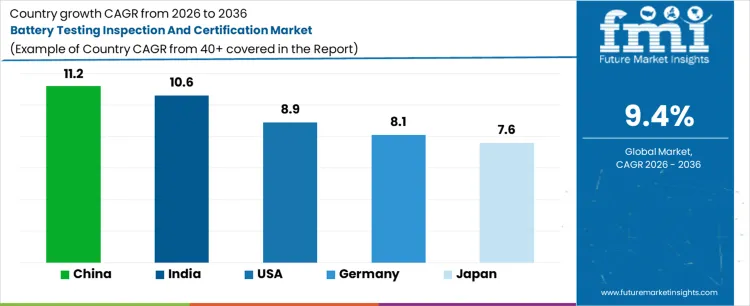
| Country | CAGR (%) |
|---|---|
| China | 11.2% |
| India | 10.6% |
| USA | 8.9% |
| Germany | 8.1% |
| Japan | 7.6% |
Why is China seeing rapid expansion in battery testing inspection and certification demand?
Battery testing inspection and certification demand in China is accelerating as large scale battery manufacturing expands across automotive and energy storage segments. Growth at 11.2% CAGR reflects regulatory tightening on safety, transport, and quality assurance. Export driven battery shipments require multilayer certification aligned with international standards. High incident sensitivity surrounding thermal runaway reinforces extensive validation protocols. Domestic certification bodies scale capacity to support gigafactory output volumes. Adoption concentrates around lithium ion performance, abuse testing, and lifecycle validation. Integration of testing with manufacturing quality systems reduces recall risk. Policy focus on EV safety compliance sustains recurring inspection demand across production cycles.
- Expansion of gigafactory capacity
- Export certification requirements
- Heightened safety incident scrutiny
- Alignment with international standards
What is driving growth of battery testing inspection and certification demand in India?
Demand for battery testing inspection and certification in India is rising as domestic battery manufacturing and EV deployment accelerate. Expansion at 10.6% CAGR reflects enforcement of safety standards for vehicles, storage systems, and electronics. Import substitution strategies increase need for local certification infrastructure. Government incentive schemes mandate compliance verification for eligibility. Testing demand grows across performance, thermal stability, and transportation safety domains. Local laboratories expand accreditation scope to reduce reliance on overseas testing. Adoption strengthens among two wheeler EV manufacturers and stationary storage providers. Compliance driven procurement supports predictable inspection volumes across development and commercialization phases.
- EV incentive linked compliance mandates
- Growth of domestic battery manufacturing
- Expansion of accredited testing labs
- Focus on transport safety validation
How is the USA supporting growth of battery testing inspection and certification demand?
Sales of battery testing inspection and certification services in the USA are increasing as safety regulation and liability exposure intensify. Growth of 8.9% CAGR reflects demand from automotive, aerospace, grid storage, and consumer electronics sectors. Certification requirements support interstate transport and international exports. Adoption emphasizes abuse testing, failure analysis, and standards harmonization. Advanced R&D activity drives prototype testing volumes. Procurement prioritizes accredited laboratories with global recognition. Infrastructure upgrades and grid resilience investments expand stationary storage testing needs. Replacement demand emerges as standards evolve for higher energy density chemistries and solid state battery development.
- Grid scale storage deployment
- Automotive and aerospace safety testing
- Evolving certification standards
- High liability compliance requirements
What factors are shaping battery testing inspection and certification sales in Germany?
Battery testing inspection and certification demand in Germany is shaped by automotive electrification and stringent safety regulation. Expansion at 8.1% CAGR reflects integration of testing within vehicle homologation and industrial quality systems. Focus remains on durability, performance consistency, and environmental compliance. Export oriented manufacturers require certification aligned with global transport regulations. Hydrogen and hybrid energy systems increase testing complexity. Laboratories emphasize precision measurement and lifecycle modeling. Industry 4.0 adoption supports data intensive validation processes. Replacement cycles occur as testing protocols update to address next generation chemistries and recycling requirements.
- Automotive homologation requirements
- Strong export compliance focus
- Integration with Industry 4.0
- Advanced lifecycle testing needs
How is Japan supporting growth of battery testing inspection and certification demand?
Battery testing inspection and certification market demand in Japan is advancing through disciplined adoption across electronics, automotive, and energy storage sectors. Growth at 7.6% CAGR reflects emphasis on safety assurance and reliability engineering. Earthquake risk planning increases scrutiny of stationary storage installations. Manufacturers prioritize long term durability and failure prevention testing. Regulatory frameworks support standardized certification pathways. Domestic laboratories specialize in precision diagnostics and materials characterization. Adoption remains measured yet consistent due to conservative commercialization approaches. Replacement demand persists as legacy systems undergo recertification to meet updated safety and performance benchmarks.
- Emphasis on reliability engineering
- Stationary storage safety validation
- Precision diagnostics specialization
- Conservative commercialization practices
What is the competitive landscape of demand for the battery testing inspection and certification market globally?

Demand for battery testing inspection and certification is driven by electric vehicle growth, energy storage deployment, and tightening safety regulations. Buyers evaluate certification scope, test coverage depth, global accreditation recognition, turnaround time, and technical expertise across chemistries. Procurement behavior prioritizes providers offering multi regional approvals, standardized test protocols, and advisory support during product development cycles. Purchasing teams emphasize risk mitigation, regulatory acceptance across export markets, cost transparency, and long term testing partnerships. Trend in the battery testing inspection and certification market reflects accelerating regulatory complexity, increasing recall avoidance focus, and demand for lifecycle safety validation.
UL Solutions holds leading positioning through proprietary safety standards, deep battery testing specialization, and strong acceptance among regulators and OEMs. SGS supports demand with extensive laboratory networks, broad certification portfolios, and scalable testing capacity across regions. TÜV SÜD competes through engineering driven validation services, automotive expertise, and close alignment with European regulatory frameworks. Intertek maintains relevance by offering integrated quality assurance, rapid testing programs, and flexible engagement models. Bureau Veritas participates through conformity assessment services supporting industrial batteries, storage systems, and compliance driven market entry strategies. Competitive differentiation centers on regulatory credibility, technical depth, geographic coverage, and ability to support accelerated commercialization timelines.
Key Players in the Battery Testing Inspection And Certification Market
- UL Solutions
- SGS
- TÜV SÜD
- Bureau Veritas
- Intertek
Scope of the Report
| Items | Values |
|---|---|
| Quantitative Units | USD million |
| Service Type | Testing; Inspection; Certification |
| Battery Type | Lithium-ion; Lead Acid; Nickel-based; Other |
| End Use | Electric Vehicles; Consumer Electronics; Energy Storage Systems; Industrial Equipment |
| Regions Covered | Asia Pacific, Europe, North America, Latin America, Middle East & Africa |
| Countries Covered | China, India, USA, Germany, Japan, and 40+ countries |
| Key Companies Profiled | UL Solutions; SGS; TÜV SÜD; Bureau Veritas; Intertek |
| Additional Attributes | Dollar sales by service type, battery type, end use, and sales channel; compliance testing scope across safety, performance, transport, and lifecycle standards; laboratory accreditation coverage and turnaround time for certification programs; inspection rigor for manufacturing audits and supply chain traceability; regional regulatory alignment across automotive, electronics, and stationary energy storage deployments; contracting patterns across OEMs, cell manufacturers, and system integrators. |
Battery Testing Inspection And Certification Market by Segment
Service Type:
- Testing
- Inspection
- Certification
Battery Type:
- Lithium-ion
- Lead Acid
- Nickel-based
- Other
End Use:
- Electric Vehicles
- Consumer Electronics
- Energy Storage Systems
- Industrial Equipment
Region:
- Asia Pacific
- China
- Japan
- South Korea
- India
- Australia & New Zealand
- ASEAN
- Rest of Asia Pacific
- Europe
- Germany
- United Kingdom
- France
- Italy
- Spain
- Nordic
- BENELUX
- Rest of Europe
- North America
- United States
- Canada
- Mexico
- Latin America
- Brazil
- Chile
- Rest of Latin America
- Middle East & Africa
- Kingdom of Saudi Arabia
- Other GCC Countries
- Turkey
- South Africa
- Other African Union
- Rest of Middle East & Africa
Bibliography
- International Organization for Standardization. (2019). Electrically propelled road vehicles—Safety specifications—Part 1: Rechargeable energy storage system (RESS) (ISO Standard No. 6469-1:2019). International Organization for Standardization.
- United Nations Economic Commission for Europe. (2022). Regulation No. 100, Uniform provisions concerning the approval of vehicles with regard to specific requirements for the electric power train (Rev. 3). United Nations.
- National Fire Protection Association. (2023). NFPA 855: Standard for the installation of stationary energy storage systems. National Fire Protection Association.
Frequently Asked Questions
How big is the battery testing inspection and certification market in 2026?
The global battery testing inspection and certification market is estimated to be valued at USD 1,850.0 million in 2026.
What will be the size of battery testing inspection and certification market in 2036?
The market size for the battery testing inspection and certification market is projected to reach USD 4,543.0 million by 2036.
How much will be the battery testing inspection and certification market growth between 2026 and 2036?
The battery testing inspection and certification market is expected to grow at a 9.4% CAGR between 2026 and 2036.
What are the key product types in the battery testing inspection and certification market?
The key product types in battery testing inspection and certification market are testing, inspection and certification.
Which battery type segment to contribute significant share in the battery testing inspection and certification market in 2026?
In terms of battery type, lithium-ion segment to command 58.0% share in the battery testing inspection and certification market in 2026.
Preview the report firsthand - request a free sample
Get SampleGet the brochure for pricing and purchase details.
Get PDFTable of Content
- Executive Summary
- Global Market Outlook
- Demand-side Trends
- Supply-side Trends
- Technology Roadmap Analysis
- Analysis and Recommendations
- Market Overview
- Market Coverage / Taxonomy
- Market Definition / Scope / Limitations
- Market Background
- Market Dynamics
- Drivers
- Restraints
- Opportunity
- Trends
- Scenario Forecast
- Demand in Optimistic Scenario
- Demand in Likely Scenario
- Demand in Conservative Scenario
- Opportunity Map Analysis
- Product Life Cycle Analysis
- Supply Chain Analysis
- Investment Feasibility Matrix
- Value Chain Analysis
- PESTLE and Porter’s Analysis
- Regulatory Landscape
- Regional Parent Market Outlook
- Production and Consumption Statistics
- Import and Export Statistics
- Market Dynamics
- Global Market Analysis 2021 to 2025 and Forecast, 2026 to 2036
- Historical Market Size Value (USD Million) Analysis, 2021 to 2025
- Current and Future Market Size Value (USD Million) Projections, 2026 to 2036
- Y-o-Y Growth Trend Analysis
- Absolute $ Opportunity Analysis
- Global Market Pricing Analysis 2021 to 2025 and Forecast 2026 to 2036
- Global Market Analysis 2021 to 2025 and Forecast 2026 to 2036, By Service Type
- Introduction / Key Findings
- Historical Market Size Value (USD Million) Analysis By Service Type, 2021 to 2025
- Current and Future Market Size Value (USD Million) Analysis and Forecast By Service Type, 2026 to 2036
- Testing
- Inspection
- Certification
- Testing
- Y-o-Y Growth Trend Analysis By Service Type, 2021 to 2025
- Absolute $ Opportunity Analysis By Service Type, 2026 to 2036
- Global Market Analysis 2021 to 2025 and Forecast 2026 to 2036, By Battery Type
- Introduction / Key Findings
- Historical Market Size Value (USD Million) Analysis By Battery Type, 2021 to 2025
- Current and Future Market Size Value (USD Million) Analysis and Forecast By Battery Type, 2026 to 2036
- Lithium-ion
- Lead Acid
- Nickel-based
- Other
- Lithium-ion
- Y-o-Y Growth Trend Analysis By Battery Type, 2021 to 2025
- Absolute $ Opportunity Analysis By Battery Type, 2026 to 2036
- Global Market Analysis 2021 to 2025 and Forecast 2026 to 2036, By End Use
- Introduction / Key Findings
- Historical Market Size Value (USD Million) Analysis By End Use, 2021 to 2025
- Current and Future Market Size Value (USD Million) Analysis and Forecast By End Use, 2026 to 2036
- Electric Vehicles
- Consumer Electronics
- Energy Storage Systems
- Industrial Equipment
- Electric Vehicles
- Y-o-Y Growth Trend Analysis By End Use, 2021 to 2025
- Absolute $ Opportunity Analysis By End Use, 2026 to 2036
- Global Market Analysis 2021 to 2025 and Forecast 2026 to 2036, By Region
- Introduction
- Historical Market Size Value (USD Million) Analysis By Region, 2021 to 2025
- Current Market Size Value (USD Million) Analysis and Forecast By Region, 2026 to 2036
- North America
- Latin America
- Western Europe
- Eastern Europe
- East Asia
- South Asia and Pacific
- Middle East & Africa
- Market Attractiveness Analysis By Region
- North America Market Analysis 2021 to 2025 and Forecast 2026 to 2036, By Country
- Historical Market Size Value (USD Million) Trend Analysis By Market Taxonomy, 2021 to 2025
- Market Size Value (USD Million) Forecast By Market Taxonomy, 2026 to 2036
- By Country
- USA
- Canada
- Mexico
- By Service Type
- By Battery Type
- By End Use
- By Country
- Market Attractiveness Analysis
- By Country
- By Service Type
- By Battery Type
- By End Use
- Key Takeaways
- Latin America Market Analysis 2021 to 2025 and Forecast 2026 to 2036, By Country
- Historical Market Size Value (USD Million) Trend Analysis By Market Taxonomy, 2021 to 2025
- Market Size Value (USD Million) Forecast By Market Taxonomy, 2026 to 2036
- By Country
- Brazil
- Chile
- Rest of Latin America
- By Service Type
- By Battery Type
- By End Use
- By Country
- Market Attractiveness Analysis
- By Country
- By Service Type
- By Battery Type
- By End Use
- Key Takeaways
- Western Europe Market Analysis 2021 to 2025 and Forecast 2026 to 2036, By Country
- Historical Market Size Value (USD Million) Trend Analysis By Market Taxonomy, 2021 to 2025
- Market Size Value (USD Million) Forecast By Market Taxonomy, 2026 to 2036
- By Country
- Germany
- UK
- Italy
- Spain
- France
- Nordic
- BENELUX
- Rest of Western Europe
- By Service Type
- By Battery Type
- By End Use
- By Country
- Market Attractiveness Analysis
- By Country
- By Service Type
- By Battery Type
- By End Use
- Key Takeaways
- Eastern Europe Market Analysis 2021 to 2025 and Forecast 2026 to 2036, By Country
- Historical Market Size Value (USD Million) Trend Analysis By Market Taxonomy, 2021 to 2025
- Market Size Value (USD Million) Forecast By Market Taxonomy, 2026 to 2036
- By Country
- Russia
- Poland
- Hungary
- Balkan & Baltic
- Rest of Eastern Europe
- By Service Type
- By Battery Type
- By End Use
- By Country
- Market Attractiveness Analysis
- By Country
- By Service Type
- By Battery Type
- By End Use
- Key Takeaways
- East Asia Market Analysis 2021 to 2025 and Forecast 2026 to 2036, By Country
- Historical Market Size Value (USD Million) Trend Analysis By Market Taxonomy, 2021 to 2025
- Market Size Value (USD Million) Forecast By Market Taxonomy, 2026 to 2036
- By Country
- China
- Japan
- South Korea
- By Service Type
- By Battery Type
- By End Use
- By Country
- Market Attractiveness Analysis
- By Country
- By Service Type
- By Battery Type
- By End Use
- Key Takeaways
- South Asia and Pacific Market Analysis 2021 to 2025 and Forecast 2026 to 2036, By Country
- Historical Market Size Value (USD Million) Trend Analysis By Market Taxonomy, 2021 to 2025
- Market Size Value (USD Million) Forecast By Market Taxonomy, 2026 to 2036
- By Country
- India
- ASEAN
- Australia & New Zealand
- Rest of South Asia and Pacific
- By Service Type
- By Battery Type
- By End Use
- By Country
- Market Attractiveness Analysis
- By Country
- By Service Type
- By Battery Type
- By End Use
- Key Takeaways
- Middle East & Africa Market Analysis 2021 to 2025 and Forecast 2026 to 2036, By Country
- Historical Market Size Value (USD Million) Trend Analysis By Market Taxonomy, 2021 to 2025
- Market Size Value (USD Million) Forecast By Market Taxonomy, 2026 to 2036
- By Country
- Kingdom of Saudi Arabia
- Other GCC Countries
- Turkiye
- South Africa
- Other African Union
- Rest of Middle East & Africa
- By Service Type
- By Battery Type
- By End Use
- By Country
- Market Attractiveness Analysis
- By Country
- By Service Type
- By Battery Type
- By End Use
- Key Takeaways
- Key Countries Market Analysis
- USA
- Pricing Analysis
- Market Share Analysis, 2025
- By Service Type
- By Battery Type
- By End Use
- Canada
- Pricing Analysis
- Market Share Analysis, 2025
- By Service Type
- By Battery Type
- By End Use
- Mexico
- Pricing Analysis
- Market Share Analysis, 2025
- By Service Type
- By Battery Type
- By End Use
- Brazil
- Pricing Analysis
- Market Share Analysis, 2025
- By Service Type
- By Battery Type
- By End Use
- Chile
- Pricing Analysis
- Market Share Analysis, 2025
- By Service Type
- By Battery Type
- By End Use
- Germany
- Pricing Analysis
- Market Share Analysis, 2025
- By Service Type
- By Battery Type
- By End Use
- UK
- Pricing Analysis
- Market Share Analysis, 2025
- By Service Type
- By Battery Type
- By End Use
- Italy
- Pricing Analysis
- Market Share Analysis, 2025
- By Service Type
- By Battery Type
- By End Use
- Spain
- Pricing Analysis
- Market Share Analysis, 2025
- By Service Type
- By Battery Type
- By End Use
- France
- Pricing Analysis
- Market Share Analysis, 2025
- By Service Type
- By Battery Type
- By End Use
- India
- Pricing Analysis
- Market Share Analysis, 2025
- By Service Type
- By Battery Type
- By End Use
- ASEAN
- Pricing Analysis
- Market Share Analysis, 2025
- By Service Type
- By Battery Type
- By End Use
- Australia & New Zealand
- Pricing Analysis
- Market Share Analysis, 2025
- By Service Type
- By Battery Type
- By End Use
- China
- Pricing Analysis
- Market Share Analysis, 2025
- By Service Type
- By Battery Type
- By End Use
- Japan
- Pricing Analysis
- Market Share Analysis, 2025
- By Service Type
- By Battery Type
- By End Use
- South Korea
- Pricing Analysis
- Market Share Analysis, 2025
- By Service Type
- By Battery Type
- By End Use
- Russia
- Pricing Analysis
- Market Share Analysis, 2025
- By Service Type
- By Battery Type
- By End Use
- Poland
- Pricing Analysis
- Market Share Analysis, 2025
- By Service Type
- By Battery Type
- By End Use
- Hungary
- Pricing Analysis
- Market Share Analysis, 2025
- By Service Type
- By Battery Type
- By End Use
- Kingdom of Saudi Arabia
- Pricing Analysis
- Market Share Analysis, 2025
- By Service Type
- By Battery Type
- By End Use
- Turkiye
- Pricing Analysis
- Market Share Analysis, 2025
- By Service Type
- By Battery Type
- By End Use
- South Africa
- Pricing Analysis
- Market Share Analysis, 2025
- By Service Type
- By Battery Type
- By End Use
- USA
- Market Structure Analysis
- Competition Dashboard
- Competition Benchmarking
- Market Share Analysis of Top Players
- By Regional
- By Service Type
- By Battery Type
- By End Use
- Competition Analysis
- Competition Deep Dive
- UL Solutions
- Overview
- Product Portfolio
- Profitability by Market Segments (Product/Age /Sales Channel/Region)
- Sales Footprint
- Strategy Overview
- Marketing Strategy
- Product Strategy
- Channel Strategy
- SGS
- TÜV SÜD
- Bureau Veritas
- Intertek
- UL Solutions
- Competition Deep Dive
- Assumptions & Acronyms Used
- Research Methodology


