

- Industry Size (2026)
- USD 1480.0 Mn
- Forecast (2036)
- USD 4935.7 Mn
- CAGR (2026 to 2036)
- 12.8%
Certification & Testing Services Market for PCR Materials Forecast and Outlook 2026 to 2036
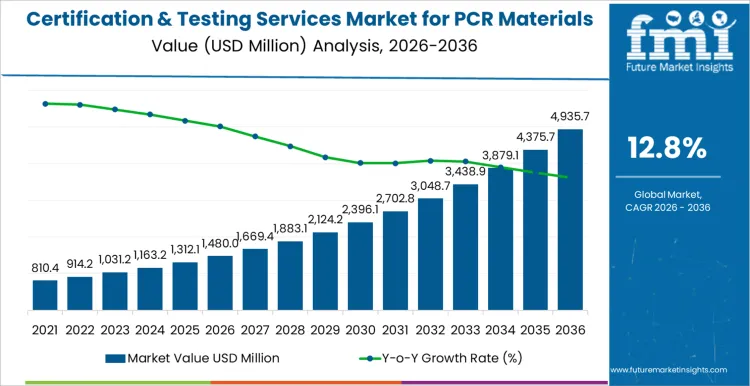
The certification & testing services market for PCR materials is forecasted to reach USD 1,480.0 million in 2026 and is set to reach USD 4,935.7 million by 2036, at a CAGR of 12.8% as regulatory scrutiny and brand accountability around recycled content intensify. Packaging, consumer goods, automotive, and electronics manufacturers increasing PCR usage require third-party validation to confirm recycled content percentages, material safety, and performance consistency. Certification services supporting chain-of-custody verification, mass balance accounting, and recycled content claims play a central role in enabling compliance with extended producer responsibility frameworks and retailer sustainability mandates across global supply chains.
Growth is reinforced by variability in PCR feedstocks, which elevates demand for analytical testing covering contamination levels, extractables, migration behavior, and mechanical performance. Accredited laboratories and certification bodies support manufacturers by reducing compliance risk in food-contact, pharmaceutical, and export-oriented applications where documentation requirements are stringent. Expansion of international recycled content standards and audit-based sustainability reporting increases reliance on independent verification rather than internal quality controls alone. Service demand remains driven by qualification complexity and regulatory enforcement rather than physical PCR volume growth, positioning certification and testing as a structural requirement within recycled material adoption strategies.
Quick Stats for Certification & Testing Services Market for PCR Materials
- Certification & Testing Services Market for PCR Materials Value (2026): USD 1,480.0 million
- Certification & Testing Services Market for PCR Materials Forecast Value (2036): USD 4,935.7 million
- Certification & Testing Services Market for PCR Materials Forecast CAGR (2026-2036): 12.8%
- Leading Service Type by Demand Share: PCR content certification
- Fastest-Growing Countries: India, China, USA, Germany, Japan
- Top Players in Global Demand: TÜV SÜD, DIN CERTCO, UL Solutions, Intertek, SGS China
Certification & Testing Services Market for PCR Materials Key Takeaways
| Metric | Value |
|---|---|
| Market Value (2026) | USD 1,480.0 million |
| Market Forecast Value (2036) | USD 4,935.7 million |
| Forecast CAGR (2026-2036) | 12.8% |
Why is the Demand for Certification & Testing Services for PCR Materials Growing?
Growth in certification and testing services for PCR (post-consumer recycled) materials is driven by increasing requirements from regulatory authorities and brand owners to ensure safety, performance, and compliance in end-use applications. Packaging, automotive, and consumer goods companies adopting higher PCR content must validate that recycled resins meet specifications for mechanical strength, chemical resistance, and dimensional stability. Independent laboratories provide analytical testing such as spectroscopy, chromatography, and melt flow rate measurements to confirm material identity and consistency across PCR batches. Certification bodies assess traceability and chain-of-custody documentation to verify that PCR streams originate from compliant collection and sorting systems, helping manufacturers demonstrate adherence to recycled content mandates in food contact, durable goods, and pharmaceutical packaging.
The complexity of PCR feedstocks, with variability in contaminants and prior use histories, increases the need for rigorous testing protocols that prevent performance failures and safety risks in finished products. Certification services that evaluate residual contaminants, extractables, and potential migration into sensitive applications such as food and personal care packaging are increasingly specified during material qualification. Quality assurance teams integrate standardized test results into production release criteria to minimize risk of off-spec parts entering supply chains. Evolving international standards for PCR verification and recycled content reporting also encourage procurement of accredited testing and certification, enabling companies to support sustainability claims with documented evidence.
How Is the Certification & Testing Services Market for PCR Materials Structured by Service Type, Material Scope, and End Use?
Certification and testing services for PCR materials support regulatory compliance, recycled content validation, and buyer confidence across packaging, consumer goods, and export-oriented supply chains. Demand is driven by brand commitments, tightening regulations, and third-party verification requirements for recycled polymers. Segmentation by service type, material scope, and end use explains how testing providers position offerings for manufacturers, converters, and global brands.
Which Service Type Holds the Largest Share in Certification & Testing Services for PCR Materials?
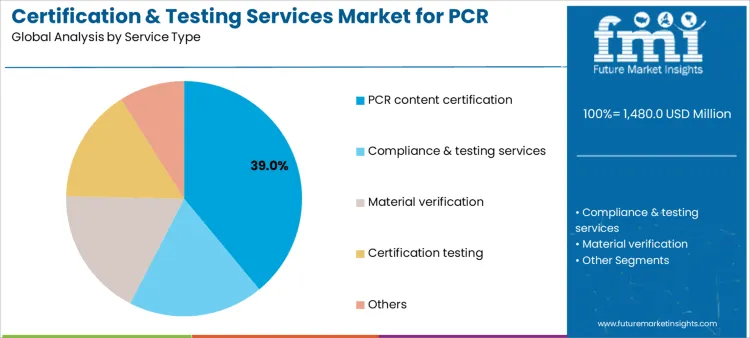
PCR content certification accounts for 39.0%, reflecting its role as the primary validation mechanism for recycled content claims. Brands and converters rely on certified PCR percentages to meet sustainability disclosures, retailer mandates, and regulatory frameworks. Compliance and testing services, material verification, certification testing, and other services complement certification by addressing contaminant analysis, traceability, and audit readiness, though individual shares are not specified.
Key Points
- PCR content certification underpins recycled content claims.
- Third-party validation supports regulatory and buyer trust.
- Ancillary services address quality, safety, and traceability gaps.
How Does Material Scope Influence Demand for PCR Certification and Testing Services?
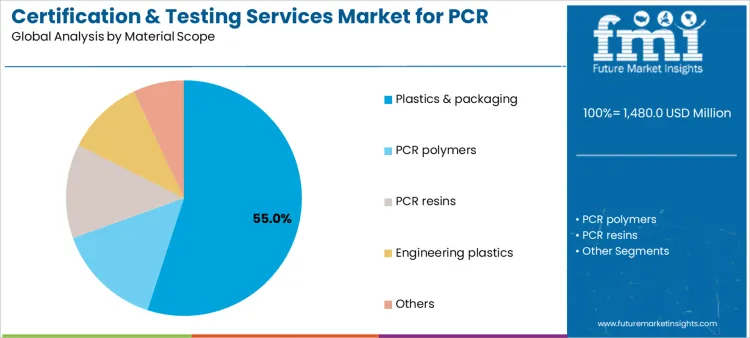
Plastics and packaging represent 55.0%, highlighting concentration around high-volume applications facing strict food-contact, safety, and recyclability requirements. Testing demand is strongest where PCR integration intersects with regulatory oversight and brand scrutiny. PCR polymers, PCR resins, engineering plastics, and other material categories reflect expanding adoption beyond packaging into higher-performance and technical applications, increasing need for advanced verification protocols.
Key Points
- Packaging drives the majority of PCR testing activity.
- Broader material scope increases complexity of validation.
- Engineering plastics require more stringent performance testing.
Which End-Use Segments Generate the Highest Demand for PCR Certification Services?
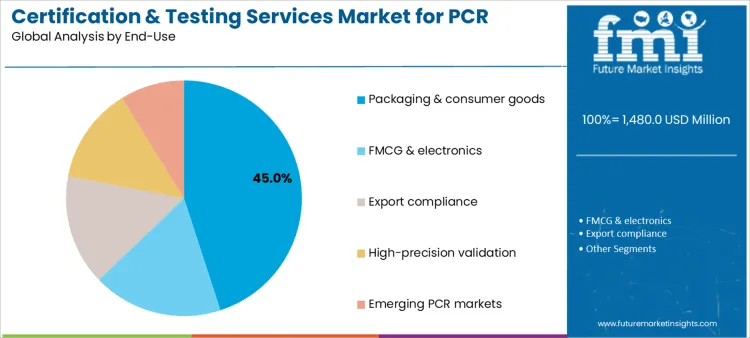
Packaging and consumer goods account for 45.0%, driven by FMCG sustainability targets and retailer-led compliance programs. These sectors require frequent certification updates and batch-level verification. FMCG and electronics, export compliance, high-precision validation, and emerging PCR markets contribute additional demand, reflecting globalization of PCR supply chains and rising scrutiny in cross-border trade.
Key Points
- Consumer-facing goods face the highest verification pressure.
- Export markets require standardized, auditable certification.
- Emerging PCR applications expand demand for specialized testing.
What are the Key Dynamics in the Certification & Testing Services Market for PCR Materials?
Demand in the certification and testing services market for PCR (post-consumer recycled) materials is shaped by requirements for traceability, safety, and performance assurance as brands increase recycled content across packaging, consumer goods, and industrial applications. Service providers assess PCR resin quality, contaminant profiles, mechanical and thermal properties, and compliance with regional food-contact and product safety regulations. Manufacturers and brand owners seek validated data that supports claims for recycled content percentages, performance equivalence to virgin materials, and adherence to sustainability standards such as extended producer responsibility and recycled content mandates.
How do regulatory frameworks and performance specifications influence service demand?
Demand for testing and certification services rises where regional regulations require documented evidence of compliance before PCR materials can be used in food contact or medical packaging. In the European Union, for example, food-contact PCR materials must satisfy specific safety criteria that vary by polymer type and application, which drives detailed analytical testing of extractables, migrants, and contaminant levels. In the United States and other markets, demonstrating conformity with FDA or third-party safety benchmarks helps converters and brand owners secure approvals and reduce liability risk. Performance specifications tied to mechanical strength, impact resistance, and thermal behavior are critical when recycled materials substitute for virgin resins in structural components such as automotive parts or consumer electronics housings. Certifying bodies provide standardized protocols to assess whether PCR batches meet these criteria, enabling product launch without costly redesigns.
How do feedstock variability and analytical complexity affect market growth?
Market growth for certification and testing services is influenced by the variability inherent to PCR feedstock and the technical demands of comprehensive analysis. Mixed waste streams often yield recycled resins with fluctuating property profiles, which increases demand for detailed characterization to ensure batch-to-batch consistency. Service providers invest in advanced techniques such as chromatography, spectroscopy, and mechanical profiling to quantify contaminant levels, polymer composition, and performance attributes. High analytical complexity and the need for bespoke test methods in specialized applications such as high-barrier food packaging or medical devices extend turnaround times and operating costs for laboratories. Divergent regulatory interpretation across regions further complicates certification pathways, as materials may require multiple sets of compliance data for global distribution. Pricing pressure on PCR materials, combined with the expense of rigorous testing, influences where manufacturers elect to pursue formal certification versus internal quality assurance, shaping the pace of adoption of recycled content materials across diverse sectors.
How Is Demand for the Certification and Testing Services Market for PCR Materials Evolving Globally?
Global demand for certification and testing services for PCR materials is rising as recycled content adoption expands across regulated packaging and industrial applications. Growth reflects stricter traceability requirements, recycled content verification, and performance validation needs across food contact, personal care, automotive, and electronics packaging. Brand commitments and regulatory audits increase reliance on third-party testing for material consistency and compliance. India records 15.4% CAGR, China records 14.0% CAGR, USA records 12.2% CAGR, Germany records 11.8% CAGR, and Japan records 10.0% CAGR. Market expansion is driven by compliance intensity and qualification complexity rather than physical PCR volume growth.
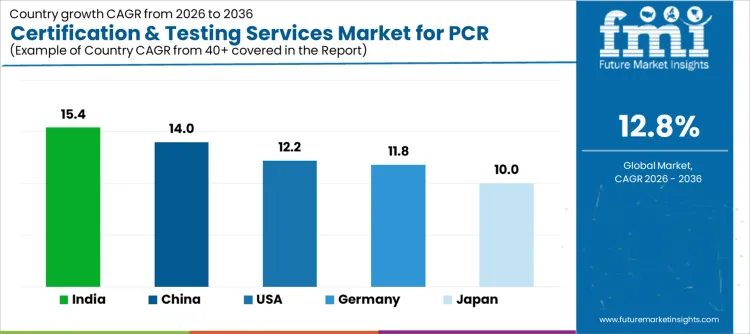
| Country | CAGR (%) |
|---|---|
| India | 15.4% |
| China | 14.0% |
| USA | 12.2% |
| Germany | 11.8% |
| Japan | 10.0% |
What is driving growth of certification and testing services demand for PCR materials in India?
Demand for certification and testing services for PCR materials in India is expanding as recycled plastics enter regulated packaging and consumer goods supply chains. Growth at 15.4% CAGR reflects rising need for recycled content validation, food-contact compliance, and performance testing. Brand audits and government guidelines increase pressure for documented PCR traceability. Domestic converters require third-party verification to qualify materials for FMCG, pharma, and personal care packaging. Testing demand concentrates on contamination screening, mechanical consistency, and migration compliance. Rapid scale-up of PCR usage increases reliance on independent laboratories to support supplier qualification and regulatory submissions.
- Growth of regulated PCR packaging adoption
- Rising need for recycled content verification
- Expansion of brand audit requirements
- Demand for food-contact and migration testing
Why is China seeing expansion in certification and testing services adoption for PCR materials?
Certification and testing services demand for PCR materials in China is rising as industrial-scale PCR usage expands across export-oriented packaging. Growth at 14.0% CAGR reflects increased scrutiny on recycled content claims, material safety, and compliance documentation. Regulatory oversight and international customer audits drive reliance on accredited testing bodies. High-volume converters require consistent validation of PCR feedstock quality and process control. Testing focuses on compositional analysis, contamination detection, and mechanical performance consistency. Demand remains centered on centralized manufacturing clusters supplying global FMCG, electronics, and personal care brands.
- Export-driven compliance documentation needs
- Regulatory oversight of recycled content claims
- High-volume PCR material qualification
- Emphasis on contamination and consistency testing
What factors are shaping certification and testing services sales for PCR materials in the USA?
Sales of certification and testing services for PCR materials in the USA are increasing as sustainability commitments translate into enforceable specifications. Growth at 12.2% CAGR reflects strong demand for recycled content verification, chain-of-custody audits, and regulatory compliance testing. Retailer scorecards and brand disclosures intensify third-party certification requirements. PCR material testing emphasizes food-contact safety, mechanical durability, and traceability validation. National brands standardize testing protocols across suppliers to manage compliance risk. Demand is driven by governance requirements rather than expansion of PCR product categories.
- Retail and brand audit pressure
- Growth of chain-of-custody certification
- Focus on food-contact compliance testing
- Standardization of supplier qualification protocols
How is Germany supporting growth of certification and testing services demand for PCR materials?
Certification and testing services demand for PCR materials in Germany is advancing as circular economy regulations tighten material oversight. Growth at 11.8% CAGR reflects increased reliance on accredited laboratories for recycled content validation and regulatory compliance. EU packaging directives require precise documentation of material origin, safety, and recyclability. German manufacturers emphasize traceability, emissions control, and consistent material performance. Testing demand focuses on conformity assessment, chemical safety, and recyclability verification. Market activity remains anchored in compliance-driven testing across established industrial and consumer packaging sectors.
- EU-aligned regulatory compliance requirements
- Strong emphasis on material traceability
- Demand for recyclability and safety validation
- Growth of accredited laboratory testing
What is driving expansion of certification and testing services demand for PCR materials in Japan?
Demand for certification and testing services for PCR materials in Japan is rising as manufacturers adopt recycled content within quality-sensitive applications. Growth at 10.0% CAGR reflects cautious PCR integration requiring extensive validation. Brand reputation protection drives conservative testing and certification approaches. Testing focuses on purity, odor control, migration safety, and long-term material stability. Regulatory expectations and customer audits reinforce third-party verification. Demand remains concentrated among premium packaging and electronics suppliers prioritizing risk-managed recycled content adoption.
- Conservative PCR qualification strategies
- High focus on purity and odor testing
- Brand-driven quality assurance requirements
- Emphasis on long-term material stability validation
What is the competitive landscape of demand for the certification and testing services market for PCR materials globally?
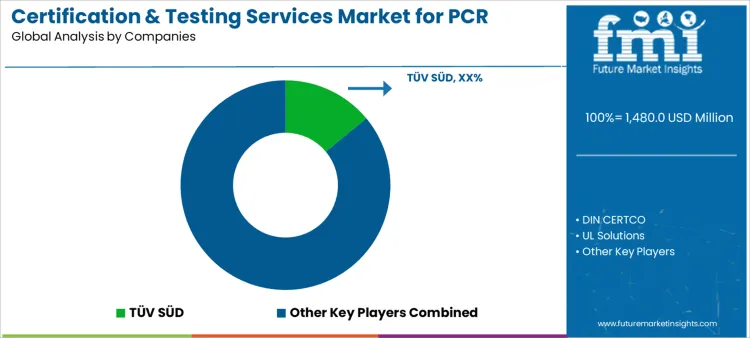
Regulatory scrutiny and brand accountability requirements are shaping demand for certification and testing services focused on PCR materials. Packaging producers and resin suppliers evaluate recycled content verification accuracy, traceability methodology, mass balance validation, and alignment with regional recycling regulations. Buyer assessment includes turnaround time for certification, audit depth, acceptance by brand owners, and credibility with regulators. Procurement behavior reflects preference for globally recognized certifiers capable of supporting multi-site operations and cross-border compliance. Trend in the certification and testing services market for PCR materials reflects rising brand mandates for third-party verification and increased enforcement of recycled content claims.
TÜV SÜD leads competitive positioning through globally accepted PCR certification schemes supported by rigorous audit frameworks. UL Solutions competes by integrating recycled content verification with broader material testing and compliance services. Intertek supports demand with flexible testing and certification programs aligned with packaging and consumer goods supply chains. SGS China maintains relevance by serving high-volume manufacturing hubs requiring rapid verification and export-oriented compliance. DIN CERTCO participates by providing recycled content certification widely referenced in European packaging standards. Competitive differentiation centers on global acceptance, audit robustness, technical credibility, and ability to support brand-level sustainability reporting.
Key Players in the Certification & Testing Services Market for PCR Materials
- TÜV SÜD
- DIN CERTCO
- UL Solutions
- Intertek
- SGS China
- CTI
- JQA
- Japan Inspection Co.
- Others
Scope of the Report
| Items | Values |
|---|---|
| Quantitative Units | USD million |
| Service Type | PCR content certification; Compliance & testing services; Material verification; Certification testing; Others |
| Material Scope | Plastics & packaging; PCR polymers; PCR resins; Engineering plastics; Others |
| End-Use | Packaging & consumer goods; FMCG & electronics; Export compliance; High-precision validation; Emerging PCR markets |
| Regions Covered | Asia Pacific, Europe, North America, Latin America, Middle East & Africa |
| Countries Covered | India, China, USA, Germany, Japan, and 40+ countries |
| Key Companies Profiled | TÜV SÜD; DIN CERTCO; UL Solutions; Intertek; SGS China; CTI; JQA; Japan Inspection Co.; Others |
| Additional Attributes | Rising demand for third-party PCR content verification to meet EPR and recycled-content mandates; increased testing volumes driven by export-oriented FMCG and electronics packaging; stricter chain-of-custody and mass-balance validation requirements; growing role of certification bodies in enabling premium PCR pricing; expanding testing scope covering mechanical, chemical, and contamination compliance for food-contact and technical-grade PCR materials. |
Certification & Testing Services Market for PCR Materials by Segment
Service Type:
- PCR content certification
- Compliance & testing services
- Material verification
- Certification testing
- Others
Material Scope:
- Plastics & packaging
- PCR polymers
- PCR resins
- Engineering plastics
- Others
End-Use:
- Packaging & consumer goods
- FMCG & electronics
- Export compliance
- High-precision validation
- Emerging PCR markets
Region:
- Asia Pacific
- China
- Japan
- South Korea
- India
- Australia & New Zealand
- ASEAN
- Rest of Asia Pacific
- Europe
- Germany
- United Kingdom
- France
- Italy
- Spain
- Nordic
- BENELUX
- Rest of Europe
- North America
- United States
- Canada
- Mexico
- Latin America
- Brazil
- Chile
- Rest of Latin America
- Middle East & Africa
- Kingdom of Saudi Arabia
- Other GCC Countries
- Turkey
- South Africa
- Other African Union
- Rest of Middle East & Africa
Bibliography
- European Commission. (2023). Proposal for a regulation on packaging and packaging waste: Recycled content verification, conformity assessment, and documentation requirements. Publications Office of the European Union.
- International Organization for Standardization. (2023). Plastics—Recycled plastics—Traceability and assessment of conformity and recycled content (ISO 22095:2023). International Organization for Standardization.
- Organisation for Economic Co‑operation and Development. (2023). Extended producer responsibility and verification of recycled content claims in plastics value chains. OECD Publishing.
Frequently Asked Questions
How big is the certification & testing services market for pcr materials in 2026?
The global certification & testing services market for pcr materials is estimated to be valued at USD 1,480.0 million in 2026.
What will be the size of certification & testing services market for pcr materials in 2036?
The market size for the certification & testing services market for pcr materials is projected to reach USD 4,935.7 million by 2036.
How much will be the certification & testing services market for pcr materials growth between 2026 and 2036?
The certification & testing services market for pcr materials is expected to grow at a 12.8% CAGR between 2026 and 2036.
What are the key product types in the certification & testing services market for pcr materials?
The key product types in certification & testing services market for pcr materials are pcr content certification, compliance & testing services, material verification, certification testing and others.
Which material scope segment to contribute significant share in the certification & testing services market for pcr materials in 2026?
In terms of material scope, plastics & packaging segment to command 55.0% share in the certification & testing services market for pcr materials in 2026.
Preview the report firsthand - request a free sample
Get SampleGet the brochure for pricing and purchase details.
Get PDFTable of Content
- Executive Summary
- Global Market Outlook
- Demand-side Trends
- Supply-side Trends
- Technology Roadmap Analysis
- Analysis and Recommendations
- Market Overview
- Market Coverage / Taxonomy
- Market Definition / Scope / Limitations
- Market Background
- Market Dynamics
- Drivers
- Restraints
- Opportunity
- Trends
- Scenario Forecast
- Demand in Optimistic Scenario
- Demand in Likely Scenario
- Demand in Conservative Scenario
- Opportunity Map Analysis
- Product Life Cycle Analysis
- Supply Chain Analysis
- Investment Feasibility Matrix
- Value Chain Analysis
- PESTLE and Porter’s Analysis
- Regulatory Landscape
- Regional Parent Market Outlook
- Production and Consumption Statistics
- Import and Export Statistics
- Market Dynamics
- Global Market Analysis 2021 to 2025 and Forecast, 2026 to 2036
- Historical Market Size Value (USD Million) Analysis, 2021 to 2025
- Current and Future Market Size Value (USD Million) Projections, 2026 to 2036
- Y-o-Y Growth Trend Analysis
- Absolute $ Opportunity Analysis
- Global Market Pricing Analysis 2021 to 2025 and Forecast 2026 to 2036
- Global Market Analysis 2021 to 2025 and Forecast 2026 to 2036, By Service Type
- Introduction / Key Findings
- Historical Market Size Value (USD Million) Analysis By Service Type , 2021 to 2025
- Current and Future Market Size Value (USD Million) Analysis and Forecast By Service Type , 2026 to 2036
- PCR content certification
- Compliance & testing services
- Material verification
- Certification testing
- Others
- PCR content certification
- Y-o-Y Growth Trend Analysis By Service Type , 2021 to 2025
- Absolute $ Opportunity Analysis By Service Type , 2026 to 2036
- Global Market Analysis 2021 to 2025 and Forecast 2026 to 2036, By Material Scope
- Introduction / Key Findings
- Historical Market Size Value (USD Million) Analysis By Material Scope, 2021 to 2025
- Current and Future Market Size Value (USD Million) Analysis and Forecast By Material Scope, 2026 to 2036
- Plastics & packaging
- PCR polymers
- PCR resins
- Engineering plastics
- Others
- Plastics & packaging
- Y-o-Y Growth Trend Analysis By Material Scope, 2021 to 2025
- Absolute $ Opportunity Analysis By Material Scope, 2026 to 2036
- Global Market Analysis 2021 to 2025 and Forecast 2026 to 2036, By End-Use
- Introduction / Key Findings
- Historical Market Size Value (USD Million) Analysis By End-Use, 2021 to 2025
- Current and Future Market Size Value (USD Million) Analysis and Forecast By End-Use, 2026 to 2036
- Packaging & consumer goods
- FMCG & electronics
- Export compliance
- High-precision validation
- Emerging PCR markets
- Packaging & consumer goods
- Y-o-Y Growth Trend Analysis By End-Use, 2021 to 2025
- Absolute $ Opportunity Analysis By End-Use, 2026 to 2036
- Global Market Analysis 2021 to 2025 and Forecast 2026 to 2036, By Region
- Introduction
- Historical Market Size Value (USD Million) Analysis By Region, 2021 to 2025
- Current Market Size Value (USD Million) Analysis and Forecast By Region, 2026 to 2036
- North America
- Latin America
- Western Europe
- Eastern Europe
- East Asia
- South Asia and Pacific
- Middle East & Africa
- Market Attractiveness Analysis By Region
- North America Market Analysis 2021 to 2025 and Forecast 2026 to 2036, By Country
- Historical Market Size Value (USD Million) Trend Analysis By Market Taxonomy, 2021 to 2025
- Market Size Value (USD Million) Forecast By Market Taxonomy, 2026 to 2036
- By Country
- USA
- Canada
- Mexico
- By Service Type
- By Material Scope
- By End-Use
- By Country
- Market Attractiveness Analysis
- By Country
- By Service Type
- By Material Scope
- By End-Use
- Key Takeaways
- Latin America Market Analysis 2021 to 2025 and Forecast 2026 to 2036, By Country
- Historical Market Size Value (USD Million) Trend Analysis By Market Taxonomy, 2021 to 2025
- Market Size Value (USD Million) Forecast By Market Taxonomy, 2026 to 2036
- By Country
- Brazil
- Chile
- Rest of Latin America
- By Service Type
- By Material Scope
- By End-Use
- By Country
- Market Attractiveness Analysis
- By Country
- By Service Type
- By Material Scope
- By End-Use
- Key Takeaways
- Western Europe Market Analysis 2021 to 2025 and Forecast 2026 to 2036, By Country
- Historical Market Size Value (USD Million) Trend Analysis By Market Taxonomy, 2021 to 2025
- Market Size Value (USD Million) Forecast By Market Taxonomy, 2026 to 2036
- By Country
- Germany
- UK
- Italy
- Spain
- France
- Nordic
- BENELUX
- Rest of Western Europe
- By Service Type
- By Material Scope
- By End-Use
- By Country
- Market Attractiveness Analysis
- By Country
- By Service Type
- By Material Scope
- By End-Use
- Key Takeaways
- Eastern Europe Market Analysis 2021 to 2025 and Forecast 2026 to 2036, By Country
- Historical Market Size Value (USD Million) Trend Analysis By Market Taxonomy, 2021 to 2025
- Market Size Value (USD Million) Forecast By Market Taxonomy, 2026 to 2036
- By Country
- Russia
- Poland
- Hungary
- Balkan & Baltic
- Rest of Eastern Europe
- By Service Type
- By Material Scope
- By End-Use
- By Country
- Market Attractiveness Analysis
- By Country
- By Service Type
- By Material Scope
- By End-Use
- Key Takeaways
- East Asia Market Analysis 2021 to 2025 and Forecast 2026 to 2036, By Country
- Historical Market Size Value (USD Million) Trend Analysis By Market Taxonomy, 2021 to 2025
- Market Size Value (USD Million) Forecast By Market Taxonomy, 2026 to 2036
- By Country
- China
- Japan
- South Korea
- By Service Type
- By Material Scope
- By End-Use
- By Country
- Market Attractiveness Analysis
- By Country
- By Service Type
- By Material Scope
- By End-Use
- Key Takeaways
- South Asia and Pacific Market Analysis 2021 to 2025 and Forecast 2026 to 2036, By Country
- Historical Market Size Value (USD Million) Trend Analysis By Market Taxonomy, 2021 to 2025
- Market Size Value (USD Million) Forecast By Market Taxonomy, 2026 to 2036
- By Country
- India
- ASEAN
- Australia & New Zealand
- Rest of South Asia and Pacific
- By Service Type
- By Material Scope
- By End-Use
- By Country
- Market Attractiveness Analysis
- By Country
- By Service Type
- By Material Scope
- By End-Use
- Key Takeaways
- Middle East & Africa Market Analysis 2021 to 2025 and Forecast 2026 to 2036, By Country
- Historical Market Size Value (USD Million) Trend Analysis By Market Taxonomy, 2021 to 2025
- Market Size Value (USD Million) Forecast By Market Taxonomy, 2026 to 2036
- By Country
- Kingdom of Saudi Arabia
- Other GCC Countries
- Turkiye
- South Africa
- Other African Union
- Rest of Middle East & Africa
- By Service Type
- By Material Scope
- By End-Use
- By Country
- Market Attractiveness Analysis
- By Country
- By Service Type
- By Material Scope
- By End-Use
- Key Takeaways
- Key Countries Market Analysis
- USA
- Pricing Analysis
- Market Share Analysis, 2025
- By Service Type
- By Material Scope
- By End-Use
- Canada
- Pricing Analysis
- Market Share Analysis, 2025
- By Service Type
- By Material Scope
- By End-Use
- Mexico
- Pricing Analysis
- Market Share Analysis, 2025
- By Service Type
- By Material Scope
- By End-Use
- Brazil
- Pricing Analysis
- Market Share Analysis, 2025
- By Service Type
- By Material Scope
- By End-Use
- Chile
- Pricing Analysis
- Market Share Analysis, 2025
- By Service Type
- By Material Scope
- By End-Use
- Germany
- Pricing Analysis
- Market Share Analysis, 2025
- By Service Type
- By Material Scope
- By End-Use
- UK
- Pricing Analysis
- Market Share Analysis, 2025
- By Service Type
- By Material Scope
- By End-Use
- Italy
- Pricing Analysis
- Market Share Analysis, 2025
- By Service Type
- By Material Scope
- By End-Use
- Spain
- Pricing Analysis
- Market Share Analysis, 2025
- By Service Type
- By Material Scope
- By End-Use
- France
- Pricing Analysis
- Market Share Analysis, 2025
- By Service Type
- By Material Scope
- By End-Use
- India
- Pricing Analysis
- Market Share Analysis, 2025
- By Service Type
- By Material Scope
- By End-Use
- ASEAN
- Pricing Analysis
- Market Share Analysis, 2025
- By Service Type
- By Material Scope
- By End-Use
- Australia & New Zealand
- Pricing Analysis
- Market Share Analysis, 2025
- By Service Type
- By Material Scope
- By End-Use
- China
- Pricing Analysis
- Market Share Analysis, 2025
- By Service Type
- By Material Scope
- By End-Use
- Japan
- Pricing Analysis
- Market Share Analysis, 2025
- By Service Type
- By Material Scope
- By End-Use
- South Korea
- Pricing Analysis
- Market Share Analysis, 2025
- By Service Type
- By Material Scope
- By End-Use
- Russia
- Pricing Analysis
- Market Share Analysis, 2025
- By Service Type
- By Material Scope
- By End-Use
- Poland
- Pricing Analysis
- Market Share Analysis, 2025
- By Service Type
- By Material Scope
- By End-Use
- Hungary
- Pricing Analysis
- Market Share Analysis, 2025
- By Service Type
- By Material Scope
- By End-Use
- Kingdom of Saudi Arabia
- Pricing Analysis
- Market Share Analysis, 2025
- By Service Type
- By Material Scope
- By End-Use
- Turkiye
- Pricing Analysis
- Market Share Analysis, 2025
- By Service Type
- By Material Scope
- By End-Use
- South Africa
- Pricing Analysis
- Market Share Analysis, 2025
- By Service Type
- By Material Scope
- By End-Use
- USA
- Market Structure Analysis
- Competition Dashboard
- Competition Benchmarking
- Market Share Analysis of Top Players
- By Regional
- By Service Type
- By Material Scope
- By End-Use
- Competition Analysis
- Competition Deep Dive
- TÜV SÜD
- Overview
- Product Portfolio
- Profitability by Market Segments (Product/Age /Sales Channel/Region)
- Sales Footprint
- Strategy Overview
- Marketing Strategy
- Product Strategy
- Channel Strategy
- DIN CERTCO
- UL Solutions
- Intertek
- SGS China
- CTI
- JQA
- Japan Inspection Co.
- Others
- TÜV SÜD
- Competition Deep Dive
- Assumptions & Acronyms Used
- Research Methodology


