

- Industry Size (2026)
- USD 2.1 Bn
- Forecast (2036)
- USD 5.9 Bn
- CAGR (2026 to 2036)
- 10.9%
Thermal Runaway Shields Market Forecast and Outlook 2026 to 2036
The global thermal runaway shields market will likely total USD 2.1 billion in 2026, and is expected to rise further to USD 5.9 billion by 2036, advancing at a 10.9% CAGR. FMI analyses that the thermal runaway shield market is undergoing a rapid transition toward high-performance, non-metallic composite materials, driven by the need for more efficient and lightweight safety solutions.
Major automotive suppliers are moving away from traditional mineral-based materials like mica in favor of advanced fiber and aerogel technologies. Autoneum launched its E-Fiber flame shield in March 2025, a mica-free composite capable of withstanding 1400o C while offering superior weight reduction and design flexibility. Alkegen similarly transitioned its high-performance fiber-aerogel composite, AlkeGel, into full-scale production in June 2025 to support its partnership with Jaguar Land Rover (JLR) for next-generation electric vehicle platforms.
Strategic expansion into specialized manufacturing and R&D infrastructure further underscores the market's growth. Companies are increasingly investing in domestic production and testing capabilities to reduce validation timelines and meet regional demand.
KULR Technology Group expanded its USA manufacturing footprint in January 2026 by acquiring Caban Energy production assets in Texas as part of a five-year battery supply agreement. Boyd concurrently inaugurated its Battery Material Safety Lab in San Jose in April 2025, a centralized facility designed to simulate extreme fire scenarios and accelerate design cycles for thermal runaway containment technologies.
The industry is also witnessing a shift toward automated and AI-integrated safety validation to comply with evolving global standards like ANSI/CAN/UL 9540A:2025. In August 2025, SGS launched the first AI-powered automated thermal runaway testing system, utilizing deep learning and computer vision to monitor smoke and fire occurrences in real-time.
Technological shifts are complemented by material innovations from firms like Sumitomo Riko, which introduced Finesulight, a silica aerogel-based thin-film insulation that maintains high performance even at thicknesses under 1 mm. Together, these developments indicate a market evolving toward more rigorous, data-driven safety architectures.
The strategic urgency of these material transitions is best articulated by industry leadership, as evidenced by the high-level integration between material scientists and major automotive manufacturers. Following the announcement of their multi-year supply agreement for next-generation EV platforms, Gaetan Borgers, Alkegen’s Battery Group President, stated: "We are delighted to partner with JLR in championing its ambitious Reimagine strategy and our shared goal to create a more sustainable world. We look forward to collaborating with both JLR and its tiered suppliers to deliver both superior thermal protection and unmatched flexibility to its product design." Gaetan Borgers, Battery Group President, Alkegen (April 17, 2024)
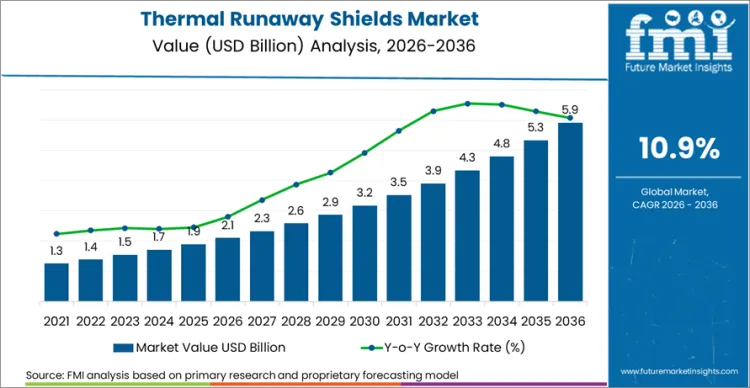
Summary of Thermal Runaway Shields Market
What is the Growth Outlook for the Thermal Runaway Shields Market Through 2036?
Future Market Insights projects the global thermal runaway shields market to expand from USD 2.1 billion in 2026 to USD 5.9 billion by 2036, registering a 10.9% CAGR over the forecast period. Market growth is underpinned by the rapid tightening of battery safety regulations and the structural redesign of electric vehicle battery architectures.
Thermal runaway shields are evolving from secondary protective layers into mission-critical safety systems. The shift toward high-energy-density chemistries, coupled with cell-to-pack and cell-to-body designs, has eliminated traditional buffer zones within battery packs, elevating the importance of advanced thermal containment materials.
FMI Research Approach: This forecast is built using FMI’s proprietary demand model incorporating EV production trajectories, battery architecture adoption rates, safety regulation timelines, and material innovation pipelines across North America, Europe, and East Asia.
How do FMI Analysts View the Structural Evolution of the Thermal Runaway Shields Market?
FMI analysts observe a decisive transition away from mineral-based insulation toward high-performance, non-metallic composite materials, including advanced fibers, aerogels, and ceramic-filled polymers. These materials offer superior thermal resistance, reduced weight, and improved moldability compared to conventional mica-based solutions.
The market is also witnessing a parallel evolution in validation methodologies. Automated and AI-enabled testing platforms are increasingly being adopted to meet stricter certification standards, accelerating design cycles and improving repeatability under extreme fire and gas-release scenarios.
FMI Research Approach: Insights are derived from analysis of supplier material roadmaps, capital investments in safety testing infrastructure, certification updates such as ANSI/CAN/UL 9540A:2025, and OEM sourcing strategies for next-generation EV platforms.
Which Countries are Driving Demand in the Thermal Runaway Shields Market?
China represents the fastest-growing market, expanding at a projected 12.4% CAGR, driven by the implementation of the GB 38031-2025 regulation, which mandates zero fire and zero explosion for at least two hours following a thermal runaway event. The United States follows with an 11.9% CAGR, supported by domestic battery manufacturing incentives and grid-scale energy storage deployment.
Germany and the United Kingdom remain critical European markets, growing at 10.8% and 10.9% CAGR, respectively, as high-voltage vehicle platforms, industrial electrification, and premium automotive safety standards reshape battery system design requirements.
FMI Research Approach: Country-level analysis integrates regulatory enforcement timelines, battery manufacturing capacity expansions, domestic content policies, and adoption of advanced battery architectures across automotive and stationary storage segments.
How large will the Thermal Runaway Shields Market be by 2036?
By 2036, the thermal runaway shields market is expected to reach USD 5.9 billion, supported by the normalization of zero-propagation safety requirements across passenger EVs, commercial vehicles, and stationary energy storage systems.
As battery systems become central to both mobility and grid infrastructure, thermal containment is transitioning from a compliance-driven feature to a foundational design parameter. This shift structurally increases the value contribution of thermal shields within the overall battery bill of materials.
FMI Research Approach: Long-term market sizing incorporates EV fleet penetration models, stationary storage deployment scenarios, regulatory-driven material substitution trends, and shield content per battery pack across evolving architectures.
What defines the Thermal Runaway Shields Market?
The thermal runaway shields market comprises revenues generated from passive fire protection and thermal containment materials designed to prevent the propagation of heat, flame, and toxic gases within lithium-ion battery systems.
The market includes materials such as mica, aerogels, microporous insulation, and ceramic-filled polymers, deployed across cell-to-cell barriers, module-level shields, and pack enclosure protection. End-use applications span passenger electric vehicles, commercial EVs, and stationary energy storage systems.
The scope excludes active cooling systems, battery management electronics, and general-purpose insulation not specifically engineered or certified for thermal runaway containment.
What Globally Distinct Trends Are Shaping the Thermal Runaway Shields Market?
Globally, the market is being shaped by the convergence of regulatory escalation, architectural densification, and material science innovation. The adoption of cell-to-pack and cell-to-chassis designs has intensified heat propagation risks, making localized containment at the cell level the primary safety strategy.
OEMs are increasingly specifying lightweight, moldable, and mica-free composites to balance fire resistance with vehicle range optimization. Sustainability and ethical sourcing considerations are accelerating this transition, particularly in Europe, where circularity and recyclability requirements are tightening.
FMI Research Approach: Trend analysis is informed by regulatory monitoring, material qualification data, OEM safety architecture disclosures, and lifecycle assessments of next-generation thermal protection materials.
Thermal Runaway Shields Market Key Takeaways
| Metric | Value |
|---|---|
| Expected Value (2026E) | USD 2.1 billion |
| Forecast Value (2036F) | USD 5.9 billion |
| CAGR (2026-2036) | 10.9% |
Source: Future Market Insights (FMI) analysis, based on proprietary forecasting model and primary research
Why is the Thermal Runaway Shields Market Growing?
Stringent global regulatory mandates for 2026 are forcing a total architectural redesign of battery safety systems. China Ministry of Industry and Information Technology published GB 38031-2025 in April 2025, mandating that electric vehicle batteries demonstrate zero fire or explosion for at least two hours following a thermal runaway event. This requirement becomes binding for new vehicle type approvals on July 1, 2026, replacing the previous five-minute warning window and necessitating significantly more robust passive fire protection layers.
The industry-wide transition toward cell-to-pack and cell-to-body architectures has removed the physical buffer zones typically provided by modular housing. Research published in January 2026 indicates that without these internal module walls, hot gases exceeding 670oC can propagate between cells and melt outer casing materials within 60 minutes. Manufacturers are consequently forced to integrate inter-cell thermal barriers that provide both high dielectric strength and extreme heat resistance to prevent localized failures from escalating into full pack ruptures.
The increasing prevalence of high-nickel chemistries such as NCM811 introduces inherent chemical instability that requires specialized shielding intervention. Technical documentation from January 2026 confirms that these cells release oxygen at the cathode interface during heating, accelerating self-heating rates and driving internal temperatures to a maximum of 1082oC. Manufacturers like LG Chem are addressing this by debuting Nexula, a dedicated thermal runaway suppression material, at InterBattery 2025 to manage the violent exothermic reactions and intense gas production specific to ultra-high nickel content exceeding 90%.
What is the Segment Profile of Thermal Runaway Shields Market?
The following segment analysis examines the distribution of market share across critical material classes, protection types, and primary end-use categories. These divisions reflect a market pivoting toward high-density protection and stringent passenger safety mandates.
How is Mica Maintaining its position amid the Rise of Synthetic Alternatives?
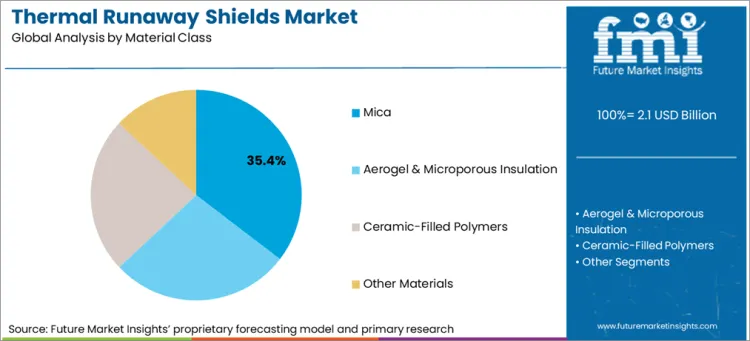
Mica remains a foundational material in the thermal runaway shield sector, currently commanding a 35.4% market share. This dominance is sustained by its inherent dielectric strength and ability to withstand temperatures exceeding 1000°C, which are critical for high-voltage insulation. Regulatory disclosures from January 2026 indicate that over 70% of advanced electrical insulation systems continue to utilize mica paper due to its proven performance in preventing electrical breakdown during high-heat events.
The material’s persistence in the market is further reinforced by its integration into new fire proof type safety parts mandated by global standards. Manufacturers are increasingly specifying high-quality mica sheets to meet secondary fire resistance criteria in battery systems, where synthetic materials may suffer from off-gassing or structural degradation. Official industry outlooks for 2026 confirm that mica's status as an "industrial gold standard" for high-performance insulation is being bolstered by its reliability in extreme thermal cycling environments where failure is not an option.
Why are cell-to-cell barriers becoming the primary focus of battery safety design?
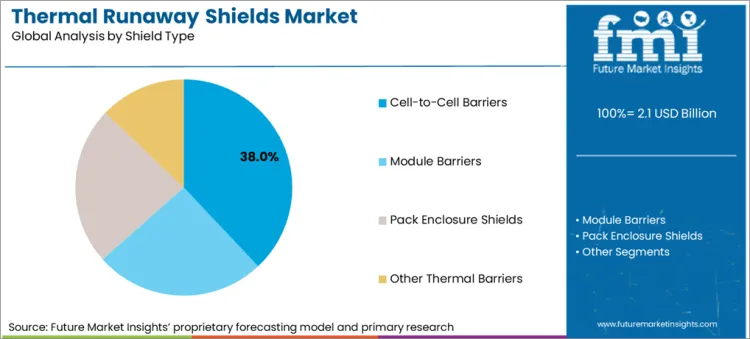
Cell-to-cell barriers have emerged as the largest segment within the shield type category, representing 38% of the total market. This prioritization stems from the fact that thermal runaway typically originates at the individual cell level, making localized isolation the most effective method for preventing a cascade failure across the entire pack.
The shift toward this specific shield type is also a direct response to the rising cell counts found in modern, high-energy-density battery packs. As cells are packed more densely to increase vehicle range, the risk of heat transfer between neighbors increases. Consequently, automakers are specifying these barriers as integral components of a multi-layer architecture. Validated performance data for 2026 shows that preventing fire propagation between adjacent cells is now a central safety objective, moving these barriers from optional safety additions to mandatory design specifications.
How are Passenger Electric Vehicles dictating the Trajectory of Shield Development?
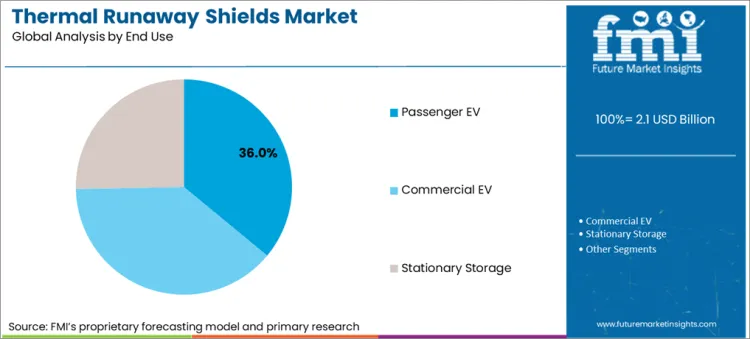
The passenger EV segment represents the most significant end-use category, accounting for 36%. This share is driven by the mass adoption of electric cars and the resulting pressure on OEMs to provide superior passenger safety features that go beyond basic regulatory compliance.
Expansion is further accelerated by the implementation of regional safety standards like FMVSS No. 305a, which introduces rigorous performance requirements for propulsion batteries in light vehicles. As automakers compete to offer zero-risk safety profiles to consumers, the demand for sophisticated shields within passenger platforms has shifted from a technical luxury to a competitive necessity. This dominance ensures that R&D investments remain heavily focused on materials that optimize the balance between extreme fire containment and the strict weight limits required for passenger vehicle efficiency.
What Drivers, Restraints, Opportunities, and Trends Prevail in the Thermal Runaway Shields Market?
Stringent global regulatory mandates serve as the primary market driver, compelling a shift from basic passenger warning systems to total fire containment. The China Ministry of Industry and Information Technology's GB 38031-2025, effective July 2026, requires that batteries demonstrate zero fire or explosion for at least two hours post-runaway. The USA NHTSA established FMVSS No. 305a, which mandates comprehensive risk mitigation documentation and performance requirements for propulsion batteries by September 2027. These policies are forcing manufacturers to adopt advanced shields that provide long-duration protection.
Market expansion is restrained by the high cost and complexity of manufacturing high-tier aerogel and composite shields. Specialized production methods like supercritical drying result in a significant price premium compared to traditional insulation. Despite strategic consolidations, such as Armacell acquiring full ownership of its South Korean aerogel joint venture in September 2024 to scale capacity, the energy-intensive nature of creating thin-film barriers continues to limit widespread adoption in price-sensitive vehicle segments.
A significant opportunity is emerging through the integration of active safety systems with passive shielding. Stellantis secured a patent in December 2025 for an onboard thermal runaway suppression system that utilizes a fire-retardant bladder and chemical foam triggered by internal sensors. This "smart" architecture allows engineers to optimize vehicle weight by reducing heavy traditional shielding in favor of responsive, chemical-based intervention. This trend toward "active shielding" opens a specialized market for manufacturers of chemical bladders and automated actuators.
The industry is currently trending toward the phase-out of mineral-based mica in favor of 3D-moldable synthetic composites. Autoneum launched its E-Fiber flame shields in March 2025, offering a lightweight, mica-free alternative that can be molded into complex geometries for better battery coverage. This shift addresses both vehicle range concerns through weight reduction and supply chain ethics by reducing reliance on mineral mining. These synthetic solutions are increasingly specified for luxury electric platforms to enhance design flexibility and gas-guiding capabilities.
How is the Thermal Runaway Shields Market Analyzed in Key Countries?
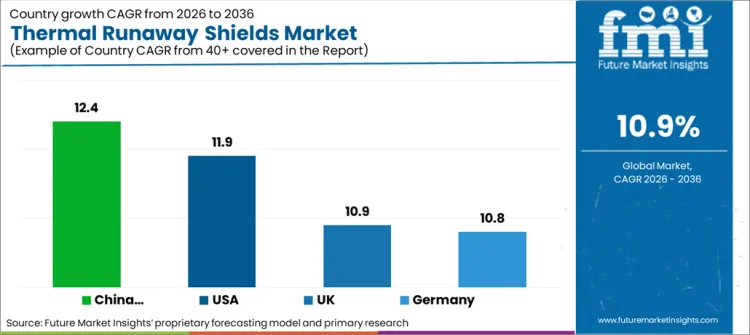
| Country | CAGR (2026-2036) |
|---|---|
| USA | 11.9% |
| UK | 10.9% |
| China | 12.4% |
| Germany | 10.8% |
Source: Future Market Insights (FMI) analysis, based on proprietary forecasting model and primary research
How is USA driving Thermal Runaway Shields Demand through Localized Industrial Policy?
USA is projected to expand at a CAGR of 11.9% between 2026 and 2036. This growth is anchored by the Inflation Reduction Act (IRA), which has pivoted federal support toward the domestic production of critical battery components. By January 2026, the policy framework has successfully incentivized a shift in the supply chain, moving from downstream pack assembly to upstream material manufacturing. This industrial reshoring ensures that safety-critical components, including specialized barriers, are integrated within the "Battery Belt" manufacturing hubs.
Momentum is further sustained by the maturation of energy storage systems across the domestic grid. The USA Department of Energy has prioritized the development of long-duration storage assets, which inherently require more robust fire protection architectures. As utilities scale up lithium-ion installations to meet state-level renewable mandates, the demand for high-reliability shields is transitioning from a specialized automotive need to a standard requirement for large-scale infrastructure safety.
What role does UK play in Setting Global Benchmarks for the Thermal Runaway Shields Market?
UK is expected to grow at a CAGR of 10.9% during the 2026-2036 forecast period. The British strategy is heavily influenced by the UK Battery Strategy, which emphasizes the development of zero-failure safety standards to protect its premium automotive manufacturing sector. Academic-led initiatives, such as those from the Faraday Institution, have accelerated the validation of next-generation protective materials that are being integrated into local gigafactory production lines to ensure long-term compliance with global export standards.
The expansion is also tied to the rapid electrification of the UK’s public transport and light-delivery sectors. As urban centers implement stricter zero-emission zones, the deployment of high-voltage electric bus fleets has surged. This transition necessitates advanced shielding solutions capable of protecting high-occupancy vehicles, driving a specialized market for barriers that can manage the intense heat signatures of large-format commercial battery packs.
How is China redefining the Thermal Runaway Shields Market through Mandatory Safety Protocols?
China remains the most aggressive growth market, with a projected CAGR of 12.4% through 2036. The primary catalyst is the implementation of the GB 38031-2025 standard, which officially transitions the industry to a no fire, no explosion baseline for a minimum of two hours. This regulation, which becomes a mandatory requirement for all new vehicle certifications by mid-2026, has eliminated the five-minute warning window in favor of total containment, forcing an immediate upgrade of protection layers across the world’s largest electric vehicle fleet.
Beyond automotive use, China’s massive expansion in the BESS sector provides a secondary growth engine. Government mandates requiring newly built renewable plants to include storage have created a vast market for thermal barriers that can isolate high-density containerized systems. This volume-driven demand allows Chinese manufacturers to achieve economies of scale in shield production that are currently unmatched in other regional markets.
Why is Germany’s Thermal Runaway Shields Market scaling through Integrated Engineering?
Germany is forecasted to grow at a CAGR of 10.8% from 2026 to 2036. The German market is characterized by a "systems-thinking" approach, where thermal shielding is integrated directly into the vehicle's structural frame. Following the 2026 transition to the BattDG (Battery Act), German manufacturers are increasingly adopting Cell-to-Chassis designs. These architectures remove traditional modular walls, creating a critical demand for inter-cell barriers that provide both structural integrity and fire protection.
Strategic growth is also supported by the country’s dominance in high-voltage 800V platforms. These systems, which enable ultra-fast charging, generate significantly higher thermal loads than standard architectures. To maintain safety certification under European REACH and UN GTR No. 20 standards, German automakers are investing heavily in multi-layer safety architectures. This technical necessity ensures a steady demand for high-performance shields within the luxury and performance vehicle segments that define the German automotive industry.
How Competitive is the Thermal Runaway Shields Market?
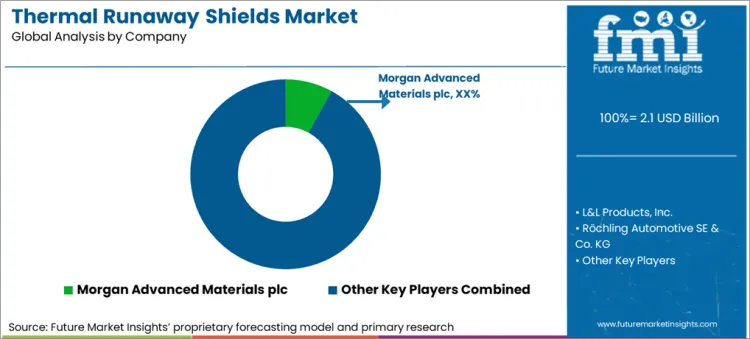
The competitive landscape of the thermal runaway shield market is characterized by high intensity, as established material science firms and automotive Tier 1 suppliers pivot their portfolios to meet the "zero-propagation" mandates of 2026. Companies are deploying aggressive vertical integration and "local-for-local" manufacturing strategies to secure positions within the regionalizing supply chains of North America, Europe, and China. Success in this domain is increasingly determined by the ability to offer multi-functional solutions that combine fire suppression, gas filtration, and dielectric insulation within ultra-thin profiles.
To maintain a competitive edge, players are transitioning from supplying individual components to providing integrated safety architectures. This shift is supported by massive capital investments in dedicated battery safety labs and AI-driven testing facilities to accelerate the validation of new materials. Strategic shifts also include a move toward sustainable, mica-free synthetics to mitigate supply chain risks and meet the circular economy requirements of the European Battery Regulation.
Key Developments
- Throughout 2024 and 2025, Morgan Advanced Materials plc expanded its Superwool EST product line, utilizing patented low-biopersistent fibers designed for cell-to-cell and pack-level protection.
- In October 2025, Compagnie de Saint-Gobain S.A. launched its Lead & Grow strategic plan, allocating €12 billion for growth capex and acquisitions through 2030. A key development includes the DEFENSOR-Flex range, which integrates technical textiles and multilayer foam pads to filter toxic gases and provide a passive fire barrier between the battery and the passenger cabin.
- At the IAA Mobility 2025, ElringKlinger AG showcased its SHAPE30 transformation strategy, emphasizing a move toward high-performance plastics and ElroSafe underbody shielding. In early 2025, the firm ramped up large-scale production of cell contacting systems at its Neuffen facility and established a new Battery Hub in Easley, South Carolina, to service the North American market.
Key Players Profiled
- Morgan Advanced Materials plc
- L&L Products, Inc.
- Röchling Automotive SE & Co. KG
- Compagnie de Saint-Gobain S.A.
- Cabot Corporation
- Unifrax LLC
- Aspen Aerogels, Inc.
- DuPont de Nemours, Inc.
- 3M Company
- ElringKlinger AG
Market Definition
The thermal runaway shields market comprises revenue generated from passive fire- and heat-protection components designed to contain, delay, or prevent the propagation of thermal runaway events within lithium-ion battery systems. These shields are engineered to withstand extreme temperatures, suppress flame and gas spread, and provide electrical insulation within high-voltage battery architectures.
The market scope includes cell-to-cell barriers, module-level shields, and pack enclosure protection manufactured from materials such as mica, aerogels, microporous insulation, and ceramic-filled polymers. Applications span passenger electric vehicles, commercial electric vehicles, and stationary energy storage systems. Revenue is measured from shield materials and assemblies supplied as dedicated battery safety components.
The market excludes active suppression systems, battery cells, modules, and complete pack manufacturing, as well as general thermal insulation products not specifically designed or certified for thermal runaway containment in battery systems.
Scope of Report
| Items | Values |
|---|---|
| Quantitative Units | USD 2.1 billion |
| Material Class | Mica, Aerogel & Microporous Insulation, Ceramic-Filled Polymers, Other Materials |
| Shield Type | Cell-to-Cell Barriers, Module Barriers, Pack Enclosure Shields, Other Thermal Barriers |
| End Use | Passenger EV, Commercial EV, Stationary Storage |
| Regions Covered | North America, Western Europe, Eastern Europe, East Asia, South Asia & Pacific, Latin America, Middle East & Africa |
| Countries | USA, UK, China, Germany and 40+ Countries |
| Key Companies | Morgan Advanced Materials plc, L&L Products Inc., Röchling Automotive SE & Co. KG, Compagnie de Saint-Gobain S.A., Cabot Corporation, Unifrax LLC, Aspen Aerogels Inc., DuPont de Nemours Inc., 3M Company, ElringKlinger AG |
Thermal Runaway Shields Market Key Segments
Material Class
- Mica
- Aerogel & Microporous Insulation
- Ceramic-Filled Polymers
- Other Materials
Shield Type
- Cell-to-Cell Barriers
- Module Barriers
- Pack Enclosure Shields
- Other Thermal Barriers
End Use
- Passenger EV
- Commercial EV
- Stationary Storage
Region
- North America
- Western Europe
- Eastern Europe
- East Asia
- South Asia & Pacific
- Latin America
- Middle East & Africa
Bibliography
- National Highway Traffic Safety Administration. (2024). Federal Motor Vehicle Safety Standards No. 305a: Electric-powered vehicles-Electrolyte spillage and electrical shock protection. USA Department of Transportation.
- Ministry of Industry and Information Technology. (2025). GB 38031-2025: Safety requirements for power batteries for electric vehicles. People’s Republic of China.
- UL Solutions. (2025). ANSI/CAN/UL 9540A: Test method for evaluating thermal runaway fire propagation in battery energy storage systems. UL Standards & Engagement.
- Morgan Advanced Materials plc. (2025). Annual report and sustainability review. Morgan Advanced Materials.
- Compagnie de Saint-Gobain S.A. (2025). Universal registration document and integrated report. Saint-Gobain Group.
- Aspen Aerogels, Inc. (2025). Advanced aerogel insulation solutions for lithium-ion battery safety. Aspen Aerogels.
- DuPont de Nemours, Inc. (2025). High-performance materials for electric vehicle battery protection. DuPont.
- 3M Company. (2025). Thermal management and fire protection materials for e-mobility applications. 3M Transportation & Electronics.
Frequently Asked Questions
What is the market value of the thermal runaway shields market in 2026?
The global thermal runaway shields market is expected to reach USD 2.1 billion in 2026, driven by stricter battery safety regulations and rising EV adoption.
What is the projected market value by 2036 and the expected CAGR from 2026 to 2036?
By 2036, the market is forecast to reach USD 5.9 billion, expanding at a CAGR of 10.9% during the 2026-2036 period.
How are battery safety regulations influencing demand for thermal runaway shields?
Mandates such as China’s GB 38031-2025 and FMVSS No. 305a are forcing OEMs to adopt zero-fire, long-duration containment solutions, directly increasing demand for advanced thermal shields.
Why are cell-to-cell barriers becoming the dominant shield type?
Cell-to-cell barriers are prioritized because thermal runaway typically originates at the individual cell level, making localized containment the most effective way to prevent cascading battery failures.
What material trends are reshaping the thermal runaway shields market?
The market is shifting from traditional mica toward lightweight composites, aerogels, and ceramic-filled polymers, offering improved thermal resistance, weight reduction, and design flexibility.
Preview the report firsthand - request a free sample
Get SampleGet the brochure for pricing and purchase details.
Get PDFTable of Content
- Executive Summary
- Global Market Outlook
- Demand-side Trends
- Supply-side Trends
- Technology Roadmap Analysis
- Analysis and Recommendations
- Market Overview
- Market Coverage / Taxonomy
- Market Definition / Scope / Limitations
- Research Methodology
- Chapter Orientation
- Analytical Lens and Working Hypotheses
- Market Structure, Signals, and Trend Drivers
- Benchmarking and Cross-market Comparability
- Market Sizing, Forecasting, and Opportunity Mapping
- Research Design and Evidence Framework
- Desk Research Programme (Secondary Evidence)
- Company Annual and Sustainability Reports
- Peer-reviewed Journals and Academic Literature
- Corporate Websites, Product Literature, and Technical Notes
- Earnings Decks and Investor Briefings
- Statutory Filings and Regulatory Disclosures
- Technical White Papers and Standards Notes
- Trade Journals, Industry Magazines, and Analyst Briefs
- Conference Proceedings, Webinars, and Seminar Materials
- Government Statistics Portals and Public Data Releases
- Press Releases and Reputable Media Coverage
- Specialist Newsletters and Curated Briefings
- Sector Databases and Reference Repositories
- FMI Internal Proprietary Databases and Historical Market Datasets
- Subscription Datasets and Paid Sources
- Social Channels, Communities, and Digital Listening Inputs
- Additional Desk Sources
- Expert Input and Fieldwork (Primary Evidence)
- Primary Modes
- Qualitative Interviews and Expert Elicitation
- Quantitative Surveys and Structured Data Capture
- Blended Approach
- Why Primary Evidence is Used
- Field Techniques
- Interviews
- Surveys
- Focus Groups
- Observational and In-context Research
- Social and Community Interactions
- Stakeholder Universe Engaged
- C-suite Leaders
- Board Members
- Presidents and Vice Presidents
- R&D and Innovation Heads
- Technical Specialists
- Domain Subject-matter Experts
- Scientists
- Physicians and Other Healthcare Professionals
- Governance, Ethics, and Data Stewardship
- Research Ethics
- Data Integrity and Handling
- Primary Modes
- Tooling, Models, and Reference Databases
- Desk Research Programme (Secondary Evidence)
- Data Engineering and Model Build
- Data Acquisition and Ingestion
- Cleaning, Normalisation, and Verification
- Synthesis, Triangulation, and Analysis
- Quality Assurance and Audit Trail
- Market Background
- Market Dynamics
- Drivers
- Restraints
- Opportunity
- Trends
- Scenario Forecast
- Demand in Optimistic Scenario
- Demand in Likely Scenario
- Demand in Conservative Scenario
- Opportunity Map Analysis
- Product Life Cycle Analysis
- Supply Chain Analysis
- Investment Feasibility Matrix
- Value Chain Analysis
- PESTLE and Porter’s Analysis
- Regulatory Landscape
- Regional Parent Market Outlook
- Production and Consumption Statistics
- Import and Export Statistics
- Market Dynamics
- Global Market Analysis 2021 to 2025 and Forecast, 2026 to 2036
- Historical Market Size Value (USD Million) Analysis, 2021 to 2025
- Current and Future Market Size Value (USD Million) Projections, 2026 to 2036
- Y-o-Y Growth Trend Analysis
- Absolute $ Opportunity Analysis
- Global Market Pricing Analysis 2021 to 2025 and Forecast 2026 to 2036
- Global Market Analysis 2021 to 2025 and Forecast 2026 to 2036, By Material Class
- Introduction / Key Findings
- Historical Market Size Value (USD Million) Analysis By Material Class , 2021 to 2025
- Current and Future Market Size Value (USD Million) Analysis and Forecast By Material Class , 2026 to 2036
- Mica
- Aerogel & Microporous Insulation
- Ceramic-Filled Polymers
- Other Materials
- Mica
- Y-o-Y Growth Trend Analysis By Material Class , 2021 to 2025
- Absolute $ Opportunity Analysis By Material Class , 2026 to 2036
- Global Market Analysis 2021 to 2025 and Forecast 2026 to 2036, By Shield Type
- Introduction / Key Findings
- Historical Market Size Value (USD Million) Analysis By Shield Type, 2021 to 2025
- Current and Future Market Size Value (USD Million) Analysis and Forecast By Shield Type, 2026 to 2036
- Cell-to-Cell Barriers
- Module Barriers
- Pack Enclosure Shields
- Other Thermal Barriers
- Cell-to-Cell Barriers
- Y-o-Y Growth Trend Analysis By Shield Type, 2021 to 2025
- Absolute $ Opportunity Analysis By Shield Type, 2026 to 2036
- Global Market Analysis 2021 to 2025 and Forecast 2026 to 2036, By End Use
- Introduction / Key Findings
- Historical Market Size Value (USD Million) Analysis By End Use, 2021 to 2025
- Current and Future Market Size Value (USD Million) Analysis and Forecast By End Use, 2026 to 2036
- Passenger EV
- Commercial EV
- Stationary Storage
- Passenger EV
- Y-o-Y Growth Trend Analysis By End Use, 2021 to 2025
- Absolute $ Opportunity Analysis By End Use, 2026 to 2036
- Global Market Analysis 2021 to 2025 and Forecast 2026 to 2036, By Region
- Introduction
- Historical Market Size Value (USD Million) Analysis By Region, 2021 to 2025
- Current Market Size Value (USD Million) Analysis and Forecast By Region, 2026 to 2036
- North America
- Latin America
- Western Europe
- Eastern Europe
- East Asia
- South Asia and Pacific
- Middle East & Africa
- Market Attractiveness Analysis By Region
- North America Market Analysis 2021 to 2025 and Forecast 2026 to 2036, By Country
- Historical Market Size Value (USD Million) Trend Analysis By Market Taxonomy, 2021 to 2025
- Market Size Value (USD Million) Forecast By Market Taxonomy, 2026 to 2036
- By Country
- USA
- Canada
- Mexico
- By Material Class
- By Shield Type
- By End Use
- By Country
- Market Attractiveness Analysis
- By Country
- By Material Class
- By Shield Type
- By End Use
- Key Takeaways
- Latin America Market Analysis 2021 to 2025 and Forecast 2026 to 2036, By Country
- Historical Market Size Value (USD Million) Trend Analysis By Market Taxonomy, 2021 to 2025
- Market Size Value (USD Million) Forecast By Market Taxonomy, 2026 to 2036
- By Country
- Brazil
- Chile
- Rest of Latin America
- By Material Class
- By Shield Type
- By End Use
- By Country
- Market Attractiveness Analysis
- By Country
- By Material Class
- By Shield Type
- By End Use
- Key Takeaways
- Western Europe Market Analysis 2021 to 2025 and Forecast 2026 to 2036, By Country
- Historical Market Size Value (USD Million) Trend Analysis By Market Taxonomy, 2021 to 2025
- Market Size Value (USD Million) Forecast By Market Taxonomy, 2026 to 2036
- By Country
- Germany
- UK
- Italy
- Spain
- France
- Nordic
- BENELUX
- Rest of Western Europe
- By Material Class
- By Shield Type
- By End Use
- By Country
- Market Attractiveness Analysis
- By Country
- By Material Class
- By Shield Type
- By End Use
- Key Takeaways
- Eastern Europe Market Analysis 2021 to 2025 and Forecast 2026 to 2036, By Country
- Historical Market Size Value (USD Million) Trend Analysis By Market Taxonomy, 2021 to 2025
- Market Size Value (USD Million) Forecast By Market Taxonomy, 2026 to 2036
- By Country
- Russia
- Poland
- Hungary
- Balkan & Baltic
- Rest of Eastern Europe
- By Material Class
- By Shield Type
- By End Use
- By Country
- Market Attractiveness Analysis
- By Country
- By Material Class
- By Shield Type
- By End Use
- Key Takeaways
- East Asia Market Analysis 2021 to 2025 and Forecast 2026 to 2036, By Country
- Historical Market Size Value (USD Million) Trend Analysis By Market Taxonomy, 2021 to 2025
- Market Size Value (USD Million) Forecast By Market Taxonomy, 2026 to 2036
- By Country
- China
- Japan
- South Korea
- By Material Class
- By Shield Type
- By End Use
- By Country
- Market Attractiveness Analysis
- By Country
- By Material Class
- By Shield Type
- By End Use
- Key Takeaways
- South Asia and Pacific Market Analysis 2021 to 2025 and Forecast 2026 to 2036, By Country
- Historical Market Size Value (USD Million) Trend Analysis By Market Taxonomy, 2021 to 2025
- Market Size Value (USD Million) Forecast By Market Taxonomy, 2026 to 2036
- By Country
- India
- ASEAN
- Australia & New Zealand
- Rest of South Asia and Pacific
- By Material Class
- By Shield Type
- By End Use
- By Country
- Market Attractiveness Analysis
- By Country
- By Material Class
- By Shield Type
- By End Use
- Key Takeaways
- Middle East & Africa Market Analysis 2021 to 2025 and Forecast 2026 to 2036, By Country
- Historical Market Size Value (USD Million) Trend Analysis By Market Taxonomy, 2021 to 2025
- Market Size Value (USD Million) Forecast By Market Taxonomy, 2026 to 2036
- By Country
- Kingdom of Saudi Arabia
- Other GCC Countries
- Turkiye
- South Africa
- Other African Union
- Rest of Middle East & Africa
- By Material Class
- By Shield Type
- By End Use
- By Country
- Market Attractiveness Analysis
- By Country
- By Material Class
- By Shield Type
- By End Use
- Key Takeaways
- Key Countries Market Analysis
- USA
- Pricing Analysis
- Market Share Analysis, 2025
- By Material Class
- By Shield Type
- By End Use
- Canada
- Pricing Analysis
- Market Share Analysis, 2025
- By Material Class
- By Shield Type
- By End Use
- Mexico
- Pricing Analysis
- Market Share Analysis, 2025
- By Material Class
- By Shield Type
- By End Use
- Brazil
- Pricing Analysis
- Market Share Analysis, 2025
- By Material Class
- By Shield Type
- By End Use
- Chile
- Pricing Analysis
- Market Share Analysis, 2025
- By Material Class
- By Shield Type
- By End Use
- Germany
- Pricing Analysis
- Market Share Analysis, 2025
- By Material Class
- By Shield Type
- By End Use
- UK
- Pricing Analysis
- Market Share Analysis, 2025
- By Material Class
- By Shield Type
- By End Use
- Italy
- Pricing Analysis
- Market Share Analysis, 2025
- By Material Class
- By Shield Type
- By End Use
- Spain
- Pricing Analysis
- Market Share Analysis, 2025
- By Material Class
- By Shield Type
- By End Use
- France
- Pricing Analysis
- Market Share Analysis, 2025
- By Material Class
- By Shield Type
- By End Use
- India
- Pricing Analysis
- Market Share Analysis, 2025
- By Material Class
- By Shield Type
- By End Use
- ASEAN
- Pricing Analysis
- Market Share Analysis, 2025
- By Material Class
- By Shield Type
- By End Use
- Australia & New Zealand
- Pricing Analysis
- Market Share Analysis, 2025
- By Material Class
- By Shield Type
- By End Use
- China
- Pricing Analysis
- Market Share Analysis, 2025
- By Material Class
- By Shield Type
- By End Use
- Japan
- Pricing Analysis
- Market Share Analysis, 2025
- By Material Class
- By Shield Type
- By End Use
- South Korea
- Pricing Analysis
- Market Share Analysis, 2025
- By Material Class
- By Shield Type
- By End Use
- Russia
- Pricing Analysis
- Market Share Analysis, 2025
- By Material Class
- By Shield Type
- By End Use
- Poland
- Pricing Analysis
- Market Share Analysis, 2025
- By Material Class
- By Shield Type
- By End Use
- Hungary
- Pricing Analysis
- Market Share Analysis, 2025
- By Material Class
- By Shield Type
- By End Use
- Kingdom of Saudi Arabia
- Pricing Analysis
- Market Share Analysis, 2025
- By Material Class
- By Shield Type
- By End Use
- Turkiye
- Pricing Analysis
- Market Share Analysis, 2025
- By Material Class
- By Shield Type
- By End Use
- South Africa
- Pricing Analysis
- Market Share Analysis, 2025
- By Material Class
- By Shield Type
- By End Use
- USA
- Market Structure Analysis
- Competition Dashboard
- Competition Benchmarking
- Market Share Analysis of Top Players
- By Regional
- By Material Class
- By Shield Type
- By End Use
- Competition Analysis
- Competition Deep Dive
- Morgan Advanced Materials plc
- Overview
- Product Portfolio
- Profitability by Market Segments (Product/Age /Sales Channel/Region)
- Sales Footprint
- Strategy Overview
- Marketing Strategy
- Product Strategy
- Channel Strategy
- L&L Products, Inc.
- Röchling Automotive SE & Co. KG
- Compagnie de Saint-Gobain S.A.
- Cabot Corporation
- Unifrax LLC
- Aspen Aerogels, Inc.
- DuPont de Nemours, Inc.
- 3M Company
- Morgan Advanced Materials plc
- Competition Deep Dive
- Assumptions & Acronyms Used


