

- Industry Size (2026)
- USD 373 Mn
- Forecast (2036)
- USD 1266.2 Mn
- CAGR (2026 to 2036)
- 13.0%
High-Voltage-Resilient Additives Market Forecast and Outlook 2026 to 2036
The high-voltage-resilient additives market is projected to grow from USD 373 million in 2026 to USD 1,266.2 million by 2036, registering a CAGR of 13.0%. Growth is driven by the rising demand for high-performance insulating materials and protective additives in power generation, transmission, and industrial applications. These additives enhance dielectric strength, thermal stability, and long-term operational reliability under high-voltage conditions.
Primary end users include electrical utilities, industrial manufacturers, and renewable energy operators. Key adoption areas are transformers, switchgears, and high-voltage cables. Leading suppliers such as BASF, Lanxess, Clariant, Solvay, and Evonik are investing in novel chemistries that improve insulation performance, reduce equipment downtime, and comply with stricter international safety standards. The market benefits from increasing electrification and modernization of power infrastructure worldwide.
Quick Stats of the High-Voltage-Resilient Additives Market:
- High-Voltage-Resilient Additives Market Value (2026): USD 373 million
- High-Voltage-Resilient Additives Market Forecast Value (2036): USD 1,266.2 million
- High-Voltage-Resilient Additives Market Forecast CAGR (2026 to 2036): 13.0%
- Leading Additive Function in the Market: Oxidation Inhibitors (30%)
- Key Growth Regions in the Market: China, Brazil, USA, Germany, UK
- Top Players in the Market: Lubrizol, Afton Chemical, Infineum, BASF, Evonik, Clariant, LANXESS, Solvay, Dow, Sinopec
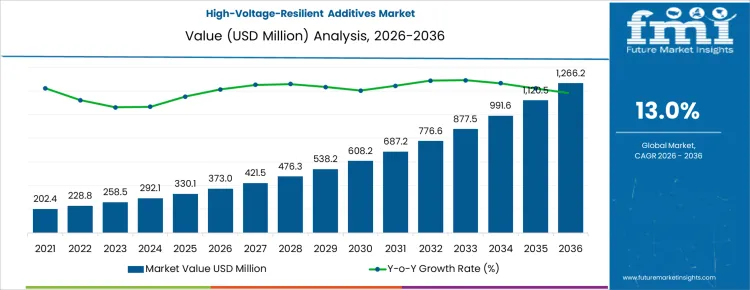
What is the Growth Forecast for the High-Voltage-Resilient Additives Market through 2036?
From 2026 to 2031, the high-voltage-resilient additives market grows from USD 373 million to USD 667 million, representing the early adoption curve. Growth during this phase is driven by adoption in power electronics, high-voltage transformers, and electric vehicle powertrain components, where improved insulation, thermal stability, and dielectric performance are critical. Year-on-year absolute value additions increase from USD 54 million in 2026 to USD 71 million in 2031, with demand concentrated in North America, Europe, and Asia Pacific. Early uptake is supported by OEM validation cycles, pilot integrations, and high-performance project specifications.
Between 2031 and 2036, the market expands from roughly USD 667 million to USD 1,266.2 million, illustrating the late adoption curve characterized by structural scaling. Annual increments widen significantly from USD 71 million to USD 147 million, driven by portfolio-wide adoption across EV powertrains, grid storage systems, and renewable energy equipment. Growth is reinforced by repeat procurement, higher per-unit incorporation, and multi-region deployment. Early growth relied on selective high-value projects, while later expansion is fueled by broader industrial integration, scale production, and standardization of high-voltage-resilient additives in global electrical and energy applications.
High Voltage Resilient Additives Market Key Takeaways
| Metric | Value |
|---|---|
| Market Value (2026) | USD 373 million |
| Forecast Value (2036) | USD 1,266.2 million |
| Forecast CAGR (2026 to 2036) | 13.0% |
What Is Driving the Demand for the High-Voltage-Resilient Additives Market?
Early demand for high-voltage-resilient additives arose from limitations in traditional insulating fluids and polymers used in electrical equipment when exposed to rising system voltages. Conventional dielectric materials provided adequate breakdown strength for low and medium voltage applications, but as utilities and industrial systems moved toward higher voltages to improve transmission efficiency and power density, existing additives and base materials exhibited premature degradation and reduced dielectric stability. Additives such as antioxidative agents, inorganic nanoparticles, and tailored polymer stabilisers were introduced to enhance breakdown resistance, control charge mobility, and suppress partial discharge phenomena. Historical uptake reflected targeted upgrades in transformers, switchgear, and high-voltage cables where early failures highlighted performance gaps rather than widespread specification across all voltage classes.
Future demand for high-voltage-resilient additives is expected to be shaped by structural changes in power infrastructure, regulatory reliability standards, and the electrification of mobility and industrial loads rather than reactive performance fixes alone. Expansion of renewable energy generation, grid densification, and high-power charging networks places new stress on insulation systems that must perform under elevated electrical and thermal loads. Additives that improve dielectric strength, thermal stability, and ageing resistance will be specified early in material selection for fluids, polymer insulations, and composite dielectrics. Demand will align with formalised insulation performance criteria in codes and standards that govern equipment life-cycle expectations and safety margins
What Factors Are Affecting the Demand for High Voltage Resilient Additives Market in Terms of Additive Function and Application System?
Demand for high voltage resilient additives is structured around additive function and application system within electrified power and cooling environments. Oxidation inhibitors account for about 30% of total demand, making them the leading additive function. Corrosion inhibitors and metal deactivators, conductivity modifiers or dielectric stabilizers, and anti foam or auxiliary aids represent additional functional categories without disclosed share splits. These additives differ in voltage tolerance, interaction with base fluids, and long term stability under electrical stress. Application system segmentation reflects exposure to electric fields and thermal load. E transmission fluids account for about 40% of demand, followed by dielectric immersion coolants, thermal management coolants, and insulating oils. Together, these segments explain demand formation driven by electrical reliability requirements and system integration rather than lubricant volume growth.
What Drives Demand by Additive Function in the High Voltage Resilient Additives Market?
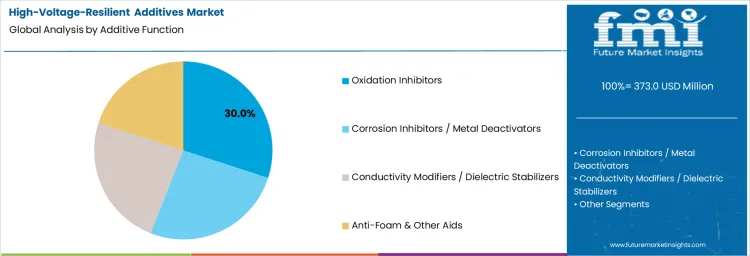
Oxidation inhibitors lead demand with a 30% share because high voltage environments accelerate fluid degradation. These additives limit oxidative breakdown that can compromise dielectric strength and fluid life. Corrosion inhibitors and metal deactivators are specified to protect copper windings and conductive components. Conductivity modifiers and dielectric stabilizers are applied to control charge accumulation and maintain insulation performance. Anti foam and auxiliary aids support fluid circulation stability under high shear conditions. Additive function selection reflects failure prevention priorities rather than incremental performance enhancement. Demand therefore aligns with maintaining electrical integrity and service life in high voltage systems rather than additive multifunctionality.
Functional demand remains stable because additive roles are defined during system qualification. Oxidation control is embedded into baseline formulations. Corrosion and conductivity control are added where material interaction risk is highest. Anti foam usage remains secondary but necessary. Once validated, additive packages are rarely altered due to testing requirements. This stabilizes demand by function. Additive function segmentation therefore reflects risk management within electrified systems rather than experimentation with new additive roles.
How Does Application System Shape Demand for High Voltage Resilient Additives Market?
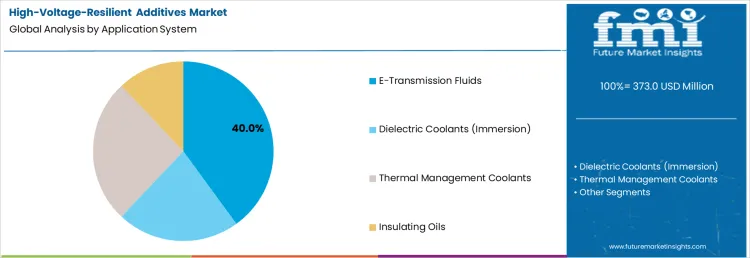
E transmission fluids account for about 40% of total demand, making them the leading application system. These fluids operate in close proximity to electric motors and power electronics under combined thermal and electrical stress. Dielectric immersion coolants adopt resilient additives to maintain insulation during direct component contact. Thermal management coolants require additives that tolerate voltage exposure while transferring heat efficiently. Insulating oils apply high voltage additives in stationary electrical equipment. Application driven demand reflects electric field exposure, operating temperature, and maintenance access rather than system size alone.
E transmission systems maintain leadership due to integration of lubrication and electrification. Immersion cooling adoption increases additive requirements where fluids contact energized components. Thermal management systems apply additives selectively based on voltage exposure. Insulating oils remain relevant in grid and auxiliary equipment. Once specified, additive strategies remain fixed through product lifecycles. This stabilizes demand distribution. Application system segmentation therefore reinforces concentration in drivetrain and power electronics related fluids.
How Are High Voltage Resilient Additives Being Applied Across Electrical Insulation Systems?
Use appears in polymers, oils, and composite materials where insulation must withstand high voltage stress without breakdown. Electrical equipment manufacturers integrate these additives into transformers, capacitors, and switchgear components to improve dielectric strength and thermal stability. Renewable energy systems, including wind and solar inverters, adopt high-voltage-resilient formulations to prevent partial discharge and extend service life. Automotive and industrial electrification sectors use them in traction motors and high-voltage cabling. These applications reflect operational and safety priorities rather than aesthetic considerations, with adoption driven by reliability, voltage endurance, and insulation performance.
What Operational and Material Conditions Support Adoption of High Voltage Resilient Additives?
Selection aligns with materials subjected to continuous electrical stress, temperature cycling, and mechanical load. Chemists optimize additive chemistry to enhance dielectric properties without compromising polymer processability, viscosity, or thermal conductivity. Manufacturers require uniform dispersion to prevent local weak points that could lead to partial discharge or insulation failure. Design engineers specify additive-treated materials to meet IEC, ASTM, or ISO electrical and thermal performance standards. These conditions arise from operational reliability, safety compliance, and long-term insulation integrity priorities.
Which Practical Considerations Limit Wider Use of High Voltage Resilient Additives?
Additive cost and processing complexity can increase overall material expenses. Compatibility with base polymers, oils, and fillers must be verified to prevent degradation or reduced performance. Long-term testing is needed to validate insulation endurance under cyclic voltage and thermal conditions. Regulatory approvals for electrical and environmental compliance may restrict certain chemistries. Equipment and process adjustments may be required for homogeneous additive integration. These factors result in selective deployment where insulation reliability, voltage resilience, and safety performance justify incremental cost and process adaptation.
What is the Demand for High Voltage Resilient Additives by Country?
| Country | CAGR (%) |
|---|---|
| USA | 12.6% |
| Germany | 12.5% |
| China | 14.7% |
| UK | 12.3% |
| Brazil | 13.6% |
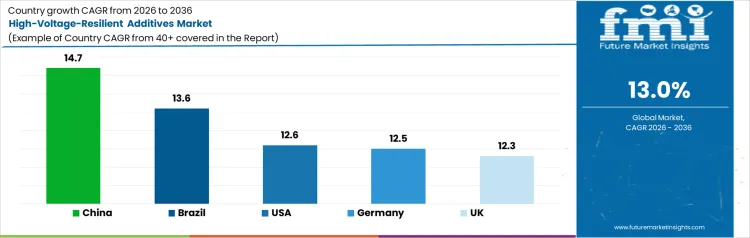
The demand for high voltage resilient additives varies across countries, driven by growth in electrical equipment, renewable energy installations, and demand for high performance insulating materials. China leads with a 14.7% CAGR, supported by large scale power infrastructure projects, increasing renewable energy adoption, and industrial electrification. Brazil follows at 13.6%, driven by grid modernization and industrial applications requiring high voltage resilience. The USA grows at 12.6%, reflecting demand from electrical and electronics manufacturing and infrastructure upgrades. Germany records 12.5%, shaped by energy efficiency initiatives and industrial electrification. The UK posts 12.3%, supported by renewable energy integration and modernization of electrical grids.
How Is High-Voltage Resilience Driving Growth in the United States?
In the United States, revenue from the High-Voltage-Resilient Additives Market is expanding at a CAGR of 12.6% through 2036, driven by adoption of chemical additives that improve dielectric strength, thermal stability, and insulation performance in electrical and electronic applications. Manufacturers are integrating high-voltage-resilient additives in transformers, cables, capacitors, and industrial electrical equipment. Demand is concentrated in power generation, industrial, and transportation sectors. Domestic suppliers provide high-performance additives compatible with polymers, insulating oils, and composite materials. Growing electrification, renewable energy deployment, and recurring equipment production are sustaining predictable procurement nationwide.
- Transformers, cables, and capacitors drive high-voltage-resilient additive adoption
- Additives improve dielectric strength, thermal stability, and insulation performance
- Domestic suppliers provide polymer- and oil-compatible high-performance additives
- Electrification and recurring equipment production sustain predictable procurement
How Are Electrical Standards Supporting Growth in Germany?
Germany continues to record steady growth in the High-Voltage-Resilient Additives Market at a CAGR of 12.5% through 2036, supported by stringent electrical safety standards and industrial electrification initiatives. Manufacturers are integrating additives into transformers, high-voltage cables, and power distribution equipment to enhance insulation, prevent breakdown, and improve reliability. Demand is concentrated in industrial facilities, power generation, and renewable energy installations. Domestic suppliers provide high-quality additives compatible with polymers, insulating oils, and composite materials. Regulatory compliance and recurring equipment production are sustaining measured adoption nationwide.
- Transformers, high-voltage cables, and power distribution equipment anchor demand
- Additives enhance insulation, reliability, and prevent breakdown
- Domestic suppliers provide polymer- and oil-compatible high-performance additives
- Compliance and recurring production sustain steady adoption
How Is Industrial Electrification Accelerating Adoption in China?
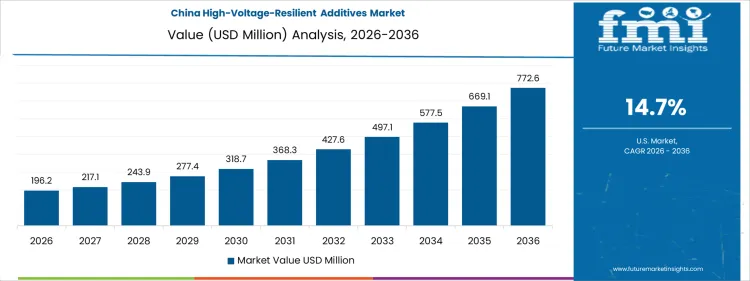
In China, revenue from the High-Voltage-Resilient Additives Market is growing at a CAGR of 14.7% through 2036, driven by rapid deployment of renewable energy, electric vehicles, and industrial electrification projects. Manufacturers are adopting high-voltage-resilient additives in transformers, cables, and industrial electrical equipment to improve dielectric performance, thermal stability, and operational reliability. Demand is strong across power generation, industrial facilities, and transportation applications. Domestic suppliers are scaling production of high-performance additives compatible with insulating oils, polymers, and composite materials. Large-scale electrification projects and structured procurement programs are sustaining rapid adoption nationwide.
- Power generation, industrial facilities, and EV infrastructure drive additive adoption
- Additives improve dielectric performance, thermal stability, and reliability
- Domestic suppliers scale production of high-performance polymer- and oil-compatible additives
- Large-scale electrification projects sustain consistent adoption
How Is Renewable Energy and Industrial Electrification Supporting Growth in the United Kingdom?
In the United Kingdom, revenue from the High-Voltage-Resilient Additives Market is expanding at a CAGR of 12.3% through 2036, supported by increasing adoption of renewable energy systems, electric vehicles, and industrial electrification. Manufacturers are integrating high-voltage-resilient additives into transformers, cables, and power distribution equipment to improve insulation and prevent electrical breakdown. Demand is concentrated in power generation, industrial installations, and transportation infrastructure. Domestic suppliers provide high-performance additives compatible with polymers, insulating oils, and composite materials. Renewable energy deployment, electrification projects, and recurring equipment production sustain predictable procurement nationwide.
- Transformers, cables, and power distribution equipment anchor demand
- Additives improve insulation, prevent breakdown, and enhance reliability
- Domestic suppliers provide polymer- and oil-compatible high-performance additives
- Renewable energy and electrification projects sustain predictable procurement
How Is Industrial and Transportation Electrification Driving Adoption in Brazil?
Brazil is seeing strong growth in the High-Voltage-Resilient Additives Market at a CAGR of 13.6% through 2036, supported by increased electrification of industrial facilities, transport systems, and renewable energy infrastructure. Manufacturers are adopting high-voltage-resilient additives to improve dielectric strength, thermal stability, and insulation performance in transformers, cables, and industrial electrical equipment. Demand is concentrated in power generation, industrial, and transportation sectors. Domestic suppliers are expanding production of high-performance additives compatible with polymers, insulating oils, and composites. Electrification initiatives, renewable energy projects, and recurring equipment production are sustaining robust procurement nationwide.
- Transformers, cables, and industrial electrical equipment drive additive adoption
- Additives enhance dielectric strength, thermal stability, and insulation performance
- Domestic suppliers expand high-performance polymer- and oil-compatible additives
- Electrification projects and recurring equipment production sustain robust procurement
Which Companies Are Shaping Competition in The High Voltage Resilient Additives Market Through Electrical Stability and Fluid Integrity Requirements?
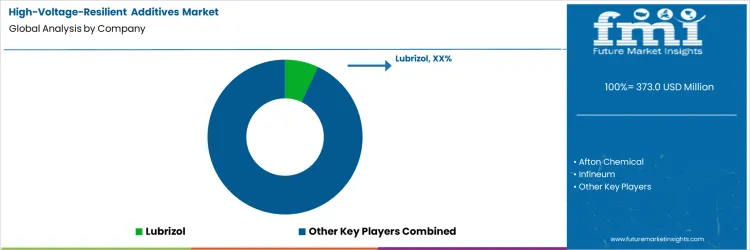
High voltage resilience in fluids and materials is addressed during formulation, where additives must maintain performance under electrical stress without degrading insulation or fluid stability. Lubrizol, Afton Chemical, and Infineum influence this market through additive technologies developed for electrically active environments such as EV fluids, e drivetrain lubricants, and high voltage cooling systems. These suppliers work within narrow conductivity and dielectric tolerances defined by OEM specifications. BASF and Evonik participate through specialty chemistries that support oxidation control and thermal stability without increasing electrical risk. Selection depends on compatibility with base fluids, resistance to electrochemical breakdown, and consistent behavior under continuous voltage exposure.
Material science driven suppliers add depth to competitive structure. Clariant, LANXESS, Solvay, and Dow contribute additives and functional polymers used where electrical resistance and chemical stability must be balanced. Sinopec supports the market through domestically developed additives aligned with regional EV and industrial standards. Adoption is shaped by qualification cycles tied to electrical testing, long duration aging studies, and integration with broader additive packages. Competitive positioning reflects testing capability, co-development with equipment manufacturers, and reliability across operating conditions rather than additive visibility. Market entry remains constrained by validation timelines, proprietary specifications, and the need for sustained performance under electrical load.
Key Players in the High Voltage Resilient Additives Market
- Lubrizol
- Afton Chemical
- Infineum
- BASF
- Evonik
- Clariant
- LANXESS
- Solvay
- Dow
- Sinopec
Scope of the Report
| Items | Values |
|---|---|
| Quantitative Units (2026) | USD million |
| Additive Function | Oxidation Inhibitors; Corrosion Inhibitors / Metal Deactivators; Conductivity Modifiers / Dielectric Stabilizers; Anti-Foam & Other Aids |
| Application System | E-Transmission Fluids; Dielectric Coolants (Immersion); Thermal Management Coolants; Insulating Oils |
| Compatibility Target | Copper Protection; Aluminum Protection; Polymer Seal Compatibility; Multi-Material Packages |
| Customer Type | Additive Packages to Oil Blenders; OEM Co-Development; Tier-1 Drivetrain Suppliers; Specialty Fluid Formulators |
| Region | Asia Pacific; Europe; North America; Latin America; Middle East & Africa |
| Countries Covered | China; Japan; South Korea; India; Australia & New Zealand; ASEAN; Rest of Asia Pacific; Germany; United Kingdom; France; Italy; Spain; Nordic; BENELUX; Rest of Europe; United States; Canada; Mexico; Brazil; Chile; Rest of Latin America; Kingdom of Saudi Arabia; Other GCC Countries; Turkey; South Africa; Other African Union; Rest of Middle East & Africa |
| Key Companies Profiled | Lubrizol; Afton Chemical; Infineum; BASF; Evonik; Clariant; LANXESS; Solvay; Dow; Sinopec |
| Additional Attributes | Dollar by sales across additive function, application system, and compatibility target; Oxidation inhibitors lead demand due to critical role in dielectric stability; E-transmission fluids account for the largest application share due to integration with electric drivetrains; Adoption driven by electrical integrity, voltage endurance, and insulation performance requirements; Market growth shaped by renewable energy deployment, EV powertrains, and industrial electrification. |
High Voltage Resilient Additives Market Segmentation
Additive Function:
- Oxidation Inhibitors
- Corrosion Inhibitors / Metal Deactivators
- Conductivity Modifiers / Dielectric Stabilizers
- Anti-Foam & Other Aids
Application System:
- E-Transmission Fluids
- Dielectric Coolants (Immersion)
- Thermal Management Coolants
- Insulating Oils
Compatibility Target:
- Copper Protection
- Aluminum Protection
- Polymer Seal Compatibility
- Multi-Material Packages
Customer Type:
- Additive Packages to Oil Blenders
- OEM Co-Development
- Tier-1 Drivetrain Suppliers
- Specialty Fluid Formulators
Region
- Asia Pacific
- China
- Japan
- South Korea
- India
- Australia & New Zealand
- ASEAN
- Rest of Asia Pacific
- Europe
- Germany
- United Kingdom
- France
- Italy
- Spain
- Nordic
- BENELUX
- Rest of Europe
- North America
- United States
- Canada
- Mexico
- Latin America
- Brazil
- Chile
- Rest of Latin America
- Middle East & Africa
- Kingdom of Saudi Arabia
- Other GCC Countries
- Turkey
- South Africa
- Other African Union
- Rest of Middle East & Africa
Frequently Asked Questions
How big is the high-voltage-resilient additives market in 2026?
The global high-voltage-resilient additives market is estimated to be valued at USD 373.0 million in 2026.
What will be the size of high-voltage-resilient additives market in 2036?
The market size for the high-voltage-resilient additives market is projected to reach USD 1,266.2 million by 2036.
How much will be the high-voltage-resilient additives market growth between 2026 and 2036?
The high-voltage-resilient additives market is expected to grow at a 13.0% CAGR between 2026 and 2036.
What are the key product types in the high-voltage-resilient additives market?
The key product types in high-voltage-resilient additives market are oxidation inhibitors, corrosion inhibitors / metal deactivators, conductivity modifiers / dielectric stabilizers and anti-foam & other aids.
Which application system segment to contribute significant share in the high-voltage-resilient additives market in 2026?
In terms of application system, e-transmission fluids segment to command 40.0% share in the high-voltage-resilient additives market in 2026.
Preview the report firsthand - request a free sample
Get SampleGet the brochure for pricing and purchase details.
Get PDFTable of Content
- Executive Summary
- Global Market Outlook
- Demand-side Trends
- Supply-side Trends
- Technology Roadmap Analysis
- Analysis and Recommendations
- Market Overview
- Market Coverage / Taxonomy
- Market Definition / Scope / Limitations
- Market Background
- Market Dynamics
- Drivers
- Restraints
- Opportunity
- Trends
- Scenario Forecast
- Demand in Optimistic Scenario
- Demand in Likely Scenario
- Demand in Conservative Scenario
- Opportunity Map Analysis
- Product Life Cycle Analysis
- Supply Chain Analysis
- Investment Feasibility Matrix
- Value Chain Analysis
- PESTLE and Porter’s Analysis
- Regulatory Landscape
- Regional Parent Market Outlook
- Production and Consumption Statistics
- Import and Export Statistics
- Market Dynamics
- Global Market Analysis 2021 to 2025 and Forecast, 2026 to 2036
- Historical Market Size Value (USD Million) Analysis, 2021 to 2025
- Current and Future Market Size Value (USD Million) Projections, 2026 to 2036
- Y-o-Y Growth Trend Analysis
- Absolute $ Opportunity Analysis
- Global Market Pricing Analysis 2021 to 2025 and Forecast 2026 to 2036
- Global Market Analysis 2021 to 2025 and Forecast 2026 to 2036, By Additive Function
- Introduction / Key Findings
- Historical Market Size Value (USD Million) Analysis By Additive Function , 2021 to 2025
- Current and Future Market Size Value (USD Million) Analysis and Forecast By Additive Function , 2026 to 2036
- Oxidation Inhibitors
- Corrosion Inhibitors / Metal Deactivators
- Conductivity Modifiers / Dielectric Stabilizers
- Anti-Foam & Other Aids
- Y-o-Y Growth Trend Analysis By Additive Function , 2021 to 2025
- Absolute $ Opportunity Analysis By Additive Function , 2026 to 2036
- Global Market Analysis 2021 to 2025 and Forecast 2026 to 2036, By Application System
- Introduction / Key Findings
- Historical Market Size Value (USD Million) Analysis By Application System, 2021 to 2025
- Current and Future Market Size Value (USD Million) Analysis and Forecast By Application System, 2026 to 2036
- E-Transmission Fluids
- Dielectric Coolants (Immersion)
- Thermal Management Coolants
- Insulating Oils
- Y-o-Y Growth Trend Analysis By Application System, 2021 to 2025
- Absolute $ Opportunity Analysis By Application System, 2026 to 2036
- Global Market Analysis 2021 to 2025 and Forecast 2026 to 2036, By Compatibility Target
- Introduction / Key Findings
- Historical Market Size Value (USD Million) Analysis By Compatibility Target, 2021 to 2025
- Current and Future Market Size Value (USD Million) Analysis and Forecast By Compatibility Target, 2026 to 2036
- Copper Protection
- Aluminum Protection
- Polymer Seal Compatibility
- Multi-Material Packages
- Y-o-Y Growth Trend Analysis By Compatibility Target, 2021 to 2025
- Absolute $ Opportunity Analysis By Compatibility Target, 2026 to 2036
- Global Market Analysis 2021 to 2025 and Forecast 2026 to 2036, By Customer Type
- Introduction / Key Findings
- Historical Market Size Value (USD Million) Analysis By Customer Type, 2021 to 2025
- Current and Future Market Size Value (USD Million) Analysis and Forecast By Customer Type, 2026 to 2036
- Additive Packages to Oil Blenders
- OEM Co-Development
- Tier-1 Drivetrain Suppliers
- Specialty Fluid Formulators
- Y-o-Y Growth Trend Analysis By Customer Type, 2021 to 2025
- Absolute $ Opportunity Analysis By Customer Type, 2026 to 2036
- Global Market Analysis 2021 to 2025 and Forecast 2026 to 2036, By Region
- Introduction
- Historical Market Size Value (USD Million) Analysis By Region, 2021 to 2025
- Current Market Size Value (USD Million) Analysis and Forecast By Region, 2026 to 2036
- North America
- Latin America
- Western Europe
- Eastern Europe
- East Asia
- South Asia and Pacific
- Middle East & Africa
- Market Attractiveness Analysis By Region
- North America Market Analysis 2021 to 2025 and Forecast 2026 to 2036, By Country
- Historical Market Size Value (USD Million) Trend Analysis By Market Taxonomy, 2021 to 2025
- Market Size Value (USD Million) Forecast By Market Taxonomy, 2026 to 2036
- By Country
- USA
- Canada
- Mexico
- By Additive Function
- By Application System
- By Compatibility Target
- By Customer Type
- By Country
- Market Attractiveness Analysis
- By Country
- By Additive Function
- By Application System
- By Compatibility Target
- By Customer Type
- Key Takeaways
- Latin America Market Analysis 2021 to 2025 and Forecast 2026 to 2036, By Country
- Historical Market Size Value (USD Million) Trend Analysis By Market Taxonomy, 2021 to 2025
- Market Size Value (USD Million) Forecast By Market Taxonomy, 2026 to 2036
- By Country
- Brazil
- Chile
- Rest of Latin America
- By Additive Function
- By Application System
- By Compatibility Target
- By Customer Type
- By Country
- Market Attractiveness Analysis
- By Country
- By Additive Function
- By Application System
- By Compatibility Target
- By Customer Type
- Key Takeaways
- Western Europe Market Analysis 2021 to 2025 and Forecast 2026 to 2036, By Country
- Historical Market Size Value (USD Million) Trend Analysis By Market Taxonomy, 2021 to 2025
- Market Size Value (USD Million) Forecast By Market Taxonomy, 2026 to 2036
- By Country
- Germany
- UK
- Italy
- Spain
- France
- Nordic
- BENELUX
- Rest of Western Europe
- By Additive Function
- By Application System
- By Compatibility Target
- By Customer Type
- By Country
- Market Attractiveness Analysis
- By Country
- By Additive Function
- By Application System
- By Compatibility Target
- By Customer Type
- Key Takeaways
- Eastern Europe Market Analysis 2021 to 2025 and Forecast 2026 to 2036, By Country
- Historical Market Size Value (USD Million) Trend Analysis By Market Taxonomy, 2021 to 2025
- Market Size Value (USD Million) Forecast By Market Taxonomy, 2026 to 2036
- By Country
- Russia
- Poland
- Hungary
- Balkan & Baltic
- Rest of Eastern Europe
- By Additive Function
- By Application System
- By Compatibility Target
- By Customer Type
- By Country
- Market Attractiveness Analysis
- By Country
- By Additive Function
- By Application System
- By Compatibility Target
- By Customer Type
- Key Takeaways
- East Asia Market Analysis 2021 to 2025 and Forecast 2026 to 2036, By Country
- Historical Market Size Value (USD Million) Trend Analysis By Market Taxonomy, 2021 to 2025
- Market Size Value (USD Million) Forecast By Market Taxonomy, 2026 to 2036
- By Country
- China
- Japan
- South Korea
- By Additive Function
- By Application System
- By Compatibility Target
- By Customer Type
- By Country
- Market Attractiveness Analysis
- By Country
- By Additive Function
- By Application System
- By Compatibility Target
- By Customer Type
- Key Takeaways
- South Asia and Pacific Market Analysis 2021 to 2025 and Forecast 2026 to 2036, By Country
- Historical Market Size Value (USD Million) Trend Analysis By Market Taxonomy, 2021 to 2025
- Market Size Value (USD Million) Forecast By Market Taxonomy, 2026 to 2036
- By Country
- India
- ASEAN
- Australia & New Zealand
- Rest of South Asia and Pacific
- By Additive Function
- By Application System
- By Compatibility Target
- By Customer Type
- By Country
- Market Attractiveness Analysis
- By Country
- By Additive Function
- By Application System
- By Compatibility Target
- By Customer Type
- Key Takeaways
- Middle East & Africa Market Analysis 2021 to 2025 and Forecast 2026 to 2036, By Country
- Historical Market Size Value (USD Million) Trend Analysis By Market Taxonomy, 2021 to 2025
- Market Size Value (USD Million) Forecast By Market Taxonomy, 2026 to 2036
- By Country
- Kingdom of Saudi Arabia
- Other GCC Countries
- Turkiye
- South Africa
- Other African Union
- Rest of Middle East & Africa
- By Additive Function
- By Application System
- By Compatibility Target
- By Customer Type
- By Country
- Market Attractiveness Analysis
- By Country
- By Additive Function
- By Application System
- By Compatibility Target
- By Customer Type
- Key Takeaways
- Key Countries Market Analysis
- USA
- Pricing Analysis
- Market Share Analysis, 2025
- By Additive Function
- By Application System
- By Compatibility Target
- By Customer Type
- Canada
- Pricing Analysis
- Market Share Analysis, 2025
- By Additive Function
- By Application System
- By Compatibility Target
- By Customer Type
- Mexico
- Pricing Analysis
- Market Share Analysis, 2025
- By Additive Function
- By Application System
- By Compatibility Target
- By Customer Type
- Brazil
- Pricing Analysis
- Market Share Analysis, 2025
- By Additive Function
- By Application System
- By Compatibility Target
- By Customer Type
- Chile
- Pricing Analysis
- Market Share Analysis, 2025
- By Additive Function
- By Application System
- By Compatibility Target
- By Customer Type
- Germany
- Pricing Analysis
- Market Share Analysis, 2025
- By Additive Function
- By Application System
- By Compatibility Target
- By Customer Type
- UK
- Pricing Analysis
- Market Share Analysis, 2025
- By Additive Function
- By Application System
- By Compatibility Target
- By Customer Type
- Italy
- Pricing Analysis
- Market Share Analysis, 2025
- By Additive Function
- By Application System
- By Compatibility Target
- By Customer Type
- Spain
- Pricing Analysis
- Market Share Analysis, 2025
- By Additive Function
- By Application System
- By Compatibility Target
- By Customer Type
- France
- Pricing Analysis
- Market Share Analysis, 2025
- By Additive Function
- By Application System
- By Compatibility Target
- By Customer Type
- India
- Pricing Analysis
- Market Share Analysis, 2025
- By Additive Function
- By Application System
- By Compatibility Target
- By Customer Type
- ASEAN
- Pricing Analysis
- Market Share Analysis, 2025
- By Additive Function
- By Application System
- By Compatibility Target
- By Customer Type
- Australia & New Zealand
- Pricing Analysis
- Market Share Analysis, 2025
- By Additive Function
- By Application System
- By Compatibility Target
- By Customer Type
- China
- Pricing Analysis
- Market Share Analysis, 2025
- By Additive Function
- By Application System
- By Compatibility Target
- By Customer Type
- Japan
- Pricing Analysis
- Market Share Analysis, 2025
- By Additive Function
- By Application System
- By Compatibility Target
- By Customer Type
- South Korea
- Pricing Analysis
- Market Share Analysis, 2025
- By Additive Function
- By Application System
- By Compatibility Target
- By Customer Type
- Russia
- Pricing Analysis
- Market Share Analysis, 2025
- By Additive Function
- By Application System
- By Compatibility Target
- By Customer Type
- Poland
- Pricing Analysis
- Market Share Analysis, 2025
- By Additive Function
- By Application System
- By Compatibility Target
- By Customer Type
- Hungary
- Pricing Analysis
- Market Share Analysis, 2025
- By Additive Function
- By Application System
- By Compatibility Target
- By Customer Type
- Kingdom of Saudi Arabia
- Pricing Analysis
- Market Share Analysis, 2025
- By Additive Function
- By Application System
- By Compatibility Target
- By Customer Type
- Turkiye
- Pricing Analysis
- Market Share Analysis, 2025
- By Additive Function
- By Application System
- By Compatibility Target
- By Customer Type
- South Africa
- Pricing Analysis
- Market Share Analysis, 2025
- By Additive Function
- By Application System
- By Compatibility Target
- By Customer Type
- USA
- Market Structure Analysis
- Competition Dashboard
- Competition Benchmarking
- Market Share Analysis of Top Players
- By Regional
- By Additive Function
- By Application System
- By Compatibility Target
- By Customer Type
- Competition Analysis
- Competition Deep Dive
- Lubrizol
- Overview
- Product Portfolio
- Profitability by Market Segments (Product/Age /Sales Channel/Region)
- Sales Footprint
- Strategy Overview
- Marketing Strategy
- Product Strategy
- Channel Strategy
- Afton Chemical
- Infineum
- BASF
- Evonik
- Clariant
- LANXESS
- Solvay
- Dow
- Sinopec
- Lubrizol
- Competition Deep Dive
- Assumptions & Acronyms Used
- Research Methodology


