

- Industry Size (2026)
- USD 72.5 Bn
- Forecast (2036)
- USD 118.1 Bn
- CAGR (2026 to 2036)
- 5.0%
Food Additives Size Market Forecast and Outlook 2026 to 2036
The food additives market is projected to be valued at USD 72.5 billion in 2026 and is forecasted to reach USD 118.1 billion by 2036 at a CAGR of 5.0%. Value formation is driven by functional dependency rather than discretionary ingredient adoption. Demand reflects the role of additives as formulation enablers supporting shelf stability, sensory consistency, and process efficiency across high-volume food manufacturing. Purchasing decisions prioritize additives that deliver predictable performance under thermal processing, extended storage, and long distribution cycles. Adoption intensity correlates with processed food penetration, centralized manufacturing models, and regulatory requirements governing food safety and quality assurance. Market growth remains anchored to formulation complexity rather than consumption growth alone.
Scalability is shaped by regulatory scrutiny, reformulation exposure, and raw material cost volatility across additive categories. Shifting regulatory classifications and labeling requirements increase compliance risk and extend product redevelopment timelines. Price sensitivity persists where additives represent a significant proportion of formulation cost in mass-market foods. Natural alternatives face supply variability and performance trade-offs compared with synthetic counterparts. Technical interaction risks within complex formulations increase quality control overhead. Cross-regional regulatory divergence limits global formulation standardization. Supplier concentration in specialty additives constrains sourcing flexibility. These factors moderate expansion despite rising processed food output, reinforcing measured growth tied to compliance stability and formulation efficiency rather than rapid volume acceleration.
Quick Stats for Food Additives Size Market
- Food Additives Market Value (2026): USD 72.5 billion
- Food Additives Market Forecast Value (2036): USD 118.1 billion
- Food Additives Market Forecast CAGR 2026 to 2036: 5.0%
- Leading Additive Type by Demand Share: Preservatives
- Fastest-Growing Countries: India, China, Brazil, USA, Germany
- Top Players in Global Demand: Cargill, BASF, DSM-Firmenich, ADM, Kerry Group
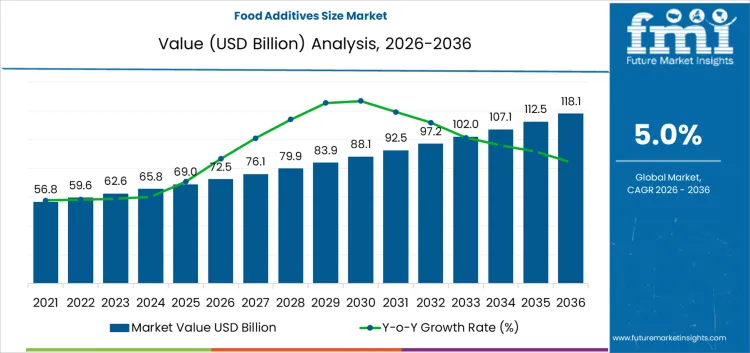
Food Additives Size Market Key Takeaways
| Metric | Value |
|---|---|
| Market Value (2026) | USD 72.5 billion |
| Market Forecast Value (2036) | USD 118.1 billion |
| Forecast CAGR 2026 to 2036 | 5.0% |
Why is the Demand for Food Additives Size Market Growing?
Demand for the food additives market is rising as food manufacturers respond to rising consumer expectations for product quality, texture, and shelf stability across diverse categories. Processed food producers incorporate emulsifiers, stabilizers, and preservatives to maintain consistency in appearance and taste while managing moisture migration and structural integrity during extended distribution periods. Snack, bakery, and dairy sectors require functional ingredients that support desired mouthfeel and prevent spoilage under fluctuating storage conditions. Beverage formulators deploy sweeteners and acidulants to tailor flavor profiles and maintain clarity without compromising safety.
Institutional foodservice and retail brands integrate clean label alternatives to align with regulatory scrutiny and voluntary ingredient transparency policies that guide purchasing decisions in competitive markets. Global supply chains and regulatory frameworks are influencing market expansion because producers need additives that comply with regional specifications and food safety criteria. Ingredient suppliers innovate with plant derived compounds that deliver performance while meeting nutritional guidelines that limit artificial components. Quality assurance laboratories apply analytical methods to verify additive concentrations to ensure compliance and minimize risk of off specification batches. Growth in convenience foods and on the go consumption patterns sustain long term requirements for texturizing and preservation solutions across processed offerings in modern diets.
How Are the Segments Classified in the Food Additives Size Market?
Demand for food additives expands due to shelf life extension needs, sensory consistency expectations, and large scale processed food production. Manufacturers rely on functional ingredients to stabilize formulations during storage and distribution. Product differentiation across flavors, appearance, and texture increases formulation complexity. Regulatory oversight and cost efficiency pressures influence additive selection across global food processing systems and standardized manufacturing environments.
Which additive type represents the largest share of demand?
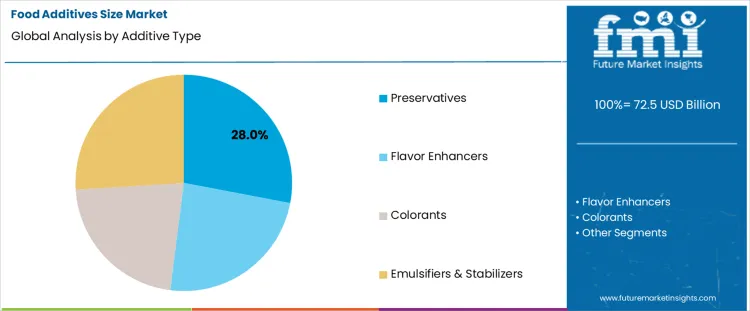
Preservatives hold the leading position with a 28.0% share, reflecting widespread use across packaged and long shelf life foods. These additives inhibit microbial growth and oxidation, supporting safety and quality stability during extended distribution cycles. High dependency arises from centralized production and long distance logistics. Compatibility with diverse formulations sustains broad deployment. Processors prioritize consistent performance under variable temperature and handling conditions, reinforcing sustained utilization across food categories.
Key Points:
- Extends shelf stability across packaged food categories
- Supports food safety during long distribution cycles
- Maintains quality under variable storage conditions
Which source accounts for the highest share of demand?
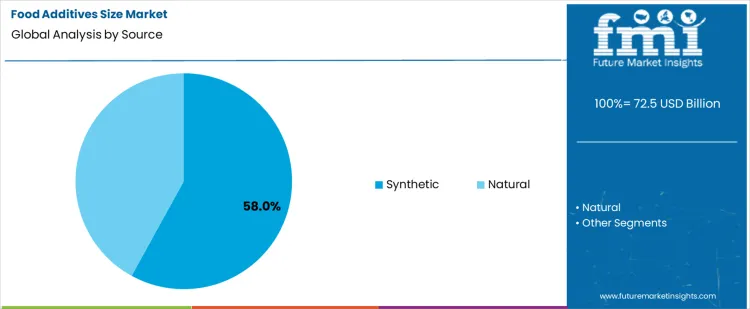
Synthetic sources dominate sourcing preference with a 58.0% share due to consistency and cost control advantages. Standardized production enables uniform functionality across large volume manufacturing operations. Predictable chemical profiles simplify formulation and regulatory compliance processes. Synthetic additives integrate efficiently into automated dosing systems. Supply reliability supports uninterrupted production schedules across global food processing networks.
Key Points:
- Delivers consistent performance across large scale production
- Supports predictable formulation and compliance requirements
- Ensures reliable availability for continuous manufacturing
Which application accounts for the highest share of demand?
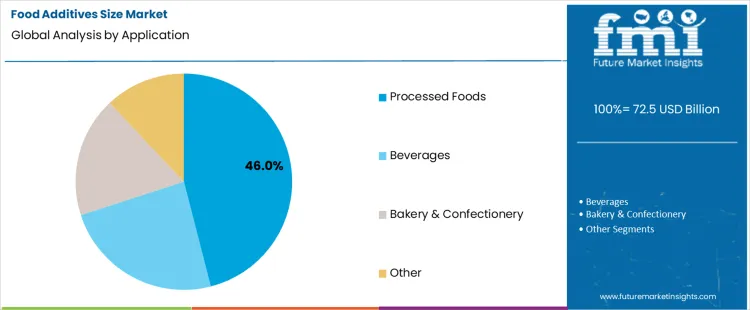
Processed foods account for a 46.0% share, driven by intensive formulation and preservation requirements. These products require additives to maintain flavor, appearance, and texture through extended shelf life. High throughput manufacturing increases reliance on functional ingredients for uniform output. Distribution through retail networks amplifies stability expectations. Additive usage remains integral to meeting consumer quality standards across packaged food categories.
Key Points:
- Requires functional ingredients for stability and consistency
- Aligns with high throughput manufacturing environments
- Supports quality retention across extended retail lifecycles
What are the Key Dynamics in the food additives size market?
Demand dynamics in the food additives size market reflect formulation optimization requirements across processed food and beverage manufacturing. Global activity centers on shelf life extension, sensory consistency, and regulatory compliance. Value formation depends on additive functionality, dosage efficiency, and application specificity. Purchasing decisions align with production scale, formulation complexity, and cost control objectives within industrial food processing operations.
How do formulation performance and regulatory compliance requirements shape adoption?
Adoption increases as manufacturers require precise control over texture, stability, flavor, and appearance across standardized food products. Demand strengthens where emulsifiers, preservatives, stabilizers, and colorants enable consistent quality during high-volume production. Clean label reformulation pressures influence selection toward additives with established safety profiles and regulatory acceptance. Processing intensity elevates reliance on additives supporting thermal stability and extended distribution timelines. Regional food safety regulations shape allowable additive types and inclusion limits. Compatibility with automated dosing systems improves manufacturing efficiency. Product diversification across ready meals, bakery, beverages, and dairy increases additive usage intensity, supporting sustained integration across multiple formulation platforms.
How do regulatory scrutiny and cost volatility influence market scalability?
Market scalability faces constraints from evolving regulatory frameworks governing additive approval, labeling, and permissible usage levels. Demand encounters pressure where reformulation becomes necessary due to regulatory reclassification or consumer perception shifts. Raw material price volatility affects cost predictability for synthetic and natural additives. Supply chain concentration among specialty chemical producers limits sourcing flexibility. Technical reformulation requirements increase development time and validation expense. Cross-border compliance differences complicate multinational product standardization. Storage stability and interaction risks within complex formulations add quality assurance overhead, constraining rapid volume expansion across diverse food categories.
How Is Demand for the Food Additives Size Market Evolving Globally?
Global demand for food additives is expanding as processed food production scales and formulation complexity increases across regions. Growth reflects need for shelf life stability, sensory consistency, and regulatory compliant ingredient functionality. Demand acceleration aligns with urbanization, packaged food penetration, and industrial food manufacturing expansion. India records 6.8% CAGR, China records 6.2% CAGR, Brazil records 5.6% CAGR, USA records 4.7% CAGR, and Germany records 4.3% CAGR. Adoption remains structurally linked to processed food output growth, cost optimized formulations, and compliance with evolving food safety standards across global supply chains.
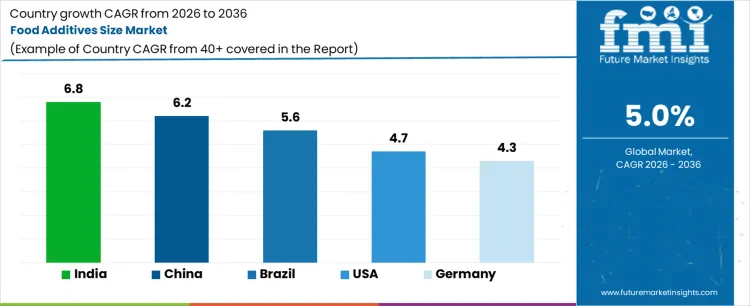
| Country | CAGR (%) |
|---|---|
| India | 6.8% |
| China | 6.2% |
| Brazil | 5.6% |
| USA | 4.7% |
| Germany | 4.3% |
What is driving growth of food additives demand in India?
Demand for food additives in India is increasing as packaged food consumption expands across urban and semi urban populations. Growth at 6.8% CAGR reflects rising production of bakery, dairy, snacks, and ready meals. Manufacturers prioritize additives supporting shelf stability under warm climate distribution conditions. Regulatory alignment with international food standards encourages standardized ingredient usage. Cost sensitivity drives adoption of multifunctional additives improving yield and texture. Domestic food processing capacity expansion sustains recurring demand. Small and mid-scale manufacturers increasingly outsource formulation expertise, reinforcing consistent additive procurement. Growth remains volume driven and linked to affordability focused product portfolios.
- Expansion of packaged food consumption
- Climate driven shelf life requirements
- Growth of domestic food processing
- Emphasis on cost efficient formulations
Why is China seeing expansion in food additives adoption?
Food additives demand in China is expanding as industrial food manufacturing modernizes and scales nationwide. Growth at 6.2% CAGR aligns with increasing consumption of processed and convenience foods. Manufacturers adopt additives to ensure consistency, safety, and production efficiency. Regulatory oversight strengthens quality and traceability requirements. Domestic additive production supports large volume availability and pricing control. Adoption intensifies within meat processing, beverages, and instant foods. Export oriented producers standardize formulations to meet overseas compliance standards. Demand remains structurally linked to high throughput manufacturing and centralized processing models.
- Industrial scale food manufacturing growth
- Strengthening food safety regulation
- Strong domestic additive supply base
- Expansion of convenience food segments
How is Brazil supporting growth of food additives demand?
Sales of food additives in Brazil are rising as food processing expands to serve domestic and export markets. Growth of 5.6% CAGR reflects demand from meat processing, beverages, and bakery sectors. Additives support product stability across long distribution distances. Climate variability increases reliance on preservatives and stabilizers. Manufacturers focus on yield improvement and waste reduction. Local agricultural output supports processing scale and ingredient integration. Adoption strengthens among export focused producers meeting international quality standards. Demand growth remains tied to protein processing expansion and packaged food penetration.
- Expansion of meat and beverage processing
- Long distribution chain requirements
- Focus on yield optimization
- Export driven quality compliance
What factors are shaping food additives sales in the USA?
Food additives demand in the USA is shaped by mature processed food markets and regulatory oversight. Expansion at 4.7% CAGR reflects steady reformulation activity rather than rapid volume growth. Manufacturers prioritize additives enabling clean label positioning and functional performance. Replacement demand arises from ingredient substitutions and nutritional optimization. Strong compliance requirements influence supplier selection. Adoption concentrates in beverages, snacks, and frozen foods. Innovation focuses on texture, stability, and flavor enhancement. Demand remains stable and closely aligned with product lifecycle management strategies.
- Reformulation driven replacement demand
- Emphasis on functional performance
- Strong regulatory compliance environment
- Mature processed food market
How is Germany supporting growth of food additives demand?
Food additives market demand in Germany is advancing through controlled expansion within regulated food manufacturing sectors. Growth at 4.3% CAGR reflects cautious adoption emphasizing quality and compliance. Manufacturers prioritize documentation, traceability, and consistency. Additive usage supports efficiency and waste reduction within premium food production. Limited tolerance for formulation variability constrains aggressive volume expansion. Demand concentrates within bakery, dairy, and specialty foods. Sustainability considerations influence ingredient selection. Growth remains incremental and aligned with high quality food standards.
- Stringent food quality regulations
- Emphasis on traceability and documentation
- Focus on premium food segments
- Sustainability influenced sourcing decisions
What is the competitive landscape of demand for the food additives size market globally?
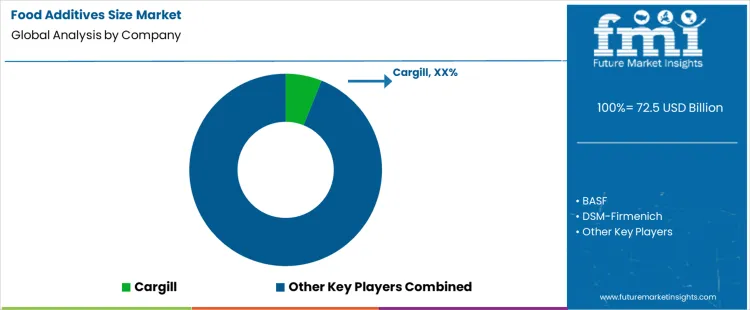
Demand for food additives is driven by processed food growth, shelf life extension requirements, and sensory optimization needs. Buyers evaluate functional efficacy, dosage efficiency, regulatory approval status, label acceptability, supply consistency, and formulation compatibility. Procurement behavior emphasizes long term contracts, multi region sourcing, traceability assurance, and suppliers with application development support. Purchasing teams prioritize cost stability, audit readiness, scalable volumes, and responsiveness to changing product specifications. Trend in the food additives market reflects clean label reformulation, natural ingredient substitution, and rising functionality requirements. Global manufacturers increasingly require additives supporting regional regulatory variation and consistent performance across diverse processing conditions.
Cargill leads competitive positioning through broad ingredient portfolios, integrated agricultural sourcing, and extensive global manufacturing capacity. ADM competes by leveraging scale, fermentation expertise, and supply reliability across food, beverage, and nutrition segments. DSM-Firmenich supports demand with science driven solutions addressing taste modulation, nutrition enhancement, and regulatory compliant formulations. BASF maintains relevance through specialty additive chemistries, consistent quality systems, and strong relationships with multinational processors. Kerry Group participates by combining functional ingredients with sensory expertise and customer centric product development capabilities. Competitive differentiation depends on formulation performance proof, regulatory reach, supply security, and ability to support rapid reformulation cycles.
Key Players in the Food Additives Size Market
- Cargill
- BASF
- DSM-Firmenich
- ADM
- Kerry Group
Scope of the Report
| Items | Values |
|---|---|
| Quantitative Units | USD billion |
| Additive Type | Preservatives; Flavor Enhancers; Colorants; Emulsifiers & Stabilizers |
| Source | Synthetic; Natural |
| Application | Processed Foods; Beverages; Bakery & Confectionery; Other |
| Regions Covered | Asia Pacific, Europe, North America, Latin America, Middle East & Africa |
| Countries Covered | India, China, Brazil, USA, Germany, and 40+ countries |
| Key Companies Profiled | Cargill; BASF; DSM-Firmenich; ADM; Kerry Group |
| Additional Attributes | Dollar sales by additive type, source, application, and sales channel; functionality performance covering shelf life extension, flavor stability, color retention, and texture control; regulatory compliance across food safety and labeling standards; formulation compatibility with processed, beverage, and bakery systems; sourcing reliability for natural ingredients; procurement dynamics spanning multinational food manufacturers, regional processors, and ingredient distribution networks. |
Food Additives Size Market by Segment
By Additive Type:
- Preservatives
- Flavor Enhancers
- Colorants
- Emulsifiers & Stabilizers
By Source:
- Synthetic
- Natural
By Application:
- Processed Foods
- Beverages
- Bakery & Confectionery
- Other
By Region:
- Asia Pacific
- China
- Japan
- South Korea
- India
- Australia & New Zealand
- ASEAN
- Rest of Asia Pacific
- Europe
- Germany
- United Kingdom
- France
- Italy
- Spain
- Nordic
- BENELUX
- Rest of Europe
- North America
- United States
- Canada
- Mexico
- Latin America
- Brazil
- Chile
- Rest of Latin America
- Middle East & Africa
- Kingdom of Saudi Arabia
- Other GCC Countries
- Turkey
- South Africa
- Other African Union
- Rest of Middle East & Africa
Bibliography
- Codex Alimentarius Commission. (n.d.). Food additives database (GSFA online). FAO/WHO Codex Alimentarius.
- European Food Safety Authority. (n.d.). Food improvement agents applications: Regulations and guidance. European Food Safety Authority.
- Food and Agriculture Organization of the United Nations. (n.d.). Food safety and quality: Scientific advice (JECFA). FAO.
Frequently Asked Questions
How big is the food additives size market in 2026?
The global food additives size market is estimated to be valued at USD 72.5 billion in 2026.
What will be the size of food additives size market in 2036?
The market size for the food additives size market is projected to reach USD 118.1 billion by 2036.
How much will be the food additives size market growth between 2026 and 2036?
The food additives size market is expected to grow at a 5.0% CAGR between 2026 and 2036.
What are the key product types in the food additives size market?
The key product types in food additives size market are preservatives, flavor enhancers, colorants and emulsifiers & stabilizers.
Which source segment to contribute significant share in the food additives size market in 2026?
In terms of source, synthetic segment to command 58.0% share in the food additives size market in 2026.
Preview the report firsthand - request a free sample
Get SampleGet the brochure for pricing and purchase details.
Get PDFTable of Content
- Executive Summary
- Global Market Outlook
- Demand-side Trends
- Supply-side Trends
- Technology Roadmap Analysis
- Analysis and Recommendations
- Market Overview
- Market Coverage / Taxonomy
- Market Definition / Scope / Limitations
- Market Background
- Market Dynamics
- Drivers
- Restraints
- Opportunity
- Trends
- Scenario Forecast
- Demand in Optimistic Scenario
- Demand in Likely Scenario
- Demand in Conservative Scenario
- Opportunity Map Analysis
- Product Life Cycle Analysis
- Supply Chain Analysis
- Investment Feasibility Matrix
- Value Chain Analysis
- PESTLE and Porter’s Analysis
- Regulatory Landscape
- Regional Parent Market Outlook
- Production and Consumption Statistics
- Import and Export Statistics
- Market Dynamics
- Global Market Analysis 2021 to 2025 and Forecast, 2026 to 2036
- Historical Market Size Value (USD Million) Analysis, 2021 to 2025
- Current and Future Market Size Value (USD Million) Projections, 2026 to 2036
- Y-o-Y Growth Trend Analysis
- Absolute $ Opportunity Analysis
- Global Market Pricing Analysis 2021 to 2025 and Forecast 2026 to 2036
- Global Market Analysis 2021 to 2025 and Forecast 2026 to 2036, By Additive Type
- Introduction / Key Findings
- Historical Market Size Value (USD Million) Analysis By Additive Type, 2021 to 2025
- Current and Future Market Size Value (USD Million) Analysis and Forecast By Additive Type, 2026 to 2036
- Preservatives
- Flavor Enhancers
- Colorants
- Emulsifiers & Stabilizers
- Preservatives
- Y-o-Y Growth Trend Analysis By Additive Type, 2021 to 2025
- Absolute $ Opportunity Analysis By Additive Type, 2026 to 2036
- Global Market Analysis 2021 to 2025 and Forecast 2026 to 2036, By Source
- Introduction / Key Findings
- Historical Market Size Value (USD Million) Analysis By Source, 2021 to 2025
- Current and Future Market Size Value (USD Million) Analysis and Forecast By Source, 2026 to 2036
- Synthetic
- Natural
- Synthetic
- Y-o-Y Growth Trend Analysis By Source, 2021 to 2025
- Absolute $ Opportunity Analysis By Source, 2026 to 2036
- Global Market Analysis 2021 to 2025 and Forecast 2026 to 2036, By Application
- Introduction / Key Findings
- Historical Market Size Value (USD Million) Analysis By Application, 2021 to 2025
- Current and Future Market Size Value (USD Million) Analysis and Forecast By Application, 2026 to 2036
- Processed Foods
- Beverages
- Bakery & Confectionery
- Other
- Processed Foods
- Y-o-Y Growth Trend Analysis By Application, 2021 to 2025
- Absolute $ Opportunity Analysis By Application, 2026 to 2036
- Global Market Analysis 2021 to 2025 and Forecast 2026 to 2036, By Region
- Introduction
- Historical Market Size Value (USD Million) Analysis By Region, 2021 to 2025
- Current Market Size Value (USD Million) Analysis and Forecast By Region, 2026 to 2036
- North America
- Latin America
- Western Europe
- Eastern Europe
- East Asia
- South Asia and Pacific
- Middle East & Africa
- Market Attractiveness Analysis By Region
- North America Market Analysis 2021 to 2025 and Forecast 2026 to 2036, By Country
- Historical Market Size Value (USD Million) Trend Analysis By Market Taxonomy, 2021 to 2025
- Market Size Value (USD Million) Forecast By Market Taxonomy, 2026 to 2036
- By Country
- USA
- Canada
- Mexico
- By Additive Type
- By Source
- By Application
- By Country
- Market Attractiveness Analysis
- By Country
- By Additive Type
- By Source
- By Application
- Key Takeaways
- Latin America Market Analysis 2021 to 2025 and Forecast 2026 to 2036, By Country
- Historical Market Size Value (USD Million) Trend Analysis By Market Taxonomy, 2021 to 2025
- Market Size Value (USD Million) Forecast By Market Taxonomy, 2026 to 2036
- By Country
- Brazil
- Chile
- Rest of Latin America
- By Additive Type
- By Source
- By Application
- By Country
- Market Attractiveness Analysis
- By Country
- By Additive Type
- By Source
- By Application
- Key Takeaways
- Western Europe Market Analysis 2021 to 2025 and Forecast 2026 to 2036, By Country
- Historical Market Size Value (USD Million) Trend Analysis By Market Taxonomy, 2021 to 2025
- Market Size Value (USD Million) Forecast By Market Taxonomy, 2026 to 2036
- By Country
- Germany
- UK
- Italy
- Spain
- France
- Nordic
- BENELUX
- Rest of Western Europe
- By Additive Type
- By Source
- By Application
- By Country
- Market Attractiveness Analysis
- By Country
- By Additive Type
- By Source
- By Application
- Key Takeaways
- Eastern Europe Market Analysis 2021 to 2025 and Forecast 2026 to 2036, By Country
- Historical Market Size Value (USD Million) Trend Analysis By Market Taxonomy, 2021 to 2025
- Market Size Value (USD Million) Forecast By Market Taxonomy, 2026 to 2036
- By Country
- Russia
- Poland
- Hungary
- Balkan & Baltic
- Rest of Eastern Europe
- By Additive Type
- By Source
- By Application
- By Country
- Market Attractiveness Analysis
- By Country
- By Additive Type
- By Source
- By Application
- Key Takeaways
- East Asia Market Analysis 2021 to 2025 and Forecast 2026 to 2036, By Country
- Historical Market Size Value (USD Million) Trend Analysis By Market Taxonomy, 2021 to 2025
- Market Size Value (USD Million) Forecast By Market Taxonomy, 2026 to 2036
- By Country
- China
- Japan
- South Korea
- By Additive Type
- By Source
- By Application
- By Country
- Market Attractiveness Analysis
- By Country
- By Additive Type
- By Source
- By Application
- Key Takeaways
- South Asia and Pacific Market Analysis 2021 to 2025 and Forecast 2026 to 2036, By Country
- Historical Market Size Value (USD Million) Trend Analysis By Market Taxonomy, 2021 to 2025
- Market Size Value (USD Million) Forecast By Market Taxonomy, 2026 to 2036
- By Country
- India
- ASEAN
- Australia & New Zealand
- Rest of South Asia and Pacific
- By Additive Type
- By Source
- By Application
- By Country
- Market Attractiveness Analysis
- By Country
- By Additive Type
- By Source
- By Application
- Key Takeaways
- Middle East & Africa Market Analysis 2021 to 2025 and Forecast 2026 to 2036, By Country
- Historical Market Size Value (USD Million) Trend Analysis By Market Taxonomy, 2021 to 2025
- Market Size Value (USD Million) Forecast By Market Taxonomy, 2026 to 2036
- By Country
- Kingdom of Saudi Arabia
- Other GCC Countries
- Turkiye
- South Africa
- Other African Union
- Rest of Middle East & Africa
- By Additive Type
- By Source
- By Application
- By Country
- Market Attractiveness Analysis
- By Country
- By Additive Type
- By Source
- By Application
- Key Takeaways
- Key Countries Market Analysis
- USA
- Pricing Analysis
- Market Share Analysis, 2025
- By Additive Type
- By Source
- By Application
- Canada
- Pricing Analysis
- Market Share Analysis, 2025
- By Additive Type
- By Source
- By Application
- Mexico
- Pricing Analysis
- Market Share Analysis, 2025
- By Additive Type
- By Source
- By Application
- Brazil
- Pricing Analysis
- Market Share Analysis, 2025
- By Additive Type
- By Source
- By Application
- Chile
- Pricing Analysis
- Market Share Analysis, 2025
- By Additive Type
- By Source
- By Application
- Germany
- Pricing Analysis
- Market Share Analysis, 2025
- By Additive Type
- By Source
- By Application
- UK
- Pricing Analysis
- Market Share Analysis, 2025
- By Additive Type
- By Source
- By Application
- Italy
- Pricing Analysis
- Market Share Analysis, 2025
- By Additive Type
- By Source
- By Application
- Spain
- Pricing Analysis
- Market Share Analysis, 2025
- By Additive Type
- By Source
- By Application
- France
- Pricing Analysis
- Market Share Analysis, 2025
- By Additive Type
- By Source
- By Application
- India
- Pricing Analysis
- Market Share Analysis, 2025
- By Additive Type
- By Source
- By Application
- ASEAN
- Pricing Analysis
- Market Share Analysis, 2025
- By Additive Type
- By Source
- By Application
- Australia & New Zealand
- Pricing Analysis
- Market Share Analysis, 2025
- By Additive Type
- By Source
- By Application
- China
- Pricing Analysis
- Market Share Analysis, 2025
- By Additive Type
- By Source
- By Application
- Japan
- Pricing Analysis
- Market Share Analysis, 2025
- By Additive Type
- By Source
- By Application
- South Korea
- Pricing Analysis
- Market Share Analysis, 2025
- By Additive Type
- By Source
- By Application
- Russia
- Pricing Analysis
- Market Share Analysis, 2025
- By Additive Type
- By Source
- By Application
- Poland
- Pricing Analysis
- Market Share Analysis, 2025
- By Additive Type
- By Source
- By Application
- Hungary
- Pricing Analysis
- Market Share Analysis, 2025
- By Additive Type
- By Source
- By Application
- Kingdom of Saudi Arabia
- Pricing Analysis
- Market Share Analysis, 2025
- By Additive Type
- By Source
- By Application
- Turkiye
- Pricing Analysis
- Market Share Analysis, 2025
- By Additive Type
- By Source
- By Application
- South Africa
- Pricing Analysis
- Market Share Analysis, 2025
- By Additive Type
- By Source
- By Application
- USA
- Market Structure Analysis
- Competition Dashboard
- Competition Benchmarking
- Market Share Analysis of Top Players
- By Regional
- By Additive Type
- By Source
- By Application
- Competition Analysis
- Competition Deep Dive
- Cargill
- Overview
- Product Portfolio
- Profitability by Market Segments (Product/Age /Sales Channel/Region)
- Sales Footprint
- Strategy Overview
- Marketing Strategy
- Product Strategy
- Channel Strategy
- BASF
- DSM-Firmenich
- ADM
- Kerry Group
- Cargill
- Competition Deep Dive
- Assumptions & Acronyms Used
- Research Methodology


