

- Industry Size (2026)
- USD 89.3 Mn
- Forecast (2036)
- USD 185.8 Mn
- CAGR (2026 to 2036)
- 7.6%
Thermal-Abuse Indicator Color Additives for Food Packaging Market Forecast and Outlook 2026 to 2036
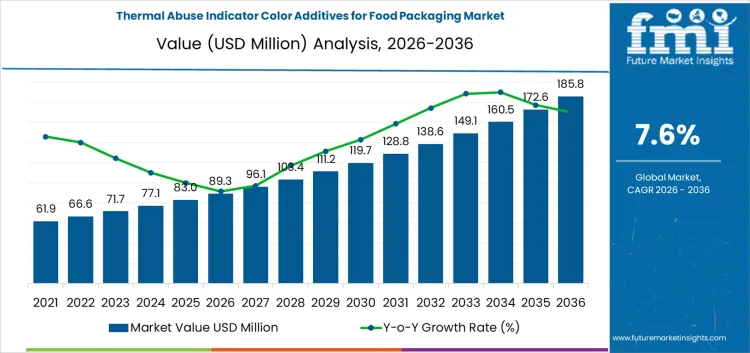
The thermal-abuse indicator color additives for food packaging market is valued at USD 89.3 million in 2026 and is forecasted to reach USD 185.8 million by 2036, registering a CAGR of 7.6%. Performance across this period is governed by risk-transfer economics within temperature-sensitive food supply chains rather than by packaging volume growth alone. These additives function as loss-prevention instruments, shifting financial exposure from downstream recalls and disputes toward upstream prevention and verification. Value concentrates where indicators reduce ambiguity around liability, shorten inspection cycles, and lower dispute costs between manufacturers, logistics providers, and retailers. Pricing power remains anchored in reliability of color response, calibration accuracy, and regulatory acceptance, since indicator failure directly undermines safety assurance and contractual trust.
Buyer behavior reinforces disciplined adoption patterns. Food producers and retailers treat thermal-abuse indicators as assurance tools rather than aesthetic enhancements, leading to cautious vendor selection and long qualification cycles. Switching costs stay elevated because indicators are validated against specific products, temperature thresholds, and packaging formats, making replacement operationally disruptive. Procurement decisions prioritize consistency, irreversibility of signal, and compatibility with existing printing or packaging lines over marginal cost savings. Demand quality improves where cold-chain complexity, cross-border logistics, or retailer audit intensity is highest. Between 2026 and 2036, growth remains tied to execution reliability, compliance alignment, and ability to support dispute avoidance, rather than rapid expansion of smart-packaging adoption.
Quick Stats for Thermal-Abuse Indicator Color Additives for Food Packaging Market
- Thermal-Abuse Indicator Color Additives for Food Packaging Market Value (2026): USD 89.3 million
- Thermal-Abuse Indicator Color Additives for Food Packaging Market Forecast Value (2036): USD 185.8 million
- Thermal-Abuse Indicator Color Additives for Food Packaging Market Forecast CAGR (2026–2036): 7.6%
- Leading Application Segment in Global Demand: Dairy
- Fastest-Growing Countries: China, USA, Germany, France
- Key Players in Global Demand: Sun Chemical, Sensient Technologies, DIC Corporation, BASF, Clariant, Toyo Ink
Thermal-Abuse Indicator Color Additives for Food Packaging Market Key Takeaways
| Metric | Value |
|---|---|
| Market Value (2026) | USD 89.3 million |
| Market Forecast Value (2036) | USD 185.8 million |
| Forecast CAGR (2026-2036) | 7.6% |
Why is the Demand for Thermal-Abuse Indicator Color Additives for Food Packaging Market Growing Globally?
Demand for thermal-abuse indicator color additives for food packaging is growing globally due to increasing emphasis on food safety, quality assurance, and extended supply chains that expose products to variable temperature conditions. Thermal-abuse indicators provide visual cues when food has been subjected to temperatures outside acceptable ranges, which helps manufacturers, retailers, and consumers identify potential spoilage or compromised product integrity without destructive testing. Growth in refrigerated and frozen food distribution across global markets increases complexity of cold chain logistics, which reinforces the need for temperature monitoring solutions that improve risk mitigation and reduce waste.
Regulatory frameworks in multiple regions emphasize safe handling, traceability, and accurate labeling, which supports adoption of smart packaging technologies including color change indicators that align with safety protocols. Advances in indicator chemistry improve sensitivity, specificity, and integration with diverse packaging substrates, enabling real-time visual feedback throughout transport and storage. Retailers and brand owners adopt these additives to enhance consumer confidence and reduce liability associated with temperature abuse events. E-commerce growth, longer transit times, and expanding global food trade further elevate demand for packaging that offers simple, intuitive thermal abuse detection. Continued focus on food safety, spoilage prevention, and supply chain transparency supports adoption of thermal-abuse indicator color additives in global food packaging portfolios.
How Is the Global Thermal-Abuse Indicator Color Additives for Food Packaging Market Structured?
Global demand for thermal-abuse indicator color additives in food packaging is driven by increased focus on cold-chain integrity, food safety verification, and spoilage risk reduction. These additives provide visible cues when packaged foods experience temperature deviations during transport or storage. Adoption is supported by regulatory scrutiny, retailer quality standards, and consumer awareness around freshness assurance. Packaging developers prioritize indicator systems that deliver reliable color response, process compatibility, and clear interpretation across diverse food categories and distribution environments.
Which Application Segment Holds the Largest Share of Global Demand?
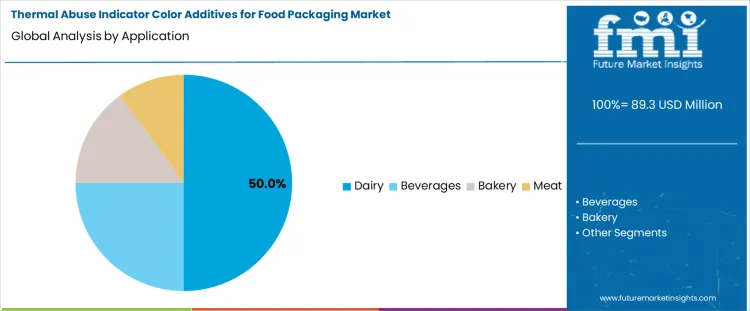
Dairy applications account for 50.0% of global demand, reflecting strong reliance on thermal-abuse indicators for milk, yogurt, cheese, and cultured products with strict temperature sensitivity. Dairy supply chains benefit from visible indicators that confirm cold storage compliance and reduce product returns. Beverage applications represent 25.0%, supported by use in functional drinks, juices, and ready-to-drink products requiring refrigerated stability assurance. Bakery applications hold 15.0%, where indicators are selectively used for cream-filled or temperature-sensitive baked goods. Meat applications account for 10.0%, reflecting targeted use in chilled and processed meat packaging where temperature excursions directly affect safety and shelf life.
Key Takeaways:
- Dairy leads due to high temperature sensitivity and cold-chain reliance
- Beverages adopt indicators for refrigerated quality assurance
- Bakery and meat usage remains selective and product-specific
Which Indicator Technology Represents the Largest Share of Global Demand?
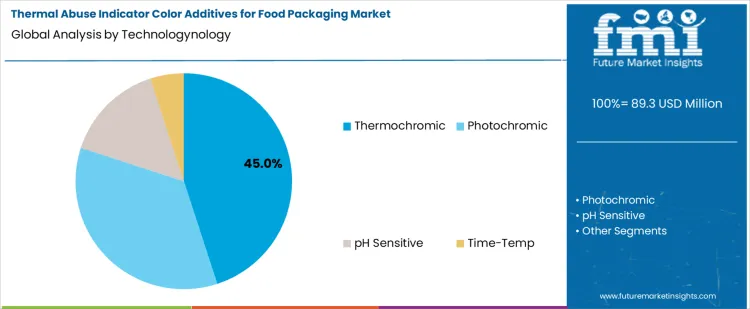
Thermochromic technologies dominate with a 45.0% share, driven by their direct and irreversible color response to temperature thresholds relevant to food safety. These systems are widely integrated into labels, inks, and films due to clarity of visual change and ease of interpretation. Photochromic indicators account for 35.0%, used where light exposure and temperature interaction provide supplementary freshness cues. pH-sensitive technologies hold 15.0%, supporting indirect spoilage detection linked to biochemical changes following thermal abuse. Time-temp indicators represent 5.0%, applied in niche scenarios requiring cumulative exposure tracking rather than instant response.
Key Takeaways:
- Thermochromic systems lead due to clear temperature-triggered response
- Photochromic solutions support combined light and temperature monitoring
- Time-temp indicators serve cumulative exposure tracking needs
Which Distribution Channel Dominates Global Supply of Indicator Color Additives?
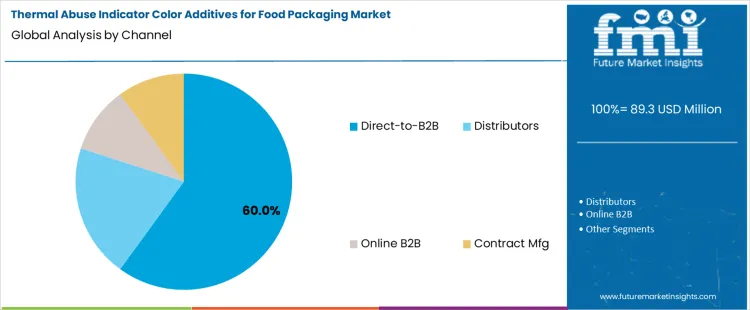
Direct-to-B2B channels account for 60.0% of global distribution, reflecting the need for close coordination between additive suppliers, packaging converters, and food producers. Direct supply supports customization of activation thresholds, ink compatibility, and regulatory documentation. Distributors hold a 20.0% share, supplying standardized indicator additives to regional converters and mid-sized packaging operations. Online B2B channels represent 10.0%, facilitating pilot trials, rapid sourcing, and innovation-stage packaging development. Contract manufacturing accounts for 10.0%, where indicator additives are incorporated into finished labels, films, or packaging components supplied as integrated solutions.
Key Takeaways:
- Direct-to-B2B dominates due to customization and compliance requirements
- Distributors expand access to standardized indicator systems
- Contract manufacturing supports integrated smart-packaging solutions
What are the Key Dynamics in the Thermal-Abuse Indicator Color Additives for Food Packaging Market?
Global demand rises as food manufacturers and packaging converters adopt thermal-abuse indicator color additives that visually signal excessive temperature exposure during storage and transit. Indicator additives change color when products exceed defined thermal thresholds, supporting quality assurance for temperature-sensitive foods such as dairy, seafood, fresh produce, and ready-to-eat meals. Adoption aligns with increasing global cold chain logistics, heightened regulatory food safety expectations, and retailer requirements for real-time quality monitoring across supply networks in North America, Europe, Asia-Pacific, and Latin America.
How do food safety expectations and supply chain performance requirements shape adoption?
Food producers and retailers face pressure to minimize spoilage, reduce waste, and demonstrate product integrity from manufacturing to point of sale. Thermal-abuse indicator color additives integrated into packaging films, labels, or inserts provide visible evidence of temperature excursions that could compromise food safety or quality. Cold chain managers use color change cues to trigger corrective action, reject compromised loads, or adjust handling protocols. Packaging developers collaborate with brand owners to calibrate color transitions that correspond with product-specific thermal sensitivity profiles. Retailers emphasize transparency to consumers through packaging cues that indicate freshness and safe handling, reinforcing trust and supporting risk management strategies.
How do formulation challenges, cost considerations, and regulatory frameworks influence market scalability?
Thermal-abuse indicator color additives require precise engineering to deliver consistent, reproducible color responses at target temperatures without interfering with food contact safety or overall packaging performance. Developing stable indicator chemistries that withstand typical processing conditions and shelf life adds formulation complexity and testing effort. Cost implications of incorporating indicator systems into packaging materials influence adoption in value-sensitive categories and for low-margin products.
Regulatory frameworks governing food contact materials, additive safety, and labeling vary across jurisdictions, shaping compliance documentation and permissible use levels for global distribution. Supply chain variability in indicator additive availability affects planning and pricing. Long-term market growth depends on continued innovation in cost-effective, reliable indicator systems and harmonized safety and regulatory standards that support broad adoption of thermal monitoring solutions in food packaging worldwide.
How Is Demand for Thermal-Abuse Indicator Color Additives for Food Packaging Evolving Globally?
Demand for thermal-abuse indicator color additives for food packaging is increasing globally due to cold-chain complexity, regulatory scrutiny on food safety, and retailer accountability for temperature excursions. China leads with a 15.1% CAGR, supported by rapid expansion of temperature-sensitive packaged foods and logistics monitoring. USA follows at 14.2%, driven by liability management, quality assurance programs, and smart packaging adoption. Germany records 13.8%, reflecting stringent compliance expectations and process discipline. France posts 13.6%, shaped by premium food positioning and traceability requirements. Growth reflects transition from passive packaging toward visual indicator systems that irreversibly signal exposure to unsafe thermal conditions.
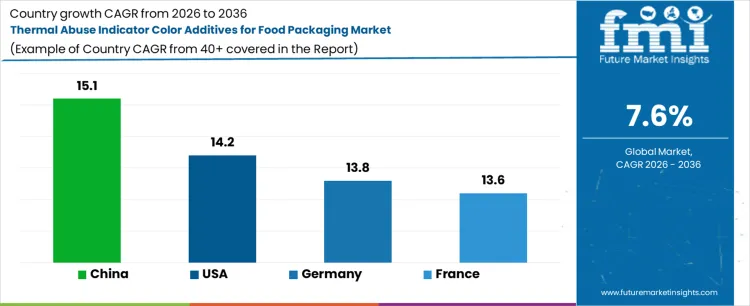
| Country | CAGR (%) |
|---|---|
| USA | 14.2% |
| Germany | 13.8% |
| France | 13.6% |
| China | 15.1% |
What is driving strong adoption of thermal-abuse indicator color additives in China?
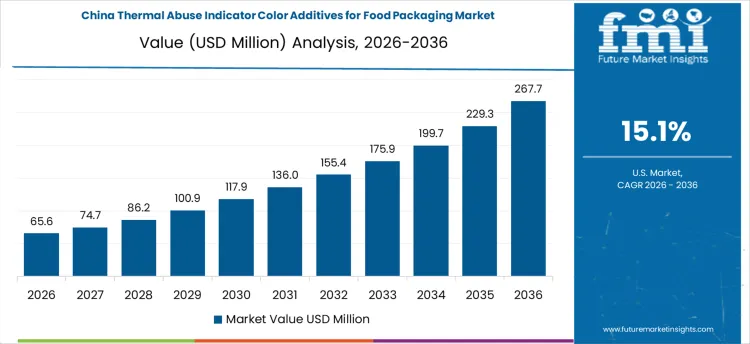
China demand is driven by large-scale cold-chain expansion for meat, seafood, dairy, and ready meals. CAGR of 15.1% reflects adoption of color additives that provide visible, irreversible indication of temperature abuse during transport and storage. Manufacturers and logistics operators require low-cost, high-volume solutions compatible with flexible and rigid packaging. Regulatory focus on food safety incidents increases adoption of monitoring aids. Domestic suppliers scale thermochromic and time–temperature indicator technologies. Growth remains scale-driven and compliance-aligned, supported by rapid growth of packaged food distribution and increasing enforcement intensity.
- Expansion of cold-chain distribution networks
- Need for visible indication of temperature excursions
- Regulatory pressure on food safety compliance
- Scaling of thermochromic additive production
How is the USA sustaining growth in thermal-abuse indicator adoption for food packaging?
USA demand is shaped by retailer quality assurance programs, liability exposure, and emphasis on traceability. CAGR of 14.2% reflects integration of thermal-abuse indicator color additives into packaging for frozen foods, chilled meals, and pharmaceuticals-adjacent nutrition products. Brands prioritize indicators that are tamper-evident and easy to interpret by consumers. Regulatory expectations and audit frameworks encourage preventive monitoring. Packaging converters adopt additive systems compatible with existing printing and coating processes. Growth remains compliance-driven and brand-led, aligned with food safety governance and risk mitigation strategies.
- Retailer-led quality assurance requirements
- Liability management for temperature-sensitive foods
- Consumer-facing, easy-to-read indicators
- Compatibility with existing packaging processes
What factors support Germany’s steady expansion in thermal-abuse indicator color additives?
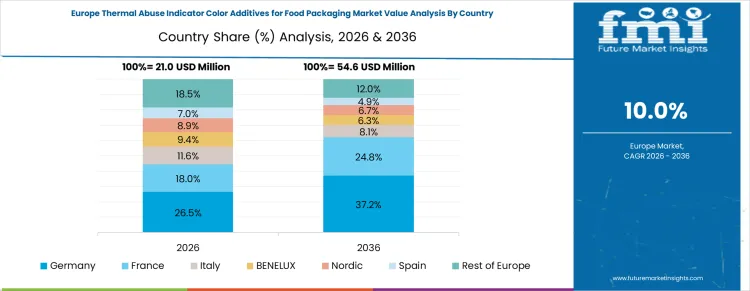
Germany demand reflects strict regulatory oversight, disciplined process control, and high consumer trust expectations. CAGR of 13.8% is supported by adoption of indicator additives within packaged meat, dairy, and ready-to-eat segments. Manufacturers emphasize reproducibility, calibration accuracy, and documentation. Regulatory frameworks favor solutions with validated performance and stability. Packaging suppliers integrate indicators into standardized formats. Growth remains quality-focused and regulation-aligned, supported by rigorous compliance culture and emphasis on preventive food safety measures.
- Strong regulatory and documentation requirements
- Focus on calibrated and reproducible indicators
- Adoption in meat, dairy, and ready meals
- Integration into standardized packaging formats
Why is France showing consistent growth in thermal-abuse indicator usage?
France demand reflects premium food positioning, cold-chain sensitivity, and traceability emphasis. CAGR of 13.6% is supported by use of thermal-abuse indicator color additives in fresh, chilled, and gourmet food packaging. Producers prioritize preservation of quality and brand reputation. Visual indicators support consumer confidence and quality claims. Regulatory alignment encourages transparent monitoring tools. Packaging innovation focuses on discreet yet reliable indicator integration. Growth remains quality-driven and application-focused, supported by high-value food categories and strong focus on origin and handling integrity.
- Premium food quality and brand protection focus
- Use in fresh and chilled food categories
- Emphasis on consumer trust and transparency
- Alignment with traceability and handling standards
What is the competitive landscape of demand for thermal-abuse indicator color additives for food packaging globally?
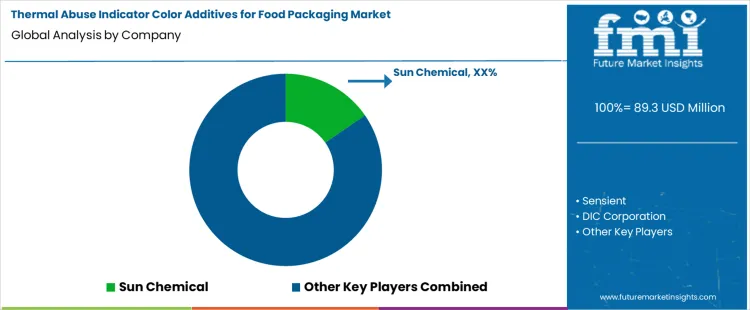
Demand for thermal-abuse indicator color additives for food packaging is driven by cold-chain monitoring requirements, food safety regulations, and reduction of spoilage-related losses. These additives are incorporated into labels, inks, and packaging films to provide visible color change when products experience temperature excursions beyond defined thresholds. Buyers evaluate color-change accuracy, response time, reversibility or irreversibility behavior, compatibility with printing and packaging substrates, and stability during normal storage.
Procurement teams prioritize suppliers with validated temperature-response calibration, food-contact compliance, and scalability for high-volume packaging applications. Trend in the global market reflects increased adoption of smart packaging, retailer accountability for temperature control, and expansion of freshness-indicating solutions across meat, dairy, seafood, and ready-to-eat foods.
Sun Chemical holds leading positioning through thermochromic and indicator ink technologies integrated into food packaging printing systems worldwide. Sensient Technologies supplies color-change pigments and additives designed for precise thermal response and regulatory compliance in food-contact applications.
DIC Corporation supports demand with advanced functional ink and color technologies applied in intelligent packaging solutions. BASF SE contributes specialty pigments and polymer-compatible additives supporting indicator stability and processing performance. Clariant AG provides functional colorant systems aligned with packaging safety standards and smart-label development. Competitive differentiation depends on indicator reliability, regulatory readiness, integration with packaging processes, and ability to support global food packaging supply chains.
Key Players in the Thermal-Abuse Indicator Color Additives for Food Packaging Market
- Sun Chemical
- Sensient Technologies
- DIC Corporation
- BASF
- Clariant
- Toyo Ink
Scope of the Report
| Items | Values |
|---|---|
| Quantitative Units | USD million |
| Application | Dairy; Beverages; Bakery; Meat |
| Technology | Thermochromic; Photochromic; pH Sensitive; Time-Temp |
| Channel | Direct-to-B2B; Distributors; Online B2B; Contract Mfg |
| Regions Covered | Asia Pacific, Europe, North America, Latin America, Middle East & Africa |
| Countries Covered | USA, Germany, France, China, and 40+ countries |
| Key Companies Profiled | Sun Chemical; Sensient Technologies; DIC Corporation; BASF; Clariant; Toyo Ink |
| Additional Attributes | Dollar sales by application and technology; adoption trends for thermochromic and time–temperature indicators in food packaging; response accuracy, color transition thresholds, and irreversibility performance metrics; compatibility with flexible and rigid packaging substrates; printing, migration, and food-contact compliance considerations; regulatory alignment with food safety and packaging standards influencing thermal-abuse indicator selection. |
Thermal-Abuse Indicator Color Additives for Food Packaging Market by Segment
Application:
- Dairy
- Beverages
- Bakery
- Meat
Technology:
- Thermochromic
- Photochromic
- pH Sensitive
- Time-Temp
Channel:
- Direct-to-B2B
- Distributors
- Online B2B
- Contract Mfg
Region:
- Asia Pacific
- China
- Japan
- South Korea
- India
- Australia & New Zealand
- ASEAN
- Rest of Asia Pacific
- Europe
- Germany
- United Kingdom
- France
- Italy
- Spain
- Nordic
- BENELUX
- Rest of Europe
- North America
- United States
- Canada
- Mexico
- Latin America
- Brazil
- Chile
- Rest of Latin America
- Middle East & Africa
- Kingdom of Saudi Arabia
- Other GCC Countries
- Turkey
- South Africa
- Other African Union
- Rest of Middle East & Africa
Frequently Asked Questions
How big is the thermal abuse indicator color additives for food packaging market in 2026?
The global thermal abuse indicator color additives for food packaging market is estimated to be valued at USD 89.3 million in 2026.
What will be the size of thermal abuse indicator color additives for food packaging market in 2036?
The market size for the thermal abuse indicator color additives for food packaging market is projected to reach USD 185.8 million by 2036.
How much will be the thermal abuse indicator color additives for food packaging market growth between 2026 and 2036?
The thermal abuse indicator color additives for food packaging market is expected to grow at a 7.6% CAGR between 2026 and 2036.
What are the key application types in the thermal abuse indicator color additives for food packaging market?
The key application types in thermal abuse indicator color additives for food packaging market are dairy, beverages, bakery and meat.
Which technology segment to contribute significant share in the thermal abuse indicator color additives for food packaging market in 2026?
In terms of technology, thermochromic segment to command 45.0% share in the thermal abuse indicator color additives for food packaging market in 2026.
Preview the report firsthand - request a free sample
Get SampleGet the brochure for pricing and purchase details.
Get PDFTable of Content
- Executive Summary
- Global Market Outlook
- Demand-side Trends
- Supply-side Trends
- Technology Roadmap Analysis
- Analysis and Recommendations
- Market Overview
- Market Coverage / Taxonomy
- Market Definition / Scope / Limitations
- Market Background
- Market Dynamics
- Drivers
- Restraints
- Opportunity
- Trends
- Scenario Forecast
- Demand in Optimistic Scenario
- Demand in Likely Scenario
- Demand in Conservative Scenario
- Opportunity Map Analysis
- Product Life Cycle Analysis
- Supply Chain Analysis
- Investment Feasibility Matrix
- Value Chain Analysis
- PESTLE and Porter’s Analysis
- Regulatory Landscape
- Regional Parent Market Outlook
- Production and Consumption Statistics
- Import and Export Statistics
- Market Dynamics
- Global Market Analysis 2021 to 2025 and Forecast, 2026 to 2036
- Historical Market Size Value (USD Million) Analysis, 2021 to 2025
- Current and Future Market Size Value (USD Million) Projections, 2026 to 2036
- Y-o-Y Growth Trend Analysis
- Absolute $ Opportunity Analysis
- Global Market Pricing Analysis 2021 to 2025 and Forecast 2026 to 2036
- Global Market Analysis 2021 to 2025 and Forecast 2026 to 2036, By Application
- Introduction / Key Findings
- Historical Market Size Value (USD Million) Analysis By Application , 2021 to 2025
- Current and Future Market Size Value (USD Million) Analysis and Forecast By Application , 2026 to 2036
- Dairy
- Beverages
- Bakery
- Meat
- Dairy
- Y-o-Y Growth Trend Analysis By Application , 2021 to 2025
- Absolute $ Opportunity Analysis By Application , 2026 to 2036
- Global Market Analysis 2021 to 2025 and Forecast 2026 to 2036, By Technologynology
- Introduction / Key Findings
- Historical Market Size Value (USD Million) Analysis By Technologynology, 2021 to 2025
- Current and Future Market Size Value (USD Million) Analysis and Forecast By Technologynology, 2026 to 2036
- Thermochromic
- Photochromic
- pH Sensitive
- Time-Temp
- Thermochromic
- Y-o-Y Growth Trend Analysis By Technologynology, 2021 to 2025
- Absolute $ Opportunity Analysis By Technologynology, 2026 to 2036
- Global Market Analysis 2021 to 2025 and Forecast 2026 to 2036, By Channel
- Introduction / Key Findings
- Historical Market Size Value (USD Million) Analysis By Channel, 2021 to 2025
- Current and Future Market Size Value (USD Million) Analysis and Forecast By Channel, 2026 to 2036
- Direct-to-B2B
- Distributors
- Online B2B
- Contract Mfg
- Direct-to-B2B
- Y-o-Y Growth Trend Analysis By Channel, 2021 to 2025
- Absolute $ Opportunity Analysis By Channel, 2026 to 2036
- Global Market Analysis 2021 to 2025 and Forecast 2026 to 2036, By Region
- Introduction
- Historical Market Size Value (USD Million) Analysis By Region, 2021 to 2025
- Current Market Size Value (USD Million) Analysis and Forecast By Region, 2026 to 2036
- North America
- Latin America
- Western Europe
- Eastern Europe
- East Asia
- South Asia and Pacific
- Middle East & Africa
- Market Attractiveness Analysis By Region
- North America Market Analysis 2021 to 2025 and Forecast 2026 to 2036, By Country
- Historical Market Size Value (USD Million) Trend Analysis By Market Taxonomy, 2021 to 2025
- Market Size Value (USD Million) Forecast By Market Taxonomy, 2026 to 2036
- By Country
- USA
- Canada
- Mexico
- By Application
- By Technologynology
- By Channel
- By Country
- Market Attractiveness Analysis
- By Country
- By Application
- By Technologynology
- By Channel
- Key Takeaways
- Latin America Market Analysis 2021 to 2025 and Forecast 2026 to 2036, By Country
- Historical Market Size Value (USD Million) Trend Analysis By Market Taxonomy, 2021 to 2025
- Market Size Value (USD Million) Forecast By Market Taxonomy, 2026 to 2036
- By Country
- Brazil
- Chile
- Rest of Latin America
- By Application
- By Technologynology
- By Channel
- By Country
- Market Attractiveness Analysis
- By Country
- By Application
- By Technologynology
- By Channel
- Key Takeaways
- Western Europe Market Analysis 2021 to 2025 and Forecast 2026 to 2036, By Country
- Historical Market Size Value (USD Million) Trend Analysis By Market Taxonomy, 2021 to 2025
- Market Size Value (USD Million) Forecast By Market Taxonomy, 2026 to 2036
- By Country
- Germany
- UK
- Italy
- Spain
- France
- Nordic
- BENELUX
- Rest of Western Europe
- By Application
- By Technologynology
- By Channel
- By Country
- Market Attractiveness Analysis
- By Country
- By Application
- By Technologynology
- By Channel
- Key Takeaways
- Eastern Europe Market Analysis 2021 to 2025 and Forecast 2026 to 2036, By Country
- Historical Market Size Value (USD Million) Trend Analysis By Market Taxonomy, 2021 to 2025
- Market Size Value (USD Million) Forecast By Market Taxonomy, 2026 to 2036
- By Country
- Russia
- Poland
- Hungary
- Balkan & Baltic
- Rest of Eastern Europe
- By Application
- By Technologynology
- By Channel
- By Country
- Market Attractiveness Analysis
- By Country
- By Application
- By Technologynology
- By Channel
- Key Takeaways
- East Asia Market Analysis 2021 to 2025 and Forecast 2026 to 2036, By Country
- Historical Market Size Value (USD Million) Trend Analysis By Market Taxonomy, 2021 to 2025
- Market Size Value (USD Million) Forecast By Market Taxonomy, 2026 to 2036
- By Country
- China
- Japan
- South Korea
- By Application
- By Technologynology
- By Channel
- By Country
- Market Attractiveness Analysis
- By Country
- By Application
- By Technologynology
- By Channel
- Key Takeaways
- South Asia and Pacific Market Analysis 2021 to 2025 and Forecast 2026 to 2036, By Country
- Historical Market Size Value (USD Million) Trend Analysis By Market Taxonomy, 2021 to 2025
- Market Size Value (USD Million) Forecast By Market Taxonomy, 2026 to 2036
- By Country
- India
- ASEAN
- Australia & New Zealand
- Rest of South Asia and Pacific
- By Application
- By Technologynology
- By Channel
- By Country
- Market Attractiveness Analysis
- By Country
- By Application
- By Technologynology
- By Channel
- Key Takeaways
- Middle East & Africa Market Analysis 2021 to 2025 and Forecast 2026 to 2036, By Country
- Historical Market Size Value (USD Million) Trend Analysis By Market Taxonomy, 2021 to 2025
- Market Size Value (USD Million) Forecast By Market Taxonomy, 2026 to 2036
- By Country
- Kingdom of Saudi Arabia
- Other GCC Countries
- Turkiye
- South Africa
- Other African Union
- Rest of Middle East & Africa
- By Application
- By Technologynology
- By Channel
- By Country
- Market Attractiveness Analysis
- By Country
- By Application
- By Technologynology
- By Channel
- Key Takeaways
- Key Countries Market Analysis
- USA
- Pricing Analysis
- Market Share Analysis, 2025
- By Application
- By Technologynology
- By Channel
- Canada
- Pricing Analysis
- Market Share Analysis, 2025
- By Application
- By Technologynology
- By Channel
- Mexico
- Pricing Analysis
- Market Share Analysis, 2025
- By Application
- By Technologynology
- By Channel
- Brazil
- Pricing Analysis
- Market Share Analysis, 2025
- By Application
- By Technologynology
- By Channel
- Chile
- Pricing Analysis
- Market Share Analysis, 2025
- By Application
- By Technologynology
- By Channel
- Germany
- Pricing Analysis
- Market Share Analysis, 2025
- By Application
- By Technologynology
- By Channel
- UK
- Pricing Analysis
- Market Share Analysis, 2025
- By Application
- By Technologynology
- By Channel
- Italy
- Pricing Analysis
- Market Share Analysis, 2025
- By Application
- By Technologynology
- By Channel
- Spain
- Pricing Analysis
- Market Share Analysis, 2025
- By Application
- By Technologynology
- By Channel
- France
- Pricing Analysis
- Market Share Analysis, 2025
- By Application
- By Technologynology
- By Channel
- India
- Pricing Analysis
- Market Share Analysis, 2025
- By Application
- By Technologynology
- By Channel
- ASEAN
- Pricing Analysis
- Market Share Analysis, 2025
- By Application
- By Technologynology
- By Channel
- Australia & New Zealand
- Pricing Analysis
- Market Share Analysis, 2025
- By Application
- By Technologynology
- By Channel
- China
- Pricing Analysis
- Market Share Analysis, 2025
- By Application
- By Technologynology
- By Channel
- Japan
- Pricing Analysis
- Market Share Analysis, 2025
- By Application
- By Technologynology
- By Channel
- South Korea
- Pricing Analysis
- Market Share Analysis, 2025
- By Application
- By Technologynology
- By Channel
- Russia
- Pricing Analysis
- Market Share Analysis, 2025
- By Application
- By Technologynology
- By Channel
- Poland
- Pricing Analysis
- Market Share Analysis, 2025
- By Application
- By Technologynology
- By Channel
- Hungary
- Pricing Analysis
- Market Share Analysis, 2025
- By Application
- By Technologynology
- By Channel
- Kingdom of Saudi Arabia
- Pricing Analysis
- Market Share Analysis, 2025
- By Application
- By Technologynology
- By Channel
- Turkiye
- Pricing Analysis
- Market Share Analysis, 2025
- By Application
- By Technologynology
- By Channel
- South Africa
- Pricing Analysis
- Market Share Analysis, 2025
- By Application
- By Technologynology
- By Channel
- USA
- Market Structure Analysis
- Competition Dashboard
- Competition Benchmarking
- Market Share Analysis of Top Players
- By Regional
- By Application
- By Technologynology
- By Channel
- Competition Analysis
- Competition Deep Dive
- Sun Chemical
- Overview
- Product Portfolio
- Profitability by Market Segments (Product/Age /Sales Channel/Region)
- Sales Footprint
- Strategy Overview
- Marketing Strategy
- Product Strategy
- Channel Strategy
- Sensient
- DIC Corporation
- BASF
- Clariant
- Toyo Ink
- Sun Chemical
- Competition Deep Dive
- Assumptions & Acronyms Used
- Research Methodology


