

- Market Size (2026)
- USD 0.7 Bn
- Forecast (2036)
- USD 1.2 Bn
- CAGR (2026 to 2036)
- 5.5%
Food-Contact Surface Sanitizers for HoReCa Market Size, Forecast, and Outlook By FMI
Summary of the Food-Contact Surface Sanitizers for HoReCa Market
- Demand and Growth Drivers
- Food-code compliance needs raise demand for surface sanitizers as kitchens document safe food-contact cleaning.
- Fast table turnover increases sanitizer use as restaurants need short contact time across service areas.
- Chain foodservice programs reinforce repeat buying as outlet managers follow standard chemical lists.
- Product and Segment View
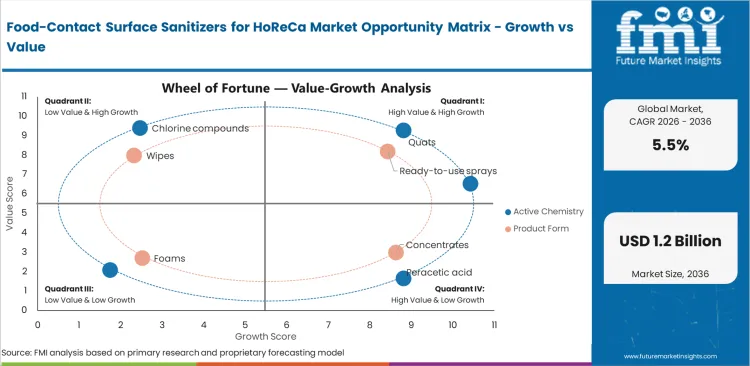
- Quats are projected to hold the top position in active chemistry, with 38.0% share in 2026 as kitchen teams rely on familiar dilution checks.
- Ready-to-use sprays are expected to capture 36.0% of product form value by 2026, due to faster table reset work during service hours.
- Restaurants are estimated to generate 45.0% share of end-use value in 2026 through repeated sanitizer use across food-contact surfaces.
- Geography and Competitive Outlook
- India is forecast to record 8.3% CAGR by 2036, with foodservice outlet growth and chain-level hygiene routines lifting sanitizer use.
- China’s market is projected to expand at 7.8% CAGR by 2036, supported by large catering volumes and daily kitchen sanitation needs.
- Competitive strength is moving toward companies pairing approved label coverage with distributor training for consistent HoReCa account service.
- Analyst Opinion
- Nikhil Kaitwade, Principal Consultant for Chemicals & Materials domain at FMI, says, “Food-contact sanitizers are becoming routine in HoReCa kitchen control. Restaurant kitchens need approved surface claims and clear contact-time directions. Hotels need refill continuity during banquet service. Chemical waste and staff training raise cost while no-rinse labels reduce outlet misuse risk.”
- Food-Contact Surface Sanitizers for HoReCa Market Value Analysis
- Food-contact surface sanitizers for HoReCa are moving from periodic chemical buying into planned kitchen hygiene budgets.
- Food-contact label requirements strengthen sanitizer use across counters and utensils in kitchens with frequent service cycles.
- The market benefits from deeper use of industrial and institutional cleaning chemical programs across chain accounts.
- Repeat refill demand is supported by daily cleaning records and safer sanitizer strength control.
Key Takeaways, Market Size, and Forecast
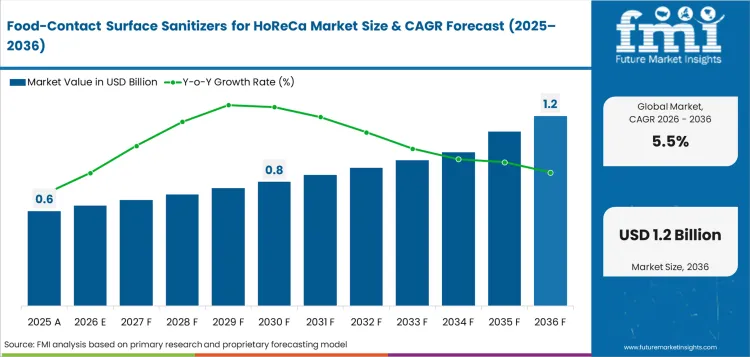
- Food-contact surface sanitizers for HoReCa were valued at USD 0.6 billion in 2025.
- By 2036, the food-contact surface sanitizers for HoReCa market is expected to be worth USD 1.2 billion.
- From 2026 to 2036, the market is projected to expand at a CAGR of 5.5%.
- The market is projected to create an incremental opportunity of USD 0.5 billion between 2026 and 2036.
- In 2026, restaurants are expected to account for 45.0% of end-use demand.
- India at 8.3% CAGR and China at 7.8% CAGR are expected to be leading countries with considerable growth.
Food-contact hygiene decisions are becoming harder for HoReCa operators as daily sanitizer use now lies next to outbreak response planning. FDA’s 2024 Food Code supplement requires disinfection of food-contact surfaces and utensils if available sanitizers do not control pathogens of concern. The rule makes escalation protocols a buying need instead of a back-office training note. EPA’s 2024 guidance creates a second filter by allowing virucidal claims on sanitizer products registered for food-contact or non-food-contact surfaces.
Formulators with clear label language can help operators avoid misuse between routine sanitizing and higher-risk response work. Service-speed pressure adds a third buying filter in restaurant kitchens. Ecolab’s Sink & Surface Cleaner Sanitizer lists 15-second COVID-19 virus kill and 30-second norovirus kill claims with use as directed. Those contact-time facts help chain restaurants link product choice with table reset discipline and fewer staff errors during peak service.
Food-Contact Surface Sanitizers for HoReCa Market Definition
Food-contact surface sanitizers for HoReCa include chemical sanitizing products used on hard surfaces in hotels and restaurants during food handling activities. These products include quats, peracetic acid, and chlorine compounds used after cleaning on prep counters and utensils. Scope includes no-rinse products and approved food-contact surface systems. Hand sanitizers and restroom disinfectants are outside the scope.
Food-Contact Surface Sanitizers for HoReCa Market Inclusions
Market scope covers all commercially traded food-contact surface sanitizer products categorized by active chemistry, including quats, peracetic acid, chlorine compounds, alcohol blends, and other chemistries; product forms, including ready-to-use sprays, concentrates, wipes, and foams; surface applications, including prep counters, dining tables, kitchen equipment, storage areas, and service carts; and end users, including restaurants, hotels, catering services, cafes, and bars. Revenue scope covers 2026 to 2036. Stakeholders include sanitizer formulators, chemical manufacturers, packaging suppliers, janitorial distributors, HoReCa operators, hotel chains, restaurant groups, catering service providers, food safety auditors, commercial cleaning service firms, and regulatory bodies.
Food-Contact Surface Sanitizers for HoReCa Market Exclusions
Scope does not include hand sanitizers, laundry sanitizers, household disinfectants, restroom-only disinfectants, or non-food-contact floor cleaners.
Food-Contact Surface Sanitizers for HoReCa Market Research Methodology
- Primary Research: FMI analysts talked to restaurant operators, hotel kitchen managers, formulators, and janitorial distributors in selected markets.
- Desk Research: Combined data from food-code references, EPA sanitizer guidance, company portfolios, and foodservice operating indicators.
- Market sizing and forecasting: Added sanitizer use across outlet types and product formats from the bottom up.
- Data validation: Cross-checked every three months against foodservice sales patterns and distributor refill behavior.
Why is the Food-Contact Surface Sanitizers for HoReCa Market Growing?
- Commercial kitchens use sanitizers earlier in each cleaning cycle to reduce surface contamination risk before service begins.
- Restaurant chains standardize sanitizer products to reduce misuse across outlets and simplify staff training.
- Ready-to-use formats reduce mixing errors in small kitchens with limited back-of-house supervision.
Food-code updates are making food-contact surface control a more visible operating task for restaurants. FDA released the Supplement tothe 2022 Food Code in November 2024 and added provisions addressing disinfection of food-contact and equipment surfaces. FDA’s 2024 supplement makes approved surface claims important for HoReCa chemical selection. Kitchens can reduce audit risk by matching sanitizer labels with staff routines and inspection expectations.
Food-away-from-home spending creates a repeat-use base for sanitizer products across service formats. According to the USDA’s September 2025 report, USA food-away-from-home spending climbed from USD 1.45 trillion in 2023 to USD 1.52 trillion in 2024. Foodservice spending keeps daily sanitizer consumption active across counters and dining areas. Suppliers serving chain restaurants can convert routine surface cycles into stable refill programs.
Market Segmentation Analysis
- Quats are projected to represent 38.0% share of active chemistry in 2026, as dilution checks are familiar across sanitizer buckets and kitchen counters.
- Ready-to-use sprays are expected to capture 36.0% of product form value by 2026, with table reset work favoring quick application.
- Prep counters are anticipated to account for 34.0% share within surface application during 2026, since raw food handling needs repeated sanitizer use.
- Restaurant kitchens are estimated to generate 45.0% of end-use value for 2026, due to frequent cleaning cycles across back-of-house surfaces.
- Janitorial distributors are projected to hold 41.0% sales channel share in 2026, as refill timing and local service influence repeat orders.
The market for food-contact surface sanitizers for HoReCa is divided into five primary segment groups based on active chemistry, product form, surface application, end use, and sales channel. Active chemistry includes quats, peracetic acid, chlorine compounds, alcohol blends, and other chemistries. Product form includes ready-to-use sprays, concentrates, wipes, and foams. Surface application includes prep counters, dining tables, kitchen equipment, storage areas, and service carts. End use includes restaurants, hotels, catering services, cafes, and bars.
Insights into Food-Contact Surface Sanitizers for HoReCa Market by Active Chemistry
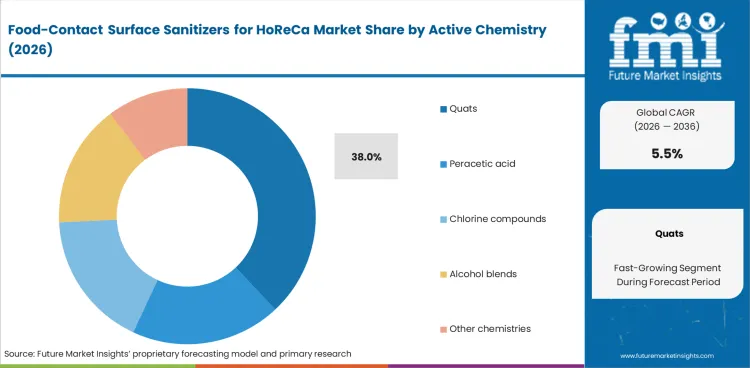
- In 2026, quats are expected to make up 38.0% of the active chemistry segment. Familiar dilution control and test-strip checks make quat systems practical for restaurant kitchens.
- Peracetic acid and chlorine compounds serve selected kitchens with stronger residue or odor concerns. Their use improves in accounts needing stricter food-contact surface routines.
Insights into Food-Contact Surface Sanitizers for HoReCa Market by Product Form
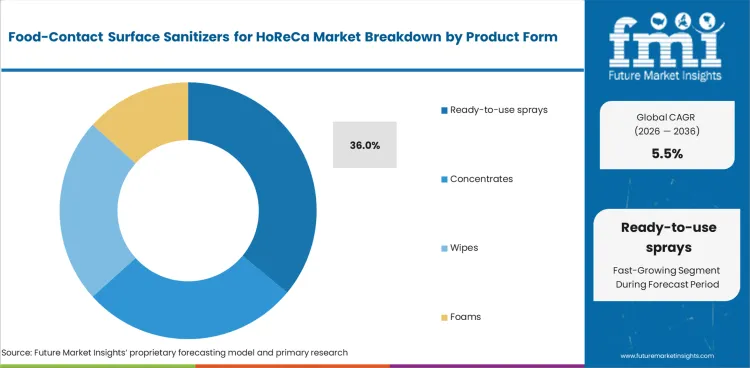
- Ready-to-use sprays are projected to account for 36.0% of the product form segment in 2026. Table reset needs and limited mixing supervision make sprays useful across busy service areas.
- Concentrates serve larger kitchens with dispenser systems and trained staff. Their value improves in hotel kitchens and chain outlets managing chemical cost per prepared liter.
Insights into Food-Contact Surface Sanitizers for HoReCa Market by Surface Application
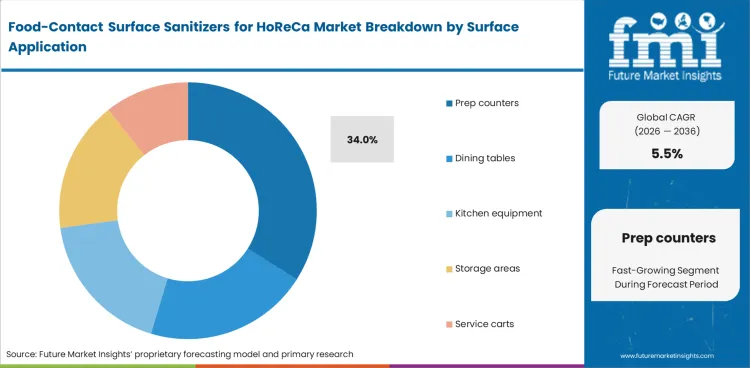
- Prep counters are estimated to account for 34.0% share of the surface application segment in 2026. Raw ingredient handling and repeated food preparation make this surface group a high-use sanitizer point.
- Dining tables and kitchen equipment create separate sanitizer needs across front and back-of-house areas. Surface material and contact time guide product selection in each case.
Insights into Food-Contact Surface Sanitizers for HoReCa Market by End Use
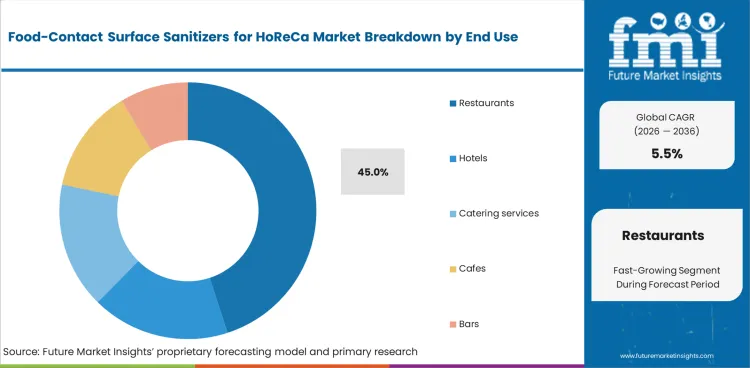
- Restaurants are projected to account for 45.0% of the end-use segment in 2026. High meal turnover and repeated surface contact raise steady sanitizer use across kitchen routines.
- Hotels and catering services require broader sanitizer planning across banquet areas and prep kitchens. Service teams use these products across larger food-contact surface networks.
Insights into Food-Contact Surface Sanitizers for HoReCa Market by Sales Channel
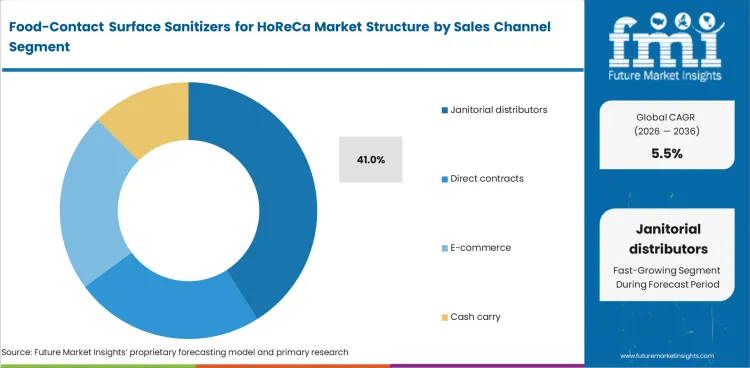
- Janitorial distributors are expected to hold 41.0% share of the sales channel segment in 2026. Local refill access and training visits make distributors important for HoReCa accounts.
- Direct contracts serve larger chains seeking delivery control and consistent product lists. E-commerce serves smaller outlets requiring faster access to standard sanitizer packs.
Food-Contact Surface Sanitizers for HoReCa Market Drivers, Restraints, and Opportunities
- Food-code surface controls are creating structured demand for approved food-contact sanitizer products.
- Mixed-use hospitality kitchens raise the demand for products suitable for use across counters and utensils in daily operations.
- Concentrate misuse increases a restraint as under-dosing can weaken sanitizer performance during inspection.
- Virucidal claim guidance creates an opportunity for higher-value products with broader label proof.
Food-contact surface sanitizers for HoReCa keep growing as restaurants and hotels need approved products for counters and utensils. Cost pressure can slow adoption in smaller outlets when staff misuse creates extra chemical waste. Sales continue through no-rinse formats and ready-to-use sprays under distributor-led refill programs.
Menu Inflation Is Limiting Sanitizer Pass-Through
The National Restaurant Association’s April 2026 report said menu prices rose 0.2% in March after 0.3% in February, with a 3.8% increase since March 2025. For food-contact surface sanitizers in HoReCa, this matters because restaurants use menu pricing to absorb food and labor pressure, which limits tolerance for broad chemical price increases.
Pricing is moving from headline increases to defensible per-use pricing based on actual consumption patterns. Suppliers can protect margins through concentrates and dosing systems to reduce waste at dish stations and prep lines. Buyers should benchmark the price by ready-to-use gallon before accepting increases based on invoice case prices.
Outbreak Visibility Is Protecting Compliance Premiums
As of May 2026, CDC said it typically coordinates 17 to 36 multistate foodborne illness investigations each week. CDC listed Campylobacter, E. coli, Listeria, and Salmonella as common multistate outbreak pathogens. Outbreak visibility keeps HoReCa sanitizer pricing firmer than standard janitorial chemicals. Operators can trade down on general cleaning products. Food-contact sanitizers affect inspection readiness and brand risk exposure. The pricing effect reflects a gap between commodity bleach solutions and validated food-contact programs with documented procedures. Suppliers should avoid unsupported premium claims. Buyers should pay more only when documentation reduces compliance risk.
Analysis of Food-Contact Surface Sanitizers for HoReCa Market By Key Countries
.webp "Top Country Growth Comparison Food Contact Surface Sanitizers For Horeca Market Cagr (2026 2036)")
| Country | CAGR |
|---|---|
| India | 8.3% |
| China | 7.8% |
| USA | 5.9% |
| Germany | 4.8% |
| UK | 4.6% |
Source: Future Market Insights, 2026.
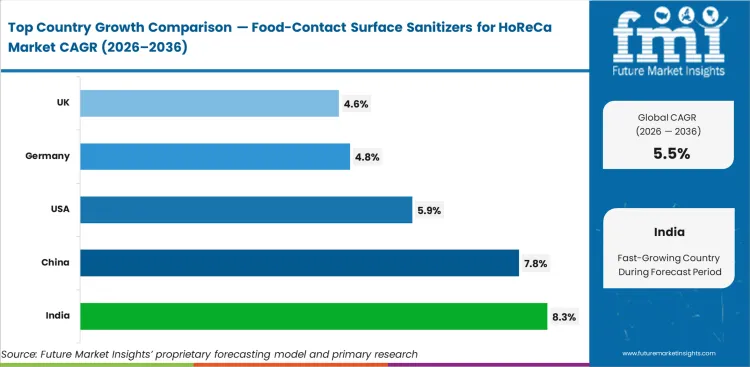
Food-Contact Surface Sanitizers for HoReCa Market CAGR Analysis By Country
- India is estimated to lead country performance at 8.3% CAGR through 2036, with chain restaurant buildout and hotel kitchen expansion lifting sanitizer use.
- China is forecast at 7.8% CAGR during the same period, as large catering revenue keeps daily surface sanitation needs high.
- A projected CAGR of 5.9% for the USA points to steady replacement buying under mature foodservice sanitation rules.
- Germany at 4.8% expected CAGR and the UK at 4.6% CAGR indicate slower but consistent demand across established hospitality bases.
Demand for food-contact surface sanitizers for HoReCa is forecast to rise at 5.5% CAGR from 2026 to 2036. Country-level analysis covers the major markets contributing to this forecast, with major markets listed below.
Demand Outlook for Food-Contact Surface Sanitizers for HoReCa Market in India
India’s food-contact surface sanitizers for HoReCa industry is projected to record a CAGR of 8.3% through 2036. NRAI reported India’s food services industry at Rs 5,69,487 crore in FY24 in its 2024 food services report. India’s outlet base supports demand for food-contact surface sanitizers for HoReCa. Local distributors can gain from restaurant owners who need simpler food-contact sanitation routines.
- Chain restaurants raise demand for ready-to-use sprays and measured concentrates across repeat kitchen routines.
- Hotel banquet kitchens need sanitizer plans to cover prep counters and service equipment after each event.
- Local distributors gain advantage through staff training and refill reliability for independent restaurants.
Sales Analysis of Food-Contact Surface Sanitizers for HoReCa Market in China
The food-contact surface sanitizers for HoReCa sector in China is expected to expand at a CAGR of 7.8% during the assessment period. China’s catering businesses generated 5.57 trillion yuan in revenue in 2024 and accounted for over 11% of retail sales of consumer goods. China’s catering base raises demand for food-contact surface sanitizers for HoReCa. Chain formats require reliable label guidance across kitchens and dining areas.
- Catering scale raises sanitizer use across prep counters and table service areas.
- Chain operators need repeatable chemical routines across urban outlets and franchise kitchens.
- Local formulators use pricing strength and distributor access to win accounts with familiar surface claims.
Demand Outlook for Food-Contact Surface Sanitizers for HoReCa Market in the United States
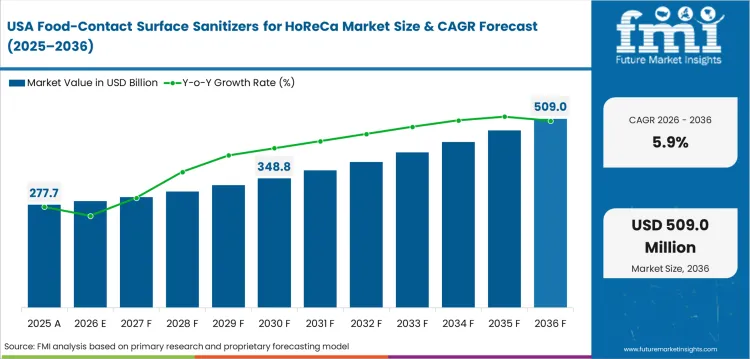
The USA food-contact surface sanitizers for HoReCa industry is forecast to grow at a CAGR of 5.9% by 2036. USA Census reported food services and drinking places sales were up 2.4% in March 2026 from March 2025. USA foodservice sales support recurring sanitizer refills across food service equipment cleaning programs. Mature food safety rules keep label discipline central for restaurant accounts.
- Restaurant groups use approved sanitizer lists to reduce variation across outlet-level cleaning routines.
- No rinse products gain relevance in prep areas with short breaks between food handling cycles in busy kitchen operations.
- Distributors focus on test strips and dispenser maintenance across regional restaurant chains.
Opportunity Analysis of Food-Contact Surface Sanitizers for HoReCa Market in Germany
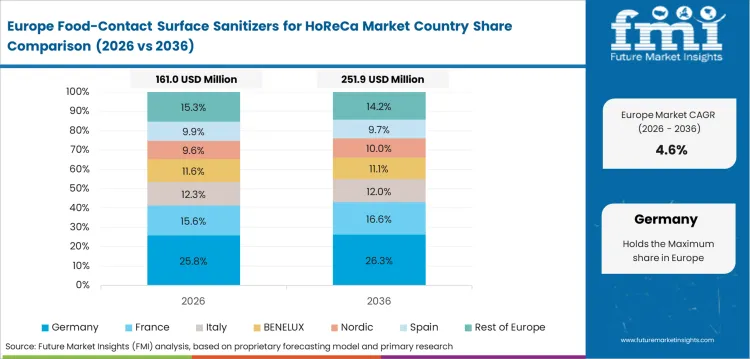
The food-contact surface sanitizers for HoReCa segment in Germany is projected to advance at 4.8% CAGR over the forecast years. According to the Destatis report, households spent 0.6% less on accommodation and food service activities in 2025 compared with the previous year. Cost pressure encourages measured chemical use and distributor-led efficiency. German kitchens favor sanitizer systems that reduce waste and meet audit expectations.
- Restaurants evaluate concentrates through cost per prepared liter and dispenser accuracy.
- Hotels use sanitizer programs alongside food holding equipment cleaning needs.
- Mature buyers favor documented label claims and technical advice before changing suppliers.
Future Outlook for Food-Contact Surface Sanitizers for HoReCa Market in the United Kingdom
The UK food-contact surface sanitizers for HoReCa industry is expected to post 4.6% CAGR through 2036. House of Commons Library reported 176,685 hospitality businesses in the UK in March 2025 using ONS data. The operating base supports demand for food-contact surface sanitizers for HoReCa as outlets manage daily surface hygiene. Distributors with training depth can help smaller operators handle cost and compliance pressure.
- Independent cafés need simple product instructions and smaller packs to suit limited storage areas.
- Pub kitchens use sanitizer routines across food prep and service counters during mixed trading hours.
- Hospitality groups link sanitizer buying with multi-surface disinfectant cleaners for broader site hygiene.
Competitive Landscape and Strategic Positioning
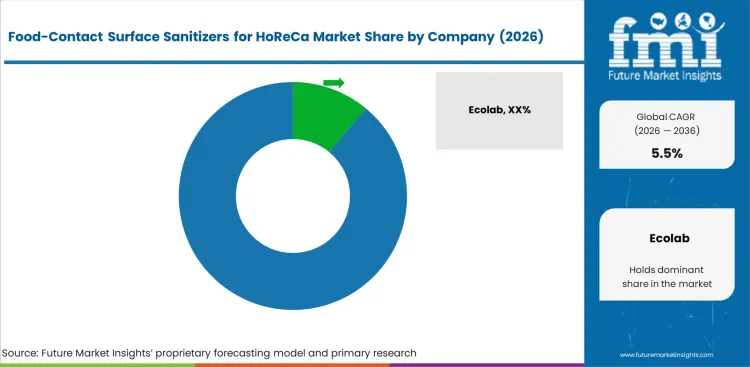
Food-Contact Surface Sanitizers for HoReCa Market Analysis By Company
- Competition centers on approved food-contact labels and reliable refill programs for restaurant and hotel kitchens.
- Ecolab leads with foodservice reach and no-rinse sanitizer systems registered for hard non-porous food-contact surfaces.
- Diversey and Spartan Chemical build positions around kitchen-care programs and distributor access for recurring HoReCa accounts.
- Specialist formulators focus on surface-safe chemistry and test-strip discipline for food-contact areas across commercial kitchens.
Ecolab holds an established position with Sink & Surface Cleaner Sanitizer and related test-strip resources. The product is listed as a no-rinse sanitizer for hard non-porous food-contact surfaces under EPA Registration No. 1677-260. Diversey competes with kitchen-care systems and hospitality training resources for organized foodservice users. Spartan Chemical and Zep serve distributor-led accounts seeking accessible no-rinse formats for daily kitchen routines.
Label registration cost and staff training needs create entry barriers across commercial kitchen accounts. Competitive priorities include food-contact claim depth and dependable refill service for repeat-use products. Restaurant and hotel operators favor suppliers combining sanitizer products with practical staff guidance during service hours. Companies with broader chemical portfolios and reliable distributor reach are better placed to win multi-site HoReCa accounts.
Key Companies in the Food-Contact Surface Sanitizers for HoReCa Market
Global companies active in the food-contact surface sanitizers for HoReCa market include:
- Ecolab, Diversey, and Kersia Group have broad hygiene program coverage for foodservice and hospitality customers.
- Spartan Chemical, Zep, and Betco serve restaurants through distributor relationships and no-rinse sanitizer formats.
- Neogen Corporation and Virox Technologies hold specialist positions across food safety and antimicrobial product systems.
Competitive Benchmarking: Food-Contact Surface Sanitizers for HoReCa Market
| Company | Food-Contact Label Depth | HoReCa Channel Access | Dosing System Strength | Geographic Footprint |
|---|---|---|---|---|
| Ecolab | High | Strong | Strong | Global presence across 170+ countries |
| Diversey | High | Strong | Strong | Global coverage through Solenis across 160+ countries |
| Kersia Group | High | Medium | Medium | Global food safety presence with Europe-led strength |
| Spartan Chemical | Medium | Strong | Medium | North America focused with LATAM availability |
| Zep | Medium | Strong | Medium | North America and selected European markets |
| Betco | Medium | Strong | Medium | USA-centered distributor network |
| Neogen Corporation | High | Medium | Medium | Global food safety presence across major regions |
| Virox Technologies | High | Medium | Medium | International reach across 70+ countries |
Source: Future Market Insights, 2026.
Key Developments in Food-Contact Surface Sanitizers for HoReCa Market
- In August 2024, Diversey received Institute of Hospitality endorsement for 17 online cleaning and disinfection training courses. The endorsement covered training used by hospitality teams managing hygiene routines across service settings.
- In March 2025, SC Johnson Professional launched fantastik® No-Rinse Disinfectant and Food Surface Sanitizer for busy commercial foodservice sites.
- In April 2026, ProNatural Brands expanded LEXX® Ready-to-Use Liquid Food Contact Surface Sanitizer & Cleaner through Amazon after wider restaurant and commercial use.
Key Players in the Food-Contact Surface Sanitizers for HoReCa Market
Major Global Players:
- Ecolab
- Diversey
- Kersia Group
- Neogen Corporation
Specialist Players:
- Spartan Chemical
- Zep
- Betco
- Virox Technologies
Report Scope and Coverage
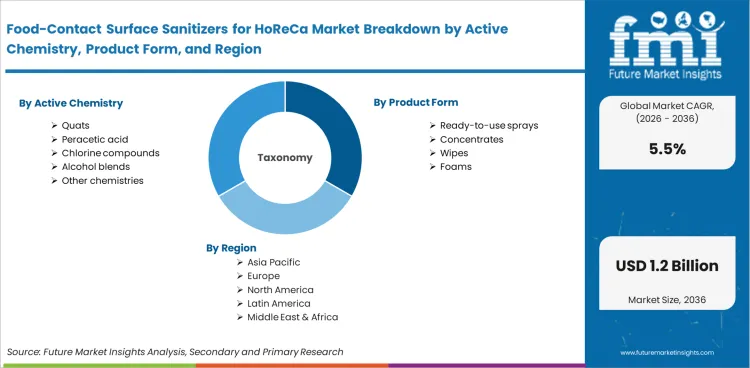
Food-Contact Surface Sanitizers for HoReCa Market Breakdown By Active Chemistry, Product Form, And Region
| Parameter | Details |
|---|---|
| Quantitative Units | USD 0.7 billion to USD 1.2 billion, at a CAGR of 5.5% |
| Market Definition | The market encompasses food-contact surface sanitizers used across HoReCa kitchens and service areas. |
| Regions Covered | North America, Latin America, Europe, East Asia, South Asia and Pacific, Middle East and Africa |
| Countries Covered | USA, UK, Germany, China, India, Japan, South Korea, and more than 30 countries |
| Key Companies Profiled | Ecolab, Diversey, Kersia Group, Spartan Chemical, Zep, Betco, Neogen Corporation, Virox Technologies |
| Forecast Period | 2026 to 2036 |
| Approach | Hybrid bottom-up and top-down methodology starting with outlet use and verified foodservice sanitation patterns. |
Food-Contact Surface Sanitizers for HoReCa Market by Segments
Food-Contact Surface Sanitizers for HoReCa Market Segmented by Active Chemistry:
- Quats
- Peracetic acid
- Chlorine compounds
- Alcohol blends
- Other chemistries
Food-Contact Surface Sanitizers for HoReCa Market Segmented by Product Form
- Ready-to-use sprays
- Concentrates
- Wipes
- Foams
Food-Contact Surface Sanitizers for HoReCa Market Segmented by Surface Application
- Prep counters
- Dining tables
- Kitchen equipment
- Storage areas
- Service carts
Food-Contact Surface Sanitizers for HoReCa Market Segmented by End Use
- Restaurants
- Hotels
- Catering services
- Cafes
- Bars
Food-Contact Surface Sanitizers for HoReCa Market Segmented by Sales Channel
- Janitorial distributors
- Direct contracts
- E-commerce
- Cash carry
Food-Contact Surface Sanitizers for HoReCa Market by Region:
- North America
- USA
- Canada
- Mexico
- Latin America
- Brazil
- Chile
- Rest of Latin America
- Europe
- Germany
- UK
- Italy
- Spain
- France
- Rest of Europe
- East Asia
- China
- Japan
- South Korea
- South Asia and Pacific
- India
- ASEAN
- Australia & New Zealand
- Rest of South Asia and Pacific
- Middle East and Africa
- Saudi Arabia
- Other GCC Countries
- South Africa
- Rest of Middle East and Africa
Research Sources and Bibliography
- National Restaurant Association. (2026, April 10). Menu prices. National Restaurant Association.
- Centers for Disease Control and Prevention. (2026, May 6). Current outbreaks. USA Department of Health and Human Services
- USA Food and Drug Administration. (2024, November). FDA releases Supplement to the 2022 Food Code.
- USA Environmental Protection Agency. (2024, October). Interim guidance for the evaluation of products for claims against viruses.
- USA Department of Agriculture Economic Research Service. (2025, September). Total food spending reached USD 2.58 trillion in 2024.
- USA Census Bureau. (2026, April). Monthly retail trade sales report for March 2026.
- National Restaurant Association of India. (2024, July). NRAI India Food Services Report 2024.
- State Council of the People’s Republic of China. (2025, May). China revises regulations to boost high-quality development of catering sector.
- Federal Statistical Office of Germany. (2026, January). Gross domestic product up 0.2% in 2025.
- House of Commons Library. (2026, February). Hospitality: Statistics and
- Solenis. (2024, May). Diversey introduces innovative mechanical ware wash solution for reusable plastic ware.
This Report Answers
- What is the current and future size of the food-contact surface sanitizers for HoReCa market?
- How fast is the food-contact surface sanitizers for HoReCa market expected to expand between 2026 and 2036?
- Which active chemistry is expected to lead the market by 2026?
- Which product form is expected to account for the most demand by 2026?
- What factors are driving demand for food-contact surface sanitizers across HoReCa globally?
- How are food-code rules influencing adoption of approved surface sanitizers?
- Why are restaurants the main demand base for sanitizer products?
- How are ready-to-use sprays reducing mixing risk in smaller kitchens?
- Which countries are projected to record faster expansion through 2036?
- What is driving market expansion in India and China?
- Who are the key companies active in the food-contact surface sanitizers for HoReCa market?
- How does FMI estimate and validate the market forecast?
Frequently Asked Questions
What is the global market demand for Food-Contact Surface Sanitizers for HoReCa in 2026?
In 2026, the global market for food-contact surface sanitizers for HoReCa is expected to be worth USD 0.7 billion.
How big will the market for Food-Contact Surface Sanitizers for HoReCa be in 2036?
By 2036, the market for food-contact surface sanitizers for HoReCa is expected to be worth USD 1.2 billion.
How much is demand for Food-Contact Surface Sanitizers for HoReCa expected to expand between 2026 and 2036?
Between 2026 and 2036, demand for food-contact surface sanitizers for HoReCa is expected to expand at a CAGR of 5.5%.
Which active chemistry segment is likely to be the leading seller globally by 2026?
Quats will make up 38.0% of the active chemistry segment in 2026.
What is causing demand to rise in India?
India food-contact surface sanitizers for HoReCa demand is projected to record 8.3% CAGR through 2036, backed by foodservice outlet expansion.
What is causing demand to rise in China?
China food-contact surface sanitizers for HoReCa demand is projected to expand at 7.8% CAGR through 2036, backed by catering scale.
What does this report mean by Food-Contact Surface Sanitizers for HoReCa Market definition?
Food-contact surface sanitizers for HoReCa include approved chemical sanitizers used on hard food-contact surfaces in hotels and restaurants.
How does FMI make the Food-Contact Surface Sanitizers for HoReCa forecast and check it?
Forecasting models use a hybrid bottom-up and top-down approach starting with outlet use and sanitation frequency.
Preview the report firsthand - request a free sample
Get SampleGet the brochure for pricing and purchase details.
Get PDFTable of Content
- Key Takeaways
- Market Size and CAGR
- Top Growth Driver
- Fastest Growing Segment
- Leading Region
- Key Companies
- Emerging Opportunities
- Executive Summary
- Global Market Outlook
- Demand-side Trends
- Supply-side Trends
- Technology Roadmap Analysis
- Analysis and Recommendations
- Analyst Perspective (What is happening? Why now? What should investors know?)
- Key Questions Answered
- How large is the market?
- What is the CAGR?
- What are key trends?
- Which region dominates?
- Who are the leaders?
- Market Overview
- Market Coverage / Taxonomy
- Market Definition / Scope / Limitations
- Research Methodology
- Chapter Orientation
- Analytical Lens and Working Hypotheses
- Market Structure, Signals, and Trend Drivers
- Benchmarking and Cross-market Comparability
- Market Sizing, Forecasting, and Opportunity Mapping
- Research Design and Evidence Framework
- Desk Research Programme (Secondary Evidence)
- Expert Input and Fieldwork (Primary Evidence)
- Tooling, Models, and Reference Databases
- Data Engineering and Model Build
- Quality Assurance and Audit Trail
- Market Background
- Market Dynamics (Drivers, Restraints, Opportunity, Trends)
- Scenario Forecast (Optimistic, Likely, Conservative)
- Impact Analysis
- AI Impact
- Sustainability Impact
- Regulatory Impact
- Technology Impact
- Consumer / Buyer Analysis
- Purchase Drivers
- Adoption Barriers
- Buyer Journey
- Opportunity Map Analysis
- Product Life Cycle Analysis
- Supply Chain Analysis
- Investment Feasibility Matrix
- Value Chain Analysis
- PESTLE and Porter's Analysis
- Regulatory Landscape
- Regional Parent Market Outlook
- Production and Consumption Statistics
- Import and Export Statistics
- Global Market Analysis and Forecast, 2021 to 2036
- Historical Market Size Value (USD Million) & Volume (Unit) Analysis, 2021 to 2025
- Current and Future Market Size Value (USD Million) & Volume (Unit) Projections, 2026 to 2036
- Y-o-Y Growth Trend Analysis
- Absolute $ Opportunity Analysis
- Global Market Pricing Analysis, 2021 to 2036
- Global Market Analysis and Forecast, By Active Chemistry, 2021 to 2036
- Introduction / Key Findings
- Historical Market Size Value (USD Million) & Volume (Unit) Analysis By Active Chemistry, 2021 to 2025
- Current and Future Market Size Value (USD Million) & Volume (Unit) Analysis and Forecast By Active Chemistry, 2026 to 2036
- Quats
- Peracetic acid
- Chlorine compounds
- Alcohol blends
- Other chemistries
- Quats
- Y-o-Y Growth Trend Analysis By Active Chemistry, 2021 to 2025
- Absolute $ Opportunity Analysis By Active Chemistry, 2026 to 2036
- Global Market Analysis and Forecast, By Product Form, 2021 to 2036
- Introduction / Key Findings
- Historical Market Size Value (USD Million) & Volume (Unit) Analysis By Product Form, 2021 to 2025
- Current and Future Market Size Value (USD Million) & Volume (Unit) Analysis and Forecast By Product Form, 2026 to 2036
- Ready-to-use sprays
- Concentrates
- Wipes
- Foams
- Ready-to-use sprays
- Y-o-Y Growth Trend Analysis By Product Form, 2021 to 2025
- Absolute $ Opportunity Analysis By Product Form, 2026 to 2036
- Global Market Analysis and Forecast, By Surface Application, 2021 to 2036
- Introduction / Key Findings
- Historical Market Size Value (USD Million) & Volume (Unit) Analysis By Surface Application, 2021 to 2025
- Current and Future Market Size Value (USD Million) & Volume (Unit) Analysis and Forecast By Surface Application, 2026 to 2036
- Prep counters
- Dining tables
- Kitchen equipment
- Storage areas
- Service carts
- Prep counters
- Y-o-Y Growth Trend Analysis By Surface Application, 2021 to 2025
- Absolute $ Opportunity Analysis By Surface Application, 2026 to 2036
- Global Market Analysis and Forecast, By End Use, 2021 to 2036
- Introduction / Key Findings
- Historical Market Size Value (USD Million) & Volume (Unit) Analysis By End Use, 2021 to 2025
- Current and Future Market Size Value (USD Million) & Volume (Unit) Analysis and Forecast By End Use, 2026 to 2036
- Restaurants
- Hotels
- Catering services
- Cafes
- Bars
- Restaurants
- Y-o-Y Growth Trend Analysis By End Use, 2021 to 2025
- Absolute $ Opportunity Analysis By End Use, 2026 to 2036
- Global Market Analysis and Forecast, By Sales Channel, 2021 to 2036
- Introduction / Key Findings
- Historical Market Size Value (USD Million) & Volume (Unit) Analysis By Sales Channel, 2021 to 2025
- Current and Future Market Size Value (USD Million) & Volume (Unit) Analysis and Forecast By Sales Channel, 2026 to 2036
- Janitorial distributors
- Direct contracts
- E-commerce
- Cash carry
- Janitorial distributors
- Y-o-Y Growth Trend Analysis By Sales Channel, 2021 to 2025
- Absolute $ Opportunity Analysis By Sales Channel, 2026 to 2036
- Global Market Analysis and Forecast, By Region, 2021 to 2036
- Introduction
- Historical Market Size Value (USD Million) & Volume (Unit) Analysis By Region, 2021 to 2025
- Current Market Size Value (USD Million) & Volume (Unit) Analysis and Forecast By Region, 2026 to 2036
- North America
- Latin America
- Western Europe
- Eastern Europe
- East Asia
- South Asia and Pacific
- Middle East & Africa
- Market Attractiveness Analysis By Region
- North America Market Analysis and Forecast, By Country, 2021 to 2036
- Historical Market Size Value (USD Million) & Volume (Unit) Trend Analysis By Market Taxonomy, 2021 to 2025
- Market Size Value (USD Million) & Volume (Unit) Forecast By Market Taxonomy, 2026 to 2036
- By Country
- USA
- Canada
- Mexico
- By Active Chemistry
- By Product Form
- By Surface Application
- By End Use
- By Sales Channel
- By Country
- Market Attractiveness Analysis
- By Country
- By Active Chemistry
- By Product Form
- By Surface Application
- By End Use
- By Sales Channel
- Key Takeaways
- Latin America Market Analysis and Forecast, By Country
- Historical Market Size Value (USD Million) & Volume (Unit) Trend Analysis By Market Taxonomy, 2021 to 2025
- Market Size Value (USD Million) & Volume (Unit) Forecast By Market Taxonomy, 2026 to 2036
- By Country
- Brazil
- Chile
- Rest of Latin America
- By Active Chemistry
- By Product Form
- By Surface Application
- By End Use
- By Sales Channel
- By Country
- Market Attractiveness Analysis
- By Country
- By Active Chemistry
- By Product Form
- By Surface Application
- By End Use
- By Sales Channel
- Key Takeaways
- Western Europe Market Analysis and Forecast, By Country
- Historical Market Size Value (USD Million) & Volume (Unit) Trend Analysis By Market Taxonomy, 2021 to 2025
- Market Size Value (USD Million) & Volume (Unit) Forecast By Market Taxonomy, 2026 to 2036
- By Country
- Germany
- UK
- Italy
- Spain
- France
- Nordic
- BENELUX
- Rest of Western Europe
- By Active Chemistry
- By Product Form
- By Surface Application
- By End Use
- By Sales Channel
- By Country
- Market Attractiveness Analysis
- By Country
- By Active Chemistry
- By Product Form
- By Surface Application
- By End Use
- By Sales Channel
- Key Takeaways
- Eastern Europe Market Analysis and Forecast, By Country
- Historical Market Size Value (USD Million) & Volume (Unit) Trend Analysis By Market Taxonomy, 2021 to 2025
- Market Size Value (USD Million) & Volume (Unit) Forecast By Market Taxonomy, 2026 to 2036
- By Country
- Russia
- Poland
- Hungary
- Balkan & Baltic
- Rest of Eastern Europe
- By Active Chemistry
- By Product Form
- By Surface Application
- By End Use
- By Sales Channel
- By Country
- Market Attractiveness Analysis
- By Country
- By Active Chemistry
- By Product Form
- By Surface Application
- By End Use
- By Sales Channel
- Key Takeaways
- East Asia Market Analysis and Forecast, By Country
- Historical Market Size Value (USD Million) & Volume (Unit) Trend Analysis By Market Taxonomy, 2021 to 2025
- Market Size Value (USD Million) & Volume (Unit) Forecast By Market Taxonomy, 2026 to 2036
- By Country
- China
- Japan
- South Korea
- By Active Chemistry
- By Product Form
- By Surface Application
- By End Use
- By Sales Channel
- By Country
- Market Attractiveness Analysis
- By Country
- By Active Chemistry
- By Product Form
- By Surface Application
- By End Use
- By Sales Channel
- Key Takeaways
- South Asia and Pacific Market Analysis and Forecast, By Country
- Historical Market Size Value (USD Million) & Volume (Unit) Trend Analysis By Market Taxonomy, 2021 to 2025
- Market Size Value (USD Million) & Volume (Unit) Forecast By Market Taxonomy, 2026 to 2036
- By Country
- India
- ASEAN
- Australia & New Zealand
- Rest of South Asia and Pacific
- By Active Chemistry
- By Product Form
- By Surface Application
- By End Use
- By Sales Channel
- By Country
- Market Attractiveness Analysis
- By Country
- By Active Chemistry
- By Product Form
- By Surface Application
- By End Use
- By Sales Channel
- Key Takeaways
- Middle East & Africa Market Analysis and Forecast, By Country
- Historical Market Size Value (USD Million) & Volume (Unit) Trend Analysis By Market Taxonomy, 2021 to 2025
- Market Size Value (USD Million) & Volume (Unit) Forecast By Market Taxonomy, 2026 to 2036
- By Country
- Kingdom of Saudi Arabia
- Other GCC Countries
- Türkiye
- South Africa
- Other African Union
- Rest of Middle East & Africa
- By Active Chemistry
- By Product Form
- By Surface Application
- By End Use
- By Sales Channel
- By Country
- Market Attractiveness Analysis
- By Country
- By Active Chemistry
- By Product Form
- By Surface Application
- By End Use
- By Sales Channel
- Key Takeaways
- Key Countries Market Analysis
- USA
- Pricing Analysis
- Market Share Analysis, 2025
- By Active Chemistry
- By Product Form
- By Surface Application
- By End Use
- By Sales Channel
- Canada
- Pricing Analysis
- Market Share Analysis, 2025
- By Active Chemistry
- By Product Form
- By Surface Application
- By End Use
- By Sales Channel
- Mexico
- Pricing Analysis
- Market Share Analysis, 2025
- By Active Chemistry
- By Product Form
- By Surface Application
- By End Use
- By Sales Channel
- Brazil
- Pricing Analysis
- Market Share Analysis, 2025
- By Active Chemistry
- By Product Form
- By Surface Application
- By End Use
- By Sales Channel
- Chile
- Pricing Analysis
- Market Share Analysis, 2025
- By Active Chemistry
- By Product Form
- By Surface Application
- By End Use
- By Sales Channel
- Germany
- Pricing Analysis
- Market Share Analysis, 2025
- By Active Chemistry
- By Product Form
- By Surface Application
- By End Use
- By Sales Channel
- UK
- Pricing Analysis
- Market Share Analysis, 2025
- By Active Chemistry
- By Product Form
- By Surface Application
- By End Use
- By Sales Channel
- Italy
- Pricing Analysis
- Market Share Analysis, 2025
- By Active Chemistry
- By Product Form
- By Surface Application
- By End Use
- By Sales Channel
- Spain
- Pricing Analysis
- Market Share Analysis, 2025
- By Active Chemistry
- By Product Form
- By Surface Application
- By End Use
- By Sales Channel
- France
- Pricing Analysis
- Market Share Analysis, 2025
- By Active Chemistry
- By Product Form
- By Surface Application
- By End Use
- By Sales Channel
- India
- Pricing Analysis
- Market Share Analysis, 2025
- By Active Chemistry
- By Product Form
- By Surface Application
- By End Use
- By Sales Channel
- ASEAN
- Pricing Analysis
- Market Share Analysis, 2025
- By Active Chemistry
- By Product Form
- By Surface Application
- By End Use
- By Sales Channel
- Australia & New Zealand
- Pricing Analysis
- Market Share Analysis, 2025
- By Active Chemistry
- By Product Form
- By Surface Application
- By End Use
- By Sales Channel
- China
- Pricing Analysis
- Market Share Analysis, 2025
- By Active Chemistry
- By Product Form
- By Surface Application
- By End Use
- By Sales Channel
- Japan
- Pricing Analysis
- Market Share Analysis, 2025
- By Active Chemistry
- By Product Form
- By Surface Application
- By End Use
- By Sales Channel
- South Korea
- Pricing Analysis
- Market Share Analysis, 2025
- By Active Chemistry
- By Product Form
- By Surface Application
- By End Use
- By Sales Channel
- Russia
- Pricing Analysis
- Market Share Analysis, 2025
- By Active Chemistry
- By Product Form
- By Surface Application
- By End Use
- By Sales Channel
- Poland
- Pricing Analysis
- Market Share Analysis, 2025
- By Active Chemistry
- By Product Form
- By Surface Application
- By End Use
- By Sales Channel
- Hungary
- Pricing Analysis
- Market Share Analysis, 2025
- By Active Chemistry
- By Product Form
- By Surface Application
- By End Use
- By Sales Channel
- Kingdom of Saudi Arabia
- Pricing Analysis
- Market Share Analysis, 2025
- By Active Chemistry
- By Product Form
- By Surface Application
- By End Use
- By Sales Channel
- Türkiye
- Pricing Analysis
- Market Share Analysis, 2025
- By Active Chemistry
- By Product Form
- By Surface Application
- By End Use
- By Sales Channel
- South Africa
- Pricing Analysis
- Market Share Analysis, 2025
- By Active Chemistry
- By Product Form
- By Surface Application
- By End Use
- By Sales Channel
- USA
- Market Structure Analysis
- Competition Dashboard
- Competition Benchmarking
- Market Share Analysis of Top Players
- By Regional
- By Active Chemistry
- By Product Form
- By Surface Application
- By End Use
- By Sales Channel
- Emerging Startups
- Innovation Benchmarking
- Competition Analysis
- Competition Deep Dive
- Ecolab
- Overview
- Product Portfolio
- Profitability by Market Segments (Product/Region/Sales Channel)
- Sales Footprint
- Strategy Overview
- Marketing Strategy
- Product Strategy
- Channel Strategy
- Diversey
- Kersia Group
- Neogen Corporation
- Spartan Chemical
- Zep
- Betco
- Virox Technologies
- Ecolab
- Case Studies
- Success Stories
- Recent Developments
- Competition Deep Dive
- Assumptions & Acronyms Used


