

- Market Size (2026)
- USD 160.0 Mn
- Forecast (2036)
- USD 378.8 Mn
- CAGR (2026 to 2036)
- 9.0%
Chain-Extension Agents for rPET Quality Restoration Market Size, Market Forecast and Outlook By FMI
The chain-extension agents for rPET quality restoration market was valued at USD 146.8 million in 2025. Industry value is forecast to reach USD 160.0 million in 2026 and reach USD 378.8 million by 2036 at 9.0% CAGR. Reactive extrusion is projected to account for 49.0% of processing-route demand in 2026. Masterbatch is estimated to represent 46.0% of form demand in 2026.
Summary of the Chain-Extension Agents for rPET Quality Restoration Market
- Demand and Growth Drivers
- Converters use chain-extension agents to restore IV after washing and heat exposure reduce rPET melt strength.
- Food packaging and sheet extrusion lines need tighter melt control as higher recycled PET content reaches brand specifications.
- Bottle flakes and sheet regrind create steady additive demand as recyclers upgrade lower IV streams into higher-value pellets.
- Product and Segment View
- Reactive extrusion is projected to account for 49.0% share in 2026, as melt-phase dosing repairs polymer chains during processing.
- Masterbatch is estimated to represent 46.0% share in 2026, as converters prefer easy dosing without separate liquid handling.
- Bottle flakes are expected to hold 43.0% share in 2026 since beverage bottle recovery remains the clearest feedstock source.
- Geography and Competitive Outlook
- China is projected to record 10.4% CAGR by 2036 as Guangdong packaging and Zhejiang polyester clusters lift recycled PET use.
- India is expected to expand at 9.8% CAGR by 2036 as Maharashtra and Gujarat converters add rPET sheet capacity.
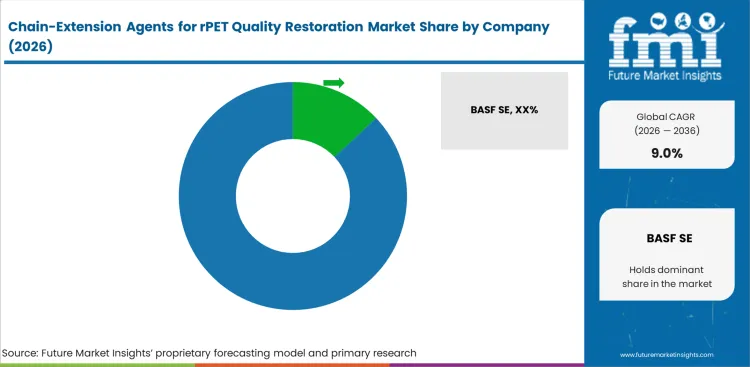
- BASF, Avient and Sukano hold the clearest supplier positions through epoxy chain extenders and additive masterbatch support.
- Analyst Opinion
- Ismail Sutaria, Principal Analyst for Packaging at FMI, observes, "rPET quality restoration is a converter yield business. Buyers pay for a melt stream able to process more recycled feed without sheet breaks. Cost pressure comes from additive dose and IV test proof. Suppliers gain account strength through stable dosing and converter line data. Clients should watch recycled bottle sheet lines and polyester fiber users through 2036."
- Chain-Extension Agents for rPET Quality Restoration Market Value Analysis
- Trial dosing is giving way to a clearer PET recycling aid segment for recycled polyethylene terephthalate quality repair.
- Converter demand is rising as higher recycled content targets raise concern over IV loss during extrusion.
- Additive dosage and line approval time influence revenue across food-contact packaging grades and bottle-grade sheet applications.
- Packaging groups support demand as cleaner rPET pellets improve output quality for bottles and thermoformed sheets.
Chain-extension agents for rPET quality restoration are expected to gain use as recyclers process more mixed bottle and tray streams. In 2024, Karl et al. reported stronger chain elongation from multifunctional epoxy-based Joncryl compared with PMDA in rPET mixtures. This supports greater use of epoxy chain extenders where hydrolysis lowers molecular weight. Rheology is also becoming a quality gate because reactive extrusion changes the melt behavior of recycled PET. Tray-rich feedstock needs tighter dosing control than bottle-only streams. Demand is likely to favor suppliers that provide food-contact compliance and feedstock-specific dosing guidance.
Chain-Extension Agents for rPET Quality Restoration Market Definition
The sector covers reactive additives used to rebuild molecular weight in recycled PET after washing, drying, melting, and reprocessing. Included products cover epoxy-functional chain extenders, viscosity builders, masterbatch carriers, and reactive extrusion additives used with bottle flakes, sheet regrind, fiber scrap, and rPET pellets. The scope includes additives sold to recyclers, converters, compounders, and polyester processors. Normal antioxidants, colorants without IV repair claims, and virgin PET polymerization catalysts fall outside this study.
Chain-Extension Agents for rPET Quality Restoration Market Inclusions
The study includes epoxy-functional agents, anhydride agents, oxazoline agents, carbodiimide agents, masterbatch forms, liquid additives, bottle flakes, bottle pellets, sheet extrusion, reactive extrusion, food packaging, fibers, recyclers, converters, compounders, and global geography. Market scope covers all commercially traded chain-extension agent products used for rPET quality restoration by chemistry type, including epoxy-functional agents and carbodiimide agents; application, including bottle-grade rPET, sheet-grade rPET, fiber-grade rPET, and film-grade rPET; end users, including recyclers, compounders, packaging converters, fiber producers, and PET resin producers; and sales channel, including direct supply, distributors, masterbatch partners, and compounder-led supply.
Revenue scope covers 2026 to 2036. The key stakeholders include chain-extension agent producers, PET recyclers, additive suppliers, masterbatch producers, plastic compounders, bottle makers, sheet producers, packaging groups, fiber manufacturers, testing laboratories, recycling technology providers, distributors, and regulatory bodies.
Chain-Extension Agents for rPET Quality Restoration Market Exclusions
The study excludes virgin PET resin catalysts, normal process stabilizers, color masterbatches without IV repair claims, bottle sorting equipment, washing lines, chemical depolymerization monomers, and recycled plastic grades outside PET.
Chain-Extension Agents for rPET Quality Restoration Market Research Methodology
- Primary Research: FMI analysts reviewed additive suppliers, rPET recyclers and packaging converters using viscosity restoration additives. Interviews focused on IV recovery and line approval time.
- Desk Research: The desk review used public recycling rules, PET recovery data and product evidence from additive suppliers. Technical papers supported screening of chain-extension chemistry.
- Market Sizing and Forecasting: The forecast combined the rPET packaging base with additive dose ranges and reactive extrusion use cases. Segment shares were checked against feedstock type and converter practice.
- Data Validation: Final values were checked against rPET end use, additive product evidence and country recycling policy signals.
Why is the Chain-Extension Agents for rPET Quality Restoration Market Growing?
- Regulation-driven recycled-content targets are pushing converters to process rPET streams with more variable IV.
- Chain-extension agents repair polymer length during melt processing so sheet and fiber lines can process more recycled feed.
- Masterbatch formats simplify dosing for converters working with varied bottle flake and tray scrap quality.
- Food packaging approval paths favor additives able to protect clarity and melt flow without raising line risk.
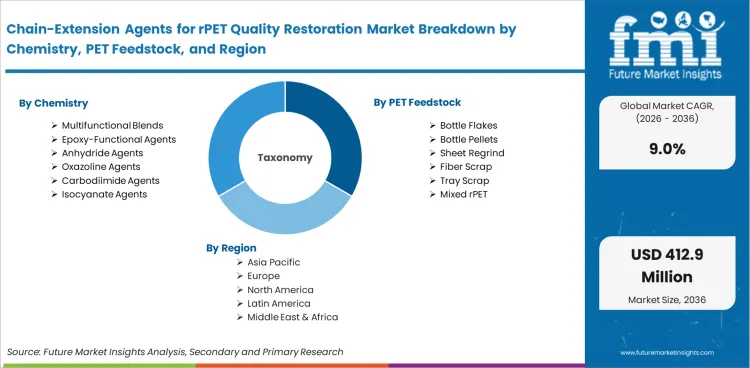
The chain-extension agents for rPET quality restoration market are segmented by agent chemistry into multifunctional epoxy agents, carbodiimide agents, oxazoline agents, anhydride agents, phosphite blends, and hybrid additive packages. By PET feedstock, market is divided into bottle flake, tray scrap, fiber waste, film scrap, mixed PET streams, and off-spec pellets. Based on application, the market is segmented into bottle-grade rPET, sheet-grade rPET, fiber-grade rPET, film-grade rPET, strapping-grade rPET, and molded PET parts. By end use, the market is segmented into recyclers, compounders, packaging converters, fiber producers, PET resin producers, and brand owners. Based on product form, the market is categorized into masterbatch concentrates, liquid additives, powder additives, pellet additives, and pre-blended compounds. By sales channel, the market is segmented into direct technical supply, distributor sales, compounder supply, masterbatch partnerships, and online B2B channels.
Chain-Extension Agents for rPET Quality Restoration Market Analysis by Agent Chemistry
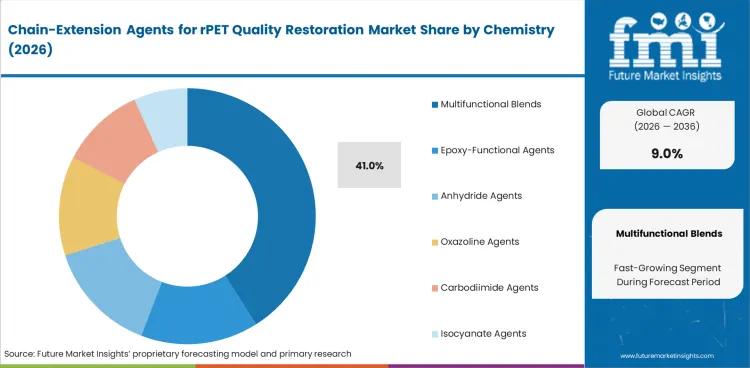
- Multifunctional epoxy agents are expected to account for 41.0% share in 2026 as processors use the chemistry to rebuild PET chain length during melt processing.
- Bottle and sheet converters prefer multifunctional epoxy agents led by controlled dosing improves melt strength without forcing major process changes.
Insights into Carbodiimide Agents Segment
- Carbodiimide agents gain adoption in rPET streams needing moisture-related degradation control during extrusion and compounding.
- Recyclers use carbodiimide additives to reduce hydrolysis risk as washed PET flakes often retain uneven moisture before drying.
Chain-Extension Agents for rPET Quality Restoration Market Analysis by PET Feedstock
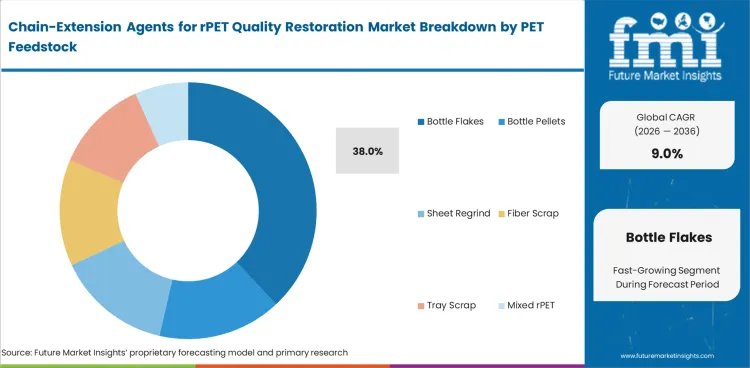
- Bottle flake is projected to represent 38.0% share in 2026, since collected PET bottles remain the most workable input for quality restoration.
- Reclaimers favor bottle flake as sorting and washing systems already create a cleaner feed base for chain-extension treatment.
Insights into Tray Scrap Segment
- Tray scrap gains attention as thermoforming waste returns to recycling lines with lower IV and higher processing variation.
- Additive use in tray scrap helps sheet producers manage brittleness after repeated heat exposure during recovery and extrusion.
Chain-Extension Agents for rPET Quality Restoration Market Analysis by Application
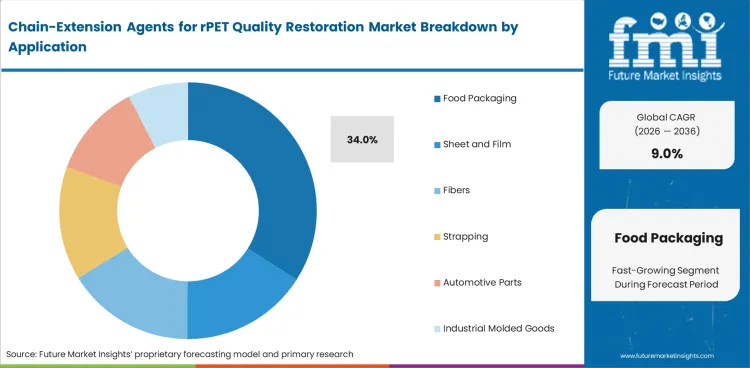
- Bottle-grade rPET is forecast to represent 34.0% share in 2026, driven by recycled-content rules and quality needs in beverage packaging.
- Beverage packaging users prioritize bottle-grade rPET as chain-extension treatment restores melt behavior for preform and bottle conversion.
Insights into Sheet-Grade rPET Segment
- Sheet-grade rPET expands as food trays and clear packaging require stable melt strength during extrusion.
- Thermoforming lines use chain-extension agents to reduce sheet breakage risk after recycled feed content rises.
Chain-Extension Agents for rPET Quality Restoration Market Analysis by End Use
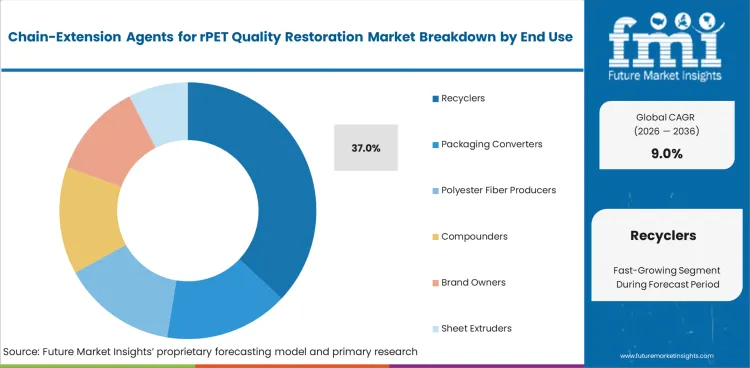
- Recyclers are projected to secure 37.0% share in 2026, reflected by quality repair beginning before pellets move to converters or compounders.
- PET reclaimers use chain-extension agents to improve pellet consistency and raise the usable share of lower-IV recovered feed.
Insights into Packaging Converters Segment
- Packaging converters use chain-extension agents for customer-grade rPET batches needing better clarity and melt flow.
- Converter trials focus on additive grades able to protect output quality across bottle and sheet processing lines.
Chain-Extension Agents for rPET Quality Restoration Market Analysis by Product Form
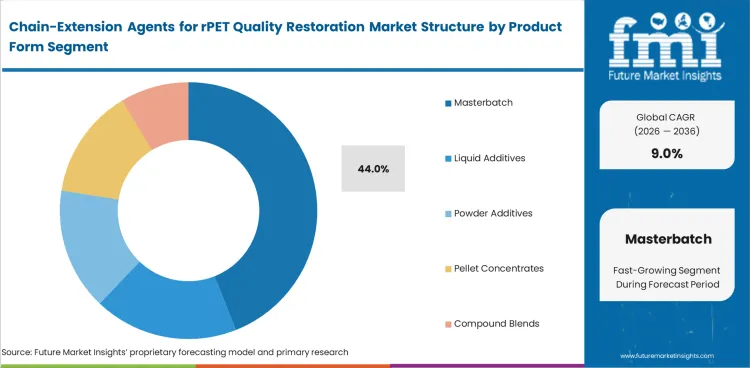
- Masterbatch concentrates are expected to make up 44.0% share in 2026, as cleaner dosing helps processors handle variable rPET feed.
- Masterbatch formats influence plant-scale adoption as additive handling stays simple during extrusion and compounding operations.
Insights into Pellet Additives Segment
- Pellet additives serve processors needing direct feed options for larger rPET compounding systems.
- Pellet formats reduce handling issues as dust control and batch stability remain central to recycled PET processing.
Chain-Extension Agents for rPET Quality Restoration Market Analysis by Sales Channel
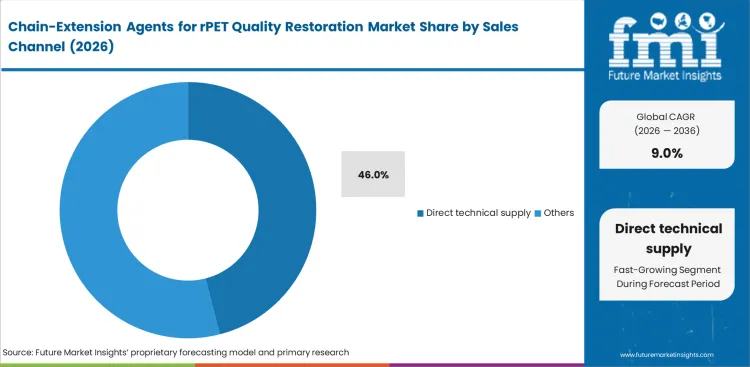
- Direct technical supply is expected to hold 46.0% share in 2026 as large rPET users need trial support and grade approval help.
- Direct supply means additive producers work with reclaimers on dosing windows and line testing before full commercial use.
Insights into Compounder Supply Segment
- Compounder supply serves converters purchasing ready-adjusted rPET compounds for packaging and fiber applications.
- Supply through compounders reduces formulation work for smaller users needing stable recycled PET quality from pre-tested grades.
Chain-Extension Agents for rPET Quality Restoration Market Drivers, Restraints, and Opportunities
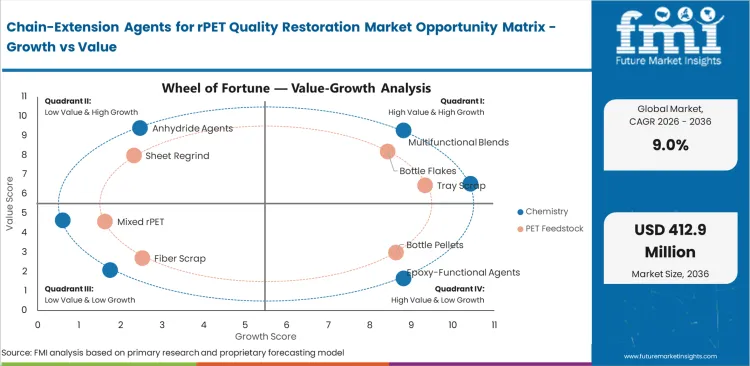
- Recycled-content rules will sustain additive use as packaging converters move toward higher rPET use without losing melt strength.
- Additive over-dosing is expected to keep qualification cost pressure steady as excess reaction can create gel and clarity defects.
- Sheet extrusion and fiber spinning will add revenue prospects for suppliers able to prove IV recovery across variable bottle flakes.
Policy pressure is expected to affect rPET quality restoration beyond normal resin price cycles through 2036. OECD projected in October 2024 a plastics production and use increase of 70% from 435 million tonnes in 2020 to 736 million tonnes in 2040. Recycled-source plastics would remain only 6% under the baseline case. Chain-extension agents support mechanical recycling by improving rPET usability before converters shift toward higher-cost renewal routes.
Infrastructure limits are expected to slow additive uptake in lower specification accounts by 2036. EPA estimated USD 36.5 billion to USD 43.4 billion in investment need by 2030 to improve United States recycling collection and processing infrastructure. EPA identified 82 million to 89 million tons of potential extra packaging and organic waste recovery. Better collection and sorting capacity should improve feed quality, creating additional prospects for chain-extension agents in higher-value rPET use.
Application-wise Equipment Use Analysis
Sheet extrusion lines create the clearest equipment path for chain-extension agents in PET packaging. NAPCOR reported 264 million pounds of PET thermoforms collected for recovery in the United States and Canada in 2024. The amount represented a 52% increase from the prior year. Higher thermoform recovery raises the need for chain repair agents as tray scrap faces heat history and IV loss before reuse.
Fiber spinning and strapping lines add a second demand path for chain-extension agents. Recycled PET often enters polyester yarn and strap products after melt filtration and pelletizing. Chain extenders improve melt strength so processors can use lower-IV feed with fewer strand breaks. Suppliers with lab support and trial-grade masterbatch should move faster through line approval.
Buyer Identification and Buying Structure Analysis
Buying decisions are expected to center on IV recovery proof and final product clarity. Recyclers test additive dose against melt flow and gel count before accepting a supplier. Packaging converters review food-contact status and migration risk for PET bottle or tray uses. Avient states rePrize IV Builder can rebuild intrinsic viscosity and increase reclaimed PET use in BOPET film, PET sheet, and fiber.
Food-contact packaging raises the approval burden for polyethylene terephthalate quality restoration. FDA maintains a favorable-opinion list for post-consumer recycled plastics used in food-contact articles. EFSA assesses post-consumer mechanical PET recycling technologies before recycled plastic can be used for food contact materials in the EU. Additive suppliers with test evidence and converter support can shorten approval cycles.
Regional Analysis
.webp "Top Country Growth Comparison Chain Extension Agents For Rpet Quality Restoration Market Cagr (2026 2036)")
| Country | CAGR 2026 to 2036 |
|---|---|
| China | 10.4% |
| India | 9.8% |
| United States | 8.7% |
| Germany | 8.3% |
| Japan | 7.8% |
| South Korea | 7.5% |
| United Kingdom | 7.1% |
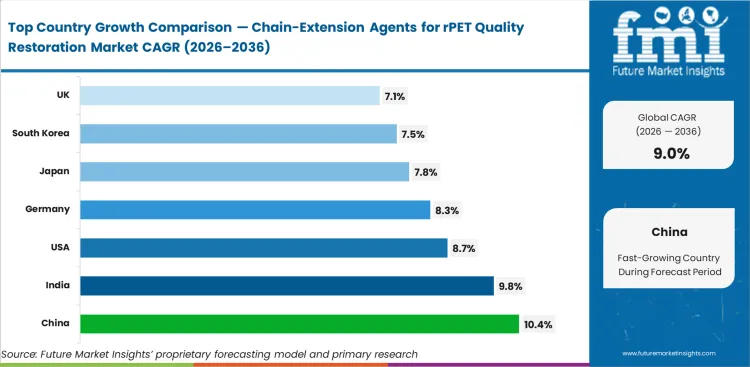
Source: Future Market Insights analysis based on rPET quality needs and public recycling source checks in 2026.
Analysis of Chain-Extension Agents for rPET Quality Restoration Market by Key Countries
- China is expected to grow at 10.4% CAGR by 2036, led by large PET bottle recycling and sheet conversion raising additive adoption.
- India is projected to follow at 9.8% CAGR by 2036 as packaged beverage output and local rPET processing increase chain-extension agent intake.
- United States demand is projected at 8.7% CAGR by 2036 since PET bottle recovery and thermoform recycling sustain steady IV repair needs.
- Germany is expected to advance at 8.3% CAGR by 2036 as recycled-content rules and food-contact checks influence rPET quality needs.
- Japan is forecast at 7.8% CAGR by 2036 through mature PET recycling systems. South Korea at 7.5% CAGR and the United Kingdom at 7.1% CAGR expand through stricter packaging quality checks.
Country growth differs with PET recovery scale and recycled-content pressure. China leads as large bottle collection and packaging conversion support faster chain-extension agent use. India follows as beverage packaging output and local recycler activity rise from a smaller base. United States demand advances through PET bottle recovery and thermoform reuse. Germany and the United Kingdom grow through packaging regulation and food-contact review. Japan and South Korea maintain steadier adoption as converters refine rPET clarity and melt capacity.
Demand Outlook for Chain-Extension Agents for rPET Quality Restoration in China
Demand for chain-extension agents for rPET quality restoration in China is projected to rise at 10.4% CAGR by 2036, reflected by large PET recycling and sheet extrusion increasing additive adoption. Local recyclers require multifunctional epoxy and carbodiimide grades that improve IV recovery without slowing bottle or sheet output. China leads the country outlook through high packaging conversion volume and wider domestic use of recycled PET.
- Large bottle recovery flows influence repeat additive adoption as recyclers require stable IV correction for bottle-grade and sheet-grade rPET.
- Sheet producers use chain-extension agents to improve melt strength after PET flakes face washing and repeated heat exposure.
- Local additive suppliers gain opportunity from recyclers needing fast trial support and stable masterbatch quality for extrusion lines.
Demand Outlook for Chain-Extension Agents for rPET Quality Restoration in India
The sector in India is expected to expand at 9.8% CAGR by 2036, driven by packaged beverage production and local recycling activity influencing chain-extension agent use. Domestic converters need better rPET quality without raising material cost beyond acceptable packaging limits. India follows China as recycler additions and bottle-to-sheet conversion support larger masterbatch demand.
- Beverage bottle recovery supports additive use as recyclers process uneven flake quality from rising packaged drink consumption.
- Local sheet producers need chain-extension agents to reduce brittleness during thermoforming and improve clear tray output.
- Supplier prospects improve for producers offering smaller trial lots and quick line support for extrusion and compounding users.
Demand Outlook for Chain-Extension Agents for rPET Quality Restoration in the United States
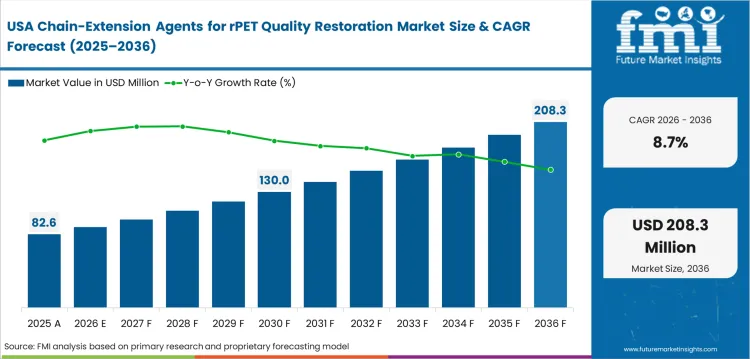
Sales of chain-extension agents for rPET quality restoration in the United States are projected to increase at 8.7% CAGR by 2036 as PET bottle recovery and thermoform recycling sustain additive need. Established reclaimers need chain-extension systems that balance IV recovery with clarity and gel control. United States demand remains steady through recycled-content goals and stronger quality review in food packaging accounts.
- PET bottle reclaimers use chain-extension agents to lift pellet quality before bottle and sheet converters start approval checks.
- Thermoform recovery creates additive demand as tray scrap often loses IV after repeated heat exposure during processing.
- Documentation needs raise supplier value as converters prefer grades backed by migration review and repeat batch proof.
Demand Outlook for Chain-Extension Agents for rPET Quality Restoration in Germany
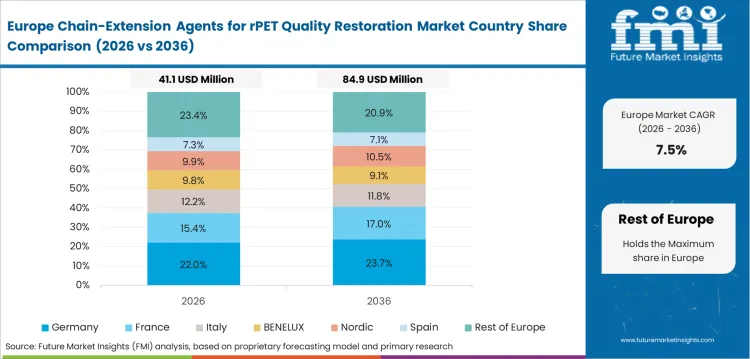
Chain-extension agent demand in Germany is projected to record 8.3% CAGR by 2036 as recycled-content rules and food-contact checks affect additive selection. German converters focus on clear rPET grades influenced by strong technical documentation. Growth stays measured as approval cycles remain strict across bottle and tray packaging programs.
- Packaging rules support chain-extension agents helping recycled PET retain melt strength during bottle and tray conversion.
- Food-contact packaging converters require repeatable clarity and gel control before rPET grades enter approved use.
- Local testing keeps approval timelines strict as recyclers check IV recovery and final pack quality before scale use.
Demand Outlook for Chain-Extension Agents for rPET Quality Restoration in Japan
The sector in Japan is expected to expand at 7.8% CAGR by 2036 since mature PET recycling and packaging quality standards maintain steady additive adoption. Japanese converters focus on reliable IV recovery and clean melt behavior across bottle and film applications. Japan records a steady pace as quality repair outweighs large new recycling capacity additions.
- Mature beverage packaging demand sustains additive use in rPET grades needing higher clarity and stable melt flow.
- Fiber producers use chain-extension agents to improve strand strength during spinning from lower-IV recycled PET feed.
- Specialty packaging producers refine rPET performance without shifting away from established PET processing routes.
Demand Outlook for Chain-Extension Agents for rPET Quality Restoration in South Korea
Demand for the sector in South Korea is expected to advance at 7.5% CAGR by 2036, as export packaging and domestic bottle recovery raise rPET quality needs. Local converters focus on clean pellet quality and stable sheet performance during extrusion. South Korea grows through high-quality packaging and polyester processing activity supporting selective additive use.
- Export packaging programs sustain chain-extension agent use as converters need rPET grades able to meet clarity checks.
- Polyester fiber producers use recycled PET feed needing melt strength correction for stable spinning and strand quality.
- Local converters favor additive suppliers able to adjust dosage without harming color or food-packaging review outcomes.
Demand Outlook for Chain-Extension Agents for rPET Quality Restoration in the United Kingdom
Industry demand in the United Kingdom is forecast to grow at 7.1% CAGR by 2036, as recycled-content goals and retailer packaging checks sustain additive adoption. Local converters use chain-extension systems supporting rPET quality claims and stable pack performance. United Kingdom adoption remains the slowest among listed countries as mature packaging review shapes material approval.
- Retailer packaging checks influence additive systems with clear documentation and consistent IV recovery performance.
- Food and household packaging converters use masterbatch formats to reduce brittleness in recycled PET sheet applications.
- Regional distributors serve smaller converters needing standard grades and shorter technical review cycles for rPET trials.
Competitive Positioning and Strategic Supplier Capability
- Recyclers are expected to favor suppliers able to prove stable pellet quality after washing, drying, and melt processing.
- Packaging converters will prioritize additive systems with low yellowing risk and clean output across clear bottle or tray applications.
- Masterbatch-led supply can gain share among smaller processors needing easier dosing without full in-house formulation work.
Competition in chain-extension agents for rPET quality restoration depends on additive proof at real recycling lines. BASF brings Joncryl® ADR into recycled polyester repair through reactive chain extension for reground condensation polymers. Avient competes with Cesa™ Extend additives for IV repair and ColorMatrix™ rePrize IV Builder for PET sheet and fiber processors. Sukano adds masterbatch depth through Melt Viscosity Enhancer products aimed at rPET resin quality improvement for converters. Supplier advantage will come from cleaner dosing windows and lower gel risk. Faster approval support will matter across bottle and sheet-grade rPET programs across bottle and sheet-grade rPET programs.
Buying teams are expected to compare suppliers through IV recovery data and final-pack clarity. Recyclers will test dosage against melt flow before adopting a chain extender across larger pellet batches. Packaging converters will favor additives with food-contact support and less yellowing risk during extrusion. BASF will remain useful for polymer repair claims, Avient will appeal to processors seeking named PET additive systems. Sukano will hold value in masterbatch-led rPET conversion accounts.
Key Companies in the Chain-Extension Agents for rPET Quality Restoration Market
Competition spans additive suppliers and masterbatch producers as PET recycling specialists compete for converter access. Each group competes through IV repair proof and dosing control.
- Reactive additive suppliers: BASF SE and Avient Corporation compete through epoxy chemistry. SI Group and Rianlon Corporation support stabilizer chemistry.
- Masterbatch specialists: Sukano AG and Tosaf Group compete through pellet dosing support. Polyvel Inc. and Pluss Advanced Technologies serve application support needs.
- PET recycling specialists: Indorama Ventures, ALPLA and Plastipak influence additive choices through upgraded rPET output needs.
Competitive Benchmarking: Chain-Extension Agents for rPET Quality Restoration Market
| Company | PET IV restoration proof | Masterbatch dosing support | Food packaging line support | Footprint |
|---|---|---|---|---|
| BASF SE | High | Moderate | Large | Global |
| Avient Corporation | High | High | Large | Global |
| Sukano AG | Moderate | High | Large | Europe led |
| SI Group | Moderate | Moderate | Moderate | Global |
| Tosaf Group | Moderate | High | Moderate | Global |
| Polyvel Inc. | Moderate | High | Moderate | North America |
| Pluss Advanced Technologies | Moderate | Moderate | Moderate | India led |
Source: Future Market Insights competitive analysis based on product evidence and covered country narratives in 2026.
Key Developments in PET Additives and rPET Quality Support
- In June 2024, Avient showcased ColorMatrix AAnchor at PRSE 2024 as an acetaldehyde control technology for PET packaging with higher recycled PET content, supporting recyclability and bottle quality needs.
- In February 2025, Avient launched ColorMatrix Amosorb 4020L for PET bottle packaging with compatibility for recycled PET use up to 100%, supporting brand owners seeking longer shelf life with higher rPET content.
- In April 2025, Avient presented PET and recycled-material additive options at Chinaplas 2025, including PET fiber additives and ColorMatrix Amosorb 4020L for PET and rPET rigid packaging.
Key Players in the Chain-Extension Agents for rPET Quality Restoration Market
Specialty chain-extension and masterbatch players
- BASF SE
- Avient Corporation
- Sukano AG
- SI Group
- Tosaf Group
- Polyvel Inc.
- Pluss Advanced Technologies
- Rianlon Corporation
- Brüggemann
- Kaneka Corporation
PET recycling and converter influence group
- Indorama Ventures
- ALPLA Group
- Plastipak Packaging
- Reliance Industries
- Far Eastern New Century
Report Scope and Coverage
| Item | Value |
|---|---|
| Market value in 2025 | USD 146.8 million |
| Market value in 2026 | USD 160.0 million |
| Market value in 2036 | USD 378.8 million |
| CAGR from 2026 to 2036 | 9.0% |
| Quantitative units | USD million |
| Market definition | Additives used to restore IV and melt performance in recycled polyethylene terephthalate during melt processing |
| By agent chemistry | Multifunctional epoxy agents, carbodiimide agents, oxazoline agents, anhydride agents, phosphite blends, hybrid additive packages |
| By PET feedstock | Bottle flake, tray scrap, fiber waste, film scrap, mixed PET streams, off-spec pellets |
| By application | Bottle-grade rPET, sheet-grade rPET, fiber-grade rPET, film-grade rPET, strapping-grade rPET, molded PET parts |
| By end user | Recyclers, compounders, packaging converters, fiber producers, PET resin producers, brand owners |
| By product form | Masterbatch concentrates, liquid additives, powder additives, pellet additives, pre-blended compounds |
| By sales channel | Direct technical supply, distributor sales, compounder supply, masterbatch partnerships, online B2B channels |
| Regions covered | North America, Latin America, Europe, East Asia, South Asia and Pacific, Middle East and Africa |
| Countries covered | China, India, United States, Germany, Japan, South Korea, United Kingdom |
| Key companies profiled | BASF, Avient, Sukano, SI Group, Tosaf, Polyvel, Pluss Advanced Technologies, Rianlon, Brüggemann, Kaneka |
| Forecast period | 2026 to 2036 |
| Approach | FMI analysis based on rPET quality restoration needs and public recycling source checks |
Source: Future Market Insights analysis, 2026.
Chain-Extension Agents for rPET Quality Restoration Market Breakdown by Chemistry, Form, rPET Feedstock, Processing Route, Application, End User, and Region
Chain-Extension Agents for rPET Quality Restoration Market Segmented by Chemistry
- Epoxy-Functional Agents
- Anhydride Agents
- Oxazoline Agents
- Carbodiimide Agents
- Isocyanate Agents
- Multifunctional Blends
Chain-Extension Agents for rPET Quality Restoration Market Segmented by Form
- Masterbatch
- Liquid Additives
- Powder Additives
- Pellet Concentrates
- Compound Blends
Chain-Extension Agents for rPET Quality Restoration Market Segmented by rPET Feedstock
- Bottle Flakes
- Bottle Pellets
- Sheet Regrind
- Fiber Scrap
- Tray Scrap
- Mixed rPET
Chain-Extension Agents for rPET Quality Restoration Market Segmented by Processing Route
- Reactive Extrusion
- Direct Compounding
- Sheet Extrusion
- Fiber Spinning
- Injection Molding
- Thermoforming Lines
Chain-Extension Agents for rPET Quality Restoration Market Segmented by Application
- Food Packaging
- Sheet and Film
- Fibers
- Strapping
- Automotive Parts
- Industrial Molded Goods
Chain-Extension Agents for rPET Quality Restoration Market Segmented by End User
- Recyclers
- Packaging Converters
- Polyester Fiber Producers
- Compounders
- Brand Owners
- Sheet Extruders
Chain-Extension Agents for rPET Quality Restoration Market by Region
- North America
- United States
- Canada
- Europe
- Germany
- United Kingdom
- France
- Italy
- East Asia
- China
- Japan
- South Korea
- South Asia and Pacific
- India
- ASEAN
- Australia and New Zealand
- Middle East and Africa
- Saudi Arabia
- South Africa
Research Sources and Bibliography
- Avient Corporation. (2024, January 22). Avient unveils ColorMatrix™ AAnchor™: New acetaldehyde control technology for PET packaging.
- Avient Corporation. (2025, February 14). Avient unveils ColorMatrix™ Amosorb™ 4020L: New shelf life extender oxygen scavenging additive for PET packaging.
- European Commission, Directorate-General for Environment. (2025, July 1). 5 things you should know about single-use plastics.
- Karl, C. W., Arstad, B., Shamsuyeva, M., Lecinski, J., Olafsen, K., Larsen, Å. G., Kubowicz, S., Comerford, J., & Endres, H.-J. (2024). Upgrading and enhancement of recycled polyethylene terephthalate with chain extenders: In-depth material characterization. Industrial & Engineering Chemistry Research, 63(28), 12277-12287.
- National Association for PET Container Resources. (2025, December 10). NAPCOR releases 2024 PET recycling report highlighting system efficiency gains and continued strength of PET circularity.
- OECD. (2024). Policy scenarios for eliminating plastic pollution by 2040. OECD Publishing.
- Sukano. (2025, October 2). Enabling PET closures with additive technology.
- USA Environmental Protection Agency. (2024, December). An assessment of the USA recycling system: Financial estimates to modernize material recovery infrastructure.
The bibliography is provided for reader reference and direct source checking.
This Report Answers
- How large the chain-extension agents for rPET quality restoration sector is in 2026 and how far it can rise by 2036?
- Which chemistry, form and processing route hold the strongest projected share positions in 2026?
- Why reactive extrusion and masterbatch hold the clearest lead in current material restoration practice?
- Why China and India lead the published country pace through 2036?
- How food packaging quality needs shape chain-extension agent adoption across converter lines?
- Which supplier capabilities help companies defend position in rPET IV restoration and masterbatch supply?
- What PET recycling and recycled-content signals support the forecast method used in this study?
Frequently Asked Questions
How large is the chain-extension agents for rPET quality restoration market in 2026?
The chain-extension agents for rPET quality restoration market is expected to reach USD 160.0 million in 2026 across packaging and polyester uses.
What will the chain-extension agents for rPET quality restoration market be worth by 2036?
The chain-extension agents for rPET quality restoration market is forecast to reach USD 378.8 million by 2036 as rPET quality needs rise.
What CAGR is projected for the chain-extension agents for rPET quality restoration market from 2026 to 2036?
The chain-extension agents for rPET quality restoration market is projected to expand at 9.0% CAGR between 2026 and 2036 globally.
Which processing route leads the chain-extension agents for rPET quality restoration market in 2026?
Reactive extrusion is estimated to lead the chain-extension agents for rPET quality restoration market with 49.0% share in 2026.
Which country grows fastest in the chain-extension agents for rPET quality restoration market?
China is anticipated to record the fastest pace at 10.4% CAGR by 2036 as packaging and polyester clusters use more upgraded rPET.
Preview the report firsthand - request a free sample
Get SampleGet the brochure for pricing and purchase details.
Get PDFTable of Content
- Executive Summary
- Global Market Outlook
- Demand-side Trends
- Supply-side Trends
- Technology Roadmap Analysis
- Analysis and Recommendations
- Market Overview
- Market Coverage / Taxonomy
- Market Definition / Scope / Limitations
- Research Methodology
- Chapter Orientation
- Analytical Lens and Working Hypotheses
- Market Structure, Signals, and Trend Drivers
- Benchmarking and Cross-market Comparability
- Market Sizing, Forecasting, and Opportunity Mapping
- Research Design and Evidence Framework
- Desk Research Programme (Secondary Evidence)
- Company Annual and Sustainability Reports
- Peer-reviewed Journals and Academic Literature
- Corporate Websites, Product Literature, and Technical Notes
- Earnings Decks and Investor Briefings
- Statutory Filings and Regulatory Disclosures
- Technical White Papers and Standards Notes
- Trade Journals, Industry Magazines, and Analyst Briefs
- Conference Proceedings, Webinars, and Seminar Materials
- Government Statistics Portals and Public Data Releases
- Press Releases and Reputable Media Coverage
- Specialist Newsletters and Curated Briefings
- Sector Databases and Reference Repositories
- FMI Internal Proprietary Databases and Historical Market Datasets
- Subscription Datasets and Paid Sources
- Social Channels, Communities, and Digital Listening Inputs
- Additional Desk Sources
- Expert Input and Fieldwork (Primary Evidence)
- Primary Modes
- Qualitative Interviews and Expert Elicitation
- Quantitative Surveys and Structured Data Capture
- Blended Approach
- Why Primary Evidence is Used
- Field Techniques
- Interviews
- Surveys
- Focus Groups
- Observational and In-context Research
- Social and Community Interactions
- Stakeholder Universe Engaged
- C-suite Leaders
- Board Members
- Presidents and Vice Presidents
- R&D and Innovation Heads
- Technical Specialists
- Domain Subject-matter Experts
- Scientists
- Physicians and Other Healthcare Professionals
- Governance, Ethics, and Data Stewardship
- Research Ethics
- Data Integrity and Handling
- Primary Modes
- Tooling, Models, and Reference Databases
- Desk Research Programme (Secondary Evidence)
- Data Engineering and Model Build
- Data Acquisition and Ingestion
- Cleaning, Normalisation, and Verification
- Synthesis, Triangulation, and Analysis
- Quality Assurance and Audit Trail
- Market Background
- Market Dynamics
- Drivers
- Restraints
- Opportunity
- Trends
- Scenario Forecast
- Demand in Optimistic Scenario
- Demand in Likely Scenario
- Demand in Conservative Scenario
- Opportunity Map Analysis
- Product Life Cycle Analysis
- Supply Chain Analysis
- Investment Feasibility Matrix
- Value Chain Analysis
- PESTLE and Porter’s Analysis
- Regulatory Landscape
- Regional Parent Market Outlook
- Production and Consumption Statistics
- Import and Export Statistics
- Market Dynamics
- Global Market Analysis 2021 to 2025 and Forecast, 2026 to 2036
- Historical Market Size Value (USD Million) Analysis, 2021 to 2025
- Current and Future Market Size Value (USD Million) Projections, 2026 to 2036
- Y-o-Y Growth Trend Analysis
- Absolute $ Opportunity Analysis
- Global Market Pricing Analysis 2021 to 2025 and Forecast 2026 to 2036
- Global Market Analysis 2021 to 2025 and Forecast 2026 to 2036, By Chemistry
- Introduction / Key Findings
- Historical Market Size Value (USD Million) Analysis By Chemistry , 2021 to 2025
- Current and Future Market Size Value (USD Million) Analysis and Forecast By Chemistry , 2026 to 2036
- Multifunctional Blends
- Epoxy-Functional Agents
- Anhydride Agents
- Oxazoline Agents
- Carbodiimide Agents
- Isocyanate Agents
- Multifunctional Blends
- Y-o-Y Growth Trend Analysis By Chemistry , 2021 to 2025
- Absolute $ Opportunity Analysis By Chemistry , 2026 to 2036
- Global Market Analysis 2021 to 2025 and Forecast 2026 to 2036, By PET Feedstock
- Introduction / Key Findings
- Historical Market Size Value (USD Million) Analysis By PET Feedstock, 2021 to 2025
- Current and Future Market Size Value (USD Million) Analysis and Forecast By PET Feedstock, 2026 to 2036
- Bottle Flakes
- Bottle Pellets
- Sheet Regrind
- Fiber Scrap
- Tray Scrap
- Mixed rPET
- Bottle Flakes
- Y-o-Y Growth Trend Analysis By PET Feedstock, 2021 to 2025
- Absolute $ Opportunity Analysis By PET Feedstock, 2026 to 2036
- Global Market Analysis 2021 to 2025 and Forecast 2026 to 2036, By Application
- Introduction / Key Findings
- Historical Market Size Value (USD Million) Analysis By Application, 2021 to 2025
- Current and Future Market Size Value (USD Million) Analysis and Forecast By Application, 2026 to 2036
- Food Packaging
- Sheet and Film
- Fibers
- Strapping
- Automotive Parts
- Industrial Molded Goods
- Food Packaging
- Y-o-Y Growth Trend Analysis By Application, 2021 to 2025
- Absolute $ Opportunity Analysis By Application, 2026 to 2036
- Global Market Analysis 2021 to 2025 and Forecast 2026 to 2036, By End Use
- Introduction / Key Findings
- Historical Market Size Value (USD Million) Analysis By End Use, 2021 to 2025
- Current and Future Market Size Value (USD Million) Analysis and Forecast By End Use, 2026 to 2036
- Recyclers
- Packaging Converters
- Polyester Fiber Producers
- Compounders
- Brand Owners
- Sheet Extruders
- Recyclers
- Y-o-Y Growth Trend Analysis By End Use, 2021 to 2025
- Absolute $ Opportunity Analysis By End Use, 2026 to 2036
- Global Market Analysis 2021 to 2025 and Forecast 2026 to 2036, By Product Form
- Introduction / Key Findings
- Historical Market Size Value (USD Million) Analysis By Product Form, 2021 to 2025
- Current and Future Market Size Value (USD Million) Analysis and Forecast By Product Form, 2026 to 2036
- Masterbatch
- Liquid Additives
- Powder Additives
- Pellet Concentrates
- Compound Blends
- Masterbatch
- Y-o-Y Growth Trend Analysis By Product Form, 2021 to 2025
- Absolute $ Opportunity Analysis By Product Form, 2026 to 2036
- Global Market Analysis 2021 to 2025 and Forecast 2026 to 2036, By Sales Channel
- Introduction / Key Findings
- Historical Market Size Value (USD Million) Analysis By Sales Channel, 2021 to 2025
- Current and Future Market Size Value (USD Million) Analysis and Forecast By Sales Channel, 2026 to 2036
- Direct technical supply
- Others
- Direct technical supply
- Y-o-Y Growth Trend Analysis By Sales Channel, 2021 to 2025
- Absolute $ Opportunity Analysis By Sales Channel, 2026 to 2036
- Global Market Analysis 2021 to 2025 and Forecast 2026 to 2036, By Region
- Introduction
- Historical Market Size Value (USD Million) Analysis By Region, 2021 to 2025
- Current Market Size Value (USD Million) Analysis and Forecast By Region, 2026 to 2036
- North America
- Latin America
- Western Europe
- Eastern Europe
- East Asia
- South Asia and Pacific
- Middle East & Africa
- Market Attractiveness Analysis By Region
- North America Market Analysis 2021 to 2025 and Forecast 2026 to 2036, By Country
- Historical Market Size Value (USD Million) Trend Analysis By Market Taxonomy, 2021 to 2025
- Market Size Value (USD Million) Forecast By Market Taxonomy, 2026 to 2036
- By Country
- USA
- Canada
- Mexico
- By Chemistry
- By PET Feedstock
- By Application
- By End Use
- By Product Form
- By Sales Channel
- By Country
- Market Attractiveness Analysis
- By Country
- By Chemistry
- By PET Feedstock
- By Application
- By End Use
- By Product Form
- By Sales Channel
- Key Takeaways
- Latin America Market Analysis 2021 to 2025 and Forecast 2026 to 2036, By Country
- Historical Market Size Value (USD Million) Trend Analysis By Market Taxonomy, 2021 to 2025
- Market Size Value (USD Million) Forecast By Market Taxonomy, 2026 to 2036
- By Country
- Brazil
- Chile
- Rest of Latin America
- By Chemistry
- By PET Feedstock
- By Application
- By End Use
- By Product Form
- By Sales Channel
- By Country
- Market Attractiveness Analysis
- By Country
- By Chemistry
- By PET Feedstock
- By Application
- By End Use
- By Product Form
- By Sales Channel
- Key Takeaways
- Western Europe Market Analysis 2021 to 2025 and Forecast 2026 to 2036, By Country
- Historical Market Size Value (USD Million) Trend Analysis By Market Taxonomy, 2021 to 2025
- Market Size Value (USD Million) Forecast By Market Taxonomy, 2026 to 2036
- By Country
- Germany
- UK
- Italy
- Spain
- France
- Nordic
- BENELUX
- Rest of Western Europe
- By Chemistry
- By PET Feedstock
- By Application
- By End Use
- By Product Form
- By Sales Channel
- By Country
- Market Attractiveness Analysis
- By Country
- By Chemistry
- By PET Feedstock
- By Application
- By End Use
- By Product Form
- By Sales Channel
- Key Takeaways
- Eastern Europe Market Analysis 2021 to 2025 and Forecast 2026 to 2036, By Country
- Historical Market Size Value (USD Million) Trend Analysis By Market Taxonomy, 2021 to 2025
- Market Size Value (USD Million) Forecast By Market Taxonomy, 2026 to 2036
- By Country
- Russia
- Poland
- Hungary
- Balkan & Baltic
- Rest of Eastern Europe
- By Chemistry
- By PET Feedstock
- By Application
- By End Use
- By Product Form
- By Sales Channel
- By Country
- Market Attractiveness Analysis
- By Country
- By Chemistry
- By PET Feedstock
- By Application
- By End Use
- By Product Form
- By Sales Channel
- Key Takeaways
- East Asia Market Analysis 2021 to 2025 and Forecast 2026 to 2036, By Country
- Historical Market Size Value (USD Million) Trend Analysis By Market Taxonomy, 2021 to 2025
- Market Size Value (USD Million) Forecast By Market Taxonomy, 2026 to 2036
- By Country
- China
- Japan
- South Korea
- By Chemistry
- By PET Feedstock
- By Application
- By End Use
- By Product Form
- By Sales Channel
- By Country
- Market Attractiveness Analysis
- By Country
- By Chemistry
- By PET Feedstock
- By Application
- By End Use
- By Product Form
- By Sales Channel
- Key Takeaways
- South Asia and Pacific Market Analysis 2021 to 2025 and Forecast 2026 to 2036, By Country
- Historical Market Size Value (USD Million) Trend Analysis By Market Taxonomy, 2021 to 2025
- Market Size Value (USD Million) Forecast By Market Taxonomy, 2026 to 2036
- By Country
- India
- ASEAN
- Australia & New Zealand
- Rest of South Asia and Pacific
- By Chemistry
- By PET Feedstock
- By Application
- By End Use
- By Product Form
- By Sales Channel
- By Country
- Market Attractiveness Analysis
- By Country
- By Chemistry
- By PET Feedstock
- By Application
- By End Use
- By Product Form
- By Sales Channel
- Key Takeaways
- Middle East & Africa Market Analysis 2021 to 2025 and Forecast 2026 to 2036, By Country
- Historical Market Size Value (USD Million) Trend Analysis By Market Taxonomy, 2021 to 2025
- Market Size Value (USD Million) Forecast By Market Taxonomy, 2026 to 2036
- By Country
- Kingdom of Saudi Arabia
- Other GCC Countries
- Turkiye
- South Africa
- Other African Union
- Rest of Middle East & Africa
- By Chemistry
- By PET Feedstock
- By Application
- By End Use
- By Product Form
- By Sales Channel
- By Country
- Market Attractiveness Analysis
- By Country
- By Chemistry
- By PET Feedstock
- By Application
- By End Use
- By Product Form
- By Sales Channel
- Key Takeaways
- Key Countries Market Analysis
- USA
- Pricing Analysis
- Market Share Analysis, 2025
- By Chemistry
- By PET Feedstock
- By Application
- By End Use
- By Product Form
- By Sales Channel
- Canada
- Pricing Analysis
- Market Share Analysis, 2025
- By Chemistry
- By PET Feedstock
- By Application
- By End Use
- By Product Form
- By Sales Channel
- Mexico
- Pricing Analysis
- Market Share Analysis, 2025
- By Chemistry
- By PET Feedstock
- By Application
- By End Use
- By Product Form
- By Sales Channel
- Brazil
- Pricing Analysis
- Market Share Analysis, 2025
- By Chemistry
- By PET Feedstock
- By Application
- By End Use
- By Product Form
- By Sales Channel
- Chile
- Pricing Analysis
- Market Share Analysis, 2025
- By Chemistry
- By PET Feedstock
- By Application
- By End Use
- By Product Form
- By Sales Channel
- Germany
- Pricing Analysis
- Market Share Analysis, 2025
- By Chemistry
- By PET Feedstock
- By Application
- By End Use
- By Product Form
- By Sales Channel
- UK
- Pricing Analysis
- Market Share Analysis, 2025
- By Chemistry
- By PET Feedstock
- By Application
- By End Use
- By Product Form
- By Sales Channel
- Italy
- Pricing Analysis
- Market Share Analysis, 2025
- By Chemistry
- By PET Feedstock
- By Application
- By End Use
- By Product Form
- By Sales Channel
- Spain
- Pricing Analysis
- Market Share Analysis, 2025
- By Chemistry
- By PET Feedstock
- By Application
- By End Use
- By Product Form
- By Sales Channel
- France
- Pricing Analysis
- Market Share Analysis, 2025
- By Chemistry
- By PET Feedstock
- By Application
- By End Use
- By Product Form
- By Sales Channel
- India
- Pricing Analysis
- Market Share Analysis, 2025
- By Chemistry
- By PET Feedstock
- By Application
- By End Use
- By Product Form
- By Sales Channel
- ASEAN
- Pricing Analysis
- Market Share Analysis, 2025
- By Chemistry
- By PET Feedstock
- By Application
- By End Use
- By Product Form
- By Sales Channel
- Australia & New Zealand
- Pricing Analysis
- Market Share Analysis, 2025
- By Chemistry
- By PET Feedstock
- By Application
- By End Use
- By Product Form
- By Sales Channel
- China
- Pricing Analysis
- Market Share Analysis, 2025
- By Chemistry
- By PET Feedstock
- By Application
- By End Use
- By Product Form
- By Sales Channel
- Japan
- Pricing Analysis
- Market Share Analysis, 2025
- By Chemistry
- By PET Feedstock
- By Application
- By End Use
- By Product Form
- By Sales Channel
- South Korea
- Pricing Analysis
- Market Share Analysis, 2025
- By Chemistry
- By PET Feedstock
- By Application
- By End Use
- By Product Form
- By Sales Channel
- Russia
- Pricing Analysis
- Market Share Analysis, 2025
- By Chemistry
- By PET Feedstock
- By Application
- By End Use
- By Product Form
- By Sales Channel
- Poland
- Pricing Analysis
- Market Share Analysis, 2025
- By Chemistry
- By PET Feedstock
- By Application
- By End Use
- By Product Form
- By Sales Channel
- Hungary
- Pricing Analysis
- Market Share Analysis, 2025
- By Chemistry
- By PET Feedstock
- By Application
- By End Use
- By Product Form
- By Sales Channel
- Kingdom of Saudi Arabia
- Pricing Analysis
- Market Share Analysis, 2025
- By Chemistry
- By PET Feedstock
- By Application
- By End Use
- By Product Form
- By Sales Channel
- Turkiye
- Pricing Analysis
- Market Share Analysis, 2025
- By Chemistry
- By PET Feedstock
- By Application
- By End Use
- By Product Form
- By Sales Channel
- South Africa
- Pricing Analysis
- Market Share Analysis, 2025
- By Chemistry
- By PET Feedstock
- By Application
- By End Use
- By Product Form
- By Sales Channel
- USA
- Market Structure Analysis
- Competition Dashboard
- Competition Benchmarking
- Market Share Analysis of Top Players
- By Regional
- By Chemistry
- By PET Feedstock
- By Application
- By End Use
- By Product Form
- By Sales Channel
- Competition Analysis
- Competition Deep Dive
- BASF SE
- Overview
- Product Portfolio
- Profitability by Market Segments (Product/Age /Sales Channel/Region)
- Sales Footprint
- Strategy Overview
- Marketing Strategy
- Product Strategy
- Channel Strategy
- Avient Corporation
- Sukano AG
- SI Group
- Tosaf Group
- Polyvel Inc.
- Pluss Advanced Technologies
- Rianlon Corporation
- Brüggemann
- Kaneka Corporation
- Indorama Ventures
- ALPLA Group
- Plastipak Packaging
- Reliance Industries
- Far Eastern New Century
- BASF SE
- Competition Deep Dive
- Assumptions & Acronyms Used


