

- Market Size (2026)
- USD 390.0 Mn
- Forecast (2036)
- USD 880.0 Mn
- CAGR (2026 to 2036)
- 8.5%
High-Quality Recycled Concrete Aggregates for EU Structural Applications Industry Size, Market Forecast and Outlook By FMI
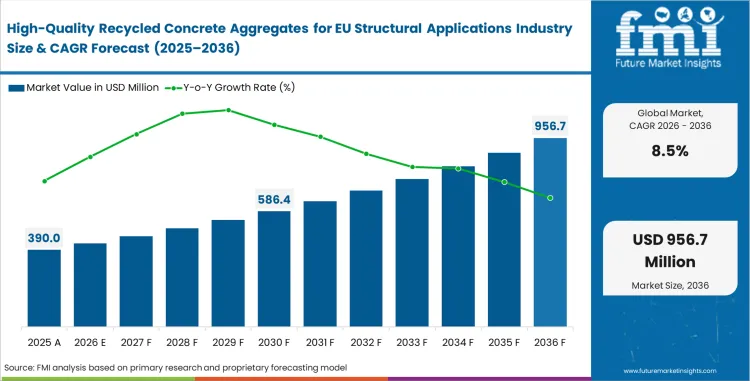
Qualification of demolition waste for structural use is becoming a more important commercial issue across the European construction sector. FMI estimates that the high-quality recycled concrete aggregates for the EU structural applications industry was valued at USD 360.0 million in 2025. Market value is projected to reach USD 390.0 million in 2026 and is expected to rise to USD 880.0 million by 2036, reflecting a CAGR of 8.5% over the forecast period. Growth is being supported by continued investment as contractors move away from low-value downcycling and toward the production of higher-grade materials suitable for load-bearing applications.
Summary of High-Quality Recycled Concrete Aggregates for EU Structural Applications Market
- The market is forecast to reach USD 880.0 million by 2036.
- The market is expected to grow at a CAGR of 8.5% from 2026 to 2036.
- The market was estimated at USD 360.0 million in 2025.
- The forecast period represents an incremental opportunity of USD 490.0 million.
- The market is specification-led, where value depends on traceability, grading control, and acceptance in structural concrete applications.
- Demand is increasing due to policy push toward higher-value use of construction and demolition waste (CDW) instead of low-grade recovery or landfill diversion.
- Advanced sorting, washing, and selective demolition technologies are improving the viability of structural-grade recycled aggregates.
- Germany leads growth at 9.1% CAGR, followed by the Netherlands, France, Belgium, Denmark, Spain, and Italy.
- Type A recycled concrete aggregates hold the largest product share at 38.0% due to better suitability for structural mixes.
- Coarse aggregates dominate with a 62.0% share, as fine fractions face stricter qualification challenges.
- Ready-mix structural concrete leads the application segment with 44.0% share due to better batching control and compliance.
- Advanced separation processes account for 34.0% share, supporting higher purity and consistency requirements.
- Commercial buildings represent the leading end-use segment with 31.0% share, driven by embodied carbon targets.
- Key companies in the market include Holcim, Heidelberg Materials, CRH, CEMEX, VINCI Construction, ACCIONA, and Heinrich Feess.
- The market remains fragmented due to localized feedstock availability and regulatory approvals.
Key Takeaways, Market Size, and Forecast
- High-Quality Recycled Concrete Aggregates for EU Structural Applications Industry is projected to grow from USD 390.0 million in 2026 to USD 880.0 million by 2036, at a CAGR of 8.5%.
- The high-quality recycled concrete aggregates for EU structural applications industry was valued at USD 360.0 million in 2025.
- By 2036, the High-Quality Recycled Concrete Aggregates for EU Structural Applications Industry is expected to be worth USD 880.0 million.
- From 2026 to 2036, the industry is projected to expand at a CAGR of 8.5%.
- The industry is projected to create an incremental opportunity of USD 490.0 million between 2026 and 2036.
- In 2026, Type A RCA is expected to account for 38.0% of the product grade segment.
- Germany (9.1%) and Netherlands (8.9%) are two of the fastest growing markets.
Contractors are operating under tighter carbon and material sourcing constraints, which is increasing interest in structural-grade recycled aggregates. Use of recycled concrete aggregates is no longer limited to waste reduction goals alone. It is becoming more relevant to public tender eligibility, compliance with circular construction targets, and protection against supply pressure in virgin aggregates. Delayed qualification of type A recycled concrete grades can leave contractors exposed to higher landfill costs and weaker access to approved material streams. Technical performance also remains a practical issue because higher water absorption in recycled aggregate mixes can change batching behavior and increase the need for tighter admixture control.
Integrated demolition-to-batching systems are beginning to reduce some of the operational barriers to wider adoption. Once crushing, sorting, and grading are managed within more controlled hubs, producers are better placed to deliver the grain size consistency required for structural concrete use. Material reliability matters heavily in this market because precast and ready-mix producers need tighter control over performance variation before substitution rates can rise at scale. Market progress is therefore depending not only on waste availability, but also on how consistently processors can deliver qualified fractions for structural applications.Integrated demolition-to-batching systems are beginning to reduce some of the operational barriers to wider adoption. Once crushing, sorting, and grading are managed within more controlled hubs, producers are better placed to deliver the grain size consistency required for structural concrete use. Material reliability remains important in this market because precast and ready-mix producers need tighter control over performance variation before substitution rates can rise at scale. Market progress therefore depends not only on waste availability, but also on how consistently processors can deliver qualified fractions for structural applications.
Germany is expected to remain one of the leading markets, with a CAGR of 9.1% through 2036, as structural standards there are more supportive of higher recycled input in load-bearing applications. The Netherlands is projected to expand at a CAGR of 8.9%, where landfill scarcity and tighter circular purchase models continue to support faster acceptance. France is likely to post 8.4% CAGR during the forecast period, while Belgium is estimated to grow at 8.2%, helped by dense urban construction activity and shorter material transport loops. Denmark is projected to register 8.0%, reflecting steady progress in higher-specification recycling infrastructure. Spain is expected to witness 7.7% CAGR through 2036, and Italy is likely to grow at 7.5%, where adoption still depends more heavily on project-level technical approval. Market variation across Europe is being shaped less by demolition volume alone and more by how quickly each country can align sorting quality, certification practice, and contractor acceptance for structural use.
Segmental Analysis
High-Quality Recycled Concrete Aggregates for EU Structural Applications Industry Analysis by Product Grade
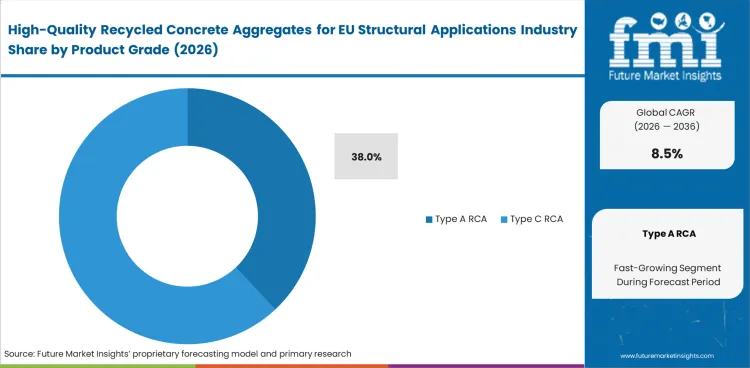
Structural use of recycled aggregates depends first on consistency in chemistry, porosity, and moisture response. Type A RCA is estimated to account for 38.0% share in 2026 because lower attached mortar levels make it more suitable for structural formulations than lower grades. Precast facilities prefer this grade when they need tighter control over dimensional stability and surface finish. Moving from mixed demolition waste to Type A material requires selective demolition and multi-stage crushing, which changes the operating cost base. Structural applications also leave little room for variability in water absorption, so engineers usually specify Type A where performance consistency matters most. Attempts to raise lower-grade content in structural mixes often create slump loss during transit and force corrective action on site. That keeps qualification discipline central to this segment.
- Performance ceiling: Type A classification supports tighter chloride and sulfate control, which helps protect reinforcement over long service lives.
- Edge condition vulnerability: Wet exposure conditions make residual porosity more visible, so higher-grade material is preferred where freeze-thaw durability matters.
- Qualification threshold: Structural certification depends on repeated petrographic and batch testing to confirm the absence of harmful impurities.
High-Quality Recycled Concrete Aggregates for EU Structural Applications Industry Analysis by Aggregate Size
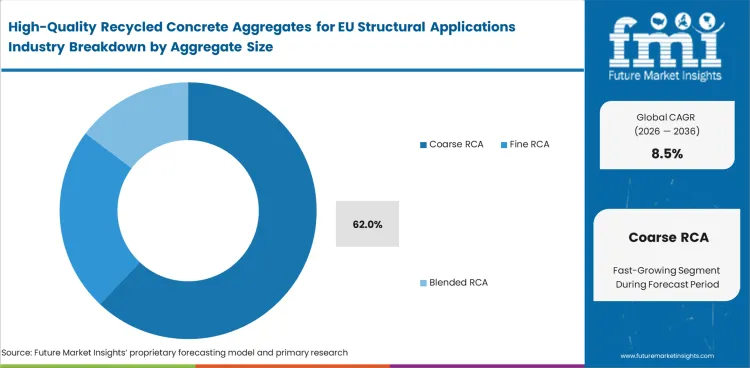
Mix design selection depends heavily on particle distribution because water demand and packing behavior shift quickly across aggregate sizes. Coarse fractions remain the preferred option in structural use because they carry less attached mortar than finer material and create fewer shrinkage concerns after curing. FMI’s analysis indicates coarse RCA is expected to hold 62.0% share in 2026. Quality control teams favor this grade because it fits more easily into existing structural formulations with fewer design adjustments. Integration still requires changes to fine-to-coarse ratios in ready mix concrete to avoid segregation during pouring. Fine recycled fractions remain harder to scale because they absorb more water and can weaken slump retention. That leaves coarse material as the main route for higher recycled content in structural applications.
- Initial specification: Coarse fractions can replace virgin gravel more directly in volumetric mix calculations with fewer structural changes.
- Secondary validation: Specific gravity testing remains necessary so production teams can maintain yield accuracy per cubic meter.
- Expansion limitation: Fine fraction use stays constrained by shrinkage and water absorption, which keeps washing and refinement as a development priority.
High-Quality Recycled Concrete Aggregates for EU Structural Applications Industry Analysis by Concrete Class
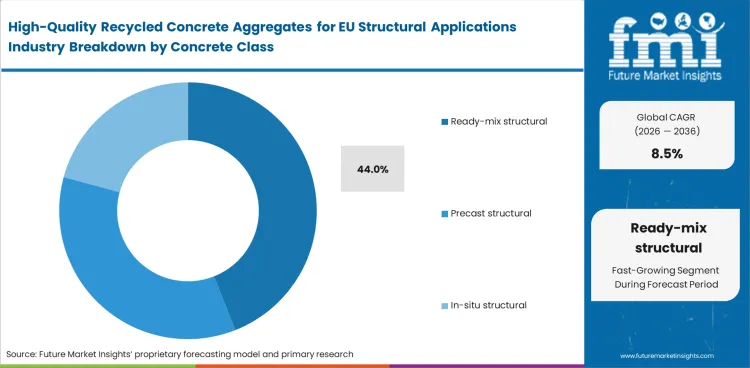
Urban construction programs are putting more pressure on concrete producers to cut transport-related emissions and use local input streams more effectively. Short-haul sourcing makes recycled aggregate especially relevant for standard structural deliveries served by regional batching networks. Ready-mix structural is anticipated to capture 44.0% share in 2026, based on FMI’s assessment. This position reflects the practical fit between local crushing operations and the distribution radius of routine ready-mix fleets. Plants that introduce recycled inputs into this class usually need moisture-monitoring systems in storage bins to control workability more accurately. Controlled factory settings can sometimes absorb higher substitution levels, but live site delivery remains more sensitive to moisture shifts during transport. Reliable monitoring therefore stays essential when recycled aggregates move into daily structural batching.
- Defect prevention: Automated moisture probes help adjust water addition in real time and reduce strength variability from saturated aggregates.
- Residual vulnerability: Longer delivery times can worsen workability loss, especially when recycled material continues absorbing free water in transit.
- Capture requirement: Backhaul coordination using road aggregates logistics routes can improve plant feedstock efficiency and reduce empty return movement.
High-Quality Recycled Concrete Aggregates for EU Structural Applications Industry Analysis by Processing Route
Structural-grade recycled aggregate depends on tighter impurity control than standard fill or sub-base material. Sensor-based sorting, air classification, and advanced cleaning all improve the chance of producing material that can meet structural specifications. Advanced separation is poised to garner 34.0% share in 2026. This route matters because brick, gypsum, and wood contamination can weaken the reliability of load-bearing mixes and restrict code acceptance. Single-crush output may still suit lower-grade construction use, but structural applications depend on a narrower group of facilities with stronger processing capability. Plants that rely only on basic magnetic recovery usually remain outside structural-grade supply chains. That gives advanced processing a more defined role in the scaling of certified green building materials.
- Sourcing baseline: Advanced sorting supports better impurity control and helps justify acceptance in structural-grade specifications.
- Hidden operational cost: Optical systems and sensor arrays require calibration, upkeep, and specialist attention to maintain sorting accuracy.
- Lifecycle comparison: Cleaner aggregate can reduce downstream correction needs and lower admixture dependence across the full project cycle.
High-Quality Recycled Concrete Aggregates for EU Structural Applications Industry Analysis by End Use
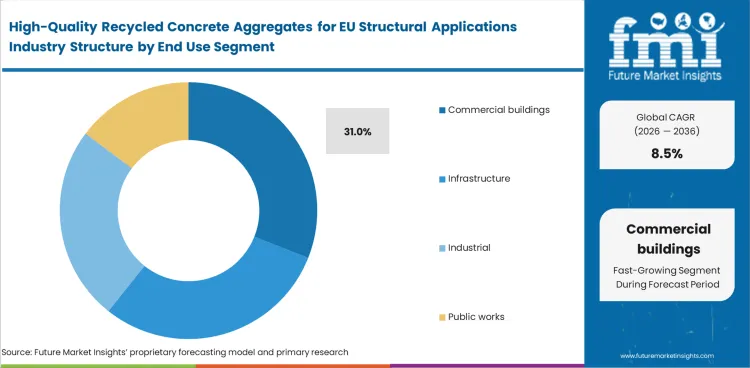
Commercial construction remains an important demand center because private projects increasingly link material selection with measurable carbon targets. Green certification frameworks also reward the use of secondary structural inputs in visible building elements. As per FMI’s projection, commercial buildings are set to represent 31.0% share in 2026. Developers specifying certified recycled aggregate in structural packages can improve environmental scoring while aligning with investor expectations around lower-impact construction. That shift also forces contractors to build working relationships with qualified recyclers rather than relying only on conventional virgin supply chains. Infrastructure may absorb larger raw tonnage, but commercial projects often move faster on higher-grade certified material because financing and certification goals are closely connected. This keeps end-use momentum strongest where compliance, design intent, and material traceability can work together.
- Initial cause: Financing terms increasingly favor projects that can document minimum circularity performance in structural materials.
- Qualification hurdle: Independent engineering approval is often required before a specific recycled aggregate source can be cleared for use.
- Renewal driver: Completed projects create repeatable sourcing models that contractors can apply across nearby commercial developments.
High-Quality Recycled Concrete Aggregates for EU Structural Applications Industry Drivers, Restraints, and Opportunities
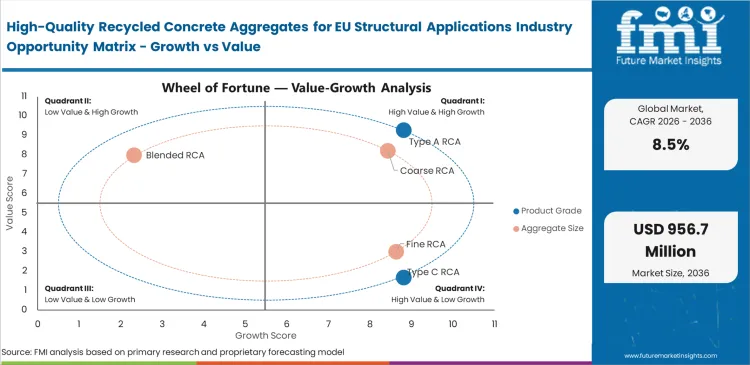
Public sourcing quotas compel construction firms to source certified secondary materials for commercial building tenders immediately. Firms face hard minimums for recycled content in public works, transforming circularity from marketing features into strict market-entry requirements. Bidding on urban development projects now requires secured supply lines of structural-grade secondary aggregates. Firms failing to lock in material streams find themselves mathematically excluded from scoring rubrics of modern public tenders. Impending alignment of local building codes with European circular economy directives accelerates this shift, penalizing traditional virgin-material workflows with heavy carbon taxation and disposal fees.
Questions regarding why recycled aggregates are still limited in use point directly to water absorption variability during ready-mix batching phases, forcing contractors to over-design cement content. Mortar adhered to crushed aggregate creates unpredictable hydration mechanics, complicating the precise water-to-cement ratios required for structural integrity. Batching plant operators must constantly adjust water inputs based on the moisture states of incoming secondary material. Operational friction persists because standard moisture sensors struggle to differentiate between surface water and water locked within porous attached mortar. While co2 reduced concrete operations offer partial mitigation, they slow down batching cycle times and introduce logistical bottlenecks at high-volume production facilities.
Opportunities in High-Quality Recycled Concrete Aggregates for EU Structural Applications Industry
- Carbonation treatment integration: Exposing crushed materials to concentrated carbon dioxide seals porous attached mortar. Material scientists achieve lower water absorption rates, allowing ready-mix producers using secondary materials without increasing costly cement volumes.
- Admixture chemistry optimization: Formulating specific polycarboxylate ether superplasticizers tailored for porous materials. Chemical engineers develop concrete admixtures maintaining workability and slump retention specifically when high volumes of secondary aggregates are batched.
- Mobile advanced sorting deployment: Bringing near-infrared classification technology directly to massive demolition sites. Firms eliminate double-handling of heavy materials, processing structural-grade aggregates on-site for immediate integration into new construction phases.
Regional Analysis
Based on regional analysis, High-Quality Recycled Concrete Aggregates for EU Structural Applications is segmented into Western Europe, Northern Europe, and Southern Europe across 40 plus countries.Based on regional analysis, the high-quality recycled concrete aggregates for EU structural applications industry is segmented into key European markets covered in this report.
.webp "Top Country Growth Comparison High Quality Recycled Concrete Aggregates For Eu Structural Applications Industry Cagr (2026 2036)")
| Country | CAGR (2026 to 2036) |
|---|---|
| Germany | 9.1% |
| Netherlands | 8.9% |
| France | 8.4% |
| Belgium | 8.2% |
| Denmark | 8.0% |
| Spain | 7.7% |
| Italy | 7.5% |
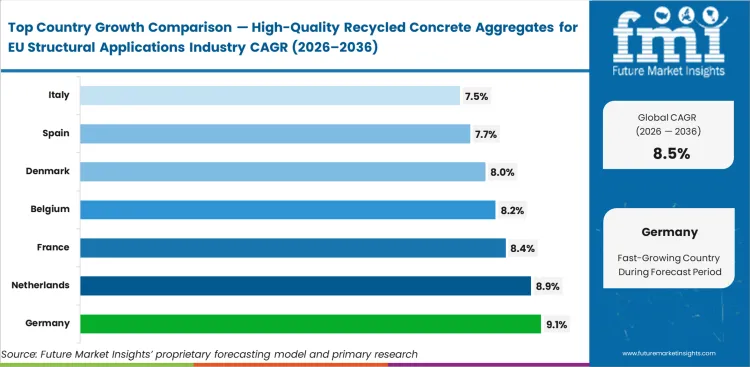
Source: Future Market Insights (FMI) analysis, based on proprietary forecasting model and primary research
Western Europe High-Quality Recycled Concrete Aggregates for EU Structural Applications Industry Analysis
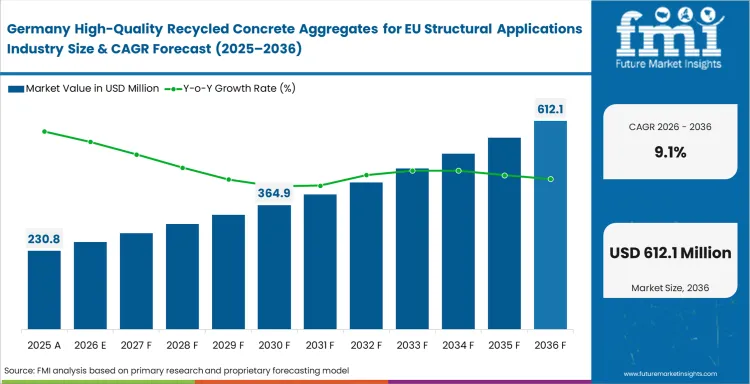
Strict requirements for urban construction projects now replace voluntary incentives across Western Europe. Acute landfill scarcity and dense urbanization force a complete shift in demolition material flows. Regional ready-mix manufacturers integrate crushing hubs directly into existing batching plant footprints to minimize heavy transport emissions. Localized approaches bypass traditional quarrying networks entirely. Regulatory environments specifically target load-bearing applications, pushing beyond early successes seen in low-grade road base utilization.Western Europe remains the most developed market cluster for structural-grade recycled concrete aggregates because landfill scarcity, urban construction density, and tighter project specifications are improving the commercial case for higher-value recovery. Adoption is moving beyond road-base and fill applications as more ready-mix and precast producers test qualified recycled material in load-bearing use. Market progress still depends on sorting quality, certification discipline, and the ability to connect demolition waste streams with approved concrete production systems.
- Germany: National standard evolution alongside industrial projects targeting selective concrete separation rapidly improves acceptance. Manufacturers leverage updated technical guidelines to substitute virgin rock in major commercial developments confidently. Demand for high-quality recycled concrete aggregates in Germany is anticipated to rise at a CAGR of 9.1% through 2036. Successful green cement integration with these specific aggregates opens lucrative public infrastructure contracts for compliant builders.
- Netherlands: Dutch structural RCA adoption is likely to advance at a CAGR of 8.9% by 2036. Extreme geographic limitations on new virgin quarry permits force regional construction sectors toward strict closed-loop material models. Local demolition networks now directly feed urban precast factories to maintain consistent material availability without interruption. Geographic constraints naturally push Dutch engineering firms to lead the continent in high-percentage structural substitution designs.
- France: Circular construction programs dictate mandatory material passports for all new commercial buildings. Sales of structural recycled concrete aggregates in France are expected to increase at a CAGR of 8.4% during the forecast period. Strict tracking requirements mandate tracing the exact origins of secondary aggregates to verify quality. Operational workflows inside French batching plants shift entirely toward automated moisture compensation systems supporting this transition.
- Belgium: Short-haul urban construction logistics support the economic viability of higher-value recycled materials across regional supply chains. Intricate canal networks effectively move raw demolition waste to advanced separation facilities without relying on heavy road transport. Belgian demand for structural RCA is anticipated to rise at an 8.2% CAGR through 2036. Specific regional dynamics shift pricing power away from virgin quarries toward integrated recycling operators.
FMI's report includes Austria and Switzerland. Advanced crushing legislation in Alpine regions focuses heavily on preserving local topography by maximizing secondary material recovery.FMI's report includes Austria and Switzerland. These markets add regional depth, though adoption remains more project-specific and dependent on local approval pathways.
Northern Europe High-Quality Recycled Concrete Aggregates for EU Structural Applications Industry Analysis
Ambitious national carbon neutrality targets lead to the specification of secondary materials in Northern Europe. Public infrastructure projects serve as primary testing grounds for high-percentage structural substitution. Regional engineering consortiums collaborate directly with environmental ministries to rewrite traditional building codes that previously blocked secondary materials. Focus rests heavily on using offshore wind energy to power energy-intensive crushing and sorting facilities.
- Denmark: Denmark is set to record a CAGR of 8.0% in high-quality structural RCA during the assessment period. Deep integration of circular economy principles pushes structural-grade penetration selectively into regional precast sectors. Precast facilities actively refine curing protocols to handle the specific thermal properties of precast concrete mixtures. Danish architectural firms now explicitly market their capability to design load-bearing structures using entirely secondary mineral inputs.
FMI's report includes Sweden and Norway. High-strength requirements for severe freeze-thaw conditions heavily restrict substitution rates in specific Nordic environments without advanced aggregate carbonation.FMI's report includes Sweden and Norway. In these markets, freeze-thaw performance and durability requirements continue to limit faster structural substitution without tighter processing control.
Southern Europe High-Quality Recycled Concrete Aggregates for EU Structural Applications Market Analysis
Adoption rises from lower processing and specification bases across Southern Europe. Fragmented demolition networks lack the capital density required to install near-infrared sorting technologies widely. Applications depend heavily on localized project acceptance rather than broad national normalization. General contractors build proprietary processing yards to guarantee a dedicated supply of certified material for their projects.
- Spain: Massive public infrastructure renovation projects create persistent localized demand spikes for specific secondary materials. High-quality recycled concrete aggregate sales in Spain are poised to grow at a CAGR of 7.7% during the assessment period. Regional crushing facilities secure dedicated supply lines explicitly for large-scale bridge and tunnel upgrades. Builders possessing these dedicated supply networks bid far more aggressively on lucrative state-funded renovation contracts.
- Italy: Complex regional permitting creates significant bottlenecks when establishing new advanced separation hubs across the country. Navigating overlapping municipal jurisdictions remains strictly necessary to secure operational licenses for high-capacity recycling centers. Italy is projected to witness a 7.5% CAGR in demand for recycled aggregates through 2036. Regulatory friction keeps secondary material prices highly localized and volatile, depending on specific provincial boundaries and material availability.
FMI's report includes Portugal and Greece. Coastal construction requirements in Mediterranean areas necessitate rigorous chloride testing for secondary materials destined for utilization.FMI's report includes Portugal and Greece. These markets add medium-term potential, though broader uptake still depends on tighter testing discipline and more consistent project-level acceptance.
Competitive Aligners for Market Players
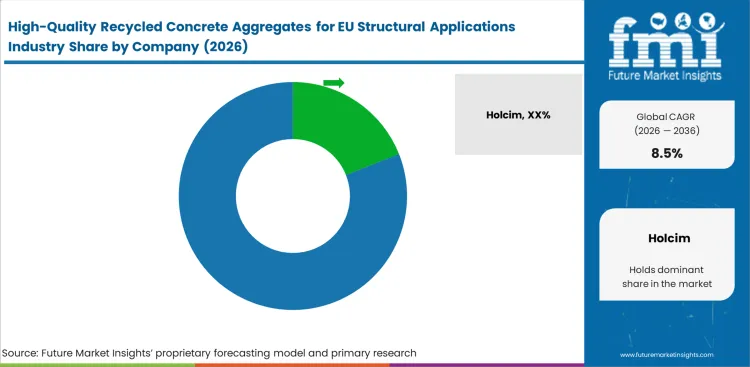
Major cement producers leverage existing batching infrastructure, absorbing processing and distribution of secondary materials. The most competitive players bypass independent recycling yards, establishing closed-loop demolition recovery networks. Integration allows controlling aggregate geometry from crushers directly to ready-mix trucks, eliminating quality variance plaguing fragmented supply chains. Tier-one firms dictate regional pricing for high-grade fractions, holding capital necessary to install advanced sensor-based sorting lines. Independent crushers face severe margin compression as massive integrated firms absorb lucrative demolition contracts.
Incumbents possess deep libraries of verified structural performance data that challengers cannot replicate quickly. Decades of concrete cylinder compression tests and freeze-thaw longevity studies provide empirical foundations required for rewriting national building codes. When firms approach municipal building authorities to approve novel mix designs, they present multi-year durability data that newly formed recycling startups simply do not own. Historical data acts as massive regulatory moats, forcing independent processing yards selling recycled glass aggregates or concrete fractions to incumbents rather than competing directly for certification.
Large commercial developers resist total supply chain lock-in mandating open-source material passports. Recycled aggregate concrete RFQs circulated across Europe actively qualify secondary suppliers in every major urban radius, maintaining competitive tension throughout bidding processes. They refuse relying entirely on single integrated cement providers for circular material needs. General contractors fund independent testing for smaller recycling facilities, intentionally building decentralized supply bases breaking pricing power of dominant cement conglomerates. Strategic qualification of alternative suppliers guarantees processing innovation remains decentralized even as sectors scale.
Key Players in High-Quality Recycled Concrete Aggregates for EU Structural Applications Industry
- Holcim
- Heidelberg Materials
- CRH
- CEMEX
- VINCI Construction
- ACCIONA
- Heinrich Feess
Scope of the Report
| Metric | Value |
|---|---|
| Quantitative Units | USD 390.0 million to USD 880.0 million, at a CAGR of 8.5% |
| Market Definition | High-Quality Recycled Concrete Aggregates for EU Structural Applications represents crushed, cleaned, and graded mineral material derived from concrete demolition waste meeting specific physical thresholds for load-bearing structural concrete. This category isolates materials processed specifically to achieve low water absorption, high compressive strength retention, and minimal deleterious impurities. |
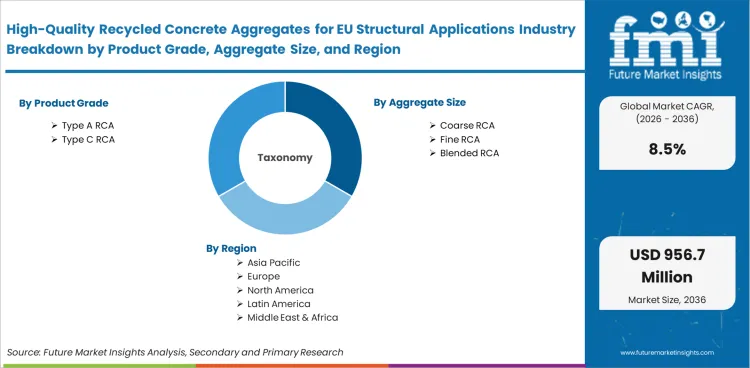
| Segmentation | Product grade, Aggregate size, Concrete class, Processing route, End use, Region |
| Regions Covered | North America, Latin America, Western Europe, Eastern Europe, South Asia and Pacific, East Asia, Middle East and AfricaEurope |
| Countries Covered | Germany, Netherlands, France, Belgium, Denmark, Spain, Italy |
| Key Companies Profiled | Holcim, Heidelberg Materials, CRH, CEMEX, VINCI Construction, ACCIONA, Heinrich Feess |
| Forecast Period | 2026 to 2036 |
| Approach | Concrete volume tracking for structural applications combined with regional demolition processing capacity established baseline supply curves.The market estimate is based on structural concrete demand, demolition processing capacity, product benchmarking, and primary research. |
Source: Future Market Insights (FMI) analysis, based on proprietary forecasting model and primary research
High-Quality Recycled Concrete Aggregates for EU Structural Applications Industry Analysis by Segments
Product grade
- Type A RCA
- Type C RCA
Aggregate size
- Coarse RCA
- Fine RCA
- Blended RCA
Concrete class
- Ready-mix structural
- Precast structural
- In-situ structural
Processing route
- Advanced separation
- Single crush
- Washing
- Carbonation
End use
- Commercial buildings
- Infrastructure
- Industrial
- Public works
Region
- Western Europe
- Germany
- Netherlands
- France
- Belgium
- Austria
- Switzerland
- Northern Europe
- Denmark
- Sweden
- Norway
- Southern Europe
- Spain
- Italy
- Portugal
- Greece
Bibliography
- Konca, P., et al. (2024, December 31). Sustainable infrastructure: Recycled concrete aggregates for structural and non-structural concrete applications. Materials, 18(1), 131.
- Akbulut, Z. F., et al. (2025, December). A critical review of recycled aggregate concrete properties and structural applicability. Case Studies in Construction Materials.
- Kępniak, M., et al. (2025, August 16). Enhancing the performance of recycled aggregate concrete through industrially feasible pretreatment methods. Scientific Reports.
- Holcim Ltd. (2026). 2025 integrated annual report.
- Heidelberg Materials. (2026). Annual and Sustainability Report 2025.
- VINCI. (2025). Optimising resources thanks to the circular economy.
This bibliography is provided for reader reference. The full FMI report contains the complete reference list with primary source documentation.
This Report Addresses
- Water absorption variability during ready-mix batching phases.
- Mortar adhered to crushed aggregates creating unpredictable hydration mechanics.
- Advanced sorting justifying premium price points over standard rubble.
- Short-haul urban construction logistics supporting high-value recycled materials.
- Sensor-based sorting lines eliminating brick, wood, and gypsum contaminants.
- Precast applications tolerating higher substitution rates in factory curing.
- Demolition contractors shifting from low-grade backfill toward premiums.
- General contractors building proprietary processing yards guaranteeing dedicated supply.
Frequently Asked Questions
How big is the EU structural RCA industry?
Industry recorded valuations of USD 360.0 million in 2025. Baselines reflect initial waves of municipal sourcing quotas mandating secondary material inclusion in public infrastructure projects.
Give me the forecast for structural recycled aggregates in Europe?
The market is projected to reach USD 880.0 million by 2036.
Can recycled aggregates be used in structural concrete?
Yes, provided materials meet strict density and impurity thresholds. Structural engineers require precise baselines preventing internal reinforcement corrosion over long design lifespans.
Is structural recycled aggregate concrete commercially viable in the EU?
Commercial viability strengthens as landfill taxes escalate and virgin material freight costs rise. Public sourcing quotas also transform circularity from marketing features into strict market-entry requirements.
Which countries lead recycled concrete aggregates in Europe?
Germany, the Netherlands, and France are among the leading markets, supported by stronger standards, landfill pressure, and better processing capability.
Why are recycled aggregates still limited in structural use?
Water absorption variability during batching forces contractors over-designing cement content. Residual porous mortar attached to recycled aggregates creates unpredictable hydration mechanics on job sites.
Who are the key companies in high-quality RCA in Europe?
Holcim, Heidelberg Materials, CRH, and CEMEX dominate through integrated supply chains. Major incumbents establish closed-loop demolition recovery networks directly tied to existing batching operations.
Why does Type A RCA hold dominant share?
Type A RCA leads because lower attached mortar levels make it more suitable for higher-performance structural mixes.
How does Coarse RCA maintain leading positions?
Coarse fractions experience significantly lower mortar adhesion during initial crushing processes. Quality control prefers larger particles, inducing far less shrinkage in cured structural elements.
What drives Ready-mix structural segments?
Localized crushing operations align perfectly with short-haul ready-mix distribution radii. Local network bypass is utilized to escalate freight costs associated with remote virgin quarries.
Why is Advanced separation critical to supply chains?
Sensor-based sorting lines eliminate brick, wood, and gypsum contaminants, causing load-bearing failures. Capital-intensive equipment is required to certify outputs for structural use.
What makes Commercial buildings leading end uses?
Green building certifications heavily reward integration of secondary materials. Aggregates securing top-tier environmental ratings required by corporate tenants are specified.
What differentiates Dutch growth trajectories?
Extreme geographic limitations on new quarry permits force Dutch construction sectors toward circular models out of necessity. Closed-loop demolition networks are orchestrated, maintaining material availability.
How do French industries approach structural aggregate adoption?
French circular construction programs dictate strict material passports for new commercial builds. The exact origins of secondary aggregates are traced, favoring established processing facilities with clear documentation.
What supports Belgian growth rates?
Dense urban environments and intricate canal networks facilitate highly efficient short-haul logistics. Transport coordinators move raw demolition waste to advanced separation facilities at lower costs than long-distance virgin material freight.
Why does Denmark show strong potential?
Deep integration of circular economy principles pushes structural-grade penetration directly into precast sectors. Refinement of factory curing protocols enables higher substitution rates of secondary mineral inputs.
What impact does carbonation treatment have?
Exposing crushed materials to concentrated carbon dioxide seals porous attached mortar. Treatment lowers water absorption rates, allowing ready-mix producers utilizing secondary materials without increasing costly cement volumes.
How are admixture chemicals evolving for this sector?
Chemical engineers formulate specific polycarboxylate ether superplasticizers tailored for highly porous materials. New admixtures maintain concrete workability and slump retention specifically when high volumes of secondary aggregates are batched.
Why is fine RCA restricted in structural applications?
Fine secondary aggregates absorb extreme water amounts during batching. Most structural codes severely restrict fine fraction substitution because pushing limits routinely results in failed slump retention tests and excessive shrinkage.
What advantage do precast facilities hold over ready-mix operations?
Precast applications tolerate higher substitution rates because controlled factory curing environments neutralize moisture variability. Site-poured concrete remains far more vulnerable to unpredictable hydration profiles of secondary aggregates.
How do sourcing quotas alter market dynamics?
Hard minimums for recycled content in public works transform circularity from marketing features into strict market-entry requirements. Bidding on urban development projects requires secured supply lines of structural-grade aggregates.
Why is specific gravity testing crucial for these materials?
Batch testing confirms specific gravity of coarse material before mixing. Accurate adjustment of total yield per cubic meter based on daily figures helps prevent structural defects.
Preview the report firsthand - request a free sample
Get SampleGet the brochure for pricing and purchase details.
Get PDFTable of Content
- Executive Summary
- Global Market Outlook
- Demand-side Trends
- Supply-side Trends
- Technology Roadmap Analysis
- Analysis and Recommendations
- Market Overview
- Market Coverage / Taxonomy
- Market Definition / Scope / Limitations
- Research Methodology
- Chapter Orientation
- Analytical Lens and Working Hypotheses
- Market Structure, Signals, and Trend Drivers
- Benchmarking and Cross-market Comparability
- Market Sizing, Forecasting, and Opportunity Mapping
- Research Design and Evidence Framework
- Desk Research Programme (Secondary Evidence)
- Company Annual and Sustainability Reports
- Peer-reviewed Journals and Academic Literature
- Corporate Websites, Product Literature, and Technical Notes
- Earnings Decks and Investor Briefings
- Statutory Filings and Regulatory Disclosures
- Technical White Papers and Standards Notes
- Trade Journals, Industry Magazines, and Analyst Briefs
- Conference Proceedings, Webinars, and Seminar Materials
- Government Statistics Portals and Public Data Releases
- Press Releases and Reputable Media Coverage
- Specialist Newsletters and Curated Briefings
- Sector Databases and Reference Repositories
- FMI Internal Proprietary Databases and Historical Market Datasets
- Subscription Datasets and Paid Sources
- Social Channels, Communities, and Digital Listening Inputs
- Additional Desk Sources
- Expert Input and Fieldwork (Primary Evidence)
- Primary Modes
- Qualitative Interviews and Expert Elicitation
- Quantitative Surveys and Structured Data Capture
- Blended Approach
- Why Primary Evidence is Used
- Field Techniques
- Interviews
- Surveys
- Focus Groups
- Observational and In-context Research
- Social and Community Interactions
- Stakeholder Universe Engaged
- C-suite Leaders
- Board Members
- Presidents and Vice Presidents
- R&D and Innovation Heads
- Technical Specialists
- Domain Subject-matter Experts
- Scientists
- Physicians and Other Healthcare Professionals
- Governance, Ethics, and Data Stewardship
- Research Ethics
- Data Integrity and Handling
- Primary Modes
- Tooling, Models, and Reference Databases
- Desk Research Programme (Secondary Evidence)
- Data Engineering and Model Build
- Data Acquisition and Ingestion
- Cleaning, Normalisation, and Verification
- Synthesis, Triangulation, and Analysis
- Quality Assurance and Audit Trail
- Market Background
- Market Dynamics
- Drivers
- Restraints
- Opportunity
- Trends
- Scenario Forecast
- Demand in Optimistic Scenario
- Demand in Likely Scenario
- Demand in Conservative Scenario
- Opportunity Map Analysis
- Product Life Cycle Analysis
- Supply Chain Analysis
- Investment Feasibility Matrix
- Value Chain Analysis
- PESTLE and Porter’s Analysis
- Regulatory Landscape
- Regional Parent Market Outlook
- Production and Consumption Statistics
- Import and Export Statistics
- Market Dynamics
- Global Market Analysis 2021 to 2025 and Forecast, 2026 to 2036
- Historical Market Size Value (USD Million) Analysis, 2021 to 2025
- Current and Future Market Size Value (USD Million) Projections, 2026 to 2036
- Y-o-Y Growth Trend Analysis
- Absolute $ Opportunity Analysis
- Global Market Pricing Analysis 2021 to 2025 and Forecast 2026 to 2036
- Global Market Analysis 2021 to 2025 and Forecast 2026 to 2036, By Product Grade
- Introduction / Key Findings
- Historical Market Size Value (USD Million) Analysis By Product Grade , 2021 to 2025
- Current and Future Market Size Value (USD Million) Analysis and Forecast By Product Grade , 2026 to 2036
- Type A RCA
- Type C RCA
- Type A RCA
- Y-o-Y Growth Trend Analysis By Product Grade , 2021 to 2025
- Absolute $ Opportunity Analysis By Product Grade , 2026 to 2036
- Global Market Analysis 2021 to 2025 and Forecast 2026 to 2036, By Aggregate Size
- Introduction / Key Findings
- Historical Market Size Value (USD Million) Analysis By Aggregate Size, 2021 to 2025
- Current and Future Market Size Value (USD Million) Analysis and Forecast By Aggregate Size, 2026 to 2036
- Coarse RCA
- Fine RCA
- Blended RCA
- Coarse RCA
- Y-o-Y Growth Trend Analysis By Aggregate Size, 2021 to 2025
- Absolute $ Opportunity Analysis By Aggregate Size, 2026 to 2036
- Global Market Analysis 2021 to 2025 and Forecast 2026 to 2036, By Concrete Class
- Introduction / Key Findings
- Historical Market Size Value (USD Million) Analysis By Concrete Class, 2021 to 2025
- Current and Future Market Size Value (USD Million) Analysis and Forecast By Concrete Class, 2026 to 2036
- Ready-mix structural
- Precast structural
- In-situ structural
- Ready-mix structural
- Y-o-Y Growth Trend Analysis By Concrete Class, 2021 to 2025
- Absolute $ Opportunity Analysis By Concrete Class, 2026 to 2036
- Global Market Analysis 2021 to 2025 and Forecast 2026 to 2036, By Processing Route
- Introduction / Key Findings
- Historical Market Size Value (USD Million) Analysis By Processing Route, 2021 to 2025
- Current and Future Market Size Value (USD Million) Analysis and Forecast By Processing Route, 2026 to 2036
- Advanced separation
- Single crush
- Washing
- Carbonation
- Advanced separation
- Y-o-Y Growth Trend Analysis By Processing Route, 2021 to 2025
- Absolute $ Opportunity Analysis By Processing Route, 2026 to 2036
- Global Market Analysis 2021 to 2025 and Forecast 2026 to 2036, By End Use
- Introduction / Key Findings
- Historical Market Size Value (USD Million) Analysis By End Use, 2021 to 2025
- Current and Future Market Size Value (USD Million) Analysis and Forecast By End Use, 2026 to 2036
- Commercial buildings
- Infrastructure
- Industrial
- Public works
- Commercial buildings
- Y-o-Y Growth Trend Analysis By End Use, 2021 to 2025
- Absolute $ Opportunity Analysis By End Use, 2026 to 2036
- Global Market Analysis 2021 to 2025 and Forecast 2026 to 2036, By Region
- Introduction
- Historical Market Size Value (USD Million) Analysis By Region, 2021 to 2025
- Current Market Size Value (USD Million) Analysis and Forecast By Region, 2026 to 2036
- North America
- Latin America
- Western Europe
- Eastern Europe
- East Asia
- South Asia and Pacific
- Middle East & Africa
- Market Attractiveness Analysis By Region
- North America Market Analysis 2021 to 2025 and Forecast 2026 to 2036, By Country
- Historical Market Size Value (USD Million) Trend Analysis By Market Taxonomy, 2021 to 2025
- Market Size Value (USD Million) Forecast By Market Taxonomy, 2026 to 2036
- By Country
- USA
- Canada
- Mexico
- By Product Grade
- By Aggregate Size
- By Concrete Class
- By Processing Route
- By End Use
- By Country
- Market Attractiveness Analysis
- By Country
- By Product Grade
- By Aggregate Size
- By Concrete Class
- By Processing Route
- By End Use
- Key Takeaways
- Latin America Market Analysis 2021 to 2025 and Forecast 2026 to 2036, By Country
- Historical Market Size Value (USD Million) Trend Analysis By Market Taxonomy, 2021 to 2025
- Market Size Value (USD Million) Forecast By Market Taxonomy, 2026 to 2036
- By Country
- Brazil
- Chile
- Rest of Latin America
- By Product Grade
- By Aggregate Size
- By Concrete Class
- By Processing Route
- By End Use
- By Country
- Market Attractiveness Analysis
- By Country
- By Product Grade
- By Aggregate Size
- By Concrete Class
- By Processing Route
- By End Use
- Key Takeaways
- Western Europe Market Analysis 2021 to 2025 and Forecast 2026 to 2036, By Country
- Historical Market Size Value (USD Million) Trend Analysis By Market Taxonomy, 2021 to 2025
- Market Size Value (USD Million) Forecast By Market Taxonomy, 2026 to 2036
- By Country
- Germany
- UK
- Italy
- Spain
- France
- Nordic
- BENELUX
- Rest of Western Europe
- By Product Grade
- By Aggregate Size
- By Concrete Class
- By Processing Route
- By End Use
- By Country
- Market Attractiveness Analysis
- By Country
- By Product Grade
- By Aggregate Size
- By Concrete Class
- By Processing Route
- By End Use
- Key Takeaways
- Eastern Europe Market Analysis 2021 to 2025 and Forecast 2026 to 2036, By Country
- Historical Market Size Value (USD Million) Trend Analysis By Market Taxonomy, 2021 to 2025
- Market Size Value (USD Million) Forecast By Market Taxonomy, 2026 to 2036
- By Country
- Russia
- Poland
- Hungary
- Balkan & Baltic
- Rest of Eastern Europe
- By Product Grade
- By Aggregate Size
- By Concrete Class
- By Processing Route
- By End Use
- By Country
- Market Attractiveness Analysis
- By Country
- By Product Grade
- By Aggregate Size
- By Concrete Class
- By Processing Route
- By End Use
- Key Takeaways
- East Asia Market Analysis 2021 to 2025 and Forecast 2026 to 2036, By Country
- Historical Market Size Value (USD Million) Trend Analysis By Market Taxonomy, 2021 to 2025
- Market Size Value (USD Million) Forecast By Market Taxonomy, 2026 to 2036
- By Country
- China
- Japan
- South Korea
- By Product Grade
- By Aggregate Size
- By Concrete Class
- By Processing Route
- By End Use
- By Country
- Market Attractiveness Analysis
- By Country
- By Product Grade
- By Aggregate Size
- By Concrete Class
- By Processing Route
- By End Use
- Key Takeaways
- South Asia and Pacific Market Analysis 2021 to 2025 and Forecast 2026 to 2036, By Country
- Historical Market Size Value (USD Million) Trend Analysis By Market Taxonomy, 2021 to 2025
- Market Size Value (USD Million) Forecast By Market Taxonomy, 2026 to 2036
- By Country
- India
- ASEAN
- Australia & New Zealand
- Rest of South Asia and Pacific
- By Product Grade
- By Aggregate Size
- By Concrete Class
- By Processing Route
- By End Use
- By Country
- Market Attractiveness Analysis
- By Country
- By Product Grade
- By Aggregate Size
- By Concrete Class
- By Processing Route
- By End Use
- Key Takeaways
- Middle East & Africa Market Analysis 2021 to 2025 and Forecast 2026 to 2036, By Country
- Historical Market Size Value (USD Million) Trend Analysis By Market Taxonomy, 2021 to 2025
- Market Size Value (USD Million) Forecast By Market Taxonomy, 2026 to 2036
- By Country
- Kingdom of Saudi Arabia
- Other GCC Countries
- Turkiye
- South Africa
- Other African Union
- Rest of Middle East & Africa
- By Product Grade
- By Aggregate Size
- By Concrete Class
- By Processing Route
- By End Use
- By Country
- Market Attractiveness Analysis
- By Country
- By Product Grade
- By Aggregate Size
- By Concrete Class
- By Processing Route
- By End Use
- Key Takeaways
- Key Countries Market Analysis
- USA
- Pricing Analysis
- Market Share Analysis, 2025
- By Product Grade
- By Aggregate Size
- By Concrete Class
- By Processing Route
- By End Use
- Canada
- Pricing Analysis
- Market Share Analysis, 2025
- By Product Grade
- By Aggregate Size
- By Concrete Class
- By Processing Route
- By End Use
- Mexico
- Pricing Analysis
- Market Share Analysis, 2025
- By Product Grade
- By Aggregate Size
- By Concrete Class
- By Processing Route
- By End Use
- Brazil
- Pricing Analysis
- Market Share Analysis, 2025
- By Product Grade
- By Aggregate Size
- By Concrete Class
- By Processing Route
- By End Use
- Chile
- Pricing Analysis
- Market Share Analysis, 2025
- By Product Grade
- By Aggregate Size
- By Concrete Class
- By Processing Route
- By End Use
- Germany
- Pricing Analysis
- Market Share Analysis, 2025
- By Product Grade
- By Aggregate Size
- By Concrete Class
- By Processing Route
- By End Use
- UK
- Pricing Analysis
- Market Share Analysis, 2025
- By Product Grade
- By Aggregate Size
- By Concrete Class
- By Processing Route
- By End Use
- Italy
- Pricing Analysis
- Market Share Analysis, 2025
- By Product Grade
- By Aggregate Size
- By Concrete Class
- By Processing Route
- By End Use
- Spain
- Pricing Analysis
- Market Share Analysis, 2025
- By Product Grade
- By Aggregate Size
- By Concrete Class
- By Processing Route
- By End Use
- France
- Pricing Analysis
- Market Share Analysis, 2025
- By Product Grade
- By Aggregate Size
- By Concrete Class
- By Processing Route
- By End Use
- India
- Pricing Analysis
- Market Share Analysis, 2025
- By Product Grade
- By Aggregate Size
- By Concrete Class
- By Processing Route
- By End Use
- ASEAN
- Pricing Analysis
- Market Share Analysis, 2025
- By Product Grade
- By Aggregate Size
- By Concrete Class
- By Processing Route
- By End Use
- Australia & New Zealand
- Pricing Analysis
- Market Share Analysis, 2025
- By Product Grade
- By Aggregate Size
- By Concrete Class
- By Processing Route
- By End Use
- China
- Pricing Analysis
- Market Share Analysis, 2025
- By Product Grade
- By Aggregate Size
- By Concrete Class
- By Processing Route
- By End Use
- Japan
- Pricing Analysis
- Market Share Analysis, 2025
- By Product Grade
- By Aggregate Size
- By Concrete Class
- By Processing Route
- By End Use
- South Korea
- Pricing Analysis
- Market Share Analysis, 2025
- By Product Grade
- By Aggregate Size
- By Concrete Class
- By Processing Route
- By End Use
- Russia
- Pricing Analysis
- Market Share Analysis, 2025
- By Product Grade
- By Aggregate Size
- By Concrete Class
- By Processing Route
- By End Use
- Poland
- Pricing Analysis
- Market Share Analysis, 2025
- By Product Grade
- By Aggregate Size
- By Concrete Class
- By Processing Route
- By End Use
- Hungary
- Pricing Analysis
- Market Share Analysis, 2025
- By Product Grade
- By Aggregate Size
- By Concrete Class
- By Processing Route
- By End Use
- Kingdom of Saudi Arabia
- Pricing Analysis
- Market Share Analysis, 2025
- By Product Grade
- By Aggregate Size
- By Concrete Class
- By Processing Route
- By End Use
- Turkiye
- Pricing Analysis
- Market Share Analysis, 2025
- By Product Grade
- By Aggregate Size
- By Concrete Class
- By Processing Route
- By End Use
- South Africa
- Pricing Analysis
- Market Share Analysis, 2025
- By Product Grade
- By Aggregate Size
- By Concrete Class
- By Processing Route
- By End Use
- USA
- Market Structure Analysis
- Competition Dashboard
- Competition Benchmarking
- Market Share Analysis of Top Players
- By Regional
- By Product Grade
- By Aggregate Size
- By Concrete Class
- By Processing Route
- By End Use
- Competition Analysis
- Competition Deep Dive
- Holcim
- Overview
- Product Portfolio
- Profitability by Market Segments (Product/Age /Sales Channel/Region)
- Sales Footprint
- Strategy Overview
- Marketing Strategy
- Product Strategy
- Channel Strategy
- Heidelberg Materials
- CRH
- CEMEX
- VINCI Construction
- ACCIONA
- Heinrich Feess
- Holcim
- Competition Deep Dive
- Assumptions & Acronyms Used


