

- Industry Size (2026)
- USD 26.8 Mn
- Forecast (2036)
- USD 74.1 Mn
- CAGR (2026 to 2036)
- 10.7%
CO2 Reduced Concrete Market Forecast and Outlook 2026 to 2036
The CO2 reduced concrete market is projected to reach USD 26.8 million in 2026 and USD 74.1 million by 2036 at a 10.7% CAGR. The adoption of this innovative concrete largely hinges on project-specific specifications that outline requirements for cement content, binder alternatives, and curing methods prior to the tendering process.
Once a particular mix design is integrated into a project package, any alterations necessitate a thorough requalification process to assess strength, setting times, and durability metrics. Contractors prioritize consistent workability, pumpability, and finishing characteristics to ensure seamless execution on the job site. Meanwhile, producers of ready-mix concrete must diligently manage the intricacies of batching, moisture control, and timing for dispatch.
Quality control is paramount in this process, with testing laboratories conducting cube strength and maturity assessments to oversee material suitability for pouring. Owners tend to emphasize the importance of comprehensive documentation and acceptance records, often prioritizing these factors over minor price variations.
The ability to supply these materials relies on effective coordination between cement manufacturers, suppliers of supplementary binders, and admixture providers to ensure timely availability for batching plants. The range of available mix designs continues to grow, driven by approvals linked to various structural classifications and exposure ratings.
Reliability in dispatch building confidence among contractors during pouring operations is crucial. Plant managers are responsible for efficiently scheduling silos, aggregate storage, and truck movements to maintain consistency in output. Quality assurance teams monitor essential properties such as air content, slump retention, and early strength developments, while field crews adjust finishing techniques based on the observed surface behavior.
Quick Stats for CO2 Reduced Concrete Market
- CO2 Reduced Concrete Market Value (2026): USD 26.8 million
- CO2 Reduced Concrete Market Forecast Value (2036): USD 74.1 million
- CO2 Reduced Concrete Market Forecast CAGR 2026 to 2036: 10.7%
- Leading Concrete Type in CO2 Reduced Concrete Market: Low-carbon and CO2-reduced ready-mix concrete
- Leading End Use Construction in CO2 Reduced Concrete Market: Residential construction
- Key Growth Regions in CO2 Reduced Concrete Market: Asia Pacific, Europe, North America
- Top Players in CO2 Reduced Concrete Market: LafargeHolcim, CEMEX, CRH plc, Heidelberg Materials
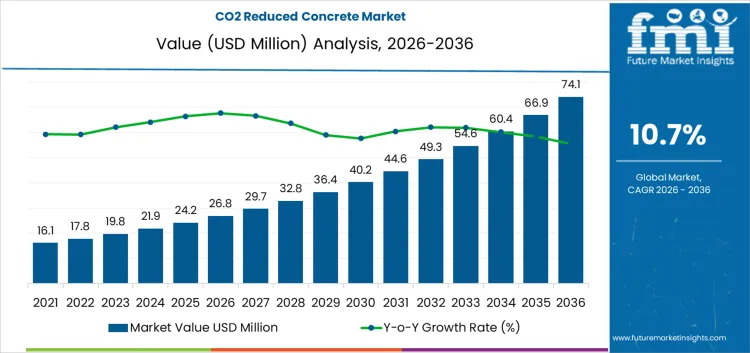
What Is the Growth Forecast for the CO2 Reduced Concrete Market through 2036?
Project specification rules and public procurement standards set the pace for the CO2 reduced concrete market more than general construction volume. In 2026, at about USD 26.8 million, usage is concentrated in infrastructure, commercial buildings, and pilot urban development’s where material selection is guided by embodied carbon targets written into tender documents. Mix designs tend to be approved at the project level and kept unchanged through the full build cycle, which links demand to the pipeline of qualifying projects rather than to day to day site purchasing. Adoption expands as engineering teams gain confidence in performance consistency, curing behavior, and supply reliability. The upward path reflects a growing share of projects specifying lower emission mixes rather than a wholesale shift in all concrete volumes.
Cost structure and supply chain readiness shape the later phase of the CO2 reduced concrete market. As value approaches roughly USD 74.1 million by 2036, attention centers on availability of alternative binders, transport distances, and batching plant adaptation. Producers invest in process control, material segregation, and documentation to meet contract requirements. Buyers focus on compressive strength assurance, placement behavior, and schedule predictability. The move from the high twenties into the seventies comes from steady inclusion in public works and large private developments rather than a single policy event. Concrete suppliers that combine dependable sourcing, consistent mix quality, and clear certification support tend to secure repeat placements in long running construction programs.
CO2-Reduced Concrete Market Key Takeaways
| Metric | Value |
|---|---|
| Market Value (2026) | USD 26.8 million |
| Forecast Value (2036) | USD 74.1 million |
| Forecast CAGR 2026 to 2036 | 10.7% |
How Is the CO2 Reduced Concrete Market Changing Material Selection in Construction Projects?
CO2 reduced concrete refers to mixes that lower embodied carbon through cement substitution, alternative binders, or carbon capture during curing. Earlier project specifications focused on compressive strength, setting time, and unit cost, with limited attention to emissions from cement production. New procurement frameworks add carbon intensity as a measurable parameter alongside structural performance. Contractors and developers evaluate these materials by workability, early strength gain, curing behavior, and compatibility with existing batching plants. Adoption started in public infrastructure and commercial buildings where reporting rules and tender scoring include emissions data. Mix design choices depend on local availability of supplementary materials and on predictable quality across seasons. Engineers still carry responsibility for durability and code compliance, which keeps acceptance tied to testing records and documented performance rather than to claims alone.
Commercial use is shaped by risk management and supply stability more than by marketing goals. Earlier pilots were limited to selected elements, which reduced exposure if schedules or finishes were affected. Current programs move toward defined low carbon mix families that can be used across multiple project types. Cement producers, admixture suppliers, and ready mix operators compete on consistency, documentation, and ability to meet specification ranges at scale. Project owners compare total cost through material price, placement speed, and approval timelines, not through carbon metrics alone. Auditors and inspectors require traceable mix data and curing records. Over time, demand follows building codes, infrastructure funding rules, and client reporting duties, with growth favoring suppliers who can deliver repeatable performance within established construction practices and quality control systems.
What Factors Are Shaping the Demand for CO2-reduced Concrete Market in 2026 by Concrete Type and End Use Construction?
Specification in CO2-reduced Concrete Market is driven by embodied carbon targets, approval pathways, and performance warranties rather than by material substitution alone. Once a project carbon budget and compliance method are defined, concrete selection becomes part of the certified design basis. Mix designs, curing regimes, and testing protocols are then fixed within the quality plan. This links demand to project pipelines, public procurement rules, and developer policies. Segment structure reflects differences in binder systems, aggregate sourcing, and performance envelopes. Buyers prioritize verified performance data, supply reliability, and audit-ready documentation because concrete affects structural liability and construction schedules. Volume development therefore follows permitting frameworks and portfolio-level decarbonization programs rather than short term construction starts.
How Does Concrete Type Selection Influence Design Risk and Production Control in the CO2-reduced Concrete Market?
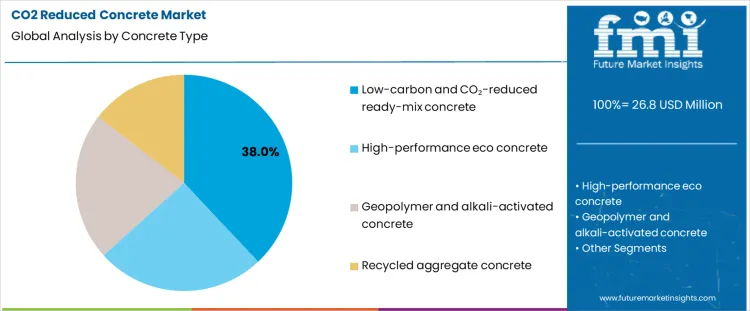
Low carbon and CO2-reduced ready mix concrete represents about 38% of demand in the CO2-reduced Concrete Market because it fits existing batching, transport, and placement practices while lowering binder intensity. This supports adoption without changing site workflows. High performance eco concrete is specified where strength, durability, or exposure classes are demanding, which increases mix design control and testing frequency. Geopolymer and alkali activated concrete serve projects prepared to accept alternative binder systems, which shifts attention to curing control, material sourcing, and standards alignment. Recycled aggregate concrete addresses resource efficiency objectives, though it requires tighter control of grading, contamination, and moisture. Each type establishes distinct production constraints and inspection routines.
From a risk management perspective, concrete type choice determines approval effort and contingency planning. Modified ready mix options rely on established standards and supplier experience, which shortens qualification cycles. High performance and alternative binder systems require extended trials, mock ups, and monitoring of early age behavior. Recycled aggregate mixes introduce variability that must be managed through process control and stock segregation. Once a mix family is approved within a project or program, changes are avoided because strength classes, durability models, and compliance documentation must be revised. Demand by type therefore follows standardization decisions and supplier capability development rather than short term material price movements.
Why Does End Use Construction Define Adoption Pace and Specification Depth in the CO2-reduced Concrete Market?
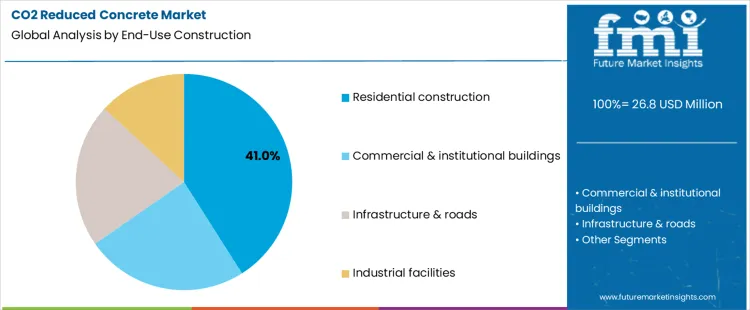
Residential construction accounts for about 41% of demand in the CO2-reduced Concrete Market because housing projects combine high volume repetition with increasing policy pressure to lower embodied emissions. These projects favor solutions that preserve placement speed and supply continuity. Commercial and institutional buildings apply stricter performance and certification requirements, which increases testing, documentation, and third party review. Infrastructure and roads involve large pours, long service lives, and exposure constraints, which limits acceptable mix options and extends approval timelines. Industrial facilities prioritize durability and operational continuity, which leads to conservative adoption and extensive prequalification. These differences explain why volume concentrates in residential programs while technical scrutiny increases in other segments.
End use also shapes procurement structure and contracting practice. Residential developers often adopt portfolio standards and framework agreements to secure consistent supply. Public and institutional projects proceed through formal tendering with prescriptive technical schedules and compliance audits. Infrastructure owners align material choices with long life maintenance strategies and national standards. Industrial owners integrate concrete selection into plant risk management and shutdown planning. The resulting demand pattern concentrates early volume where repetition and policy alignment coincide. Broader penetration depends on code acceptance, specification libraries, and contractor familiarity rather than on short term shifts in construction activity.
How Is The CO2-Reduced Concrete Market Being Defined by Specification Control and Project Risk Management?
The CO2-Reduced Concrete Market is shaped by how project owners, engineers, and contractors manage performance responsibility and approval risk in structural applications. Concrete is a regulated, specification-driven material where mix design changes affect strength classes, curing behavior, and long-term durability assumptions. Buyers focus on compliance with codes, predictable placement behavior, and documented performance rather than on headline claims. Adoption decisions involve structural engineers, quality teams, and project managers. This positions CO2-reduced concrete as a specification and liability decision rather than a simple material substitution, which makes qualification discipline and documentation quality central to supplier selection.
How Is Mix Design Standardization Changing Acceptance in The CO2-Reduced Concrete Market?
Concrete producers increasingly prefer standardized mix families that can be used across multiple projects and customers without repeated approvals. This is changing expectations in the CO2-Reduced Concrete Market toward solutions that fit inside existing mix design frameworks with minimal disruption to batching, transport, and placement practices. Engineers and producers want predictable workability windows, familiar curing profiles, and stable strength development curves. As a result, acceptance favors approaches that integrate into current production routines rather than those requiring frequent jobsite adjustments. Supplier value is judged by how easily new formulations can be absorbed into routine plant operations and quality control workflows.
Where Is Repeat Volume Being Built in The CO2-Reduced Concrete Market?
Repeat volume is being built in large programs where the same concrete specifications are used across many structures or phases of work. Infrastructure corridors, industrial sites, logistics parks, and multi-building developments create opportunities for standardized material use once a mix is approved. The CO2-Reduced Concrete Market benefits when developers and contractors lock in a single specification across long project timelines. There is also opportunity in ready-mix producers offering these formulations as part of their standard portfolio rather than as special orders. This creates recurring demand tied to project pipelines rather than to isolated demonstration projects.
Why Do Approval Cycles and Cost Sensitivity Slow Wider Adoption in The CO2-Reduced Concrete Market?
Concrete sits at the center of structural responsibility, which makes engineers and asset owners cautious about changing formulations. Any modification to cement systems or additives can trigger new testing, approvals, and insurance review. This slows decision-making and favors proven recipes. The CO2-Reduced Concrete Market also faces cost pressure because construction budgets are tightly controlled and material changes must justify both performance and risk. In many projects, conventional mixes remain the default choice to avoid schedule or approval uncertainty. These factors limit rapid substitution and keep adoption concentrated in projects where specification owners are willing to manage change.
What is the Demand for CO2 reduced Concrete by Country?
| Country | CAGR |
|---|---|
| USA | 10.0% |
| UK | 9.5% |
| China | 11.5% |
| India | 12.5% |
| Brazil | 10.2% |
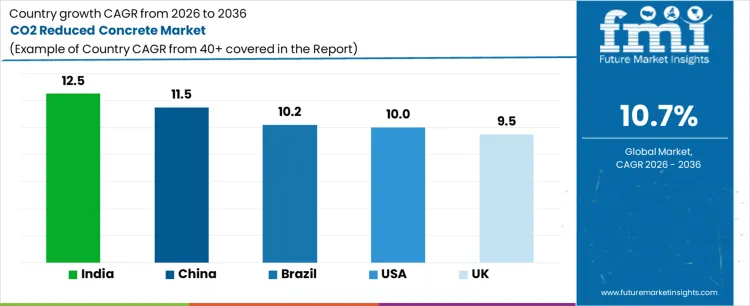
Demand for CO2 reduced concrete is rising as construction companies and infrastructure authorities seek to lower embodied carbon while maintaining structural performance and cost control. India leads with a 12.5% CAGR, supported by large scale infrastructure programs, rising use of blended cements, and policy pressure to reduce emissions in public projects. China follows at 11.5%, driven by massive construction volumes and growing adoption of alternative binders and supplementary cementitious materials. Brazil records 10.2%, reflecting interest from commercial developers and infrastructure upgrades. The USA grows at 10.0%, shaped by green building standards and procurement requirements. The UK, at 9.5%, reflects steady integration of low carbon concrete in regulated construction markets and public sector projects.
How Do Public Procurement Rules and Infrastructure Programs Shape Demand in the United States?
Infrastructure funding priorities keep the CO2 reduced concrete market in the United States on a 10.0% CAGR path. Demand comes from transport agencies, municipal projects, and commercial developers working under emissions reporting rules. Specification teams focus on cement substitution ratios, compressive strength, and curing behavior. Procurement decisions move through project qualification lists rather than spot purchasing. Batch plants invest in mixing controls and quality monitoring systems. Contractors track placement performance and finishing characteristics. Documentation for embodied carbon remains part of bid submissions. Material testing labs verify consistency across pours. Replacement of standard mixes occurs through gradual specification updates. Training programs support correct handling practices. Supply contracts align with project schedules. Commercial position depends on inclusion in approved material schedules and audit acceptance rather than competition for single job deliveries to small construction sites.
Why Do Planning Policy and Certification Systems Guide Adoption in the United Kingdom?
Planning guidance and carbon disclosure frameworks place the CO2 reduced concrete market in the United Kingdom on a 9.5% CAGR trajectory. Public works, commercial buildings, and transport upgrades represent core applications. Designers specify mixes based on lifecycle assessment results and structural requirements. Product acceptance follows certification and plant audit processes. Ready mix suppliers adapt batching operations to manage alternative binders and additives. Contractors review workability and finishing outcomes during site trials. Procurement follows framework agreements covering multiple projects. Testing records remain part of handover documentation. Replacement of conventional mixes occurs through project level specification changes. Training for site crews supports consistent placement quality. Investment in quality control equipment influences supplier standing. Commercial access depends on compliance performance and framework participation rather than price competition for individual concrete deliveries.
What Role Do Urban Construction Scale and Central Standards Play in China?
Large scale construction programs place the CO2 reduced concrete market in China on an 11.5% growth path. Urban infrastructure, public housing, and transport projects account for most volume. Central design institutes define material guidelines used across project groups. Batch plants adjust production to include supplementary cementitious materials. Quality teams monitor strength development and setting behavior. Procurement flows through project packages rather than independent material orders. Documentation for emissions reporting enters project approval files. Replacement of traditional mixes proceeds through directive updates. Logistics planning supports high throughput delivery schedules. Training programs for operators support consistent batching. Payment schedules follow project milestones. Commercial success depends on inclusion in approved construction programs and compliance with central material standards rather than fragmented sales to small private builders operating outside major project systems.
How Do Urbanization Programs and Contractor Led Specifications Shape Demand in India?
Rapid construction growth fixes the CO2 reduced concrete market in India at a 12.5% CAGR. Metro systems, highways, commercial complexes, and industrial parks drive adoption. Engineering consultants specify mixes based on durability targets and carbon reporting needs. Ready mix producers adapt plants to handle blended cements and additives. Procurement decisions follow project tender conditions. Site trials confirm workability under heat exposure. Quality documentation remains part of inspection records. Replacement of conventional grades occurs through specification revisions. Training programs for placement crews affect surface finish outcomes. Inventory planning follows continuous project schedules. Distribution reach influences contractor preference. Investment in testing capability supports supplier acceptance. Commercial results depend on participation in large projects and maintaining compliance records rather than competition for one time supply to small independent construction sites.
How Do Infrastructure Investment and Industrial Construction Shape Spending in Brazil?
Public works and private development keep the CO2 reduced concrete market in Brazil near a 10.2% CAGR. Transport corridors, ports, energy facilities, and commercial buildings represent main applications. Designers review mix designs based on durability and emissions metrics. Batch plants invest in blending equipment and quality monitoring. Procurement often occurs through long term project supply agreements. Site teams evaluate placement behavior and curing time. Documentation for compliance audits remains part of project files. Replacement of standard mixes follows specification updates. Logistics planning supports regional distribution from central plants. Training for crews supports consistent finishing quality. Testing laboratories verify batch performance. Commercial position depends on supplier approval status and ability to meet project requirements rather than competition for isolated small volume concrete deliveries.
How Do Cement Groups Compete for Specification in the CO2 reduced Concrete Market?
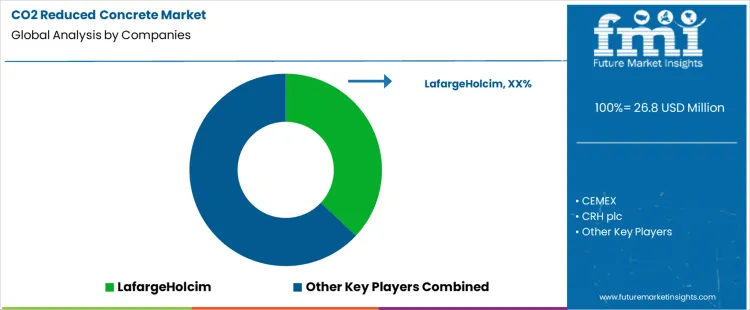
CO2 reduced concrete procurement starts inside project design teams and permitting reviews rather than at material ordering desks. Engineers define strength class, curing profile, durability targets, and approved binder families before supplier names appear. LafargeHolcim, CEMEX, CRH, Heidelberg Materials compete during that specification phase through mix libraries and performance records. Once a mix design enters project documents, substitution requires new test batches and approval cycles. LafargeHolcim relies on portfolio breadth across alternative binders and blended cements. Heidelberg Materials emphasizes controlled clinker reduction routes and plant level consistency. CEMEX supports projects through mix design support and placement guidance. CRH positions products through local production networks and contractor relationships. Project teams treat these materials as structural inputs, not interchangeable commodities. Procurement follows drawings, not price lists.
Competitive position reflects certification files, production footprint, and contractor confidence rather than headline emissions claims. Buyers examine compressive strength curves, early age behavior, shrinkage control, and long term durability during approvals. Batch plant readiness matters where schedules allow limited curing tolerance. LafargeHolcim benefits from wide regional coverage and established performance databases. Heidelberg Materials secures positions where conservative specifications demand repeatable outcomes. CEMEX supports placements through site level technical teams and mix optimization work. CRH relies on proximity to projects and control over aggregates and batching assets. Pricing pressure remains bounded by approval effort and structural risk allocation. Market positions differ by national codes, public procurement rules, and owner willingness to accept alternative binder systems. Decisions follow engineering sign off, not marketing claims or short term cost shifts.
Key Players in the CO2 Reduced Concrete Market
- LafargeHolcim
- CEMEX
- CRH plc
- Heidelberg Materials
Scope of the Report
| Items | Values |
|---|---|
| Quantitative Units (2026) | USD million |
| Concrete Type | Low-carbon and CO2-reduced ready-mix concrete, High-performance eco concrete, Geopolymer and alkali-activated concrete, Recycled aggregate concrete |
| End-Use Construction | Residential construction, Commercial & institutional buildings, Infrastructure & roads, Industrial facilities |
| Region | Asia Pacific, Europe, North America, Latin America, Middle East & Africa |
| Countries Covered | China, Japan, South Korea, India, Australia & New Zealand, ASEAN, Germany, United Kingdom, France, Italy, Spain, Nordic, BENELUX, United States, Canada, Mexico, Brazil, Chile, Saudi Arabia, Turkey, South Africa, and other regional markets |
| Key Companies Profiled | LafargeHolcim, CEMEX, CRH plc, Heidelberg Materials |
| Additional Attributes | Dollar by sales by concrete type and end use; demand driven by project specifications and public procurement rules; adoption shaped by mix approvals, testing, and documentation; purchasing governed by batch consistency, placement behavior, curing control, and supply chain readiness rather than price competition. |
CO2 Reduced Concrete Market Segmentation
Concrete Type:
- Low-carbon and CO₂-reduced ready-mix concrete
- High-performance eco concrete
- Geopolymer and alkali-activated concrete
- Recycled aggregate concrete
End-Use Construction:
- Residential construction
- Commercial & institutional buildings
- Infrastructure & roads
- Industrial facilities
Region:
- Asia Pacific
- China
- Japan
- South Korea
- India
- Australia & New Zealand
- ASEAN
- Rest of Asia Pacific
- Europe
- Germany
- United Kingdom
- France
- Italy
- Spain
- Nordic
- BENELUX
- Rest of Europe
- North America
- United States
- Canada
- Mexico
- Latin America
- Brazil
- Chile
- Rest of Latin America
- Middle East & Africa
- Kingdom of Saudi Arabia
- Other GCC Countries
- Turkey
- South Africa
- Other African Union
- Rest of Middle East & Africa
Bibliography
- International Organization for Standardization. (2023). Greenhouse gases—Carbon footprint of products—Requirements and guidelines for quantification (ISO 14067). ISO.
- European Committee for Standardization. (2023). Concrete—Specification, performance, production and conformity (EN 206). CEN.
- ASTM International. (2023). Standard specification for slag cement for use in concrete and mortars (ASTM C989/C989M). ASTM International.
- ASTM International. (2023). Standard specification for coal fly ash and raw or calcined natural pozzolan for use in concrete (ASTM C618). ASTM International.
- ASTM International. (2023). Standard specification for chemical admixtures for concrete (ASTM C494/C494M). ASTM International.
Frequently Asked Questions
How big is the CO2 reduced concrete market in 2026?
The global CO2 reduced concrete market is estimated to be valued at USD 26.8 million in 2026.
What will be the size of CO2 reduced concrete market in 2036?
The market size for the CO2 reduced concrete market is projected to reach USD 74.1 million by 2036.
How much will be the CO2 reduced concrete market growth between 2026 and 2036?
The CO2 reduced concrete market is expected to grow at a 10.7% CAGR between 2026 and 2036.
What are the key product types in the CO2 reduced concrete market?
The key product types in CO2 reduced concrete market are low‑carbon and co₂‑reduced ready‑mix concrete, high‑performance eco concrete, geopolymer and alkali‑activated concrete and recycled aggregate concrete.
Which end‑use construction segment to contribute significant share in the CO2 reduced concrete market in 2026?
In terms of end‑use construction, residential construction segment to command 41.0% share in the CO2 reduced concrete market in 2026.
Preview the report firsthand - request a free sample
Get SampleGet the brochure for pricing and purchase details.
Get PDFTable of Content
- Executive Summary
- Global Market Outlook
- Demand-side Trends
- Supply-side Trends
- Technology Roadmap Analysis
- Analysis and Recommendations
- Market Overview
- Market Coverage / Taxonomy
- Market Definition / Scope / Limitations
- Market Background
- Market Dynamics
- Drivers
- Restraints
- Opportunity
- Trends
- Scenario Forecast
- Demand in Optimistic Scenario
- Demand in Likely Scenario
- Demand in Conservative Scenario
- Opportunity Map Analysis
- Product Life Cycle Analysis
- Supply Chain Analysis
- Investment Feasibility Matrix
- Value Chain Analysis
- PESTLE and Porter’s Analysis
- Regulatory Landscape
- Regional Parent Market Outlook
- Production and Consumption Statistics
- Import and Export Statistics
- Market Dynamics
- Global Market Analysis 2021 to 2025 and Forecast, 2026 to 2036
- Historical Market Size Value (USD Million) Analysis, 2021 to 2025
- Current and Future Market Size Value (USD Million) Projections, 2026 to 2036
- Y-o-Y Growth Trend Analysis
- Absolute $ Opportunity Analysis
- Global Market Pricing Analysis 2021 to 2025 and Forecast 2026 to 2036
- Global Market Analysis 2021 to 2025 and Forecast 2026 to 2036, By Concrete Type
- Introduction / Key Findings
- Historical Market Size Value (USD Million) Analysis By Concrete Type , 2021 to 2025
- Current and Future Market Size Value (USD Million) Analysis and Forecast By Concrete Type , 2026 to 2036
- Low‑carbon and CO₂‑reduced ready‑mix concrete
- High‑performance eco concrete
- Geopolymer and alkali‑activated concrete
- Recycled aggregate concrete
- Low‑carbon and CO₂‑reduced ready‑mix concrete
- Y-o-Y Growth Trend Analysis By Concrete Type , 2021 to 2025
- Absolute $ Opportunity Analysis By Concrete Type , 2026 to 2036
- Global Market Analysis 2021 to 2025 and Forecast 2026 to 2036, By End‑Use Construction
- Introduction / Key Findings
- Historical Market Size Value (USD Million) Analysis By End‑Use Construction, 2021 to 2025
- Current and Future Market Size Value (USD Million) Analysis and Forecast By End‑Use Construction, 2026 to 2036
- Residential construction
- Commercial & institutional buildings
- Infrastructure & roads
- Industrial facilities
- Residential construction
- Y-o-Y Growth Trend Analysis By End‑Use Construction, 2021 to 2025
- Absolute $ Opportunity Analysis By End‑Use Construction, 2026 to 2036
- Global Market Analysis 2021 to 2025 and Forecast 2026 to 2036, By Region
- Introduction
- Historical Market Size Value (USD Million) Analysis By Region, 2021 to 2025
- Current Market Size Value (USD Million) Analysis and Forecast By Region, 2026 to 2036
- North America
- Latin America
- Western Europe
- Eastern Europe
- East Asia
- South Asia and Pacific
- Middle East & Africa
- Market Attractiveness Analysis By Region
- North America Market Analysis 2021 to 2025 and Forecast 2026 to 2036, By Country
- Historical Market Size Value (USD Million) Trend Analysis By Market Taxonomy, 2021 to 2025
- Market Size Value (USD Million) Forecast By Market Taxonomy, 2026 to 2036
- By Country
- USA
- Canada
- Mexico
- By Concrete Type
- By End‑Use Construction
- By Country
- Market Attractiveness Analysis
- By Country
- By Concrete Type
- By End‑Use Construction
- Key Takeaways
- Latin America Market Analysis 2021 to 2025 and Forecast 2026 to 2036, By Country
- Historical Market Size Value (USD Million) Trend Analysis By Market Taxonomy, 2021 to 2025
- Market Size Value (USD Million) Forecast By Market Taxonomy, 2026 to 2036
- By Country
- Brazil
- Chile
- Rest of Latin America
- By Concrete Type
- By End‑Use Construction
- By Country
- Market Attractiveness Analysis
- By Country
- By Concrete Type
- By End‑Use Construction
- Key Takeaways
- Western Europe Market Analysis 2021 to 2025 and Forecast 2026 to 2036, By Country
- Historical Market Size Value (USD Million) Trend Analysis By Market Taxonomy, 2021 to 2025
- Market Size Value (USD Million) Forecast By Market Taxonomy, 2026 to 2036
- By Country
- Germany
- UK
- Italy
- Spain
- France
- Nordic
- BENELUX
- Rest of Western Europe
- By Concrete Type
- By End‑Use Construction
- By Country
- Market Attractiveness Analysis
- By Country
- By Concrete Type
- By End‑Use Construction
- Key Takeaways
- Eastern Europe Market Analysis 2021 to 2025 and Forecast 2026 to 2036, By Country
- Historical Market Size Value (USD Million) Trend Analysis By Market Taxonomy, 2021 to 2025
- Market Size Value (USD Million) Forecast By Market Taxonomy, 2026 to 2036
- By Country
- Russia
- Poland
- Hungary
- Balkan & Baltic
- Rest of Eastern Europe
- By Concrete Type
- By End‑Use Construction
- By Country
- Market Attractiveness Analysis
- By Country
- By Concrete Type
- By End‑Use Construction
- Key Takeaways
- East Asia Market Analysis 2021 to 2025 and Forecast 2026 to 2036, By Country
- Historical Market Size Value (USD Million) Trend Analysis By Market Taxonomy, 2021 to 2025
- Market Size Value (USD Million) Forecast By Market Taxonomy, 2026 to 2036
- By Country
- China
- Japan
- South Korea
- By Concrete Type
- By End‑Use Construction
- By Country
- Market Attractiveness Analysis
- By Country
- By Concrete Type
- By End‑Use Construction
- Key Takeaways
- South Asia and Pacific Market Analysis 2021 to 2025 and Forecast 2026 to 2036, By Country
- Historical Market Size Value (USD Million) Trend Analysis By Market Taxonomy, 2021 to 2025
- Market Size Value (USD Million) Forecast By Market Taxonomy, 2026 to 2036
- By Country
- India
- ASEAN
- Australia & New Zealand
- Rest of South Asia and Pacific
- By Concrete Type
- By End‑Use Construction
- By Country
- Market Attractiveness Analysis
- By Country
- By Concrete Type
- By End‑Use Construction
- Key Takeaways
- Middle East & Africa Market Analysis 2021 to 2025 and Forecast 2026 to 2036, By Country
- Historical Market Size Value (USD Million) Trend Analysis By Market Taxonomy, 2021 to 2025
- Market Size Value (USD Million) Forecast By Market Taxonomy, 2026 to 2036
- By Country
- Kingdom of Saudi Arabia
- Other GCC Countries
- Turkiye
- South Africa
- Other African Union
- Rest of Middle East & Africa
- By Concrete Type
- By End‑Use Construction
- By Country
- Market Attractiveness Analysis
- By Country
- By Concrete Type
- By End‑Use Construction
- Key Takeaways
- Key Countries Market Analysis
- USA
- Pricing Analysis
- Market Share Analysis, 2025
- By Concrete Type
- By End‑Use Construction
- Canada
- Pricing Analysis
- Market Share Analysis, 2025
- By Concrete Type
- By End‑Use Construction
- Mexico
- Pricing Analysis
- Market Share Analysis, 2025
- By Concrete Type
- By End‑Use Construction
- Brazil
- Pricing Analysis
- Market Share Analysis, 2025
- By Concrete Type
- By End‑Use Construction
- Chile
- Pricing Analysis
- Market Share Analysis, 2025
- By Concrete Type
- By End‑Use Construction
- Germany
- Pricing Analysis
- Market Share Analysis, 2025
- By Concrete Type
- By End‑Use Construction
- UK
- Pricing Analysis
- Market Share Analysis, 2025
- By Concrete Type
- By End‑Use Construction
- Italy
- Pricing Analysis
- Market Share Analysis, 2025
- By Concrete Type
- By End‑Use Construction
- Spain
- Pricing Analysis
- Market Share Analysis, 2025
- By Concrete Type
- By End‑Use Construction
- France
- Pricing Analysis
- Market Share Analysis, 2025
- By Concrete Type
- By End‑Use Construction
- India
- Pricing Analysis
- Market Share Analysis, 2025
- By Concrete Type
- By End‑Use Construction
- ASEAN
- Pricing Analysis
- Market Share Analysis, 2025
- By Concrete Type
- By End‑Use Construction
- Australia & New Zealand
- Pricing Analysis
- Market Share Analysis, 2025
- By Concrete Type
- By End‑Use Construction
- China
- Pricing Analysis
- Market Share Analysis, 2025
- By Concrete Type
- By End‑Use Construction
- Japan
- Pricing Analysis
- Market Share Analysis, 2025
- By Concrete Type
- By End‑Use Construction
- South Korea
- Pricing Analysis
- Market Share Analysis, 2025
- By Concrete Type
- By End‑Use Construction
- Russia
- Pricing Analysis
- Market Share Analysis, 2025
- By Concrete Type
- By End‑Use Construction
- Poland
- Pricing Analysis
- Market Share Analysis, 2025
- By Concrete Type
- By End‑Use Construction
- Hungary
- Pricing Analysis
- Market Share Analysis, 2025
- By Concrete Type
- By End‑Use Construction
- Kingdom of Saudi Arabia
- Pricing Analysis
- Market Share Analysis, 2025
- By Concrete Type
- By End‑Use Construction
- Turkiye
- Pricing Analysis
- Market Share Analysis, 2025
- By Concrete Type
- By End‑Use Construction
- South Africa
- Pricing Analysis
- Market Share Analysis, 2025
- By Concrete Type
- By End‑Use Construction
- USA
- Market Structure Analysis
- Competition Dashboard
- Competition Benchmarking
- Market Share Analysis of Top Players
- By Regional
- By Concrete Type
- By End‑Use Construction
- Competition Analysis
- Competition Deep Dive
- LafargeHolcim
- Overview
- Product Portfolio
- Profitability by Market Segments (Product/Age /Sales Channel/Region)
- Sales Footprint
- Strategy Overview
- Marketing Strategy
- Product Strategy
- Channel Strategy
- CEMEX
- CRH plc
- Heidelberg Materials
- LafargeHolcim
- Competition Deep Dive
- Assumptions & Acronyms Used
- Research Methodology


