

- Industry Size (2026)
- USD 1.0 Bn
- Forecast (2036)
- USD 1.7 Bn
- CAGR (2026 to 2036)
- 5.6%
Concrete Pore-Blocking Agents Market Forecast and Outlook 2026 to 2036
The concrete pore-blocking agents market is valued at USD 1 billion in 2026 and is expected to grow to USD 1.7 billion by 2036, reflecting a CAGR of 5.6%. Crystalline cementitious agents dominate the chemistry segment, primarily applied in basements and foundations through liquid penetrants. Silicate densifiers and silane/siloxane penetrants are widely used for bridges, parking structures, and infrastructure projects, delivered via slurries or admixture integration. End users include waterproofing contractors, infrastructure owners, industrial facility operators, and residential DIY segments, driven by increasing demand for enhanced durability, reduced water ingress, and long-term structural performance.
Over the next decade, polymeric sealers and spray-applied coatings gain traction in industrial floors and commercial construction, supporting consistent market expansion. Adoption is particularly strong in regions with aggressive weathering, urban development, and stringent building codes. Companies emphasizing multi-chemistry solutions, combining crystalline and silane-based technologies, are poised to capture higher shares. Market growth is further fueled by renovation projects, preventive waterproofing for aging infrastructure, and performance-oriented residential construction, ensuring steady revenue accumulation and penetration across diverse application sectors.
Quick Stats of the Concrete Pore-Blocking Agents Market:
- Concrete Pore-Blocking Agents Market Value (2026): USD 1.0 billion
- Concrete Pore-Blocking Agents Market Forecast Value (2036): USD 1.7 billion
- Concrete Pore-Blocking Agents Market Forecast CAGR (2026 to 2036): 5.6%
- Leading Chemistry in the Market: Crystalline Cementitious (36%)
- Key Growth Regions in the Market: China, Brazil, USA, Germany, UK
- Top Players in the Market: Xypex, Kryton, Penetron, Sika, Master Builders Solutions, Mapei, Saint-Gobain (Chryso/GCP), Fosroc, RPM (Tremco/Euclid), BASF (Specialty)
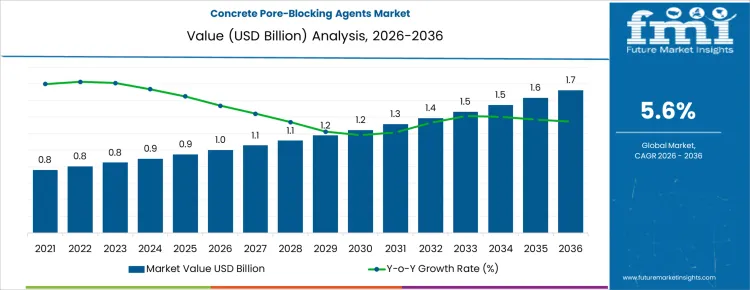
What is the Growth Forecast for the Concrete Pore-Blocking Agents Market through 2036?
From 2026 to 2031, the concrete pore-blocking agents market grows from USD 1.0 billion to approximately USD 1.3 billion, with annual value additions increasing from USD 0.1 billion in 2026 to USD 0.13 billion in 2031. Early adoption is concentrated in high-performance building projects, bridge decks, and industrial floors, which together account for nearly 65% of total demand. Growth is driven by the need for reduced water permeability, enhanced durability, and compliance with infrastructure longevity standards. Regionally, North America and Europe lead adoption at roughly 55% of market value, while Asia Pacific scales pilot projects in urban infrastructure and precast concrete production.
Between 2031 and 2036, the market expands from around USD 1.3 billion to USD 1.7 billion, reflecting accelerated uptake in mass construction, commercial retrofitting, and large-scale precast concrete applications. Annual value additions grow steadily from USD 0.13 billion to USD 0.17 billion, supported by broader regulatory acceptance and rising adoption in high-humidity and coastal construction zones. Later-stage growth is concentrated in industrial floors, bridge rehabilitation, and high-rise residential projects, with repeat procurement and higher per-project usage reinforcing structural demand. Early growth relied on selective high-value deployments, while later expansion reflects broader portfolio integration and global market penetration.
Concrete Pore Blocking Agents Market Key Takeaways
| Metric | Value |
|---|---|
| Market Value (2026) | USD 1.0 billion |
| Forecast Value (2036) | USD 1.7 billion |
| Forecast CAGR (2026 to 2036) | 5.6% |
What Is Driving the Demand for the Concrete Pore-Blocking Agents Market?
Demand for concrete pore-blocking agents developed from performance limitations in traditional concrete mixtures exposed to aggressive environments. Conventional concrete commonly allows water and dissolved ions to enter through capillary pores, accelerating steel reinforcement corrosion and reducing structural durability. Early use of pore-blocking additives responded to specific deterioration issues in marine structures, bridge decks, and underground facilities where moisture ingress compromised service life. Material scientists and contractors introduced silane, siloxane, and fine particle agents to reduce the connectivity of pore networks, slow fluid penetration, and improve resistance to freeze-thaw cycles.
Future demand for concrete pore-blocking agents is expected to be driven by regulatory performance criteria, lifecycle durability expectations, and shifts in design standards that emphasise long term infrastructure resilience. Building codes and infrastructure guidelines increasingly define permeability and durability thresholds for concrete exposed to defined environmental conditions. Asset owners and engineers are specifying pore-blocking agents as part of mix designs to meet predictable service life goals and reduce maintenance costs. Advances in admixture chemistry are improving compatibility with low carbon and supplementary cementitious material rich concretes, aligning durability needs with sustainability goals.
What Factors Are Affecting the Demand for Concrete Pore-Blocking Agents Market in Terms of Chemistry and Application?
Demand for concrete pore blocking agents is segmented by chemistry and application across structural protection and durability enhancement uses. Crystalline cementitious systems account for about 36% of total demand, making them the leading chemistry segment. Silicate densifiers, silane and siloxane penetrants, and polymeric sealers represent additional chemistries without disclosed share splits. These materials differ in penetration depth, reaction mechanism, and long term permeability reduction. Application segmentation reflects exposure conditions and service life requirements. Basements and foundations account for about 28% of demand, followed by bridges and infrastructure, parking structures, and industrial floors. Together, these segments explain demand formation shaped by moisture ingress risk, structural protection needs, and maintenance cycles rather than concrete volume alone.
What Drives Demand by Chemistry in the Concrete Pore-Blocking Agents Market?
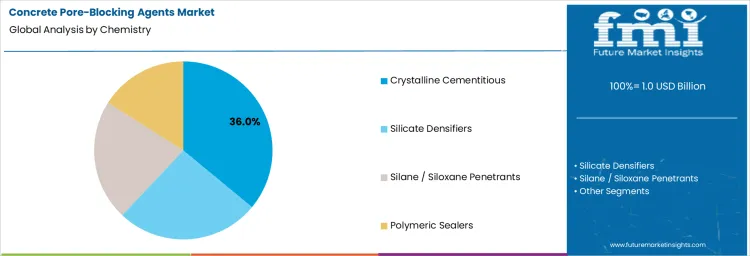
Crystalline cementitious agents lead demand with a 36% share due to their ability to react with free lime and form insoluble crystals within capillary pores. This mechanism provides long term resistance to water penetration without surface film formation. Silicate densifiers are used to reduce surface porosity and improve abrasion resistance. Silane and siloxane penetrants are applied where hydrophobic protection is required without altering vapor permeability. Polymeric sealers provide surface level barrier protection in controlled environments. Chemistry selection reflects durability expectations and substrate condition rather than application speed. Demand therefore aligns with proven performance in moisture control and lifecycle protection rather than short term cost considerations.
Chemistry driven demand remains stable because pore blocking systems are specified during design or rehabilitation planning. Crystalline systems are embedded into foundation and below grade protection strategies. Densifiers and penetrants are selected based on surface exposure. Polymeric sealers are applied where maintenance access is regular. These patterns limit rapid substitution. Chemistry segmentation highlights reliance on established moisture mitigation technologies. Demand therefore follows engineering specifications and durability standards rather than episodic construction trends.
How Does Application Shape Demand for Concrete Pore-Blocking Agents Market?
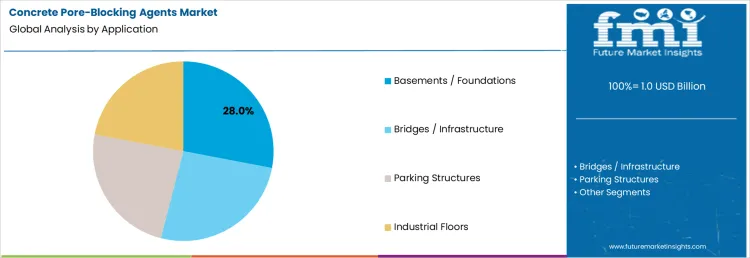
Basements and foundations account for about 28% of total demand, making them the leading application segment. These structures face continuous hydrostatic pressure and moisture exposure. Bridges and infrastructure adopt pore blocking agents to limit chloride ingress and freeze thaw damage. Parking structures require protection against water and deicing chemicals. Industrial floors apply pore blocking systems to manage moisture vapor transmission and surface wear. Application driven demand reflects exposure severity and service life requirements rather than structure size alone.
Basement and foundation applications maintain leadership due to below grade exposure conditions. Infrastructure applications adopt based on maintenance planning. Parking structures apply systems during refurbishment cycles. Industrial floors select agents based on operational demands. Specifiers avoid altering systems once performance is validated. This stabilizes demand distribution. Application segmentation therefore reinforces concentration in moisture critical structural components.
How Are Concrete Pore-Blocking Agents Being Applied Across Construction and Infrastructure Projects?
Use appears in concrete formulations where enhanced durability and water tightness are required. Bridge decks, tunnels, and foundations incorporate pore-blocking agents to reduce capillary porosity and limit water ingress, thereby enhancing freeze-thaw and corrosion resistance. Precast concrete manufacturers use them in panels and structural elements to improve long-term performance and dimensional stability. Residential and commercial flooring projects adopt treated mixes to minimize efflorescence and surface permeability. These applications reflect operational and structural priorities rather than aesthetic considerations, with adoption driven by durability, maintenance reduction, and long-term performance.
What Operational and Material Conditions Support Adoption of Concrete Pore-Blocking Agents?
Selection aligns with mixes requiring controlled workability, setting time, and strength development. Concrete technologists optimize dosage to ensure uniform dispersion and effective pore sealing without affecting hydration or rheology. Contractors value additives compatible with different cement types, supplementary cementitious materials, and aggregate blends. Infrastructure project managers specify pore-blocked concrete to meet performance standards for water ingress, chemical resistance, and freeze-thaw cycles. These conditions arise from operational reliability, durability requirements, and long-term performance objectives in structured construction workflows.
Which Practical Considerations Limit Wider Use of Concrete Pore-Blocking Agents?
Cost per cubic meter may be higher than conventional concrete mixes, affecting adoption in budget-sensitive projects. Effectiveness can vary with cement chemistry, mix design, and curing conditions. Compatibility with other admixtures must be validated to avoid unintended interactions. Quality control during batching and mixing is essential to ensure uniform performance. Regulatory acceptance and performance certification may differ by region. These factors result in selective deployment where enhanced durability, water resistance, and maintenance reduction justify additional material cost and process control.
What is the Demand for Concrete Pore-Blocking Agents by Country?
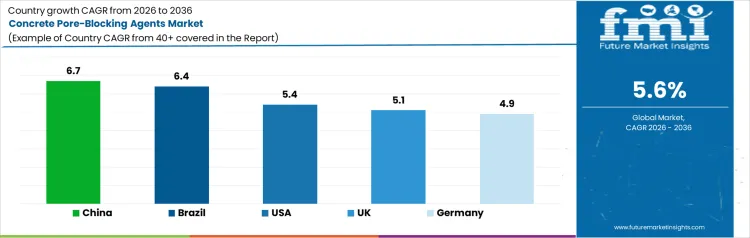
| Country | CAGR (%) |
|---|---|
| USA | 5.4% |
| Germany | 4.9% |
| China | 6.7% |
| UK | 5.1% |
| Brazil | 6.4% |
The demand for concrete pore blocking agents varies across countries, driven by construction quality requirements, durability standards, and adoption of advanced concrete additives. China leads with a 6.7% CAGR, supported by large scale infrastructure development, urban construction projects, and adoption of pore blocking agents to improve concrete longevity. Brazil follows at 6.4%, driven by infrastructure growth and modernization of urban housing. The USA grows at 5.4%, reflecting steady adoption in commercial and residential construction. Germany records 4.9%, shaped by regulated construction standards and mature markets. The UK posts 5.1%, supported by quality improvement initiatives in concrete applications and maintenance of long lasting structures.
How Is Pore-Blocking Technology Driving Growth in the United States?
In the United States, revenue from the Concrete Pore-Blocking Agents Market is expanding at a CAGR of 5.4% through 2036, driven by adoption of chemical additives to reduce porosity, improve durability, and enhance water resistance in concrete structures. Manufacturers are integrating pore-blocking agents in ready-mix concrete, precast elements, and infrastructure projects. Demand is concentrated in commercial construction, civil engineering, and industrial facilities. Domestic suppliers provide high-performance additives compatible with cementitious systems and standard mixing processes. Regulatory compliance, durability requirements, and recurring construction activities are sustaining predictable procurement nationwide.
- Commercial, civil engineering, and industrial projects adopt pore-blocking agents
- Additives reduce porosity, enhance water resistance, and improve durability
- Domestic suppliers provide high-performance, cement-compatible additives
- Recurring construction projects sustain predictable procurement
How Are Durability Standards Supporting Growth in Germany?
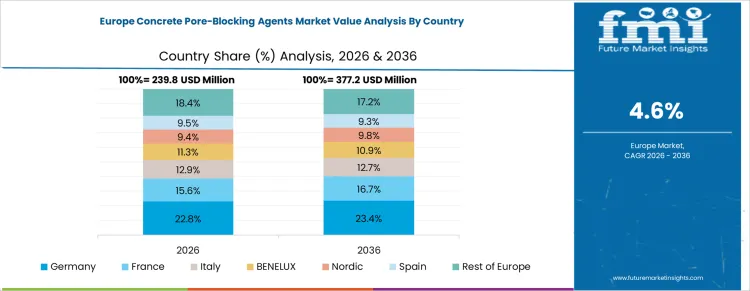
Germany continues to record steady growth in the Concrete Pore-Blocking Agents Market at a CAGR of 4.9% through 2036, supported by strict construction and durability regulations. Manufacturers are integrating pore-blocking agents into concrete for roads, bridges, and commercial buildings to reduce water ingress and improve lifespan. Demand is concentrated in infrastructure, industrial, and commercial construction projects. Domestic suppliers provide additives engineered for consistent performance, cement compatibility, and improved mechanical properties. Compliance-driven procurement and stable construction volumes are sustaining measured adoption nationwide.
- Infrastructure, industrial, and commercial construction projects anchor demand
- Additives improve water resistance and reduce concrete porosity
- Domestic suppliers provide cement-compatible, high-performance additives
- Compliance and stable construction volumes sustain steady adoption
How Is Infrastructure Expansion Accelerating Adoption in China?
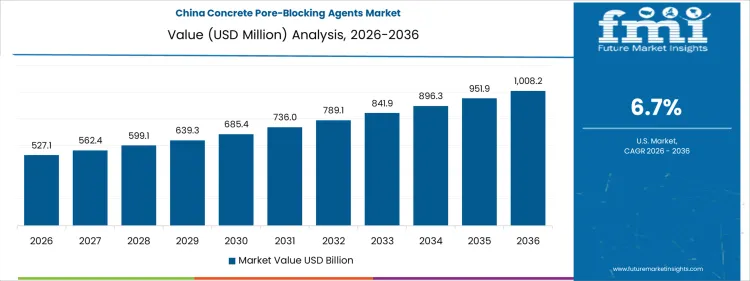
In China, revenue from the Concrete Pore-Blocking Agents Market is growing at a CAGR of 6.7% through 2036, driven by rapid infrastructure and commercial construction expansion. Manufacturers are adopting pore-blocking agents to improve durability, reduce porosity, and enhance water resistance in bridges, roads, and high-rise buildings. Demand is strong across civil engineering, industrial facilities, and urban development projects. Domestic suppliers are scaling production of high-efficiency pore-blocking agents compatible with cementitious systems. High construction volumes and structured procurement practices are sustaining rapid adoption nationwide.
- Bridges, roads, and high-rise buildings drive pore-blocking agent adoption
- Additives improve durability, reduce porosity, and enhance water resistance
- Domestic suppliers scale high-efficiency, cement-compatible additives
- High construction volumes sustain consistent adoption
How Is Building Maintenance and Construction Supporting Growth in the United Kingdom?
In the United Kingdom, revenue from the Concrete Pore-Blocking Agents Market is expanding at a CAGR of 5.1% through 2036, supported by demand for durable concrete in construction and infrastructure maintenance. Manufacturers are integrating pore-blocking agents in repair mortars, precast elements, and commercial concrete applications. Demand is concentrated in civil engineering, industrial projects, and urban construction. Domestic suppliers provide additives designed for cement compatibility, performance consistency, and enhanced durability. Recurring maintenance, regulatory compliance, and project volume stability are sustaining predictable procurement nationwide.
- Repair mortars, precast elements, and commercial concrete anchor demand
- Additives improve durability, reduce water ingress, and limit porosity
- Domestic suppliers provide cement-compatible, high-performance additives
- Recurring maintenance and construction projects sustain predictable procurement
How Is Civil and Industrial Construction Supporting Adoption in Brazil?
Brazil is seeing strong growth in the Concrete Pore-Blocking Agents Market at a CAGR of 6.4% through 2036, supported by rising infrastructure, commercial, and industrial construction. Manufacturers are adopting pore-blocking agents to enhance concrete durability, reduce water penetration, and improve lifespan in bridges, roads, and buildings. Demand is concentrated in civil engineering, industrial facilities, and urban construction projects. Domestic suppliers are expanding production of high-performance additives compatible with cement-based concrete. Growth in construction and recurring maintenance projects is sustaining robust procurement nationwide.
- Bridges, roads, and building projects drive pore-blocking agent adoption
- Additives reduce water ingress, enhance durability, and improve lifespan
- Domestic suppliers expand high-performance, cement-compatible additives
- Recurring construction and maintenance sustain robust procurement
Which Companies Are Shaping Competition in The Concrete Pore-Blocking Agents Market Through Waterproofing and Durability Performance?
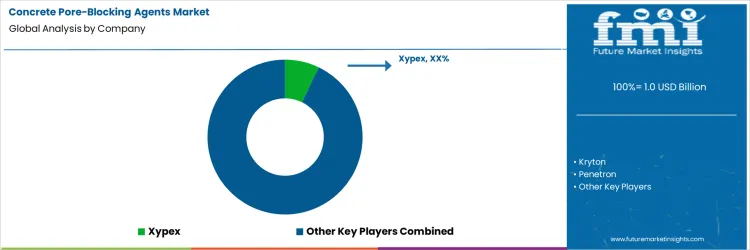
Performance expectations in the Concrete Pore Blocking Agents Market are defined by long term resistance to water ingress, chemical exposure, and microcracking rather than early age strength gains. Crystalline waterproofing specialists such as Xypex, Kryton, and Penetron occupy a distinct position, as their products react within the concrete matrix to block capillaries over time. These systems are specified frequently in basements, tunnels, water containment, and marine structures where external membranes are impractical. Selection is driven by proven durability in service conditions, compatibility with mix designs, and acceptance within engineering specifications. Product choice often reflects historical performance on similar projects, reinforcing conservative procurement behavior among contractors and asset owners.
Broader construction chemical suppliers influence competition by embedding pore blocking functionality within multi performance admixture and repair portfolios. Sika, Master Builders Solutions, Mapei, Saint Gobain through Chryso and GCP, and Fosroc integrate permeability reduction into waterproofing, repair, and durability systems specified at the design stage. RPM, via Tremco and Euclid, supports this segment through project driven waterproofing solutions aligned with infrastructure maintenance. BASF Specialty participates through admixture chemistry and durability focused additives rather than standalone crystalline systems. Local contractors and specifiers shape outcomes by favoring suppliers offering technical support and on site validation. Competitive positioning depends on specification coverage, field reliability, and alignment with lifecycle durability requirements rather than formulation novelty.
Key Players in the Concrete Pore Blocking Agents Market
- Xypex
- Kryton
- Penetron
- Sika
- Master Builders Solutions
- Mapei
- Saint-Gobain (Chryso/GCP)
- Fosroc
- RPM (Tremco/Euclid)
- BASF (Specialty)
Scope of the Report
| Items | Values |
|---|---|
| Quantitative Units (2026) | USD billion |
| Type | Crystalline Cementitious, Silicate Densifiers, Silane / Siloxane Penetrants, Polymeric Sealers |
| Application | Basements / Foundations, Bridges / Infrastructure, Parking Structures, Industrial Floors |
| Delivery / Form | Liquid Penetrants, Cementitious Slurries, Admixture-Integrated, Spray-Applied Coatings |
| End User | Waterproofing Contractors, Infrastructure Owners, Industrial Facilities, Residential / DIY |
| Region | Asia Pacific, Europe, North America, Latin America, Middle East & Africa |
| Countries Covered | United States, Canada, Mexico, Germany, United Kingdom, France, Italy, Spain, Nordic, BENELUX, China, Japan, South Korea, India, Australia & New Zealand, ASEAN, Brazil, Chile, Kingdom of Saudi Arabia, Turkey, South Africa |
| Key Companies Profiled | Xypex, Kryton, Penetron, Sika, Master Builders Solutions, Mapei, Saint-Gobain (Chryso/GCP), Fosroc, RPM (Tremco/Euclid), BASF Specialty |
| Additional Attributes | Dollar by sales by chemistry, application, delivery form, and end user; Dollar by sales by region and country; regional CAGR analysis; value growth trends; historical versus future growth drivers; procurement and specification trends; regulatory and durability performance considerations |
Concrete Pore Blocking Agents Market Segmentation
By Chemistry:
- Crystalline Cementitious
- Silicate Densifiers
- Silane / Siloxane Penetrants
- Polymeric Sealers
By Application:
- Basements / Foundations
- Bridges / Infrastructure
- Parking Structures
- Industrial Floors
By Delivery / Form:
- Liquid Penetrants
- Cementitious Slurries
- Admixture-Integrated
- Spray-Applied Coatings
By End User:
- Waterproofing Contractors
- Infrastructure Owners
- Industrial Facilities
- Residential / DIY
By Region:
- Asia Pacific
- China
- Japan
- South Korea
- India
- Australia & New Zealand
- ASEAN
- Rest of Asia Pacific
- Europe
- Germany
- United Kingdom
- France
- Italy
- Spain
- Nordic
- BENELUX
- Rest of Europe
- North America
- United States
- Canada
- Mexico
- Latin America
- Brazil
- Chile
- Rest of Latin America
- Middle East & Africa
- Kingdom of Saudi Arabia
- Other GCC Countries
- Turkey
- South Africa
- Other African Union
- Rest of Middle East & Africa
Frequently Asked Questions
How big is the concrete pore-blocking agents market in 2026?
The global concrete pore-blocking agents market is estimated to be valued at USD 1.0 billion in 2026.
What will be the size of concrete pore-blocking agents market in 2036?
The market size for the concrete pore-blocking agents market is projected to reach USD 1.7 billion by 2036.
How much will be the concrete pore-blocking agents market growth between 2026 and 2036?
The concrete pore-blocking agents market is expected to grow at a 5.6% CAGR between 2026 and 2036.
What are the key chemistry types in the concrete pore-blocking agents market?
The key chemistry types in concrete pore-blocking agents market are crystalline cementitious, silicate densifiers, silane / siloxane penetrants and polymeric sealers.
Which application segment to contribute significant share in the concrete pore-blocking agents market in 2026?
In terms of application, basements / foundations segment to command 28.0% share in the concrete pore-blocking agents market in 2026.
Preview the report firsthand - request a free sample
Get SampleGet the brochure for pricing and purchase details.
Get PDFTable of Content
- Executive Summary
- Global Market Outlook
- Demand-side Trends
- Supply-side Trends
- Technology Roadmap Analysis
- Analysis and Recommendations
- Market Overview
- Market Coverage / Taxonomy
- Market Definition / Scope / Limitations
- Market Background
- Market Dynamics
- Drivers
- Restraints
- Opportunity
- Trends
- Scenario Forecast
- Demand in Optimistic Scenario
- Demand in Likely Scenario
- Demand in Conservative Scenario
- Opportunity Map Analysis
- Product Life Cycle Analysis
- Supply Chain Analysis
- Investment Feasibility Matrix
- Value Chain Analysis
- PESTLE and Porter’s Analysis
- Regulatory Landscape
- Regional Parent Market Outlook
- Production and Consumption Statistics
- Import and Export Statistics
- Market Dynamics
- Global Market Analysis 2021 to 2025 and Forecast, 2026 to 2036
- Historical Market Size Value (USD Million) Analysis, 2021 to 2025
- Current and Future Market Size Value (USD Million) Projections, 2026 to 2036
- Y-o-Y Growth Trend Analysis
- Absolute $ Opportunity Analysis
- Global Market Pricing Analysis 2021 to 2025 and Forecast 2026 to 2036
- Global Market Analysis 2021 to 2025 and Forecast 2026 to 2036, By Chemistry
- Introduction / Key Findings
- Historical Market Size Value (USD Million) Analysis By Chemistry , 2021 to 2025
- Current and Future Market Size Value (USD Million) Analysis and Forecast By Chemistry , 2026 to 2036
- Crystalline Cementitious
- Silicate Densifiers
- Silane / Siloxane Penetrants
- Polymeric Sealers
- Y-o-Y Growth Trend Analysis By Chemistry , 2021 to 2025
- Absolute $ Opportunity Analysis By Chemistry , 2026 to 2036
- Global Market Analysis 2021 to 2025 and Forecast 2026 to 2036, By Application
- Introduction / Key Findings
- Historical Market Size Value (USD Million) Analysis By Application, 2021 to 2025
- Current and Future Market Size Value (USD Million) Analysis and Forecast By Application, 2026 to 2036
- Basements / Foundations
- Bridges / Infrastructure
- Parking Structures
- Industrial Floors
- Y-o-Y Growth Trend Analysis By Application, 2021 to 2025
- Absolute $ Opportunity Analysis By Application, 2026 to 2036
- Global Market Analysis 2021 to 2025 and Forecast 2026 to 2036, By Delivery or Form
- Introduction / Key Findings
- Historical Market Size Value (USD Million) Analysis By Delivery or Form, 2021 to 2025
- Current and Future Market Size Value (USD Million) Analysis and Forecast By Delivery or Form, 2026 to 2036
- Liquid Penetrants
- Cementitious Slurries
- Admixture-Integrated
- Spray-Applied Coatings
- Y-o-Y Growth Trend Analysis By Delivery or Form, 2021 to 2025
- Absolute $ Opportunity Analysis By Delivery or Form, 2026 to 2036
- Global Market Analysis 2021 to 2025 and Forecast 2026 to 2036, By End User
- Introduction / Key Findings
- Historical Market Size Value (USD Million) Analysis By End User, 2021 to 2025
- Current and Future Market Size Value (USD Million) Analysis and Forecast By End User, 2026 to 2036
- Waterproofing Contractors
- Infrastructure Owners
- Industrial Facilities
- Residential / DIY
- Y-o-Y Growth Trend Analysis By End User, 2021 to 2025
- Absolute $ Opportunity Analysis By End User, 2026 to 2036
- Global Market Analysis 2021 to 2025 and Forecast 2026 to 2036, By Region
- Introduction
- Historical Market Size Value (USD Million) Analysis By Region, 2021 to 2025
- Current Market Size Value (USD Million) Analysis and Forecast By Region, 2026 to 2036
- North America
- Latin America
- Western Europe
- Eastern Europe
- East Asia
- South Asia and Pacific
- Middle East & Africa
- Market Attractiveness Analysis By Region
- North America Market Analysis 2021 to 2025 and Forecast 2026 to 2036, By Country
- Historical Market Size Value (USD Million) Trend Analysis By Market Taxonomy, 2021 to 2025
- Market Size Value (USD Million) Forecast By Market Taxonomy, 2026 to 2036
- By Country
- USA
- Canada
- Mexico
- By Chemistry
- By Application
- By Delivery or Form
- By End User
- By Country
- Market Attractiveness Analysis
- By Country
- By Chemistry
- By Application
- By Delivery or Form
- By End User
- Key Takeaways
- Latin America Market Analysis 2021 to 2025 and Forecast 2026 to 2036, By Country
- Historical Market Size Value (USD Million) Trend Analysis By Market Taxonomy, 2021 to 2025
- Market Size Value (USD Million) Forecast By Market Taxonomy, 2026 to 2036
- By Country
- Brazil
- Chile
- Rest of Latin America
- By Chemistry
- By Application
- By Delivery or Form
- By End User
- By Country
- Market Attractiveness Analysis
- By Country
- By Chemistry
- By Application
- By Delivery or Form
- By End User
- Key Takeaways
- Western Europe Market Analysis 2021 to 2025 and Forecast 2026 to 2036, By Country
- Historical Market Size Value (USD Million) Trend Analysis By Market Taxonomy, 2021 to 2025
- Market Size Value (USD Million) Forecast By Market Taxonomy, 2026 to 2036
- By Country
- Germany
- UK
- Italy
- Spain
- France
- Nordic
- BENELUX
- Rest of Western Europe
- By Chemistry
- By Application
- By Delivery or Form
- By End User
- By Country
- Market Attractiveness Analysis
- By Country
- By Chemistry
- By Application
- By Delivery or Form
- By End User
- Key Takeaways
- Eastern Europe Market Analysis 2021 to 2025 and Forecast 2026 to 2036, By Country
- Historical Market Size Value (USD Million) Trend Analysis By Market Taxonomy, 2021 to 2025
- Market Size Value (USD Million) Forecast By Market Taxonomy, 2026 to 2036
- By Country
- Russia
- Poland
- Hungary
- Balkan & Baltic
- Rest of Eastern Europe
- By Chemistry
- By Application
- By Delivery or Form
- By End User
- By Country
- Market Attractiveness Analysis
- By Country
- By Chemistry
- By Application
- By Delivery or Form
- By End User
- Key Takeaways
- East Asia Market Analysis 2021 to 2025 and Forecast 2026 to 2036, By Country
- Historical Market Size Value (USD Million) Trend Analysis By Market Taxonomy, 2021 to 2025
- Market Size Value (USD Million) Forecast By Market Taxonomy, 2026 to 2036
- By Country
- China
- Japan
- South Korea
- By Chemistry
- By Application
- By Delivery or Form
- By End User
- By Country
- Market Attractiveness Analysis
- By Country
- By Chemistry
- By Application
- By Delivery or Form
- By End User
- Key Takeaways
- South Asia and Pacific Market Analysis 2021 to 2025 and Forecast 2026 to 2036, By Country
- Historical Market Size Value (USD Million) Trend Analysis By Market Taxonomy, 2021 to 2025
- Market Size Value (USD Million) Forecast By Market Taxonomy, 2026 to 2036
- By Country
- India
- ASEAN
- Australia & New Zealand
- Rest of South Asia and Pacific
- By Chemistry
- By Application
- By Delivery or Form
- By End User
- By Country
- Market Attractiveness Analysis
- By Country
- By Chemistry
- By Application
- By Delivery or Form
- By End User
- Key Takeaways
- Middle East & Africa Market Analysis 2021 to 2025 and Forecast 2026 to 2036, By Country
- Historical Market Size Value (USD Million) Trend Analysis By Market Taxonomy, 2021 to 2025
- Market Size Value (USD Million) Forecast By Market Taxonomy, 2026 to 2036
- By Country
- Kingdom of Saudi Arabia
- Other GCC Countries
- Turkiye
- South Africa
- Other African Union
- Rest of Middle East & Africa
- By Chemistry
- By Application
- By Delivery or Form
- By End User
- By Country
- Market Attractiveness Analysis
- By Country
- By Chemistry
- By Application
- By Delivery or Form
- By End User
- Key Takeaways
- Key Countries Market Analysis
- USA
- Pricing Analysis
- Market Share Analysis, 2025
- By Chemistry
- By Application
- By Delivery or Form
- By End User
- Canada
- Pricing Analysis
- Market Share Analysis, 2025
- By Chemistry
- By Application
- By Delivery or Form
- By End User
- Mexico
- Pricing Analysis
- Market Share Analysis, 2025
- By Chemistry
- By Application
- By Delivery or Form
- By End User
- Brazil
- Pricing Analysis
- Market Share Analysis, 2025
- By Chemistry
- By Application
- By Delivery or Form
- By End User
- Chile
- Pricing Analysis
- Market Share Analysis, 2025
- By Chemistry
- By Application
- By Delivery or Form
- By End User
- Germany
- Pricing Analysis
- Market Share Analysis, 2025
- By Chemistry
- By Application
- By Delivery or Form
- By End User
- UK
- Pricing Analysis
- Market Share Analysis, 2025
- By Chemistry
- By Application
- By Delivery or Form
- By End User
- Italy
- Pricing Analysis
- Market Share Analysis, 2025
- By Chemistry
- By Application
- By Delivery or Form
- By End User
- Spain
- Pricing Analysis
- Market Share Analysis, 2025
- By Chemistry
- By Application
- By Delivery or Form
- By End User
- France
- Pricing Analysis
- Market Share Analysis, 2025
- By Chemistry
- By Application
- By Delivery or Form
- By End User
- India
- Pricing Analysis
- Market Share Analysis, 2025
- By Chemistry
- By Application
- By Delivery or Form
- By End User
- ASEAN
- Pricing Analysis
- Market Share Analysis, 2025
- By Chemistry
- By Application
- By Delivery or Form
- By End User
- Australia & New Zealand
- Pricing Analysis
- Market Share Analysis, 2025
- By Chemistry
- By Application
- By Delivery or Form
- By End User
- China
- Pricing Analysis
- Market Share Analysis, 2025
- By Chemistry
- By Application
- By Delivery or Form
- By End User
- Japan
- Pricing Analysis
- Market Share Analysis, 2025
- By Chemistry
- By Application
- By Delivery or Form
- By End User
- South Korea
- Pricing Analysis
- Market Share Analysis, 2025
- By Chemistry
- By Application
- By Delivery or Form
- By End User
- Russia
- Pricing Analysis
- Market Share Analysis, 2025
- By Chemistry
- By Application
- By Delivery or Form
- By End User
- Poland
- Pricing Analysis
- Market Share Analysis, 2025
- By Chemistry
- By Application
- By Delivery or Form
- By End User
- Hungary
- Pricing Analysis
- Market Share Analysis, 2025
- By Chemistry
- By Application
- By Delivery or Form
- By End User
- Kingdom of Saudi Arabia
- Pricing Analysis
- Market Share Analysis, 2025
- By Chemistry
- By Application
- By Delivery or Form
- By End User
- Turkiye
- Pricing Analysis
- Market Share Analysis, 2025
- By Chemistry
- By Application
- By Delivery or Form
- By End User
- South Africa
- Pricing Analysis
- Market Share Analysis, 2025
- By Chemistry
- By Application
- By Delivery or Form
- By End User
- USA
- Market Structure Analysis
- Competition Dashboard
- Competition Benchmarking
- Market Share Analysis of Top Players
- By Regional
- By Chemistry
- By Application
- By Delivery or Form
- By End User
- Competition Analysis
- Competition Deep Dive
- Xypex
- Overview
- Product Portfolio
- Profitability by Market Segments (Product/Age /Sales Channel/Region)
- Sales Footprint
- Strategy Overview
- Marketing Strategy
- Product Strategy
- Channel Strategy
- Kryton
- Penetron
- Sika
- Master Builders Solutions
- Mapei
- Saint-Gobain (Chryso/GCP)
- Fosroc
- RPM (Tremco/Euclid)
- BASF (Specialty)
- Xypex
- Competition Deep Dive
- Assumptions & Acronyms Used
- Research Methodology


