

- Industry Size (2026)
- USD 284.0 Mn
- Forecast (2036)
- USD 666.2 Mn
- CAGR (2026 to 2036)
- 8.9%
Concrete Rebar Corrosion and Delamination Imaging Systems Market Size, Market Forecast and Outlook By FMI
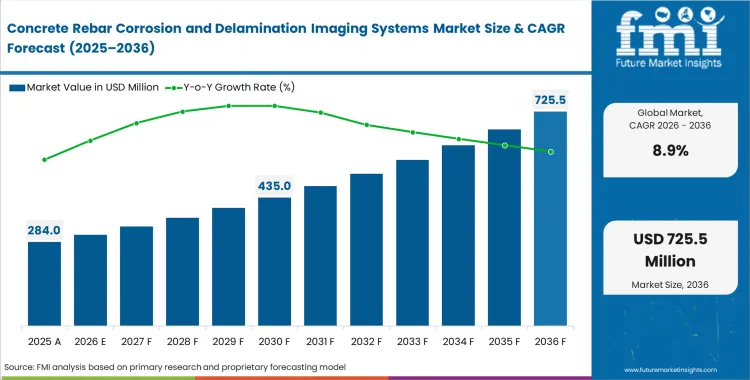
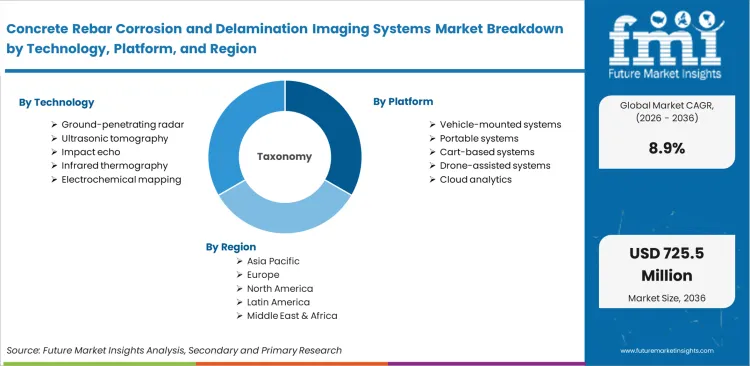
The concrete rebar corrosion and delamination imaging systems market crossed a valuation of USD 260.8 million in 2025. The market is estimated at USD 284.0 million in 2026 and is projected to reach USD 666.2 million by 2036, reflecting a CAGR of 8.9% over the forecast period. FMI analysis indicates that demand is rising as transportation agencies move away from visual bridge condition scoring and adopt quantitative subsurface imaging to identify hidden deterioration with greater confidence.
Summary of Concrete Rebar Corrosion and Delamination Imaging Systems Market
- The market is forecast to reach USD 666.2 million by 2036.
- The market is expected to grow at a CAGR of 8.9% from 2026 to 2036.
- The market was estimated at USD 260.8 million in 2025.
- The forecast period represents an incremental opportunity of USD 382.8 million.
- This market is a specification-led infrastructure NDE segment focused on imaging hidden reinforced-concrete deterioration such as corrosion, delamination, voids, and moisture damage.
- Demand is driven by bridge-deck preservation programs and the shift from manual inspection toward digital, repeatable imaging workflows.
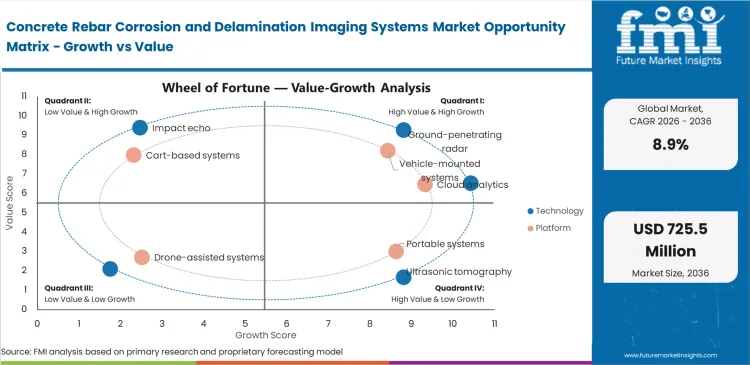
- Ground-penetrating radar leads the technology segment with a 38% share due to its ability to rapidly scan large deck areas for rebar condition and corrosion risk.
- Vehicle-mounted systems dominate the platform segment with a 34% share, enabling near-traffic-speed inspection for large infrastructure assets.
- Bridge decks account for 44% of application demand, reflecting the urgency of corrosion and delamination monitoring in transportation infrastructure.
- Transportation agencies lead the end-user segment with a 41% share, driven by public ownership of major bridge networks.
- Hardware holds the largest share at 52%, though software and analytics are gaining importance with integrated inspection workflows.
- India, China, and Japan are the fastest-growing markets, with India leading at a 10.4% CAGR.
- Screening Eagle Technologies, GSSI, Hilti, MISTRAS Group, Olson Instruments, and IDS GeoRadar are key participants in the competitive landscape.
Investment decisions in bridge structural health monitoring solutions are becoming more evidence based. Transportation departments are increasingly weighing localized spot testing against bridge deck scanning systems that can capture continuous, high-speed condition data across wider surface areas. This choice matters because repair budgets built around visible spalling or surface distress can miss deeper reinforcement damage inside the slab. Surface signs do not always reflect corrosion depth, delamination spread, or internal section loss with enough accuracy. Imaging systems are therefore gaining wider use because they support better repair prioritization and reduce the risk of underestimating structural deterioration during planning cycles.
Adoption is also expected to strengthen when highway agencies require three-dimensional subsurface evidence for rehabilitation planning and funding support. Once engineering evaluations must include quantified findings on corrosion and delamination, advanced imaging systems move beyond selective investigation work and become part of routine assessment practice. Demand is further supported by the need for more repeatable inspections, stronger documentation, and faster movement from defect identification to repair scheduling. This shift is making such systems a practical requirement in bridge maintenance planning rather than a specialist option.
India is projected to expand at a CAGR of 10.4% through 2036 as bridge network expansion raises the need for stronger baseline inspection and early defect mapping. China is estimated to grow at 9.8%, supported by heavy rehabilitation activity across aging transport infrastructure. Japan is likely to record 8.6% CAGR during the forecast period, where preventive maintenance systems are already well established and continue to support regular imaging demand. The United States is expected to register 8.2%, reflecting federal preservation programs and greater use of quantified inspection data in repair planning. Canada is projected to rise at 8.1%, while Germany and the United Kingdom are anticipated to post CAGRs of 7.9% and 7.7%, respectively, where certification-heavy testing requirements continue to support steady adoption.
Segmental Analysis
Concrete Rebar Corrosion and Delamination Imaging Systems Market Analysis by Technology
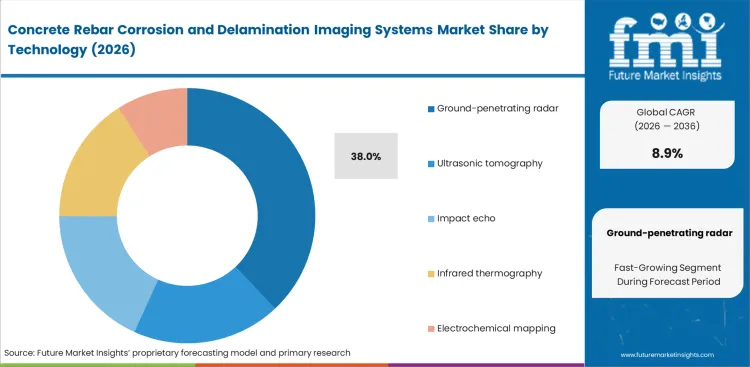
Ground-penetrating radar is estimated to account for 38.0% share in 2026. Its position is tied to the need for high-speed data collection across large bridge and roadway surfaces where slower acoustic methods are less practical. Radar is relied upon because it can map rebar depth and moisture variation without requiring direct couplant contact on the concrete surface. Use of non-destructive testers equipment in these surveys also reduces the labor burden associated with manual grid marking and repeated point-by-point checks. Radar still has a known limit in early corrosion assessment, since it is better at identifying physical deterioration patterns than confirming active electrochemical corrosion at a very early stage. That gap keeps radar important, but not fully sufficient on its own for preventive maintenance decisions.
- Survey velocity: Vehicle-based radar arrays can cover large bridge deck areas quickly and reduce the traffic disruption linked to slower manual survey methods.
- Moisture interference: High moisture content can weaken signal clarity and reduce imaging quality in saturated or marine-exposed concrete sections.
- Data integration: Modern radar platforms can export outputs into mapping systems that support network-level infrastructure review and repair planning.
Concrete Rebar Corrosion and Delamination Imaging Systems Market Analysis by Platform
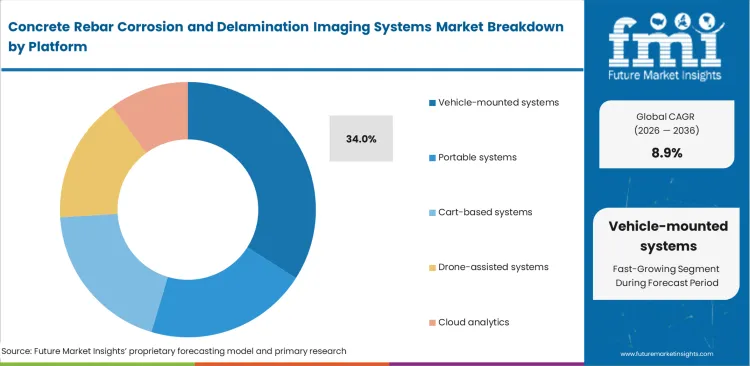
Platform selection is increasingly influenced by the need to inspect larger transport networks within shorter overnight work windows. Vehicle-mounted systems are estimated to account for 34.0% share in 2026, as they support faster lane-level scanning and reduce worker exposure in live traffic conditions. State and municipal agencies tend to prefer this format when daily coverage needs are high and traffic management windows remain limited. NDT inspection service providers also benefit from truck-based deployment, since lower field labor intensity can improve route-level operating efficiency. Access constraints still limit broader use in certain settings, as large vehicle systems are less suited to narrow walkways, undersides, and tightly constrained urban structures. Portable and modular tools therefore remain relevant where structure geometry reduces the practicality of road-going platforms.
- Coverage economics: Truck-mounted systems can scan broader areas per shift and lower unit inspection cost across high-volume transport networks.
- Vibration susceptibility: High-speed movement can introduce noise into sensor output and requires mechanical damping for stable readings.
- Urban navigation: Large inspection vehicles face access limits on tight ramps, narrow paths, and irregular bridge approaches.
Concrete Rebar Corrosion and Delamination Imaging Systems Market Analysis by Application
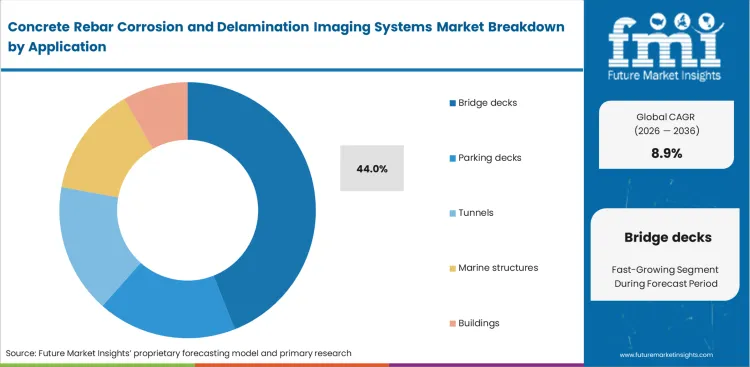
Bridge decks receive the highest inspection focus because visible damage at that level can disrupt traffic movement and trigger maintenance action quickly. Bridge decks are estimated to account for 44.0% share in 2026, supported by the scale of deck monitoring programs across aging road infrastructure. Three-dimensional ground penetrating radar is also used to define patch boundaries more accurately before demolition and rehabilitation work begins. Heavy concentration on deck surfaces, however, can reduce attention on substructure elements where corrosion may continue with less visible warning. Asset owners that focus too narrowly on deck conditions may overlook deeper deterioration developing in columns and other vertical support structures.
- Patching precision: Imaging data helps define the actual perimeter of damaged zones and supports more controlled concrete removal during repair work.
- Overlay interference: Asphalt and surface overlays can hide visible deterioration, making subsurface imaging more important for deck assessment.
- Load rating: Section-loss interpretation can feed into capacity review and support more realistic load-management decisions.
Concrete Rebar Corrosion and Delamination Imaging Systems Market Analysis by End User
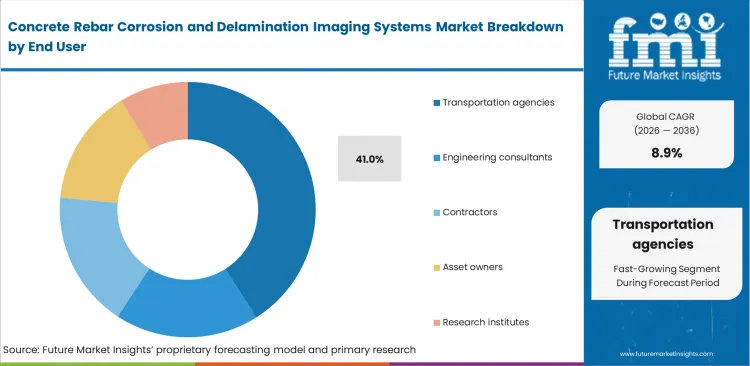
Public-sector ownership remains central in this market because transport agencies carry direct responsibility for bridge inventory condition and inspection continuity. Network-wide standardization, emergency response needs, and specification control all support internal equipment purchasing by government bodies. In-house access to field inspection testers also gives agencies faster deployment capability after floods, impacts, or seismic events when immediate screening is needed. Transportation agencies are poised to garner 41.0% share in 2026, reflecting both purchase scale and the need to manage inspection consistency across multiple districts. Hardware ownership alone, though, does not remove the challenge of interpretation, and many agencies still depend on external specialists for deeper analysis of complex imaging outputs. That skill gap continues to shape how effectively purchased systems are used in practice.
- Emergency response: Agency-owned systems can be mobilized quickly after major weather events or incidents affecting key transport routes.
- Calibration burdens: Multi-sensor hardware requires periodic recalibration, which can complicate maintenance planning for public operators.
- Specification authority: Government buyers often shape regional testing standards and influence which system formats become widely adopted.
Concrete Rebar Corrosion and Delamination Imaging Systems Market Analysis by Offering
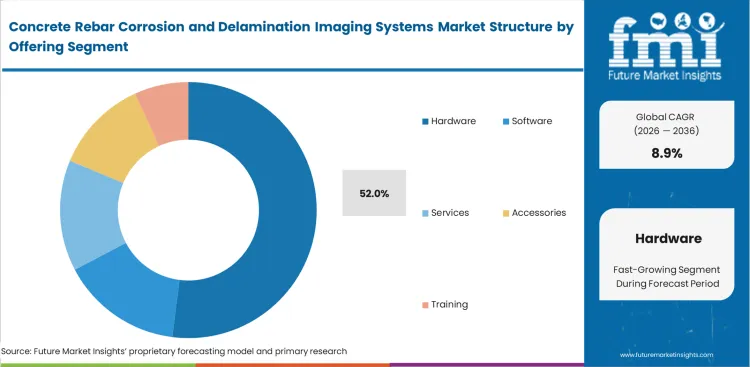
Offering structure in this market continues to be led by physical system value, as ruggedized imaging platforms still require antennas, control units, positioning hardware, and field-ready protective enclosures. Equipment in this category is expected to withstand dust, vibration, repeated transport, and rough site handling during inspection work. Product strategies remain centered on that hardware requirement, even as suppliers continue adding software layers around the installed base. Hardware is estimated to account for 52.0% share in 2026. This position remains important in current purchasing cycles, especially where agencies and contractors are building structural health monitoring capability through direct equipment ownership. Longer-term differentiation, however, is expected to shift more toward processing and interpretation tools as hardware formats become more standardized.
- Capital depreciation: Inspection hardware retains physical utility for years, but sensing capability can age faster than accounting schedules suggest.
- Interoperability lock-in: Proprietary data formats can make it difficult to combine outputs from multiple hardware brands in one analysis environment.
- Maintenance cycles: Wear on wheels, skids, and other field-contact components adds recurring upkeep cost to daily operating use.
Concrete Rebar Corrosion and Delamination Imaging Systems Market Drivers, Restraints, and Opportunities
Asset owners increasingly require predictive defect modeling before committing funds to major rehabilitation programs. State transportation agencies can no longer rely only on chain-drag acoustics and visual spall mapping when replacement decisions involve large bridge deck investments. Leakage from bridge expansion joints can carry chlorides into substructure elements, making quantitative imaging more useful for setting repair priorities across aging bridge networks. Without continuous subsurface data, agencies may assign funding to structures with visible damage but limited internal deterioration, while less visible defects continue to develop elsewhere.
Adoption is still constrained by the gap between data collection speed and interpretation capacity. Vehicle-mounted radar systems can gather large volumes of condition data in a single night, though manual review of radargrams to pinpoint delamination boundaries often takes far longer. This slows portfolio-scale deployment and reduces the practical advantage of continuous scanning. Broader use is likely to depend on more reliable automation in defect extraction, especially where raw sensor noise must be separated from actual structural deterioration. Until analysis becomes faster and more consistent, engineering teams are expected to remain selective in how widely they deploy continuous scanning programs.
Opportunities in the Concrete Rebar Corrosion and Delamination Imaging Systems Market
- Thermal screening: Aviation specialists combining infrared bridge deck delamination imaging payloads with automated flight paths capture data on inaccessible vertical piers without scaffolding.
- Acoustic validation: Consultants specifying ultrasonic tomography for concrete delamination generate highly accurate depth profiles that radar systems cannot achieve in moisture-heavy environments.
- Multi-modality platforms: Data scientists creating unified dashboards that overlay GPR, impact echo, and electrochemical data provide civil engineers with comprehensive deterioration models.
Regional Analysis
Based on regional analysis, concrete rebar corrosion and delamination imaging systems market is segmented into North America, Asia Pacific, and Europe across 40 plus countries.
.webp "Top Country Growth Comparison Concrete Rebar Corrosion And Delamination Imaging Systems Market Cagr (2026 2036)")
| Country | CAGR (2026 to 2036) |
|---|---|
| India | 10.4% |
| China | 9.8% |
| Japan | 8.6% |
| United States | 8.2% |
| Canada | 8.1% |
| Germany | 7.9% |
| United Kingdom | 7.7% |
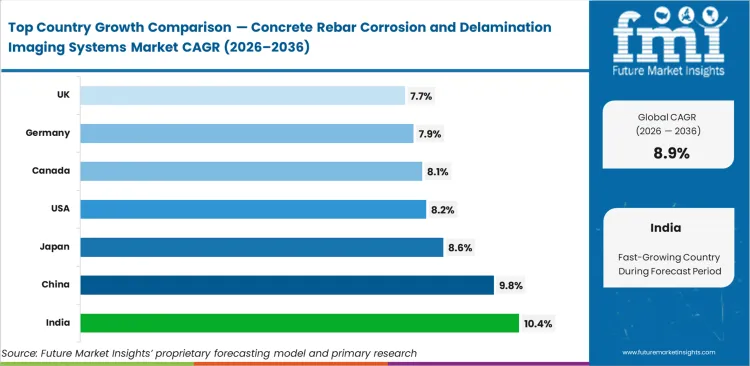
Source: Future Market Insights (FMI) analysis, based on proprietary forecasting model and primary research
North America Concrete Rebar Corrosion and Delamination Imaging Systems Market Analysis
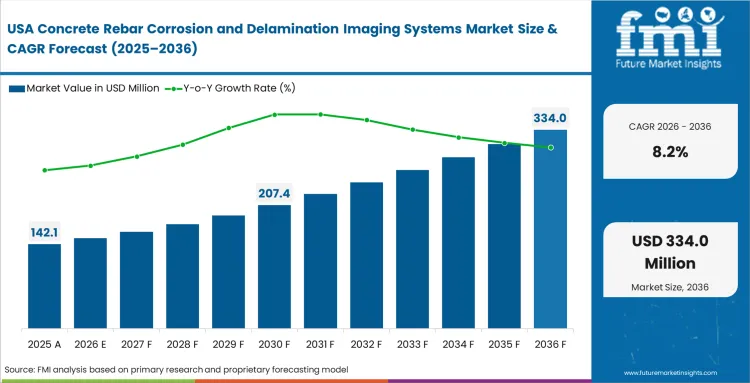
Federal mandates requiring quantitative element-level inspection data dictate sourcing rhythms across state transportation departments. Companies specify high-speed concrete paving equipment assessments to comply with stringent highway administration guidelines. FMI's analysis indicates that North American buyers prioritize vehicle-mounted integration over portable resolution because labor costs make manual grid-testing financially prohibitive on interstate corridors. Hardware vendors are pushed to demonstrate seamless GIS integration so inspection results populate directly into national infrastructure databases without manual transcription.
- United States: Strict bridge preservation policies force state DOTs to transition from reactive patching to predictive corrosion modelling in the United States bridge deck imaging systems market. Companies acquire multi-channel systems to assess vast aging interstate networks. United States is projected to witness 8.2% CAGR through 2036. Equipment suppliers securing federal framework contracts gain massive installed-base advantages over competitors fighting for municipal bids.
- Canada: Extreme freeze-thaw cycles and heavy de-icing salt application accelerate reinforcement corrosion in urban viaducts. Civil contractors require hardware certified for sub-zero operation. Adoption in Canada is expected to move ahead at 8.1% CAGR during the forecast period. Engineering firms mastering multi-modality winter inspections capture significant regional market share from conventional testing outfits.
Asia Pacific Concrete Rebar Corrosion and Delamination Imaging Systems Market Analysis
Expansion of high-speed rail networks and mega-bridge projects establishes a massive requirement for initial quality baseline scanning. Civil contractors evaluate CO2 reduced concrete structures using advanced imaging to verify rebar placement and cover depth before final handover. As per FMI's projection, trajectories here split distinctly: emerging economies buy portable systems to audit new construction, while mature economies invest heavily in automated arrays to manage aging assets. Infrastructure authorities increasingly reject visual sign-offs, forcing local testing laboratories to upgrade NDT capabilities or lose government certification entirely.
- India: Railway and highway authorities mandate subsurface imaging to verify construction quality on complex viaducts, propelling the India bridge deck inspection systems industry. Project supervisors demand rugged, portable units capable of surviving harsh site conditions. India is likely to post 10.4% CAGR by 2036. Early movers offering localized software interfaces secure deep roots in a rapidly growing infrastructure pipeline.
- China: Rehabilitation intensity is accelerating as an initial wave of rapid infrastructure development requires verification, expanding the China concrete corrosion imaging segment. Municipal authorities deploy vehicle-mounted radar to clear massive urban bridge networks efficiently. China is anticipated to see adoption grow at 9.8% CAGR over the forecast period. Domestic manufacturers are rapidly scaling production of high-frequency antennas to undercut imported European hardware.
- Japan: A highly mature preventive maintenance culture demands precise degradation tracking over decades. Ultrasonic tomography is prioritized to detect micro-cracking before full delamination occurs. Japan is poised to expand at 8.6% CAGR from 2026 to 2036. This creates a highly technical environment where sensor accuracy outranks acquisition speed in purchase scoring.
Europe Concrete Rebar Corrosion and Delamination Imaging Systems Market Analysis
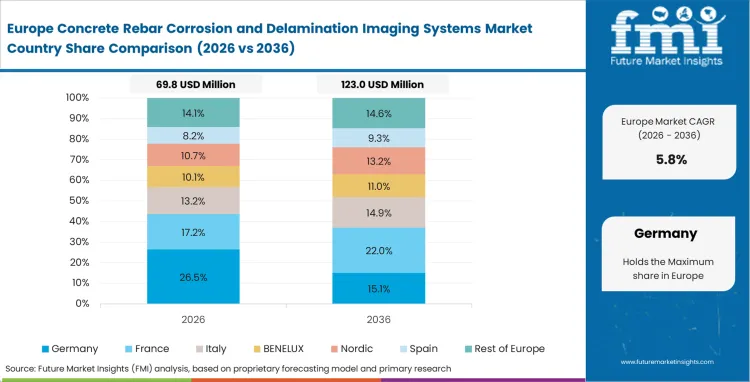
Buyer preferences in this market are shaped by certification demands and long-established preservation requirements. Work on older masonry and early reinforced concrete structures often needs non-destructive evaluation before any intervention is approved. That requirement gives imaging and testing systems a clearer role in front-end assessment rather than later-stage verification alone. In many European projects, condition review is built from more than one diagnostic layer, with ground resistance testing used alongside imaging to give engineers a fuller reading of deterioration patterns. Software value is also becoming more visible in purchase decisions. Municipal owners increasingly look for platforms that can support service-life estimation and repair planning, rather than judging systems only by field hardware capability.
- Germany: High engineering standards push forward the sourcing of specification-heavy, multi-modality scanning carts. Research institutes test advanced algorithmic defect recognition models on municipal highway assets. Germany is set to record 7.9% CAGR during the assessment period. Technical rigor makes this country a primary proving ground for complex software before global deployment.
- United Kingdom: Transport network operators focus on extending service life of existing motorways without disrupting traffic flow. Civil engineers demand cloud-connected hardware for real-time offsite data processing. Demand across United Kingdom is set to rise at 7.7% CAGR through 2036. Service providers offering combined scanning and interpretation contracts dominate regional purchase frameworks.
FMI's report includes qualitative assessments of surrounding regional markets not detailed above. Equipment requirements in Middle East diverge sharply, focusing on chloride ingress mapping in marine environments rather than freeze-thaw delamination tracking.
Competitive Aligners for Market Players
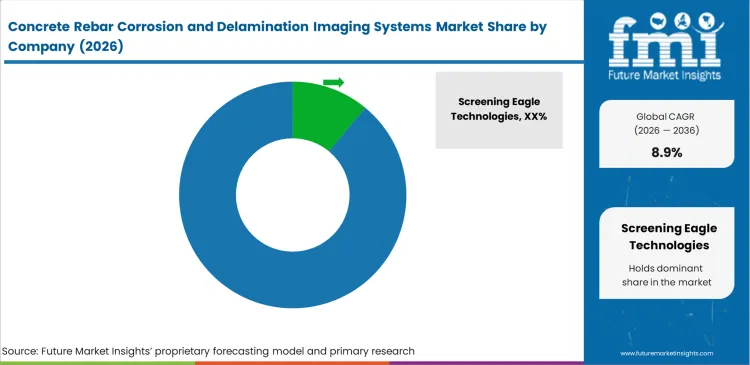
Competition in concrete corrosion imaging systems is shaped more by software processing and interpretation speed than by sensor specifications alone. Leading suppliers are strengthening their position through defect recognition software trained on large historical inspection datasets. Engineering teams do not compare surface radar systems only on antenna frequency. Purchase decisions are increasingly influenced by how quickly each platform can turn field data into a repair map that supports action. Switching barriers remain high because a change in hardware often requires new technician training and breaks continuity with older data records and established workflows.
Established bridge deck ground penetrating radar suppliers also benefit from tighter control over hardware, calibration, and reporting environments. When one supplier manages the path from integrated three-dimensional radar carts to cloud-based reporting, buyers face more effort in changing systems across active inspection programs. Fleet operators often work within supplier-specific calibration methods, software routines, and reporting structures built over time. This makes it harder for standalone hardware providers to compete when buyers want equipment that fits existing data practices without added conversion work.
Buyer influence remains important, especially where transportation agencies require open data delivery in inspection contracts. Non-destructive evaluation systems are increasingly expected to provide output in formats that can move into broader GIS and asset management environments without heavy reprocessing. This is pushing more suppliers to improve interoperability rather than rely on closed software structures alone. Longer-term value is likely to shift toward data interpretation, workflow integration, and recurring software use, while hardware becomes less of a standalone differentiator.
Key Players in Concrete Rebar Corrosion and Delamination Imaging Systems Market
- Screening Eagle Technologies
- Geophysical Survey Systems, Inc. (GSSI)
- Hilti
- MISTRAS Group
- Olson Instruments
- IDS GeoRadar
Scope of the Report
| Metric | Value |
|---|---|
| Quantitative Units | USD 284.0 million to USD 666.2 million, at a CAGR of 8.9% |
| Market Definition | Hardware and software solutions that identify rebar oxidation and concrete delamination without physical intrusion form this market. Systems map internal health to guide targeted infrastructure rehabilitation and prevent failures. |
| Segmentation | By Technology, Platform, Application, End User, Offering, and Region |
| Regions Covered | North America, Latin America, Europe, Asia Pacific, Middle East and Africa |
| Countries Covered | United States, China, India, Japan, Germany, Canada, United Kingdom |
| Key Companies Profiled | Screening Eagle Technologies, Geophysical Survey Systems, Inc. (GSSI), Hilti, MISTRAS Group, Olson Instruments, IDS GeoRadar |
| Forecast Period | 2026 to 2036 |
| Approach | Top-down infrastructure budget assessment cross-referenced with bottom-up hardware shipment volumes. |
Source: Future Market Insights (FMI) analysis, based on proprietary forecasting model and primary research
Concrete Rebar Corrosion and Delamination Imaging Systems Market Analysis by Segments
By Technology
- Ground-penetrating radar
- Ultrasonic tomography
- Impact echo
- Infrared thermography
- Electrochemical mapping
By Platform
- Portable systems
- Vehicle-mounted systems
- Cart-based systems
- Drone-assisted systems
- Cloud analytics
By Application
- Bridge decks
- Parking decks
- Tunnels
- Marine structures
- Buildings
By End User
- Transportation agencies
- Engineering consultants
- Contractors
- Asset owners
- Research institutes
By Offering
- Hardware
- Software
- Services
- Accessories
- Training
Region:
- North America
- United States
- Canada
- Europe
- Germany
- United Kingdom
- France
- Italy
- Spain
- Asia Pacific
- China
- Japan
- South Korea
- Taiwan
- Singapore
- Latin America
- Brazil
- Mexico
- Argentina
- Middle East & Africa
- GCC Countries
- South Africa
Bibliography
- Balakumaran, S. S. G., & Behravan, A. (2025). Reliability of Nondestructive Evaluation of Concrete Bridge Decks (FHWA/VTRC 26-R25). Virginia Transportation Research Council.
- Nejad, S., Washer, G., Walther, R. A., Wagner, E., Garrett, S., & Azari, H. (2025). Linking NDE Data and Bridge Deck Performance (FHWA-HRT-25-029). United States Department of Transportation, Federal Highway Administration, Office of Infrastructure Research and Development.
- Oh, R.-O., Kim, H.-H., Choo, Y.-J., Park, S.-K., Rodrigazo, S. A., Yeon, J., & Park, C. G. (2024). Evaluation of Delaminations and Defects in Concrete Deck Using Non-Destructive Multi-Physical Scanning Technology. Sustainability, 16(21), 9225.
- Zhang, H., Shi, Z., Li, L., Jiao, P., Shang, B., & Chen, G. (2024). Code-specified early delamination detection and quantification in a RC bridge deck: passive vs. active infrared thermography. Journal of Civil Structural Health Monitoring, 15(1), 227–244.
- Elseicy, A., Solla, M., & Lorenzo, H. (2025). Automated delamination detection in concrete bridge decks using 1D-CNN and GPR data. Case Studies in Construction Materials, 22(1), e04174.
- Kuchipudi, S. T., Ghosh, D., & Ganguli, A. (2025). Imaging-based detection and classification of corrosion damages in reinforced concrete using ultrasonic shear waves. Journal of Building Engineering, 105, 112490.
This bibliography is provided for reader reference. The full FMI report contains the complete reference list with primary source documentation.
This Report Addresses
- Identifies exact hardware sourcing shifts among major transportation agencies evaluating high-speed vehicle-mounted inspection arrays.
- Quantifies the adoption gap between basic cart-based radar usage and advanced AI-driven defect recognition platforms.
- Maps the shift toward predictive maintenance modeling mandated by federal bridge preservation guidelines.
- Assesses the impact of multi-modality sensor fusion on traditional civil engineering consultancy service margins.
- Analyzes commercial vulnerabilities for NDT contractors operating legacy hardware incapable of continuous highway-speed scanning.
- Evaluates specific geographical demand clusters driven by massive rail and viaduct construction pipelines in Asia Pacific.
- Details the operational bottleneck created by massive raw radargram data collection without corresponding analytical automation.
- Explains how open-data requirements from municipal asset owners are forcing closed-ecosystem hardware manufacturers to adjust software strategies.
Frequently Asked Questions
What is the concrete rebar corrosion and delamination imaging systems market?
Hardware and software solutions that identify rebar oxidation and concrete separation without physical intrusion form this segment. Systems map internal health to guide targeted infrastructure rehabilitation and prevent failures.
How large is the market in 2025 and 2036?
Demand reached USD 284.0 million in 2026. This figure anchors a rapid expansion cycle as state highway administrations modernize their evaluation protocols, projecting to hit USD 666.2 million by 2036.
Why is bridge-deck inspection driving this category?
Horizontal surfaces endure constant cyclic loading and direct exposure to corrosive de-icing chemicals. Surface spalling on decks immediately disrupts traffic flow, forcing asset owners to prioritize deck scanning over column evaluations.
How is rebar corrosion imaged without breaking concrete?
Engineers measure variations in electromagnetic properties, acoustic wave propagation, or thermal conductivity. Instruments read returning signal signatures to map hidden deterioration layers safely.
GPR vs ultrasonic tomography for concrete inspection: which is better?
Radar maps structures at highway speeds but struggles with moisture saturation. Tomography generates highly accurate depth profiles in wet concrete but operates at significantly slower acquisition speeds.
Which countries are growing fastest for bridge deck imaging systems?
India leads regional adoption at 10.4% CAGR as new viaduct projects enforce rigorous quality baselines, while China expands at 9.8% to assess rapidly aging urban infrastructure.
Who are the leading suppliers of bridge-deck imaging systems?
Firms like Screening Eagle Technologies, Geophysical Survey Systems, Inc. (GSSI), Hilti, and IDS GeoRadar dominate hardware manufacturing and data processing software pipelines.
How do transportation agencies justify the cost of these systems?
Departments confirm the exact cost benefit of concrete corrosion imaging systems by avoiding multi-million-dollar deck replacements. Identifying specific repair perimeters preserves sound concrete and stretches tight rehabilitation budgets.
What is included in this market and what is excluded?
Hardware like radar arrays and acoustic meters falls inside scope, alongside dedicated processing software. Destructive core drills and permanently embedded chemical sensors sit strictly outside this assessment.
How is AI changing concrete bridge inspection workflows?
Implementing AI bridge deck inspection systems eliminates severe analytical bottlenecks. Machine learning algorithms automatically isolate defect perimeters from raw sensor noise, reducing processing times from weeks to hours.
What limits the exclusive use of radar arrays?
High-frequency radar struggles to detect early-stage active corrosion before actual physical delamination occurs. Supplement radar surveys must be supplemented with electrochemical mapping to confirm oxidation states.
Why do vehicle-mounted platforms command significant share?
Municipalities mandate tight overnight operational windows for major interstate inspections. Truck-mounted systems multiply daily linear coverage dramatically compared to manual ground crews pushing portable carts.
What forces engineering firms to upgrade hardware?
Firms lacking highway-speed scanning capabilities cannot compete on turnaround time for large-scale corridor bids. Equipment modernization shifts from a technical preference to a strict requirement for winning state contracts.
What hidden risk exists in current inspection priorities?
Over-focusing on deck surfaces obscures advancing deterioration in vertical piers. Standard vehicle radar arrays cannot easily map substructure columns, allowing hidden corrosion to mature unnoticed beneath bridge decks.
Why do transportation agencies buy these systems directly?
Owning equipment enables rapid deployment after extreme weather events or strikes. District supervisors need immediate verification of integrity without waiting for private contractor scheduling.
What bottleneck do state agencies face after purchasing hardware?
Agencies easily acquire advanced sensor arrays but struggle to retain specialized geophysicists. Without capable data scientists, departments accumulate massive digital archives of radargrams that never convert into actionable repair schedules.
Why is value shifting from hardware to software?
Physical antennas commoditize as manufacturing scales globally. Commercial power now rests with vendors who provide machine learning algorithms capable of isolating defect perimeters from raw sensor noise automatically.
Why is North America pivoting to multi-modality platforms?
Federal guidelines increasingly reject load ratings based on single-sensor evaluations. Impact echo and infrared data are combined with radar to build defensible deterioration models for aging interstates.
How do open-data mandates change competitive dynamics?
Transport departments refuse to lock infrastructure data inside proprietary vendor formats. Manufacturers must build API connections to generic municipal dashboards or risk exclusion from major government tenders.
What operational friction slows continuous scanning adoption?
Data interpretation severely lags data collection. A truck scans miles of deck in one shift, but human analysts take weeks to map resulting defects, frustrating asset owners seeking immediate repair coordinates.
What is the rebar corrosion mapping equipment price consideration?
Ruggedized inspection equipment demands high upfront capital. Financial controllers balance physical longevity against immediate needs for upgraded sensor resolution and mandatory recurring software licensing fees.
How does drone technology impact the market?
Aviation platforms equipped with thermal payloads survey inaccessible suspension elements and vertical piers without expensive scaffolding. This eliminates severe access restrictions common in maritime bridge environments.
What advantage do incumbent manufacturers hold?
Established vendors control massive historical datasets required to train effective AI algorithms. Challengers struggle because their uncalibrated defect-recognition software generates false positives that engineering consultants refuse to trust.
Preview the report firsthand - request a free sample
Get SampleGet the brochure for pricing and purchase details.
Get PDFTable of Content
- Executive Summary
- Global Market Outlook
- Demand-side Trends
- Supply-side Trends
- Technology Roadmap Analysis
- Analysis and Recommendations
- Market Overview
- Market Coverage / Taxonomy
- Market Definition / Scope / Limitations
- Research Methodology
- Chapter Orientation
- Analytical Lens and Working Hypotheses
- Market Structure, Signals, and Trend Drivers
- Benchmarking and Cross-market Comparability
- Market Sizing, Forecasting, and Opportunity Mapping
- Research Design and Evidence Framework
- Desk Research Programme (Secondary Evidence)
- Company Annual and Sustainability Reports
- Peer-reviewed Journals and Academic Literature
- Corporate Websites, Product Literature, and Technical Notes
- Earnings Decks and Investor Briefings
- Statutory Filings and Regulatory Disclosures
- Technical White Papers and Standards Notes
- Trade Journals, Industry Magazines, and Analyst Briefs
- Conference Proceedings, Webinars, and Seminar Materials
- Government Statistics Portals and Public Data Releases
- Press Releases and Reputable Media Coverage
- Specialist Newsletters and Curated Briefings
- Sector Databases and Reference Repositories
- FMI Internal Proprietary Databases and Historical Market Datasets
- Subscription Datasets and Paid Sources
- Social Channels, Communities, and Digital Listening Inputs
- Additional Desk Sources
- Expert Input and Fieldwork (Primary Evidence)
- Primary Modes
- Qualitative Interviews and Expert Elicitation
- Quantitative Surveys and Structured Data Capture
- Blended Approach
- Why Primary Evidence is Used
- Field Techniques
- Interviews
- Surveys
- Focus Groups
- Observational and In-context Research
- Social and Community Interactions
- Stakeholder Universe Engaged
- C-suite Leaders
- Board Members
- Presidents and Vice Presidents
- R&D and Innovation Heads
- Technical Specialists
- Domain Subject-matter Experts
- Scientists
- Physicians and Other Healthcare Professionals
- Governance, Ethics, and Data Stewardship
- Research Ethics
- Data Integrity and Handling
- Primary Modes
- Tooling, Models, and Reference Databases
- Desk Research Programme (Secondary Evidence)
- Data Engineering and Model Build
- Data Acquisition and Ingestion
- Cleaning, Normalisation, and Verification
- Synthesis, Triangulation, and Analysis
- Quality Assurance and Audit Trail
- Market Background
- Market Dynamics
- Drivers
- Restraints
- Opportunity
- Trends
- Scenario Forecast
- Demand in Optimistic Scenario
- Demand in Likely Scenario
- Demand in Conservative Scenario
- Opportunity Map Analysis
- Product Life Cycle Analysis
- Supply Chain Analysis
- Investment Feasibility Matrix
- Value Chain Analysis
- PESTLE and Porter’s Analysis
- Regulatory Landscape
- Regional Parent Market Outlook
- Production and Consumption Statistics
- Import and Export Statistics
- Market Dynamics
- Global Market Analysis 2021 to 2025 and Forecast, 2026 to 2036
- Historical Market Size Value (USD Million) Analysis, 2021 to 2025
- Current and Future Market Size Value (USD Million) Projections, 2026 to 2036
- Y-o-Y Growth Trend Analysis
- Absolute $ Opportunity Analysis
- Global Market Pricing Analysis 2021 to 2025 and Forecast 2026 to 2036
- Global Market Analysis 2021 to 2025 and Forecast 2026 to 2036, By Technology
- Introduction / Key Findings
- Historical Market Size Value (USD Million) Analysis By Technology , 2021 to 2025
- Current and Future Market Size Value (USD Million) Analysis and Forecast By Technology , 2026 to 2036
- Ground-penetrating radar
- Ultrasonic tomography
- Impact echo
- Infrared thermography
- Electrochemical mapping
- Ground-penetrating radar
- Y-o-Y Growth Trend Analysis By Technology , 2021 to 2025
- Absolute $ Opportunity Analysis By Technology , 2026 to 2036
- Global Market Analysis 2021 to 2025 and Forecast 2026 to 2036, By Platform
- Introduction / Key Findings
- Historical Market Size Value (USD Million) Analysis By Platform, 2021 to 2025
- Current and Future Market Size Value (USD Million) Analysis and Forecast By Platform, 2026 to 2036
- Vehicle-mounted systems
- Portable systems
- Cart-based systems
- Drone-assisted systems
- Cloud analytics
- Vehicle-mounted systems
- Y-o-Y Growth Trend Analysis By Platform, 2021 to 2025
- Absolute $ Opportunity Analysis By Platform, 2026 to 2036
- Global Market Analysis 2021 to 2025 and Forecast 2026 to 2036, By Application
- Introduction / Key Findings
- Historical Market Size Value (USD Million) Analysis By Application, 2021 to 2025
- Current and Future Market Size Value (USD Million) Analysis and Forecast By Application, 2026 to 2036
- Bridge decks
- Parking decks
- Tunnels
- Marine structures
- Buildings
- Bridge decks
- Y-o-Y Growth Trend Analysis By Application, 2021 to 2025
- Absolute $ Opportunity Analysis By Application, 2026 to 2036
- Global Market Analysis 2021 to 2025 and Forecast 2026 to 2036, By End User
- Introduction / Key Findings
- Historical Market Size Value (USD Million) Analysis By End User, 2021 to 2025
- Current and Future Market Size Value (USD Million) Analysis and Forecast By End User, 2026 to 2036
- Transportation agencies
- Engineering consultants
- Contractors
- Asset owners
- Research institutes
- Transportation agencies
- Y-o-Y Growth Trend Analysis By End User, 2021 to 2025
- Absolute $ Opportunity Analysis By End User, 2026 to 2036
- Global Market Analysis 2021 to 2025 and Forecast 2026 to 2036, By Offering
- Introduction / Key Findings
- Historical Market Size Value (USD Million) Analysis By Offering, 2021 to 2025
- Current and Future Market Size Value (USD Million) Analysis and Forecast By Offering, 2026 to 2036
- Hardware
- Software
- Services
- Accessories
- Training
- Hardware
- Y-o-Y Growth Trend Analysis By Offering, 2021 to 2025
- Absolute $ Opportunity Analysis By Offering, 2026 to 2036
- Global Market Analysis 2021 to 2025 and Forecast 2026 to 2036, By Region
- Introduction
- Historical Market Size Value (USD Million) Analysis By Region, 2021 to 2025
- Current Market Size Value (USD Million) Analysis and Forecast By Region, 2026 to 2036
- North America
- Latin America
- Western Europe
- Eastern Europe
- East Asia
- South Asia and Pacific
- Middle East & Africa
- Market Attractiveness Analysis By Region
- North America Market Analysis 2021 to 2025 and Forecast 2026 to 2036, By Country
- Historical Market Size Value (USD Million) Trend Analysis By Market Taxonomy, 2021 to 2025
- Market Size Value (USD Million) Forecast By Market Taxonomy, 2026 to 2036
- By Country
- USA
- Canada
- Mexico
- By Technology
- By Platform
- By Application
- By End User
- By Offering
- By Country
- Market Attractiveness Analysis
- By Country
- By Technology
- By Platform
- By Application
- By End User
- By Offering
- Key Takeaways
- Latin America Market Analysis 2021 to 2025 and Forecast 2026 to 2036, By Country
- Historical Market Size Value (USD Million) Trend Analysis By Market Taxonomy, 2021 to 2025
- Market Size Value (USD Million) Forecast By Market Taxonomy, 2026 to 2036
- By Country
- Brazil
- Chile
- Rest of Latin America
- By Technology
- By Platform
- By Application
- By End User
- By Offering
- By Country
- Market Attractiveness Analysis
- By Country
- By Technology
- By Platform
- By Application
- By End User
- By Offering
- Key Takeaways
- Western Europe Market Analysis 2021 to 2025 and Forecast 2026 to 2036, By Country
- Historical Market Size Value (USD Million) Trend Analysis By Market Taxonomy, 2021 to 2025
- Market Size Value (USD Million) Forecast By Market Taxonomy, 2026 to 2036
- By Country
- Germany
- UK
- Italy
- Spain
- France
- Nordic
- BENELUX
- Rest of Western Europe
- By Technology
- By Platform
- By Application
- By End User
- By Offering
- By Country
- Market Attractiveness Analysis
- By Country
- By Technology
- By Platform
- By Application
- By End User
- By Offering
- Key Takeaways
- Eastern Europe Market Analysis 2021 to 2025 and Forecast 2026 to 2036, By Country
- Historical Market Size Value (USD Million) Trend Analysis By Market Taxonomy, 2021 to 2025
- Market Size Value (USD Million) Forecast By Market Taxonomy, 2026 to 2036
- By Country
- Russia
- Poland
- Hungary
- Balkan & Baltic
- Rest of Eastern Europe
- By Technology
- By Platform
- By Application
- By End User
- By Offering
- By Country
- Market Attractiveness Analysis
- By Country
- By Technology
- By Platform
- By Application
- By End User
- By Offering
- Key Takeaways
- East Asia Market Analysis 2021 to 2025 and Forecast 2026 to 2036, By Country
- Historical Market Size Value (USD Million) Trend Analysis By Market Taxonomy, 2021 to 2025
- Market Size Value (USD Million) Forecast By Market Taxonomy, 2026 to 2036
- By Country
- China
- Japan
- South Korea
- By Technology
- By Platform
- By Application
- By End User
- By Offering
- By Country
- Market Attractiveness Analysis
- By Country
- By Technology
- By Platform
- By Application
- By End User
- By Offering
- Key Takeaways
- South Asia and Pacific Market Analysis 2021 to 2025 and Forecast 2026 to 2036, By Country
- Historical Market Size Value (USD Million) Trend Analysis By Market Taxonomy, 2021 to 2025
- Market Size Value (USD Million) Forecast By Market Taxonomy, 2026 to 2036
- By Country
- India
- ASEAN
- Australia & New Zealand
- Rest of South Asia and Pacific
- By Technology
- By Platform
- By Application
- By End User
- By Offering
- By Country
- Market Attractiveness Analysis
- By Country
- By Technology
- By Platform
- By Application
- By End User
- By Offering
- Key Takeaways
- Middle East & Africa Market Analysis 2021 to 2025 and Forecast 2026 to 2036, By Country
- Historical Market Size Value (USD Million) Trend Analysis By Market Taxonomy, 2021 to 2025
- Market Size Value (USD Million) Forecast By Market Taxonomy, 2026 to 2036
- By Country
- Kingdom of Saudi Arabia
- Other GCC Countries
- Turkiye
- South Africa
- Other African Union
- Rest of Middle East & Africa
- By Technology
- By Platform
- By Application
- By End User
- By Offering
- By Country
- Market Attractiveness Analysis
- By Country
- By Technology
- By Platform
- By Application
- By End User
- By Offering
- Key Takeaways
- Key Countries Market Analysis
- USA
- Pricing Analysis
- Market Share Analysis, 2025
- By Technology
- By Platform
- By Application
- By End User
- By Offering
- Canada
- Pricing Analysis
- Market Share Analysis, 2025
- By Technology
- By Platform
- By Application
- By End User
- By Offering
- Mexico
- Pricing Analysis
- Market Share Analysis, 2025
- By Technology
- By Platform
- By Application
- By End User
- By Offering
- Brazil
- Pricing Analysis
- Market Share Analysis, 2025
- By Technology
- By Platform
- By Application
- By End User
- By Offering
- Chile
- Pricing Analysis
- Market Share Analysis, 2025
- By Technology
- By Platform
- By Application
- By End User
- By Offering
- Germany
- Pricing Analysis
- Market Share Analysis, 2025
- By Technology
- By Platform
- By Application
- By End User
- By Offering
- UK
- Pricing Analysis
- Market Share Analysis, 2025
- By Technology
- By Platform
- By Application
- By End User
- By Offering
- Italy
- Pricing Analysis
- Market Share Analysis, 2025
- By Technology
- By Platform
- By Application
- By End User
- By Offering
- Spain
- Pricing Analysis
- Market Share Analysis, 2025
- By Technology
- By Platform
- By Application
- By End User
- By Offering
- France
- Pricing Analysis
- Market Share Analysis, 2025
- By Technology
- By Platform
- By Application
- By End User
- By Offering
- India
- Pricing Analysis
- Market Share Analysis, 2025
- By Technology
- By Platform
- By Application
- By End User
- By Offering
- ASEAN
- Pricing Analysis
- Market Share Analysis, 2025
- By Technology
- By Platform
- By Application
- By End User
- By Offering
- Australia & New Zealand
- Pricing Analysis
- Market Share Analysis, 2025
- By Technology
- By Platform
- By Application
- By End User
- By Offering
- China
- Pricing Analysis
- Market Share Analysis, 2025
- By Technology
- By Platform
- By Application
- By End User
- By Offering
- Japan
- Pricing Analysis
- Market Share Analysis, 2025
- By Technology
- By Platform
- By Application
- By End User
- By Offering
- South Korea
- Pricing Analysis
- Market Share Analysis, 2025
- By Technology
- By Platform
- By Application
- By End User
- By Offering
- Russia
- Pricing Analysis
- Market Share Analysis, 2025
- By Technology
- By Platform
- By Application
- By End User
- By Offering
- Poland
- Pricing Analysis
- Market Share Analysis, 2025
- By Technology
- By Platform
- By Application
- By End User
- By Offering
- Hungary
- Pricing Analysis
- Market Share Analysis, 2025
- By Technology
- By Platform
- By Application
- By End User
- By Offering
- Kingdom of Saudi Arabia
- Pricing Analysis
- Market Share Analysis, 2025
- By Technology
- By Platform
- By Application
- By End User
- By Offering
- Turkiye
- Pricing Analysis
- Market Share Analysis, 2025
- By Technology
- By Platform
- By Application
- By End User
- By Offering
- South Africa
- Pricing Analysis
- Market Share Analysis, 2025
- By Technology
- By Platform
- By Application
- By End User
- By Offering
- USA
- Market Structure Analysis
- Competition Dashboard
- Competition Benchmarking
- Market Share Analysis of Top Players
- By Region
- By Technology
- By Platform
- By Application
- By End User
- By Offering
- Competition Analysis
- Competition Deep Dive
- Screening Eagle Technologies
- Overview
- Product Portfolio
- Profitability by Market Segments (Product/Age /Sales Channel/Region)
- Sales Footprint
- Strategy Overview
- Marketing Strategy
- Product Strategy
- Channel Strategy
- Geophysical Survey Systems, Inc. (GSSI)
- Hilti
- MISTRAS Group
- Olson Instruments
- IDS GeoRadar
- Screening Eagle Technologies
- Competition Deep Dive
- Assumptions & Acronyms Used


