

- Market Size (2026)
- USD 1.8 Bn
- Forecast (2036)
- USD 2.8 Bn
- CAGR (2026 to 2036)
- 4.7%
Corrosion-Resistant Coated Fasteners for Aircraft Structures Market
Summary of the Corrosion-Resistant Coated Fasteners for Aircraft Structures Market
- Demand and Growth Drivers
- Aircraft production schedules are likely to support coated fastener demand as fuselage, wing and landing gear assemblies need qualified corrosion-resistant hardware.
- Demand for commercial aircraft MRO is expected to stay firm as corrosion-prone joints require approved replacement fasteners during inspection and repair work.
- Cadmium phase-down pressure is creating space for zinc-nickel coated fasteners, although aircraft qualification cycles keep substitution selective.
- Product and Segment View
- Cadmium-coated fasteners are likely to lead coating type demand because legacy aircraft programs still rely on approved finishes and repair manual specifications.
- Alloy steel fasteners are expected to hold a leading material position as high-load structural joints need proven strength and fatigue resistance.
- Bolts are projected to lead fastener type demand since primary airframe joints require controlled clamp force and documented coating performance.
- Geography and Competitive Outlook
- India is likely to record a leading country CAGR as fleet expansion and regional aviation programs increase structural hardware demand.
- China is expected to follow closely as local aircraft programs and rising fleet size widen the need for qualified coated fasteners.
- Companies with approved coating routes, batch traceability and structural fastener breadth are likely to gain preference across OEM and MRO supply chains.
- Analyst Opinion
- Nikhil Kaitwade, Principal Consultant, Automotive Domain, at FMI says, “Market expanion will be shaped by qualification depth, not fastener volume. Aircraft programs will favor suppliers that can prove coating chemistry and base metal compatibility under one approved route. Cadmium will remain common in legacy platforms as zinc-nickel suppliers with clear approval evidence gain a stronger role in future structural fastener sourcing.”
- Corrosion-Resistant Coated Fasteners for Aircraft Structures Market Value Analysis
- Coated aircraft structural fasteners create value through qualified corrosion protection in load-bearing joints.
- Cadmium-coated fasteners keep value in legacy aircraft programs because repair manuals still specify approved finishes.
- Fuselage and wing structures support repeat demand as fastener-hole corrosion can affect joint life.
- OEM direct supply stays important as aircraft programs need source approval and batch traceability.
- Supplier pricing depends on coating control because aerospace fasteners need corrosion proof and embrittlement checks.
Key Takeaways, Market Size, and Forecast
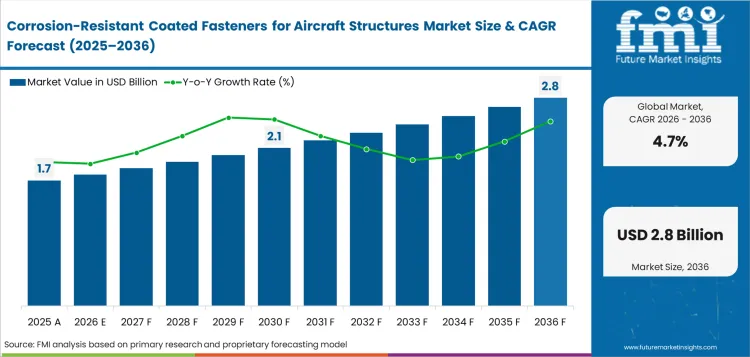
- The corrosion-resistant coated fasteners for aircraft structures market is valued at USD 1.7 billion in 2025 based on bottom-up aircraft fastener use and coating mix analysis.
- By 2036, the market is forecast to reach USD 2.8 billion as aircraft production and structural maintenance work expand.
- From 2026 to 2036, the market is projected to grow at 4.7% CAGR across aircraft OEM and MRO demand.
- The market is forecast to create an incremental opportunity of USD 1.0 billion between 2026 and 2036.
- Cadmium-coated fasteners are estimated to hold 31.0% coating type share in 2026 since legacy aircraft programs still specify approved finishes.
- India is forecast to record 6.6% CAGR through 2036 as fleet expansion and regional aviation programs raise fastener demand.
- Alloy steel fasteners are projected to capture 36.0% material share in 2026 with continued use in fatigue-sensitive structural joints.
Aircraft structural fasteners require corrosion protection that does not compromise the strength of high‑strength steels. In 2026, the United States Defense Logistics Agency specified that steels above 180 ksi must demonstrate more than 200 hours of re‑embrittlement resistance under ASTM F519 testing when corrosion‑resistant plating is applied. This requirement makes hydrogen embrittlement control a formal certification criterion rather than a simple coating performance claim.
Procurement practices also reinforce this requirement. For example, in May 2026, Boeing Distribution Services listed a corrosion‑resistant steel bolt under part number MS9490‑14, highlighting the need for approved, traceable hardware for both aircraft assembly and MRO replacement. Material compatibility is equally important, as structural fasteners are frequently installed adjacent to aluminum and other dissimilar metals. In this context, zinc‑nickel coatings are increasingly evaluated against cadmium baselines as lower‑hazard alternatives. Suppliers that can demonstrate proven corrosion performance and full aerospace traceability are more likely to gain acceptance from OEM and MRO buyers.
Corrosion-Resistant Coated Fasteners for Aircraft Structures Market Definition
The corrosion-resistant coated fasteners for aircraft structures market includes coated bolts, screws, nuts, rivets, collars, and washers used in structural aircraft assemblies, with demand closely aligned with the aerospace fastener market.
Corrosion-Resistant Coated Fasteners for Aircraft Structures Market Inclusions
Market scope includes coated structural fasteners by coating type, fastener type, base material, aircraft type, application area, sales channel, and all major regions covered by aircraft OEM and MRO supply chains. Market participants include aircraft OEMs, tier-1 aerostructure suppliers, MRO providers, aerospace fastener manufacturers, coating applicators, aircraft hardware distributors and defense maintenance agencies.
Corrosion-Resistant Coated Fasteners for Aircraft Structures Market Exclusions
The scope excludes uncoated commodity fasteners, cabin trim screws, engine-internal fasteners, general automotive fasteners, standalone plating chemicals, and corrosion compounds sold without structural aircraft fastener supply.
Corrosion-Resistant Coated Fasteners for Aircraft Structures Market Research Methodology
- Primary Research: FMI analysts assessed suppliers serving the aerospace fastener manufacturing solution market, aerospace coating specialists, aircraft OEM sourcing teams, MRO planners, and distributor networks active in structural hardware supply. Interviews focused on coating approvals, fastener qualification cycles, replacement behavior, and aircraft program sourcing patterns.
- Desk Research: The study reviewed aircraft delivery data, civil aviation traffic indicators, defense material standards, qualified product listings, and official company releases. Technical references were used to define corrosion-control coatings and structural fastener use across metallic and composite airframes.
- Market Sizing and Forecasting: Market sizing combined aircraft output, replacement cycles, fastener density by aircraft structure, coating mix, and channel-level price assumptions. Forecasts were cross-checked against aircraft backlog, civil aviation fleet growth, country-level aerospace production, and coating qualification activity.
- Data Validation: Forecasts were reviewed against coated fastener portfolios, aircraft program exposure, and MRO demand signals across major aviation countries. Company positions were checked through official product pages, company filings, press releases, and aerospace industry disclosures.
Why is the Corrosion-Resistant Coated Fasteners for Aircraft Structures Market Growing?
- Aircraft production growth increases coated fastener use as each airframe requires approved corrosion-control hardware across primary structures.
- MRO activity supports replacement demand as corrosion-prone joints need compliant fasteners during inspection and repair work.
- Zinc-nickel coatings gain attention as aircraft programs seek lower-risk alternatives to cadmium in qualified hardware lines.
- Composite and aluminum structures raise coating scrutiny since galvanic corrosion can damage joints around fastener holes.
Commercial aircraft output is the main volume base for coated structural fasteners. Airbus delivered 793 commercial aircraft in 2025 and closed the year with a backlog of 8,754 aircraft. The backlog gives fastener suppliers a steadier production runway for qualified coated bolts and rivets. Airframe programs cannot switch coating finishes quickly because each finish needs approval across corrosion and embrittlement performance. Approved suppliers gain order stability when aircraft build plans stay active.
Traffic recovery supports transport MRO demand through higher aircraft use and tighter maintenance schedules.. IATA reported that total passenger traffic rose 5.3% in 2025 and the passenger load factor reached 83.6%. Higher aircraft use raises inspection pressure across lower fuselage areas and landing gear attachments. MRO providers replace coated fasteners when corrosion or coating damage can affect joint life. Flight activity gives coated fastener suppliers a second demand path beyond new aircraft production.
Market Segmentation Analysis
- With a 31.0% share in 2026, cadmium-coated fasteners are projected to lead because legacy approvals still guide structural hardware sourcing.
- Bolts are expected to capture 34.0% in 2026 since high-load joints rely on controlled clamp force.
- Alloy steel is forecast to represent 36.0% during the 2026 base year, supported by its use in fatigue-sensitive airframe attachments.
- Commercial aircraft are estimated to hold 57.0% by 2026 due to high production volume and recurring maintenance needs.
- Fuselage structures are projected to account for 29.0% in the forecast base year as skin and frame joints require corrosion protection.
- OEM direct supply is anticipated to represent 48.0% in 2026, with source control based on aircraft program approvals.
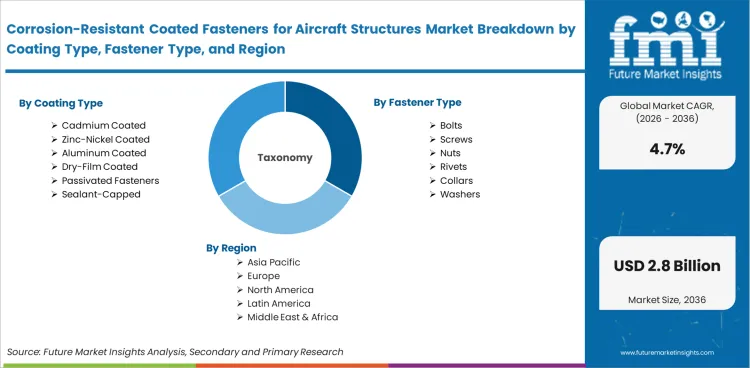
Market segmentation covers coating type, fastener type, material, aircraft type, application area, sales channel, and region. Coating type includes cadmium coated, zinc-nickel coated, aluminum coated, dry-film coated, passivated fasteners, and sealant-capped formats. Fastener type covers bolts, screws, nuts, rivets, collars, and washers. Material includes alloy steel, titanium, stainless steel, aluminum alloy, and nickel alloy. Aircraft type includes commercial aircraft, military aircraft, business jets, helicopters, and regional aircraft. Application area covers fuselage structures, wing structures, landing gear, engine pylons, and tail sections.
Insights into Corrosion-Resistant Coated Fasteners for Aircraft Structures Market by Coating Type
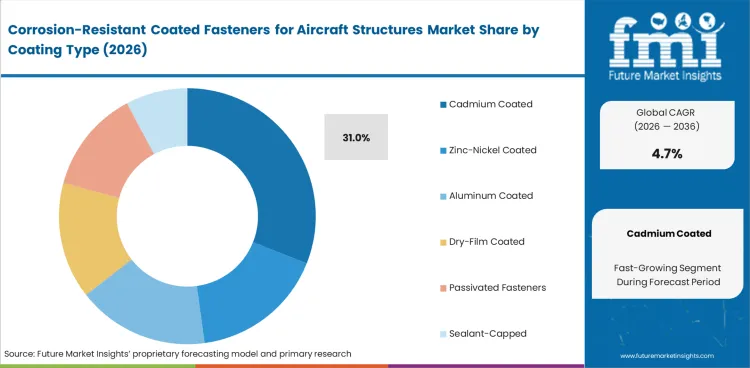
- Cadmium-coated fasteners are projected to represent 31.0% in the forecast base year as legacy aircraft approvals still specify cadmium finishes for many structural locations.
- Zinc-nickel coated fasteners are receiving more attention in new qualification work since low-hydrogen embrittlement plating reduces cadmium exposure in selected aerospace programs.
Insights into Corrosion-Resistant Coated Fasteners for Aircraft Structures Market by Fastener Type
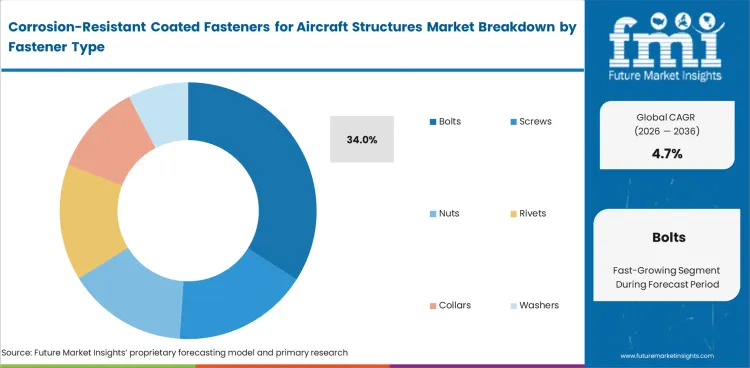
- By 2026, bolts are expected to lead with 34.0% because primary structural joints need predictable clamp load under vibration.
- Rivets and collars stay important in skin and frame assembly. Bolts carry higher unit value through strength grade and coating qualification needs.
Insights into Corrosion-Resistant Coated Fasteners for Aircraft Structures Market by Material
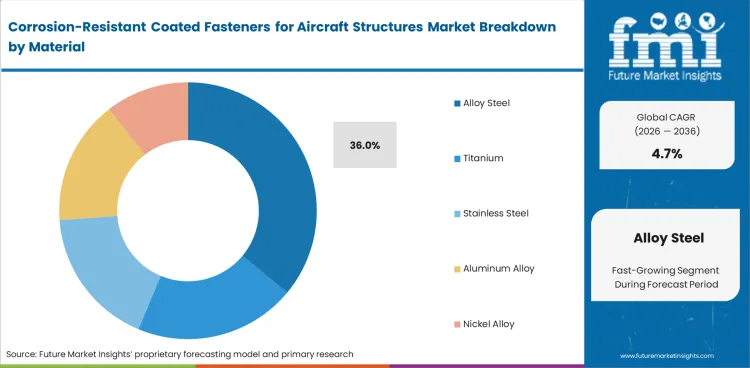
- Alloy steel is forecast to represent 36.0% in 2026 because high-strength structural fasteners need proven fatigue resistance.
- Titanium fasteners are used more often near composite structures because galvanic behavior and weight control affect fastener selection.
Insights into Corrosion-Resistant Coated Fasteners for Aircraft Structures Market by Aircraft Type
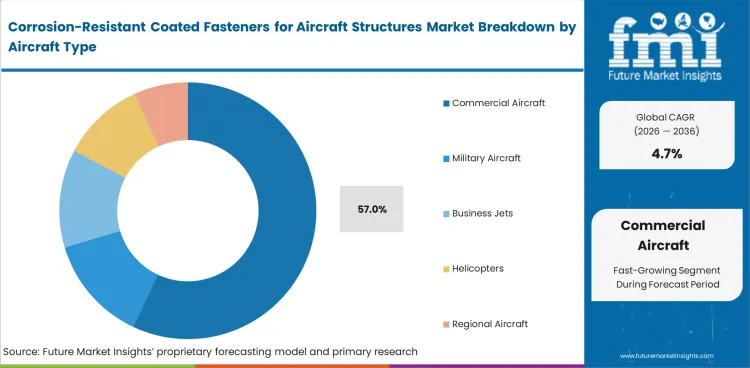
- Commercial aircraft are estimated to hold 57.0% in 2026, supported by large airframe output and recurring structural maintenance needs.
- Military aircraft demand is smaller in unit terms. Coated fastener value rises when programs specify harsh-environment finishes.
Insights into Corrosion-Resistant Coated Fasteners for Aircraft Structures Market by Application Area
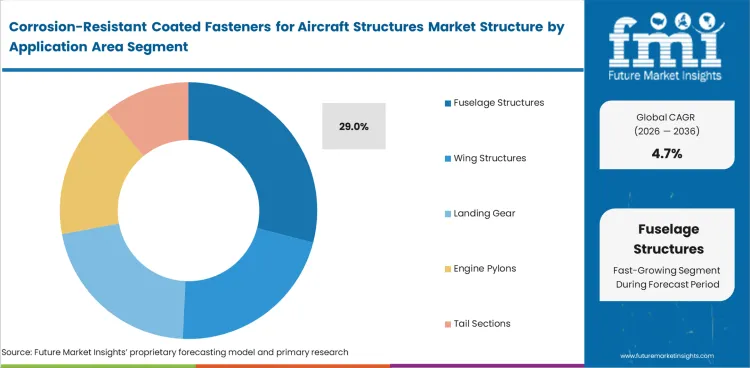
- Fuselage structures are projected to capture 29.0% in 2026 as skin panels and frames use high volumes of corrosion-resistant fasteners.
- Landing gear locations need deeper coating scrutiny because water exposure and deicing fluid can damage coatings around exposed joints.
Insights into Corrosion-Resistant Coated Fasteners for Aircraft Structures Market by Sales Channel
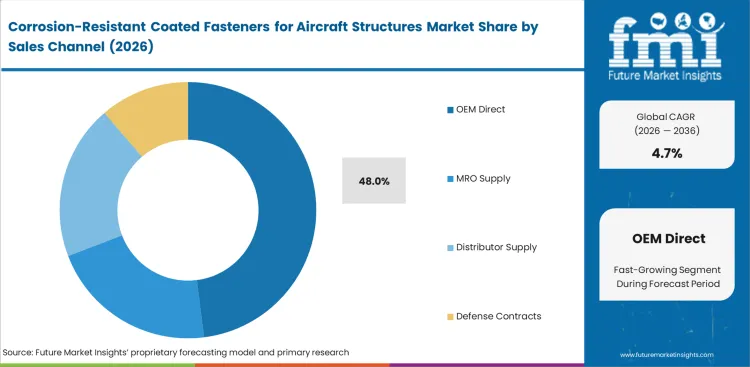
- In 2026, OEM direct supply is anticipated to represent 48.0% as airframe programs use approved supplier lists and batch traceability.
- Distributor supply supports MRO work when aircraft-on-ground repairs need fast delivery of approved coated fasteners with full documentation.
Corrosion-Resistant Coated Fasteners for Aircraft Structures Market Drivers, Restraints, and Opportunities
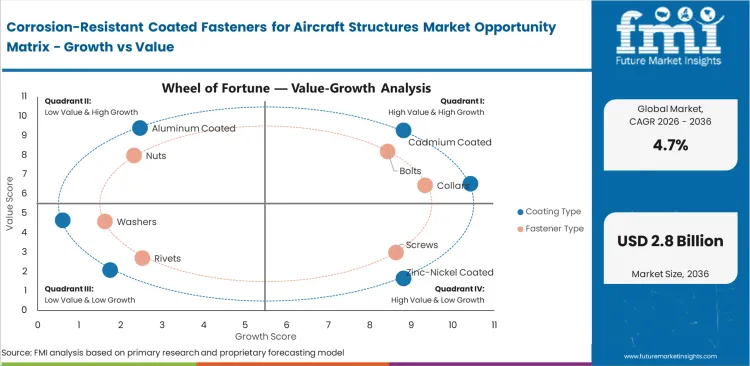
- Airframe production schedules create repeat demand for approved coated fasteners used in fuselage and wing joints.
- Cadmium replacement pressure increases interest in zinc-nickel coatings as aerospace users seek lower exposure risk.
- Composite structures raise the value of material and coating pairing as galvanic corrosion can start around fastener holes.
- Approval cost limits fast coating substitution since each finish needs corrosion and embrittlement proof.
- MRO repair kits offer supplier opportunity when approved fasteners are paired with compatible sealants and surface treatment guidance.
Airframe Qualification Lock-In
Aircraft fastener supply depends on approved finishes and documented process control. The Defense Logistics Agency’s QPL-32648 for MIL-DTL-32648 was last updated on May 20, 2025 and lists 8 qualified items for zinc-nickel plating. A low qualified count shows why coating substitution moves slowly in aerospace fastener supply. Aircraft programs need repeatable plating chemistry before a coated fastener can enter structural use. Suppliers with qualified coating routes can hold share when airframers look for cadmium alternatives.
Fastener-Hole Touchup Control
MRO repair work creates demand for coated fasteners that match approved surface treatment steps. Henkel introduced BONDERITE M-CR 1132 M AERO Pen in September 2025 for aircraft touch-up in hard-to-reach areas such as fastener holes. The pen supports controlled chromate conversion coating on bare aluminum substrates and can reach fastener holes as small as 3/16 inch. Surface preparation matters because coated fasteners often need prepared contact surfaces before sealing and final installation. Suppliers that pair approved fasteners with compatible touch-up guidance can gain stronger acceptance in aircraft repair workflows.
Analysis of Corrosion-Resistant Coated Fasteners for Aircraft Structures Market by Key Countries
.webp "Top Country Growth Comparison Corrosion Resistant Coated Fasteners For Aircraft Structures Market Cagr (2026 2036)")
| Country | CAGR |
|---|---|
| India | 6.6% |
| China | 6.2% |
| United States | 4.9% |
| France | 4.8% |
| Germany | 4.6% |
| United Kingdom | 4.4% |
| Japan | 4.3% |
Source: FMI analysis based on primary research and proprietary forecasting model.
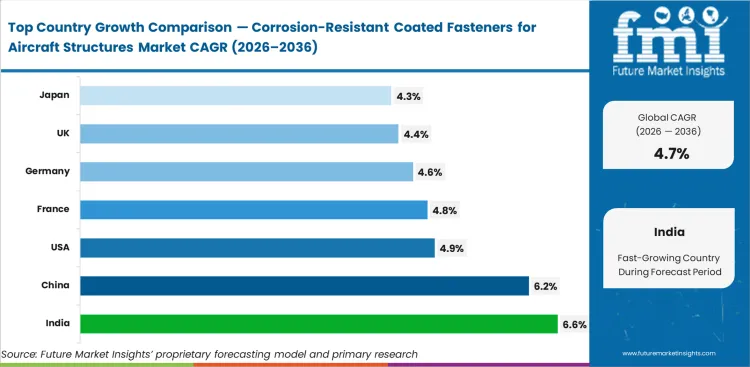
Corrosion-Resistant Coated Fasteners for Aircraft Structures Market CAGR Analysis By Country
- India leads country growth at 6.6% CAGR between 2026 and 2036 as fleet additions raise fastener demand.
- China is forecast at 6.2% CAGR as aircraft programs advance and fleet size increases.
- The United States is projected to grow at 4.9% CAGR by 2036 due to OEM and MRO depth.
- France reaches 4.8% CAGR in the assessment period through Airbus-linked supplier activity.
- Germany records 4.6% CAGR as precision aerospace production supports coated fastener use.
- The United Kingdom is forecast at 4.4% CAGR over the study period due to wing and MRO work.
- Japan posts 4.3% CAGR by 2036 as aircraft parts production supports high-spec hardware demand.
Demand Outlook for Corrosion-Resistant Coated Fasteners for Aircraft Structures Market in India
Fleet expansion influences demand in India, making it one of the leading countries for coated structural fasteners. India is projected to record 6.6% CAGR during the assessment period as airlines add narrowbody aircraft and domestic routes increase aircraft use. MRO suppliers capture value as coated fastener availability matches aircraft turnaround needs. Defense programs add another demand base through approved repair hardware and coating traceability.
- Regional airport expansion widens aircraft maintenance needs outside major metro hubs.
- Bengaluru and Hyderabad aerospace clusters support structural assembly through nearby airframe suppliers.
- Defense aviation programs raise demand for approved coated fasteners and repair hardware.
Sales Analysis of Corrosion-Resistant Coated Fasteners for Aircraft Structures Market in China
China industry is shaped by local aircraft production and fleet scale. At 6.2% CAGR by 2036, the country is expected to grow faster than the global average as domestic aircraft programs increase structural hardware needs. Qualified coating capacity close to assembly centers can help suppliers serve OEM and MRO demand. Airworthiness documentation will decide supplier acceptance.
- Provincial aviation hubs increase the need for qualified structural repair parts.
- Shanghai and Chengdu aircraft activity supports coated fastener demand around local assembly.
- Domestic aircraft programs create space for suppliers with approved coating capability.
Demand Analysis of Corrosion-Resistant Coated Fasteners for Aircraft Structures Market in United States
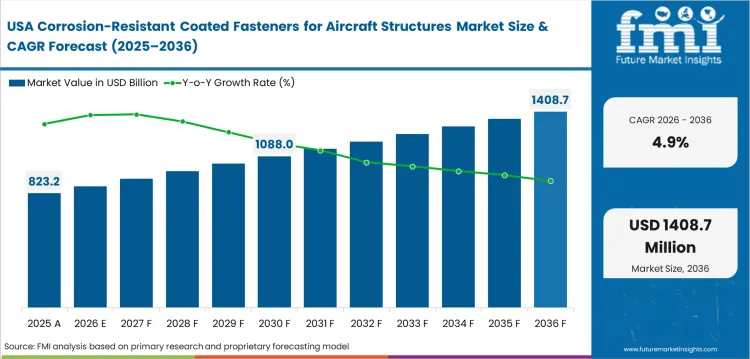
United States draws on a deep base of aircraft manufacturing and certified maintenance activity. Fastener suppliers capture value when they combine approved coating routes with quick delivery for aircraft-on-ground repair. OEM output and MRO depth support a 4.9% CAGR over the study period. FAA oversight keeps documentation and traceability central to coated fastener sourcing.
- Wichita supports machined fastener supply through its established aerospace manufacturing base.
- Southern California coating and aerospace suppliers support commercial aircraft programs.
- FAA airworthiness oversight keeps traceability central to coated fastener sourcing.
Opportunity Analysis of Corrosion-Resistant Coated Fasteners for Aircraft Structures Market in France
France holds an established position in European airframe assembly and supplier qualification. Demand is expected to advance at 4.8% CAGR in the forecast timeframe as Airbus-related production and repair activity keep coated structural fasteners in use. Export-oriented aerospace suppliers need coating documentation that can travel across global aircraft programs. Toulouse remains central to this demand base.
- Toulouse aircraft assembly creates demand for approved structural fasteners.
- Aerospace supplier depth in France supports coating qualification and documentation work.
- Public aerospace research programs support material testing and process validation.
Future Outlook for Corrosion-Resistant Coated Fasteners for Aircraft Structures Market in Germany
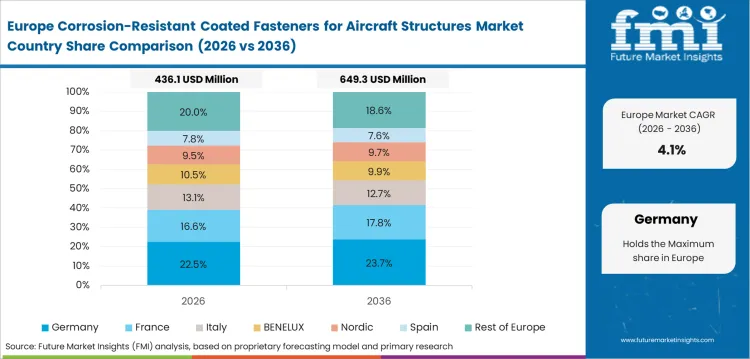
Germany is projected to rise at 4.6% CAGR by 2036 as structural parts work sustains demand for coated fasteners. Germany industry is rising owing to precision aerospace production and certified component manufacturing. German suppliers often compete on process control and tight documentation. Process discipline supports use in metallic structures and composite-adjacent assemblies.
- Hamburg aircraft production supports coated fastener use across fuselage sections.
- Bavaria’s aerospace cluster supports precision machining and certified component supply.
- Civil aviation manufacturing activity strengthens demand for structural hardware suppliers.
Demand Outlook for Corrosion-Resistant Coated Fasteners for Aircraft Structures Market in the United Kingdom
United Kingdom demand centers on wing structures and landing gear expertise. Demand is forecast at 4.4% CAGR during the assessment period as certified component production and MRO work continue. Suppliers with approved coating routes can serve new-build and repair demand. Broughton and Belfast remain important structural hardware demand centers.
- Broughton wing activity supports corrosion-resistant fastener use in wing boxes.
- Belfast aerospace production supports structural hardware demand in aerostructure supply chains.
- UK aircraft structure suppliers need approved coatings for export-oriented programs.
In-depth Analysis of Corrosion-Resistant Coated Fasteners for Aircraft Structures Market in Japan
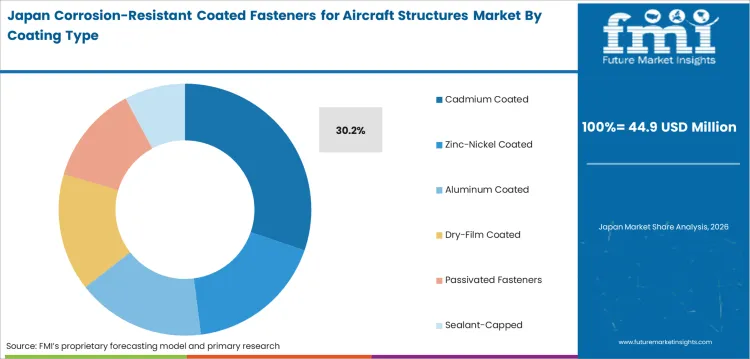
Demand in Japan comes from high-spec component production and aircraft parts imports. Japan is expected to post 4.3% CAGR by 2036 as local suppliers serve global programs and domestic maintenance. Import depth gives approved coated fastener suppliers a path into MRO and component supply. Documentation quality remains a key supplier selection factor.
- Nagoya remains central to the aerostructure supply chain in Japan.
- Aircraft component suppliers in Japan support high-spec fastener demand.
- Imported aircraft parts create opportunities for approved coated fastener suppliers.
Competitive Landscape and Strategic Positioning
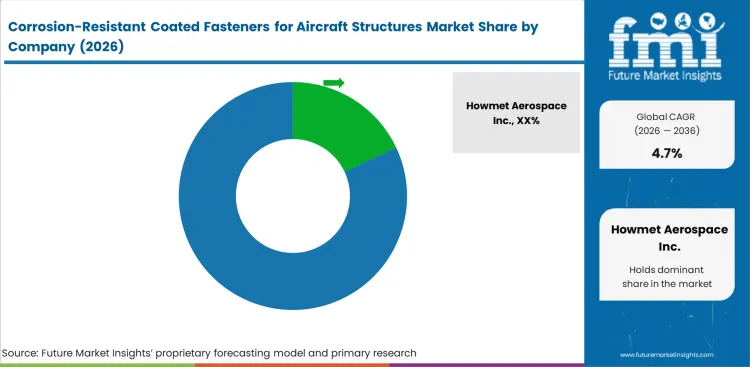
- Market competition is moderately concentrated because aircraft programs rely on approved suppliers with controlled coating processes.
- Leading companies compete through structural fastener breadth and airframe program access.
- Specialist suppliers compete through short-run hardware, legacy part support and close MRO service.
- Entry barriers stay high because coating changes need corrosion proof and embrittlement evidence before aircraft use.
Competition outlook in the market is driven by approved product depth and not catalogue size. Howmet Aerospace Inc. positions Howmet Fastening Systems as a designer and manufacturer of precision aircraft fasteners and installation tools for commercial and military aircraft. Its aerospace portfolio includes blind bolts and blind rivets, with broader fastener families serving structural aircraft needs. Airframe programs prefer suppliers that can cover multiple hardware needs under controlled documentation.
Specialist suppliers still compete when application support and delivery discipline matter, especially across the aerospace defense c class parts market. B&B Specialties, Inc. manufactures aerospace quality fasteners using high-strength and high-temperature materials. National Aerospace Fasteners Corporation states that it focuses on aerospace fastener products and advanced industrial applications. Specialist suppliers can support legacy programs, replacement work and smaller production needs. MRO accounts often need approved hardware quickly, so practical availability can matter as much as product range.
Key Companies in the Corrosion-Resistant Coated Fasteners for Aircraft Structures Market
- Global Fastener Leaders: Howmet Aerospace Inc., LISI Aerospace and Precision Castparts Corp. compete through structural fastener portfolios used across major aircraft programs.
- Specialist and Regional Suppliers: PennAero, B&B Specialties, National Aerospace Fasteners Corporation and Poggipolini compete through qualified hardware supply for OEM and MRO accounts.
- Coating and Sealant Adjacent Suppliers: Henkel, PPG and SOCOMORE support the fastener supply chain through conversion coatings, sealant caps and corrosion protection products.
Competitive Benchmarking: Corrosion-Resistant Coated Fasteners for Aircraft Structures Market
| Company | Coating Qualification Depth | Structural Fastener Breadth | Airframe Program Access | Geographic Footprint |
|---|---|---|---|---|
| Howmet Aerospace Inc. | High | High | Strong | Global |
| LISI Aerospace | High | High | Strong | Global |
| Precision Castparts Corp. | High | High | Strong | Global |
| PennAero | High | High | Strong | North America and Europe |
| Stanley Engineered Fastening | Medium | Medium | Moderate | Global |
| National Aerospace Fasteners Corporation | Medium | Medium | Moderate | Asia and North America |
| B&B Specialties, Inc. | Medium | Medium | Moderate | North America |
| Poggipolini S.p.A. | Medium | Medium | Moderate | Europe |
| Böllhoff Group | Medium | Medium | Moderate | Global |
Source: Future Market Insights competitive analysis, 2026. Ratings reflect relative positioning based on coating qualification depth, structural fastener breadth, and airframe program access.
Key Developments in Corrosion-Resistant Coated Fasteners for Aircraft Structures Market
- In July 2025, LISI AEROSPACE announced the renewal of its “Fasteners” contract with Airbus. The renewal strengthens LISI AEROSPACE as a long-term supplier for aircraft structural fastening programs.
- In April 2026, Böllhoff Group expanded its aerospace operations in Casablanca through an EN9100-certified site. The site supports Collins Aerospace in the A320 program ramp-up with reliable local fastening and assembly support.
Key Players in the Corrosion-Resistant Coated Fasteners for Aircraft Structures Market
Global Fastener Leaders
- Howmet Aerospace Inc.
- LISI Aerospace
- Precision Castparts Corp.
- Stanley Engineered Fastening
Specialist and Regional Suppliers
- PennAero
- B&B Specialties, Inc.
- National Aerospace Fasteners Corporation
- Poggipolini S.p.A.
- Böllhoff Group
Coating and Sealant Adjacent Suppliers
- Henkel AG & Co. KGaA
- PPG Industries, Inc.
- SOCOMORE
Report Scope and Coverage
| Parameter | Details |
|---|---|
| Quantitative Units | USD 1.8 billion to USD 2.8 billion, at a CAGR of 4.7% |
| Market Definition | Coated structural fasteners used in aircraft fuselage, wing, landing gear, pylon, and tail structures |
| Regions Covered | North America, Latin America, Europe, East Asia, South Asia and Pacific, Middle East and Africa |
| Countries Covered | India, China, United States, France, Germany, United Kingdom, Japan, 30+ countries |
| Key Companies Profiled | Howmet Aerospace Inc., LISI Aerospace, Precision Castparts Corp., PennAero, Stanley Engineered Fastening, B&B Specialties, Inc., National Aerospace Fasteners Corporation |
| Forecast Period | 2026 to 2036 |
| Approach | Hybrid bottom-up and top-down methodology starting with verified transaction data and aircraft program demand checks |
Corrosion-Resistant Coated Fasteners for Aircraft Structures Market by Segments
Corrosion-Resistant Coated Fasteners for Aircraft Structures Market Segmented by Coating Type:
- Cadmium Coated
- Zinc-Nickel Coated
- Aluminum Coated
- Dry-Film Coated
- Passivated Fasteners
- Sealant-Capped
Corrosion-Resistant Coated Fasteners for Aircraft Structures Market Segmented by Fastener Type:
- Bolts
- Screws
- Nuts
- Rivets
- Collars
- Washers
Corrosion-Resistant Coated Fasteners for Aircraft Structures Market Segmented by Material:
- Alloy Steel
- Titanium
- Stainless Steel
- Aluminum Alloy
- Nickel Alloy
Corrosion-Resistant Coated Fasteners for Aircraft Structures Market Segmented by Aircraft Type:
- Commercial Aircraft
- Military Aircraft
- Business Jets
- Helicopters
- Regional Aircraft
Corrosion-Resistant Coated Fasteners for Aircraft Structures Market Segmented by Application Area:
- Fuselage Structures
- Wing Structures
- Landing Gear
- Engine Pylons
- Tail Sections
Corrosion-Resistant Coated Fasteners for Aircraft Structures Market Segmented by Sales Channel:
- OEM Direct
- MRO Supply
- Distributor Supply
- Defense Contracts
Corrosion-Resistant Coated Fasteners for Aircraft Structures Market by Region:
- North America
- United States
- Canada
- Mexico
- Latin America
- Brazil
- Chile
- Rest of Latin America
- Western Europe
- Germany
- UK
- Italy
- Spain
- France
- Nordic
- BENELUX
- Rest of Western Europe
- Eastern Europe
- Russia
- Poland
- Hungary
- Balkan & Baltic
- Rest of Eastern Europe
- East Asia
- China
- Japan
- South Korea
- South Asia and Pacific
- India
- ASEAN
- Australia & New Zealand
- Rest of South Asia and Pacific
- Middle East & Africa
- Kingdom of Saudi Arabia
- Other GCC Countries
- Turkiye
- South Africa
- Other African Union
- Rest of Middle East & Africa
Research Sources and Bibliography
- Airbus. (2026, January 12). Airbus reports 793 commercial aircraft deliveries in 2025. Airbus.
- International Air Transport Association. (2026, January 29). Strong 2025 passenger demand masks ongoing capacity constraints. IATA.
- Defense Logistics Agency. (2025, May 20). QPL-32648 qualified products list: MIL-DTL-32648 zinc nickel plating, low hydrogen embrittlement electro-deposition. Defense Logistics Agency.
- Henkel AG & Co. KGaA. (2025, September 16). Henkel compact conversion coating pen simplifies aircraft touchup. Henkel.
- Howmet Aerospace Inc. (2026, February 12). Howmet Aerospace reports fourth quarter and full year 2025 results. Howmet Aerospace Inc.
- National Aerospace Fasteners Corporation. (2024, March 31). 2023 annual report. National Aerospace Fasteners Corporation.
- LISI Group. (2025, July 24). The LISI Group achieved record sales of nearly €980 million in the first half of 2025 and significantly improved its key financial indicators. LISI Group.
- Böllhoff Group. (2026, April 27). A new milestone for Böllhoff in aerospace. Böllhoff Group.
The bibliography is provided for reader reference and uses official company, government, regulatory, or trade body sources.
This Report Answers
- What is the current and future value of the corrosion-resistant coated fasteners for aircraft structures market?
- What CAGR is forecast for coated aircraft structural fasteners during the assessment period?
- Which coating type is projected to lead aircraft structural fastener demand in 2026?
- Which fastener type is expected to hold a strong share in aircraft structure applications?
- How do corrosion-control rules and coating approvals affect supplier selection in aircraft programs?
- Which countries are forecast to grow fastest in coated aircraft structural fastener demand?
- How do aircraft OEM and MRO channels shape coated fastener sales?
- Which companies are positioned across approved aerospace fasteners and corrosion-control support?
- How does FMI define the corrosion-resistant coated fasteners for aircraft structures scope?
- What methodology was used to forecast coated fastener demand by coating type and aircraft structure?
Frequently Asked Questions
What is the global market demand for corrosion-resistant coated fasteners for aircraft structures in 2026?
In 2026, the global market is forecast to be worth USD 1.8 billion with demand coming from OEM and MRO programs.
How large will the corrosion-resistant coated fasteners for aircraft structures market be by 2036?
By 2036, the market is forecast to reach USD 2.8 billion as structural maintenance and aircraft output expand.
What CAGR is forecast for corrosion-resistant coated aircraft structural fasteners?
Market demand is projected to grow at 4.7% CAGR during the assessment period as approved fastener demand rises.
Which coating type is projected to lead demand in 2026?
Cadmium-coated fasteners are estimated to hold 31.0% coating type share in 2026 due to legacy program approvals.
Which sales channel is expected to lead coated aircraft structural fastener demand?
OEM direct supply is anticipated to represent 48.0% sales channel demand in 2026 due to program-level source control.
Why is India forecast to grow faster than other major countries?
India is projected to record 6.6% CAGR through 2036 as fleet orders and regional aviation increase fastener demand.
What does this market include?
Scope includes coated structural bolts, screws, nuts, rivets, collars and washers used across aircraft load-bearing structures.
How does FMI estimate the market forecast?
FMI uses aircraft output, replacement cycles, coating mix, channel pricing and country-level aerospace activity to estimate demand.
Preview the report firsthand - request a free sample
Get SampleGet the brochure for pricing and purchase details.
Get PDFTable of Content
- Key Takeaways
- Market Size and CAGR
- Top Growth Driver
- Fastest Growing Segment
- Leading Region
- Key Companies
- Emerging Opportunities
- Executive Summary
- Global Market Outlook
- Demand-side Trends
- Supply-side Trends
- Technology Roadmap Analysis
- Analysis and Recommendations
- Analyst Perspective (What is happening? Why now? What should investors know?)
- Key Questions Answered
- How large is the market?
- What is the CAGR?
- What are key trends?
- Which region dominates?
- Who are the leaders?
- Market Overview
- Market Coverage / Taxonomy
- Market Definition / Scope / Limitations
- Research Methodology
- Chapter Orientation
- Analytical Lens and Working Hypotheses
- Market Structure, Signals, and Trend Drivers
- Benchmarking and Cross-market Comparability
- Market Sizing, Forecasting, and Opportunity Mapping
- Research Design and Evidence Framework
- Desk Research Programme (Secondary Evidence)
- Expert Input and Fieldwork (Primary Evidence)
- Tooling, Models, and Reference Databases
- Data Engineering and Model Build
- Quality Assurance and Audit Trail
- Market Background
- Market Dynamics (Drivers, Restraints, Opportunity, Trends)
- Scenario Forecast (Optimistic, Likely, Conservative)
- Impact Analysis
- AI Impact
- Sustainability Impact
- Regulatory Impact
- Technology Impact
- Consumer / Buyer Analysis
- Purchase Drivers
- Adoption Barriers
- Buyer Journey
- Opportunity Map Analysis
- Product Life Cycle Analysis
- Supply Chain Analysis
- Investment Feasibility Matrix
- Value Chain Analysis
- PESTLE and Porter's Analysis
- Regulatory Landscape
- Regional Parent Market Outlook
- Production and Consumption Statistics
- Import and Export Statistics
- Global Market Analysis and Forecast, 2021 to 2036
- Historical Market Size Value (USD Billion) & Volume (Unit) Analysis, 2021 to 2025
- Current and Future Market Size Value (USD Billion) & Volume (Unit) Projections, 2026 to 2036
- Y-o-Y Growth Trend Analysis
- Absolute $ Opportunity Analysis
- Global Market Pricing Analysis, 2021 to 2036
- Global Market Analysis and Forecast, By Coating Type, 2021 to 2036
- Introduction / Key Findings
- Historical Market Size Value (USD Billion) & Volume (Unit) Analysis By Coating Type, 2021 to 2025
- Current and Future Market Size Value (USD Billion) & Volume (Unit) Analysis and Forecast By Coating Type, 2026 to 2036
- Cadmium Coated
- Zinc-Nickel Coated
- Aluminum Coated
- Dry-Film Coated
- Passivated Fasteners
- Sealant-Capped
- Cadmium Coated
- Y-o-Y Growth Trend Analysis By Coating Type, 2021 to 2025
- Absolute $ Opportunity Analysis By Coating Type, 2026 to 2036
- Global Market Analysis and Forecast, By Fastener Type, 2021 to 2036
- Introduction / Key Findings
- Historical Market Size Value (USD Billion) & Volume (Unit) Analysis By Fastener Type, 2021 to 2025
- Current and Future Market Size Value (USD Billion) & Volume (Unit) Analysis and Forecast By Fastener Type, 2026 to 2036
- Bolts
- Screws
- Nuts
- Rivets
- Collars
- Washers
- Bolts
- Y-o-Y Growth Trend Analysis By Fastener Type, 2021 to 2025
- Absolute $ Opportunity Analysis By Fastener Type, 2026 to 2036
- Global Market Analysis and Forecast, By Material, 2021 to 2036
- Introduction / Key Findings
- Historical Market Size Value (USD Billion) & Volume (Unit) Analysis By Material, 2021 to 2025
- Current and Future Market Size Value (USD Billion) & Volume (Unit) Analysis and Forecast By Material, 2026 to 2036
- Alloy Steel
- Titanium
- Stainless Steel
- Aluminum Alloy
- Nickel Alloy
- Alloy Steel
- Y-o-Y Growth Trend Analysis By Material, 2021 to 2025
- Absolute $ Opportunity Analysis By Material, 2026 to 2036
- Global Market Analysis and Forecast, By Aircraft Type, 2021 to 2036
- Introduction / Key Findings
- Historical Market Size Value (USD Billion) & Volume (Unit) Analysis By Aircraft Type, 2021 to 2025
- Current and Future Market Size Value (USD Billion) & Volume (Unit) Analysis and Forecast By Aircraft Type, 2026 to 2036
- Commercial Aircraft
- Military Aircraft
- Business Jets
- Helicopters
- Regional Aircraft
- Commercial Aircraft
- Y-o-Y Growth Trend Analysis By Aircraft Type, 2021 to 2025
- Absolute $ Opportunity Analysis By Aircraft Type, 2026 to 2036
- Global Market Analysis and Forecast, By Application Area, 2021 to 2036
- Introduction / Key Findings
- Historical Market Size Value (USD Billion) & Volume (Unit) Analysis By Application Area, 2021 to 2025
- Current and Future Market Size Value (USD Billion) & Volume (Unit) Analysis and Forecast By Application Area, 2026 to 2036
- Fuselage Structures
- Wing Structures
- Landing Gear
- Engine Pylons
- Tail Sections
- Fuselage Structures
- Y-o-Y Growth Trend Analysis By Application Area, 2021 to 2025
- Absolute $ Opportunity Analysis By Application Area, 2026 to 2036
- Global Market Analysis and Forecast, By Sales Channel
- Introduction / Key Findings
- Historical Market Size Value (USD Billion) & Volume (Unit) Analysis By Sales Channel, 2021 to 2025
- Current and Future Market Size Value (USD Billion) & Volume (Unit) Analysis and Forecast By Sales Channel, 2026 to 2036
- OEM Direct
- MRO Supply
- Distributor Supply
- Defense Contracts
- OEM Direct
- Y-o-Y Growth Trend Analysis By Sales Channel, 2021 to 2025
- Absolute $ Opportunity Analysis By Sales Channel, 2026 to 2036
- Global Market Analysis and Forecast, By Region, 2021 to 2036
- Introduction
- Historical Market Size Value (USD Billion) & Volume (Unit) Analysis By Region, 2021 to 2025
- Current Market Size Value (USD Billion) & Volume (Unit) Analysis and Forecast By Region, 2026 to 2036
- North America
- Latin America
- Western Europe
- Eastern Europe
- East Asia
- South Asia and Pacific
- Middle East & Africa
- Market Attractiveness Analysis By Region
- North America Market Analysis and Forecast, By Country, 2021 to 2036
- Historical Market Size Value (USD Billion) & Volume (Unit) Trend Analysis By Market Taxonomy, 2021 to 2025
- Market Size Value (USD Billion) & Volume (Unit) Forecast By Market Taxonomy, 2026 to 2036
- By Country
- USA
- Canada
- Mexico
- By Coating Type
- By Fastener Type
- By Material
- By Aircraft Type
- By Application Area
- By Sales Channel
- By Country
- Market Attractiveness Analysis
- By Country
- By Coating Type
- By Fastener Type
- By Material
- By Aircraft Type
- By Application Area
- By Sales Channel
- Key Takeaways
- Latin America Market Analysis and Forecast, By Country
- Historical Market Size Value (USD Billion) & Volume (Unit) Trend Analysis By Market Taxonomy, 2021 to 2025
- Market Size Value (USD Billion) & Volume (Unit) Forecast By Market Taxonomy, 2026 to 2036
- By Country
- Brazil
- Chile
- Rest of Latin America
- By Coating Type
- By Fastener Type
- By Material
- By Aircraft Type
- By Application Area
- By Sales Channel
- By Country
- Market Attractiveness Analysis
- By Country
- By Coating Type
- By Fastener Type
- By Material
- By Aircraft Type
- By Application Area
- By Sales Channel
- Key Takeaways
- Western Europe Market Analysis and Forecast, By Country
- Historical Market Size Value (USD Billion) & Volume (Unit) Trend Analysis By Market Taxonomy, 2021 to 2025
- Market Size Value (USD Billion) & Volume (Unit) Forecast By Market Taxonomy, 2026 to 2036
- By Country
- Germany
- UK
- Italy
- Spain
- France
- Nordic
- BENELUX
- Rest of Western Europe
- By Coating Type
- By Fastener Type
- By Material
- By Aircraft Type
- By Application Area
- By Sales Channel
- By Country
- Market Attractiveness Analysis
- By Country
- By Coating Type
- By Fastener Type
- By Material
- By Aircraft Type
- By Application Area
- By Sales Channel
- Key Takeaways
- Eastern Europe Market Analysis and Forecast, By Country
- Historical Market Size Value (USD Billion) & Volume (Unit) Trend Analysis By Market Taxonomy, 2021 to 2025
- Market Size Value (USD Billion) & Volume (Unit) Forecast By Market Taxonomy, 2026 to 2036
- By Country
- Russia
- Poland
- Hungary
- Balkan & Baltic
- Rest of Eastern Europe
- By Coating Type
- By Fastener Type
- By Material
- By Aircraft Type
- By Application Area
- By Sales Channel
- By Country
- Market Attractiveness Analysis
- By Country
- By Coating Type
- By Fastener Type
- By Material
- By Aircraft Type
- By Application Area
- By Sales Channel
- Key Takeaways
- East Asia Market Analysis and Forecast, By Country
- Historical Market Size Value (USD Billion) & Volume (Unit) Trend Analysis By Market Taxonomy, 2021 to 2025
- Market Size Value (USD Billion) & Volume (Unit) Forecast By Market Taxonomy, 2026 to 2036
- By Country
- China
- Japan
- South Korea
- By Coating Type
- By Fastener Type
- By Material
- By Aircraft Type
- By Application Area
- By Sales Channel
- By Country
- Market Attractiveness Analysis
- By Country
- By Coating Type
- By Fastener Type
- By Material
- By Aircraft Type
- By Application Area
- By Sales Channel
- Key Takeaways
- South Asia and Pacific Market Analysis and Forecast, By Country
- Historical Market Size Value (USD Billion) & Volume (Unit) Trend Analysis By Market Taxonomy, 2021 to 2025
- Market Size Value (USD Billion) & Volume (Unit) Forecast By Market Taxonomy, 2026 to 2036
- By Country
- India
- ASEAN
- Australia & New Zealand
- Rest of South Asia and Pacific
- By Coating Type
- By Fastener Type
- By Material
- By Aircraft Type
- By Application Area
- By Sales Channel
- By Country
- Market Attractiveness Analysis
- By Country
- By Coating Type
- By Fastener Type
- By Material
- By Aircraft Type
- By Application Area
- By Sales Channel
- Key Takeaways
- Middle East & Africa Market Analysis and Forecast, By Country
- Historical Market Size Value (USD Billion) & Volume (Unit) Trend Analysis By Market Taxonomy, 2021 to 2025
- Market Size Value (USD Billion) & Volume (Unit) Forecast By Market Taxonomy, 2026 to 2036
- By Country
- Kingdom of Saudi Arabia
- Other GCC Countries
- Türkiye
- South Africa
- Other African Union
- Rest of Middle East & Africa
- By Coating Type
- By Fastener Type
- By Material
- By Aircraft Type
- By Application Area
- By Sales Channel
- By Country
- Market Attractiveness Analysis
- By Country
- By Coating Type
- By Fastener Type
- By Material
- By Aircraft Type
- By Application Area
- By Sales Channel
- Key Takeaways
- Key Countries Market Analysis
- USA
- Pricing Analysis
- Market Share Analysis, 2025
- By Coating Type
- By Fastener Type
- By Material
- By Aircraft Type
- By Application Area
- By Sales Channel
- Canada
- Pricing Analysis
- Market Share Analysis, 2025
- By Coating Type
- By Fastener Type
- By Material
- By Aircraft Type
- By Application Area
- By Sales Channel
- Mexico
- Pricing Analysis
- Market Share Analysis, 2025
- By Coating Type
- By Fastener Type
- By Material
- By Aircraft Type
- By Application Area
- By Sales Channel
- Brazil
- Pricing Analysis
- Market Share Analysis, 2025
- By Coating Type
- By Fastener Type
- By Material
- By Aircraft Type
- By Application Area
- By Sales Channel
- Chile
- Pricing Analysis
- Market Share Analysis, 2025
- By Coating Type
- By Fastener Type
- By Material
- By Aircraft Type
- By Application Area
- By Sales Channel
- Germany
- Pricing Analysis
- Market Share Analysis, 2025
- By Coating Type
- By Fastener Type
- By Material
- By Aircraft Type
- By Application Area
- By Sales Channel
- UK
- Pricing Analysis
- Market Share Analysis, 2025
- By Coating Type
- By Fastener Type
- By Material
- By Aircraft Type
- By Application Area
- By Sales Channel
- Italy
- Pricing Analysis
- Market Share Analysis, 2025
- By Coating Type
- By Fastener Type
- By Material
- By Aircraft Type
- By Application Area
- By Sales Channel
- Spain
- Pricing Analysis
- Market Share Analysis, 2025
- By Coating Type
- By Fastener Type
- By Material
- By Aircraft Type
- By Application Area
- By Sales Channel
- France
- Pricing Analysis
- Market Share Analysis, 2025
- By Coating Type
- By Fastener Type
- By Material
- By Aircraft Type
- By Application Area
- By Sales Channel
- India
- Pricing Analysis
- Market Share Analysis, 2025
- By Coating Type
- By Fastener Type
- By Material
- By Aircraft Type
- By Application Area
- By Sales Channel
- ASEAN
- Pricing Analysis
- Market Share Analysis, 2025
- By Coating Type
- By Fastener Type
- By Material
- By Aircraft Type
- By Application Area
- By Sales Channel
- Australia & New Zealand
- Pricing Analysis
- Market Share Analysis, 2025
- By Coating Type
- By Fastener Type
- By Material
- By Aircraft Type
- By Application Area
- By Sales Channel
- China
- Pricing Analysis
- Market Share Analysis, 2025
- By Coating Type
- By Fastener Type
- By Material
- By Aircraft Type
- By Application Area
- By Sales Channel
- Japan
- Pricing Analysis
- Market Share Analysis, 2025
- By Coating Type
- By Fastener Type
- By Material
- By Aircraft Type
- By Application Area
- By Sales Channel
- South Korea
- Pricing Analysis
- Market Share Analysis, 2025
- By Coating Type
- By Fastener Type
- By Material
- By Aircraft Type
- By Application Area
- By Sales Channel
- Russia
- Pricing Analysis
- Market Share Analysis, 2025
- By Coating Type
- By Fastener Type
- By Material
- By Aircraft Type
- By Application Area
- By Sales Channel
- Poland
- Pricing Analysis
- Market Share Analysis, 2025
- By Coating Type
- By Fastener Type
- By Material
- By Aircraft Type
- By Application Area
- By Sales Channel
- Hungary
- Pricing Analysis
- Market Share Analysis, 2025
- By Coating Type
- By Fastener Type
- By Material
- By Aircraft Type
- By Application Area
- By Sales Channel
- Kingdom of Saudi Arabia
- Pricing Analysis
- Market Share Analysis, 2025
- By Coating Type
- By Fastener Type
- By Material
- By Aircraft Type
- By Application Area
- By Sales Channel
- Türkiye
- Pricing Analysis
- Market Share Analysis, 2025
- By Coating Type
- By Fastener Type
- By Material
- By Aircraft Type
- By Application Area
- By Sales Channel
- South Africa
- Pricing Analysis
- Market Share Analysis, 2025
- By Coating Type
- By Fastener Type
- By Material
- By Aircraft Type
- By Application Area
- By Sales Channel
- USA
- Market Structure Analysis
- Competition Dashboard
- Competition Benchmarking
- Market Share Analysis of Top Players
- By Regional
- By Coating Type
- By Fastener Type
- By Material
- By Aircraft Type
- By Application Area
- By Sales Channel
- Emerging Startups
- Innovation Benchmarking
- Competition Analysis
- Competition Deep Dive
- Howmet Aerospace Inc.
- Overview
- Product Portfolio
- Profitability by Market Segments (Product/Region/Sales Channel)
- Sales Footprint
- Strategy Overview
- Marketing Strategy
- Product Strategy
- Channel Strategy
- LISI Aerospace
- Precision Castparts Corp.
- PennAero
- Stanley Engineered Fastening
- National Aerospace Fasteners Corporation
- B&B Specialties, Inc.
- Poggipolini S.p.A.
- Böllhoff Group
- Howmet Aerospace Inc.
- Case Studies
- Success Stories
- Recent Developments
- Competition Deep Dive
- Assumptions & Acronyms Used


