

- Industry Size (2026)
- USD 201.5 Mn
- Forecast (2036)
- USD 408.1 Mn
- CAGR (2026 to 2036)
- 7.30%
Aircraft Sensor Pod Mounting Structures Market Size, Market Forecast and Outlook By FMI
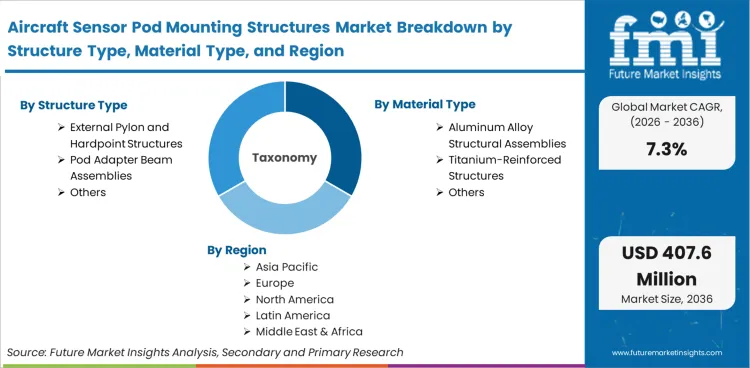
The aircraft sensor pod mounting structures market surpassed a value of USD 188.0 million in 2025. Sales are projected to rise to USD 201.5 million in 2026 and further increase to USD 408.1 million by 2036, reflecting a CAGR of 7.30% during 2026 to 2036. Growth is being supported by rising civilian and military demand for versatile hardpoints that can carry interchangeable exterior payloads.
Executing safe mission aircraft structural modifications for pods requires multi-mission adapter plates capable of carrying intelligence gathering hardware without requiring permanent fuselage modification. Integrators lacking standardized structural interfaces face severe maintenance delays when swapping heavy targeting hardware between sorties. Evaluating the overall aircraft sensor pod mounting structures market size, FMI analysis indicates aerospace avionics integration relies entirely on these exterior load-bearing mounts to secure sensitive equipment safely outside the pressurized cabin. Airworthiness authorities strictly prohibit altering structural wing spars without extensive fatigue testing, forcing fleet managers to adopt certified modular pod adapters. Airlines and defense contractors cannot afford massive aerodynamic drag penalties associated with poorly sculpted external pylons. Sourcing teams demand vibration-isolated structural beams preventing catastrophic harmonic resonance during high-speed maneuvers. Failing to secure certified structural attachment points instantly grounds special-mission aircraft and invalidates overall flight safety approvals.
Summary of Aircraft Sensor Pod Mounting Structures Market
- Aircraft Sensor Pod Mounting Structures Market Definition
- Purpose-built aerodynamic enclosures, airborne mission equipment mounts, and load-bearing interfaces designed to secure exterior aviation sensors while ensuring optimal load transfer and structural stability.
- Demand Drivers in the Market
- Intelligence gathering requirements compel fleet operators to demand external hardpoints capable of swapping payloads rapidly.
- Strict weight reduction mandates force airframe designers to integrate advanced composites replacing traditional heavy metallic pylons.
- Drag reduction targets require engineers to utilize highly contoured adapters preventing auxiliary fuel burn penalties.
- Key Segments Analyzed in the FMI Report
- Structure Type: External pylon and hardpoint structures: is expected to hold 36.0% share in 2026, driven by intense demand for underwing payload carriage.
- Material Type: Aluminum alloy structural assemblies: is anticipated to record 34.0% share in 2026, as OEMs prioritize cost-effective load-bearing strength.
- Pod Application: EO/IR and ISR pod mounting structures: is poised to capture 31.0% share in 2026, benefiting from massive capital backing aiming at adverse weather flight surveillance.
- Aircraft Type: Special-mission fixed-wing aircraft: is estimated to secure 29.0% share in 2026, because retrofitting existing airframes generates maximum capability return on investment.
- Fitment: Aftermarket retrofit structures: is projected to claim 57.0% share in 2026, reflecting the high volume of legacy platforms requiring new intelligence gathering capabilities.
- Analyst Opinion at FMI
- Nikhil Kaitwade, Principal Analyst, Automotive, at Future Market Insights, opines, “Our latest evaluation indicates that modularity is becoming a key requirement in aircraft sensor integration. Defense and surveillance missions demand rapid reconfiguration of sensor payloads, making adaptable mounting systems essential. Manufacturers that develop standardized, quick-install mounting platforms compatible with multiple sensor types will gain a strategic advantage in both military and specialized aviation applications.”
- Strategic Implications / Executive Takeaways
- Aerostructures suppliers must prioritize vibration damping testing to pass stringent OEM supplier qualification audits.
- Airframe designers risk total project failure if payload mounts conflict with load-bearing fuselage stress paths.
- Fleet operations directors face severe operational bottlenecks if they fail to secure specialized erosion-resistant replacement fittings.
- Methodology
- Primary Research: Direct interviews with line maintenance directors validating fatigue degradation rates under real-world conditions.
- Desk Research: Systematic review of FAA and EASA certification guidelines dictating precise structural overload limits.
- Market-Sizing and Forecasting: Baseline calculation derived from verified airframe prototype payload architectural specifications.
- Data Validation and Update Cycle: Continuous cross-referencing against specialized aerospace component production volume disclosures globally.
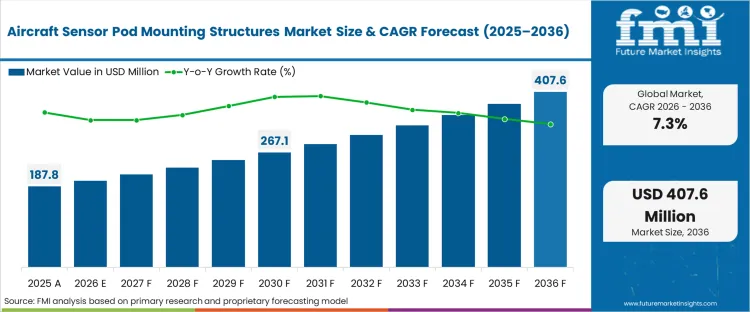
Aircraft Sensor Pod Mounting Structures Market Key Takeaways
| Metric | Details |
|---|---|
| Industry Size (2026) | USD 201.5 Million |
| Industry Value (2036) | USD 408.1 Million |
| CAGR (2026-2036) | 7.30% |
Source: Future Market Insights (FMI) analysis, based on proprietary forecasting model and primary research
Certification authorities mandate absolute proof of structural integrity before approving any external stores or mission payloads. Operators securing supplemental type certificates unlock immediate fleet-wide payload integration capabilities, allowing them to monetize aerial surveillance routes. Standardized structural testing forces manufacturers to adopt advanced composite reinforcement layers rather than relying on legacy aluminum billets. Any recorded failure during rapid decompression simulations permanently halts deployment, forcing engineers to completely redesign the entire lug and fitting assembly before proceeding with flight testing.
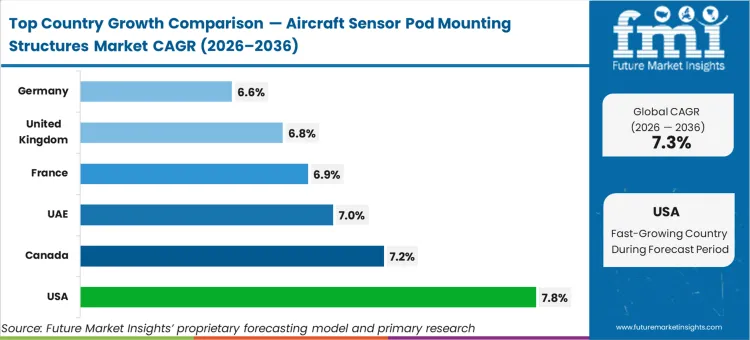
United States demand expands at a 7.8% CAGR driven by aggressive defense modernization programs requiring massive intelligence payloads. Canada advances at 7.2% optimizing special-mission aircraft for remote border patrol operations. UAE registers 7.0% leveraging high capital budgets to secure advanced maritime patrol capabilities. France tracks at 6.9% anchored by legacy airframe assembly requirements and established aerospace consortiums. United Kingdom secures 6.8% utilizing proven structural component manufacturing hubs. Germany secures a 6.6% rate balancing strict European certification protocols with steady military retrofit demand.
Aircraft Sensor Pod Mounting Structures Market Definition
An aircraft sensor pod mounting structure can also be understood as a dedicated external support assembly that holds sensor pods in place while managing the mechanical and aerodynamic demands of flight. It provides the structural interface between the payload and the aircraft, allowing external systems to remain securely mounted as loads, vibration, and airflow conditions change during operation. These structures are designed to transfer flight-induced forces safely into the airframe, support stable payload positioning, and reduce the risk of vibration-related performance loss in sensitive electronic and imaging systems. At the same time, engineers shape and tune them to limit drag, avoid flutter concerns, and match the operational requirements of the specific payload being carried.
Aircraft Sensor Pod Mounting Structures Market Inclusions
Scope encompasses load-bearing composite pylons, contoured belly-mount structural frames, specialized adapter plates, and the aerodynamic weather seals surrounding external fuselage cutouts. Analytical coverage extends to multi-layer aircraft transparency hardware integrations and composite matrices containing embedded optical glass windows where they interface with the aircraft pod mounting structures. Factory-installed mounting skirts designed explicitly to support retractable mount structures fall within these analytical boundaries alongside general aircraft external payload mounting structures and specialized protective elastomeric shock mounts. Replaceable steel lugs and titanium fittings integrated into the adapter beams remain fully included.
Aircraft Sensor Pod Mounting Structures Market Exclusions
Internal cabin surveillance camera mounts fall entirely outside this perimeter because they lack direct aerodynamic integration with external airframe surfaces. Ground-based security domes, cosmetic interior trim covers, and the actual electronic sensor components or optical lenses themselves do not qualify as specialized aerodynamic housings or aircraft external stores structures. Commercial passenger cabin window frames, internal avionics racking systems, and generic fuselage skin panels lacking specific payload support requirements remain completely excluded from the analysis. Temporary ground handling equipment and maintenance jacks used exclusively during hangar operations lack the certification necessary for high-speed flight applications.
Aircraft Sensor Pod Mounting Structures Market Research Methodology
- Primary Research: Chief airworthiness engineers, structural composites directors, and radome procurement officers at tier-1 aerospace suppliers.
- Desk Research: Federal Aviation Administration supplemental type certificate applications, EASA certification memorandums for external installations, and public material science patent filings.
- Market-Sizing and Forecasting: Baseline production volumes derived directly from stated OEM manufacturing capacity roadmaps regarding special-mission aircraft deliveries.
- Data Validation and Update Cycle: Independent cross-referencing against quarterly aerospace composite material shipment volume disclosures.
Segmental Analysis
Aircraft Sensor Pod Mounting Structures Market Analysis by Structure Type
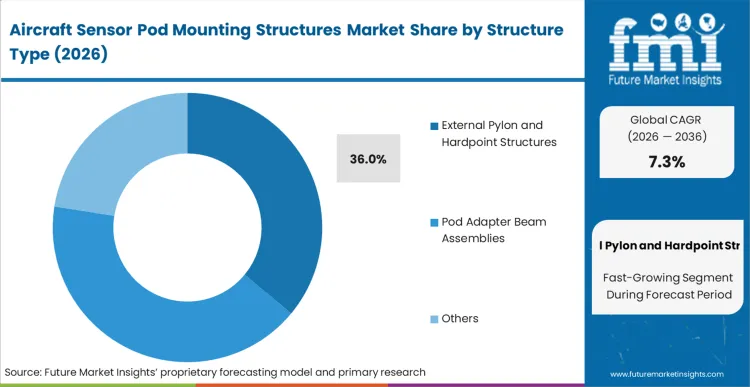
Aerodynamic footprints shape core airframe load paths and drag behavior, with external pylon and hardpoint structures projected to capture 36.0% share in 2026. Chief engineers designing aircraft pylon structures for sensor pods aim to increase payload capacity without weakening wing integrity. Underwing pod pylons remain important for ISR aircraft because they allow secure sensor deployment across demanding flight envelopes. These structures must remain rigid under stress and avoid the flexing seen in earlier lightweight prototypes. Belly-mount sensor pod structures create added engineering difficulty because oversized unsupported sections can act as air brakes during high-speed cruise. Structural teams must calculate airflow separation points carefully to prevent turbulent wake effects from disturbing downstream surfaces. Operators that prioritize payload size too aggressively often encounter drag-related flight handling concerns. Demand is also rising for retractable and vibration-isolated pod mounts that support quick swapping of electronic warfare modules while maintaining reliable performance under cold, altitude, and pressure extremes.
- Pod adapter beam assemblies: Profile drag limits operational efficiency. Engineers utilize razor-thin composites slicing through airstreams to minimize aerodynamic penalties.
- Stub-wing and side-mount structures: Mounting locations dictate extreme vibration exposure. Maintenance crews inspect these sections heavily for micro-fractures during scheduled teardowns.
- Vibration-isolated support assemblies: Resonance destroys sensitive optical glass. Suppliers formulate specialized elastomeric matrices eliminating physical interference from rotor blades.
Aircraft Sensor Pod Mounting Structures Market Analysis by Material Type
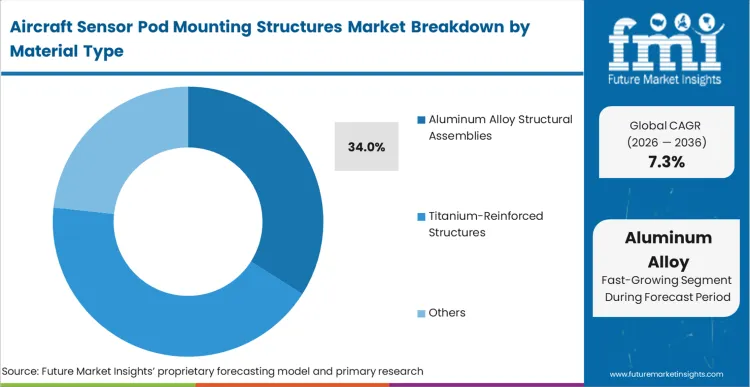
Thermal stress profiles force airworthiness engineers evaluating what materials are used in aircraft pod pylons and mounts to constantly evaluate load-bearing material selections. Aluminum alloy structural assemblies is estimated to secure 34.0% share in 2026 because traditional metallic enclosures provide known fatigue curves and reliable machining characteristics. Teams specify highly machined matrices surviving severe flexing during pressurized high-altitude cruise maneuvers. Technicians require materials capable of absorbing direct flight loads without fracturing into hazardous fragments that could ingest into aft-mounted engines. Formulating advanced structures means bare metals corrode rapidly under intense coastal humidity, requiring sophisticated chemical treatments and aerospace coatings compatibility layers. Maintenance directors discover highly efficient engineering plastics turning completely brittle after just two years of continuous tarmac exposure if protective barrier coatings fail. Certification officers reject any formulation exhibiting brittle failure characteristics during extreme load testing, forcing reliance on advanced carbon fiber pod mounting structures aircraft integrations for specialized low-weight applications. Modifying airframes with titanium-reinforced structures provides unmatched strength-to-weight ratios, though procurement managers pay immense premiums for raw material acquisition and specific aircraft lighting systems bonding requirements.
- Carbon fiber composite support structures: Legacy metals suffer from excessive weight. Operators transition toward lighter alternatives preserving fuel and extending loiter times.
- Hybrid metal-composite mounts: High-stress attachment points struggle transferring loads through pure composites. Manufacturers utilize steel inserts embedded within carbon fiber matrices.
- Steel lug and fitting assemblies: Repeated payload swapping wears down soft attachment points. Machinists rely on hardened steel enduring continuous physical connections.
Aircraft Sensor Pod Mounting Structures Market Analysis by Pod Application
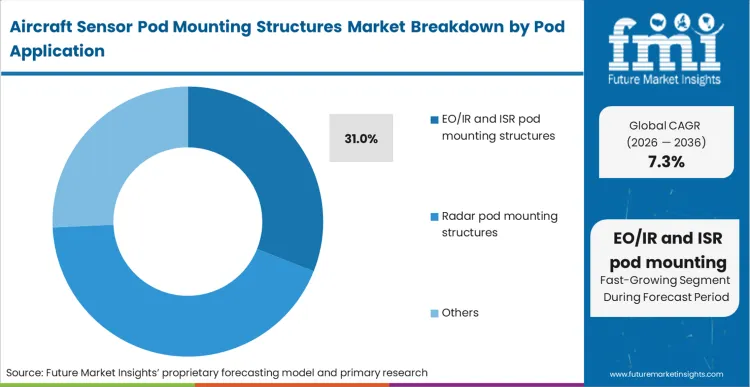
Intelligence gathering mandates push commercial and military operators toward increasingly complex exterior hardware. EO/IR and ISR pod mounting structures is expected to record 31.0% share in 2026. Understanding why do ISR pods need dedicated aircraft mounting structures reveals fleet managers rush to satisfy operational demands for uninterrupted target tracking. Airworthiness engineers specify these massive aircraft hardpoints for EO IR pods guaranteeing continuous stability during aggressive banking maneuvers. Technicians require vibration-isolated layers built into the mount functioning independently of main cabin structures. Flush-mounted aircraft maintenance repair and overhaul inspection procedures frequently reveal structural delamination around adapter plates when exposed to extreme temperature variations. Maintenance directors utilizing sensor fusion arrays discover aircraft grounded when intricate wiring harnesses short circuit from basic condensation trapped within the pylon cavity. Fail-safe structural mandates dictate enclosures protecting radar pods must never detach during flight. Advanced diagnostic tools now detect sub-surface moisture accumulation before it triggers catastrophic material fatigue. Integrating maritime patrol pod structures involves coating entire assemblies in specialized anti-corrosive paints surviving continuous low-altitude saltwater spray.
- Survey and scientific pod structures: High-value atmospheric tracking dictates precise optical profiles. Ground crews easily swap these standardized units between different leased airframes.
- Targeting and reconnaissance pod structures: Classified missions require absolute line-of-sight stability. Defense contractors restrict mechanical tolerances preventing targeting errors at long distances.
- Multi-mission modular pod structures: Complex ground maneuvering generates immense turnaround delays. Structural designers implement universal plug-and-play interfaces within the pylon footprint.
Aircraft Sensor Pod Mounting Structures Market Analysis by Aircraft Type
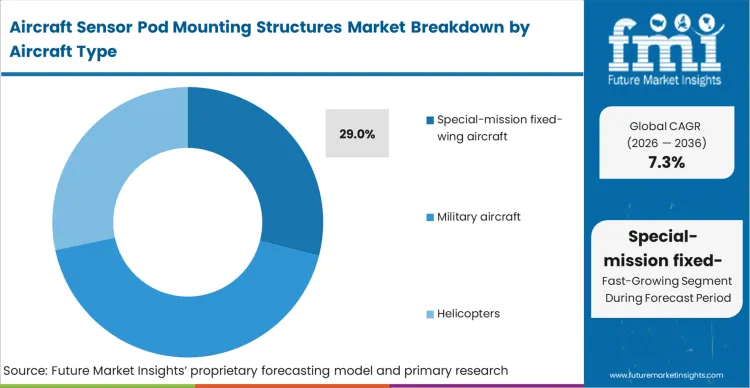
Special-mission fixed-wing aircraft is anticipated to hold 29.0% share in 2026 as highly capitalized defense contractors push toward aggressive implementation dates. Flight operations directors orchestrate dense daily schedules necessitating rapid turnaround times combined with highly durable aerodynamic enclosures. Hardware covering critical flight deck cameras must survive constant physical abuse from extreme weather and high-speed particle impacts. High-altitude cruising dictates specialized polycarbonate films preventing ice accumulation from destroying optical clarity on adjacent windows. Operators failing specifying hardened internal hardware face immediate regulatory grounding if a single exterior panel separates over a populated metropolitan area. Narrow-body commercial jets heavily modified for surveillance currently dominate installation backlogs as domestic routes become reliant on advanced border security. Structural engineers select military-grade alloys preventing premature surface wear on these high-cycle airframes. Integrating mission pod hardpoint structures aircraft hardware onto business jets requires preserving luxury aesthetics while adding massive external payloads.
- Military aircraft: Defense clients demand absolute safety under fire. Integrators utilize highly sculpted pylons preserving radar cross-sections and maneuverability.
- Helicopters: Main rotor downwash induces extreme vibration. Hardware teams over-engineer mounting brackets surviving constant structural shaking and asymmetric loads.
- Unmanned and optionally piloted aircraft: Surveillance equipment requires massive uninterrupted scanning arcs. Airframe modifiers design custom unmanned aerial vehicles UAV commercial drone underbelly blisters accommodating spinning optical turrets.
Aircraft Sensor Pod Mounting Structures Market Analysis by Fitment
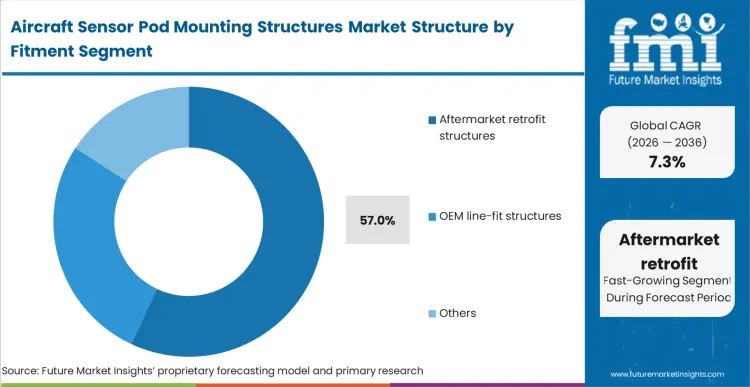
Factory installation dominates certain segments, but retrofitting legacy airframes remains highly lucrative. Aftermarket retrofit structures is projected to command 57.0% share in 2026 because cutting access holes and reinforcing wing spars on older fuselages introduces unpredictable stress concentrations addressed locally. Procurement teams comparing installation configurations integrate modular pod adapter beams for aircraft directly into existing hardpoints maintaining unbroken load paths across the fuselage. Hardware suppliers acting as prime integration partners must deliver fully assembled frames directly to modification centers meeting strict maintenance cadences. Late-stage design changes to exterior payload placements routinely delay entire certification programs by months. Just-in-time delivery synchronizes with fuselage teardown schedules, forcing procurement officers building highly rigid supply chains preventing bottlenecks. Conversely, immense demand for aircraft lug suspension pod mounts persists as operators modernize legacy fleets lacking factory-installed visual ports. Sourcing avionics upgrades simultaneously with structural mounts allows maintenance directors reducing overall aircraft downtime during heavy checks.
- OEM line-fit structures: Factory integration guarantees perfect aerodynamic sealing. Operators avoid costly downtime associated with third-party modification centers.
- Replacement and upgrade kits: Hard landings and bird strikes destroy composite structures randomly. Line maintenance crews stock pre-painted structural spares avoiding extensive dispatch delays.
- Aftermarket retrofit structures: Legacy aircraft require severe structural reinforcements before receiving new cameras. Heavy adapter plates offset missing fuselage stringers and ribs.
Aircraft Sensor Pod Mounting Structures Market Drivers, Restraints, and Opportunities
Aircraft sensor pod mounting structure regulations must be viewed through the certification demands tied to modern visual awareness and intelligence-gathering missions. Airframe designers are under pressure to integrate advanced low-profile external housings because chief engineering officers cannot rely only on traditional visual flight rules when premium operators require high-definition runway tracking, perimeter monitoring, and dependable adverse-weather operations. Delayed procurement of specialized structural housings can weaken dispatch reliability and reduce the commercial logic behind upgraded fleets. The certification pathway for ISR pod pylons requires these mounting systems to demonstrate impact resistance, structural stability, and aerodynamic safety before supplemental type certificates are issued for major external modifications. This is driving volume demand for standardized composite adapter beams as military branches modernize transport aircraft with targeting payloads. Maritime patrol expansion is reinforcing the same trend by pushing operators to install large radar arrays on civilian-derived aircraft instead of acquiring new mission-built fleets. Modular pylon systems are gaining importance as fleet directors seek structures that allow one platform to perform electronic warfare, patrol, and search-and-rescue duties across different operating days.
Aerodynamic drag and structural fatigue concerns severely restrict how much physical hardware engineers bolt onto the exterior of an aircraft. This friction persists structurally because increasing the size and weight of the payload adapter almost always degrades overall flight performance and increases fuel consumption dramatically. Current hybrid laminates offer partial weight relief but introduce unacceptable manufacturing costs to highly optimized electric airframes requiring absolute fuel efficiency. Finding exact balances between mechanical load-bearing capacity and minimum aerodynamic cross-sections remains an ongoing metallurgical and chemical challenge. Civil aviation authorities require massive amounts of flight test data verifying a new external pod will not alter spin recovery characteristics of host aircraft. These mandatory test campaigns add millions of dollars to development cycles, frequently deterring smaller operators pursuing custom pod integration projects.
Opportunities in the Aircraft Sensor Pod Mounting Structures Market
- Self-healing scratch coatings: Integrating reactive polymer layers repairs minor surface abrasions automatically on leading edges of pylons. Procurement directors secure highly reliable signal clarity without grounding aircraft for frequent polishing cycles.
- Aerospace composite sensor fairings: Embedding structural health monitors directly into structural laminates. Software architects simplify aircraft automated inspection and monitoring diagnostics maintaining strict weight constraints while detecting subsurface micro-fractures early.
- Acoustic metamaterial films: Applying engineered sound-baffling layers reduces low-frequency aerodynamic rumble drastically. Airframe teams deliver continuous operational comfort across noisy advanced air mobility installations where external pods generate turbulent airflow against the fuselage.
Regional Analysis
Based on regional analysis, Aircraft Sensor Pod Mounting Structures is segmented into North America, Latin America, Western Europe, Eastern Europe, East Asia, South Asia & Pacific, and Middle East & Africa across 40 plus countries.
.webp "Top Country Growth Comparison Aircraft Sensor Pod Mounting Structures Market Cagr (2026 2036)")
| Country | CAGR (2026 to 2036) |
|---|---|
| United States | 7.8% |
| Canada | 7.2% |
| UAE | 7.0% |
| France | 6.9% |
| United Kingdom | 6.8% |
| Germany | 6.6% |
Source: Future Market Insights (FMI) analysis, based on proprietary forecasting model and primary research
North America Aircraft Sensor Pod Mounting Structures Market Analysis
Localized certification requirements govern initial operational footprints across domestic fleets and defense contractors. Civil aviation authorities prioritize rapid commercial deployment over harmonized global visibility standards. Procurement directors at tier-1 integrators capitalize on established aerospace supply chains sourcing specialized impact-resistant hardware locally. FMI observes certification protocols here emphasize heavy reliance on physical vibration testing mitigating structural failure risks during aggressive flight envelopes. Aggressive domestic certification timelines shape the United States aircraft pod mounting structures market, driving massive development in load-bearing composite material science. Aircraft modifiers aggressively pursue supplemental type certificates allowing them mounting massive intelligence pods onto standard civilian business jets, effectively converting them into military assets without alerting foreign observers. This strategy requires highly specialized engineering talent concentrated primarily within defense hubs.
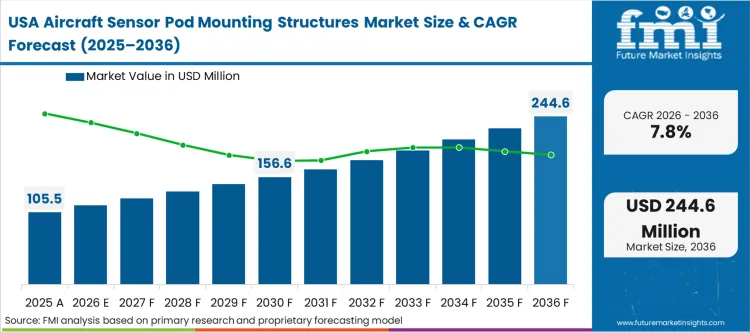
- United States: Strict regulatory oversight continues to shape structural testing standards across the market, as manufacturers must prove enclosure durability, mounting integrity, and long-cycle operational reliability before deployment. Domestic operators are projected to expand at a 7.8% rate, driven by rising demand for hardened enclosures that can withstand intensive flight schedules and repeated mission turnover. Growth is also supported by defense surveillance programs that require continuous hardware refinement, faster validation cycles, and stronger structural resilience under demanding operating conditions. This environment is increasing pressure on suppliers to deliver tested and upgrade-ready systems that align with both commercial fleet utilization needs and classified national security requirements.
- Canada: Regional surveillance missions require specialized anti-icing layers to maintain sensor reliability during prolonged cold-weather operations. Airframe manufacturers are projected to expand at a 7.2% rate as they prioritize rugged exterior hardware for border patrol and maritime monitoring aircraft. Demand is rising for systems that can withstand freezing conditions, long-duration flights, and continuous exposure across harsh surveillance environments.
Western Europe Aircraft Sensor Pod Mounting Structures Market Analysis
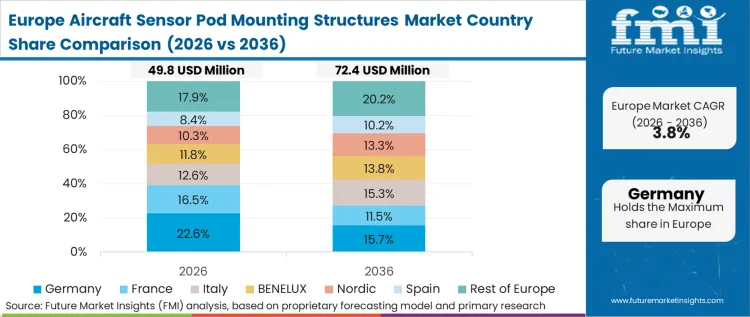
Strict legacy aerospace regulations severely restrict unproven material implementations, forcing suppliers over-engineering laminates meeting EASA's unique certification memorandums regarding external stores. Engineering teams burn millions designing thick adapter plates capable of satisfying both dense structural requirements and stringent European optical standards. Structural engineers push heavily toward highly tuned enclosures controlling fuselage airflow naturally. Component suppliers focus on ensuring absolute load transfer perfection, avoiding even minor fatigue cracking degrading target tracking capabilities during long loiter times. European defense consortiums consistently push for modular integration architectures, allowing different member nations attaching proprietary sensor pods using universal mounting hardware. This standardization effort drastically reduces logistical footprints during multi-national deployment exercises. The push toward electric aviation forces regional structural engineers reconsidering legacy aluminum mounts, driving substantial investment into lightweight titanium and carbon fiber alternatives preserving precious battery life.
- France: Legacy airframe assembly requirements continue to anchor localized demand, which is projected to grow at 6.9%. Suppliers are positioning manufacturing facilities close to major OEM final assembly lines to support just-in-time delivery of specialized components for patrol aircraft variants. This proximity helps reduce logistics delays, improve production coordination, and support faster integration across tightly scheduled aerospace programs.
- United Kingdom: Established composite manufacturing clusters drive a 6.8% expansion. Engineering firms leverage deep defense aerospace expertise developing ultra-lightweight structural housings supporting NATO intelligence gathering initiatives.
- Germany: Rigid certification protocols are projected to support a 6.6% CAGR as external pylon systems require extensive laboratory fatigue testing before approval. Local providers retain an advantage in specialized test-chamber validation, particularly for extreme temperature exposure and vibration survival. Their role remains important in helping manufacturers prove structural reliability under demanding aerospace operating conditions.
Middle East & Africa Aircraft Sensor Pod Mounting Structures Market Analysis
Dedicated military and border patrol transit corridors establish clear operational boundaries for early hardware deployments. Aviation authorities proactively mandate exceptional external visibility supporting premium passenger experiences and advanced military observation. Fleet operators utilize these extreme environments validating baseline thermal rejection performance under intense desert conditions. FMI's assessment indicates severe daytime heat profiles routinely warp poorly designed synthetic panels while aircraft idle on tarmac surfaces. Modifying civilian airframes for regional intelligence gathering remains a massive growth sector, as local governments seek bypassing lengthy foreign military sales processes building domestic integration capabilities. Engineering teams focus heavily protecting sensitive payload interfaces from fine sand intrusion, mandating specialized elastomeric seals surrounding every external mounting lug.
- UAE: High-capital airlines and defense fleets prioritize rapid payload integration, expanding at a 7.0% rate. Maintenance directors implement rigorous inspection routines detecting sand-induced micro-abrasions on critical load-bearing adapter plates.
Competitive Aligners for Market Players
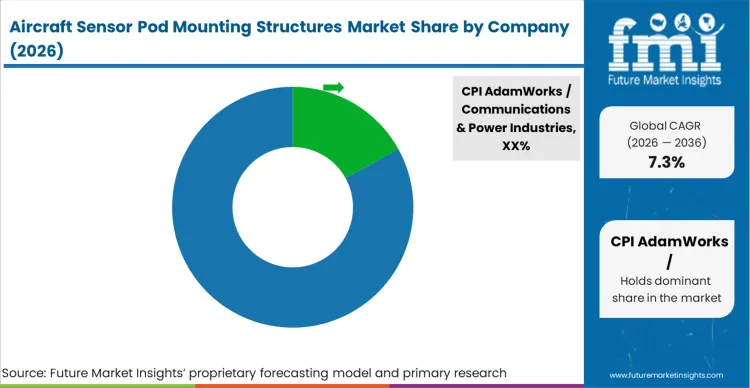
Evaluating who are the top suppliers of aircraft sensor pod mounts reveals certification experience creates impenetrable barriers for consumer electronics entrants attempting capturing aerospace share. CPI AdamWorks / Communications & Power Industries holds a 15.0% position entirely because their engineering teams possess decades of institutional knowledge regarding complex chemical coatings and deep-draw molding techniques. Procurement directors at major airframe manufacturers refuse evaluating uncertified fiberglass matrices, regardless of massive weight savings or innovative modular designs. Engineering a load-bearing pylon requires understanding exactly how mechanical stress propagates through an airframe during turbulence; lacking this foundational data dooms any prototype during physical load testing.
Prominent aircraft pod mounting structure suppliers leverage massive existing libraries of certified mechanical integration templates and specialized fastening components. Procurement directors exploring which companies make aircraft sensor pod mounts discover incumbents already understand sealing access ports against extreme altitude pressure cycles and caustic aviation fluids preventing premature composite delamination. Competitors must build these fundamental physical validation capabilities from scratch while simultaneously developing advanced low-weight urban air autonomous eVTOLs structural elements. Rigorous requirements mounting massive turret assemblies on top of thin aluminum fuselages mandate incredibly complex adapter plates only legacy engineering firms fully understand. Managing electrical bonding and lightning strike protection pathways through external mounts remains highly guarded proprietary secrets among top-tier suppliers.
Large airframe integrators fiercely resist vendor lock-in demanding modular replacement architectures even when purchasing highly integrated structural panels. Chief engineering officers write strict interface control documents requiring suppliers outputting precise geometric data validating internal clearance functionality rather than relying on proprietary mounting tools. Competition centers delivering optically flawless panels integrating directly into complex observation arrays without introducing aerodynamic interference. Ultimately, the supplier successfully balancing absolute visual transparency with zero-maintenance structural longevity dictates pricing power. The industry transitioning toward uncrewed operations means the ability rapidly iterating mounting designs for unique sensor payloads separates dominant structural suppliers from legacy metal fabrication shops unable meeting strict tolerance demands.
Key Players in Aircraft Sensor Pod Mounting Structures Market
- CPI AdamWorks / Communications & Power Industries
- Avcon Industries
- Airborne Technologies
- Parker Meggitt Defense Systems
- Trine Aerospace
- Hutchinson Aerospace
- TPS Group
Scope of the Report
| Metric | Value |
|---|---|
| Quantitative Units | USD 201.5 million to USD 408.1 million, at a CAGR of 7.3% |
| Market Definition | Aircraft Sensor Pod Mounting Structures comprise purpose-built aerodynamic and load-bearing interface assemblies designed specifically to secure exterior hardware enclosures onto mobile airframes securely. |
| Segmentation | By Structure Type, By Material Type, By Pod Application, By Aircraft Type, and By Fitment |
| Regions Covered | North America, Latin America, Western Europe, Eastern Europe, East Asia, South Asia & Pacific, Middle East & Africa |
| Countries Covered | United States, Canada, France, United Kingdom, Germany, UAE, Singapore |
| Key Companies Profiled | CPI AdamWorks / Communications & Power Industries, Avcon Industries, Airborne Technologies, Parker Meggitt Defense Systems, Trine Aerospace, Hutchinson Aerospace, TPS Group |
| Forecast Period | 2026 to 2036 |
| Approach | Baseline production volumes derived directly from stated OEM manufacturing capacity roadmaps regarding special-mission aircraft deliveries. |
Source: Future Market Insights (FMI) analysis, based on proprietary forecasting model and primary research
Aircraft Sensor Pod Mounting Structures Market Analysis by Segments
Structure Type
- External pylon and hardpoint structures
- Pod adapter beam assemblies
- Belly-mount structural frames
- Stub-wing and side-mount structures
- Retractable mount structures
- Vibration-isolated support assemblies
Material Type
- Aluminum alloy structural assemblies
- Titanium-reinforced structures
- Carbon fiber composite support structures
- Hybrid metal-composite mounts
- Steel lug and fitting assemblies
- Elastomer-isolated structural interfaces
Pod Application
- EO/IR and ISR pod mounting structures
- Radar pod mounting structures
- Survey and scientific pod structures
- Maritime patrol pod structures
- Targeting and reconnaissance pod structures
- Multi-mission modular pod structures
Aircraft Type
- Special-mission fixed-wing aircraft
- Military aircraft
- Helicopters
- Utility turboprops
- Business jets with mission retrofits
- Unmanned and optionally piloted aircraft
Fitment
- Aftermarket retrofit structures
- OEM line-fit structures
- Replacement and upgrade kits
Region
- North America
- United States
- Canada
- Latin America
- Brazil
- Mexico
- Rest of Latin America
- Western Europe
- Germany
- United Kingdom
- France
- Spain
- Italy
- BENELUX
- Rest of Western Europe
- Eastern Europe
- Russia
- Poland
- Rest of Eastern Europe
- East Asia
- China
- Japan
- South Korea
- South Asia & Pacific
- India
- ASEAN
- Oceania
- Rest of South Asia & Pacific
- Middle East & Africa
- GCC
- South Africa
- North Africa
- Rest of Middle East & Africa
Bibliography
- European Union Aviation Safety Agency. (2025, April 7). Installation of antennas on large aeroplanes (CS-25): EASA CM No.: CM-S-013 Issue 01.
- Federal Aviation Administration. (2024, May 23). Advisory Circular 150/5210-19B, Driver’s Enhanced Vision System (DEVS).
- USA Department of the Navy, Naval Air Systems Command. (2025, February 11). PEO (U&W) portfolio overview.
- European Union Aviation Safety Agency. (2025). Annual safety review 2025.
This bibliography is provided for reader reference and is not exhaustive. The full report contains the complete reference list with primary source documentation.
This Report Addresses
- Component certification barriers complicating aerostructures hardware deployments during initial commercial rollout.
- Weight-to-payload limitations driving synthetic composite material selections for upper fuselage blister fairings.
- Airframe composite stress fractures caused by rigid aftermarket retrofit installations lacking proper adapter plates.
- Thermal expansion vulnerabilities inherent inside sealed aerodynamic enclosures housing high-power optical arrays.
- Acoustic insulation limits restricting overall transparent surface area allocations for specialized communication domes.
- Operational shutdowns resulting from localized ultraviolet radiation panel degradation across the airline fleet.
- Early revenue testing models leveraging strictly segregated luxury transit flight corridors for system upgrades.
- Supplemental type certificate application volumes anchoring precise hardware demand forecasting for legacy aircraft retrofits.
Frequently Asked Questions
How Much Does An Aircraft Pod Mount Structure Cost?
Pricing remains highly variable based on optical tuning requirements and adapter plate complexity. Simple taxi camera mounts cost a few hundred dollars, while massive multi-sensor housings represent multi-thousand dollar investments per airframe.
Explain The Aircraft Sensor Pod Mounting Structures Market?
This sector involves the manufacturing and integration of load-bearing composite radomes, contoured optical housings, and specialized adapter plates providing critical impact resistance for electronic camera nodes without inducing severe parasitic drag. The broader aircraft sensor pod mounts market connects directly to modern defense retrofits.
What Is An Aircraft Sensor Pod Mounting Structure?
This equipment comprises purpose-built aerodynamic and load-bearing interface assemblies designed specifically securing exterior hardware enclosures onto mobile airframes seamlessly.
Why Do Aircraft Cameras Need Aerodynamic Fairings?
Unprotected exterior lenses generate massive aerodynamic drag and are instantly destroyed by high-speed bird strikes, corrosive aviation fluids, and extreme thermal cycling. Enclosures protect sensitive arrays maintaining flight efficiency.
What Materials Are Used In Aircraft Sensor Pod Mounts?
Structural engineers specify highly pliable quartz matrices, RF-transparent laminates, thermoplastic resins, and advanced synthetic composites absorbing direct impacts without blocking essential optical signals.
Which Companies Make Aircraft External Camera Housings?
The consolidated supplier ecosystem includes major aerospace components manufacturers such as CPI AdamWorks / Communications & Power Industries, Avcon Industries, Airborne Technologies, Parker Meggitt Defense Systems, Trine Aerospace, Hutchinson Aerospace, and TPS Group.
What Regulations Affect Aircraft External Payload Installations?
The Federal Aviation Administration and EASA enforce strict supplemental type certification requirements, mandating comprehensive impact protection layers and proof of absolute aerodynamic stability before allowing large external fuselage modifications.
Estimate Price Per Aircraft Sensor Pod Assembly?
A complete low-profile optical fairing assembly, including necessary structural adapter plates and aerodynamic weather seals, ranges from tens of thousands to over a hundred thousand dollars depending on required certification overhead.
What limits retrofit radome installation on certified airframes?
Aerodynamic testing profiles break instantly upon adding unapproved exterior structures. Fleet maintenance teams face immediate airworthiness certificate revocation modifying external composite surfaces without full engineering revalidation.
Why do synthetic composites dominate over traditional aluminum housings?
Aviation authorities fundamentally mandate extreme optical transparency maximizing visual bandwidth capacities. Airworthiness engineers specify synthetic non-conductive materials guaranteeing signal transmission while surviving high-torque vertical flight maneuvers.
How do massive optical blisters affect aircraft maintenance cycles?
Expansive belly fairings require frequent surface inspection maintaining structural integrity against abrasive urban particulate matter. Maintenance directors trade premium visual connectivity experiences for slightly increased unit turnaround times on tarmac surfaces.
What specific operational hurdle slows payload fairing certification?
Regulators demand thousands of verified safe impact tests before authorizing commercial passenger flight operations. Component suppliers currently lack sufficient real-world high-velocity bird-strike data proving synthetic laminate fatigue reliability conclusively across all temperature profiles.
Why do routine line inspection ports require specialized anti-static coatings?
Friction generated during high-speed cruise creates massive static electrical buildup, ruining sensitive electronic equipment. Acoustic and electrical engineers mandate precision conductive coatings preventing internal arcing preserving necessary optical transparency.
How do thermal expansion constraints influence exterior hardware design?
Dissimilar materials expand unevenly under direct sunlight, causing composite panels binding against rigid metallic airframes. Hardware engineers must design flexible mounting gaskets capable of overcoming thermal friction without warping surrounding structures.
What structural difference explains North America's accelerated hardware adoption?
Aggressive aviation authorities bypass prolonged experimental stages mandating rapid domestic fleet modernization. Domestic airline directors scale massive high-definition networks utilizing simplified hardware configurations targeting massive consumer demand for safety upgrades.
Why do OEMs demand standardized hardware mounting footprints?
Airframe designers want retaining absolute control over critical supply chains. Chief engineering officers write strict interface documents preventing vendor lock-in, allowing rapid supplier switching if specific composite molding manufacturers fail.
What specific advantage do legacy aerospace suppliers hold?
Incumbents possess deep institutional knowledge regarding DO-160G environmental stress protocols. Procurement teams heavily favor suppliers guaranteeing hardware survival during extreme vibration and altitude pressure cycling without spontaneous delamination.
How do atmospheric particulates threaten continuous dispatch reliability?
Micro-debris continuously abrades soft synthetic fairing surfaces during high-speed cruise. Fleet dispatchers lose massive revenue when forced grounding entire regional networks because optical transceiver signals become completely obscured by severe micro-scratching.
Why are lightweight composite laminates critical for future hardware designs?
Heavy metallic assemblies introduce unacceptable weight penalties into strictly controlled aerodynamic designs. Thermoplastic composites eliminate excess mass, allowing procurement teams meeting strict mechanical tolerance budgets without sacrificing visual clarity.
What restricts generic fastener effectiveness during daily commuter operations?
Standard framing hardware degrades rapidly under high-frequency acoustic vibration cycles. Operations directors must replace cheap mounting gaskets constantly or risk catastrophic in-flight panel separation over densely populated metropolitan areas during routine flights.
How does auxiliary power demand dictate external hardware procurement?
Excessive cooling requirements directly destroy commercial flight profitability. Chief engineering officers reject highly capable camera suites if poor thermal rejection capabilities force the air conditioning system draining main engine power reserves constantly.
Why are dedicated cargo operations crucial for hardware validation?
Regulators grant flight waivers rapidly over unpopulated industrial zones. Hardware engineers utilize these low-stress operations harvesting terabytes of structural fatigue data required for eventual mass passenger commuter certification and broader fleet deployment.
What causes composite delamination during retrofit installations?
Cutting expansive access holes into cured carbon fiber creates concentrated stress points during high-G maneuvers. Structural engineers prevent catastrophic airframe failure forcing all adapter plate integration into strict load-distributing mechanical tolerances.
What is the airborne ISR pod mounting systems market?
The airborne ISR pod mounting systems market represents a high-growth subset focused entirely on intelligence, surveillance, and reconnaissance hardware adaptation for legacy defense airframes requiring rapid capability upgrades.
Preview the report firsthand - request a free sample
Get SampleGet the brochure for pricing and purchase details.
Get PDFTable of Content
- Executive Summary
- Global Market Outlook
- Demand-side Trends
- Supply-side Trends
- Technology Roadmap Analysis
- Analysis and Recommendations
- Market Overview
- Market Coverage / Taxonomy
- Market Definition / Scope / Limitations
- Research Methodology
- Chapter Orientation
- Analytical Lens and Working Hypotheses
- Market Structure, Signals, and Trend Drivers
- Benchmarking and Cross-market Comparability
- Market Sizing, Forecasting, and Opportunity Mapping
- Research Design and Evidence Framework
- Desk Research Programme (Secondary Evidence)
- Company Annual and Sustainability Reports
- Peer-reviewed Journals and Academic Literature
- Corporate Websites, Product Literature, and Technical Notes
- Earnings Decks and Investor Briefings
- Statutory Filings and Regulatory Disclosures
- Technical White Papers and Standards Notes
- Trade Journals, Industry Magazines, and Analyst Briefs
- Conference Proceedings, Webinars, and Seminar Materials
- Government Statistics Portals and Public Data Releases
- Press Releases and Reputable Media Coverage
- Specialist Newsletters and Curated Briefings
- Sector Databases and Reference Repositories
- FMI Internal Proprietary Databases and Historical Market Datasets
- Subscription Datasets and Paid Sources
- Social Channels, Communities, and Digital Listening Inputs
- Additional Desk Sources
- Expert Input and Fieldwork (Primary Evidence)
- Primary Modes
- Qualitative Interviews and Expert Elicitation
- Quantitative Surveys and Structured Data Capture
- Blended Approach
- Why Primary Evidence is Used
- Field Techniques
- Interviews
- Surveys
- Focus Groups
- Observational and In-context Research
- Social and Community Interactions
- Stakeholder Universe Engaged
- C-suite Leaders
- Board Members
- Presidents and Vice Presidents
- R&D and Innovation Heads
- Technical Specialists
- Domain Subject-matter Experts
- Scientists
- Physicians and Other Healthcare Professionals
- Governance, Ethics, and Data Stewardship
- Research Ethics
- Data Integrity and Handling
- Primary Modes
- Tooling, Models, and Reference Databases
- Desk Research Programme (Secondary Evidence)
- Data Engineering and Model Build
- Data Acquisition and Ingestion
- Cleaning, Normalisation, and Verification
- Synthesis, Triangulation, and Analysis
- Quality Assurance and Audit Trail
- Market Background
- Market Dynamics
- Drivers
- Restraints
- Opportunity
- Trends
- Scenario Forecast
- Demand in Optimistic Scenario
- Demand in Likely Scenario
- Demand in Conservative Scenario
- Opportunity Map Analysis
- Product Life Cycle Analysis
- Supply Chain Analysis
- Investment Feasibility Matrix
- Value Chain Analysis
- PESTLE and Porter’s Analysis
- Regulatory Landscape
- Regional Parent Market Outlook
- Production and Consumption Statistics
- Import and Export Statistics
- Market Dynamics
- Global Market Analysis 2021 to 2025 and Forecast, 2026 to 2036
- Historical Market Size Value (USD Million) Analysis, 2021 to 2025
- Current and Future Market Size Value (USD Million) Projections, 2026 to 2036
- Y-o-Y Growth Trend Analysis
- Absolute $ Opportunity Analysis
- Global Market Pricing Analysis 2021 to 2025 and Forecast 2026 to 2036
- Global Market Analysis 2021 to 2025 and Forecast 2026 to 2036, By Structure Type
- Introduction / Key Findings
- Historical Market Size Value (USD Million) Analysis By Structure Type , 2021 to 2025
- Current and Future Market Size Value (USD Million) Analysis and Forecast By Structure Type , 2026 to 2036
- External Pylon and Hardpoint Structures
- Pod Adapter Beam Assemblies
- Others
- External Pylon and Hardpoint Structures
- Y-o-Y Growth Trend Analysis By Structure Type , 2021 to 2025
- Absolute $ Opportunity Analysis By Structure Type , 2026 to 2036
- Global Market Analysis 2021 to 2025 and Forecast 2026 to 2036, By Material Type
- Introduction / Key Findings
- Historical Market Size Value (USD Million) Analysis By Material Type, 2021 to 2025
- Current and Future Market Size Value (USD Million) Analysis and Forecast By Material Type, 2026 to 2036
- Aluminum Alloy Structural Assemblies
- Titanium-Reinforced Structures
- Others
- Aluminum Alloy Structural Assemblies
- Y-o-Y Growth Trend Analysis By Material Type, 2021 to 2025
- Absolute $ Opportunity Analysis By Material Type, 2026 to 2036
- Global Market Analysis 2021 to 2025 and Forecast 2026 to 2036, By Pod Application
- Introduction / Key Findings
- Historical Market Size Value (USD Million) Analysis By Pod Application, 2021 to 2025
- Current and Future Market Size Value (USD Million) Analysis and Forecast By Pod Application, 2026 to 2036
- EO/IR and ISR pod mounting structures
- Radar pod mounting structures
- Others
- EO/IR and ISR pod mounting structures
- Y-o-Y Growth Trend Analysis By Pod Application, 2021 to 2025
- Absolute $ Opportunity Analysis By Pod Application, 2026 to 2036
- Global Market Analysis 2021 to 2025 and Forecast 2026 to 2036, By Aircraft Type
- Introduction / Key Findings
- Historical Market Size Value (USD Million) Analysis By Aircraft Type, 2021 to 2025
- Current and Future Market Size Value (USD Million) Analysis and Forecast By Aircraft Type, 2026 to 2036
- Special-mission fixed-wing aircraft
- Military aircraft
- Helicopters
- Special-mission fixed-wing aircraft
- Y-o-Y Growth Trend Analysis By Aircraft Type, 2021 to 2025
- Absolute $ Opportunity Analysis By Aircraft Type, 2026 to 2036
- Global Market Analysis 2021 to 2025 and Forecast 2026 to 2036, By Fitment
- Introduction / Key Findings
- Historical Market Size Value (USD Million) Analysis By Fitment, 2021 to 2025
- Current and Future Market Size Value (USD Million) Analysis and Forecast By Fitment, 2026 to 2036
- Aftermarket retrofit structures
- OEM line-fit structures
- Others
- Aftermarket retrofit structures
- Y-o-Y Growth Trend Analysis By Fitment, 2021 to 2025
- Absolute $ Opportunity Analysis By Fitment, 2026 to 2036
- Global Market Analysis 2021 to 2025 and Forecast 2026 to 2036, By Region
- Introduction
- Historical Market Size Value (USD Million) Analysis By Region, 2021 to 2025
- Current Market Size Value (USD Million) Analysis and Forecast By Region, 2026 to 2036
- North America
- Latin America
- Western Europe
- Eastern Europe
- East Asia
- South Asia and Pacific
- Middle East & Africa
- Market Attractiveness Analysis By Region
- North America Market Analysis 2021 to 2025 and Forecast 2026 to 2036, By Country
- Historical Market Size Value (USD Million) Trend Analysis By Market Taxonomy, 2021 to 2025
- Market Size Value (USD Million) Forecast By Market Taxonomy, 2026 to 2036
- By Country
- USA
- Canada
- Mexico
- By Structure Type
- By Material Type
- By Pod Application
- By Aircraft Type
- By Fitment
- By Country
- Market Attractiveness Analysis
- By Country
- By Structure Type
- By Material Type
- By Pod Application
- By Aircraft Type
- By Fitment
- Key Takeaways
- Latin America Market Analysis 2021 to 2025 and Forecast 2026 to 2036, By Country
- Historical Market Size Value (USD Million) Trend Analysis By Market Taxonomy, 2021 to 2025
- Market Size Value (USD Million) Forecast By Market Taxonomy, 2026 to 2036
- By Country
- Brazil
- Chile
- Rest of Latin America
- By Structure Type
- By Material Type
- By Pod Application
- By Aircraft Type
- By Fitment
- By Country
- Market Attractiveness Analysis
- By Country
- By Structure Type
- By Material Type
- By Pod Application
- By Aircraft Type
- By Fitment
- Key Takeaways
- Western Europe Market Analysis 2021 to 2025 and Forecast 2026 to 2036, By Country
- Historical Market Size Value (USD Million) Trend Analysis By Market Taxonomy, 2021 to 2025
- Market Size Value (USD Million) Forecast By Market Taxonomy, 2026 to 2036
- By Country
- Germany
- UK
- Italy
- Spain
- France
- Nordic
- BENELUX
- Rest of Western Europe
- By Structure Type
- By Material Type
- By Pod Application
- By Aircraft Type
- By Fitment
- By Country
- Market Attractiveness Analysis
- By Country
- By Structure Type
- By Material Type
- By Pod Application
- By Aircraft Type
- By Fitment
- Key Takeaways
- Eastern Europe Market Analysis 2021 to 2025 and Forecast 2026 to 2036, By Country
- Historical Market Size Value (USD Million) Trend Analysis By Market Taxonomy, 2021 to 2025
- Market Size Value (USD Million) Forecast By Market Taxonomy, 2026 to 2036
- By Country
- Russia
- Poland
- Hungary
- Balkan & Baltic
- Rest of Eastern Europe
- By Structure Type
- By Material Type
- By Pod Application
- By Aircraft Type
- By Fitment
- By Country
- Market Attractiveness Analysis
- By Country
- By Structure Type
- By Material Type
- By Pod Application
- By Aircraft Type
- By Fitment
- Key Takeaways
- East Asia Market Analysis 2021 to 2025 and Forecast 2026 to 2036, By Country
- Historical Market Size Value (USD Million) Trend Analysis By Market Taxonomy, 2021 to 2025
- Market Size Value (USD Million) Forecast By Market Taxonomy, 2026 to 2036
- By Country
- China
- Japan
- South Korea
- By Structure Type
- By Material Type
- By Pod Application
- By Aircraft Type
- By Fitment
- By Country
- Market Attractiveness Analysis
- By Country
- By Structure Type
- By Material Type
- By Pod Application
- By Aircraft Type
- By Fitment
- Key Takeaways
- South Asia and Pacific Market Analysis 2021 to 2025 and Forecast 2026 to 2036, By Country
- Historical Market Size Value (USD Million) Trend Analysis By Market Taxonomy, 2021 to 2025
- Market Size Value (USD Million) Forecast By Market Taxonomy, 2026 to 2036
- By Country
- India
- ASEAN
- Australia & New Zealand
- Rest of South Asia and Pacific
- By Structure Type
- By Material Type
- By Pod Application
- By Aircraft Type
- By Fitment
- By Country
- Market Attractiveness Analysis
- By Country
- By Structure Type
- By Material Type
- By Pod Application
- By Aircraft Type
- By Fitment
- Key Takeaways
- Middle East & Africa Market Analysis 2021 to 2025 and Forecast 2026 to 2036, By Country
- Historical Market Size Value (USD Million) Trend Analysis By Market Taxonomy, 2021 to 2025
- Market Size Value (USD Million) Forecast By Market Taxonomy, 2026 to 2036
- By Country
- Kingdom of Saudi Arabia
- Other GCC Countries
- Turkiye
- South Africa
- Other African Union
- Rest of Middle East & Africa
- By Structure Type
- By Material Type
- By Pod Application
- By Aircraft Type
- By Fitment
- By Country
- Market Attractiveness Analysis
- By Country
- By Structure Type
- By Material Type
- By Pod Application
- By Aircraft Type
- By Fitment
- Key Takeaways
- Key Countries Market Analysis
- USA
- Pricing Analysis
- Market Share Analysis, 2025
- By Structure Type
- By Material Type
- By Pod Application
- By Aircraft Type
- By Fitment
- Canada
- Pricing Analysis
- Market Share Analysis, 2025
- By Structure Type
- By Material Type
- By Pod Application
- By Aircraft Type
- By Fitment
- Mexico
- Pricing Analysis
- Market Share Analysis, 2025
- By Structure Type
- By Material Type
- By Pod Application
- By Aircraft Type
- By Fitment
- Brazil
- Pricing Analysis
- Market Share Analysis, 2025
- By Structure Type
- By Material Type
- By Pod Application
- By Aircraft Type
- By Fitment
- Chile
- Pricing Analysis
- Market Share Analysis, 2025
- By Structure Type
- By Material Type
- By Pod Application
- By Aircraft Type
- By Fitment
- Germany
- Pricing Analysis
- Market Share Analysis, 2025
- By Structure Type
- By Material Type
- By Pod Application
- By Aircraft Type
- By Fitment
- UK
- Pricing Analysis
- Market Share Analysis, 2025
- By Structure Type
- By Material Type
- By Pod Application
- By Aircraft Type
- By Fitment
- Italy
- Pricing Analysis
- Market Share Analysis, 2025
- By Structure Type
- By Material Type
- By Pod Application
- By Aircraft Type
- By Fitment
- Spain
- Pricing Analysis
- Market Share Analysis, 2025
- By Structure Type
- By Material Type
- By Pod Application
- By Aircraft Type
- By Fitment
- France
- Pricing Analysis
- Market Share Analysis, 2025
- By Structure Type
- By Material Type
- By Pod Application
- By Aircraft Type
- By Fitment
- India
- Pricing Analysis
- Market Share Analysis, 2025
- By Structure Type
- By Material Type
- By Pod Application
- By Aircraft Type
- By Fitment
- ASEAN
- Pricing Analysis
- Market Share Analysis, 2025
- By Structure Type
- By Material Type
- By Pod Application
- By Aircraft Type
- By Fitment
- Australia & New Zealand
- Pricing Analysis
- Market Share Analysis, 2025
- By Structure Type
- By Material Type
- By Pod Application
- By Aircraft Type
- By Fitment
- China
- Pricing Analysis
- Market Share Analysis, 2025
- By Structure Type
- By Material Type
- By Pod Application
- By Aircraft Type
- By Fitment
- Japan
- Pricing Analysis
- Market Share Analysis, 2025
- By Structure Type
- By Material Type
- By Pod Application
- By Aircraft Type
- By Fitment
- South Korea
- Pricing Analysis
- Market Share Analysis, 2025
- By Structure Type
- By Material Type
- By Pod Application
- By Aircraft Type
- By Fitment
- Russia
- Pricing Analysis
- Market Share Analysis, 2025
- By Structure Type
- By Material Type
- By Pod Application
- By Aircraft Type
- By Fitment
- Poland
- Pricing Analysis
- Market Share Analysis, 2025
- By Structure Type
- By Material Type
- By Pod Application
- By Aircraft Type
- By Fitment
- Hungary
- Pricing Analysis
- Market Share Analysis, 2025
- By Structure Type
- By Material Type
- By Pod Application
- By Aircraft Type
- By Fitment
- Kingdom of Saudi Arabia
- Pricing Analysis
- Market Share Analysis, 2025
- By Structure Type
- By Material Type
- By Pod Application
- By Aircraft Type
- By Fitment
- Turkiye
- Pricing Analysis
- Market Share Analysis, 2025
- By Structure Type
- By Material Type
- By Pod Application
- By Aircraft Type
- By Fitment
- South Africa
- Pricing Analysis
- Market Share Analysis, 2025
- By Structure Type
- By Material Type
- By Pod Application
- By Aircraft Type
- By Fitment
- USA
- Market Structure Analysis
- Competition Dashboard
- Competition Benchmarking
- Market Share Analysis of Top Players
- By Regional
- By Structure Type
- By Material Type
- By Pod Application
- By Aircraft Type
- By Fitment
- Competition Analysis
- Competition Deep Dive
- CPI AdamWorks / Communications & Power Industries
- Overview
- Product Portfolio
- Profitability by Market Segments (Product/Age /Sales Channel/Region)
- Sales Footprint
- Strategy Overview
- Marketing Strategy
- Product Strategy
- Channel Strategy
- Avcon Industries
- Airborne Technologies
- Parker Meggitt Defense Systems
- Trine Aerospace
- CPI AdamWorks / Communications & Power Industries
- Competition Deep Dive
- Assumptions & Acronyms Used


