

- Market Size (2026)
- USD 21.3 Bn
- Forecast (2036)
- USD 59.6 Bn
- CAGR (2026 to 2036)
- 10.8%
How big is the solar panel mounting structures market in 2026?
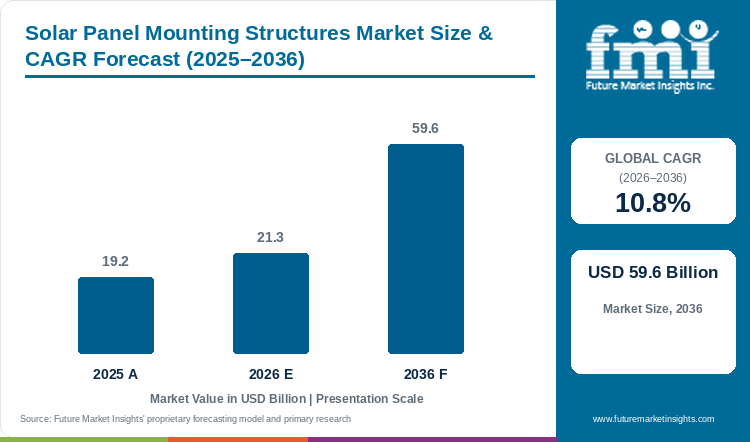
The solar panel mounting structures market is estimated at USD 21.3 billion in 2026 and is forecast to reach USD 59.6 billion by 2036, at a 10.8% CAGR from 2026 to 2036.
Solar mounting structures transfer module loads into a roof or foundation over many years, so their design follows building or ground conditions as well as the panel layout. Roof installations require suitable attachments and water sealing, while ground-mounted arrays need foundations matched to terrain and soil; trackers add moving components whose wind behaviour must also be considered. Roof-mounted structures and aluminum lead their respective 2026 categories, although material choice cannot establish performance independently of section geometry and connections. Developers therefore need documentation for the complete installed design and access that permits inspection and maintenance in service. Floating systems add mooring requirements associated with exposure and changing water levels. Through 2036, the commercial opportunity will depend on projects reaching construction with support arrangements suited to their locations, supported by engineering review and components whose condition can be checked throughout operation.
Key Market Trends & Insights
- The Roof-mounted Structure segment is projected to account for 44.0% of product type demand in 2026.
- The Aluminum segment is projected to account for 39.0% of material demand in 2026.
- 2 to 3 mm is projected to account for 37.0% of thickness demand in 2026.
Regional Highlights
- United States records the highest profiled forecast at 11.5% CAGR from 2026 to 2036.
- Japan is forecast at 9.8% CAGR over the same period. Country and combined-market rates are analyst estimates.
Market Size & Forecast
Table 1: Market Size and Forecast for Solar Panel Mounting Structures Market, 2026 to 2036
| Metric | Value |
|---|---|
| 2025 market value | USD 19.2 billion |
| 2026 market estimate | USD 21.3 billion |
| 2036 market forecast | USD 59.6 billion |
| CAGR, 2026 to 2036 | 10.8% |
Purchasing Evidence and Operating Requirements
Table 2: Purchasing Evidence and Operating Requirements
| Source | Date | Evidence | Coverage |
|---|---|---|---|
| U.S. Department of the Treasury and Internal Revenue Service | 2025-01-16 | Issued administrative guidance | Guidance released January 2025; later law and guidance require separate assessment.[1] |
| IEA Photovoltaic Power Systems Programme, Task 13 | 2025-12 | Official technical report summary | International experience synthesized in December 2025 report.[2] |
| IEA Photovoltaic Power Systems Programme, Task 13 | 2025-04 | Official technical review | Technical literature and experience reviewed for April 2025 report.[3] |
| Fraunhofer Institute for Solar Energy Systems ISE | 2025-03-17 | Funded research project | Research project described March 2025, with a three-and-a-half-year funding period.[4] |
Analyst Perspective
Mounting hardware needs a design case for the actual roof or foundation, with connections and inspection access assessed alongside material weight. Those details influence how the support system carries loads and can be maintained throughout the array's life, making the complete assembly the appropriate basis for selection.
- Nikhil Kaitwade, Principal Analyst at Future Market Insights
How is the solar panel mounting structures market segmented?
By product type, the categories are Roof-mounted Structure, Ground-mounted Structure, Top-of-pole Mounted Structure, Side-of-pole Mounted Structure, Tracking System Mounted Structure. By material, the categories are High Speed Steel, Cold Formed Steel, Aluminum, Galvanized Iron, Others. By thickness, the categories are 0.5 to 2 mm, 2 to 3 mm, 3 to 6 mm, Others.
Why does the Roof-mounted Structure segment account for 44.0% of product type demand in 2026?
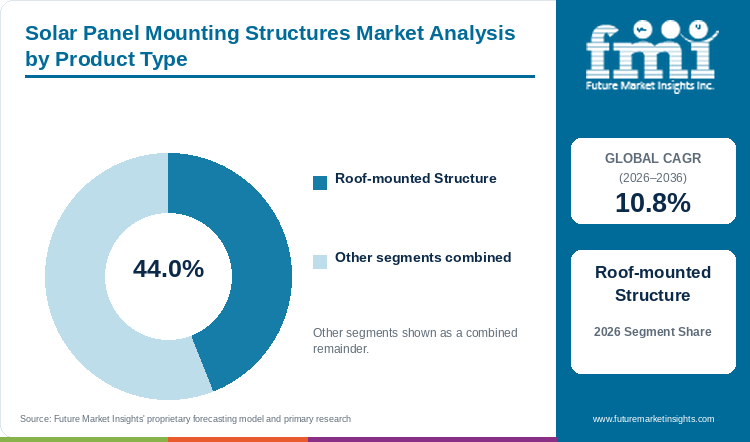
Roof-mounted Structure represents 44.0% of product type demand in 2026, placing the condition and load capacity of the host building at the centre of the mounting design.
Table 3: Product Type Share for Solar Panel Mounting Structures Market, 2026
| Product Type | Share (2026) |
|---|---|
| Roof-mounted Structure | 44.0% |
| Other product type segments | 56.0% |
| Total | 100.0% |
A roof gives a solar array an existing location, but it also fixes the building condition and available attachment positions before hardware is selected. The structure has to transfer the proposed loads while preserving weather sealing, making construction anchor selection part of an assessment of the complete roof assembly. Faster installation is commercially useful when these details have already been resolved, because correcting an unsuitable connection after the array is in place adds work to both the mounting system and the host building.
- The Roof-mounted Structure segment accounts for 44.0% of product type demand in 2026.
- Roof attachment must preserve structural and weather-sealing performance.
Why does the Aluminum segment account for 39.0% of material demand in 2026?
Aluminum accounts for 39.0% of material demand in 2026, with its weight and formability supporting structural components designed around the required loads and connections.
Table 4: Material Share for Solar Panel Mounting Structures Market, 2026
| Material | Share (2026) |
|---|---|
| Aluminum | 39.0% |
| Other material segments | 61.0% |
| Total | 100.0% |
Aluminum's manageable weight can simplify handling, while its formability gives designers options for structural sections; neither characteristic removes the need to design the connections and section dimensions for the proposed duty. Materials in contact also influence corrosion behaviour in the actual exposure environment. Buyers can consequently compare the complete arrangement against roof or foundation conditions, establishing which components belong in the installed design and how their condition will be inspected after commissioning.
- The Aluminum segment accounts for 39.0% of material demand in 2026.
- Aluminum sections require suitable connection and corrosion design.
What are the drivers, restraints, and opportunities in the solar panel mounting structures market?
Driver: Project design turns solar capacity into hardware orders
Every array needs support, with terrain, foundations and module layout determining the quantities and forms of structural material required. IRS Notice 2025-08 distinguishes foundation and tracker components within its administrative framework, while solar microinverters need to be coordinated with the array for their separate electrical conversion function.[1]
Restraint: Weather exposure and foundations create design risk
IEA PVPS recommends engineering review of racking and trackers exposed to extreme weather, with terrain and geology affecting the foundation solution.[2] That assessment needs to continue into maintenance through fastener checks and accessible components, allowing a standard product to be evaluated against the loads and conditions of the individual project.
Opportunity: Specialist sites widen the engineering requirement
Floating PV requires mooring and anchoring checks for exposure and changing water levels, while MoorPower plans comparisons of mounting approaches on rewetted peatland.[3][4] These development settings highlight site-specific foundation questions, with soil testing informing ground-mounted design and machine control supporting construction accuracy where the project and equipment suit the method.
Which country and market growth rates are profiled?
Table 5: Country CAGR Comparison for Solar Panel Mounting Structures Market, 2026 to 2036
| Country | CAGR |
|---|---|
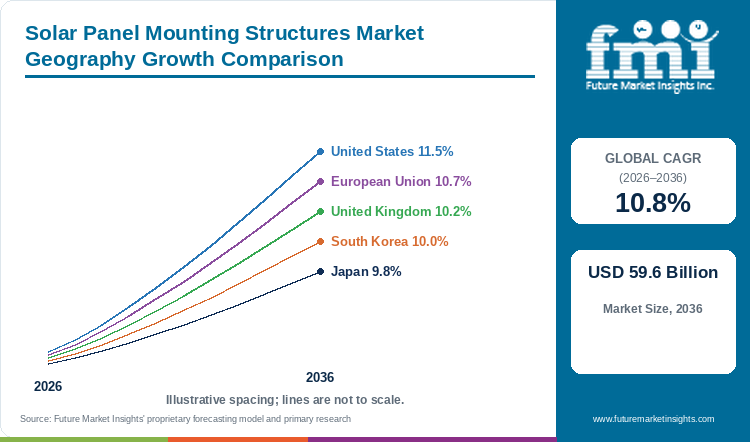
| United States | 11.5% |
| United Kingdom | 10.2% |
| Japan | 9.8% |
| South Korea | 10.0% |
| European Union | 10.7% |
Growth rates in the table are FMI analyst forecasts.
Country-wise Analysis
United States
The United States forecast of 11.5% CAGR for 2026 to 2036 is the strongest profiled rate, while project design remains tied to local roofs and foundations. IRS Notice 2025-08 supplies component definitions and assigned values for its administrative purpose, adding a separate accounting consideration to the project.[1] Those values do not establish a mounting-system selling price; a purchaser still needs the structural scope, installation conditions and applicable requirements identified before the equipment offer can be assessed.
United Kingdom
Roof obstructions and limited attachment positions can decide the workable panel layout on a United Kingdom building before a mounting order is placed. Clear design documents allow the installer to coordinate those constraints with site access and preserve a route for later inspection, reducing the chance that assembly convenience creates a service problem. The country's demand is projected at 10.2% CAGR over 2026 to 2036, with the host building giving each roof project its own engineering and delivery requirements.
Japan
The mounting layout on a constrained Japanese roof has to use the available area while accommodating the building's structural and weather exposure requirements. The proposed material is only one part of that design, with attachment details and inspection methods establishing how the system can remain suitable in service. Against a 9.8% CAGR forecast during 2026 to 2036, installers and component suppliers need to coordinate these details early enough for the customer to compare complete arrangements for the actual building.
South Korea
A South Korean contractor installing a roof system faces different preparation and connection work from a contractor supplying a ground-mounted array, even when some components are shared. Traceable parts and compatible replacements help preserve the original design after installation, so project assumptions need to remain available alongside the equipment. South Korea's 2026 to 2036 forecast is 10.0% CAGR, with this distinction between applications influencing both installation scope and the support a customer will need later.
European Union
Fraunhofer's MoorPower work investigates a particular foundation setting on rewetted peatland, adding evidence for a specialised European installation problem.[4] Other European Union projects begin with different ground or building conditions, requiring their own structural assessment before that experience can be applied. The combined-market forecast of 10.7% CAGR from 2026 to 2036 covers this variety of settings, with mounting suppliers needing to connect component design and installation method to the location in which the array will operate.
Who are the notable companies in the solar panel mounting structures market?
Unirac Inc.; IronRidge; Schletter Group; K2 Systems; PV Hardware
Rooftop mounting requirements bring Unirac and IronRidge into consideration alongside structural portfolios from Schletter and K2 Systems, while PV Hardware contributes tracker-related offerings. Installation type and foundation duty determine the relevant comparison, because rooftop attachment and a moving ground-mounted structure require different configurations and project support.
Competitive Benchmarking: Solar Panel Mounting Structures Market
Table 6: Competitive Benchmarking
| Participant | Relevant portfolio | Purchasing comparison |
|---|---|---|
| Unirac Inc. | Rooftop solar mounting | Roof attachment and installation method |
| IronRidge | Solar racking and mounting | Assembly documentation and compatibility |
| Schletter Group | Solar support structures | Structural design and material protection |
| K2 Systems | Solar mounting systems | Roof interface and component fit |
| PV Hardware | Tracker and ground-support systems | Foundation and wind design |
Key Developments in the Solar Panel Mounting Structures Market
- IEA PVPS published an extreme-weather report summary in December 2025 recommending engineering review and site-aware structural design for PV support systems.[2]
- Fraunhofer announced MoorPower in March 2025 to compare mounting and foundation designs under different water levels on rewetted peatland. Its grant covers the wider research project.[4]
Key Players in the Solar Panel Mounting Structures Market
- Unirac Inc.: Rooftop solar mounting.
- IronRidge: Solar racking and mounting.
- Schletter Group: Solar support structures.
- K2 Systems: Solar mounting systems.
- PV Hardware: Tracker and ground-support systems.
Solar Panel Mounting Structures Market - Report Scope
Table 7: Report Scope for Solar Panel Mounting Structures Market
| Coverage field | Report scope |
|---|---|
| Market definition | PV support structures, tracker components, foundations and floating-system anchoring, excluding standalone module and inverter demand. |
| Historical reference year | 2025 |
| Market breakdown | product type, material, thickness |
| Quantitative Units | USD Billion |
| Regions covered | North America; Latin America; Western Europe; Eastern Europe; East Asia; South Asia and Pacific; Middle East and Africa |
| Countries profiled | United States; United Kingdom; Japan; South Korea; European Union |
| Forecast period | 2026 to 2036 |
| Key companies profiled | Unirac Inc.; IronRidge; Schletter Group; K2 Systems; PV Hardware |
Solar Panel Mounting Structures Market - Research Methodology
Table 8: Research Methodology
| Method | Approach |
|---|---|
| Quantitative analysis | Market values, category shares and country forecasts are presented as FMI analyst estimates. |
| Desk research | Government records, public procurement and technical research establish application conditions and documented activity. |
| Evidence assessment | Awards are distinguished from tenders. Laboratory and modeled results retain their stated operating limits. |
| Segmentation framework | Shares use the stated segment axis as their denominator; country rates use the stated forecast period. |
Solar Panel Mounting Structures Market by Segments
Product Type
- Roof-mounted Structure
- Ground-mounted Structure
- Top-of-pole Mounted Structure
- Side-of-pole Mounted Structure
- Tracking System Mounted Structure
Material
- High Speed Steel
- Cold Formed Steel
- Aluminum
- Galvanized Iron
- Others
Thickness
- 0.5 to 2 mm
- 2 to 3 mm
- 3 to 6 mm
- Others
Solar Panel Mounting Structures Market by Region
- North America
- United States
- Canada
- Latin America
- Brazil
- Mexico
- Argentina
- Chile
- Western Europe
- Germany
- France
- United Kingdom
- Italy
- Spain
- Benelux
- Nordics
- Eastern Europe
- Poland
- Czech Republic
- Romania
- Hungary
- East Asia
- China
- Japan
- South Korea
- South Asia and Pacific
- India
- ASEAN
- Australia and New Zealand
- Middle East and Africa
- GCC Countries
- South Africa
- Türkiye
- Israel
Research Sources and Bibliography
- [1] U.S. Department of the Treasury and Internal Revenue Service. (2025-01-16). Notice 2025-08: Domestic Content Bonus Credit Amounts under the Inflation Reduction Act of 2022: First Updated Elective Safe Harbor modifying Notice 2024-41
- [2] IEA Photovoltaic Power Systems Programme, Task 13. (2025-12). Operational and Economic Impacts of Extreme Weather on PV Power Plants
- [3] IEA Photovoltaic Power Systems Programme, Task 13. (2025-04). Floating Photovoltaic Power Plants: A Review of Energy Yield, Reliability, and Maintenance
- [4] Fraunhofer Institute for Solar Energy Systems ISE. (2025-03-17). Rewetting More Peatlands with Photovoltaics
- Future Market Insights. (2026). Solar Panel Mounting Structures Market: Global industry analysis and opportunity assessment 2036.
This Report Answers
- How large is the solar panel mounting structures market in 2026?
- What market value is forecast for 2036?
- Which product type category leads in 2026?
- Why does Aluminum lead its category?
- Which profiled market has the highest forecast growth?
- Which companies participate in the solar panel mounting structures market?
Frequently Asked Questions
How large is the solar panel mounting structures market in 2026?
The market is estimated at USD 21.3 billion in 2026, compared with USD 19.2 billion in 2025.
What market value is forecast for 2036?
The forecast is USD 59.6 billion in 2036 at a 10.8% CAGR from 2026 to 2036.
Which product type category leads in 2026?
The Roof-mounted Structure segment is projected to account for 44.0% of product type demand in 2026.
Why does Aluminum lead its category?
Aluminum offers a useful combination of manageable weight and formability for structural components.
Which profiled market has the highest forecast growth?
United States has the highest profiled rate at 11.5% CAGR during 2026 to 2036.
Which companies participate in the solar panel mounting structures market?
Unirac Inc.; IronRidge; Schletter Group; K2 Systems; PV Hardware.
Preview the report firsthand - request a free sample
Get SampleGet the brochure for pricing and purchase details.
Get PDFTable of Content
- Key Takeaways
- Market Size and CAGR
- Top Growth Driver
- Fastest Growing Segment
- Leading Region
- Key Companies
- Emerging Opportunities
- Executive Summary
- Global Market Outlook
- Demand-side Trends
- Supply-side Trends
- Technology Roadmap Analysis
- Analysis and Recommendations
- Analyst Perspective (What is happening? Why now? What should investors know?)
- Key Questions Answered
- How large is the market?
- What is the CAGR?
- What are key trends?
- Which region dominates?
- Who are the leaders?
- Market Overview
- Market Coverage / Taxonomy
- Market Definition / Scope / Limitations
- Research Methodology
- Chapter Orientation
- Analytical Lens and Working Hypotheses
- Market Structure, Signals, and Trend Drivers
- Benchmarking and Cross-market Comparability
- Market Sizing, Forecasting, and Opportunity Mapping
- Research Design and Evidence Framework
- Desk Research Programme (Secondary Evidence)
- Expert Input and Fieldwork (Primary Evidence)
- Tooling, Models, and Reference Databases
- Data Engineering and Model Build
- Quality Assurance and Audit Trail
- Market Background
- Market Dynamics (Drivers, Restraints, Opportunity, Trends)
- Scenario Forecast (Optimistic, Likely, Conservative)
- Impact Analysis
- AI Impact
- Sustainability Impact
- Regulatory Impact
- Technology Impact
- Consumer / Buyer Analysis
- Purchase Drivers
- Adoption Barriers
- Buyer Journey
- Opportunity Map Analysis
- Product Life Cycle Analysis
- Supply Chain Analysis
- Investment Feasibility Matrix
- Value Chain Analysis
- PESTLE and Porter's Analysis
- Regulatory Landscape
- Regional Parent Market Outlook
- Production and Consumption Statistics
- Import and Export Statistics
- Global Market Analysis and Forecast, 2021 to 2036
- Historical Market Size Value (USD Billion) Analysis, 2021 to 2025
- Current and Future Market Size Value (USD Billion) Projections, 2026 to 2036
- Y-o-Y Growth Trend Analysis
- Absolute $ Opportunity Analysis
- Global Market Pricing Analysis, 2021 to 2036
- Global Market Analysis and Forecast, By Product Type, 2021 to 2036
- Introduction / Key Findings
- Historical Market Size Value (USD Billion) Analysis By Product Type, 2021 to 2025
- Current and Future Market Size Value (USD Billion) Analysis and Forecast By Product Type, 2026 to 2036
- Roof-mounted Structure
- Ground-mounted Structure
- Top-of-pole Mounted Structure
- Side-of-pole Mounted Structure
- Tracking System Mounted Structure
- Y-o-Y Growth Trend Analysis By Product Type, 2021 to 2025
- Absolute $ Opportunity Analysis By Product Type, 2026 to 2036
- Global Market Analysis and Forecast, By Material, 2021 to 2036
- Introduction / Key Findings
- Historical Market Size Value (USD Billion) Analysis By Material, 2021 to 2025
- Current and Future Market Size Value (USD Billion) Analysis and Forecast By Material, 2026 to 2036
- High Speed Steel
- Cold Formed Steel
- Aluminum
- Galvanized Iron
- Others
- Y-o-Y Growth Trend Analysis By Material, 2021 to 2025
- Absolute $ Opportunity Analysis By Material, 2026 to 2036
- Global Market Analysis and Forecast, By Thickness, 2021 to 2036
- Introduction / Key Findings
- Historical Market Size Value (USD Billion) Analysis By Thickness, 2021 to 2025
- Current and Future Market Size Value (USD Billion) Analysis and Forecast By Thickness, 2026 to 2036
- 0.5 to 2 mm
- 2 to 3 mm
- 3 to 6 mm
- Others
- Y-o-Y Growth Trend Analysis By Thickness, 2021 to 2025
- Absolute $ Opportunity Analysis By Thickness, 2026 to 2036
- Global Market Analysis and Forecast, By Region, 2021 to 2036
- Introduction
- Historical Market Size Value (USD Billion) Analysis By Region, 2021 to 2025
- Current Market Size Value (USD Billion) Analysis and Forecast By Region, 2026 to 2036
- North America
- Latin America
- Western Europe
- Eastern Europe
- East Asia
- South Asia and Pacific
- Middle East and Africa
- Market Attractiveness Analysis By Region
- North America Market Analysis and Forecast, By Country, 2021 to 2036
- Historical Market Size Value (USD Billion) Trend Analysis By Market Taxonomy, 2021 to 2025
- Market Size Value (USD Billion) Forecast By Market Taxonomy, 2026 to 2036
- By Country
- United States
- Canada
- By Product Type
- By Material
- By Thickness
- By Country
- Market Attractiveness Analysis
- By Country
- By Product Type
- By Material
- By Thickness
- Key Takeaways
- Latin America Market Analysis and Forecast, By Country
- Historical Market Size Value (USD Billion) Trend Analysis By Market Taxonomy, 2021 to 2025
- Market Size Value (USD Billion) Forecast By Market Taxonomy, 2026 to 2036
- By Country
- Brazil
- Mexico
- Argentina
- Chile
- By Product Type
- By Material
- By Thickness
- By Country
- Market Attractiveness Analysis
- By Country
- By Product Type
- By Material
- By Thickness
- Key Takeaways
- Western Europe Market Analysis and Forecast, By Country
- Historical Market Size Value (USD Billion) Trend Analysis By Market Taxonomy, 2021 to 2025
- Market Size Value (USD Billion) Forecast By Market Taxonomy, 2026 to 2036
- By Country
- Germany
- France
- United Kingdom
- Italy
- Spain
- Benelux
- Nordics
- By Product Type
- By Material
- By Thickness
- By Country
- Market Attractiveness Analysis
- By Country
- By Product Type
- By Material
- By Thickness
- Key Takeaways
- Eastern Europe Market Analysis and Forecast, By Country
- Historical Market Size Value (USD Billion) Trend Analysis By Market Taxonomy, 2021 to 2025
- Market Size Value (USD Billion) Forecast By Market Taxonomy, 2026 to 2036
- By Country
- Poland
- Czech Republic
- Romania
- Hungary
- By Product Type
- By Material
- By Thickness
- By Country
- Market Attractiveness Analysis
- By Country
- By Product Type
- By Material
- By Thickness
- Key Takeaways
- East Asia Market Analysis and Forecast, By Country
- Historical Market Size Value (USD Billion) Trend Analysis By Market Taxonomy, 2021 to 2025
- Market Size Value (USD Billion) Forecast By Market Taxonomy, 2026 to 2036
- By Country
- China
- Japan
- South Korea
- By Product Type
- By Material
- By Thickness
- By Country
- Market Attractiveness Analysis
- By Country
- By Product Type
- By Material
- By Thickness
- Key Takeaways
- South Asia and Pacific Market Analysis and Forecast, By Country
- Historical Market Size Value (USD Billion) Trend Analysis By Market Taxonomy, 2021 to 2025
- Market Size Value (USD Billion) Forecast By Market Taxonomy, 2026 to 2036
- By Country
- India
- ASEAN
- Australia and New Zealand
- By Product Type
- By Material
- By Thickness
- By Country
- Market Attractiveness Analysis
- By Country
- By Product Type
- By Material
- By Thickness
- Key Takeaways
- Middle East and Africa Market Analysis and Forecast, By Country
- Historical Market Size Value (USD Billion) Trend Analysis By Market Taxonomy, 2021 to 2025
- Market Size Value (USD Billion) Forecast By Market Taxonomy, 2026 to 2036
- By Country
- GCC Countries
- South Africa
- Türkiye
- Israel
- By Product Type
- By Material
- By Thickness
- By Country
- Market Attractiveness Analysis
- By Country
- By Product Type
- By Material
- By Thickness
- Key Takeaways
- Key Countries Market Analysis
- United States
- Pricing Analysis
- Market Share Analysis, 2025
- By Product Type
- By Material
- By Thickness
- Canada
- Pricing Analysis
- Market Share Analysis, 2025
- By Product Type
- By Material
- By Thickness
- Mexico
- Pricing Analysis
- Market Share Analysis, 2025
- By Product Type
- By Material
- By Thickness
- Brazil
- Pricing Analysis
- Market Share Analysis, 2025
- By Product Type
- By Material
- By Thickness
- Chile
- Pricing Analysis
- Market Share Analysis, 2025
- By Product Type
- By Material
- By Thickness
- Germany
- Pricing Analysis
- Market Share Analysis, 2025
- By Product Type
- By Material
- By Thickness
- United Kingdom
- Pricing Analysis
- Market Share Analysis, 2025
- By Product Type
- By Material
- By Thickness
- Italy
- Pricing Analysis
- Market Share Analysis, 2025
- By Product Type
- By Material
- By Thickness
- Spain
- Pricing Analysis
- Market Share Analysis, 2025
- By Product Type
- By Material
- By Thickness
- France
- Pricing Analysis
- Market Share Analysis, 2025
- By Product Type
- By Material
- By Thickness
- India
- Pricing Analysis
- Market Share Analysis, 2025
- By Product Type
- By Material
- By Thickness
- ASEAN
- Pricing Analysis
- Market Share Analysis, 2025
- By Product Type
- By Material
- By Thickness
- Australia and New Zealand
- Pricing Analysis
- Market Share Analysis, 2025
- By Product Type
- By Material
- By Thickness
- China
- Pricing Analysis
- Market Share Analysis, 2025
- By Product Type
- By Material
- By Thickness
- Japan
- Pricing Analysis
- Market Share Analysis, 2025
- By Product Type
- By Material
- By Thickness
- South Korea
- Pricing Analysis
- Market Share Analysis, 2025
- By Product Type
- By Material
- By Thickness
- Poland
- Pricing Analysis
- Market Share Analysis, 2025
- By Product Type
- By Material
- By Thickness
- Hungary
- Pricing Analysis
- Market Share Analysis, 2025
- By Product Type
- By Material
- By Thickness
- Türkiye
- Pricing Analysis
- Market Share Analysis, 2025
- By Product Type
- By Material
- By Thickness
- South Africa
- Pricing Analysis
- Market Share Analysis, 2025
- By Product Type
- By Material
- By Thickness
- European Union
- Pricing Analysis
- Market Share Analysis, 2025
- By Product Type
- By Material
- By Thickness
- United States
- Market Structure Analysis
- Competition Dashboard
- Competition Benchmarking
- Market Share Analysis of Top Players
- By Regional
- By Product Type
- By Material
- By Thickness
- Emerging Startups
- Innovation Benchmarking
- Competition Analysis
- Competition Deep Dive
- Unirac Inc.
- Overview
- Product Portfolio
- Profitability by Market Segments
- Sales Footprint
- Strategy Overview
- Marketing Strategy
- Product Strategy
- Channel Strategy
- IronRidge
- Schletter Group
- K2 Systems
- PV Hardware
- Unirac Inc.: Rooftop solar mounting.
- IronRidge: Solar racking and mounting.
- Schletter Group: Solar support structures.
- K2 Systems: Solar mounting systems.
- PV Hardware: Tracker and ground-support systems.
- Unirac Inc.
- Case Studies
- Success Stories
- Recent Developments
- Competition Deep Dive
- Assumptions & Acronyms Used


