

- Industry Size (2026)
- USD 115 Mn
- Forecast (2036)
- USD 545 Mn
- CAGR (2026 to 2036)
- 10.90%
Sensor-Integrated Aircraft Exterior Access Panels Market Size, Market Forecast and Outlook By FMI
The sensor-integrated aircraft exterior access panels market was valued at USD 115 million in 2025. The industry is poised to reach USD 240 million in 2026 at a CAGR of 10.90% during the forecast period. Sustained investment propels the total opportunity to USD 545 million through 2036 as fleet operators transition from reactive visual inspections to integrated structural health monitoring systems for exterior skins.
Airframe maintenance managers are currently navigating a fundamental shift in how structural integrity is verified, moving away from labor-intensive manual latch checks toward automated digital signatures. This transformation is driven by the mandate to reduce Aircraft on Ground (AOG) time, where the cost of a delayed departure far exceeds the premium of a structural health monitoring enabled panel. By embedding intelligence directly into the access point, operators gain real-time visibility into skin fatigue and fastener security, eliminating the "open-and-inspect" cycles that often introduce secondary damage. The stakes of delay are high; carriers clinging to legacy inspection regimes face widening gaps in fleet availability compared to competitors utilizing predictive maintenance architectures.
Summary of Sensor-Integrated Aircraft Exterior Access Panels Market
- Sensor-Integrated Aircraft Exterior Access Panels Market Definition:
- This market covers exterior airframe panels equipped with integrated sensors for real-time monitoring of structural health and operational security, providing a digital interface between the aircraft skin and maintenance systems.
- Demand Drivers in the Market:
- The shift toward condition-based maintenance compels fleet operators to seek panels that eliminate redundant visual inspections of high-use access points.
- Escalating AOG costs drive procurement managers to prioritize aircraft sensors that provide pre-failure alerts for engine cowlings and landing gear bays.
- Tightening safety regulations regarding fuel tank access security require manufacturers to implement tamper-evident and latch-verified smart panels.
- Key Segments Analyzed in the FMI Report:
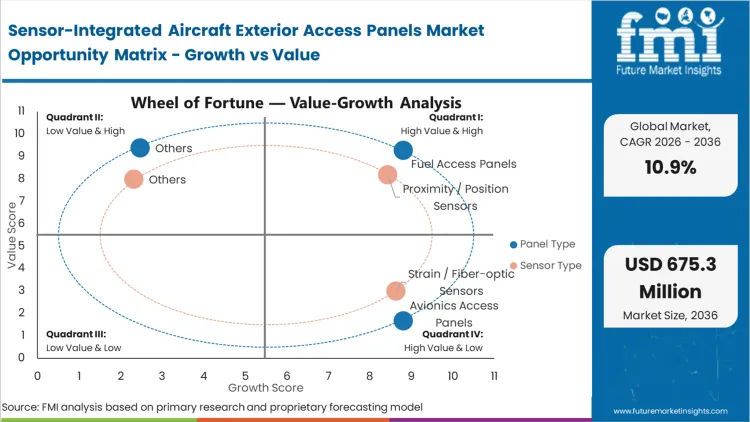
- Fuel access panels: Fuel access panels are expected to account for 29.0% share in 2026, driven by the critical need for seal integrity monitoring and leak detection.
- Proximity / position sensors: Proximity sensors are predicted to hold 34.0% share in 2026, as they provide the simplest digital confirmation of latch closure for avionics and service bays.
- Composite sandwich panels: Composite materials garner 41.0% share, owing to the ease of embedding fiber-optic strain sensors within the laminate layup during production.
- Commercial fixed-wing: Commercial fixed-wing leads at 61.0% share, as high-cycle airline operations derive the maximum ROI from reduced maintenance downtime.
- China: China leads growth at 12.6% CAGR, reflecting the massive infrastructure investment in domestic narrow-body manufacturing and smart MRO hubs.
- Analyst Opinion at FMI:
- As per Rahul Pandita, Principal Analyst, Technology, at FMI, "The industry narrative often centers on the 'smartness' of the sensor, but practitioners know that the true bottleneck is the connector. We have observed that even the most advanced piezoelectric vibrations sensor is useless if the connector cannot withstand ten years of thermal cycling and high-frequency vibration on an engine cowl. The winners in this market will not be the sensor innovators, but the materials engineers who can integrate data paths into the panel structure without creating new failure points for moisture or lightning strikes."
- Strategic Implications / Executive Takeaways:
- MRO directors must invest in digital diagnostic tools that can interface with the emerging variety of smart panel data protocols.
- Composite manufacturers should seek partnerships with sensor providers to offer smart composite layup machines that automate the embedding process for high-volume narrow-body programs.
- Supply chain leads face a qualification gap where sensors must be certified as part of the airframe structure, requiring earlier involvement in the aircraft design cycle.
- Methodology:
- FMI's approach integrates primary interviews with role-specific decision-makers and quantitative analysis of aircraft production backlogs to provide a 10-year outlook anchored to real-world fleet modernization cycles.
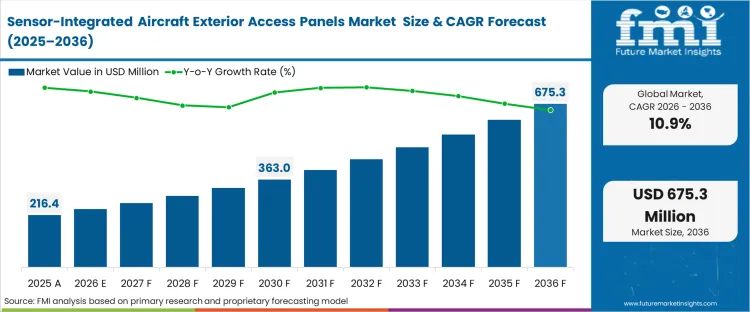
The primary inflection point for this market is the standardization of wireless data transmission protocols for embedded sensor nodes. Until high-reliability wireless power and data transfer become the industry norm, the weight penalty of additional wiring harnesses restricts smart panels to high-criticality zones like engine cowls. Once this technical gate is passed, triggered by the maturation of energy-harvesting piezoelectric systems, the adoption of sensor-integrated panels will expand from specialized safety points to the entire airframe skin.
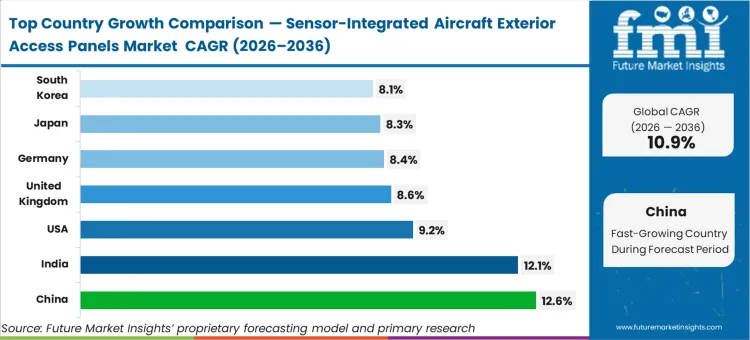
China is expected to expand at 12.6% compound annual growth, followed by India at 12.1% and the United States at 9.2%. The United Kingdom is anticipated to register a CAGR of 8.6%, while Germany follows at 8.4%. Japan and South Korea are projected to grow at 8.3% and 8.1% respectively. This geographic divergence is shaped by the varying rates of narrow-body production ramp-ups in Asian hubs compared to the heavy retrofit focus dominating Western MRO facilities.
Sensor-Integrated Aircraft Exterior Access Panels Market Key Takeaways
| Metric | Details |
|---|---|
| Industry Size (2026) | USD 240 million |
| Industry Value (2036) | USD 545 million |
| CAGR (2026-2036) | 10.90% |
Source: Future Market Insights (FMI) analysis, based on proprietary forecasting model and primary research
Sensor-Integrated Aircraft Exterior Access Panels Market Definition
The Sensor-Integrated Aircraft Exterior Access Panels Market encompasses structural components designed to provide access to internal aircraft systems while functioning as part of the aerodynamic skin. These panels are distinguished by the integration of embedded or surface-bonded sensors that monitor parameters such as latch security, structural strain, moisture ingress, and thermal gradients. This market isolates components where sensing capability is an architectural feature of the panel itself, rather than a standalone sensor mounted near the opening.
Sensor-Integrated Aircraft Exterior Access Panels Market Inclusions
This market includes fuel tank access points, avionics bay covers, and engine cowlings featuring co-molded fiber-optic or piezoelectric sensors. It also covers the associated electronics for data pre-processing within the panel assembly and specialized aircraft seals that incorporate conductive paths for continuity sensing. Integrated assemblies for both OEM line-fit and aftermarket upgrade kits are within scope.
Sensor-Integrated Aircraft Exterior Access Panels Market Exclusions
Excluded from this scope are standard panels that require external inspection tools for verification. Standalone sensors that are not physically integrated into the panel structure or material layup are likewise excluded. Internal aerospace interior panels, cargo bay doors, and primary flight control surfaces like ailerons are outside the functional boundary of this specific access-focused market.
Sensor-Integrated Aircraft Exterior Access Panels Market Research Methodology
- Primary Research: FMI conducted interviews with Airframe Design Leads at major OEMs and Maintenance Directors at tier-1 MRO providers to validate sensor durability requirements.
- Desk Research: Data was aggregated from aerospace certification registries, FAA/EASA airworthiness directive databases, and procurement specifications for upcoming narrow-body aircraft programs.
- Market-Sizing and Forecasting: The baseline anchors to the volume of scheduled heavy maintenance checks (C and D checks) and annual production rates for commercial and military fixed-wing aircraft.
- Data Validation and Update Cycle: Forecasts were triangulated using independent data streams from composite material shipment volumes and the adoption rates of iot in aviation platforms across global fleets.
Segmental Analysis
Sensor-Integrated Aircraft Exterior Access Panels Market Analysis by Panel Type
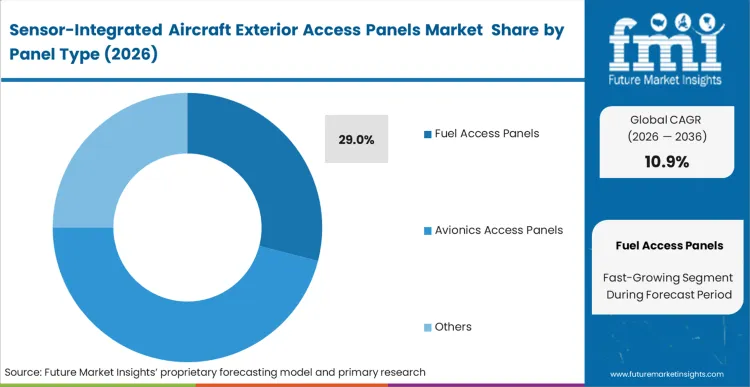
The structural reason fuel access panels hold 29.0% of this market is the non-negotiable requirement for fuel tank safety and the difficulty of verifying internal seal health without time-consuming removal. Maintenance crews at major airlines prioritize these panels because a single undetected leak can lead to catastrophic airframe loss or massive environmental fines. FMI notes that the integration of humidity and position sensors into these specific points allows for "through-the-skin" verification, ensuring that the panel is not only physically closed but also hermetically sealed. Operators who rely on standard panels often face secondary seal damage caused by unnecessary inspection cycles, a risk that is eliminated by digital monitoring. The demand for aircraft seals that work in tandem with these sensors is consequently rising.
- Seal integrity amortization: Where cost savings originate in the procurement cycle by reducing the frequency of gasket replacements on frequently accessed panels.
- Access delay costs: What hidden costs emerge in the operational phase when a standard panel fails a manual inspection, grounding the aircraft during peak flight windows.
- Total lifecycle visibility: What the total lifecycle comparison reveals about the reduced labor requirement for digital fuel-panel verification across a 20-year airframe life.
Sensor-Integrated Aircraft Exterior Access Panels Market Analysis by Sensor Type
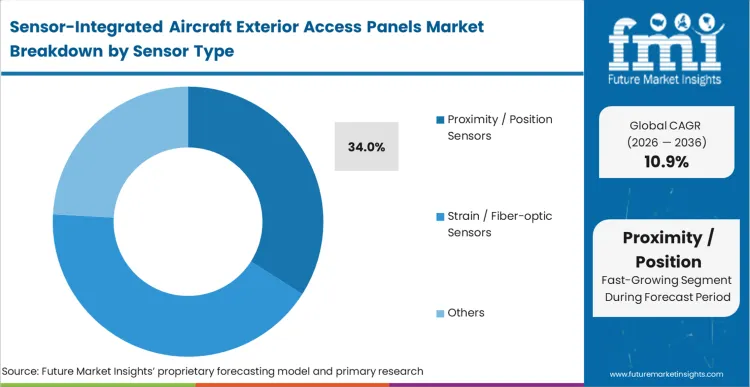
Legacy manual latch verification is being displaced by proximity and position sensors because visual confirmation is no longer sufficient for high-speed narrow-body turnarounds. A proximity sensor provides a binary digital signal that can be integrated into the aerospace avionics suite, allowing pilots to confirm all exterior panels are secured before engine start. FMI's assessment suggests that this move away from walk-around inspections toward cockpit-verified security is the primary driver for the 34.0% share held by proximity sensors. While strain sensors offer more detailed structural data, the immediate operational ROI of knowing a landing gear door is truly latched provides a clearer path to adoption. As per FMI's projection, the simplicity of position sensing makes it the standard entry point for smart panel upgrades.
- Sensitivity thresholds: Where performance exceeds expectations by detecting millimetric latch misalignment that would be invisible to a visual inspector on the tarmac.
- Signal-to-noise limitations: Where performance gaps appear under edge conditions like extreme cold or ice accumulation, requiring redundant sensor types.
- Qualification benchmarks: What specifying bodies determine as acceptable failure rates for digital position signals used in safety-critical access points.
Sensor-Integrated Aircraft Exterior Access Panels Market Analysis by Material
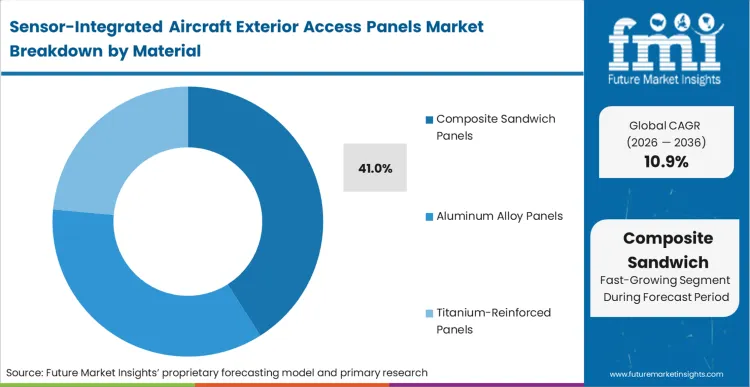
There is a structural tension between the weight-saving requirements of aerospace lightweight materials and the need to embed delicate sensor networks within the skin. Composite sandwich panels lead with 41.0% share because their multi-layered construction allows for the co-curing of fiber-optic sensors without compromising the aerodynamic profile. According to FMI's estimates, the difficulty of embedding electronics into solid aluminum or titanium panels without creating stress concentrations has pushed the market toward hybrid or composite solutions. Manufacturers must balance the electromagnetic shielding properties of the panel with the wireless signal transparency needed for internal sensor data transmission.
- Prepreg compatibility: Who produces this sub-segment and why they can sustain it through specialized resin systems that protect embedded electronics during the autoclave cycle.
- Material lead times: What supply constraints buyers must plan around as specialized smart-composite materials require more rigorous testing than standard alloys.
- Recycled fiber maturity: What the supply landscape looks like heading toward 2036 as composite airframes move toward sustainable fiber sources that may affect sensor signal stability.
Sensor-Integrated Aircraft Exterior Access Panels Market Analysis by Aircraft Type
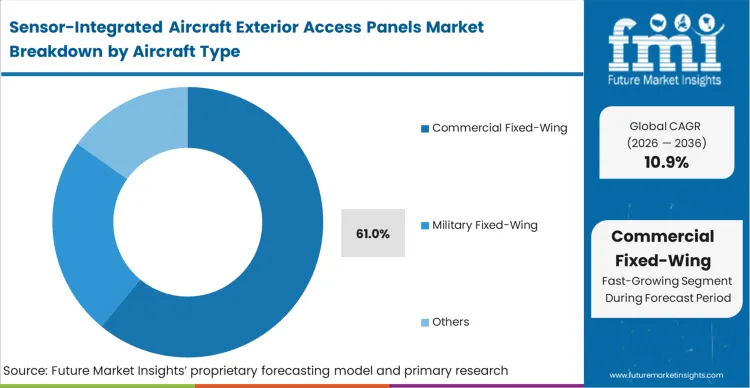
The decision for commercial fixed-wing operators to lead this market with 61.0% share is driven by the sheer volume of flight hours and the tight margins of modern airline operations. Unlike military or business jet segments, commercial carriers operate on a schedule where a one-hour delay can cost thousands of dollars in passenger compensation and slot fees. FMI analysts opine that the commercial sector's focus on narrow-body efficiency makes aircraft door and access panel monitoring a high-priority investment. By 2036, the integration of these systems will move from a "premium" option to a standard safety requirement for any aircraft entering high-frequency commercial service.
- AOG trigger events: What triggers the initial purchase decision as carriers reach the limit of manual inspection labor availability in high-traffic hubs.
- Dispatch reliability: What validates the choice during qualification by showing a measurable reduction in technical delays related to exterior panel checks.
- Fleet-wide scaling: What makes the buyer expand adoption from new aircraft to the existing fleet through modular aviation test equipment and retrofit kits.
Sensor-Integrated Aircraft Exterior Access Panels Market Drivers, Restraints, and Opportunities
The structural forcing condition driving this market is the escalating shortage of qualified airframe maintenance technicians combined with the rising frequency of flights. Maintenance directors are being forced to decide between increasing their headcount or automating the verification of exterior panels. Choosing to automate through sensor integration allows a single technician to verify the entire airframe's skin security from a tablet, significantly increasing throughput. Carriers that delay this shift face stagnant dispatch reliability and rising labor costs that cannot be easily passed on to passengers in competitive routes.
The primary restraint is the structural barrier of wiring complexity and weight. Integrating sensors into exterior access panels often requires dedicated data harnesses that snake through the airframe, adding weight that offsets the fuel savings of aerospace lightweight materials. This friction is structural because airworthiness certification for new wiring paths is slow and expensive. While wireless solutions are emerging, they face challenges with signal interference in the metal-rich environment of an aircraft, limiting their current deployment to non-critical monitoring.
Opportunities in the Sensor-Integrated Aircraft Exterior Access Panels Market
- Wireless sensor nodes: The maturation of ultra-low-power wireless data protocols enables retrofits that do not require new internal wiring. Avionics directors can capture this opportunity by upgrading aerospace radome and service panels without extensive airframe modification.
- Edge analytics integration: Panels that pre-process data to provide a simple "Go/No-Go" signal reduce the load on central aerospace avionics systems. Software providers can capture this by developing lightweight algorithms for embedded microcontrollers.
- Environmental sensing expansion: Beyond structural health, panels that monitor moisture ingress prevent long-term corrosion. Maintenance managers can capture this by deploying panels with integrated sensor-ready coatings in high-humidity regional routes.
Regional Analysis
Based on the regional analysis, the Sensor-Integrated Aircraft Exterior Access Panels market is segmented into North America, Latin America, Europe, East Asia, South Asia, Oceania, and Middle East and Africa across 40 plus countries.
.webp "Top Country Growth Comparison Sensor Integrated Aircraft Exterior Access Panels Market Cagr (2026 2036)")
| Country | CAGR (2026 to 2036) |
|---|---|
| China | 12.6% |
| India | 12.1% |
| United States | 9.2% |
| United Kingdom | 8.6% |
| Germany | 8.4% |
| Japan | 8.3% |
| South Korea | 8.1% |
Source: Future Market Insights (FMI) analysis, based on proprietary forecasting model and primary research
North America Sensor-Integrated Aircraft Exterior Access Panels Market Analysis
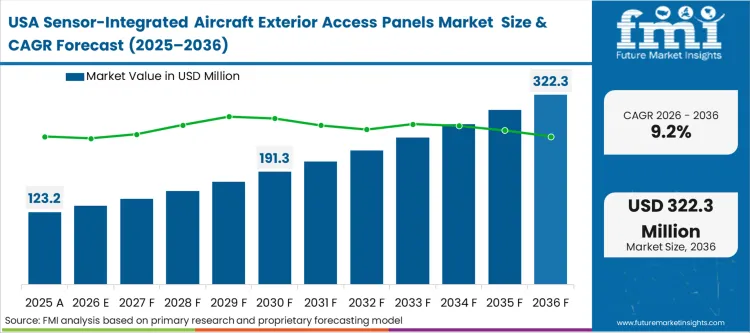
North America's adoption of smart access panels is strictly policy-led, driven by the FAA's aggressive push toward NextGen air traffic and maintenance standards. The region serves as the primary testbed for structural health monitoring, with the United States acting as the anchor for both OEM innovation and high-value retrofits. FMI views the North American market as the global leader in establishing the certification frameworks that other regions eventually adopt. The focus here is not just on the hardware, but on the data-security protocols required to transmit airframe health data over public networks at airports.
- United States: The United States' focus on extending the life of aging commercial fleets requires a shift to digital monitoring to catch fatigue before it becomes a structural failure. Demand for aircraft filters and service panels with integrated sensing is set to grow at 9.2% compound. Maintenance directors know that the cost of grounding a 20-year-old narrow-body for a manual inspection often outweighs the remaining value of the flight cycle. Practitioners emphasize that the real challenge is integrating these digital signals into legacy maintenance software that was designed for paper-based sign-offs.
East Asia Sensor-Integrated Aircraft Exterior Access Panels Market Analysis
East Asia's market trajectory is infrastructure-led, characterized by the rapid construction of massive "Smart MRO" cities in China and the modernization of regional hubs in Japan and South Korea. According to FMI's estimates, the region's advantage lies in its ability to build new narrow-body aircraft programs like the C919 with sensor-ready composite airframes from day one. This allows for a much higher level of sensor density than the retrofit-heavy markets of the West. The region's focus is on scaling production and reducing the unit cost of smart composite components.
- China: China's domestic aircraft programs are integrating structural health monitoring as a core architectural feature to compete with Western OEMs on total cost of ownership. The market for sensor-integrated panels in China is forecast to register a CAGR of 12.6% through 2036. This trajectory signals a move toward a fully digital fleet where manual skin inspections are phased out by the mid-2030s.
- Japan: Japan's aerospace sector is poised to expand at 8.3% compound as manufacturers focus on high-precision electric aircraft onboard sensors for next-generation regional jets. The structural shift here involves moving from purely mechanical latch systems to those with integrated electronic verification. This dynamic establishes a trajectory where Japanese components define the global standard for sensor-composite reliability.
- South Korea: South Korea is expected to see its aircraft panel sector grow at a compound annual rate of 8.1% as it leverages its domestic electronics expertise to develop modular sensor kits. The country's trajectory positions its aerospace suppliers as key partners for global OEMs seeking to "digitize" existing airframe designs. This competitive positioning allows South Korean firms to capture high-value contracts in both commercial and military segments.
South Asia Sensor-Integrated Aircraft Exterior Access Panels Market Analysis
The regional trajectory in South Asia is infrastructure-led, characterized by the rapid development of greenfield airports and the localization of maintenance, repair, and overhaul (MRO) capabilities. This shift is driven by the mandate to reduce reliance on foreign service hubs, making the integration of digital diagnostic tools a strategic priority for regional fleet sustainability. FMI analysts observe that the transition toward sensor-integrated airframes is essential for managing the high-cycle narrow-body operations that define the region's domestic corridors.
- India: India's rapid expansion of its domestic aviation fleet creates a commercial opportunity for MRO providers who can offer high-tech maintenance for narrow-body aircraft. FMI estimates the sensor-integrated panel market in India to expand at an annual growth rate of 12.1% through the forecast period. Carriers that act now to build "smart" maintenance hubs will capture dominant market share as the regional fleet doubles in size. A commercial opportunity is realized for operators who minimize technical grounding time through automated panel security verification.
Europe Sensor-Integrated Aircraft Exterior Access Panels Market Analysis
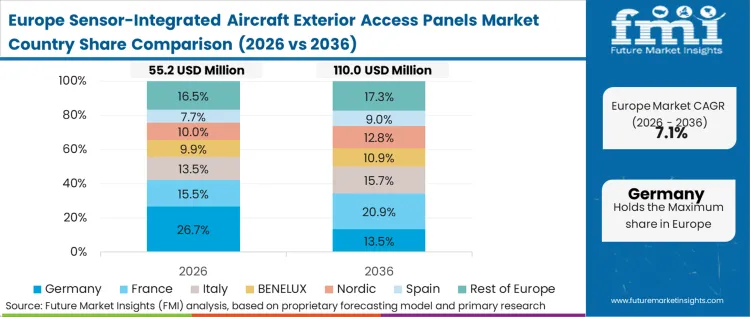
The European market dynamic is economics-led, where high labor costs and strict environmental regulations make the ROI of automated inspection particularly compelling. European carriers are the most advanced in adopting condition-based maintenance to offset the continent's high technician wages. FMI's report includes a deep dive into how advanced aerospace coatings are being fused with sensor networks to meet both structural and aerodynamic requirements. The structural pattern across Europe is one of deep integration between sensor providers and airframe manufacturers.
- United Kingdom: The United Kingdom's aerospace sector is poised for a CAGR of 8.6%, driven by its leadership in aerospace floor panels and structural assemblies. UK-based firms are positioning themselves as the primary architects of integrated sensor networks for military and high-end business jets. This competitive positioning creates a gap between high-tech domestic suppliers and lower-cost international competitors.
- Germany: The Germany market for smart access panels is likely to post a CAGR of 8.4% as Lufthansa Technik and other regional leaders standardize digital airframe verification. This adoption achieves an operational outcome where wide-body turnaround times are reduced by nearly 15.0% through automated skin security checks. A resource is freed as technicians shift from visual checks to high-level system analysis.
FMI's report includes detailed analysis of growth across Latin America, the Middle East, and Oceania. One structural pattern across these additional regions is the growing reliance on OEM-provided digital health data, which is forcing local MROs to upgrade their diagnostic infrastructure to remain competitive in global service networks.
Competitive Aligners for Market Players
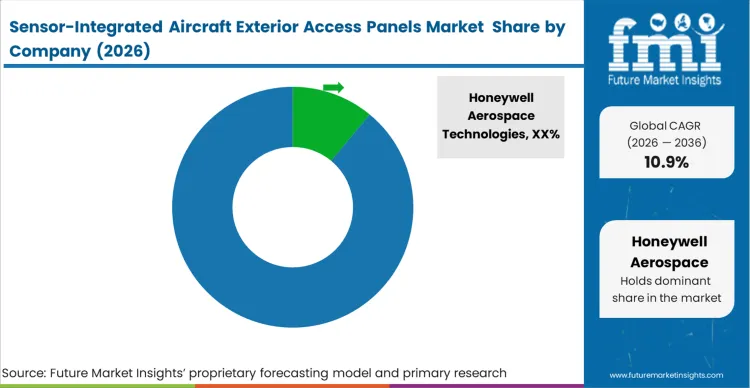
The competitive structure of the Sensor-Integrated Aircraft Exterior Access Panels market is concentrated-moderate, shaped by the extreme barrier of airworthiness certification. Buyers do not choose vendors based on sensor "innovation" alone, but on the proven reliability of the composite-to-metal bond and the durability of the connector in high-vibration environments. Leading players like Honeywell and Astronics distinguish themselves through their deep integration with aerospace avionics suites, ensuring that the signal from a fuel panel is natively understood by the aircraft's central computer. This structural requirement for "system-wide harmony" makes it difficult for standalone component manufacturers to enter the market without tier-1 partnerships.
Incumbents like Howmet Aerospace and Hartwell Corporation hold a structural advantage through their long-standing qualification status with major OEMs. This advantage persists because the cost of re-qualifying a structural access panel, including lightning strike testing and bird-strike analysis, is a multi-million-dollar hurdle for any challenger. To compete, new entrants must build capabilities in smart composite layup machines that can automate the embedding process, reducing the variable cost of "smart" panels to near-parity with legacy versions. FMI's analysis suggests that the winners will be those who can provide a "drop-in" replacement that requires no change to existing airframe wiring.
Buyer power in this market is concentrated among a few global airlines and the four major airframe OEMs, who are increasingly resisting vendor lock-in by demanding open data standards. The structural tension between these buyers, who want interchangeable components, and dominant vendors, who seek proprietary data ecosystems, will define the competitive trajectory to 2036. As cabin panel fasteners and exterior latches become increasingly digitized, the market is likely to consolidate around those firms that can offer a unified digital structural health file for the entire aircraft.
Key Players in Sensor-Integrated Aircraft Exterior Access Panels Market
- Honeywell Aerospace Technologies
- Astronics Corporation
- Hartwell Corporation
- Howmet Aerospace
- Adams Rite Aerospace
- GKN Aerospace
- Hutchinson
- Moog Inc.
- Parker Hannifin Corporation
- Safran S.A.
- Meggitt PLC
- Crane Aerospace & Electronics
Scope of the Report
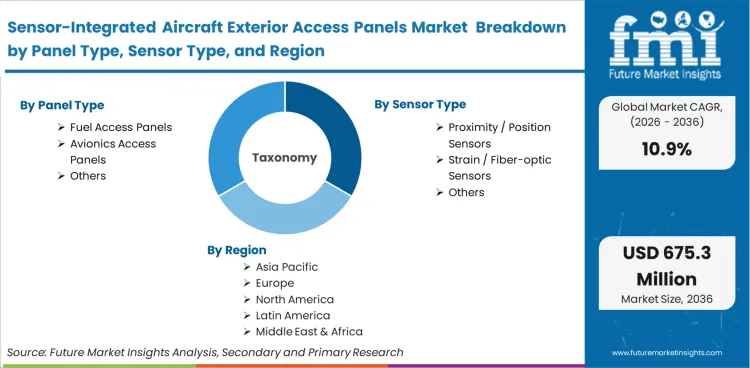
| Metric | Value |
|---|---|
| Quantitative Units | USD 240 million to USD 545 million, at a CAGR of 10.90% |
| Market Definition | Exterior airframe access points equipped with integrated sensing technology for the digital monitoring of structural integrity, latch security, and environmental conditions. |
| Panel Type Segmentation | Fuel access panels, Avionics access panels, Engine cowls, Hydraulic panels, Landing-gear panels |
| Sensor Type Segmentation | Proximity, Strain (Fiber-optic), Piezoelectric, Temperature, Humidity |
| Material Segmentation | Composite sandwich, Aluminum alloy, Titanium, Hybrid |
| Aircraft Type Segmentation | Commercial fixed-wing, Military, Rotorcraft, Business jets, UAVs |
| Regions Covered | North America, Europe, East Asia, South Asia, Latin America, Middle East, Oceania |
| Countries Covered | China, India, United States, UK, Germany, Japan, South Korea, and 40 plus countries |
| Key Companies Profiled | Honeywell, Astronics, Hartwell, Howmet, Adams Rite, GKN, Hutchinson |
| Forecast Period | 2026 to 2036 |
| Approach | FMI uses a supply-side analysis of composite production and a demand-side analysis of MRO labor costs. Forecasts are validated through primary interviews with aerospace structural engineers and data triangulation from fleet modernization cycles. |
Source: Future Market Insights (FMI) analysis, based on proprietary forecasting model and primary research
Sensor-Integrated Aircraft Exterior Access Panels Market Analysis by Segments
Panel Type:
- Fuel access panels
- Avionics access panels
- Engine / fan-cowl access panels
- Hydraulic service panels
- Landing-gear service panels
Sensor Type:
- Proximity / position sensors
- Strain / fiber-optic sensors
- Piezoelectric vibration sensors
- Temperature sensors
- Humidity / corrosion sensors
Material:
- Composite sandwich panels
- Aluminum alloy panels
- Titanium-reinforced panels
- Hybrid composite-metal panels
Aircraft Type:
- Commercial fixed-wing
- Military fixed-wing
- Rotorcraft
- Business jets
- UAV / special mission aircraft
Region:
- North America
- United States
- Canada
- Europe
- Germany
- United Kingdom
- France
- Italy
- Spain
- Asia Pacific
- China
- Japan
- South Korea
- Taiwan
- Singapore
- Latin America
- Brazil
- Mexico
- Argentina
- Middle East & Africa
- GCC Countries
- South Africa
- Israel
Bibliography
- Advanced Engineering Materials. (2024, October). Advanced Sensors and Sensing Systems for Structural Health Monitoring of Aerospace Composite Structures. Wiley Online Library.
- Airbus. (2024, June). Safety First: Strategic Maintenance and Structural Integrity. Airbus Safety.
- CompositesWorld. (2026, March). Cross-supply chain collab achieves rCCF aircraft access panel.
- European Union Aviation Safety Agency. (2024, December). 2024-0235 : Doors – Rear Passenger Door Latching Mechanism - Inspection / Modification.
- Federal Aviation Administration. (2024, July). Transport Airplane Issues List, 2024 Quarter 2.
This bibliography is provided for reader reference. The full FMI report contains the complete reference list with primary source documentation.
This Report Addresses
- Market intelligence to support strategic decision making across fuel access panels, avionics bay covers, and engine cowl assemblies.
- Market size estimation and 10-year revenue forecasts from 2026 to 2036, supported by supply-side composite manufacturing analysis and MRO labor tracking.
- Growth opportunity mapping across sensor-embedded composites with emphasis on the standardization of wireless data transmission gates.
- Segment and regional revenue forecasts covering proximity and strain sensors across the accelerating MRO hubs in China and India.
- Competition strategy assessment including the certification hurdles for structural-sensor integration and connector durability variables.
- Technology development tracking including co-cured fiber optics, piezoelectric energy harvesting, and electromagnetic shielding frameworks.
- Market access analysis covering FAA and EASA airworthiness directives and the shift to condition-based maintenance qualification standards.
- Market report delivery in PDF, Excel, PPT, and interactive dashboard formats for executive strategy, fleet modernization planning, and operational benchmarking use.
Frequently Asked Questions
How large is the Sensor-Integrated Aircraft Exterior Access Panels Market in 2025?
The market was valued at USD 115 million in 2025. This figure reflects the early-stage adoption of smart panels in high-end narrow-body and long-range aircraft programs where maintenance downtime is most costly.
What will it be valued at by 2036?
The industry is projected to cross USD 545 million by 2036. This growth signals a structural transition where "self-reporting" skins become the standard for commercial aviation, replacing manual walking inspections.
What CAGR is projected for the sensor-integrated access panel sector?
A CAGR of 10.90% is expected from 2026 to 2036. This rate is driven by the rapid modernization of global narrow-body fleets and the move toward fully digital structural health monitoring ecosystems.
Which panel type segment leads the market?
Fuel access panels lead the market with 29.0% share. This dominance is due to the critical safety requirement for verified seal integrity in fuel systems, which is the most difficult area to inspect manually without risking seal damage.
Which sensor type segment leads the industry?
Proximity and position sensors lead with 34.0% share. They lead because they provide an immediate, binary confirmation of latch security that can be natively integrated into cockpit avionics for pre-flight verification.
Which material segment leads in smart panel production?
Composite sandwich panels lead with 41.0% share. This is because composite laminates allow for the integration of sensors during the manufacturing process without the stress-concentration risks associated with drilling into metal alloys.
What drives rapid growth in the sensor-integrated panel market?
Growth is driven by the convergence of labor shortages in the MRO sector and the increasing cost of technical delays. Automated panel verification allows for faster turnarounds, directly improving the dispatch reliability of high-utilization commercial aircraft.
What is the primary restraint for adoption?
The primary restraint is the weight and complexity of wiring for embedded sensors. Until wireless data nodes are fully certified for safety-critical zones, the additional airframe wiring required can offset the fuel benefits of lightweight panel materials.
Which country grows fastest in this sector?
China is the fastest-growing market at 12.6% CAGR. This leads the 12.1% growth in India and the 9.2% in the USA because China is building new, sensor-ready aircraft programs like the C919 at an unprecedented scale.
How does structural health monitoring (SHM) impact access panel design?
SHM requires panels to function as both a structural skin and a data source. This forces a shift toward materials that can house sensors permanently while maintaining the aerodynamic and load-bearing properties required for exterior flight surfaces.
What is the significance of "integrated sensor-ready coatings"?
These coatings allow for surface-level sensing that can detect moisture or chemical leaks without embedding sensors deep into the laminate. They provide a lower-cost entry point for retrofitting existing aircraft with smart panel capabilities.
How does the market distinguish between OEM and MRO fitment?
OEM fitment accounts for the majority of the market (58.0%) as sensors are best integrated during the initial composite layup. MRO fitment involves aftermarket "smart" replacement kits that provide digital upgrades during heavy maintenance checks.
What is the role of piezoelectric vibration sensors in these panels?
Piezoelectric sensors monitor high-frequency vibration signatures on engine cowls and landing gear doors. They can detect loosening fasteners or sub-surface fatigue cracks that are invisible to a standard visual inspection.
Why is commercial fixed-wing the dominant aircraft segment?
Commercial carriers operate on high-frequency schedules where a single minute of delay has a clear dollar value. This makes the ROI of automated panel verification much higher than in military or business jet sectors.
What are the certification challenges for smart access panels?
Any panel that functions as a structural skin must undergo rigorous bird-strike, lightning, and fire-testing. Integrating sensors adds a layer of complexity to these tests, as the sensor data path must also be shielded from electromagnetic interference.
How does China's aviation infrastructure drive market growth?
China's "Smart MRO" cities are designed from the ground up for digital diagnostic data. This infrastructure allows Chinese carriers to fully utilize the data generated by sensor-integrated panels, creating a self-reinforcing market for high-tech components.
What is the "Analyst Insight" regarding connectors in smart panels?
FMI analysts suggest that while the sensor is the "brain," the connector is the "Achilles' heel." Real-world reliability depends on connectors that can withstand the thermal shock and hydraulic fluid exposure common on aircraft exterior surfaces.
How do wireless sensor nodes change the retrofit market?
Wireless nodes eliminate the need for new internal airframe wiring, which is the single biggest barrier to retrofitting older aircraft. Once certified, wireless nodes will allow carriers to "digitize" their existing fleets overnight.
What is the impact of narrow-body production backlogs on this market?
The multi-year backlog for aircraft like the A320neo and 737 MAX provides a guaranteed demand stream for OEM-integrated panels, as these newer airframes are designed to be "maintenance-ready" out of the box.
What are hybrid composite-metal panels?
These panels use a metal frame for structural rigidity at the latch points combined with a composite skin for sensor integration. They provide a balance between the durability of legacy metal panels and the intelligence of new composite designs.
How do humidity sensors in fuel panels prevent corrosion?
By detecting moisture ingress at the panel seal, these sensors alert maintenance to replace a seal before water can cause corrosion in the internal fuel tank structure, preventing massive long-term repair costs.
What will be the end state of the market in 2036?
By 2036, the exterior of an aircraft will function as a continuous digital skin. Manual walk-around inspections will be replaced by a "digital twin" of the airframe that alerts technicians to the exact fastener that needs attention.
What will be the end state of the market in 2036?
By 2036, the exterior of an aircraft will function as a continuous digital skin. Manual walk-around inspections will be replaced by a "digital twin" of the airframe that alerts technicians to the exact fastener that needs attention.
Preview the report firsthand - request a free sample
Get SampleGet the brochure for pricing and purchase details.
Get PDFTable of Content
- Executive Summary
- Global Market Outlook
- Demand-side Trends
- Supply-side Trends
- Technology Roadmap Analysis
- Analysis and Recommendations
- Market Overview
- Market Coverage / Taxonomy
- Market Definition / Scope / Limitations
- Research Methodology
- Chapter Orientation
- Analytical Lens and Working Hypotheses
- Market Structure, Signals, and Trend Drivers
- Benchmarking and Cross-market Comparability
- Market Sizing, Forecasting, and Opportunity Mapping
- Research Design and Evidence Framework
- Desk Research Programme (Secondary Evidence)
- Company Annual and Sustainability Reports
- Peer-reviewed Journals and Academic Literature
- Corporate Websites, Product Literature, and Technical Notes
- Earnings Decks and Investor Briefings
- Statutory Filings and Regulatory Disclosures
- Technical White Papers and Standards Notes
- Trade Journals, Industry Magazines, and Analyst Briefs
- Conference Proceedings, Webinars, and Seminar Materials
- Government Statistics Portals and Public Data Releases
- Press Releases and Reputable Media Coverage
- Specialist Newsletters and Curated Briefings
- Sector Databases and Reference Repositories
- FMI Internal Proprietary Databases and Historical Market Datasets
- Subscription Datasets and Paid Sources
- Social Channels, Communities, and Digital Listening Inputs
- Additional Desk Sources
- Expert Input and Fieldwork (Primary Evidence)
- Primary Modes
- Qualitative Interviews and Expert Elicitation
- Quantitative Surveys and Structured Data Capture
- Blended Approach
- Why Primary Evidence is Used
- Observational and In-context Research
- Social and Community Interactions
- Primary Modes
- Stakeholder Universe Engaged
- C-suite Leaders
- Board Members
- Presidents and Vice Presidents
- R&D and Innovation Heads
- Technical Specialists
- Domain Subject-matter Experts
- Scientists
- Physicians and Other Healthcare Professionals
- Governance, Ethics, and Data Stewardship
- Research Ethics
- Data Integrity and Handling
- Desk Research Programme (Secondary Evidence)
- Tooling, Models, and Reference Databases
- Data Engineering and Model Build
- Data Acquisition and Ingestion
- Cleaning, Normalisation, and Verification
- Synthesis, Triangulation, and Analysis
- Quality Assurance and Audit Trail
- Market Background
- Market Dynamics
- Drivers
- Restraints
- Opportunity
- Trends
- Scenario Forecast
- Demand in Optimistic Scenario
- Demand in Likely Scenario
- Demand in Conservative Scenario
- Opportunity Map Analysis
- Product Life Cycle Analysis
- Supply Chain Analysis
- Investment Feasibility Matrix
- Value Chain Analysis
- PESTLE and Porter’s Analysis
- Regulatory Landscape
- Regional Parent Market Outlook
- Production and Consumption Statistics
- Import and Export Statistics
- Market Dynamics
- Global Market Analysis 2021 to 2025 and Forecast, 2026 to 2036
- Historical Market Size Value (USD Million) Analysis, 2021 to 2025
- Current and Future Market Size Value (USD Million) Projections, 2026 to 2036
- Y-o-Y Growth Trend Analysis
- Absolute $ Opportunity Analysis
- Global Market Pricing Analysis 2021 to 2025 and Forecast 2026 to 2036
- Global Market Analysis 2021 to 2025 and Forecast 2026 to 2036, By Panel Type
- Introduction / Key Findings
- Historical Market Size Value (USD Million) Analysis By Panel Type , 2021 to 2025
- Current and Future Market Size Value (USD Million) Analysis and Forecast By Panel Type , 2026 to 2036
- Fuel Access Panels
- Avionics Access Panels
- Others
- Fuel Access Panels
- Y-o-Y Growth Trend Analysis By Panel Type , 2021 to 2025
- Absolute $ Opportunity Analysis By Panel Type , 2026 to 2036
- Global Market Analysis 2021 to 2025 and Forecast 2026 to 2036, By Sensor Type
- Introduction / Key Findings
- Historical Market Size Value (USD Million) Analysis By Sensor Type, 2021 to 2025
- Current and Future Market Size Value (USD Million) Analysis and Forecast By Sensor Type, 2026 to 2036
- Proximity / Position Sensors
- Strain / Fiber-optic Sensors
- Others
- Proximity / Position Sensors
- Y-o-Y Growth Trend Analysis By Sensor Type, 2021 to 2025
- Absolute $ Opportunity Analysis By Sensor Type, 2026 to 2036
- Global Market Analysis 2021 to 2025 and Forecast 2026 to 2036, By Material
- Introduction / Key Findings
- Historical Market Size Value (USD Million) Analysis By Material, 2021 to 2025
- Current and Future Market Size Value (USD Million) Analysis and Forecast By Material, 2026 to 2036
- Composite Sandwich Panels
- Aluminum Alloy Panels
- Titanium-Reinforced Panels
- Composite Sandwich Panels
- Y-o-Y Growth Trend Analysis By Material, 2021 to 2025
- Absolute $ Opportunity Analysis By Material, 2026 to 2036
- Global Market Analysis 2021 to 2025 and Forecast 2026 to 2036, By Aircraft Type
- Introduction / Key Findings
- Historical Market Size Value (USD Million) Analysis By Aircraft Type, 2021 to 2025
- Current and Future Market Size Value (USD Million) Analysis and Forecast By Aircraft Type, 2026 to 2036
- Commercial Fixed-Wing
- Military Fixed-Wing
- Others
- Commercial Fixed-Wing
- Y-o-Y Growth Trend Analysis By Aircraft Type, 2021 to 2025
- Absolute $ Opportunity Analysis By Aircraft Type, 2026 to 2036
- Global Market Analysis 2021 to 2025 and Forecast 2026 to 2036, By Region
- Introduction
- Historical Market Size Value (USD Million) Analysis By Region, 2021 to 2025
- Current Market Size Value (USD Million) Analysis and Forecast By Region, 2026 to 2036
- North America
- Latin America
- Western Europe
- Eastern Europe
- East Asia
- South Asia and Pacific
- Middle East & Africa
- Market Attractiveness Analysis By Region
- North America Market Analysis 2021 to 2025 and Forecast 2026 to 2036, By Country
- Historical Market Size Value (USD Million) Trend Analysis By Market Taxonomy, 2021 to 2025
- Market Size Value (USD Million) Forecast By Market Taxonomy, 2026 to 2036
- By Country
- USA
- Canada
- Mexico
- By Panel Type
- By Sensor Type
- By Material
- By Aircraft Type
- By Country
- Market Attractiveness Analysis
- By Country
- By Panel Type
- By Sensor Type
- By Material
- By Aircraft Type
- Key Takeaways
- Latin America Market Analysis 2021 to 2025 and Forecast 2026 to 2036, By Country
- Historical Market Size Value (USD Million) Trend Analysis By Market Taxonomy, 2021 to 2025
- Market Size Value (USD Million) Forecast By Market Taxonomy, 2026 to 2036
- By Country
- Brazil
- Chile
- Rest of Latin America
- By Panel Type
- By Sensor Type
- By Material
- By Aircraft Type
- By Country
- Market Attractiveness Analysis
- By Country
- By Panel Type
- By Sensor Type
- By Material
- By Aircraft Type
- Key Takeaways
- Western Europe Market Analysis 2021 to 2025 and Forecast 2026 to 2036, By Country
- Historical Market Size Value (USD Million) Trend Analysis By Market Taxonomy, 2021 to 2025
- Market Size Value (USD Million) Forecast By Market Taxonomy, 2026 to 2036
- By Country
- Germany
- UK
- Italy
- Spain
- France
- Nordic
- BENELUX
- Rest of Western Europe
- By Panel Type
- By Sensor Type
- By Material
- By Aircraft Type
- By Country
- Market Attractiveness Analysis
- By Country
- By Panel Type
- By Sensor Type
- By Material
- By Aircraft Type
- Key Takeaways
- Eastern Europe Market Analysis 2021 to 2025 and Forecast 2026 to 2036, By Country
- Historical Market Size Value (USD Million) Trend Analysis By Market Taxonomy, 2021 to 2025
- Market Size Value (USD Million) Forecast By Market Taxonomy, 2026 to 2036
- By Country
- Russia
- Poland
- Hungary
- Balkan & Baltic
- Rest of Eastern Europe
- By Panel Type
- By Sensor Type
- By Material
- By Aircraft Type
- By Country
- Market Attractiveness Analysis
- By Country
- By Panel Type
- By Sensor Type
- By Material
- By Aircraft Type
- Key Takeaways
- East Asia Market Analysis 2021 to 2025 and Forecast 2026 to 2036, By Country
- Historical Market Size Value (USD Million) Trend Analysis By Market Taxonomy, 2021 to 2025
- Market Size Value (USD Million) Forecast By Market Taxonomy, 2026 to 2036
- By Country
- China
- Japan
- South Korea
- By Panel Type
- By Sensor Type
- By Material
- By Aircraft Type
- By Country
- Market Attractiveness Analysis
- By Country
- By Panel Type
- By Sensor Type
- By Material
- By Aircraft Type
- Key Takeaways
- South Asia and Pacific Market Analysis 2021 to 2025 and Forecast 2026 to 2036, By Country
- Historical Market Size Value (USD Million) Trend Analysis By Market Taxonomy, 2021 to 2025
- Market Size Value (USD Million) Forecast By Market Taxonomy, 2026 to 2036
- By Country
- India
- ASEAN
- Australia & New Zealand
- Rest of South Asia and Pacific
- By Panel Type
- By Sensor Type
- By Material
- By Aircraft Type
- By Country
- Market Attractiveness Analysis
- By Country
- By Panel Type
- By Sensor Type
- By Material
- By Aircraft Type
- Key Takeaways
- Middle East & Africa Market Analysis 2021 to 2025 and Forecast 2026 to 2036, By Country
- Historical Market Size Value (USD Million) Trend Analysis By Market Taxonomy, 2021 to 2025
- Market Size Value (USD Million) Forecast By Market Taxonomy, 2026 to 2036
- By Country
- Kingdom of Saudi Arabia
- Other GCC Countries
- Turkiye
- South Africa
- Other African Union
- Rest of Middle East & Africa
- By Panel Type
- By Sensor Type
- By Material
- By Aircraft Type
- By Country
- Market Attractiveness Analysis
- By Country
- By Panel Type
- By Sensor Type
- By Material
- By Aircraft Type
- Key Takeaways
- Key Countries Market Analysis
- USA
- Pricing Analysis
- Market Share Analysis, 2025
- By Panel Type
- By Sensor Type
- By Material
- By Aircraft Type
- Canada
- Pricing Analysis
- Market Share Analysis, 2025
- By Panel Type
- By Sensor Type
- By Material
- By Aircraft Type
- Mexico
- Pricing Analysis
- Market Share Analysis, 2025
- By Panel Type
- By Sensor Type
- By Material
- By Aircraft Type
- Brazil
- Pricing Analysis
- Market Share Analysis, 2025
- By Panel Type
- By Sensor Type
- By Material
- By Aircraft Type
- Chile
- Pricing Analysis
- Market Share Analysis, 2025
- By Panel Type
- By Sensor Type
- By Material
- By Aircraft Type
- Germany
- Pricing Analysis
- Market Share Analysis, 2025
- By Panel Type
- By Sensor Type
- By Material
- By Aircraft Type
- UK
- Pricing Analysis
- Market Share Analysis, 2025
- By Panel Type
- By Sensor Type
- By Material
- By Aircraft Type
- Italy
- Pricing Analysis
- Market Share Analysis, 2025
- By Panel Type
- By Sensor Type
- By Material
- By Aircraft Type
- Spain
- Pricing Analysis
- Market Share Analysis, 2025
- By Panel Type
- By Sensor Type
- By Material
- By Aircraft Type
- France
- Pricing Analysis
- Market Share Analysis, 2025
- By Panel Type
- By Sensor Type
- By Material
- By Aircraft Type
- India
- Pricing Analysis
- Market Share Analysis, 2025
- By Panel Type
- By Sensor Type
- By Material
- By Aircraft Type
- ASEAN
- Pricing Analysis
- Market Share Analysis, 2025
- By Panel Type
- By Sensor Type
- By Material
- By Aircraft Type
- Australia & New Zealand
- Pricing Analysis
- Market Share Analysis, 2025
- By Panel Type
- By Sensor Type
- By Material
- By Aircraft Type
- China
- Pricing Analysis
- Market Share Analysis, 2025
- By Panel Type
- By Sensor Type
- By Material
- By Aircraft Type
- Japan
- Pricing Analysis
- Market Share Analysis, 2025
- By Panel Type
- By Sensor Type
- By Material
- By Aircraft Type
- South Korea
- Pricing Analysis
- Market Share Analysis, 2025
- By Panel Type
- By Sensor Type
- By Material
- By Aircraft Type
- Russia
- Pricing Analysis
- Market Share Analysis, 2025
- By Panel Type
- By Sensor Type
- By Material
- By Aircraft Type
- Poland
- Pricing Analysis
- Market Share Analysis, 2025
- By Panel Type
- By Sensor Type
- By Material
- By Aircraft Type
- Hungary
- Pricing Analysis
- Market Share Analysis, 2025
- By Panel Type
- By Sensor Type
- By Material
- By Aircraft Type
- Kingdom of Saudi Arabia
- Pricing Analysis
- Market Share Analysis, 2025
- By Panel Type
- By Sensor Type
- By Material
- By Aircraft Type
- Turkiye
- Pricing Analysis
- Market Share Analysis, 2025
- By Panel Type
- By Sensor Type
- By Material
- By Aircraft Type
- South Africa
- Pricing Analysis
- Market Share Analysis, 2025
- By Panel Type
- By Sensor Type
- By Material
- By Aircraft Type
- USA
- Market Structure Analysis
- Competition Dashboard
- Competition Benchmarking
- Market Share Analysis of Top Players
- By Regional
- By Panel Type
- By Sensor Type
- By Material
- By Aircraft Type
- Competition Analysis
- Competition Deep Dive
- Honeywell Aerospace Technologies
- Overview
- Product Portfolio
- Profitability by Market Segments (Product/Age /Sales Channel/Region)
- Sales Footprint
- Strategy Overview
- Marketing Strategy
- Product Strategy
- Channel Strategy
- Astronics Corporation
- Hartwell Corporation
- Howmet Aerospace
- Adams Rite Aerospace
- GKN Aerospace
- Honeywell Aerospace Technologies
- Competition Deep Dive
- Assumptions & Acronyms Used


