

- Industry Size (2026)
- USD 0.4 Bn
- Forecast (2036)
- USD 1.4 Bn
- CAGR (2026 to 2036)
- 14.2%
Aircraft Exterior Structure Digital Twin Platforms Market Size, Market Forecast and Outlook By FMI
The aircraft exterior structure digital twin platforms market cross a valuation of USD 0.3 billion in 2025 showcasing a consistent growth ready to hit USD 0.4 billion in 2026, advancing at a 14.2% CAGR throughout the forecast period. Structural tracking automation pushes total industry scale to USD 1.4 billion by 2036, as fleet operators deploy aerospace exterior structure digital twin software to transition from reactive damage logging to predictive degradation modeling.
Engineering directors at major airlines currently face an unsustainable backlog in structural repair approvals. Relying on manual dent mapping combined with static OEM manuals delays return-to-service timelines significantly, driving immediate demand for aircraft structural repair planning software. Digital models replace paper-based damage tolerance calculations, allowing rapid certification of complex repairs. Implementing automated inspection and monitoring directly links scanner data to specific fuselage coordinates. Delaying this transition toward an aviation structural maintenance digital twin software environment forces maintenance planners to buffer aircraft availability, sacrificing revenue days per asset.
Summary of Aircraft Exterior Structure Digital Twin Platforms Market
- Aircraft Exterior Structure Digital Twin Platforms Market Definition
- Software systems creating dynamic virtual replicas of specific aircraft airframes to calculate fatigue, track damage, and predict structural failures using operational flight data.
- Demand Drivers in the Market
- Aging fleet demographics force maintenance directors to utilize a structural prognostics platform for aircraft to model fatigue life accurately.
- Lease-return dispute risks compel asset managers to require an aircraft damage records traceability software audit for structural integrity.
- Next-generation composite fuselages require engineering teams to track internal delamination invisibly.
- Key Segments Analyzed in the FMI Report
- Airframe Lifecycle Twin Platform: 34.0% share in 2026, driven by lessor demands for cradle-to-grave structural traceability.
- Cloud/Hybrid Cloud: 46.0% share, enabled by massive telemetry datasets requiring distributed processing power.
- Commercial Fixed-Wing: 52.0% share, reflecting massive global passenger fleet volumes undergoing heavy maintenance.
- Airlines And Independent MROs: 41.0% share, as operators desperately seek an aviation predictive maintenance platform for airframes.
- Predictive Maintenance And Remaining Useful Life: 31.0% share, reducing unscheduled groundings effectively.
- India: 17.2% CAGR, expanding parallel to massive domestic carrier widebody procurement cycles.
- Analyst Opinion at FMI
- Nikhil Kaitwade, Principal Analyst at FMI, Industrial Automation, observes that, "Airlines assume digitizing inspection records automatically creates a functional twin. This fundamentally misreads how fuselage corrosion monitoring alters operations. Storing dent photos in a cloud environment only accelerates retrieval speed. True structural twins calculate exact fatigue life consumption based on flight-specific atmospheric telemetry. Procurement managers buying visualization tools without predictive physics engines eventually purchase software twice. Aircraft lessors penalize returning operators who lack mathematical proof regarding remaining structural vitality."
- Strategic Implications / Executive Takeaways
- MRO technical directors must upgrade hangar IT infrastructure to support an aircraft inspection data twin platform integrating real-time 3D scanning.
- Airline procurement heads face vendor lock-in risks if choosing platforms lacking open API structural data export capabilities.
- Lessor asset managers gain leverage during aircraft transitions by mandating digital twin continuity clauses in new contracts.
- Methodology
- Primary conversations with airline chief engineers validate actual adoption depth versus pilot program announcements.
- Civil aviation authority directive analyses anchor safety compliance algorithms.
- Fleet delivery schedules cross-referenced against retirement curves verify addressable platform volumes.
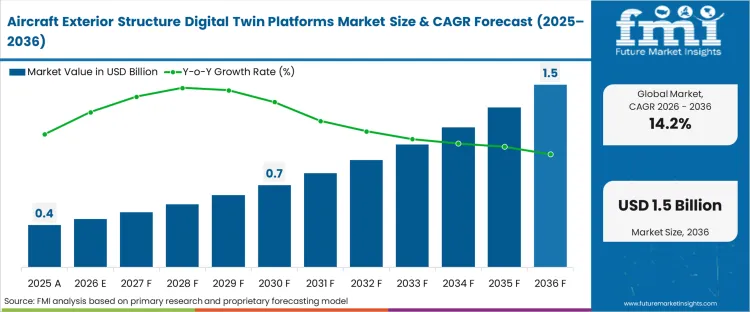
Once airworthiness authorities universally accept synthetic fatigue data in place of physical tear-downs, adoption of the digital twin for aircraft structural integrity accelerates exponentially. Regulators demand absolute traceability for predictive algorithms before approving lifecycle extensions. Airlines demonstrating closed-loop validation between physical inspections and structural health monitoring coatings gain rapid clearance for extended maintenance intervals.
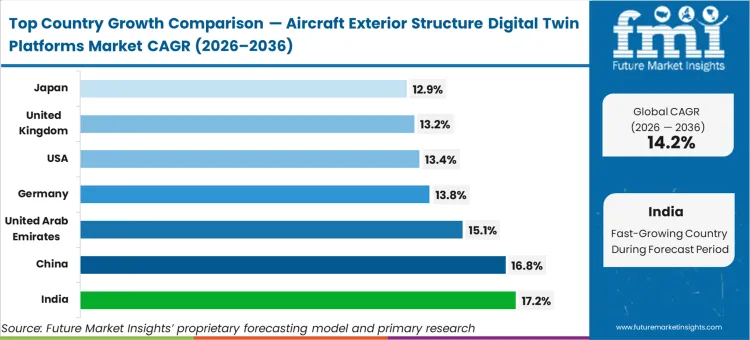
India leads at 17.2% as domestic carriers rapidly expand widebody fleets requiring advanced tracking. China tracks at 16.8% based on massive state-backed aerospace modernization programs. United Arab Emirates expands at 15.1% because regional fleet managers need precise sand-erosion degradation models. Germany advances at 13.8% driven by aggressive zero-emissions fleet efficiency mandates. United States grows at 13.4% owing to a vast aging commercial base investigating the aircraft digital twin CAGR forecast. United Kingdom reaches 13.2% on strong tier-one supplier integration. Japan expands at 12.9% leveraging strict regulatory compliance automation. Divergence across these regions stems entirely from disparate national airworthiness certification speeds.
Aircraft Exterior Structure Digital Twin Platforms Market Definition
An aircraft exterior structure digital twin platform represents software environments generating high-fidelity virtual replicas of specific physical airplane skins and structural frames. Systems ingest non-destructive testing data, flight loads, and environmental exposure metrics to calculate real-time material fatigue. This operational boundary specifically excludes generic flight simulator engines and isolated passenger cabin monitoring tools.
Aircraft Exterior Structure Digital Twin Platforms Market Inclusions
Scope covers localized damage assessment applications, aircraft corrosion and fatigue digital twin algorithms, and integrated sensor ready coatings data ingestion modules. Systems supporting direct integration with OEM structural repair manuals fall entirely within this boundary. Solutions calculating lease-return structural financial penalties using a composite airframe digital twin platform also qualify under this definition.
Aircraft Exterior Structure Digital Twin Platforms Market Exclusions
Engine performance digital twins fall outside this analysis because propulsion thermodynamics require entirely different computational fluid dynamics engines. Evaluators comparing a digital damage twin vs maintenance information system will note that standard airline fleet scheduling software lacks specific material fatigue computation capabilities and is therefore excluded. Internal cabin systems tracking passenger usage patterns remain outside this scope.
Aircraft Exterior Structure Digital Twin Platforms Market Research Methodology
- Primary Research: Vice Presidents of Engineering, Fleet Maintenance Directors, and Chief Airworthiness Inspectors
- Desk Research: EASA/FAA certification databases, structural repair manual amendments, and lessor return-condition registries
- Market-Sizing and Forecasting: Annual widebody and narrowbody heavy maintenance check volumes
- Data Validation and Update Cycle: Global commercial aircraft fleet retirement and lease-transition velocity
Segmental Analysis
Aircraft Exterior Structure Digital Twin Platforms Market Analysis by Platform Type
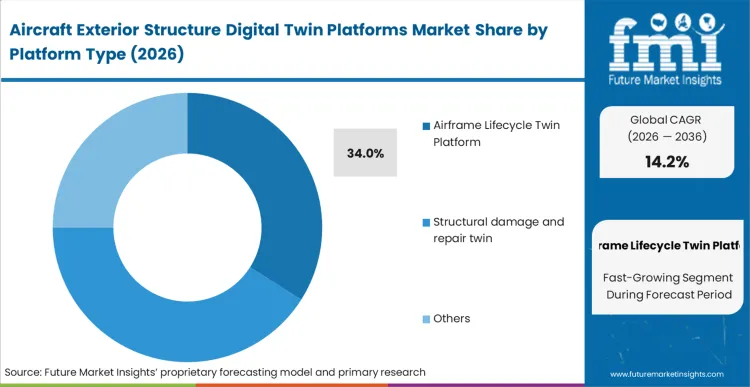
Lessor demands for cradle-to-grave structural traceability explain why comprehensive tracking systems dominate procurement cycles within the airframe digital twin platform market. Airframe lifecycle twin platform holds 34.0% share, and FMI's analysis indicates lease-return managers dictate this standard. Engineering directors deploying partial solutions face massive data synthesis penalties during aircraft handovers. Surface temperature monitoring modules feed directly into these comprehensive frameworks. Aviation financiers heavily discount assets lacking an aircraft lease transfer structural records software history. What IT buyers rarely acknowledge is how lifecycle platforms permanently alter MRO vendor relationships; changing maintenance providers becomes seamless when structural history lives in an independent twin rather than proprietary MRO databases. Choosing isolated damage trackers instead guarantees painful manual audits later.
- Initial Onboarding Verification: Fleet integration managers require systems capable of absorbing legacy paper records. Converting static OEM damage limits into dynamic digital thresholds determines project viability immediately.
- Flight Load Validation: Performance engineers cross-reference ice accretion detection data against aerodynamic stress models. This correlation confirms exact fatigue consumption per flight cycle.
- Lease Transition Acceleration: Asset managers extract comprehensive structural health certificates instantaneously. Operators avoid millions in unjustified return-condition penalties using undeniable mathematical proof.
Aircraft Exterior Structure Digital Twin Platforms Market Analysis by Deployment Model
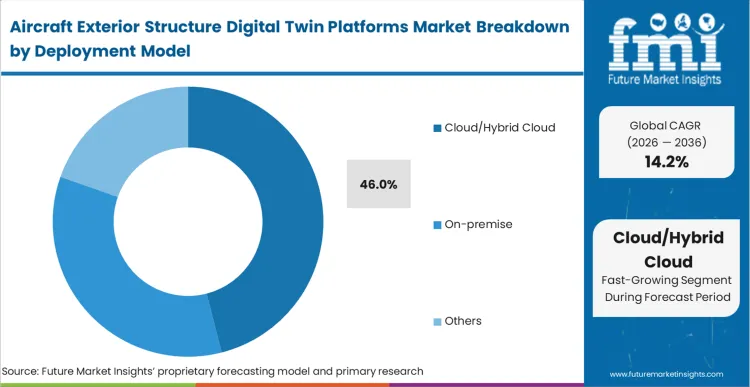
MRO network planners accessing shared structural models eliminate redundant physical inspections across different line stations. Connecting chrome free corrosion protection sensors requires constant bidirectional data streams. Strict national data sovereignty laws silently force airlines into complex hybrid configurations despite purely cloud-based preferences. Operators restricting twins to isolated on-premise servers lose critical fleet-wide comparative anomaly detection benefits. Massive telemetry datasets require distributed processing power exceeding internal airline capabilities. Cloud / hybrid cloud architectures capture 46.0% share, and based on FMI's assessment, chief information officers mandate this approach when evaluating aircraft structural digital twin solution providers.
- Storage Cost Rationalization: IT procurement directors offset massive 3D scan storage requirements using scalable cloud architecture. Paying only for active compute cycles during heavy checks reduces fixed IT overhead.
- Global Access Execution: Hangar managers working in remote commercial aircraft mro outstations query exact repair tolerances instantly. Bypassing central engineering bottlenecks accelerates gate releases significantly.
- Cross-Fleet Benchmarking: Reliability engineers compare localized fatigue rates against global anonymized datasets. Identifying premature composite wear early prevents catastrophic unscheduled groundings later.
Aircraft Exterior Structure Digital Twin Platforms Market Analysis by Aircraft Type
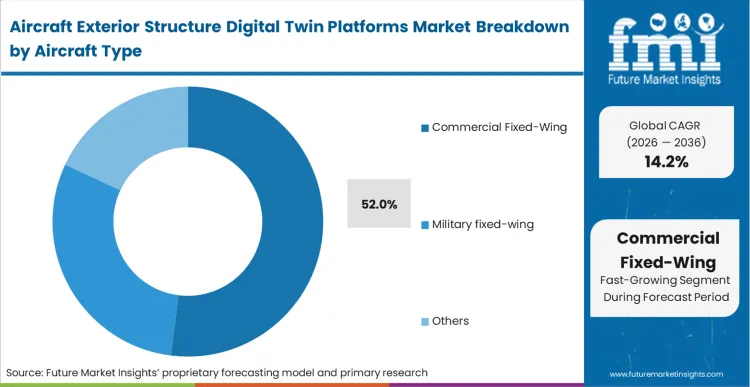
Massive global passenger fleet volumes undergoing heavy maintenance dictate technology investment priorities. Commercial fixed-wing assets account for 52.0% share, and FMI observes that airline technical directors prioritize these platforms purely for dispatch reliability protection. Fleet schedulers relying on aviation asset management insights utilize an aircraft digital damage twin platform to optimize routing assignments dynamically. Sending heavily stressed airframes on benign routes extends usable life mathematically. Traditional aviation analytics entirely miss localized aerodynamic stress concentrations visible only inside a true digital twin for wing and fuselage structures. Airlines operating widebody aircraft without exterior structural twins incur systematically higher hull insurance premiums due to unquantifiable risk profiles.
- Corrosion Prevention Mapping: Reliability teams isolate specific fuselage panels suffering accelerated oxidation. Modifying wash schedules based on an aircraft twin platform for corrosion monitoring extends paint life dramatically.
- Dent Tracking Continuity: Line maintenance technicians log ground-support equipment impacts instantly. Comparing new measurements against historical digital damage files prevents redundant repair authorizations.
- Composite Delamination Plotting: NDT specialists visualize internal carbon-fiber separations undetectable visually. Tracking subsurface crack propagation allows airlines to schedule complex repairs during planned winter low-seasons.
Aircraft Exterior Structure Digital Twin Platforms Market Analysis by End Use
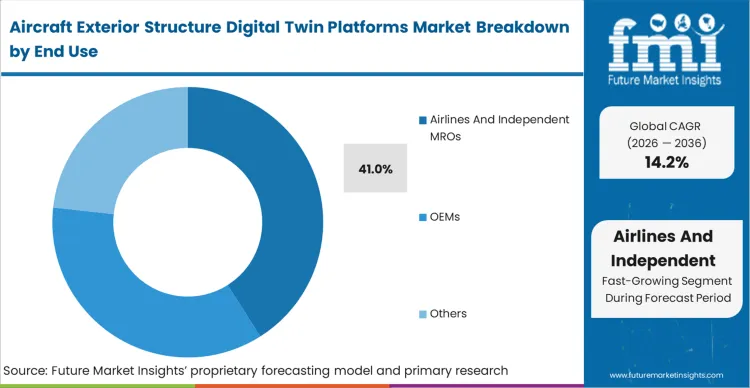
MROs quietly use digital twin ownership as a wedge to secure long-term exclusive maintenance contracts from smaller airlines lacking an internal aviation MRO digital twin implementation partner. Carriers outsourcing structural engineering entirely risk losing control over their own airworthiness decision logic. Operators, on the other hand, desperately seek ways to minimize hangar time amid severe global capacity constraints. Airlines and independent MROs represent 41.0% share, and as per FMI's projection, vice presidents of technical operations push this adoption aggressively. Hangar capacity planners utilizing aviation cloud platforms pre-order custom structural patches weeks before an aircraft arrives. Aviation compliance monitoring software integrations automate regulatory paperwork creation alongside physical repairs.
- Supply Chain Anticipation: MRO materials managers order exotic titanium fasteners based on predictive fatigue models. Eliminating supply-driven hangar delays improves customer aircraft turnaround times directly.
- Tooling Allocation Control: Hangar resource directors position specific laser scanners exactly where predictive models indicate damage. Optimizing technician workflows reduces wasted transit time across massive maintenance facilities.
- Audit Defense Automation: Quality assurance leads generate definitive structural status reports instantly. Satisfying aggressive regulatory inspectors using transparent mathematical evidence prevents grounding mandates.
Aircraft Exterior Structure Digital Twin Platforms Market Analysis by Application
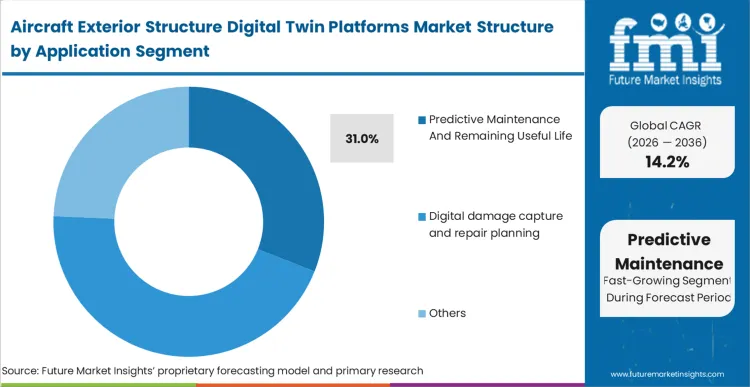
Reducing unscheduled groundings effectively drives immediate commercial payback for software investments. Predictive maintenance and remaining useful life solutions capture 31.0% share, and FMI analysts note that airline chief financial officers demand a clear ROI of airframe digital twin software before approval. Maintenance planners utilizing flight data monitoring systems convert hard landings directly into consumed structural life metrics. Implementing iot in aviation gateways feeds continuous vibration telemetry into these predictive engines. Purely predictive models fail spectacularly when external ground vehicles strike aircraft; deterministic damage modeling remains equally critical. Delaying implementation of a dedicated aircraft twin platform for fatigue monitoring forces airlines to retire perfectly viable airframes prematurely based on generic OEM calendar limits.
- Component Degradation Forecasting: Reliability engineers model how specific routing profiles accelerate wing-root fatigue. Adjusting network assignments based on structural health extends total asset profitability.
- Maintenance Interval Escalation: Technical directors petition civil aviation authorities for customized inspection schedules. Presenting comprehensive digital twin evidence allows airlines to skip mandated tear-downs legally.
- End-Of-Life Residual Valuation: Aircraft trading managers calculate exact scrap value using precise material degradation histories. Selling aged airframes backed by comprehensive digital proofs commands significant market premiums.
Aircraft Exterior Structure Digital Twin Platforms Market Drivers, Restraints, and Opportunities
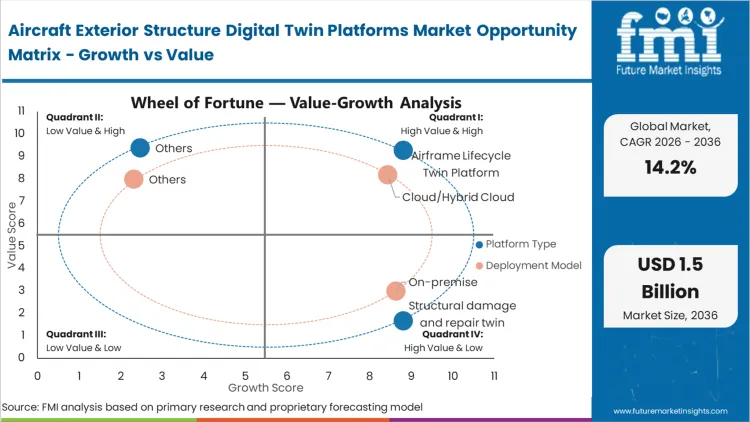
Unscheduled widebody groundings cost airlines hundreds of thousands daily in lost revenue and passenger compensation, driving growth in the aircraft structural health digital twin market. Engineering directors face severe pressure to eliminate surprise structural defects discovered during routine maintenance. Aircraft sensors detect micro-cracks early, but isolated alerts lack context without an aircraft repair workflow digital twin. Airlines delaying digitalization rely entirely on manual visual inspections prone to human error. Reactive operations guarantee extended hangar stays while waiting for OEM repair schema approvals. Integrating predictive maintenance platforms allows planners to fabricate required patches weeks before scheduled downtime.
Legacy data fragmentation completely paralyses initial implementation efforts and creates major aircraft digital twin adoption barriers. Airlines store decades of structural repair records across disparate proprietary formats, PDF scans, and paper logs. Engineering teams spend thousands of hours manually transcribing historical damage coordinates into new digital formats. This ingestion bottleneck highlights severe challenges in integrating aircraft inspection data across large mixed fleets. Optical character recognition tools attempt automation but struggle with handwritten technician notes from decades past.
Opportunities in the Aircraft Exterior Structure Digital Twin Platforms Market
- Automated Laser-Scan Ingestion: Tooling engineers eliminate manual data entry by directly linking hangar 3D scanners to structural models.
- Generative Repair Design: Stress engineers utilize digital twin technology to calculate custom patch geometries instantly.
- Procurement Platform Integration: Buyers issuing an aircraft maintenance digital platform RFQ align technical upgrades with structured aircraft structural analytics platform pricing models.
Regional Analysis
Global adoption trajectories hinge entirely on how rapidly domestic airworthiness authorities transition from legacy calendar-based inspection mandates to continuous digital structural verification. Regional climatic extremes and local fleet modernization pressures further dictate exactly which prognostic capabilities maintenance directors prioritize with the market being segmented into North America, Europe, Asia Pacific, and Middle East across 40 plus countries.
.webp "Top Country Growth Comparison Aircraft Exterior Structure Digital Twin Platforms Market Cagr (2026 2036)")
| Country | CAGR (2026 to 2036) |
|---|---|
| India | 17.2% |
| China | 16.8% |
| United Arab Emirates | 15.1% |
| Germany | 13.8% |
| United States | 13.4% |
| United Kingdom | 13.2% |
| Japan | 12.9% |
Source: Future Market Insights (FMI) analysis, based on proprietary forecasting model and primary research
Asia Pacific Aircraft Exterior Structure Digital Twin Platforms Market Analysis
Tying operating certificates directly to continuous health verification, new mandates are upending how fleet operators manage maintenance. Instead of relying on historical calendar-based heavy checks, regulatory bodies across major Asian aviation hubs now explicitly demand predictive structural proof for aging widebody assets.
- India: Expanding at a rapid 17.2% of CAGR, the India aviation structural digital twin software market focuses intensely on solutions capable of withstanding extreme climatic variations. Domestic carriers here operate aging legacy frames simultaneously while absorbing new aircraft at a massive scale. By proving exact structural conditions mathematically, engineering directors deploying these virtual replicas immediately slash expensive lease-return dispute costs.
- China: Complete digitalization of maintenance operations remains the primary directive for state-backed carriers. The China aircraft structural digital twin market as a result, is generating a 16.8% CAGR, as domestic repair organizations hunt for software that integrates deeply with indigenous aircraft manufacturing ecosystems. Expanding these capabilities allows Chinese operators to match global safety standards efficiently and aggressively.
- Japan: Redundant safety verifications are practically mandatory within this strict compliance culture. Japanese engineering hubs utilize virtual replicas to meticulously validate minor repairs against severe seismic and typhoon exposure profiles, while advancing at 12.9% CAGR, perfectly positioning these fleets for upcoming global certification shifts.
FMI's report includes South Korea and ASEAN nations. Southeast Asian operators face unique humidity-driven corrosion challenges requiring specialized prognostic models.
Middle East Aircraft Exterior Structure Digital Twin Platforms Market Analysis
High-cycle operations through deeply abrasive sand environments cause leading-edge erosion to accelerate exponentially. Because these extreme environmental conditions aggressively degrade aluminum skins and exterior composites across regional fleets, maintenance directors demand highly specific environmental physics models that standard European or American software packages simply cannot provide.
- United Arab Emirates: Tracking at an impressive 15.1% CAGR, local operators entirely avoid catastrophic mid-route composite de-laminations by leveraging highly accurate physics engines. Mega-carriers based in massive hub airports rely on maximum asset utilization to protect profitability margins. By combining ai driven predictive maintenance with these virtual platforms, fleet managers predict sand-induced engine-cowl wear with absolute precision.
FMI's report includes Saudi Arabia and Qatar. Heavy investment in massive new maintenance facilities across this region natively incorporates digital twin infrastructure from day one.
Europe Aircraft Exterior Structure Digital Twin Platforms Market Analysis
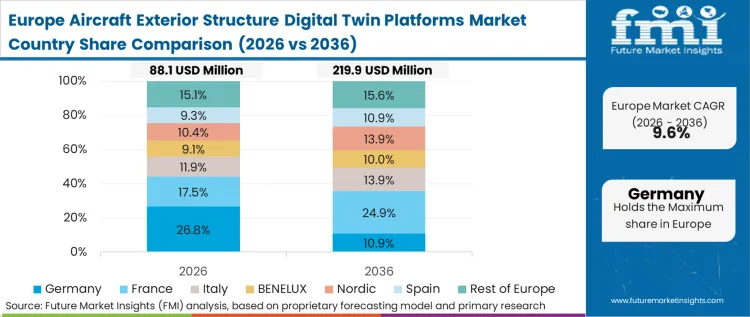
Because micro-dents and minor paint degradation drastically increase parasitic drag, technical directors are ruthlessly focusing on exterior perfection to avoid steep carbon emission penalties and reduce fuel burn. This meticulous optimization of fleet aerodynamics is primarily forced by aggressive sustainability mandates sweeping across continental airlines.
- Germany: Massive engineering resources allow flag carriers to model the exact aerodynamic penalties associated with specific fuselage patches. Moving forward at 13.8% of CAGR value, the Germany aerospace digital twin platform market leverages these structural replicas to confidently justify expensive, immediate repairs instead of settling for temporary, drag-inducing fixes.
- United Kingdom: Standardized data exchange formats are an absolute necessity for the extensive aerospace engineering services outsourcing hubs located here. Allowing the local market to grow at 13.2% CAGR, independent engineering firms adopt software platforms strictly based on their seamless OEM data integration capabilities.
FMI's report includes France and Italy. Heavy presence of original equipment manufacturers in these nations guarantees early access to proprietary structural datasets for local airlines.
North America Aircraft Exterior Structure Digital Twin Platforms Market Analysis
Transitioning legacy data remains the most significant hurdle for operators managing massive, decades-old commercial fleets. Hangar planners urgently require predictive software to prevent unscheduled groundings of heavily stressed airframes and accurately track fatigue accumulation over millions of flight miles.
- United States: Expanding at 13.4%, the aircraft digital twin market in the United States directly addresses the immediate needs of carriers operating vast aging fleets. Fleet engineers rely heavily on digital fatigue modeling to safely extend airframe operational limits far beyond initial OEM calendar guidelines. Avoiding surprise structural defects during heavy maintenance checks saves these operators millions in deferred revenue.
FMI's report includes Canada. Cross-border regulatory synchronization ensures North American carriers can seamlessly transfer digital structural records across regional maintenance facilities.
Competitive Aligners for Market Players
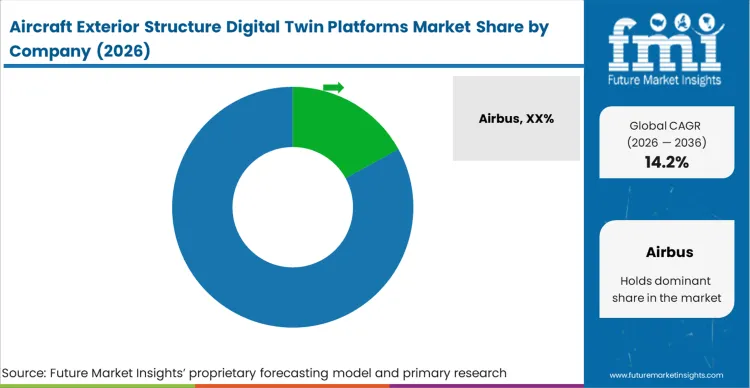
Software integration capabilities dictate vendor survival much more than pure visualization fidelity when evaluating who are the leading vendors in aircraft structural digital twins. Airlines flatly reject standalone physics engines requiring manual data import from existing maintenance IT architectures. Dassault Systèmes and Siemens Digital Industries Software embed their solutions deeply into initial aircraft design phases. Transferring these native OEM models directly to airline operators creates an unbreakable data continuity chain. Procurement directors investigating how to choose an aircraft structural digital twin vendor demand guaranteed API connectivity with legacy tracking systems.
Incumbents possess massive proprietary material fatigue datasets accumulated over decades of physical tear-downs. Airbus leverages its unique position by offering native structural twins perfectly calibrated to its own proprietary alloys and composite weaves. Challengers attempting to calculate exact crack propagation rates struggle without access to these baseline OEM fatigue curves. Independent aircraft digital twin software vendors must build robust structural-equivalence algorithms capable of matching OEM accuracy using purely synthetic flight data before securing enterprise contracts.
Large leasing companies deliberately disrupt OEM software monopolies by demanding platform-agnostic structural records. Asset managers refuse to lock their multi-brand fleets into singular manufacturer ecosystems. Hexagon AB and Ansys capitalize on this friction by offering independent verification engines capable of ingesting data from any aircraft type. Independent structural health algorithms within the broader structural health monitoring sector will command premium valuations as airlines demand complete data sovereignty.
Key Players in Aircraft Exterior Structure Digital Twin Platforms Market
- Airbus
- Dassault Systèmes
- Siemens Digital Industries Software
- Ansys
- Hexagon AB
- Altair Engineering
- Palantir Technologies
Scope of the Report
| Metric | Value |
|---|---|
| Quantitative Units | USD 0.4 billion to USD 1.4 billion, at a CAGR of 14.2% |
| Market Definition | Software systems creating dynamic virtual replicas of specific aircraft airframes to calculate fatigue, track damage, and predict structural failures using operational flight data. |
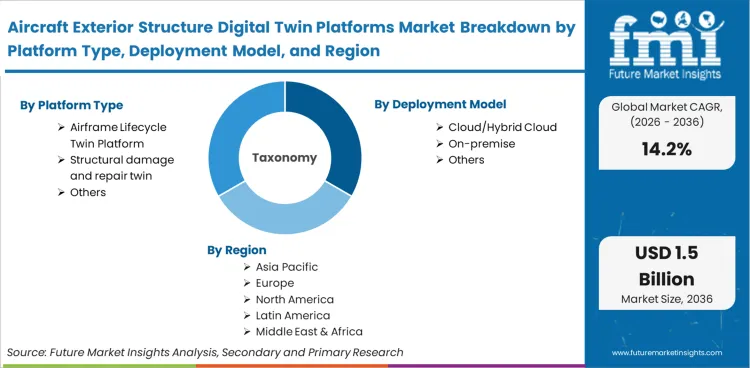
| Segmentation | Platform type, Deployment model, Aircraft type, End user, and Application |
| Regions Covered | North America, Latin America, Europe, East Asia, South Asia, Oceania, Middle East and Africa |
| Countries Covered | United States, China, India, Germany, United Kingdom, Japan, United Arab Emirates |
| Key Companies Profiled | Airbus, Dassault Systèmes, Siemens Digital Industries Software, Ansys, Hexagon AB, Altair Engineering, Palantir Technologies |
| Forecast Period | 2026 to 2036 |
| Approach | Annual widebody and narrowbody heavy maintenance check volumes |
Source: Future Market Insights (FMI) analysis, based on proprietary forecasting model and primary research
Segments
Platform Type:
- Airframe lifecycle twin platform
- Structural damage and repair twin
- Corrosion and fatigue prognostics twin
- Composite delamination and impact twin
- Inspection workflow and evidence twin
Deployment MODEL:
- Cloud / hybrid cloud
- On-premise
- Edge-connected federated deployment
Aircraft Type:
- Commercial fixed-wing
- Military fixed-wing
- Rotorcraft
- Advanced air mobility / eVTOL
End User:
- Airlines and independent MROs
- OEMs
- Tier-1 aero-structure suppliers
- Defense fleet operators
- Lessors / asset managers
Application:
- Predictive maintenance and remaining useful life
- Digital damage capture and repair planning
- Structural certification-by-analysis support
- Fleet-wide corrosion and fatigue tracking
- Lease-transfer / records traceability
Regions:
- North America
- United States
- Canada
- Mexico
- Latin America
- Brazil
- Argentina
- Chile
- Europe
- Germany
- United Kingdom
- France
- Italy
- Spain
- Asia-Pacific
- China
- Japan
- South Korea
- India
- ASEAN
- ANZ
- Middle East & Africa
- UAE
- Saudi Arabia
- South Africa
Bibliography
- Airbus. (2024, February). Report of the Board of Directors 2023. Airbus SE.
- Altair Engineering Inc. (2024, July). Altair signs MoU with the University of Nottingham to develop aerospace digital twin project.
- European Union Aviation Safety Agency. (2024, March). EASA Artificial Intelligence (AI) Concept Paper Issue 2: Guidance for Level 1 & 2 machine-learning applications.
- International Air Transport Association. (2025, August). The global commercial aircraft fleet.
- National Aeronautics and Space Administration. (2025, January). Inter-Agency Working Group on Engineering Complex Systems. NASA Technical Memorandum.
This bibliography is provided for reader reference. The full FMI report contains the complete reference list with primary source documentation.
This Report Addresses
- Aircraft lessor lease-return structural verification processes and penalties.
- Generative repair design adoption within independent MRO hangar operations.
- Data ingestion bottlenecks concerning legacy PDF damage records.
- OEM material fatigue curve monopolies versus synthetic predictive models.
- Airworthiness authority certification standards for synthetic fatigue data.
- Cloud architecture requirements for processing fleet-wide 3D scanner telemetry.
- Sand-erosion degradation tracking across Middle Eastern mega-carriers.
- Widebody heavy maintenance interval extension strategies using continuous monitoring.
Frequently Asked Questions
What is an aircraft exterior structure digital twin platform?
It represents software environments generating high-fidelity virtual replicas of specific physical airplane skins and structural frames to calculate real-time material fatigue.
How do aircraft structural digital twins work?
Systems ingest non-destructive testing data, flight loads, and environmental exposure metrics to calculate real-time material degradation.
Why are airlines using structural digital twins?
Engineering directors at major carriers utilize digital models to accelerate complex repair certifications legally, eliminating the unsustainable turnaround delays caused by manual damage plotting.
Can digital twins predict aircraft corrosion?
Yes, reliability teams can isolate specific fuselage panels suffering accelerated oxidation and modify wash schedules based on predictive warnings to extend structural life dramatically.
Which companies offer aircraft structural digital twin platforms?
Leading vendors include Airbus, Dassault Systèmes, Siemens Digital Industries Software, Ansys, Hexagon AB, Altair Engineering, and Palantir Technologies.
How is a digital damage twin used in aircraft repair?
Line maintenance technicians log ground-support equipment impacts instantly, comparing new 3D measurements against historical digital files to prevent redundant repair authorizations.
Explain the market for aircraft exterior structure digital twin platforms.
The market supplies software creating dynamic virtual replicas of specific airframes to calculate fatigue, track damage, and predict failures using operational flight data.
How large is the aircraft airframe digital twin market by 2036?
Revenue crosses USD 1.4 billion by 2036 because aviation financiers increasingly refuse to underwrite asset transfers lacking continuous digital structural threads.
What is the aircraft digital twin CAGR forecast?
Analysis indicates a 14.2% CAGR, propelled globally by airworthiness authorities shifting toward continuous safety verification mandates that require aggressive software procurement.
What drives demand for digital twins in aircraft exterior maintenance?
Demand is driven by the need to prevent catastrophic composite delaminations mid-route, avoiding the hundreds of thousands of dollars operators lose daily during unscheduled widebody groundings.
Which countries will adopt aircraft structural digital twins fastest?
India advances at 17.2%, followed closely by China at 16.8%, as rapid fleet expansion in these regions requires highly scalable tracking solutions immediately.
How to choose an aircraft structural digital twin vendor?
Procurement directors must select solutions that guarantee open API connectivity, allowing the ingestion of historical paper records while connecting smoothly with legacy maintenance IT architectures.
What distinguishes a digital twin vs structural health monitoring software aviation?
Digital twins utilize physics engines to simulate complete airframe lifecycles, whereas traditional monitoring software simply reports isolated sensor alerts without predictive context.
How do Siemens vs Dassault aerospace digital twin platforms compare?
Both embed deeply into initial aircraft design phases, creating an unbreakable data continuity chain by transferring these native OEM models directly to airline operators.
What role does Ansys Twin Builder for aircraft structures play?
Independent software providers capitalize on friction by offering verification engines capable of ingesting structural data from any aircraft type without OEM lock-in.
Why evaluate Airbus Skywise vs aircraft digital twin platforms?
Airbus leverages proprietary alloy fatigue curves perfectly calibrated to its own frames, forcing independent vendors to build complex equivalence algorithms using synthetic data.
What limits rapid software adoption?
Converting legacy paper records severely paralyses initial implementation because optical character recognition fails frequently on handwritten maintenance logs from older aircraft.
How do lessors influence procurement?
Asset managers protect residual hull values mathematically by penalizing airlines returning aircraft without comprehensive digital histories and mandating twin continuity clauses in new leases.
Why do airlines fear vendor lock-in?
Technical directors demand open architecture for sovereign data control because purchasing proprietary systems prevents seamless transitions to competing maintenance providers.
What role do civil aviation authorities play?
Regulators demand absolute mathematical traceability before extending physical inspection intervals, meaning validated digital evidence allows airlines to skip mandated tear-downs legally.
How does environmental exposure impact modeling?
Platforms must integrate specific atmospheric engines to remain accurate because Southeast Asian humidity creates unique corrosion patterns unlike Middle Eastern sand erosion.
Why is engine performance excluded?
Fuselage structural stress algorithms operate on fundamentally different engineering principles than the specialized computational fluid dynamics processing required for propulsion thermodynamics.
How does digital tracking impact aircraft resale?
Aircraft backed by immutable structural proofs command significant market premiums because trading managers can calculate scrap value precisely using verified material degradation histories.
Preview the report firsthand - request a free sample
Get SampleGet the brochure for pricing and purchase details.
Get PDFTable of Content
- Executive Summary
- Global Market Outlook
- Demand-side Trends
- Supply-side Trends
- Technology Roadmap Analysis
- Analysis and Recommendations
- Market Overview
- Market Coverage / Taxonomy
- Market Definition / Scope / Limitations
- Research Methodology
- Chapter Orientation
- Analytical Lens and Working Hypotheses
- Market Structure, Signals, and Trend Drivers
- Benchmarking and Cross-market Comparability
- Market Sizing, Forecasting, and Opportunity Mapping
- Research Design and Evidence Framework
- Desk Research Programme (Secondary Evidence)
- Company Annual and Sustainability Reports
- Peer-reviewed Journals and Academic Literature
- Corporate Websites, Product Literature, and Technical Notes
- Earnings Decks and Investor Briefings
- Statutory Filings and Regulatory Disclosures
- Technical White Papers and Standards Notes
- Trade Journals, Industry Magazines, and Analyst Briefs
- Conference Proceedings, Webinars, and Seminar Materials
- Government Statistics Portals and Public Data Releases
- Press Releases and Reputable Media Coverage
- Specialist Newsletters and Curated Briefings
- Sector Databases and Reference Repositories
- FMI Internal Proprietary Databases and Historical Market Datasets
- Subscription Datasets and Paid Sources
- Social Channels, Communities, and Digital Listening Inputs
- Additional Desk Sources
- Expert Input and Fieldwork (Primary Evidence)
- Primary Modes
- Qualitative Interviews and Expert Elicitation
- Quantitative Surveys and Structured Data Capture
- Blended Approach
- Why Primary Evidence is Used
- Field Techniques
- Interviews
- Surveys
- Focus Groups
- Observational and In-context Research
- Social and Community Interactions
- Stakeholder Universe Engaged
- C-suite Leaders
- Board Members
- Presidents and Vice Presidents
- R&D and Innovation Heads
- Technical Specialists
- Domain Subject-matter Experts
- Scientists
- Physicians and Other Healthcare Professionals
- Governance, Ethics, and Data Stewardship
- Research Ethics
- Data Integrity and Handling
- Primary Modes
- Tooling, Models, and Reference Databases
- Desk Research Programme (Secondary Evidence)
- Data Engineering and Model Build
- Data Acquisition and Ingestion
- Cleaning, Normalisation, and Verification
- Synthesis, Triangulation, and Analysis
- Quality Assurance and Audit Trail
- Market Background
- Market Dynamics
- Drivers
- Restraints
- Opportunity
- Trends
- Scenario Forecast
- Demand in Optimistic Scenario
- Demand in Likely Scenario
- Demand in Conservative Scenario
- Opportunity Map Analysis
- Product Life Cycle Analysis
- Supply Chain Analysis
- Investment Feasibility Matrix
- Value Chain Analysis
- PESTLE and Porter’s Analysis
- Regulatory Landscape
- Regional Parent Market Outlook
- Production and Consumption Statistics
- Import and Export Statistics
- Market Dynamics
- Global Market Analysis 2021 to 2025 and Forecast, 2026 to 2036
- Historical Market Size Value (USD Million) Analysis, 2021 to 2025
- Current and Future Market Size Value (USD Million) Projections, 2026 to 2036
- Y-o-Y Growth Trend Analysis
- Absolute $ Opportunity Analysis
- Global Market Pricing Analysis 2021 to 2025 and Forecast 2026 to 2036
- Global Market Analysis 2021 to 2025 and Forecast 2026 to 2036, By Platform Type
- Introduction / Key Findings
- Historical Market Size Value (USD Million) Analysis By Platform Type , 2021 to 2025
- Current and Future Market Size Value (USD Million) Analysis and Forecast By Platform Type , 2026 to 2036
- Airframe Lifecycle Twin Platform
- Structural damage and repair twin
- Others
- Airframe Lifecycle Twin Platform
- Y-o-Y Growth Trend Analysis By Platform Type , 2021 to 2025
- Absolute $ Opportunity Analysis By Platform Type , 2026 to 2036
- Global Market Analysis 2021 to 2025 and Forecast 2026 to 2036, By Deployment Model
- Introduction / Key Findings
- Historical Market Size Value (USD Million) Analysis By Deployment Model, 2021 to 2025
- Current and Future Market Size Value (USD Million) Analysis and Forecast By Deployment Model, 2026 to 2036
- Cloud/Hybrid Cloud
- On-premise
- Others
- Cloud/Hybrid Cloud
- Y-o-Y Growth Trend Analysis By Deployment Model, 2021 to 2025
- Absolute $ Opportunity Analysis By Deployment Model, 2026 to 2036
- Global Market Analysis 2021 to 2025 and Forecast 2026 to 2036, By Aircraft Type
- Introduction / Key Findings
- Historical Market Size Value (USD Million) Analysis By Aircraft Type, 2021 to 2025
- Current and Future Market Size Value (USD Million) Analysis and Forecast By Aircraft Type, 2026 to 2036
- Commercial Fixed-Wing
- Military fixed-wing
- Others
- Commercial Fixed-Wing
- Y-o-Y Growth Trend Analysis By Aircraft Type, 2021 to 2025
- Absolute $ Opportunity Analysis By Aircraft Type, 2026 to 2036
- Global Market Analysis 2021 to 2025 and Forecast 2026 to 2036, By End Use
- Introduction / Key Findings
- Historical Market Size Value (USD Million) Analysis By End Use, 2021 to 2025
- Current and Future Market Size Value (USD Million) Analysis and Forecast By End Use, 2026 to 2036
- Airlines And Independent MROs
- OEMs
- Others
- Airlines And Independent MROs
- Y-o-Y Growth Trend Analysis By End Use, 2021 to 2025
- Absolute $ Opportunity Analysis By End Use, 2026 to 2036
- Global Market Analysis 2021 to 2025 and Forecast 2026 to 2036, By Application
- Introduction / Key Findings
- Historical Market Size Value (USD Million) Analysis By Application, 2021 to 2025
- Current and Future Market Size Value (USD Million) Analysis and Forecast By Application, 2026 to 2036
- Predictive Maintenance And Remaining Useful Life
- Digital damage capture and repair planning
- Others
- Predictive Maintenance And Remaining Useful Life
- Y-o-Y Growth Trend Analysis By Application, 2021 to 2025
- Absolute $ Opportunity Analysis By Application, 2026 to 2036
- Global Market Analysis 2021 to 2025 and Forecast 2026 to 2036, By Region
- Introduction
- Historical Market Size Value (USD Million) Analysis By Region, 2021 to 2025
- Current Market Size Value (USD Million) Analysis and Forecast By Region, 2026 to 2036
- North America
- Latin America
- Western Europe
- Eastern Europe
- East Asia
- South Asia and Pacific
- Middle East & Africa
- Market Attractiveness Analysis By Region
- North America Market Analysis 2021 to 2025 and Forecast 2026 to 2036, By Country
- Historical Market Size Value (USD Million) Trend Analysis By Market Taxonomy, 2021 to 2025
- Market Size Value (USD Million) Forecast By Market Taxonomy, 2026 to 2036
- By Country
- USA
- Canada
- Mexico
- By Platform Type
- By Deployment Model
- By Aircraft Type
- By End Use
- By Application
- By Country
- Market Attractiveness Analysis
- By Country
- By Platform Type
- By Deployment Model
- By Aircraft Type
- By End Use
- By Application
- Key Takeaways
- Latin America Market Analysis 2021 to 2025 and Forecast 2026 to 2036, By Country
- Historical Market Size Value (USD Million) Trend Analysis By Market Taxonomy, 2021 to 2025
- Market Size Value (USD Million) Forecast By Market Taxonomy, 2026 to 2036
- By Country
- Brazil
- Chile
- Rest of Latin America
- By Platform Type
- By Deployment Model
- By Aircraft Type
- By End Use
- By Application
- By Country
- Market Attractiveness Analysis
- By Country
- By Platform Type
- By Deployment Model
- By Aircraft Type
- By End Use
- By Application
- Key Takeaways
- Western Europe Market Analysis 2021 to 2025 and Forecast 2026 to 2036, By Country
- Historical Market Size Value (USD Million) Trend Analysis By Market Taxonomy, 2021 to 2025
- Market Size Value (USD Million) Forecast By Market Taxonomy, 2026 to 2036
- By Country
- Germany
- UK
- Italy
- Spain
- France
- Nordic
- BENELUX
- Rest of Western Europe
- By Platform Type
- By Deployment Model
- By Aircraft Type
- By End Use
- By Application
- By Country
- Market Attractiveness Analysis
- By Country
- By Platform Type
- By Deployment Model
- By Aircraft Type
- By End Use
- By Application
- Key Takeaways
- Eastern Europe Market Analysis 2021 to 2025 and Forecast 2026 to 2036, By Country
- Historical Market Size Value (USD Million) Trend Analysis By Market Taxonomy, 2021 to 2025
- Market Size Value (USD Million) Forecast By Market Taxonomy, 2026 to 2036
- By Country
- Russia
- Poland
- Hungary
- Balkan & Baltic
- Rest of Eastern Europe
- By Platform Type
- By Deployment Model
- By Aircraft Type
- By End Use
- By Application
- By Country
- Market Attractiveness Analysis
- By Country
- By Platform Type
- By Deployment Model
- By Aircraft Type
- By End Use
- By Application
- Key Takeaways
- East Asia Market Analysis 2021 to 2025 and Forecast 2026 to 2036, By Country
- Historical Market Size Value (USD Million) Trend Analysis By Market Taxonomy, 2021 to 2025
- Market Size Value (USD Million) Forecast By Market Taxonomy, 2026 to 2036
- By Country
- China
- Japan
- South Korea
- By Platform Type
- By Deployment Model
- By Aircraft Type
- By End Use
- By Application
- By Country
- Market Attractiveness Analysis
- By Country
- By Platform Type
- By Deployment Model
- By Aircraft Type
- By End Use
- By Application
- Key Takeaways
- South Asia and Pacific Market Analysis 2021 to 2025 and Forecast 2026 to 2036, By Country
- Historical Market Size Value (USD Million) Trend Analysis By Market Taxonomy, 2021 to 2025
- Market Size Value (USD Million) Forecast By Market Taxonomy, 2026 to 2036
- By Country
- India
- ASEAN
- Australia & New Zealand
- Rest of South Asia and Pacific
- By Platform Type
- By Deployment Model
- By Aircraft Type
- By End Use
- By Application
- By Country
- Market Attractiveness Analysis
- By Country
- By Platform Type
- By Deployment Model
- By Aircraft Type
- By End Use
- By Application
- Key Takeaways
- Middle East & Africa Market Analysis 2021 to 2025 and Forecast 2026 to 2036, By Country
- Historical Market Size Value (USD Million) Trend Analysis By Market Taxonomy, 2021 to 2025
- Market Size Value (USD Million) Forecast By Market Taxonomy, 2026 to 2036
- By Country
- Kingdom of Saudi Arabia
- Other GCC Countries
- Turkiye
- South Africa
- Other African Union
- Rest of Middle East & Africa
- By Platform Type
- By Deployment Model
- By Aircraft Type
- By End Use
- By Application
- By Country
- Market Attractiveness Analysis
- By Country
- By Platform Type
- By Deployment Model
- By Aircraft Type
- By End Use
- By Application
- Key Takeaways
- Key Countries Market Analysis
- USA
- Pricing Analysis
- Market Share Analysis, 2025
- By Platform Type
- By Deployment Model
- By Aircraft Type
- By End Use
- By Application
- Canada
- Pricing Analysis
- Market Share Analysis, 2025
- By Platform Type
- By Deployment Model
- By Aircraft Type
- By End Use
- By Application
- Mexico
- Pricing Analysis
- Market Share Analysis, 2025
- By Platform Type
- By Deployment Model
- By Aircraft Type
- By End Use
- By Application
- Brazil
- Pricing Analysis
- Market Share Analysis, 2025
- By Platform Type
- By Deployment Model
- By Aircraft Type
- By End Use
- By Application
- Chile
- Pricing Analysis
- Market Share Analysis, 2025
- By Platform Type
- By Deployment Model
- By Aircraft Type
- By End Use
- By Application
- Germany
- Pricing Analysis
- Market Share Analysis, 2025
- By Platform Type
- By Deployment Model
- By Aircraft Type
- By End Use
- By Application
- UK
- Pricing Analysis
- Market Share Analysis, 2025
- By Platform Type
- By Deployment Model
- By Aircraft Type
- By End Use
- By Application
- Italy
- Pricing Analysis
- Market Share Analysis, 2025
- By Platform Type
- By Deployment Model
- By Aircraft Type
- By End Use
- By Application
- Spain
- Pricing Analysis
- Market Share Analysis, 2025
- By Platform Type
- By Deployment Model
- By Aircraft Type
- By End Use
- By Application
- France
- Pricing Analysis
- Market Share Analysis, 2025
- By Platform Type
- By Deployment Model
- By Aircraft Type
- By End Use
- By Application
- India
- Pricing Analysis
- Market Share Analysis, 2025
- By Platform Type
- By Deployment Model
- By Aircraft Type
- By End Use
- By Application
- ASEAN
- Pricing Analysis
- Market Share Analysis, 2025
- By Platform Type
- By Deployment Model
- By Aircraft Type
- By End Use
- By Application
- Australia & New Zealand
- Pricing Analysis
- Market Share Analysis, 2025
- By Platform Type
- By Deployment Model
- By Aircraft Type
- By End Use
- By Application
- China
- Pricing Analysis
- Market Share Analysis, 2025
- By Platform Type
- By Deployment Model
- By Aircraft Type
- By End Use
- By Application
- Japan
- Pricing Analysis
- Market Share Analysis, 2025
- By Platform Type
- By Deployment Model
- By Aircraft Type
- By End Use
- By Application
- South Korea
- Pricing Analysis
- Market Share Analysis, 2025
- By Platform Type
- By Deployment Model
- By Aircraft Type
- By End Use
- By Application
- Russia
- Pricing Analysis
- Market Share Analysis, 2025
- By Platform Type
- By Deployment Model
- By Aircraft Type
- By End Use
- By Application
- Poland
- Pricing Analysis
- Market Share Analysis, 2025
- By Platform Type
- By Deployment Model
- By Aircraft Type
- By End Use
- By Application
- Hungary
- Pricing Analysis
- Market Share Analysis, 2025
- By Platform Type
- By Deployment Model
- By Aircraft Type
- By End Use
- By Application
- Kingdom of Saudi Arabia
- Pricing Analysis
- Market Share Analysis, 2025
- By Platform Type
- By Deployment Model
- By Aircraft Type
- By End Use
- By Application
- Turkiye
- Pricing Analysis
- Market Share Analysis, 2025
- By Platform Type
- By Deployment Model
- By Aircraft Type
- By End Use
- By Application
- South Africa
- Pricing Analysis
- Market Share Analysis, 2025
- By Platform Type
- By Deployment Model
- By Aircraft Type
- By End Use
- By Application
- USA
- Market Structure Analysis
- Competition Dashboard
- Competition Benchmarking
- Market Share Analysis of Top Players
- By Regional
- By Platform Type
- By Deployment Model
- By Aircraft Type
- By End Use
- By Application
- Competition Analysis
- Competition Deep Dive
- Airbus
- Overview
- Product Portfolio
- Profitability by Market Segments (Product/Age /Sales Channel/Region)
- Sales Footprint
- Strategy Overview
- Marketing Strategy
- Product Strategy
- Channel Strategy
- Dassault Systèmes
- Siemens Digital Industries Software
- Ansys
- Hexagon AB
- Altair Engineering
- Airbus
- Competition Deep Dive
- Assumptions & Acronyms Used


