

- Industry Size (2026)
- USD 350.2 Mn
- Forecast (2036)
- USD 976.6 Mn
- CAGR (2026 to 2036)
- 10.8%
Digital Twin-Based Industrial Operator Training Platforms Market Size, Market Forecast and Outlook By FMI
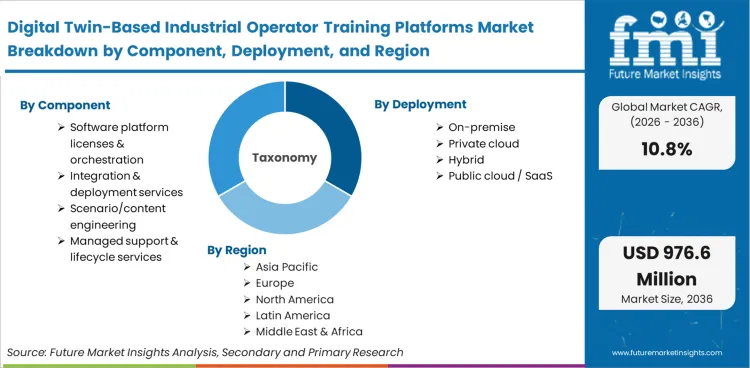
The digital twin-based industrial operator training platforms market surpassed the valuation of USD 316.1 million in 2025 with the industry growth ready to reach USD 350.2 million in 2026 at a CAGR of 10.8% during the forecast period, reflecting high demand across the broader industrial operator training platform market. Sustained investment carries the market value to USD 976.6 million through 2036 as process plants recognize that the cost of an operator-induced unplanned shutdown has vastly outpaced the capital required to deploy high-fidelity dynamic simulation models.
Plant managers and automation directors are shifting away from standalone simulators toward integrated digital twin technology that perfectly mirrors live control system logic. This transition forces buyers evaluating digital twin operator training software to decide whether to lock into their existing Distributed Control System (DCS) vendor's proprietary simulation environment or invest in hardware-agnostic platforms capable of translating multi-vendor architectures. Selecting closed ecosystems streamlines immediate deployment but restricts the facility from simulating enterprise-wide data interactions. The urgency is compounded by the retirement of veteran operators; plants can no longer rely on decades of tacit knowledge to navigate process upsets. FMI's tracking of digital transformation in manufacturing indicates that facilities standardizing on an open digital twin training platform market for industry standards achieve qualification milestones substantially faster than those managing disparate training silos.
Summary of Digital Twin-Based Industrial Operator Training Platforms Market
- Digital Twin-Based Industrial Operator Training Platforms Market Definition
- This landscape consists of high-fidelity, physics-based simulation environments that perfectly replicate a facility’s control architecture and process dynamics. They function as a zero-risk proving ground, bridging the gap between theoretical knowledge and the complex, multi-variable reality of running an industrial process.
- Demand Drivers in the Market
- The permanent loss of experiential knowledge through workforce retirement compels plant managers to mandate rigorous, simulated process-upset rehearsals before allowing new hires on the board.
- EPC project handover stipulations require engineering directors to deliver fully verified virtual models alongside the physical plant.
- Stricter process safety management compliance frameworks obligate operations executives to provide auditable proof of operator competency.
- Key Segments Analyzed in the FMI Report
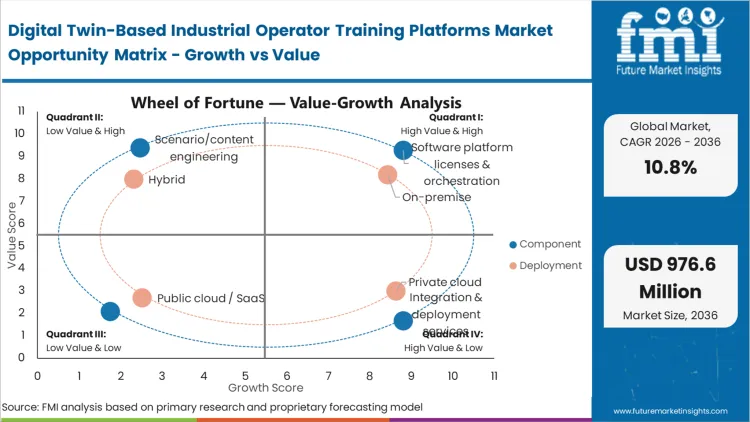
- Software Platform Licenses & Orchestration: Software platform licenses & orchestration is poised to hold 61.0% share in 2026, as the core intellectual property and thermodynamic modeling capabilities reside in the underlying industrial digital simulation training platform engine rather than the hardware interfaces.
- On-Premise: On-premise is projected to grab 58.0% share in 2026, driven by strict operational technology cybersecurity protocols that prohibit live control logic from communicating over external networks.
- Oil & Gas/Petrochemicals: Oil & gas / petrochemicals is estimated to garner 29.0% share in 2026, due to the extreme financial and environmental consequences of procedural errors during complex continuous processes.
- Abnormal Situation & Emergency Response Training: Abnormal situation & emergency response training is likely to account for 31.0% share in 2026, as operators cannot safely replicate these volatile edge-case scenarios on live production assets.
- Process/Plant Digital Twin: Process / plant digital twin is anticipated to record 54.0% share in 2026, providing the comprehensive boundary conditions necessary for holistic operational rehearsal.
- India: 13.1% CAGR, reflecting the intense concentration of new grassroots refinery and specialty chemical capacity bypassing legacy training paradigms.
- Analyst Opinion at FMI
- Rahul Pandita, Principal Analyst, Technology, at FMI, opines, "The standard assumption is that operators measure the return on these platforms by how quickly new hires complete their certification hours. However, the true financial metric is the avoidance of single-event anomalies. When a control room operator successfully catches a cascading compressor failure in a virtual environment, they build the muscle memory required to save millions in physical equipment damage and unplanned downtime during a real event. The value isn't in standard operations; it is entirely captured in the rehearsal of the catastrophic."
- Strategic Implications / Executive Takeaways
- Training simulation directors must align their digital twin training platform for control room operators with their core DCS providers to ensure high-fidelity control logic replication during upgrades.
- EPC project managers should embed OTS delivery milestones into the virtual commissioning phase to avoid post-handover integration delays.
- Plant operations executives face rigid corporate IT security parameters that require robust network segmentation when integrating third-party 3D visualization layers.
- Methodology
- Primary Research: Operations technology (OT) directors, training simulation leads, and DCS integration engineers.
- Desk Research: EPC project handover specifications, industrial automation vendor alliance registries, and process safety qualification standards.
- Market-Sizing and Forecasting: The baseline anchors to the installed base of Tier-1 process control systems and the documented attach rate of advanced training simulators.
- Data Validation and Update Cycle: Forecasts are cross-validated against industrial software license revenue disclosures and reported capital expenditure.
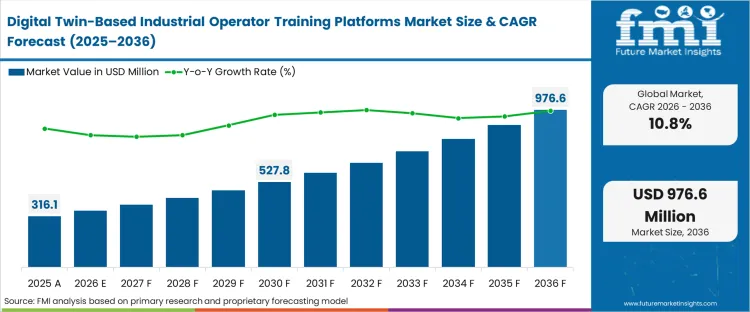
The structural gate that makes this growth self-reinforcing is the convergence of 3D virtual environments with dynamic process models, accelerating adoption within the operator training simulator market industrial sector. Once engineering procurement and construction (EPC) firms mandate a virtual commissioning and operator training platform as a prerequisite for physical handover, integrating operator training into the exact same physics-based model becomes the default standard. Facilities bypassing physical control room mock-ups eliminate a massive capital bottleneck, allowing parallel training phases to commence months before the physical plant is energized.
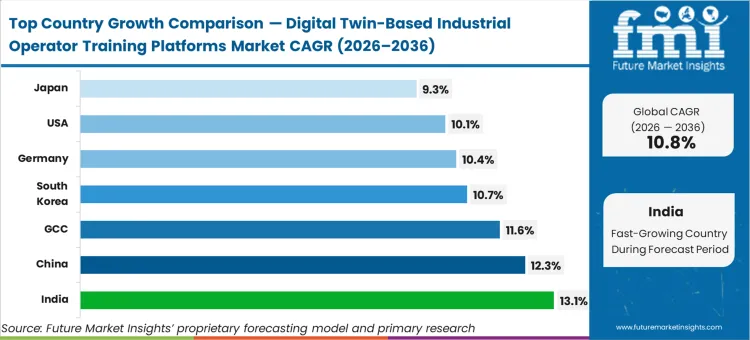
India is expected to advance at 13.1%, followed by China which tracks at 12.3%. The GCC is estimated to grow at 11.6%, while South Korea follows at 10.7%. Germany is projected to expand at 10.4%, the United States will garner 10.1%, and Japan is poised to register 9.3%. The divergence in expansion speeds within this digital twin operator training market reflects how heavily different procurement environments rely on greenfield mega-projects; regions building entirely new refining complexes embed these platforms into base project expenditure, whereas areas dominated by legacy assets face prolonged brownfield integration cycles.
Digital Twin-Based Industrial Operator Training Platforms Market Definition
If procurement teams ask what is a digital twin-based industrial operator training platform, it is defined as a dynamic simulation environment that fuses real-time thermodynamic, mechanical, and control logic models with visual interfaces to create an exact operational replica of a specific industrial asset. Unlike generic training simulators, these platforms utilize the exact control system configurations and historian data of the live plant, enabling operators to interact with genuine system responses under specific operating conditions.
Digital Twin-Based Industrial Operator Training Platforms Market Inclusions
The scope encompasses core modeling engines, 3D visualization layers, instructor orchestration interfaces, and direct DCS emulation packages deployed specifically for personnel qualification. This includes simulation software configured as process plant operator training software, as well as field operator ar vr software when natively integrated into the centralized process model.
Digital Twin-Based Industrial Operator Training Platforms Market Exclusions
Standalone virtual reality safety orientation applications and generic procedural videos are explicitly excluded, as they do not run on real-time process simulation engines. General enterprise asset management databases and independent computer-aided design (CAD) visualization tools are omitted because they lack the bidirectional dynamic logic required to simulate operational upset conditions.
Digital Twin-Based Industrial Operator Training Platforms Market Research Methodology
- Primary Research: Operations technology (OT) directors, training simulation leads, and DCS integration engineers executing deployments for operator training simulator software for plants.
- Desk Research: EPC project handover specifications, industrial automation vendor alliance registries, and process safety qualification standards.
- Market-Sizing and Forecasting: The baseline anchors to the installed base of Tier-1 process control systems and the documented attach rate of advanced training simulators per new greenfield mega-project.
- Data Validation and Update Cycle: Forecasts are cross-validated against industrial software license revenue disclosures and reported capital expenditure on operator readiness programs in heavy industry.
Segmental Analysis
Digital Twin-Based Industrial Operator Training Platforms Market Analysis by Component
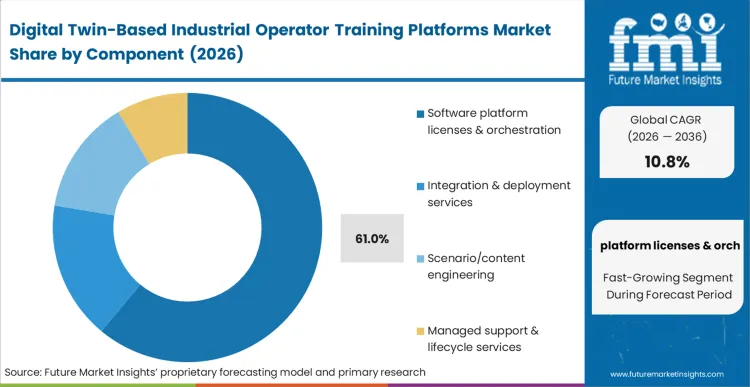
Incumbent classroom methodologies and generic process simulators fail to capture the specific thermodynamic realities of a plant, leaving operators blind to how their actual facility behaves under stress. The reason Software platform licenses & orchestration holds 61.0% of the market is because the proprietary physics engines and control translation layers are the defining mechanisms that separate a true twin from a video game. As digital twins technologies mature, procurement teams sourcing an industrial simulation training software market solution are shifting spend away from custom hardware panels toward scalable software environments that can be updated concurrently with the live DCS. According to FMI's estimates, facilities that attempt to decouple the software engine from their primary automation vendor often spend twice as much on integration services. The core software platform acts as the singular source of truth, dictating how accurately a simulated pressure spike mimics physical reality. Relying on disconnected visualization tools without a rigorous orchestration engine exposes the plant to negative training transfer, where operators learn responses that are dangerously incorrect in the real world.
- Procurement Trigger: The acquisition of advanced platform licenses usually correlates directly with a major DCS upgrade. Operations directors use these transition periods to justify the capital expenditure of building a unified simulation environment.
- Qualification Validation: Once deployed, the industrial digital twin training software must prove it can execute process models faster than real-time without computational lag. Engineers validate the twin by running historical upset data through the platform and matching the simulated output against recorded historian trends.
- Expansion Constraint: The primary barrier to license scaling is the internal engineering bandwidth required to maintain the models over time. If the facility lacks dedicated simulation engineers, the platform degrades as physical plant modifications outpace virtual updates.
Digital Twin-Based Industrial Operator Training Platforms Market Analysis by Deployment
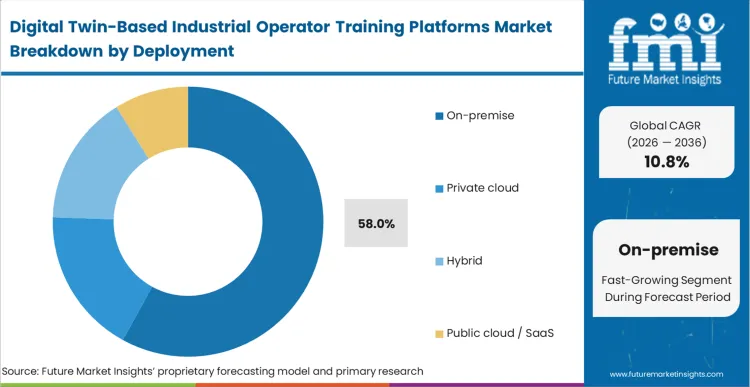
Operations technology directors will not permit environments that house exact replicas of their safety instrumented systems and control logic to sit on public servers. Even as modern cloud PLC frameworks gain traction in discrete manufacturing, heavy continuous process industries maintain an absolute air-gap between their process simulation networks and external internet access. The structural reality of industrial cybersecurity forces 58.0% of deployment into On-premise architectures, despite the wider enterprise push toward cloud computing. Based on FMI's assessment, the cost of securing a cloud-based industrial operator training platform often negates the computational savings of off-site hosting. On-premise hardware ensures that simulator instructors have zero-latency access to the control interface, a critical requirement when operators are responding to simulated split-second trip conditions. Facilities evaluating a hybrid operator training simulator for industrial facilities often face immediate veto from their corporate risk and compliance officers.
- Capital Outlay: The initial cost burden of on-premise deployment involves high-performance server clusters capable of processing complex thermodynamic equations simultaneously. This expense is absorbed into the base automation budget rather than the training department's operational spend.
- Lifecycle Maintenance: Maintaining proprietary hardware requires ongoing service level agreements with the primary vendor, adding hidden support costs over the facility's lifecycle. IT departments must dedicate specific resources to patching simulation servers that cannot rely on automated over-the-air updates.
- Total Lifecycle Analysis: Despite higher upfront capital requirements, evaluating on-premise vs cloud industrial operator training platform models shows on-premise provides absolute cost predictability over a 15-year plant lifecycle. Facilities avoid variable compute charges that can spiral when hundreds of operators run simultaneous, computation-heavy training scenarios.
Digital Twin-Based Industrial Operator Training Platforms Market Analysis by End-use Industry
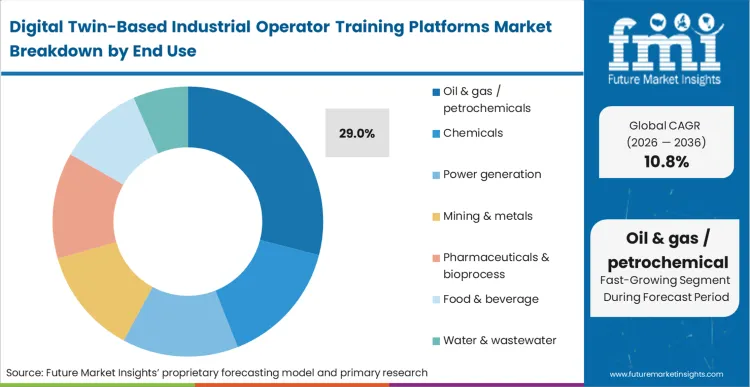
Procurement directors in Oil & gas / petrochemicals face a stark binary choice, either invest heavily in exact digital replicas or accept the catastrophic risk of an operator mismanaging a hydrocarbon release. This sector drives 29.0% of the market because the financial penalty of a single unscheduled shutdown dwarfs the cost of the entire simulation suite. Unlike discrete manufacturing, continuous fluid processes possess immense thermal and kinetic inertia; operators must learn how a valve adjustment now will affect a distillation column twenty minutes later. FMI analysts opine that predictive maintenance data integrated into digital twin training for oil and gas operators allows personnel to rehearse procedures tailored to the current degraded state of aging equipment. When refineries implement strict high-fidelity training protocols, they effectively eliminate the human error variable from their process safety incident reports. Delaying the rollout of digital twin operator training in chemicals and petrochemicals leaves the facility dependent on classroom theory, increasing the likelihood of an environmental event during complex transitional states.
- Vulnerability Gap: Process disruptions occur most frequently during start-up and shutdown sequences. If operators are not drilled on these exact transitional phases, the risk of a containment loss spikes significantly.
- Residual Exposure: Even with a perfect digital twin, human fatigue and shift-rotation variables remain outside the simulator's control. Training departments must actively enforce rest periods before testing operators on the most complex emergency response modules.
- Operational Capture: To realize the full safety benefit within the power plant operator training simulator market or oil and gas sector, plant managers must structurally embed simulation hours into the annual recertification requirements of every board operator.
Digital Twin-Based Industrial Operator Training Platforms Market Analysis by Application
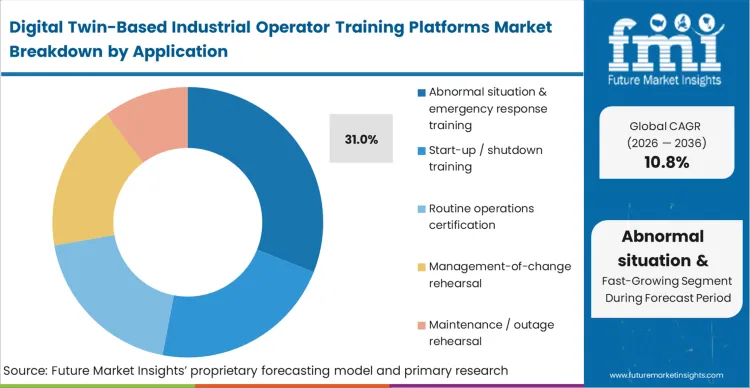
Plant managers cannot intentionally induce a reactor thermal runaway to see if a new hire knows the correct mitigation sequence. This limitation forces the adoption of an abnormal situation management training platform where edge-case disasters can be rehearsed with total psychological fidelity. The integration of AR and VR in training further amplifies this, allowing field operators to coordinate physically with control room personnel during a simulated upset. The inability to safely test operators on catastrophic failures on live equipment directly dictates the 31.0% share held by Abnormal situation & emergency response training. As per FMI's projection, facilities that aggressively drill emergency response simulation training for industrial operators demonstrate recovery times nearly 40% faster than those relying on standard operating procedure manuals. Failing to mandate this specific application leaves the plant vulnerable to cascading failures, where an operator's delayed recognition of a critical alarm transforms a manageable incident into a facility-wide trip.
- Pioneer Integration: Greenfield LNG and petrochemical facilities are the primary adopters, utilizing start-up and shutdown operator training software into the initial commissioning budget. They use the simulation not just to train, but to validate the actual emergency operating procedures before the plant goes live.
- Subsequent Roll-Out: Brownfield sites follow once they experience a significant near-miss or regulatory audit failure. Their implementation focuses heavily on industrial management of change rehearsal software to create precise replays of the historical incidents that triggered the audit.
- Late Majority Conversion: Smaller specialty chemical batch plants are the final tier to adopt, usually compelled by insurance underwriters demanding rigorous proof of competency. Their conversion is often driven by external risk premium reductions rather than internal training optimization goals.
Digital Twin-Based Industrial Operator Training Platforms Market Analysis by Twin Type
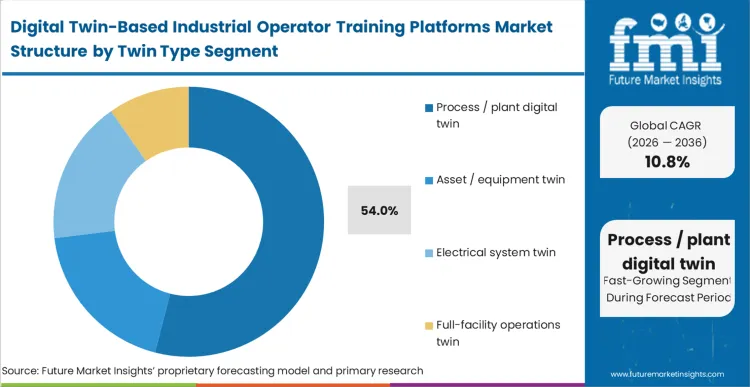
In FMI's view, facilities that attempt to stitch together disparate, unit-specific models often encounter boundary-condition errors where the simulated logic breaks down at the connection points. Standardizing on a comprehensive process twin ensures that mass and energy balances remain true across the entire simulated enterprise. Compromising on this holistic capability results in isolated training silos that fail to prepare operators for unit-to-unit cascading disturbances. A distinct operational tension exists between the need for localized equipment monitoring and the requirement to understand holistic facility dynamics. Process / plant digital twin architectures resolve this by providing the overarching connective tissue, securing 54.0% of the market. While an electrical digital twin might perfect the power distribution view, process operators must understand how a voltage sag impacts fluid flow through a compressor three units away. A dynamic simulation operator training platform synthesizes these isolated variables into a unified thermodynamic reality.
- Baseline Utility: At its foundational level, the process twin accurately models steady-state continuous operations under normal load conditions. This provides the standard benchmark used to qualify junior operators on daily production monitoring tasks.
- Edge Degradation: When pushed into severe abnormal conditions, generic or simplified process models begin to suffer from thermodynamic drift. The mathematical approximations that hold during normal operations fail to accurately represent the extreme pressures of a real-time upset sequence.
- Acceptance Criteria: For a holistic twin to be deemed acceptable by process safety engineers, it must demonstrate an exact alignment with the plant's actual dynamic behavior during a documented historical trip. If the simulator fails to match the historian data precisely, it is relegated to familiarization training rather than critical competency certification.
Digital Twin-Based Industrial Operator Training Platforms Market Drivers, Restraints, and Opportunities
Engineering directors orchestrating billion-dollar mega-projects face an unforgiving structural mandate, operational competency must be fully established before physical commissioning even begins. The traditional timeline of waiting for structural steel to be erected before training personnel is no longer commercially viable. This absolute zero-tolerance for delay compels capital project teams to invest heavily in exact digital replicas, guaranteeing that control board operators log hundreds of hours of virtual flight time using digital twin-based training for plant start-up and shutdown long before the first live hydrocarbons enter the system. Navigating an initial plant start-up without this rigorous virtual rehearsal directly exposes the facility to catastrophic equipment damage and massive deferred revenue penalties.
Model decay acts as the dominant structural friction dragging on widespread adoption. The precise physics and control logic algorithms that flawlessly represent a facility on day one suffer rapid obsolescence as physical equipment degrades, instruments are recalibrated, and DCS logic is patched. Combatting this lifecycle maintenance burden demands highly specialized simulation and test data management workflows and dedicated simulation engineers, resources that most operating companies do not natively retain on staff. Although vendor-managed service agreements are increasingly deployed to bridge this gap, the inherent latency in remote model updating fundamentally limits the platform's long-term utility as an infallible, real-time operational mirror.
Opportunities in the Digital Twin-Based Industrial Operator Training Platforms Market
- Dynamic Logic Synchronization: The emergence of bidirectional synchronization algorithms allows the OTS to automatically update its control parameters based on live DCS changes. Automation directors utilizing industrial digital twin scenario training software capture a permanently accurate simulation environment without the manual engineering overhead.
- Field-Operator Integration: Spatial mapping technologies enable the fusion of 3D virtual plant walkthroughs with the thermodynamic process model. Training managers utilize immersive analytics to conduct joint exercises where control board actions instantly alter the virtual environment seen by the headset-wearing field worker.
- AI-Driven Scenario Generation: Advanced machine learning algorithms can analyze historical plant near-misses and automatically generate complex training modules based on those vulnerabilities. Using ai driven predictive maintenance data, process safety teams identify the specific sequences most likely to cause a failure and automatically drill operators on those exact conditions.
Regional Analysis
The global adoption of digital twin-based operator training simulators exposes a stark structural divide between regions aggressively commissioning greenfield mega-projects and those focused on extending the operational life of legacy brownfield assets. This divergence in capital deployment ultimately dictates the varying growth trajectories and procurement priorities observed across major industrial hubs worldwide with the market being segmented into North America, Europe, Asia Pacific, Middle East & Africa, and Latin America across 40 plus countries.
.webp "Top Country Growth Comparison Digital Twin Based Industrial Operator Training Platforms Market Cagr (2026 2036)")
| Country | CAGR (2026 to 2036) |
|---|---|
| India | 13.1% |
| China | 12.3% |
| GCC | 11.6% |
| South Korea | 10.7% |
| Germany | 10.4% |
| United States | 10.1% |
| Japan | 9.3% |
Source: Future Market Insights (FMI) analysis, based on proprietary forecasting model and primary research
Asia Pacific Digital Twin-Based Industrial Operator Training Platforms Market Analysis
A severe shortage of veteran control board personnel is currently colliding with an unprecedented wave of concurrent LNG and petrochemical facility constructions across the region. The time-intensive traditional apprenticeship models as a result are being rapidly abandoned in favor of digitized qualification. Based on FMI's assessment, engineering and procurement contractors now structurally embed high-fidelity virtual training deliverables into the initial project scope rather than treating them as optional post-handover add-ons. Aligning with a broader smart factory ethos, this shift guarantees that fully verified operating crews are ready to take control the exact day a grassroots plant reaches mechanical completion.
- India: Plant managers operating within major industrial corridors are being forced to compress what historically required a five-year experiential learning curve into a highly intensive six-month virtual qualification window. This urgency stems from domestic refining capacity expanding far faster than the organic development of seasoned control room personnel. The India operator training platform market for process industries advance at a 13.1% CAGR, being propelled by an impending regulatory environment where minimum simulated hours become a legal prerequisite for managing high-hazard continuous processes, propelling
- China: Expanding at 12.3%, the China digital twin industrial training software market relies on these sophisticated tools to systematically strip out human error during highly volatile start-up sequences. Operations directors are mandating simulation architectures capable of modeling the cascading effects of a single unit trip across an entire mega-facility. This scale of newly commissioned integrated chemical complexes necessitates training environments that are inherently multi-unit and highly centralized. The ultimate operational outcome is a drastically compressed physical commissioning window that enables facilities to hit nameplate production capacity far ahead of legacy schedules.
- South Korea: Natively integrating simulation platforms with the specific, proprietary DCS architectures already entrenched in existing facilities remains the top priority for local procurement teams. Growing at 10.7%, South Korea leverages these highly accurate operational twins to safely push physical assets closer to their absolute thermodynamic limits. The region's concentrated heavy industrial sector is aggressively modernizing its brownfield sites with advanced control layers to maintain a competitive edge in high-margin specialty chemicals, creating a distinct market positioning advantage without compromising process safety margins.
- Japan: The rapid digitization of tacit operational knowledge is no longer optional due to the severe demographic realities of an aging industrial workforce. The primary commercial opportunity here lies in capturing these highly refined operational models and subsequently licensing them to secondary markets or newer facilities operating within the same corporate portfolio. Registering a 9.3% CAGR, the Japanese landscape relies on automation leads to rigorously document and replicate the exact emergency response procedures historically utilized by retiring experts.
FMI's report includes extensive analysis of emerging automation hubs in Southeast Asia. Markets like Vietnam and Indonesia are increasingly mandating strict virtual operator qualification as a prerequisite for securing international project financing for their energy infrastructure.
Middle East & Africa Digital Twin-Based Industrial Operator Training Platforms Market Analysis
National oil companies are systematically utilizing exact digital replicas to shield multi-billion-dollar infrastructure investments from the catastrophic costs of human error. This adoption curve is heavily dictated by sheer capital availability combined with an uncompromising focus on maximizing hydrocarbon extraction margins. FMI analysts opine that simulation platforms are structurally mandated and heavily funded across all new downstream projects, driven directly by the region's aggressive, top-down push toward comprehensive industrial automation.
- GCC: Expanding at an 11.6% rate, the GCC industrial digital twin training market imposes massive deferred revenue penalties on any project that delays workforce readiness due to massive integrated downstream assets demand fail-safe operational competence prior to physical commissioning, companies that successfully deploy these holistic simulators capture the lucrative commercial opportunity of seamless, on-time plant start-ups that immediately support national export quotas. Operations executives acting on behalf of sovereign wealth funds enforce absolute virtual training protocols, ensuring local workforces possess the capability to safely manage newly acquired, highly complex process technologies.
FMI's report includes secondary industrial zones across North Africa and the broader Middle East. Facilities in these adjacent regions largely adopt simulation standards dictated by the major joint-venture partners operating out of the Gulf hubs.
North America Digital Twin-Based Industrial Operator Training Platforms Market Analysis
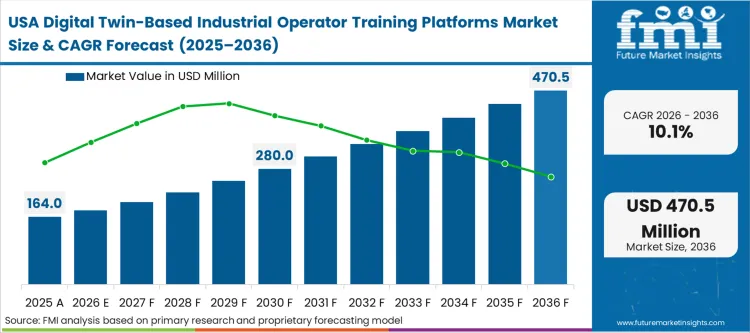
Operators across this region are now required to physically demonstrate their capability to manage process upsets within controlled, highly verifiable virtual environments, rendering legacy paper documentation obsolete. Uncompromising process safety management frameworks and rigid environmental regulations fundamentally define how simulation technology is procured here. According to FMI's estimates, operations directors investing in the North America digital twin operator training platform market utilize these high-fidelity replicas primarily to generate auditable proof of competency for regulators following historical incidents, especially as facilities integrate increasingly complex factory automation and industrial controls.
- United States: Tracking at 10.1%, the USA market focuses intensely on extending the safe operational life of legacy assets rather than outfitting greenfield sites. This requires plant managers to procure true digital twins that reflect the actual, current physical condition of the facility, complete with bypassed logic and recalibrated instruments. The aging infrastructure densely concentrated across the Gulf Coast refining sector forces operators to navigate highly specific, degraded-state scenarios that generic or idealized simulators simply cannot model accurately. This results in a workforce capable of confidently managing transient operations without inadvertently tripping protective systems that cause massive unplanned downtime.
FMI's report includes evaluation of the Canadian heavy oil and oil sands sectors. These remote production environments increasingly leverage virtual qualification models to verify the competency of rotational fly-in workforces before they are deployed to isolated physical sites.
Europe Digital Twin-Based Industrial Operator Training Platforms Market Analysis
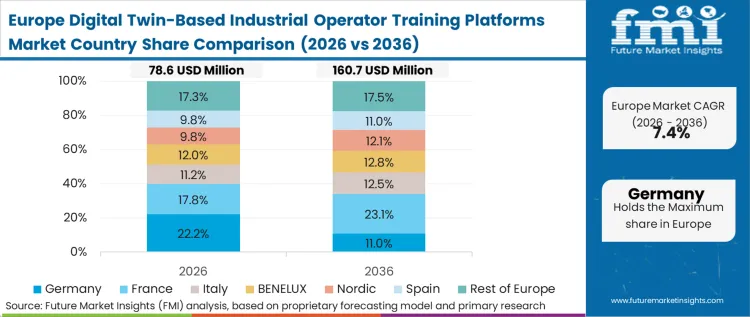
Europe's focus on decarbonization and rigorous safety directives requires operators to manage process facilities with exceptionally tight thermodynamic tolerances. Training directors systematically implement rigorous simulator assessments to ensure personnel can safely navigate the complex operational transitions associated with these modern sustainability mandates. FMI analysts opine that the region's procurement strategy strongly favors holistic simulation architectures that can be utilized to test proposed control logic changes continuously before those updates are ever pushed to the live physical plant.
- Germany: Chemical plant operators are compelled by uncompromising domestic industrial safety mandates to systematically maintain auditable, exact records detailing the emergency response capabilities of their personnel. By implementing rigorous simulator assessments, training directors guarantee that operators can safely navigate the increasingly tight operational tolerances demanded by modern European sustainability directives. Driving the Germany process plant operator training software market to advance at a 10.4% CAGR between 2026 and 2036 with the practitioner reality that these platforms transcend basic training while they are continuously used as engineering sandboxes to validate the safety implications of proposed DCS logic changes.
FMI's report includes assessment of the United Kingdom and broader European union compliance hubs. These markets show a distinct pattern of adopting cross-facility simulation platforms to standardize operator competency across highly distributed, multi-national corporate portfolios.
Competitive Aligners for Market Players
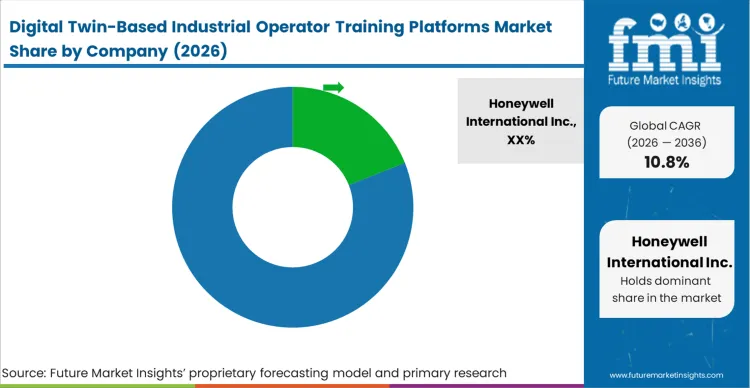
The competitive structure of this market is intensely concentrated among tier-1 industrial automation providers who already own the underlying distributed control systems. Plant managers evaluating best industrial operator training software for process plants strongly prefer to source their high-fidelity digital thread for automation from the exact same vendor that provided their DCS, as this guarantees native translation of control logic without the need for error-prone middleware. Key industrial operator training platform vendors like Honeywell International Inc., Emerson Electric Co., and Yokogawa Electric Corporation leverage this installed-base advantage to block out pure-play simulation software entrants. The primary variable buyers use to distinguish qualified from unqualified digital twin operator training platform suppliers is the vendor's ability to automatically synchronize the offline training simulator with real-time logic updates executed on the live plant.
Incumbents possess massive libraries of pre-configured thermodynamic models and standard equipment algorithms built over decades of process engineering experience. When buyers evaluate AVEVA OTS vs Siemens SIMIT, they note these simulation engines hold distinct structural advantages because they are deeply integrated into the broader lifecycle engineering tools used during the plant's initial design phase. To replicate this, a challenger must build a robust, hardware-agnostic translation layer capable of reading and compiling proprietary control logic from multiple competing DCS brands. The development of seamless software defined automation integration is what separates a tier-1 simulation provider from a niche 3D visualization vendor, directly impacting overall industrial OTS software pricing.
Large operating companies resist complete vendor lock-in by increasingly demanding simulation architectures that support open communication standards like OPC UA. When framing the debate of Honeywell unisim vs Emerson mimic train, the structural tension between buyer preferences for interoperability and dominant vendor incentives to ring-fence their ecosystems defines the market's trajectory through 2036. The market is structurally consolidating as major automation firms aggressively acquire niche extended reality and 3D modeling companies to incorporate immersive visualization directly into their core, proprietary process simulation suites.
Key Players in Digital Twin-Based Industrial Operator Training Platforms Market
- Honeywell International Inc.
- Emerson Electric Co.
- Siemens AG
- AVEVA Solutions Limited
- Yokogawa Electric Corporation
- Schneider Electric SE
- GSE Solutions
Scope of the Report
| Metric | Value |
|---|---|
| Quantitative Units | USD 350.2 million to USD 976.6 million, at a CAGR of 10.8% |
| Market Definition | High-fidelity, physics-based simulation environments that fuse real-time thermodynamic, mechanical, and control logic models with visual interfaces to create an exact operational replica of a specific industrial asset for personnel training. |
| Component Segmentation | Software platform licenses & orchestration, Integration & deployment services, Scenario/content engineering, Managed support & lifecycle services |
| Deployment Segmentation | On-premise, Private cloud, Hybrid, Public cloud / SaaS |
| End-use Industry Segmentation | Oil & gas / petrochemicals, Chemicals, Power generation, Mining & metals, Pharmaceuticals & bioprocess, Food & beverage, Water & wastewater |
| Application Segmentation | Abnormal situation & emergency response training, Start-up / shutdown training, Routine operations certification, Management-of-change rehearsal, Maintenance / outage rehearsal |
| Twin Type Segmentation | Process / plant digital twin, Asset / equipment twin, Electrical system twin, Full-facility operations twin |
| Regions Covered | North America, Europe, Asia Pacific, Middle East & Africa, Latin America |
| Countries Covered | India, China, GCC, South Korea, Germany, United States, Japan, and 40 plus countries |
| Key Companies Profiled | Honeywell International Inc., Emerson Electric Co., Siemens AG, AVEVA Solutions Limited, Yokogawa Electric Corporation, Schneider Electric SE, GSE Solutions |
| Forecast Period | 2026 to 2036 |
| Approach | Primary interviews conducted with operations technology directors and training simulation leads. The baseline anchors to the installed base of Tier-1 process control systems. Forecasts are cross-validated against industrial software license revenue disclosures. |
Source: Future Market Insights (FMI) analysis, based on proprietary forecasting model and primary research
Segments
Component:
- Software platform licenses & orchestration
- Integration & deployment services
- Scenario/content engineering
- Managed support & lifecycle services
Deployment:
- On-premise
- Private cloud
- Hybrid
- Public cloud / SaaS
End-use Industry:
- Oil & gas / petrochemicals
- Chemicals
- Power generation
- Mining & metals
- Pharmaceuticals & bioprocess
- Food & beverage
- Water & wastewater
Application:
- Abnormal situation & emergency response training
- Start-up / shutdown training
- Routine operations certification
- Management-of-change rehearsal
- Maintenance / outage rehearsal
Twin Type:
- Process / plant digital twin
- Asset / equipment twin
- Electrical system twin
- Full-facility operations twin
Regions:
- North America
- United States
- Canada
- Latin America
- Brazil
- Mexico
- Europe
- Germany
- United Kingdom
- France
- Italy
- Spain
- Asia-Pacific
- China
- Japan
- South Korea
- India
- Rest of Asia-Pacific
- Australia
- Middle East & Africa
- South Africa
- GCC Countries
Bibliography
- Eurostat. (2025, December 11). 20% of EU enterprises use AI technologies. European Commission.
- González-Herbón, R., González-Mateos, G., Rodríguez-Ossorio, J. R., Domínguez, M., Alonso, S., & Fuertes, J. J. (2024). An approach to develop digital twins in industry. Sensors, 24(3), 998.
- NITI Aayog. (2025). Reimagining Manufacturing: India’s Roadmap to Global Leadership in Advanced Manufacturing.
- Perno, M., Hvam, L., & Haug, A. (2025). Uses and challenges of digital twins-based augmented reality in operator training and data visualization in process manufacturing lines. Flexible Services and Manufacturing Journal.
- Shao, G. (2024, September 24). Manufacturing digital twin standards. National Institute of Standards and Technology.
- USA Department of Energy. (2024, November 11). DOE-NSF Workshop on Digital Twins for Manufacturing. Advanced Materials & Manufacturing Technologies Office.
- Wang, Z., Lyu, H., Zheng, X., & Yang, Q. (2025). Design and implementation of digital twin simulation training system based on scalable configuration and mechanism model. In Proceedings of the 2025 3rd International Conference on Educational Knowledge and Informatization (EKI ’25) (pp. 416-423).
This bibliography is provided for reader reference. The full FMI report contains the complete reference list with primary source documentation.
This Report Addresses
- Market intelligence to support strategic decision making across specific thermodynamic simulation and control logic replication categories.
- Market size estimation and 10-year revenue forecasts from 2026 to 2036, supported by Tier-1 control system installed base metrics.
- Growth opportunity mapping across deployment architectures with emphasis on the structural shift toward bidirectional DCS synchronization.
- Segment and regional revenue forecasts covering critical continuous process sub-segments across heavily regulated downstream procurement environments.
- Competition strategy assessment including DCS integration advantages and native translation layer capabilities.
- Platform development tracking including high-fidelity physics engines, historian data integration, and immersive spatial mapping standards.
- Market access analysis covering process safety management compliance frameworks and EPC virtual commissioning pathways.
- Market report delivery in PDF, Excel, PPT, and interactive dashboard formats for executive strategy, central engineering, and operational benchmarking use.
Frequently Asked Questions
What is a digital twin-based industrial operator training platform?
Reaching USD 350.2 million in 2026, this valuation signals the definitive transition from theoretical classroom instruction to capital-intensive, high-fidelity virtual qualification programs that fuse real-time thermodynamic, mechanical, and control logic models into an exact operational replica.
What will it be valued at by 2036?
Poised to surpass USD 976.6 million by 2036, this cumulative buildup reflects the absolute necessity of integrating digital rehearsal environments before physically commissioning multi-billion-dollar process facilities.
What CAGR is projected?
The industry tracks at a 10.8% CAGR, representing the speed at which operators are migrating toward physics-based simulation environments to avoid the escalating financial penalties of unplanned plant shutdowns.
Which Component segment leads?
Software platform licenses & orchestration holds a 61.0% share because the proprietary thermodynamic algorithms and exact control logic translation engines dictate the true fidelity of the platform, making the software vastly more critical than the associated visualization hardware.
Which Deployment segment leads?
On-premise architectures dominate with a 58.0% share as plant IT directors strictly enforce air-gapped security protocols, refusing to host exact digital replicas of critical safety instrumented systems on external public clouds.
Which End-use Industry segment leads?
Oil & gas / petrochemicals garners a 29.0% share due to operators facing continuous fluid processes with immense thermal inertia that require exact dynamic simulation to understand the delayed consequences of complex valve adjustments.
What problems do digital twin training systems solve in plants?
As the generational shift in the industrial workforce accelerates, facilities losing decades of tacit knowledge to retirement must institute mathematically exact virtual proving grounds to certify new personnel before granting them control board access.
What are the major barriers to adoption in brownfield facilities?
The lifecycle decay of the simulation model acts as the dominant friction, meaning if a facility lacks dedicated engineering resources to synchronize the digital twin with ongoing physical plant modifications, the simulator quickly becomes obsolete and actively dangerous to use for qualification.
Which country grows fastest?
India advances at 13.1%, outpacing China’s 12.3%, a trajectory defined by a massive pipeline of grassroots greenfield refineries that bypass legacy training infrastructure entirely, whereas China is increasingly focused on integrating complex models across existing mega-complexes.
How is it different from a traditional operator training simulator?
While sharing basic training goals, a digital twin training platform natively mirrors the live plant's real-time DCS configuration and historian data, moving beyond generic process approximations to deliver exact facility-specific behavioral responses unlike a traditional operator training simulator.
Which vendors are strongest in process industries?
Plant managers structurally default to purchasing the simulator provided by their primary automation vendor because sourcing a third-party digital twin packaging line or process model requires building complex middleware translation layers that often fail to accurately mimic proprietary safety logic, cementing the lead of Tier-1 control system providers.
How do companies use these platforms for start-up, shutdown, and emergency drills?
Because control room operators cannot intentionally induce thermal runaway on live assets to test their response capabilities, the simulation environment serves as the only viable mechanism for building muscle memory against catastrophic edge-case scenarios without risking facility destruction.
How do operator training simulators use digital twins?
By augmenting the core thermodynamic engine with spatial mapping layers, facilities deploy immersive tools so field operators can physically coordinate their virtual movements with the simulated control room, aligning cross-functional teams during highly specific shutdown sequences.
How much do industrial operator training platforms usually cost?
While industrial OTS software pricing scales with plant complexity, the upfront capital expenditure for a high-fidelity twin often aligns with major DCS upgrade budgets, ultimately acting as an insurance premium against single-event unplanned downtime that could cost ten times the software license fee.
Is cloud deployment realistic for OT training environments?
Despite the broader software trend toward SaaS, critical process safety management frameworks largely prohibit hosting an exact replica of a facility's safety instrumented system off-site, driving strict adherence to on-premise hardware deployments over public cloud networks.
Which industries adopt these platforms first?
Sovereign wealth operators heavily penalize deferred revenue caused by poor commissioning execution, mandating exhaustive virtual rehearsal programs to ensure local operators can seamlessly ramp new downstream oil and gas process units to nameplate capacity without delay.
What ROI metrics matter most for buyers?
The true financial metric is the avoidance of single-event anomalies; when a control room operator successfully catches a cascading compressor failure in a virtual environment, they build the muscle memory required to save millions in physical equipment damage during a real event.
Explain ROI of digital twin training platforms in process industries
Because unit-specific models break down at their physical boundary conditions, the holistic process twin ensures that mathematical energy balances remain true across the entire facility, preventing the negative training transfer associated with isolated equipment simulations and guaranteeing the capital investment yields actual safety improvements.
How do digital twins improve plant operator competency and safety?
Simulation engineers run historical plant upset data through the virtual model, certifying the platform for training use only if the simulated outputs flawlessly match the documented historian trends from an actual past event to provide auditable proof of operator readiness.
Should manufacturers buy a standalone OTS or integrated digital twin platform?
While petrochemicals lead, sectors like water treatment and digital twin modeling for recycling plant operations adopt integrated platforms once insurance underwriters demand rigorous simulated competency proofs, as standalone generic simulators fail to satisfy modern risk premium reduction requirements.
How does continuous processes differ from discrete manufacturing twins?
While discrete manufacturing focuses heavily on spatial collision and robotic pathing, continuous process twins must instantly calculate highly complex fluid dynamics, heat transfer, and chemical reaction kinetics simultaneously, requiring a fundamentally different class of physics engine.
Best deployment model for industrial operator training platform on-prem vs cloud
Although emerging platforms with bidirectional synchronization eliminate maintenance bottlenecks by automatically updating offline training logic whenever the live DCS is patched, they transform the simulator into a permanently accurate operational mirror that strictly requires robust, on-premise cybersecurity protocols to prevent unauthorized logic manipulation.
Preview the report firsthand - request a free sample
Get SampleGet the brochure for pricing and purchase details.
Get PDFTable of Content
- Executive Summary
- Global Market Outlook
- Demand-side Trends
- Supply-side Trends
- Technology Roadmap Analysis
- Analysis and Recommendations
- Market Overview
- Market Coverage / Taxonomy
- Market Definition / Scope / Limitations
- Research Methodology
- Chapter Orientation
- Analytical Lens and Working Hypotheses
- Market Structure, Signals, and Trend Drivers
- Benchmarking and Cross-market Comparability
- Market Sizing, Forecasting, and Opportunity Mapping
- Research Design and Evidence Framework
- Desk Research Programme (Secondary Evidence)
- Company Annual and Sustainability Reports
- Peer-reviewed Journals and Academic Literature
- Corporate Websites, Product Literature, and Technical Notes
- Earnings Decks and Investor Briefings
- Statutory Filings and Regulatory Disclosures
- Technical White Papers and Standards Notes
- Trade Journals, Industry Magazines, and Analyst Briefs
- Conference Proceedings, Webinars, and Seminar Materials
- Government Statistics Portals and Public Data Releases
- Press Releases and Reputable Media Coverage
- Specialist Newsletters and Curated Briefings
- Sector Databases and Reference Repositories
- FMI Internal Proprietary Databases and Historical Market Datasets
- Subscription Datasets and Paid Sources
- Social Channels, Communities, and Digital Listening Inputs
- Additional Desk Sources
- Expert Input and Fieldwork (Primary Evidence)
- Primary Modes
- Qualitative Interviews and Expert Elicitation
- Quantitative Surveys and Structured Data Capture
- Blended Approach
- Why Primary Evidence is Used
- Field Techniques
- Interviews
- Surveys
- Focus Groups
- Observational and In-context Research
- Social and Community Interactions
- Stakeholder Universe Engaged
- C-suite Leaders
- Board Members
- Presidents and Vice Presidents
- R&D and Innovation Heads
- Technical Specialists
- Domain Subject-matter Experts
- Scientists
- Physicians and Other Healthcare Professionals
- Governance, Ethics, and Data Stewardship
- Research Ethics
- Data Integrity and Handling
- Primary Modes
- Tooling, Models, and Reference Databases
- Desk Research Programme (Secondary Evidence)
- Data Engineering and Model Build
- Data Acquisition and Ingestion
- Cleaning, Normalisation, and Verification
- Synthesis, Triangulation, and Analysis
- Quality Assurance and Audit Trail
- Market Background
- Market Dynamics
- Drivers
- Restraints
- Opportunity
- Trends
- Scenario Forecast
- Demand in Optimistic Scenario
- Demand in Likely Scenario
- Demand in Conservative Scenario
- Opportunity Map Analysis
- Product Life Cycle Analysis
- Supply Chain Analysis
- Investment Feasibility Matrix
- Value Chain Analysis
- PESTLE and Porter’s Analysis
- Regulatory Landscape
- Regional Parent Market Outlook
- Production and Consumption Statistics
- Import and Export Statistics
- Market Dynamics
- Global Market Analysis 2021 to 2025 and Forecast, 2026 to 2036
- Historical Market Size Value (USD Million) Analysis, 2021 to 2025
- Current and Future Market Size Value (USD Million) Projections, 2026 to 2036
- Y-o-Y Growth Trend Analysis
- Absolute $ Opportunity Analysis
- Global Market Pricing Analysis 2021 to 2025 and Forecast 2026 to 2036
- Global Market Analysis 2021 to 2025 and Forecast 2026 to 2036, By Component
- Introduction / Key Findings
- Historical Market Size Value (USD Million) Analysis By Component , 2021 to 2025
- Current and Future Market Size Value (USD Million) Analysis and Forecast By Component , 2026 to 2036
- Software platform licenses & orchestration
- Integration & deployment services
- Scenario/content engineering
- Managed support & lifecycle services
- Software platform licenses & orchestration
- Y-o-Y Growth Trend Analysis By Component , 2021 to 2025
- Absolute $ Opportunity Analysis By Component , 2026 to 2036
- Global Market Analysis 2021 to 2025 and Forecast 2026 to 2036, By Deployment
- Introduction / Key Findings
- Historical Market Size Value (USD Million) Analysis By Deployment, 2021 to 2025
- Current and Future Market Size Value (USD Million) Analysis and Forecast By Deployment, 2026 to 2036
- On-premise
- Private cloud
- Hybrid
- Public cloud / SaaS
- On-premise
- Y-o-Y Growth Trend Analysis By Deployment, 2021 to 2025
- Absolute $ Opportunity Analysis By Deployment, 2026 to 2036
- Global Market Analysis 2021 to 2025 and Forecast 2026 to 2036, By End Use
- Introduction / Key Findings
- Historical Market Size Value (USD Million) Analysis By End Use, 2021 to 2025
- Current and Future Market Size Value (USD Million) Analysis and Forecast By End Use, 2026 to 2036
- Oil & gas / petrochemicals
- Chemicals
- Power generation
- Mining & metals
- Pharmaceuticals & bioprocess
- Food & beverage
- Water & wastewater
- Oil & gas / petrochemicals
- Y-o-Y Growth Trend Analysis By End Use, 2021 to 2025
- Absolute $ Opportunity Analysis By End Use, 2026 to 2036
- Global Market Analysis 2021 to 2025 and Forecast 2026 to 2036, By Application
- Introduction / Key Findings
- Historical Market Size Value (USD Million) Analysis By Application, 2021 to 2025
- Current and Future Market Size Value (USD Million) Analysis and Forecast By Application, 2026 to 2036
- Abnormal situation & emergency response training
- Start-up / shutdown training
- Routine operations certification
- Management-of-change rehearsal
- Maintenance / outage rehearsal
- Abnormal situation & emergency response training
- Y-o-Y Growth Trend Analysis By Application, 2021 to 2025
- Absolute $ Opportunity Analysis By Application, 2026 to 2036
- Global Market Analysis 2021 to 2025 and Forecast 2026 to 2036, By Twin Type
- Introduction / Key Findings
- Historical Market Size Value (USD Million) Analysis By Twin Type, 2021 to 2025
- Current and Future Market Size Value (USD Million) Analysis and Forecast By Twin Type, 2026 to 2036
- Process / plant digital twin
- Asset / equipment twin
- Electrical system twin
- Full-facility operations twin
- Process / plant digital twin
- Y-o-Y Growth Trend Analysis By Twin Type, 2021 to 2025
- Absolute $ Opportunity Analysis By Twin Type, 2026 to 2036
- Global Market Analysis 2021 to 2025 and Forecast 2026 to 2036, By Region
- Introduction
- Historical Market Size Value (USD Million) Analysis By Region, 2021 to 2025
- Current Market Size Value (USD Million) Analysis and Forecast By Region, 2026 to 2036
- North America
- Latin America
- Western Europe
- Eastern Europe
- East Asia
- South Asia and Pacific
- Middle East & Africa
- Market Attractiveness Analysis By Region
- North America Market Analysis 2021 to 2025 and Forecast 2026 to 2036, By Country
- Historical Market Size Value (USD Million) Trend Analysis By Market Taxonomy, 2021 to 2025
- Market Size Value (USD Million) Forecast By Market Taxonomy, 2026 to 2036
- By Country
- USA
- Canada
- Mexico
- By Component
- By Deployment
- By End Use
- By Application
- By Twin Type
- By Country
- Market Attractiveness Analysis
- By Country
- By Component
- By Deployment
- By End Use
- By Application
- By Twin Type
- Key Takeaways
- Latin America Market Analysis 2021 to 2025 and Forecast 2026 to 2036, By Country
- Historical Market Size Value (USD Million) Trend Analysis By Market Taxonomy, 2021 to 2025
- Market Size Value (USD Million) Forecast By Market Taxonomy, 2026 to 2036
- By Country
- Brazil
- Chile
- Rest of Latin America
- By Component
- By Deployment
- By End Use
- By Application
- By Twin Type
- By Country
- Market Attractiveness Analysis
- By Country
- By Component
- By Deployment
- By End Use
- By Application
- By Twin Type
- Key Takeaways
- Western Europe Market Analysis 2021 to 2025 and Forecast 2026 to 2036, By Country
- Historical Market Size Value (USD Million) Trend Analysis By Market Taxonomy, 2021 to 2025
- Market Size Value (USD Million) Forecast By Market Taxonomy, 2026 to 2036
- By Country
- Germany
- UK
- Italy
- Spain
- France
- Nordic
- BENELUX
- Rest of Western Europe
- By Component
- By Deployment
- By End Use
- By Application
- By Twin Type
- By Country
- Market Attractiveness Analysis
- By Country
- By Component
- By Deployment
- By End Use
- By Application
- By Twin Type
- Key Takeaways
- Eastern Europe Market Analysis 2021 to 2025 and Forecast 2026 to 2036, By Country
- Historical Market Size Value (USD Million) Trend Analysis By Market Taxonomy, 2021 to 2025
- Market Size Value (USD Million) Forecast By Market Taxonomy, 2026 to 2036
- By Country
- Russia
- Poland
- Hungary
- Balkan & Baltic
- Rest of Eastern Europe
- By Component
- By Deployment
- By End Use
- By Application
- By Twin Type
- By Country
- Market Attractiveness Analysis
- By Country
- By Component
- By Deployment
- By End Use
- By Application
- By Twin Type
- Key Takeaways
- East Asia Market Analysis 2021 to 2025 and Forecast 2026 to 2036, By Country
- Historical Market Size Value (USD Million) Trend Analysis By Market Taxonomy, 2021 to 2025
- Market Size Value (USD Million) Forecast By Market Taxonomy, 2026 to 2036
- By Country
- China
- Japan
- South Korea
- By Component
- By Deployment
- By End Use
- By Application
- By Twin Type
- By Country
- Market Attractiveness Analysis
- By Country
- By Component
- By Deployment
- By End Use
- By Application
- By Twin Type
- Key Takeaways
- South Asia and Pacific Market Analysis 2021 to 2025 and Forecast 2026 to 2036, By Country
- Historical Market Size Value (USD Million) Trend Analysis By Market Taxonomy, 2021 to 2025
- Market Size Value (USD Million) Forecast By Market Taxonomy, 2026 to 2036
- By Country
- India
- ASEAN
- Australia & New Zealand
- Rest of South Asia and Pacific
- By Component
- By Deployment
- By End Use
- By Application
- By Twin Type
- By Country
- Market Attractiveness Analysis
- By Country
- By Component
- By Deployment
- By End Use
- By Application
- By Twin Type
- Key Takeaways
- Middle East & Africa Market Analysis 2021 to 2025 and Forecast 2026 to 2036, By Country
- Historical Market Size Value (USD Million) Trend Analysis By Market Taxonomy, 2021 to 2025
- Market Size Value (USD Million) Forecast By Market Taxonomy, 2026 to 2036
- By Country
- Kingdom of Saudi Arabia
- Other GCC Countries
- Turkiye
- South Africa
- Other African Union
- Rest of Middle East & Africa
- By Component
- By Deployment
- By End Use
- By Application
- By Twin Type
- By Country
- Market Attractiveness Analysis
- By Country
- By Component
- By Deployment
- By End Use
- By Application
- By Twin Type
- Key Takeaways
- Key Countries Market Analysis
- USA
- Pricing Analysis
- Market Share Analysis, 2025
- By Component
- By Deployment
- By End Use
- By Application
- By Twin Type
- Canada
- Pricing Analysis
- Market Share Analysis, 2025
- By Component
- By Deployment
- By End Use
- By Application
- By Twin Type
- Mexico
- Pricing Analysis
- Market Share Analysis, 2025
- By Component
- By Deployment
- By End Use
- By Application
- By Twin Type
- Brazil
- Pricing Analysis
- Market Share Analysis, 2025
- By Component
- By Deployment
- By End Use
- By Application
- By Twin Type
- Chile
- Pricing Analysis
- Market Share Analysis, 2025
- By Component
- By Deployment
- By End Use
- By Application
- By Twin Type
- Germany
- Pricing Analysis
- Market Share Analysis, 2025
- By Component
- By Deployment
- By End Use
- By Application
- By Twin Type
- UK
- Pricing Analysis
- Market Share Analysis, 2025
- By Component
- By Deployment
- By End Use
- By Application
- By Twin Type
- Italy
- Pricing Analysis
- Market Share Analysis, 2025
- By Component
- By Deployment
- By End Use
- By Application
- By Twin Type
- Spain
- Pricing Analysis
- Market Share Analysis, 2025
- By Component
- By Deployment
- By End Use
- By Application
- By Twin Type
- France
- Pricing Analysis
- Market Share Analysis, 2025
- By Component
- By Deployment
- By End Use
- By Application
- By Twin Type
- India
- Pricing Analysis
- Market Share Analysis, 2025
- By Component
- By Deployment
- By End Use
- By Application
- By Twin Type
- ASEAN
- Pricing Analysis
- Market Share Analysis, 2025
- By Component
- By Deployment
- By End Use
- By Application
- By Twin Type
- Australia & New Zealand
- Pricing Analysis
- Market Share Analysis, 2025
- By Component
- By Deployment
- By End Use
- By Application
- By Twin Type
- China
- Pricing Analysis
- Market Share Analysis, 2025
- By Component
- By Deployment
- By End Use
- By Application
- By Twin Type
- Japan
- Pricing Analysis
- Market Share Analysis, 2025
- By Component
- By Deployment
- By End Use
- By Application
- By Twin Type
- South Korea
- Pricing Analysis
- Market Share Analysis, 2025
- By Component
- By Deployment
- By End Use
- By Application
- By Twin Type
- Russia
- Pricing Analysis
- Market Share Analysis, 2025
- By Component
- By Deployment
- By End Use
- By Application
- By Twin Type
- Poland
- Pricing Analysis
- Market Share Analysis, 2025
- By Component
- By Deployment
- By End Use
- By Application
- By Twin Type
- Hungary
- Pricing Analysis
- Market Share Analysis, 2025
- By Component
- By Deployment
- By End Use
- By Application
- By Twin Type
- Kingdom of Saudi Arabia
- Pricing Analysis
- Market Share Analysis, 2025
- By Component
- By Deployment
- By End Use
- By Application
- By Twin Type
- Turkiye
- Pricing Analysis
- Market Share Analysis, 2025
- By Component
- By Deployment
- By End Use
- By Application
- By Twin Type
- South Africa
- Pricing Analysis
- Market Share Analysis, 2025
- By Component
- By Deployment
- By End Use
- By Application
- By Twin Type
- USA
- Market Structure Analysis
- Competition Dashboard
- Competition Benchmarking
- Market Share Analysis of Top Players
- By Regional
- By Component
- By Deployment
- By End Use
- By Application
- By Twin Type
- Competition Analysis
- Competition Deep Dive
- Honeywell International Inc.
- Overview
- Product Portfolio
- Profitability by Market Segments (Product/Age /Sales Channel/Region)
- Sales Footprint
- Strategy Overview
- Marketing Strategy
- Product Strategy
- Channel Strategy
- Emerson Electric Co.
- Siemens AG
- AVEVA Solutions Limited
- Yokogawa Electric Corporation
- Schneider Electric SE
- GSE Solutions
- Honeywell International Inc.
- Competition Deep Dive
- Assumptions & Acronyms Used


