

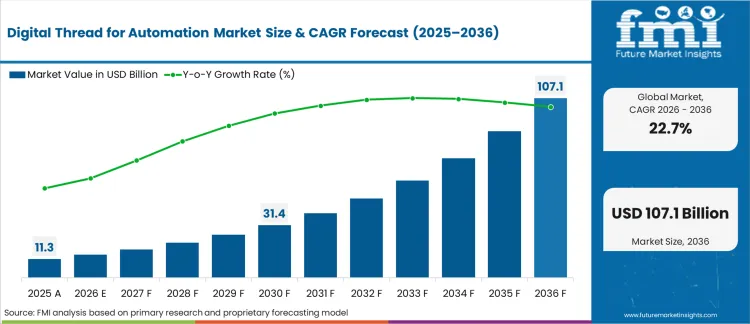
- Industry Size (2026)
- USD 13.85 Bn
- Forecast (2036)
- USD 131.3 Bn
- CAGR (2026 to 2036)
- 22.70%
Digital Thread for Automation Market Size, Market Forecast and Outlook By FMI
By 2025, the digital thread for automation market had already exceeded USD 11.29 billion in value. It is on track to reach USD 13.85 billion in 2026 and surge to USD 131.3 billion by 2036, reflecting a CAGR of 22.70%. Rapid expansion is being fueled by a broad push toward seamless data continuity across the enterprise. Major discrete manufacturers and automotive OEMs are overhauling their technology stacks to remove isolated PLM systems and replace them with unified, end‑to‑end data architectures.
Operations managers facing compressed product iteration cycles require unified information architectures to accelerate time-to-market. Capital allocation decisions reflect a structural shift toward agentic capabilities embedded within product lifecycle management frameworks. System integrators interpret this capability of integration as proof that static data repositories are becoming obsolete. .
Summary of Digital Thread for Automation Market
- Digital Thread for Automation Market Definition:
- A unified digital architecture that seamlessly connects disparate data streams across the product lifecycle, from design and production to field service, enabling real-time traceability and closed-loop automation for industrial operations.
- Demand Drivers in the Market:
- Mandatory closed-loop traceability guidelines force automotive and aerospace suppliers to adopt unified lifecycle data architectures.
- Accelerating hardware-software convergence in product design pushes engineering teams toward integrated simulation and physical validation pipelines.
- Distributed supply chain disruptions compel procurement leaders to demand real-time production visibility across geographically dispersed manufacturing nodes.
- Key Segments Analyzed in the FMI Report:
- PLM Integration Modules: 38% of segment volumes as manufacturers replace fragmented engineering software with cohesive lifecycle backbones.
- Smart Manufacturing: 42% share driven by plant managers deploying real-time data loops to optimize machine utilization and reduce unplanned downtime.
- Asia-Pacific: High adoption growth anchored by regional automotive scale and aggressive factory automation upgrades across the electric vehicle supply chain.
- Analyst Opinion at FMI:
- Nikhil Kaitwade, Principal Consultant for Process Automation at Future Market Insights, opines, “Facilities without certified digital evidence trails are already facing exclusion from Tier-1 aerospace and automotive approved vendor lists. Suppliers investing in integrated simulation environments to guarantee bidirectional data flow will capture premium contracts from buyers facing strict supply chain visibility mandates.”
- Strategic Implications / Executive Takeaways:
- Mandate API-first interoperability standards across all engineering and production software procurement to prevent data silos.
- Prioritize cloud-native deployment architectures to enable secure collaboration across distributed tier-supplier networks.
- Embed automated compliance documentation within the digital thread to reduce audit cycle times for regulated manufacturing sectors.
- Methodology:
- Direct interviews with industrial software architects, automotive supply chain directors, and automation integration engineers provided baseline adoption of metrics.
- Custom import datasets and corporate capacity announcements substantiated regional software deployment models.
- Analysts developed a bottom-up adoption model starting from regional industrial IoT installations, applying historical integration yield ratios to project software license tonnage.
Frances Evans, SVP, Lifecycle Collaboration Software, Siemens, opined, “The Siemens Xcelerator portfolio, with Teamcenter as its digital thread backbone, drives transformation for innovators across all industries. From flexible deployment and operations to advanced PLM technologies like industrial-grade AI, Teamcenter is recognized as the most widely used PLM software for discrete manufacturers for a reason, to help manufacturers of all sizes deliver innovation at the pace industry demands.” [2] Procurement teams are shifting focus from standalone software licenses to total system interoperability. Industrial conglomerates that secure integration agreements with unified platform providers avoid the severe data-reconciliation overhead currently penalizing operators reliant on fragmented legacy systems.
Strong regional adoption variations reflect distinct industrial priorities. China leads with a projected 26.0% CAGR through 2036, driven by massive scale advantages and digital thread investments tracking directly alongside electric vehicle supply chain industrialization. The United States follows with a 24.0% CAGR, characterized by aerospace and discrete manufacturing sectors where compliance traceability is a non-negotiable procurement baseline. India is expected to expand at a 23.0% CAGR, accelerating via global OEM supply-chain integration mandates and cloud PLM rollouts aimed at reducing time-to-market. Germany registers a 20.0% CAGR as its robust Industry 4.0 ecosystem extends data architectures from engineering into service lifecycles to protect margins. South Korea and Japan command 18.0% CAGRs respectively; the former pushes integrated threads for faster software-defined vehicle iterations, while the latter focuses on robotics reliability and simulation quality loops. The United Kingdom expands at a 17.0% CAGR, forming adoption clusters in regulated engineering sectors demanding secure digital evidence trails.
Digital Thread for Automation Market Definition
The digital thread for automation market encompasses integrated software architectures, cloud environments, and semantic data models that establish continuous, bidirectional information flow across a product’s lifecycle. Deployments utilize standardized APIs and industrial communication protocols to link computer-aided design, product lifecycle management, manufacturing execution systems, and field service operations. Industrial automation leaders leverage these unified data structures to enable digital twins, streamline compliance reporting, and optimize closed-loop manufacturing performance.
Digital Thread for Automation Market Inclusions
The category includes software modules for PLM integration, digital twin simulation tools, and industrial data extraction, transformation, and loading (ETL) systems. It covers both cloud-hosted and on-premise architectures intended for discrete and process manufacturing environments. Edge connectivity solutions specifically developed to feed real-time telematics into centralized lifecycle databases are also within scope.
Digital Thread for Automation Market Exclusions
The scope excludes standalone enterprise resource planning (ERP) systems used solely for financial or human resources management without production data linkage. It does not include raw industrial sensors or hardware equipment devoid of embedded software connectivity. Generic cloud storage subscriptions and basic consumer-grade data visualization tools are excluded where industrial-grade interoperability protocols are absent.
Digital Thread for Automation Market Research Methodology
- Primary Research: Direct consultations with chief digital officers, software integration specialists, and supply chain managers provide fundamental pricing and deployment scale data.
- Desk Research: Corporate earnings transcripts, software update release notes, and verified patent filings for substantiated structural integration models.
- Market-Sizing and Forecasting: Analysts constructed a bottom-up framework starting with regional automated facility counts, applying typical software to attach rates to estimate aggregate market valuation.
- Data Validation and Update Cycle: Findings underwent cross-verification against official industrial automation whitepapers and interoperability standard registries before finalizing the forecast structure.
Segmental Analysis
Digital Thread for Automation Market Analysis by Module
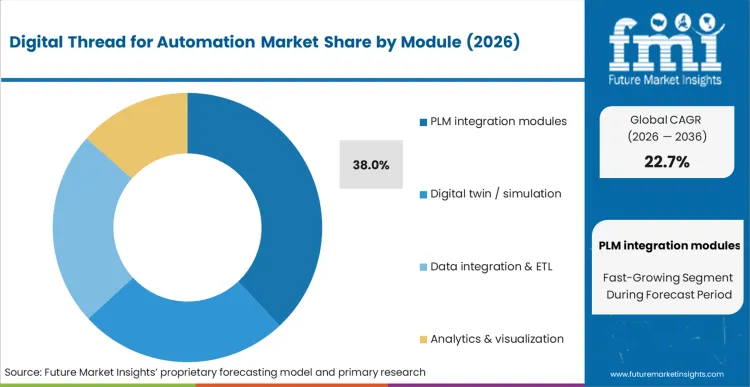
Digital thread architectures are undergoing recalibration as industrial buyers shift preference from isolated engineering applications to unified functional backbones. The structural push toward connected ecosystems places PLM integration modules at 38% of the segment share in 2026. The USA Census Bureau reported that overall USA business AI use approached 10% in May 2025 [3], proving that foundational data readiness is accelerating across traditional sectors. Factory managers are abandoning manual data reconciliation processes to specify model based manufacturing technologies that natively sync design iterations with shop-floor execution. Solution architects evaluate such integration modules based on API flexibility and semantic data matching capabilities. Buyers who fail to establish this core connectivity layer face cascading deployment delays when attempting advanced analytics implementations.
- Technical Validation: High-performance data parsers yield consistent semantic models that integrate seamlessly into complex mechanical assemblies.
- Procurement Shifts: Cross-functional engineering teams demand single-source-of-truth repositories to reduce defect rates.
- Process Compatibility: Manufacturing setups designed around legacy historian databases readily accept modern ETL wrappers to bridge old and new infrastructure.
Digital Thread for Automation Market Analysis by Deployment
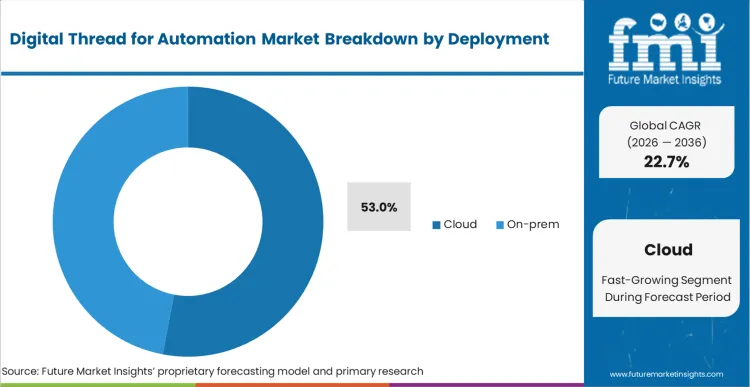
Cloud deployments capture 53% of 2026 volumes, reflecting the logistical necessities of global collaboration and distributed supplier networks. IBM announced new hybrid and agent capabilities in May 2025 to operationalize enterprise AI [11], demonstrating that secure, scalable infrastructure is the primary enabler for cross-border engineering teams. FMI analysts opine that elastic compute capacity and immediate update propagation remain critical quality parameters for industrial buyers seeking replacements for outdated on-premise servers. IT directors specify product life cycle management (PLM) IT systems built on cloud-native microservices to avoid expensive annual maintenance cycles. Organizations maintaining rigid physical server rules face severe agility penalties when coordinating rapid product iterations.
- Logistics Advantage: Hosted architectures eliminate local hardware degradation risks during long operational cycles.
- Adoption Acceleration: Multi-tiered supply chains require instantaneous design document synchronization across distinct legal entities.
- Cost Structures: Tighten when capital expenditure on dedicated server racks is converted into predictable operational subscription models.
Digital Thread for Automation Market Analysis by Application
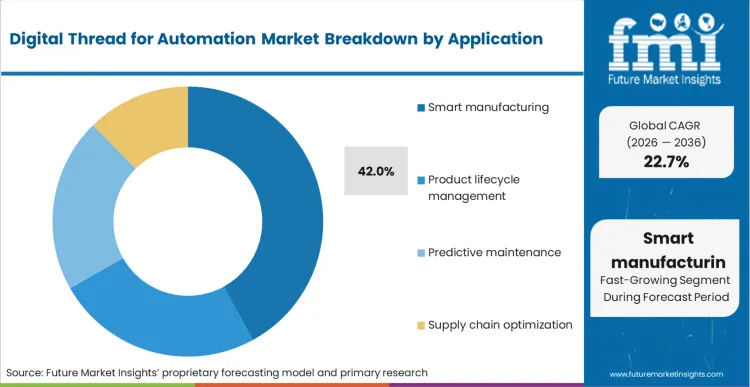
Smart manufacturing leads to application demand, representing 42% of total segment volume as operators digitize production floors to mitigate labor shortages. Continuous data feedback loops enable autonomous correction mechanisms that directly impact facility output. In FY 2024, the NIST MEP National Network reported impacts of USD 15 billion in new and retained sales and over 108,000 jobs created or retained [6], quantifying the massive economic leverage generated by optimized industrial processes. Plant engineers prioritize digital twin technology implementations to create virtual representations of physical assets for immediate bottleneck identification. Facilities lacking real-time telemetry from production nodes cannot participate in advanced predictive maintenance programs.
- Volume Concentration: Narrows to high-throughput discrete manufacturing facilities where minute process deviations cause significant financial loss.
- Supplier Positioning: Improves software vendors offer pre-configured industry templates that drastically reduce deployment timelines.
- Requalification Cycles: Lengthens custom-coded integration scripts are replaced by standardized application interfaces.
Digital Thread for Automation Market Analysis by End-use
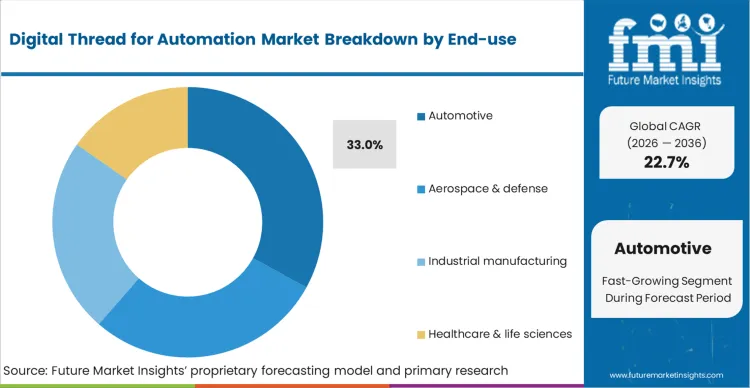
The automotive sector commands 33% of the end-use segment as the transition to software-defined vehicles dictates massive concurrent engineering efforts. FMI analysts opine that traceability mandates force a transition away from fragmented component tracking to holistic vehicle lifecycle documentation. The IEA stated that 2025 electric car sales are expected to surpass 20 million, accounting for over a quarter of cars sold worldwide [7], providing the volume depth necessary to justify enterprise-wide digital overhauls. Original equipment manufacturers source digital twin in logistics capabilities to align rapidly changing battery chemistries with parallel assembly line reconfigurations. Supply chain managers who do not hold integrated visibility platforms face spot-market premium exposure during component shortages.
- Product Innovation: Joint ventures linking automotive software integrators with traditional mechanical tiers to accelerate vehicle commercialization timelines.
- Dietary Compliance: Strict regional safety reporting mandates force a transition toward automated regulatory documentation generation.
- Shelf Stability: Extended digital archiving requirements allow procurement teams to execute reliable long-term service contracts based on immutable product histories.
Digital Thread for Automation Market Drivers, Restraints, and Opportunities
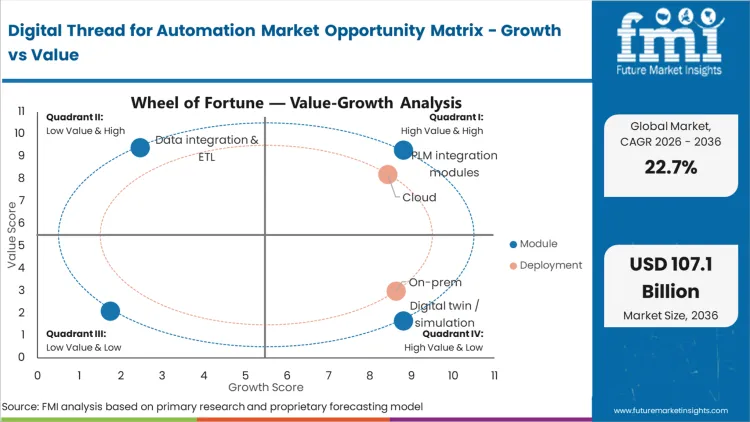
Tier-1 manufacturing brands respecifying supplier contracts under advanced quality planning standards are removing partners without continuous data linkage capabilities ahead of the next commodity-category expansion. The IFR reported 542,076 industrial robots were installed worldwide in 2024, and operational stock reached 4,663,773 [4], proving the massive hardware base that requires corresponding software architecture to function autonomously. Production lines adapt to these dense automation networks without facing sudden communication bottlenecks only when governed by a unified digital thread. Component suppliers entering tender cycles without pre-certified digital continuity infrastructure face a disqualification window they cannot close after shortlisting begins.
Protocol fragmentation and legacy system incompatibility restrict rapid capacity scaling for seamless enterprise integration. ISO in figures 2025 reported 1,493 ISO standards published in 2025 totaling 77,652 pages [9], illustrating the complex compliance landscape that software architects must navigate to ensure cross-platform compatibility. The margin pressure intensifies when emerging manufacturers attempt to connect older programmable logic controllers to modern cloud environments using custom middleware. System integrators refine semantic translation methods to lower unit costs and differentiate their service lifecycle management application capabilities to justify slight implementation of premiums.
- Cloud Simulation Expansion: Simulation environments moved to the cloud to reduce localized compute bottlenecks for engineering teams.
- Agentic AI Integration: Copilot capabilities embedded in automation platforms democratize complex data access for floor operators. Schneider Electric announced innovations at Automate 2025, describing platform integration supporting copilots via real-time data access [10].
- Software-Defined Vehicle Ecosystems: Automotive OEMs partnering with specialized integrators collapse development timelines for next-generation mobility platforms. Tata Technologies announced a collaboration with Synopsys to accelerate software-defined vehicle innovation [12].
Regional Analysis
Based on the regional analysis, the Digital Thread for Automation market is segmented into North America, Latin America, Europe, East Asia, South Asia, Oceania and Middle East & Africa across 40+ countries. The full report also offers market attractiveness analysis based on regional trends.
.webp "Top Country Growth Comparison Digital Thread For Automation Market Cagr (2026 2036)")
| Country | CAGR (2026 to 2036) |
|---|---|
| China | 26.0% |
| United States | 24.0% |
| India | 23.0% |
| Germany | 20.0% |
| Japan | 18.0% |
| South Korea | 18.0% |
| United Kingdom | 17.0% |
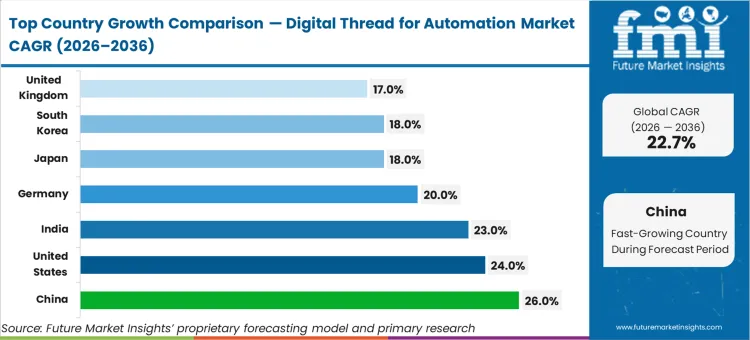
Source: Future Market Insights (FMI) analysis, based on proprietary forecasting model and primary research
Asia Pacific Digital Thread for Automation Market Analysis
Asia Pacific’s commercialization pace is increasingly defined by how quickly regional manufacturers convert expanding automation hardware investments into unified, data-driven ecosystems. Factory modernization programs force operations directors to integrate disparate sensor networks to remain competitive in high-volume export markets. BLS reported manufacturing labor productivity rose 3.7% in Q3 2025, with output up 3.0% and hours worked down 0.7% [13], a performance baseline that Asian manufacturing hubs must replicate through superior digital operations. Regional integrators evaluate platform switching strictly on a time-to-value basis, favoring architectures that seamlessly connect factory floors to enterprise planning systems. The structural push toward software-defined manufacturing environments exposes operators lacking robust IT/OT convergence to severe productivity disadvantages.
- Japan: High-quality manufacturing and robotics density force engineers to focus on reliability, quality loops, and simulation integrity. Sales of digital thread solutions in Japan are on track to record a CAGR of 18.0% from 2026 to 2036. Siemens announced Nidec adopted Teamcenter X to drive innovation in electric motor development [18]. Procurement directors must prioritize interoperable lifecycle architectures to maintain global competitiveness in precision motor exports.
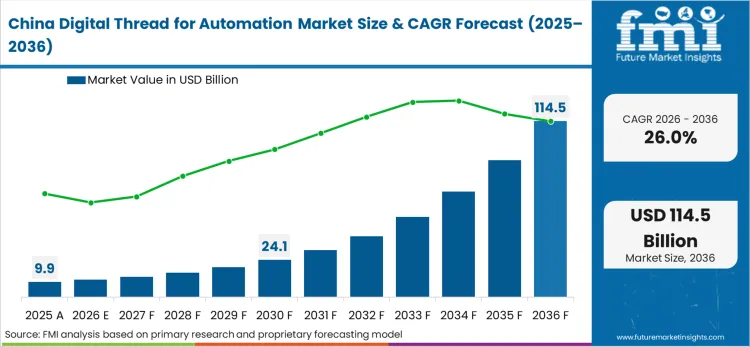
- China: Scale advantages dictate that digital thread investments follow volume manufacturing and electric vehicle industrialization pathways. China is expected to see its digital thread sector grow at a compound annual rate of 26.0% over the forecast period. Suppliers competing for automotive contracts must validate data continuity across the entire tier network before production scales.
- India: Global OEM digitization programs and rapid cloud PLM rollouts accelerate domestic supply chain integration to reduce time-to-market, pushing the market for digital threads in India to forecast a CAGR of 23.0% through 2036. Tata Elxsi announced collaboration with Mercedes-Benz R&D India for vehicle engineering and SDV development [19]. Engineering service providers without secure, bidirectional data sharing capabilities face exclusion from lucrative multinational development projects.
- South Korea: Electronics and automotive hubs push integrated digital threads for faster product iterations and over-the-air ready platforms. A CAGR of 18.0% is expected for the digital thread market in South Korea over the forecast period. Samsung Newsroom announced HARMAN will acquire ZF’s ADAS business [20]. Buyers integrating advanced driver-assistance systems must mandate unified software tracking to manage complex validation requirements.
FMI's report includes comprehensive tracking of the Asia Pacific integration landscape, connecting automation hardware deployment to finished software capacity. Across Taiwan, Vietnam, and Malaysia, growth concentrates where localization aligns with lead-time reduction, prompting electronics manufacturers to secure reliable agile application life cycle management deployments.
North America Digital Thread for Automation Market Analysis
North America’s integration landscape is undergoing recalibration as domestic manufacturing recovery aligns with advanced defense and aerospace capability investments. Reshoring initiatives compel operations leaders to specify intelligent data backbones that maximize output from highly compensated labor pools. NSF announced a USD 25.5 million investment supporting 7 research grants and 9 seed projects across 36 institutions and companies [21], confirming strong institutional backing for next-generation production methodologies. FMI analysts opine that functionality-led substitution away from isolated applications continues to influence enterprise architecture, as brands seek continuous operational visibility without compromising security protocols. The transition from reactive maintenance to predictive asset management dictates mandatory digital twin capability across heavy industrial sectors.
- United States: Faster uptake in aerospace and discrete manufacturing occurs as AI-assisted PLM and strict compliance traceability become non-negotiable table stakes. Demand for digital threads in the United States is estimated to expand at a CAGR of 24.0% through 2036. DOE awarded 12 HPC4Manufacturing projects totaling USD 4.8 million to strengthen USA manufacturing competitiveness [22]. Defense contractors lacking certified digital evidence trails face immediate disqualification from federal procurement cycles before technical evaluations begin.
FMI's report includes full coverage of the North American data integration ecosystem, mapping public funding directly to regional deployment patterns. Across Canada and Mexico, growth concentrates where cross-border manufacturing requires synchronized digital handover capabilities, compelling automotive suppliers to upgrade industrial IOT infrastructure.
Europe Digital Thread for Automation Market Analysis
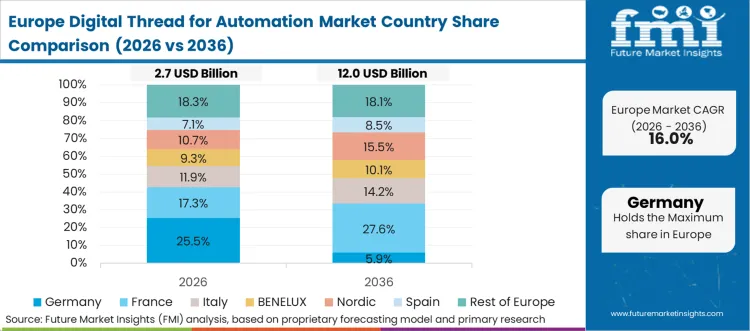
Europe functions as a technical proving ground for advanced lifecycle architectures under strict sustainability, traceability, and operational sovereignty rules. Regulatory scrutiny compels manufacturers to source secure, auditable data structures while minimizing exposure to fragmented supply chain black spots. Dassault Systèmes announced Grundfos chose the 3DEXPERIENCE platform to gain end-to-end visibility and a digital thread [5], demonstrating that major industrial equipment producers are actively formalizing continuous digital tracking. The facilities positioned near major European industrial clusters maintain a structural advantage when deploying these interconnected ecosystems. The mandate for comprehensive digital product passports renders legacy, disconnected databases structurally unable to compete for regional enterprise contracts.
- Germany: Strong Industry 4.0 foundations drive the digital thread from engineering directly into service lifecycles to protect aftermarket margins. Germany’s digital thread industry is expected to demonstrate a CAGR of 20.0% through 2036. Autodesk described new integration such as the Vault-Fusion Manage Connector enabling a continuous data thread [16]. System architects must transition to unified connector models to avoid the compounding technical debt of custom point-to-point integrations.
- United Kingdom: Adoption clusters rapidly form in aerospace and automotive engineering services where digital evidence trails guarantee regulatory compliance.The digital thread space in the United Kingdom is forecast to observe a CAGR of 17.0% during the assessment period. ISO work in 2025 summary reported 8,595 meetings in 2025 and that 91% were virtual/hybrid [23]. Governance directors must deploy verifiable tracking software to align with international standards bodies requiring auditable development histories.
FMI's report includes detailed mapping of the European software integration terrain, linking regional compliance mandates to direct software adoption rates. Across France, Italy, and the Nordics, growth concentrates where sustainability reporting intersects with manufacturing, prompting enterprises to deploy IOT in manufacturing frameworks to quantify real-time carbon footprints.
Competitive Aligners for Market Players
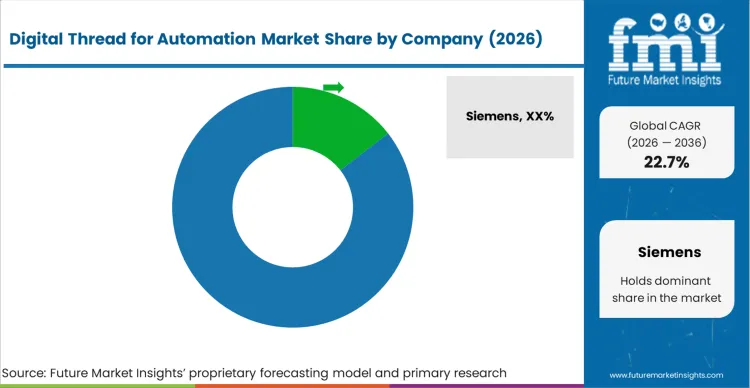
Technological capability differentiates premium platform suppliers from standard database vendors. General Motors announced a unified software platform and computing upgrade, including major increases in OTA capacity [15], establishing robust data pipelines as the de facto entry requirement rather than a differentiating feature. Integrators holding intellectual property for specific semantic translation techniques command higher margins by delivering rapid interoperability across disparate OEM networks. Software providers entering 2027 enterprise tender cycles without native over-the-air validation mechanisms face a disqualification gap they cannot close.
Strategic alliances and cross-vendor consortiums accelerate commercialization timelines for emerging connectivity protocols. Microsoft published that Autodesk and Microsoft collaborate to create an AI-powered digital thread [17], shifting negotiating leverage away from siloed applications toward comprehensive ecosystem providers. Co-investment programs offset the massive integration complexity associated with bridging cloud analytics to edge automation hardware. Procurement directors evaluate these consolidated ecosystems to minimize the security vulnerabilities inherent in fragmented, multi-vendor IT environments.
Market structure relies heavily on access to secure, low-latency industrial communication networks. Facilities positioned with upgraded 5G or robust localized networks maintain a structural advantage over competitors reliant on legacy ethernet architectures. Reduced integration expenses and guaranteed data continuity allow advanced operations to weather temporary network disruptions. Plant managers secure multi-year edge ai for smart manufacturing infrastructure contracts to stabilize localized processing speeds before pushing heavy simulation workloads to central clouds.
Recent Developments:
The report includes full coverage of key trends from competitive benchmarking. Some of the recent developments covered in the reports:
- In March 2025, PTC announced it will preview Windchill AI and demonstrate agentic AI across the product digital thread. [1]
- In December 2025, Siemens announced updates to Simcenter X (cloud simulation/optimization environment). [14]
- In March 2025, Volkswagen stated the ID. EVERY1 production version will be the first model in the Group to use a new software architecture. [8]
Key Players in Digital Thread for Automation Market
- Siemens
- PTC
- Dassault Systèmes
- SAP
- IBM
- Autodesk
- Oracle
Scope of the Report
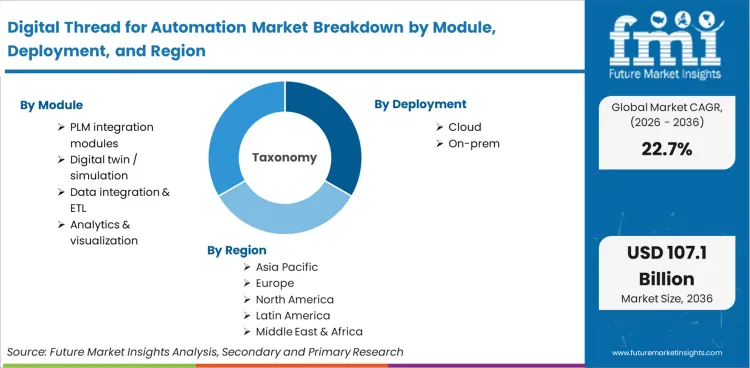
| Metric | Value |
|---|---|
| Quantitative Units | USD 13.85 billion (2026) to USD 131.3 billion (2036), at a CAGR of 22.70% |
| Market Definition | A unified digital architecture that seamlessly connects disparate data streams across the product lifecycle, from design and production to field service, enabling real-time traceability and closed-loop automation for industrial operations. |
| module Segmentation | PLM integration modules, Digital twin / simulation, Data integration & ETL, Analytics & visualization |
| deployment Segmentation | Cloud, On-prem |
| application Segmentation | Smart manufacturing, Product lifecycle management, Predictive maintenance, Supply chain optimization |
| end use Segmentation | Automotive, Aerospace & defense, Industrial manufacturing, Healthcare & life sciences |
| Regions Covered | North America, Latin America, Europe, East Asia, South Asia, Oceania, Middle East and Africa |
| Countries Covered | United States, Canada, Mexico, Brazil, Argentina, Germany, France, United Kingdom, Italy, Spain, China, India, Japan, South Korea, Indonesia, Australia and 40 plus countries |
| Key Companies Profiled | Siemens, PTC, Dassault Systèmes, SAP, IBM, Autodesk, Oracle |
| Forecast Period | 2026 to 2036 |
| Approach | Hybrid top-down and bottom-up market modeling validated through primary interviews with software architects and automation engineers, supported by corporate deployment benchmarking. |
Source: Future Market Insights (FMI) analysis, based on proprietary forecasting model and primary research
Segmental Analysis
Module:
- PLM integration modules
- Digital twin / simulation
- Data integration & ETL
- Analytics & visualization
Deployment:
- Cloud
- On-prem
Application:
- Smart manufacturing
- Product lifecycle management
- Predictive maintenance
- Supply chain optimization
End-use:
- Automotive
- Aerospace & defense
- Industrial manufacturing
- Healthcare & life sciences
Region:
- Asia Pacific
- India
- China
- Japan
- South Korea
- Indonesia
- Australia & New Zealand
- ASEAN
- Rest of Asia Pacific
- Europe
- Germany
- Italy
- France
- United Kingdom
- Spain
- Benelux
- Nordics
- Central & Eastern Europe
- Rest of Europe
- North America
- United States
- Canada
- Mexico
- Latin America
- Brazil
- Argentina
- Chile
- Rest of Latin America
- Middle East & Africa
- Kingdom of Saudi Arabia
- United Arab Emirates
- South Africa
- Turkey
- Rest of Middle East & Africa
Bibliography
- [1] PTC. (2025, March 25). PTC brings AI-powered PLM to Hannover Messe (Press release).
- [2] Siemens. (2025, January). Siemens Teamcenter ABI research 2025 (Company news release).
- [3] USA Census Bureau. (2025, July 24). AI use in some sectors surging (Government report).
- [4] International Federation of Robotics (IFR). (2025, September 24). World robotics 2025 press release (Press release).
- [5] Dassault Systèmes. (2025, September 18). Grundfos chooses Dassault Systemes 3DEXPERIENCE platform (Press release).
- [6] National Institute of Standards and Technology (NIST). (2025, March 20). MEP economic impacts boost business and jobs (Government report).
- [7] International Energy Agency (IEA). (2025). Electric vehicles (Government report).
- [8] Volkswagen. (2025, March 05). Mobility for everyone with the ID. EVERY1 (Company news release).
- [9] International Organization for Standardization (ISO). (2026, February). ISO in figures 2025 (Government report).
- [10] Schneider Electric. (2025, May 12). Schneider Electric unveils innovations advancing American manufacturing at Automate 2025 (Press release).
- [11] IBM. (2025, May 06). IBM accelerates enterprise Gen AI revolution with hybrid capabilities (Company news release).
- [12] Tata Technologies. (2025, October 17). Tata Technologies collaborates with Synopsys to accelerate software-defined vehicle innovation (Company news release).
- [13] USA Bureau of Labor Statistics (BLS). (2026, January 29). Productivity and costs (Government report).
- [14] Siemens. (2025, December 01). Siemens Simcenter X advanced 2025 (Company news release).
- [15] General Motors. (2025, October 22). GM eyes off driving conversational AI unified software platform (Company news release).
- [16] Autodesk. (2025, September 16). How Autodesk is unlocking capacity and delivering the future (Company news release).
- [17] Microsoft. (2025, March 25). Industrial AI in action (Company news release).
- [18] Siemens. (2025, July 31). Siemens Nidec collaboration (Company news release).
- [19] Tata Elxsi. (2025, May 14). Tata Elxsi collaborates with Mercedes-Benz R&D India (Company news release).
- [20] Samsung Newsroom. (2025, December 23). HARMAN to acquire ZF’s ADAS business (Press release).
- [21] National Science Foundation (NSF). (2025, June 24). NSF invests 25.5M in research to drive new US manufacturing (Government report).
- [22] USA Department of Energy (DOE). (2026, February 19). DOE awards 4.8 million for HPC4Manufacturing projects (Government report).
- [23] International Organization for Standardization (ISO). (2025). ISO in figures summary (Government report).
This bibliography is provided for reader reference and is not exhaustive. The full report contains the complete reference list and detailed citations.
This Report Addresses
- Market size estimation and revenue forecasts from 2026 to 2036, supported by validated corporate deployment benchmarks across major industrial automation hubs.
- Growth opportunity mapping across cloud and on-premise architectures with emphasis on enterprise-wide data interoperability transitions.
- Segment and regional revenue forecasts covering critical applications like smart manufacturing, supply chain optimization, and predictive maintenance.
- Competition strategy assessment including alliance models, platform survivability positioning, and semantic translation capability benchmarking.
- Product architecture tracking covering key metrics such as API flexibility, simulation latency, and cloud deployment scalability.
- Regulatory impact analysis evaluating strict digital product passport mandates, aerospace safety reporting rules, and data sovereignty guidelines.
- Market report delivery in PDF, Excel, PPT, and interactive dashboard formats for executive and operational use.
Frequently Asked Questions
How large is the demand for Digital Thread for Automation in the global market in 2026?
Demand for Digital Thread for Automation in the global market is estimated to be valued at USD 13.85 billion in 2026.
What will be the market size of Digital Thread for Automation in the global market by 2036?
Market size for Digital Thread for Automation is projected to reach USD 131.3 billion by 2036.
What is the expected demand growth for Digital Thread for Automation in the global market between 2026 and 2036?
Demand for Digital Thread for Automation is expected to grow at a CAGR of 22.70% between 2026 and 2036.
Which module is poised to lead global sales by 2026?
PLM integration modules commands 38% in 2026 as manufacturers replace fragmented engineering software with cohesive lifecycle backbones.
How significant is the role of Smart manufacturing in driving Digital Thread for Automation adoption in 2026?
Smart manufacturing represents 42% of segment share as operators digitize production floors to mitigate labor shortages.
What is driving demand in China?
Scale advantages and digital thread investments tracking directly alongside massive electric vehicle supply chain industrialization.
What compliance standards or regulations are referenced for United Kingdom?
Regulatory compliance mandates requiring secure digital evidence trails to align with international standards bodies.
What is the China growth outlook in this report?
China is projected to grow at a CAGR of 26.0% during 2026 to 2036.
Why is North America described as a priority region in this report?
Reshoring initiatives and advanced defense manufacturing capability investments compel operations leaders to specify intelligent data backbones.
What type of demand dominates in North America?
Functionality-led substitution away from isolated applications to continuous operational visibility platforms.
What is United States's growth outlook in this report?
United States is projected to expand at a CAGR of 24.0% during 2026 to 2036.
Does the report cover India in its regional analysis?
Yes, India is included within Asia Pacific under the regional scope of analysis.
What are the sources referred to for analyzing India?
Corporate integration announcements and verified automation deployment data from global OEM digitization programs form the analytical basis.
What is the main demand theme linked to India in its region coverage?
Global OEM supply-chain integration mandates and rapid cloud PLM rollouts aimed at reducing time-to-market.
Does the report cover Germany in its regional analysis?
Yes, Germany is included within Europe under the regional coverage framework.
What is the main Germany related demand theme in its region coverage?
Industry 4.0 foundations driving the digital thread from engineering directly into service lifecycles to protect aftermarket margins.
Which product formats or configurations are strategically important for Asia Pacific supply chains?
Cloud-deployed PLM integration modules and digital twin tools tailored for high-volume automotive environments.
What is Digital Thread for Automation and what is it mainly used for?
It is a unified digital architecture connecting disparate data streams across the product lifecycle, utilized primarily to enable real-time traceability and closed-loop industrial automation.
What does Digital Thread for Automation mean in this report?
The market refers to the global production, deployment, and industrial integration of software modules establishing bidirectional information flows across manufacturing ecosystems.
What is included in the scope of this Digital Thread for Automation report?
Software modules for PLM integration, digital twin simulation tools, and industrial data ETL systems intended for discrete and process environments.
What is excluded from the scope of this report?
Standalone ERP systems, raw industrial sensors lacking connectivity software, and generic consumer-grade data visualization tools.
What does market forecast mean on this page?
The market forecast represents a model-based projection built on defined technology and adoption assumptions for strategic planning purposes.
How does FMI build and validate the Digital Thread for Automation forecast?
Forecasts combine bottom-up automated facility counts with historical software integration ratios, validated by primary consultations with chief digital officers.
What does zero reliance on speculative third-party market research mean here?
Primary interviews, verified patent filings, and official corporate integration datasets are used exclusively instead of unverified syndicated estimates.
Preview the report firsthand - request a free sample
Get SampleGet the brochure for pricing and purchase details.
Get PDFTable of Content
- Executive Summary
- Global Market Outlook
- Demand-side Trends
- Supply-side Trends
- Technology Roadmap Analysis
- Analysis and Recommendations
- Market Overview
- Market Coverage / Taxonomy
- Market Definition / Scope / Limitations
- Research Methodology
- Chapter Orientation
- Analytical Lens and Working Hypotheses
- Market Structure, Signals, and Trend Drivers
- Benchmarking and Cross-market Comparability
- Market Sizing, Forecasting, and Opportunity Mapping
- Research Design and Evidence Framework
- Desk Research Programme (Secondary Evidence)
- Company Annual and Sustainability Reports
- Peer-reviewed Journals and Academic Literature
- Corporate Websites, Product Literature, and Technical Notes
- Earnings Decks and Investor Briefings
- Statutory Filings and Regulatory Disclosures
- Technical White Papers and Standards Notes
- Trade Journals, Industry Magazines, and Analyst Briefs
- Conference Proceedings, Webinars, and Seminar Materials
- Government Statistics Portals and Public Data Releases
- Press Releases and Reputable Media Coverage
- Specialist Newsletters and Curated Briefings
- Sector Databases and Reference Repositories
- FMI Internal Proprietary Databases and Historical Market Datasets
- Subscription Datasets and Paid Sources
- Social Channels, Communities, and Digital Listening Inputs
- Additional Desk Sources
- Expert Input and Fieldwork (Primary Evidence)
- Primary Modes
- Qualitative Interviews and Expert Elicitation
- Quantitative Surveys and Structured Data Capture
- Blended Approach
- Why Primary Evidence is Used
- Field Techniques
- Interviews
- Surveys
- Focus Groups
- Observational and In-context Research
- Social and Community Interactions
- Stakeholder Universe Engaged
- C-suite Leaders
- Board Members
- Presidents and Vice Presidents
- R&D and Innovation Heads
- Technical Specialists
- Domain Subject-matter Experts
- Scientists
- Physicians and Other Healthcare Professionals
- Governance, Ethics, and Data Stewardship
- Research Ethics
- Data Integrity and Handling
- Primary Modes
- Tooling, Models, and Reference Databases
- Desk Research Programme (Secondary Evidence)
- Data Engineering and Model Build
- Data Acquisition and Ingestion
- Cleaning, Normalisation, and Verification
- Synthesis, Triangulation, and Analysis
- Quality Assurance and Audit Trail
- Market Background
- Market Dynamics
- Drivers
- Restraints
- Opportunity
- Trends
- Scenario Forecast
- Demand in Optimistic Scenario
- Demand in Likely Scenario
- Demand in Conservative Scenario
- Opportunity Map Analysis
- Product Life Cycle Analysis
- Supply Chain Analysis
- Investment Feasibility Matrix
- Value Chain Analysis
- PESTLE and Porter’s Analysis
- Regulatory Landscape
- Regional Parent Market Outlook
- Production and Consumption Statistics
- Import and Export Statistics
- Market Dynamics
- Global Market Analysis 2021 to 2025 and Forecast, 2026 to 2036
- Historical Market Size Value (USD Million) Analysis, 2021 to 2025
- Current and Future Market Size Value (USD Million) Projections, 2026 to 2036
- Y-o-Y Growth Trend Analysis
- Absolute $ Opportunity Analysis
- Global Market Pricing Analysis 2021 to 2025 and Forecast 2026 to 2036
- Global Market Analysis 2021 to 2025 and Forecast 2026 to 2036, By Module
- Introduction / Key Findings
- Historical Market Size Value (USD Million) Analysis By Module , 2021 to 2025
- Current and Future Market Size Value (USD Million) Analysis and Forecast By Module , 2026 to 2036
- PLM integration modules
- Digital twin / simulation
- Data integration & ETL
- Analytics & visualization
- PLM integration modules
- Y-o-Y Growth Trend Analysis By Module , 2021 to 2025
- Absolute $ Opportunity Analysis By Module , 2026 to 2036
- Global Market Analysis 2021 to 2025 and Forecast 2026 to 2036, By Deployment
- Introduction / Key Findings
- Historical Market Size Value (USD Million) Analysis By Deployment, 2021 to 2025
- Current and Future Market Size Value (USD Million) Analysis and Forecast By Deployment, 2026 to 2036
- Cloud
- On-prem
- Cloud
- Y-o-Y Growth Trend Analysis By Deployment, 2021 to 2025
- Absolute $ Opportunity Analysis By Deployment, 2026 to 2036
- Global Market Analysis 2021 to 2025 and Forecast 2026 to 2036, By Application
- Introduction / Key Findings
- Historical Market Size Value (USD Million) Analysis By Application, 2021 to 2025
- Current and Future Market Size Value (USD Million) Analysis and Forecast By Application, 2026 to 2036
- Smart manufacturing
- Product lifecycle management
- Predictive maintenance
- Supply chain optimization
- Smart manufacturing
- Y-o-Y Growth Trend Analysis By Application, 2021 to 2025
- Absolute $ Opportunity Analysis By Application, 2026 to 2036
- Global Market Analysis 2021 to 2025 and Forecast 2026 to 2036, By End-use
- Introduction / Key Findings
- Historical Market Size Value (USD Million) Analysis By End-use, 2021 to 2025
- Current and Future Market Size Value (USD Million) Analysis and Forecast By End-use, 2026 to 2036
- Automotive
- Aerospace & defense
- Industrial manufacturing
- Healthcare & life sciences
- Automotive
- Y-o-Y Growth Trend Analysis By End-use, 2021 to 2025
- Absolute $ Opportunity Analysis By End-use, 2026 to 2036
- Global Market Analysis 2021 to 2025 and Forecast 2026 to 2036, By Region
- Introduction
- Historical Market Size Value (USD Million) Analysis By Region, 2021 to 2025
- Current Market Size Value (USD Million) Analysis and Forecast By Region, 2026 to 2036
- North America
- Latin America
- Western Europe
- Eastern Europe
- East Asia
- South Asia and Pacific
- Middle East & Africa
- Market Attractiveness Analysis By Region
- North America Market Analysis 2021 to 2025 and Forecast 2026 to 2036, By Country
- Historical Market Size Value (USD Million) Trend Analysis By Market Taxonomy, 2021 to 2025
- Market Size Value (USD Million) Forecast By Market Taxonomy, 2026 to 2036
- By Country
- USA
- Canada
- Mexico
- By Module
- By Deployment
- By Application
- By End-use
- By Country
- Market Attractiveness Analysis
- By Country
- By Module
- By Deployment
- By Application
- By End-use
- Key Takeaways
- Latin America Market Analysis 2021 to 2025 and Forecast 2026 to 2036, By Country
- Historical Market Size Value (USD Million) Trend Analysis By Market Taxonomy, 2021 to 2025
- Market Size Value (USD Million) Forecast By Market Taxonomy, 2026 to 2036
- By Country
- Brazil
- Chile
- Rest of Latin America
- By Module
- By Deployment
- By Application
- By End-use
- By Country
- Market Attractiveness Analysis
- By Country
- By Module
- By Deployment
- By Application
- By End-use
- Key Takeaways
- Western Europe Market Analysis 2021 to 2025 and Forecast 2026 to 2036, By Country
- Historical Market Size Value (USD Million) Trend Analysis By Market Taxonomy, 2021 to 2025
- Market Size Value (USD Million) Forecast By Market Taxonomy, 2026 to 2036
- By Country
- Germany
- UK
- Italy
- Spain
- France
- Nordic
- BENELUX
- Rest of Western Europe
- By Module
- By Deployment
- By Application
- By End-use
- By Country
- Market Attractiveness Analysis
- By Country
- By Module
- By Deployment
- By Application
- By End-use
- Key Takeaways
- Eastern Europe Market Analysis 2021 to 2025 and Forecast 2026 to 2036, By Country
- Historical Market Size Value (USD Million) Trend Analysis By Market Taxonomy, 2021 to 2025
- Market Size Value (USD Million) Forecast By Market Taxonomy, 2026 to 2036
- By Country
- Russia
- Poland
- Hungary
- Balkan & Baltic
- Rest of Eastern Europe
- By Module
- By Deployment
- By Application
- By End-use
- By Country
- Market Attractiveness Analysis
- By Country
- By Module
- By Deployment
- By Application
- By End-use
- Key Takeaways
- East Asia Market Analysis 2021 to 2025 and Forecast 2026 to 2036, By Country
- Historical Market Size Value (USD Million) Trend Analysis By Market Taxonomy, 2021 to 2025
- Market Size Value (USD Million) Forecast By Market Taxonomy, 2026 to 2036
- By Country
- China
- Japan
- South Korea
- By Module
- By Deployment
- By Application
- By End-use
- By Country
- Market Attractiveness Analysis
- By Country
- By Module
- By Deployment
- By Application
- By End-use
- Key Takeaways
- South Asia and Pacific Market Analysis 2021 to 2025 and Forecast 2026 to 2036, By Country
- Historical Market Size Value (USD Million) Trend Analysis By Market Taxonomy, 2021 to 2025
- Market Size Value (USD Million) Forecast By Market Taxonomy, 2026 to 2036
- By Country
- India
- ASEAN
- Australia & New Zealand
- Rest of South Asia and Pacific
- By Module
- By Deployment
- By Application
- By End-use
- By Country
- Market Attractiveness Analysis
- By Country
- By Module
- By Deployment
- By Application
- By End-use
- Key Takeaways
- Middle East & Africa Market Analysis 2021 to 2025 and Forecast 2026 to 2036, By Country
- Historical Market Size Value (USD Million) Trend Analysis By Market Taxonomy, 2021 to 2025
- Market Size Value (USD Million) Forecast By Market Taxonomy, 2026 to 2036
- By Country
- Kingdom of Saudi Arabia
- Other GCC Countries
- Turkiye
- South Africa
- Other African Union
- Rest of Middle East & Africa
- By Module
- By Deployment
- By Application
- By End-use
- By Country
- Market Attractiveness Analysis
- By Country
- By Module
- By Deployment
- By Application
- By End-use
- Key Takeaways
- Key Countries Market Analysis
- USA
- Pricing Analysis
- Market Share Analysis, 2025
- By Module
- By Deployment
- By Application
- By End-use
- Canada
- Pricing Analysis
- Market Share Analysis, 2025
- By Module
- By Deployment
- By Application
- By End-use
- Mexico
- Pricing Analysis
- Market Share Analysis, 2025
- By Module
- By Deployment
- By Application
- By End-use
- Brazil
- Pricing Analysis
- Market Share Analysis, 2025
- By Module
- By Deployment
- By Application
- By End-use
- Chile
- Pricing Analysis
- Market Share Analysis, 2025
- By Module
- By Deployment
- By Application
- By End-use
- Germany
- Pricing Analysis
- Market Share Analysis, 2025
- By Module
- By Deployment
- By Application
- By End-use
- UK
- Pricing Analysis
- Market Share Analysis, 2025
- By Module
- By Deployment
- By Application
- By End-use
- Italy
- Pricing Analysis
- Market Share Analysis, 2025
- By Module
- By Deployment
- By Application
- By End-use
- Spain
- Pricing Analysis
- Market Share Analysis, 2025
- By Module
- By Deployment
- By Application
- By End-use
- France
- Pricing Analysis
- Market Share Analysis, 2025
- By Module
- By Deployment
- By Application
- By End-use
- India
- Pricing Analysis
- Market Share Analysis, 2025
- By Module
- By Deployment
- By Application
- By End-use
- ASEAN
- Pricing Analysis
- Market Share Analysis, 2025
- By Module
- By Deployment
- By Application
- By End-use
- Australia & New Zealand
- Pricing Analysis
- Market Share Analysis, 2025
- By Module
- By Deployment
- By Application
- By End-use
- China
- Pricing Analysis
- Market Share Analysis, 2025
- By Module
- By Deployment
- By Application
- By End-use
- Japan
- Pricing Analysis
- Market Share Analysis, 2025
- By Module
- By Deployment
- By Application
- By End-use
- South Korea
- Pricing Analysis
- Market Share Analysis, 2025
- By Module
- By Deployment
- By Application
- By End-use
- Russia
- Pricing Analysis
- Market Share Analysis, 2025
- By Module
- By Deployment
- By Application
- By End-use
- Poland
- Pricing Analysis
- Market Share Analysis, 2025
- By Module
- By Deployment
- By Application
- By End-use
- Hungary
- Pricing Analysis
- Market Share Analysis, 2025
- By Module
- By Deployment
- By Application
- By End-use
- Kingdom of Saudi Arabia
- Pricing Analysis
- Market Share Analysis, 2025
- By Module
- By Deployment
- By Application
- By End-use
- Turkiye
- Pricing Analysis
- Market Share Analysis, 2025
- By Module
- By Deployment
- By Application
- By End-use
- South Africa
- Pricing Analysis
- Market Share Analysis, 2025
- By Module
- By Deployment
- By Application
- By End-use
- USA
- Market Structure Analysis
- Competition Dashboard
- Competition Benchmarking
- Market Share Analysis of Top Players
- By Regional
- By Module
- By Deployment
- By Application
- By End-use
- Competition Analysis
- Competition Deep Dive
- Siemens
- Overview
- Product Portfolio
- Profitability by Market Segments (Product/Age /Sales Channel/Region)
- Sales Footprint
- Strategy Overview
- Marketing Strategy
- Product Strategy
- Channel Strategy
- PTC
- Dassault Systèmes
- SAP
- IBM
- Autodesk
- Oracle
- Siemens
- Competition Deep Dive
- Assumptions & Acronyms Used


