

- Industry Size (2026)
- USD 1.0 Bn
- Forecast (2036)
- USD 2.0 Bn
- CAGR (2026 to 2036)
- 7.2%
Digital Torque Tools Market Forecast and Outlook 2026 to 2036
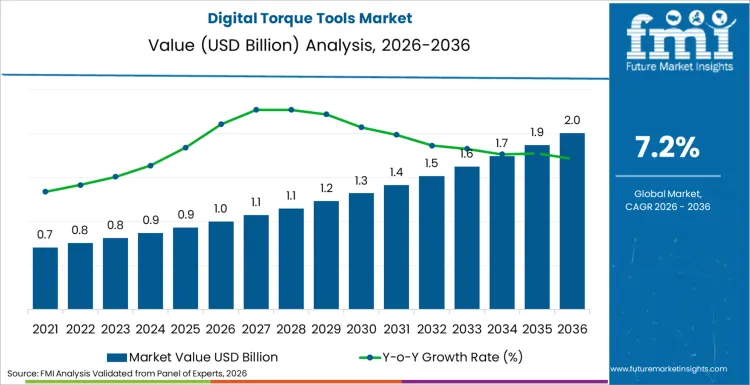
Digital torque tools market revenue is projected to total USD 1.0 billion in 2026, increasing to USD 2.0 billion by 2036, at a CAGR of 7.2%. FMI analysis indicates the market is undergoing a fundamental shift from standalone measurement devices to networked components of Industry 4.0 assembly lines. The 2026–2027 period will be defined by the widespread adoption of wireless tools with built-in angle measurement and the integration of tool data into digital twin simulations for process validation.
Growth is anchored in stringent quality and traceability mandates across regulated industries. The 2026 update to the International Organization for Standardization (ISO) 9001 quality management standards includes explicit guidance on the use of digitally recorded verification data for production processes. This formal recognition is accelerating the replacement of analog tools with digital systems that provide auditable, time-stamped records for every fastener tightened.
Atlas Copco AB launched its QLAS (Quality Link Assembly System) wireless tool platform in Q1 2026. The system not only records torque and angle but also uses onboard sensors to detect cross-threading or material yield in real-time, flagging potential defects before the product moves to the next station, thereby reducing rework costs by up to 25% in pilot automotive applications.
Technical innovation focuses on ergonomics and adaptive tightening. Ingersoll Rand, Inc. introduced the IQV-Series of smart mechatronic drivers in late 2025. These tools feature a patented reactive clutch that provides haptic feedback to the operator upon reaching target torque, reducing musculoskeletal strain, and can store multiple job profiles for flexible assembly cells.
Desoutter Industrial Tools announced a strategic partnership with a major cloud software provider in February 2026 to integrate tool data directly into SAP's Manufacturing Execution (ME) system. This enables real-time production dashboards that display torque performance metrics alongside other line data, closing the loop between assembly execution and enterprise resource planning.
STANLEY Assembly Technologies expanded its portfolio of ruggedized, intrinsically safe digital wrenches for oil and gas applications in early 2026, meeting ATEX and IECEx standards for use in hazardous environments where connectivity options are limited, representing a specialized high-value segment.
Summary of Digital Torque Tools Market
What is the Long-Term Growth Outlook for the Digital Torque Tools Market?
FMI projects the global digital torque tools market to expand from USD 1.0 billion in 2026 to USD 2.0 billion by 2036, registering a 7.2% CAGR. Market expansion reflects the irreversible transition from paper-based quality records to digital proof of assembly. In advanced manufacturing, the torque value is no longer the sole output; the complete digital signature of the fastening process, including ramp-up rate and final angle, is becoming the standard for quality certification.
This growth is propelled by the electrification of vehicles requiring new fastener strategies, the relentless pursuit of lightweighting in aerospace which demands precise joint clamping force, and the need for audit trails in pharmaceutical and medical device manufacturing. Demand is accelerating for tools that offer not only precision but also connectivity, data security, and interoperability with factory networks.
FMI Research Approach: This projection is derived from FMI’s proprietary forecasting framework integrating global automotive and aerospace production forecasts, analysis of regulatory tightening in medical devices, surveys on Industry 4.0 investment priorities, and primary interviews with production engineers and quality managers.
How do FMI Analysts Expect the Digital Torque Tools Market to Evolve Structurally?
FMI analysts anticipate a rapid convergence between the tool hardware and manufacturing software, leading to the rise of "tool-as-a-service" models. This evolution is driven by manufacturers' desire to avoid capital expenditure and access continuously updated analytics. The market will stratify into high-accuracy, certified tools for safety-critical applications and cost-optimized, connected tools for high-volume production.
Innovations such as vision-assisted tools that scan a fastener barcode before applying torque, tools with energy-harvesting capabilities for cordless operation, and the use of artificial intelligence to predict tool maintenance from performance drift are redefining product capabilities. The digital tool is becoming a smart edge device on the factory network.
FMI Research Approach: Insights are informed by analysis of patent filings related to tool connectivity and data security, software platform partnerships announced by tool OEMs, and procurement trends among global contract manufacturers.
Which Geographies Command the Largest Share of the Digital Torque Tools Market?
China leads the global digital torque tools market, advancing at an estimated 10.4% CAGR, driven by its massive automotive manufacturing base transitioning to electric vehicle production and government mandates for smart manufacturing. The United Kingdom follows with a 9.0% CAGR, underpinned by its high-value aerospace and motorsport sectors where precision assembly is paramount.
The USA, Japan, and South Korea represent mature yet innovation-driven markets with CAGRs of 8.9%, 7.7%, and 8.4%, respectively. Growth in the USA is supported by reshoring initiatives and defense manufacturing, Japan's by its automotive and electronics industries, and South Korea's by its semiconductor equipment and shipbuilding sectors.
FMI Research Approach: Country-level forecasts are built using analysis of national manufacturing output, government subsidies for industrial digitization, foreign direct investment in new production facilities, and the density of high-tech industries within each economy.
What will be the Market Size of Digital Torque Tools by 2036?
By 2036, the digital torque tools market is expected to reach USD 2.0 billion. This growth will be supported by the near-complete phase-out of non-digital tools in any formal manufacturing setting, the expansion of applications into maintenance, repair, and operations (MRO), and the increasing complexity of products requiring multiple, verified torque steps. The market will see significant value migration from the sale of tools to the sale of data subscriptions and analytics services.
FMI Research Approach: Long-term market sizing incorporates installed base replacement rates, penetration analysis into MRO and service sectors, and the projected growth of software and service revenue as a percentage of total tool supplier sales.
What are some Globally Distinct Trends Shaping the Digital Torque Tools Market?
Globally, the market is being shaped by the interplay of quality regulations, workforce dynamics, and sustainability goals. Stricter product liability laws and safety recalls are forcing manufacturers to adopt tools that create legally defensible assembly records. Simultaneously, an aging skilled workforce and high turnover are increasing reliance on tools that guide operators and prevent errors, reducing dependence on tribal knowledge.
Sustainability mandates are pushing for tools with longer battery life, repairable designs, and data capabilities that help optimize energy use in assembly processes. Furthermore, the need for supply chain agility is driving demand for tools that can be quickly reprogrammed for new product variants, supporting flexible, low-volume production runs.
FMI Research Approach: Trend analysis is informed by monitoring global product recall databases, analyzing workforce demographic data in manufacturing hubs, reviewing corporate sustainability reports from industrial conglomerates, and tracking announcements for flexible manufacturing systems.
Digital Torque Tools Market Key Takeaways
| Metrics | Values |
|---|---|
| Expected Value (2026E) | USD 1.0 billion |
| Projected Value (2036F) | USD 2.0 billion |
| CAGR (2026–2036) | 7.2% |
Source: Future Market Insights (FMI) analysis, based on proprietary forecasting model and primary research
Why is the Digital Torque Tools Market Growing?
The shift to EVs and battery pack manufacturing introduces new, critical fastening challenges. A 2026 teardown analysis by a leading engineering firm revealed that a typical EV battery pack contains over 150 torque-critical fasteners, many involving dissimilar materials that are prone to relaxation.
Digital tools with angle-controlled tightening strategies are essential to achieve and verify consistent clamp force in these joints, directly correlating with battery safety and vehicle longevity. This application is creating a substantial new demand segment distinct from traditional automotive assembly.
Lightweighting in aerospace demands absolute precision and documentation. The 2026 certification requirements for next-generation composite airframes from the Federal Aviation Administration and European Union Aviation Safety Agency mandate digital traceability for every structural fastener.
This has led Airbus and Boeing to specify tools, like those from Snap-on Incorporated's aerospace division, that not only log data but also encrypt it to prevent tampering, ensuring the airworthiness certificate is supported by immutable digital records.
The rise of adaptive manufacturing and digital twins requires real-time tool feedback. Siemens' 2026 demonstration of its adaptive assembly cell used digital torque tools from Robert Bosch GmbH as data-generating sensors.
The torque and angle data from each assembly cycle were fed back into the digital twin of the product, allowing the model to predict long-term joint integrity and potentially adjust tightening parameters for subsequent units based on material batch variations, moving from static assembly instructions to a dynamic, self-optimizing process.
How is the Digital Torque Tools Market Segmented?
The digital torque tools market segment landscape is defined by the level of electronic integration, the dominant industry driving volume, and the specific use case. Electronic torque wrenches dominate due to their versatility and established role in calibration, the automotive sector is the primary volume driver due to fastener count and quality mandates, and general manufacturing represents a broad and growing base for adoption.
Why do Electronic Torque Wrenches Maintain Market Leadership?
Electronic torque wrenches account for a 39% market share. Their dominance is anchored in their role as the primary calibrated instrument for final verification and audit in quality labs and on the shop floor. The 2026 update to the ISO 6789 standard for hand torque tools places greater emphasis on the calibration traceability and uncertainty measurement of electronic instruments.
This reinforces their status as the reference standard, ensuring their continued use for certifying other tools and for critical safety inspections, sustaining a replacement and calibration-driven market.
How does Automotive Assembly Drive Volume and Innovation?
The Automotive Assembly segment commands a 44% share of the application market. This leadership is due to the sheer number of fasteners per vehicle and the industry's zero-defect aspirations. Apex Tool Group, LLC's 2026 contract with a major European automaker involved supplying several thousand wireless pulse tools for engine assembly.
The contract included a performance-based clause where payment was tied to a reduction in warranty claims related to fastening over a three-year period. This links tool performance directly to operational cost, driving innovation in reliability and data accuracy.
What is the Role of General Manufacturing in Broadening Adoption?
General Manufacturing is a key growth segment as digitization spreads beyond automotive and aerospace. The proliferation of IoT platforms from companies like PTC and Siemens is making it cost-effective for smaller manufacturers to connect tools. Mountz, Inc.'s 2026 launch of a mid-range smart torque screwdriver with Bluetooth connectivity and a simple smartphone app for data logging is targeted at this segment.
It allows smaller manufacturers of industrial equipment, furniture, and consumer goods to implement basic traceability without a major investment in a factory-wide system, democratizing access to digital torque data.
What Drivers, Restraints, Opportunities, and Trends Prevail in the Digital Torque Tools Market?
The hardening of global supply chain due diligence laws drives market expansion. The UK's 2026 New Manufacturing Products (Safety) Act and similar EU legislation impose criminal liability on senior managers for safety failures, including those stemming from assembly faults. This is forcing companies to implement demonstrably robust quality control systems, with digital torque tool records serving as primary evidence of due diligence, transforming them from a quality tool to a legal necessity.
A primary restraint is the high total cost of ownership and integration complexity. Beyond the tool itself, costs include calibration software, network infrastructure, IT support, and operator training. A 2026 survey by NIST found that for SMEs, the perceived cost and complexity of integrating digital tool data into existing systems remained the single largest barrier to adoption, slowing market penetration outside large corporations.
A significant trend is the development of predictive maintenance for the tools themselves. Crane Electronics, Inc. introduced a cloud-based tool management service in 2026 that analyzes torque curve data from a fleet of tools. By detecting subtle shifts in the motor performance or clutch engagement, the service can predict bearing failure or calibration drift weeks in advance, scheduling maintenance proactively and preventing line downtime, adding a new service revenue layer.
The trend toward cobots presents a major opportunity. HYTORC and Universal Robots announced a co-developed solution in 2026 where a digital torque tool is integrated as an end-effector on a cobot arm. The cobot positions the tool, and the tool executes the precise torque, combining the consistency of automation with the flexibility of a digital tool. This opens the market to automated cells in smaller batch production where full robotics were previously uneconomical.
Analysis of Digital Torque Tools Market by Key Countries
| Country | CAGR (2026–2036) |
|---|---|
| USA | 8.9% |
| UK | 9.0% |
| China | 10.4% |
| Japan | 7.7% |
| South Korea | 8.4% |
Source: Future Market Insights (FMI) analysis, based on proprietary forecasting model and primary research
How do Reshoring and Defense Priorities Shape the US Market?
USA’s 8.9% CAGR is fueled by the intersection of industrial reshoring initiatives and stringent defense manufacturing standards. The 2026 National Defense Authorization Act includes provisions funding the modernization of the defense industrial base, specifically earmarking funds for smart tooling that provides digital provenance for weapon system components. This drives demand for high-security, ruggedized tools.
Reshoring of semiconductor fab construction under the CHIPS Act has led to tool suppliers like Snap-on establishing dedicated calibration and service centers near major fab sites in Arizona and Ohio, creating localized demand hubs for precision tools used in cleanroom equipment assembly.
What Role Does UK's Motorsport and Aerospace Hub Play in Demanding High-Performance Tools?
The UK's 9.0% CAGR is heavily influenced by its concentration of Formula 1 teams and tier-one aerospace manufacturers. The competitive pressure in F1 requires tools that are not only precise but extremely fast and lightweight. A 2026 technical partnership between a leading F1 team and Desoutter focused on developing a carbon-fiber mechatronic driver that could shave milliseconds off pit-stop times while streaming telemetry to the pit wall.
This extreme performance requirement drives bleeding-edge innovation that later trickles down to mainstream industrial tools. Furthermore, the UK's Aerospace Technology Institute (ATI) funds projects requiring digital thread traceability, mandating the use of advanced digital tooling in research and production.
How is China's EV Dominance and National Standards Driving Tool Specifications?
China's leading 10.4% CAGR is directly tied to its command of the global EV supply chain. The MIIT 2026 Technical Specifications for Power Battery Assembly mandates the use of digital tools with closed-loop angle control for all module-to-pack fastening. This has created a volume market for specific tool types.
Tool manufacturers in China are advancing rapidly, with companies leveraging the domestic market scale to develop cost-competitive smart tools that are now challenging established international brands in Southeast Asia and Africa, supported by China's "Belt and Road" infrastructure projects that specify Chinese equipment standards.
Why is Japan's Focus on Monozukuri, or Manufacturing Excellence, and Automation Unique?
Japan's 7.7% CAGR, while lower, reflects a mature market characterized by extreme focus on precision and automation integration. Japanese automotive and electronics manufacturers were early adopters of digital torque tools and are now focused on touchless integration. A 2026 initiative by Toyota involved equipping tools with RFID readers that automatically pull the correct tightening program when an operator scans a VIN at the station, eliminating manual selection errors.
This deep integration within highly automated kaizen (continuous improvement) cultures drives demand for tools with robust, reliable communication protocols and long-term durability over flashy new features.
How does South Korea's Semiconductor and Shipbuilding Industry Create Specialized Demand?
South Korea's 8.4% CAGR is bifurcated between its world-leading industries. In semiconductor fabrication, the assembly of wafer handling robots and lithography stages requires ultra-cleanroom-compatible digital tools that do not outgas particulates. Local tool distributors work with global brands to provide specially packaged versions. In shipbuilding, the construction of LNG tankers involves thousands of critical high-torque bolts on containment systems.
Hyundai Heavy Industries' 2026 specification required wireless digital multipliers from brands like HYTORC that could log torque values in confined, explosive-atmosphere spaces and sync data only when brought to a deck-level receiver, addressing both precision and safety challenges in a single application.
What is the Competition Outlook for Digital Torque Tools?
Competitive intensity reflects the convergence of mechanical engineering, electronics, and industrial software. The landscape is divided between traditional tool powerhouses with broad portfolios and newer, agile players focusing on connectivity and data analytics. Competition is increasingly based on the openness of tool data protocols, the strength of software partnerships, and the ability to provide global calibration and support networks that meet international accreditation standards.
Strategic evolution prior to 2025 was characterized by the digitization of existing mechanical tool lines, with a focus on improving accuracy and adding basic data logging. The observable strategic direction for 2026 and beyond is the acquisition of software and sensor companies to control the full data stack.
Ingersoll Rand's 2025 acquisition of a specialist in industrial wireless sensor networks aimed to integrate tighter, more secure connectivity into its tool ecosystem, reducing dependence on third-party communication modules. Strategic leadership is shifting toward outcome-based business models.
Atlas Copco's Tightening Assurance as a Service program, expanded in 2026, offers a per-fastener price model. Customers pay based on the number of verified tightening cycles, with Atlas Copco providing all tools, software, calibration, and maintenance. This reduces customer capital expenditure and aligns the tool supplier's success with the customer's production uptime and quality yield.
Recent Developments
- Robert Bosch GmbH opened its Connected Tools Lab in Stuttgart in February 2026, a joint research facility with several German automotive OEMs focused on developing AI models to predict assembly quality issues from torque-time curve analysis.
- Apex Tool Group, LLC and Microsoft announced a collaboration in late 2025 to embed Azure Sphere security chips into its high-end digital wrenches, ensuring data generated in defense and aerospace applications is cryptographically secured from the point of generation.
- STANLEY Assembly Technologies launched a new line of ergonomic, low-reaction force smart tools in Q1 2026, specifically designed to reduce injury rates in repetitive assembly tasks, responding to increased focus on operator wellness in manufacturing.
Key Players Profiled
- Atlas Copco AB
- Desoutter Industrial Tools
- Ingersoll Rand, Inc.
- STANLEY Assembly Technologies
- Snap-on Incorporated
- Robert Bosch GmbH
- Apex Tool Group, LLC
- Mountz, Inc.
- Crane Electronics, Inc.
- HYTORC
Market Definition
The digital torque tools market comprises revenue generated from the design, manufacture, and supply of hand-held or stationary tools used to apply a precise rotational force (torque) to a fastener, where the tool electronically measures, displays, and often records the output. These tools include wrenches, screwdrivers, multipliers, and pulsed tools that provide digital readouts, data logging, and connectivity features. The market includes electronic, mechatronic, and smart networked tools.
The market scope covers tools used in manufacturing assembly, quality assurance, and maintenance operations across automotive, aerospace, general industry, and energy sectors. Revenue includes value from the tool itself, dedicated controllers, software licenses for data management, and calibration equipment. The market excludes non-digital torque tools, general power tools without precise torque measurement, and software platforms sold independently without bundled tool hardware.
Scope of Report
| Items | Values |
|---|---|
| Quantitative Units | USD 1.0 billion |
| Type | Electronic torque wrenches; Mechatronic torque drivers; Smart WiFi torque tools |
| Application | Automotive assembly; Aerospace; General manufacturing |
| Regions Covered | North America, Western Europe, Eastern Europe, East Asia, South Asia & Pacific, Latin America, Middle East & Africa |
| Countries | USA, UK, China, Japan, South Korea and 40+ countries |
Source: Future Market Insights (FMI) analysis, based on proprietary forecasting model and primary research
Digital Torque Tools Market Key Segments
By Type
- Electronic torque wrenches
- Mechatronic torque drivers
- Smart Wi-Fi torque tools
By Application
- Automotive assembly
- Aerospace
- General manufacturing
By Region
- North America
- Western Europe
- Eastern Europe
- East Asia
- South Asia & Pacific
- Latin America
- Middle East & Africa
Bibliography
- Federal Aviation Administration (FAA). (2026). Advisory Circular: Digital Recordkeeping for Assembly and Maintenance.
- UK Department for Business and Trade. (2026). New Manufacturing Products (Safety) Act: Guidance for Industry.
- National Institute of Standards and Technology (NIST). (2026). Survey on Barriers to Adoption of Smart Manufacturing Technologies in SMEs.
Frequently Asked Questions
What is the expected value of the digital torque tools market in 2026?
The digital torque tools market is expected to reach USD 1.0 billion in 2026, supported by stringent quality traceability requirements and the transition to smart, connected manufacturing environments.
What is the projected value by 2036 and CAGR from 2026 to 2036?
By 2036, the market is projected to reach USD 2.0 billion, expanding at a CAGR of 7.2% between 2026 and 2036.
How is Industry 4.0 influencing the digital torque tools market?
Industry 4.0 drives the integration of torque tools into networked production systems. Tools are no longer isolated instruments but data sources that feed real-time information into Manufacturing Execution Systems (MES) and digital twins, enabling traceability, process optimization, and predictive quality control.
What is the primary driver behind the adoption of these tools in automotive manufacturing?
The primary driver is the need for absolute quality assurance and digital traceability to prevent costly recalls and warranty claims. Electric vehicle assembly, with its sensitive battery systems and new material joints, particularly demands the precision and verification provided by digital torque and angle measurement.
Which tool type currently holds the largest market share and why?
Electronic torque wrenches hold the largest share, as they serve as the primary calibrated standard for verification and audit across industries. Their versatility, established calibration frameworks, and role in certifying other assembly tools ensure their continued dominance in both production and quality control settings.
Preview the report firsthand - request a free sample
Get SampleGet the brochure for pricing and purchase details.
Get PDFTable of Content
- Executive Summary
- Global Market Outlook
- Demand-side Trends
- Supply-side Trends
- Technology Roadmap Analysis
- Analysis and Recommendations
- Market Overview
- Market Coverage / Taxonomy
- Market Definition / Scope / Limitations
- Market Background
- Market Dynamics
- Drivers
- Restraints
- Opportunity
- Trends
- Scenario Forecast
- Regional Parent Market Outlook
- Production and Consumption Statistics
- Import and Export Statistics
- Global Market Analysis 2021 to 2025 and Forecast, 2026 to 2036
- Historical Market Size Value (USD Million) Analysis, 2021 to 2025
- Current and Future Market Size Value (USD Million) Projections, 2026 to 2036
- Y-o-Y Growth Trend Analysis
- Absolute $ Opportunity Analysis
- Global Market Pricing Analysis 2021 to 2025 and Forecast 2026 to 2036
- Global Market Analysis 2021 to 2025 and Forecast 2026 to 2036, By Type
- Introduction / Key Findings
- Historical Market Size Value (USD Million) Analysis By Type , 2021 to 2025
- Current and Future Market Size Value (USD Million) Analysis and Forecast By Type , 2026 to 2036
- Electronic torque wrenches
- Mechatronic torque drivers
- Smart Wi-Fi torque tools
- Electronic torque wrenches
- Y-o-Y Growth Trend Analysis By Type , 2021 to 2025
- Absolute $ Opportunity Analysis By Type , 2026 to 2036
- Global Market Analysis 2021 to 2025 and Forecast 2026 to 2036, By Application
- Introduction / Key Findings
- Historical Market Size Value (USD Million) Analysis By Application, 2021 to 2025
- Current and Future Market Size Value (USD Million) Analysis and Forecast By Application, 2026 to 2036
- Automotive assembly
- Aerospace
- General manufacturing
- Automotive assembly
- Y-o-Y Growth Trend Analysis By Application, 2021 to 2025
- Absolute $ Opportunity Analysis By Application, 2026 to 2036
- Global Market Analysis 2021 to 2025 and Forecast 2026 to 2036, By Region
- Introduction
- Historical Market Size Value (USD Million) Analysis By Region, 2021 to 2025
- Current Market Size Value (USD Million) Analysis and Forecast By Region, 2026 to 2036
- North America
- Latin America
- Western Europe
- Eastern Europe
- East Asia
- South Asia and Pacific
- Middle East & Africa
- Market Attractiveness Analysis By Region
- North America Market Analysis 2021 to 2025 and Forecast 2026 to 2036, By Country
- Historical Market Size Value (USD Million) Trend Analysis By Market Taxonomy, 2021 to 2025
- Market Size Value (USD Million) Forecast By Market Taxonomy, 2026 to 2036
- By Country
- USA
- Canada
- Mexico
- By Type
- By Application
- By Country
- Market Attractiveness Analysis
- By Country
- By Type
- By Application
- Key Takeaways
- Latin America Market Analysis 2021 to 2025 and Forecast 2026 to 2036, By Country
- Historical Market Size Value (USD Million) Trend Analysis By Market Taxonomy, 2021 to 2025
- Market Size Value (USD Million) Forecast By Market Taxonomy, 2026 to 2036
- By Country
- Brazil
- Chile
- Rest of Latin America
- By Type
- By Application
- By Country
- Market Attractiveness Analysis
- By Country
- By Type
- By Application
- Key Takeaways
- Western Europe Market Analysis 2021 to 2025 and Forecast 2026 to 2036, By Country
- Historical Market Size Value (USD Million) Trend Analysis By Market Taxonomy, 2021 to 2025
- Market Size Value (USD Million) Forecast By Market Taxonomy, 2026 to 2036
- By Country
- Germany
- UK
- Italy
- Spain
- France
- Nordic
- BENELUX
- Rest of Western Europe
- By Type
- By Application
- By Country
- Market Attractiveness Analysis
- By Country
- By Type
- By Application
- Key Takeaways
- Eastern Europe Market Analysis 2021 to 2025 and Forecast 2026 to 2036, By Country
- Historical Market Size Value (USD Million) Trend Analysis By Market Taxonomy, 2021 to 2025
- Market Size Value (USD Million) Forecast By Market Taxonomy, 2026 to 2036
- By Country
- Russia
- Poland
- Hungary
- Balkan & Baltic
- Rest of Eastern Europe
- By Type
- By Application
- By Country
- Market Attractiveness Analysis
- By Country
- By Type
- By Application
- Key Takeaways
- East Asia Market Analysis 2021 to 2025 and Forecast 2026 to 2036, By Country
- Historical Market Size Value (USD Million) Trend Analysis By Market Taxonomy, 2021 to 2025
- Market Size Value (USD Million) Forecast By Market Taxonomy, 2026 to 2036
- By Country
- China
- Japan
- South Korea
- By Type
- By Application
- By Country
- Market Attractiveness Analysis
- By Country
- By Type
- By Application
- Key Takeaways
- South Asia and Pacific Market Analysis 2021 to 2025 and Forecast 2026 to 2036, By Country
- Historical Market Size Value (USD Million) Trend Analysis By Market Taxonomy, 2021 to 2025
- Market Size Value (USD Million) Forecast By Market Taxonomy, 2026 to 2036
- By Country
- India
- ASEAN
- Australia & New Zealand
- Rest of South Asia and Pacific
- By Type
- By Application
- By Country
- Market Attractiveness Analysis
- By Country
- By Type
- By Application
- Key Takeaways
- Middle East & Africa Market Analysis 2021 to 2025 and Forecast 2026 to 2036, By Country
- Historical Market Size Value (USD Million) Trend Analysis By Market Taxonomy, 2021 to 2025
- Market Size Value (USD Million) Forecast By Market Taxonomy, 2026 to 2036
- By Country
- Kingdom of Saudi Arabia
- Other GCC Countries
- Turkiye
- South Africa
- Other African Union
- Rest of Middle East & Africa
- By Type
- By Application
- By Country
- Market Attractiveness Analysis
- By Country
- By Type
- By Application
- Key Takeaways
- Key Countries Market Analysis
- USA
- Pricing Analysis
- Market Share Analysis, 2025
- By Type
- By Application
- Canada
- Pricing Analysis
- Market Share Analysis, 2025
- By Type
- By Application
- Mexico
- Pricing Analysis
- Market Share Analysis, 2025
- By Type
- By Application
- Brazil
- Pricing Analysis
- Market Share Analysis, 2025
- By Type
- By Application
- Chile
- Pricing Analysis
- Market Share Analysis, 2025
- By Type
- By Application
- Germany
- Pricing Analysis
- Market Share Analysis, 2025
- By Type
- By Application
- UK
- Pricing Analysis
- Market Share Analysis, 2025
- By Type
- By Application
- Italy
- Pricing Analysis
- Market Share Analysis, 2025
- By Type
- By Application
- Spain
- Pricing Analysis
- Market Share Analysis, 2025
- By Type
- By Application
- France
- Pricing Analysis
- Market Share Analysis, 2025
- By Type
- By Application
- India
- Pricing Analysis
- Market Share Analysis, 2025
- By Type
- By Application
- ASEAN
- Pricing Analysis
- Market Share Analysis, 2025
- By Type
- By Application
- Australia & New Zealand
- Pricing Analysis
- Market Share Analysis, 2025
- By Type
- By Application
- China
- Pricing Analysis
- Market Share Analysis, 2025
- By Type
- By Application
- Japan
- Pricing Analysis
- Market Share Analysis, 2025
- By Type
- By Application
- South Korea
- Pricing Analysis
- Market Share Analysis, 2025
- By Type
- By Application
- Russia
- Pricing Analysis
- Market Share Analysis, 2025
- By Type
- By Application
- Poland
- Pricing Analysis
- Market Share Analysis, 2025
- By Type
- By Application
- Hungary
- Pricing Analysis
- Market Share Analysis, 2025
- By Type
- By Application
- Kingdom of Saudi Arabia
- Pricing Analysis
- Market Share Analysis, 2025
- By Type
- By Application
- Turkiye
- Pricing Analysis
- Market Share Analysis, 2025
- By Type
- By Application
- South Africa
- Pricing Analysis
- Market Share Analysis, 2025
- By Type
- By Application
- USA
- Market Structure Analysis
- Competition Dashboard
- Competition Benchmarking
- Market Share Analysis of Top Players
- By Regional
- By Type
- By Application
- Competition Analysis
- Competition Deep Dive
- Atlas Copco AB
- Overview
- Product Portfolio
- Profitability by Market Segments (Product/Age /Sales Channel/Region)
- Sales Footprint
- Strategy Overview
- Marketing Strategy
- Product Strategy
- Channel Strategy
- Desoutter Industrial Tools
- Ingersoll Rand, Inc.
- STANLEY Assembly Technologies
- Snap-on Incorporated
- Robert Bosch GmbH
- Apex Tool Group, LLC
- Mountz, Inc.
- Crane Electronics, Inc.
- HYTORC
- Atlas Copco AB
- Competition Deep Dive
- Market Dynamics
- Assumptions & Acronyms Used
- Research Methodology


