

- Industry Size (2026)
- USD 162.0 Mn
- Forecast (2036)
- USD 690.0 Mn
- CAGR (2026 to 2036)
- 14.0%
Digital Watermarking for Food-Grade rPET Sorting Market Size, Market Forecast and Outlook By FMI
In 2025, the Digital Watermarking for Food-Grade rPET Sorting market crossed a valuation of USD 145.0 million and is projected to reach USD 162.0 million in 2026 and USD 690.0 million by 2036, reflecting a CAGR of 14.0%, underpinned by strict contamination thresholds pushing procurement of advanced sorting sensors. Regulators prioritize ultra-pure feedstock, forcing facility modernizations to capture premium bale margins.
Absolute dollar growth of USD 528.0 million over the decade signals a critical compliance shift, where manual sorting techniques are yielding to automated verification systems driven by aggressive recycled content mandates. Commercial viability testing during industrial trials verified a greater than 90% detection efficiency across 5,949 unique SKUs on high-speed lines [1]. Operators replace basic optical units to reduce downstream rejection risks and avoid virgin plastic tax liabilities.
Summary of Digital Watermarking for Food-Grade rPET Sorting
- Digital Watermarking for Food-Grade rPET Sorting Market Definition
- Advanced sensor systems decode imperceptible surface patterns to separate food-contact polymers from mixed municipal streams.
- Demand Drivers in the Market
- Contamination limits imposed by health safety bodies restrict usage of standard municipal bales.
- Brand commitments demand higher volumes of verified post-consumer recycled content than current mechanical capacity provides.
- Software cost reductions improve payback periods for municipal operators upgrading sorting lines.
- Key Segments Analyzed in the FMI Report
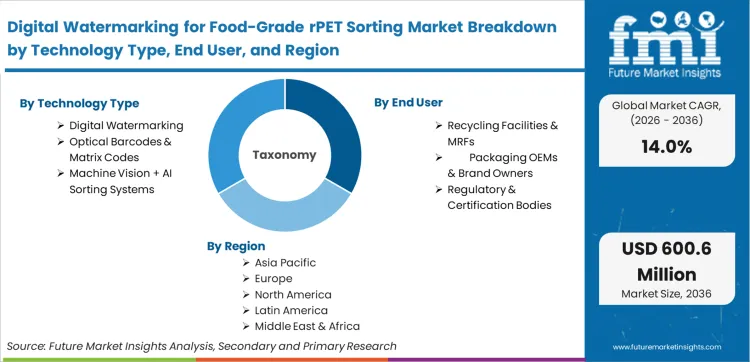
- Technology Type: Digital watermarking (invisible codes) (46%) versus optical barcodes, AI vision systems, and RFID hybrids.
- End User: Recycling facilities & MRFs (42% of total demand) versus OEMs, brand owners, and retailers.
- Geography: High-growth Europe and North America (Germany 15.2%, United States 14.7%) versus expanding Asia-Pacific (China 14.1%, India 13.3%).
- Analyst Opinion at FMI
- Ismail Sutaria, Principal Consultant for Packaging at Future Market Insights, opines, “In our recent evaluation of the Digital Watermarking for Food-Grade rPET Sorting Market, my team and I have identified interoperability as the decisive scaling factor. A watermark is only as powerful as the ecosystem that reads it. Fragmented adoption across brands, converters, and recovery facilities limits system-wide efficiency gains. The next growth phase will depend on standardized coding protocols and alignment with deposit return schemes. Stakeholders who treat watermarking as shared infrastructure, not proprietary differentiation, will unlock true circular food-grade resin recovery at scale.”
- Strategic Implications/Executive Takeaways
- Prioritize GPU-optimized software integration to lower hardware processing costs.
- Secure brand partnerships to subsidize municipal sorting equipment installations.
- Align development cycles with regulatory deadlines for mandatory recycled content minimums.
- Methodology
- Validated through first-hand corporate production and capacity data.
- Zero reliance on speculative third-party market research reports.
- Based on verifiable industrial benchmarks and verified sources.
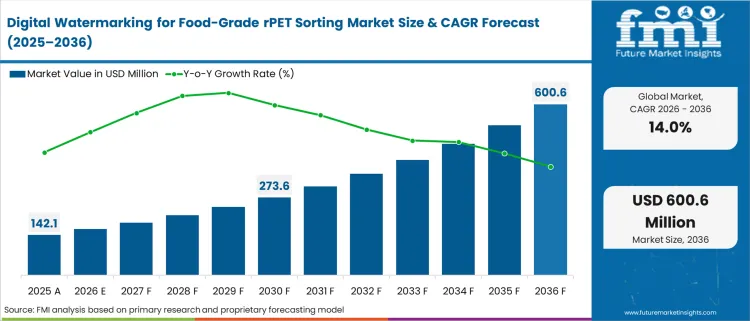
Digital Watermarking for Food-Grade rPET Sorting Market Key Takeaways
| Metric | Details |
|---|---|
| Industry Size (2026) | USD 162.0 million |
| Industry Value (2036) | USD 690.0 million |
| CAGR (2026-2036) | 14.0% |
Traceability upgrades provide immense operational value to facility owners. As noted by Riley McCormack, CEO of Digimarc, "This milestone isn’t just about increasing the quality and quantity of plastic recyclates, it’s about delivering actionable data that benefits everyone in the value chain." [2] Brand owners fund initial scanning capacity to secure dedicated circular supply allocations, shifting tracking from a compliance burden to an operational asset.
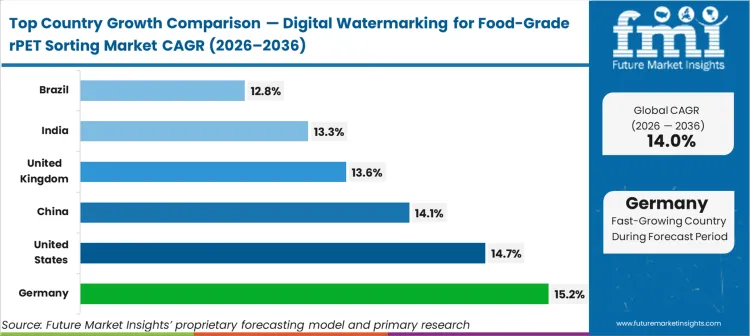
Growth across Europe and North America is accelerating in markets where recycled content regulations directly support infrastructure upgrades. Germany (15.2% CAGR) and the United States (14.7% CAGR) lead adoption, followed by China (14.1% CAGR), the United Kingdom (13.6% CAGR), India (13.3% CAGR), and Brazil (12.8% CAGR). In each case, stronger policy enforcement is streamlining procurement approvals, allowing early movers to modernize facilities and secure long-term contracts ahead of slower competitors.
Digital Watermarking for Food-Grade rPET Sorting Definition
Digital watermarking for food-grade rPET sorting involves applying imperceptible codes to packaging surfaces, enabling optical scanners at recovery facilities to identify specific resin histories. These systems differentiate non-food contact materials from target streams to ensure compliance with regulatory standards for secondary usage. High-speed detection modules read the embedded data arrays, triggering pneumatic ejection valves to segregate materials. The purity of the output directly impacts the economic returns for reclaimers who sell the sorted rPET into fast-moving consumer goods supply chains.
Digital Watermarking for Food-Grade rPET Sorting Inclusions
This includes invisible barcode software licensing, high-resolution camera modules designed for material recovery facilities, and cloud-assisted decoding subscriptions. Revenue from GPU-optimized sortation software deployed on municipal waste lines is part of the coverage. Retrofit sensor kits installed on existing near-infrared conveyors also fall within the scope. Pilot deployments that scale to commercial validation contribute to the regional total.
Digital Watermarking for Food-Grade rPET Sorting Exclusions
Exclusions include mechanical balers, granulators, and basic near-infrared separators that lack digital watermark decoding capabilities. Standalone traceability software for logistics, which does not incorporate physical sorting functions, is outside the defined scope. Revenue from consumer-facing barcode reading applications and raw recycled flake sales are also excluded from the tracked equipment and software revenues.
Digital Watermarking for Food-Grade rPET Sorting Market Research Methodology
- Primary Research: Direct interviews targeted chief technology officers at material recovery facilities and engineering leads at sensor manufacturing firms to validate adoption timelines.
- Desk Research: Assessments utilized packaging waste reports from European regulators and capacity audits published by plastics associations to gauge total addressable infrastructure.
- Market-Sizing and Forecasting: Models triangulated mandated recycled content targets with verified installation costs for optical detection arrays.
- Data Validation and Update Cycle: Findings underwent cross-referencing against quarterly earnings releases from leading automation providers and regulatory approvals for food-contact recycled resins.
Segmental Analysis
Digital Watermarking for Food-Grade rPET Sorting Market Analysis by Technology Type
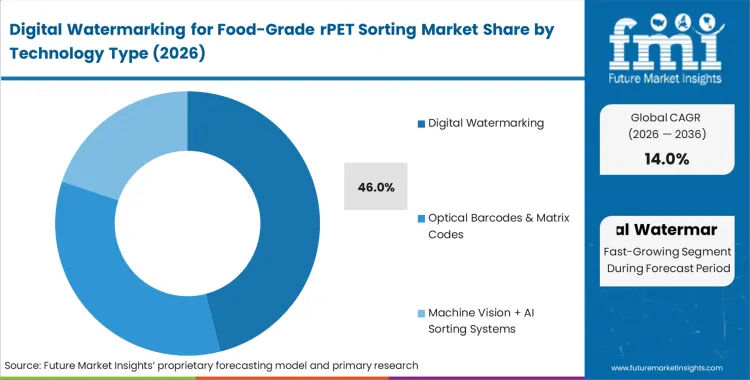
Material recovery facilities are increasingly adopting advanced identification systems as traditional near-infrared sorting becomes less reliable, particularly when physical shape and color no longer indicate prior material usage. Optical barcodes and machine vision technologies support bulk characterization, while GPU-accelerated computing enables real-time processing of high-resolution images at conveyor speeds above three meters per second. Falling hardware costs are further encouraging deployment across mid-sized recovery plants, positioning digital watermarking (invisible codes) to command 46% share in 2026.
- Regulatory signal: Health authorities require verified prior-use history before authorizing secondary food contact applications. Upgraded decoders process imperceptible patterns at speeds necessary for commercial viability, validated by prototype systems reaching 99% detection accuracy [3].
- Cost physics: Software enhancements lower the computational overhead required to analyze complex data arrays on high-speed belts. Newly launched GPU-optimized sortation tools cut processing costs by nearly half, shortening facility payback periods [4].
- Integration priority: Packaging producers embed codes across entire label surfaces to ensure readability regardless of physical deformation. Full surface coverage guarantees scanners capture data, maintaining throughput for recycled polyethylene terephthalate packaging lines.
Digital Watermarking for Food-Grade rPET Sorting Market Analysis by End User
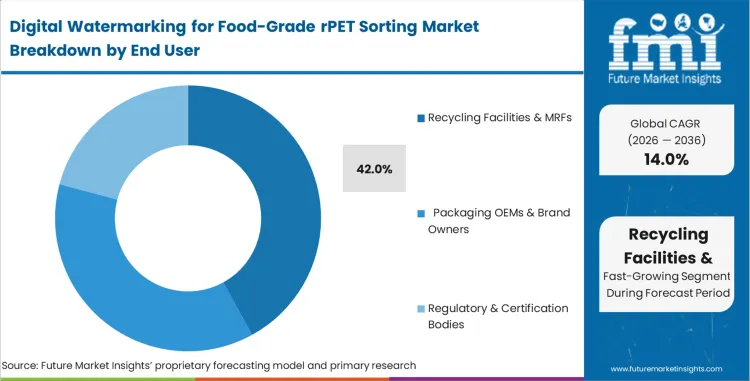
Recycling Facilities & MRFs hold a 42% share in 2026, serving as the primary deployment environment for physical detection hardware. Municipal operators face margin compression from contaminated bales, prompting investments in precision sorting capabilities. According to FMI's estimates, North American reclaimers require advanced upstream sorting to fully utilize existing infrastructure. Packaging OEMs partner with facilities to ensure their uniquely marked products successfully complete the circular loop. Joint funding models reduce capital risks for municipal entities adopting unproven optical arrays. Regulatory bodies utilize generated data dashboards to verify regional recycling targets.
- Margin defense: Contaminated bales sell at steep discounts compared to certified food-grade feedstock. Facilities installing advanced optical arrays capture premium pricing, responding to intense demand for safe recycled plastic packaging resins [10].
- Capacity utilization: Existing mechanical extruders sit idle without reliable streams of sorted, pure material. Upgrading upstream optical sensors unlocks utilization rates for downstream assets, creating a measurable return on investment cycle.
- Partnership model: Fast-moving consumer goods companies co-fund sensor installations to secure guaranteed offtake agreements. Brands subsidize equipment costs to ensure proprietary items re-enter their own pet containers supply chains.
Digital Watermarking for Food-Grade rPET Sorting Market Drivers, Restraints, and Opportunities
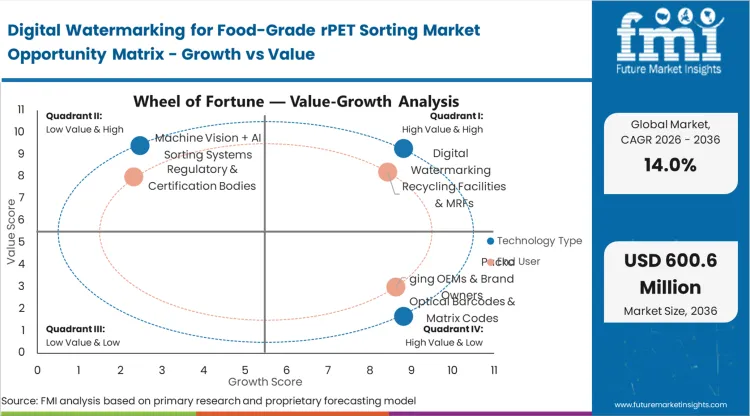
Strict contamination regulations paired with aggressive recycled content mandates force a structural change in material recovery facility operations. Manual sorting and basic optical identification cannot reliably separate food-contact polymers from chemically identical industrial containers, creating a supply bottleneck for fast-moving consumer goods brands. Facilities upgrade to digital watermark decoding to secure premium pricing for verified, pure bales. European statistics indicate plastic packaging waste reached 35.3 kg per person, prompting urgent regulatory intervention [5]. Optical investments convert low-value mixed plastics into high-margin commodities required for closed-loop manufacturing.
Capital intensity and unproven long-term durability of detection modules in harsh industrial environments delay municipal adoption. Small-scale operators lack sufficient capital to overhaul functional, albeit less accurate, existing conveyor lines. Facilities mitigate financial risks through collaborative funding models where brand owners subsidize equipment costs in exchange for guaranteed volume offtake agreements. Integrating design for recycling packaging methodologies standardizes inputs, shortening installation downtime and preserving operational continuity.
- Capacity Activation: Excess mechanical recycling capacity requires pure upstream feedstock to achieve profitable utilization rates. Integrating precision sorting unlocks massive processing potential, supporting a 36% capacity increase potential in North American facilities [6].
- Authentication Expansion: Digital marks designed for sorting provide secondary benefits for supply chain security and anti-counterfeiting. Medical applications adopting these codes demonstrate multi-use value, accelerating overall return on investment [11].
- Flexible Film Breakthrough: Proven success in rigid containers paves avenues for challenging multi-layer film recovery. Expanding detection capabilities to complex snack packaging creates entirely new revenue streams for municipal operators.
Regional Analysis
Based on the regional analysis, the Digital Watermarking for Food-Grade rPET Sorting market is segmented into North America, Latin America, Europe, East Asia, South Asia, Oceania and Middle East & Africa across 40+ countries. The full report also offers market attractiveness analysis based on regional trends.
.webp "Top Country Growth Comparison Digital Watermarking For Food Grade Rpet Sorting Market Cagr (2026 2036)")
| Country | CAGR (2026 to 2036) |
|---|---|
| Germany | 15.2% |
| United States | 14.7% |
| China | 14.1% |
| United Kingdom | 13.6% |
| India | 13.3% |
| Brazil | 12.8% |
Source: Future Market Insights (FMI) analysis, based on proprietary forecasting model and primary research
Europe Digital Watermarking for Food-Grade rPET Sorting Market Analysis
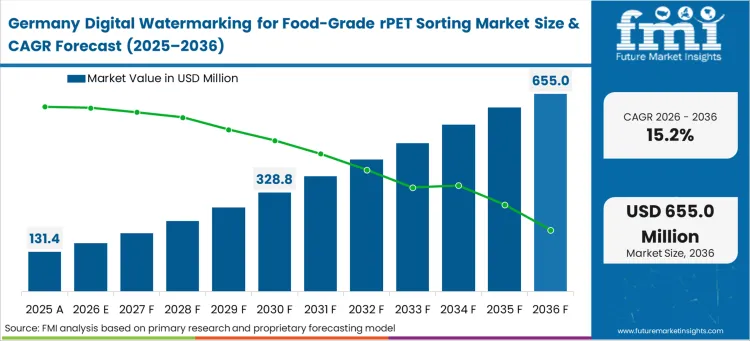
Europe leads regulatory-driven modernization, deploying digital tracking to satisfy stringent regional packaging directives. Facilities face mounting pressure to produce certified food-grade materials as mandates elevate required recycled content thresholds. Operators rapidly transition from pilot phases to permanent installation to capture available supply contracts. Cross-border consortiums standardize code structures to ensure interoperability across different national waste streams.
- Germany: Demand for upgraded sorting lines in Germany is set to grow at 15.2% CAGR through 2036, supported by strict domestic recycling targets before procurement cycles translate into higher deployment volumes. Regional facilities utilize verified extraction rates to justify capital expenditures, offsetting slowed 6% industry turnover growth with premium margins [8].
- United Kingdom: In the United Kingdom, adoption is accelerating as packaging tax policies discourage virgin plastic use and encourage higher recycled content integration. This shift is prompting technology upgrades across sorting and recovery infrastructure. Brand owners are also supporting municipal system improvements to secure verified feedstock streams through expanded container collection programs, driving growth at a 13.6% CAGR from 2026 to 2036.
FMI’s report includes a detailed growth analysis and country-wise assessment. France and Italy represent significant expansion targets due to extensive domestic beverage manufacturing requiring pure secondary resins. Policy standardization across these borders accelerates technology deployment, encouraging multinational brands to fund uniform sorting infrastructure. Procurement shifts toward integrated pet depolymerization technology combined with front-end optical sorting.
North America Digital Watermarking for Food-Grade rPET Sorting Market Analysis
North America exhibits fragmented policy landscapes, shifting reliance onto voluntary brand commitments to drive technology uptake. Reclaimers struggle with severe contamination rates, stranding vast mechanical capacities due to poor input quality. As per FMI's projection, resolving upstream separation inefficiencies unlocks significant processing potential. Operators adopt software-optimized detection systems to lower integration costs. Strategic hubs combining sorting and processing emerge to streamline supply chains.
- United States: United States sales are projected to rise at 14.7% CAGR from 2026 to 2036 as persistent contamination limits domestic flake utility, creating a clearer pathway from policy or spending intent to purchase orders. Facilities deploy automated tracking tools to cut overhead costs while maximizing the 39.2% overall regional collection rate [9].
FMI’s report includes a detailed growth analysis and country-wise assessment. Canada and Mexico offer promising pathways as cross-border trade in secondary materials requires standardized purity documentation. Facilities addressing the plastic jar industry analysis in the united states export high-grade bales to regional partners, demanding robust tracking mechanisms.
East Asia Digital Watermarking for Food-Grade rPET Sorting Market Analysis
East Asia focuses on raw volume processing, upgrading massive infrastructure hubs to capture international recycling contracts. Regional facilities integrate optical sensors to elevate export-grade materials meeting strict Western purity standards. Chemical recycling investments require highly specified inputs, driving parallel growth in digital identification arrays. Technology providers localize software development to process unique domestic packaging formats efficiently.
- China: In China, demand is strengthening as restrictions on mixed waste imports push greater reliance on domestic collection and processing systems. This shift is compelling facilities to optimize operations and invest in adoption-driven upgrades, including high-speed conveyors capable of handling rising local volumes efficiently. Policy-backed modernization efforts and infrastructure financing are reinforcing this transition, supporting growth at a 14.1% CAGR from 2026 to 2036.
FMI’s report includes a detailed growth analysis and country-wise assessment. Japan and South Korea lead premium technological integration, prioritizing ultra-pure separation for domestic cosmetic and pharmaceutical packaging. Upgraded sorting lines process complex multi-layer formats, providing verified inputs for regional converters.
South Asia Digital Watermarking for Food-Grade rPET Sorting Market Analysis
South Asia experiences rapid formalization of waste management networks, bypassing legacy systems to install advanced optical sorting directly. Multilateral financing supports massive capacity expansions aimed at curbing environmental leakage. Facilities implement digital tracking to provide transparent material sourcing data demanded by international buyers.
- India: In India, the market is forecast to advance at 13.3% CAGR through 2036, with growth anchored in multilateral capacity funding that converts into measurable budget allocation. Major polymer producers integrate new processing plants requiring verified pure inputs to satisfy global off-take agreements.
FMI’s report includes a detailed growth analysis and country-wise assessment. Thailand and Indonesia present immediate opportunities as global chemical corporations establish regional recycling bases. Investments target technology that guarantees material provenance for brands exporting back to regulated markets.
Latin America Digital Watermarking for Food-Grade rPET Sorting Market Analysis
Latin America upgrades primary sorting capabilities to integrate into global circular supply chains. Export-oriented facilities adopt digital detection to meet compliance standards required by North American buyers. Brand-led initiatives fund local municipal modernizations to secure reliable regional feedstock.
- Brazil: In Brazil, revenue expansion is gaining momentum as domestic brand commitments drive investments in processing capacity and workflow modernization. Recovery facilities are refining operations to better handle localized packaging formats and improve material capture efficiency, supporting growth at a 12.8% CAGR from 2026 to 2036.
FMI’s report includes a detailed growth analysis and country-wise assessment. Argentina and Chile attract targeted investments focusing on premium beverage container recovery. Standardizing detection protocols across regional borders improves aggregate bale volumes.
Competitive Aligners for Market Players
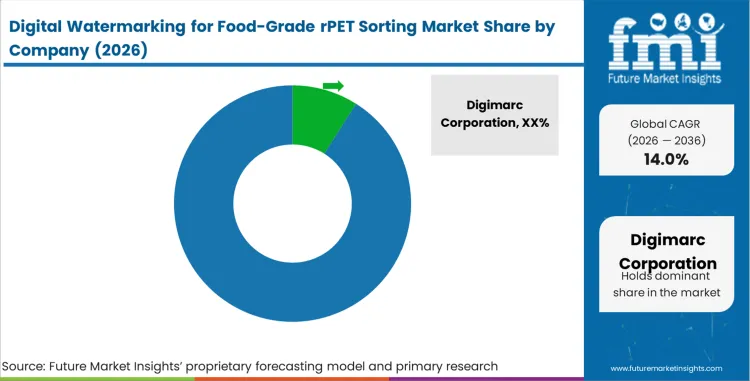
Market structure consolidates around technology providers offering seamless integration with existing mechanical conveyor systems. Competition hinges on software efficiency, as processing speed directly dictates facility throughput. Operators lacking GPU-optimized capabilities face severe margin compression during high-volume periods.
Partnerships define commercial success, linking digital code creators directly with sorting hardware manufacturers. Firms providing end-to-end solutions, from package marking to pneumatic valve triggering, secure dominant market positions. Disjointed systems suffer integration delays, increasing capital risk for municipal buyers seeking food grade PCR resin compliance.
Regulatory alignment further narrows competitive fields. Technology must reliably identify specific food-contact approvals to satisfy health authorities. Systems incapable of differentiating subtle polymer variations fail to generate premium food-grade bales, isolating underinvested providers from high-margin contracts.
Recent Developments
The report includes full coverage of key trends from competitive benchmarking. Some of the recent developments covered in the reports:
- In August 2025, Beaulieu International Group integrated scanning technology to demonstrate digital watermarks for product passports [7].
Key Players in Digital Watermarking for Food-Grade rPET Sorting Market
- Digimarc Corporation
- Pellenc ST
- TOMRA Recycling
- Steinert
- MCC (Multi-Color Corporation)
- Avery Dennison
- Indorama Ventures (IVL)
Scope of the Report
| Metric | Value |
|---|---|
| Quantitative Units | USD 162.0 million (2026) to USD 690.0 million (2036), at a CAGR of 14.0% |
| Market Definition | Digital watermarking for food-grade rPET sorting involves applying imperceptible codes to packaging surfaces, allowing optical scanners at recovery facilities to identify specific resin histories to ensure regulatory compliance for secondary usage. |
| Technology Type Segmentation | Digital Watermarking, Optical Barcodes & Matrix Codes, Machine Vision + AI Sorting Systems, RFID / Tagging Hybrid Solutions |
| End User Segmentation | Recycling Facilities & MRFs, Packaging OEMs & Brand Owners, Retailers / CPG Companies, Regulatory & Certification Bodies, Technology Providers / Integrators |
| Regions Covered | North America, Latin America, Europe, East Asia, South Asia, Oceania, Middle East and Africa |
| Countries Covered | United States, Canada, Mexico, Brazil, Argentina, Germany, France, United Kingdom, Italy, Spain, China, India, Japan, South Korea, Indonesia, Australia and 40 plus countries |
| Key Companies Profiled | Digimarc Corporation, Pellenc ST, TOMRA Recycling, Steinert, MCC, Avery Dennison, Indorama Ventures |
| Forecast Period | 2026 to 2036 |
| Approach | Hybrid top-down and bottom-up market modeling, validated through primary interviews with rPET producers and sorting technology providers, supported by trade data benchmarking and facility-level implementation analysis for sorting efficiency |
Digital Watermarking for Food-Grade rPET Sorting Market Analysis by Segments
Technology Type
- Digital Watermarking (Invisible Codes)
- Optical Barcodes & Matrix Codes
- Machine Vision + AI Sorting Systems
- RFID / Tagging Hybrid Solutions
End User
- Recycling Facilities & MRFs
- Packaging OEMs & Brand Owners
- Retailers / CPG Companies
- Regulatory & Certification Bodies
- Technology Providers / Integrators
Region
- Asia Pacific
- India
- China
- Japan
- South Korea
- Indonesia
- Australia & New Zealand
- ASEAN
- Rest of Asia Pacific
- Europe
- Germany
- Italy
- France
- United Kingdom
- Spain
- Benelux
- Nordics
- Central & Eastern Europe
- Rest of Europe
- North America
- United States
- Canada
- Mexico
- Latin America
- Brazil
- Argentina
- Chile
- Rest of Latin America
- Middle East & Africa
- Kingdom of Saudi Arabia
- United Arab Emirates
- South Africa
- Turkey
- Rest of Middle East & Africa
Bibliography
- [1] Digimarc Corporation. "Digimarc Recycle Earns Industrial-Scale Validation in HolyGrail 2.0 Trials." Official Press Release, April 2025.
- [2] Digimarc Corporation. Riley McCormack quote on HolyGrail 2.0 validation. Official Press Release, April 2025.
- [3] Ellen MacArthur Foundation. "HolyGrail 2.0 prototype validation." Official Documentation, 2025.
- [4] Digimarc Corporation. "Digimarc Revolutionizes Recycling: New GPU-Optimized Sortation Software." Official Press Release, October 2024.
- [5] Eurostat. "Packaging waste statistics." European Commission, 2025.
- [6] Association of Plastic Recyclers (APR). "2025 Plastic Recycling Capacity in the US and Canada." APR Reports, 2025.
- [7] Digimarc Corporation. "Beaulieu International Group and Digimarc Demonstrate Digital Watermarks." Official Press Release, August 2025.
- [8] Plastics Recyclers Europe. "Statistics 2025 Report." PRE Publications, 2025.
- [9] NAPCOR. "PET By The Numbers 2025 Report." National Association for PET Container Resources, 2025.
- [10] USA Food and Drug Administration (FDA). "Recycled Plastics Database." FDA CFSAN, updated 2025.
- [11] Digimarc Corporation. "Digimarc reports third-quarter 2025 financial results." Official Press Release, October 2025.
This bibliography is provided for reader reference and is not exhaustive. The full report contains the complete reference list and detailed citations.
This Report Addresses
- Market intelligence to enable structured strategic decision making across mature and emerging resin economies
- Market size estimation and 10 year revenue forecasts from 2026 to 2036, supported by validated capacity and trade benchmarks
- Growth opportunity mapping across invisible codes, optical barcodes, and AI systems with emphasis on purity grade transitions
- Segment and regional revenue forecasts covering MRFs, OEMs, retailers, and regulatory applications
- Competition strategy assessment including integration models, software cost survivability positioning, and compliance capability benchmarking
- Product reformulation and emission compliance tracking including FDA LNOs and European packaging mandates
- Regulatory impact analysis covering food contact safety thresholds, verifiable purity data, and export driven specification upgrades
- Market report delivery in PDF, Excel, PPT, and interactive dashboard formats for executive and operational use
Frequently Asked Questions
How large is the demand for Digital Watermarking for Food-Grade rPET Sorting in the global market in 2026?
Demand for Digital Watermarking for Food-Grade rPET Sorting in the global market is estimated to be valued at USD 162.0 million in 2026.
What will be the market size of Digital Watermarking for Food-Grade rPET Sorting in the global market by 2036?
Market size for Digital Watermarking for Food-Grade rPET Sorting is projected to reach USD 690.0 million by 2036.
What is the expected demand growth for Digital Watermarking for Food-Grade rPET Sorting in the global market between 2026 and 2036?
Demand for Digital Watermarking for Food-Grade rPET Sorting in the global market is expected to grow at a CAGR of 14.0% between 2026 and 2036.
Which Technology Type is poised to lead global sales by 2026?
Digital Watermarking (Invisible Codes) is expected to be the dominant form, capturing 46% of global market share in 2026 due to high data density capable of surviving physical abrasion in waste streams.
How significant is the role of Recycling Facilities & MRFs in driving Digital Watermarking for Food-Grade rPET Sorting adoption in 2026?
Recycling Facilities & MRFs represent a critical segment, projected to hold a substantial 42% share of the total market in 2026 as contamination limits restrict usage of standard municipal bales.
What is driving demand in Germany?
Strict domestic recycling targets and premium margins from domestic beverage producers justify high-speed optical upgrades for verification.
What compliance standards or regulations are referenced for Germany?
European Commission packaging waste directives and associated regional recycled content mandates govern contamination thresholds.
What is the Germany growth outlook in this report?
Germany is projected to grow at a CAGR of 15.2% during 2026 to 2036.
Why is North America described as a priority region in this report?
Growth is necessary to activate excess mechanical capacity constrained by poor input bale quality.
What type of demand dominates in North America?
Capacity-driven demand for software-optimized detection systems dominates regional consumption to lower facility overhead.
What is United States growth outlook in this report?
The United States is projected to expand at a CAGR of 14.7% during 2026 to 2036.
Does the report cover China in its regional analysis?
Yes, China is included within East Asia under the regional scope of analysis.
What are the sources referred to for analyzing China?
Official capacity data and international finance reports detailing localized chemical and mechanical recycling infrastructure expansions.
What is the main demand theme linked to China in its region coverage?
East Asia demand is associated with import restrictions forcing collection optimization to elevate export-grade commodity values.
Does the report cover United Kingdom in its regional analysis?
Yes, the United Kingdom is included within Europe under the regional coverage framework.
What is the main United Kingdom related demand theme in its region coverage?
Packaging tax policies penalizing virgin plastic usage prompt brand owners to subsidize municipal MRF modernizations.
Which product formats or configurations are strategically important for Europe supply chains?
On-premise edge computing arrays integrating GPU-optimized software are prioritized to maintain millisecond ejection reliability.
What is Digital Watermarking for Food-Grade rPET Sorting and what is it mainly used for?
It involves imperceptible codes on packaging decoded by high-speed scanners to separate food-contact polymers from mixed waste for regulatory-compliant secondary usage.
What does Digital Watermarking for Food-Grade rPET Sorting mean in this report?
The market refers to the software licensing, high-resolution camera modules, and subscriptions required to identify and sort coded plastics.
What is included in the scope of this Digital Watermarking for Food-Grade rPET Sorting report?
Scope covers invisible barcode software, camera modules for MRFs, cloud decoding subscriptions, and integrated GPU processing units.
What is excluded from the scope of this report?
Basic mechanical balers, granulators, generic near-infrared separators, and consumer-facing barcode applications are excluded.
What does market forecast mean on this page?
Market forecast represents a model-based projection built on defined adoption assumptions for strategic planning purposes.
How does FMI build and validate the Digital Watermarking for Food-Grade rPET Sorting forecast?
Forecast is developed using hybrid top-down and bottom-up modeling validated through capacity checks, software installation costs, and industry review.
What does zero reliance on speculative third party market research mean here?
Primary interviews and verifiable public datasets are used instead of unverified syndicated market estimates.
Preview the report firsthand - request a free sample
Get SampleGet the brochure for pricing and purchase details.
Get PDFTable of Content
- Executive Summary
- Global Market Outlook
- Demand-side Trends
- Supply-side Trends
- Technology Roadmap Analysis
- Analysis and Recommendations
- Market Overview
- Market Coverage / Taxonomy
- Market Definition / Scope / Limitations
- Research Methodology
- Chapter Orientation
- Analytical Lens and Working Hypotheses
- Market Structure, Signals, and Trend Drivers
- Benchmarking and Cross-market Comparability
- Market Sizing, Forecasting, and Opportunity Mapping
- Research Design and Evidence Framework
- Desk Research Programme (Secondary Evidence)
- Company Annual and Sustainability Reports
- Peer-reviewed Journals and Academic Literature
- Corporate Websites, Product Literature, and Technical Notes
- Earnings Decks and Investor Briefings
- Statutory Filings and Regulatory Disclosures
- Technical White Papers and Standards Notes
- Trade Journals, Industry Magazines, and Analyst Briefs
- Conference Proceedings, Webinars, and Seminar Materials
- Government Statistics Portals and Public Data Releases
- Press Releases and Reputable Media Coverage
- Specialist Newsletters and Curated Briefings
- Sector Databases and Reference Repositories
- FMI Internal Proprietary Databases and Historical Market Datasets
- Subscription Datasets and Paid Sources
- Social Channels, Communities, and Digital Listening Inputs
- Additional Desk Sources
- Expert Input and Fieldwork (Primary Evidence)
- Primary Modes
- Qualitative Interviews and Expert Elicitation
- Quantitative Surveys and Structured Data Capture
- Blended Approach
- Why Primary Evidence is Used
- Field Techniques
- Interviews
- Surveys
- Focus Groups
- Observational and In-context Research
- Social and Community Interactions
- Stakeholder Universe Engaged
- C-suite Leaders
- Board Members
- Presidents and Vice Presidents
- R&D and Innovation Heads
- Technical Specialists
- Domain Subject-matter Experts
- Scientists
- Physicians and Other Healthcare Professionals
- Governance, Ethics, and Data Stewardship
- Research Ethics
- Data Integrity and Handling
- Primary Modes
- Tooling, Models, and Reference Databases
- Desk Research Programme (Secondary Evidence)
- Data Engineering and Model Build
- Data Acquisition and Ingestion
- Cleaning, Normalisation, and Verification
- Synthesis, Triangulation, and Analysis
- Quality Assurance and Audit Trail
- Market Background
- Market Dynamics
- Drivers
- Restraints
- Opportunity
- Trends
- Scenario Forecast
- Demand in Optimistic Scenario
- Demand in Likely Scenario
- Demand in Conservative Scenario
- Opportunity Map Analysis
- Product Life Cycle Analysis
- Supply Chain Analysis
- Investment Feasibility Matrix
- Value Chain Analysis
- PESTLE and Porter’s Analysis
- Regulatory Landscape
- Regional Parent Market Outlook
- Production and Consumption Statistics
- Import and Export Statistics
- Market Dynamics
- Global Market Analysis 2021 to 2025 and Forecast, 2026 to 2036
- Historical Market Size Value (USD Million) Analysis, 2021 to 2025
- Current and Future Market Size Value (USD Million) Projections, 2026 to 2036
- Y-o-Y Growth Trend Analysis
- Absolute $ Opportunity Analysis
- Global Market Pricing Analysis 2021 to 2025 and Forecast 2026 to 2036
- Global Market Analysis 2021 to 2025 and Forecast 2026 to 2036, By Technology Type
- Introduction / Key Findings
- Historical Market Size Value (USD Million) Analysis By Technology Type , 2021 to 2025
- Current and Future Market Size Value (USD Million) Analysis and Forecast By Technology Type , 2026 to 2036
- Digital Watermarking
- Optical Barcodes & Matrix Codes
- Machine Vision + AI Sorting Systems
- Digital Watermarking
- Y-o-Y Growth Trend Analysis By Technology Type , 2021 to 2025
- Absolute $ Opportunity Analysis By Technology Type , 2026 to 2036
- Global Market Analysis 2021 to 2025 and Forecast 2026 to 2036, By End User
- Introduction / Key Findings
- Historical Market Size Value (USD Million) Analysis By End User, 2021 to 2025
- Current and Future Market Size Value (USD Million) Analysis and Forecast By End User, 2026 to 2036
- Recycling Facilities & MRFs
- Packaging OEMs & Brand Owners
- Regulatory & Certification Bodies
- Recycling Facilities & MRFs
- Y-o-Y Growth Trend Analysis By End User, 2021 to 2025
- Absolute $ Opportunity Analysis By End User, 2026 to 2036
- Global Market Analysis 2021 to 2025 and Forecast 2026 to 2036, By Region
- Introduction
- Historical Market Size Value (USD Million) Analysis By Region, 2021 to 2025
- Current Market Size Value (USD Million) Analysis and Forecast By Region, 2026 to 2036
- North America
- Latin America
- Western Europe
- Eastern Europe
- East Asia
- South Asia and Pacific
- Middle East & Africa
- Market Attractiveness Analysis By Region
- North America Market Analysis 2021 to 2025 and Forecast 2026 to 2036, By Country
- Historical Market Size Value (USD Million) Trend Analysis By Market Taxonomy, 2021 to 2025
- Market Size Value (USD Million) Forecast By Market Taxonomy, 2026 to 2036
- By Country
- USA
- Canada
- Mexico
- By Technology Type
- By End User
- By Country
- Market Attractiveness Analysis
- By Country
- By Technology Type
- By End User
- Key Takeaways
- Latin America Market Analysis 2021 to 2025 and Forecast 2026 to 2036, By Country
- Historical Market Size Value (USD Million) Trend Analysis By Market Taxonomy, 2021 to 2025
- Market Size Value (USD Million) Forecast By Market Taxonomy, 2026 to 2036
- By Country
- Brazil
- Chile
- Rest of Latin America
- By Technology Type
- By End User
- By Country
- Market Attractiveness Analysis
- By Country
- By Technology Type
- By End User
- Key Takeaways
- Western Europe Market Analysis 2021 to 2025 and Forecast 2026 to 2036, By Country
- Historical Market Size Value (USD Million) Trend Analysis By Market Taxonomy, 2021 to 2025
- Market Size Value (USD Million) Forecast By Market Taxonomy, 2026 to 2036
- By Country
- Germany
- UK
- Italy
- Spain
- France
- Nordic
- BENELUX
- Rest of Western Europe
- By Technology Type
- By End User
- By Country
- Market Attractiveness Analysis
- By Country
- By Technology Type
- By End User
- Key Takeaways
- Eastern Europe Market Analysis 2021 to 2025 and Forecast 2026 to 2036, By Country
- Historical Market Size Value (USD Million) Trend Analysis By Market Taxonomy, 2021 to 2025
- Market Size Value (USD Million) Forecast By Market Taxonomy, 2026 to 2036
- By Country
- Russia
- Poland
- Hungary
- Balkan & Baltic
- Rest of Eastern Europe
- By Technology Type
- By End User
- By Country
- Market Attractiveness Analysis
- By Country
- By Technology Type
- By End User
- Key Takeaways
- East Asia Market Analysis 2021 to 2025 and Forecast 2026 to 2036, By Country
- Historical Market Size Value (USD Million) Trend Analysis By Market Taxonomy, 2021 to 2025
- Market Size Value (USD Million) Forecast By Market Taxonomy, 2026 to 2036
- By Country
- China
- Japan
- South Korea
- By Technology Type
- By End User
- By Country
- Market Attractiveness Analysis
- By Country
- By Technology Type
- By End User
- Key Takeaways
- South Asia and Pacific Market Analysis 2021 to 2025 and Forecast 2026 to 2036, By Country
- Historical Market Size Value (USD Million) Trend Analysis By Market Taxonomy, 2021 to 2025
- Market Size Value (USD Million) Forecast By Market Taxonomy, 2026 to 2036
- By Country
- India
- ASEAN
- Australia & New Zealand
- Rest of South Asia and Pacific
- By Technology Type
- By End User
- By Country
- Market Attractiveness Analysis
- By Country
- By Technology Type
- By End User
- Key Takeaways
- Middle East & Africa Market Analysis 2021 to 2025 and Forecast 2026 to 2036, By Country
- Historical Market Size Value (USD Million) Trend Analysis By Market Taxonomy, 2021 to 2025
- Market Size Value (USD Million) Forecast By Market Taxonomy, 2026 to 2036
- By Country
- Kingdom of Saudi Arabia
- Other GCC Countries
- Turkiye
- South Africa
- Other African Union
- Rest of Middle East & Africa
- By Technology Type
- By End User
- By Country
- Market Attractiveness Analysis
- By Country
- By Technology Type
- By End User
- Key Takeaways
- Key Countries Market Analysis
- USA
- Pricing Analysis
- Market Share Analysis, 2025
- By Technology Type
- By End User
- Canada
- Pricing Analysis
- Market Share Analysis, 2025
- By Technology Type
- By End User
- Mexico
- Pricing Analysis
- Market Share Analysis, 2025
- By Technology Type
- By End User
- Brazil
- Pricing Analysis
- Market Share Analysis, 2025
- By Technology Type
- By End User
- Chile
- Pricing Analysis
- Market Share Analysis, 2025
- By Technology Type
- By End User
- Germany
- Pricing Analysis
- Market Share Analysis, 2025
- By Technology Type
- By End User
- UK
- Pricing Analysis
- Market Share Analysis, 2025
- By Technology Type
- By End User
- Italy
- Pricing Analysis
- Market Share Analysis, 2025
- By Technology Type
- By End User
- Spain
- Pricing Analysis
- Market Share Analysis, 2025
- By Technology Type
- By End User
- France
- Pricing Analysis
- Market Share Analysis, 2025
- By Technology Type
- By End User
- India
- Pricing Analysis
- Market Share Analysis, 2025
- By Technology Type
- By End User
- ASEAN
- Pricing Analysis
- Market Share Analysis, 2025
- By Technology Type
- By End User
- Australia & New Zealand
- Pricing Analysis
- Market Share Analysis, 2025
- By Technology Type
- By End User
- China
- Pricing Analysis
- Market Share Analysis, 2025
- By Technology Type
- By End User
- Japan
- Pricing Analysis
- Market Share Analysis, 2025
- By Technology Type
- By End User
- South Korea
- Pricing Analysis
- Market Share Analysis, 2025
- By Technology Type
- By End User
- Russia
- Pricing Analysis
- Market Share Analysis, 2025
- By Technology Type
- By End User
- Poland
- Pricing Analysis
- Market Share Analysis, 2025
- By Technology Type
- By End User
- Hungary
- Pricing Analysis
- Market Share Analysis, 2025
- By Technology Type
- By End User
- Kingdom of Saudi Arabia
- Pricing Analysis
- Market Share Analysis, 2025
- By Technology Type
- By End User
- Turkiye
- Pricing Analysis
- Market Share Analysis, 2025
- By Technology Type
- By End User
- South Africa
- Pricing Analysis
- Market Share Analysis, 2025
- By Technology Type
- By End User
- USA
- Market Structure Analysis
- Competition Dashboard
- Competition Benchmarking
- Market Share Analysis of Top Players
- By Regional
- By Technology Type
- By End User
- Competition Analysis
- Competition Deep Dive
- Digimarc Corporation
- Overview
- Product Portfolio
- Profitability by Market Segments (Product/Age /Sales Channel/Region)
- Sales Footprint
- Strategy Overview
- Marketing Strategy
- Product Strategy
- Channel Strategy
- Pellenc ST
- TOMRA Recycling
- Steinert
- MCC (Multi-Color Corporation)
- Avery Dennison
- Indorama Ventures (IVL)
- Digimarc Corporation
- Competition Deep Dive
- Assumptions & Acronyms Used


