

- Market Size (2026)
- USD 7,279.7 Mn
- Forecast (2036)
- USD 21,427.1 Mn
- CAGR (2026 to 2036)
- 11.4%
How big is the digital journal apps market in 2026?
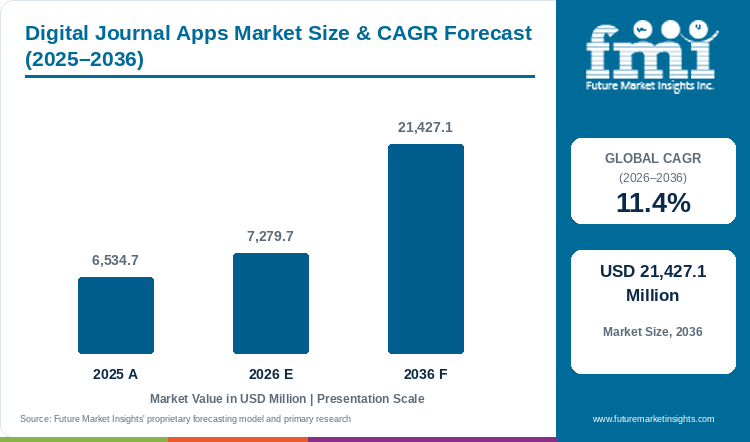
Demand is projected to expand at 11.4% CAGR from 2026 to 2036. Market value rises from USD 6,534.7 million in 2025 to USD 7,279.7 million in 2026 and USD 21,427.1 million by 2036. [1]
Digital journal apps are estimated at USD 7,279.7 million in 2026 and projected to reach USD 21,427.1 million by 2036, with a CAGR of 11.4% across the forecast period. [1] Demand depends on a user finding it easy to create and revisit a personal record, which places the writing experience and continuity of access alongside subscription features. Mobile application store distribution helps users discover tools, but lasting use also requires clear controls over synchronization, protection and the ability to retain entries when devices or services change. Apple documents locking and backup arrangements for its Journal application, while Android’s privacy guidance addresses how applications should handle information and permissions. [2][3] Day One describes end-to-end encryption, and Journey documents entry management and connected functions, illustrating different parts of the journaling experience. [4][5] Suppliers can develop prompts and other assistance, although customers still need confidence that a private record remains under suitable control. Growth through 2026 to 2036 therefore rests on useful routines and understandable service terms, with premium functions creating value when they support the user’s preferred way of recording and revisiting experiences.
Key Market Trends and Insights
- Journaling applications combine entry creation with synchronization and retrieval, making continuity of access important when users change devices or return to older personal records. [2][5]
- Privacy and information controls influence the experience because journal entries can contain sensitive personal material, giving locking, permissions and protection a practical purchasing role. [2][3][4]
- Premium functions need to support a lasting routine rather than add complexity, with customers comparing guidance, storage and export options according to their own recording preferences. [1][5]
Regional Highlights
- North American revenue conditions include subscription use and connected device ecosystems, giving the quality of the continuing application experience a role beyond the initial download. [1][2]
- European demand includes customers who value control over personal entries, while protection and understandable access terms remain practical requirements for a lasting record. [1][4]
- India and China offer growth through smartphone use and local-language experiences, with prompts and interfaces needing to fit how users prefer to express personal information. [1]
Market Size and Forecast
Table 1: Value outlook for the digital journal apps market
| Metric | Value |
|---|---|
| 2025 market value | USD 6,534.7 million [1] |
| 2026 market value | USD 7,279.7 million [1] |
| 2036 market value | USD 21,427.1 million [1] |
| CAGR 2026 to 2036 | 11.4% [1] |
| Revenue increase 2026 to 2036 | USD 14,147.4 million [1] |
| Market expansion 2026 to 2036 | 2.94 times [1] |
The revenue outlook depends on converting repeated use into demand for the functions and service arrangements that customers value, rather than treating every download as a paying account. Wearable fitness tracker integration can provide additional context where users choose to connect activity with reflection, while journal entries remain a distinct personal record. Suppliers need to maintain useful writing and retrieval experiences alongside privacy and access controls, giving continued support and understandable premium features a practical role in subscription retention. [1][3][5]
How do privacy and continuity affect journaling app choice?
Journal documentation covers several different aspects of control, including locking, backup, encryption and entry management. These functions matter because the value of a personal record extends beyond the session in which it is written. A useful comparison considers how the user can create entries, protect access and revisit or export information over time, while understanding the terms attached to synchronization and premium services. [2][3][4][5]
Table 2: Industry evidence relevant to the digital journal apps market
| Indicator | Data point or observation | Market relevance | Source |
|---|---|---|---|
| Access controls | Apple documents Journal locking and encrypted backup arrangements. | Assess protection together with recovery and continued access. | [2] |
| Application privacy | Android provides privacy and permission guidance for application developers. | Keep information handling clear within the user experience. | [3] |
| Journal protection | Day One documents end-to-end encryption for journal content. | Compare protection with the functions needed for continued use. | [4] |
Analyst Perspective
"Subscription revenue models deliver predictable cash flows that fund continuous feature development. For journal applications, that recurring payment still needs to be earned through a useful writing experience, dependable access to previous entries and features that users continue to value." [1]
— Sudip Saha, Principal Consultant for Technology, FMI
How is the digital journal apps market segmented?
The market is segmented by Platform, Application, Services, and Region.
By platform, the market covers Android, iOS, Windows, MacOS. By application, the market covers Mobile Phones, Tablets, Desktop PCs. By services, the market covers Freemium Services, Premium Services.
Why does the iOS segment lead demand within the platform category?
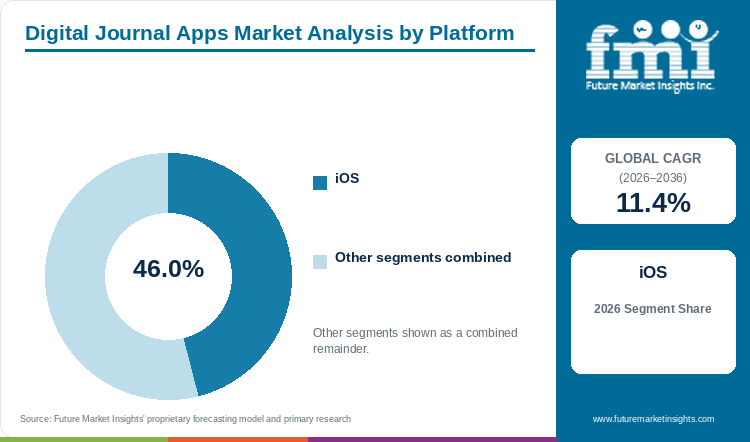
The iOS segment accounts for 46.0% of platform demand in 2026. [1]
The iOS platform connects journaling with a device environment in which users already create and retain personal information, giving dedicated applications a route to convenient access and premium service use. Its estimated 46.0% share of platform demand in 2026 reflects this revenue position within the covered market. [1] Customers still compare the usefulness of a dedicated service with other available journaling functions, including the locking and backup arrangements documented for Apple’s Journal application. [2] Paid tools need to make their value understandable through the writing, retrieval and continuity experience, rather than assume that a compatible device creates a subscription. Encryption and connected functions can support confidence, while the user’s preferred routine determines which features remain useful over time. [4][5]
- The iOS segment is estimated to account for 46.0% of platform demand in 2026, reflecting its position within the revenue coverage of digital journal applications. [1]
- Dedicated services need an understandable premium proposition, because customers compare writing, protection and retrieval with journaling functions already available within their device environment. [2][4][5]
Table 3: Leading platform share in 2026
| Segment | Share of demand |
|---|---|
| iOS | 46.0% [1] |
| Other platform segments | 54.0% [1] |
| Total | 100.0% |
Why does the Mobile phones segment lead demand within the application category?
The Mobile phones segment accounts for 72.0% of application demand in 2026. [1]
A mobile phone is usually available when a user wants to record an experience, making it a convenient setting for a journal that develops through brief entries over time. The application category is estimated to hold 72.0% of demand in 2026, supported by this connection between access and an everyday recording routine. [1] Convenience still depends on a clear writing interface and dependable synchronization, because an entry is useful only when it remains available for later retrieval. Apple and Journey document functions that address access, backup and management of journal information. [2][5] Mobile leadership therefore reflects the device’s role in the user’s routine, while tablets and desktops remain useful when customers prefer a larger writing environment or different ways of organizing records.
- Mobile phones are estimated to represent 72.0% of application demand in 2026, giving users a convenient way to record experiences as part of daily routines. [1]
- Writing, synchronization and retrieval need to remain dependable across device changes, because the value of the record extends beyond the moment in which an entry is created. [2][5]
What are the drivers, restraints, and opportunities in the digital journal apps market?
Driver
A journal becomes useful through repeated recording and retrieval, supporting demand for applications that make both activities convenient within the user’s existing device routine. Fitness apps can provide adjacent personal information where customers choose to connect experiences, while journal entries retain a separate role for reflection and memory. Suppliers can support adoption through understandable interfaces and dependable access, with premium demand shaped by the functions that customers continue to value rather than the number of prompts or features advertised. [1][2][5]
Restraint
Users may hesitate to maintain a personal record when protection, synchronization or export terms are difficult to understand, particularly if entries contain sensitive experiences. Additional features can also make the application less convenient when they interrupt the recording routine or create uncertainty about information use. Privacy guidance and product documentation show why control and continuity matter, while premium services must explain their value clearly enough for customers to compare them with simpler or built-in journaling options. [2][3][4]
Opportunity
Providers can improve retention by supporting the ways users already prefer to record and revisit experiences, with accessible interfaces, dependable recovery and clear control over optional connections. Conversational AI can assist selected writing or retrieval tasks when users understand its role, while sensitive personal information requires suitable handling. The opportunity lies in a service that remains useful and trustworthy across a lasting routine, with premium functions tied to practical value such as organized access, protected records and an appropriate writing experience. [1][3][5]
Which country CAGRs are profiled in the digital journal apps market?
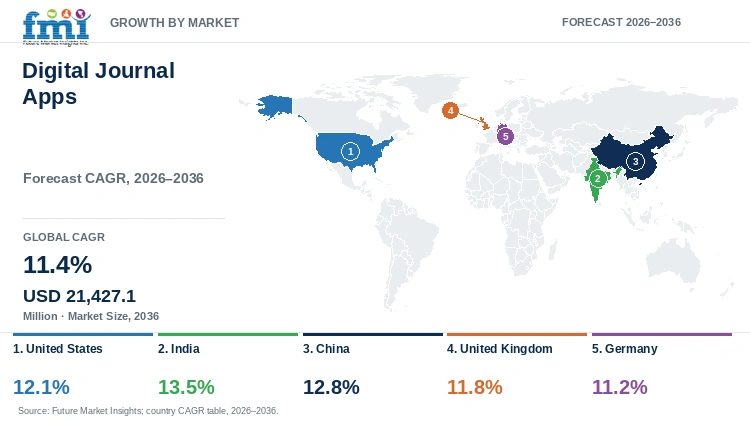
Table 4: Country CAGR comparison for the digital journal apps market
| Country or market | CAGR 2026 to 2036 |
|---|---|
| United States | 12.1% [1] |
| India | 13.5% [1] |
| China | 12.8% [1] |
| United Kingdom | 11.8% [1] |
| Germany | 11.2% [1] |
Country-wise Analysis
United States
Subscription use and connected device ecosystems influence US journal app demand, according to the report’s current country outlook. [1] A dedicated service needs to explain how its writing, protection and retrieval functions improve the user’s routine, particularly when built-in alternatives already provide a way to keep entries. Apple documents locking and backup arrangements for Journal, while Day One describes encryption within its dedicated service. [2][4] The United States market is projected to grow at a CAGR of 12.1% from 2026 to 2036, with demand shaped by continued use and the premium functions customers choose to maintain. Suppliers can support that use through clear information controls and dependable access to a personal record as devices, preferences and service arrangements change over time. [5]
India
Local-language interfaces and prompts are a useful purchasing condition in India, where the report connects journal app expansion with smartphone use and tools that fit how users express personal experiences. [1] A recording routine can become less useful when the application requires unnecessary translation or a writing style that does not suit the customer, giving language and interface choices a practical role. Users also need dependable synchronization and a clear understanding of information permissions, because convenient entry creation should lead to a lasting record. India’s market is projected to expand at a CAGR of 13.5% from 2026 to 2036, with premium adoption dependent on the value of the functions offered and the confidence customers place in continued access and suitable privacy controls. [3][5]
China
China’s journal app outlook includes smartphone-driven use and local-language assistance, making the writing experience important to whether the application becomes part of an everyday routine. [1] Suppliers need to support understandable entry creation and retrieval rather than assume that prompts alone provide value, because users maintain different preferences for private reflection and memory keeping. Connected functions can help organize a record, but permissions and synchronization should remain clear when personal material moves between devices or services. [3][5] The market is projected to grow at a CAGR of 12.8% from 2026 to 2036, with demand shaped by continued use and the premium functions customers choose to retain. Language fit, dependable access and appropriate information controls influence the practical appeal of the service. [1]
United Kingdom
UK customers considering digital journals need a clear relationship between reflective use and the service being purchased, particularly when an application presents prompts or wellness-related features. [1] The useful comparison concerns how easily a customer can record experiences, protect entries and return to them, rather than an assumption that journaling software provides a clinical outcome. Day One’s encryption documentation and Journey’s entry functions illustrate two parts of this everyday experience. [4][5] The United Kingdom market is projected to expand at a CAGR of 11.8% from 2026 to 2036, with demand influenced by continuing use and the value of premium functions. Suppliers can support a lasting routine through understandable controls, appropriate guidance and dependable access as the personal record develops over time. [1]
Germany
Control over personal information is a practical concern for German journal users, because entries can hold details that the customer wants to retain privately and revisit over a long period. [1] An application therefore needs understandable access, synchronization and export arrangements alongside a convenient writing interface. Android’s privacy guidance addresses information handling within applications, while dedicated journal documentation shows how protection and entry management can form part of the service. [3][4][5] Germany’s market is projected to grow at a CAGR of 11.2% from 2026 to 2036, with premium adoption shaped by the usefulness of the continuing experience. Customers compare functions according to their own recording preferences, giving dependable access and clear information controls a role in the decision to maintain a subscription. [1]
Who are the notable companies in the digital journal apps market?
Day One (Automattic); Journey; Penzu; Diarium; Momento
Competitive Benchmarking
Journal providers compete through the writing and retrieval experience, with different offerings emphasizing privacy, multimedia entries, connected information or cross-platform use. Day One and Journey document protection and management functions that address different parts of this requirement. [4][5] Customers also compare dedicated services with journaling functions already available on their devices, making premium value and continuity of access material distinctions. A useful comparison therefore considers the lasting personal record rather than only the initial feature list or writing prompt. [2]
Table 5: Competitive positioning for the digital journal apps market
| Company | Positioning | Evidence or purchasing distinction |
|---|---|---|
| Day One (Automattic) | Dedicated digital journal application | Documents end-to-end encryption for journal content. [4] |
| Journey | Cross-platform journaling and entry functions | Documents writing, synchronization and journal management. [5] |
| Penzu | Private online journaling | Provides a personal diary service with customization functions. [1] |
| Diarium | Multimedia journaling | Supports varied forms of entries within a digital journal. [1] |
| Momento | Memory-oriented journaling | Connects personal records with information from linked activities. [1] |
Key Developments in the Digital Journal Apps Market
- Apple’s Journal documentation explains locking, synchronization and encrypted backup options, providing customers with practical information about retaining access to their personal entries. [2]
- Day One documents end-to-end encryption as part of its journal service, illustrating how protection can form a central feature of a dedicated application. [4]
- Journey publishes guidance on writing, entry management and connected functions, supporting users who need to organize and revisit a personal record over time. [5]
Key Players in the Digital Journal Apps Market
- Day One (Automattic)
- Journey
- Penzu
- Diarium
- Momento
Digital Journal Apps Market Report Scope
Table 6: Report coverage for the digital journal apps market
| Attribute | Coverage |
|---|---|
| Market | Digital Journal Apps Market |
| Base year | 2026 |
| Historical reference | 2025 |
| Forecast period | 2026 to 2036 |
| Currency and units | USD million |
| Segmentation | Platform, Application, Services |
| Geographical coverage | North America, Latin America, Western Europe, Eastern Europe, East Asia, South Asia and Pacific, Middle East & Africa |
| Country profiles | United States, India, China, United Kingdom, Germany |
| Competition | Representative participants, product positioning and purchasing distinctions |
Digital Journal Apps Market Research Methodology
Table 7: Research methods for the digital journal apps market
| Method | Approach |
|---|---|
| Market definition | The study defines digital journal apps revenue within the stated product, service and application coverage, retaining the distinction between market sales and adjacent economic activity. |
| Desk research | Public FMI research, official institutional publications, technical documentation and company disclosures provide the evidence for market conditions and participant positioning. |
| Segmentation | Demand is organized by platform, application, services, with leading segment shares assessed separately within each category rather than added across categories. |
| Country assessment | The country outlook considers adoption conditions, purchasing practices, local deployment requirements and the operating constraints relevant to each profiled market. |
| Forecast assessment | The 2026 to 2036 outlook considers demand formation, replacement cycles, supplier capacity and the commercial conditions described in the market analysis. |
| Competitive comparison | Representative companies are compared by their stated offerings and role in the value chain, without treating every participant as an interchangeable supplier. |
Digital Journal Apps Market by Segments
Digital Journal Apps Market segmented by Platform:
- Android
- iOS
- Windows
- MacOS
Digital Journal Apps Market segmented by Application:
- Mobile Phones
- Tablets
- Desktop PCs
Digital Journal Apps Market segmented by Services:
- Freemium Services
- Premium Services
- Monthly Subscription
- Quarterly Subscription
- Annual Subscription
Digital Journal Apps Market by Region
North America
- USA
- Canada
- Mexico
Latin America
- Brazil
- Chile
- Rest of Latin America
Western Europe
- Germany
- UK
- Italy
- Spain
- France
- Nordic
- BENELUX
- Rest of Western Europe
Eastern Europe
- Russia
- Poland
- Hungary
- Balkan & Baltic
- Rest of Eastern Europe
East Asia
- China
- Japan
- South Korea
South Asia and Pacific
- India
- ASEAN
- Australia & New Zealand
- Rest of South Asia and Pacific
Middle East & Africa
- Kingdom of Saudi Arabia
- Other GCC Countries
- Turkiye
- South Africa
- Other African Union
- Rest of Middle East & Africa
Research Sources and Bibliography
- [1] Future Market Insights. Accessed 14 October 2026. Digital Journal Apps Market
- [2] Apple. Accessed 14 October 2026. Protect journal entries
- [3] Android Developers. Accessed 14 October 2026. Privacy checklist
- [4] Day One. Accessed 14 October 2026. End-to-end journal encryption
- [5] Journey. Accessed 14 October 2026. Application interface and features
This Report Answers
- How big is the digital journal apps market in 2026?
- What is the market forecast for 2036?
- Which segment leads demand in 2026?
- Which countries are profiled in the market outlook?
- Which companies are covered in the competitive analysis?
Frequently Asked Questions
How big is the digital journal apps market in 2026?
The market is estimated at USD 7,279.70 million in 2026, within the defined product and service coverage. [1]
What is the market forecast for 2036?
Market revenue is projected to reach USD 21,427.10 million by 2036, representing a CAGR of 11.4% from 2026 to 2036. [1]
Which segment leads demand in 2026?
The iOS segment is estimated to hold a 46.0% share within the platform category in 2026, with demand shaped by the purchasing conditions described in the segment analysis. [1]
Which countries are profiled in the market outlook?
The country outlook profiles United States, India, China, United Kingdom, Germany, with a separate 2026 to 2036 CAGR and discussion of local purchasing conditions for each market. [1]
Which companies are covered in the competitive analysis?
Representative participants include Day One (Automattic), Journey, Penzu, Diarium, Momento, whose offerings and value-chain roles are compared within the market coverage. [1]
Preview the report firsthand - request a free sample
Get SampleGet the brochure for pricing and purchase details.
Get PDFTable of Content
- Key Takeaways
- Market Size and CAGR
- Top Growth Driver
- Fastest Growing Segment
- Leading Region
- Key Companies
- Emerging Opportunities
- Executive Summary
- Global Market Outlook
- Demand-side Trends
- Supply-side Trends
- Technology Roadmap Analysis
- Analysis and Recommendations
- Analyst Perspective (What is happening? Why now? What should investors know?)
- Key Questions Answered
- How large is the market?
- What is the CAGR?
- What are key trends?
- Which region dominates?
- Who are the leaders?
- Market Overview
- Market Coverage / Taxonomy
- Market Definition / Scope / Limitations
- Research Methodology
- Chapter Orientation
- Analytical Lens and Working Hypotheses
- Market Structure, Signals, and Trend Drivers
- Benchmarking and Cross-market Comparability
- Market Sizing, Forecasting, and Opportunity Mapping
- Research Design and Evidence Framework
- Desk Research Programme (Secondary Evidence)
- Expert Input and Fieldwork (Primary Evidence)
- Tooling, Models, and Reference Databases
- Data Engineering and Model Build
- Quality Assurance and Audit Trail
- Market Background
- Market Dynamics (Drivers, Restraints, Opportunity, Trends)
- Scenario Forecast (Optimistic, Likely, Conservative)
- Impact Analysis
- AI Impact
- Sustainability Impact
- Regulatory Impact
- Technology Impact
- Consumer / Buyer Analysis
- Purchase Drivers
- Adoption Barriers
- Buyer Journey
- Opportunity Map Analysis
- Product Life Cycle Analysis
- Supply Chain Analysis
- Investment Feasibility Matrix
- Value Chain Analysis
- PESTLE and Porter's Analysis
- Regulatory Landscape
- Regional Parent Market Outlook
- Production and Consumption Statistics
- Import and Export Statistics
- Global Market Analysis and Forecast, 2021 to 2036
- Historical Market Size Value (USD Million) Analysis, 2021 to 2025
- Current and Future Market Size Value (USD Million) Projections, 2026 to 2036
- Y-o-Y Growth Trend Analysis
- Absolute $ Opportunity Analysis
- Global Market Pricing Analysis, 2021 to 2036
- Global Market Analysis and Forecast, By Platform, 2021 to 2036
- Introduction / Key Findings
- Historical Market Size Value (USD Million) Analysis By Platform, 2021 to 2025
- Current and Future Market Size Value (USD Million) Analysis and Forecast By Platform, 2026 to 2036
- Android
- iOS
- Windows
- MacOS
- Y-o-Y Growth Trend Analysis By Platform, 2021 to 2025
- Absolute $ Opportunity Analysis By Platform, 2026 to 2036
- Global Market Analysis and Forecast, By Application, 2021 to 2036
- Introduction / Key Findings
- Historical Market Size Value (USD Million) Analysis By Application, 2021 to 2025
- Current and Future Market Size Value (USD Million) Analysis and Forecast By Application, 2026 to 2036
- Mobile Phones
- Tablets
- Desktop PCs
- Y-o-Y Growth Trend Analysis By Application, 2021 to 2025
- Absolute $ Opportunity Analysis By Application, 2026 to 2036
- Global Market Analysis and Forecast, By Services, 2021 to 2036
- Introduction / Key Findings
- Historical Market Size Value (USD Million) Analysis By Services, 2021 to 2025
- Current and Future Market Size Value (USD Million) Analysis and Forecast By Services, 2026 to 2036
- Freemium Services
- Premium Services
- Monthly Subscription
- Quarterly Subscription
- Annual Subscription
- Y-o-Y Growth Trend Analysis By Services, 2021 to 2025
- Absolute $ Opportunity Analysis By Services, 2026 to 2036
- Global Market Analysis and Forecast, By Region, 2021 to 2036
- Introduction
- Historical Market Size Value (USD Million) Analysis By Region, 2021 to 2025
- Current Market Size Value (USD Million) Analysis and Forecast By Region, 2026 to 2036
- North America
- Latin America
- Western Europe
- Eastern Europe
- East Asia
- South Asia and Pacific
- Middle East & Africa
- Market Attractiveness Analysis By Region
- North America Market Analysis and Forecast, By Country, 2021 to 2036
- Historical Market Size Value (USD Million) Trend Analysis By Market Taxonomy, 2021 to 2025
- Market Size Value (USD Million) Forecast By Market Taxonomy, 2026 to 2036
- By Country
- USA
- Canada
- Mexico
- By Platform
- By Application
- By Services
- By Country
- Market Attractiveness Analysis
- By Country
- By Platform
- By Application
- By Services
- Key Takeaways
- Latin America Market Analysis and Forecast, By Country
- Historical Market Size Value (USD Million) Trend Analysis By Market Taxonomy, 2021 to 2025
- Market Size Value (USD Million) Forecast By Market Taxonomy, 2026 to 2036
- By Country
- Brazil
- Chile
- Rest of Latin America
- By Platform
- By Application
- By Services
- By Country
- Market Attractiveness Analysis
- By Country
- By Platform
- By Application
- By Services
- Key Takeaways
- Western Europe Market Analysis and Forecast, By Country
- Historical Market Size Value (USD Million) Trend Analysis By Market Taxonomy, 2021 to 2025
- Market Size Value (USD Million) Forecast By Market Taxonomy, 2026 to 2036
- By Country
- Germany
- UK
- Italy
- Spain
- France
- Nordic
- BENELUX
- Rest of Western Europe
- By Platform
- By Application
- By Services
- By Country
- Market Attractiveness Analysis
- By Country
- By Platform
- By Application
- By Services
- Key Takeaways
- Eastern Europe Market Analysis and Forecast, By Country
- Historical Market Size Value (USD Million) Trend Analysis By Market Taxonomy, 2021 to 2025
- Market Size Value (USD Million) Forecast By Market Taxonomy, 2026 to 2036
- By Country
- Russia
- Poland
- Hungary
- Balkan & Baltic
- Rest of Eastern Europe
- By Platform
- By Application
- By Services
- By Country
- Market Attractiveness Analysis
- By Country
- By Platform
- By Application
- By Services
- Key Takeaways
- East Asia Market Analysis and Forecast, By Country
- Historical Market Size Value (USD Million) Trend Analysis By Market Taxonomy, 2021 to 2025
- Market Size Value (USD Million) Forecast By Market Taxonomy, 2026 to 2036
- By Country
- China
- Japan
- South Korea
- By Platform
- By Application
- By Services
- By Country
- Market Attractiveness Analysis
- By Country
- By Platform
- By Application
- By Services
- Key Takeaways
- South Asia and Pacific Market Analysis and Forecast, By Country
- Historical Market Size Value (USD Million) Trend Analysis By Market Taxonomy, 2021 to 2025
- Market Size Value (USD Million) Forecast By Market Taxonomy, 2026 to 2036
- By Country
- India
- ASEAN
- Australia & New Zealand
- Rest of South Asia and Pacific
- By Platform
- By Application
- By Services
- By Country
- Market Attractiveness Analysis
- By Country
- By Platform
- By Application
- By Services
- Key Takeaways
- Middle East & Africa Market Analysis and Forecast, By Country
- Historical Market Size Value (USD Million) Trend Analysis By Market Taxonomy, 2021 to 2025
- Market Size Value (USD Million) Forecast By Market Taxonomy, 2026 to 2036
- By Country
- Kingdom of Saudi Arabia
- Other GCC Countries
- Turkiye
- South Africa
- Other African Union
- Rest of Middle East & Africa
- By Platform
- By Application
- By Services
- By Country
- Market Attractiveness Analysis
- By Country
- By Platform
- By Application
- By Services
- Key Takeaways
- Key Countries Market Analysis
- USA
- Pricing Analysis
- Market Share Analysis, 2025
- By Platform
- By Application
- By Services
- Canada
- Pricing Analysis
- Market Share Analysis, 2025
- By Platform
- By Application
- By Services
- Mexico
- Pricing Analysis
- Market Share Analysis, 2025
- By Platform
- By Application
- By Services
- Brazil
- Pricing Analysis
- Market Share Analysis, 2025
- By Platform
- By Application
- By Services
- Chile
- Pricing Analysis
- Market Share Analysis, 2025
- By Platform
- By Application
- By Services
- Germany
- Pricing Analysis
- Market Share Analysis, 2025
- By Platform
- By Application
- By Services
- UK
- Pricing Analysis
- Market Share Analysis, 2025
- By Platform
- By Application
- By Services
- Italy
- Pricing Analysis
- Market Share Analysis, 2025
- By Platform
- By Application
- By Services
- Spain
- Pricing Analysis
- Market Share Analysis, 2025
- By Platform
- By Application
- By Services
- France
- Pricing Analysis
- Market Share Analysis, 2025
- By Platform
- By Application
- By Services
- India
- Pricing Analysis
- Market Share Analysis, 2025
- By Platform
- By Application
- By Services
- ASEAN
- Pricing Analysis
- Market Share Analysis, 2025
- By Platform
- By Application
- By Services
- Australia & New Zealand
- Pricing Analysis
- Market Share Analysis, 2025
- By Platform
- By Application
- By Services
- China
- Pricing Analysis
- Market Share Analysis, 2025
- By Platform
- By Application
- By Services
- Japan
- Pricing Analysis
- Market Share Analysis, 2025
- By Platform
- By Application
- By Services
- South Korea
- Pricing Analysis
- Market Share Analysis, 2025
- By Platform
- By Application
- By Services
- Russia
- Pricing Analysis
- Market Share Analysis, 2025
- By Platform
- By Application
- By Services
- Poland
- Pricing Analysis
- Market Share Analysis, 2025
- By Platform
- By Application
- By Services
- Hungary
- Pricing Analysis
- Market Share Analysis, 2025
- By Platform
- By Application
- By Services
- Kingdom of Saudi Arabia
- Pricing Analysis
- Market Share Analysis, 2025
- By Platform
- By Application
- By Services
- South Africa
- Pricing Analysis
- Market Share Analysis, 2025
- By Platform
- By Application
- By Services
- USA
- Market Structure Analysis
- Competition Dashboard
- Competition Benchmarking
- Market Share Analysis of Top Players
- By Regional
- By Platform
- By Application
- By Services
- Emerging Startups
- Innovation Benchmarking
- Competition Analysis
- Competition Deep Dive
- Day One (Automattic)
- Overview
- Product Portfolio
- Profitability by Market Segments
- Sales Footprint
- Strategy Overview
- Marketing Strategy
- Product Strategy
- Channel Strategy
- Journey
- Penzu
- Diarium
- Momento
- Day One (Automattic)
- Case Studies
- Success Stories
- Recent Developments
- Competition Deep Dive
- Assumptions & Acronyms Used


