

- Industry Size (2025)
- USD 425.8 Mn
- Forecast (2035)
- USD 1370.5 Mn
- CAGR (2025 to 2035)
- 12.40%
Digital Illustration App Market Size, Market Forecast and Outlook By FMI
The digital illustration app market is expected to expand from USD 425.8 million in 2025 to USD 1,370.5 million by 2035. The market is anticipated to register a 12.4% CAGR during the forecast period. Digital artists are likely to lead with a 43% share in 2025. Windows is projected to account for 55% of the platform segment in the same year.
Summary of the Digital Illustration App Market
- Demand and Growth Drivers
- Rising use of digital artwork in gaming and advertising is expected to raise demand for advanced illustration tools.
- Social media creators are likely to increase app adoption as visual content needs faster editing and publishing workflows.
- Mobile devices and stylus-enabled tablets are anticipated to help students and freelancers access professional drawing tools.
- Product and Segment View
- Digital artists are expected to lead end user demand as paid tools improve brushes and workflow control.
- Windows is likely to keep strong platform share as professional users need hardware compatibility and drawing tablet access.
- Pixel-based illustration apps are anticipated to gain use among gaming artists and creators using retro visual styles.
- Geography and Competitive Outlook
- India is expected to record fast expansion as smartphone use and creator communities increase digital art adoption.
- The United States is likely to see steady demand from animation studios and professional design software users.
- Companies offering lower subscription plans and stronger cross-platform access are anticipated to attract younger creator groups.
- Analyst Opinion
- Sudip Saha, Co-founder at Future Market Insights, suggests, “The digital illustration app market is likely to favor vendors combining simple interfaces with professional creative control. App developers offering cloud access and flexible pricing are expected to gain stronger traction among artists and creator-led businesses.”
- Digital Illustration App Market Value Analysis
- The digital illustration app market is moving from professional studio software toward everyday creator tools across devices.
- Demand is likely to rise as artists use apps for gaming assets and online content creation.
- Adoption is expected to increase as tablets and hybrid laptops make digital drawing easier for new users.
- Spending is anticipated to be backed by subscription models and stronger monetization options for digital creators.
Global Digital Illustration App Market Assessment
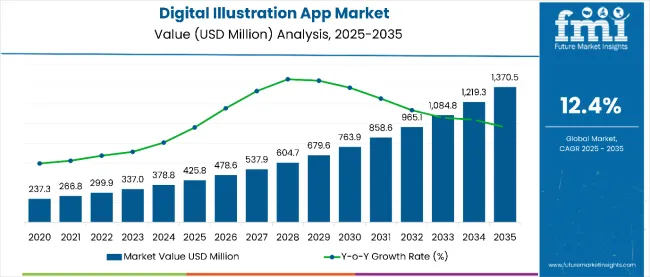
Key Takeaways, Market Size, and Forecast
| Metric | Value |
|---|---|
| Market Size (2025) | USD 425.8 Million |
| Market Size (2035) | USD 1,370.5 Million |
| CAGR (2025–2035) | 12.4% |
| Leading End User (2025) | Digital Artists |
| Digital Artists Share (2025) | 43% |
| Leading Platform (2025) | Windows |
| Windows Share (2025) | 55% |
| Fastest-Growing Country | India |
| India CAGR | 15.2% |
| Attributes | Description |
|---|---|
| Historical Size, 2024 | USD 382.8 million |
| Estimated Size, 2025 | USD 425.8 million |
| Projected Size, 2035 | USD 1,370.5 million |
| Value-based CAGR (2025 to 2035) | 12.40% |
Ecosystem Integrations and Plugin and API Extensibility in Digital Illustration App Market
Illustration apps become embedded in professional pipelines when they do more than standalone drawing, they interoperate, extend, and feed into broader creative workflows. Top products expose plugin or extension frameworks, offer APIs or well-defined import/export formats, and integrate with asset managers, video editors, cloud storage, publishing/distribution platforms, and team review systems. That makes them not just tools for making an image but nodes in a content supply chain, reducing friction between ideation, production, collaboration, and delivery.
- Plugin/Extension Frameworks: Illustration apps like Adobe Illustrator offer plugin frameworks that allow third-party developers to create custom brushes, filters, and export options. For example, CorelDRAW provides over 1,000 plugins, which empower users to extend their functionality in specific workflows.
- APIs and Webhooks: APIs enable seamless integration with asset management and version control systems, such as Dropbox and Figma, allowing external applications to interact with digital artwork. For instance, Adobe Creative Cloud exposes over 3,000 APIs for integration, enabling smooth workflows, while webhooks automatically trigger actions like canvas updated or asset exported, with 80% of users preferring these automated features over manual exports.
- File Format Interoperability: Illustration apps support industry-standard file formats such as PSD, SVG, TIFF, and EXR, ensuring smooth interoperability with video editing software like After Effects and Premiere Pro. Procreate, for example, allows users to export to PSD format, which can then be imported directly into Photoshop, and around 90% of designers use cross-platform tools in their workflows.
- Native Connectors/Cloud Storage: Integrations with popular cloud services like Google Drive, Dropbox, and Adobe Creative Cloud make it easy to share files and collaborate. Adobe Creative Cloud, for example, connects with over 50 apps, streamlining cross-platform collaboration.
- Enterprise Embedding and White-Labeling: White-label options and headless APIs allow large enterprises to embed illustration capabilities directly into their platforms. Autodesk Sketchbook, for instance, provides enterprise solutions with custom workflows tailored for industries like automotive design.
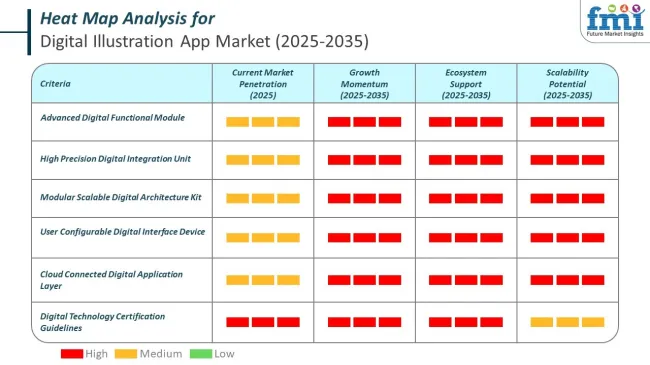
Digital Illustration App Market: Security, Privacy, and Intellectual Property Protections
In the Digital Illustration App Market, security, privacy, and intellectual property protections are critical for maintaining trust among professional and enterprise users. These apps prioritize offline encryption, ownership clarity, and secure sharing mechanisms to safeguard user-created content. Such features ensure that creators retain full control over their work while protecting it from unauthorized access, data breaches, and potential intellectual property theft.
- Offline encryption ensures that user files remain secure even when stored locally, preventing unauthorized access when not synced or shared in the cloud. Adobe Photoshop encrypts content both in transit and at rest, including files stored locally on a user’s device, ensuring data is protected when offline.
- Ownership clarity is provided through clear intellectual property policies, allowing users to retain full copyright over their artwork and preventing disputes over content ownership. Procreate ensures that users retain full copyright over their artwork, with terms of service stating that users maintain exclusive rights to their creations.
- Safe sharing mechanisms, such as password protection and two-factor authentication, enable users to securely share their work with trusted collaborators, minimizing the risk of unauthorized access and modifications. Figma allows users to set specific permissions for file sharing and integrates two-factor authentication (2FA) to safeguard sensitive designs during collaboration.
Semi Annual Market Update
The below table presents the expected CAGR for the global digital illustration app market over several semi-annual periods spanning from 2025 to 2035. This assessment outlines changes in the memory interconnect industry and identify revenue trends, offering key decision makers an understanding about market performance throughout the year.
H1 represents first half of the year from January to June, H2 spans from July to December, which is the second half. In the first half (H1) of the year from 2024 to 2034, the business is predicted to surge at a CAGR of 11.8%, followed by a higher growth rate of 12.3% in the second half (H2) of the same decade.
| Particular | Value CAGR |
|---|---|
| H1 (2024 to 2034) | 11.8% |
| H2 (2024 to 2034) | 12.3% |
| H1 (2025 to 2035) | 12.1% |
| H2 (2025 to 2035) | 12.7% |
Moving into the subsequent period, from H1 2025 to H2 2035, the CAGR is projected to increase slightly to 12.1% in the first half and remain higher at 12.7% in the second half. In the first half (H1) the market witnessed a decrease of 30 BPS and in the second half (H2), the market witnessed an increase of 40 BPS.
Analyzing Digital Illustration App Market by Top Investment Segments
Digital Artists Remain the Largest User Base with 43% Share
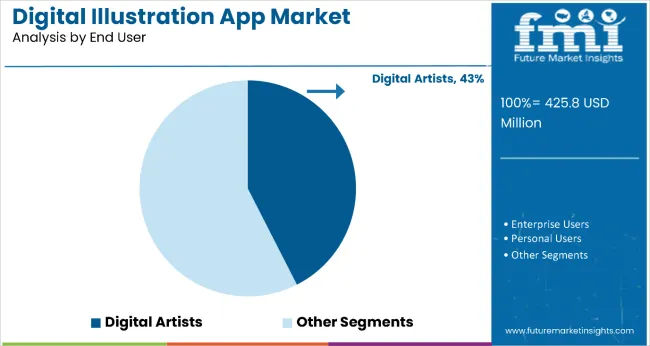
Digital artists represented a 43% share of the total market in 2025, continuing as the most dominant user category. They rely on apps for creating concept art, comics, branding assets, and portraits.
Key app features demanded by this group include cloud synchronization, custom brushes, pressure sensitivity, and multi-frame animation support.Significant 2024 updates introduced auto-saving and canvas navigation improvements, reducing workflow interruptions.
The growth of freelance digital artists globally has driven subscriptions for platforms like Procreate and Adobe Fresco. Portable devices, such as hybrid laptops and tablets, have enabled creative flexibility across locations. Industry events, NFT marketplaces, and online design contests have also increased adoption.
By Platform, Windows Hold 55% Share
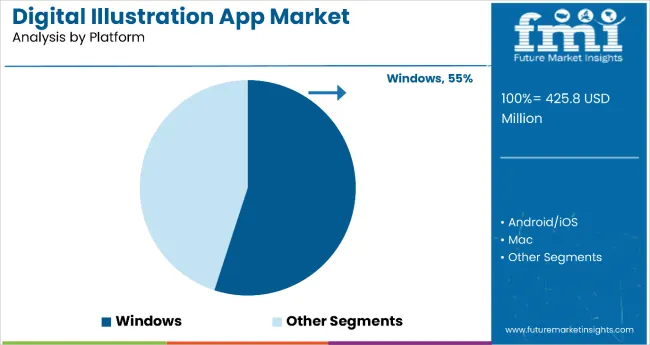
The Windows segment accounts for 55% share. Windows is a popular platform for digital illustration apps due to its wide compatibility, powerful hardware support, and broad user base.
It supports a vast range of professional illustration software such as Adobe Illustrator, CorelDRAW, and Clip Studio Paint, offering artists flexibility and choice. Windows devices often come with high-performance graphics capabilities and are compatible with popular drawing tablets and styluses, making them ideal for creative work.
The platform is also known for its frequent updates, customization options, and affordability across different device types. These factors make Windows a preferred and accessible choice for both beginner and professional digital illustrators.
Key Success Factors Driving the Digital Illustration App Industry
Increasing Demand for Digital Content Pushes the Market Growth
In light of the changes that have occurred in this industry, the market for digital illustration apps will evolve soberly because of its increased demand for digital content across several industries such as entertainment, advertising, gaming, publishing, and social media. Companies now have to depend on a segment of high-quality visuals for effective marketing, branding, and customer engagement based on their increasing dependence on digital content to market products and customers.
Illustrations are distributed across online advertising, social media marketing, websites, blogs, product catalogs, and educational content. The market for visual media has expanded for companies, influencers, and content creators who use illustrations to create even stronger brand identities and differentiation in contested markets.
The creation of a boom in user-generated content around the world as creators are constantly beautifying their audience's accounts with digital illustrations tied to their work as social platforms like Instagram, Pinterest, and TikTok thrive within.
Coupled with this viral nature of such illustrations, the demand for digital tools for art creation continues to surge. Digital illustration apps fast track the process whereby artists, graphic designers, or content makers create top-notch visuals within the shortest time. This helps them keep pace with the constant demand for new content.
Along with this, other industries, such as gaming and animation, are also moving toward digital illustration applications to design highly intricate character designs, storyboards, backgrounds, as well as other visual components.
Available on versatile devices like the tablet, the smartphone, or even the computer, digital illustration tools have democratized creativity, making it possible for novice and professional artists alike to take advantage of powerful features at manageable prices. In this way, by providing the necessary ingredients for creativity all over the world, the global demand for digital content is still escalating among diverse sections.
Rise of Mobile and Tablet Illustration Tools Emerges as Market Driver
Devices including an iPad or Microsoft Surface, which have considerable processing power, benefit from huge touchscreens, attachable styluses, and portability, which has turned them into must-have gadgets for digital artists.
They serve as a portable, easy, and extremely effective platform to create art fit for any professional, thus drawing the interest of artists requiring flexibility in their crafts. Thanks to the flexibility presented by a tablet and a smartphone, illustrators can complete art projects from almost anywhere: on-the-way, in public spaces, or snugly at home-certainly one of the major pulls for a professional or hobbyist.
Today's mobile and tablet illustration applications have many of the long-available advanced features for desktop software. Digital illustrators can now easily use a stylus equipped with pressure sensitivity, thus mimicking the natural feel of a real pencil, brush, or marker, making creation of digital art even more intuitive and complex designs possible with more precision and ease compared to previously.
Also, mobile applications are much cheaper than desktop versions of applications so that they may have lower walls of accessibility for novice or student artists and hobbyists.
High Cost of Premium Software Subscriptions May Become a Challenge in the Market
The cost of digital premium illustration software sometimes restricts many potential users from accessing the market. Most of these applications have basic editions free of charge or at lower prices depending on what it involved, but from advanced features, professional-grade tools, and even the slightest of resources, that is where a subscription fee comes in or a flat one-off payment- for instance, well-known tools of digital illustration like Adobe Illustrator, CorelDRAW, or Procreate; all have premiums that unlock all features controlled by them.
Yet again, costs get placed for emerging artists, hobbyists, students, and users across developing countries where affordability might be a challenge.
The subscription model may even create a cyclical way of charging for users that may be strenuous to manage in the long run. Even though some of the mobile devices provide cheap alternatives, most have a weakness in depth in tools applied and precision, viewed as inadequate for professional-quality designing. This may lead users toward totally free or reduced-cost alternatives, like GIMP or Inkscape, which do not have the same advanced capabilities but are sufficient for casual use.
Thus, the actual marketing price of premium tools could narrow the access range for the application to such a wide audience in sensitive price markets. And as this market of digital illustration applications expands, developers are going to have to look into that by presenting a tiered pricing scheme or by coming up with less expensive solutions to tap a wider, more diversified user base.
Market Structure and Concentration Analysis for Digital Illustration Applications
Tier-1 vendors in this digital illustration application category comprise industry pacesetters like Adobe (Illustrator), Corel (CorelDRAW), and Autodesk (Sketchbook). The vendors have captured the market with a robust presence, superior feature sets, and professional drawing tools.
They are inclined towards the high-end users like professionals, agencies, and very large corporations. Subscription models and continuous innovation are offered to these users. The entire contribution made by Tier 1 vendors comes to something between 45% - 50% of the total market size.
Tier-2 include vendors such as Affinity (Affinity Designer) and Clip Studio Paint, which have a narrow offering of strong tools at prices lower than Tier-1 vendors' prices. They cater to the semi-professional and serious hobbyist markets through a broad range of features for digital artists, illustrators, and graphic designers and typically pursue versatility and accessibility for intermediate users. Thus Tier 2 would probably constitute around 15% - 20% market size capture.
Tier 3 consists of smaller niche vendors such as Procreate, Krita, or Inkscape. In addition, these companies mostly offer free or low-cost applications that have just the most basic features and target non-professionals like typical hobbyists and casual users, including school students.
They provide easy-to-use tools, usually with fewer advanced functions, but the attraction could still reach the most casual user segments, especially through mobile devices. About 25% - 30% of the total market size would be share of Tier 3 vendors, approximately.
Top Countries Advancing Usage and Monetization of Digital Illustration Apps
The section highlights the CAGRs of countries experiencing growth in the digital illustration app market, along with the latest advancements contributing to overall market development. Based on current estimates USA, India and Germany are expected to see steady growth during the forecast period.
| Countries | CAGR from 2025 to 2035 |
|---|---|
| India | 15.2% |
| China | 13.4% |
| Germany | 12.1% |
| KSA | 11.6% |
| United States | 12.9% |
Rise in the Smartphone Penetration and Social Media Use Fuels the Market Growth in India
Digital tools become abundantly available, thanks to a rapid increase in smartphone penetration and internet access; over 750 million internet users for India in 2023, a good percentage of which owns smartphones to access mobile illustration apps such as Procreate and Adobe Fresco. Furthermore, the home-grown creative industry in the country has developed into a market with the emergence of graphic designers, animators, and content creators who seek the use of these tools.
Other platforms such as YouTube and Instagram have also flourished, thus establishing an avenue for digital artists to create and share content. Equipped with increasing digital literacy and shifting towards online education, more people in the country now figure out that graphic design and digital illustrations could benefit their careers.
The increasing acceptability of low-cost mobile applications along with some free alternatives such as Krita and Inkscape is appealing to the relatively lower-income groups further extending the expansion of this market segment.
Established Technology Ecosystem in USA Grows the Market in the Country
Application software innovators like Adobe (Illustrator) and Autodesk (Sketchbook) are commonly competitors in the cloud and AI integration markets. The aforementioned factors have prompted a rise in demand for user-friendly yet sophisticated applications because of the creation of digital content on platforms such as Instagram, YouTube, and TikTok, where USA content creators dominate the angle of production for visual media.
In addition, the USA market creative industries include animation, graphic design, and video game development, thereby increasing the need for further advanced illustration products. According to Statista, the value of the USA graphic design market stood at more than USD 15 billion as of 2023, owing largely to the high demand for digital illustration software.
Market in China is Booming with Rapid Digital Transformation and Adoption of New Technologies
FMI reports that China is the largest smartphone market in the world, as per the above recent information, boasting more than 1.6 billion mobile connections as of 2023 and giving rise to a growing demand for mobile-friendly design apps. And in addition to all that, the promotion of digital innovation and development of the creative economy by the Chinese government are bolstering the market.
The wants of modernization through technological advancement are combined with other programs like Made in China 2025, which are intended to promote technological developments from local software firms. Meanwhile, increasing social media platforms like WeChat, Douyin, and Bilibili have ignited further interest in creating digital content, leading to more requirements for digital art tools. Local vendors, like Tencent and Huawei, are providing further growth to the market by presenting cloud-based solutions and strong device ecosystems.
Strategic Assessment of Competitive Dynamics in the Digital Illustration App Space
The competition in the digital illustration app market is intense, with numerous players targeting different user segments. The major companies are advancing their products with new features that include an AI, cloud, and cross platform; on the other hand, the medium companies will try to make a product differentiation through cost-effective, rich-featured alternative solutions along with very strong community support.
Furthermore, the growing trend of mobile-first applications and freemium software-as-a-service product offerings has made competition even hotter. The pricing strategies, subscription models, and localized offerings are what set them apart. The competition among both the big established enterprises in the market and the small new entrants is not going to taper down, especially as the requirement for user-friendly as well as professional tools increases.
Industry Update
- In October 2022, the most recent updates for Adobe Express were revealed by Adobe at Adobe MAX, the largest creativity conference in the world. Adobe Express is a template-based online and mobile tool that facilitates creators to smoothly create, edit, and share unique content anytime.
- In October 2022, an update to the introduction of Clip Studio Paint Ver. 2.0 was made by Clip Studio Paint. With configurable proportions for features like the eyes, nose, and mouth, this will provide a 3D head model. Additionally, it will have a hand pose scanner that makes it possible to apply live hand captures to 3D models as well as a more user-friendly and realistic color mixing system.
- In July 2021, FXhome updated the very advanced picture-making application Imerge Pro. In addition to the eight new effects, the update added new presets for effect stacking and underwent considerable modifications to the effects interface. Imerge Pro has avoided being grouped with other Photoshop alternatives by employing a method of picture production that is adjustable, versatile, and built for the various user workflow processes.
Top Companies Shaping the Digital Illustration App Market
- Corel Corporation
- Krita Foundation
- Adobe, Inc.
- Ibis Mobile Inc.
- Clip Studio Paint
- Autodesk, Inc.
- Affinity Designer
- Inkscape
- Serif Labs
- Ambient Design
Report Scope Table - Digital Illustration App Market
| Report Attributes | Details |
|---|---|
| Current Total Market Size (2025) | USD 425.8 million |
| Projected Market Size (2035) | USD 1,370.5 million |
| CAGR (2025 to 2035) | 12.40% |
| Base Year for Estimation | 2024 |
| Historical Period | 2020 to 2024 |
| Projections Period | 2025 to 2035 |
| Quantitative Units | USD million for value and million downloads for volume |
| App Types Analyzed (Segment 1) | Vector-Based Illustration Apps, Pixel-Based Illustration Apps |
| Platforms Analyzed (Segment 2) | Android/iOS, Windows, Mac |
| End Users Analyzed (Segment 3) | Personal Users, Enterprise Users, Digital Artists |
| Regions Covered | North America; Latin America; Western Europe; Eastern Europe; South Asia and Pacific; East Asia; Middle East & Africa |
| Countries Covered | United States, Canada, Mexico, Brazil, Argentina, Germany, France, United Kingdom, Italy, Spain, Netherlands, China, India, Japan, South Korea, ANZ, GCC Countries, South Africa |
| Key Players influencing the Digital Illustration App Market | Corel Corporation, Krita Foundation, Adobe, Inc., Ibis Mobile Inc., Clip Studio Paint, Autodesk, Inc., Affinity Designer, Inkscape, Serif Labs, Ambient Design |
| Additional Attributes | User preference for pixel vs vector-based interfaces, Feature innovation in creative tools and stylus compatibility, Cross-platform availability and user engagement trends, Enterprise-level integration of design apps, Monetization through subscriptions and in-app purchases |
| Customization and Pricing | Customization and Pricing Available on Request |
Top Investment Segments in the Digital Illustration App Market
By App Type:
In terms of product type, the segment is divided into Vector-based Illustration Apps and Pixel-Based Illustration Apps.
By Platform:
In terms of sampling method, the segment is segregated into Android/iOS, Windows and Mac.
By End User:
In terms of industry, the segment is segregated into Personal Users, Enterprise Users & Digital Artists.
By Region:
A regional analysis has been carried out in key countries of North America, Latin America, East Asia, South Asia & Pacific, Western Europe, Eastern Europe and Middle East and Africa (MEA).
Frequently Asked Questions
What is the future of Global Digital Illustration App industry?
The Global Digital Illustration App industry is projected to witness CAGR of 12.5% between 2025 and 2035.
What was the worth of the Global Digital Illustration App industry in 2025?
The Global Digital Illustration App industry stood at USD 425.8 million in 2025.
What will the worth of Global Digital Illustration App industry by 2035 end?
The Global Digital Illustration App industry is anticipated to reach USD 1.36 billion by 2035 end.
Which region to showcase the highest CAGR during forecast period?
South Asia & Pacific is set to record the highest CAGR of 14.7% in the assessment period.
Who are the key providers of Global Digital Illustration App industry?
The key players operating in the Global Digital Illustration App industry includes Corel Corporation, Krita Foundation, Adobe, Inc., Autodesk Inc, Clip Studio Paint, Inc. among others.
Preview the report firsthand - request a free sample
Get SampleGet the brochure for pricing and purchase details.
Get PDFTable of Content
- Executive Summary
- Market Introduction
- Market Trends
- Pricing Analysis, By App Type
- Global Market Demand Analysis 2020 to 2024 and Forecast 2025 to 2035
- Global Market Analysis, By App Type
- Vector-based Illustration Apps
- Pixel-Based Illustration Apps
- Global Market Analysis, By Platform
- Android/iOS
- Windows
- Mac
- Global Market Analysis, By End User
- Personal Users
- Enterprise Users
- Digital Artists
- Global Market Analysis, By Region
- North America
- Latin America
- East Asia
- South Asia & Pacific
- Western Europe
- Eastern Europe
- Middle East and Africa
- North America Sales Analysis, by Key Segments and Countries
- Latin America Sales Analysis, by Key Segments and Countries
- East Asia Sales Analysis, by Key Segments and Countries
- South Asia & Pacific Sales Analysis, by Key Segments and Countries
- Western Europe Sales Analysis, by Key Segments and Countries
- Eastern Europe Sales Analysis, by Key Segments and Countries
- Middle East and Africa Sales Analysis, by Key Segments and Countries
- Sales Forecast 2025 to 2035 By App Type, Platform, End User for 30 Countries
- Competition Outlook, including Market Structure Analysis
- Company Profile
- Corel Corporation
- Krita Foundation
- SYSTEMAX, Inc.
- Ibis Mobile Inc.
- Savage Interactive Pty Ltd
- MediBang Inc.
- Sergei Komarov
- The GIMP Team
- Serif Labs
- Ambient Design


