

- Industry Size (2026)
- USD 4860 Mn
- Forecast (2036)
- USD 12940 Mn
- CAGR (2026 to 2036)
- 10.3%
Design-for-Recycling Packaging Market Forecast and Outlook 2026 to 2036
The design-for-recycling packaging market revenue is likely to total USD 4,860 million in 2026, rising further to USD 12,940 million by 2036, at a CAGR of 10.3%. Future Market Insights analysis indicates this market is transitioning from a compliance-driven consideration to a core design principle embedded in new product development.
This expansion through 2026 is fueled by the enforcement of recyclability mandates in key regions, the financial implications of extended producer responsibility schemes, and advancements in material science that deliver necessary performance from simplified, recyclable structures.
Regulatory requirements under the EU’s PPWR are increasingly influencing how packaging is specified, qualified, and placed on the market. The regulation establishes mandatory recyclability criteria by 2030, with interim compliance thresholds already shaping material selection and structure design decisions. This has accelerated a shift away from complex, non-recyclable laminates toward formats that can demonstrably meet recyclability criteria at scale.
In 2024, Mondi expanded its BarrierPack Recyclable portfolio to support this transition, targeting the replacement of aluminum-containing and PET-based multilayer structures in flexible food packaging with recyclable polyolefin-based and paper-based high-barrier alternatives while preserving shelf-life performance.
Material innovation is increasingly centered on achieving barrier performance without introducing components that disrupt established recycling streams. Instead of adding functional layers, suppliers are simplifying structures and embedding performance directly into recyclable substrates.
Huhtamaki’s 2024 commercialization of its Push Tab® fiber-based foodservice packaging reflects this approach. The design integrates a recyclable barrier coating within the paper structure, reducing separation requirements during recycling and supporting compatibility with existing paper recovery systems.
EPR fee modulation is reinforcing these design shifts. In the UK and in emerging EU frameworks linked to the PPWR, packaging formats verified as recyclable are subject to lower EPR fees than non-recyclable alternatives. This introduces a direct economic consequence for packaging design choices, repositioning recyclability as a cost-linked qualification parameter. Berry Global’s 2024 sustainability disclosures highlight continued development of mono-material polyethylene pouches and films aligned with recyclability guidelines, positioning these formats as increasingly cost-advantaged as EPR fee differentiation intensifies.
Packaging redesign is also being evaluated against manufacturing constraints. High-speed filling and sealing performance remains a critical qualification requirement for high-volume consumer goods. Through 2024 and into 2025, Amcor has continued collaborative development with chemical suppliers to advance sealant resin technologies tailored for mono-material PE and PP packaging. These materials are designed to deliver consistent sealing performance at commercial line speeds, enabling adoption of recyclable formats without compromising operational efficiency.
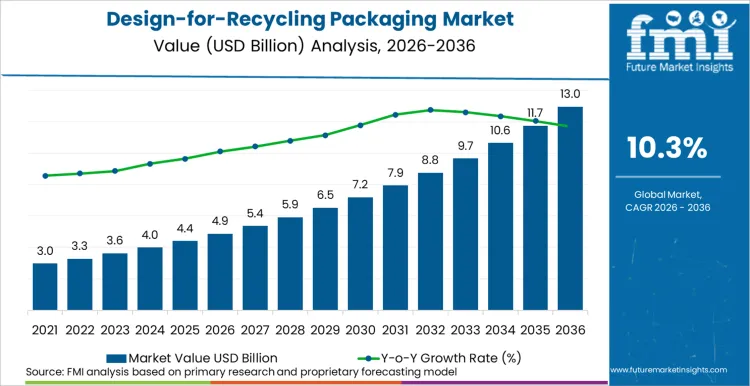
Summary of Design-for-Recycling Packaging Market
What is the Long-Term Growth Outlook for the Design-for-Recycling Packaging Market?
FMI projects the global design-for-recycling packaging market to expand from USD 4,860 million in 2026 to USD 12,940 million by 2036, registering a 10.3% CAGR. This robust growth reflects a systemic transformation in packaging development, where recyclability is now a non-negotiable design parameter alongside protection, marketing, and cost.
FMI Research Approach: This projection is derived from FMI's proprietary model analyzing the implementation timelines of recyclability laws (EU PPWR, state laws in USA), corporate packaging sustainability pledges, capital expenditure by converters into mono-material production lines, and consumer adoption rates of products in redesigned packaging.
How do FMI Analysts Expect the Design-for-Recycling Packaging Market to Evolve Structurally?
FMI analysts anticipate a market evolution beyond simple mono-material substitution toward sophisticated, system-compatible design. This includes the rise of digital watermarks (e.g., HolyGrail 2.0) for accurate sorting, the design of attachments (closures, labels) for easy separation, and the development of performance-equivalent barriers using water-based or vapor-deposited coatings.
FMI Research Approach: Insights are informed by tracking patent filings in recyclable barrier technologies, analysis of packaging testing protocols from recyclability certification bodies and monitoring design guidelines issued by major waste management organizations.
Which Geographies Command Strategic Importance in the Design-for-Recycling Packaging Market?
Strategic growth is concentrated in regions with advanced regulatory frameworks and large consumer packaging markets. Germany is the regulatory and innovation leader. The United States market is driven by state-level policies and corporate commitments. China and India represent high-growth markets where government policies on plastic waste are catalyzing rapid change in packaging design for both domestic and export goods. Japan focuses on precision design and waste stream efficiency.
FMI Research Approach: Regional market sizing is based on the stringency and enforcement of design-for-recycling regulations, the structure of EPR systems, the volume of packaged consumer goods, and investments in local recycling infrastructure.
What Will Be the Market Size of Design-for-Recycling Packaging by 2036?
By 2036, the design-for-recycling packaging market is expected to reach USD 12,940 million. This expansion will be sustained as recyclability standards become the global baseline, rendering non-compliant packaging obsolete in regulated markets.
FMI Research Approach: The long-term outlook incorporates forecasts for global packaging demand, the phase-out timelines for non-recyclable packaging in key regions, and the ongoing R&D cost required to develop next-generation recyclable solutions for challenging applications like high-barrier food packaging.
What are some Globally Distinct Trends Shaping the Design-for-Recycling Packaging Market?
The market is shaped by the drive for mono-material solutions, the critical role of digital markers for sorting, and the concept of "pre-cycling" – designing packaging to avoid recycling contamination. The shift to PE and PP mono-structures dominates flexible packaging. Digital watermarks are becoming essential for ensuring correctly sorted.
FMI Research Approach: Trend identification involves monitoring the adoption of digital watermarking initiatives, analyzing new product launches for material composition, and reviewing updates to packaging design-for-recycling guidelines from global associations like CEFLEX and the Ellen MacArthur Foundation.
Design-for-Recycling Packaging Market Key Takeaways
| Metrics | Values |
|---|---|
| Expected Value (2026E) | USD 4,860 million |
| Projected Value (2036F) | USD 12,940 million |
| CAGR (2026-2036) | 10.3% |
Source: Future Market Insights (FMI) analysis, based on proprietary forecasting model and primary research
Why is the Design-for-Recycling Packaging Market Growing?
An important driver is the economic impact of EPR schemes that modulate fees based on recyclability. Packaging that is not designed for recycling incurs prohibitively high EPR costs, making redesign a financially urgent matter. This direct link between packaging design and corporate P&L statements is compelling rapid adoption, as seen in France’s CITEO system, where fee differentials have directly spurred investment in recyclable flexible packaging solutions.
Corporate commitments to 100% recyclable, reusable, or compostable packaging are creating massive, locked-in demand. Major FMCG companies have public deadlines (2025-2030) for these goals. To meet them, they are issuing new packaging specifications to suppliers that mandate design-for-recycling principles, often requiring third-party certification from bodies like How2Recycle or RecyClass. This top-down specification change is restructuring entire packaging supply chains, forcing converters to innovate or lose business.
Technological breakthroughs in barrier materials and sealing are enabling the shift. Traditional high-barrier packaging used complex, non-recyclable laminates. New technologies, such as vapor-deposited silica coatings on films or molecularly oriented EVOH layers within mono-PP structures, are providing the necessary oxygen and moisture barrier in formats that are compatible with polyolefin recycling streams. These advancements are removing the last technical excuses for non-recyclable designs in many applications.
How is Design-for-Recycling Packaging Market Segmented?
The immense volume of fast-moving consumer goods requiring packaging redesign defines the market segment landscape. FMCG and food packaging leads demand, with mono-material packs emerging as the dominant structural answer.
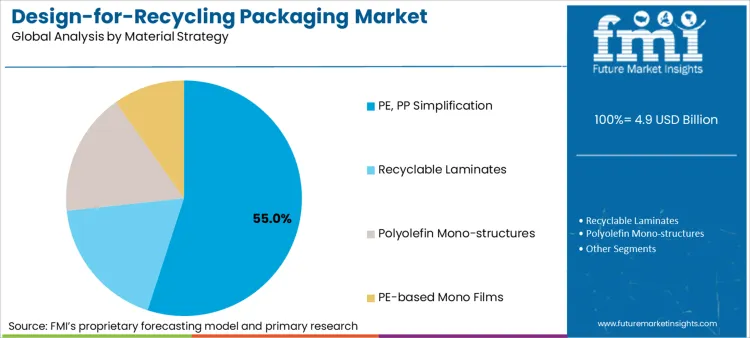
The material strategy centers on simplifying structures to pure PE or PP, enabled by technologies focused on replacing complex barriers and reducing material use without sacrificing protection.
How is the FMCG and Food Sector Driving Systemic Change?
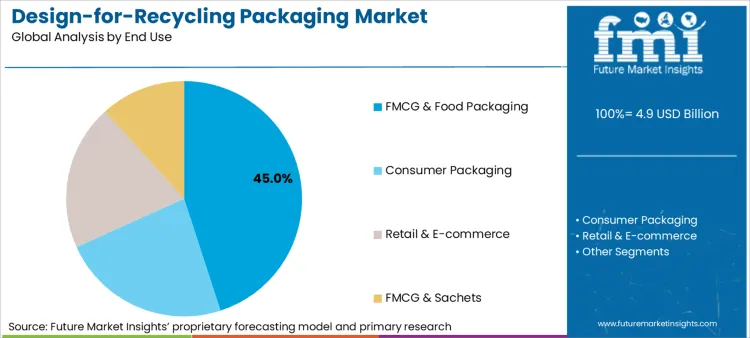
FMCG and food packaging represents the largest end-use segment with a 45.0% share. This sector generates the highest volume of post-consumer packaging waste and faces the most intense regulatory and consumer scrutiny. The challenge is to redesign billions of units of packaging-or snacks, confectionery, dairy, and household products—that are currently multi-material, into formats that can be efficiently recycled. This volume makes the sector the primary battleground for scalable design-for-recycling innovation.
This segment’s requirements validate new technologies. A successful mono-material barrier pouch for coffee or crackers must have a shelf life identical to its non-recyclable predecessor, run on existing high-speed filling lines, and be cost-competitive. Solutions that meet this trifecta, as several major brands began rolling out in 2024-2025, demonstrate the market's maturation.
Which Packaging Format Embodies the Design-for-Recycling Principle?
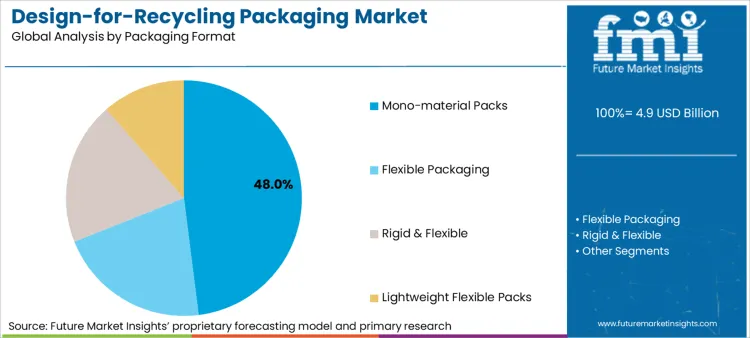
Mono-material packs constitute the leading packaging format segment with a 48.0% share. This format, whether rigid or flexible, is made from a single polymer family (e.g., all-PE, all-PP), sometimes with compatible barrier coatings. The core design principle is to eliminate material combinations that cannot be separated and thus contaminate recycling streams. Mono-material design ensures the entire package can be processed through a single recycling pathway, maximizing yield and quality of the output recyclate.
The dominance of this format directs R&D across the industry. Material scientists, machinery manufacturers, and converters are all aligning their efforts to enable high-performance, high-speed production of mono-material packaging, making it the central pillar of the design-for-recycling movement.
What is the Prevailing Material Simplification Strategy?
PE and PP simplification is the leading material strategy segment with a 55.0% share. Polyethylene and Polypropylene are the most widely recycled polyolefins with established collection and processing infrastructure in many regions. The strategy involves redesigning packaging that previously incorporated PET, PA, EVOH, or aluminum into structures that use only PE or PP, often through advanced co-extrusion of different PE/PP grades to achieve required properties. This simplification to polyolefins maximizes the likelihood that packaging will be effectively recycled in practice, not just in theory.
Which Technology Enables the Shift to Simplified Materials?
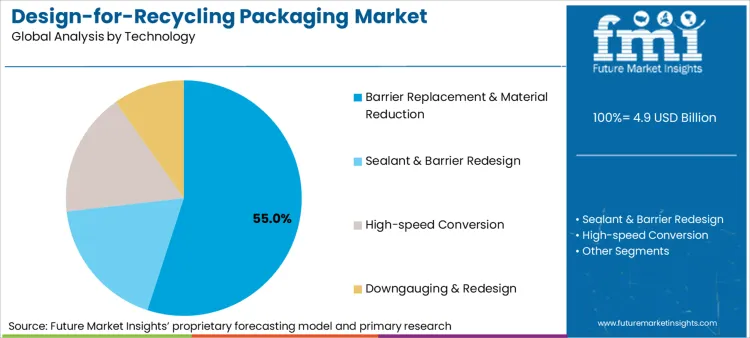
Barrier replacement and material reduction is the dominant technology segment with a 55.0% share. This encompasses the suite of innovations required to maintain product protection while removing non-recyclable materials. It includes developing new recyclable barrier coatings, redesigning sealant layers to be compatible with the main polymer, and downgauging material thickness through stronger polymer grades or better structural design. The technology's goal is to deliver equal or better functionality from a simpler, lighter, and recyclable material system.
What Drivers, Restraints, Opportunities, and Trends Prevail in the Design-for-Recycling Packaging Market?
Major supermarket chains and e-commerce platforms are setting their own packaging sustainability standards, often ahead of regulation. To maintain shelf space or platform access, suppliers must comply with these private standards, which universally mandate design-for-recycling. This commercial pressure is often more immediate and influential than government policy, accelerating redesign timelines across entire categories.
A primary restraint is the higher initial cost and performance limitations of some next-generation recyclable materials. Advanced mono-material barriers or new recyclable coatings can be more expensive than incumbent multi-layer laminates. Additionally, for some highly sensitive products (e.g., certain pharmaceuticals, high-oxygen-sensitive foods), the absolute barrier performance of recyclable designs may not yet match that of aluminum foil-based laminates, limiting immediate application scope and requiring further R&D.
A significant opportunity lies in developing design-for-recycling standards for e-commerce and logistics packaging. The explosive growth of e-commerce has created a wave of packaging often designed for durability, not recyclability. Developing and implementing standards for recyclable cushioned mailers, void fill, and corrugated boxes with easy-to-remove tape/labels represents a vast, fast-growing market segment where design principles can be embedded from the start.
A defining technical trend is the integration of digital watermarks into packaging design. Initiatives like HolyGrail 2.0 promote embedding nearly invisible codes on packaging. When scanned at recycling facilities, these codes identify the precise material composition and instruct sortation machinery. This technology allows for more sophisticated packaging designs to be accurately sorted, providing a bridge between today's infrastructure and future packaging innovation.
Minimum viable packaging combines design-for-recycling with radical source reduction. Beyond material simplification, brands are reevaluating the necessity of secondary packaging, excess headspace, and decorative elements that hinder recycling. This holistic approach, using tools like life-cycle assessment, aims to deliver the product with the absolute minimum amount of correctly designed material, optimizing both resource efficiency and end-of-life outcomes.
Analysis of Design-for-Recycling Packaging Market by Key Countries
| Country | CAGR (2026-2036) |
|---|---|
| India | 13.6% |
| China | 12.4% |
| USA | 9.8% |
| Germany | 9.6% |
| Brazil | 10.0% |
| Japan | 8.2% |
Source: Future Market Insights (FMI) analysis, based on proprietary forecasting model and primary research
How are EPR Rules and Sachet Economy Redefining the Indian Market?
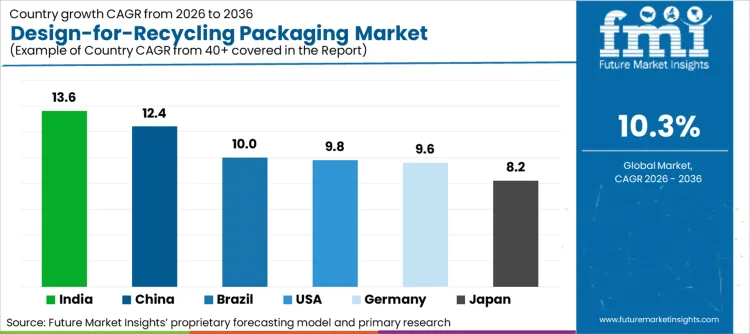
India is projected to expand at a 13.6% CAGR through 2036, the highest among key nations. This is propelled by the stringent enforcement of its EPR rules and the unique challenge of redesigning the ubiquitous multi-layer plastic sachet. The government's focus on phasing out non-recyclable MLPs is driving innovation in mono-material flexible packs, particularly PE-based structures, for small-portion FMCG products.
Domestic converters like UFlex are pioneering downgauged, high-barrier mono-PE films to replace traditional sachet materials, aligning with both regulation and the low-cost, high-volume needs of the market.
How do Supply Chain Modernization and Export Demands Shape the Chinese Market?
China’s market is growing at a 12.4% CAGR, driven by its Green Packaging standardization initiatives and the need for export-oriented manufacturers to comply with international regulations like the EU PPWR.
The focus is on developing polyolefin mono-structures for both rigid and flexible applications that can be produced at high speed to serve the massive domestic retail and e-commerce market. Companies like Amcor China and Greatview are investing in advanced co-extrusion and lamination technologies to produce these recyclable solutions at the scale demanded by Chinese consumer goods companies.
Which Mix of State Legislation and Corporate Initiatives Defines the US Market?
USA’s 9.8% CAGR is shaped by a growing patchwork of state laws setting recyclability criteria and by the powerful sustainability agendas of large retailers and brands. The absence of a federal standard creates complexity but drives innovation in flexible packaging, particularly in developing recyclable laminates and sealant/barrier redesigns. US-based material suppliers and converters are working closely with brands to pilot new mono-material solutions that can be scaled nationally while navigating varying state requirements.
How do EU's PPWR and Deposit System Alignment Steer the German Market?
The EU PPWR and its well-established packaging waste management system directly govern Germany’s market, expanding at a 9.6% CAGR. The focus is on precision engineering of mono-material packs to ensure they not only meet legal design criteria but also perform flawlessly in the country's high-tech sorting and recycling facilities.
The alignment with Germany's deposit return system for beverages further incentivizes design-for-recycling, as packaging that contaminates the PET or aluminum stream incurs significant financial penalties, pushing for impeccable material purity in design.
What Role does the Circular Economy Roadmap Play in the Brazilian Market?
The National Solid Waste Policy and sectoral agreements that are increasingly incorporating design-for-recycling principles influence Brazil’s market, with a 10.0% CAGR. The growing domestic consumer market and pressure from global brands are driving demand for more sustainable packaging.
The opportunity lies in adapting global mono-material solutions to local recycling infrastructure, which is strong for certain streams like aluminum and PET but developing for flexible plastics, requiring tailored design approaches.
How does a Focus on Waste Sorting Efficiency Influence Japan?
Japan’s market, growing at an 8.2% CAGR, is defined by its highly efficient, consumer-participatory waste sorting system. Design-for-recycling focuses on creating packaging that consumers can easily and correctly separate according to municipal rules. This drives innovation in lightweight flexible packs with clear, simple material identification and features like easy-to-peel labels or separable components. The design goal is to minimize human error in the sorting process, ensuring the packaging flows into the correct, high-purity recycling stream.
What is the Competition Outlook for Design-for-Recycling Packaging?
Competitive intensity centers on technological mastery in barrier performance and sealing within mono-material structures, and the speed of commercialization. Leaders are those who can offer a portfolio of pre-tested, certified solutions that meet both brand performance needs and regulatory/EPR requirements. The landscape features competition between large, integrated packaging giants with in-house R&D and smaller, agile specialists focusing on breakthrough coating or material technologies.
Strategic moves are characterized by partnerships across the value chain. Packaging converters are forming tight alliances with resin producers to develop new polymer grades and with recycling organizations to test and certify their designs. Success depends on creating a closed feedback loop where packaging performance in real-world recycling systems informs the next generation of design, requiring deep collaboration rather than operating in isolation.
Recent Developments
- Mondi launched FunctionalBarrier Paper Ultimate in 2025, a paper-based ultra-high barrier packaging solution designed for recycling in standard paper recycling streams. It delivers low oxygen and moisture transmission rates suitable for dried food and other applications formerly reliant on non-recyclable multi-material laminates, helping brands meet circularity goals.
- In 2024, Berry Global partnered with VOID Technologies to commercialize a high-performance PE film engineered for recyclable, mono-material flexible packaging applications such as pet food. The solution enhances mechanical performance while enabling store drop-off recycling via mono-PE streams and aligns with sustainable design-for-recycling practices.
- In late 2025, Sealed Air introduced Cryovac® VPP MonoPro, a recycle-ready mono-material VFFS packaging solution with strong barrier properties. Designed with low or no polyamide content, it allows food processors to shift away from complex multi-layer films and facilitate compatibility with current recycling infrastructure.
Key Players Profiled
- Mondi Group
- Huhtamaki Oyj
- Berry Global Inc.
- Sealed Air Corporation
- Amcor plc (China operations)
- Greatview Aseptic Packaging Co., Ltd.
- UFlex Limited
Market Definition
The design-for-recycling packaging market comprises revenue generated from the sale of primary, secondary, and tertiary packaging that is intentionally engineered to be effectively and efficiently recycled in mainstream post-consumer collection, sorting, and reprocessing systems. This packaging is characterized by the use of compatible, single-polymer materials or easily separable components, the avoidance of elements that disrupt recycling, and often carries certification from recognized bodies verifying its recyclability.
The market scope includes the value of the packaging materials such as films, rigid containers, and paperboard supplied in formats meeting these design principles. It covers both newly designed packaging and redesigned versions of existing packaging formats. The market excludes packaging that is technically recyclable in theory but not in widespread practice due to design flaws, and packaging designed solely for composting or reuse without consideration for mechanical recycling pathways.
Scope of Report
| Items | Values |
|---|---|
| Quantitative Units | USD Million for revenue |
| End-use | FMCG & Food Packaging, Consumer Packaging, Retail & E-commerce, FMCG & Sachets, Other |
| Packaging Format | Mono-material Packs, Flexible Packaging, Rigid & Flexible, Lightweight Flexible Packs, Other |
| Material Strategy | PE, PP Simplification, Recyclable Laminates, Polyolefin Mono-structures, PE-based Mono Films, Other |
| Technology | Barrier Replacement & Material Reduction, Sealant & Barrier Redesign, High-speed Conversion, Downgauging & Redesign, Other |
| Regions Covered | North America, Europe, Asia-Pacific, Latin America, Middle East & Africa |
| Countries | USA, Germany, China, India, Brazil, Japan and 40+ countries |
| Key Companies | Mondi, Huhtamaki, Berry Global, Sealed Air, Amcor China, Greatview, UFlex |
Source: Future Market Insights (FMI) analysis, based on proprietary forecasting model and primary research
Design-for-Recycling Packaging Market Key Segments
End-use
- FMCG & Food Packaging
- Consumer Packaging
- Retail & E-commerce
- FMCG & Sachets
- Other
Packaging Format
- Mono-material Packs
- Flexible Packaging
- Rigid & Flexible
- Lightweight Flexible Packs
- Other
Material Strategy
- PE, PP Simplification
- Recyclable Laminates
- Polyolefin Mono-structures
- PE-based Mono Films
- Other
Technology
- Barrier Replacement & Material Reduction
- Sealant & Barrier Redesign
- High-speed Conversion
- Downgauging & Redesign
- Other
Region
- North America
- Europe
- Asia-Pacific
- Latin America
- Middle East & Africa
Bibliography
- CEFLEX. (2024). Designing flexible packaging for a circular economy: Design for recycling guidelines and performance considerations. Circular Economy for Flexible Packaging.
- RecyClass. (2024). Design for recycling guidelines for plastic packaging: Evaluation methodology and recyclability criteria. RecyClass.
- How2Recycle. (2025). Updated design guidance for recyclable packaging. Sustainable Packaging Coalition.
- PlasticsEurope. (2024). Plastics – the facts 2024: Packaging design, material flows, and recycling performance. PlasticsEurope Association.
- World Packaging Organisation. (2024). Packaging sustainability and recyclability: Global design trends and regulatory alignment. World Packaging Organisation.
- International Solid Waste Association. (2024). Packaging design and sorting efficiency in modern recycling systems. ISWA.
- Smithers. (2024). The future of recyclable packaging materials and barrier technologies. Smithers.
- Sustainable Packaging Coalition. (2024). Critical guidance on recyclability, mono-material design, and labeling effectiveness. SPC.
-
Frequently Asked Questions
- What is the expected value of the design-for-recycling packaging market in 2026?
- The design-for-recycling packaging market is expected to reach USD 4,860 million in 2026.
- What is the projected market value by 2036 and the CAGR?
- By 2036, the market is projected to reach USD 12,940 million, expanding at a CAGR of 10.3% between 2026 and 2036.
- Which packaging format is central to design-for-recycling, and why is it dominant?
- Mono-material packs are the leading format, holding a 48.0% share. This dominance is because packaging made from a single polymer family is compatible with existing recycling infrastructure.
- What is the primary material strategy for achieving recyclability?
- The leading strategy is the simplification of packaging structures to PE and PP, which holds a 55.0% share. These polyolefins have well-established collection and recycling systems.
- Which country is anticipated to be the fastest-growing market and why?
- India is projected to have the highest CAGR at 13.6% through 2036. This growth is fueled by the stringent enforcement of its EPR rules, which are phasing out non-recyclable MLPs.
- What is the key enabling technology for this market?
- Barrier replacement and material reduction is the dominant enabling technology, with a 55.0% share.
Frequently Asked Questions
How big is the design-for-recycling packaging market in 2026?
The global design-for-recycling packaging market is estimated to be valued at USD 4.9 billion in 2026.
What will be the size of design-for-recycling packaging market in 2036?
The market size for the design-for-recycling packaging market is projected to reach USD 13.0 billion by 2036.
How much will be the design-for-recycling packaging market growth between 2026 and 2036?
The design-for-recycling packaging market is expected to grow at a 10.3% CAGR between 2026 and 2036.
What are the key product types in the design-for-recycling packaging market?
The key product types in design-for-recycling packaging market are fmcg & food packaging, consumer packaging, retail & e-commerce and fmcg & sachets.
Which packaging format segment to contribute significant share in the design-for-recycling packaging market in 2026?
In terms of packaging format, mono-material packs segment to command 48.0% share in the design-for-recycling packaging market in 2026.
Preview the report firsthand - request a free sample
Get SampleGet the brochure for pricing and purchase details.
Get PDFTable of Content
- Executive Summary
- Global Market Outlook
- Demand-side Trends
- Supply-side Trends
- Technology Roadmap Analysis
- Analysis and Recommendations
- Market Overview
- Market Coverage / Taxonomy
- Market Definition / Scope / Limitations
- Research Methodology
- Chapter Orientation
- Analytical Lens and Working Hypotheses
- Market Structure, Signals, and Trend Drivers
- Benchmarking and Cross-market Comparability
- Market Sizing, Forecasting, and Opportunity Mapping
- Research Design and Evidence Framework
- Desk Research Programme (Secondary Evidence)
- Company Annual and Sustainability Reports
- Peer-reviewed Journals and Academic Literature
- Corporate Websites, Product Literature, and Technical Notes
- Earnings Decks and Investor Briefings
- Statutory Filings and Regulatory Disclosures
- Technical White Papers and Standards Notes
- Trade Journals, Industry Magazines, and Analyst Briefs
- Conference Proceedings, Webinars, and Seminar Materials
- Government Statistics Portals and Public Data Releases
- Press Releases and Reputable Media Coverage
- Specialist Newsletters and Curated Briefings
- Sector Databases and Reference Repositories
- FMI Internal Proprietary Databases and Historical Market Datasets
- Subscription Datasets and Paid Sources
- Social Channels, Communities, and Digital Listening Inputs
- Additional Desk Sources
- Expert Input and Fieldwork (Primary Evidence)
- Primary Modes
- Qualitative Interviews and Expert Elicitation
- Quantitative Surveys and Structured Data Capture
- Blended Approach
- Why Primary Evidence is Used
- Field Techniques
- Interviews
- Surveys
- Focus Groups
- Observational and In-context Research
- Social and Community Interactions
- Stakeholder Universe Engaged
- C-suite Leaders
- Board Members
- Presidents and Vice Presidents
- R&D and Innovation Heads
- Technical Specialists
- Domain Subject-matter Experts
- Scientists
- Physicians and Other Healthcare Professionals
- Governance, Ethics, and Data Stewardship
- Research Ethics
- Data Integrity and Handling
- Primary Modes
- Tooling, Models, and Reference Databases
- Desk Research Programme (Secondary Evidence)
- Data Engineering and Model Build
- Data Acquisition and Ingestion
- Cleaning, Normalisation, and Verification
- Synthesis, Triangulation, and Analysis
- Quality Assurance and Audit Trail
- Market Background
- Market Dynamics
- Drivers
- Restraints
- Opportunity
- Trends
- Scenario Forecast
- Demand in Optimistic Scenario
- Demand in Likely Scenario
- Demand in Conservative Scenario
- Opportunity Map Analysis
- Product Life Cycle Analysis
- Supply Chain Analysis
- Investment Feasibility Matrix
- Value Chain Analysis
- PESTLE and Porter’s Analysis
- Regulatory Landscape
- Regional Parent Market Outlook
- Production and Consumption Statistics
- Import and Export Statistics
- Market Dynamics
- Global Market Analysis 2021 to 2025 and Forecast, 2026 to 2036
- Historical Market Size Value (USD Million) Analysis, 2021 to 2025
- Current and Future Market Size Value (USD Million) Projections, 2026 to 2036
- Y-o-Y Growth Trend Analysis
- Absolute $ Opportunity Analysis
- Global Market Pricing Analysis 2021 to 2025 and Forecast 2026 to 2036
- Global Market Analysis 2021 to 2025 and Forecast 2026 to 2036, By End Use
- Introduction / Key Findings
- Historical Market Size Value (USD Million) Analysis By End Use , 2021 to 2025
- Current and Future Market Size Value (USD Million) Analysis and Forecast By End Use , 2026 to 2036
- FMCG & Food Packaging
- Consumer Packaging
- FMCG & Sachets
- FMCG & Food Packaging
- Y-o-Y Growth Trend Analysis By End Use , 2021 to 2025
- Absolute $ Opportunity Analysis By End Use , 2026 to 2036
- Global Market Analysis 2021 to 2025 and Forecast 2026 to 2036, By Packaging Format
- Introduction / Key Findings
- Historical Market Size Value (USD Million) Analysis By Packaging Format, 2021 to 2025
- Current and Future Market Size Value (USD Million) Analysis and Forecast By Packaging Format, 2026 to 2036
- Mono-material Packs
- Flexible Packaging
- Rigid & Flexible
- Lightweight Flexible Packs
- Mono-material Packs
- Y-o-Y Growth Trend Analysis By Packaging Format, 2021 to 2025
- Absolute $ Opportunity Analysis By Packaging Format, 2026 to 2036
- Global Market Analysis 2021 to 2025 and Forecast 2026 to 2036, By Material Strategy
- Introduction / Key Findings
- Historical Market Size Value (USD Million) Analysis By Material Strategy, 2021 to 2025
- Current and Future Market Size Value (USD Million) Analysis and Forecast By Material Strategy, 2026 to 2036
- PE, PP Simplification
- Recyclable Laminates
- Polyolefin Mono-structures
- PE-based Mono Films
- PE, PP Simplification
- Y-o-Y Growth Trend Analysis By Material Strategy, 2021 to 2025
- Absolute $ Opportunity Analysis By Material Strategy, 2026 to 2036
- Global Market Analysis 2021 to 2025 and Forecast 2026 to 2036, By Technology
- Introduction / Key Findings
- Historical Market Size Value (USD Million) Analysis By Technology, 2021 to 2025
- Current and Future Market Size Value (USD Million) Analysis and Forecast By Technology, 2026 to 2036
- Barrier Replacement & Material Reduction
- Sealant & Barrier Redesign
- High-speed Conversion
- Downgauging & Redesign
- Barrier Replacement & Material Reduction
- Y-o-Y Growth Trend Analysis By Technology, 2021 to 2025
- Absolute $ Opportunity Analysis By Technology, 2026 to 2036
- Global Market Analysis 2021 to 2025 and Forecast 2026 to 2036, By Region
- Introduction
- Historical Market Size Value (USD Million) Analysis By Region, 2021 to 2025
- Current Market Size Value (USD Million) Analysis and Forecast By Region, 2026 to 2036
- North America
- Latin America
- Western Europe
- Eastern Europe
- East Asia
- South Asia and Pacific
- Middle East & Africa
- Market Attractiveness Analysis By Region
- North America Market Analysis 2021 to 2025 and Forecast 2026 to 2036, By Country
- Historical Market Size Value (USD Million) Trend Analysis By Market Taxonomy, 2021 to 2025
- Market Size Value (USD Million) Forecast By Market Taxonomy, 2026 to 2036
- By Country
- USA
- Canada
- Mexico
- By End Use
- By Packaging Format
- By Material Strategy
- By Technology
- By Country
- Market Attractiveness Analysis
- By Country
- By End Use
- By Packaging Format
- By Material Strategy
- By Technology
- Key Takeaways
- Latin America Market Analysis 2021 to 2025 and Forecast 2026 to 2036, By Country
- Historical Market Size Value (USD Million) Trend Analysis By Market Taxonomy, 2021 to 2025
- Market Size Value (USD Million) Forecast By Market Taxonomy, 2026 to 2036
- By Country
- Brazil
- Chile
- Rest of Latin America
- By End Use
- By Packaging Format
- By Material Strategy
- By Technology
- By Country
- Market Attractiveness Analysis
- By Country
- By End Use
- By Packaging Format
- By Material Strategy
- By Technology
- Key Takeaways
- Western Europe Market Analysis 2021 to 2025 and Forecast 2026 to 2036, By Country
- Historical Market Size Value (USD Million) Trend Analysis By Market Taxonomy, 2021 to 2025
- Market Size Value (USD Million) Forecast By Market Taxonomy, 2026 to 2036
- By Country
- Germany
- UK
- Italy
- Spain
- France
- Nordic
- BENELUX
- Rest of Western Europe
- By End Use
- By Packaging Format
- By Material Strategy
- By Technology
- By Country
- Market Attractiveness Analysis
- By Country
- By End Use
- By Packaging Format
- By Material Strategy
- By Technology
- Key Takeaways
- Eastern Europe Market Analysis 2021 to 2025 and Forecast 2026 to 2036, By Country
- Historical Market Size Value (USD Million) Trend Analysis By Market Taxonomy, 2021 to 2025
- Market Size Value (USD Million) Forecast By Market Taxonomy, 2026 to 2036
- By Country
- Russia
- Poland
- Hungary
- Balkan & Baltic
- Rest of Eastern Europe
- By End Use
- By Packaging Format
- By Material Strategy
- By Technology
- By Country
- Market Attractiveness Analysis
- By Country
- By End Use
- By Packaging Format
- By Material Strategy
- By Technology
- Key Takeaways
- East Asia Market Analysis 2021 to 2025 and Forecast 2026 to 2036, By Country
- Historical Market Size Value (USD Million) Trend Analysis By Market Taxonomy, 2021 to 2025
- Market Size Value (USD Million) Forecast By Market Taxonomy, 2026 to 2036
- By Country
- China
- Japan
- South Korea
- By End Use
- By Packaging Format
- By Material Strategy
- By Technology
- By Country
- Market Attractiveness Analysis
- By Country
- By End Use
- By Packaging Format
- By Material Strategy
- By Technology
- Key Takeaways
- South Asia and Pacific Market Analysis 2021 to 2025 and Forecast 2026 to 2036, By Country
- Historical Market Size Value (USD Million) Trend Analysis By Market Taxonomy, 2021 to 2025
- Market Size Value (USD Million) Forecast By Market Taxonomy, 2026 to 2036
- By Country
- India
- ASEAN
- Australia & New Zealand
- Rest of South Asia and Pacific
- By End Use
- By Packaging Format
- By Material Strategy
- By Technology
- By Country
- Market Attractiveness Analysis
- By Country
- By End Use
- By Packaging Format
- By Material Strategy
- By Technology
- Key Takeaways
- Middle East & Africa Market Analysis 2021 to 2025 and Forecast 2026 to 2036, By Country
- Historical Market Size Value (USD Million) Trend Analysis By Market Taxonomy, 2021 to 2025
- Market Size Value (USD Million) Forecast By Market Taxonomy, 2026 to 2036
- By Country
- Kingdom of Saudi Arabia
- Other GCC Countries
- Turkiye
- South Africa
- Other African Union
- Rest of Middle East & Africa
- By End Use
- By Packaging Format
- By Material Strategy
- By Technology
- By Country
- Market Attractiveness Analysis
- By Country
- By End Use
- By Packaging Format
- By Material Strategy
- By Technology
- Key Takeaways
- Key Countries Market Analysis
- USA
- Pricing Analysis
- Market Share Analysis, 2025
- By End Use
- By Packaging Format
- By Material Strategy
- By Technology
- Canada
- Pricing Analysis
- Market Share Analysis, 2025
- By End Use
- By Packaging Format
- By Material Strategy
- By Technology
- Mexico
- Pricing Analysis
- Market Share Analysis, 2025
- By End Use
- By Packaging Format
- By Material Strategy
- By Technology
- Brazil
- Pricing Analysis
- Market Share Analysis, 2025
- By End Use
- By Packaging Format
- By Material Strategy
- By Technology
- Chile
- Pricing Analysis
- Market Share Analysis, 2025
- By End Use
- By Packaging Format
- By Material Strategy
- By Technology
- Germany
- Pricing Analysis
- Market Share Analysis, 2025
- By End Use
- By Packaging Format
- By Material Strategy
- By Technology
- UK
- Pricing Analysis
- Market Share Analysis, 2025
- By End Use
- By Packaging Format
- By Material Strategy
- By Technology
- Italy
- Pricing Analysis
- Market Share Analysis, 2025
- By End Use
- By Packaging Format
- By Material Strategy
- By Technology
- Spain
- Pricing Analysis
- Market Share Analysis, 2025
- By End Use
- By Packaging Format
- By Material Strategy
- By Technology
- France
- Pricing Analysis
- Market Share Analysis, 2025
- By End Use
- By Packaging Format
- By Material Strategy
- By Technology
- India
- Pricing Analysis
- Market Share Analysis, 2025
- By End Use
- By Packaging Format
- By Material Strategy
- By Technology
- ASEAN
- Pricing Analysis
- Market Share Analysis, 2025
- By End Use
- By Packaging Format
- By Material Strategy
- By Technology
- Australia & New Zealand
- Pricing Analysis
- Market Share Analysis, 2025
- By End Use
- By Packaging Format
- By Material Strategy
- By Technology
- China
- Pricing Analysis
- Market Share Analysis, 2025
- By End Use
- By Packaging Format
- By Material Strategy
- By Technology
- Japan
- Pricing Analysis
- Market Share Analysis, 2025
- By End Use
- By Packaging Format
- By Material Strategy
- By Technology
- South Korea
- Pricing Analysis
- Market Share Analysis, 2025
- By End Use
- By Packaging Format
- By Material Strategy
- By Technology
- Russia
- Pricing Analysis
- Market Share Analysis, 2025
- By End Use
- By Packaging Format
- By Material Strategy
- By Technology
- Poland
- Pricing Analysis
- Market Share Analysis, 2025
- By End Use
- By Packaging Format
- By Material Strategy
- By Technology
- Hungary
- Pricing Analysis
- Market Share Analysis, 2025
- By End Use
- By Packaging Format
- By Material Strategy
- By Technology
- Kingdom of Saudi Arabia
- Pricing Analysis
- Market Share Analysis, 2025
- By End Use
- By Packaging Format
- By Material Strategy
- By Technology
- Turkiye
- Pricing Analysis
- Market Share Analysis, 2025
- By End Use
- By Packaging Format
- By Material Strategy
- By Technology
- South Africa
- Pricing Analysis
- Market Share Analysis, 2025
- By End Use
- By Packaging Format
- By Material Strategy
- By Technology
- USA
- Market Structure Analysis
- Competition Dashboard
- Competition Benchmarking
- Market Share Analysis of Top Players
- By Regional
- By End Use
- By Packaging Format
- By Material Strategy
- By Technology
- Competition Analysis
- Competition Deep Dive
- Competition Deep Dive
- Assumptions & Acronyms Used


