

- Industry Size (2026)
- USD 1.31 Bn
- Forecast (2036)
- USD 4.89 Bn
- CAGR (2026 to 2036)
- 14.08%
Packaging Void-Fill Reduction Software Market Size, Market Forecast and Outlook By FMI
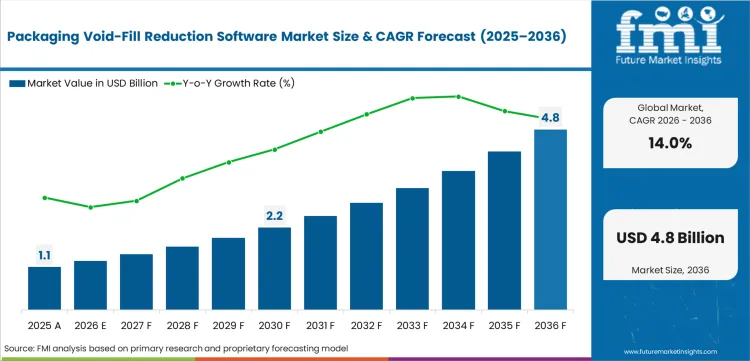
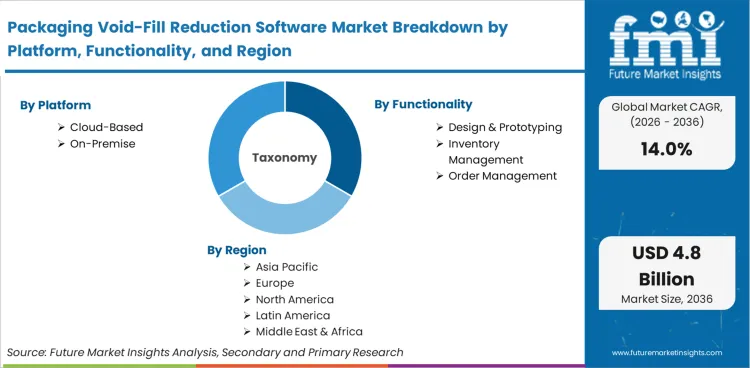
The packaging void‑fill reduction software market was valued at USD 1.15 billion in 2025, projected to reach USD 1.31 billion in 2026, and is forecast to expand to USD 4.89 billion by 2036 at a 14.08% CAGR. Rising dimensional‑weight pricing pressures and tightening corporate sustainability mandates are accelerating the adoption of carton optimization platforms across global fulfillment networks. What were once optional cartonization tools have now become mandatory capital investments for peak‑season readiness, forcing fulfillment center directors to meet strict algorithmic‑efficiency thresholds.
Standardized algorithmic foundations have crossed from aspirational concepts to contractually mandated specifications. Logistics network planners executing distribution center expansions now reject static box matrices that fragment outbound shipping efficiency. Architectural pivot requirements force incumbent supply chain vendors to integrate 3D nesting capabilities into every new warehouse management product line. Software suppliers entering 2027 tender cycles without certified software box packaging integration face a disqualification window they cannot close after shortlisting begins.
Summary of Packaging Void-Fill Reduction Software Market
- Packaging Void-Fill Reduction Software Market Definition
- Packaging Void-Fill Reduction Software encompasses specialized algorithms, design platforms, and integration tools built to analyze product dimensions and calculate optimal carton geometries to eliminate excess shipped air and minimize protective material usage.
- Demand Drivers in the Market
- Escalating dimensional weight charges levied by global parcel carriers force logistics directors to specify algorithmic packaging tools capable of matching exact product geometries.
- High-volume e-commerce fulfillment operations mandate sub-second cartonization calculations to prevent processing bottlenecks during peak dispatch cycles.
- Strict corporate decarbonization targets compel supply chain architects to replace excessive physical cushioning material with precision-engineered right-size carton configurations.
- Key Segments Analyzed in the FMI Report
- Cloud-Based platform: 65.0% share in 2026, reflecting massive multi-site distribution networks requiring synchronized deployment of volume calculation engines across disparate geographic locations.
- Design & Prototyping functionality: 35.0% share in 2026, as packaging engineers standardize on virtual drop-test simulations to eliminate costly physical prototyping iterations.
- India: 16.1% compound growth driven by greenfield third-party logistics hubs deploying unified fulfillment topologies from initial blueprints.
- Analyst Opinion at FMI
- Ismail Sutaria, Principal Consultant for Packaging, opines: “In my analysis, I have observed that true bottleneck in modern fulfillment is not warehouse picking speed but the dimensional inefficiency of outbound shipments. Distribution hubs attempting to manage escalating freight rates using standardized box matrices face unavoidable margin erosion from shipping excess air. Supply chain architects who continue relying on manual carton selection will find themselves unable to meet the strict volumetric economics required for competitive third-party logistics contracts. Operations delaying this algorithmic integration risk permanent lockout from the high-volume shipping tiers their competitors actively secure.”
- Strategic Implications / Executive Takeaways
- Software providers must secure certified integration pathways with tier-1 warehouse management systems to qualify for impending global logistics facility contracts.
- Capital project directors should phase out standard carton purchasing and mandate native fit to size autoboxing software compatibility in all new equipment procurement specifications.
- Packaging engineers must develop specialized virtual simulation competencies to prove transit safety parameters during the digital design phase.
- Methodology
- Primary Research: FMI conducted detailed technical interviews with principal supply chain architects, fulfillment network engineers, and logistics operations directors across 40 countries to validate software adoption timelines.
- Desk Research: Analysts aggregated public API documentation from major carrier networks, corporate software launch sheets, and national transport infrastructure standards.
- Market-Sizing and Forecasting: Forecasting models apply a bottom-up methodology starting with global installed base metrics for distribution center software and projecting the conversion rate to automated cartonization.
- Data Validation and Update Cycle: Segment forecasts undergo cross-validation against quarterly enterprise software revenue volumes for supply chain execution platforms.
Packaging Void-Fill Reduction Software Market Key Takeaways
| Metric | Details |
|---|---|
| Industry Size (2026) | USD 1.31 billion |
| Industry Value (2036) | USD 4.89 billion |
| CAGR (2026-2036) | 14.08% |
Source: Future Market Insights, 2026
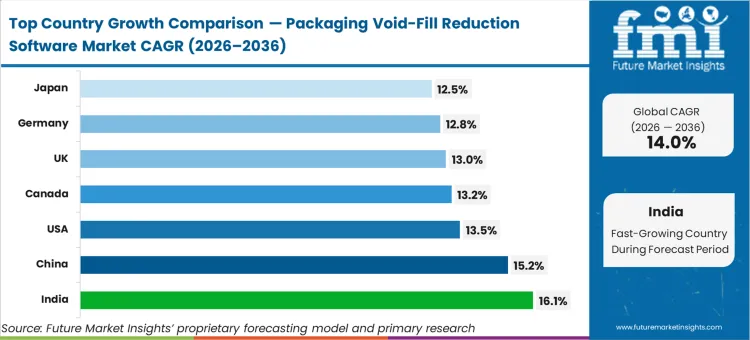
All major e-commerce markets reflect accelerated software deployment parameters. India sets the pace with a 16.1% CAGR, followed closely by China at 15.2% as both nations leverage greenfield logistics construction to bypass legacy facility hurdles. United States operations advance at a 13.5% rate, supported by parcel carrier optimization mandates, while Canada tracks at 13.2%. United Kingdom networks maintain a 13.0% expansion trajectory. Germany registers a 12.8% pace, driven by strict secondary packaging waste reduction targets. Japan expands at a 12.5% trajectory anchored by its robust domestic delivery automation sector.
Packaging Void-Fill Reduction Software Market Definition
Packaging Void-Fill Reduction Software represents the computational layer designed specifically to calculate optimal secondary packaging dimensions and nesting patterns within fulfillment environments. Software ecosystems include cartonization algorithms, structural design platforms, and machine orchestration modules compliant with global transport sizing constraints. Core inclusions govern software supporting dynamic right-sizing hardware integration. Carrier dimensional pricing frameworks dictate the operational parameters defining these precise volume calculations.
Packaging Void-Fill Reduction Software Market Inclusions
Market scope includes algorithmic cartonization engines, virtual 3D packaging simulation tools, automated box-sizing orchestration software, and cloud-based shipping optimization modules. Protocol-specific integration layers connecting warehouse execution systems with right-sizing machinery fall within defined boundaries. Software packages utilizing predictive analytics for design for recycling packaging compliance are fully incorporated.
Packaging Void-Fill Reduction Software Market Exclusions
Standard enterprise resource planning suites lacking specialized volumetric calculation engines are excluded. Physical cushioning hardware, standalone structural testing machinery, and manual box-making equipment fall outside analytical parameters. Legacy shipping label software without 3D nesting capabilities is explicitly omitted from the valuation.
Packaging Void-Fill Reduction Software Market Research Methodology
- Primary Research: Analysts engaged with logistics specification leads, fulfillment systems engineers, and supply chain infrastructure directors to map the specific decision gates triggering software upgrades.
- Desk Research: Data collection phases aggregated carrier dimensional weight pricing roadmaps, logistics standards ratification schedules, and major retail vendor guidelines.
- Market-Sizing and Forecasting: Baseline values derive from a bottom-up aggregation of supply chain software licenses, applying region-specific automation curves to project future adoption velocity.
- Data Validation and Update Cycle: Projections are rigorously tested against publicly reported technology expenditure guidance from leading third-party logistics and retail conglomerates.
Segmental Analysis
Packaging Void-Fill Reduction Software Market Analysis by Platform
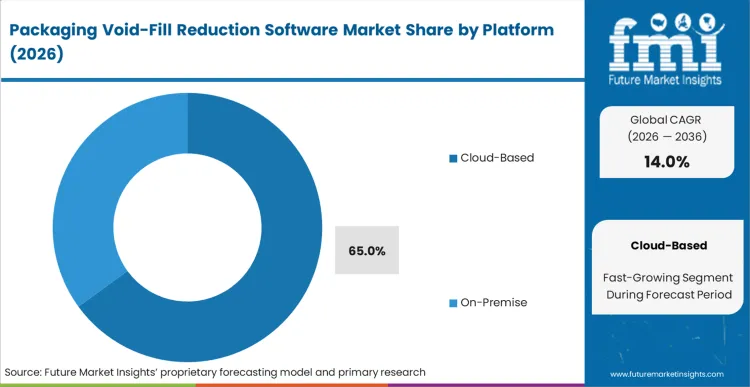
Multi-site fulfillment networks struggling with fragmented dimensional data execute full-scale platform modernization programs. Cloud-Based solutions command a dominant 65.0% share in 2026, reflecting the absolute requirement for unified volume calculations before advanced network-wide orchestration can occur. Logistics architects deploying centralized algorithms directly across global facilities establish the foundation for real-time order optimization. Centralized data processing eliminates the need for expensive on-premise server maintenance at individual warehouse nodes.
Network planners specifying these scalable platforms streamline their deployment topologies and significantly reduce overall IT infrastructure footprint. According to FMI's estimates, facilities transitioning to native cloud software realize measurable reductions in system commissioning times. Software vendors unable to supply certified highly-available cloud architectures risk immediate exclusion from the next wave of greenfield logistics RFPs.
- Algorithmic synchronization: Centralized processing engines demand rigorous uptime guarantees to process seamless volume calculations across competing fulfillment centers on the same network layer.
- Data aggregation: Scalable cloud capabilities natively handle complex dimensional libraries, shifting the computational burden away from local warehouse control systems.
- Deployment footprint: Eliminating local server racks shrinks the physical IT cabinet space required for control electronics in constrained distribution environments.
Packaging Void-Fill Reduction Software Market Analysis by Functionality
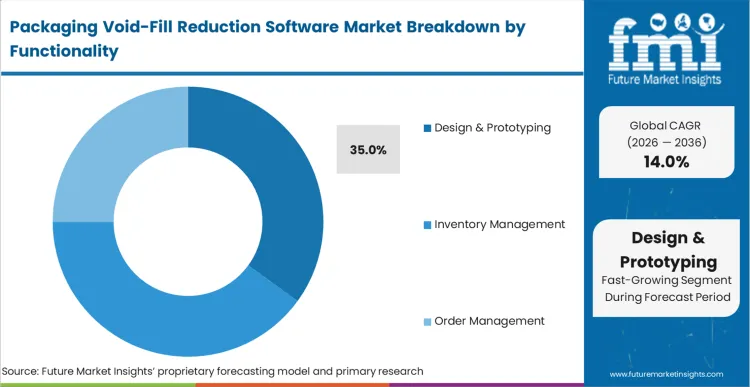
Packaging engineering teams standardize on virtual testing platforms to eliminate costly physical prototyping iterations. Design & Prototyping applications emerge as the dominant functional area, capturing 35.0% of total market share in 2026. Modern structural design environments are increasingly built around unified 3D modeling engines, removing the delays and material waste caused by traditional iterative sample production. FMI analysts opine that digitizing the structural validation phase directly enables accelerated product launches within the fast-moving consumer goods sector. Brand packaging leads must validate digital compression strength metrics during virtual drop-testing to authorize final supplier tool creation. Integration of material performance databases across isolated design cells forces structural engineers to rethink traditional corrugated specifications.
- Virtual validation: Critical transit simulations receive guaranteed calculation accuracy while standard layout renderings utilize background processing power without causing interface lag.
- Tolerance checking: Connecting CAD files directly to the main testing engine accelerates the extraction of failure point data for predictive design adjustments.
- Prototyping velocity: Standardized digital parameters reduce the engineering hours previously required to physically cut and test proprietary board grades.
Packaging Void-Fill Reduction Software Market Analysis by User Size
Global fulfillment specification leads bidding on massive retail distribution contracts now face strict adherence criteria for shipment volume optimization. Large Enterprises account for a leading 55.0% segment share in 2026. Supply chain engineers operating high-volume cross-dock facilities reject software designs introducing latency into the order processing loop. Incorporating certified volume-calculation APIs guarantees that high-speed robotic packing commands arrive exactly when scheduled. As per FMI's projection, the convergence of automated retrieval systems with core dimensional algorithms amplifies the demand for high-performance processing capabilities. Code developers failing to demonstrate seamless integration with established enterprise resource planning systems lose priority status in critical infrastructure upgrade cycles.
- Latency elimination: Optimized code bases ensure volume calculations bypass standard queuing mechanisms, delivering millisecond accuracy for high-speed robotic manipulators.
- Inventory integration: Dedicated API pathways permit live SKU dimension data to feed the same computational engine as outbound routing algorithms.
- Vendor agnosticism: Open software standards empower facility owners to source specialized packing machinery without worrying about proprietary digital lock-in.
Packaging Void-Fill Reduction Software Market Drivers, Restraints, and Opportunities
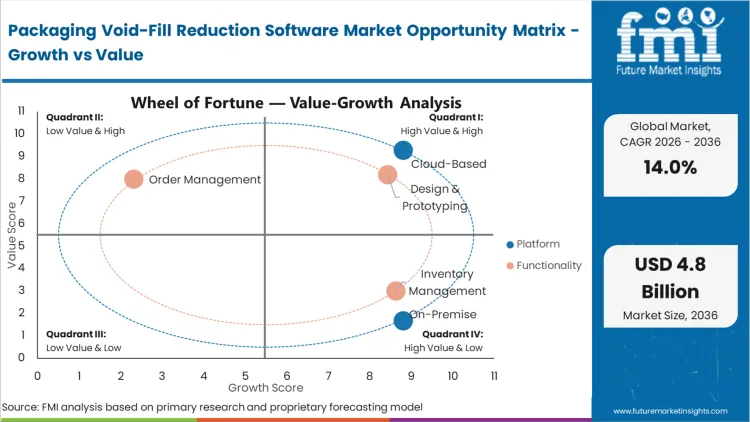
Aggressive dimensional weight pricing models enforced by global parcel carriers force logistics specification leads to extract actionable volume data directly from the fulfillment floor. Outdated volumetric assumptions render static carton inventories financially unviable. Operations directors upgrading brownfield facilities face a strict binary choice between absorbing escalating freight penalties or overhauling their secondary packaging strategies. Transitioning to a dynamic cartonization software layer simplifies fulfillment workflows and enables direct volume reduction. Distribution centers failing to modernize their core calculation layers risk massive shipping cost overruns and reduced overall margin realization.
Complex API configuration parameters required to optimize dynamic sizing equipment create steep learning curves for traditional warehouse IT engineers. Designing conflict-free data transmission streams across multi-vendor software demands specialized database architecture expertise that most logistics facilities lack internally. To mitigate this skill gap, capital projects directors increasingly rely on advanced middleware configuration tools that automate the data-mapping process and validate digital pathways before physical deployment.
Opportunities in the Packaging Void-Fill Reduction Software Market
- Automated Equipment Consolidation: Next-generation cartonization software enables logistics architects to run continuous right-sizing machinery directly from the warehouse management system. Synchronized hardware communication eliminates dedicated third-party controllers and drastically simplifies pack-station design.
- Sustainable Material Reporting: Upgraded reporting modules permit corporate sustainability teams to track exact corrugated material savings without relying on estimated purchasing data. Auditable metrics prevent regulatory fines from progressing through regional environmental compliance frameworks.
- Retail Ready Optimization: Supply chain network planners integrating mixed-SKU pallets require precise spatial visualization software. Advanced nesting algorithms provide the millimeter accuracy necessary to balance volatile retail order compositions across the entire transport fleet.
Regional Analysis
.webp "Top Country Growth Comparison Packaging Void Fill Reduction Software Market Cagr (2026 2036)")
Based on the regional analysis, the Packaging Void-Fill Reduction Software market is segmented into North America, Latin America, Europe, East Asia, South Asia, Oceania and Middle East & Africa across 40+ countries. The full report also offers market attractiveness analysis based on regional trends.
| Country | CAGR (2026 to 2036) |
|---|---|
| India | 16.1% |
| China | 15.2% |
| USA | 13.5% |
| Canada | 13.2% |
| UK | 13.0% |
| Germany | 12.8% |
| Japan | 12.5% |
Source: Future Market Insights (FMI) analysis, based on proprietary forecasting model and primary research
Asia Pacific Packaging Void-Fill Reduction Software Market Analysis
Greenfield logistics infrastructure development across the Asia Pacific region accelerates the bypass of manual packaging constraints. Capital projects directors constructing new mega-fulfillment centers specify unified algorithmic networking in their initial site blueprints. FMI analysts opine that this clean-slate approach entirely eliminates the costly and time-consuming system integration phase that plagues older retail distribution hubs. By building native volume calculation capabilities into the foundation, regional asset owners establish highly flexible shipping environments capable of rapid seasonal scaling. Aggressive greenfield expansion strategies directly fuel the demand for high-performance supply chain software. Implementation of robust data architecture forms the critical prerequisite for deploying advanced autoboxing applications. Specific retail requirements of individual nations dictate the precise configuration parameters for these software technologies.
- India: Indian e-commerce fulfillment operations face severe last-mile delivery constraints driven by diverse geographic terrain and volatile transport economics. Supply chain architects must deploy advanced space-optimization algorithms to guarantee maximum package density within constrained third-party carrier networks. National expansion of rapid-delivery grocery and apparel platforms triggers a wave of facility upgrades prioritizing highly efficient outbound packing processes. Severe logistics margin pressure anchors India's 16.1% compound expansion of packaging software demand to 2036. Software developers failing to provide seamless vernacular language integration mechanisms face disqualification from major domestic retail facility tenders.
- China: China's export-driven e-commerce sector deploys highly automated, software-defined outbound consolidation centers requiring continuous data exchange between cross-border shipping systems and automated packing lines. Greenfield facility architects bypass manual carton selection entirely, specifying native cartonization engines for all new warehouse procurement contracts. Concentrated mega-port logistics zones establish a massive installed base of interoperable software infrastructure across the eastern manufacturing corridor. Relentless global shipping volume drives a 15.2% CAGR for void-fill reduction platforms in China through 2036. Developers unable to demonstrate verified high-speed algorithmic sorting capabilities lose access to the most lucrative automated warehousing projects in the region.
- Japan: Japanese urban logistics networks enforce strict vehicle capacity regulations to manage extreme delivery density across hyper-concentrated metropolitan zones. Every new distribution architecture must validate algorithmic volume compliance before receiving authorization for automated fleet integration. Domestic retail supply chains embed precision carton sizing directly into their outbound workflows to maintain operational efficiency amidst critical labor shortages. Sustained workforce reduction constraints sustain a 12.5% CAGR for algorithmic packaging upgrades in Japan's major logistics corridors. Software suppliers lacking verified automated-hardware integration records forfeit access to the next generation of full-line fulfillment automation contracts.
FMI's report includes extensive coverage of the Asia Pacific packaging software landscape. Detailed analysis of South Korea, Indonesia, Australia, and the broader ASEAN region forms the core regional intelligence. Rapid localization of fast-fashion fulfillment forces contract logistics providers to deploy unified volume optimization tools to satisfy stringent international carrier pricing models.
North America Packaging Void-Fill Reduction Software Market Analysis
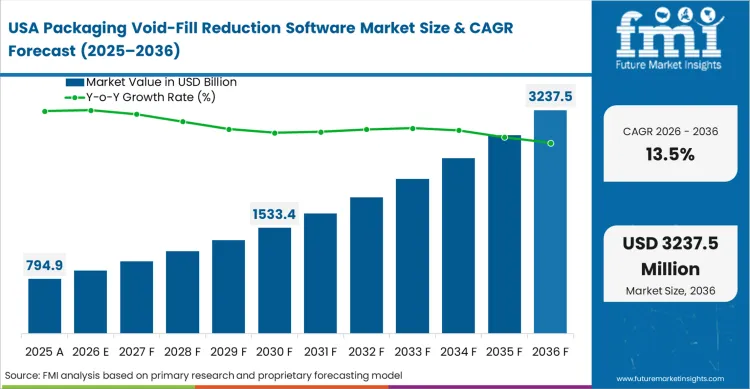
Industrial modernization mandates across North America target the systematic eradication of excessive secondary packaging waste. Supply chain software engineers leading critical distribution overhauls face strict corporate directives to unify disparate dimensioning systems under a single manageable platform. According to FMI's estimates, the dominant third-party logistics sectors actively drive this consolidation to secure their operational margins against sophisticated carrier pricing algorithms. Implementing a standardized cartonization backbone enables fulfillment centers to deploy advanced right-sizing hardware without compromising real-time processing stability. Strategic pivots require significant capital allocation toward robust software ecosystems capable of processing mixed-SKU order streams instantly. The success of these modernization initiatives depends entirely on the availability of certified logistics packaging APIs. Regional sustainability frameworks and carrier dimensioning standards govern the exact specifications required for these critical software deployments.
- USA: United States e-commerce fulfillment operators face strict volumetric pricing models enforced across all major national parcel carrier networks. Fulfillment center directors must deploy algorithmic cartonization tools to guarantee outbound shipments match exact product geometries without incurring dimensional weight penalties. Concentrated mega-retailer distribution hubs necessitate continuous investment in automated box-sizing software to maximize trailer density and systematically reduce reliance on physical cushioning material inventory. Major parcel carriers aggressively auditing package dimensions force high-volume shippers to abandon manual carton selection entirely. Margin preservation pressure anchors the 13.5% compound expansion of algorithmic packaging optimization demand in the United States to 2036. Software providers failing to demonstrate native integration with established warehouse management systems face immediate disqualification from major third-party logistics facility tenders before the next peak season preparation cycle opens.
- Canada: Canadian cross-border logistics operations manage vast geographic transit distances that exponentially amplify the financial penalty of shipping unoptimized empty space. Distribution architects must integrate specialized volumetric software to calculate exact container utilization rates before releasing orders to the outbound dock. Nationwide corporate sustainability pledges actively fund the replacement of wasteful loose-fill practices with precision-engineered corrugated enclosures. Vast transit distances mandate a 13.2% compound rate across the forecast decade as retail distributors unify their logical shipping topologies. Platform developers lacking documented compliance with rigorous environmental reporting standards face immediate exclusion from national retail modernization contracts.
FMI's report includes comprehensive evaluation of the North American dimensional software sector. Specific analysis of the Mexican cross-border distribution market highlights critical nearshoring infrastructure. Integration of trans-national automotive parts supply chains requires standardized volume calculation protocols to coordinate just-in-time delivery sequences across multiple facilities.
Europe Packaging Void-Fill Reduction Software Market Analysis
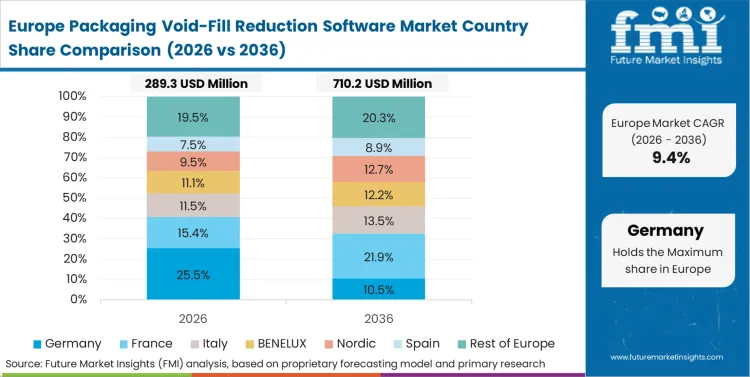
European environmental policy actively penalizes the continued generation of excessive secondary packaging material and non-recyclable void fill. Automation architects redesigning legacy fulfillment lines must integrate continuous carbon-footprint tracking data alongside critical shipping labels. Dual-purpose compliance requirements force the rapid adoption of algorithmic sizing protocols to guarantee regulatory adherence while minimizing corrugated consumption. System transitions require a complete overhaul of existing fulfillment topologies, shifting from standard box matrices to dynamic right-sizing architectures. Upgrading the core calculation infrastructure provides the necessary processing bandwidth to support advanced sustainable packaging practices. Logistics directors recognize that maintaining outdated material-heavy workflows severely limits their ability to compete in highly regulated European markets. Regional Extended Producer Responsibility (EPR) regulations heavily influence the technical requirements for these software transformations.
- UK: United Kingdom grocery and retail distribution networks operate under strict plastic tax regulations that penalize reliance on traditional polymer-based cushioning materials. Supply chain directors deploying advanced fulfillment systems mandate software architectures capable of precisely sizing corrugated enclosures to eliminate the need for protective void fill pillows. Strict regulatory pressure forces fulfillment operators to abandon legacy bubble-wrap protocols in favor of highly optimized, right-sized paper packaging. Critical material transition anchors the UK's 13.0% compound trajectory to 2036 as major retailers systematically upgrade their operational software backbones. Code developers unable to demonstrate absolute volumetric reduction metrics under peak load conditions forfeit qualification for national grocery expansion projects.
- Germany: German supply chain operators execute fulfillment strategies under the stringent VerpackG (Packaging Act) legislation that mandates aggressive reduction of secondary transit packaging volume. Packaging engineers must demonstrate flawless algorithmic carton selection before receiving authorization to ship commercial volumes across the national logistics network. Robust export manufacturing sectors operate under rigorous corporate sustainability certifications that demand auditable waste reduction layers, creating a recurring compliance cycle that accelerates software upgrades. Systemic regulatory pressure drives a 12.8% annual expansion rate for certified cartonization software as the standard proliferates. Software providers targeting domestic automotive parts distribution projects must guarantee exact volumetric compliance metrics prior to the finalization of capital procurement budgets.
FMI's report includes thorough investigation of the European sustainable fulfillment framework. Regional analysis encompasses Italy, France, Spain, the Nordics, and the Benelux region. Mandatory compliance with strict eco-modulation fee structures forces asset owners to specify dimensioning software that can reliably calculate minimal packaging weight alongside standard operational data.
Competitive Aligners for Market Players
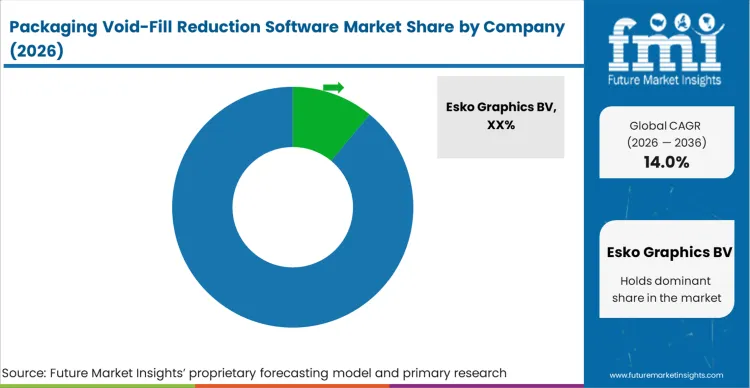
The competitive landscape for packaging automation software is being reshaped by the rapid shift toward standardized, interoperable communication frameworks. As integration standards continue to redefine requirements for automated packaging hardware, software vendors are under mounting pressure to deliver certified, API‑driven platforms rather than standalone or proprietary tools. This trend is already locking out developers that depend on closed ecosystems or isolated dimensional‑calculation modules, as buyers now mandate seamless machine‑to‑software connectivity in procurement cycles.
Against this backdrop, leading providers such as Esko Graphics BV, Epicor Software Corp., Oracle Corp., Amtech Software LLC, Advantive, Sistrade Software Consulting SA, and Abaca Systems Ltd compete by accelerating the transition toward fully unified design‑to‑shipment platforms. Vendors integrating native structural design tools directly into cartonization environments gain a structural advantage, reducing processing timelines and minimizing engineering hours needed for packaging approvals. Platforms lacking these unified capabilities, especially those still reliant on external CAD tools, risk losing relevance during enterprise shortlisting phases.
As cross‑platform fulfillment ecosystems expand, the market is further disrupted by the commoditization of core dimensional‑calculation engines. Systems integrators now prefer architectures that allow mixing specialized algorithmic modules from multiple developers without synchronization risk. This shift enables enterprise users to evaluate vendors like Esko, Epicor, Oracle, and Advantive based on material‑reduction performance, automation compatibility, and API robustness, rather than legacy IT lock‑in. This dynamic reinforces the need for advanced optimization layers, such as machine‑learning‑driven automation and predictive analytics, to differentiate offerings in an increasingly modular and vendor‑agnostic market.
Key Players in Packaging Void-Fill Reduction Software Market
- Esko Graphics BV
- Epicor Software Corp.
- Oracle Corp.
- Amtech Software LLC
- Advantive
- Sistrade Software Consulting SA
- Abaca Systems Ltd.
Scope of the Report
| Metric | Value |
|---|---|
| Quantitative Units | USD 1.31 billion to USD 4.89 billion, at a CAGR of 14.08% |
| Market Definition | Packaging Void-Fill Reduction Software encompasses specialized algorithms, design platforms, and integration tools built to analyze product dimensions and calculate optimal carton geometries to eliminate excess shipped air and minimize protective material usage. |
| Platform Segmentation | Cloud-Based, On-Premise |
| Functionality Segmentation | Design & Prototyping, Inventory Management, Order Management, Production Planning & Scheduling, Reporting & Analytics |
| User Size Segmentation | Large Enterprises, Small & Medium Enterprises |
| Regions Covered | North America, Latin America, Europe, East Asia, South Asia, Oceania, Middle East & Africa |
| Countries Covered | India, China, USA, Canada, UK, Germany, Japan, and 40 plus countries |
| Key Companies Profiled | Esko Graphics BV, Epicor Software Corp., Oracle Corp., Amtech Software LLC, Advantive, Sistrade Software Consulting SA, Abaca Systems Ltd. |
| Forecast Period | 2026 to 2036 |
| Approach | Forecasting models apply a bottom-up methodology starting with global installed base metrics for distribution center software and projecting the conversion rate to automated cartonization. |
Packaging Void-Fill Reduction Software Market Analysis by Segments
Platform:
- Cloud-Based
- On-Premise
Functionality:
- Design & Prototyping
- Inventory Management
- Order Management
- Production Planning & Scheduling
- Reporting & Analytics
User Size:
- Large Enterprises
- Small & Medium Enterprises
Region:
- Asia Pacific
- India
- China
- Japan
- South Korea
- Indonesia
- Australia & New Zealand
- ASEAN
- Rest of Asia Pacific
- Europe
- Germany
- Italy
- France
- United Kingdom
- Spain
- Benelux
- Nordics
- Central & Eastern Europe
- Rest of Europe
- North America
- United States
- Canada
- Mexico
- Latin America
- Brazil
- Argentina
- Chile
- Rest of Latin America
- Middle East & Africa
- Kingdom of Saudi Arabia
- United Arab Emirates
- South Africa
- Turkey
- Rest of Middle East & Africa
Bibliography
- GS1 AISBL. (2024). General specifications change notification (GSCN) 24-181: ID standard. GS1.
- Organisation for Economic Co-operation and Development. (2024, June). Urban logistics hubs: Summary and conclusions. OECD.
- United Kingdom. (2024). The Producer Responsibility Obligations (Packaging and Packaging Waste) Regulations 2024. legislation.gov.uk.
- United States Environmental Protection Agency. (2024, November). National strategy to prevent plastic pollution. USA Environmental Protection Agency.
- European Commission, Directorate-General for Environment. (2024, December 16). Packaging and Packaging Waste Regulation (PPWR) [Presentation slides]. European Commission.
- United States Postal Service. (2025, July 13). Notice 123: Price change effective July 13, 2025. Postal Explorer.
This bibliography is provided for reader reference. The full FMI report contains the complete reference list with primary research documentation.
This Report Addresses
- Market sizing and quantitative forecast metrics detailing the precise enterprise software expenditure dedicated to packaging void-fill reduction across major retail sectors through 2036.
- Segmentation analysis mapping the adoption velocity of specific cartonization algorithms and evaluating the technical limitations driving cloud platform migrations.
- Regional deployment intelligence comparing the aggressive greenfield fulfillment strategies in Asia Pacific against the complex brownfield software integration requirements prevalent in European logistics hubs.
- Regulatory compliance assessment analyzing how stringent secondary packaging waste directives and Extended Producer Responsibility mandates force the adoption of precision volumetric software.
- Competitive posture evaluation tracking the mandatory shift toward hardware-agnostic API integration and the resulting commoditization of standalone dimensional calculators.
- Capital project strategic guidance defining the exact procurement specifications and processing latencies required to support next-generation automated right-sizing machinery.
- Supply chain vulnerability analysis identifying the specific data synchronization bottlenecks that extend warehouse execution system commissioning timelines.
- Custom data delivery formats encompassing interactive dashboards, raw Excel datasets, and comprehensive PDF narrative reports.
Frequently Asked Questions
How large is the demand for Packaging Void-Fill Reduction Software in the global market in 2026?
Demand for Packaging Void-Fill Reduction Software in the global market is estimated to be valued at USD 1.31 billion in 2026.
What will be the market size of Packaging Void-Fill Reduction Software in the global market by 2036?
Market size for Packaging Void-Fill Reduction Software is projected to reach USD 4.89 billion by 2036.
What is the expected demand growth for Packaging Void-Fill Reduction Software in the global market between 2026 and 2036?
Demand for Packaging Void-Fill Reduction Software is expected to grow at a CAGR of 14.08% between 2026 and 2036.
Which Platform is poised to lead global sales by 2026?
Cloud-Based accounts for 65.0% in 2026 as multi-site distribution networks require synchronized deployment of volume calculation engines across disparate geographic locations.
How significant is the role of Design & Prototyping in driving Packaging Void-Fill Reduction Software adoption in 2026?
Design & Prototyping represents 35.0% of segment share as packaging engineers standardize on virtual drop-test simulations to eliminate costly physical prototyping iterations.
What is driving demand in India?
Indian greenfield third-party logistics hubs deploying unified fulfillment topologies from initial blueprints fuel massive demand for scalable cartonization algorithms.
What compliance standards or regulations are referenced for Germany?
German supply chain operators execute fulfillment strategies under the stringent VerpackG legislation that mandates aggressive reduction of secondary transit packaging volume.
What is the India growth outlook in this report?
India is projected to grow at a CAGR of 16.1% during 2026 to 2036.
Why is North America described as a priority region in this report?
North American third-party logistics sectors actively drive volume consolidation to secure operational margins against sophisticated carrier pricing algorithms.
What type of demand dominates in North America?
Demand heavily focuses on algorithmic cartonization tools to guarantee outbound shipments match exact product geometries without incurring dimensional weight penalties.
What is China's growth outlook in this report?
China is projected to expand at a CAGR of 15.2% during 2026 to 2036.
Does the report cover USA in its regional analysis?
Yes, USA is included within North America under the regional scope of analysis.
What are the sources referred to for analyzing USA?
Carrier dimensional weight pricing roadmaps and logistics standards ratification schedules form the analytical basis.
What is the main demand theme linked to USA in its region coverage?
Strict volumetric pricing models enforced across all major national parcel carrier networks force the abandonment of manual carton selection.
Does the report cover Germany in its regional analysis?
Yes, Germany is included within Europe under the regional coverage framework.
What is the main Germany related demand theme in its region coverage?
Stringent VerpackG legislation mandates aggressive reduction of secondary transit packaging volume across domestic fulfillment hubs.
Which product formats or configurations are strategically important for Asia Pacific supply chains?
Algorithmic network configuration tools capable of seamlessly integrating with highly automated outbound consolidation machinery are critical.
What is Packaging Void-Fill Reduction Software and what is it mainly used for?
Packaging Void-Fill Reduction Software calculates optimal carton dimensions to eliminate excess shipped air. Logistics platforms primarily use it to minimize dimensional weight charges and reduce physical cushioning material usage.
What does Packaging Void-Fill Reduction Software mean in this report?
The scope encompasses specialized algorithms, design platforms, and integration tools built to analyze product dimensions and calculate exact corrugated box geometries.
What is included in the scope of this Packaging Void-Fill Reduction Software report?
The market covers algorithmic cartonization engines, virtual 3D packaging simulation tools, automated box-sizing orchestration software, and cloud-based shipping optimization modules.
What is excluded from the scope of this report?
Standard enterprise resource planning suites lacking specialized volumetric calculation engines, physical cushioning hardware, and manual box-making equipment are explicitly excluded.
What does market forecast mean on this page?
The market forecast represents a model-based projection built on defined logistics software and supply chain automation assumptions for strategic planning purposes.
How does FMI build and validate the Packaging Void-Fill Reduction Software forecast?
Forecasting models apply a bottom-up methodology starting with global installed base metrics and cross-validate projections against quarterly enterprise software revenue volumes.
What does zero reliance on speculative third-party market research mean here?
Primary interviews, verified public API documentation, and official logistics standards registries are used exclusively instead of unverified syndicated estimates.
Preview the report firsthand - request a free sample
Get SampleGet the brochure for pricing and purchase details.
Get PDFTable of Content
- Executive Summary
- Global Market Outlook
- Demand-side Trends
- Supply-side Trends
- Technology Roadmap Analysis
- Analysis and Recommendations
- Market Overview
- Market Coverage / Taxonomy
- Market Definition / Scope / Limitations
- Research Methodology
- Chapter Orientation
- Analytical Lens and Working Hypotheses
- Market Structure, Signals, and Trend Drivers
- Benchmarking and Cross-market Comparability
- Market Sizing, Forecasting, and Opportunity Mapping
- Research Design and Evidence Framework
- Desk Research Programme (Secondary Evidence)
- Company Annual and Sustainability Reports
- Peer-reviewed Journals and Academic Literature
- Corporate Websites, Product Literature, and Technical Notes
- Earnings Decks and Investor Briefings
- Statutory Filings and Regulatory Disclosures
- Technical White Papers and Standards Notes
- Trade Journals, Industry Magazines, and Analyst Briefs
- Conference Proceedings, Webinars, and Seminar Materials
- Government Statistics Portals and Public Data Releases
- Press Releases and Reputable Media Coverage
- Specialist Newsletters and Curated Briefings
- Sector Databases and Reference Repositories
- FMI Internal Proprietary Databases and Historical Market Datasets
- Subscription Datasets and Paid Sources
- Social Channels, Communities, and Digital Listening Inputs
- Additional Desk Sources
- Expert Input and Fieldwork (Primary Evidence)
- Primary Modes
- Qualitative Interviews and Expert Elicitation
- Quantitative Surveys and Structured Data Capture
- Blended Approach
- Why Primary Evidence is Used
- Field Techniques
- Interviews
- Surveys
- Focus Groups
- Observational and In-context Research
- Social and Community Interactions
- Stakeholder Universe Engaged
- C-suite Leaders
- Board Members
- Presidents and Vice Presidents
- R&D and Innovation Heads
- Technical Specialists
- Domain Subject-matter Experts
- Scientists
- Physicians and Other Healthcare Professionals
- Governance, Ethics, and Data Stewardship
- Research Ethics
- Data Integrity and Handling
- Primary Modes
- Tooling, Models, and Reference Databases
- Desk Research Programme (Secondary Evidence)
- Data Engineering and Model Build
- Data Acquisition and Ingestion
- Cleaning, Normalisation, and Verification
- Synthesis, Triangulation, and Analysis
- Quality Assurance and Audit Trail
- Market Background
- Market Dynamics
- Drivers
- Restraints
- Opportunity
- Trends
- Scenario Forecast
- Demand in Optimistic Scenario
- Demand in Likely Scenario
- Demand in Conservative Scenario
- Opportunity Map Analysis
- Product Life Cycle Analysis
- Supply Chain Analysis
- Investment Feasibility Matrix
- Value Chain Analysis
- PESTLE and Porter’s Analysis
- Regulatory Landscape
- Regional Parent Market Outlook
- Production and Consumption Statistics
- Import and Export Statistics
- Market Dynamics
- Global Market Analysis 2021 to 2025 and Forecast, 2026 to 2036
- Historical Market Size Value (USD Million) Analysis, 2021 to 2025
- Current and Future Market Size Value (USD Million) Projections, 2026 to 2036
- Y-o-Y Growth Trend Analysis
- Absolute $ Opportunity Analysis
- Global Market Pricing Analysis 2021 to 2025 and Forecast 2026 to 2036
- Global Market Analysis 2021 to 2025 and Forecast 2026 to 2036, By Platform
- Introduction / Key Findings
- Historical Market Size Value (USD Million) Analysis By Platform , 2021 to 2025
- Current and Future Market Size Value (USD Million) Analysis and Forecast By Platform , 2026 to 2036
- Cloud-Based
- On-Premise
- Cloud-Based
- Y-o-Y Growth Trend Analysis By Platform , 2021 to 2025
- Absolute $ Opportunity Analysis By Platform , 2026 to 2036
- Global Market Analysis 2021 to 2025 and Forecast 2026 to 2036, By Functionality
- Introduction / Key Findings
- Historical Market Size Value (USD Million) Analysis By Functionality, 2021 to 2025
- Current and Future Market Size Value (USD Million) Analysis and Forecast By Functionality, 2026 to 2036
- Design & Prototyping
- Inventory Management
- Order Management
- Design & Prototyping
- Y-o-Y Growth Trend Analysis By Functionality, 2021 to 2025
- Absolute $ Opportunity Analysis By Functionality, 2026 to 2036
- Global Market Analysis 2021 to 2025 and Forecast 2026 to 2036, By Region
- Introduction
- Historical Market Size Value (USD Million) Analysis By Region, 2021 to 2025
- Current Market Size Value (USD Million) Analysis and Forecast By Region, 2026 to 2036
- North America
- Latin America
- Western Europe
- Eastern Europe
- East Asia
- South Asia and Pacific
- Middle East & Africa
- Market Attractiveness Analysis By Region
- North America Market Analysis 2021 to 2025 and Forecast 2026 to 2036, By Country
- Historical Market Size Value (USD Million) Trend Analysis By Market Taxonomy, 2021 to 2025
- Market Size Value (USD Million) Forecast By Market Taxonomy, 2026 to 2036
- By Country
- USA
- Canada
- Mexico
- By Platform
- By Functionality
- By Country
- Market Attractiveness Analysis
- By Country
- By Platform
- By Functionality
- Key Takeaways
- Latin America Market Analysis 2021 to 2025 and Forecast 2026 to 2036, By Country
- Historical Market Size Value (USD Million) Trend Analysis By Market Taxonomy, 2021 to 2025
- Market Size Value (USD Million) Forecast By Market Taxonomy, 2026 to 2036
- By Country
- Brazil
- Chile
- Rest of Latin America
- By Platform
- By Functionality
- By Country
- Market Attractiveness Analysis
- By Country
- By Platform
- By Functionality
- Key Takeaways
- Western Europe Market Analysis 2021 to 2025 and Forecast 2026 to 2036, By Country
- Historical Market Size Value (USD Million) Trend Analysis By Market Taxonomy, 2021 to 2025
- Market Size Value (USD Million) Forecast By Market Taxonomy, 2026 to 2036
- By Country
- Germany
- UK
- Italy
- Spain
- France
- Nordic
- BENELUX
- Rest of Western Europe
- By Platform
- By Functionality
- By Country
- Market Attractiveness Analysis
- By Country
- By Platform
- By Functionality
- Key Takeaways
- Eastern Europe Market Analysis 2021 to 2025 and Forecast 2026 to 2036, By Country
- Historical Market Size Value (USD Million) Trend Analysis By Market Taxonomy, 2021 to 2025
- Market Size Value (USD Million) Forecast By Market Taxonomy, 2026 to 2036
- By Country
- Russia
- Poland
- Hungary
- Balkan & Baltic
- Rest of Eastern Europe
- By Platform
- By Functionality
- By Country
- Market Attractiveness Analysis
- By Country
- By Platform
- By Functionality
- Key Takeaways
- East Asia Market Analysis 2021 to 2025 and Forecast 2026 to 2036, By Country
- Historical Market Size Value (USD Million) Trend Analysis By Market Taxonomy, 2021 to 2025
- Market Size Value (USD Million) Forecast By Market Taxonomy, 2026 to 2036
- By Country
- China
- Japan
- South Korea
- By Platform
- By Functionality
- By Country
- Market Attractiveness Analysis
- By Country
- By Platform
- By Functionality
- Key Takeaways
- South Asia and Pacific Market Analysis 2021 to 2025 and Forecast 2026 to 2036, By Country
- Historical Market Size Value (USD Million) Trend Analysis By Market Taxonomy, 2021 to 2025
- Market Size Value (USD Million) Forecast By Market Taxonomy, 2026 to 2036
- By Country
- India
- ASEAN
- Australia & New Zealand
- Rest of South Asia and Pacific
- By Platform
- By Functionality
- By Country
- Market Attractiveness Analysis
- By Country
- By Platform
- By Functionality
- Key Takeaways
- Middle East & Africa Market Analysis 2021 to 2025 and Forecast 2026 to 2036, By Country
- Historical Market Size Value (USD Million) Trend Analysis By Market Taxonomy, 2021 to 2025
- Market Size Value (USD Million) Forecast By Market Taxonomy, 2026 to 2036
- By Country
- Kingdom of Saudi Arabia
- Other GCC Countries
- Turkiye
- South Africa
- Other African Union
- Rest of Middle East & Africa
- By Platform
- By Functionality
- By Country
- Market Attractiveness Analysis
- By Country
- By Platform
- By Functionality
- Key Takeaways
- Key Countries Market Analysis
- USA
- Pricing Analysis
- Market Share Analysis, 2025
- By Platform
- By Functionality
- Canada
- Pricing Analysis
- Market Share Analysis, 2025
- By Platform
- By Functionality
- Mexico
- Pricing Analysis
- Market Share Analysis, 2025
- By Platform
- By Functionality
- Brazil
- Pricing Analysis
- Market Share Analysis, 2025
- By Platform
- By Functionality
- Chile
- Pricing Analysis
- Market Share Analysis, 2025
- By Platform
- By Functionality
- Germany
- Pricing Analysis
- Market Share Analysis, 2025
- By Platform
- By Functionality
- UK
- Pricing Analysis
- Market Share Analysis, 2025
- By Platform
- By Functionality
- Italy
- Pricing Analysis
- Market Share Analysis, 2025
- By Platform
- By Functionality
- Spain
- Pricing Analysis
- Market Share Analysis, 2025
- By Platform
- By Functionality
- France
- Pricing Analysis
- Market Share Analysis, 2025
- By Platform
- By Functionality
- India
- Pricing Analysis
- Market Share Analysis, 2025
- By Platform
- By Functionality
- ASEAN
- Pricing Analysis
- Market Share Analysis, 2025
- By Platform
- By Functionality
- Australia & New Zealand
- Pricing Analysis
- Market Share Analysis, 2025
- By Platform
- By Functionality
- China
- Pricing Analysis
- Market Share Analysis, 2025
- By Platform
- By Functionality
- Japan
- Pricing Analysis
- Market Share Analysis, 2025
- By Platform
- By Functionality
- South Korea
- Pricing Analysis
- Market Share Analysis, 2025
- By Platform
- By Functionality
- Russia
- Pricing Analysis
- Market Share Analysis, 2025
- By Platform
- By Functionality
- Poland
- Pricing Analysis
- Market Share Analysis, 2025
- By Platform
- By Functionality
- Hungary
- Pricing Analysis
- Market Share Analysis, 2025
- By Platform
- By Functionality
- Kingdom of Saudi Arabia
- Pricing Analysis
- Market Share Analysis, 2025
- By Platform
- By Functionality
- Turkiye
- Pricing Analysis
- Market Share Analysis, 2025
- By Platform
- By Functionality
- South Africa
- Pricing Analysis
- Market Share Analysis, 2025
- By Platform
- By Functionality
- USA
- Market Structure Analysis
- Competition Dashboard
- Competition Benchmarking
- Market Share Analysis of Top Players
- By Regional
- By Platform
- By Functionality
- Competition Analysis
- Competition Deep Dive
- Esko Graphics BV
- Overview
- Product Portfolio
- Profitability by Market Segments (Product/Age /Sales Channel/Region)
- Sales Footprint
- Strategy Overview
- Marketing Strategy
- Product Strategy
- Channel Strategy
- Epicor Software Corp.
- Oracle Corp.
- Amtech Software LLC
- Advantive
- Sistrade Software Consulting SA
- Abaca Systems Ltd.
- Esko Graphics BV
- Competition Deep Dive
- Assumptions & Acronyms Used


