

- Industry Size (2026)
- USD 4.28 Bn
- Forecast (2036)
- USD 6.46 Bn
- CAGR (2026 to 2036)
- 4.2%
Packaging Lacquering Market Size, Market Forecast and Outlook By FMI
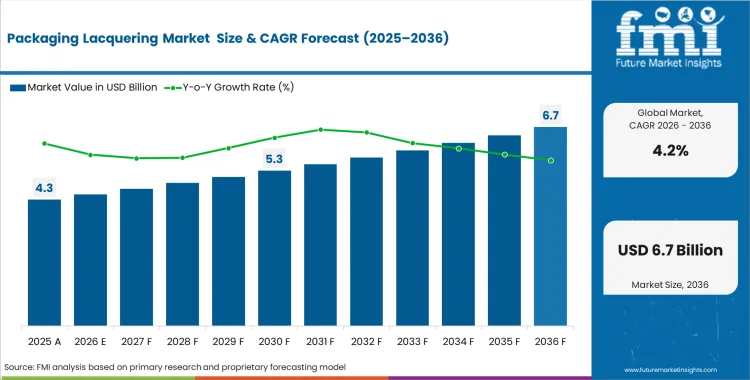
The packaging lacquering market was valued at USD 4.10 billion in 2025. The market is projected to reach USD 4.28 billion in 2026 and USD 6.46 billion by 2036, expanding at a CAGR of 4.2% during the forecast period. Internal lacquers are expected to account for 37.5% share in 2026. Metal cans are projected to hold 42.8% share, while food is expected to represent 29.6% share of demand.
Summary of Packaging Lacquering Market
- Market Snapshot
- The packaging lacquering market was valued at USD 4.10 billion in 2025.
- The packaging lacquering market is projected to reach USD 6.46 billion by 2036.
- The packaging lacquering market is expected to expand at a CAGR of 4.2% from 2026 to 2036.
- Demand and Growth Drivers
- Can makers and closure suppliers continue to rely on lacquer systems for corrosion control and pack integrity.
- Food-contact reformulation is creating replacement demand as buyers review older coating systems.
- Decorative overprint lacquers still matter in metal-pack presentation and handling.
- Product and Segment View
- The market covers internal and external lacquer systems used on cans, closures, aerosol components, glass, and selected board applications.
- Internal lacquers are expected to lead coating type demand with a 37.5% share in 2026.
- Metal cans are projected to remain the leading packaging substrate with a 42.8% share in 2026.
- Geography and Competitive Outlook
- Food segment is expected to lead end-use demand with a 29.6% share in 2026.
- The report covers North America, Latin America, Western Europe, Eastern Europe, East Asia, South Asia and Pacific, and the Middle East and Africa.
- Key companies in the packaging lacquering market include PPG, AkzoNobel, Sherwin-Williams, Kansai Paint, Axalta, and Henkel.
- Analyst Opinion
- Ismail Sutaria, Senior Consultant at FMI says, 'Packaging lacquering looks mature on the surface, but qualification work still shapes buying decisions. Growth is coming from reformulation cycles and substrate-specific performance needs.'
Packaging Lacquering Market Definition
The packaging lacquering market includes protective and decorative lacquer systems applied to packaging substrates to preserve product compatibility, support print performance, improve durability, and reduce corrosion risk. It includes internal can coatings, external overprint lacquers, closure coatings, aerosol-pack lacquers, and selected lacquer systems used on glass and paperboard. These products serve food, beverage, personal care, household, and pharmaceutical packaging applications where substrate protection and compliance both matter.
Packaging Lacquering Market Inclusions
- Sales of internal and external lacquer systems used on packaging-grade metal and related substrates.
- Revenue from can coatings, closure lacquers, aerosol-pack coatings, and comparable packaging-protection systems.
- Commercial demand across global regions for packaging applications requiring protective or decorative lacquer performance.
Packaging Lacquering Market Exclusions
- Architectural and industrial coatings outside packaging end uses.
- Adhesives and sealants sold without lacquer functionality in packaging.
- General chemical intermediates not sold as packaging lacquer systems.
Packaging Lacquering Market Research Methodology
This study analyzes packaging lacquering demand by coating type, packaging substrate, and end-use industry with 2025 as the base year and 2026 to 2036 as the forecast period in value terms. Inputs include packaging regulations, food-contact compliance references, trade literature on metal-packaging coatings, and company disclosures from leading coatings suppliers. Market estimates are developed through triangulation of metal-pack output, closure and aerosol production, reformulation cycles, qualification lead times, and coating intensity across food, beverage, and household packaging.
Key Drivers, Restraints, and Trends in Packaging Lacquering Market
Drivers
Packaging lacquering remains essential because metal packaging still needs controlled interior and exterior surfaces to perform as intended. Internal lacquers help prevent corrosion and protect product quality. External lacquers support print durability and surface appearance. Demand is also being supported by reformulation work as customers review coating systems under tighter food-contact expectations.
Restraints
The market grows more slowly than newer packaging-process categories because validation cycles are long and switching costs are real. Large fillers and can makers do not change coatings quickly when migration, adhesion, cure behavior, and line efficiency are still under review. Reformulated systems can raise cost or add process complexity. Regional regulatory differences also make portfolio management harder.
Trends
The market is moving toward chemistry that fits a specific application instead of one broad lacquer system. Buyers want coatings that match substrate type, filling conditions, and compliance needs. BPA-non-intent systems and water-based options are drawing more attention in selected uses. Decorative lacquers also remain relevant in premium packs. Competition is shifting toward application support and qualification speed.
Segmental Analysis
Packaging Lacquering Market Analysis by Coating Type
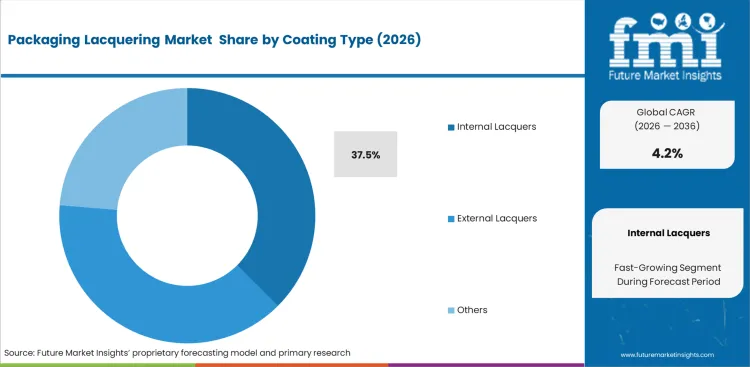
Internal lacquers are expected to account for 37.5% of market value in 2026 because product protection remains the central job of packaging coatings in metal food and beverage applications. Interior systems directly affect corrosion resistance and long-term compatibility between the pack and its contents. That makes this segment hard to compromise, even when buyers are evaluating new chemistries.
Packaging Lacquering Market Analysis by End Use Industry
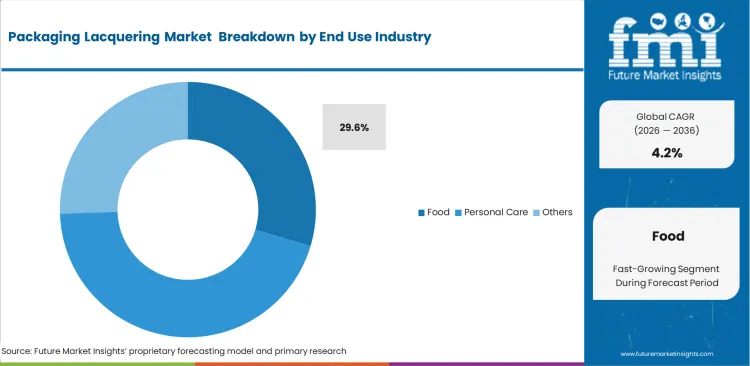
Food is projected to hold 29.6% of demand in 2026 because food packaging uses large installed can and closure volumes and imposes strict compatibility requirements on interior coatings. Lacquers remain important for shelf life and safe storage. The food segment also creates recurring qualification and reorder patterns once approval is secured.
Competitive Aligners for Market Players
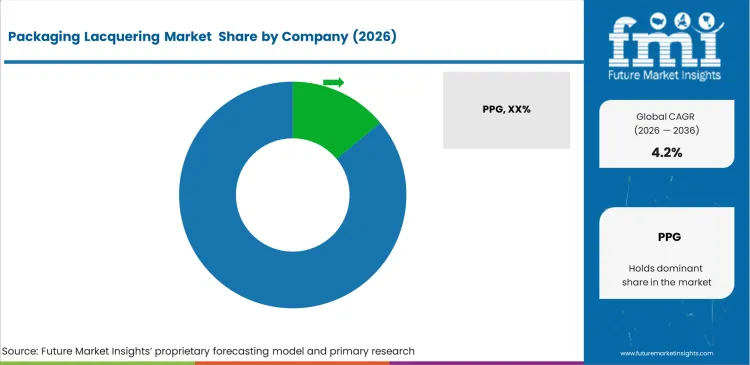
Competition in packaging lacquering is being shaped by regulatory fluency and application support. Buyers want suppliers that can reformulate quickly, manage qualification work, and deliver consistent performance across metal-pack formats. Large coatings groups have an edge because they can support global customer footprints and long validation cycles.
Key Players in Packaging Lacquering Market
- PPG
- AkzoNobel
- Sherwin-Williams
- Kansai Paint
- Axalta
- Henkel
- TIGER Coatings
- Beckers Group
- Valspar
- ALTANA
Strategic Outlook by FMI on Packaging Lacquering Market
FMI views packaging lacquering as a stable but strategically important coatings market whose value is being reset by reformulation pressure. The next phase of competition will depend on who can help can makers and fillers move to updated systems without losing process reliability. Companies that combine chemistry expertise, food-contact confidence, and strong qualification support are likely to shape the market through 2036.
Scope of the Report
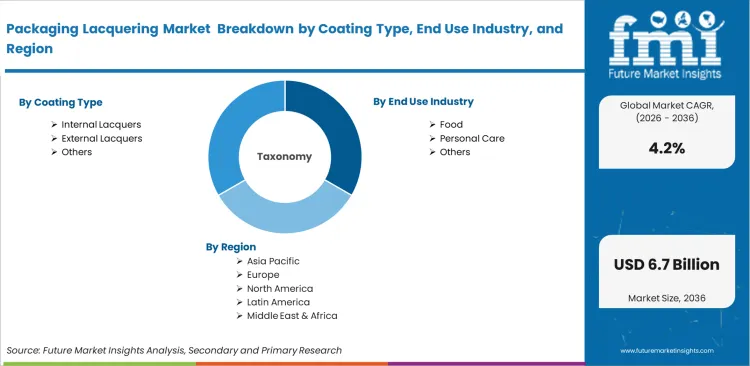
| Metric | Value |
|---|---|
| Market Value | USD 4.10 billion in 2025 to USD 6.46 billion by 2036 |
| CAGR | 4.2% from 2026 to 2036 |
| Base Year | 2025 |
| Forecast Period | 2026 to 2036 |
| Coating Type Segmentation | Internal Lacquers, External Lacquers, Water-based Lacquers, Solvent-based Lacquers, BPA-NI Systems, Others |
| Packaging Substrate Segmentation | Metal Cans, Caps and Closures, Aerosol Components, Glass, Paperboard, Others |
| End Use Industry Segmentation | Food, Beverages, Personal Care, Household Products, Pharmaceuticals, Others |
| Regions Covered | North America, Latin America, Western Europe, Eastern Europe, East Asia, South Asia and Pacific, Middle East and Africa |
Bibliography
- European Commission. 2025. Packaging and Packaging Waste Regulation.
- European Food Safety Authority. n.d. Food contact materials.
- USA Food and Drug Administration. n.d. Food Contact Substances (FCS).
- PPG. n.d. Packaging Coatings.
- AkzoNobel. n.d. AkzoNobel Packaging Coatings.
- Sherwin-Williams. n.d. Packaging Coatings.
- Metal Packaging Europe. n.d. About us.
Frequently Asked Questions
How big is the packaging lacquering market?
The packaging lacquering market was valued at USD 4.10 billion in 2025 and is projected to reach USD 6.46 billion by 2036.
What is the CAGR of the packaging lacquering market?
The packaging lacquering market is expected to expand at a CAGR of 4.2% from 2026 to 2036.
Which coating type leads the packaging lacquering market?
Internal lacquers are expected to lead the packaging lacquering market with a 37.5% share in 2026.
Which packaging substrate leads the packaging lacquering market?
Metal cans are projected to remain the leading packaging substrate in the packaging lacquering market with a 42.8% share in 2026.
Which end-use industry leads the packaging lacquering market?
Food is expected to lead end-use demand in the packaging lacquering market with a 29.6% share in 2026.
What is driving growth in the packaging lacquering market?
Growth is being supported by corrosion-control needs, food-contact reformulation cycles, and continued demand for protective metal-pack coatings.
Who are the key companies in the packaging lacquering market?
Key companies in the packaging lacquering market include PPG, AkzoNobel, Sherwin-Williams, Kansai Paint, Axalta, and Henkel.
Preview the report firsthand - request a free sample
Get SampleGet the brochure for pricing and purchase details.
Get PDFTable of Content
- Executive Summary
- Global Market Outlook
- Demand-side Trends
- Supply-side Trends
- Technology Roadmap Analysis
- Analysis and Recommendations
- Market Overview
- Market Coverage / Taxonomy
- Market Definition / Scope / Limitations
- Research Methodology
- Chapter Orientation
- Analytical Lens and Working Hypotheses
- Market Structure, Signals, and Trend Drivers
- Benchmarking and Cross-market Comparability
- Market Sizing, Forecasting, and Opportunity Mapping
- Research Design and Evidence Framework
- Desk Research Programme (Secondary Evidence)
- Company Annual and Sustainability Reports
- Peer-reviewed Journals and Academic Literature
- Corporate Websites, Product Literature, and Technical Notes
- Earnings Decks and Investor Briefings
- Statutory Filings and Regulatory Disclosures
- Technical White Papers and Standards Notes
- Trade Journals, Industry Magazines, and Analyst Briefs
- Conference Proceedings, Webinars, and Seminar Materials
- Government Statistics Portals and Public Data Releases
- Press Releases and Reputable Media Coverage
- Specialist Newsletters and Curated Briefings
- Sector Databases and Reference Repositories
- FMI Internal Proprietary Databases and Historical Market Datasets
- Subscription Datasets and Paid Sources
- Social Channels, Communities, and Digital Listening Inputs
- Additional Desk Sources
- Expert Input and Fieldwork (Primary Evidence)
- Primary Modes
- Qualitative Interviews and Expert Elicitation
- Quantitative Surveys and Structured Data Capture
- Blended Approach
- Why Primary Evidence is Used
- Field Techniques
- Interviews
- Surveys
- Focus Groups
- Observational and In-context Research
- Social and Community Interactions
- Stakeholder Universe Engaged
- C-suite Leaders
- Board Members
- Presidents and Vice Presidents
- R&D and Innovation Heads
- Technical Specialists
- Domain Subject-matter Experts
- Scientists
- Physicians and Other Healthcare Professionals
- Governance, Ethics, and Data Stewardship
- Research Ethics
- Data Integrity and Handling
- Primary Modes
- Tooling, Models, and Reference Databases
- Desk Research Programme (Secondary Evidence)
- Data Engineering and Model Build
- Data Acquisition and Ingestion
- Cleaning, Normalisation, and Verification
- Synthesis, Triangulation, and Analysis
- Quality Assurance and Audit Trail
- Market Background
- Market Dynamics
- Drivers
- Restraints
- Opportunity
- Trends
- Scenario Forecast
- Demand in Optimistic Scenario
- Demand in Likely Scenario
- Demand in Conservative Scenario
- Opportunity Map Analysis
- Product Life Cycle Analysis
- Supply Chain Analysis
- Investment Feasibility Matrix
- Value Chain Analysis
- PESTLE and Porter’s Analysis
- Regulatory Landscape
- Regional Parent Market Outlook
- Production and Consumption Statistics
- Import and Export Statistics
- Market Dynamics
- Global Market Analysis 2021 to 2025 and Forecast, 2026 to 2036
- Historical Market Size Value (USD Million) Analysis, 2021 to 2025
- Current and Future Market Size Value (USD Million) Projections, 2026 to 2036
- Y-o-Y Growth Trend Analysis
- Absolute $ Opportunity Analysis
- Global Market Pricing Analysis 2021 to 2025 and Forecast 2026 to 2036
- Global Market Analysis 2021 to 2025 and Forecast 2026 to 2036, By Coating Type
- Introduction / Key Findings
- Historical Market Size Value (USD Million) Analysis By Coating Type , 2021 to 2025
- Current and Future Market Size Value (USD Million) Analysis and Forecast By Coating Type , 2026 to 2036
- Internal Lacquers
- External Lacquers
- Others
- Internal Lacquers
- Y-o-Y Growth Trend Analysis By Coating Type , 2021 to 2025
- Absolute $ Opportunity Analysis By Coating Type , 2026 to 2036
- Global Market Analysis 2021 to 2025 and Forecast 2026 to 2036, By End Use Industry
- Introduction / Key Findings
- Historical Market Size Value (USD Million) Analysis By End Use Industry, 2021 to 2025
- Current and Future Market Size Value (USD Million) Analysis and Forecast By End Use Industry, 2026 to 2036
- Food
- Personal Care
- Others
- Food
- Y-o-Y Growth Trend Analysis By End Use Industry, 2021 to 2025
- Absolute $ Opportunity Analysis By End Use Industry, 2026 to 2036
- Global Market Analysis 2021 to 2025 and Forecast 2026 to 2036, By Region
- Introduction
- Historical Market Size Value (USD Million) Analysis By Region, 2021 to 2025
- Current Market Size Value (USD Million) Analysis and Forecast By Region, 2026 to 2036
- North America
- Latin America
- Western Europe
- Eastern Europe
- East Asia
- South Asia and Pacific
- Middle East & Africa
- Market Attractiveness Analysis By Region
- North America Market Analysis 2021 to 2025 and Forecast 2026 to 2036, By Country
- Historical Market Size Value (USD Million) Trend Analysis By Market Taxonomy, 2021 to 2025
- Market Size Value (USD Million) Forecast By Market Taxonomy, 2026 to 2036
- By Country
- USA
- Canada
- Mexico
- By Coating Type
- By End Use Industry
- By Country
- Market Attractiveness Analysis
- By Country
- By Coating Type
- By End Use Industry
- Key Takeaways
- Latin America Market Analysis 2021 to 2025 and Forecast 2026 to 2036, By Country
- Historical Market Size Value (USD Million) Trend Analysis By Market Taxonomy, 2021 to 2025
- Market Size Value (USD Million) Forecast By Market Taxonomy, 2026 to 2036
- By Country
- Brazil
- Chile
- Rest of Latin America
- By Coating Type
- By End Use Industry
- By Country
- Market Attractiveness Analysis
- By Country
- By Coating Type
- By End Use Industry
- Key Takeaways
- Western Europe Market Analysis 2021 to 2025 and Forecast 2026 to 2036, By Country
- Historical Market Size Value (USD Million) Trend Analysis By Market Taxonomy, 2021 to 2025
- Market Size Value (USD Million) Forecast By Market Taxonomy, 2026 to 2036
- By Country
- Germany
- UK
- Italy
- Spain
- France
- Nordic
- BENELUX
- Rest of Western Europe
- By Coating Type
- By End Use Industry
- By Country
- Market Attractiveness Analysis
- By Country
- By Coating Type
- By End Use Industry
- Key Takeaways
- Eastern Europe Market Analysis 2021 to 2025 and Forecast 2026 to 2036, By Country
- Historical Market Size Value (USD Million) Trend Analysis By Market Taxonomy, 2021 to 2025
- Market Size Value (USD Million) Forecast By Market Taxonomy, 2026 to 2036
- By Country
- Russia
- Poland
- Hungary
- Balkan & Baltic
- Rest of Eastern Europe
- By Coating Type
- By End Use Industry
- By Country
- Market Attractiveness Analysis
- By Country
- By Coating Type
- By End Use Industry
- Key Takeaways
- East Asia Market Analysis 2021 to 2025 and Forecast 2026 to 2036, By Country
- Historical Market Size Value (USD Million) Trend Analysis By Market Taxonomy, 2021 to 2025
- Market Size Value (USD Million) Forecast By Market Taxonomy, 2026 to 2036
- By Country
- China
- Japan
- South Korea
- By Coating Type
- By End Use Industry
- By Country
- Market Attractiveness Analysis
- By Country
- By Coating Type
- By End Use Industry
- Key Takeaways
- South Asia and Pacific Market Analysis 2021 to 2025 and Forecast 2026 to 2036, By Country
- Historical Market Size Value (USD Million) Trend Analysis By Market Taxonomy, 2021 to 2025
- Market Size Value (USD Million) Forecast By Market Taxonomy, 2026 to 2036
- By Country
- India
- ASEAN
- Australia & New Zealand
- Rest of South Asia and Pacific
- By Coating Type
- By End Use Industry
- By Country
- Market Attractiveness Analysis
- By Country
- By Coating Type
- By End Use Industry
- Key Takeaways
- Middle East & Africa Market Analysis 2021 to 2025 and Forecast 2026 to 2036, By Country
- Historical Market Size Value (USD Million) Trend Analysis By Market Taxonomy, 2021 to 2025
- Market Size Value (USD Million) Forecast By Market Taxonomy, 2026 to 2036
- By Country
- Kingdom of Saudi Arabia
- Other GCC Countries
- Turkiye
- South Africa
- Other African Union
- Rest of Middle East & Africa
- By Coating Type
- By End Use Industry
- By Country
- Market Attractiveness Analysis
- By Country
- By Coating Type
- By End Use Industry
- Key Takeaways
- Key Countries Market Analysis
- USA
- Pricing Analysis
- Market Share Analysis, 2025
- By Coating Type
- By End Use Industry
- Canada
- Pricing Analysis
- Market Share Analysis, 2025
- By Coating Type
- By End Use Industry
- Mexico
- Pricing Analysis
- Market Share Analysis, 2025
- By Coating Type
- By End Use Industry
- Brazil
- Pricing Analysis
- Market Share Analysis, 2025
- By Coating Type
- By End Use Industry
- Chile
- Pricing Analysis
- Market Share Analysis, 2025
- By Coating Type
- By End Use Industry
- Germany
- Pricing Analysis
- Market Share Analysis, 2025
- By Coating Type
- By End Use Industry
- UK
- Pricing Analysis
- Market Share Analysis, 2025
- By Coating Type
- By End Use Industry
- Italy
- Pricing Analysis
- Market Share Analysis, 2025
- By Coating Type
- By End Use Industry
- Spain
- Pricing Analysis
- Market Share Analysis, 2025
- By Coating Type
- By End Use Industry
- France
- Pricing Analysis
- Market Share Analysis, 2025
- By Coating Type
- By End Use Industry
- India
- Pricing Analysis
- Market Share Analysis, 2025
- By Coating Type
- By End Use Industry
- ASEAN
- Pricing Analysis
- Market Share Analysis, 2025
- By Coating Type
- By End Use Industry
- Australia & New Zealand
- Pricing Analysis
- Market Share Analysis, 2025
- By Coating Type
- By End Use Industry
- China
- Pricing Analysis
- Market Share Analysis, 2025
- By Coating Type
- By End Use Industry
- Japan
- Pricing Analysis
- Market Share Analysis, 2025
- By Coating Type
- By End Use Industry
- South Korea
- Pricing Analysis
- Market Share Analysis, 2025
- By Coating Type
- By End Use Industry
- Russia
- Pricing Analysis
- Market Share Analysis, 2025
- By Coating Type
- By End Use Industry
- Poland
- Pricing Analysis
- Market Share Analysis, 2025
- By Coating Type
- By End Use Industry
- Hungary
- Pricing Analysis
- Market Share Analysis, 2025
- By Coating Type
- By End Use Industry
- Kingdom of Saudi Arabia
- Pricing Analysis
- Market Share Analysis, 2025
- By Coating Type
- By End Use Industry
- Turkiye
- Pricing Analysis
- Market Share Analysis, 2025
- By Coating Type
- By End Use Industry
- South Africa
- Pricing Analysis
- Market Share Analysis, 2025
- By Coating Type
- By End Use Industry
- USA
- Market Structure Analysis
- Competition Dashboard
- Competition Benchmarking
- Market Share Analysis of Top Players
- By Regional
- By Coating Type
- By End Use Industry
- Competition Analysis
- Competition Deep Dive
- PPG
- Overview
- Product Portfolio
- Profitability by Market Segments (Product/Age /Sales Channel/Region)
- Sales Footprint
- Strategy Overview
- Marketing Strategy
- Product Strategy
- Channel Strategy
- AkzoNobel
- Sherwin-Williams
- Kansai Paint
- Axalta
- PPG
- Competition Deep Dive
- Assumptions & Acronyms Used


