

- Market Size (2026)
- USD 430 Mn
- Forecast (2036)
- USD 1190 Mn
- CAGR (2026 to 2036)
- 71.0%
Packaging Extended Producer Responsibility Compliance Test Platforms Market Size, Forecast, and Outlook By FMI
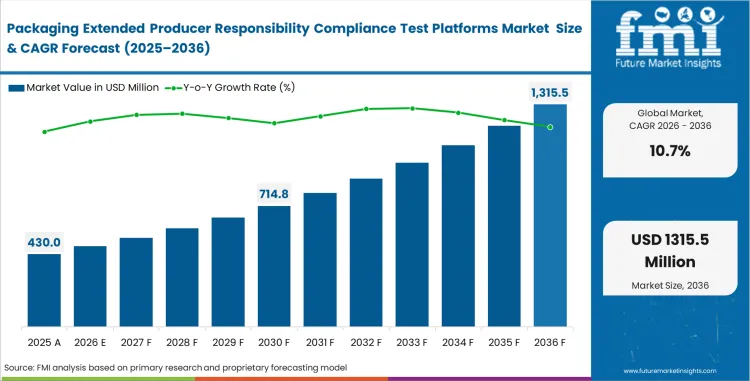
Packaging extended producer responsibility compliance test platforms market was valued at USD 390 million in 2025. Sector is expected to reach USD 430 million in 2026 at a CAGR of 10.7% during the forecast period. Valuation is estimated to advance to USD 1,190 million by 2036 as packaging EPR work moves from fragmented file handling toward software-led control of material data, filing logic, fee exposure, and audit evidence.
Summary of Packaging Extended Producer Responsibility Compliance Test Platforms Market
- Packaging Extended Producer Responsibility Compliance Test Platforms Market Snapshot
- Packaging extended producer responsibility compliance test platforms market is valued at USD 390 million in 2025 and is projected to reach USD 1,190 million by 2036.
- Industry valuation is expected to register a 10.7% CAGR from 2026 to 2036, creating an incremental opportunity of USD 760 million.
- Category remains a compliance-focused industrial software space where value comes from registration control, packaging-data normalization, fee modelling, audit readiness, and multi-jurisdiction reporting rather than from generic ESG dashboards.
- Digital reporting regimes in the United Kingdom and India, expanding producer-responsibility programs in the United States, and wider European packaging compliance obligations are accelerating category expansion.
- Packaging Extended Producer Responsibility Compliance Test Platforms Market Demand and Growth Drivers
- Producers now need a defensible system of record for packaging weights, materials, recyclability attributes, and jurisdiction-specific filing logic as EPR rules become more granular across markets.
- Platform adoption is strongest where teams must connect packaging specifications with fee forecasting, since eco-modulation and recyclability-linked costs are turning packaging data into a finance issue rather than a narrow compliance task.
- United States state-level rollout is adding to category expansion as more reporting programs move from policy design into active filing and evidence management.
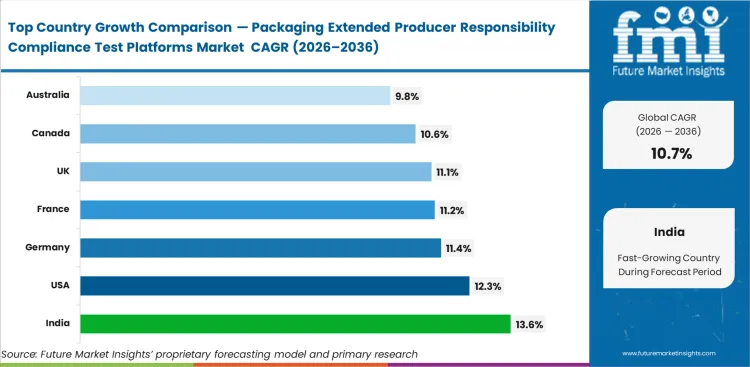
- Among key countries, India is projected to record 13.6% CAGR, followed by the United States at 12.3%, Germany at 11.4%, France at 11.2%, the United Kingdom at 11.1%, Canada at 10.6%, and Australia at 9.8% through 2036.
- Fragmented definitions, differing material taxonomies, and the need to reconcile packaging data across ERP, PLM, supplier, and marketplace channels continue to moderate industry outlook.
- Packaging Extended Producer Responsibility Compliance Test Platforms Market Product and Segment View
- Scope covers software platforms used to test, validate, organize, and report packaging EPR data, mainly for producer registration, filing, fee calculation, audit support, and recyclability-linked cost exposure.
- Cloud is expected to account for 71% share in the Deployment segment in 2026 because packaging obligations change too quickly for static local installations.
- Since multinational sellers rarely want separate reporting stacks for each state or country, multi-jurisdiction platforms are projected to represent 57% share in the Platform Type segment in 2026.
- Reporting Engines are likely to contribute 33% share in the Functionality segment in 2026, as filing accuracy remains the first budget trigger before optimization layers are added.
- Reflecting direct exposure to EPR fees, labeling accountability, and cross-border packaging claims, Brand Owners are anticipated to hold 42% share in the End User segment in 2026.
- Large Enterprises are forecast to make up 54% share in the Enterprise Size segment in 2026 because SKU complexity, market coverage, and supplier-data volume make manual reporting harder to sustain.
- Scope includes platform software for packaging data mapping, producer registration support, filing workflow control, fee modelling, and audit evidence management, while excluding generic ERP suites, non-packaging EPR-only tools, and pure consulting without a software layer.
- Packaging Extended Producer Responsibility Compliance Test Platforms Market Geography and Competitive Outlook
- India, the United States, and Germany are emerging as the fastest-expanding country markets, while the United Kingdom remains one of the steadier high-value software bases because digital packaging reporting is already institutionalized there.
- Competition is being shaped by platform integrations, especially where specification data must move smoothly into compliance reporting, while newer participants are differentiating through faster deployment, SME targeting, and fee-modulation capability.
Key Takeaways, Market Size, and Forecast
- Packaging Extended Producer Responsibility Compliance Test Platforms Market is anticipated to increase from USD 430 million in 2026 to USD 1,190 million by 2036, at a CAGR of 10.7%.
- The packaging extended producer responsibility compliance test platforms market was valued at USD 390 million in 2025.
- By 2036, the Packaging Extended Producer Responsibility Compliance Test Platforms Market is expected to be valued at USD 1,190 million.
- From 2026 to 2036, the market is likely to advance at a CAGR of 10.7%.
- The market is projected to create an incremental opportunity of USD 760 million across the forecast period.
- In 2026, Cloud is estimated to account for 71% of the deployment segment.
- India (13.6% CAGR) and the United States (12.3% CAGR) are predicted to be among the fastest growing markets.
Compliance teams are no longer deciding whether packaging records need tighter control. Immediate pressure now sits around how quickly packaging specifications, material declarations, and filing workflows can be aligned before country and state obligations widen further. Manual methods can carry a business through a narrow reporting requirement for a limited period, yet they lose reliability once more jurisdictions, more legal entities, and more packaging formats enter the picture. Industry outlook therefore favors platforms that make packaging information usable across repeated reporting cycles rather than tools built only for one filing event.
Data alignment is the gate that makes category expansion easier. Once all packaging data is organized in one governed platform, teams can more easily reuse it for registrations, reporting, and fee calculations across different compliance programs. Internal adoption usually advances once packaging, finance, and compliance teams begin working from one record rather than parallel versions.
India is projected to record 13.6% CAGR through 2036, followed by the United States at 12.3%, Germany at 11.4%, France at 11.2%, the United Kingdom at 11.1%, Canada at 10.6%, and Australia at 9.8%. Higher-ranking countries are still moving through earlier software formalization cycles, while mature European programs are adding value through better fee interpretation, stronger evidence control, and cleaner cross-border filing discipline. Range across these countries reflects how quickly internal reporting capability can catch up with packaging-rule complexity.
Packaging Extended Producer Responsibility Compliance Test Platforms Market Key Takeaways
| Metric | Details |
|---|---|
| Industry Size (2026) | USD 430 million |
| Industry Value (2036) | USD 1,190 million |
| CAGR (2026-2036) | 10.70% |
Source: Future Market Insights (FMI) analysis, based on proprietary forecasting model and primary research
Segmental Analysis
Packaging Extended Producer Responsibility Compliance Test Platforms Market Analysis by Deployment
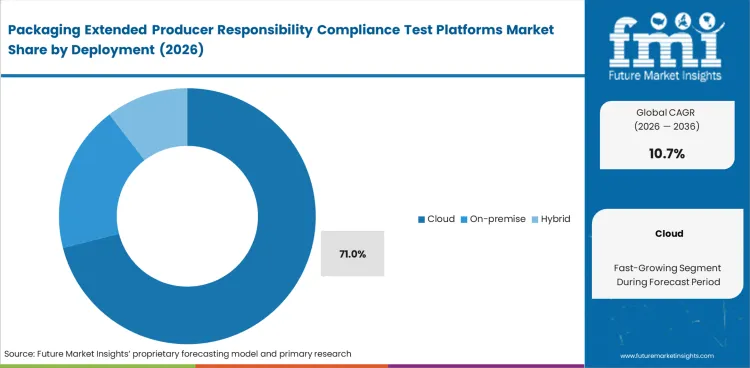
Fast rule changes, shared workflows, and recurring evidence requests make operating flexibility more valuable than server ownership in this category. Packaging compliance teams working across several reporting entities need one environment where material attributes, packaging bills, and filing logic can be revised without long release cycles or version confusion. Cloud deployment is expected to account for 71.0% share in 2026 because it aligns with the way compliance work is actually executed when declarations are corrected, supplier inputs are updated, and reporting requirements widen across jurisdictions.
Preference for cloud also rises when packaging data must move quickly between compliance, finance, and ecological teams. On-premise options still attract organizations with tighter internal IT controls, though they usually add more maintenance effort as reporting requirements expand. Hybrid models remain relevant in a narrow set of cases, but they often leave part of the same data fragmentation users are trying to remove. Interest in related areas such as track and trace packaging also supports the case for centrally managed digital control.
- Rule refresh: Cloud environments make validation logic and reporting updates easier to deploy. Compliance teams avoid waiting for local system changes during active filing periods.
- Shared access: Packaging, finance, and sustainability teams can work from one live environment. Review cycles move faster when all users are looking at the same current record.
- Evidence continuity: Audit files, packaging declarations, and version histories are easier to retain and retrieve in centralized systems. Record loss across disconnected folders becomes less likely.
Packaging Extended Producer Responsibility Compliance Test Platforms Market Analysis by Platform Type
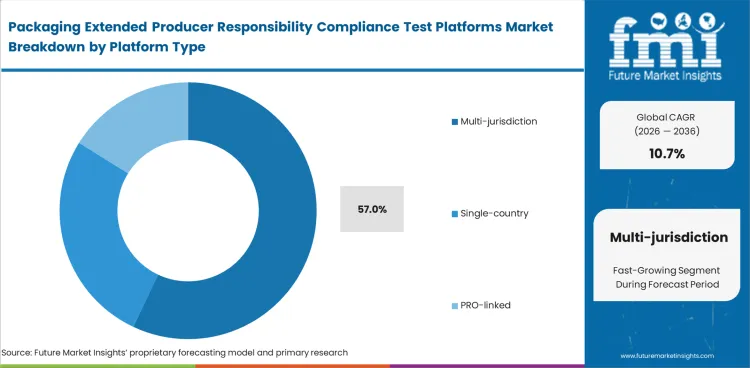
Cross-border compliance is turning into a packaging-data consistency problem before it becomes a filing problem. Broad product portfolios rarely struggle with one rule in isolation; pressure appears when one packaging format must be translated into multiple declarations, fee models, and program definitions without losing accuracy. Multi-jurisdiction platforms are projected to secure 57.0% share in 2026, since large reporting groups do not want separate software stacks for every country or state obligation.
Appeal comes from one coordinated rules environment that can absorb differing definitions without forcing teams to rebuild packaging records each time a new reporting requirement is added. Single-country tools stay useful for narrower operators, while PRO-linked models suit cases where one stewardship relationship carries most of the compliance burden. Larger enterprises still lean toward broader systems because future filing additions tend to raise integration work faster than internal capacity can absorb. Similar logic appears across compliance and traceability solution categories where data reuse matters more than one-time setup.
- Coverage range: One platform handling multiple rules lowers duplicate setup work. Compliance teams spend less time translating the same packaging item into parallel systems.
- Record reuse: Shared packaging records support repeated filing use across countries and states. Team effort moves toward verification rather than repeated data entry.
- Expansion readiness: New obligations can be added into an existing operating environment faster than building country-specific stacks. Larger groups preserve continuity as compliance scope widens.
Packaging Extended Producer Responsibility Compliance Test Platforms Market Analysis by Functionality
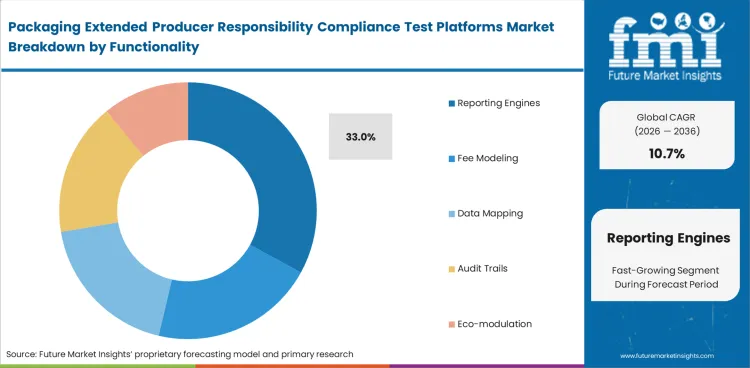
Filing confidence usually receives the first software budget in this category. Businesses can delay deeper analytics for a time, yet they cannot delay accurate submission logic once packaging declarations must be filed on time and defended later. Reporting Engines are likely to represent 33% share in 2026 because compliance owners need a direct path from packaging data to jurisdiction-ready outputs before they invest in broader optimization layers.
Reporting modules lead when enterprises are still trying to stabilize recurring submission routines, especially where internal data arrives from several business units or suppliers. Fee Modeling, Data Mapping, Audit Trails, and Eco-modulation tools gain importance after the basic filing process becomes dependable. Sequence matters here. Buying analytics before reporting discipline often leaves teams with better dashboards and the same filing exposure. Related momentum in digital product passport software further supports the need for a trusted reporting core before broader data layers are added.
- Submission accuracy: Reporting engines convert packaging attributes into filing-ready outputs. Teams cut manual rework during producer declarations.
- Workflow order: Basic reporting control usually comes before advanced optimization. Enterprises reduce exposure by stabilizing the filing step first.
- Review support: Output logic that traces back to source records improves defensibility. Internal checks become easier when calculations and declarations can be explained quickly.
Packaging Extended Producer Responsibility Compliance Test Platforms Market Analysis by End User
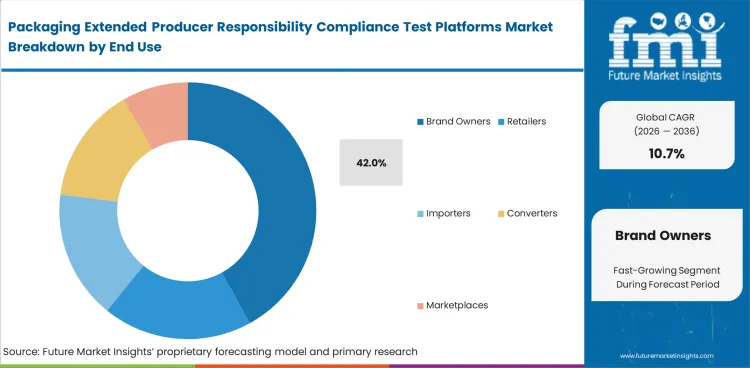
Direct fee exposure and portfolio breadth keep Brand Owners at the center of this category. Retailers, Importers, Converters, and Marketplaces all carry packaging responsibilities in selected programs, yet Brand Owners face broader pressure to maintain declarations across larger SKU counts and more frequent specification changes. In 2026, Brand Owners are expected to contribute 42% of total market share, reflecting the need to connect packaging data, supplier disclosures, and reporting outputs without losing product-level visibility.
User logic here is tied to accountability. Once filings, fee outcomes, and packaging claims connect back to the branded product, software control becomes harder to postpone. Retailers and Marketplaces are rising users where private-label or platform obligations widen, while Converters remain important when they supply essential packaging data into the reporting chain. Pressure from adjacent packaging categories such as recyclable packaging is also making product-level packaging records more consequential.
- Portfolio breadth: Brand Owners manage larger packaging mixes and more frequent packaging updates. Software helps keep declarations aligned with current specifications.
- Supplier coordination: Packaging data often enters from multiple converters and material sources. Centralized control reduces correction loops during reporting periods.
- Claim accountability: Recycled-content and recyclability statements sit close to the branded pack. Users need records that can stand up to review and challenge.
Packaging Extended Producer Responsibility Compliance Test Platforms Market Analysis by Enterprise Size
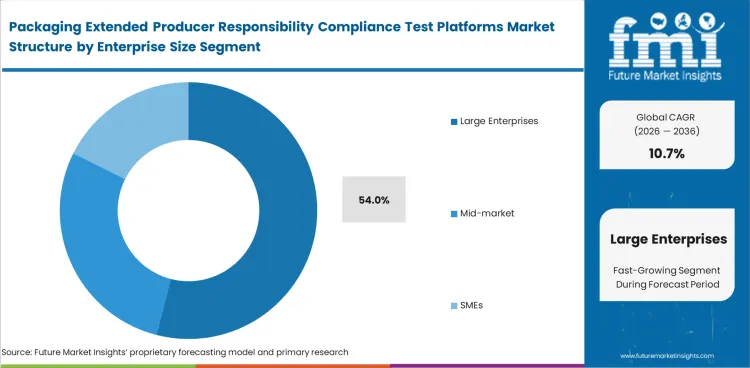
Scale creates its own reporting burden. Mid-sized operators can sometimes manage packaging obligations with lighter internal systems when geography, SKU count, and supplier diversity remain limited. Large Enterprises are forecast to account for 54.0% share in 2026 because packaging-data volumes, entity counts, and cross-border reporting demands compound quickly once portfolios widen.
Larger groups tend to buy earlier because manual control weakens once multiple business units, suppliers, and filing calendars must be coordinated. Mid-market interest is still rising as obligations spread, while SMEs usually enter later or rely longer on narrower tools and service-heavy models. Bigger organizations also feel fee-forecasting pressure sooner, since packaging redesign choices and reporting errors can move through broader product portfolios. Similar adoption behavior can be seen in sustainable packaging, where scale makes data discipline harder to defer.
- Volume burden: Large Enterprises manage wider packaging portfolios and more reporting entities. Administrative load rises faster than spreadsheet control can handle.
- Coordination pressure: More internal teams and suppliers increase the chance of mismatched data. Platform use reduces repeated reconciliation work.
- Cost visibility: Fee exposure becomes easier to misread at larger scale. Users need better modeling before packaging changes are rolled out broadly.
Packaging Extended Producer Responsibility Compliance Test Platforms Market Drivers, Restraints, and Opportunities
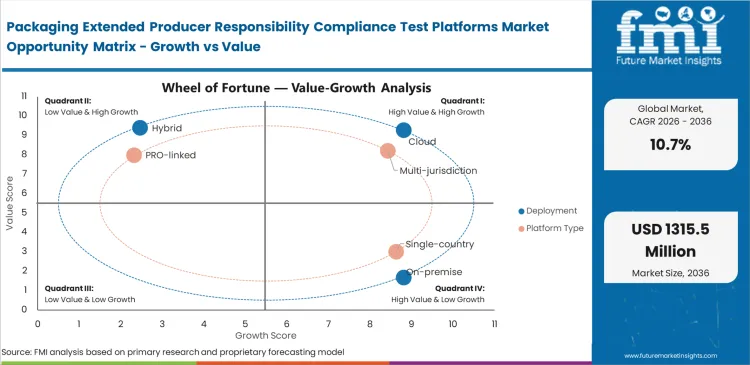
Retail waste compliance is pushing packaging-data ownership into a more formal operating role. Filing duties, producer registration, and eco-modulated fee pressure are making packaging information too consequential to remain inside disconnected spreadsheets and email trails. Brand owners, importers, and retailers now need software that can carry packaging attributes from source records into declarations without losing traceability along the way. Filing logic matters, yet evidence retention matters just as much. Once packaging claims, recycled-content statements, and material declarations begin affecting fee exposure or compliance risk, enterprises move toward systems that can connect packaging decisions with reporting outcomes in a repeatable manner.
Internal data fragmentation remains the main restraint. Packaging weights may sit in specification systems, supplier declarations may sit in separate folders, and legal-entity details may live somewhere else entirely. Bringing those records together is slow when naming conventions, packaging hierarchies, and responsibility lines vary across regions or brands. Better software reduces this burden, though it does not remove the cleanup work needed before reliable filings can be produced. Industry outlook therefore advances fastest where companies already treat packaging data as a governed business record rather than a reporting afterthought.
Opportunities in the Packaging Extended Producer Responsibility Compliance Test Platforms Market
- Fee simulation: Eco-modulated fee logic creates room for platforms that compare packaging scenarios before filings are submitted. Finance teams and packaging leads can capture this by linking material choices with cost forecasting earlier in the design cycle.
- Supplier onboarding: Packaging declarations lose value when supplier inputs arrive late or in inconsistent formats. Platform vendors can win more enterprise use by giving converters and material suppliers cleaner intake workflows with less manual correction.
- Audit readiness: Review pressure opens more room for software that preserves evidence, version history, and filing logic in one place. Brand Owners working across multiple packaging formats can use this to shorten response time when records are questioned.
Regional Analysis
Based on the regional analysis, the Packaging Extended Producer Responsibility Compliance Test Platforms Market is segmented into North America, Europe, and Asia Pacific across 40 plus countries.
.webp "Top Country Growth Comparison Packaging Extended Producer Responsibility Compliance Test Platforms Market Cagr (2026 2036)")
| Country | CAGR (2026 to 2036) |
|---|---|
| India | 13.6% |
| United States | 12.3% |
| Germany | 11.4% |
| France | 11.2% |
| United Kingdom | 11.1% |
| Canada | 10.6% |
| Australia | 9.8% |
Source: Future Market Insights (FMI) analysis, based on proprietary forecasting model and primary research
North America Packaging Extended Producer Responsibility Compliance Test Platforms Market Analysis
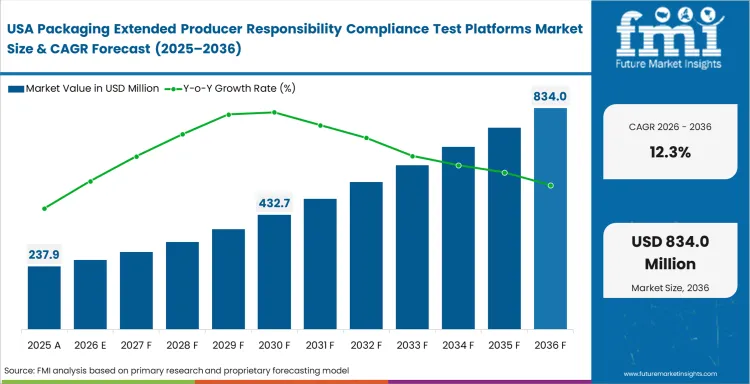
North America is developing through regulatory layering rather than through one uniform compliance path. Packaging obligations are widening across states and provinces, and that keeps software demand tied to adaptability, rule maintenance, and entity-level record control. Enterprises operating across several consumer markets cannot afford to rebuild filing logic every time another jurisdiction comes into scope.
Platform selection in this region therefore leans toward tools that can absorb new reporting requirements without breaking packaging records already in use. Commercial traction is also supported by a more mature internal view of packaging data as a governed business asset rather than a narrow compliance file, a pattern that also aligns with broader investment in connected packaging and track and trace packaging.
- United States: Industry outlook in the United States points to 12.3% CAGR through 2036. State-level EPR rollout is giving the United States a stronger near-term expansion profile than most other countries in this study. Large consumer-goods groups, retailers, and import-heavy operators are being asked to manage more filing logic without the support of one national system, and that keeps attention fixed on configurable multi-jurisdiction platforms. Pace here reflects a widening program base and the practical need to keep packaging declarations aligned across brands, legal entities, and reporting calendars. Companies that standardize records early are better placed to absorb later compliance additions without repeated internal rework.
- Canada: Federal reporting layers and provincial stewardship obligations are giving Canada a more administratively demanding profile than program counts alone would suggest. Packaging-data teams often need systems that can support multiple reporting formats while preserving consistency across national and provincial requirements. Canada is expected to register 10.6% CAGR in this market during the forecast period. Expansion runs below the United States, though the commercial case stays sound because packaging compliance is becoming more visible inside internal planning and governance. Stronger software discipline helps organizations spend less time reconciling records and more time checking packaging assumptions before declarations are finalized.
North America also includes Mexico, where cross-border consumer-goods flows keep packaging information moving between markets rather than staying inside one isolated reporting environment. Regional direction therefore favors software that can travel across jurisdictions and adapt to additional programs with limited disruption.
Europe Packaging Extended Producer Responsibility Compliance Test Platforms Market Analysis
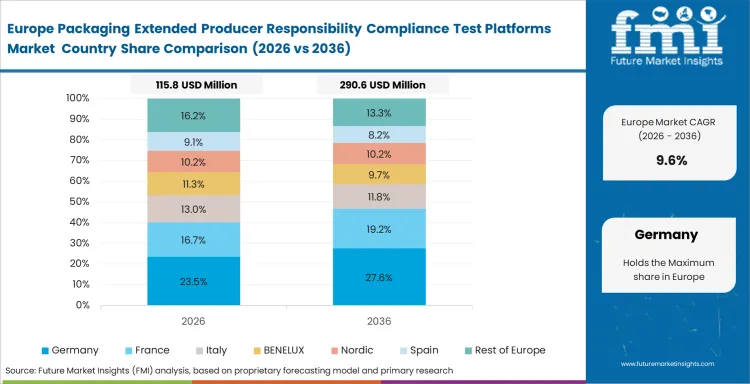
Europe brings a different operating reality. Mature packaging regulation does not make compliance easier; it makes record quality, evidence retention, and filing consistency more important. Many enterprises in the region are no longer choosing whether to formalize compliance systems. Current focus sits on how to preserve packaging-record integrity across several national rules without creating repeat correction work every cycle. Software demand in Europe is therefore less about first-wave onboarding and more about depth, defensibility, and repeatable reporting performance. Buyers here usually place greater value on record continuity, packaging-attribute control, and fee interpretation than on rapid deployment alone. Similar discipline is visible across adjacent design for recycling priorities, where documentation quality influences downstream compliance work.
- Germany: Filing discipline gives Germany one of the stronger positions among mature European markets. Enterprises here usually want systems that reduce manual correction, keep packaging attributes audit-ready, and maintain continuity across broad product portfolios. Germany is forecast to post 11.4% CAGR in the sector through 2036. Country performance stays ahead of many established peers because compliance routines are already embedded deeply enough to justify more capable software support. Packaging-data control also matters more in Germany because recurring reporting work needs to remain clean over time rather than being corrected at the last minute. Buyers therefore lean toward platforms that improve accuracy without adding unnecessary workflow burden.
- France: France is forecast to grow at an 11.2% CAGR through 2036, as clearer links between packaging characteristics and compliance costs increase attention on fee exposure and software control. Packaging teams often need tighter control over composition records, recyclability logic, and product-level declarations so design decisions can be understood before filing periods close. Commercial relevance here comes from the link between packaging data quality and cost interpretation, not from filing volume alone. Better software helps teams connect packaging design choices with downstream reporting consequences early enough to act on them. That makes platform usefulness easier to justify across both compliance and financial planning functions.
- United Kingdom: Digital reporting discipline gives the United Kingdom a steadier and more operationally mature base than many other markets in this study. Enterprises have largely moved past the question of whether formal systems are needed and are now comparing which platforms can reduce duplicate entry, preserve submission evidence, and keep packaging records usable over repeated reporting cycles. Industry outlook in the United Kingdom points to 11.1% CAGR through 2036. Expansion remains measured rather than abrupt because the market is further along in formalization, yet buyer expectations are correspondingly higher around usability, accuracy, and documented control. Vendors that simplify recurring filing work tend to keep stronger long-term relevance here.
Europe also includes Benelux and the Nordic countries, where packaging operations often act as disciplined regional hubs for material handling, format consistency, and controlled data management. Regional tone therefore favors reliable workflow depth and defensible reporting records over first-cycle onboarding speed.
Asia Pacific Packaging Extended Producer Responsibility Compliance Test Platforms Market Analysis
Asia Pacific is building from a different starting point. Many enterprises are still moving from policy awareness into active filing routines, so software adoption is tied closely to onboarding speed, data gathering, and first-cycle process control. Value rises quickly once packaging compliance begins to demand repeatable digital records instead of informal internal coordination. Regional direction therefore rewards vendors that can absorb uneven data quality, support broad packaging portfolios, and shorten the path from record collection to usable filing output. Packaging-format diversity also matters more here, because inconsistencies across supplier declarations and internal systems make early software discipline commercially useful. Related momentum in sustainable packaging is also reinforcing the need for cleaner packaging records across materials, formats, and compliance claims.
- India: India is likely to post 13.6% CAGR in the sector by 2036. It is the fastest-moving country in this analysis because portal-led compliance formalization is colliding with broad consumer-goods packaging volume. Packaging-data teams often need to organize declarations across wide product ranges while supplier documentation still varies in consistency across parts of the chain. High expansion reflects first-wave digitization combined with the practical need to replace fragmented reporting routines as filings become more formal and harder to manage manually. Record cleanup carries unusual importance in India because businesses that organize packaging information early can move into later filing cycles with less disruption and stronger internal control.
- Australia: Stewardship expectations and packaging-governance maturity give Australia a more measured but still commercially positive profile. Enterprises there usually prefer systems that keep records clean and defensible without creating administrative burden beyond the reporting work already required. Industry outlook in Australia points to 9.8% CAGR through 2036. Pace stays below India because onboarding urgency is lower and the addressable enterprise base is smaller, yet software adoption is still advancing where packaging declarations and evidence trails must remain dependable under ongoing review. Operational payoff in Australia comes from consistency, controlled documentation, and reduced correction effort rather than from sheer scale of deployment.
Asia Pacific also includes Japan, South Korea, China, and Southeast Asian markets, where data maturity can vary widely across sectors and supply chains. Regional progress therefore favors platforms that can handle uneven record quality while still giving brands and packaging-data teams a cleaner route into repeat filing cycles, a direction that also connects with broader investment in recyclable packaging.
Competitive Aligners for Market Players
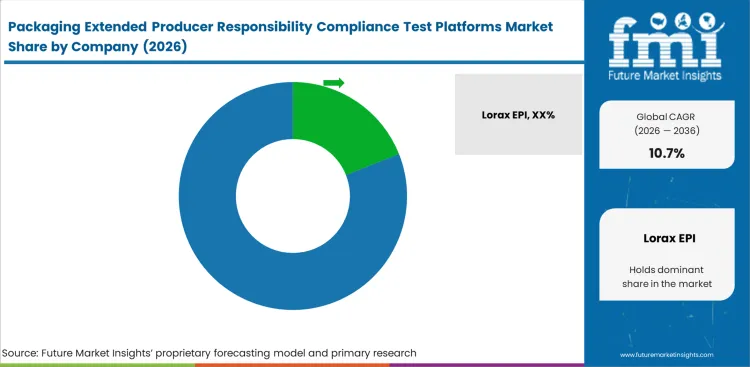
Fragmentation defines this category because packaging compliance needs vary by jurisdiction, user maturity, and internal data quality. Lorax EPI, Specright, Assent, PCX Markets, FoodChain ID, rePurpose Global, and Packgine remain relevant because enterprises are not selecting software on name visibility alone. Filing control, packaging-data reconciliation, audit support, and rule adaptability carry more weight. Organizations comparing options usually look first at whether a platform can take imperfect packaging records and convert them into repeatable reporting workflows. Vendors that reduce correction loops and preserve clear evidence tend to earn more trust than those offering broad feature lists without dependable filing execution.
Incumbents benefit from deeper packaging-compliance familiarity and from systems that already connect packaging data with filing outputs. Lorax EPI, Specright, FoodChain ID, and Assent hold clearer positions where enterprises want software that can sit close to packaging records rather than on top of them as a light reporting add-on. Challengers can still gain ground. PCX Markets, Packgine, and rePurpose Global matter where onboarding speed, narrower compliance scope, or lower-complexity adoption models fit enterprise needs better. Category remains open enough for newer vendors to win business when they simplify setup and reduce operating friction.
Large enterprises still hold meaningful bargaining power because this category has not consolidated around one unavoidable operating standard. Users can resist lock-in by demanding exportable records, configurable rule layers, and cleaner integration with internal specification systems. Even so, vendors with stronger packaging-data models and smoother filing workflows are likely to hold an advantage through 2036. Category is expected to remain fragmented rather than narrowly concentrated, since user requirements vary widely by geography and compliance maturity.
Key Players in Packaging Extended Producer Responsibility Compliance Test Platforms Market
- Lorax EPI
- Specright
- Assent
- PCX Markets
- FoodChain ID
- rePurpose Global
- Packgine
Scope of the Report
| Metric | Value |
|---|---|
| Quantitative Units | USD 430 million to USD 1,190 million, at a CAGR of 10.7% |
| Market Definition | Packaging Extended Producer Responsibility Compliance Test Platforms Market covers software used to validate packaging data, support producer registration, generate filing outputs, model fee exposure, and preserve audit evidence under packaging EPR programs. Scope is limited to packaging-specific compliance platforms rather than broad sustainability systems. |
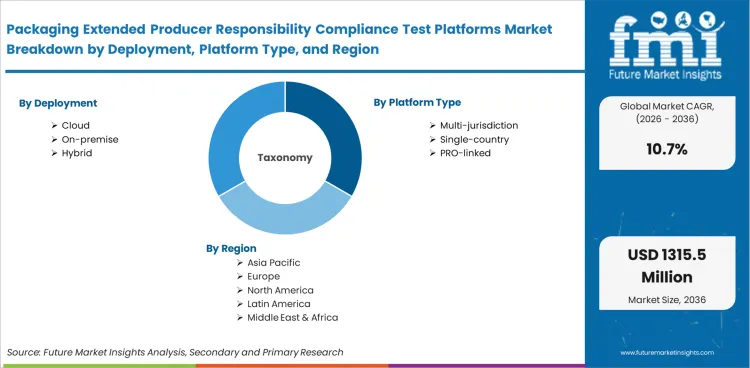
| Deployment Segmentation | Cloud, On-premise, Hybrid |
| Platform Type Segmentation | Multi-jurisdiction, Single-country, PRO-linked |
| Functionality Segmentation | Reporting Engines, Fee Modeling, Data Mapping, Audit Trails, Eco-modulation |
| End User Segmentation | Brand Owners, Retailers, Importers, Converters, Marketplaces |
| Enterprise Size Segmentation | Large Enterprises, Mid-market, SMEs |
| Regions Covered | North America, Europe, Asia Pacific |
| Countries Covered | India, United States, Germany, France, United Kingdom, Canada, Australia, and 40 plus countries |
| Key Companies Profiled | Lorax EPI, Specright, Assent, PCX Markets, FoodChain ID, rePurpose Global, Packgine |
| Forecast Period | 2026 to 2036 |
| Approach | FMI combined primary interviews with packaging compliance and specification owners, desk assessment of packaging filing frameworks and software materials, and bottom-up sizing based on addressable obligated enterprises and recurring platform-spend logic. Forecasts were checked against adoption patterns in adjacent packaging-compliance and data-management categories. |
Source: Future Market Insights (FMI) analysis, based on proprietary forecasting model and primary research
Packaging Extended Producer Responsibility Compliance Test Platforms Market Analysis by Segments
By Deployment
- Cloud
- On-premise
- Hybrid
- By Platform Type
- Multi-jurisdiction
- Single-country
- PRO-linked
By Functionality
- Reporting Engines
- Fee Modeling
- Data Mapping
- Audit Trails
- Eco-modulation
By End User
- Brand Owners
- Retailers
- Importers
- Converters
- Marketplaces
By Enterprise Size
- Large Enterprises
- Mid-market
- SMEs
By Region
- North America
- United States
- Canada
- Mexico
- Europe
- Germany
- France
- United Kingdom
- Benelux
- Nordics
- Asia Pacific
- India
- Australia
- China
- Japan
- South Korea
- Southeast Asia
Bibliography
- Department for Environment, Food & Rural Affairs. (2026, March). Extended producer responsibility for packaging: Check the public registers. GOV.UK.
- Environment and Climate Change Canada. (2026, March 13). Federal Plastics Registry. Government of Canada.
- Circular Action Alliance Oregon. (2025). 2025 financial report: Covering FY 2023-2024. Circular Action Alliance Oregon.
- OECD. (2024, April 22). Digital technologies for better enforcement of waste regulation. OECD.
- GS1. (2025, January 2). GS1 Standards enabling the EU digital product passport. GS1.
This bibliography is provided for reader reference. The full FMI report contains the complete reference list with primary source documentation.
This Report Addresses
- Market intelligence to support strategic decision making across cloud compliance platforms, multi-jurisdiction filing systems, reporting engines, fee-modeling tools, and audit-control software.
- Market size estimation and 10-year valuation forecasts from 2026 to 2036, supported by bottom-up assessment of addressable obligated enterprises and recurring platform-spend logic.
- Opportunity mapping across deployment, platform type, functionality, end user, enterprise size, and region with emphasis on packaging-data alignment as the key adoption gate.
- Segment and regional valuation forecasts covering cloud deployment, multi-jurisdiction platforms, reporting engines, Brand Owners, and Large Enterprises across packaging EPR reporting environments.
- Competition assessment including filing control, audit readiness, rule adaptability, integration depth, onboarding speed, and packaging-data reconciliation capability.
- Packaging-compliance development tracking including producer registration support, filing workflow control, eco-modulation analysis, recyclability-linked records, packaging evidence retention, and audit readiness.
- Market access analysis covering packaging EPR reporting pathways, fee-modulation exposure, packaging-declaration requirements, and documentation control across widening jurisdiction programs.
- Market report delivery in PDF, Excel, PPT, and interactive dashboard formats for executive strategy, packaging compliance planning, and operational benchmarking use.
Frequently Asked Questions
How large is the Packaging Extended Producer Responsibility Compliance Test Platforms Market in 2026?
Industry valuation is estimated at USD 430 million in 2026. Figure indicates a specialist software category that is broadening from narrow compliance use into wider packaging-data control.
What will the Packaging Extended Producer Responsibility Compliance Test Platforms Market be valued at by 2036?
FMI projects valuation to reach USD 1,190 million by 2036. Scale at that point reflects wider software use across filing, fee modeling, and audit-control workflows rather than one-time onboarding alone.
What CAGR is projected for the market from 2026 to 2036?
FMI projects a CAGR of 10.7% for 2026 to 2036. Rate indicates a software category expanding faster than mature packaging segments because reporting complexity is rising more quickly than internal manual capacity.
Which Deployment segment leads the market?
Cloud leads Deployment and is expected to account for 71% share in 2026. Preference comes from easier rule updates, broader access, and better continuity across reporting cycles.
Which Platform Type segment leads the market?
Multi jurisdiction platforms lead Platform Type with an expected 57% share in 2026. Enterprises prefer one operating environment when packaging records must be reused across several programs.
Which Functionality segment leads the market?
Reporting Engines lead Functionality and are forecast to represent 33% share in 2026. Filing accuracy usually receives budget priority before deeper optimization layers are added.
What is pushing adoption in this category?
Packaging obligations are forcing enterprises to control packaging data in a more formal way. Registration, filing, fee exposure, and evidence retention all become harder once multiple programs are active and records sit in separate systems.
What is the primary restraint for category expansion?
Data fragmentation is the largest restraint. Packaging specifications, supplier declarations, and legal-entity details often sit in different systems, so platform value stays limited until those records are cleaned and aligned.
Which country expands fastest in this study?
India expands fastest at 13.6% CAGR through 2036. Pace exceeds the United States because portal-led compliance formalization is still widening and first-wave software adoption has more room to advance.
Why does packaging-data alignment matter so much in this market?
Alignment turns scattered packaging information into something software can reuse across filings. Once material, weight, and format records are harmonized, reporting becomes repeatable instead of being rebuilt each cycle.
How is fee-modulation affecting software interest?
Fee-modulation gives packaging attributes direct cost implications. Platform interest rises because enterprises want to test packaging scenarios before filings lock in fee exposure.
What do users usually compare when choosing vendors?
Users compare filing reliability, packaging-data reconciliation, rule adaptability, and evidence control more than feature count alone. Systems that reduce correction loops tend to win more trust than those offering broad compliance coverage with weaker execution.
Why do Brand Owners account for the largest End User share?
Brand Owners are expected to represent 42% share in 2026 because packaging claims, fee liability, and product-level declarations usually sit closest to the branded pack. Portfolio breadth also makes manual control harder to sustain.
Why do Large Enterprises lead by Enterprise Size?
Large Enterprises are forecast to account for 54% share in 2026. Wider SKU counts, more business units, and more suppliers create a reporting burden that makes platform adoption commercially easier to justify.
How does the United States compare with Canada?
United States is projected to expand at 12.3% CAGR, ahead of Canada at 10.6%. Difference comes from broader state-level rollout and a faster widening of software use across larger packaging portfolios.
How do Germany and France differ in software interest?
Germany at 11.4% CAGR reflects stronger institutional filing discipline, while France at 11.2% benefits from closer linkage between packaging attributes and fee outcomes. One favors repeatable control; the other places more weight on packaging-cost interpretation.
Why is the United Kingdom still important despite a slightly lower CAGR?
United Kingdom is expected to record 11.1% CAGR through 2036. Lower pace than Germany does not weaken its importance, because mature reporting discipline makes it a steady base for platforms built around recurring filing use.
What does Australia’s position say about Asia Pacific?
Australia posts 9.8% CAGR, below India but still positive. Result shows Asia Pacific contains both early formalization countries and more mature stewardship settings, so vendors need flexible onboarding models.
Are On-premise and Hybrid platforms still relevant?
Yes, though they serve narrower needs. Businesses with tighter internal IT governance or legacy-system preferences may still use them, but they usually add more maintenance work as rule sets widen.
What is included in market scope?
Scope includes software for producer registration support, reporting engines, fee modeling, data mapping, audit trails, and eco-modulation analysis. Consulting without a software layer and generic ESG tools remain outside this category.
What is excluded from this market?
Generic ERP systems without packaging-specific compliance capability are excluded, as are non-packaging EPR tools and consulting-only offers. Boundary stays focused on platforms built to validate and report packaging-compliance data.
How was the market sized?
FMI used a bottom-up approach anchored in the count of addressable obligated enterprises and blended annual platform spending. Forecasts were then checked against rollout pace and adoption logic in adjacent compliance and data-management software categories.
What changes by 2036 in practical terms?
By 2036, packaging-compliance software is likely to be treated less as a side system and more as a controlled record for packaging attributes, filings, fee analysis, and audit evidence. Enterprises reaching that point earlier can absorb new reporting programs with less internal disruption.
What is the non-obvious point practitioners inside this category usually understand first?
Rule libraries alone do not decide vendor strength. Day-to-day value comes from whether packaging records can survive correction, review, and refiling without breaking across teams and jurisdictions.
Preview the report firsthand - request a free sample
Get SampleGet the brochure for pricing and purchase details.
Get PDFTable of Content
- Executive Summary
- Global Market Outlook
- Demand-side Trends
- Supply-side Trends
- Technology Roadmap Analysis
- Analysis and Recommendations
- Market Overview
- Market Coverage / Taxonomy
- Market Definition / Scope / Limitations
- Research Methodology
- Chapter Orientation
- Analytical Lens and Working Hypotheses
- Market Structure, Signals, and Trend Drivers
- Benchmarking and Cross-market Comparability
- Market Sizing, Forecasting, and Opportunity Mapping
- Research Design and Evidence Framework
- Desk Research Programme (Secondary Evidence)
- Company Annual and Sustainability Reports
- Peer-reviewed Journals and Academic Literature
- Corporate Websites, Product Literature, and Technical Notes
- Earnings Decks and Investor Briefings
- Statutory Filings and Regulatory Disclosures
- Technical White Papers and Standards Notes
- Trade Journals, Industry Magazines, and Analyst Briefs
- Conference Proceedings, Webinars, and Seminar Materials
- Government Statistics Portals and Public Data Releases
- Press Releases and Reputable Media Coverage
- Specialist Newsletters and Curated Briefings
- Sector Databases and Reference Repositories
- FMI Internal Proprietary Databases and Historical Market Datasets
- Subscription Datasets and Paid Sources
- Social Channels, Communities, and Digital Listening Inputs
- Additional Desk Sources
- Expert Input and Fieldwork (Primary Evidence)
- Primary Modes
- Qualitative Interviews and Expert Elicitation
- Quantitative Surveys and Structured Data Capture
- Blended Approach
- Why Primary Evidence is Used
- Field Techniques
- Interviews
- Surveys
- Focus Groups
- Observational and In-context Research
- Social and Community Interactions
- Stakeholder Universe Engaged
- C-suite Leaders
- Board Members
- Presidents and Vice Presidents
- R&D and Innovation Heads
- Technical Specialists
- Domain Subject-matter Experts
- Scientists
- Physicians and Other Healthcare Professionals
- Governance, Ethics, and Data Stewardship
- Research Ethics
- Data Integrity and Handling
- Primary Modes
- Tooling, Models, and Reference Databases
- Desk Research Programme (Secondary Evidence)
- Data Engineering and Model Build
- Data Acquisition and Ingestion
- Cleaning, Normalisation, and Verification
- Synthesis, Triangulation, and Analysis
- Quality Assurance and Audit Trail
- Market Background
- Market Dynamics
- Drivers
- Restraints
- Opportunity
- Trends
- Scenario Forecast
- Demand in Optimistic Scenario
- Demand in Likely Scenario
- Demand in Conservative Scenario
- Opportunity Map Analysis
- Product Life Cycle Analysis
- Supply Chain Analysis
- Investment Feasibility Matrix
- Value Chain Analysis
- PESTLE and Porter’s Analysis
- Regulatory Landscape
- Regional Parent Market Outlook
- Production and Consumption Statistics
- Import and Export Statistics
- Market Dynamics
- Global Market Analysis 2021 to 2025 and Forecast, 2026 to 2036
- Historical Market Size Value (USD Million) Analysis, 2021 to 2025
- Current and Future Market Size Value (USD Million) Projections, 2026 to 2036
- Y-o-Y Growth Trend Analysis
- Absolute $ Opportunity Analysis
- Global Market Pricing Analysis 2021 to 2025 and Forecast 2026 to 2036
- Global Market Analysis 2021 to 2025 and Forecast 2026 to 2036, By Deployment
- Introduction / Key Findings
- Historical Market Size Value (USD Million) Analysis By Deployment , 2021 to 2025
- Current and Future Market Size Value (USD Million) Analysis and Forecast By Deployment , 2026 to 2036
- Cloud
- On-premise
- Hybrid
- Cloud
- Y-o-Y Growth Trend Analysis By Deployment , 2021 to 2025
- Absolute $ Opportunity Analysis By Deployment , 2026 to 2036
- Global Market Analysis 2021 to 2025 and Forecast 2026 to 2036, By Platform Type
- Introduction / Key Findings
- Historical Market Size Value (USD Million) Analysis By Platform Type, 2021 to 2025
- Current and Future Market Size Value (USD Million) Analysis and Forecast By Platform Type, 2026 to 2036
- Multi-jurisdiction
- Single-country
- PRO-linked
- Multi-jurisdiction
- Y-o-Y Growth Trend Analysis By Platform Type, 2021 to 2025
- Absolute $ Opportunity Analysis By Platform Type, 2026 to 2036
- Global Market Analysis 2021 to 2025 and Forecast 2026 to 2036, By Functionality
- Introduction / Key Findings
- Historical Market Size Value (USD Million) Analysis By Functionality, 2021 to 2025
- Current and Future Market Size Value (USD Million) Analysis and Forecast By Functionality, 2026 to 2036
- Reporting Engines
- Fee Modeling
- Data Mapping
- Audit Trails
- Eco-modulation
- Reporting Engines
- Y-o-Y Growth Trend Analysis By Functionality, 2021 to 2025
- Absolute $ Opportunity Analysis By Functionality, 2026 to 2036
- Global Market Analysis 2021 to 2025 and Forecast 2026 to 2036, By End Use
- Introduction / Key Findings
- Historical Market Size Value (USD Million) Analysis By End Use, 2021 to 2025
- Current and Future Market Size Value (USD Million) Analysis and Forecast By End Use, 2026 to 2036
- Brand Owners
- Retailers
- Importers
- Converters
- Marketplaces
- Brand Owners
- Y-o-Y Growth Trend Analysis By End Use, 2021 to 2025
- Absolute $ Opportunity Analysis By End Use, 2026 to 2036
- Global Market Analysis 2021 to 2025 and Forecast 2026 to 2036, By Enterprise Size
- Introduction / Key Findings
- Historical Market Size Value (USD Million) Analysis By Enterprise Size, 2021 to 2025
- Current and Future Market Size Value (USD Million) Analysis and Forecast By Enterprise Size, 2026 to 2036
- Large Enterprises
- Mid-market
- SMEs
- Large Enterprises
- Y-o-Y Growth Trend Analysis By Enterprise Size, 2021 to 2025
- Absolute $ Opportunity Analysis By Enterprise Size, 2026 to 2036
- Global Market Analysis 2021 to 2025 and Forecast 2026 to 2036, By Region
- Introduction
- Historical Market Size Value (USD Million) Analysis By Region, 2021 to 2025
- Current Market Size Value (USD Million) Analysis and Forecast By Region, 2026 to 2036
- North America
- Latin America
- Western Europe
- Eastern Europe
- East Asia
- South Asia and Pacific
- Middle East & Africa
- Market Attractiveness Analysis By Region
- North America Market Analysis 2021 to 2025 and Forecast 2026 to 2036, By Country
- Historical Market Size Value (USD Million) Trend Analysis By Market Taxonomy, 2021 to 2025
- Market Size Value (USD Million) Forecast By Market Taxonomy, 2026 to 2036
- By Country
- USA
- Canada
- Mexico
- By Deployment
- By Platform Type
- By Functionality
- By End Use
- By Enterprise Size
- By Country
- Market Attractiveness Analysis
- By Country
- By Deployment
- By Platform Type
- By Functionality
- By End Use
- By Enterprise Size
- Key Takeaways
- Latin America Market Analysis 2021 to 2025 and Forecast 2026 to 2036, By Country
- Historical Market Size Value (USD Million) Trend Analysis By Market Taxonomy, 2021 to 2025
- Market Size Value (USD Million) Forecast By Market Taxonomy, 2026 to 2036
- By Country
- Brazil
- Chile
- Rest of Latin America
- By Deployment
- By Platform Type
- By Functionality
- By End Use
- By Enterprise Size
- By Country
- Market Attractiveness Analysis
- By Country
- By Deployment
- By Platform Type
- By Functionality
- By End Use
- By Enterprise Size
- Key Takeaways
- Western Europe Market Analysis 2021 to 2025 and Forecast 2026 to 2036, By Country
- Historical Market Size Value (USD Million) Trend Analysis By Market Taxonomy, 2021 to 2025
- Market Size Value (USD Million) Forecast By Market Taxonomy, 2026 to 2036
- By Country
- Germany
- UK
- Italy
- Spain
- France
- Nordic
- BENELUX
- Rest of Western Europe
- By Deployment
- By Platform Type
- By Functionality
- By End Use
- By Enterprise Size
- By Country
- Market Attractiveness Analysis
- By Country
- By Deployment
- By Platform Type
- By Functionality
- By End Use
- By Enterprise Size
- Key Takeaways
- Eastern Europe Market Analysis 2021 to 2025 and Forecast 2026 to 2036, By Country
- Historical Market Size Value (USD Million) Trend Analysis By Market Taxonomy, 2021 to 2025
- Market Size Value (USD Million) Forecast By Market Taxonomy, 2026 to 2036
- By Country
- Russia
- Poland
- Hungary
- Balkan & Baltic
- Rest of Eastern Europe
- By Deployment
- By Platform Type
- By Functionality
- By End Use
- By Enterprise Size
- By Country
- Market Attractiveness Analysis
- By Country
- By Deployment
- By Platform Type
- By Functionality
- By End Use
- By Enterprise Size
- Key Takeaways
- East Asia Market Analysis 2021 to 2025 and Forecast 2026 to 2036, By Country
- Historical Market Size Value (USD Million) Trend Analysis By Market Taxonomy, 2021 to 2025
- Market Size Value (USD Million) Forecast By Market Taxonomy, 2026 to 2036
- By Country
- China
- Japan
- South Korea
- By Deployment
- By Platform Type
- By Functionality
- By End Use
- By Enterprise Size
- By Country
- Market Attractiveness Analysis
- By Country
- By Deployment
- By Platform Type
- By Functionality
- By End Use
- By Enterprise Size
- Key Takeaways
- South Asia and Pacific Market Analysis 2021 to 2025 and Forecast 2026 to 2036, By Country
- Historical Market Size Value (USD Million) Trend Analysis By Market Taxonomy, 2021 to 2025
- Market Size Value (USD Million) Forecast By Market Taxonomy, 2026 to 2036
- By Country
- India
- ASEAN
- Australia & New Zealand
- Rest of South Asia and Pacific
- By Deployment
- By Platform Type
- By Functionality
- By End Use
- By Enterprise Size
- By Country
- Market Attractiveness Analysis
- By Country
- By Deployment
- By Platform Type
- By Functionality
- By End Use
- By Enterprise Size
- Key Takeaways
- Middle East & Africa Market Analysis 2021 to 2025 and Forecast 2026 to 2036, By Country
- Historical Market Size Value (USD Million) Trend Analysis By Market Taxonomy, 2021 to 2025
- Market Size Value (USD Million) Forecast By Market Taxonomy, 2026 to 2036
- By Country
- Kingdom of Saudi Arabia
- Other GCC Countries
- Turkiye
- South Africa
- Other African Union
- Rest of Middle East & Africa
- By Deployment
- By Platform Type
- By Functionality
- By End Use
- By Enterprise Size
- By Country
- Market Attractiveness Analysis
- By Country
- By Deployment
- By Platform Type
- By Functionality
- By End Use
- By Enterprise Size
- Key Takeaways
- Key Countries Market Analysis
- USA
- Pricing Analysis
- Market Share Analysis, 2025
- By Deployment
- By Platform Type
- By Functionality
- By End Use
- By Enterprise Size
- Canada
- Pricing Analysis
- Market Share Analysis, 2025
- By Deployment
- By Platform Type
- By Functionality
- By End Use
- By Enterprise Size
- Mexico
- Pricing Analysis
- Market Share Analysis, 2025
- By Deployment
- By Platform Type
- By Functionality
- By End Use
- By Enterprise Size
- Brazil
- Pricing Analysis
- Market Share Analysis, 2025
- By Deployment
- By Platform Type
- By Functionality
- By End Use
- By Enterprise Size
- Chile
- Pricing Analysis
- Market Share Analysis, 2025
- By Deployment
- By Platform Type
- By Functionality
- By End Use
- By Enterprise Size
- Germany
- Pricing Analysis
- Market Share Analysis, 2025
- By Deployment
- By Platform Type
- By Functionality
- By End Use
- By Enterprise Size
- UK
- Pricing Analysis
- Market Share Analysis, 2025
- By Deployment
- By Platform Type
- By Functionality
- By End Use
- By Enterprise Size
- Italy
- Pricing Analysis
- Market Share Analysis, 2025
- By Deployment
- By Platform Type
- By Functionality
- By End Use
- By Enterprise Size
- Spain
- Pricing Analysis
- Market Share Analysis, 2025
- By Deployment
- By Platform Type
- By Functionality
- By End Use
- By Enterprise Size
- France
- Pricing Analysis
- Market Share Analysis, 2025
- By Deployment
- By Platform Type
- By Functionality
- By End Use
- By Enterprise Size
- India
- Pricing Analysis
- Market Share Analysis, 2025
- By Deployment
- By Platform Type
- By Functionality
- By End Use
- By Enterprise Size
- ASEAN
- Pricing Analysis
- Market Share Analysis, 2025
- By Deployment
- By Platform Type
- By Functionality
- By End Use
- By Enterprise Size
- Australia & New Zealand
- Pricing Analysis
- Market Share Analysis, 2025
- By Deployment
- By Platform Type
- By Functionality
- By End Use
- By Enterprise Size
- China
- Pricing Analysis
- Market Share Analysis, 2025
- By Deployment
- By Platform Type
- By Functionality
- By End Use
- By Enterprise Size
- Japan
- Pricing Analysis
- Market Share Analysis, 2025
- By Deployment
- By Platform Type
- By Functionality
- By End Use
- By Enterprise Size
- South Korea
- Pricing Analysis
- Market Share Analysis, 2025
- By Deployment
- By Platform Type
- By Functionality
- By End Use
- By Enterprise Size
- Russia
- Pricing Analysis
- Market Share Analysis, 2025
- By Deployment
- By Platform Type
- By Functionality
- By End Use
- By Enterprise Size
- Poland
- Pricing Analysis
- Market Share Analysis, 2025
- By Deployment
- By Platform Type
- By Functionality
- By End Use
- By Enterprise Size
- Hungary
- Pricing Analysis
- Market Share Analysis, 2025
- By Deployment
- By Platform Type
- By Functionality
- By End Use
- By Enterprise Size
- Kingdom of Saudi Arabia
- Pricing Analysis
- Market Share Analysis, 2025
- By Deployment
- By Platform Type
- By Functionality
- By End Use
- By Enterprise Size
- Turkiye
- Pricing Analysis
- Market Share Analysis, 2025
- By Deployment
- By Platform Type
- By Functionality
- By End Use
- By Enterprise Size
- South Africa
- Pricing Analysis
- Market Share Analysis, 2025
- By Deployment
- By Platform Type
- By Functionality
- By End Use
- By Enterprise Size
- USA
- Market Structure Analysis
- Competition Dashboard
- Competition Benchmarking
- Market Share Analysis of Top Players
- By Regional
- By Deployment
- By Platform Type
- By Functionality
- By End Use
- By Enterprise Size
- Competition Analysis
- Competition Deep Dive
- Lorax EPI
- Overview
- Product Portfolio
- Profitability by Market Segments (Product/Age /Sales Channel/Region)
- Sales Footprint
- Strategy Overview
- Marketing Strategy
- Product Strategy
- Channel Strategy
- Specright
- Assent
- PCX Markets
- FoodChain ID
- rePurpose Global
- Packgine
- Lorax EPI
- Competition Deep Dive
- Assumptions & Acronyms Used


