

- Industry Size (2026)
- USD 6.55 Bn
- Forecast (2036)
- USD 10.98 Bn
- CAGR (2026 to 2036)
- 5.3%
Packaging Metallization Market Size, Market Forecast and Outlook By FMI
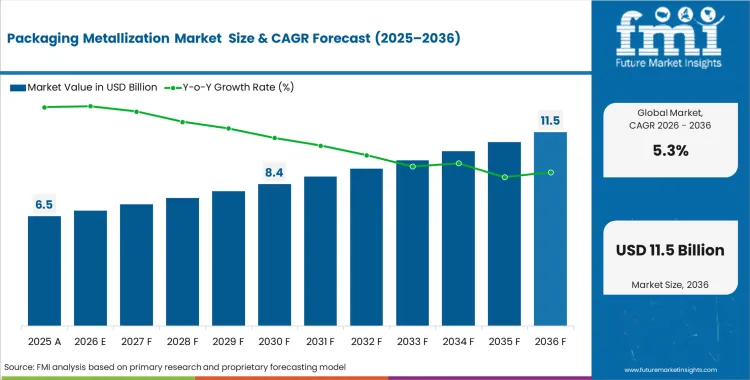
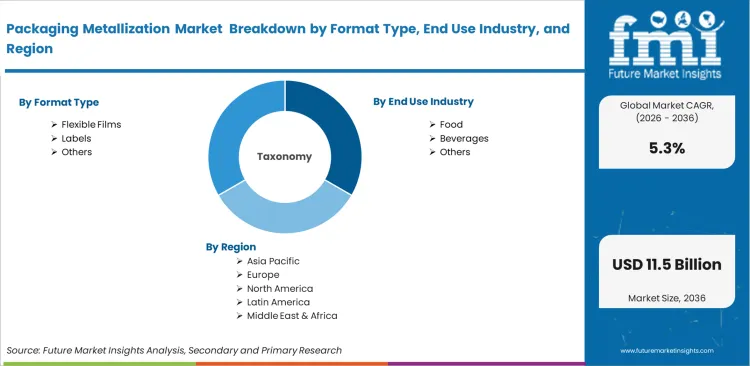
The packaging metallization market was valued at USD 6.20 billion in 2025. The market is projected to reach USD 6.55 billion in 2026 and USD 10.98 billion by 2036, expanding at a CAGR of 5.3% during the forecast period. PET is expected to lead material type demand with a 38.4% share in 2026. Flexible films are projected to remain the leading format type with a 52.1% share in 2026. Food is expected to lead end-use demand with a 34.7% share in 2026.
Summary of Packaging Metallization Market
- Market Snapshot
- The packaging metallization market was valued at USD 6.20 billion in 2025.
- The packaging metallization market is projected to reach USD 10.98 billion by 2036.
- The packaging metallization market is expected to expand at a CAGR of 5.3% from 2026 to 2036.
- Demand and Growth Drivers
- Barrier needs in snacks, confectionery, and dry foods are sustaining demand for metallized flexible structures.
- Brand owners continue to use metallization to improve shelf impact without moving fully into aluminum foil formats.
- Downgauging and performance-led redesign are pushing converters toward thin metallic layers that preserve barrier and appearance.
- Product and Segment View
- The market covers vacuum-metallized films, papers, labels, cartons, and selected decorative rigid-pack applications.
- PET is expected to lead material type demand with a 38.4% share in 2026.
- Flexible films are projected to remain the leading format type with a 52.1% share in 2026.
- Geography and Competitive Outlook
- Food is expected to lead end-use demand with a 34.7% share in 2026.
- The report covers North America, Latin America, Western Europe, Eastern Europe, East Asia, South Asia and Pacific, and Middle East and Africa.
- Key companies in the packaging metallization market include Uflex, Jindal Poly Films, Cosmo First, Toray Industries, Celplast, Kurz, Amcor, and Mondi.
- Analyst Opinion
- Ismail Sutaria, Senior Consultant at FMI says, 'Metallization remains attractive because it solves two commercial problems at once: barrier and branding. The companies that keep growing will be the ones that make metallized structures easier to specify in a more circular packaging system.'
Packaging Metallization Market Definition
The packaging metallization market includes the application of thin metallic layers, usually aluminum, onto packaging substrates to improve barrier performance, visual effect, or both. It includes metallized polymer films, metallized paper, metallized labels, metallized carton surfaces, and selected decorative uses on rigid packaging. These materials serve food, beverage, personal care, pharmaceutical, and household packaging applications where shelf life, light protection, and premium appearance matter.
Packaging Metallization Market Inclusions
- Sales of vacuum-metallized packaging films, papers, labels, and carton surfaces used in consumer and industrial packaging.
- Revenue from flexible packaging structures, decorative labels, metallized paper wraps, and comparable converted-packaging components.
- Commercial demand across global regions for barrier and decorative metallization used in packaging applications.
Packaging Metallization Market Exclusions
- Capacitor films, electronics films, and other non-packaging metallized substrates.
- Standalone aluminum foil markets not relying on metallization as the performance route.
- Architectural reflective films and industrial laminates that do not serve packaging demand.
Packaging Metallization Market Research Methodology
This study analyzes packaging metallization demand by material type, format type, and end-use industry with 2025 as the base year and 2026 to 2036 as the forecast period in value terms. Inputs include packaging regulations, recycling design guidance, trade references on vacuum coating and flexible packaging, and company disclosures from film producers and packaging converters. Market estimates are developed through triangulation of flexible-pack penetration, metallized-substrate intensity in food packaging, premium-label usage, and redesign activity tied to barrier optimization and material reduction.
Key Drivers, Restraints, and Trends in Packaging Metallization Market
Drivers
Packaging metallization is growing because converters still need a cost-efficient route to improve oxygen, moisture, and light barrier without relying only on thicker foil structures. Food remains the center of gravity, especially in snacks, confectionery, coffee, and dry goods, where shelf life and shelf appeal often matter at the same time. Metallization also gives brand owners a premium visual cue that fits both mass and premium packs. As packaging teams search for better performance per gram of material, thin metallic layers remain commercially useful.
Restraints
Recyclability remains the main strategic constraint. Metallization improves performance, but not every metallized structure fits current recovery streams equally well, especially when combined with complex laminates. Process quality also matters, because pinholes, poor adhesion, or inconsistent coating can reduce barrier performance quickly. Energy costs, substrate-price swings, and pressure to simplify structures can all narrow margins for converters and metallizers.
Trends
The market is moving toward smarter metallization rather than heavier metallization. Buyers want top-coated metallized films, mono-material-friendly solutions, and paper-based structures that preserve decorative value without making recovery claims harder to defend. Metallized paper and premium labels are also gaining attention in categories where tactile feel and reflectivity matter. Competitive differentiation is shifting toward performance consistency, downgauging support, and compatibility with evolving circular-packaging requirements.
Segmental Analysis
Packaging Metallization Market Analysis by Format Type
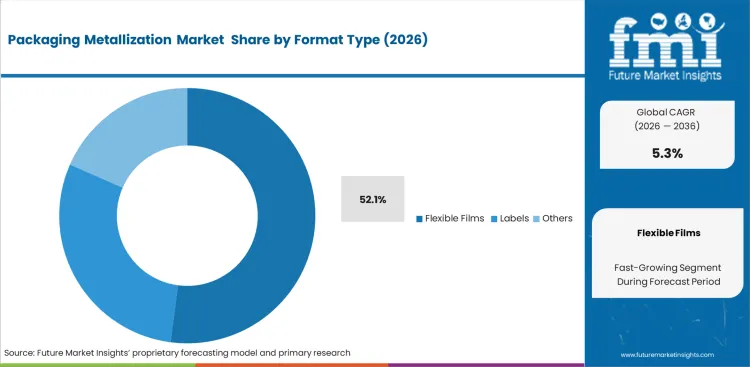
Flexible films are expected to account for 52.1% of market value in 2026 because they combine the largest packaging volumes with the clearest need for lightweight barrier improvement. Metallization works especially well in flexible structures used for snacks, confectionery, dry foods, and personal care refills, where visual impact and protection have to be achieved without excessive weight. The segment also benefits from broad converting infrastructure and long-established vacuum-metallization capability across major flexible-pack regions.
Packaging Metallization Market Analysis by End Use Industry
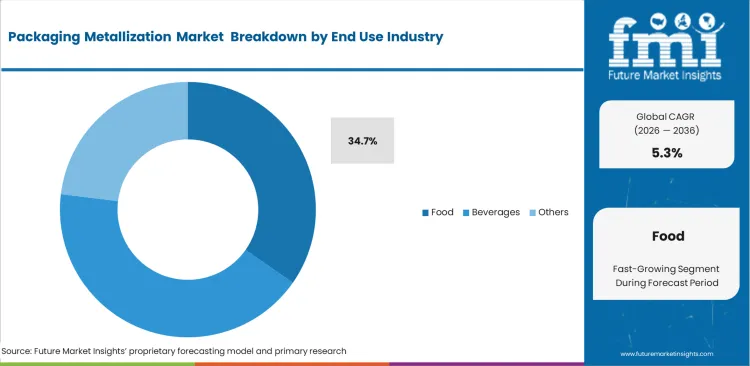
Food is projected to hold 34.7% of demand in 2026 because shelf life, aroma retention, and visual differentiation all matter intensely in that category. Snack foods, coffee, dry mixes, confectionery, and selected bakery products continue to use metallized substrates where barrier performance affects sell-through and waste rates. Food also benefits from recurring reorder patterns and large production runs, which keep metallized structures commercially relevant even as pack simplification gains attention.
Competitive Aligners for Market Players
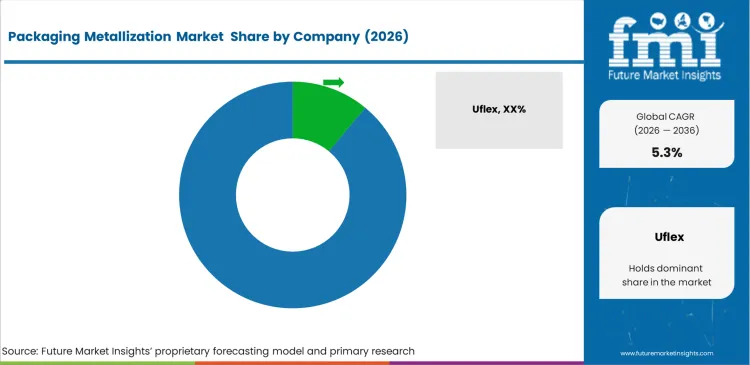
The market is being shaped by barrier engineering and converting reliability, not by metal deposition alone. Buyers want suppliers that can maintain coating uniformity, help redesign structures for recyclability, and integrate metallization with printing, lamination, and sealing requirements. Film producers with in-house metallization scale hold an advantage in high-volume markets, while specialist converters stay relevant when they solve niche barrier or decorative challenges. The strongest players are those that can translate metallization from a legacy process into a redesign tool for modern packaging.
Key Players in Packaging Metallization Market
- Uflex
- Jindal Poly Films
- Cosmo First
- Toray Industries
- Celplast
- Kurz
- Amcor
- Mondi
- Treofan
- Flex Films
Strategic Outlook by FMI on Packaging Metallization Market
FMI views packaging metallization as a large but increasingly specification-sensitive market. Growth will continue, but the profit pool will shift toward suppliers that align barrier gains with material reduction and recovery compatibility. Companies that deliver better coated-substrate performance without locking customers into difficult-to-recycle structures will be better positioned through 2036.
Scope of the Report
| Metric | Value |
|---|---|
| Market Value | USD 6.20 billion in 2025 to USD 10.98 billion by 2036 |
| CAGR | 5.3% from 2026 to 2036 |
| Base Year | 2025 |
| Forecast Period | 2026 to 2036 |
| Material Type Segmentation | BOPP, PET, CPP, Paper, Others |
| Format Type Segmentation | Flexible Films, Labels, Cartons and Board, Glass Decoration, Others |
| End Use Industry Segmentation | Food, Beverages, Personal Care, Pharmaceuticals, Household Products, Others |
| Regions Covered | North America, Latin America, Western Europe, Eastern Europe, East Asia, South Asia and Pacific, Middle East and Africa |
Bibliography
- European Commission. 2025. Packaging and Packaging Waste Regulation.
- CEFLEX. 2024. Designing for a Circular Economy Guidelines.
- Flexible Packaging Association. 2024. Flexible Packaging Industry Indicators.
- Uflex. 2024. Annual Report 2023-24.
- Jindal Poly Films. 2024. Annual Report.
- Cosmo First. 2024. Annual Report.
- Association of International Metallizers, Coaters and Laminators. 2024. Technical Resources on Metallization and Coating.
Frequently Asked Questions
How big is the packaging metallization market?
The packaging metallization market was valued at USD 6.20 billion in 2025 and is projected to reach USD 10.98 billion by 2036.
What is the CAGR of the packaging metallization market?
The packaging metallization market is expected to expand at a CAGR of 5.3% from 2026 to 2036.
Which material type leads the packaging metallization market?
PET is expected to lead the packaging metallization market with a 38.4% share in 2026.
Which format type leads the packaging metallization market?
Flexible films are projected to remain the leading format type in the packaging metallization market with a 52.1% share in 2026.
Which end-use industry leads the packaging metallization market?
Food is expected to lead end-use demand in the packaging metallization market with a 34.7% share in 2026.
What is driving growth in the packaging metallization market?
Growth is being supported by barrier needs in food packaging, premium shelf presentation, and downgauged substrate redesign.
Who are the key companies in the packaging metallization market?
Key companies in the packaging metallization market include Uflex, Jindal Poly Films, Cosmo First, Toray Industries, Celplast, Kurz, Amcor, and Mondi.
Preview the report firsthand - request a free sample
Get SampleGet the brochure for pricing and purchase details.
Get PDFTable of Content
- Executive Summary
- Global Market Outlook
- Demand-side Trends
- Supply-side Trends
- Technology Roadmap Analysis
- Analysis and Recommendations
- Market Overview
- Market Coverage / Taxonomy
- Market Definition / Scope / Limitations
- Research Methodology
- Chapter Orientation
- Analytical Lens and Working Hypotheses
- Market Structure, Signals, and Trend Drivers
- Benchmarking and Cross-market Comparability
- Market Sizing, Forecasting, and Opportunity Mapping
- Research Design and Evidence Framework
- Desk Research Programme (Secondary Evidence)
- Company Annual and Sustainability Reports
- Peer-reviewed Journals and Academic Literature
- Corporate Websites, Product Literature, and Technical Notes
- Earnings Decks and Investor Briefings
- Statutory Filings and Regulatory Disclosures
- Technical White Papers and Standards Notes
- Trade Journals, Industry Magazines, and Analyst Briefs
- Conference Proceedings, Webinars, and Seminar Materials
- Government Statistics Portals and Public Data Releases
- Press Releases and Reputable Media Coverage
- Specialist Newsletters and Curated Briefings
- Sector Databases and Reference Repositories
- FMI Internal Proprietary Databases and Historical Market Datasets
- Subscription Datasets and Paid Sources
- Social Channels, Communities, and Digital Listening Inputs
- Additional Desk Sources
- Expert Input and Fieldwork (Primary Evidence)
- Primary Modes
- Qualitative Interviews and Expert Elicitation
- Quantitative Surveys and Structured Data Capture
- Blended Approach
- Why Primary Evidence is Used
- Field Techniques
- Interviews
- Surveys
- Focus Groups
- Observational and In-context Research
- Social and Community Interactions
- Stakeholder Universe Engaged
- C-suite Leaders
- Board Members
- Presidents and Vice Presidents
- R&D and Innovation Heads
- Technical Specialists
- Domain Subject-matter Experts
- Scientists
- Physicians and Other Healthcare Professionals
- Governance, Ethics, and Data Stewardship
- Research Ethics
- Data Integrity and Handling
- Primary Modes
- Tooling, Models, and Reference Databases
- Desk Research Programme (Secondary Evidence)
- Data Engineering and Model Build
- Data Acquisition and Ingestion
- Cleaning, Normalisation, and Verification
- Synthesis, Triangulation, and Analysis
- Quality Assurance and Audit Trail
- Market Background
- Market Dynamics
- Drivers
- Restraints
- Opportunity
- Trends
- Scenario Forecast
- Demand in Optimistic Scenario
- Demand in Likely Scenario
- Demand in Conservative Scenario
- Opportunity Map Analysis
- Product Life Cycle Analysis
- Supply Chain Analysis
- Investment Feasibility Matrix
- Value Chain Analysis
- PESTLE and Porter’s Analysis
- Regulatory Landscape
- Regional Parent Market Outlook
- Production and Consumption Statistics
- Import and Export Statistics
- Market Dynamics
- Global Market Analysis 2021 to 2025 and Forecast, 2026 to 2036
- Historical Market Size Value (USD Million) Analysis, 2021 to 2025
- Current and Future Market Size Value (USD Million) Projections, 2026 to 2036
- Y-o-Y Growth Trend Analysis
- Absolute $ Opportunity Analysis
- Global Market Pricing Analysis 2021 to 2025 and Forecast 2026 to 2036
- Global Market Analysis 2021 to 2025 and Forecast 2026 to 2036, By Format Type
- Introduction / Key Findings
- Historical Market Size Value (USD Million) Analysis By Format Type , 2021 to 2025
- Current and Future Market Size Value (USD Million) Analysis and Forecast By Format Type , 2026 to 2036
- Flexible Films
- Labels
- Others
- Flexible Films
- Y-o-Y Growth Trend Analysis By Format Type , 2021 to 2025
- Absolute $ Opportunity Analysis By Format Type , 2026 to 2036
- Global Market Analysis 2021 to 2025 and Forecast 2026 to 2036, By End Use Industry
- Introduction / Key Findings
- Historical Market Size Value (USD Million) Analysis By End Use Industry, 2021 to 2025
- Current and Future Market Size Value (USD Million) Analysis and Forecast By End Use Industry, 2026 to 2036
- Food
- Beverages
- Others
- Food
- Y-o-Y Growth Trend Analysis By End Use Industry, 2021 to 2025
- Absolute $ Opportunity Analysis By End Use Industry, 2026 to 2036
- Global Market Analysis 2021 to 2025 and Forecast 2026 to 2036, By Region
- Introduction
- Historical Market Size Value (USD Million) Analysis By Region, 2021 to 2025
- Current Market Size Value (USD Million) Analysis and Forecast By Region, 2026 to 2036
- North America
- Latin America
- Western Europe
- Eastern Europe
- East Asia
- South Asia and Pacific
- Middle East & Africa
- Market Attractiveness Analysis By Region
- North America Market Analysis 2021 to 2025 and Forecast 2026 to 2036, By Country
- Historical Market Size Value (USD Million) Trend Analysis By Market Taxonomy, 2021 to 2025
- Market Size Value (USD Million) Forecast By Market Taxonomy, 2026 to 2036
- By Country
- USA
- Canada
- Mexico
- By Format Type
- By End Use Industry
- By Country
- Market Attractiveness Analysis
- By Country
- By Format Type
- By End Use Industry
- Key Takeaways
- Latin America Market Analysis 2021 to 2025 and Forecast 2026 to 2036, By Country
- Historical Market Size Value (USD Million) Trend Analysis By Market Taxonomy, 2021 to 2025
- Market Size Value (USD Million) Forecast By Market Taxonomy, 2026 to 2036
- By Country
- Brazil
- Chile
- Rest of Latin America
- By Format Type
- By End Use Industry
- By Country
- Market Attractiveness Analysis
- By Country
- By Format Type
- By End Use Industry
- Key Takeaways
- Western Europe Market Analysis 2021 to 2025 and Forecast 2026 to 2036, By Country
- Historical Market Size Value (USD Million) Trend Analysis By Market Taxonomy, 2021 to 2025
- Market Size Value (USD Million) Forecast By Market Taxonomy, 2026 to 2036
- By Country
- Germany
- UK
- Italy
- Spain
- France
- Nordic
- BENELUX
- Rest of Western Europe
- By Format Type
- By End Use Industry
- By Country
- Market Attractiveness Analysis
- By Country
- By Format Type
- By End Use Industry
- Key Takeaways
- Eastern Europe Market Analysis 2021 to 2025 and Forecast 2026 to 2036, By Country
- Historical Market Size Value (USD Million) Trend Analysis By Market Taxonomy, 2021 to 2025
- Market Size Value (USD Million) Forecast By Market Taxonomy, 2026 to 2036
- By Country
- Russia
- Poland
- Hungary
- Balkan & Baltic
- Rest of Eastern Europe
- By Format Type
- By End Use Industry
- By Country
- Market Attractiveness Analysis
- By Country
- By Format Type
- By End Use Industry
- Key Takeaways
- East Asia Market Analysis 2021 to 2025 and Forecast 2026 to 2036, By Country
- Historical Market Size Value (USD Million) Trend Analysis By Market Taxonomy, 2021 to 2025
- Market Size Value (USD Million) Forecast By Market Taxonomy, 2026 to 2036
- By Country
- China
- Japan
- South Korea
- By Format Type
- By End Use Industry
- By Country
- Market Attractiveness Analysis
- By Country
- By Format Type
- By End Use Industry
- Key Takeaways
- South Asia and Pacific Market Analysis 2021 to 2025 and Forecast 2026 to 2036, By Country
- Historical Market Size Value (USD Million) Trend Analysis By Market Taxonomy, 2021 to 2025
- Market Size Value (USD Million) Forecast By Market Taxonomy, 2026 to 2036
- By Country
- India
- ASEAN
- Australia & New Zealand
- Rest of South Asia and Pacific
- By Format Type
- By End Use Industry
- By Country
- Market Attractiveness Analysis
- By Country
- By Format Type
- By End Use Industry
- Key Takeaways
- Middle East & Africa Market Analysis 2021 to 2025 and Forecast 2026 to 2036, By Country
- Historical Market Size Value (USD Million) Trend Analysis By Market Taxonomy, 2021 to 2025
- Market Size Value (USD Million) Forecast By Market Taxonomy, 2026 to 2036
- By Country
- Kingdom of Saudi Arabia
- Other GCC Countries
- Turkiye
- South Africa
- Other African Union
- Rest of Middle East & Africa
- By Format Type
- By End Use Industry
- By Country
- Market Attractiveness Analysis
- By Country
- By Format Type
- By End Use Industry
- Key Takeaways
- Key Countries Market Analysis
- USA
- Pricing Analysis
- Market Share Analysis, 2025
- By Format Type
- By End Use Industry
- Canada
- Pricing Analysis
- Market Share Analysis, 2025
- By Format Type
- By End Use Industry
- Mexico
- Pricing Analysis
- Market Share Analysis, 2025
- By Format Type
- By End Use Industry
- Brazil
- Pricing Analysis
- Market Share Analysis, 2025
- By Format Type
- By End Use Industry
- Chile
- Pricing Analysis
- Market Share Analysis, 2025
- By Format Type
- By End Use Industry
- Germany
- Pricing Analysis
- Market Share Analysis, 2025
- By Format Type
- By End Use Industry
- UK
- Pricing Analysis
- Market Share Analysis, 2025
- By Format Type
- By End Use Industry
- Italy
- Pricing Analysis
- Market Share Analysis, 2025
- By Format Type
- By End Use Industry
- Spain
- Pricing Analysis
- Market Share Analysis, 2025
- By Format Type
- By End Use Industry
- France
- Pricing Analysis
- Market Share Analysis, 2025
- By Format Type
- By End Use Industry
- India
- Pricing Analysis
- Market Share Analysis, 2025
- By Format Type
- By End Use Industry
- ASEAN
- Pricing Analysis
- Market Share Analysis, 2025
- By Format Type
- By End Use Industry
- Australia & New Zealand
- Pricing Analysis
- Market Share Analysis, 2025
- By Format Type
- By End Use Industry
- China
- Pricing Analysis
- Market Share Analysis, 2025
- By Format Type
- By End Use Industry
- Japan
- Pricing Analysis
- Market Share Analysis, 2025
- By Format Type
- By End Use Industry
- South Korea
- Pricing Analysis
- Market Share Analysis, 2025
- By Format Type
- By End Use Industry
- Russia
- Pricing Analysis
- Market Share Analysis, 2025
- By Format Type
- By End Use Industry
- Poland
- Pricing Analysis
- Market Share Analysis, 2025
- By Format Type
- By End Use Industry
- Hungary
- Pricing Analysis
- Market Share Analysis, 2025
- By Format Type
- By End Use Industry
- Kingdom of Saudi Arabia
- Pricing Analysis
- Market Share Analysis, 2025
- By Format Type
- By End Use Industry
- Turkiye
- Pricing Analysis
- Market Share Analysis, 2025
- By Format Type
- By End Use Industry
- South Africa
- Pricing Analysis
- Market Share Analysis, 2025
- By Format Type
- By End Use Industry
- USA
- Market Structure Analysis
- Competition Dashboard
- Competition Benchmarking
- Market Share Analysis of Top Players
- By Regional
- By Format Type
- By End Use Industry
- Competition Analysis
- Competition Deep Dive
- Uflex
- Overview
- Product Portfolio
- Profitability by Market Segments (Product/Age /Sales Channel/Region)
- Sales Footprint
- Strategy Overview
- Marketing Strategy
- Product Strategy
- Channel Strategy
- Jindal Poly Films
- Cosmo First
- Toray Industries
- Celplast
- Kurz
- Uflex
- Competition Deep Dive
- Assumptions & Acronyms Used


