

- Industry Size (2026)
- USD 54.09 Bn
- Forecast (2036)
- USD 112.5 Bn
- CAGR (2026 to 2036)
- 16.00%
Software Defined Automation Market Size, Market Forecast and Outlook By FMI
In 2025, the software defined automation market was valued at USD 46.63 billion and is projected to reach USD 54.09 billion in 2026 and USD 112.5 billion by 2036, reflecting a 16.00% CAGR as plant operators rapidly decouple control software from proprietary hardware to escape vendor lock-in. Plant managers are actively respecifying control layer contracts, demanding hardware-agnostic runtime environments that enable continuous IT/OT convergence.
Buyers operating without hardware abstraction layers face compounding lifecycle costs and restricted data mobility across the enterprise edge. Capital allocation decisions underscore this architectural pivot as Tier-1 automation vendors preemptively cannibalize their legacy hardware revenues to capture recurring software subscriptions. Siemens expanded its partnership with NVIDIA in January 2026 to build an Industrial AI Operating System powered by software-defined automation for the end-to-end manufacturing value chain, proving that AI-driven orchestration now requires an open control architecture [1]. Plant operators interpreting this capital signal are accelerating smart factory qualification protocols.
Nathan Pettus, President of Process Systems and Solutions Business at Emerson, opined, “The speed of technological innovation and rise of industrial AI coupled with growing compute demands at the control layer have created an inflection point requiring a new way for companies to unify operational data and scale automation across the enterprise. DeltaV version 16.LTS is the next step in delivering the software-defined enterprise operations platform that will meet those needs, unlocking unlimited flexibility and future proofing technology choices for years to come.” [2] This operational shift signals a permanent transition in continuous process industries, where facility managers are decoupling upgrades from physical shutdowns. Automation buyers must restructure their IT/OT budgets to prioritize scalable runtime licenses, as suppliers failing to offer containerized control systems face automatic disqualification in upcoming tender cycles.
Summary of Software Defined Automation Market
- Software Defined Automation Market Definition
- An advanced industrial control architecture that abstracts control logic from proprietary hardware, enabling automation workloads to run on standardized edge IT infrastructure through virtualization and containerization.
- Demand Drivers in the Market
- Escalating compute demands at the industrial edge force the migration of control logic to scalable server environments.
- Widespread labor shortages compel manufacturers to deploy centralized orchestration software to manage distributed automated assets.
- Strict supply chain resilience mandates require plant operators to continuously update operational software without replacing underlying physical controllers.
- Key Segments Analyzed in the FMI Report
- Software Platforms: 48% share driven by rapid virtualization of legacy PLC environments into hardware-agnostic runtime applications.
- Manufacturing: 46% share fueled by the immediate requirement for high-frequency digital twin synchronization and AI-driven process optimization.
- India: 19.0% CAGR accelerating as domestic manufacturers leverage massive state incentives to leapfrog legacy hardware directly into cloud-edge hybrid automation.
- Analyst Opinion at FMI
- Nikhil Kaitwade, Principal Consultant at Industrial Automation, Future Market Insights, opines, “Through our recent evaluations, we observed that software-defined automation is shifting procurement leverage away from legacy hardware integrators. Suppliers investing in containerized control applications will secure stronger positioning in Tier-1 automotive and semiconductor upgrade pipelines.”
- Strategic Implications / Executive Takeaways
- Respecify procurement guidelines to mandate hardware independence for all new supervisory and control layer investments.
- Prioritize hybrid deployment models to balance real-time deterministic control at the edge with cloud-based analytics.
- Secure vendor partnerships that offer transparent orchestration APIs to prevent secondary software lock-in at the platform level.
- Methodology
- Direct interviews with automation facility managers, systems integrators, and digital transformation architects to establish baseline adoption metrics.
- Custom import/export datasets and corporate capability announcements substantiated regional integration models.
- Analysts developed a bottom-up adoption model starting from regional industrial robotic deployments, applying virtualization yield ratios to project software revenues.
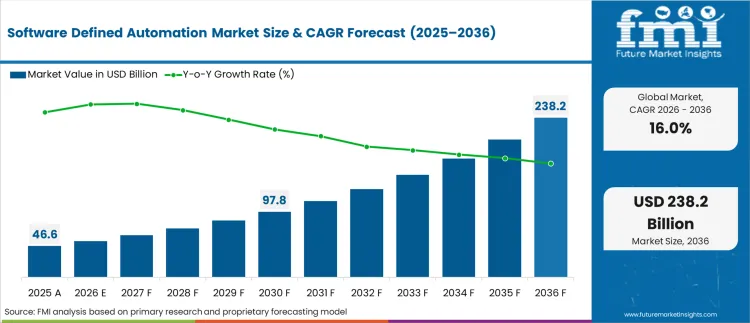
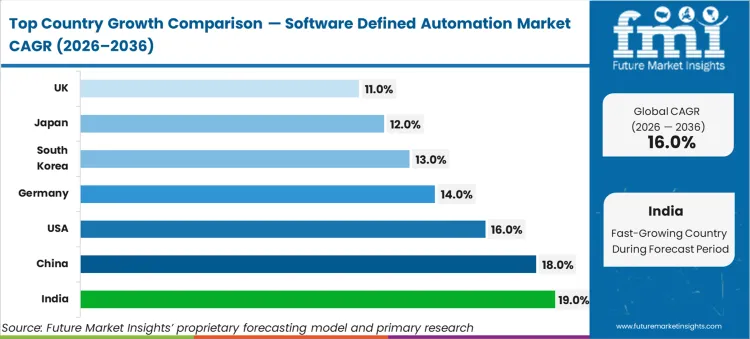
Demand dynamics vary distinctly across geographies, with India projected to expand at a 19.0% CAGR and China following at an 18.0% CAGR through 2036 as massive state-backed smart manufacturing initiatives force the virtualization of newly installed robotic bases. The United States market is set for a 16.0% CAGR, supported by aggressive nearshoring capital that prioritizes flexible software architectures over rigid legacy lines. Germany anticipates a 14.0% CAGR, relying on its engineering maturity to incrementally digitize highly complex discrete manufacturing sectors. South Korea and Japan, registering a 13.0% CAGR and a 12.0% CAGR respectively, lean on advanced semiconductor investments to optimize their hardware-heavy foundations. Meanwhile, the UK expects an 11.0% CAGR as industrial buyers cautiously migrate logistics and energy infrastructure toward hybrid automation deployments.
Software Defined Automation Market Definition
Software defined automation refers to the decoupling of industrial control logic from proprietary physical hardware, utilizing virtualization, containerization, and edge computing to execute automation tasks on commercial off-the-shelf IT servers. This framework encompasses virtual PLCs, software-based DCS, and orchestrated edge environments. For instance, replacing a hard-coded physical PLC with a virtual runtime application managed via a centralized dashboard constitutes a direct application. It fundamentally aligns with modern industrial DevOps standards.
Software Defined Automation Market Inclusions
The scope includes software platforms, hardware abstraction layers, and lifecycle services dedicated to virtualizing the automation stack. It covers hybrid, cloud, and on-premise deployments utilized across manufacturing, energy, and logistics end-uses. A borderline case that is included is edge AI hardware explicitly packaged as a node for software-defined control orchestration, provided the primary value lies in the decoupled runtime software.
Software Defined Automation Market Exclusions
The scope strictly excludes legacy hardware-bound PLCs, conventional physical wiring infrastructure, and basic SCADA software that lacks decoupled architecture capabilities. Unconnected industrial robots and simple motor drives are excluded. General enterprise IT software (like basic ERPs) that does not directly interface with or virtualize the industrial control layer is excluded, as the ingredient-level process control is not separately defined.
Software Defined Automation Market Research Methodology
- Primary Research: Direct interviews with automation facility managers, OT security architects, and system integration executives across major industrial hubs provided real-world deployment metrics and CAPEX transition data.
- Desk Research: Corporate software launch announcements, official grant disbursements from the USA Department of Energy, and automation standards publications from ISO substantiated regional capability models.
- Market-Sizing and Forecasting: Analysts utilized a bottom-up adoption model starting from regional installed bases of industrial robots and PLCs, applying historical virtualization penetration rates to project addressable software revenues.
- Data Validation and Update Cycle: Findings underwent cross-verification against official national productivity logs and peer-reviewed automation journals before final forecast integration, with triggers set for major protocol standard releases.
Segmental Market Analysis
Software Defined Automation Market Analysis by Offering
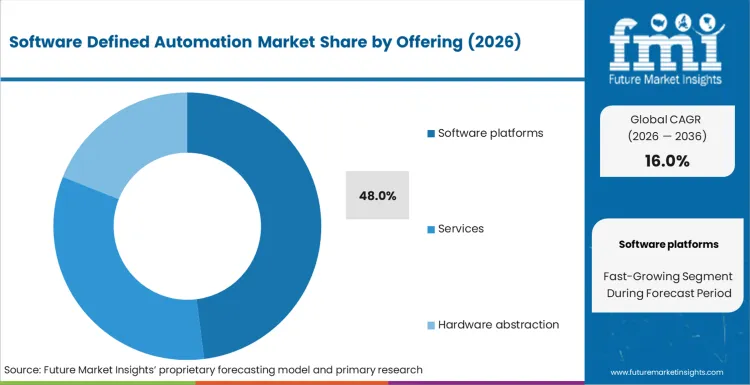
As plant architectures transition toward IT/OT convergence, Software platforms capture a 48% share in 2026, establishing the foundational layer for all subsequent factory virtualization. Plant operators deploying industrial automation systems increasingly prioritize these unified management interfaces to escape hardware vendor silos. The American Society of Mechanical Engineers (ASME) reports that 70 % of organizations have increased their budget for software compared to the previous year, reflecting a commitment to digital-first manufacturing in 2025 [3]. This capital pivot ensures that pure software orchestration layers outpace basic services in new tender allocations. Facilities lacking robust platform integration capabilities face mounting technical debt as edge computing workloads scale beyond physical hardware limits.
- Technical Validation: Open architectural standards enable platform agnostic operations across diverse factory environments.
- Requalification Cycles: Proprietary hardware replacements are phased out in favor of centralized runtime updates.
- Procurement Shifts: Buyers now evaluate total lifecycle software maintenance rather than upfront hardware capital expenditures.
Software Defined Automation Market Analysis by Deployment
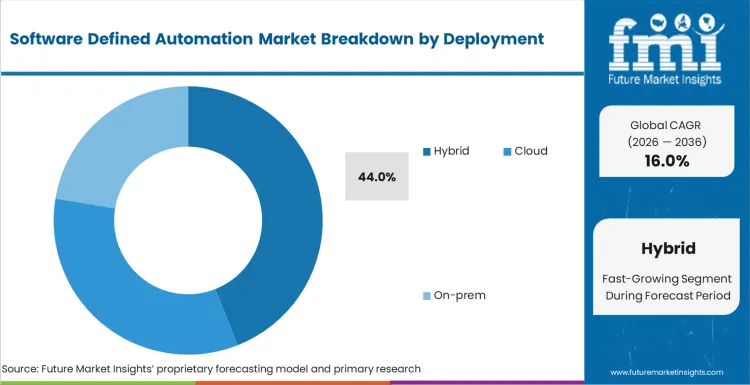
Hybrid configurations dominate the deployment landscape with a 44% share in 2026, bridging the gap between mission-critical on-premise determinism and cloud-scale analytical power. FMI analysts opine that IT directors refuse to compromise on latency for control loops, forcing automation vendors to deliver synchronized edge-to-cloud architectures. Supporting this structural mandate, Flexxbotics released a free download of its Software-Defined Automation platform explicitly designed for manufacturing autonomy and seamless robot integration across distributed environments [4]. This hybrid baseline allows edge ai for smart manufacturing tools to process high-frequency sensor data locally while offloading fleet-wide model training to the cloud. Suppliers exclusively pushing cloud-only control models risk disqualification in safety-critical sectors.
- Process Compatibility: Facility networks naturally segment critical operational technology from enterprise data lakes using hybrid topologies.
- Adoption: Data sovereignty regulations prohibit the export of proprietary manufacturing telemetry to public clouds.
- Volume Concentration: Integrators capable of managing seamless container orchestration across both local servers and remote instances.
Software Defined Automation Market Analysis by End use
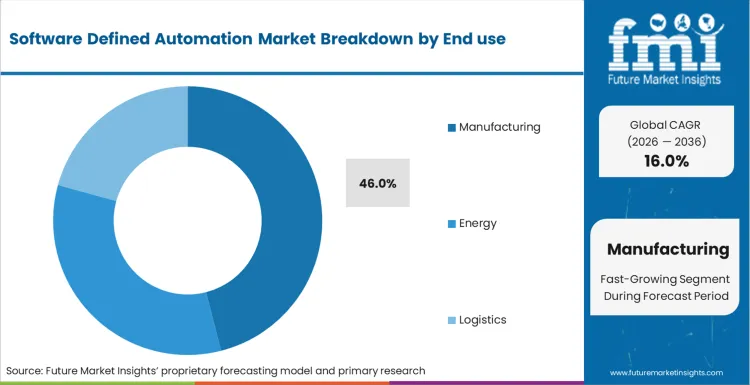
Manufacturing leads end-use adoption, commanding 46% of volumes in 2026 as production complexity overwhelms traditional hard-coded control logic. Production engineers facing high-mix, low-volume requirements utilize manufacturing execution systems that dynamically reprogram virtual controllers on the fly. The International Federation of Robotics states that 542,000 industrial robots were installed globally in 2024, representing an immense installed base requiring scalable software orchestration [5]. This density of automated assets renders manual, machine-by-machine reprogramming financially inviable, accelerating the transition to software-defined oversight. Brands successfully abstracting their shop floor hardware secure unprecedented agility in reacting to supply chain disruptions and rapid product changeovers.
- Product Innovation: Digital twin technology simulations run natively on virtualized controllers before physical commissioning occurs.
- Supplier Positioning: Vendors bundle industry-specific process libraries with their core automation software platforms.
- Cost Structures: Manufacturers eliminate the need for specialized electrical engineering during routine production line reconfigurations.
Software Defined Automation Market Analysis by Automation Layer
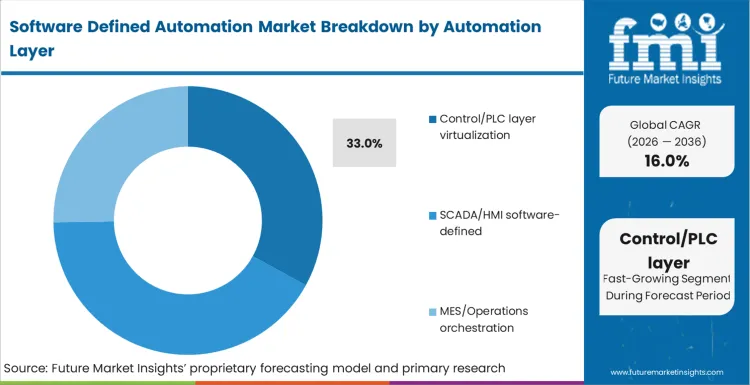
Control/PLC layer virtualization leads the architectural shift, securing a 33% share in 2026 as the most direct path to eliminating physical automation bottlenecks. Control engineers are stripping away proprietary physical controllers in favor of real-time Linux environments running on commercial industrial PCs. ISO published the new standard ISO/TS 10303-1258:2025 for industrial automation systems and integration, actively supporting product data exchange in these software-defined environments [6]. This standardization lowers the entry barrier for virtual plc and soft plc deployments across heterogeneous plant floors. Operators implementing virtualized control layers drastically reduce their physical spares inventory and minimize mean-time-to-recovery during hardware failures.
- Logistics Advantage: Centralized IT teams deploy control logic updates globally without dispatching technicians to physical factory locations.
- Dietary Compliance: Strict traceability in high-volume manufacturing necessitates automated data logging inherently built into virtual PLC architectures.
- Shelf Stability: Software runtimes do not suffer from physical component degradation, dramatically extending the operational lifespan of the control layer.
Software Defined Automation Market Drivers, Restraints, and Opportunities
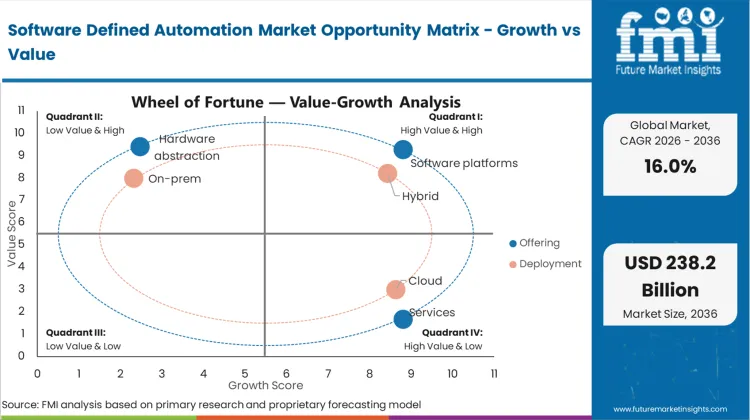
The escalating requirement for operational agility forces mid-market and Tier-1 manufacturers to abandon rigid physical control architectures. Plant directors seeking to deploy digital transformation in manufacturing initiatives require systems that can be updated, simulated, and orchestrated remotely without halting production lines. The USA Bureau of Labor Statistics projects employment of software developers to increase 17.9 % between 2023 and 2033, driven directly by the critical need to develop and maintain these complex AI and automation systems [7]. This structural shift in engineering talent away from hardware design toward software development permanently alters procurement models, requiring suppliers to deliver continuous integration pipelines rather than static machinery.
Deeply embedded legacy hardware and the associated risk aversion among OT personnel severely restrict rapid architectural transitions. Facility managers operating continuous process plants actively resist replacing proven, deterministic physical PLCs with server-based virtual equivalents due to perceived latency and security vulnerabilities. However, the USA Department of Energy announced nearly USD 13 million in funding available in 2025 to incentivize smart manufacturing technologies including automation at small- and medium-sized facilities [8]. This targeted capital injection systematically de-risks initial pilot programs, allowing cautious buyers to validate real-time performance and security protocols before committing to full-scale, enterprise-wide control virtualization.
- Open Ecosystem Transition: Industrial integrators are building hardware-agnostic control networks. Intel announced a partnership with Red Hat and HPE for a Software Defined Industrial Automation System supporting open architectures, dismantling proprietary barriers [9].
- Continuous Delivery Optimization: Automation developers implement robust DevOps practices directly on the factory floor. Software Defined Automation expanded its Industrial DevOps solution with new document upload and workflow orchestration capabilities for multiple PLC brands [10].
- Advanced Controller Deployment: Equipment manufacturers integrate edge intelligence directly into discrete operations. Beckhoff Automation introduced new edge AI and software-defined features in its machine automation controllers specifically tailored for discrete manufacturing agility [11].
Regional Market Analysis
.webp "Top Country Growth Comparison Software Defined Automation Market Cagr (2026 2036)")
Based on the regional analysis, the software defined automation market is segmented into North America, Latin America, Europe, East Asia, South Asia, Oceania and Middle East & Africa across 40+ countries. The full report also offers market attractiveness analysis based on regional trends.
| Country | CAGR (2026 to 2036) |
|---|---|
| India | 19.0% |
| China | 18.0% |
| USA | 16.0% |
| Germany | 14.0% |
| South Korea | 13.0% |
| Japan | 12.0% |
| UK | 11.0% |
Source: Future Market Insights (FMI) analysis, based on proprietary forecasting model and primary research
Asia Pacific Software Defined Automation Market Analysis
Asia Pacific acts as the primary global growth engine for virtualized industrial control, driven by massive, state-sponsored digitalization mandates and an unparalleled density of new manufacturing infrastructure. Rather than retrofitting legacy systems, newly constructed facilities across the region are deploying process automation and instrumentation natively via edge servers to maximize scalability. ICRIER reports that India's digital economy is growing at twice the rate of the overall economy and is projected to reach one-fifth of the economy by 2029, heavily driven by industrial automation [12]. FMI analysts opine that this rapid maturation of digital infrastructure allows regional operators to bypass traditional hardware lifecycles entirely. The resulting surge in software reliance firmly establishes localized processing depth and digital twin validation as the non-negotiable standards for future industrial capacity expansion.
- India: State-mandated modernization initiatives strictly condition long-term industrial subsidies on the adoption of advanced digital control architectures. NITI Aayog states that India's manufacturing sector is targeted to contribute 25 % to GDP by 2035 through the strategic adoption of frontier technologies, including AI and software-defined automation [13]. Automation vendors must immediately localize their software delivery networks and certification programs, as buyers lacking compliant virtualized infrastructure will face immediate exclusion from national supply chain integrations and public sector tenders.
- China: Escalating domestic labor costs and an aggressive push for global manufacturing supremacy compel Chinese facility operators to rapidly virtualize factory floors. The World Economic Forum highlights that the SDA approach lets Chinese manufacturers reconfigure production systems rapidly and integrate emerging technologies like edge computing and digital twins without replacing hardware [14]. Procurement directors are mandated to source centralized, software-defined platforms to orchestrate these massive robotic fleets, rendering hardware-bound integrators structurally uncompetitive in upcoming mega-factory projects.
- Japan: An aging industrial workforce forces Japanese precision manufacturers to aggressively codify tacit operator knowledge into software-defined automation algorithms. The Japan Science and Technology Agency is accelerating this through programs like Moonshot, which uses advanced robotic simulation frameworks to train AI-driven caregiving and industrial robots [15]. Suppliers must deliver control software with proven, high-fidelity deterministic performance, as buyers transitioning legacy automotive and electronics lines cannot accept any latency degradation during the virtualization process.
- South Korea: South Korea’s semiconductor and advanced electronics sectors demand absolute control agility to maintain yield rates during rapid product changeovers. SEMI reports that an industry-wide survey conducted in 2025 showed strong consensus on the necessity of predictive maintenance automation in semiconductor smart manufacturing [16]. Integrators operating in this high-stakes environment must provision software-defined architectures capable of real-time edge analytics, or face swift replacement by vendors offering seamless, containerized yield-optimization applications.
FMI's report includes extensive coverage of the Asia Pacific landscape, tracking crucial developments across ASEAN markets like Vietnam, Thailand, and Indonesia. Across these emerging manufacturing hubs, the transition toward hybrid automation networks fundamentally dictates foreign direct investment attractiveness, shaping how multinational brands evaluate regional operational resilience.
North America Software Defined Automation Market Analysis
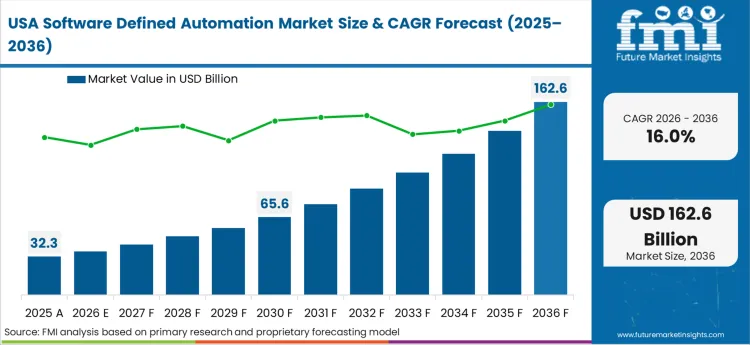
North America’s manufacturing sector undergoes a rigorous architectural recalibration as historic reshoring capital directly collides with acute technical labor shortages. Plant directors utilize factory automation and industrial controls frameworks not merely for efficiency, but as the only viable mechanism to operate expanded domestic capacity without proportionally increasing headcount. CESMII reports that 2025 marked the strongest growth in new members, industry engagement, and Smart Manufacturing adoption in its entire history [17]. This institutional momentum confirms that virtualization has crossed from pilot testing into widespread commercial necessity. Integrators supplying the North American market must provide hardware-agnostic control platforms capable of managing complex, highly automated supply chains natively from the edge.
- USA: Reshoring imperatives and federal smart manufacturing incentives aggressively drive the virtualization of domestic production environments. NIST reports that automation will increase among small manufacturers in 2025, with robots and automated systems specifically streamlining repetitive tasks to address labor gaps [18]. Vendors targeting this demographic must pivot from selling complex physical integration hardware to offering intuitive, software-defined subscription models; buyers failing to implement these flexible architectures before 2028 will permanently lose their competitive cost positioning.
FMI's report includes deep analytical tracking of the North American theater, encompassing critical operational shifts in Canada and Mexico. The integration of cross-border digital supply chains and shared software-defined logistics networks directly shapes the vendor qualification criteria for continental automotive and energy sectors.
Europe Software Defined Automation Market Analysis
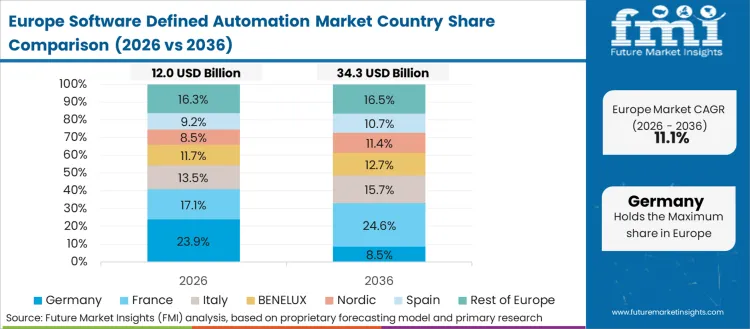
Europe operates as the regulatory and standard-setting proving ground for open, software-defined industrial networks, aggressively driven by the continent's energy transition and 'Industrie 4.0' maturity. Facility operators are methodically replacing proprietary automation silos with software-defined systems and open-source control runtime environments. Destatis reports increased investment in digital automation technologies across German manufacturing sectors for 2025, validating the structural pivot away from rigid machinery [19]. This capital shift enforces stringent interoperability requirements on all incoming equipment. Automation suppliers entering the European zone must proactively demonstrate total architectural openness, as buyers systematically dismantle vendor lock-in to achieve the agile energy orchestration demanded by strict sustainability mandates.
- Germany: Deep-rooted engineering excellence transitions into advanced digital systems as operators seek to decouple their process logic from aging physical controllers. The VDMA Robotics + Automation Association emphasizes that the long-term growth drivers of digitalization, AI, and smart production remain completely intact for the German market heading into 2026 [20]. Automation providers must prioritize the delivery of interoperable application packages, as industrial buyers locked into proprietary hardware cycles will fail to meet the agility metrics required by Tier-1 automotive and industrial machinery export markets.
- UK: Post-Brexit industrial strategies heavily emphasize rapid software modernization to secure necessary productivity gains across decentralized supply chains. Make UK reports in its 2026 Executive Survey that 60% of manufacturers are increasing investment in digital tech, AI, and automation to drive long-term productivity [21]. Solutions providers must deliver lightweight, rapidly deployable software-defined orchestration tools, as facility managers lacking capital for massive physical overhauls depend entirely on virtualized efficiency upgrades to remain viable.
FMI's report includes highly focused assessments of the broader European market, detailing the modernization trajectories of France, Italy, and the Nordics. The aggressive push toward completely decentralized, software-defined energy grid integrations across these nations establishes the primary baseline for future industrial automation procurement strategies.
Competitive Aligners for Market Players
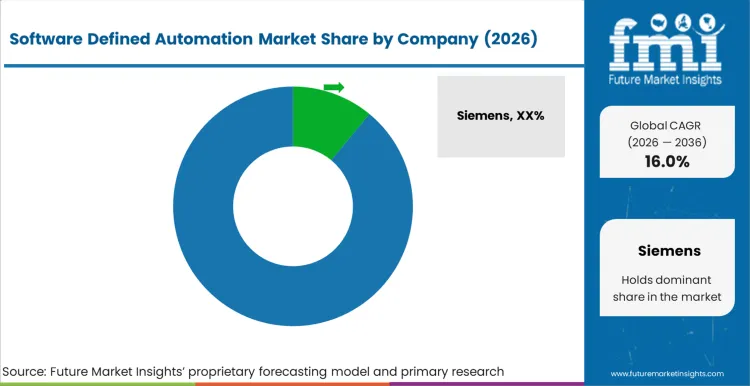
Market structure relies heavily on the ability to decouple proprietary control software from underlying physical hardware, radically shifting the balance of power from legacy equipment manufacturers to agile software platform providers. Plant operators utilizing mes software for discrete manufacturing are actively rewriting their RFPs to explicitly mandate hardware-agnostic runtime environments. Schneider Electric notes that transitioning from closed ecosystems to open, software-defined architectures can help large industrial organizations avoid up to USD 45 million in hidden operational and maintenance costs [22]. Suppliers that refuse to open their APIs face severe marginalization as buyers consolidate their operations around unified, software-defined edge networks.
Technological capability differentiates premium automation vendors through the seamless deployment of highly deterministic virtual controllers and digital twin integrations. Schneider Electric unveiled EcoStruxure Foxboro Software Defined Automation (SDA) as the industry's first open, software-defined Distributed Control System designed to power flexible production [23]. This caliber of native abstraction allows facility managers to execute zero-downtime upgrades and instantaneous process reconfigurations. Integrators must rapidly acquire containerization and edge-orchestration competencies, as industrial end-users will aggressively penalize partners who cannot deliver real-time control via commercial off-the-shelf IT servers.
Strategic alliances and ecosystem partnerships redefine go-to-market pathways as the technical complexity of IT/OT convergence surpasses the capabilities of any single vendor. Automation leaders are actively forging deep integrations with public cloud providers and enterprise IT specialists to secure their footprint on the factory floor. PTC expanded its ThingWorx platform with software-defined automation connectors specifically optimized for digital twin and IIoT orchestration in smart factories [24]. This collaborative restructuring forces niche automation developers to ensure absolute interoperability within major industrial ecosystems, as isolated point solutions are systematically purged from modern, software-defined procurement lists.
Recent Developments
The report includes full coverage of key trends from competitive benchmarking. Some of the recent developments covered in the reports:
- In January 2026, COPA-DATA launched zenon software-defined automation platform updates emphasizing flexibility and sovereignty for industrial operations [25].
- In 2025, Rockwell Automation launched enhanced PLC programming and virtualization tools for software-defined manufacturing environments [26].
- In 2025, ABB released a new open software-defined DCS architecture integration with partners for scalable industrial automation [27].
Key Players in Software Defined Automation Market
- Siemens
- Rockwell Automation
- Schneider Electric
- ABB
- Emerson
- Honeywell
- Bosch Rexroth
- Flexxbotics
- Software Defined Automation
- COPA-DATA
- Intel
- Beckhoff Automation
- PTC
Scope of the Report
| Metric | Value |
|---|---|
| Quantitative Units | USD 54.09 billion to USD 112.5 billion, at a CAGR of 16.00% |
| Market Definition | An advanced industrial control architecture that abstracts control logic from proprietary hardware, enabling automation workloads to run on standardized edge IT infrastructure through virtualization. |
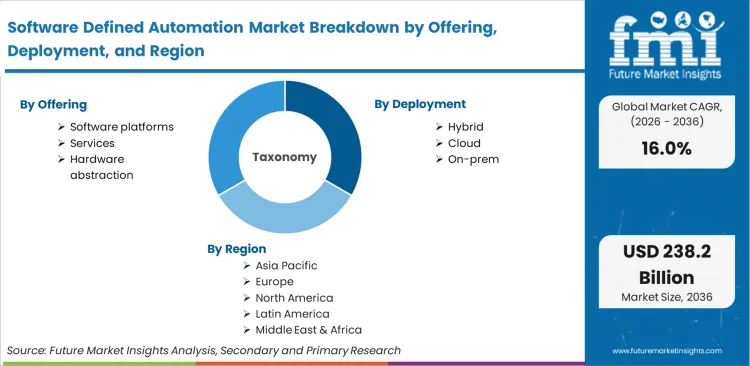
| Offering Segmentation | Software platforms, Services, Hardware abstraction |
| Deployment Segmentation | Hybrid, Cloud, On-prem |
| End use Segmentation | Manufacturing, Energy, Logistics |
| Automation layer Segmentation | Control/PLC layer virtualization, SCADA/HMI software-defined, MES/Operations orchestration, Asset management |
| Regions Covered | North America, Latin America, Europe, East Asia, South Asia, Oceania, Middle East and Africa |
| Countries Covered | United States, China, India, Germany, Japan, South Korea, United Kingdom, and 40 plus countries |
| Key Companies Profiled | Siemens, Rockwell Automation, Schneider Electric, ABB, Emerson, Honeywell, Bosch Rexroth |
| Forecast Period | 2026 to 2036 |
| Approach | Bottom-up adoption model built on regional robotic and PLC installed bases validated by primary integration interviews. |
Software Defined Automation Market Analysis by Segments
Offering:
- Software platforms
- Services
- Hardware abstraction
Deployment:
- Hybrid
- Cloud
- On-prem
End use:
- Manufacturing
- Energy
- Logistics
Automation layer:
- Control/PLC layer virtualization
- SCADA/HMI software-defined
- MES/Operations orchestration
- Asset management
Region:
- Asia Pacific
- India
- China
- Japan
- South Korea
- Indonesia
- Australia & New Zealand
- ASEAN
- Rest of Asia Pacific
- Europe
- Germany
- Italy
- France
- United Kingdom
- Spain
- Benelux
- Nordics
- Central & Eastern Europe
- Rest of Europe
- North America
- United States
- Canada
- Mexico
- Latin America
- Brazil
- Argentina
- Chile
- Rest of Latin America
- Middle East & Africa
- Kingdom of Saudi Arabia
- United Arab Emirates
- South Africa
- Turkey
- Rest of Middle East & Africa
Bibliography
- [1] NVIDIA. (2026). Siemens and NVIDIA Expand Partnership to Build the Industrial AI Operating System.
- [2] Emerson. (2026, January 20). Emerson advances software-defined automation with latest control system release [Press release].
- [3] American Society of Mechanical Engineers (ASME). (2025). Optimism increases with smarter manufacturing.
- [4] MassRobotics / Flexxbotics. (2026). Flexxbotics Releases Free Download of Software-Defined Automation.
- [5] International Federation of Robotics (IFR). (2026). Top 5 global robotics trends 2026.
- [6] International Organization for Standardization (ISO). (2025). ISO/TS 10303-1258:2025.
- [7] USA Bureau of Labor Statistics. (2025). AI impacts in BLS employment projections.
- [8] USA Department of Energy. (2025). US department energy announces nearly 13 million incentivize smart manufacturing.
- [9] Intel. (2025). Industrial partnerships supporting open architectures.
- [10] Software Defined Automation GmbH. (2025). Expanding industrial devops solution for manufacturing automation systems.
- [11] Beckhoff Automation. (2025). Beckhoff 2025 controller releases.
- [12] ICRIER. (2025). 2025 digital economy report.
- [13] NITI Aayog. (2025). 2025 manufacturing strategy report.
- [14] World Economic Forum (WEF). (2026). Software-defined automation: the force awakens.
- [15] NVIDIA Blog / JST. (2025). Japan Science and Technology Agency Develops NVIDIA-Powered Moonshot Robot.
- [16] SEMI. (2025). Smart manufacturing survey.
- [17] CESMII. (2026). A message from our CEO looking ahead in 2026.
- [18] NIST. (2025). Whats coming US manufacturing 2025.
- [19] Destatis. (2025). 2025 industry digitalization data.
- [20] VDMA. (2026). Robotics and Automation Forecast 2026.
- [21] Make UK. (2026). Executive Survey 2026.
- [22] Schneider Electric. (2025). How open, software defined automation turns inefficiency into opportunity.
- [23] Schneider Electric. (2026). Schneider electric unveils the industrys first open software defined distributed control system.
- [24] PTC. (2025). 2025 ThingWorx updates.
- [25] COPA-DATA. (2026). The software-defined era is awakening.
- [26] Rockwell Automation. (2025). 2025 virtualization launch.
- [27] ABB. (2025). 2025-2026 automation releases.
This Report Addresses
- Market size estimation and revenue forecasts from 2026 to 2036, supported by validated capability and capex benchmarks across major smart manufacturing hubs.
- Growth opportunity mapping across hybrid, cloud, and on-premise architectures with emphasis on hardware abstraction supply chain transitions.
- Segment and regional revenue forecasts covering critical applications like manufacturing, energy orchestration, and logistics automation.
- Competition strategy assessment including digital twin integration models, API survivability positioning, and process capability benchmarking.
- Product virtualization tracking covering key metrics such as determinism, control/PLC layer latency, and edge compute profiling.
- Regulatory impact analysis evaluating strict data sovereignty mandates, edge IT security protocols, and interoperability standard guidelines.
- Market report delivery in PDF, Excel, PPT, and interactive dashboard formats for executive and operational use.
Frequently Asked Questions
How large is the demand for Software Defined Automation in the global market in 2026?
Demand for Software Defined Automation in the global market is estimated to be valued at USD 54.09 billion in 2026.
What will be the market size of Software Defined Automation in the global market by 2036?
Market size for Software Defined Automation is projected to reach USD 112.5 billion by 2036.
What is the expected demand growth for Software Defined Automation in the global market between 2026 and 2036?
Demand for Software Defined Automation is expected to grow at a CAGR of 16.00% between 2026 and 2036.
Which Offering is poised to lead global sales by 2026?
Software platforms command 48% in 2026 as plant managers rapidly establish unified hardware-agnostic management interfaces.
How significant is the role of Manufacturing in driving Software Defined Automation adoption in 2026?
Manufacturing represents 46% of segment share as operators virtualize massive installed bases of industrial robots to enable rapid line changeovers.
What is driving demand in India?
Explosive expansion of the digital economy and strict state-backed targets for high-tech manufacturing GDP contributions drive functional platform adoption.
What compliance standards or regulations are referenced for India?
NITI Aayog's frontier technology manufacturing directives explicitly influence domestic procurement behavior.
What is the India growth outlook in this report?
India is projected to grow at a CAGR of 19.0% during 2026 to 2036.
Why is North America described as a priority region in this report?
Aggressive nearshoring capital injections and critical technical labor shortages accelerate the commercial deployment of autonomous edge control software.
What type of demand dominates in North America?
Functionality-led substitution away from proprietary hardware siloes to centralized IT/OT cloud orchestration dominates regional formulation demand.
What is China's growth outlook in this report?
China is projected to expand at a CAGR of 18.0% during 2026 to 2036.
Does the report cover the United States in its regional analysis?
Yes, the United States is included within North America under the regional scope of analysis.
What are the sources referred to for analyzing the United States?
Official labor projections from the Bureau of Labor Statistics and grant disclosures from the Department of Energy form the analytical basis.
What is the main demand theme linked to the United States in its region coverage?
Bridging severe operational labor gaps by scaling remote software orchestration across small and mid-sized manufacturing facilities.
Does the report cover Germany in its regional analysis?
Yes, Germany is included within Europe under the regional coverage framework.
What is the main Germany related demand theme in its region coverage?
Deep engineering base digitization and the replacement of legacy physical controllers with interoperable digital twin ecosystems.
Which product formats or configurations are strategically important for Europe supply chains?
Highly deterministic hybrid orchestration applications running on standardized industrial edge servers hold immense strategic importance.
What is Software Defined Automation and what is it mainly used for?
It is a modern control architecture that decouples logic from proprietary hardware, utilized primarily for managing complex edge-to-cloud manufacturing networks.
What does Software Defined Automation mean in this report?
The market refers to the global production, trade, and industrial deployment of software platforms, virtualization tools, and IT/OT edge abstraction services.
What is included in the scope of this Software Defined Automation report?
Scope includes hybrid control platforms, virtual PLC applications, and related edge services designated for manufacturing, logistics, or energy automation.
What is excluded from the scope of this report?
Legacy hardware-bound PLCs, static SCADA platforms lacking decoupled architecture, and unconnected industrial robotics are strictly excluded.
What does market forecast mean on this page?
The market forecast represents a model-based projection built on defined industrial capacity and technology adoption assumptions for strategic planning purposes.
How does FMI build and validate the Software Defined Automation forecast?
Forecasts combine top-down robotic installation data with bottom-up virtualization penetration yields, validated by primary facility manager interviews.
What does zero reliance on speculative third-party market research mean here?
Primary interviews, verified IT infrastructure filings, and official government labor and productivity datasets are used exclusively instead of unverified syndicated estimates.
Preview the report firsthand - request a free sample
Get SampleGet the brochure for pricing and purchase details.
Get PDFTable of Content
- Executive Summary
- Global Market Outlook
- Demand-side Trends
- Supply-side Trends
- Technology Roadmap Analysis
- Analysis and Recommendations
- Market Overview
- Market Coverage / Taxonomy
- Market Definition / Scope / Limitations
- Research Methodology
- Chapter Orientation
- Analytical Lens and Working Hypotheses
- Market Structure, Signals, and Trend Drivers
- Benchmarking and Cross-market Comparability
- Market Sizing, Forecasting, and Opportunity Mapping
- Research Design and Evidence Framework
- Desk Research Programme (Secondary Evidence)
- Company Annual and Sustainability Reports
- Peer-reviewed Journals and Academic Literature
- Corporate Websites, Product Literature, and Technical Notes
- Earnings Decks and Investor Briefings
- Statutory Filings and Regulatory Disclosures
- Technical White Papers and Standards Notes
- Trade Journals, Industry Magazines, and Analyst Briefs
- Conference Proceedings, Webinars, and Seminar Materials
- Government Statistics Portals and Public Data Releases
- Press Releases and Reputable Media Coverage
- Specialist Newsletters and Curated Briefings
- Sector Databases and Reference Repositories
- FMI Internal Proprietary Databases and Historical Market Datasets
- Subscription Datasets and Paid Sources
- Social Channels, Communities, and Digital Listening Inputs
- Additional Desk Sources
- Expert Input and Fieldwork (Primary Evidence)
- Primary Modes
- Qualitative Interviews and Expert Elicitation
- Quantitative Surveys and Structured Data Capture
- Blended Approach
- Why Primary Evidence is Used
- Field Techniques
- Interviews
- Surveys
- Focus Groups
- Observational and In-context Research
- Social and Community Interactions
- Stakeholder Universe Engaged
- C-suite Leaders
- Board Members
- Presidents and Vice Presidents
- R&D and Innovation Heads
- Technical Specialists
- Domain Subject-matter Experts
- Scientists
- Physicians and Other Healthcare Professionals
- Governance, Ethics, and Data Stewardship
- Research Ethics
- Data Integrity and Handling
- Primary Modes
- Tooling, Models, and Reference Databases
- Desk Research Programme (Secondary Evidence)
- Data Engineering and Model Build
- Data Acquisition and Ingestion
- Cleaning, Normalisation, and Verification
- Synthesis, Triangulation, and Analysis
- Quality Assurance and Audit Trail
- Market Background
- Market Dynamics
- Drivers
- Restraints
- Opportunity
- Trends
- Scenario Forecast
- Demand in Optimistic Scenario
- Demand in Likely Scenario
- Demand in Conservative Scenario
- Opportunity Map Analysis
- Product Life Cycle Analysis
- Supply Chain Analysis
- Investment Feasibility Matrix
- Value Chain Analysis
- PESTLE and Porter’s Analysis
- Regulatory Landscape
- Regional Parent Market Outlook
- Production and Consumption Statistics
- Import and Export Statistics
- Market Dynamics
- Global Market Analysis 2021 to 2025 and Forecast, 2026 to 2036
- Historical Market Size Value (USD Million) Analysis, 2021 to 2025
- Current and Future Market Size Value (USD Million) Projections, 2026 to 2036
- Y-o-Y Growth Trend Analysis
- Absolute $ Opportunity Analysis
- Global Market Pricing Analysis 2021 to 2025 and Forecast 2026 to 2036
- Global Market Analysis 2021 to 2025 and Forecast 2026 to 2036, By Offering
- Introduction / Key Findings
- Historical Market Size Value (USD Million) Analysis By Offering , 2021 to 2025
- Current and Future Market Size Value (USD Million) Analysis and Forecast By Offering , 2026 to 2036
- Software platforms
- Services
- Hardware abstraction
- Software platforms
- Y-o-Y Growth Trend Analysis By Offering , 2021 to 2025
- Absolute $ Opportunity Analysis By Offering , 2026 to 2036
- Global Market Analysis 2021 to 2025 and Forecast 2026 to 2036, By Deployment
- Introduction / Key Findings
- Historical Market Size Value (USD Million) Analysis By Deployment, 2021 to 2025
- Current and Future Market Size Value (USD Million) Analysis and Forecast By Deployment, 2026 to 2036
- Hybrid
- Cloud
- On-prem
- Hybrid
- Y-o-Y Growth Trend Analysis By Deployment, 2021 to 2025
- Absolute $ Opportunity Analysis By Deployment, 2026 to 2036
- Global Market Analysis 2021 to 2025 and Forecast 2026 to 2036, By End use
- Introduction / Key Findings
- Historical Market Size Value (USD Million) Analysis By End use, 2021 to 2025
- Current and Future Market Size Value (USD Million) Analysis and Forecast By End use, 2026 to 2036
- Manufacturing
- Energy
- Logistics
- Manufacturing
- Y-o-Y Growth Trend Analysis By End use, 2021 to 2025
- Absolute $ Opportunity Analysis By End use, 2026 to 2036
- Global Market Analysis 2021 to 2025 and Forecast 2026 to 2036, By Automation Layer
- Introduction / Key Findings
- Historical Market Size Value (USD Million) Analysis By Automation Layer, 2021 to 2025
- Current and Future Market Size Value (USD Million) Analysis and Forecast By Automation Layer, 2026 to 2036
- Control/PLC layer virtualization
- SCADA/HMI software-defined
- MES/Operations orchestration
- Control/PLC layer virtualization
- Y-o-Y Growth Trend Analysis By Automation Layer, 2021 to 2025
- Absolute $ Opportunity Analysis By Automation Layer, 2026 to 2036
- Global Market Analysis 2021 to 2025 and Forecast 2026 to 2036, By Region
- Introduction
- Historical Market Size Value (USD Million) Analysis By Region, 2021 to 2025
- Current Market Size Value (USD Million) Analysis and Forecast By Region, 2026 to 2036
- North America
- Latin America
- Western Europe
- Eastern Europe
- East Asia
- South Asia and Pacific
- Middle East & Africa
- Market Attractiveness Analysis By Region
- North America Market Analysis 2021 to 2025 and Forecast 2026 to 2036, By Country
- Historical Market Size Value (USD Million) Trend Analysis By Market Taxonomy, 2021 to 2025
- Market Size Value (USD Million) Forecast By Market Taxonomy, 2026 to 2036
- By Country
- USA
- Canada
- Mexico
- By Offering
- By Deployment
- By End use
- By Automation Layer
- By Country
- Market Attractiveness Analysis
- By Country
- By Offering
- By Deployment
- By End use
- By Automation Layer
- Key Takeaways
- Latin America Market Analysis 2021 to 2025 and Forecast 2026 to 2036, By Country
- Historical Market Size Value (USD Million) Trend Analysis By Market Taxonomy, 2021 to 2025
- Market Size Value (USD Million) Forecast By Market Taxonomy, 2026 to 2036
- By Country
- Brazil
- Chile
- Rest of Latin America
- By Offering
- By Deployment
- By End use
- By Automation Layer
- By Country
- Market Attractiveness Analysis
- By Country
- By Offering
- By Deployment
- By End use
- By Automation Layer
- Key Takeaways
- Western Europe Market Analysis 2021 to 2025 and Forecast 2026 to 2036, By Country
- Historical Market Size Value (USD Million) Trend Analysis By Market Taxonomy, 2021 to 2025
- Market Size Value (USD Million) Forecast By Market Taxonomy, 2026 to 2036
- By Country
- Germany
- UK
- Italy
- Spain
- France
- Nordic
- BENELUX
- Rest of Western Europe
- By Offering
- By Deployment
- By End use
- By Automation Layer
- By Country
- Market Attractiveness Analysis
- By Country
- By Offering
- By Deployment
- By End use
- By Automation Layer
- Key Takeaways
- Eastern Europe Market Analysis 2021 to 2025 and Forecast 2026 to 2036, By Country
- Historical Market Size Value (USD Million) Trend Analysis By Market Taxonomy, 2021 to 2025
- Market Size Value (USD Million) Forecast By Market Taxonomy, 2026 to 2036
- By Country
- Russia
- Poland
- Hungary
- Balkan & Baltic
- Rest of Eastern Europe
- By Offering
- By Deployment
- By End use
- By Automation Layer
- By Country
- Market Attractiveness Analysis
- By Country
- By Offering
- By Deployment
- By End use
- By Automation Layer
- Key Takeaways
- East Asia Market Analysis 2021 to 2025 and Forecast 2026 to 2036, By Country
- Historical Market Size Value (USD Million) Trend Analysis By Market Taxonomy, 2021 to 2025
- Market Size Value (USD Million) Forecast By Market Taxonomy, 2026 to 2036
- By Country
- China
- Japan
- South Korea
- By Offering
- By Deployment
- By End use
- By Automation Layer
- By Country
- Market Attractiveness Analysis
- By Country
- By Offering
- By Deployment
- By End use
- By Automation Layer
- Key Takeaways
- South Asia and Pacific Market Analysis 2021 to 2025 and Forecast 2026 to 2036, By Country
- Historical Market Size Value (USD Million) Trend Analysis By Market Taxonomy, 2021 to 2025
- Market Size Value (USD Million) Forecast By Market Taxonomy, 2026 to 2036
- By Country
- India
- ASEAN
- Australia & New Zealand
- Rest of South Asia and Pacific
- By Offering
- By Deployment
- By End use
- By Automation Layer
- By Country
- Market Attractiveness Analysis
- By Country
- By Offering
- By Deployment
- By End use
- By Automation Layer
- Key Takeaways
- Middle East & Africa Market Analysis 2021 to 2025 and Forecast 2026 to 2036, By Country
- Historical Market Size Value (USD Million) Trend Analysis By Market Taxonomy, 2021 to 2025
- Market Size Value (USD Million) Forecast By Market Taxonomy, 2026 to 2036
- By Country
- Kingdom of Saudi Arabia
- Other GCC Countries
- Turkiye
- South Africa
- Other African Union
- Rest of Middle East & Africa
- By Offering
- By Deployment
- By End use
- By Automation Layer
- By Country
- Market Attractiveness Analysis
- By Country
- By Offering
- By Deployment
- By End use
- By Automation Layer
- Key Takeaways
- Key Countries Market Analysis
- USA
- Pricing Analysis
- Market Share Analysis, 2025
- By Offering
- By Deployment
- By End use
- By Automation Layer
- Canada
- Pricing Analysis
- Market Share Analysis, 2025
- By Offering
- By Deployment
- By End use
- By Automation Layer
- Mexico
- Pricing Analysis
- Market Share Analysis, 2025
- By Offering
- By Deployment
- By End use
- By Automation Layer
- Brazil
- Pricing Analysis
- Market Share Analysis, 2025
- By Offering
- By Deployment
- By End use
- By Automation Layer
- Chile
- Pricing Analysis
- Market Share Analysis, 2025
- By Offering
- By Deployment
- By End use
- By Automation Layer
- Germany
- Pricing Analysis
- Market Share Analysis, 2025
- By Offering
- By Deployment
- By End use
- By Automation Layer
- UK
- Pricing Analysis
- Market Share Analysis, 2025
- By Offering
- By Deployment
- By End use
- By Automation Layer
- Italy
- Pricing Analysis
- Market Share Analysis, 2025
- By Offering
- By Deployment
- By End use
- By Automation Layer
- Spain
- Pricing Analysis
- Market Share Analysis, 2025
- By Offering
- By Deployment
- By End use
- By Automation Layer
- France
- Pricing Analysis
- Market Share Analysis, 2025
- By Offering
- By Deployment
- By End use
- By Automation Layer
- India
- Pricing Analysis
- Market Share Analysis, 2025
- By Offering
- By Deployment
- By End use
- By Automation Layer
- ASEAN
- Pricing Analysis
- Market Share Analysis, 2025
- By Offering
- By Deployment
- By End use
- By Automation Layer
- Australia & New Zealand
- Pricing Analysis
- Market Share Analysis, 2025
- By Offering
- By Deployment
- By End use
- By Automation Layer
- China
- Pricing Analysis
- Market Share Analysis, 2025
- By Offering
- By Deployment
- By End use
- By Automation Layer
- Japan
- Pricing Analysis
- Market Share Analysis, 2025
- By Offering
- By Deployment
- By End use
- By Automation Layer
- South Korea
- Pricing Analysis
- Market Share Analysis, 2025
- By Offering
- By Deployment
- By End use
- By Automation Layer
- Russia
- Pricing Analysis
- Market Share Analysis, 2025
- By Offering
- By Deployment
- By End use
- By Automation Layer
- Poland
- Pricing Analysis
- Market Share Analysis, 2025
- By Offering
- By Deployment
- By End use
- By Automation Layer
- Hungary
- Pricing Analysis
- Market Share Analysis, 2025
- By Offering
- By Deployment
- By End use
- By Automation Layer
- Kingdom of Saudi Arabia
- Pricing Analysis
- Market Share Analysis, 2025
- By Offering
- By Deployment
- By End use
- By Automation Layer
- Turkiye
- Pricing Analysis
- Market Share Analysis, 2025
- By Offering
- By Deployment
- By End use
- By Automation Layer
- South Africa
- Pricing Analysis
- Market Share Analysis, 2025
- By Offering
- By Deployment
- By End use
- By Automation Layer
- USA
- Market Structure Analysis
- Competition Dashboard
- Competition Benchmarking
- Market Share Analysis of Top Players
- By Regional
- By Offering
- By Deployment
- By End use
- By Automation Layer
- Competition Analysis
- Competition Deep Dive
- Siemens
- Overview
- Product Portfolio
- Profitability by Market Segments (Product/Age /Sales Channel/Region)
- Sales Footprint
- Strategy Overview
- Marketing Strategy
- Product Strategy
- Channel Strategy
- Rockwell Automation
- Schneider Electric
- ABB
- Emerson
- Honeywell
- Bosch Rexroth
- Flexxbotics
- Siemens
- Competition Deep Dive
- Assumptions & Acronyms Used


