

- Industry Size (2026)
- USD 220.0 Bn
- Forecast (2036)
- USD 500.0 Bn
- CAGR
- 8.5%(2026 to 2036)
Smart Factory Market Size and Share Forecast Outlook 2026 to 2036
The global smart factory market is on track to achieve a valuation of USD 500.0 Billion by 2036, accelerating from USD 220.0 Billion in 2026 at a CAGR of 8.5%. As per Future Market Insights, expansion is structurally underpinned by the accelerating incorporation of cyber-physical systems, real-time data analytics for predictive maintenance, and live monitoring of manufacturing processes across discrete and process industries. The World Economic Forum reported in its 2024 Advanced Manufacturing report that factories deploying AI-driven production optimization achieved 20 to 30% improvements in overall equipment effectiveness, validating the business case for smart factory investment. This compels industrial groups to invest in interoperable platforms that connect shop-floor equipment with enterprise planning systems. Simultaneously the competitive environment is shifting from point-solution automation to end-to-end digital manufacturing ecosystems where AI, digital twins, and 5G connectivity form an integrated production backbone.
Roland Busch, CEO of Siemens AG, stated: 'Industrial AI is no longer a feature; it is a force that will reshape the next century.' FMI opines that this reflects a broader structural shift where industrial automation leaders are repositioning from equipment suppliers to platform companies, with AI-native manufacturing becoming a baseline expectation for new factory designs rather than a premium add-on.
The operational reality for smart factory technology providers is defined by the convergence of AI, digital twin simulation, and private 5G connectivity into unified production platforms. Siemens updated its ONE Tech Company financial framework in January 2026, raising its mid-term revenue growth ambition to 6% to 9% to capitalize on the secular drivers of automation and artificial intelligence. Schneider Electric announced in November 2025 a plan to invest EUR 2 billion in AI and data center infrastructure over three years, positioning itself to serve the growing demand for energy-efficient smart manufacturing systems. KION Group presented its Physical AI platform at CeMAT Shanghai in October 2025, demonstrating real-time data-to-action warehouse performance following a January 2025 partnership with NVIDIA and Accenture to integrate AI-powered robots and digital twins into supply chains. As per FMI, these moves confirm that the smart factory sector is entering a phase of platform consolidation where end-to-end digital manufacturing ecosystems replace point-solution automation, and suppliers that cannot offer integrated AI, simulation, and connectivity face declining relevance in new factory designs.
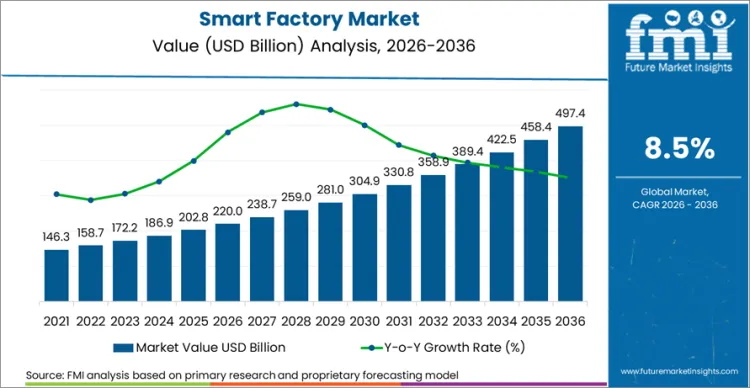
Summary of Smart Factory Market
What Is Growth Outlook for Smart Factory Market as per Future Market Insights Projection?
Future Market Insights projects the smart factory market to expand at a CAGR of 8.5% from 2026 to 2036, increasing from USD 220.0 Billion in 2026 to USD 500.0 Billion by 2036.
FMI Research Approach: FMI proprietary forecasting model based on manufacturing value-added output correlation and industrial automation CAPEX analysis.
How Do FMI Analysts Perceive Smart Factory Market to Evolve?
FMI analysts perceive the market evolving toward end-to-end digital manufacturing ecosystems where AI-driven production optimization, digital twin simulation, and private 5G connectivity form an integrated backbone, replacing point-solution automation with adaptive, data-driven production environments.
FMI Research Approach: World Economic Forum manufacturing benchmarks and industrial AI deployment case studies.
Which Country Holds Largest Share in Global Smart Factory Market?
The United States holds a significant share of the global smart factory market by value, supported by a large manufacturing base investing in AI-driven production optimization and reshoring-linked factory construction.
FMI Research Approach: FMI country-level revenue modelling by manufacturing value-added output and industrial automation CAPEX.
How Large Will Smart Factory Market Be by 2036?
The global smart factory market is projected to reach USD 500.0 Billion by 2036.
FMI Research Approach: FMI long-term revenue forecast derived from global manufacturing investment projections and AI adoption curves.
What Is Definition of Smart Factory Market?
The smart factory market includes revenue generated from the sale of integrated systems, software platforms, and services that enable digitally connected, AI-optimized manufacturing environments, covering industrial IoT platforms, MES/MOM systems, digital twin solutions, industrial robotics, and private 5G networks deployed in production settings.
FMI Research Approach: FMI market taxonomy and inclusion-exclusion framework.
What Are Globally Unique Trends Shaping Smart Factory Market?
Globally unique trends include the integration of Physical AI platforms that translate shop-floor data into autonomous actions in real time, the deployment of private 5G networks as the connectivity backbone for smart factories, and the convergence of energy management with production optimization in response to rising electricity costs.
FMI Research Approach: CeMAT product launch tracking and Hannover Messe technology roadmap analysis.
Smart Factory Market Key Takeaways
| Metric | Details |
|---|---|
| Industry Size (2026) | USD 220.0 Billion |
| Industry Value (2036) | USD 500.0 Billion |
| CAGR (2026 to 2036) | 8.5% |
Source: Future Market Insights (FMI) analysis, based on proprietary forecasting model and primary research
Segment-wise Analysis
By Component
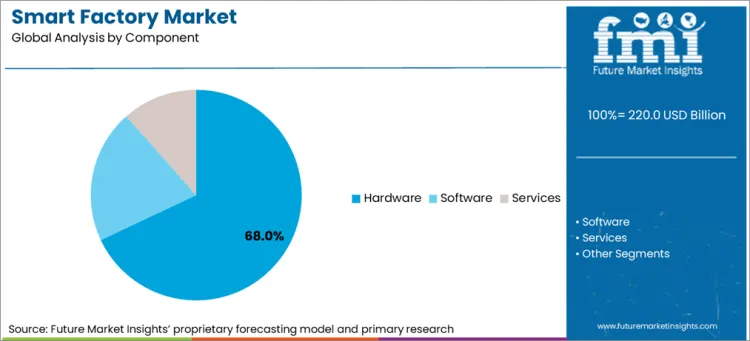
The industry has been segmented into hardware, software, and services segments, out of which the hardware segment accounted for the highest industry share of 68% in 2026, owing to rising automation, artificial intelligence, and Industry 4.0 adoption. ABB, Fanuc, and KUKA are at the forefront of the evolution of AI automation. To illustrate this, the International Federation of Robotics (IFR) predicts that the automotive and electronics industries alone will account for surpassing half a million global installations of industrial robots per year as of 2026.
Alternatively, perceptive machine vision systems, which could be used in the use of inspection systems in these kinds of applications, like Cognex and Keyence AI, help system gr to be gradually used in quality assurance and detect any imperfections in the fast-speed production process.
Besides, leading industrial giants such as Bosch & Honeywell are also transforming factory safety, energy efficiency, and operational intelligence through IoT-enabled sensor technology, which has become integral for real-time monitoring to predict maintenance needs.
In 2026, manufacturing companies have been estimated to capture a services industry share of 32% by virtue of integrations to predictive analytics and cybersecurity solutions, among others. Siemens and Rockwell Automation provide consulting and integration services that help businesses embrace AI-driven automation strategies, while system integrators Schneider Electric and GE Digital help make deployment easier.
Consequently, support and maintenance services are taking centre stage, while IBM and PTC are using AI-based analytics to avoid machine breakdowns and maximize production uptime. Additionally, with the rise in cybersecurity threats, manufacturers are placing emphasis not only on protecting data but also on training their workforce with Industry 4.0 competencies. However, the industry continues to grow rapidly as the global manufacturing process undergoes a revolution facilitated by these technologies.
By End User
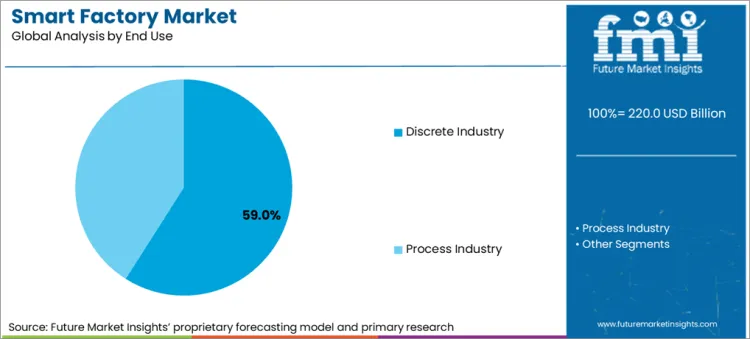
The industry is rapidly gaining traction within both discrete and process industries owing to the increasing penetration of automation, AI, and IoT solutions across sectors. The discrete industry segment is predicted to achieve a 59% industry share by 2026, with the adoption of intelligent manufacturing solutions by the automotive and electronic industries and in the aerospace sector.
'Tesla, Siemens, and General Electric, for instance, are utilizing industrial robots, machine vision systems, and digital twins to boost accuracy, downtime, and product quality. Continuous customization to the mass industry and the need for flexible manufacturing systems act as further catalysts for smart factories in discrete industries.
In 2026, the process industry segment is expected to hold a 41% industry share due to the rapid transformation process in the oil & gas, pharmaceuticals, chemicals, and food & beverage sectors during the forecasted period. Full-fledged industries need constant and seamless functioning of machines and processes. Deploying IoT-enabled sensors, AI-backed predictive maintenance, and cloud-based analytics are helping firms ensure production efficiency while eliminating operational risks.
BASF, Nestlé, and ExxonMobil are just a few examples of major enterprises making moves toward smart factory solutions for improved energy management, process automation, and real-time production line monitoring. Stringent regulatory requirements in industries such as pharmaceuticals are also pushing the adoption of automated compliance and quality control systems.
Trend Analysis and Purchasing Criteria Across Different End-Use Segments
The industry is growing rapidly because of the factors like Industry 4.0 technologies, AI implementation, and adoption of IoT. Automakers are investing in their production lines that are highly automated as well as AI-powered for precision, efficiency, and predictive maintenance.
In the electronics industry, real-time data analysis and robotics are in rising demand to enhance process efficiency and quality control. The food & beverage sector requires cost-efficient automation and intelligent packaging to optimize production efficiency and safety. Healthcare industries target AI-based diagnostics, automated laboratory processes, and robot-assisted manufacturing, which need high regulatory compliance and cybersecurity.
Aerospace and defense sectors require advanced robotics, digital twins, and IoT tracking systems in order to deliver high accuracy and operational effectiveness. Equally so, manufacturing in industry is shifting towards interoperability, cost reduction, and energy-saving measures to increase production while reducing downtime.
Contracts and Deals Analysis
| Company | Contract Value (USD million) |
|---|---|
| Mingyang Smart Energy and Scottish Government | Approximately USD 37.5 |
Shifts in the Market from 2021 to 2025 and Future Trends 2026 to 2036
From 2021 to 2025, the industry grew at a fast pace as companies adopted automation, artificial intelligence (AI), and Internet of Things (IoT) technologies to enhance production efficiency and productivity. Companies integrated robotics, cloud computing, and digital twin technologies to facilitate real-time decision-making, predictive maintenance, and supply chain responsiveness.
Cyber-physical systems, edge computing, and 5G-enabled industrial networks provided continuous machine-to-machine (M2M) communication, minimized downtime, and optimized efficiency. Artificial intelligence (AI)-powered analytics optimized processes, and robotic process automation (RPA) rationalized processes and reduced errors. The COVID-19 pandemic has accelerated the usage of industry solutions, and this witnessed high demand for remote monitoring, AI-based demand forecasting, and touchless activities. Industry 4.0 technologies such as additive manufacturing, AI-powered quality control, and cognitive systems revolutionized conventional factories to smart, connected ecosystems.
However, challenges such as exorbitant implementation costs, interoperability challenges, and hacking pushed it to be hardened in data governance as well as ICS security. The years 2026 to 2036 will be the time when the smart factory business will be operating in a era of hyper-automation, self-manufacturing, and cognition through AI-infused systems.
Firms will apply quantum computing to real-time optimization, digital twins enabled by artificial intelligence for dynamic process simulation, and adaptive robotics for flexible manufacturing. AI-decision intelligence will ensure autonomous production planning, pre-failure prediction, and automated self-healing manufacturing systems. Blockchain-secured and decentralized industrial markets and procurement networks will improve transparency and efficiency of supply chains.
Smart factories will embrace green production technologies such as AI-optimized energy management, carbon-free manufacturing lines, and waste reduction by circular economy approaches. Quantum-enhanced simulations will enable real-time material analysis and production optimization adaptively, while AI-driven augmented reality (AR) and virtual reality (VR) technologies will enable remote factory management as well as employee training. The propagation of 6G-enabled smart factories will enable ultra-low-latency communications, which will enable real-time industrial edge computing. AI-driven threat detection, quantum-encrypted data protection, and blockchain-based data security frameworks will protect industrial systems and manufacturing data against new cyber threats.
Comparative Market Shift Analysis 2021 to 2025 vs. 2026 to 2036
| 2021 to 2025 | 2026 to 2036 |
|---|---|
| Governments introduced Industry 4.0 compliance requirements, cybersecurity regulations, and industrial IoT data protection policies. | AI-powered regulatory compliance, blockchain-secured manufacturing data governance, and quantum-encrypted cybersecurity frameworks will shape governance. |
| AI-powered predictive maintenance, autonomous robots, and digital twin adoption improved efficiency. | Quantum computing, AI-driven cognitive manufacturing, and decentralized AI-powered industrial ecosystems will redefine smart factories. |
| Smart factories enabled real-time process optimization, robotic automation, and predictive maintenance. | AI-driven decision intelligence, autonomous production planning, and self-healing manufacturing networks will expand market applications. |
| Manufacturers deployed AI-integrated industrial robots, digital twin simulations, and edge computing-enabled production systems. | AI-powered quantum-enhanced production, decentralized robotic manufacturing, and autonomous industrial IoT networks will drive next-gen smart factories. |
| Companies focused on green energy adoption, AI-driven efficiency optimization, and carbon-neutral manufacturing initiatives. | AI-powered carbon footprint reduction, self-powered IoT sensors, and blockchain-secured sustainable manufacturing will enhance cost efficiency and sustainability. |
| AI-driven predictive analytics optimized production planning, quality control, and supply chain forecasting. | Quantum-enhanced AI-driven decision intelligence, AI-powered real-time material analysis, and decentralized predictive manufacturing models will redefine process optimization. |
| Supply chain disruptions, rising production costs, and workforce challenges impacted industry adoption. | AI-optimized decentralized supply chains, quantum-assisted demand forecasting, and autonomous industrial blockchain networks will improve resilience and scalability. |
| Industry 4.0 adoption, automation demand, and AI-driven manufacturing efficiency accelerated market expansion. | AI-powered autonomous factories, decentralized industrial intelligence, and self-healing manufacturing networks will drive future industry growth. |
Risk Assessment of the Smart Factory Market
The industry is expanding mainly due to the drivers such as rising automation, IoT, and AI-based manufacturing. However, high upfront investment and integration issues result in financial risks. In order to achieve maximum ROI and long-term competitiveness, organizations must move their attention towards scalable, cost-effective solutions and strategic collaborations.
The implementation of smart factories is affected by supply chain disruptions like semiconductor shortages and dependence on specialized components. The uncertainties are compounded by geopolitical tensions, trade restrictions, and price fluctuations. Companies should diversify their suppliers, invest in localized production, and apply risk management techniques to sustain stability in operations.
The progress in the fields of AI, robotics, and cloud computing is leading to the rapid system evolution, which in turn is increasing the risk of obsolescence. Organizations should allocate resources to the development of modular, upgradable systems and also need to encourage ongoing R&D to be competitive in the industry and satisfy demands for new manufacturing processes.
Interconnected networks are the foundation for smart factories; thus, cybersecurity has become a big concern. Data breaches, ransomware, and unauthorized access can disrupt production and compromise sensitive information. The deployment of AI-based security measures, robust encryption, and regular system upgrades is vital for the protection of essential operations and the integrity of the data.
Country-wise Analysis
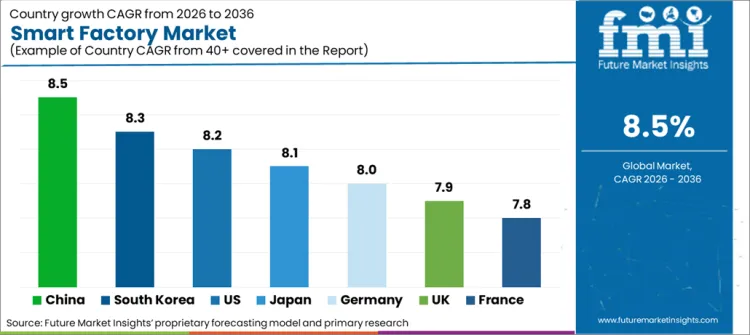
| Countries | CAGR (2026 to 2036) |
|---|---|
| USA | 8.2% |
| UK | 7.9% |
| France | 7.8% |
| Germany | 8% |
| Italy | 7.7% |
| South Korea | 8.3% |
| Japan | 8.1% |
| China | 8.5% |
| Australia | 7.5% |
| New Zealand | 7.3% |
USA
CAGR of 2026 to 2036 stands at 8.2% as firms are speeding up automation, AI, and IoT-based manufacturing. America is a world leader in the technology, and General Electric, Rockwell Automation, and Tesla are driving innovation. Increased demand for predictive maintenance, digital twins, and networked ecosystems boosts industry growth. Furthermore, organizations invest in analytics fueled by AI to improve manufacturing efficiency and minimize downtime.
Automotive and aviation industries are at the forefront of the adoption of robotics and cloud-based manufacturing execution systems. Energy conservation goals and legal requirements drive enterprises towards efficient energy use and smart industrial solutions. Moreover, pro-Industry 4.0 government policies enhancing deployment contribute towards speeding up digitalization in the manufacturing sector and making the industry highly rewarding.
UK
7.9% CAGR during 2026 to 2036 is anticipated, with the UK taking the lead in the development. Rolls-Royce and BAE Systems utilize AI-powered automation, robotics, and cloud to propel production automation. Manufacturing firms use IoT networks backed up by cybersecurity for real-time continuous monitoring and data protection.
State-funded smart industrialization initiatives promote automation for pharmaceuticals and logistics at a faster pace. The evolution of digital and green manufacturing forces industries to invest in environmentally friendly manufacturing equipment. Besides this, high demand for edge computing boosts efficiency, driving the sustained growth of the industry.
France
CAGR between 2026 to 2036 is projected to be 7.8% as France places industrial digitalization and automation as a top priority. Schneider Electric and Dassault Systèmes are some of the industry leaders that dominate the creation of smart factory solutions through AI, IoT, and cybersecurity technologies. The nation's high demand to lower operational expenditures and maximize supply chain visibility is the driving force behind industry expansion.
The government of France actively encourages industry through tax breaks and financial assistance to manufacturers adopting digitalization. Aerospace, automotive, and luxury industries apply digital twins and predictive analytics to enhance efficiency. In addition, partnerships with technology companies increase innovation in smart, sustainable factories with AI functionality.
Germany
CAGR is projected at 8% as Germany becomes a global leader in intelligent manufacturing. Siemens, Bosch, and BMW make significant investments in AI-based automation, robotics, and cyber-physical systems to transform production. The German economy prospers with technological excellence and precision engineering, leading to a high penetration of digital factory solutions.
Germany's strong regulatory framework requires environmentally friendly and energy-efficient production processes, further driving smart factory investment. Industry 4.0 projects, supported by 5G and edge computing technologies, drive the digitalization of factories. Moreover, demand for high-precision AI-based production increases industry demand.
Italy
7.7% is CAGR 2026 to 2036, with Italy transforming its manufacturing sector. Fiat Chrysler and Leonardo are among the companies that include AI, IoT, and robots in production. Flexible automation is the trend in the automobile and fashion sectors as the country confronts rising demands.
Government assistance facilitates manufacturers' shift to green smart factories. Blockchain and digital twin-based supply chains make industry-wide operations more efficient. Additionally, Italy has a robust SME base that invests actively in cloud-based smart factory technology to enhance productivity and competitiveness.
South Korea
8.3% CAGR during 2026 to 2036 when South Korea has established its digital manufacturing infrastructure. Industry titans like Samsung and Hyundai invest in AI-driven robots, 5G-networked automation, and cloud-based manufacturing systems. The country's push for high-tech industrialization positions it as the lead driver of smart factory implementation.
Government-backed programs drive the uptake of real-time data analytics and cybersecurity technologies in manufacturing. South Korea's emphasis on semiconductor and electronics manufacturing also drives innovation in AI-driven smart factory networks. Integration of digital twins and autonomous systems further enhances operational accuracy.
Japan
8.1% CAGR for the period of 2026 to 2036 is predicted for Japan as it maintains its track record of innovations in technology. Toyota, Hitachi, and Fanuc are some of the organizations that top the list in the implementation of robotics, machine learning, and IoT-based manufacturing automation. Japanese lean manufacturing strategies allow for cost-effectiveness and minimized production costs.
Industries prefer AI-based automation and cyber-physical systems to remain globally competitive. The fast advancement of autonomous manufacturing solutions further drives digital transformation faster. Moreover, the government of Japan also enables AI-based industry research to allow the next generation of industrial automation.
China
The CAGR is likely to grow at the rate of 8.5%, owing to China's aggressive pursuit of industrial automation. Huawei and Haier, among others, have been investing in AI, robotics, and IoT to develop future-proof smart factory environments. China's robust manufacturing ecosystem and government-backed industry initiatives make China the world leader in digital industrialization.
The quick rollout of 5G networks provides smooth real-time connectivity in manufacturing. Moreover, China's emphasis on semiconductor and high-tech manufacturing autonomy enhances its industry ecosystem. Green industrial automation investment further enhances industry appeal.
Australia
7.5% is the estimated CAGR of 2026 to 2036 as Australia develops manufacturing technologies into cutting-edge tech. Organizations like CSL and BHP implement automation and cloud technology based on artificial intelligence to minimize production bottlenecks: evolving cybersecurity requirements and IoT-driven monitoring boost operation resilience.
Government policies facilitate the digital transformation of energy-efficient smart factories for the pharmaceutical, mining, and logistics industries. Moreover, Australian strategic investment in energy-efficient smart factories is in accordance with global sustainability directions. The use of 3D printing and analytics by artificial intelligence facilitates manufacturing efficiency and scale in markets.
New Zealand
CAGR over 2026 to 2036 is estimated to be 7.3% as New Zealand adopts digital manufacturing. Fisher & Paykel Healthcare, among others, invest in automation and AI-based manufacturing systems to reap the highest levels of efficiency. The country's emphasis on sustainability and green manufacturing drives the adoption of smart factories.
Government programs encourage businesses to invest in Industry 4.0 solutions. Moreover, cloud computing technology and IoT-based logistics enhance supply chain visibility. The biotech and high-tech orientation of New Zealand also drives the demand for industry solutions.
Competitive Outlook
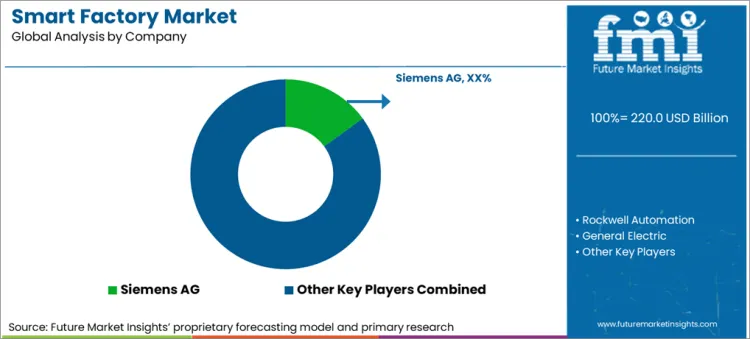
Industries are increasingly embracing automation, AI-based production techniques, and IoT-driven operations, paving the way for significant growth in the Industry. Industrial robotics, digital twin technology, real-time data analytics, and cloud-based automation platforms drive demand. However, smart energy management, predictive maintenance systems, and AI-powered quality control systems are some additional factors driving growth.
Key players include leading, established industrial automation companies like Siemens AG, Rockwell Automation, General Electric, Schneider Electric, and ABB Ltd, which have strong domain knowledge, a global footprint, and sustained product innovation, as well as new entrants and specialized automation vendors that are innovating in the space, especially in the form of AI-powered process optimization, cybersecurity solutions, and connected manufacturing ecosystems that respond to the evolving needs of the sector.
In addition, growing movements towards sustainability and green manufacturing, as well as advancements in manufacturing technologies, are likely to increase growth opportunities in the global Industry. Organizations are now placing a higher emphasis on product diversification to offer end-to-end digital transformation solutions, besides increasing their focus toward high-growth sectors such as automotive, healthcare, and electronics.
Cost optimization, supply chain digitization, compliance with industry dynamic regulatory policies, and implementation of an advanced cybersecurity framework to repel frequent attacks are some of the most pertinent strategic factors defining competition in the industry. As the industry continues to embrace Industry 4.0, organizations must start to vary in their energy efficiency, compatibility, scalability, and AI-based production insight.
Recent Developments:
- In January 2026, Siemens updated its ONE Tech Company financial framework, raising its mid-term revenue growth ambition to 6% to 9% to capitalize on the secular drivers of automation and artificial intelligence in manufacturing.
- In November 2025, Schneider Electric announced a plan to invest EUR 2 billion in AI and data center infrastructure over three years, positioning itself to serve energy-efficient smart manufacturing demand.
- In October 2025, KION Group presented its Physical AI platform at CeMAT Shanghai, demonstrating real-time data-to-action warehouse performance following a January 2025 partnership with NVIDIA and Accenture to integrate AI-powered robots and digital twins into supply chains.
Key Company Offerings and Activities
| Company Name | Key Offerings/Activities |
|---|---|
| Siemens AG | Leading Digital Twin Technology with Industrial Automation, AI-Powered Manufacturing Analytics. |
| Rockwell Automation | Responsible for industry solutions, industrial IoT platforms, and AI robotics to maximize production. |
| General Electric | Focuses on AI-powered predictive maintenance, digital transformation, and industrial automation. |
| Schneider Electric | Expertise In smart energy management, connected manufacturing, and real-time operational insights. |
| ABB Ltd. | Supply robotics, AI-integrated automation, and intelligent control systems for smart factories. |
Key Company Insights
Siemens AG (20-25%)
Siemens is an industry leader in smart factories, with features like AI-based industrial automation, digital twin simulations, and predictive analytics. It's data center edge computing solutions, and AI-driven operational intelligence is the industry gold standard for efficient and scalable operations.
Rockwell Automation (15-20%)
Rockwell Automation is leading the way in industrial IoT implementation, real-time manufacturing intelligence, and AI-powered robotics for plug-and-play smart factories.
General Electric (12-17%)
GE focuses on predictive maintenance, real-time industrial insights, and end-to-end digital transformation to enhance manufacturing resilience and operational efficiency.
Schneider Electric (8-12%)
With expertise in smart energy management, automation solutions, and real-time monitoring systems, Schneider Electric leads industrial sustainability and cost efficiency.
ABB Ltd. (5-9%)
ABB is at the forefront of intelligent robotics, AI-infused automation offerings, and intelligent control architectures that enable productivity in smart factories.
Other Key Players (30-40% Combined)
- Honeywell International Inc.
- Mitsubishi Electric Corporation
- Fanuc Corporation
- Bosch Rexroth AG
- Hitachi Ltd.
Key Market Players
- Siemens AG
- Rockwell Automation
- General Electric
- Schneider Electric
- ABB Ltd.
- Honeywell International Inc
- Mitsubishi Electric Corporation.
- Fanuc Corporation
- Bosch Rexroth AG
- Hitachi Ltd.
Market Definition
The smart factory market represents revenue generated from the sale of integrated systems, software platforms, and services that enable digitally connected and AI-optimized manufacturing environments. The market measures the value of industrial IoT platforms, manufacturing execution systems, digital twin solutions, industrial robotics with AI capability, and private 5G deployments sold to manufacturers across discrete and process industries.
Inclusions cover shop-floor connectivity platforms, predictive maintenance systems, AI-powered quality inspection, digital twin simulation software, collaborative and autonomous robots deployed in production, and private 5G or Wi-Fi 6E networks installed for factory connectivity. Consulting and system integration services sold as part of smart factory deployments are also included.
Exclusions include standard industrial automation components without connectivity or AI capability (standalone PLCs, basic HMIs), enterprise resource planning (ERP) software not integrated with shop-floor systems, and general IT infrastructure (servers, storage) not purpose-built for manufacturing. Construction costs for factory buildings and general utilities are outside the scope.
Key Segmentation
By Component:
The industry covers hardware, software, and services.
By End User:
The industry includes discrete industry and process industry, with discrete industry holding the largest share due to increasing automation in manufacturing and assembly lines.
By Industry Vertical:
The industry spans smart factories for automotive, aerospace & defense, electrical & electronics, food & beverages, energy & utilities, healthcare & pharmaceuticals, and others, with automotive smart factories leading due to rapid advancements in industry technologies.
By Region:
The industry covers North America, Latin America, Europe, East Asia, South Asia & Pacific, and the Middle East & Africa (MEA), with Europe leading due to strong industrial automation initiatives and government support for smart manufacturing.
Bibliography
- Siemens AG. (2026, January). ONE Tech Company financial framework update. Siemens press release.
- Schneider Electric. (2025, November). EUR 2 billion AI and data center investment plan. Schneider Electric corporate disclosure.
- KION Group. (2025, October). Physical AI platform at CeMAT Shanghai. KION Group corporate disclosure.
- World Economic Forum. (2024). Advanced Manufacturing and Global Lighthouse Network. WEF.
Frequently Asked Questions
What is the current global market size for the Smart Factory Market?
The market is valued at USD 220.0 Billion in 2026, driven by the accelerating integration of industrial AI, digital twin simulation, and real-time shop-floor analytics into production environments.
What is the projected Compound Annual Growth Rate (CAGR) for the market over the next 10 years?
The market is projected to grow at a CAGR of 8.5% from 2026 to 2036.
Which regions are experiencing the fastest expansion?
Asia Pacific leads with the highest growth rate, driven by large-scale factory construction in China and government-backed Industry 4.0 programs in India and South Korea, followed by North America and Europe.
What are the primary market drivers?
The convergence of AI-driven production optimization, digital twin simulation, and private 5G connectivity into integrated manufacturing platforms, combined with reshoring-driven new factory construction, are the primary drivers.
Who are the leading companies in the industry?
Siemens, Schneider Electric, KION Group, and Rockwell Automation are key players, differentiating through end-to-end digital manufacturing platforms, AI-native production optimization, and private 5G factory connectivity.
Preview the report firsthand - request a free sample
Get SampleGet the brochure for pricing and purchase details.
Get PDFTable of Content
- Executive Summary
- Global Market Outlook
- Demand-side Trends
- Supply-side Trends
- Technology Roadmap Analysis
- Analysis and Recommendations
- Market Overview
- Market Coverage / Taxonomy
- Market Definition / Scope / Limitations
- Research Methodology
- Chapter Orientation
- Analytical Lens and Working Hypotheses
- Market Structure, Signals, and Trend Drivers
- Benchmarking and Cross-market Comparability
- Market Sizing, Forecasting, and Opportunity Mapping
- Research Design and Evidence Framework
- Desk Research Programme (Secondary Evidence)
- Company Annual and Sustainability Reports
- Peer-reviewed Journals and Academic Literature
- Corporate Websites, Product Literature, and Technical Notes
- Earnings Decks and Investor Briefings
- Government Statistics Portals and Public Data Releases
- Press Releases and Reputable Media Coverage
- Specialist Newsletters and Curated Briefings
- Sector Databases and Reference Repositories
- FMI Internal Proprietary Databases and Historical Market Datasets
- Subscription Datasets and Paid Sources
- Social Channels, Communities, and Digital Listening Inputs
- Additional Desk Sources
- Expert Input and Fieldwork (Primary Evidence)
- Primary Modes
- Qualitative Interviews and Expert Elicitation
- Quantitative Surveys and Structured Data Capture
- Blended Approach
- Why Primary Evidence is Used
- Field Techniques
- Interviews
- Surveys
- Focus Groups
- Observational and In-context Research
- Social and Community Interactions
- Stakeholder Universe Engaged
- C-suite Leaders
- Board Members
- Presidents and Vice Presidents
- R&D and Innovation Heads
- Technical Specialists
- Domain Subject-matter Experts
- Scientists
- Physicians and Other Healthcare Professionals
- Governance, Ethics, and Data Stewardship
- Research Ethics
- Data Integrity and Handling
- Primary Modes
- Tooling, Models, and Reference Databases
- Desk Research Programme (Secondary Evidence)
- Data Engineering and Model Build
- Data Acquisition and Ingestion
- Cleaning, Normalisation, and Verification
- Synthesis, Triangulation, and Analysis
- Quality Assurance and Audit Trail
- Market Background
- Market Dynamics
- Drivers
- Restraints
- Opportunity
- Trends
- Scenario Forecast
- Demand in Optimistic Scenario
- Demand in Likely Scenario
- Demand in Conservative Scenario
- Opportunity Map Analysis
- Product Life Cycle Analysis
- Supply Chain Analysis
- Investment Feasibility Matrix
- Value Chain Analysis
- PESTLE and Porter’s Analysis
- Regulatory Landscape
- Regional Parent Market Outlook
- Production and Consumption Statistics
- Import and Export Statistics
- Market Dynamics
- Global Market Analysis 2021 to 2025 and Forecast, 2026 to 2036
- Historical Market Size Value (USD Million) Analysis, 2021 to 2025
- Current and Future Market Size Value (USD Million) Projections, 2026 to 2036
- Y-o-Y Growth Trend Analysis
- Absolute $ Opportunity Analysis
- Global Market Pricing Analysis 2021 to 2025 and Forecast 2026 to 2036
- Global Market Analysis 2021 to 2025 and Forecast 2026 to 2036, By Component
- Introduction / Key Findings
- Historical Market Size Value (USD Million) Analysis By Component , 2021 to 2025
- Current and Future Market Size Value (USD Million) Analysis and Forecast By Component , 2026 to 2036
- Hardware
- Software
- Services
- Hardware
- Y-o-Y Growth Trend Analysis By Component , 2021 to 2025
- Absolute $ Opportunity Analysis By Component , 2026 to 2036
- Global Market Analysis 2021 to 2025 and Forecast 2026 to 2036, By End Use
- Introduction / Key Findings
- Historical Market Size Value (USD Million) Analysis By End Use, 2021 to 2025
- Current and Future Market Size Value (USD Million) Analysis and Forecast By End Use, 2026 to 2036
- Discrete Industry
- Process Industry
- Discrete Industry
- Y-o-Y Growth Trend Analysis By End Use, 2021 to 2025
- Absolute $ Opportunity Analysis By End Use, 2026 to 2036
- Global Market Analysis 2021 to 2025 and Forecast 2026 to 2036, By Region
- Introduction
- Historical Market Size Value (USD Million) Analysis By Region, 2021 to 2025
- Current Market Size Value (USD Million) Analysis and Forecast By Region, 2026 to 2036
- North America
- Latin America
- Western Europe
- Eastern Europe
- East Asia
- South Asia and Pacific
- Middle East & Africa
- Market Attractiveness Analysis By Region
- North America Market Analysis 2021 to 2025 and Forecast 2026 to 2036, By Country
- Historical Market Size Value (USD Million) Trend Analysis By Market Taxonomy, 2021 to 2025
- Market Size Value (USD Million) Forecast By Market Taxonomy, 2026 to 2036
- By Country
- USA
- Canada
- Mexico
- By Component
- By End Use
- By Country
- Market Attractiveness Analysis
- By Country
- By Component
- By End Use
- Key Takeaways
- Latin America Market Analysis 2021 to 2025 and Forecast 2026 to 2036, By Country
- Historical Market Size Value (USD Million) Trend Analysis By Market Taxonomy, 2021 to 2025
- Market Size Value (USD Million) Forecast By Market Taxonomy, 2026 to 2036
- By Country
- Brazil
- Chile
- Rest of Latin America
- By Component
- By End Use
- By Country
- Market Attractiveness Analysis
- By Country
- By Component
- By End Use
- Key Takeaways
- Western Europe Market Analysis 2021 to 2025 and Forecast 2026 to 2036, By Country
- Historical Market Size Value (USD Million) Trend Analysis By Market Taxonomy, 2021 to 2025
- Market Size Value (USD Million) Forecast By Market Taxonomy, 2026 to 2036
- By Country
- Germany
- UK
- Italy
- Spain
- France
- Nordic
- BENELUX
- Rest of Western Europe
- By Component
- By End Use
- By Country
- Market Attractiveness Analysis
- By Country
- By Component
- By End Use
- Key Takeaways
- Eastern Europe Market Analysis 2021 to 2025 and Forecast 2026 to 2036, By Country
- Historical Market Size Value (USD Million) Trend Analysis By Market Taxonomy, 2021 to 2025
- Market Size Value (USD Million) Forecast By Market Taxonomy, 2026 to 2036
- By Country
- Russia
- Poland
- Hungary
- Balkan & Baltic
- Rest of Eastern Europe
- By Component
- By End Use
- By Country
- Market Attractiveness Analysis
- By Country
- By Component
- By End Use
- Key Takeaways
- East Asia Market Analysis 2021 to 2025 and Forecast 2026 to 2036, By Country
- Historical Market Size Value (USD Million) Trend Analysis By Market Taxonomy, 2021 to 2025
- Market Size Value (USD Million) Forecast By Market Taxonomy, 2026 to 2036
- By Country
- China
- Japan
- South Korea
- By Component
- By End Use
- By Country
- Market Attractiveness Analysis
- By Country
- By Component
- By End Use
- Key Takeaways
- South Asia and Pacific Market Analysis 2021 to 2025 and Forecast 2026 to 2036, By Country
- Historical Market Size Value (USD Million) Trend Analysis By Market Taxonomy, 2021 to 2025
- Market Size Value (USD Million) Forecast By Market Taxonomy, 2026 to 2036
- By Country
- India
- ASEAN
- Australia & New Zealand
- Rest of South Asia and Pacific
- By Component
- By End Use
- By Country
- Market Attractiveness Analysis
- By Country
- By Component
- By End Use
- Key Takeaways
- Middle East & Africa Market Analysis 2021 to 2025 and Forecast 2026 to 2036, By Country
- Historical Market Size Value (USD Million) Trend Analysis By Market Taxonomy, 2021 to 2025
- Market Size Value (USD Million) Forecast By Market Taxonomy, 2026 to 2036
- By Country
- Kingdom of Saudi Arabia
- Other GCC Countries
- Turkiye
- South Africa
- Other African Union
- Rest of Middle East & Africa
- By Component
- By End Use
- By Country
- Market Attractiveness Analysis
- By Country
- By Component
- By End Use
- Key Takeaways
- Key Countries Market Analysis
- USA
- Pricing Analysis
- Market Share Analysis, 2025
- By Component
- By End Use
- Canada
- Pricing Analysis
- Market Share Analysis, 2025
- By Component
- By End Use
- Mexico
- Pricing Analysis
- Market Share Analysis, 2025
- By Component
- By End Use
- Brazil
- Pricing Analysis
- Market Share Analysis, 2025
- By Component
- By End Use
- Chile
- Pricing Analysis
- Market Share Analysis, 2025
- By Component
- By End Use
- Germany
- Pricing Analysis
- Market Share Analysis, 2025
- By Component
- By End Use
- UK
- Pricing Analysis
- Market Share Analysis, 2025
- By Component
- By End Use
- Italy
- Pricing Analysis
- Market Share Analysis, 2025
- By Component
- By End Use
- Spain
- Pricing Analysis
- Market Share Analysis, 2025
- By Component
- By End Use
- France
- Pricing Analysis
- Market Share Analysis, 2025
- By Component
- By End Use
- India
- Pricing Analysis
- Market Share Analysis, 2025
- By Component
- By End Use
- ASEAN
- Pricing Analysis
- Market Share Analysis, 2025
- By Component
- By End Use
- Australia & New Zealand
- Pricing Analysis
- Market Share Analysis, 2025
- By Component
- By End Use
- China
- Pricing Analysis
- Market Share Analysis, 2025
- By Component
- By End Use
- Japan
- Pricing Analysis
- Market Share Analysis, 2025
- By Component
- By End Use
- South Korea
- Pricing Analysis
- Market Share Analysis, 2025
- By Component
- By End Use
- Russia
- Pricing Analysis
- Market Share Analysis, 2025
- By Component
- By End Use
- Poland
- Pricing Analysis
- Market Share Analysis, 2025
- By Component
- By End Use
- Hungary
- Pricing Analysis
- Market Share Analysis, 2025
- By Component
- By End Use
- Kingdom of Saudi Arabia
- Pricing Analysis
- Market Share Analysis, 2025
- By Component
- By End Use
- Turkiye
- Pricing Analysis
- Market Share Analysis, 2025
- By Component
- By End Use
- South Africa
- Pricing Analysis
- Market Share Analysis, 2025
- By Component
- By End Use
- USA
- Market Structure Analysis
- Competition Dashboard
- Competition Benchmarking
- Market Share Analysis of Top Players
- By Regional
- By Component
- By End Use
- Competition Analysis
- Competition Deep Dive
- Siemens AG
- Overview
- Product Portfolio
- Profitability by Market Segments (Product/Age /Sales Channel/Region)
- Sales Footprint
- Strategy Overview
- Marketing Strategy
- Product Strategy
- Channel Strategy
- Rockwell Automation
- General Electric
- Schneider Electric
- ABB Ltd.
- Honeywell International Inc
- Siemens AG
- Competition Deep Dive
- Assumptions & Acronyms Used


