

- Industry Size (2026)
- USD 81.9 Bn
- Forecast (2036)
- USD 234.8 Bn
- CAGR (2026 to 2036)
- 11.1%
E-Commerce Packaging EPR Compliance Software Market Size, Market Forecast and Outlook By FMI
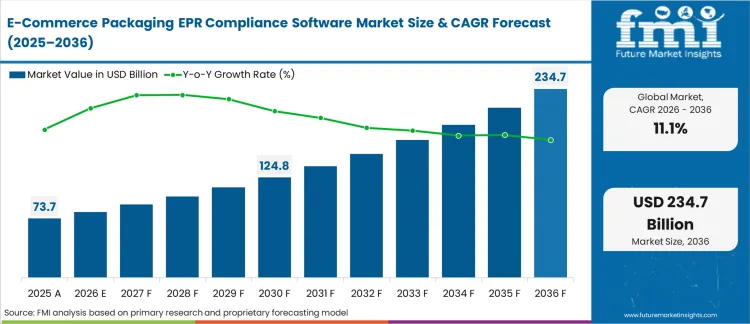
The e-commerce packaging EPR compliance software market was valued at USD 73.7 billion in 2025. Industry is estimated to surpass USD 81.9 billion in 2026 at a CAGR of 11.1% during the forecast. Demand outlook carries the market valuation to USD 234.8 billion through 2036 as stringent cross-border material tariffs reach high-volume retail logistics networks that previously deferred compliance upgrades. The transition from localized spreadsheet management to automated extended producer responsibility tracking forces an absolute architectural pivot across global supply chains.
Sustainability officers operating high-volume fulfillment centers now reject manual data aggregation platforms that obscure actual material tonnage. This compliance shift forces incumbent retail brands to integrate real-time reporting logic into every primary warehouse management system. Enterprises deferring this digital upgrade face immediate shipment embargoes at critical international customs checkpoints.
The specific condition under which growth becomes self-sustaining is the harmonization of post-consumer recycled content thresholds across the European Union and fragmented state-level frameworks in North America. Chief sustainability officers and corporate logistics directors face a critical 24-month action window to deploy unified API-led reporting architectures before these harmonized tariffs activate. Facilities achieving this native digital integration transition from defensive compliance reporting to predictive tax avoidance, effectively neutralizing regulatory fines as a severe operational cost center.
Summary of E-Commerce Packaging EPR Compliance Software Market
- E-Commerce Packaging EPR Compliance Software Market Definition
- E-Commerce Packaging EPR Compliance Software encompasses specialized enterprise platforms designed to track, calculate, and report packaging material tonnage for regulatory taxation purposes. The technology structurally bridges the gap between physical supply chain operations and complex international environmental compliance mandates.
- Demand Drivers in the Market
- Multi-jurisdictional plastic taxes force retail distribution networks to deploy automated calculation engines to prevent costly reporting inaccuracies.
- Cross-border customs authorities mandate digital material passports, compelling export logistics providers to integrate real-time compliance tracking into existing dispatch systems.
- Corporate sustainability pledges drive procurement directors to adopt verifiable traceability software to prove post-consumer recycled content claims to institutional investors.
- Key Segments Analyzed in the FMI Report
- Cloud: 58.0% share in 2026, reflecting the massive shift toward scalable, continuously updated regulatory databases hosted off-site.
- Compliance & Supply Chain: 40.0% share in 2026, as enterprise architects embed reporting logic directly into core inventory tracking workflows.
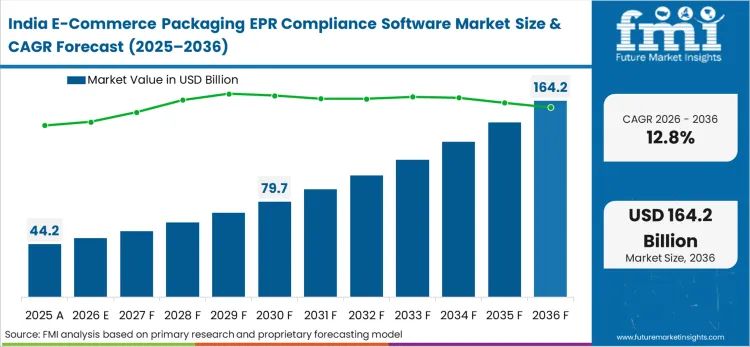
- India: 12.8% CAGR, driven by aggressive national extended producer responsibility enforcement targeting domestic e-commerce marketplaces.
- Analyst Opinion at FMI
- Ismail Sutaria, Principal Consultant for Packaging and Logistics, opines, "In my analysis, I have observed that the true bottleneck in packaging compliance is not fee calculation, but the fragmented material traceability across vendor networks. Facilities attempting to satisfy modern plastic tax requirements using static supplier spreadsheets face unavoidable audit penalties. Supply chain directors who delay integrating automated reporting ledgers will find themselves unable to meet the real-time data extraction requirements mandated for the next phase of European and North American circular economy legislation."
- Strategic Implications / Executive Takeaways
- Enterprise software vendors must secure native integrations with major warehouse management systems to qualify for impending corporate infrastructure upgrade cycles.
- E-commerce fulfillment directors should phase out manual reporting protocols and mandate automated tonnage tracking in all new facility software specifications.
- Systems integrators must develop specialized data harmonization competencies to prove accurate material classification during the initial platform commissioning phase.
- Market Research Methodology
- Primary Research: FMI conducted detailed technical interviews with principal software architects, sustainability officers, and compliance directors across 40 countries to validate deployment timelines.
- Desk Research: Analysts aggregated public regulatory documentation from environmental ministries, corporate software launch sheets, and national circular economy grant programs.
- Market-Sizing and Forecasting: The model applies a bottom-up methodology starting with global installed base metrics for enterprise compliance nodes and projecting the conversion rate to specialized EPR standards.
- Data Validation and Update Cycle: Segment forecasts undergo cross-validation against quarterly software subscription revenues for supply chain regulatory platforms.
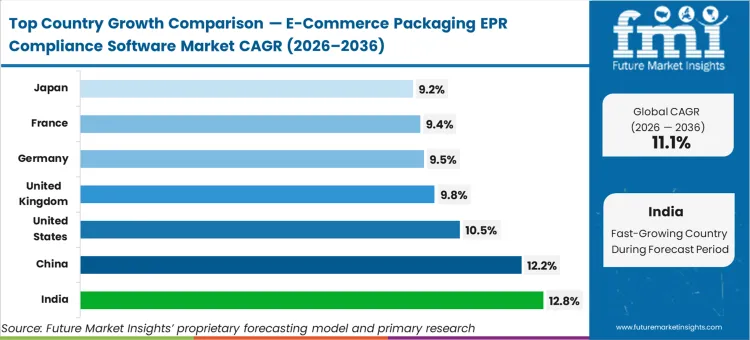
India advances at a 12.8% CAGR, supported by ambitious national plastic waste reduction mandates. China expands at 12.2% as massive export hubs deploy unified digital ledgers to satisfy European destination requirements. The United States tracks at 10.5% driven by state-level packaging legislation fragmenting the domestic reporting landscape. The United Kingdom registers a 9.8% expansion while Germany grows at 9.5%, both anchored by mature circular economy taxation frameworks. France follows at 9.4% and Japan records a 9.2% trajectory. This geographic distribution confirms that fragmented regulatory pressure structurally guarantees software adoption regardless of local manufacturing maturity.
E-Commerce Packaging EPR Compliance Software Market Definition
E-Commerce Packaging EPR Compliance Software represents the dedicated enterprise architecture utilized to aggregate, calculate, and report extended producer responsibility obligations for shipped materials. This digital infrastructure isolates specific packaging weights, identifies component materials, and automatically generates tax submissions for diverse regulatory bodies. The ecosystem functions as the critical translation layer between warehouse operational data and environmental taxation authorities.
E-Commerce Packaging EPR Compliance Software Market Inclusions
The market scope includes cloud-based calculation engines, on-premises reporting modules, supply chain traceability ledgers, and dedicated application programming interfaces designed for packaging tax automation. Software utilizing artificial intelligence to classify packaging materials and recycling traceability platforms verifying post-consumer recycled content claims are fully incorporated. Subscription licenses, implementation services, and continuous regulatory update feeds constitute the core valuation boundary.
E-Commerce Packaging EPR Compliance Software Market Exclusions
General enterprise resource planning software lacking dedicated extended producer responsibility calculation modules is excluded. Standalone physical barcode scanners, raw packaging materials, and third-party legal consulting services without a persistent software component fall outside the defined parameters. Legacy financial accounting tools incapable of tracking granular material tonnage are explicitly omitted from the valuation.
E-Commerce Packaging EPR Compliance Software Market Research Methodology
- Primary Research: Analysts engaged with chief sustainability officers, supply chain compliance directors, and warehouse IT architects to map the specific decision gates triggering software upgrades.
- Desk Research: The data collection phase aggregated compliance roadmaps from global environmental protection agencies, customs authorities, and retail consortium guidelines.
- Market-Sizing and Forecasting: The baseline value derives from a bottom-up aggregation of compliance software license deployments, applying region-specific regulatory curves to project the future adoption velocity.
- Data Validation and Update Cycle: Projections are rigorously tested against publicly reported capital expenditure guidance from the leading e-commerce and retail distribution conglomerates.
Segmental Analysis
E-Commerce Packaging EPR Compliance Software Market Analysis by Deployment
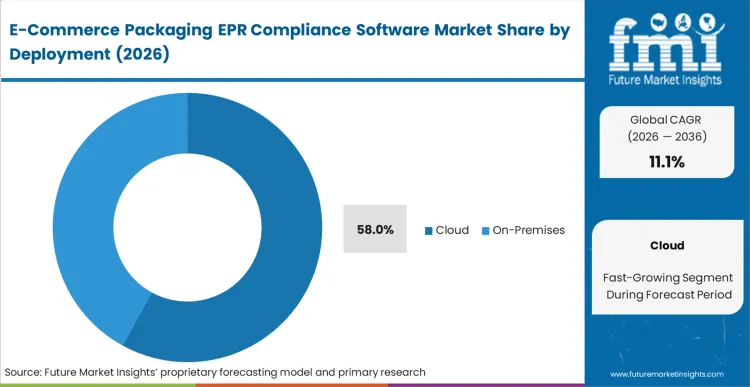
FMI analysts opine that centralizing compliance logic off-site directly eliminates the costly maintenance burden plaguing distributed retail networks. Enterprise IT architects specifying these solutions secure unified visibility across global fulfillment operations. Legacy on-premises reporting tools systematically fail to capture rapidly changing international tax codes, triggering large-scale migration to dynamic alternatives. Cloud commands a dominant 58.0% share in 2026, reflecting the absolute requirement for continuous regulatory updates without manual IT intervention. Leveraging sophisticated retail e-commerce packaging protocols, companies automatically calculate liability across diverse product lines. Platform operators unable to deliver seamless, over-the-air regulatory updates risk immediate exclusion from enterprise software tenders.
- Update Velocity: Cloud architectures ingest legislative changes in real-time, preventing severe non-compliance penalties caused by outdated fee schedules.
- Deployment Footprint: Eliminating physical servers shrinks the infrastructure capital required to establish reporting capabilities in new geographic territories.
- Data Harmonization: Centralized repositories allow multinational corporations to standardize material classification protocols across entirely distinct regional supply chains.
E-Commerce Packaging EPR Compliance Software Market Analysis by Function
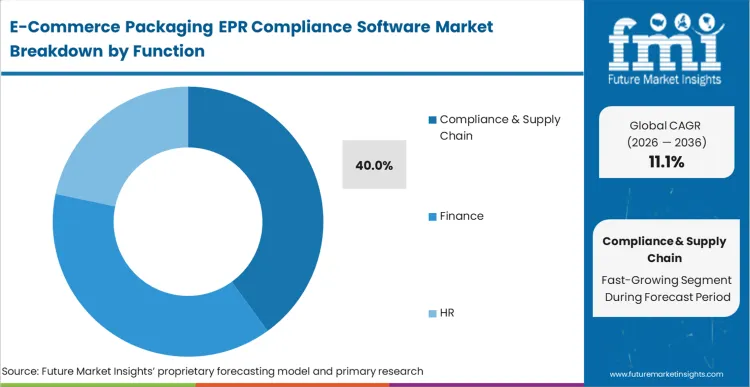
Software designers must validate seamless API communication with automated sorting equipment during pilot testing to authorize full rollout. Network operators maintaining siloed compliance systems face compounding financial penalties as data discrepancies multiply. With physical shipping volumes directly determining tax liabilities, operations teams force compliance protocols directly into the logistics layer. Compliance & Supply Chain captures 40.0% of the market share in 2026 by establishing a single source of truth for all outbound material flows. Incorporating automated calculation engines at the dispatch point guarantees that exact packaging weights are recorded before packages enter the transport network. FMI's analysis indicates that the integration of digital traceability platforms accelerates the extraction of necessary audit data
- Weight Extraction: Direct integration with conveyor scales ensures accurate tonnage reporting bypasses manual data entry bottlenecks.
- Supplier Validation: Automated workflows instantly flag inbound shipments lacking required digital material passports before they enter inventory.
- Audit Reconstruction: Immutable digital ledgers allow legal teams to defend specific packaging classifications during aggressive regulatory investigations.
E-Commerce Packaging EPR Compliance Software Market Analysis by Enterprise Size
Every global retail conglomerate bidding on cross-border logistics contracts now faces strict adherence criteria for environmental packaging declarations. Large enterprise size accounts for a leading 60.0% segment share in 2026 as these entities navigate the highest volume of multi-jurisdictional complexity. As per FMI's projection, the convergence of complex corporate tax strategy with physical logistics amplifies the demand for enterprise-grade compliance suites. Procurement directors operating extensive vendor networks demand software capable of absorbing millions of daily transaction records without latency. Suppliers failing to demonstrate high-throughput data processing capabilities lose priority status in critical software upgrade cycles. Chief sustainability officers must validate data accuracy thresholds during final site acceptance to clear regulatory hurdles.
- Volume Processing: Scalable architectures ensure high-speed order fulfillment continues uninterrupted while background calculations assess specific packaging liabilities.
- Multi-tier Visibility: Advanced mapping modules allow parent companies to track the compliance status of decentralized franchise operations automatically.
- Risk Mitigation: Institutional-grade reporting tools shield corporate executives from personal liability tied to intentional environmental data falsification.
E-Commerce Packaging EPR Compliance Software Market Drivers, Restraints, and Opportunities
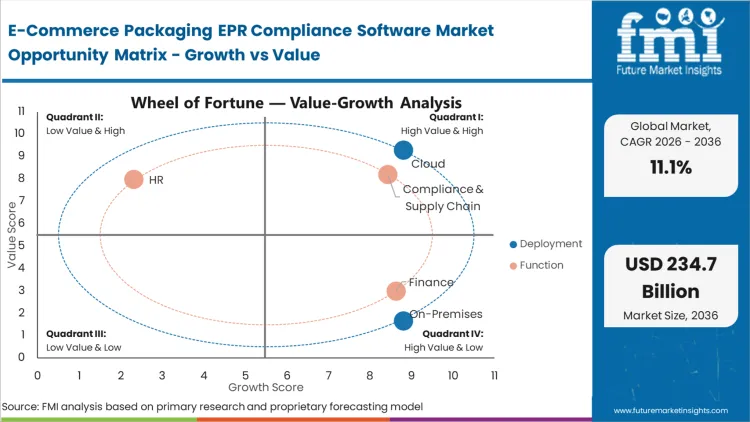
The proliferation of granular plastic taxes and extended producer responsibility laws forces supply chain compliance directors to extract exact material data directly from outbound logistics workflows. This architectural requirement renders manual spreadsheet estimations entirely obsolete. Asset owners upgrading distribution centers face a strict binary choice between deploying complex automated compliance platforms or halting international shipments entirely. Transitioning to a unified digital reporting backbone simplifies tax liability forecasting and enables direct regulatory submissions. Retailers that fail to modernize their core compliance layers risk severe operational embargoes and devastating financial penalties from environmental authorities.
The intricate classification matrices required to optimize multi-material packaging assessments create steep learning curves for traditional warehouse managers. Mapping complex proprietary material blends into standardized regulatory categories demands specialized material science expertise that most retail fulfillment centers lack internally. To mitigate this skill gap, capital projects directors increasingly rely on advanced software configuration consultants who automate the classification process and validate system accuracy before full deployment.
Opportunities in the E-Commerce Packaging EPR Compliance Software Market
- Predictive Taxation Modeling: Next-generation compliance software enables financial directors to run virtualized tax scenarios directly on the platform to optimize packaging redesigns.
- Advanced Tracing Integration: Upgraded PCR plastic blockchain traceability software permits compliance teams to authenticate recycled material origins without delaying standard dispatch operations.
- Vendor Ecosystem Consolidation: Procurement leaders integrating distributed packaging suppliers require unified portals to enforce standardized material reporting across the entire upstream network.
Regional Analysis
.webp "Top Country Growth Comparison E Commerce Packaging Epr Compliance Software Market Cagr (2026 2036)")
Based on the regional analysis, the E-Commerce Packaging EPR Compliance Software market is segmented into North America, Latin America, Europe, East Asia, South Asia, Oceania, and Middle East & Africa across 40 plus countries.
| Country | CAGR (2026 to 2036) |
|---|---|
| India | 12.8% |
| China | 12.2% |
| United States | 10.5% |
| United Kingdom | 9.8% |
| Germany | 9.5% |
| France | 9.4% |
| Japan | 9.2% |
Source: Future Market Insights (FMI) analysis, based on proprietary forecasting model and primary research
Asia Pacific E-Commerce Packaging EPR Compliance Software Market Analysis
Based on FMI's assessment, the costly and error-prone reconciliation processes that plague older western logistics networks are eliminated by this unified approach. The precise implementation parameters for these tracking technologies are dictated by the specific regulatory demands of individual nations. Government technology ministries constructing new digital trade corridors now specify unified EPR reporting frameworks directly in their initial cross-border blueprints. The aggressive greenfield digital infrastructure development across the Asia Pacific region, as a result, accelerates the bypass of legacy manual reporting constraints.
- India: Supply chain directors are forced to deploy compliance networks capable of guaranteeing critical material data delivery to environmental ministries without any processing delays. Operating under stringent centralized extended producer responsibility directives, India's digital commerce sector requires immutable electronic records for all plastic packaging output. This regulatory compliance pressure anchors India's 12.8% CAGR through to 2036 as the national push toward aggressive plastic waste formalization triggers a wave of facility upgrades prioritizing unified, secure reporting backbones. Ultimately, software vendors failing to provide platforms with built-in data integrity mechanisms face immediate disqualification from major fulfillment center tenders.
- China: An aggressive modernization strategy drives a 12.2% CAGR for compliance software in China through the forecast decade. The sheer volume of international trade establishes a massive installed base of interoperable reporting infrastructure across the eastern seaboard. To handle this, massive export logistics operators deploy highly automated tracking lines requiring seamless data exchange between dispatch systems and international customs portals. Facility IT architects bypass manual classification entirely by specifying native API endpoints for all new compliance procurement contracts. The system integrators, as a result, are unable to demonstrate verified high-throughput data capabilities lose access to the most lucrative greenfield logistics projects.
- Japan: The domestic packaging sector embeds precise material tracking logic directly into warehouse management tools to maintain a critical advantage in high-performance sustainability. Every new compliance architecture must successfully validate reporting accuracy before receiving authorization for full enterprise deployment. Procurement specification leads lacking verified interoperable testing records forfeit access to the next generation of fulfillment software contracts. Japan's sophisticated retail supply chain actively enforces strict material accountability through intricate domestic recycling laws for synchronized reverse logistics. As precise tracking proliferates, this continuous qualification constraint sustains a 9.2% of CAGR.
FMI's report includes extensive coverage of the broader Asia Pacific compliance landscape. The rapid formalization of digital trade across emerging ASEAN markets forces regional platforms to deploy unified reporting architectures to satisfy stringent global brand sustainability requirements.
North America E-Commerce Packaging EPR Compliance Software Market Analysis
Corporate compliance officers leading supply chain overhauls face strict directives to unify disparate state reporting requirements under a single manageable architecture. Implementing a standardized digital backbone enables these facilities to manage multi-state taxation seamlessly. National corporate governance frameworks govern the exact specifications required for these critical software deployments. Fragmented state-level environmental mandates across North America target the systematic enforcement of extended producer responsibility on large retail shippers. In FMI's view, the complex matrix of localized plastic taxes actively drives this software consolidation to secure corporate financial flows against severe penalty exposure.
- United States: Compliance specification leads replacing aging static spreadsheets must deploy dynamic architectures capable of supporting both real-time legislative updates and secure tonnage telemetry. The United States retail distribution sector continuously navigates a rapidly evolving patchwork of state-level extended producer responsibility legislation across its entire fulfillment ecosystem. As national retailers unify their reporting topologies, the United States advances at a 10.5% CAGR across the forecast decade. Corporate sustainability initiatives actively fund the replacement of vulnerable manual processes with standardized, resilient software backbones. Ultimately, software suppliers lacking documented compliance with rigorous data visibility standards face immediate exclusion from enterprise-grade modernization contracts.
FMI's report includes comprehensive evaluation of the North American digital compliance sector. The integration of cross-border supply chains with Canada and Mexico requires standardized data protocols to coordinate accurate material reporting across multiple interconnected distribution facilities.
Europe E-Commerce Packaging EPR Compliance Software Market Analysis
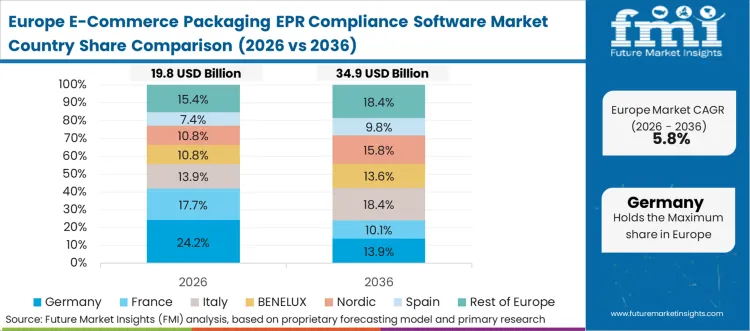
Sustainability architects redesigning legacy logistics platforms must integrate continuous material volume data alongside critical financial accounting signals. The transition requires a complete overhaul of existing data aggregation topologies. European environmental policy aggressively penalizes the continued operation of opaque and unaccountable e-commerce packaging networks. Regional circular economy directives and stringent plastic tax frameworks heavily influence the technical requirements for these digital transformations. This dual-purpose reporting requirement forces the rapid adoption of specialized calculation engines to guarantee compliance stability while transmitting heavy audit payloads.
- United Kingdom: This critical regulatory transition anchors the UK's 9.8% CAGR trajectory to 2036. Retail compliance planners deploying advanced enterprise resource planning systems mandate software architectures capable of sub-gram data accuracy across distributed geographic assets. The shift toward stringent financial penalties forces logistics operators to abandon legacy estimation protocols in favor of highly resilient, automated compliance networks. The United Kingdom's plastic packaging tax programs require precise material composition data to accurately assess fees on imported and domestically produced e-commerce shipments. Financial directors unable to demonstrate absolute reporting determinism under severe audit conditions forfeit qualification for corporate liability insurance programs.
- Germany: Platform providers targeting domestic distribution retooling projects must guarantee real-time synchronization performance prior to the finalization of capital software budgets. Germany's complex dual-system packaging recovery network dictates stringent validation criteria for material tonnage reporting on high-volume fulfillment lines. The national push toward aggressive circularity targets creates a recurring compliance cycle that accelerates software module replacement. IT systems engineers must demonstrate flawless execution of automated data flows before receiving authorization to connect new warehouse facilities to the main corporate reporting backbone. This systemic qualification pressure drives a 9.5% CAGR for compliance platforms in Germany.
- France: Supply chain compliance teams prioritize the implementation of track and trace packaging solutions to navigate highly specific end-of-life processing fees. France's sophisticated anti-waste and circular economy legislation imposes strict tracing requirements on specialized packaging materials entering the domestic market. France expands at a 9.4% CAGR as precise tracing mechanisms become standard operational procedure. The stringent regulatory environment eliminates tolerance for manual approximation, pushing facilities toward total digital automation. Enterprise architects lacking native API integration capabilities remain structurally locked out of the next wave of major retail fulfillment upgrades.
FMI's report includes thorough investigation of the European digital sustainability framework. A prevailing structural condition across these nations is the mandatory compliance with strict cross-border taxation directives, forcing asset owners to specify dynamic networks that reliably calculate multi-national obligations.
Competitive Aligners for Market Players
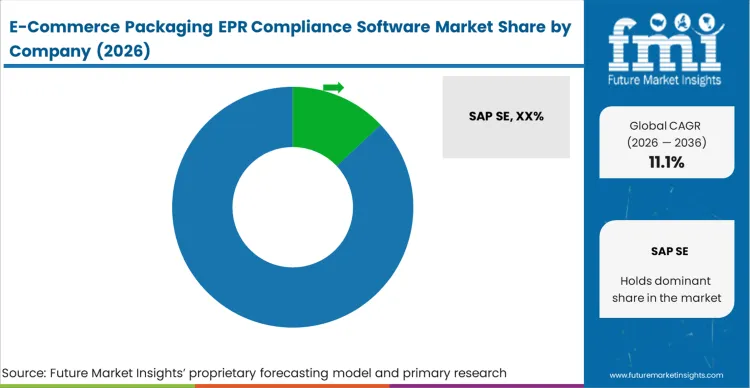
The introduction of unified digital material reporting standards by global environmental authorities is reshaping how enterprise buyers evaluate compliance software. Instead of accepting fragmented point solutions, procurement teams now demand comprehensive, continuously updated calculation engines in all new enterprise architecture tenders. This shift has raised the performance bar across the industry, meaning vendors that continue to rely on static databases and manual upload processes risk being excluded from major corporate modernization programs. Industry leaders have already begun adapting by acquiring specialized regulatory intelligence firms to feed real-time tax code updates directly into their core software platforms.
Vendors embedding advanced automated calculation protocols directly into broader enterprise resource planning ecosystems gain a significant architectural advantage. Companies such as SAP SE and Oracle Corp, which increasingly incorporate dedicated EPR compliance modules natively, help reduce IT integration overhead during deployment and shrink the risk of critical data silos. This native-integration approach accelerates large-scale enterprise rollouts, allowing chief sustainability officers and IT leads to prioritize platforms that avoid the complexity associated with third-party middleware. In contrast, standalone software developers slow to secure certified API connections with major logistics systems risk losing position during early-stage vendor shortlisting.
Growth of standardized data exchange formats for material passports is disrupting long-established software market strongholds. With more regulatory reporting layers becoming structurally unified, enterprise architects designing modern logistics networks can source advanced recycled PE packaging tracing tools without worrying about formatting incompatibilities. This expanded flexibility empowers retail distribution conglomerates to optimize software stacks for accuracy and audit defense instead of being constrained by legacy vendor lock-in. The trajectory indicates that basic calculation tools will rapidly commoditize, forcing top-tier providers to compete primarily on predictive tax modeling and automated audit generation capabilities.
Key Players in E-Commerce Packaging EPR Compliance Software Market
- SAP SE
- Oracle Corp
- Microsoft
- NetSuite
- Epicor Software
- IBM
- Designpro Automation
Scope of the Report
| Metric | Value |
|---|---|
| Quantitative Units | USD 81.9 billion to USD 234.8 billion, at a CAGR of 11.1% |
| Market Definition | E-Commerce Packaging EPR Compliance Software encompasses specialized enterprise platforms designed to track, calculate, and report packaging material tonnage for regulatory taxation purposes. |
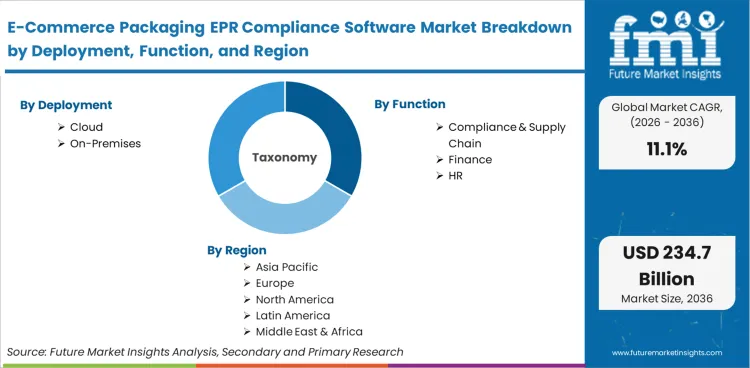
| Deployment Segmentation | Cloud, On-Premises |
| Function Segmentation | Compliance & Supply Chain, Finance, HR, Operations |
| Enterprise Size Segmentation | Large, Medium, Small |
| Regions Covered | North America, Latin America, Europe, East Asia, South Asia, Oceania, Middle East & Africa |
| Countries Covered | India, China, United States, United Kingdom, Germany, France, Japan, and 40 plus countries |
| Key Companies Profiled | SAP SE, Oracle Corp, Microsoft, NetSuite, Epicor Software, IBM, Designpro Automation |
| Forecast Period | 2026 to 2036 |
| Approach | The baseline value derives from a bottom-up aggregation of compliance software license deployments, applying region-specific regulatory curves to project future adoption velocity. |
Source: Future Market Insights (FMI) analysis, based on proprietary forecasting model and primary research
Segments:
Deployment:
- Cloud
- On-Premises
Function:
- Compliance & Supply Chain
- Finance
- HR
- Operations
Enterprise Size:
- Large
- Medium
- Small
Regions:
- North America
- United States
- Canada
- Mexico
- Latin America
- Brazil
- Argentina
- Chile
- Rest of Latin America
- Europe
- Germany
- United Kingdom
- France
- Spain
- Italy
- Benelux
- Nordics
- Central & Eastern Europe
- Rest of Europe
- East Asia
- China
- Japan
- South Korea
- South Asia
- India
- Rest of South Asia
- Oceania
- Australia
- New Zealand
- Middle East & Africa
- GCC Countries
- South Africa
- Turkey
- Rest of Middle East & Africa
Bibliography
- Ministry of Environment, Forest and Climate Change. (2025, January). Plastic waste management rules: Centralized EPR portal integration guidelines. Government of India.
- United Kingdom Department for Environment, Food & Rural Affairs. (2024, September). Plastic packaging tax: Digital record keeping and API submission standards. GOV.UK.
- German Environment Agency (UBA). (2024, October). VerpackG compliance and digital material registration protocols. Umweltbundesamt.
- Retail Industry Leaders Association. (2024, July). Navigating multi-state EPR legislation: Software requirements for modern fulfillment. RILA Publications.
- Ministry of Ecology and Environment of the PRC. (2025, March). Digital tracking standards for export packaging materials. MEE Official Releases.
- Consumer Brands Association. (2024, December). The future of material passports and automated supply chain reporting. CBA Research.
This bibliography is provided for reader reference. The full FMI report contains the complete reference list with primary research documentation.
This Report Addresses
- Market sizing for the organized e-commerce packaging EPR compliance software layer
- Forecast demand for automated calculation engines from 2026 to 2036
- Deployment analysis across cloud and on-premises sub-segments
- Function demand patterns across compliance, finance, HR, and operations
- Regional growth comparisons shaped by fragmented plastic tax legislation
- Competitive positioning factors for global enterprise software vendors
- Revenue opportunities tied to predictive sustainability modeling streams
- Strategic implications for chief sustainability officers and retail logistics directors
Frequently Asked Questions
How large is the E-Commerce Packaging EPR Compliance Software market in 2026?
The market is valued at USD 81.9 billion in 2026 as international regulatory pressures force massive enterprise technology upgrades. Logistics operators deploy automated systems to prevent crippling customs embargoes.
What will the E-Commerce Packaging EPR Compliance Software market be valued at by 2036?
The valuation reaches USD 234.8 billion by 2036 driven by universal mandates for digital material passports. Widespread enforcement ensures that software integration becomes an unavoidable cost of doing business globally.
What CAGR is projected for E-Commerce Packaging EPR Compliance Software from 2026 to 2036?
The market expands at a highly defensible 11.1% CAGR over the decade. This rate is sustained by the continuous introduction of new regional tax codes requiring persistent software updates.
Which Deployment segment leads the global market?
Cloud deployment holds a 58.0% share in 2026, driven by the need for instantaneous regulatory database updates. On-premises systems systematically fail to track rapidly shifting international fee structures.
Which Function segment dominates software adoption?
Compliance & Supply Chain represents 40.0% of the market share as physical logistics data becomes the core basis for taxation. Integrating software at the warehouse level prevents costly data reconciliation delays.
What size of enterprise drives the most software demand?
Large enterprise size leads with a 60.0% share, reflecting their exposure to the highest volume of multi-jurisdictional compliance risk. Massive retail conglomerates must automate reporting to manage millions of individual packaging records.
What primary policy framework forces companies to act?
Fragmented extended producer responsibility laws and localized plastic taxes eliminate the viability of centralized, manual spreadsheet tracking. Severe financial penalties compel corporate boards to mandate automated data extraction.
How do leading software providers differentiate their platforms?
Top-tier vendors compete primarily on the breadth of their native API integrations with established warehouse management systems. Platforms that eliminate third-party middleware drastically reduce enterprise deployment times.
What makes the 11.1% CAGR structurally defensible?
The absolute necessity of digital compliance to clear international customs guarantees continuous software investment regardless of broader economic cycles. Regulatory fines vastly outweigh the capital cost of platform implementation.
Why are manual reporting protocols failing?
Static spreadsheets cannot dynamically cross-reference exact packaging weights against shifting international tax rates in real-time. This structural limitation causes unavoidable audit failures during large-scale supply chain investigations.
What predictive capability do modern compliance platforms offer?
Advanced software allows financial teams to simulate tax liabilities based on proposed packaging material changes before physical production begins. This capability directly optimizes corporate procurement strategies to minimize compliance costs.
What drives the high software demand in India?
India's strict centralized waste tracking mandates force domestic retail marketplaces to adopt secure, immutable data reporting architectures. The nation posts a 12.8% CAGR as compliance enforcement escalates.
How does China's export strategy impact software adoption?
Massive export hubs implement unified digital tracking ledgers to satisfy strict European material requirements, driving a 12.2% growth rate. Failure to deploy these systems results in immediate rejection at destination ports.
What accelerates deployment in the United States?
A fragmented landscape of conflicting state-level packaging legislation forces national shippers to adopt dynamic software capable of multi-state calculation. The U.S. market grows at 10.5% to manage this localized regulatory chaos.
Why is the United Kingdom market expanding steadily?
The mature plastic packaging tax infrastructure demands precise sub-gram tracking accuracy, pushing UK adoption to a 9.8% CAGR. Logistics operators must deploy resilient systems to secure necessary liability insurance.
What forces German fulfillment centers to upgrade?
Germany's complex dual-system recovery network requires flawless automated data flows to calculate specialized end-of-life processing fees. This stringent environment sustains a 9.5% CAGR for compliant tracking software.
How do France and Japan differ in their implementation?
France leverages software to navigate specific anti-waste taxes, while Japan embeds precision logic for synchronized reverse logistics networks. Both rely on advanced traceability, but their operational endpoints focus on different circular economy phases.
What specific operational hurdle delays site commissioning?
Reconciling proprietary supplier material codes with standardized government taxonomy frequently extends implementation timelines. System integrators must resolve these data conflicts to ensure accurate automated tax calculation.
Why do compliance officers prioritize vendor ecosystem consolidation?
Maintaining disparate tracking tools across multiple franchise operations creates severe blind spots during consolidated corporate tax audits. Unified platforms eliminate these discrepancies and establish a single source of truth.
What is the defining transformation in this software market?
The industry has fundamentally pivoted from voluntary corporate sustainability dashboards to legally mandated, financially binding automated taxation engines. This shifts the software from a public relations tool to critical financial infrastructure.
What falls completely outside the scope of this report?
General ledger accounting systems lacking specialized material tonnage calculation logic and standalone physical barcode scanners are excluded. The focus remains exclusively on dedicated environmental compliance architecture.
How does FMI validate its software deployment forecasts?
Analysts cross-reference public corporate capital expenditure guidance with quarterly subscription revenue reports from leading enterprise supply chain software developers.
What defines the boundary of the market inclusions?
The market encompasses specialized calculation engines, material tracking APIs, and continuously updated regulatory database feeds. It explicitly measures the software infrastructure translating physical logistics into legal tax documentation.
What is the core strategic takeaway for fulfillment directors?
Directors must eliminate manual data entry from packaging compliance workflows entirely and mandate native software integration in all future warehouse management upgrades. Delaying this transition guarantees cascading regulatory penalties.
Preview the report firsthand - request a free sample
Get SampleGet the brochure for pricing and purchase details.
Get PDFTable of Content
- Key Takeaways
- Market Size and CAGR
- Top Growth Driver
- Fastest Growing Segment
- Leading Region
- Key Companies
- Emerging Opportunities
- Executive Summary
- Global Market Outlook
- Demand-side Trends
- Supply-side Trends
- Technology Roadmap Analysis
- Analysis and Recommendations
- Analyst Perspective (What is happening? Why now? What should investors know?)
- Key Questions Answered
- How large is the market?
- What is the CAGR?
- What are key trends?
- Which region dominates?
- Who are the leaders?
- Market Overview
- Market Coverage / Taxonomy
- Market Definition / Scope / Limitations
- Research Methodology
- Chapter Orientation
- Analytical Lens and Working Hypotheses
- Market Structure, Signals, and Trend Drivers
- Benchmarking and Cross-market Comparability
- Market Sizing, Forecasting, and Opportunity Mapping
- Research Design and Evidence Framework
- Desk Research Programme (Secondary Evidence)
- Expert Input and Fieldwork (Primary Evidence)
- Tooling, Models, and Reference Databases
- Data Engineering and Model Build
- Quality Assurance and Audit Trail
- Market Background
- Market Dynamics (Drivers, Restraints, Opportunity, Trends)
- Scenario Forecast (Optimistic, Likely, Conservative)
- Impact Analysis
- AI Impact
- Sustainability Impact
- Regulatory Impact
- Technology Impact
- Consumer / Buyer Analysis
- Purchase Drivers
- Adoption Barriers
- Buyer Journey
- Opportunity Map Analysis
- Product Life Cycle Analysis
- Supply Chain Analysis
- Investment Feasibility Matrix
- Value Chain Analysis
- PESTLE and Porter's Analysis
- Regulatory Landscape
- Regional Parent Market Outlook
- Production and Consumption Statistics
- Import and Export Statistics
- Global Market Analysis and Forecast, 2021 to 2036
- Historical Market Size Value (USD Billion) & Volume (Unit) Analysis, 2021 to 2025
- Current and Future Market Size Value (USD Billion) & Volume (Unit) Projections, 2026 to 2036
- Y-o-Y Growth Trend Analysis
- Absolute $ Opportunity Analysis
- Global Market Pricing Analysis, 2021 to 2036
- Global Market Analysis and Forecast, By Deployment, 2021 to 2036
- Introduction / Key Findings
- Historical Market Size Value (USD Billion) & Volume (Unit) Analysis By Deployment, 2021 to 2025
- Current and Future Market Size Value (USD Billion) & Volume (Unit) Analysis and Forecast By Deployment, 2026 to 2036
- Cloud
- On-Premises
- Cloud
- Y-o-Y Growth Trend Analysis By Deployment, 2021 to 2025
- Absolute $ Opportunity Analysis By Deployment, 2026 to 2036
- Global Market Analysis and Forecast, By Function, 2021 to 2036
- Introduction / Key Findings
- Historical Market Size Value (USD Billion) & Volume (Unit) Analysis By Function, 2021 to 2025
- Current and Future Market Size Value (USD Billion) & Volume (Unit) Analysis and Forecast By Function, 2026 to 2036
- Compliance & Supply Chain
- Finance
- HR
- Operations
- Compliance & Supply Chain
- Y-o-Y Growth Trend Analysis By Function, 2021 to 2025
- Absolute $ Opportunity Analysis By Function, 2026 to 2036
- Global Market Analysis and Forecast, By Enterprise Size, 2021 to 2036
- Introduction / Key Findings
- Historical Market Size Value (USD Billion) & Volume (Unit) Analysis By Enterprise Size, 2021 to 2025
- Current and Future Market Size Value (USD Billion) & Volume (Unit) Analysis and Forecast By Enterprise Size, 2026 to 2036
- Large
- Medium
- Small
- Large
- Y-o-Y Growth Trend Analysis By Enterprise Size, 2021 to 2025
- Absolute $ Opportunity Analysis By Enterprise Size, 2026 to 2036
- Global Market Analysis and Forecast, By Region, 2021 to 2036
- Introduction
- Historical Market Size Value (USD Billion) & Volume (Unit) Analysis By Region, 2021 to 2025
- Current Market Size Value (USD Billion) & Volume (Unit) Analysis and Forecast By Region, 2026 to 2036
- North America
- Latin America
- Western Europe
- Eastern Europe
- East Asia
- South Asia and Pacific
- Middle East & Africa
- Market Attractiveness Analysis By Region
- North America Market Analysis and Forecast, By Country, 2021 to 2036
- Historical Market Size Value (USD Billion) & Volume (Unit) Trend Analysis By Market Taxonomy, 2021 to 2025
- Market Size Value (USD Billion) & Volume (Unit) Forecast By Market Taxonomy, 2026 to 2036
- By Country
- USA
- Canada
- Mexico
- By Deployment
- By Function
- By Enterprise Size
- By Country
- Market Attractiveness Analysis
- By Country
- By Deployment
- By Function
- By Enterprise Size
- Key Takeaways
- Latin America Market Analysis and Forecast, By Country
- Historical Market Size Value (USD Billion) & Volume (Unit) Trend Analysis By Market Taxonomy, 2021 to 2025
- Market Size Value (USD Billion) & Volume (Unit) Forecast By Market Taxonomy, 2026 to 2036
- By Country
- Brazil
- Chile
- Rest of Latin America
- By Deployment
- By Function
- By Enterprise Size
- By Country
- Market Attractiveness Analysis
- By Country
- By Deployment
- By Function
- By Enterprise Size
- Key Takeaways
- Western Europe Market Analysis and Forecast, By Country
- Historical Market Size Value (USD Billion) & Volume (Unit) Trend Analysis By Market Taxonomy, 2021 to 2025
- Market Size Value (USD Billion) & Volume (Unit) Forecast By Market Taxonomy, 2026 to 2036
- By Country
- Germany
- UK
- Italy
- Spain
- France
- Nordic
- BENELUX
- Rest of Western Europe
- By Deployment
- By Function
- By Enterprise Size
- By Country
- Market Attractiveness Analysis
- By Country
- By Deployment
- By Function
- By Enterprise Size
- Key Takeaways
- Eastern Europe Market Analysis and Forecast, By Country
- Historical Market Size Value (USD Billion) & Volume (Unit) Trend Analysis By Market Taxonomy, 2021 to 2025
- Market Size Value (USD Billion) & Volume (Unit) Forecast By Market Taxonomy, 2026 to 2036
- By Country
- Russia
- Poland
- Hungary
- Balkan & Baltic
- Rest of Eastern Europe
- By Deployment
- By Function
- By Enterprise Size
- By Country
- Market Attractiveness Analysis
- By Country
- By Deployment
- By Function
- By Enterprise Size
- Key Takeaways
- East Asia Market Analysis and Forecast, By Country
- Historical Market Size Value (USD Billion) & Volume (Unit) Trend Analysis By Market Taxonomy, 2021 to 2025
- Market Size Value (USD Billion) & Volume (Unit) Forecast By Market Taxonomy, 2026 to 2036
- By Country
- China
- Japan
- South Korea
- By Deployment
- By Function
- By Enterprise Size
- By Country
- Market Attractiveness Analysis
- By Country
- By Deployment
- By Function
- By Enterprise Size
- Key Takeaways
- South Asia and Pacific Market Analysis and Forecast, By Country
- Historical Market Size Value (USD Billion) & Volume (Unit) Trend Analysis By Market Taxonomy, 2021 to 2025
- Market Size Value (USD Billion) & Volume (Unit) Forecast By Market Taxonomy, 2026 to 2036
- By Country
- India
- ASEAN
- Australia & New Zealand
- Rest of South Asia and Pacific
- By Deployment
- By Function
- By Enterprise Size
- By Country
- Market Attractiveness Analysis
- By Country
- By Deployment
- By Function
- By Enterprise Size
- Key Takeaways
- Middle East & Africa Market Analysis and Forecast, By Country
- Historical Market Size Value (USD Billion) & Volume (Unit) Trend Analysis By Market Taxonomy, 2021 to 2025
- Market Size Value (USD Billion) & Volume (Unit) Forecast By Market Taxonomy, 2026 to 2036
- By Country
- Kingdom of Saudi Arabia
- Other GCC Countries
- Türkiye
- South Africa
- Other African Union
- Rest of Middle East & Africa
- By Deployment
- By Function
- By Enterprise Size
- By Country
- Market Attractiveness Analysis
- By Country
- By Deployment
- By Function
- By Enterprise Size
- Key Takeaways
- Key Countries Market Analysis
- USA
- Pricing Analysis
- Market Share Analysis, 2025
- By Deployment
- By Function
- By Enterprise Size
- Canada
- Pricing Analysis
- Market Share Analysis, 2025
- By Deployment
- By Function
- By Enterprise Size
- Mexico
- Pricing Analysis
- Market Share Analysis, 2025
- By Deployment
- By Function
- By Enterprise Size
- Brazil
- Pricing Analysis
- Market Share Analysis, 2025
- By Deployment
- By Function
- By Enterprise Size
- Chile
- Pricing Analysis
- Market Share Analysis, 2025
- By Deployment
- By Function
- By Enterprise Size
- Germany
- Pricing Analysis
- Market Share Analysis, 2025
- By Deployment
- By Function
- By Enterprise Size
- UK
- Pricing Analysis
- Market Share Analysis, 2025
- By Deployment
- By Function
- By Enterprise Size
- Italy
- Pricing Analysis
- Market Share Analysis, 2025
- By Deployment
- By Function
- By Enterprise Size
- Spain
- Pricing Analysis
- Market Share Analysis, 2025
- By Deployment
- By Function
- By Enterprise Size
- France
- Pricing Analysis
- Market Share Analysis, 2025
- By Deployment
- By Function
- By Enterprise Size
- India
- Pricing Analysis
- Market Share Analysis, 2025
- By Deployment
- By Function
- By Enterprise Size
- ASEAN
- Pricing Analysis
- Market Share Analysis, 2025
- By Deployment
- By Function
- By Enterprise Size
- Australia & New Zealand
- Pricing Analysis
- Market Share Analysis, 2025
- By Deployment
- By Function
- By Enterprise Size
- China
- Pricing Analysis
- Market Share Analysis, 2025
- By Deployment
- By Function
- By Enterprise Size
- Japan
- Pricing Analysis
- Market Share Analysis, 2025
- By Deployment
- By Function
- By Enterprise Size
- South Korea
- Pricing Analysis
- Market Share Analysis, 2025
- By Deployment
- By Function
- By Enterprise Size
- Russia
- Pricing Analysis
- Market Share Analysis, 2025
- By Deployment
- By Function
- By Enterprise Size
- Poland
- Pricing Analysis
- Market Share Analysis, 2025
- By Deployment
- By Function
- By Enterprise Size
- Hungary
- Pricing Analysis
- Market Share Analysis, 2025
- By Deployment
- By Function
- By Enterprise Size
- Kingdom of Saudi Arabia
- Pricing Analysis
- Market Share Analysis, 2025
- By Deployment
- By Function
- By Enterprise Size
- Türkiye
- Pricing Analysis
- Market Share Analysis, 2025
- By Deployment
- By Function
- By Enterprise Size
- South Africa
- Pricing Analysis
- Market Share Analysis, 2025
- By Deployment
- By Function
- By Enterprise Size
- USA
- Market Structure Analysis
- Competition Dashboard
- Competition Benchmarking
- Market Share Analysis of Top Players
- By Regional
- By Deployment
- By Function
- By Enterprise Size
- Emerging Startups
- Innovation Benchmarking
- Competition Analysis
- Competition Deep Dive
- SAP SE
- Overview
- Product Portfolio
- Profitability by Market Segments (Product/Region/Sales Channel)
- Sales Footprint
- Strategy Overview
- Marketing Strategy
- Product Strategy
- Channel Strategy
- Oracle Corp
- Microsoft
- NetSuite
- Epicor Software
- IBM
- Designpro Automation
- SAP SE
- Case Studies
- Success Stories
- Recent Developments
- Competition Deep Dive
- Assumptions & Acronyms Used


