

- Industry Size (2026)
- USD 105.0 Mn
- Forecast (2036)
- USD 625.0 Mn
- CAGR (2026 to 2036)
- 19.5%
PCR Plastic Blockchain Traceability Software Market Size, Market Forecast and Outlook By FMI
In 2025, the PCR plastic blockchain traceability software market surpassed a value of USD 88.0 million and is projected to reach USD 105.0 million in 2026 and USD 625.0 million by 2036, reflecting a CAGR of 19.5% as strict regional packaging mandates force brands to adopt immutable digital custody chains. Procurement groups shift from manual auditing to cryptographic ledgers to mitigate fraud. Buyers integrate verifiable architectures to validate resin purity and secure ongoing corporate compliance.
Compliance thresholds reset minimum verification protocols and bring forward software upgrades. According to FMI's estimates, pre-qualified tracking platforms clear procurement committees faster, allowing brands to avoid steep statutory penalties. In January 2026, Maine mandated minimum 25% PCR in plastic beverage containers, forcing regional operators to deploy digital architectures [1]. Early adopters secure enterprise contracts by demonstrating mathematical certainty over material origins.
Summary of PCR Plastic Blockchain Traceability Software Market
- PCR Plastic Blockchain Traceability Software Market Definition
- Enterprise software utilizing distributed ledgers securely tracks post-consumer recycled material provenance across industrial supply chains.
- Demand Drivers in the Market
- Minimum recycled content statutory mandates force brands to secure verifiable supply chains.
- Investor pressure for transparent reporting advances digital platform procurement.
- Fraud risks associated with premium-priced recycled resins push reclaimers toward cryptographic verification.
- Key Segments Analyzed in the FMI Report
- Deployment Type: Cloud-hosted solutions (57%) versus on-premise/private blockchain and hybrid enterprise platforms.
- End-User Industry: Food & beverage packaging (42% of total volume) versus consumer goods, automotive & electronics, and industrial plastics.
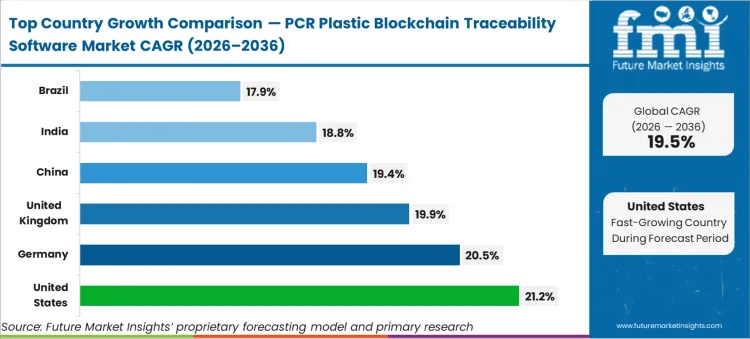
- Geography: High-growth North America and Europe (United States 21.2%, Germany 20.5%, United Kingdom 19.9%) versus scaling Asia-Pacific and Latin America (China 19.4%, India 18.8%, Brazil 17.9%).
- Analyst Opinion at FMI
- Ismail Sutaria, Principal Consultant for Packaging at Future Market Insights, opines, “In our recent evaluation of the PCR Plastic Blockchain Traceability Software Market, my team and I have identified data integrity, not recycled volume, as the real currency of circular packaging. As minimum recycled content mandates tighten, discrepancies between declared and actual PCR usage expose brands to reputational and legal risk. Blockchain platforms that integrate real-time inventory reconciliation, audit trails, and third-party certification layers will redefine procurement transparency. The next phase of adoption will favor solutions that seamlessly connect ERP systems with recycling facility inputs, transforming compliance from reactive reporting into proactive verification.”
- Strategic Implications/Executive Takeaways
- Transition software sales from pilot programs to enterprise-wide framework agreements.
- Prioritize integration modules compatible with legacy ERP systems to lower adoption friction.
- Anchor marketing logic to regulatory penalty avoidance rather than pure sustainability claims.
- Methodology
- Validated through first-hand corporate production and capacity data.
- Zero reliance on speculative third-party market research reports.
- Based on verifiable industrial benchmarks and verified sources.
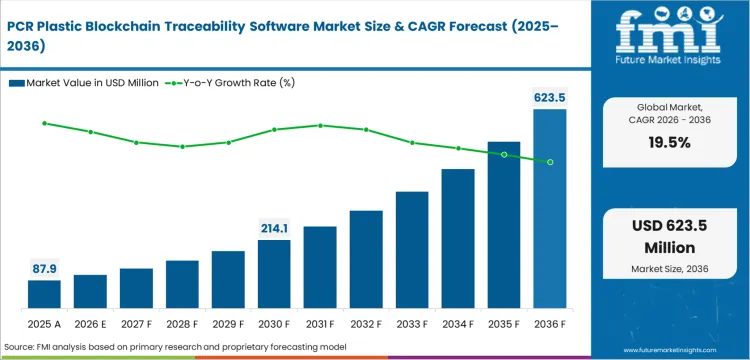
PCR Plastic Blockchain Traceability Software Market Key Takeaways
| Metric | Details |
|---|---|
| Industry Size (2026) | USD 105.0 Million |
| Industry Value (2036) | USD 625.0 Million |
| CAGR (2026-2036) | 19.5% |
Country dispersion skews toward strict environmental policy corridors; United States (21.2% CAGR), Germany (20.5% CAGR), United Kingdom (19.9% CAGR), China (19.4% CAGR), India (18.8% CAGR), and Brazil (17.9% CAGR) post higher conversion rates. Sourcing clusters around framework agreements and pre-qualification. Incumbents holding recognized technical certifications clear audits and secure larger volume allocations.
PCR Plastic Blockchain Traceability Software Market Definition
Enterprise tools utilizing distributed ledgers securely track post-consumer recycled material provenance. Procurement teams utilize such systems to secure immutable records of material origin, processing stages, and final post-consumer recycled plastic packaging integration. Verified digital histories enable consumer goods manufacturers to prove regulatory compliance, claim extended producer responsibility credits, and combat fraudulent virgin resin substitution.
PCR Plastic Blockchain Traceability Software Market Inclusions
Software licenses, SaaS subscriptions, cryptographic node deployment fees, and smart contract configuration services utilized for post-consumer recycled material tracking form primary inclusions. Analytics dashboards, tokenization modules tracking physical resin batches, and integration interfaces connecting ledgers with enterprise resource planning systems are explicitly quantified. FMI analysts opine that assessment incorporates revenue generated by platforms enabling compliance audits for extended producer responsibility programs.
PCR Plastic Blockchain Traceability Software Market Exclusions
Physical sorting equipment, chemical recycling hardware, and traditional database architecture lacking cryptographic ledger functionality remain strictly excluded. Consulting services unrelated to software deployment, general corporate sustainability reporting tools, and consumer-facing carbon offsetting applications fall outside measurement boundaries. Revenue from virgin plastic trading platforms lacking distinct post-consumer verification modules is omitted.
PCR Plastic Blockchain Traceability Software Market Research Methodology
- Primary Research: Interviews involved software product managers, resin reclaimers, compliance auditors, and brand sustainability officers across major regions to validate adoption metrics.
- Desk Research: Official environmental agency budgets, regulatory filings regarding minimum recycled content, and software vendor earnings transcripts supported volume benchmarking.
- Market-Sizing and Forecasting: A hybrid top-down and bottom-up model extracted demand from blockchain technology penetration rates within packaging supply chains, validated against vendor licensing revenues.
- Data Validation and Update Cycle: Financial outputs undergo variance checks across regional compliance timelines and structured peer review before finalization.
Segmental Analysis
PCR Plastic Blockchain Traceability Software Market Analysis by Deployment Type
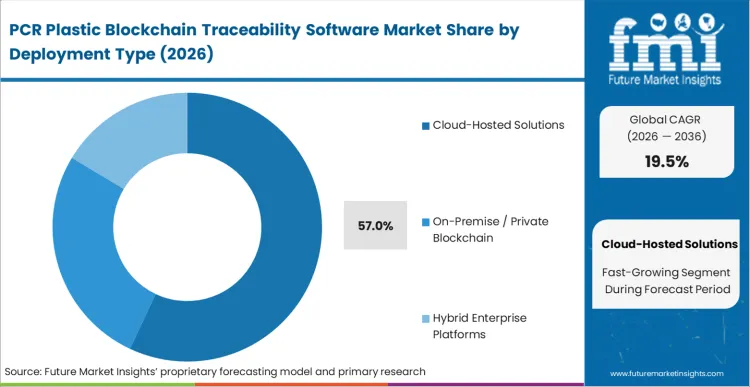
Cloud-Hosted Solutions command 57% share in 2026, guided by procurement preferences for scalable, rapid-deployment enterprise architectures. Brands migrating from manual auditing processes prioritize platforms requiring minimal internal IT infrastructure upgrades. As per FMI's projection, digital product passport DPP platforms delivered via cloud models shorten qualification cycles, enabling fast integration with global supply chain partners. Global plastic pollution reaches 130 Mt annually, pressing regulators to demand immutable tracking ecosystems [2]. Cost physics favor subscription-based software over capital-intensive on-premise builds, aligning operational expenses directly with processing volumes.
- Architectural Shift: Buyers abandon legacy databases because cryptographic cloud ledgers ensure immutable multi-party verification. Transition occurs during annual software contract renewals, reducing audit costs permanently.
- Cost Discipline: Subscription models lower upfront capital requirements, expanding accessibility for mid-sized plastic reclaimers. Adoption speeds up following recent regional packaging mandates, establishing cloud tracking as standard protocol.
- Integration Capability: Standardized API connections enable rapid supplier onboarding, removing data silos across international borders. Implementation advances preceding 2030 sustainability deadlines, linking data visibility to vendor retention.
PCR Plastic Blockchain Traceability Software Market Analysis by End-User Industry
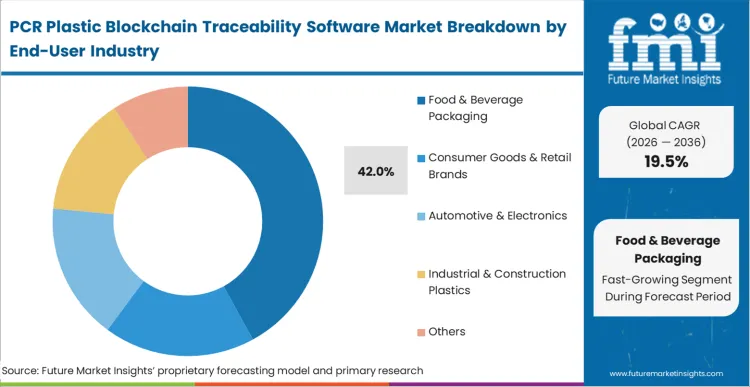
Food & Beverage Packaging represents 42% demand in 2026 as consumer goods corporations execute aggressive plastic reduction commitments. Strict food-contact safety regulations require immutable proof that reclaimed resins meet medical-grade purity standards before integration. FMI analysts opine that PCR bottles manufacturers rely on digital tracking to validate progress and secure brand reputation by mathematically verifying material origins against global standards. Brand signatories tripled post-consumer recycled content use to 16% in 2024, forcing major beverage brands to secure verified high-quality resin supplies [3]. Traceability platforms convert regulatory exposure into measurable procurement criteria.
- Regulatory Gate: Food safety boards demand exact origin tracking, making cryptographic ledgers mandatory for recycled resin approvals. Brands overhaul supplier requirements during current tender cycles, eliminating unverified resin sources.
- Consumer Trust: Counterfeit recycled claims pose high brand risk, pushing investment in transparent verification tools. Rollouts follow public sustainability pledges, solidifying cryptographic networks as brand protection infrastructure.
- Audit Efficiency: Automated smart contracts reduce manual compliance checks, saving thousands in annual auditing fees per facility. Factories deploy modules alongside new mechanical sorting lines, directly tying software to physical throughput.
PCR Plastic Blockchain Traceability Software Market Drivers, Restraints, and Opportunities
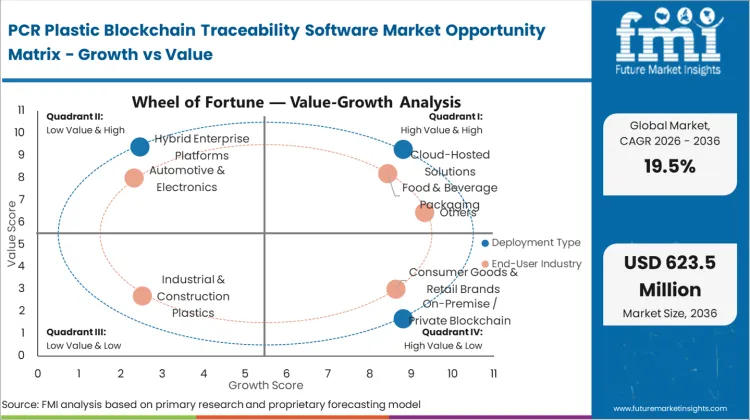
Statutory mandates governing minimum recycled content establish absolute compliance gates, forcing packaging producers to adopt cryptographic tracking. Brands face severe financial penalties and market access restrictions unless material provenance undergoes rigorous mathematical verification. According to FMI's estimates, material passport systems for circular plastics transform abstract sustainability goals into hard operational requirements. In California, plastic covered material must achieve a 65% recycling rate by 2032, compelling immediate investment in verifiable data architectures [4]. Software adoption follows legislative calendars closely, with procurement spikes occurring 12 to 18 months prior to enforcement deadlines.
Data interoperability barriers restrain rapid network expansion, as diverse global suppliers operate fragmented, legacy IT systems. Forcing thousands of small-scale waste collectors and independent reclaimers onto unified cryptographic ledgers requires heavy change management and training resources. Up to 43% of US households lack basic recycling access, complicating initial data entry points for comprehensive tracking software [5]. Vendors mitigate friction by developing mobile-first, low-bandwidth interfaces tailored for developing market collection networks to ensure comprehensive data capture.
- Financing Alignment: Green bonds require verifiable impact data, pushing corporate treasury departments to fund enterprise tracing software rollouts across massive primary plastic production volumes reaching 450 Mt [12]. Financial institutions utilize immutable ledger records to validate key performance indicators before releasing capital tranches.
- Efficiency Gains: Automated reporting modules replace manual audits, lowering ongoing operational compliance costs. Platforms utilizing low-bandwidth interfaces capture critical first-mile data essential for downstream corporate reporting.
- Economic Output: Proper sorting generates large-scale value. Configurable smart contracts allow single tracking platforms to service multiple regulatory jurisdictions without duplicating administrative effort.
Regional Analysis
Based on regional analysis, PCR Plastic Blockchain Traceability Software market is segmented into North America, Latin America, Europe, East Asia, South Asia, Oceania and Middle East & Africa across 40+ countries. Full report offers market attractiveness analysis based on regional trends.
.webp "Top Country Growth Comparison Pcr Plastic Blockchain Traceability Software Market Cagr (2026 2036)")
| Country | CAGR (2026 to 2036) |
|---|---|
| United States | 21.2% |
| Germany | 20.5% |
| United Kingdom | 19.9% |
| China | 19.4% |
| India | 18.8% |
| Brazil | 17.9% |
Source: Future Market Insights (FMI) analysis, based on proprietary forecasting model and primary research
North America PCR Plastic Blockchain Traceability Software Market Analysis
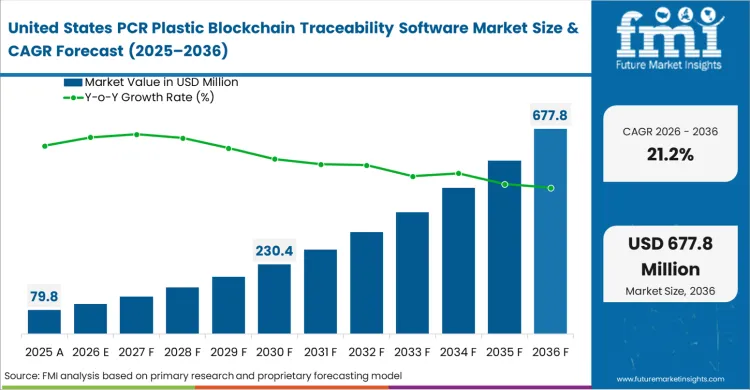
North America executes strict statutory phase-ins regarding minimum post-consumer content, driving aggressive enterprise software procurement. State-level mandates replace voluntary corporate goals with hard operational constraints, penalizing undocumented supply chains. Software platforms match verified supply with corporate demand efficiently.
- United States: Demand for PCR plastic blockchain traceability software in United States is anticipated to grow at 21.2% CAGR through 2036, anchored by fragmented state-level policies before procurement and budgeting cycles translate into higher deployment volumes. North American recyclers reported heavy processing capacity availability, requiring digital ledgers to connect corporate buyers with verified domestic resin sources safely [6].
FMI’s report includes deep analysis regarding Canada and Mexico. Traceability adoption across Canada climbs alongside federal plastic bans, prioritizing platforms securing verified resin imports. Cross-border material flows dictate technical specifications as brands consolidate North American reporting systems utilizing advanced recycled circular polyolefin packaging and durables architectures.
Europe PCR Plastic Blockchain Traceability Software Market Analysis
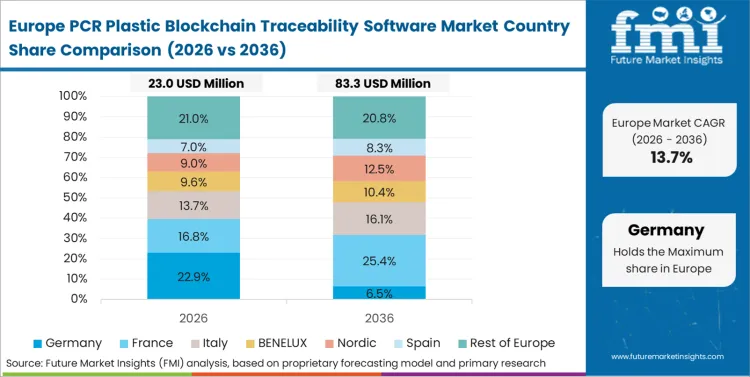
Europe defines global regulatory benchmarks, penalizing unverified plastic imports through strict eco-modulation fees. Enterprise focus shifts from pilot tracking programs to mandatory, region-wide digital integration. Ledger implementation scales rapidly to shield corporate margins against evolving non-compliance levies.
- Germany: Sales of PCR plastic blockchain traceability software in Germany are projected to rise at 20.5% CAGR from 2026 to 2036 as national packaging laws enforce precise material audits, creating a clearer pathway from policy or spending intent to purchase orders. Industrial manufacturers deploy audited supply chains to avoid severe state-levied fines, tracking millions of recovered units [7].
- United Kingdom: United Kingdom is expected to rise 19.9% CAGR in PCR plastic blockchain traceability software demand over 2026 to 2036 as plastic packaging taxes penalize unverified resins, tightening links between operational constraints and adoption-led investment. Brands launch molecular marking plus digital tracking across key networks to secure exemptions under newly introduced fiscal frameworks [8].
FMI’s report includes comprehensive assessments covering France, Italy, and Spain. Mediterranean regions implement digital ledgers tracking tourism-heavy waste streams, connecting coastal collection data directly to corporate buyers. Interoperability remains paramount for suppliers adopting PCR based circular supply chain platform models.
East Asia PCR Plastic Blockchain Traceability Software Market Analysis
East Asia dominates physical polymer production, compelling regional manufacturers to adopt verifiable tracking to maintain lucrative Western export channels. Factory software upgrades prioritize securing immutable compliance records satisfying distant regulatory bodies. Software vendors deploy bilingual smart contracts ensuring transparent data transfer between Asian processors and European brands.
- China: China is likely to witness PCR plastic blockchain traceability software revenues increase at 19.4% CAGR during 2026 to 2036, given export compliance pressures and resulting push for capacity and workflow upgrades. Packaging conglomerates enforce strict recycled content goals, demanding verified inputs from Asian suppliers [9].
FMI’s report includes detailed forecasting for Japan and South Korea. Japanese conglomerates pilot tokenized incentive programs rewarding precise sorting behavior, integrating civic action with industrial resin tracking. Export reliance speeds up software timelines across specialized tech corridors via digital traceability platforms for PCR materials.
South Asia PCR Plastic Blockchain Traceability Software Market Analysis
South Asia leverages high informal sector collection rates, requiring mobile-first software bridging informal waste pickers with formal industrial reclaimers. Digital platforms tokenize collected volumes, providing financial transparency and verifiable origin data. Platforms utilizing low-bandwidth interfaces capture critical first-mile data essential for downstream corporate compliance.
- India: Demand for PCR plastic blockchain traceability software in India is expected to grow at 18.8% CAGR through 2036, guided by formalization directives that increase value of reliability and compliance in buyer criteria. High national recycling rates offer large-scale raw data inputs requiring cryptographic organization [10].
FMI’s report includes localized insights concerning Bangladesh and Sri Lanka. Coastal conservation projects adopt ledger technology documenting ocean-bound plastic recovery, monetizing verified data for corporate ESG reports. Mobile connectivity pushes upstream adoption across developing waste networks utilizing recycled materials packaging standards.
Latin America PCR Plastic Blockchain Traceability Software Market Analysis
Latin America expands digital tracing capabilities alongside growing foreign direct investment in regional recycling infrastructure. Global brands fund platform deployments tracking local agricultural and consumer plastic waste recovery. Cross-border digital deployments bridge regional operational gaps, aligning local recycling outputs with international corporate sustainability ledgers. Formalization efforts demand unified reporting structures.
- Brazil: Sales of PCR plastic blockchain traceability software in Brazil are anticipated to grow 17.9% CAGR from 2026 to 2036 as federal solid waste policies mandate reverse logistics, strengthening demand from both public programs and private operators. Collaborative platforms integrate digital traceability, connecting local collection networks to international brands seeking certified materials [11].
FMI’s report includes market dynamics impacting Mexico, Chile, and Argentina. Andean nations leverage blockchain tools securing fair-trade certifications for waste collector cooperatives, blending social impact metrics with material traceability. Audit costs decline consequently via blockchain connected PCR procurement systems.
Competitive Aligners for Market Players
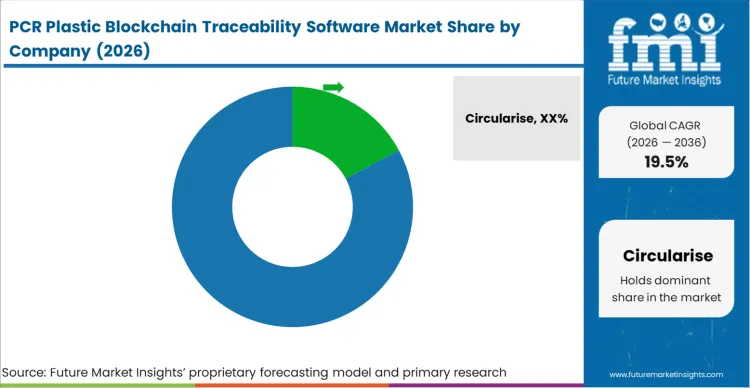
Software developers prioritize modular architectures allowing rapid integration with established enterprise resource planning platforms. Standalone tracking applications fail against unified suites embedding smart contracts directly into routine procurement workflows. Third-party validation secures compliance without disrupting existing buyer habits. Integration reduces friction, securing multi-year licensing agreements from large packaging conglomerates.
Pricing models shift from high upfront licensing fees toward volume-based tokenization charges, aligning software costs directly with physical material throughput. Suppliers operating fixed-cost structures face severe margin compression during industrial downturns. Industry coalitions emphasize post-consumer recycled content tracking within emerging frameworks, pushing vendors to adapt pricing to regulatory cycles.
Regulatory compliance intelligence dictates competitive survival; platforms failing updates regarding specific regional tax codes lose enterprise clients rapidly. Developers maintaining dedicated legal compliance teams update smart contracts automatically, securing multi-year client retention. According to FMI's estimates, global trade in plastic waste continued declining trends in 2023, forcing developers to localize compliance modules strictly.
Recent Developments
The report includes full coverage of key trends from competitive benchmarking. Some of the recent developments covered in the reports:
- In May 2025, APR expanded global PCR Certification Programs utilizing ISO-based chain-of-custody tracking. [13]
Key Players in PCR Plastic Blockchain Traceability Software Market
- Circularise
- Circulor
- Finboot
- Plastiks
- Oceanworks
- Satma CE
- Security Matters
Scope of the Report
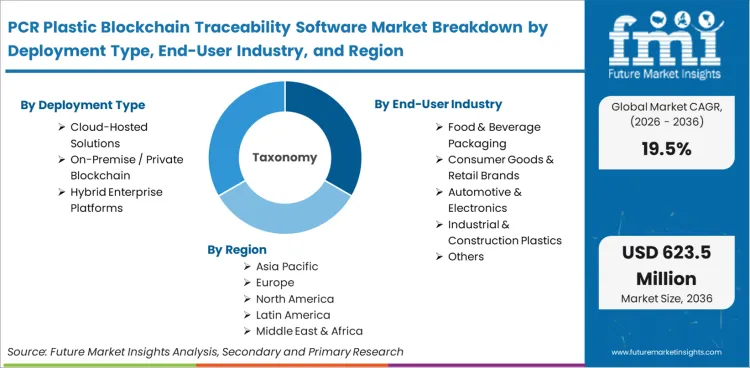
| Metric | Value |
|---|---|
| Quantitative Units | USD 105.0 Million (2026) to USD 625.0 Million (2036), at a CAGR of 19.5% |
| Market Definition | Enterprise software applications utilizing distributed ledger technology to track, verify, and document post-consumer recycled plastic flow across industrial supply chains. |
| Deployment Type Segmentation | Cloud-Hosted Solutions, On-Premise / Private Blockchain, Hybrid Enterprise Platforms |
| End-User Industry Segmentation | Food & Beverage Packaging, Consumer Goods & Retail Brands, Automotive & Electronics, Industrial & Construction Plastics, Others |
| Regions Covered | North America, Latin America, Europe, East Asia, South Asia, Oceania, Middle East and Africa |
| Countries Covered | United States, Canada, Mexico, Brazil, Argentina, Germany, France, United Kingdom, Italy, Spain, China, India, Japan, South Korea, Indonesia, Australia and 40 plus countries |
| Key Companies Profiled | Circularise, Circulor, Finboot, Plastiks, Oceanworks, Satma CE, Security Matters |
| Forecast Period | 2026 to 2036 |
| Approach | Hybrid top down and bottom up market modeling validated through primary interviews with software developers and packaging manufacturers, supported by regulatory benchmarking and vendor revenue verification |
PCR Plastic Blockchain Traceability Software Market Analysis by Segments
Deployment Type
- Cloud-Hosted Solutions
- On-Premise / Private Blockchain
- Hybrid Enterprise Platforms
End-User Industry
- Food & Beverage Packaging
- Consumer Goods & Retail Brands
- Automotive & Electronics
- Industrial & Construction Plastics
- Others
Region
- Asia Pacific
- India
- China
- Japan
- South Korea
- Indonesia
- Australia & New Zealand
- ASEAN
- Rest of Asia Pacific
- Europe
- Germany
- Italy
- France
- United Kingdom
- Spain
- Benelux
- Nordics
- Central & Eastern Europe
- Rest of Europe
- North America
- United States
- Canada
- Mexico
- Latin America
- Brazil
- Argentina
- Chile
- Rest of Latin America
- Middle East & Africa
- Kingdom of Saudi Arabia
- United Arab Emirates
- South Africa
- Turkey
- Rest of Middle East & Africa
Bibliography
- [1] Maine DEP. (2025). LD 1467 reporting requirements.
- [2] Pew Charitable Trusts. (2025). Breaking the Plastic Wave 2025.
- [3] Ellen MacArthur Foundation. (2025). Global Commitment 2025 Progress Report.
- [4] CalRecycle. (2025). 2025 CMC List Update.
- [5] Greenpeace USA. (2025). Merchants of Myth.
- [6] Association of Plastic Recyclers. (2025). 2025 Plastic Recycling Capacity in US and Canada.
- [7] DS Smith. (2025). Corporate Sustainability Report.
- [8] SMX. (2025). Singapore A*STAR and SMX lead drive for world first Plastics Passport program.
- [9] Amcor. (2025). FY25 Sustainability Report.
- [10] The Roundup. (2026). Plastic waste statistics.
- [11] GPAP. (2026). Certified Circular Plastic Market Trends.
- [12] Pew Charitable Trusts. (2025). Primary plastic production tracking.
- [13] Association of Plastic Recyclers. (2025). APR broadens reach of PCR certification program.
This bibliography is provided for reader reference and is not exhaustive. The full report contains the complete reference list and detailed citations.
This Report Addresses
- Market intelligence to enable structured strategic decision making across mature and emerging software economies
- Market size estimation and 10 year revenue forecasts from 2026 to 2036, supported by validated licensing and regulatory benchmarks
- Growth opportunity mapping across deployment models with emphasis on compliance transitions
- Segment and regional revenue forecasts covering critical end-user applications
- Competition strategy assessment including integration models, cost survivability positioning, and compliance capability benchmarking
- Product reformulation and emission compliance tracking including EPR, state mandates, and international treaty aligned grades
- Regulatory impact analysis covering packaging emission mandates, supply chain audit thresholds, and export driven specification upgrades
- Market report delivery in PDF, Excel, PPT, and interactive dashboard formats for executive and operational use
Frequently Asked Questions
How large is demand for PCR Plastic Blockchain Traceability Software in global markets in 2026?
Demand for PCR Plastic Blockchain Traceability Software in global markets is estimated to be valued at USD 105.0 Million in 2026.
What will be market size of PCR Plastic Blockchain Traceability Software in global markets by 2036?
Market size for PCR Plastic Blockchain Traceability Software is projected to reach USD 625.0 Million by 2036.
What is expected demand growth for PCR Plastic Blockchain Traceability Software in global markets between 2026 and 2036?
Demand for PCR Plastic Blockchain Traceability Software in global markets is expected to grow at a CAGR of 19.5% between 2026 and 2036.
Which Deployment Type is poised to lead global sales by 2026?
Cloud-Hosted Solutions are expected to be dominant form, capturing approximately 57% of global market share in 2026 due to rapid integration efficiency and lower upfront costs.
How significant is role of Food & Beverage Packaging in driving PCR Plastic Blockchain Traceability Software adoption in 2026?
Food & Beverage Packaging represents a critical segment, projected to hold a substantial 42% share of total market in 2026 as strict contact-safety regulations demand verifiable material histories.
What is driving demand in United States?
Fragmented state-level extended producer responsibility laws and corporate zero-waste mandates force immediate upgrades to verifiable digital custody chains.
What compliance standards or regulations are referenced for United States?
Maine DEP LD 1467 and California CalRecycle mandates govern minimum post-consumer recycled content targets.
What is United States growth outlook in this report?
United States is projected to grow at a CAGR of 21.2% during 2026 to 2036.
Why is Europe described as a priority region in this report?
Growth is accelerated by elevated compliance penalties and increasing penetration of region-wide Digital Product Passport integration requirements.
What type of demand dominates in Europe?
Regulatory-driven compliance demand for premium grade, highly secure enterprise tracking software dominates regional procurement.
What is Germany growth outlook in this report?
Germany is projected to expand at a CAGR of 20.5% during 2026 to 2036.
Does report cover United Kingdom in its regional analysis?
Yes, United Kingdom is included within Europe under regional scope of analysis.
What are sources referred to for analyzing United Kingdom?
Corporate sustainability reports outlining single-use plastic reduction and compliance documentation addressing national packaging taxes serve as primary evidence.
What is main demand theme linked to United Kingdom in its region coverage?
Procurement focuses on shielding corporate margins against strict non-compliance levies utilizing automated ledger reporting.
Does report cover China in its regional analysis?
Yes, China is included within East Asia under regional coverage framework.
What is main China related demand theme in its region coverage?
Export-driven digital upgrading ensuring domestic resins meet strict European and North American traceability standards dominates strategic focus.
Which product formats or configurations are strategically important for North America supply chains?
Cloud-hosted platforms integrating seamlessly with existing ERP systems are prioritized to manage fragmented state regulatory reporting efficiently.
What is PCR Plastic Blockchain Traceability Software and what is it mainly used for?
It constitutes enterprise software applications utilizing distributed ledger technology to verify, track, and document post-consumer recycled plastic flow securely across global industrial supply chains.
What does PCR Plastic Blockchain Traceability Software mean in this report?
Market refers to global licensing, deployment, and utilization of cryptographic tracing platforms serving plastic packaging and reclaiming industries.
What is included in scope of this PCR Plastic Blockchain Traceability Software report?
Scope covers software licenses, SaaS subscriptions, tokenization modules, and smart contract configuration services utilized for verifiable post-consumer material tracking.
What is excluded from scope of this report?
Physical sorting equipment, traditional non-cryptographic databases, and consumer-facing carbon offsetting applications remain strictly excluded from valuation metrics.
What does market forecast mean on this page?
Market forecast represents a model-based projection built on defined regulatory assumptions and vendor adoption rates for strategic corporate planning.
How does FMI build and validate PCR Plastic Blockchain Traceability Software forecast?
Forecast is developed using hybrid top-down and bottom-up modeling validated through software vendor revenue analysis, regulatory timelines, and industry peer review.
What does zero reliance on speculative third party market research mean here?
Primary executive interviews and verifiable public regulatory datasets dictate findings instead of unverified syndicated market estimates.
Preview the report firsthand - request a free sample
Get SampleGet the brochure for pricing and purchase details.
Get PDFTable of Content
- Executive Summary
- Global Market Outlook
- Demand-side Trends
- Supply-side Trends
- Technology Roadmap Analysis
- Analysis and Recommendations
- Market Overview
- Market Coverage / Taxonomy
- Market Definition / Scope / Limitations
- Research Methodology
- Chapter Orientation
- Analytical Lens and Working Hypotheses
- Market Structure, Signals, and Trend Drivers
- Benchmarking and Cross-market Comparability
- Market Sizing, Forecasting, and Opportunity Mapping
- Research Design and Evidence Framework
- Desk Research Programme (Secondary Evidence)
- Company Annual and Sustainability Reports
- Peer-reviewed Journals and Academic Literature
- Corporate Websites, Product Literature, and Technical Notes
- Earnings Decks and Investor Briefings
- Statutory Filings and Regulatory Disclosures
- Technical White Papers and Standards Notes
- Trade Journals, Industry Magazines, and Analyst Briefs
- Conference Proceedings, Webinars, and Seminar Materials
- Government Statistics Portals and Public Data Releases
- Press Releases and Reputable Media Coverage
- Specialist Newsletters and Curated Briefings
- Sector Databases and Reference Repositories
- FMI Internal Proprietary Databases and Historical Market Datasets
- Subscription Datasets and Paid Sources
- Social Channels, Communities, and Digital Listening Inputs
- Additional Desk Sources
- Expert Input and Fieldwork (Primary Evidence)
- Primary Modes
- Qualitative Interviews and Expert Elicitation
- Quantitative Surveys and Structured Data Capture
- Blended Approach
- Why Primary Evidence is Used
- Field Techniques
- Interviews
- Surveys
- Focus Groups
- Observational and In-context Research
- Social and Community Interactions
- Stakeholder Universe Engaged
- C-suite Leaders
- Board Members
- Presidents and Vice Presidents
- R&D and Innovation Heads
- Technical Specialists
- Domain Subject-matter Experts
- Scientists
- Physicians and Other Healthcare Professionals
- Governance, Ethics, and Data Stewardship
- Research Ethics
- Data Integrity and Handling
- Primary Modes
- Tooling, Models, and Reference Databases
- Desk Research Programme (Secondary Evidence)
- Data Engineering and Model Build
- Data Acquisition and Ingestion
- Cleaning, Normalisation, and Verification
- Synthesis, Triangulation, and Analysis
- Quality Assurance and Audit Trail
- Market Background
- Market Dynamics
- Drivers
- Restraints
- Opportunity
- Trends
- Scenario Forecast
- Demand in Optimistic Scenario
- Demand in Likely Scenario
- Demand in Conservative Scenario
- Opportunity Map Analysis
- Product Life Cycle Analysis
- Supply Chain Analysis
- Investment Feasibility Matrix
- Value Chain Analysis
- PESTLE and Porter’s Analysis
- Regulatory Landscape
- Regional Parent Market Outlook
- Production and Consumption Statistics
- Import and Export Statistics
- Market Dynamics
- Global Market Analysis 2021 to 2025 and Forecast, 2026 to 2036
- Historical Market Size Value (USD Million) Analysis, 2021 to 2025
- Current and Future Market Size Value (USD Million) Projections, 2026 to 2036
- Y-o-Y Growth Trend Analysis
- Absolute $ Opportunity Analysis
- Global Market Pricing Analysis 2021 to 2025 and Forecast 2026 to 2036
- Global Market Analysis 2021 to 2025 and Forecast 2026 to 2036, By Deployment Type
- Introduction / Key Findings
- Historical Market Size Value (USD Million) Analysis By Deployment Type , 2021 to 2025
- Current and Future Market Size Value (USD Million) Analysis and Forecast By Deployment Type , 2026 to 2036
- Cloud-Hosted Solutions
- On-Premise / Private Blockchain
- Hybrid Enterprise Platforms
- Cloud-Hosted Solutions
- Y-o-Y Growth Trend Analysis By Deployment Type , 2021 to 2025
- Absolute $ Opportunity Analysis By Deployment Type , 2026 to 2036
- Global Market Analysis 2021 to 2025 and Forecast 2026 to 2036, By End-User Industry
- Introduction / Key Findings
- Historical Market Size Value (USD Million) Analysis By End-User Industry, 2021 to 2025
- Current and Future Market Size Value (USD Million) Analysis and Forecast By End-User Industry, 2026 to 2036
- Food & Beverage Packaging
- Consumer Goods & Retail Brands
- Automotive & Electronics
- Industrial & Construction Plastics
- Others
- Food & Beverage Packaging
- Y-o-Y Growth Trend Analysis By End-User Industry, 2021 to 2025
- Absolute $ Opportunity Analysis By End-User Industry, 2026 to 2036
- Global Market Analysis 2021 to 2025 and Forecast 2026 to 2036, By Region
- Introduction
- Historical Market Size Value (USD Million) Analysis By Region, 2021 to 2025
- Current Market Size Value (USD Million) Analysis and Forecast By Region, 2026 to 2036
- North America
- Latin America
- Western Europe
- Eastern Europe
- East Asia
- South Asia and Pacific
- Middle East & Africa
- Market Attractiveness Analysis By Region
- North America Market Analysis 2021 to 2025 and Forecast 2026 to 2036, By Country
- Historical Market Size Value (USD Million) Trend Analysis By Market Taxonomy, 2021 to 2025
- Market Size Value (USD Million) Forecast By Market Taxonomy, 2026 to 2036
- By Country
- USA
- Canada
- Mexico
- By Deployment Type
- By End-User Industry
- By Country
- Market Attractiveness Analysis
- By Country
- By Deployment Type
- By End-User Industry
- Key Takeaways
- Latin America Market Analysis 2021 to 2025 and Forecast 2026 to 2036, By Country
- Historical Market Size Value (USD Million) Trend Analysis By Market Taxonomy, 2021 to 2025
- Market Size Value (USD Million) Forecast By Market Taxonomy, 2026 to 2036
- By Country
- Brazil
- Chile
- Rest of Latin America
- By Deployment Type
- By End-User Industry
- By Country
- Market Attractiveness Analysis
- By Country
- By Deployment Type
- By End-User Industry
- Key Takeaways
- Western Europe Market Analysis 2021 to 2025 and Forecast 2026 to 2036, By Country
- Historical Market Size Value (USD Million) Trend Analysis By Market Taxonomy, 2021 to 2025
- Market Size Value (USD Million) Forecast By Market Taxonomy, 2026 to 2036
- By Country
- Germany
- UK
- Italy
- Spain
- France
- Nordic
- BENELUX
- Rest of Western Europe
- By Deployment Type
- By End-User Industry
- By Country
- Market Attractiveness Analysis
- By Country
- By Deployment Type
- By End-User Industry
- Key Takeaways
- Eastern Europe Market Analysis 2021 to 2025 and Forecast 2026 to 2036, By Country
- Historical Market Size Value (USD Million) Trend Analysis By Market Taxonomy, 2021 to 2025
- Market Size Value (USD Million) Forecast By Market Taxonomy, 2026 to 2036
- By Country
- Russia
- Poland
- Hungary
- Balkan & Baltic
- Rest of Eastern Europe
- By Deployment Type
- By End-User Industry
- By Country
- Market Attractiveness Analysis
- By Country
- By Deployment Type
- By End-User Industry
- Key Takeaways
- East Asia Market Analysis 2021 to 2025 and Forecast 2026 to 2036, By Country
- Historical Market Size Value (USD Million) Trend Analysis By Market Taxonomy, 2021 to 2025
- Market Size Value (USD Million) Forecast By Market Taxonomy, 2026 to 2036
- By Country
- China
- Japan
- South Korea
- By Deployment Type
- By End-User Industry
- By Country
- Market Attractiveness Analysis
- By Country
- By Deployment Type
- By End-User Industry
- Key Takeaways
- South Asia and Pacific Market Analysis 2021 to 2025 and Forecast 2026 to 2036, By Country
- Historical Market Size Value (USD Million) Trend Analysis By Market Taxonomy, 2021 to 2025
- Market Size Value (USD Million) Forecast By Market Taxonomy, 2026 to 2036
- By Country
- India
- ASEAN
- Australia & New Zealand
- Rest of South Asia and Pacific
- By Deployment Type
- By End-User Industry
- By Country
- Market Attractiveness Analysis
- By Country
- By Deployment Type
- By End-User Industry
- Key Takeaways
- Middle East & Africa Market Analysis 2021 to 2025 and Forecast 2026 to 2036, By Country
- Historical Market Size Value (USD Million) Trend Analysis By Market Taxonomy, 2021 to 2025
- Market Size Value (USD Million) Forecast By Market Taxonomy, 2026 to 2036
- By Country
- Kingdom of Saudi Arabia
- Other GCC Countries
- Turkiye
- South Africa
- Other African Union
- Rest of Middle East & Africa
- By Deployment Type
- By End-User Industry
- By Country
- Market Attractiveness Analysis
- By Country
- By Deployment Type
- By End-User Industry
- Key Takeaways
- Key Countries Market Analysis
- USA
- Pricing Analysis
- Market Share Analysis, 2025
- By Deployment Type
- By End-User Industry
- Canada
- Pricing Analysis
- Market Share Analysis, 2025
- By Deployment Type
- By End-User Industry
- Mexico
- Pricing Analysis
- Market Share Analysis, 2025
- By Deployment Type
- By End-User Industry
- Brazil
- Pricing Analysis
- Market Share Analysis, 2025
- By Deployment Type
- By End-User Industry
- Chile
- Pricing Analysis
- Market Share Analysis, 2025
- By Deployment Type
- By End-User Industry
- Germany
- Pricing Analysis
- Market Share Analysis, 2025
- By Deployment Type
- By End-User Industry
- UK
- Pricing Analysis
- Market Share Analysis, 2025
- By Deployment Type
- By End-User Industry
- Italy
- Pricing Analysis
- Market Share Analysis, 2025
- By Deployment Type
- By End-User Industry
- Spain
- Pricing Analysis
- Market Share Analysis, 2025
- By Deployment Type
- By End-User Industry
- France
- Pricing Analysis
- Market Share Analysis, 2025
- By Deployment Type
- By End-User Industry
- India
- Pricing Analysis
- Market Share Analysis, 2025
- By Deployment Type
- By End-User Industry
- ASEAN
- Pricing Analysis
- Market Share Analysis, 2025
- By Deployment Type
- By End-User Industry
- Australia & New Zealand
- Pricing Analysis
- Market Share Analysis, 2025
- By Deployment Type
- By End-User Industry
- China
- Pricing Analysis
- Market Share Analysis, 2025
- By Deployment Type
- By End-User Industry
- Japan
- Pricing Analysis
- Market Share Analysis, 2025
- By Deployment Type
- By End-User Industry
- South Korea
- Pricing Analysis
- Market Share Analysis, 2025
- By Deployment Type
- By End-User Industry
- Russia
- Pricing Analysis
- Market Share Analysis, 2025
- By Deployment Type
- By End-User Industry
- Poland
- Pricing Analysis
- Market Share Analysis, 2025
- By Deployment Type
- By End-User Industry
- Hungary
- Pricing Analysis
- Market Share Analysis, 2025
- By Deployment Type
- By End-User Industry
- Kingdom of Saudi Arabia
- Pricing Analysis
- Market Share Analysis, 2025
- By Deployment Type
- By End-User Industry
- Turkiye
- Pricing Analysis
- Market Share Analysis, 2025
- By Deployment Type
- By End-User Industry
- South Africa
- Pricing Analysis
- Market Share Analysis, 2025
- By Deployment Type
- By End-User Industry
- USA
- Market Structure Analysis
- Competition Dashboard
- Competition Benchmarking
- Market Share Analysis of Top Players
- By Regional
- By Deployment Type
- By End-User Industry
- Competition Analysis
- Competition Deep Dive
- Circularise
- Overview
- Product Portfolio
- Profitability by Market Segments (Product/Age /Sales Channel/Region)
- Sales Footprint
- Strategy Overview
- Marketing Strategy
- Product Strategy
- Channel Strategy
- Circulor
- Finboot
- Plastiks
- Oceanworks
- Satma CE
- Security Matters
- Circularise
- Competition Deep Dive
- Assumptions & Acronyms Used


