

- Industry Size (2026)
- USD 720 Mn
- Forecast (2036)
- USD 2532 Mn
- CAGR (2026 to 2036)
- 13.4%
Multi-Layer PCR Film Deinking Systems Market Forecast and Outlook 2026 to 2036
The multi-layer PCR film deinking systems market is projected to grow from USD 720 million in 2026 to USD 2,532 million by 2036, expanding at a CAGR of 13.4%. Value creation in this market is shaped far more by cost structure control and performance outcomes than by sheer installation volumes. Capital intensity is high, with system pricing driven by engineering depth, chemical efficiency, automation, and integration with downstream washing and extrusion lines. Margin concentration favors technology providers that deliver consistently high ink-removal efficiency while minimizing water, energy, and chemical consumption, as these factors directly affect recyclers’ operating costs.
Pricing power rests with suppliers able to demonstrate measurable improvements in PCR quality, yield uplift, and compliance readiness rather than lowest upfront equipment cost. Between 2026 and 2036, value accrues to system designers offering modular scalability, proprietary process know-how, and long-term service contracts. As recycled-content mandates tighten, recyclers prioritize reliability and lifecycle economics, allowing performance-led suppliers to capture disproportionate share of profit pools across the circular plastics value chain.
Quick Stats for Multi-Layer PCR Film Deinking Systems Market
- Multi-Layer PCR Film Deinking Systems Market Value (2026): USD 720 Million
- Multi-Layer PCR Film Deinking Systems Market Forecast Value (2036): USD 2,532 Million
- Multi-Layer PCR Film Deinking Systems Market Forecast CAGR 2026 to 2036: 13.4%
- Leading System Type in Multi-Layer PCR Film Deinking Systems Market: Wet & Chemical Deinking Lines (43% share)
- Key Growth Regions in Multi-Layer PCR Film Deinking Systems Market: Asia Pacific, Europe, North America, Latin America, Middle East & Africa
- Top Key Players in Multi-Layer PCR Film Deinking Systems Market: CADEL DEINKING S.r.l., SOREMA S.r.l., HERBOLD Meckesheim GmbH, B+B Anlagenbau GmbH, EBARA CORPORATION, Mitsubishi Heavy Industries, Ltd.
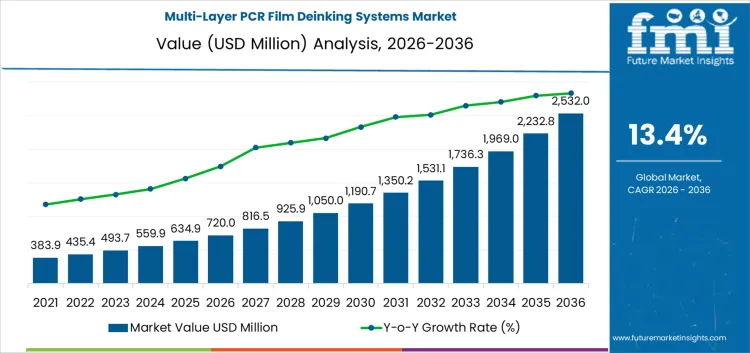
Multi-Layer PCR Film Deinking Systems Market Key Takeaways
| Metric | Value |
|---|---|
| Multi-Layer PCR Film Deinking Systems Market Value (2026) | USD 720 Million |
| Multi-Layer PCR Film Deinking Systems Market Forecast Value (2036) | USD 2,532 Million |
| Multi-Layer PCR Film Deinking Systems Market Forecast CAGR 2026 to 2036 | 13.4% |
How Are Circular Packaging Mandates and Material Recovery Challenges Driving the Multi-Layer PCR Film Deinking Systems Market?
The multi-layer PCR film deinking systems market is gaining momentum as packaging producers and recyclers confront the growing complexity of post-consumer plastic waste streams. Multi-layer films used in food, personal care, and consumer goods packaging often contain inks, adhesives, and barrier layers that limit recyclability. Deinking systems are becoming essential for enabling high-quality recycled content by removing surface contaminants and improving polymer purity. For equipment manufacturers, demand is increasingly tied to packaging compliance targets rather than discretionary recycling investments.
Regulatory pressure and brand sustainability commitments are accelerating adoption. Governments and brand owners are setting minimum recycled content requirements for flexible packaging, pushing converters to secure reliable sources of clean PCR material. Deinking systems enable recyclers to upgrade lower-grade film waste into usable feedstock suitable for higher-value applications. Suppliers that can deliver scalable, modular deinking solutions with proven contaminant removal performance are gaining strategic relevance across recycling and packaging value chains.
Technology differentiation and integration capability are also shaping purchasing decisions. Recyclers are seeking systems that integrate efficiently with washing, separation, and extrusion lines while minimizing water, energy, and chemical consumption. Equipment providers offering process optimization, application engineering support, and customization for different film structures are better positioned to win long-term contracts. As circular economy requirements tighten globally, the ability to convert complex multi-layer films into compliant PCR materials is becoming a critical growth lever, supporting rapid expansion of the multi-layer PCR film deinking systems market over the forecast period.
How Is The Multi-Layer PCR Film Deinking Systems Market Organized By End Use And System Type?
The multi-layer PCR film deinking systems market is segmented by end use and system type, reflecting how recycling objectives and contamination profiles shape technology adoption. By end use, flexible packaging recycling leads with 45% share, driven by regulatory pressure and brand commitments to post-consumer recycled content in films. Other end uses include food and non-food films, high-purity film recovery, large-scale film recycling, and emerging film recycling streams that require tailored deinking performance. By system type, wet and chemical deinking lines account for 43% share, while modular deinking units, precision separation systems, and integrated wash lines support scalability and application-specific recovery goals.
Why Does Flexible Packaging Recycling Lead The Multi-Layer PCR Film Deinking Systems Market By End Use?
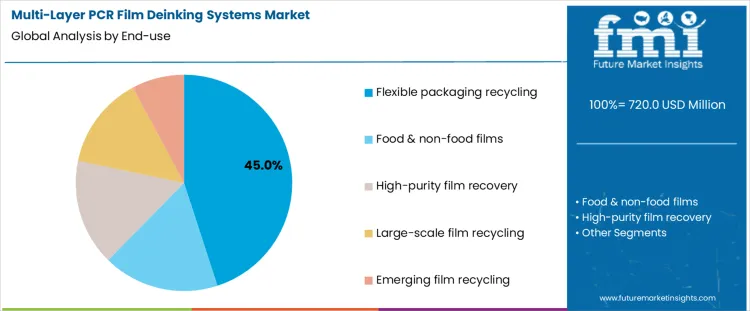
Flexible packaging recycling holds 45% share in the multi-layer PCR film deinking systems market because multi-layer laminates dominate consumer packaging waste streams. These films contain inks, adhesives, and barrier layers that require advanced deinking to achieve usable PCR output. Recyclers invest in dedicated deinking systems to meet brand-owner specifications for color, odor, and contaminant thresholds. Regulatory mandates on recycled content accelerate adoption across packaging recovery facilities. High throughput requirements favor robust systems that deliver consistent flake quality. For system suppliers, flexible packaging projects offer repeat installations and long-term service opportunities. These operational and compliance drivers explain leadership of flexible packaging recycling.
Why Do Wet And Chemical Deinking Lines Dominate The Multi-Layer PCR Film Deinking Systems Market By System Type?
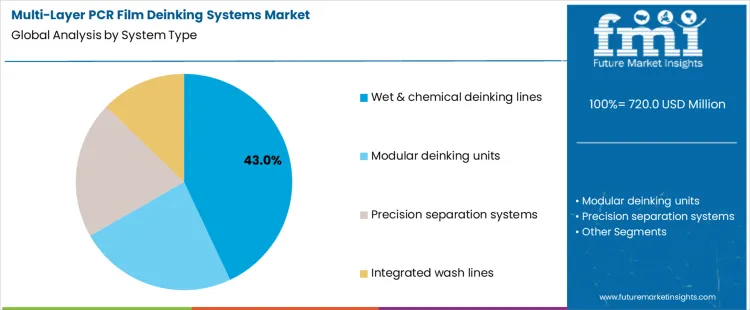
Wet and chemical deinking lines command 43% share of the multi-layer PCR film deinking systems market because they effectively remove inks, coatings, and adhesive residues from complex film structures. Chemical agents break ink-polymer bonds, while controlled washing stages ensure separation without excessive polymer degradation. These lines handle variable feedstock quality and achieve higher purity suitable for food-contact-adjacent applications after downstream processing. Operators prefer proven wet-chemical approaches for predictable outcomes at scale. Suppliers benefit from standardized line architectures adaptable to different capacities. This balance of efficacy, scalability, and reliability explains dominance of wet and chemical deinking lines.
What Are The Key Dynamics Of The Multi-Layer PCR Film Deinking Systems Market?
The multi-layer PCR (post-consumer recycled) film deinking systems market is driven by increasing regulatory pressure and corporate sustainability commitments to reduce plastic waste and boost recycling rates. Deinking systems separate inks, pigments, and contaminants from multi-layer films such as those used in packaging and enable production of high-quality recycled PCR resins. Demand is rising from packaging manufacturers, recyclers, and brand owners looking to meet recycled content mandates and avoid landfill disposal. For system suppliers and OEMs, performance efficiency (ink removal rate, throughput), energy consumption, and reliability in handling diverse film compositions are key competitive factors shaping procurement and long-term contracts.
How Are Technological Innovations And Process Trends Reshaping The Market?
Technological innovations and process trends are reshaping the multi-layer PCR film deinking systems market toward enhanced separation efficiency, automation, and scalability. Advanced mechanical and chemical deinking technologies such as friction washers, flotation cells, and eco-friendly surfactants are improving ink removal without degrading polymer quality. Integration of sensors, real-time quality monitoring, and automated process controls helps optimize wash cycles, reduce water usage, and improve output consistency. Modular system architectures allow recyclers to scale capacity incrementally as feedstock volumes grow. For suppliers, offering full process solutions including pre-treatment, deinking modules, and post-processing filtration strengthens value and reduces customer integration complexity.
Why Do Feedstock Variability And Operational Constraints Restrain Market Growth?
Feedstock variability and operational constraints restrain growth in the multi-layer PCR film deinking systems market. PCR film streams vary widely in polymer types (PE, PP), thickness, additive content, and printing inks creating challenges for uniform deinking performance. Hard-to-remove inks, multilayer lamination adhesives, and contamination (food residues, labels) increase processing complexity. Systems must balance thorough ink removal with minimal polymer degradation, requiring precise control and often extensive operator expertise. High water and energy consumption, need for wastewater treatment, and compliance with environmental discharge regulations add operational cost pressures. These constraints can increase total cost of ownership for recyclers evaluating deinking system investments.
What Is the Country-Wise Outlook for the Multi-Layer PCR Film Deinking Systems Market?
The multi-layer PCR film deinking systems market is shaped by rising regulatory pressure on plastic recycling, brand-owner commitments to post-consumer recycled (PCR) content, and technological progress in flexible packaging recovery. Growth differs by country depending on recycling infrastructure maturity, enforcement of circular economy mandates, and investment in advanced separation technologies. Emerging markets are driven by capacity creation and policy-led recycling targets, while developed economies focus on yield improvement, contamination reduction, and food-grade PCR quality. Suppliers offering modular, high-efficiency deinking systems with chemical and mechanical integration are best positioned to capture country-level opportunities across flexible packaging recycling value chains.
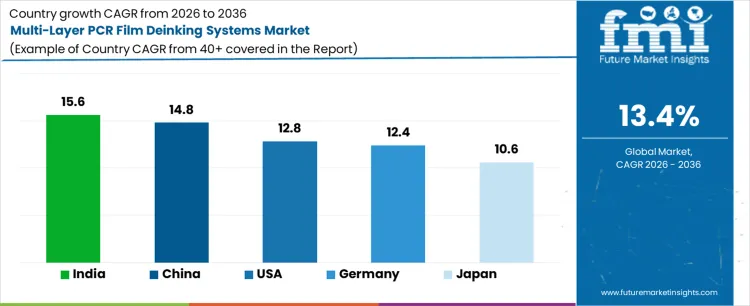
| Country | CAGR (%) |
|---|---|
| India | 15.6% |
| China | 14.8% |
| United States | 12.8% |
| Germany | 12.4% |
| Japan | 10.6% |
How is Germany Strengthening High-Purity Recycling through Multi-Layer PCR Film Deinking Systems?
The multi-layer PCR film deinking systems market in Germany, growing at a CAGR of 12.4% during 2026-2036, is shaped by strict circular-economy regulations and high quality expectations for recycled plastics. German recyclers focus on removing inks, adhesives, and contaminants from complex flexible packaging while preserving polymer integrity. Demand is largely upgrade-driven, as operators modernize existing washing lines with advanced wet and chemical deinking modules. Buyers emphasize ink removal efficiency, food-contact compliance, process stability, and traceable system performance. Procurement processes are specification-intensive, often requiring pilot validation and documented yield improvement. Volumes are moderate, but system value per installation remains high due to engineering depth and customization requirements. Germany favors suppliers capable of integrating deinking systems into closed-loop recycling operations serving food, personal care, and household packaging brands. Long-term service support, automation, and data-driven process control influence purchasing decisions.
What is Driving Accelerated Adoption of PCR Film Deinking Systems in the United States?
Demand for multi-layer PCR film deinking systems in the United States, expanding at a CAGR of 12.8% during 2026-2036, is driven by brand commitments to post-consumer recycled content and expansion of domestic flexible packaging recycling capacity. Recycling operators invest in deinking systems to recover printed films and meet PCR supply requirements for consumer goods companies. Buyers prioritize scalability, integration with existing wash and extrusion lines, and flexibility across film structures. Procurement decisions focus on throughput, uptime, and technical support rather than standalone equipment pricing. Private equity and corporate sustainability funding support installation of large regional recycling hubs. Demand is both Greenfield and upgrade-led, as facilities seek higher yields and cleaner output. The US market favors suppliers offering modular system architectures, process optimization expertise, and strong aftersales support. This is a growth-oriented but performance-driven environment where reliability, operator training, and lifecycle cost efficiency determine long-term supplier positioning.
How is Japan Applying Precision Recycling Principles to PCR Film Deinking Investments?
Sale of multi-layer PCR film deinking systems in Japan, growing at a CAGR of 10.6% during the forecast period, reflects a strong emphasis on precision recycling and material consistency. Japanese recyclers prioritize controlled processing conditions that remove inks and residues without degrading polymer properties. Demand is driven by packaging producers seeking stable PCR quality for high-performance applications. Buyers emphasize compact system design, energy efficiency, low water consumption, and process repeatability. Procurement decisions favor suppliers with proven engineering credibility, long equipment lifecycles, and strong local service capability. Growth is incremental rather than capacity-led, with focus on continuous improvement of recycling efficiency. Volumes are limited, but system specifications are rigorous. Japan rewards technology providers offering precise separation performance, automation, and long-term operational reliability rather than rapid throughput expansion.
Why is China Emerging as a Major Growth Engine for PCR Film Deinking Systems?
The multi-layer PCR film deinking systems market in China, expanding at a CAGR of 14.8% during 2026-2036, is driven by rapid expansion of flexible packaging recycling capacity and policy mandates on plastic waste reduction. Large volumes of printed multi-layer films create strong need for high-throughput deinking solutions. Buyers prioritize system scalability, cost efficiency, and ability to handle mixed film waste streams. Domestic suppliers compete aggressively in standard configurations, while international technology providers target premium installations requiring higher purity output. Procurement decisions are influenced by capital cost, local service availability, and installation timelines. Demand is largely Greenfield, supported by new recycling parks and industrial clusters. China represents a volume-led market where success depends on throughput capability, localized manufacturing or partnerships, and competitive pricing aligned with fast-growing recycling capacity.
How is India Becoming the Fastest-Growing Market for PCR Film Deinking Systems?
Demand for multi-layer PCR film deinking systems in India, growing at a CAGR of 15.6% during 2026-2036, reflects rapid development of flexible plastic recycling infrastructure. Extended Producer Responsibility regulations and brand-led PCR targets are accelerating investment in deinking technologies. Buyers emphasize affordability, modular scalability, and compatibility with heterogeneous post-consumer film waste. Demand is concentrated among emerging recyclers and packaging companies establishing in-house PCR capabilities. Procurement decisions are cost-sensitive, yet performance expectations are rising as food and FMCG brands seek consistent recycled material quality. Local partnerships, operator training, and phased system deployment influence supplier selection. India represents a high-growth, early-stage market where technology providers that offer adaptable systems, local support, and application guidance can secure long-term positioning as recycling capacity scales nationwide.
What Defines Competition in the Multi-Layer PCR Film Deinking Systems Market?
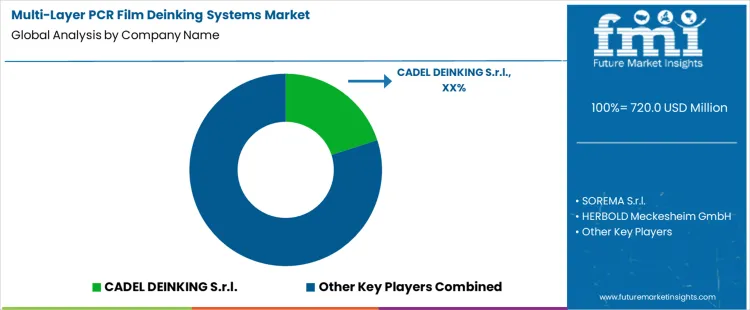
Competition in the multi-layer PCR film deinking systems market is anchored in process efficiency, separation quality, and throughput performance documented in official product literature and technical brochures. CADEL DEINKING S.r.l. positions its deinking lines with documentation that highlights high-clarity output and optimized washing stages tailored for multi-layer post-consumer films. Brochures emphasize staged friction and floatation sections designed to maximize contaminant removal while preserving polymer integrity. SOREMA S.r.l. competes through modular deinking solutions with official materials underscoring adjustable process trains and low water usage. Product guides detail control logic that supports stable deinking yield across variable film blends.
Engineering and equipment robustness define another competitive axis. HERBOLD Meckesheim GmbH differentiates via heavy-duty deinking lines documented for superior mechanical washing and high throughput. Technical literature highlights precision shredding paired with multi-stage floatation to enhance ink detachment and dispersion. B+B Anlagenbau GmbH positions its systems with brochures that focus on automated process controls and scalable system modules suitable for high-capacity PCR film streams.
Global OEMs bring broad equipment portfolios to the market. EBARA CORPORATION and Mitsubishi Heavy Industries, Ltd. compete by integrating deinking units with upstream washing and downstream extrusion in turnkey recycling plants, with official materials emphasizing energy-efficient drives and robust material handling. ACERETECH Machinery Co., Ltd. and Polystar Machinery Co., Ltd. differentiate through cost-optimized deinking systems with documented performance claims on separated polymer purity and stable cycle times. Across suppliers, documented separation quality, system flexibility, and production efficiency drive competitive advantage rather than price alone.
Key Players in Multi-Layer PCR Film Deinking Systems Market
- CADEL DEINKING S.r.l.
- SOREMA S.r.l.
- HERBOLD Meckesheim GmbH
- B+B Anlagenbau GmbH
- EBARA CORPORATION
- Mitsubishi Heavy Industries, Ltd.
- ACERETECH Machinery Co., Ltd.
- Polystar Machinery Co., Ltd.
Scope of Report
| Attribute | Description |
|---|---|
| Quantitative Unit | USD Million |
| End-use | Flexible Packaging Recycling, Food & Non-Food Films, High-Purity Film Recovery, Large-Scale Film Recycling, Emerging Film Recycling |
| System Type | Wet & Chemical Deinking Lines, Modular Deinking Units, Precision Separation Systems, Integrated Wash Lines |
| Countries Covered | China, Japan, South Korea, India, Australia & New Zealand, ASEAN, Rest of Asia Pacific, Germany, United Kingdom, France, Italy, Spain, Nordic, BENELUX, Rest of Europe, United States, Canada, Mexico, Brazil, Chile, Rest of Latin America, Kingdom of Saudi Arabia, Other GCC Countries, Turkey, South Africa, Other African Union, Rest of Middle East & Africa |
| Regions Covered | Asia Pacific, Europe, North America, Latin America, Middle East & Africa |
| Key Companies Profiled | CADEL DEINKING S.r.l., SOREMA S.r.l., HERBOLD Meckesheim GmbH, B+B Anlagenbau GmbH, EBARA CORPORATION, Mitsubishi Heavy Industries, Ltd., ACERETECH Machinery Co., Ltd., Polystar Machinery Co., Ltd. |
| Additional Attributes | Dollar sales by end-use and system type are assessed across post-consumer flexible packaging recycling operations. The report includes country-level demand assessment, growth projections for 2026-2036, evaluation of ink removal efficiency and polymer purity outcomes, assessment of modular versus integrated line adoption, competitive benchmarking of system suppliers, and analysis of investment trends supporting circular plastics and PCR film quality compliance. |
Multi-Layer PCR Film Deinking Systems Market by Key Segments
End-use
- Flexible packaging recycling
- Food & non-food films
- High-purity film recovery
- Large-scale film recycling
- Emerging film recycling
System Type
- Wet & chemical deinking lines
- Modular deinking units
- Precision separation systems
- Integrated wash lines
Region
- Asia Pacific
- China
- Japan
- South Korea
- India
- Australia & New Zealand
- ASEAN
- Rest of Asia Pacific
- Europe
- Germany
- United Kingdom
- France
- Italy
- Spain
- Nordic
- BENELUX
- Rest of Europe
- North America
- United States
- Canada
- Mexico
- Latin America
- Brazil
- Chile
- Rest of Latin America
- Middle East & Africa
- Kingdom of Saudi Arabia
- Other GCC Countries
- Turkey
- South Africa
- Other African Union
- Rest of Middle East & Africa
Bibliography
- European Union. (2025). Regulation (EU) 2025/40 of the European Parliament and of the Council of 19 December 2024 on packaging and packaging waste. EUR-Lex / Publications Office of the European Union.
- Ministry of Environment, Forest and Climate Change (MoEFCC), Government of India. (2024). Plastic Waste Management (Amendment) Rules, 2024 (G.S.R. 201 (E)). Government of India Press.
- Organisation for Economic Co-operation and Development. (2024). Circular economy policy approaches for flexible plastic packaging recycling. OECD Publishing.
Frequently Asked Questions
How big is the multi-layer PCR film deinking systems market in 2026?
The global multi-layer PCR film deinking systems market is estimated to be valued at USD 720.0 million in 2026.
What will be the size of multi-layer PCR film deinking systems market in 2036?
The market size for the multi-layer PCR film deinking systems market is projected to reach USD 2,532.0 million by 2036.
How much will be the multi-layer PCR film deinking systems market growth between 2026 and 2036?
The multi-layer PCR film deinking systems market is expected to grow at a 13.4% CAGR between 2026 and 2036.
What are the key end-use segments in the multi-layer PCR film deinking systems market?
The key end-use segments include flexible packaging recycling, food & non-food films, high-purity film recovery, large-scale film recycling, and emerging film recycling.
Which system type segment to contribute significant share in the multi-layer PCR film deinking systems market in 2026?
In terms of system type, wet & chemical deinking lines segment to command 43.0% share in the multi-layer PCR film deinking systems market in 2026.
Preview the report firsthand - request a free sample
Get SampleGet the brochure for pricing and purchase details.
Get PDFTable of Content
- Executive Summary
- Global Market Outlook
- Demand-side Trends
- Supply-side Trends
- Technology Roadmap Analysis
- Analysis and Recommendations
- Market Overview
- Market Coverage / Taxonomy
- Market Definition / Scope / Limitations
- Market Background
- Market Dynamics
- Drivers
- Restraints
- Opportunity
- Trends
- Scenario Forecast
- Demand in Optimistic Scenario
- Demand in Likely Scenario
- Demand in Conservative Scenario
- Opportunity Map Analysis
- Product Life Cycle Analysis
- Supply Chain Analysis
- Investment Feasibility Matrix
- Value Chain Analysis
- PESTLE and Porter’s Analysis
- Regulatory Landscape
- Regional Parent Market Outlook
- Production and Consumption Statistics
- Import and Export Statistics
- Market Dynamics
- Global Market Analysis 2021 to 2025 and Forecast, 2026 to 2036
- Historical Market Size Value (USD Million) Analysis, 2021 to 2025
- Current and Future Market Size Value (USD Million) Projections, 2026 to 2036
- Y-o-Y Growth Trend Analysis
- Absolute $ Opportunity Analysis
- Global Market Pricing Analysis 2021 to 2025 and Forecast 2026 to 2036
- Global Market Analysis 2021 to 2025 and Forecast 2026 to 2036, By End-use
- Introduction / Key Findings
- Historical Market Size Value (USD Million) Analysis By End-use , 2021 to 2025
- Current and Future Market Size Value (USD Million) Analysis and Forecast By End-use , 2026 to 2036
- Flexible packaging recycling
- Food & non-food films
- High-purity film recovery
- Large-scale film recycling
- Emerging film recycling
- Flexible packaging recycling
- Y-o-Y Growth Trend Analysis By End-use , 2021 to 2025
- Absolute $ Opportunity Analysis By End-use , 2026 to 2036
- Global Market Analysis 2021 to 2025 and Forecast 2026 to 2036, By System Type
- Introduction / Key Findings
- Historical Market Size Value (USD Million) Analysis By System Type, 2021 to 2025
- Current and Future Market Size Value (USD Million) Analysis and Forecast By System Type, 2026 to 2036
- Wet & chemical deinking lines
- Modular deinking units
- Precision separation systems
- Integrated wash lines
- Wet & chemical deinking lines
- Y-o-Y Growth Trend Analysis By System Type, 2021 to 2025
- Absolute $ Opportunity Analysis By System Type, 2026 to 2036
- Global Market Analysis 2021 to 2025 and Forecast 2026 to 2036, By Region
- Introduction
- Historical Market Size Value (USD Million) Analysis By Region, 2021 to 2025
- Current Market Size Value (USD Million) Analysis and Forecast By Region, 2026 to 2036
- North America
- Latin America
- Western Europe
- Eastern Europe
- East Asia
- South Asia and Pacific
- Middle East & Africa
- Market Attractiveness Analysis By Region
- North America Market Analysis 2021 to 2025 and Forecast 2026 to 2036, By Country
- Historical Market Size Value (USD Million) Trend Analysis By Market Taxonomy, 2021 to 2025
- Market Size Value (USD Million) Forecast By Market Taxonomy, 2026 to 2036
- By Country
- USA
- Canada
- Mexico
- By End-use
- By System Type
- By Country
- Market Attractiveness Analysis
- By Country
- By End-use
- By System Type
- Key Takeaways
- Latin America Market Analysis 2021 to 2025 and Forecast 2026 to 2036, By Country
- Historical Market Size Value (USD Million) Trend Analysis By Market Taxonomy, 2021 to 2025
- Market Size Value (USD Million) Forecast By Market Taxonomy, 2026 to 2036
- By Country
- Brazil
- Chile
- Rest of Latin America
- By End-use
- By System Type
- By Country
- Market Attractiveness Analysis
- By Country
- By End-use
- By System Type
- Key Takeaways
- Western Europe Market Analysis 2021 to 2025 and Forecast 2026 to 2036, By Country
- Historical Market Size Value (USD Million) Trend Analysis By Market Taxonomy, 2021 to 2025
- Market Size Value (USD Million) Forecast By Market Taxonomy, 2026 to 2036
- By Country
- Germany
- UK
- Italy
- Spain
- France
- Nordic
- BENELUX
- Rest of Western Europe
- By End-use
- By System Type
- By Country
- Market Attractiveness Analysis
- By Country
- By End-use
- By System Type
- Key Takeaways
- Eastern Europe Market Analysis 2021 to 2025 and Forecast 2026 to 2036, By Country
- Historical Market Size Value (USD Million) Trend Analysis By Market Taxonomy, 2021 to 2025
- Market Size Value (USD Million) Forecast By Market Taxonomy, 2026 to 2036
- By Country
- Russia
- Poland
- Hungary
- Balkan & Baltic
- Rest of Eastern Europe
- By End-use
- By System Type
- By Country
- Market Attractiveness Analysis
- By Country
- By End-use
- By System Type
- Key Takeaways
- East Asia Market Analysis 2021 to 2025 and Forecast 2026 to 2036, By Country
- Historical Market Size Value (USD Million) Trend Analysis By Market Taxonomy, 2021 to 2025
- Market Size Value (USD Million) Forecast By Market Taxonomy, 2026 to 2036
- By Country
- China
- Japan
- South Korea
- By End-use
- By System Type
- By Country
- Market Attractiveness Analysis
- By Country
- By End-use
- By System Type
- Key Takeaways
- South Asia and Pacific Market Analysis 2021 to 2025 and Forecast 2026 to 2036, By Country
- Historical Market Size Value (USD Million) Trend Analysis By Market Taxonomy, 2021 to 2025
- Market Size Value (USD Million) Forecast By Market Taxonomy, 2026 to 2036
- By Country
- India
- ASEAN
- Australia & New Zealand
- Rest of South Asia and Pacific
- By End-use
- By System Type
- By Country
- Market Attractiveness Analysis
- By Country
- By End-use
- By System Type
- Key Takeaways
- Middle East & Africa Market Analysis 2021 to 2025 and Forecast 2026 to 2036, By Country
- Historical Market Size Value (USD Million) Trend Analysis By Market Taxonomy, 2021 to 2025
- Market Size Value (USD Million) Forecast By Market Taxonomy, 2026 to 2036
- By Country
- Kingdom of Saudi Arabia
- Other GCC Countries
- Turkiye
- South Africa
- Other African Union
- Rest of Middle East & Africa
- By End-use
- By System Type
- By Country
- Market Attractiveness Analysis
- By Country
- By End-use
- By System Type
- Key Takeaways
- Key Countries Market Analysis
- USA
- Pricing Analysis
- Market Share Analysis, 2025
- By End-use
- By System Type
- Canada
- Pricing Analysis
- Market Share Analysis, 2025
- By End-use
- By System Type
- Mexico
- Pricing Analysis
- Market Share Analysis, 2025
- By End-use
- By System Type
- Brazil
- Pricing Analysis
- Market Share Analysis, 2025
- By End-use
- By System Type
- Chile
- Pricing Analysis
- Market Share Analysis, 2025
- By End-use
- By System Type
- Germany
- Pricing Analysis
- Market Share Analysis, 2025
- By End-use
- By System Type
- UK
- Pricing Analysis
- Market Share Analysis, 2025
- By End-use
- By System Type
- Italy
- Pricing Analysis
- Market Share Analysis, 2025
- By End-use
- By System Type
- Spain
- Pricing Analysis
- Market Share Analysis, 2025
- By End-use
- By System Type
- France
- Pricing Analysis
- Market Share Analysis, 2025
- By End-use
- By System Type
- India
- Pricing Analysis
- Market Share Analysis, 2025
- By End-use
- By System Type
- ASEAN
- Pricing Analysis
- Market Share Analysis, 2025
- By End-use
- By System Type
- Australia & New Zealand
- Pricing Analysis
- Market Share Analysis, 2025
- By End-use
- By System Type
- China
- Pricing Analysis
- Market Share Analysis, 2025
- By End-use
- By System Type
- Japan
- Pricing Analysis
- Market Share Analysis, 2025
- By End-use
- By System Type
- South Korea
- Pricing Analysis
- Market Share Analysis, 2025
- By End-use
- By System Type
- Russia
- Pricing Analysis
- Market Share Analysis, 2025
- By End-use
- By System Type
- Poland
- Pricing Analysis
- Market Share Analysis, 2025
- By End-use
- By System Type
- Hungary
- Pricing Analysis
- Market Share Analysis, 2025
- By End-use
- By System Type
- Kingdom of Saudi Arabia
- Pricing Analysis
- Market Share Analysis, 2025
- By End-use
- By System Type
- Turkiye
- Pricing Analysis
- Market Share Analysis, 2025
- By End-use
- By System Type
- South Africa
- Pricing Analysis
- Market Share Analysis, 2025
- By End-use
- By System Type
- USA
- Market Structure Analysis
- Competition Dashboard
- Competition Benchmarking
- Market Share Analysis of Top Players
- By Regional
- By End-use
- By System Type
- Competition Analysis
- Competition Deep Dive
- CADEL DEINKING S.r.l.
- Overview
- Product Portfolio
- Profitability by Market Segments (Product/Age /Sales Channel/Region)
- Sales Footprint
- Strategy Overview
- Marketing Strategy
- Product Strategy
- Channel Strategy
- SOREMA S.r.l.
- HERBOLD Meckesheim GmbH
- B+B Anlagenbau GmbH
- EBARA CORPORATION
- Mitsubishi Heavy Industries, Ltd.
- ACERETECH Machinery Co., Ltd.
- Polystar Machinery Co., Ltd.
- CADEL DEINKING S.r.l.
- Competition Deep Dive
- Assumptions & Acronyms Used
- Research Methodology


