

- Market Size (2026)
- USD 820 Mn
- Forecast (2036)
- USD 3040 Mn
- CAGR (2026 to 2036)
- 14.0%
Blockchain-Connected PCR Procurement Systems Market Forecast and Outlook 2026 to 2036
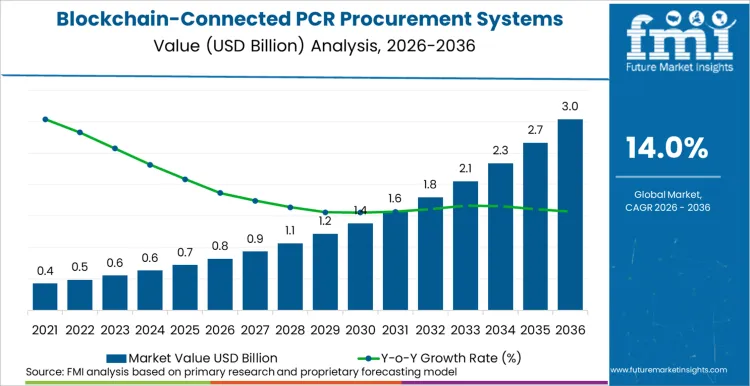
Blockchain-connected PCR procurement systems market revenue is projected to total USD 820 million in 2026, increasing to USD 3,040 million by 2036, at a CAGR of 14.0%. FMI analysis indicates the market is undergoing a fundamental shift from standalone verification tools to integrated, smart-contract-driven platforms that automate procurement workflows, escrow payments, and compliance reporting. The 2026-2027 period will be defined by the enforcement of cross-border carbon adjustment mechanisms and mandatory recycled content laws, forcing multinational brands to implement defensible, real-time sourcing evidence systems.
Growth is anchored in the conversion of PCR from a bulk commodity into a differentiated, specification-driven material with associated liabilities. PCR procurement is tied to contractual expectations around recycled-content attribution, origin narratives, and auditability-especially where mass-balance or chain-of-custody claims are used to support compliance and customer commitments. In practice, platforms are shifting the market from trust-based declarations to evidence-backed digital records, using selective disclosure and traceability workflows to reduce disputes and support premium positioning of verified PCR.
IBM’s role in this market is not best described as IBM Blockchain deepening integration in 2024-2025, because IBM Blockchain Platform Software Edition reached end of support in 2023 and customers were directed to migrate to IBM Support for Hyperledger Fabric. In parallel, IBM has continued expanding adjacent enterprise capabilities relevant to PCR procurement assurance, particularly ESG data management and supply-chain emissions visibility through IBM Envizi ESG Suite enhancements. IBM’s practical influence is increasingly through enterprise ESG/supply-chain data layers that can sit alongside traceability records, rather than through a single proprietary IBM Blockchain procurement stack.
Technical innovation in the SAP ecosystem is also more hybrid and integration-led than native blockchain smart contracts inside S/4HANA/Ariba. SAP’s own ecosystem communications indicate that blockchain is not being positioned as the default foundation for auditability going forward, such as SAP messaging around sunsetting blockchain in parts of its sustainability/token context. SAP-aligned PCR procurement implementations are more credibly framed as embedding sustainability attributes, supplier data requests, and audit trails into ERP/procurement workflows, while integrating external traceability/assurance tools where needed, instead of asserting automatic on-chain smart contracts as standard functionality.
Platform providers are specializing in connecting digital claims with physical certification and assurance regimes, and this is where DNV is a verifiable example. DNV’s My Story™ is explicitly described as a blockchain-powered digital assurance solution, implemented on the VeChain ledger and designed to connect verified information and potentially IoT-linked evidence to digital identities used for trust and transparency.
While this is not ISO certificates written directly onto procurement blockchains” as a standardized feed, it is defensible evidence of how assurance providers bridge traditional verification with tamper-evident digital records that can be referenced in procurement, reporting, and customer-facing transparency.
In Asia, the stronger, verifiable direction is the scaling of cloud-backed traceability infrastructure for sustainable plastics rather than a blanket claim about “AntChain running commodity-grade PCR trading.” A documented example is Covestro’s collaboration with Alibaba Cloud (2024) to develop solutions for traceability and CO₂ footprint transparency for sustainable plastics across supply chains, including digital access to origin/footprint information via QR-enabled approaches. This is consistent with the region’s emphasis on high-throughput digital trade enablement and logistics integration, but it should be described as cloud-enabled traceability and transparency systems rather than a confirmed, PCR-trading-specific AntChain backbone.
Summary of Blockchain-Connected PCR Procurement Systems Market
- The blockchain-connected PCR procurement systems market comprises permissioned and consortium blockchain platforms, smart contract applications, and integrated software services used to digitize, execute, verify, and audit the sourcing contracts and material flows for post-consumer recycled plastics.
- The defined scope follows FMI taxonomy, covering platforms where blockchain technology is central to procurement execution and verification, including smart contracts for purchase orders, immutable records of certificates and shipments, and automated compliance reporting. It excludes general-purpose ERP procurement modules without integrated blockchain-ledger functionality.
- The market is projected to grow at a CAGR of 14.0% from 2026 to 2036, expanding from USD 820 million in 2026 to USD 3,040 million by 2036, based on FMI proprietary modeling incorporating regulatory timelines for recycled content, global PCR trade forecasts, and primary interviews with procurement officers and sustainability leaders.
- The sector is transitioning from simple origin tracing to complex contractual automation, with system specialization for high-volume brand sourcing, EU regulatory compliance, precision sourcing for engineering grades, and the formalization of emerging PCR supply chains.
- Competition is concentrated among enterprise blockchain providers, specialist circular economy platforms, and verification bodies, with differentiation driven by integration depth, smart contract flexibility, and the credibility of connected data feeds.
- India records the fastest growth at 16.2% CAGR through 2036, driven by the formalization of its PCR supply base to meet export and domestic EPR demand, while the USA remains the highest-value market, shaped by litigation risk and brand-led sourcing mandates.
Blockchain-Connected PCR Procurement Systems Market Key Takeaways
| Metrics | Values |
|---|---|
| Expected Value (2026E) | USD 820 million |
| Projected Value (2036F) | USD 3,040 million |
| CAGR (2026-2036) | 14.0% |
Source: Future Market Insights (FMI) analysis, based on proprietary forecasting model and primary research
Why is the Blockchain-Connected PCR Procurement Systems Market Growing?
Expansion of legal and reputational risk associated with greenwashing claims is a primary catalyst. Class-action lawsuits targeting brands for inaccurate recycled content statements have established that procurement records are discoverable evidence. Blockchain systems create an immutable, time-stamped audit trail that demonstrates due diligence in sourcing, transforming procurement data into a legal defensibility asset, not just an operational record.
International trade compliance is becoming computationally complex. Mechanisms like the EU’s CBAM and rules of origin under the US Inflation Reduction Act require precise, batch-level data on recycled content and associated emissions. Blockchain-connected systems can automatically generate the necessary digital documentation packets for customs, turning compliance from a manual, error-prone process into an automated by-product of procurement, saving time and mitigating the risk of costly border delays or penalties.
The financialization of circularity is creating direct value. "Green" loans and sustainability-linked bonds increasingly include Key Performance Indicators (KPIs) tied to verified PCR usage. Blockchain systems provide the auditable, real-time data stream required by lenders and investors to monitor covenant compliance, effectively lowering the cost of capital for companies that deploy them and creating a clear financial return on investment beyond procurement efficiency.
How is the Blockchain-Connected PCR Procurement Systems Market Segmented?
The underlying procurement model, the scope of data anchored on-chain, and the technological architecture of the blockchain network segment the market. This segmentation reflects a progression from digitizing documents to automating entire commercial agreements.
Blockchain-enabled procurement platforms, which use the ledger as a system of record for transactions and documents, command the highest value share (50%), as they represent the foundational step for most organizations. More advanced smart-contract-driven models are growing rapidly for specific, high-value, or highly regulated procurement streams.
How is the Dominance of Permissioned Blockchain Architecture Sustained in Enterprise Procurement?
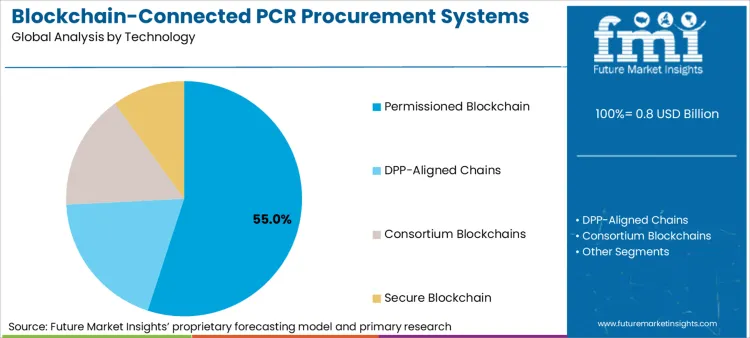
Permissioned (private or consortium) blockchains account for a leading 55% technology share, as they align with the confidentiality and performance requirements of B2B commerce. Unlike public blockchains, permissioned networks control participant access, keeping sensitive pricing, volume, and supplier information private among contracted parties while still providing the benefits of a shared, immutable ledger.
This architecture allows for higher transaction throughput and lower costs critical for high-volume PCR trade and facilitates compliance with data sovereignty regulations (e.g., GDPR, China's data laws). Enterprise buyers prioritize this controlled environment over the transparency of public networks.
Which Contractual and Compliance Factors are Concentrating Value on Core Data Types?
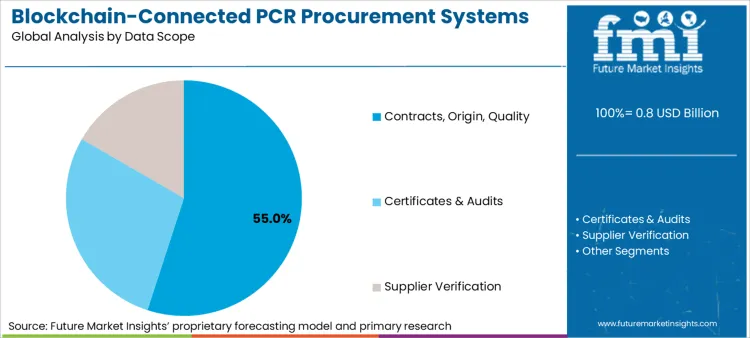
Data related to contracts, material origin, and quality specifications collectively represent over 55% of the data scope value. This dominance exists because this data triplet forms the legal and commercial core of any PCR purchase. T
he smart contract terms define the obligations; origin data supported by mass balance certificates proves the recycled content claim and complies with made-in rules; quality data (CoA) ensures the material meets technical specifications. Anchoring these three elements immutably on a blockchain resolves the fundamental trust asymmetry between buyer and seller in a fragmented, opaque market, directly reducing procurement risk and enabling more ambitious sourcing targets.
What Role does Brand & OEM Sourcing Play in Driving Platform Requirements and Innovation?
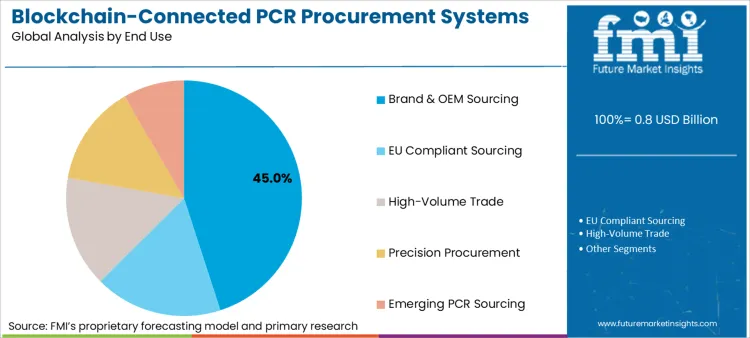
Brand & OEM sourcing, accounting for 45% of demand, acts as the primary driver for platform sophistication. Large brands and manufacturers do not just buy PCR; they manage complex programs across multiple suppliers, geographies, and product lines to meet aggregate content goals. T
heir procurement systems must therefore integrate with corporate ESG reporting, manage allocation claims to specific products, and provide data for consumer-facing labels or digital product passports. This demand pushes platform providers beyond simple traceability to develop features for portfolio management, claim serialization, and automated regulatory reporting, setting the functional benchmark for the entire market.
What Drivers, Restraints, Opportunities, and Trends Prevail in the Market?
Market expansion is supported by the standardization of digital compliance data. Initiatives like the EU's Digital Product Passport are defining common data schemas for material composition. Procurement platforms that can natively collect, verify, and output data in these standardized formats are becoming essential compliance utilities, as they eliminate costly manual data transformation and reduce audit friction.
While demand is robust, a key restraint is the fragmentation of the upstream supply chain. Integrating small-scale recyclers and collectors-who often lack digital infrastructure-into blockchain systems remains a challenge. The cost and complexity of onboarding these critical players can create data gaps at the origin point, limiting the system's end-to-end integrity and value proposition.
Technical innovation is defined by the convergence of blockchain with IoT and AI. Smart sensors at recycling plants are being used to automatically log batch production data onto a blockchain, while AI algorithms analyze shipping documents and quality reports to trigger smart contract clauses (e.g., automatic payment, non-compliance alerts). This trend is moving systems from passive record-keeping to active supply chain orchestration.
The emergence of blockchain-based PCR "material marketplaces" represents a disruptive opportunity. These platforms allow recyclers to list certified batches with attached digital passports, and buyers to discover and procure them using standardized smart contracts. This could disintermediate traditional brokers, increase market liquidity, and create more transparent pricing for PCR, potentially reshaping traditional procurement channels.
Analysis of Blockchain-Connected PCR Procurement Systems Market by Key Countries
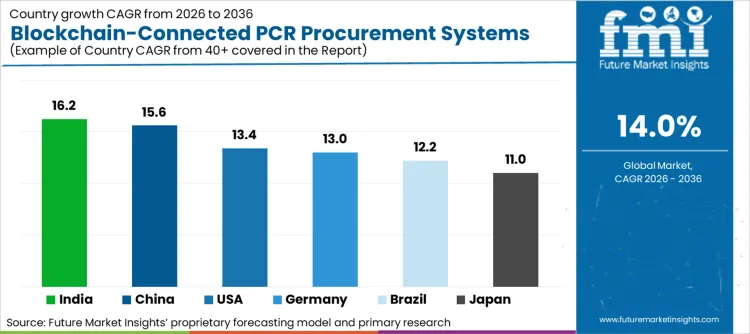
| Country | CAGR (2026-2036) |
|---|---|
| USA | 13.4% |
| Germany | 13.0% |
| China | 15.6% |
| Japan | 11.0% |
| India | 16.2% |
| Brazil | 12.2% |
Source: FMI analysis based on primary research and proprietary forecasting model
How is Litigation Risk and Brand-Led Mandates Shaping the US Market?
USA, expanding at a 13.4% CAGR, is a market primarily driven by risk mitigation and corporate mandate enforcement. The threat of litigation and Federal Trade Commission (FTC) action over unsubstantiated environmental claims has made verifiable procurement a board-level concern.
Major brands are not only adopting these systems for their own operations but are mandating their use down through their supply chains via supplier codes of conduct. This creates a cascading adoption effect. The market favors platforms like IBM Blockchain that offer robust integration with existing enterprise IT landscapes, treating PCR verification as an extension of core risk and compliance management.
What Role does Contractual Enforcement and EU Regulatory Alignment Play in Germany?
Germany’s growth at a 13.0% CAGR is characterized by a focus on precise contractual enforcement and seamless alignment with EU regulatory machinery. German industrial buyers, particularly in automotive and chemicals, use blockchain-connected procurement to encode complex technical specifications and sustainability covenants directly into smart contracts.
The system automatically verifies compliance through connected data feeds such as from certified recyclers and testing labs, enabling automatic payment and reducing administrative overhead. Furthermore, platforms are engineered to pre-format data for submission under the EU DPP and CBAM, positioning them as essential tools for navigating the region’s complex regulatory environment.
How is Export Credibility and Domestic Platform Strategy Driving China's Adoption?
China’s high growth rate of 15.6% CAGR is fueled by a dual dynamic: meeting the stringent traceability demands of Western export markets and advancing a domestic digital infrastructure agenda. For Chinese PCR producers and compounders, blockchain systems are critical export credentials that verify origin and content for Western buyers.
Domestically, state-backed platforms like AntChain are being promoted as national infrastructure for the circular economy, aiming to digitize and bring transparency to the entire domestic PCR value chain. This state-led push accelerates adoption and favors platforms that can handle the immense scale and speed of Chinese industrial trade.
How are Japan's Precision Requirements for Engineered PCR Shaping Niche Systems?
Japan’s market, growing at an 11.0% CAGR, is focused on the procurement of high-performance, engineered PCR for automotive and electronics applications. The requirement here is extreme precision and trust in material pedigrees. Japanese systems, often developed by IT giants like Fujitsu, emphasize secure, trusted ledgers with granular access controls to share intricate material data sheets, recycling process parameters, and long-term performance guarantees within tightly knit supplier network. The focus is less on volume trade and more on securing verifiable, high-integrity data for critical, specification-grade materials.
How is India Using Blockchain to Formalize and Monetize Emerging PCR Supply Chains?
India exhibits the highest CAGR at 16.2%, driven by the transformative use of blockchain to formalize its nascent but growing PCR supply base. The system's role is to create digital trust and auditable records where little formal infrastructure exists.
By providing recyclers and aggregators with simple tools to log transactions and attest to material flows on a blockchain, these systems help formalize the sector, making it bankable and attractive to large domestic and international buyers seeking to meet EPR obligations. The platforms pioneering in India are often lightweight, mobile-first, and focused on establishing basic digital credibility to unlock market access.
Which Regional Trade and Quality Assurance Dynamics Influence Brazil's Market?
Brazil’s market expansion at a 12.2% CAGR is closely tied to its role as a regional industrial hub. Brazilian plastic converters supplying multinational brands across Latin America use blockchain procurement systems to provide standardized, verifiable proof of PCR content, which is increasingly a requirement for regional supply contracts.
The technology serves as a quality assurance and trade facilitation tool within Mercosur, helping Brazilian suppliers differentiate themselves and command premium prices by offering a level of sourcing transparency that is still novel in the region.
What is the Competition Outlook for Blockchain-Connected PCR Procurement Systems?
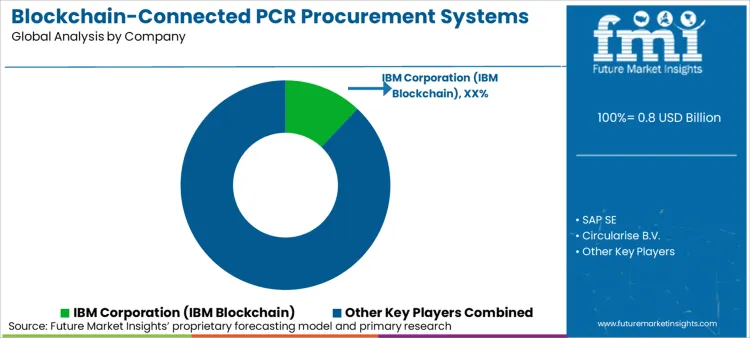
Competitive intensity is increasing as companies seek a system of record for verified recycled-content procurement rather than fragmented sustainability claims. The market is separating into horizontal enterprise software providers, such as SAP, which integrate traceability and sustainability data into core ERP and procurement workflows, and vertical circular-economy specialists, such as Circularise, which focus specifically on material-level traceability, mass-balance logic, and connection to certification and auditing processes. Competitive success increasingly depends on ecosystem alignment, particularly with certification schemes, recyclers, and brand owners, rather than on technology alone.
The dominant architectural approach across platforms is a hybrid data model. Instead of placing full procurement datasets on-chain, blockchain is used selectively to anchor immutable proofs such as hashes of certificates, transaction events, or compliance attestations while operational and commercial data remain in conventional databases. This design reflects industry consensus that scalability, confidentiality, and cost efficiency are essential for procurement systems handling high transaction volumes and sensitive supplier relationships.
Strategic leadership in this market is shifting toward analytics-driven value creation. Verified procurement data is leveraged to generate insights on recycled-content achievement, supplier reliability, exposure to compliance risk, and cost volatility in PCR feedstock markets. Platforms that successfully translate verified traceability data into actionable procurement intelligence, rather than static compliance records, are better positioned to become embedded decision tools within corporate sourcing and sustainability teams.
Recent Developments
- SAP continued expanding sustainability and traceability capabilities across its ERP ecosystem during 2024-2025, including tools to track recycled and renewable material flows alongside financial and procurement data. These developments support auditable PCR sourcing by embedding sustainability attributes directly into enterprise procurement and reporting workflows, without requiring all data to be stored on a public blockchain.
- Circularise strengthened its position as a vertical specialist in blockchain-enabled material traceability during 2024-2025 by expanding deployments with polymer producers, converters, and brand owners. The platform emphasizes selective data disclosure, mass-balance verification, and linkage to third-party certification processes, enabling secure PCR procurement validation across multi-tier supply chains.
- DNV continued developing digital assurance and traceability solutions that connect physical audits with digital records during 2024-2025. Through offerings such as My Story, DNV enables verified sustainability and recycled-content claims to be associated with materials and products, supporting trust and transparency in PCR procurement ecosystems when integrated with enterprise and circular-economy platforms.
Key Players Profiled
- IBM Corporation (IBM Blockchain)
- SAP SE
- Circularise B.V.
- DNV AS
- Ant Group (AntChain)
- VeChain
- Fujitsu Limited
- Oracle Corporation
- Microsoft Corporation (Azure Blockchain)
- Accenture Plc
Market Definition
The blockchain-connected PCR procurement systems market comprises revenue generated from software platforms, services, and infrastructure that utilize distributed ledger technology to facilitate, verify, and execute the sourcing and purchasing of post-consumer recycled plastics. This includes revenue from platform licensing/subscription, smart contract development and deployment, system integration, and ongoing support and maintenance services.
The core function is to create a shared, immutable record of procurement transactions, contractual terms, material certifications, and chain-of-custody data among buyers, sellers, and relevant third parties (e.g., auditors, logistics providers).
The market scope covers dedicated platforms and integrated modules where blockchain is essential to the procurement process’s execution or verification. It excludes general supply chain management software, basic e-procurement tools, and standalone sustainability reporting platforms unless they incorporate a functional blockchain ledger as a core component for PCR sourcing.
Scope of Report
| Items | Values |
|---|---|
| Quantitative Units | USD 820 million |
| Procurement Model | Blockchain-Enabled Procurement, Smart-Contract Procurement, Trade Blockchain Systems, Trusted Ledgers, Others |
| Data Scope | Contracts, Origin, Quality, Certificates & Audits, Supplier Verification, Others |
| Technology | Permissioned Blockchain, DPP-Aligned Chains, Consortium Blockchains, Secure Blockchain, Others |
| End Use | Brand & OEM Sourcing, EU Compliant Sourcing, High-Volume Trade, Precision Procurement, Emerging PCR Sourcing, Others |
| Regions Covered | North America, Western Europe, Eastern Europe, East Asia, South Asia & Pacific, Latin America, Middle East & Africa |
| Countries | USA, Germany, China, Japan, India, Brazil and 40+ countries |
| Key Companies | IBM Blockchain, SAP, Circularise, DNV, AntChain, VeChain, Fujitsu, Oracle, Microsoft, Accenture |
Source: Future Market Insights (FMI) analysis, based on proprietary forecasting model and primary research
Blockchain-Connected PCR Procurement Systems Market Key Segments
By Procurement Model
- Blockchain-Enabled Procurement
- Smart-Contract Procurement
- Trade Blockchain Systems
- Trusted Ledgers
- Others
By Data Scope
- Contracts, Origin, Quality
- Certificates & Audits
- Supplier Verification
- Others
By Technology
- Permissioned Blockchain
- DPP-Aligned Chains
- Consortium Blockchains
- Secure Blockchain
- Others
By End Use
- Brand & OEM Sourcing
- EU Compliant Sourcing
- High-Volume Trade
- Precision Procurement
- Emerging PCR Sourcing
- Others
By Region
- North America
- Western Europe
- Eastern Europe
- East Asia
- South Asia & Pacific
- Latin America
- Middle East & Africa
Bibliography
- International Chamber of Commerce (ICC). (2026). Distributed Ledger Technologies in Cross-Border Trade and Sustainable Procurement. ICC Publishing.
- DIN Deutsches Institut für Normung. (2025). DIN SPEC 91436: Digital Proofs and Distributed Ledgers in Supply Chain Transactions. Beuth Verlag.
- International Sustainability and Carbon Certification (ISCC). (2026). Chain of Custody and Mass Balance Verification for Recycled Polymers. ISCC System.
- Japan Ministry of Economy, Trade and Industry (METI). (2025). Trusted Digital Infrastructure for Sustainable Manufacturing and Procurement. Government of Japan.
- China Electronics Standardization Institute (CESI). (2025). Technical Requirements for Blockchain-Enabled Traceability Systems in Green Supply Chains. CESI.
- Confederation of Indian Industry (CII). (2025). Digitising Secondary Materials Procurement and Market Formalisation in India. CII Publications.
- Brazilian National Confederation of Industry (CNI). (2025). Digital Traceability and Contract Assurance in Regional Trade of Industrial Materials. CNI.
- MIT Center for Transportation & Logistics. (2025). From Pilots to Production: Enterprise Blockchain in Procurement and Supply Chains. MIT CTL.
Frequently Asked Questions
How big is the blockchain-connected pcr procurement systems market in 2026?
The global blockchain-connected pcr procurement systems market is estimated to be valued at USD 0.8 billion in 2026.
What will be the size of blockchain-connected pcr procurement systems market in 2036?
The market size for the blockchain-connected pcr procurement systems market is projected to reach USD 3.0 billion by 2036.
How much will be the blockchain-connected pcr procurement systems market growth between 2026 and 2036?
The blockchain-connected pcr procurement systems market is expected to grow at a 14.0% CAGR between 2026 and 2036.
What are the key product types in the blockchain-connected pcr procurement systems market?
The key product types in blockchain-connected pcr procurement systems market are permissioned blockchain, dpp-aligned chains, consortium blockchains and secure blockchain.
Which data scope segment to contribute significant share in the blockchain-connected pcr procurement systems market in 2026?
In terms of data scope, contracts, origin, quality segment to command 55.0% share in the blockchain-connected pcr procurement systems market in 2026.
Preview the report firsthand - request a free sample
Get SampleGet the brochure for pricing and purchase details.
Get PDFTable of Content
- Executive Summary
- Global Market Outlook
- Demand-side Trends
- Supply-side Trends
- Technology Roadmap Analysis
- Analysis and Recommendations
- Market Overview
- Market Coverage / Taxonomy
- Market Definition / Scope / Limitations
- Research Methodology
- Chapter Orientation
- Analytical Lens and Working Hypotheses
- Market Structure, Signals, and Trend Drivers
- Benchmarking and Cross-market Comparability
- Market Sizing, Forecasting, and Opportunity Mapping
- Research Design and Evidence Framework
- Desk Research Programme (Secondary Evidence)
- Company Annual and Sustainability Reports
- Peer-reviewed Journals and Academic Literature
- Corporate Websites, Product Literature, and Technical Notes
- Earnings Decks and Investor Briefings
- Statutory Filings and Regulatory Disclosures
- Technical White Papers and Standards Notes
- Trade Journals, Industry Magazines, and Analyst Briefs
- Conference Proceedings, Webinars, and Seminar Materials
- Government Statistics Portals and Public Data Releases
- Press Releases and Reputable Media Coverage
- Specialist Newsletters and Curated Briefings
- Sector Databases and Reference Repositories
- FMI Internal Proprietary Databases and Historical Market Datasets
- Subscription Datasets and Paid Sources
- Social Channels, Communities, and Digital Listening Inputs
- Additional Desk Sources
- Expert Input and Fieldwork (Primary Evidence)
- Primary Modes
- Qualitative Interviews and Expert Elicitation
- Quantitative Surveys and Structured Data Capture
- Blended Approach
- Why Primary Evidence is Used
- Field Techniques
- Interviews
- Surveys
- Focus Groups
- Observational and In-context Research
- Social and Community Interactions
- Stakeholder Universe Engaged
- C-suite Leaders
- Board Members
- Presidents and Vice Presidents
- R&D and Innovation Heads
- Technical Specialists
- Domain Subject-matter Experts
- Scientists
- Physicians and Other Healthcare Professionals
- Governance, Ethics, and Data Stewardship
- Research Ethics
- Data Integrity and Handling
- Primary Modes
- Tooling, Models, and Reference Databases
- Desk Research Programme (Secondary Evidence)
- Data Engineering and Model Build
- Data Acquisition and Ingestion
- Cleaning, Normalisation, and Verification
- Synthesis, Triangulation, and Analysis
- Quality Assurance and Audit Trail
- Market Background
- Market Dynamics
- Drivers
- Restraints
- Opportunity
- Trends
- Scenario Forecast
- Demand in Optimistic Scenario
- Demand in Likely Scenario
- Demand in Conservative Scenario
- Opportunity Map Analysis
- Product Life Cycle Analysis
- Supply Chain Analysis
- Investment Feasibility Matrix
- Value Chain Analysis
- PESTLE and Porter’s Analysis
- Regulatory Landscape
- Regional Parent Market Outlook
- Production and Consumption Statistics
- Import and Export Statistics
- Market Dynamics
- Global Market Analysis 2021 to 2025 and Forecast, 2026 to 2036
- Historical Market Size Value (USD Million) Analysis, 2021 to 2025
- Current and Future Market Size Value (USD Million) Projections, 2026 to 2036
- Y-o-Y Growth Trend Analysis
- Absolute $ Opportunity Analysis
- Global Market Pricing Analysis 2021 to 2025 and Forecast 2026 to 2036
- Global Market Analysis 2021 to 2025 and Forecast 2026 to 2036, By Technology
- Introduction / Key Findings
- Historical Market Size Value (USD Million) Analysis By Technology , 2021 to 2025
- Current and Future Market Size Value (USD Million) Analysis and Forecast By Technology , 2026 to 2036
- Permissioned Blockchain
- DPP-Aligned Chains
- Consortium Blockchains
- Secure Blockchain
- Permissioned Blockchain
- Y-o-Y Growth Trend Analysis By Technology , 2021 to 2025
- Absolute $ Opportunity Analysis By Technology , 2026 to 2036
- Global Market Analysis 2021 to 2025 and Forecast 2026 to 2036, By Data Scope
- Introduction / Key Findings
- Historical Market Size Value (USD Million) Analysis By Data Scope, 2021 to 2025
- Current and Future Market Size Value (USD Million) Analysis and Forecast By Data Scope, 2026 to 2036
- Contracts, Origin, Quality
- Certificates & Audits
- Supplier Verification
- Contracts, Origin, Quality
- Y-o-Y Growth Trend Analysis By Data Scope, 2021 to 2025
- Absolute $ Opportunity Analysis By Data Scope, 2026 to 2036
- Global Market Analysis 2021 to 2025 and Forecast 2026 to 2036, By End Use
- Introduction / Key Findings
- Historical Market Size Value (USD Million) Analysis By End Use, 2021 to 2025
- Current and Future Market Size Value (USD Million) Analysis and Forecast By End Use, 2026 to 2036
- Brand & OEM Sourcing
- EU Compliant Sourcing
- High-Volume Trade
- Precision Procurement
- Emerging PCR Sourcing
- Brand & OEM Sourcing
- Y-o-Y Growth Trend Analysis By End Use, 2021 to 2025
- Absolute $ Opportunity Analysis By End Use, 2026 to 2036
- Global Market Analysis 2021 to 2025 and Forecast 2026 to 2036, By Region
- Introduction
- Historical Market Size Value (USD Million) Analysis By Region, 2021 to 2025
- Current Market Size Value (USD Million) Analysis and Forecast By Region, 2026 to 2036
- North America
- Latin America
- Western Europe
- Eastern Europe
- East Asia
- South Asia and Pacific
- Middle East & Africa
- Market Attractiveness Analysis By Region
- North America Market Analysis 2021 to 2025 and Forecast 2026 to 2036, By Country
- Historical Market Size Value (USD Million) Trend Analysis By Market Taxonomy, 2021 to 2025
- Market Size Value (USD Million) Forecast By Market Taxonomy, 2026 to 2036
- By Country
- USA
- Canada
- Mexico
- By Technology
- By Data Scope
- By End Use
- By Country
- Market Attractiveness Analysis
- By Country
- By Technology
- By Data Scope
- By End Use
- Key Takeaways
- Latin America Market Analysis 2021 to 2025 and Forecast 2026 to 2036, By Country
- Historical Market Size Value (USD Million) Trend Analysis By Market Taxonomy, 2021 to 2025
- Market Size Value (USD Million) Forecast By Market Taxonomy, 2026 to 2036
- By Country
- Brazil
- Chile
- Rest of Latin America
- By Technology
- By Data Scope
- By End Use
- By Country
- Market Attractiveness Analysis
- By Country
- By Technology
- By Data Scope
- By End Use
- Key Takeaways
- Western Europe Market Analysis 2021 to 2025 and Forecast 2026 to 2036, By Country
- Historical Market Size Value (USD Million) Trend Analysis By Market Taxonomy, 2021 to 2025
- Market Size Value (USD Million) Forecast By Market Taxonomy, 2026 to 2036
- By Country
- Germany
- UK
- Italy
- Spain
- France
- Nordic
- BENELUX
- Rest of Western Europe
- By Technology
- By Data Scope
- By End Use
- By Country
- Market Attractiveness Analysis
- By Country
- By Technology
- By Data Scope
- By End Use
- Key Takeaways
- Eastern Europe Market Analysis 2021 to 2025 and Forecast 2026 to 2036, By Country
- Historical Market Size Value (USD Million) Trend Analysis By Market Taxonomy, 2021 to 2025
- Market Size Value (USD Million) Forecast By Market Taxonomy, 2026 to 2036
- By Country
- Russia
- Poland
- Hungary
- Balkan & Baltic
- Rest of Eastern Europe
- By Technology
- By Data Scope
- By End Use
- By Country
- Market Attractiveness Analysis
- By Country
- By Technology
- By Data Scope
- By End Use
- Key Takeaways
- East Asia Market Analysis 2021 to 2025 and Forecast 2026 to 2036, By Country
- Historical Market Size Value (USD Million) Trend Analysis By Market Taxonomy, 2021 to 2025
- Market Size Value (USD Million) Forecast By Market Taxonomy, 2026 to 2036
- By Country
- China
- Japan
- South Korea
- By Technology
- By Data Scope
- By End Use
- By Country
- Market Attractiveness Analysis
- By Country
- By Technology
- By Data Scope
- By End Use
- Key Takeaways
- South Asia and Pacific Market Analysis 2021 to 2025 and Forecast 2026 to 2036, By Country
- Historical Market Size Value (USD Million) Trend Analysis By Market Taxonomy, 2021 to 2025
- Market Size Value (USD Million) Forecast By Market Taxonomy, 2026 to 2036
- By Country
- India
- ASEAN
- Australia & New Zealand
- Rest of South Asia and Pacific
- By Technology
- By Data Scope
- By End Use
- By Country
- Market Attractiveness Analysis
- By Country
- By Technology
- By Data Scope
- By End Use
- Key Takeaways
- Middle East & Africa Market Analysis 2021 to 2025 and Forecast 2026 to 2036, By Country
- Historical Market Size Value (USD Million) Trend Analysis By Market Taxonomy, 2021 to 2025
- Market Size Value (USD Million) Forecast By Market Taxonomy, 2026 to 2036
- By Country
- Kingdom of Saudi Arabia
- Other GCC Countries
- Turkiye
- South Africa
- Other African Union
- Rest of Middle East & Africa
- By Technology
- By Data Scope
- By End Use
- By Country
- Market Attractiveness Analysis
- By Country
- By Technology
- By Data Scope
- By End Use
- Key Takeaways
- Key Countries Market Analysis
- USA
- Pricing Analysis
- Market Share Analysis, 2025
- By Technology
- By Data Scope
- By End Use
- Canada
- Pricing Analysis
- Market Share Analysis, 2025
- By Technology
- By Data Scope
- By End Use
- Mexico
- Pricing Analysis
- Market Share Analysis, 2025
- By Technology
- By Data Scope
- By End Use
- Brazil
- Pricing Analysis
- Market Share Analysis, 2025
- By Technology
- By Data Scope
- By End Use
- Chile
- Pricing Analysis
- Market Share Analysis, 2025
- By Technology
- By Data Scope
- By End Use
- Germany
- Pricing Analysis
- Market Share Analysis, 2025
- By Technology
- By Data Scope
- By End Use
- UK
- Pricing Analysis
- Market Share Analysis, 2025
- By Technology
- By Data Scope
- By End Use
- Italy
- Pricing Analysis
- Market Share Analysis, 2025
- By Technology
- By Data Scope
- By End Use
- Spain
- Pricing Analysis
- Market Share Analysis, 2025
- By Technology
- By Data Scope
- By End Use
- France
- Pricing Analysis
- Market Share Analysis, 2025
- By Technology
- By Data Scope
- By End Use
- India
- Pricing Analysis
- Market Share Analysis, 2025
- By Technology
- By Data Scope
- By End Use
- ASEAN
- Pricing Analysis
- Market Share Analysis, 2025
- By Technology
- By Data Scope
- By End Use
- Australia & New Zealand
- Pricing Analysis
- Market Share Analysis, 2025
- By Technology
- By Data Scope
- By End Use
- China
- Pricing Analysis
- Market Share Analysis, 2025
- By Technology
- By Data Scope
- By End Use
- Japan
- Pricing Analysis
- Market Share Analysis, 2025
- By Technology
- By Data Scope
- By End Use
- South Korea
- Pricing Analysis
- Market Share Analysis, 2025
- By Technology
- By Data Scope
- By End Use
- Russia
- Pricing Analysis
- Market Share Analysis, 2025
- By Technology
- By Data Scope
- By End Use
- Poland
- Pricing Analysis
- Market Share Analysis, 2025
- By Technology
- By Data Scope
- By End Use
- Hungary
- Pricing Analysis
- Market Share Analysis, 2025
- By Technology
- By Data Scope
- By End Use
- Kingdom of Saudi Arabia
- Pricing Analysis
- Market Share Analysis, 2025
- By Technology
- By Data Scope
- By End Use
- Turkiye
- Pricing Analysis
- Market Share Analysis, 2025
- By Technology
- By Data Scope
- By End Use
- South Africa
- Pricing Analysis
- Market Share Analysis, 2025
- By Technology
- By Data Scope
- By End Use
- USA
- Market Structure Analysis
- Competition Dashboard
- Competition Benchmarking
- Market Share Analysis of Top Players
- By Regional
- By Technology
- By Data Scope
- By End Use
- Competition Analysis
- Competition Deep Dive
- IBM Corporation (IBM Blockchain)
- Overview
- Product Portfolio
- Profitability by Market Segments (Product/Age /Sales Channel/Region)
- Sales Footprint
- Strategy Overview
- Marketing Strategy
- Product Strategy
- Channel Strategy
- SAP SE
- Circularise B.V.
- DNV AS
- Ant Group (AntChain)
- VeChain
- Fujitsu Limited
- Oracle Corporation
- IBM Corporation (IBM Blockchain)
- Competition Deep Dive
- Assumptions & Acronyms Used


