

- Industry Size (2026)
- USD 2.4 Bn
- Forecast (2036)
- USD 6.4 Bn
- CAGR (2026 to 2036)
- 10.3%
Flooring & Surface Systems Using High Durability PCR Market Forecast and Outlook 2026 to 2036
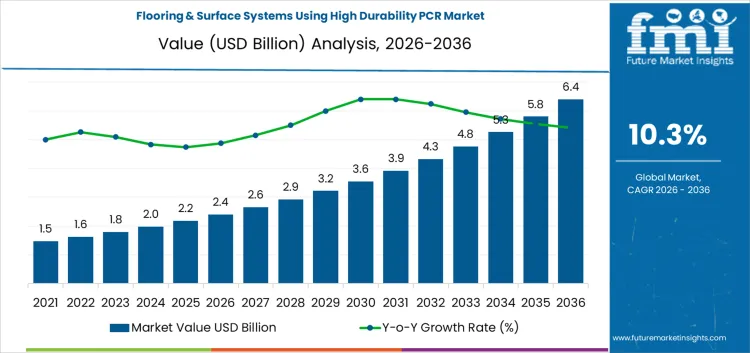
The flooring and surface systems using high-durability PCR market is projected to reach USD 2.4 billion in 2026 and is likely to grow to USD 6.4 billion by 2036, with a CAGR of 10.3%. This growth is driven by the increasing use of post-consumer recycled (PCR) materials in high-durability flooring and surface applications. PCR materials are becoming a preferred choice in industries such as construction, retail, and hospitality due to their ability to deliver long-lasting performance and enhanced resilience while reducing environmental impact.
High-durability PCR materials offer significant advantages in flooring and surface systems, including resistance to wear, impact, and environmental stress. As industries seek cost-effective alternatives to traditional materials, these PCR-based solutions provide an ideal option that combines performance with environmental benefits. Moreover, advancements in processing technologies are improving the mechanical properties of PCR materials, making them suitable for high-traffic and demanding applications. As demand for resilient, efficient, and eco-conscious building materials continues to rise, the flooring and surface systems using high-durability PCR market is expected to expand, driven by innovation, regulatory pressure, and a growing focus on resource efficiency in construction.
Quick Stats for Flooring & Surface Systems Using High Durability PCR Market
- Flooring & Surface Systems Using High Durability PCR Market Value (2026): USD 2.4 billion
- Flooring & Surface Systems Using High Durability PCR Market Forecast Value (2036): USD 6.4 billion
- Flooring & Surface Systems Using High Durability PCR Market Forecast CAGR 2026 to 2036: 10.3%
- Leading Type in Flooring & Surface Systems Using High Durability PCR Market: LVT & resilient flooring
- Key Growth Regions in Flooring & Surface Systems Using High Durability PCR Market: Asia Pacific, North America, Europe
- Top Players in Flooring & Surface Systems Using High Durability PCR Market: Tarkett, Forbo, Mohawk Industries, Nature Flooring, Responsive Industries, Duratex, Toli Corporation
What is the Growth Forecast for Flooring & Surface Systems Using High-Durability PCR Market through 2036?
The flooring and surface systems using high-durability PCR market is projected to reach USD 2.4 billion in 2026 and grow to USD 6.4 billion by 2036, registering a compound annual growth rate (CAGR) of 10.3%. From 2020 to 2026, the market increases from USD 1.3 billion in 2020 to USD 2.4 billion in 2026. This growth is driven by the increasing demand for durable, long-lasting flooring and surface materials, especially in commercial and residential sectors. North America leads the adoption of high-durability PCR materials, supported by robust construction standards and regulations, while Asia Pacific experiences rapid growth due to the expanding infrastructure and construction sectors.
From 2026 to 2036, the flooring and surface systems using high-durability PCR market will continue to expand, reaching USD 6.4 billion by 2036. The market is forecast to grow from USD 2.6 billion in 2027 to USD 5.8 billion by 2034, driven by growing awareness of the benefits of high-durability PCR materials. As regulations tighten and environmental concerns increase, demand for sustainable and high-performance materials in construction and renovation projects will drive further growth. Vendors who offer innovative, certified solutions that meet industry standards will be well-positioned to capitalize on these opportunities, particularly in emerging markets where infrastructure development is accelerating.
How Are Flooring and Surface Systems Using High-Durability PCR Enhancing Performance and Longevity?
Flooring and surface systems using high-durability post-consumer recycled (PCR) materials are increasingly adopted to provide long-lasting, resilient surfaces in residential, commercial, and industrial spaces. Historically, floors were made from virgin plastics, wood, or laminates, which often wore quickly under heavy traffic and required frequent replacement. Modern PCR-based systems combine robust polymers with protective coatings and embossed textures to deliver scratch resistance, chemical resistance, and consistent performance over extended use.
Architects, facility managers, and flooring manufacturers prioritize material strength, dimensional stability, and compliance with building standards. Early adoption focused on commercial and institutional projects, while current demand spans offices, hospitality, and industrial facilities, driven by durability requirements, maintenance efficiency, and cost-effective material use. Material uniformity, wear resistance, and ease of cleaning influence supplier selection.
Rising demand for durable flooring, operational cost reduction, and high-performance surfaces is shaping market growth. Compared with conventional materials, PCR-based flooring emphasizes resistance to daily wear, structural integrity, and compatibility with high-traffic areas. Cost structures depend on polymer sourcing, manufacturing quality, and surface finishing processes, concentrating margins among suppliers capable of delivering consistent, long-lasting products.
Facility operators and designers adopt these systems to extend service life, minimize maintenance, and ensure reliable performance. By 2036, flooring and surface systems using high-durability PCR are expected to become standard across residential, commercial, and industrial applications, supporting durability, maintenance efficiency, and long-term operational performance.
What Factors Are Shaping the Demand for High Durability PCR Flooring and Surface Systems by Use Setting and Flooring Format in 2026?
The flooring and surface systems using high durability PCR market in 2026 is segmented by end use setting and by flooring type. By use setting, demand is divided into commercial and public buildings, commercial interiors, residential and retail floors, offices and housing, and other premium or specialized spaces, each with different traffic loads and replacement cycles. By flooring format, demand is organized around LVT and resilient flooring, vinyl and composite flooring, modular flooring tiles, vinyl and SPC flooring, and other systems that differ in installation method, wear performance, and refurbishment strategy. These segments reflect how buyers balance lifecycle cost, downtime tolerance, and surface longevity in high use environments.
Why Do Commercial and Public Buildings Represent the Largest End Use Segment?
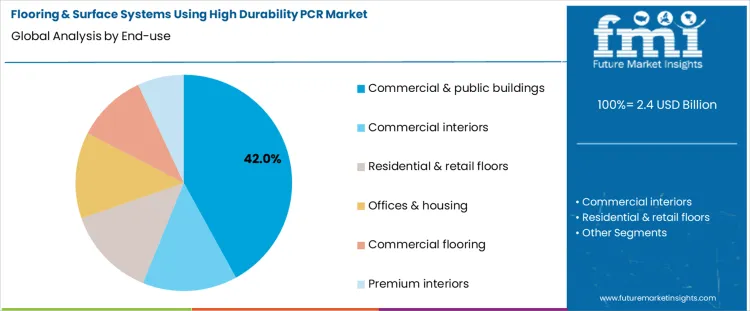
Commercial and public buildings account for about 42% of demand in 2026, reflecting their high traffic intensity and strict maintenance requirements. Airports, schools, hospitals, and transport hubs subject floors to constant footfall, cleaning equipment, and rolling loads, which accelerates wear. Facility managers in these environments prioritize materials that can withstand abrasion and impact while maintaining acceptable appearance over long periods. Replacement work in such buildings is disruptive and expensive, so longer service life carries clear economic value. PCR based high durability systems are selected where lifecycle cost matters more than initial purchase price. This constant exposure to heavy use and the cost of downtime keep public and commercial buildings as the largest single consumption base.
Other settings follow different usage patterns. Commercial interiors and offices focus more on aesthetics and layout flexibility, which shortens renovation cycles even if materials remain serviceable. Residential and retail floors face varied wear depending on occupancy and customer traffic, yet their total surface area per site is smaller. Premium interiors often select specialized finishes that trade durability for appearance. These segments are important, yet their aggregate replacement volumes and average stress levels are lower. This keeps the heaviest duty public and commercial environments as the primary driver of demand for high durability PCR based flooring systems.
Why Do LVT and Resilient Flooring Dominate Flooring Type Demand?
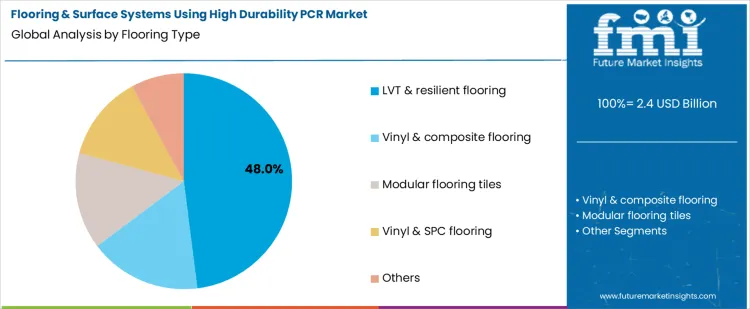
LVT and resilient flooring account for about 48% of demand in 2026 because they combine wear resistance with predictable installation and repair practices. These products handle point loads, rolling traffic, and repeated cleaning better than many traditional surfaces while remaining relatively easy to replace in sections. Their layered construction allows surface renewal without full substrate removal, which reduces downtime in occupied buildings. Designers and contractors are also familiar with their behavior, which lowers specification risk. The formats support a wide range of visual finishes, allowing one technical solution to serve many design briefs. This blend of mechanical performance, serviceability, and design flexibility keeps resilient LVT systems as the dominant flooring type.
Vinyl and composite sheets, modular tiles, and SPC systems address more specific project needs. Sheet products suit large open areas but are harder to repair locally. Modular tiles favor frequent layout changes but involve more joints and edge wear management. SPC systems offer rigidity and dimensional stability, yet their installation tolerances are tighter. Each format solves particular problems, yet none matches the broad applicability of resilient LVT in mixed use, high traffic environments. As a result, while alternative formats grow in selected niches, LVT and similar resilient systems continue to anchor most high durability PCR flooring specifications.
Why Are Lifecycle Cost Accounting and Asset Protection Policies Driving the Flooring and Surface Systems Using High Durability PCR Market through 2036?
Demand is anchored in how owners manage wear intensive spaces rather than in design fashion. Airports, retail chains, hospitals, and logistics buildings prioritize surfaces that survive heavy traffic, cleaning cycles, and impact without frequent replacement. High durability PCR based systems are specified where downtime and refurbishment cost exceed material price differences. Procurement teams increasingly evaluate total cost of ownership across multi year cycles, which favors products that hold finish and structural integrity longer. Once a facility standardizes a surface system across sites, repeat orders follow refurbishment schedules rather than new build cycles. This ties growth to asset management strategies and portfolio maintenance planning.
What Performance Proof Burden, Specification Risk, and Cost Tradeoffs Are Limiting Faster Adoption?
Constraints come from risk aversion. Decision makers remain cautious about recycled content in load bearing or high abuse surfaces, even when test data is available. Any failure creates visible operational disruption and reputational risk. Certification, fire rating, and slip resistance requirements differ by sector and region, increasing approval effort. In some cases, virgin material systems still offer lower upfront cost, which dominates tender outcomes. Installers also prefer familiar products to reduce callback risk. These factors slow switching, lengthen qualification cycles, and confine adoption to projects where long service life is prioritized over lowest initial purchase price.
How Are Portfolio Standardization and Circular Material Sourcing Changing This Category?
Structural change is coming from how large owners buy and replace surfaces. Retailers, healthcare groups, and logistics operators increasingly standardize surface systems across their estates to simplify maintenance and spares. This favors suppliers that can guarantee long term availability and consistent batches of PCR material. Some customers also align surface replacement cycles with broader refurbishment programs, creating predictable demand waves. Design teams are learning to specify performance classes rather than specific compositions, which opens the door to higher PCR content over time. The category is shifting from one off green choices to system level material strategies tied to asset lifecycle planning.
What is the Demand for Flooring and Surface Systems Using High-Durability PCR by Country?
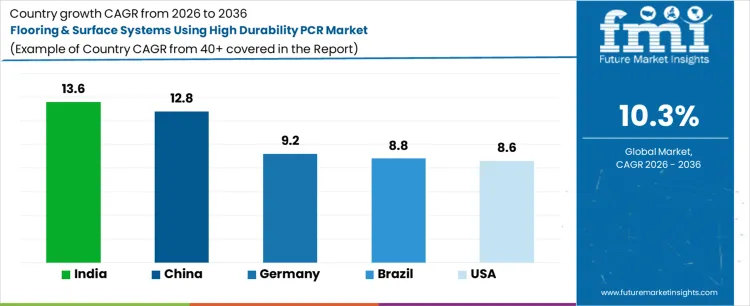
| Country | CAGR (%) |
|---|---|
| Germany | 9.2% |
| USA | 8.6% |
| China | 12.8% |
| India | 13.6% |
| Brazil | 8.8% |
Demand for flooring and surface systems using high-durability post-consumer recycled (PCR) materials is rising as commercial, residential, and industrial sectors prioritize sustainable, long-lasting, and environmentally friendly construction solutions. India leads with a 13.6% CAGR, driven by rapid urbanization, rising construction activity, and growing adoption of eco-friendly materials. China follows at 12.8%, supported by large-scale infrastructure projects, demand for sustainable interiors, and integration of high-durability PCR materials. Germany records 9.2% growth, shaped by adoption in commercial and residential spaces emphasizing sustainability and quality. The USA grows at 8.6%, influenced by green building initiatives and replacement demand. Brazil shows 8.8% CAGR, reflecting gradual adoption of high-durability PCR flooring and surface systems in urban and industrial projects.
How is Germany experiencing growth in the flooring & surface systems using high-durability PCR market?
Germany is experiencing growth at a CAGR of 9.2%, driven by industrial and commercial construction projects emphasizing long-lasting, low-maintenance flooring solutions. High-durability PCR flooring and surface systems are optimized for heavy foot traffic, chemical resistance, and thermal stability in factories, warehouses, and office buildings. Demand is concentrated in industrial regions such as North Rhine-Westphalia, Bavaria, and Baden-Württemberg, where manufacturing facilities and logistics hubs require resilient surfaces. Investments focus on material performance, compliance with EU building regulations, and integration into modern facility management practices. Growth reflects the push for reliable, long-life surfaces in high-usage industrial and commercial environments.
- Industrial and commercial construction drives adoption.
- Materials optimize durability, chemical resistance, and thermal stability.
- Manufacturing and logistics hubs concentrate demand.
- Material performance and regulatory compliance guide investment.
How is the United States witnessing growth in the flooring & surface systems using high-durability PCR market?
United States is witnessing growth at a CAGR of 8.6%, fueled by demand in warehouses, healthcare facilities, and commercial offices requiring robust and low-maintenance surfaces. High-durability PCR flooring systems are optimized for abrasion resistance, chemical resilience, and ease of cleaning under heavy-use conditions. Demand is concentrated in regions such as California, Texas, and New Jersey, where industrial parks and commercial complexes are expanding. Investments focus on long-term performance, compliance with ASTM standards, and ease of installation. Growth reflects increasing adoption of materials that reduce maintenance costs while meeting durability requirements in high-traffic environments.
- Industrial and healthcare facilities drive adoption.
- Materials enhance abrasion resistance and chemical resilience.
- Industrial and commercial zones concentrate demand.
- Performance and regulatory compliance guide investment.
How is China experiencing growth in the flooring & surface systems using high-durability PCR market?
China is experiencing growth at a CAGR of 12.8%, supported by rapid urban construction, high-rise commercial developments, and industrial expansion in cities like Shanghai, Beijing, and Shenzhen. Flooring and surface systems using high-durability PCR are optimized for heavy-duty performance, long-term wear resistance, and chemical stability in large-scale manufacturing plants and commercial complexes. Demand is concentrated in industrial parks, commercial centers, and newly developed urban districts. Investments prioritize material reliability, production scalability, and adherence to national building standards. Growth reflects the country’s expanding industrial footprint and increasing emphasis on resilient surface materials in high-traffic facilities.
- Urban industrial expansion drives adoption.
- Materials optimize wear resistance and chemical stability.
- Industrial parks and commercial centers concentrate demand.
- Reliability and regulatory compliance guide investment.
How is India witnessing growth in the flooring & surface systems using high-durability PCR market?
India is witnessing growth at a CAGR of 13.6%, fueled by rapid construction of industrial parks, commercial complexes, and residential high-rises in Mumbai, Delhi, and Bengaluru. High-durability PCR flooring systems are optimized for heavy use, chemical exposure, and tropical climate conditions. Demand is concentrated in industrial and IT parks, commercial offices, and logistics hubs. Investments focus on material toughness, thermal stability, and adherence to national building codes. Growth reflects rising industrial activity, expanding commercial infrastructure, and the need for surfaces that maintain performance under intensive use.
- Industrial and commercial infrastructure drives adoption.
- Materials enhance toughness and thermal stability.
- Industrial and IT parks concentrate demand.
- Material durability and regulatory compliance guide investment.
How is Brazil experiencing growth in the flooring & surface systems using high-durability PCR market?
Brazil is experiencing growth at a CAGR of 8.8%, driven by increasing industrial, commercial, and institutional construction in São Paulo, Rio de Janeiro, and Paraná. Flooring and surface systems using high-durability PCR are optimized for high foot traffic, chemical resistance, and long-term wear in tropical and humid conditions. Demand is concentrated in factories, warehouses, and commercial complexes. Investments prioritize material longevity, operational performance, and compliance with national building standards. Growth reflects expansion of industrial and commercial facilities and the adoption of durable, low-maintenance flooring solutions suited to Brazil’s climate.
- Industrial and commercial construction drives adoption.
- Materials optimize chemical resistance and wear performance.
- Factories and commercial hubs concentrate demand.
- Material longevity and regulatory compliance guide investment.
Who Competes in the Flooring & Surface Systems Using High Durability PCR Market and What Defines Their Capabilities?
Competition in the flooring and surface systems market that uses high durability post-consumer recycled (PCR) materials is defined by product performance, longevity, and sustainability integration. Tarkett supplies flooring systems engineered with high PCR content and durable wear layers suitable for commercial and residential spaces, with technical support for specification and installation.
Forbo develops surface solutions incorporating recycled materials that meet durability specifications for high-traffic environments while aligning with indoor air quality standards. Mohawk Industries offers PCR-enhanced flooring options with engineered backing and wear coatings designed for abrasion resistance and extended service life. Nature Flooring provides sustainable flooring products that balance recycled material content with structural resilience for both residential and light commercial use. Responsive Industries contributes PCR-based surface systems with focus on durability and cost-effective performance.
Duratex supplies high-PCR flooring and wall systems engineered for moisture resistance and mechanical durability in institutional settings. Toli Corporation delivers flooring products that integrate recycled components with performance coatings for wear and stain resistance. Other regional and specialty manufacturers produce surface materials tailored to local regulations and niche applications, such as modular flooring or acoustic surface panels.
Market differentiation arises from PCR content levels, abrasion and wear ratings, long-term dimensional stability, and compliance with sustainability certifications and building standards. Suppliers with documented performance data, validated durability, and transparency in recycled content are positioned to meet demand from institutional and corporate buyers seeking both resilient surfaces and measurable environmental credentials. Adoption reflects preferences for materials that support circular economy goals while satisfying performance criteria in high-use flooring installations.
Key Players in the Flooring & Surface Systems Using High Durability PCR Market
- Tarkett
- Forbo
- Mohawk Industries
- Nature Flooring
- Responsive Industries
- Duratex
- Toli Corporation
Scope of the Report
| Items | Values |
|---|---|
| Quantitative Units (2026) | USD billion |
| End-use | Commercial & Public Buildings, Commercial Interiors, Residential & Retail Floors, Offices & Housing, Commercial Flooring, Premium Interiors |
| Flooring Type | LVT & Resilient Flooring, Vinyl & Composite Flooring, Modular Flooring Tiles, Vinyl & SPC Flooring, Others |
| Material | PCR-PVC, PCR-PET, PCR Polymers, Others |
| Technology | Wear-Layer Reinforcement & Scratch Resistance, High-Durability Surface Coatings, High-Speed Calendering, Cost-Optimised Durability Design, Others |
| Regions Covered | Asia Pacific, Europe, North America, Latin America, Middle East & Africa |
| Countries Covered | China, Japan, South Korea, India, Australia & New Zealand, ASEAN, Germany, United Kingdom, France, Italy, Spain, Nordic, BENELUX, United States, Canada, Mexico, Brazil, Chile, Saudi Arabia, Turkey, South Africa, and other regional markets |
| Key Companies Profiled | Tarkett, Forbo, Mohawk Industries, Nature Flooring, Responsive Industries, Duratex, Toli Corporation |
| Additional Attributes | Dollar sales by end-use, flooring type, material, and technology; LVT and resilient flooring as the leading format; demand driven by lifecycle cost control and wear resistance; procurement shaped by abrasion, scratch, and chemical resistance tests; performance influenced by PCR feedstock consistency, coating quality, and long-term dimensional stability. |
Flooring & Surface Systems Using High Durability PCR Market Segmentation
By End-use:
- Commercial & public buildings
- Commercial interiors
- Residential & retail floors
- Offices & housing
- Commercial flooring
- Premium interiors
By Flooring Type:
- LVT & resilient flooring
- Vinyl & composite flooring
- Modular flooring tiles
- Vinyl & SPC flooring
- Others
By Material:
- PCR-PVC
- PCR-PET
- PCR polymers
- Others
By Technology:
- Wear-layer reinforcement & scratch resistance
- High-durability surface coatings
- High-speed calendering
- Cost-optimised durability design
- Others
By Region:
- Asia Pacific
- China
- Japan
- South Korea
- India
- Australia & New Zealand
- ASEAN
- Rest of Asia Pacific
- Europe
- Germany
- United Kingdom
- France
- Italy
- Spain
- Nordic
- BENELUX
- Rest of Europe
- North America
- United States
- Canada
- Mexico
- Latin America
- Brazil
- Chile
- Rest of Latin America
- Middle East & Africa
- Kingdom of Saudi Arabia
- Other GCC Countries
- Turkey
- South Africa
- Other African Union
- Rest of Middle East & Africa
Bibliography
- Government of India, Ministry of Environment, Forest and Climate Change. (2025). Guidelines on Extended Producer Responsibility for plastic packaging waste (applied recycled content targets from FY 2025 to 2026).
- Organisation for Economic Co-operation and Development. (2024). Plastics recycled content requirements (OECD Environment Working Papers No. 236). OECD Publishing.
- Plastics Recycling Foundation / Policy Hub. (2025). Recycled plastic content requirements in USA state policy (state recycled content laws and mandates).
- European Union. (2024). European regulation on construction materials and environmental performance criteria (Construction Products Regulation updates promoting recycled materials). European Union.
- Bioregional & Sustainable Global Resources. (2024). Sustainable procurement of building materials (global best practices on sourcing recycled and sustainable construction products). SAICM Knowledge.
Frequently Asked Questions
How big is the flooring & surface systems using high durability pcr market in 2026?
The global flooring & surface systems using high durability pcr market is estimated to be valued at USD 2.4 billion in 2026.
What will be the size of flooring & surface systems using high durability pcr market in 2036?
The market size for the flooring & surface systems using high durability pcr market is projected to reach USD 6.4 billion by 2036.
How much will be the flooring & surface systems using high durability pcr market growth between 2026 and 2036?
The flooring & surface systems using high durability pcr market is expected to grow at a 10.3% CAGR between 2026 and 2036.
What are the key product types in the flooring & surface systems using high durability pcr market?
The key product types in flooring & surface systems using high durability pcr market are commercial & public buildings, commercial interiors, residential & retail floors, offices & housing, commercial flooring and premium interiors.
Which flooring type segment to contribute significant share in the flooring & surface systems using high durability pcr market in 2026?
In terms of flooring type, lvt & resilient flooring segment to command 48.0% share in the flooring & surface systems using high durability pcr market in 2026.
Preview the report firsthand - request a free sample
Get SampleGet the brochure for pricing and purchase details.
Get PDFTable of Content
- Executive Summary
- Global Market Outlook
- Demand-side Trends
- Supply-side Trends
- Technology Roadmap Analysis
- Analysis and Recommendations
- Market Overview
- Market Coverage / Taxonomy
- Market Definition / Scope / Limitations
- Market Background
- Market Dynamics
- Drivers
- Restraints
- Opportunity
- Trends
- Scenario Forecast
- Demand in Optimistic Scenario
- Demand in Likely Scenario
- Demand in Conservative Scenario
- Opportunity Map Analysis
- Product Life Cycle Analysis
- Supply Chain Analysis
- Investment Feasibility Matrix
- Value Chain Analysis
- PESTLE and Porter’s Analysis
- Regulatory Landscape
- Regional Parent Market Outlook
- Production and Consumption Statistics
- Import and Export Statistics
- Market Dynamics
- Global Market Analysis 2021 to 2025 and Forecast, 2026 to 2036
- Historical Market Size Value (USD Million) Analysis, 2021 to 2025
- Current and Future Market Size Value (USD Million) Projections, 2026 to 2036
- Y-o-Y Growth Trend Analysis
- Absolute $ Opportunity Analysis
- Global Market Pricing Analysis 2021 to 2025 and Forecast 2026 to 2036
- Global Market Analysis 2021 to 2025 and Forecast 2026 to 2036, By End-use
- Introduction / Key Findings
- Historical Market Size Value (USD Million) Analysis By End-use , 2021 to 2025
- Current and Future Market Size Value (USD Million) Analysis and Forecast By End-use , 2026 to 2036
- Commercial & public buildings
- Commercial interiors
- Residential & retail floors
- Offices & housing
- Commercial flooring
- Premium interiors
- Commercial & public buildings
- Y-o-Y Growth Trend Analysis By End-use , 2021 to 2025
- Absolute $ Opportunity Analysis By End-use , 2026 to 2036
- Global Market Analysis 2021 to 2025 and Forecast 2026 to 2036, By Flooring Type
- Introduction / Key Findings
- Historical Market Size Value (USD Million) Analysis By Flooring Type, 2021 to 2025
- Current and Future Market Size Value (USD Million) Analysis and Forecast By Flooring Type, 2026 to 2036
- LVT & resilient flooring
- Vinyl & composite flooring
- Modular flooring tiles
- Vinyl & SPC flooring
- Others
- LVT & resilient flooring
- Y-o-Y Growth Trend Analysis By Flooring Type, 2021 to 2025
- Absolute $ Opportunity Analysis By Flooring Type, 2026 to 2036
- Global Market Analysis 2021 to 2025 and Forecast 2026 to 2036, By Material
- Introduction / Key Findings
- Historical Market Size Value (USD Million) Analysis By Material, 2021 to 2025
- Current and Future Market Size Value (USD Million) Analysis and Forecast By Material, 2026 to 2036
- PCR-PVC
- PCR-PET
- PCR polymers
- Others
- PCR-PVC
- Y-o-Y Growth Trend Analysis By Material, 2021 to 2025
- Absolute $ Opportunity Analysis By Material, 2026 to 2036
- Global Market Analysis 2021 to 2025 and Forecast 2026 to 2036, By Technology
- Introduction / Key Findings
- Historical Market Size Value (USD Million) Analysis By Technology, 2021 to 2025
- Current and Future Market Size Value (USD Million) Analysis and Forecast By Technology, 2026 to 2036
- Wear-layer reinforcement & scratch resistance
- High-durability surface coatings
- High-speed calendering
- Cost-optimised durability design
- Others
- Wear-layer reinforcement & scratch resistance
- Y-o-Y Growth Trend Analysis By Technology, 2021 to 2025
- Absolute $ Opportunity Analysis By Technology, 2026 to 2036
- Global Market Analysis 2021 to 2025 and Forecast 2026 to 2036, By 0.36
- Introduction / Key Findings
- Historical Market Size Value (USD Million) Analysis By 0.36, 2021 to 2025
- Current and Future Market Size Value (USD Million) Analysis and Forecast By 0.36, 2026 to 2036
- 0.28
- 0.22
- 0.1
- 0.02
- 0.02
- 0.28
- Y-o-Y Growth Trend Analysis By 0.36, 2021 to 2025
- Absolute $ Opportunity Analysis By 0.36, 2026 to 2036
- Global Market Analysis 2021 to 2025 and Forecast 2026 to 2036, By Region
- Introduction
- Historical Market Size Value (USD Million) Analysis By Region, 2021 to 2025
- Current Market Size Value (USD Million) Analysis and Forecast By Region, 2026 to 2036
- North America
- Latin America
- Western Europe
- Eastern Europe
- East Asia
- South Asia and Pacific
- Middle East & Africa
- Market Attractiveness Analysis By Region
- North America Market Analysis 2021 to 2025 and Forecast 2026 to 2036, By Country
- Historical Market Size Value (USD Million) Trend Analysis By Market Taxonomy, 2021 to 2025
- Market Size Value (USD Million) Forecast By Market Taxonomy, 2026 to 2036
- By Country
- USA
- Canada
- Mexico
- By End-use
- By Flooring Type
- By Material
- By Technology
- By 0.36
- By Country
- Market Attractiveness Analysis
- By Country
- By End-use
- By Flooring Type
- By Material
- By Technology
- By 0.36
- Key Takeaways
- Latin America Market Analysis 2021 to 2025 and Forecast 2026 to 2036, By Country
- Historical Market Size Value (USD Million) Trend Analysis By Market Taxonomy, 2021 to 2025
- Market Size Value (USD Million) Forecast By Market Taxonomy, 2026 to 2036
- By Country
- Brazil
- Chile
- Rest of Latin America
- By End-use
- By Flooring Type
- By Material
- By Technology
- By 0.36
- By Country
- Market Attractiveness Analysis
- By Country
- By End-use
- By Flooring Type
- By Material
- By Technology
- By 0.36
- Key Takeaways
- Western Europe Market Analysis 2021 to 2025 and Forecast 2026 to 2036, By Country
- Historical Market Size Value (USD Million) Trend Analysis By Market Taxonomy, 2021 to 2025
- Market Size Value (USD Million) Forecast By Market Taxonomy, 2026 to 2036
- By Country
- Germany
- UK
- Italy
- Spain
- France
- Nordic
- BENELUX
- Rest of Western Europe
- By End-use
- By Flooring Type
- By Material
- By Technology
- By 0.36
- By Country
- Market Attractiveness Analysis
- By Country
- By End-use
- By Flooring Type
- By Material
- By Technology
- By 0.36
- Key Takeaways
- Eastern Europe Market Analysis 2021 to 2025 and Forecast 2026 to 2036, By Country
- Historical Market Size Value (USD Million) Trend Analysis By Market Taxonomy, 2021 to 2025
- Market Size Value (USD Million) Forecast By Market Taxonomy, 2026 to 2036
- By Country
- Russia
- Poland
- Hungary
- Balkan & Baltic
- Rest of Eastern Europe
- By End-use
- By Flooring Type
- By Material
- By Technology
- By 0.36
- By Country
- Market Attractiveness Analysis
- By Country
- By End-use
- By Flooring Type
- By Material
- By Technology
- By 0.36
- Key Takeaways
- East Asia Market Analysis 2021 to 2025 and Forecast 2026 to 2036, By Country
- Historical Market Size Value (USD Million) Trend Analysis By Market Taxonomy, 2021 to 2025
- Market Size Value (USD Million) Forecast By Market Taxonomy, 2026 to 2036
- By Country
- China
- Japan
- South Korea
- By End-use
- By Flooring Type
- By Material
- By Technology
- By 0.36
- By Country
- Market Attractiveness Analysis
- By Country
- By End-use
- By Flooring Type
- By Material
- By Technology
- By 0.36
- Key Takeaways
- South Asia and Pacific Market Analysis 2021 to 2025 and Forecast 2026 to 2036, By Country
- Historical Market Size Value (USD Million) Trend Analysis By Market Taxonomy, 2021 to 2025
- Market Size Value (USD Million) Forecast By Market Taxonomy, 2026 to 2036
- By Country
- India
- ASEAN
- Australia & New Zealand
- Rest of South Asia and Pacific
- By End-use
- By Flooring Type
- By Material
- By Technology
- By 0.36
- By Country
- Market Attractiveness Analysis
- By Country
- By End-use
- By Flooring Type
- By Material
- By Technology
- By 0.36
- Key Takeaways
- Middle East & Africa Market Analysis 2021 to 2025 and Forecast 2026 to 2036, By Country
- Historical Market Size Value (USD Million) Trend Analysis By Market Taxonomy, 2021 to 2025
- Market Size Value (USD Million) Forecast By Market Taxonomy, 2026 to 2036
- By Country
- Kingdom of Saudi Arabia
- Other GCC Countries
- Turkiye
- South Africa
- Other African Union
- Rest of Middle East & Africa
- By End-use
- By Flooring Type
- By Material
- By Technology
- By 0.36
- By Country
- Market Attractiveness Analysis
- By Country
- By End-use
- By Flooring Type
- By Material
- By Technology
- By 0.36
- Key Takeaways
- Key Countries Market Analysis
- USA
- Pricing Analysis
- Market Share Analysis, 2025
- By End-use
- By Flooring Type
- By Material
- By Technology
- By 0.36
- Canada
- Pricing Analysis
- Market Share Analysis, 2025
- By End-use
- By Flooring Type
- By Material
- By Technology
- By 0.36
- Mexico
- Pricing Analysis
- Market Share Analysis, 2025
- By End-use
- By Flooring Type
- By Material
- By Technology
- By 0.36
- Brazil
- Pricing Analysis
- Market Share Analysis, 2025
- By End-use
- By Flooring Type
- By Material
- By Technology
- By 0.36
- Chile
- Pricing Analysis
- Market Share Analysis, 2025
- By End-use
- By Flooring Type
- By Material
- By Technology
- By 0.36
- Germany
- Pricing Analysis
- Market Share Analysis, 2025
- By End-use
- By Flooring Type
- By Material
- By Technology
- By 0.36
- UK
- Pricing Analysis
- Market Share Analysis, 2025
- By End-use
- By Flooring Type
- By Material
- By Technology
- By 0.36
- Italy
- Pricing Analysis
- Market Share Analysis, 2025
- By End-use
- By Flooring Type
- By Material
- By Technology
- By 0.36
- Spain
- Pricing Analysis
- Market Share Analysis, 2025
- By End-use
- By Flooring Type
- By Material
- By Technology
- By 0.36
- France
- Pricing Analysis
- Market Share Analysis, 2025
- By End-use
- By Flooring Type
- By Material
- By Technology
- By 0.36
- India
- Pricing Analysis
- Market Share Analysis, 2025
- By End-use
- By Flooring Type
- By Material
- By Technology
- By 0.36
- ASEAN
- Pricing Analysis
- Market Share Analysis, 2025
- By End-use
- By Flooring Type
- By Material
- By Technology
- By 0.36
- Australia & New Zealand
- Pricing Analysis
- Market Share Analysis, 2025
- By End-use
- By Flooring Type
- By Material
- By Technology
- By 0.36
- China
- Pricing Analysis
- Market Share Analysis, 2025
- By End-use
- By Flooring Type
- By Material
- By Technology
- By 0.36
- Japan
- Pricing Analysis
- Market Share Analysis, 2025
- By End-use
- By Flooring Type
- By Material
- By Technology
- By 0.36
- South Korea
- Pricing Analysis
- Market Share Analysis, 2025
- By End-use
- By Flooring Type
- By Material
- By Technology
- By 0.36
- Russia
- Pricing Analysis
- Market Share Analysis, 2025
- By End-use
- By Flooring Type
- By Material
- By Technology
- By 0.36
- Poland
- Pricing Analysis
- Market Share Analysis, 2025
- By End-use
- By Flooring Type
- By Material
- By Technology
- By 0.36
- Hungary
- Pricing Analysis
- Market Share Analysis, 2025
- By End-use
- By Flooring Type
- By Material
- By Technology
- By 0.36
- Kingdom of Saudi Arabia
- Pricing Analysis
- Market Share Analysis, 2025
- By End-use
- By Flooring Type
- By Material
- By Technology
- By 0.36
- Turkiye
- Pricing Analysis
- Market Share Analysis, 2025
- By End-use
- By Flooring Type
- By Material
- By Technology
- By 0.36
- South Africa
- Pricing Analysis
- Market Share Analysis, 2025
- By End-use
- By Flooring Type
- By Material
- By Technology
- By 0.36
- USA
- Market Structure Analysis
- Competition Dashboard
- Competition Benchmarking
- Market Share Analysis of Top Players
- By Regional
- By End-use
- By Flooring Type
- By Material
- By Technology
- By 0.36
- Competition Analysis
- Competition Deep Dive
- Tarkett
- Overview
- Product Portfolio
- Profitability by Market Segments (Product/Age /Sales Channel/Region)
- Sales Footprint
- Strategy Overview
- Marketing Strategy
- Product Strategy
- Channel Strategy
- Mohawk Industries
- Nature Flooring
- Responsive Industries
- Duratex
- Toli Corporation
- Forbo
- Tarkett
- Competition Deep Dive
- Assumptions & Acronyms Used
- Research Methodology


