

- Industry Size (2026)
- USD 2980 Mn
- Forecast (2036)
- USD 8615.2 Mn
- CAGR (2026 to 2036)
- 11.2%
High-Barrier PCR Film Market for Meat & Frozen Foods Forecast and Outlook 2026 to 2036
The high-barrier PCR film market for meat and frozen foods is expected to expand from USD 2,980 million in 2026 to USD 8,615.2 million by 2036, registering a CAGR of 11.2%. Growth in this market is anchored in the ability to combine recycled content with uncompromised protection against oxygen ingress, moisture loss, and freezer burn. Unlike conventional PCR applications, value here is created through material engineering depth rather than throughput scale. Multilayer film structures, compatibilizers, and barrier resins determine who captures margins as brands prioritize shelf-life assurance and food-contact compliance.
Procurement behavior is increasingly risk-averse, favoring suppliers that can demonstrate validated barrier retention, odor neutrality, and stable machinability across cold-chain conditions. Between 2026 and 2036, profitability concentrates among film producers and recyclers with secured access to high-quality PCR streams and in-house testing capability. As qualification timelines lengthen and specifications tighten, pricing power shifts toward technology-led suppliers able to support regulatory audits, performance trials, and long-term sourcing commitments in meat and frozen food packaging.
Quick Stats for High-Barrier PCR Film Market for Meat & Frozen Foods
- High-Barrier PCR Film Market Value (2026): USD 2,980 Million
- High-Barrier PCR Film Market Forecast Value (2036): USD 8,615.2 Million
- High-Barrier PCR Film Market Forecast CAGR 2026 to 2036: 11.2%
- Leading Film Structure: Multi-layer barrier films (EVOH/PA-based structures with selective PCR placement)
- Key Growth Regions: Asia Pacific, Europe, North America, Latin America, Middle East & Africa
- Top Key Players: Amcor plc, Sealed Air Corporation, Berry Global Group, Inc., Mondi plc, Toppan Inc., Mitsubishi Chemical Packaging Corporation, Shanghai Zijiang Enterprise Group Co., Ltd., Greatview Aseptic Packaging Co., Ltd.
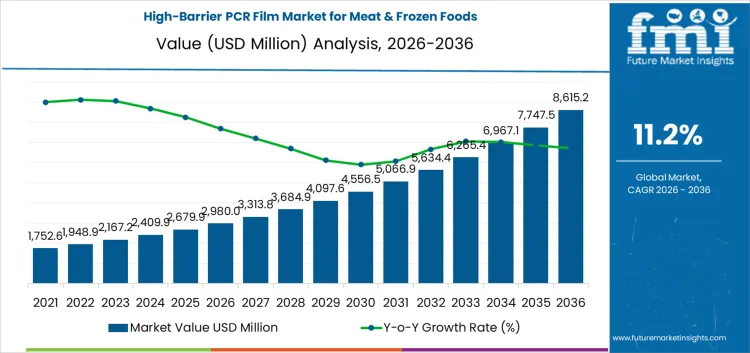
High-Barrier PCR Film Market for Meat & Frozen Foods Key Takeaways
| Metric | Value |
|---|---|
| High-Barrier PCR Film Market Value (2026) | USD 2,980 Million |
| High-Barrier PCR Film Market Forecast Value (2036) | USD 8,615.2 Million |
| High-Barrier PCR Film Market Forecast CAGR 2026 to 2036 | 11.2% |
How are Shelf-Life Protection and Recycled-Content Mandates Redefining High-Barrier PCR Films for Meat & Frozen Foods?
Adoption of high-barrier PCR films in meat and frozen food packaging is accelerating as brands reconcile recycled-content targets with stringent shelf-life and food-safety requirements. These applications demand exceptional oxygen and moisture barriers, puncture resistance, and seal integrity across cold-chain logistics. For film manufacturers and converters, value creation is shifting toward multilayer architectures that maintain performance parity with virgin materials while incorporating certified PCR content without compromising machinability on high-speed lines.
Qualification and risk management now dominate procurement decisions. Meat processors and frozen food brands are prioritizing PCR films with validated barrier retention, low odor/taint, and consistent mechanical properties under freezing and thaw cycles. This elevates demand for advanced compatibilization, tie-layer optimization, and selective PCR placement within multilayer stacks. Suppliers that can provide data-backed performance validation, food-contact compliance dossiers, and rapid trial support are securing preferred-vendor status.
Supply assurance and scalability are emerging as differentiators as volumes ramp. Reliable access to high-quality PCR streams suitable for barrier films remains constrained, pushing converters toward long-term agreements with recyclers and compounders. Investments in improved sorting, decontamination, and inline quality control are reducing variability but extend qualification timelines. For stakeholders across the value chain, competitive advantage increasingly depends on integrating material science, compliance readiness, and resilient sourcing positioning high-barrier PCR films as a strategic enabler for sustainable meat and frozen food packaging growth.
How Is The High-Barrier PCR Film Market For Meat & Frozen Foods Structured By End Use And Film Design?
The high-barrier PCR film market for meat & frozen foods is segmented by end use and film structure, reflecting how shelf-life protection, seal integrity, and cold-chain performance influence material selection. By end use, fresh and frozen meat leads the market, driven by strict requirements for oxygen control, moisture resistance, and contamination prevention. Other end uses include processed meat and poultry, premium frozen foods, mass frozen foods, frozen food exports, and meat exports, each demanding specific barrier and mechanical properties. By film structure, multi-layer barrier films represent the leading configuration, while vacuum and MAP films, thin high-barrier films, and barrier laminates support diverse packaging and processing needs.
Why Do Fresh And Frozen Meat Applications Lead Demand In The High-Barrier PCR Film Market For Meat & Frozen Foods?
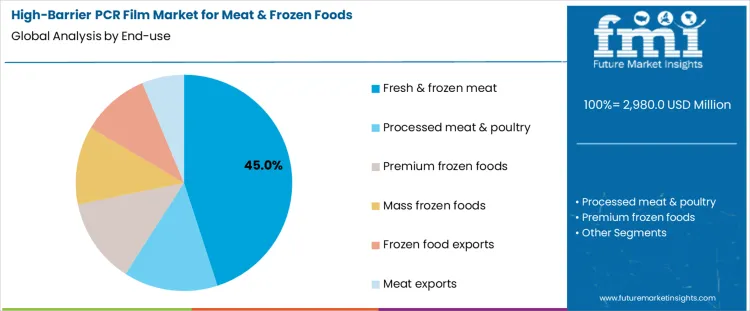
Fresh and frozen meat accounts for 45% share of the high-barrier PCR film market for meat & frozen foods because protein products are highly sensitive to oxygen exposure, moisture loss, and microbial growth. Packaging must preserve appearance, texture, and product integrity throughout refrigerated and frozen storage. High-barrier PCR films provide the required protection during long distribution cycles and retail handling. Processors prefer film structures that perform reliably on high-speed packaging lines without compromising seal strength. Large retail volumes and export flows increase packaging consumption. Continuous improvements in film engineering improve odor control and barrier consistency, reinforcing demand from meat processors.
Why Do Multi-Layer Barrier Films Dominate Film Structures In The High-Barrier PCR Film Market For Meat & Frozen Foods?
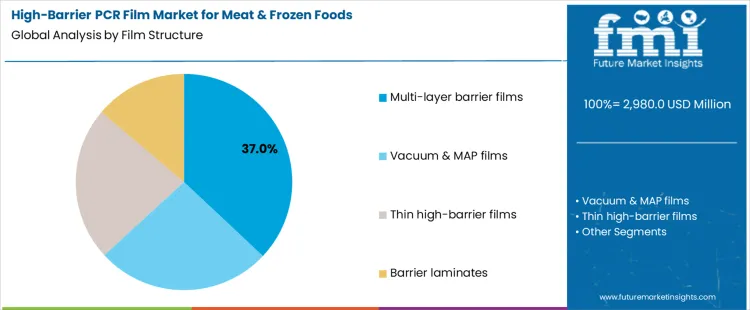
Multi-layer barrier films hold 37% share of the high-barrier PCR film market for meat & frozen foods because layered constructions combine gas barrier, sealant, and strength layers within a single structure. This design allows converters to tailor performance for vacuum sealing and modified atmosphere packaging. Multi-layer films withstand freezing temperatures, mechanical stress, and handling without delamination. They also support downgauging while maintaining package integrity and machinability. Packaging converters value their compatibility with co-extrusion and lamination processes. These functional and manufacturing advantages explain why multi-layer barrier films remain the dominant film structure.
What Are The Key Dynamics Of The High-Barrier PCR Film Market For Meat & Frozen Foods?
The high-barrier PCR film market for meat and frozen foods is influenced by growing demand for packaging that delivers extended shelf life, superior moisture and oxygen protection, and reliable mechanical strength. High-barrier films, often built with multilayer structures and engineered resins, are critical for preserving product quality, reducing drip loss, and maintaining food safety in chilled and frozen supply chains. For film producers, resin performance (gas transmission rates, seal strength, toughness), production throughput, and compatibility with existing converting lines are central purchasing factors. Availability of post-consumer recycled (PCR) resins in required quality grades and stable supply arrangements also guide procurement strategies.
How Are Application Requirements And Industry Standards Shaping This Market?
Application requirements and industry standards are shaping the high-barrier PCR film market for meat and frozen foods by establishing performance thresholds for permeability, puncture resistance, and thermal stability. Retailers and processors specify minimum oxygen and water vapor transmission rates (OTR/WVTR) to ensure packaged products maintain color, flavor, and texture throughout distribution. Certification protocols and compliance with food contact regulations influence material selection and documentation. Advances in film extrusion and co-extrusion technology allow manufacturers to achieve targeted barrier profiles with optimized layer stacking, enabling PCR content integration without compromising functional attributes. Packaging design compatibility with automated fill-seal equipment and convenience features (easy-peel seals) further shape material choices.
Why Do Quality Consistency And Technical Integration Challenges Restrain Market Expansion?
Quality consistency and technical integration challenges restrain adoption of high-barrier PCR film for meat and frozen foods. Presence of PCR resin introduces variability in color, odor, and barrier performance that must be tightly controlled to meet stringent application requirements. Achieving consistent multilayer film structures with uniform barrier properties demands precise process control, sophisticated extrusion systems, and skilled operators. Food contact regulations require rigorous testing, documentation, and certification, extending qualification cycles. Compatibility with high-speed form-fill-seal and thermoforming lines adds complexity, and any deviation can lead to production stoppages or packaging defects. These technical and operational constraints limit rapid scaling of PCR integration.
What Is the Country-Wise Outlook for the High-Barrier PCR Film Market for Meat & Frozen Foods?
The high-barrier PCR film market for meat and frozen foods is driven by sustainability targets, food-safety requirements, and advances in multilayer film engineering. Adoption varies by country based on regulatory acceptance of food-contact PCR, cold-chain penetration, and capability to maintain oxygen and moisture barriers using recycled content. Mature markets prioritize performance validation, shelf-life protection, and compliance, while emerging economies focus on rapid capacity build-out and brand-led commitments to circular packaging. Growth is supported by improvements in decontamination, compatibilizers, and co-extrusion technologies that enable PCR integration without compromising barrier integrity. Suppliers offering certified PCR, application engineering, and reliable supply chains are best positioned across countries.
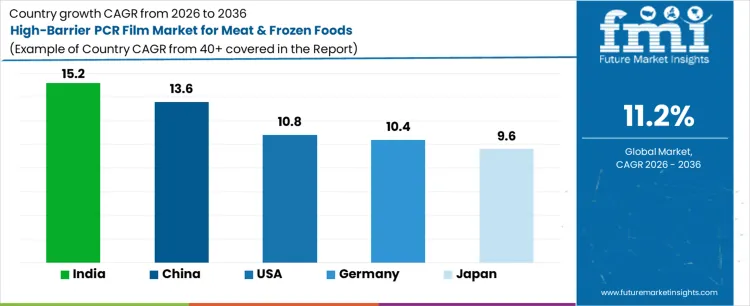
| Country | CAGR (%) |
|---|---|
| India | 15.2% |
| China | 13.6% |
| United States | 10.8% |
| Germany | 10.4% |
| Japan | 9.6% |
How Is Germany Advancing Compliant, High-Performance PCR Films for Meat and Frozen Foods?
Demand for high-barrier PCR film for meat and frozen foods in Germany, growing at a CAGR of 10.4% during 2026-2036, is driven by stringent food-contact regulations and strong retailer pressure for circular packaging. German meat and frozen-food processors require PCR-enabled films that preserve oxygen and moisture barriers while ensuring migration safety and odor neutrality. Adoption is largely upgrade-led, with converters optimizing multilayer co-extrusion structures combining EVOH or PA barriers with certified PCR layers. Buyers emphasize documented compliance, traceability, and consistent resin performance to protect shelf life and sensory quality. Qualification cycles are long and specification-intensive, often involving pilot trials and shelf-life validation. Volumes are moderate, but value per project remains high due to engineering complexity and regulatory oversight. Procurement favors suppliers capable of delivering validated decontamination processes, color control, and stable long-term supply.
What Is Driving Rapid Uptake of High-Barrier PCR Films in the United States?
Sale of high-barrier PCR film for meat and frozen foods in the United States, expanding at a CAGR of 10.8% during 2026-2036, is propelled by brand sustainability commitments and growing availability of food-grade PCR resins. Meat processors and frozen-food brands seek PCR-integrated films that maintain machinability on high-speed packaging lines while preserving barrier performance under cold-chain conditions. Buyers prioritize FDA compliance, resin consistency, and supply security across national operations. Adoption often begins with secondary or non-contact layers, followed by gradual increases in PCR content as validation confidence improves. Procurement decisions focus on scalability, uptime reliability, and technical collaboration rather than lowest material cost. Investments in advanced recycling and sorting infrastructure support broader PCR adoption. The US market rewards suppliers offering modular film structures, formulation flexibility, and strong technical service.
How Is Japan Applying Precision Standards to PCR Film Adoption for Frozen Proteins?
The high-barrier PCR film market for meat and frozen foods in Japan, growing at a CAGR of 9.6% during the forecast period, reflects a precision-focused and conservative adoption approach. Japanese processors prioritize maintaining barrier integrity, odor neutrality, and dimensional stability during freezing and thawing cycles. PCR integration is incremental, with extensive pilot testing and long validation timelines. Buyers emphasize compact multilayer designs, energy efficiency, and highly controlled processing conditions. Procurement favors suppliers with advanced purification technologies, strong documentation, and proven consistency across batches. Volumes remain measured, but quality expectations are among the highest globally. Japan rewards suppliers that can demonstrate repeatable performance, long-term reliability, and close technical collaboration. The market emphasizes incremental quality improvement over rapid scale-up, making it attractive for technology providers with strong engineering credibility and ability to support stringent food-safety and performance benchmarks.
Why Is China Becoming a Major Growth Engine for High-Barrier PCR Films?
Demand for high-barrier PCR film for meat and frozen foods in China, expanding at a CAGR of 13.6% during 2026-2036, is driven by rapid growth in packaged protein consumption and evolving plastic waste regulations. Large meat processors and frozen-food brands are increasing use of flexible packaging, creating demand for scalable PCR-enabled barrier films. Buyers focus on throughput, cost efficiency, and compatibility with mixed PCR feedstocks. Domestic suppliers compete aggressively in standard multilayer structures, while international players target higher-performance applications requiring improved barrier and cleanliness. Adoption is largely volume-led, with qualification timelines shorter than in Europe or Japan. Procurement decisions emphasize pricing discipline, local service availability, and rapid installation. China represents a scale-driven market where supplier success depends on high-capacity production, localized partnerships, and the ability to progressively improve PCR quality as regulatory and brand expectations evolve.
How Is India Emerging as the Fastest-Growing Market for PCR Barrier Films in Frozen Foods?
The high-barrier PCR film market for meat and frozen foods in India, growing at a CAGR of 15.2% during 2026-2036, reflects rapid expansion of cold-chain infrastructure and branded packaged protein consumption. Adoption is primarily greenfield-led, as new meat and frozen-food processing facilities incorporate PCR-compatible packaging from the outset. Buyers emphasize affordability, modular film designs, and compatibility with heterogeneous PCR inputs. Food-safety validation is gaining importance as exports and organized retail expand. Procurement decisions remain cost-sensitive but increasingly consider consistency, odor control, and barrier performance. India represents a high-growth, early-stage market where suppliers offering adaptable structures, phased PCR integration, and local technical support can secure long-term positioning as packaging standards mature.
What Is Driving Competition in the High-Barrier PCR Film Market for Meat & Frozen Foods?
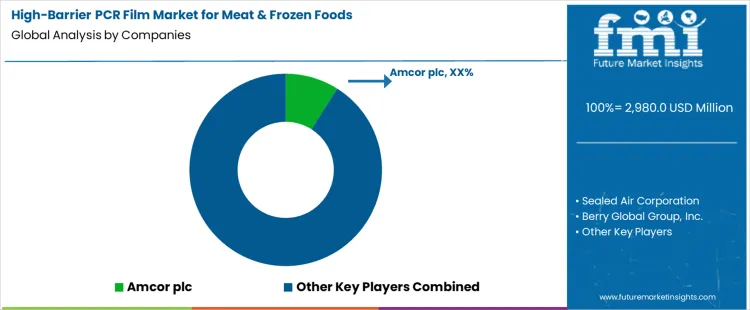
Competition in the high-barrier PCR (post-consumer recycled) film market for meat and frozen foods is anchored in verified barrier performance, PCR content claims, and processing compatibility documented in official product literature. Amcor plc positions its PCR-enhanced high-barrier films with brochures highlighting oxygen and moisture barrier ratings tailored to fresh meat and frozen supply chains. Product datasheets emphasize consistent seal integrity, thermoformability, and certified recycled content levels aligned with food contact regulations. Sealed Air Corporation competes through multi-layer PCR film constructions engineered for freezer performance, with official materials detailing retort and cold chain durability and validated barrier metrics based on standard testing protocols.
Broader portfolio strength and customization are key differentiators. Berry Global Group, Inc. offers high-barrier PCR films with documentation that highlights calibrated barrier layers, high PCR percentages, and processing windows compatible with vacuum and modified atmosphere packaging (MAP) lines. Mondi plc positions its PCR film solutions around tailored barrier performance profiles supported by technical literature that quantifies oxygen transmission rates (OTR) and water vapor transmission rates (WVTR) for extended shelf life.
Japan and Asia-Pacific producers focus on balanced performance and cost-effectiveness. Toppan Inc. and Mitsubishi Chemical Packaging Corporation differentiate through high-precision co-extrusion technology documented in brochures that emphasize uniform barrier distribution and PCR compatibility with thermoforming processes. Shanghai Zijiang Enterprise Group Co., Ltd. and Greatview Aseptic Packaging Co., Ltd. compete via regional supply strength and documented PCR film grades optimized for frozen and chilled meat applications, with product guides focusing on barrier stability across fluctuating freezer conditions. Across all players, competitive value is established through brochure-verified barrier data, processing adaptability, and documented PCR traceability rather than by price alone.
Key Players in High-Barrier PCR Film Market for Meat & Frozen Foods
- Amcor plc
- Sealed Air Corporation
- Berry Global Group, Inc.
- Mondi plc
- Toppan Inc.
- Mitsubishi Chemical Packaging Corporation
- Shanghai Zijiang Enterprise Group Co., Ltd.
- Greatview Aseptic Packaging Co., Ltd.
Scope of Report
| Attribute | Description |
|---|---|
| Quantitative Unit | USD Million |
| End-use | Fresh & Frozen Meat, Processed Meat & Poultry, Premium Frozen Foods, Mass Frozen Foods, Frozen Food Exports, Meat Exports |
| Film Structure | Multi-Layer Barrier Films, Vacuum & MAP Films, Thin High-Barrier Films, Barrier Laminates |
| Countries Covered | China, Japan, South Korea, India, Australia & New Zealand, ASEAN, Rest of Asia Pacific, Germany, United Kingdom, France, Italy, Spain, Nordic, BENELUX, Rest of Europe, United States, Canada, Mexico, Brazil, Chile, Rest of Latin America, Kingdom of Saudi Arabia, Other GCC Countries, Turkey, South Africa, Other African Union, Rest of Middle East & Africa |
| Regions Covered | Asia Pacific, Europe, North America, Latin America, Middle East & Africa |
| Key Companies Profiled | Amcor plc, Sealed Air Corporation, Berry Global Group, Inc., Mondi plc, Toppan Inc., Mitsubishi Chemical Packaging Corporation, Shanghai Zijiang Enterprise Group Co., Ltd., Greatview Aseptic Packaging Co., Ltd. |
| Additional Attributes | Dollar sales by end-use and film structure are assessed across chilled and frozen protein packaging applications. The report includes country-level demand assessment, growth projections for 2026-2036, analysis of oxygen and moisture barrier performance, evaluation of PCR content compliance and recyclability, competitive benchmarking of suppliers, and assessment of sustainability-driven adoption across meat processors and frozen food exporters. |
High-Barrier PCR Film Market for Meat & Frozen Foods by Key Segments
End-use
- Fresh & frozen meat
- Processed meat & poultry
- Premium frozen foods
- Mass frozen foods
- Frozen food exports
- Meat exports
Film Structure
- Multi-layer barrier films
- Vacuum & MAP films
- Thin high-barrier films
- Barrier laminates
Region
- Asia Pacific
- China
- Japan
- South Korea
- India
- Australia & New Zealand
- ASEAN
- Rest of Asia Pacific
- Europe
- Germany
- United Kingdom
- France
- Italy
- Spain
- Nordic
- BENELUX
- Rest of Europe
- North America
- United States
- Canada
- Mexico
- Latin America
- Brazil
- Chile
- Rest of Latin America
- Middle East & Africa
- Kingdom of Saudi Arabia
- Other GCC Countries
- Turkey
- South Africa
- Other African Union
- Rest of Middle East & Africa
Bibliography
- European Food Safety Authority. (2025). Guidance on the safety assessment of recycled plastics in food contact materials. EFSA Journal.
- European Commission Directorate-General for Health and Food Safety. (2025). Regulation on recycled content and food contact materials (2025 framework). Publications Office of the EU.
- Food Standards Agency. (2024). Guidelines for assessment of recycled plastics in food contact applications. FSA.
Frequently Asked Questions
How big is the high-barrier PCR film market for meat & frozen foods in 2026?
The global high-barrier PCR film market for meat & frozen foods is estimated to be valued at USD 2,980.0 million in 2026.
What will be the size of high-barrier PCR film market for meat & frozen foods in 2036?
The market size for the high-barrier PCR film market for meat & frozen foods is projected to reach USD 8,615.2 million by 2036.
How much will be the high-barrier PCR film market for meat & frozen foods growth between 2026 and 2036?
The high-barrier PCR film market for meat & frozen foods is expected to grow at a 11.2% CAGR between 2026 and 2036.
What are the key product types in the high-barrier PCR film market for meat & frozen foods?
The key product types in high-barrier PCR film market for meat & frozen foods are fresh & frozen meat, processed meat & poultry, premium frozen foods, mass frozen foods, frozen food exports and meat exports.
Which film structure segment to contribute significant share in the high-barrier PCR film market for meat & frozen foods in 2026?
In terms of film structure, multi-layer barrier films segment to command 37.0% share in the high-barrier PCR film market for meat & frozen foods in 2026.
Preview the report firsthand - request a free sample
Get SampleGet the brochure for pricing and purchase details.
Get PDFTable of Content
- Executive Summary
- Global Market Outlook
- Demand-side Trends
- Supply-side Trends
- Technology Roadmap Analysis
- Analysis and Recommendations
- Market Overview
- Market Coverage / Taxonomy
- Market Definition / Scope / Limitations
- Market Background
- Market Dynamics
- Drivers
- Restraints
- Opportunity
- Trends
- Scenario Forecast
- Demand in Optimistic Scenario
- Demand in Likely Scenario
- Demand in Conservative Scenario
- Opportunity Map Analysis
- Product Life Cycle Analysis
- Supply Chain Analysis
- Investment Feasibility Matrix
- Value Chain Analysis
- PESTLE and Porter’s Analysis
- Regulatory Landscape
- Regional Parent Market Outlook
- Production and Consumption Statistics
- Import and Export Statistics
- Market Dynamics
- Global Market Analysis 2021 to 2025 and Forecast, 2026 to 2036
- Historical Market Size Value (USD Million) Analysis, 2021 to 2025
- Current and Future Market Size Value (USD Million) Projections, 2026 to 2036
- Y-o-Y Growth Trend Analysis
- Absolute $ Opportunity Analysis
- Global Market Pricing Analysis 2021 to 2025 and Forecast 2026 to 2036
- Global Market Analysis 2021 to 2025 and Forecast 2026 to 2036, By End-use
- Introduction / Key Findings
- Historical Market Size Value (USD Million) Analysis By End-use , 2021 to 2025
- Current and Future Market Size Value (USD Million) Analysis and Forecast By End-use , 2026 to 2036
- Fresh & frozen meat
- Processed meat & poultry
- Premium frozen foods
- Mass frozen foods
- Frozen food exports
- Meat exports
- Fresh & frozen meat
- Y-o-Y Growth Trend Analysis By End-use , 2021 to 2025
- Absolute $ Opportunity Analysis By End-use , 2026 to 2036
- Global Market Analysis 2021 to 2025 and Forecast 2026 to 2036, By Film Structure
- Introduction / Key Findings
- Historical Market Size Value (USD Million) Analysis By Film Structure, 2021 to 2025
- Current and Future Market Size Value (USD Million) Analysis and Forecast By Film Structure, 2026 to 2036
- Multi-layer barrier films
- Vacuum & MAP films
- Thin high-barrier films
- Barrier laminates
- Multi-layer barrier films
- Y-o-Y Growth Trend Analysis By Film Structure, 2021 to 2025
- Absolute $ Opportunity Analysis By Film Structure, 2026 to 2036
- Global Market Analysis 2021 to 2025 and Forecast 2026 to 2036, By Region
- Introduction
- Historical Market Size Value (USD Million) Analysis By Region, 2021 to 2025
- Current Market Size Value (USD Million) Analysis and Forecast By Region, 2026 to 2036
- North America
- Latin America
- Western Europe
- Eastern Europe
- East Asia
- South Asia and Pacific
- Middle East & Africa
- Market Attractiveness Analysis By Region
- North America Market Analysis 2021 to 2025 and Forecast 2026 to 2036, By Country
- Historical Market Size Value (USD Million) Trend Analysis By Market Taxonomy, 2021 to 2025
- Market Size Value (USD Million) Forecast By Market Taxonomy, 2026 to 2036
- By Country
- USA
- Canada
- Mexico
- By End-use
- By Film Structure
- By Country
- Market Attractiveness Analysis
- By Country
- By End-use
- By Film Structure
- Key Takeaways
- Latin America Market Analysis 2021 to 2025 and Forecast 2026 to 2036, By Country
- Historical Market Size Value (USD Million) Trend Analysis By Market Taxonomy, 2021 to 2025
- Market Size Value (USD Million) Forecast By Market Taxonomy, 2026 to 2036
- By Country
- Brazil
- Chile
- Rest of Latin America
- By End-use
- By Film Structure
- By Country
- Market Attractiveness Analysis
- By Country
- By End-use
- By Film Structure
- Key Takeaways
- Western Europe Market Analysis 2021 to 2025 and Forecast 2026 to 2036, By Country
- Historical Market Size Value (USD Million) Trend Analysis By Market Taxonomy, 2021 to 2025
- Market Size Value (USD Million) Forecast By Market Taxonomy, 2026 to 2036
- By Country
- Germany
- UK
- Italy
- Spain
- France
- Nordic
- BENELUX
- Rest of Western Europe
- By End-use
- By Film Structure
- By Country
- Market Attractiveness Analysis
- By Country
- By End-use
- By Film Structure
- Key Takeaways
- Eastern Europe Market Analysis 2021 to 2025 and Forecast 2026 to 2036, By Country
- Historical Market Size Value (USD Million) Trend Analysis By Market Taxonomy, 2021 to 2025
- Market Size Value (USD Million) Forecast By Market Taxonomy, 2026 to 2036
- By Country
- Russia
- Poland
- Hungary
- Balkan & Baltic
- Rest of Eastern Europe
- By End-use
- By Film Structure
- By Country
- Market Attractiveness Analysis
- By Country
- By End-use
- By Film Structure
- Key Takeaways
- East Asia Market Analysis 2021 to 2025 and Forecast 2026 to 2036, By Country
- Historical Market Size Value (USD Million) Trend Analysis By Market Taxonomy, 2021 to 2025
- Market Size Value (USD Million) Forecast By Market Taxonomy, 2026 to 2036
- By Country
- China
- Japan
- South Korea
- By End-use
- By Film Structure
- By Country
- Market Attractiveness Analysis
- By Country
- By End-use
- By Film Structure
- Key Takeaways
- South Asia and Pacific Market Analysis 2021 to 2025 and Forecast 2026 to 2036, By Country
- Historical Market Size Value (USD Million) Trend Analysis By Market Taxonomy, 2021 to 2025
- Market Size Value (USD Million) Forecast By Market Taxonomy, 2026 to 2036
- By Country
- India
- ASEAN
- Australia & New Zealand
- Rest of South Asia and Pacific
- By End-use
- By Film Structure
- By Country
- Market Attractiveness Analysis
- By Country
- By End-use
- By Film Structure
- Key Takeaways
- Middle East & Africa Market Analysis 2021 to 2025 and Forecast 2026 to 2036, By Country
- Historical Market Size Value (USD Million) Trend Analysis By Market Taxonomy, 2021 to 2025
- Market Size Value (USD Million) Forecast By Market Taxonomy, 2026 to 2036
- By Country
- Kingdom of Saudi Arabia
- Other GCC Countries
- Turkiye
- South Africa
- Other African Union
- Rest of Middle East & Africa
- By End-use
- By Film Structure
- By Country
- Market Attractiveness Analysis
- By Country
- By End-use
- By Film Structure
- Key Takeaways
- Key Countries Market Analysis
- USA
- Pricing Analysis
- Market Share Analysis, 2025
- By End-use
- By Film Structure
- Canada
- Pricing Analysis
- Market Share Analysis, 2025
- By End-use
- By Film Structure
- Mexico
- Pricing Analysis
- Market Share Analysis, 2025
- By End-use
- By Film Structure
- Brazil
- Pricing Analysis
- Market Share Analysis, 2025
- By End-use
- By Film Structure
- Chile
- Pricing Analysis
- Market Share Analysis, 2025
- By End-use
- By Film Structure
- Germany
- Pricing Analysis
- Market Share Analysis, 2025
- By End-use
- By Film Structure
- UK
- Pricing Analysis
- Market Share Analysis, 2025
- By End-use
- By Film Structure
- Italy
- Pricing Analysis
- Market Share Analysis, 2025
- By End-use
- By Film Structure
- Spain
- Pricing Analysis
- Market Share Analysis, 2025
- By End-use
- By Film Structure
- France
- Pricing Analysis
- Market Share Analysis, 2025
- By End-use
- By Film Structure
- India
- Pricing Analysis
- Market Share Analysis, 2025
- By End-use
- By Film Structure
- ASEAN
- Pricing Analysis
- Market Share Analysis, 2025
- By End-use
- By Film Structure
- Australia & New Zealand
- Pricing Analysis
- Market Share Analysis, 2025
- By End-use
- By Film Structure
- China
- Pricing Analysis
- Market Share Analysis, 2025
- By End-use
- By Film Structure
- Japan
- Pricing Analysis
- Market Share Analysis, 2025
- By End-use
- By Film Structure
- South Korea
- Pricing Analysis
- Market Share Analysis, 2025
- By End-use
- By Film Structure
- Russia
- Pricing Analysis
- Market Share Analysis, 2025
- By End-use
- By Film Structure
- Poland
- Pricing Analysis
- Market Share Analysis, 2025
- By End-use
- By Film Structure
- Hungary
- Pricing Analysis
- Market Share Analysis, 2025
- By End-use
- By Film Structure
- Kingdom of Saudi Arabia
- Pricing Analysis
- Market Share Analysis, 2025
- By End-use
- By Film Structure
- Turkiye
- Pricing Analysis
- Market Share Analysis, 2025
- By End-use
- By Film Structure
- South Africa
- Pricing Analysis
- Market Share Analysis, 2025
- By End-use
- By Film Structure
- USA
- Market Structure Analysis
- Competition Dashboard
- Competition Benchmarking
- Market Share Analysis of Top Players
- By Regional
- By End-use
- By Film Structure
- Competition Analysis
- Competition Deep Dive
- Amcor plc
- Overview
- Product Portfolio
- Profitability by Market Segments (Product/Age /Sales Channel/Region)
- Sales Footprint
- Strategy Overview
- Marketing Strategy
- Product Strategy
- Channel Strategy
- Sealed Air Corporation
- Berry Global Group, Inc.
- Mondi plc
- Toppan Inc.
- Mitsubishi Chemical Packaging Corporation
- Shanghai Zijiang Enterprise Group Co., Ltd.
- Greatview Aseptic Packaging Co., Ltd.
- Amcor plc
- Competition Deep Dive
- Assumptions & Acronyms Used
- Research Methodology


