

- Industry Size (2025)
- USD 0.7 Bn
- Forecast (2035)
- USD 1.1 Bn
- CAGR (2025 to 2035)
- 4.4%
Demand for PCR Films in USA 2025 to 2035
The USA PCR films demand is valued at USD 0.7 billion in 2025 and is anticipated to reach USD 1.1 billion by 2035, indicating a CAGR of 4.4%. Growth is supported by heightened sustainability mandates that favor reduced virgin plastic content in consumer and industrial packaging. Brand commitments to circularity and retailer-driven packaging scorecards continue to accelerate the shift toward recycled content integration across food, personal care, and pharmaceutical applications.
Polyethylene terephthalate (PET) is the leading material due to its strong mechanical properties, clarity, and established recycling streams that enable consistent post-consumer resin availability. Performance enhancements in barrier coatings and multilayer structures help maintain product shelf life while increasing recycled content levels. Converters prioritize stable film gauge control and printability to support premium packaging formats without compromising sustainability targets.
The West, South, and Northeast regions record strong uptake driven by advanced plastic recovery infrastructure, brand-owner ESG commitments, and regulatory focus on packaging lifecycle impacts. National Scientific Corporation, Vitl Life Science Solutions, BioPointe Scientific, Eppendorf, and Brooks Life Sciences (SSIbio) represent key suppliers. Their priorities include improving PCR purity, scaling food-grade supply, and optimizing film compatibility with high-speed packaging lines to meet stringent quality and sustainability requirements.
Quick Stats for USA PCR Films Demand
- USA PCR Films Sales Value (2025): USD 0.7 billion
- USA PCR Films Forecast Value (2035): USD 1.1 billion
- USA PCR Films Forecast CAGR (2025–2035): 4.4%
- Leading Material in USA PCR Films Demand: Polyethylene Terephthalate (PET)
- Key Growth Regions in USA PCR Films Demand: West USA, South USA, Northeast USA
- Top Players in USA PCR Films Demand: National Scientific Corporation, Vitl Life Science Solutions, BioPointe Scientific, Eppendorf, Brooks Life Sciences (SSIbio)
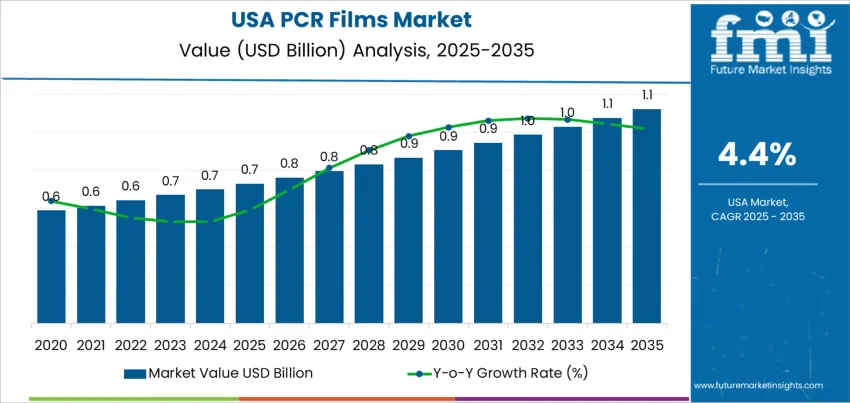
What is the Growth Forecast for PCR Films Industry in USA through 2035?
Demand for PCR films in the United States shows an acceleration pattern in the initial forecast years due to rapid shifts in sustainability mandates and brand commitments to reduce virgin plastic usage. The early acceleration is driven by strong adoption across the food packaging, personal care, and e-commerce sectors, which seek environmentally responsible solutions aligned with corporate ESG goals. Government-led recycling initiatives and retailer packaging standards also increase PCR film usage rates, contributing to upward growth momentum.
As the period progresses, the rate of acceleration begins to moderate. Supply chain limitations for high-quality recycled resin, cost premiums over conventional films, and performance constraints in applications requiring strict barrier properties introduce deceleration pressures. Competition from compostable and paper-based alternatives further disperses growth across multiple eco-friendly packaging pathways, rather than concentrating demand solely on PCR films. The shift from rapid policy-led adoption to cost-benefit scrutiny results in more balanced, steady growth during the later timeline. This creates a growth curve that rises quickly at first, then tapers into a stable trajectory as the United States packaging industry approaches wider material diversification and improved recycling infrastructure.
USA PCR Films Key Takeaways
| Metric | Value |
|---|---|
| USA PCR Films Sales Value (2025) | USD 0.7 billion |
| USA PCR Films Forecast Value (2035) | USD 1.1 billion |
| USA PCR Films Forecast CAGR (2025-2035) | 4.4% |
Why is the Demand for PCR Films in the USA Growing?
Demand for PCR (post-consumer recycled) films in the USA is increasing because packaging manufacturers and brand owners focus on sustainability and waste reduction. Many states and retailers now encourage or require higher recycling content in plastic packaging, which drives demand for films made from recycled materials. Food, beverage and consumer-goods companies choose PCR films to meet corporate environmental goals and satisfy consumer expectations for recyclable or recycled packaging. E commerce and direct shipping of household and personal-care products support use of flexible film packaging that balances durability, lightweight shipping and environmental impact. PCR films help reduce reliance on virgin resin and lower carbon footprint while preserving necessary barrier and sealing properties.
Supply chain tightening for virgin plastic resin, together with rising resin costs, further motivates packaging converters to adopt PCR films. Advances in recycling and film-production technology improve consistency, clarity and physical performance of PCR films, making them a viable alternative for many packaging formats. Constraints include limitations in moisture and oxygen barrier performance compared with virgin materials in some sensitive product categories. Some buyers hesitate when recycled film prices fluctuate or when supply reliability is uncertain. Regulatory compliance and quality control standards may require additional testing when PCR content is increased.
Which Materials, Applications, and Formats Lead Demand for PCR Films in the USA?
Demand for post-consumer recycled (PCR) films in the United States is driven by regulatory pressure to increase recycled plastic content and corporate sustainability mandates. Packaging producers prioritize high-clarity resins, durability, and barrier properties suitable for food, household, and personal care categories. As consumer brands commit to PCR integration in rigid and flexible packaging, usage expands in thermoforming and extrusion operations, supporting national recycling infrastructure. Growth is influenced by material availability, processing compatibility, and state-level laws on recycled content.
By Material, PET Holds the Largest Share
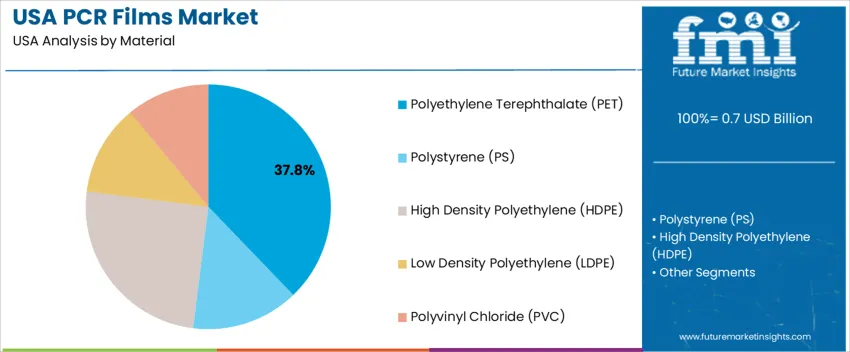
Polyethylene terephthalate (PET) leads with 37.8%, supported by strong recycling stream recovery and suitability for transparent packaging formats. High-density polyethylene (HDPE) accounts for 25.0%, favored in durable packaging for household and personal care products. Polystyrene (PS) stands at 14.2%, primarily used in protective and rigid food packaging segments. Low-density polyethylene (LDPE) holds 12.0%, contributing to flexible protective films. Polyvinyl chloride (PVC) makes up 11.0%, maintained in specific medical and industrial applications requiring strength and formability. Material adoption corresponds to recyclability standards, mechanical performance, and compliance with USA packaging circularity programs.
Key Points:
- PET supports high-clarity thermoformed and rigid packaging
- HDPE meets performance needs for household and chemical products
- PS and LDPE enable lightweight protective and flexible formats
By Application, Trays Lead Adoption
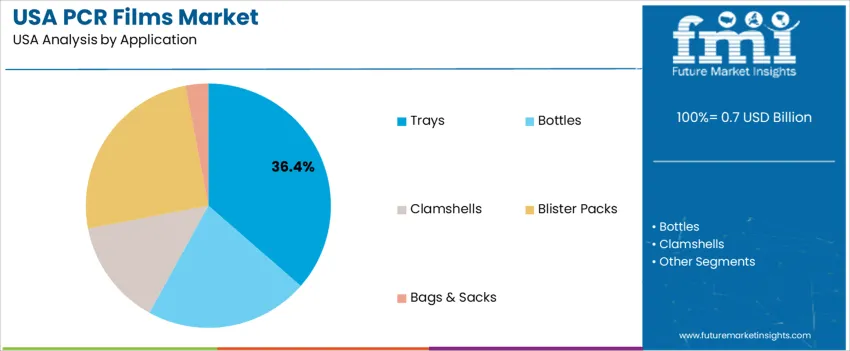
Trays represent 36.4%, driven by PCR use in food-grade thermoformed solutions across retail and institutional channels. Blister packs hold 25.0%, widely used in healthcare and personal care packaging requiring product visibility and impact resistance. Bottles account for 21.6%, linked to beverage and hygiene packaging. Clamshells contribute 14.0%, serving fresh produce and consumer goods. Bags and sacks represent 3.0%, limited by performance requirements and lower recycling availability for flexible films. USA adoption patterns follow strong demand for rigid food containers and regulated healthcare packaging that support the inclusion of verified recycled content.
Key Points:
- Rigid food trays dominate PCR thermoforming
- Blister pack usage rises in healthcare and personal care
- Bottle adoption grows under recycled content mandates
By Packaging Format, Bottles Hold the Largest Share
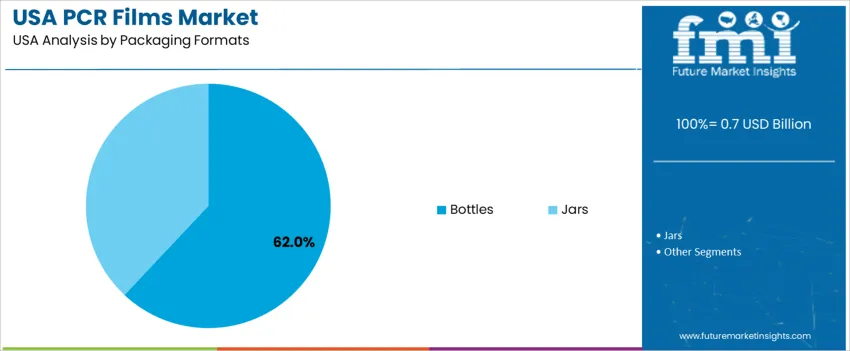
Bottles lead with 62.0%, reflecting strong recycling infrastructure and brand commitments in beverages, personal care, and household chemicals. Jars account for 38.0%, used in spreads, powdered supplements, and food condiments requiring structural rigidity. Format preference is tied to lightweighting trends, compatibility with recycled resin pellet quality, and ability to maintain product safety and shelf appeal.
Key Points:
- Bottles remain the primary PCR resin usage category
- Jars support growth across condiments and nutrition products
- Adoption aligns with circular economy and retail sustainability targets
What are the Drivers, Restraints, and Key Trends of the Demand for PCR Films in the USA?
Growth of molecular diagnostics testing, expansion of biotech and pharmaceutical R&D, and increased adoption of high-throughput PCR workflows drive demand.
In the United States, PCR films are essential sealing materials for PCR plates used in clinical diagnostics, academic research and industrial biotechnology. Hospitals and reference laboratories continue to run high volumes of molecular tests for infectious diseases, genetic screening and oncology panels, supporting consistent replenishment of PCR consumables. Biopharmaceutical companies use PCR-based assays in cell line development, quality testing and biologics production, increasing procurement through contract research and manufacturing networks. Universities and federal research institutes maintain strong demand due to active genomics and proteomics programs. Automation in PCR workflows expands film usage because sealing quality must ensure sample integrity, prevent evaporation and support reliable thermocycling. These sectorwide applications support sustained demand for PCR films across USA laboratory environments.
Price sensitivity for laboratory consumables, storage and handling challenges, and competition from heat-seal equipment restrain demand.
Laboratories face budget constraints that limit spending on higher-priced film products, especially when procurement volume is high in routine testing. Incorrect application or storage can reduce film adhesion performance, causing risk of sample evaporation and repeat testing. Some facilities adopt plate heat-seal solutions for long-run PCR workflows due to improved sealing durability, shifting procurement away from adhesive films in specific applications. Smaller research labs may rely on lower-cost sealing materials such as foil seals for non-critical assays, reducing conversion to premium PCR films. These practical and economic challenges moderate faster penetration across all testing environments.
Shift toward low-autofluorescence, pierceable and temperature-stable films, increased integration with automated plate handling systems and rising focus on contamination-control define key trends.
Manufacturers develop films optimized for real-time PCR detection with clear optical transmission and minimal background signal. Pierceable and resealable films gain importance in workflows requiring repeated access to wells, including sampling and liquid-handling robotics. Improved adhesive chemistry ensures durability across high-temperature cycles without compromising sample recovery. Facilities adopt sterile packaging formats and color-coded labeling to enhance traceability and contamination control in high-volume testing labs. These developments indicate steady, technology-driven demand for PCR films across the United States supported by precision diagnostics growth and ongoing innovation in laboratory automation.
Analysis of the Demand for PCR Films in the USA by Region
Demand for PCR (Polymerase Chain Reaction) films in the United States is expanding due to the growing use of PCR-based diagnostics, molecular research, and high-throughput laboratory workflows across clinical, pharmaceutical, and biotech environments. These sealing films ensure sample integrity, prevent evaporation, and support automation compatibility in PCR plates during thermal cycling. Increasing adoption of precision medicine and surveillance testing drives continuous consumption in laboratories. West USA leads with a 5.0% CAGR, followed by South USA at 4.5%, Northeast USA at 4.0%, and Midwest USA at 3.5%. Growth aligns with biotech investments, hospital laboratory networks, and production capacity for consumables required in routine PCR operations.
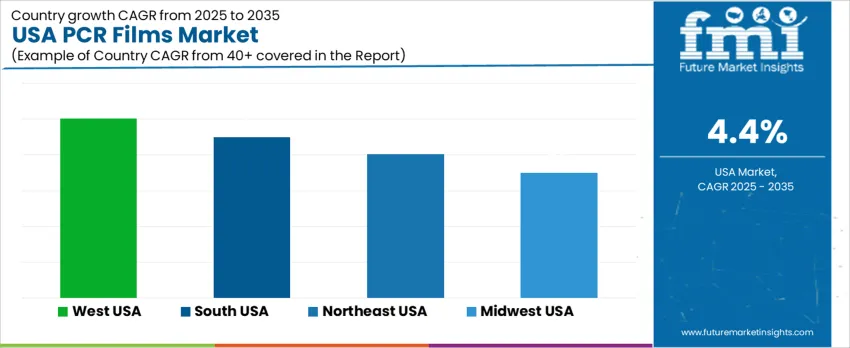
| Region | CAGR (2025-2035) |
|---|---|
| West USA | 5.0% |
| South USA | 4.5% |
| Northeast USA | 4.0% |
| Midwest USA | 3.5% |
How is the West USA driving demand for PCR films?
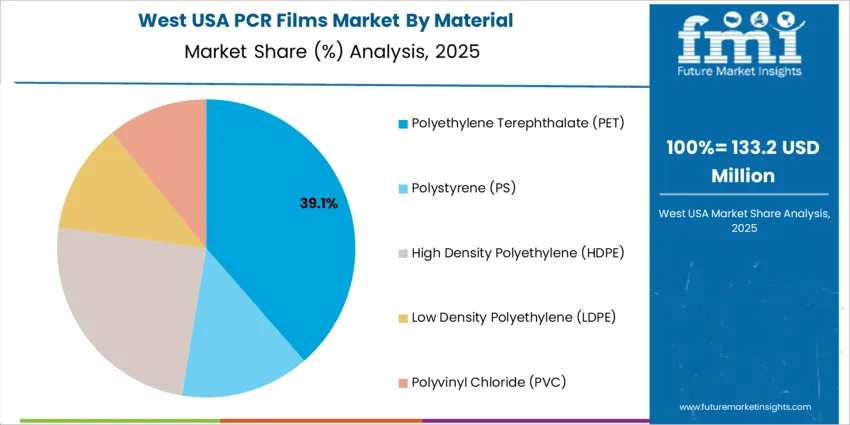
The West USA grows at 5.0% CAGR, supported by strong life-sciences funding and clinical diagnostics expansion in California, Washington, Utah, and Colorado. Biotech and pharmaceutical companies incorporate PCR films into automated workflows used for genetic testing, assay development, and cell-line validation. Hospital laboratories maintain recurring procurement to support respiratory-panel testing and oncology screening programs. Research universities deploy advanced multiplex PCR methods requiring high-performance, optically clear films suitable for qPCR fluorescence detection. Procurement decisions emphasize adhesive consistency that withstands aggressive thermal cycling without edge lifting. Distribution networks near biotechnology clusters ensure rapid replenishment due to high throughput usage.
- Biotech R&D driving high-frequency consumable usage
- Hospital labs requiring evaporation-resistant sealing films
- qPCR compatibility influencing clarity and optical validation
- Proximity to life-science supply routes improving availability
How is the South USA shaping demand for PCR films?
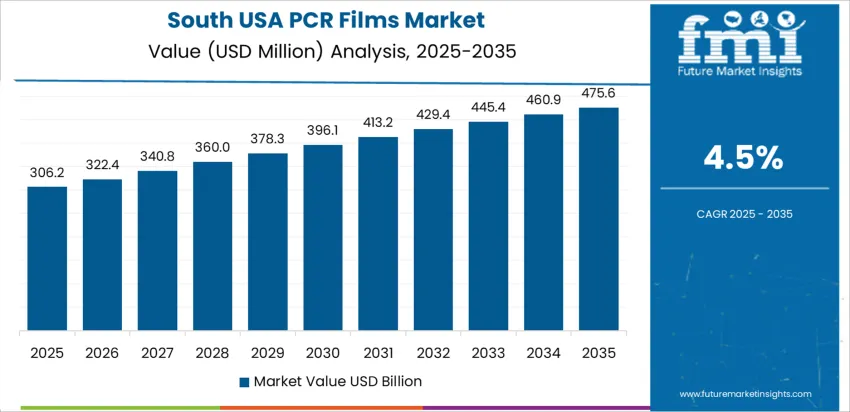
The South USA expands at 4.5% CAGR, driven by diagnostics manufacturing clusters and academic medical systems operating across Texas, Florida, Georgia, and North Carolina. PCR films support infectious-disease detection and chronic-disease monitoring programs in high-volume clinical labs. Pharmaceutical QC teams adopt sealing films for contamination control during stability and genetic identity testing. Hospitals with expanding outpatient capacity use PCR-based workflows to process rapid turn-around samples. Buyers evaluate film material performance for heat resistance and chemical compatibility with reagent formulations. Distribution through Gulf Coast logistics hubs maintains efficient supply continuity for statewide networks.
- Infectious and chronic disease testing sustaining procurement
- QC workflows in pharma labs requiring secure plate sealing
- Outpatient testing expansion increasing sample throughput
- Logistics hubs supporting consistent lab consumable access
How is the Northeast USA influencing adoption of PCR films?
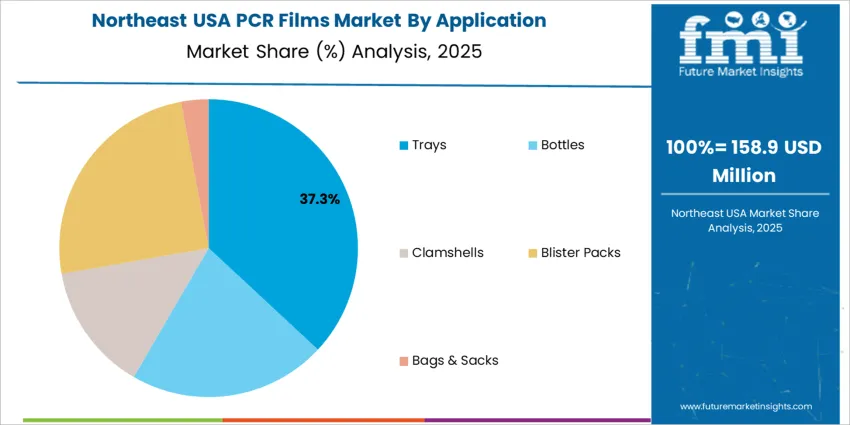
The Northeast USA grows at 4.0% CAGR, anchored by hospital systems, Ivy League-linked research facilities, and biotech manufacturing in New York, Massachusetts, and Pennsylvania. PCR films are essential in gene-expression studies, oncology panels, and pathogen surveillance initiatives. Centralized lab networks enable routine bulk purchasing. R&D laboratories demand optical-grade films compatible with real-time detection instruments. Procurement reviews sealing integrity to avoid sample cross-contamination and maintain assay reproducibility. Sustainability programs encourage evaluation of recyclable packaging formats and reduced-waste dispensing designs for frequent-use consumables.
- Strong research ecosystem reinforcing high-complexity PCR use
- Oncology and infectious disease programs driving film selection
- Bulk procurement supporting predictable consumption cycles
- Seal reliability and assay precision shaping vendor approval
How is the Midwest USA contributing to PCR film demand?
The Midwest USA records 3.5% CAGR, driven by steady adoption across hospital laboratories and biotech development sites in Illinois, Ohio, Michigan, and Minnesota. PCR films support clinical workflows in regional medical centers that manage large patient populations. Manufacturers in the region supply consumables to agricultural-biotech and food-testing labs applying PCR for contamination and pathogen detection. Procurement emphasizes adhesive durability supporting longer cycling programs used in confirmatory assays. Cost-efficiency influences selection due to budget-managed healthcare systems and competitive pricing from distributors.
- Hospital-based diagnostics maintaining routine consumables usage
- Adoption in agribiotech and food-safety testing is expanding volume
- Adhesion performance driving quality oversight
- Cost-focused sourcing supporting operational consistency
How is competitive positioning structured among suppliers of PCR films in the United States?
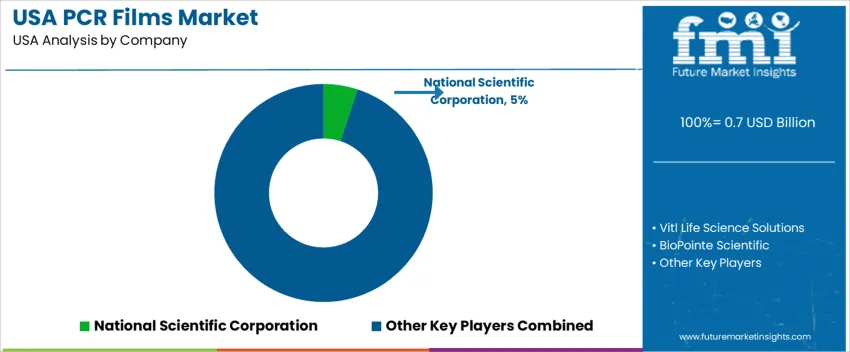
In the United States PCR-film segment, competition centers on film clarity, seal integrity, evaporation prevention, and compatibility with automated thermal-cycling workflows. Buyers such as research labs, diagnostic centers, and biotech manufacturers value reproducible performance under high-throughput conditions and reliable lot traceability for regulatory compliance. National Scientific Corporation holds an estimated 5.0% share. Its position rests on supplying entry- to mid-tier labs that require cost-effective sealing solutions for routine PCR or storage applications. Its value proposition centers on affordability and acceptable performance for moderate-volume workflows.
Vitl Life Science Solutions competes through offering films formulated for low-binding and reduced autofluorescence attractive to labs conducting sensitive assays or fluorescent-based readouts. Their presence strengthens in molecular-diagnostics setups where data fidelity is critical. BioPointe Scientific maintains a niche through customizable sealing films, including heat-seal and peel-seal options, for labs needing flexibility in assay design or manual processing. Their role is notable in research and small-scale clinical labs where batch size varies.
Eppendorf supports high-throughput research and commercial-scale labs with premium sealing solutions integrated into its plate-based product line. Reliable compatibility with automated sealing equipment and robust seal integrity under repeated thermal cycles strengthens its position. Brooks Life Sciences (SSIbio) competes through high-end sealing films engineered for minimal evaporation, strong adhesion, and compatibility with robotics traits valued by genomics and biopharma operations running large PCR libraries or batch processing. Competitive advantage increasingly depends on film shelf stability, lot-to-lot consistency, and validated performance in fluorescence and qPCR assays. Suppliers combining technical reliability with dependable distribution remain best positioned in the United States PCR-film segment.
Key Players in USA PCR Films Demand
- National Scientific Corporation
- Vitl Life Science Solutions
- BioPointe Scientific
- Eppendorf
- Brooks Life Sciences (SSIbio)
Scope of the Report
| Items | Values |
|---|---|
| Quantitative Units | USD billion |
| Material | Polyethylene Terephthalate (PET), Polystyrene (PS), High Density Polyethylene (HDPE), Low Density Polyethylene (LDPE), Polyvinyl Chloride (PVC) |
| Application | Trays, Bottles, Clamshells, Blister Packs, Bags & Sacks |
| Packaging Formats | Bottles, Jars |
| End Use | Cosmetics and Personal Care, Food, Beverages, Pharmaceuticals, Homecare and Toiletries |
| Regions Covered | West USA, South USA, Northeast USA, Midwest USA |
| Key Companies Profiled | National Scientific Corporation, Vitl Life Science Solutions, BioPointe Scientific, Eppendorf, Brooks Life Sciences (SSIbio) |
| Additional Attributes | Dollar sales by material type, application, and end-use industries; adoption growth in food packaging and pharmaceutical compliance trays; demand shift toward PET-based post-consumer recycled content; brand sustainability preferences accelerating blister and clamshell replacement; R&D investment in heat resistance and sealing properties for PCR films used in regulated packaging. |
USA PCR Films Demand by Segments
Material:
- Polyethylene Terephthalate (PET)
- Polystyrene (PS)
- High Density Polyethylene (HDPE)
- Low Density Polyethylene (LDPE)
- Polyvinyl Chloride (PVC)
Application:
- Trays
- Bottles
- Clamshells
- Blister Packs
- Bags & Sacks
Packaging Formats:
- Bottles
- Jars
End Use:
- Cosmetics and Personal Care
- Food
- Beverages
- Pharmaceuticals
- Homecare and Toiletries
Region:
- West USA
- South USA
- Northeast USA
- Midwest USA
Frequently Asked Questions
How big is the demand for PCR films in USA in 2025?
The demand for PCR films in USA is estimated to be valued at USD 0.7 billion in 2025.
What will be the size of PCR films in USA in 2035?
The market size for the PCR films in USA is projected to reach USD 1.1 billion by 2035.
How much will be the demand for PCR films in USA growth between 2025 and 2035?
The demand for PCR films in USA is expected to grow at a 4.4% CAGR between 2025 and 2035.
What are the key product types in the PCR films in USA?
The key product types in PCR films in USA are polyethylene terephthalate (pet), polystyrene (ps), high density polyethylene (hdpe), low density polyethylene (ldpe) and polyvinyl chloride (pvc).
Which application segment is expected to contribute significant share in the PCR films in USA in 2025?
In terms of application, trays segment is expected to command 36.4% share in the PCR films in USA in 2025.
Preview the report firsthand - request a free sample
Get SampleGet the brochure for pricing and purchase details.
Get PDFTable of Content
- Executive Summary
- USA Market Outlook
- Demand-side Trends
- Supply-side Trends
- Technology Roadmap Analysis
- Analysis and Recommendations
- Market Overview
- Market Coverage / Taxonomy
- Market Definition / Scope / Limitations
- Market Background
- Market Dynamics
- Drivers
- Restraints
- Opportunity
- Trends
- Scenario Forecast
- Demand in Optimistic Scenario
- Demand in Likely Scenario
- Demand in Conservative Scenario
- Opportunity Map Analysis
- Product Life Cycle Analysis
- Supply Chain Analysis
- Investment Feasibility Matrix
- Value Chain Analysis
- PESTLE and Porter’s Analysis
- Regulatory Landscape
- Regional Parent Market Outlook
- Production and Consumption Statistics
- Import and Export Statistics
- Market Dynamics
- USA Market Analysis 2020 to 2024 and Forecast, 2025 to 2035
- Historical Market Size Value (USD Million) Analysis, 2020 to 2024
- Current and Future Market Size Value (USD Million) Projections, 2025 to 2035
- Y-o-Y Growth Trend Analysis
- Absolute $ Opportunity Analysis
- USA Market Pricing Analysis 2020 to 2024 and Forecast 2025 to 2035
- USA Market Analysis 2020 to 2024 and Forecast 2025 to 2035, By Material
- Introduction / Key Findings
- Historical Market Size Value (USD Million) Analysis By Material , 2020 to 2024
- Current and Future Market Size Value (USD Million) Analysis and Forecast By Material , 2025 to 2035
- Polyethylene Terephthalate (PET)
- Polystyrene (PS)
- High Density Polyethylene (HDPE)
- Low Density Polyethylene (LDPE)
- Polyvinyl Chloride (PVC)
- Y-o-Y Growth Trend Analysis By Material , 2020 to 2024
- Absolute $ Opportunity Analysis By Material , 2025 to 2035
- USA Market Analysis 2020 to 2024 and Forecast 2025 to 2035, By Application
- Introduction / Key Findings
- Historical Market Size Value (USD Million) Analysis By Application, 2020 to 2024
- Current and Future Market Size Value (USD Million) Analysis and Forecast By Application, 2025 to 2035
- Trays
- Bottles
- Clamshells
- Blister Packs
- Bags & Sacks
- Y-o-Y Growth Trend Analysis By Application, 2020 to 2024
- Absolute $ Opportunity Analysis By Application, 2025 to 2035
- USA Market Analysis 2020 to 2024 and Forecast 2025 to 2035, By Packaging Formats
- Introduction / Key Findings
- Historical Market Size Value (USD Million) Analysis By Packaging Formats, 2020 to 2024
- Current and Future Market Size Value (USD Million) Analysis and Forecast By Packaging Formats, 2025 to 2035
- Bottles
- Jars
- Y-o-Y Growth Trend Analysis By Packaging Formats, 2020 to 2024
- Absolute $ Opportunity Analysis By Packaging Formats, 2025 to 2035
- USA Market Analysis 2020 to 2024 and Forecast 2025 to 2035, By End Use
- Introduction / Key Findings
- Historical Market Size Value (USD Million) Analysis By End Use, 2020 to 2024
- Current and Future Market Size Value (USD Million) Analysis and Forecast By End Use, 2025 to 2035
- Cosmetics and Personal Care
- Food
- Beverages
- Pharmaceuticals
- Homecare and Toiletries
- Y-o-Y Growth Trend Analysis By End Use, 2020 to 2024
- Absolute $ Opportunity Analysis By End Use, 2025 to 2035
- Market Structure Analysis
- Competition Dashboard
- Competition Benchmarking
- Market Share Analysis of Top Players
- By Regional
- By Material
- By Application
- By Packaging Formats
- By End Use
- Competition Analysis
- Competition Deep Dive
- National Scientific Corporation
- Overview
- Product Portfolio
- Profitability by Market Segments (Product/Age /Sales Channel/Region)
- Sales Footprint
- Strategy Overview
- Marketing Strategy
- Product Strategy
- Channel Strategy
- Vitl Life Science Solutions
- BioPointe Scientific
- Eppendorf
- Brooks Life Sciences (SSIbio)
- National Scientific Corporation
- Competition Deep Dive
- Assumptions & Acronyms Used
- Research Methodology


