

- Industry Size (2025)
- USD 96.4 Mn
- Forecast (2035)
- USD 135.3 Mn
- CAGR (2025 to 2035)
- 3.5%
Demand for PCR Films in Japan Forecast and Outlook 2025 to 2035
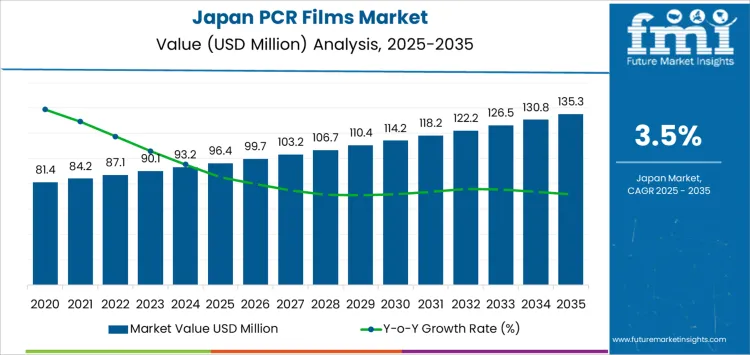
Demand for PCR films in Japan is valued at USD 96.4 million in 2025 and is projected to reach USD 135.3 million by 2035 at a CAGR of 3.5%. The PCR films industry in Japan is structured around PET, PS, HDPE, LDPE, and PVC materials, with PET and HDPE forming the core base for bottle, tray, and clamshell formats. Food and beverage packaging together account for the largest application share, supported by steady demand from pharmaceuticals and cosmetics and personal care.
Bottles and jars dominate rigid packaging formats, while blister packs and bags support smaller volume flows. Kanto and Chubu represent the primary demand centers due to dense food processing, pharmaceutical manufacturing, and contract packaging activity. Key suppliers active in Japan include National Scientific, Vitl Life Science Solutions, BioPointe Scientific, Eppendorf, and Brooks Life Sciences SSIbio.
Quick Stats of the Demand for PCR Films in Japan
- Demand for PCR Films in Japan Value (2025): USD 96.4 million
- Demand for PCR Films in Japan Forecast Value (2035): USD 135.3 million
- Demand for PCR Films in Japan Forecast CAGR (2025 to 2035): 3.5%
- Leading Material in Japan (2025): Polyethylene Terephthalate (38%)
- Key Growth Regions in Japan: Kyushu & Okinawa, Kanto, Kinki, Chubu
- Top Players in Japan: National Scientific, Vitl Life Science Solutions, BioPointe Scientific, Eppendorf, Brooks Life Sciences SSIbio
What is the Demand Forecast for PCR Films in Japan through 2035?
After 2030, growth in the PCR films industry in Japan is shaped mainly by packaging redesign cycles, resin availability, and corporate recycled content mandates rather than packaging volume expansion. Food brands continue to introduce higher recycled content in rigid containers to meet internal environmental targets, which supports stable PCR film substitution. Pharmaceutical and cosmetic packaging maintains controlled demand due to performance and compliance requirements tied to barrier integrity and traceability.
Homecare and toiletries contribute incremental volume through refill packs and lightweight containers. Supply conditions remain closely tied to domestic recycling throughput and polymer reprocessing efficiency, which directly influences film pricing and grade availability. Competitive positioning increasingly depends on resin purity consistency, certification readiness, and compatibility with high speed thermoforming and vacuum forming lines rather than short term price competition.
The demand for PCR films in Japan is measured at USD 96.4 million in 2025 and increases to USD 110.4 million by 2030, generating a net gain of USD 14.0 million in the first half of the forecast period. The progression from USD 81.4 million in 2020 to USD 96.4 million in 2025 reflects steady integration of post-consumer recycled content into flexible packaging for food, personal care, and household products. The Japan PCR films industry advances through incremental line conversions by major converters rather than abrupt capacity shifts. Brand mandates on recycled content ratios, retail packaging guidelines, and export compliance standards drive predictable offtake. Growth in this phase is tied to packaging volume continuity in snacks, daily-use consumer goods, and refill formats.
From 2030 to 2035, demand rises from USD 110.4 million to USD 135.3 million, adding USD 24.9 million in incremental value across the second half of the outlook. Annual increases trend higher in this phase as value additions move from roughly USD 3.8 million to over USD 4.5 million toward the end of the period. This acceleration reflects broader deployment of high-clarity PCR films in premium packaging, pressure from multinational brand sustainability targets applied to Japan operations, and improved resin sorting efficiency that supports higher-grade recycled feedstock.
The growing use of PCR films in mono-material structures for pouches, wraps, and sachets also strengthens pull-through. By 2035, PCR film demand in Japan is governed by packaging compliance frameworks and converter-level material substitution rather than consumer-driven packaging redesign cycles.
PCR Films Industry in Japan Key Takeaways
| Metric | Value |
|---|---|
| Industry Value (2025) | USD 96.4 million |
| Forecast Value (2035) | USD 135.3 million |
| Forecast CAGR (2025 to 2035) | 3.5% |
What Is Driving the Demand for PCR Films in Japan Packaging Industry?
The demand for PCR films in Japan is rooted in long term shifts in packaging accountability, waste reduction discipline, and brand level material transparency. Historically, Japans packaging sector relied heavily on virgin plastics to meet strict quality and hygiene expectations, particularly in food, consumer goods, and pharmaceutical packaging. Over time, pressure from municipal recycling frameworks, retailer packaging scorecards, and consumer expectations around visible environmental responsibility pushed converters to incorporate post consumer resin content into flexible films.
PCR films gained early traction in personal care refills, secondary food packaging, and household products where direct material contact risk is lower and recycling origin can be clearly communicated. Export oriented brands also adopted PCR films to align with overseas sustainability disclosure norms.
Future demand for PCR films in Japan will be shaped by tightening packaging material disclosure rules, retail driven sustainability audits, and corporate carbon reduction commitments across consumer goods companies. Growth will continue in food outer wraps, personal care pouches, e commerce mailers, and industrial liners where recycled content targets are becoming procurement requirements rather than brand options.
Barriers include contamination control challenges, limited domestic PCR feedstock consistency, and strict appearance standards that limit use in premium primary packaging. Cost volatility tied to recycling infrastructure capacity also remains a constraint. Long term demand will depend on how effectively Japan expands high grade plastic sorting, stabilizes domestic PCR supply, and balances recycled content mandates with quality expectations across high precision packaging applications.
What Is the Structural Breakdown of the Demand for PCR Films in Japan by Material and Application?
The demand for PCR films in Japan is segmented by material and application. By material, usage is classified into polyethylene terephthalate, polystyrene, high density polyethylene, low density polyethylene, and polyvinyl chloride. By application, demand is distributed across trays, bottles, clamshells, blister packs, and bags and sacks. These segment divisions reflect packaging performance needs across Japans food processing, retail logistics, pharmaceutical packaging, and personal care distribution systems.
Material selection is shaped by heat resistance, barrier performance, recyclability standards, and thickness tolerance. Application demand is driven by portion control, shelf life stability, transport durability, and automated packaging line compatibility across high volume consumer product categories.
Why Does Polyethylene Terephthalate Dominate the Demand for PCR Films in Japan by Material?
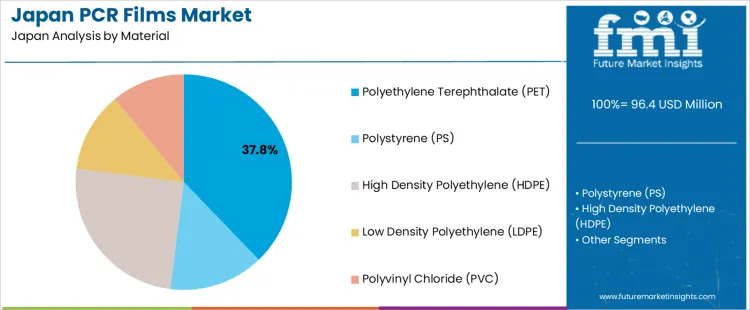
Polyethylene terephthalate accounts for 38% of the demand for PCR films in Japan, reflecting its strong position in rigid and semi rigid packaging formats. Consumption intensity is driven by high usage in food trays, beverage labels, and thermoformed containers requiring clarity and mechanical strength. Usage remains stable due to Japans dense retail distribution network and strict visual inspection standards. Procurement is largely contract based with packaging converters securing yearly supply volumes.
Price sensitivity remains moderate because film performance consistency is prioritized over raw material cost. Specification control is strict due to thickness uniformity, migration limits, and thermal stability requirements under heat sealing conditions.
Polyethylene terephthalate contributes strongly to incremental PCR adoption due to its compatibility with closed loop recycling systems already established in Japan. Repeat usage remains high because food packaging output cycles operate continuously throughout the year. Buyers favor long term sourcing agreements to stabilize input quality and recyclate consistency. Margin structure remains narrow under sustained pricing pressure from food processors.
Certification dependence is elevated due to food contact compliance audits. Import reliance persists for high clarity recycled resins. Lead time exposure is managed through bonded warehouse inventory. Substitution pressure from polyethylene grades remains moderate but limited in applications requiring transparency and rigidity.
What Is Driving Trays to Lead the Demand for PCR Films in Japan by Application?
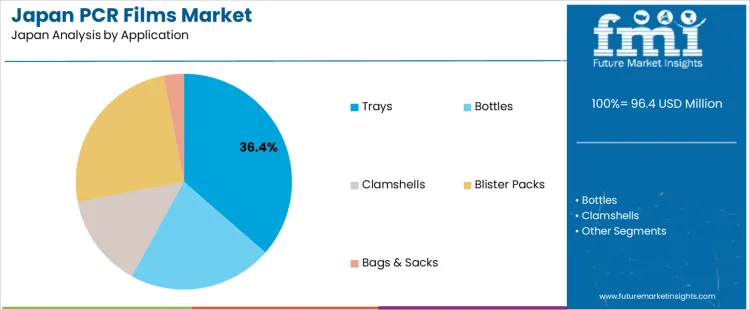
Trays represent 36.4% of the demand for PCR films in Japan, reflecting their central role in ready meal, seafood, meat, and fresh produce packaging. Consumption per retail outlet remains high due to strong preference for portioned, hygienic food presentation. Usage intensity is stable because convenience food demand remains constant across urban and suburban regions. Procurement is dominated by contracted supply between food processors and thermoformers.
Price sensitivity remains controlled since tray failure leads to spoilage losses and compliance penalties. Specification sensitivity is elevated due to load bearing strength, seal integrity, and controlled oxygen transfer requirements within chilled storage environments.
Trays contribute significantly to recurring PCR film consumption due to high turnover in food retail and daily household purchasing behavior. Repeat procurement cycles are short because food packaging output is continuous. Buyers favor standardized tray formats to minimize tooling changeover and waste. Margin capture remains tight due to competition among packaging converters. Certification requirements remain high due to food safety inspections and traceability audits.
Import dependence arises for specialty multilayer recycled films. Lead time risk is managed through rolling production schedules. Substitution pressure from molded pulp remains limited in applications requiring moisture and fat resistance.
What Is Driving the Demand for PCR Films in Japan Diagnostic and Life Science Systems?
Demand for PCR films in Japan is driven by molecular diagnostics standardization, infectious disease surveillance, and genetic testing expansion across hospitals, research institutes, and pharmaceutical development labs. Japan strong focus on precision diagnostics supports consistent use of sealed amplification systems where optical clarity, thermal stability, and contamination control are critical. Government-backed public health monitoring, cancer screening programs, and university research funding sustain steady test volume. PCR films are specified for compatibility with automated thermal cyclers and high-throughput testing platforms. Demand is therefore shaped by national diagnostic infrastructure and research continuity rather than temporary pandemic-driven testing spikes.
How Is Clinical Diagnostics Standardization Strengthening PCR Film Consumption?
Japan hospital laboratories operate under tightly controlled diagnostic protocols that require consistent reaction sealing, evaporation control, and optical transparency during amplification. PCR films are increasingly preferred over rigid caps in high-throughput testing because they enable automated plate handling and uniform thermal contact. National cancer screening, genetic disorder profiling, and viral load monitoring rely on stable amplification formats. Japan preference for automation-ready consumables supports recurring PCR film procurement across public hospitals and private diagnostic centers. This demand is reinforced by accreditation requirements and inter-laboratory data consistency rather than by episodic testing demand.
Why Are Pharmaceutical Research and Genomics Programs Creating Structural Demand?
Japan pharmaceutical companies and academic genomics programs sustain year-round PCR testing for drug discovery, biomarker validation, and gene expression analysis. PCR films support multi-well amplification in large experimental batches, improving workflow speed and contamination control. Government-supported genomic medicine initiatives and rare disease research further stabilize demand. Contract research organizations also rely on PCR films for standardized assay execution across client programs. This research-led demand is structurally resilient because it is embedded in long-cycle development pipelines rather than short-term diagnostic surges.
How Do Cost Sensitivity, Recycling Constraints, and Equipment Compatibility Restrain Expansion?
Demand for PCR films in Japan faces restraint from laboratory cost controls, particularly in public hospitals and universities operating under fixed testing budgets. Plastic waste regulation and recycling constraints are increasing scrutiny of disposable lab consumables. In addition, compatibility limitations between certain PCR film types and legacy thermal cycler platforms reduce universal interchangeability. Import dependence for specialty optical-grade films also exposes buyers to currency and freight volatility. These factors limit rapid volume acceleration despite steady institutional demand.
What is the Demand for PCR Films in Japan by Region?
| Region | CAGR (%) |
|---|---|
| Kyushu & Okinawa | 4.3% |
| Kanto | 4.0% |
| Kinki | 3.5% |
| Chubu | 3.1% |
| Tohoku | 2.7% |
| Rest of Japan | 2.6% |
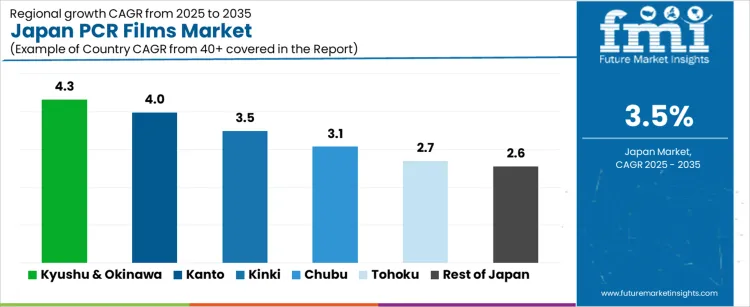
The demand for PCR films in Japan is increasing steadily across all regions, with Kyushu and Okinawa leading at a 4.3% CAGR. Growth in this region is supported by expanding molecular diagnostics testing capacity, rising infectious disease screening volumes, and steady investment in laboratory infrastructure. Kanto follows at 4.0%, driven by a dense concentration of clinical laboratories, academic research centers, and hospital diagnostic units.
Kinki records 3.5% growth, reflecting balanced demand from medical testing laboratories and biotechnology research facilities. Chubu at 3.1% shows moderate uptake linked to pharmaceutical manufacturing and industrial research activity. Tohoku and the Rest of Japan, at 2.7% and 2.6%, reflect slower growth shaped by lower laboratory density, limited testing volumes, and longer procurement cycles for consumable diagnostic materials.
How Is Molecular Diagnostics Expansion in Kyushu and Okinawa Shaping PCR Films Demand?
Growth in Kyushu and Okinawa is progressing at a CAGR of 4.3% through 2035 for PCR films demand, supported by rising infectious disease testing, university hospital research programs, and public health laboratory upgrades. Medical centers in Fukuoka and Okinawa continue to expand real time PCR capacity for respiratory infections, food safety testing, and emergency screening. Compared with Tohoku, deployment here is more strongly linked to clinical diagnostics than academic research alone. PCR films are mainly used for sample sealing, thermal cycling stability, and contamination control across hospital and public testing facilities.
- Hospital based diagnostics anchor core film demand
- Public health labs sustain recurring testing volumes
- Emergency screening strengthens consumable usage
- Regional medical universities lead procurement activity
What Is Driving PCR Films Consumption Across High Throughput Testing Systems in Kanto?
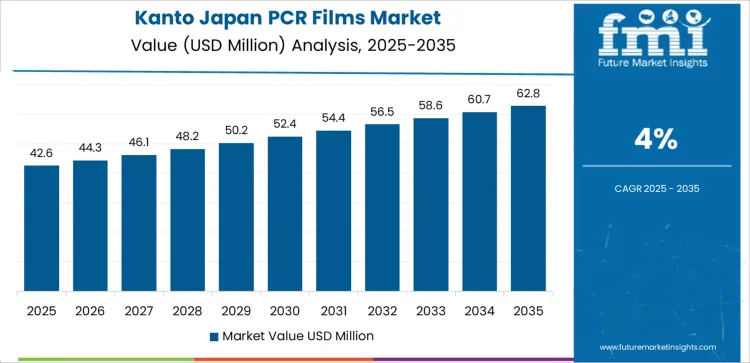
Expansion in Kanto reflects a CAGR of 4.0% through 2035 for PCR films usage, led by dense concentration of clinical laboratories, pharmaceutical research centers, and biotech testing facilities across Tokyo and surrounding prefectures. Kanto contrasts with Kyushu and Okinawa through higher dependence on commercial diagnostic service providers rather than hospital driven testing alone. PCR films are widely used in infectious disease panels, genetic testing, oncology screening, and contract research organization workflows. High automation levels sustain continuous replacement cycles across large volume diagnostic networks.
- Commercial diagnostic labs drive bulk consumable usage
- Oncology and genetic screening expand testing breadth
- Automation supports continuous film replacement
- Contract research organizations dominate large volume buying
Why Is Regional Healthcare and Research Balance Supporting PCR Films Growth in Kinki?
Growth in Kinki is advancing at a CAGR of 3.5% through 2035 for PCR films demand, supported by a balanced mix of hospital diagnostics, university research, and pharmaceutical quality testing. Osaka, Kobe, and Kyoto institutions continue to expand molecular testing for infectious diseases and drug development validation. Kinki contrasts with Kanto through a more even split between research and clinical usage rather than dominance of commercial diagnostics. PCR films are used across academic genomics labs, hospital pathology units, and pharma stability testing environments.
- University research sustains steady film consumption
- Hospital pathology supports routine diagnostic testing
- Pharmaceutical validation adds secondary demand layer
- Public research grants influence procurement cycles
How Is Industrial and Medical Research Infrastructure Influencing PCR Films Adoption in Chubu?
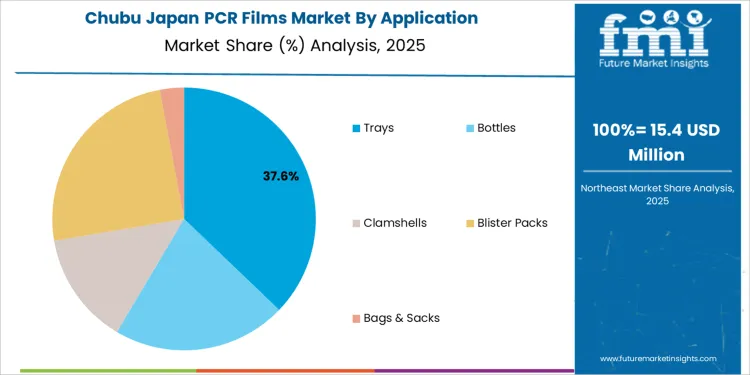
Expansion in Chubu reflects a CAGR of 3.1% through 2035 for PCR films demand, supported by regional medical universities, automotive linked biotech research, and hospital diagnostic upgrades. Nagoya continues to anchor both clinical and applied life science testing across medical and industrial research centers. Chubu differs from Kinki through stronger linkage between industrial biotechnology programs and medical diagnostics. PCR films are used in environmental testing, food pathogen screening, hospital virology, and applied genetics research tied to industrial bio programs.
- Food pathogen testing supports applied diagnostics usage
- Medical universities anchor regional research demand
- Industrial biotechnology adds cross sector testing needs
- Public hospitals lead routine diagnostic procurement
What Is Sustaining Gradual PCR Films Uptake Across Aging Care and Public Labs in Tohoku?
Growth in Tohoku is moving at a CAGR of 2.7% through 2035 for PCR films demand, supported by public health laboratories, aging population disease surveillance, and regional hospital diagnostic services. Tohoku contrasts with Kanto and Kinki through lower research funding density and smaller commercial diagnostic presence. PCR films are mainly used for influenza screening, food safety monitoring, tuberculosis testing, and basic genetic assays in community hospitals. Budget limitations and lower testing throughput continue to restrict faster adoption.
- Public health surveillance anchors baseline film demand
- Community hospitals sustain routine infectious testing
- Food safety labs support steady regional usage
- Funding constraints moderate expansion pace
How Does Low Density Research Infrastructure Influence PCR Films Demand in the Rest of Japan?
Growth in the Rest of Japan is advancing at a CAGR of 2.6% through 2035 for PCR films demand, shaped by small hospital laboratories, agricultural testing centers, and regional food inspection facilities. This region contrasts with Kanto and Kyushu and Okinawa through lower testing automation and limited molecular research infrastructure. PCR films are primarily used for livestock disease detection, crop pathogen screening, local hospital diagnostics, and small scale environmental testing. Procurement remains dependent on prefectural health budgets and annual testing program approvals.
- Agricultural pathogen testing supports key rural usage
- Small hospitals dominate basic diagnostic applications
- Environmental monitoring adds limited additional volume
- Prefectural budgets guide purchasing timelines
What Is Driving the Demand for PCR Films in Japan and Which Suppliers Control Laboratory Adoption
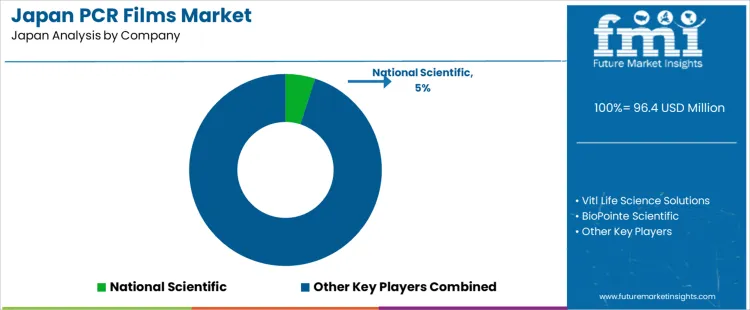
The demand for PCR films in Japan is shaped by steady molecular diagnostics volume, public health surveillance programs, and sustained research activity in academic and clinical laboratories. Eppendorf holds a strong position through deep integration with PCR systems already installed across university hospitals and research institutes. Brooks Life Sciences SSIbio supports high throughput diagnostic workflows through sealing systems aligned with automated thermal cyclers used in testing centers.
Nipro and Fujifilm Wako Pure Chemical support domestic distribution through established life science supply networks that serve hospitals, contract research organizations, and public laboratories. National Scientific participates through specialty consumables supplied to research focused buyers through Japanese distributors aligned with import controlled laboratory products.
Vitl Life Science Solutions serves selected clinical and applied testing laboratories with sealing films positioned for routine PCR workflows and contamination control. BioPointe Scientific supplies niche segments tied to academic research and small scale diagnostic development labs through agent based access. Procurement in Japan is guided by sealing integrity, optical transparency for fluorescence detection, chemical resistance, and compatibility with domestic thermal cycler platforms.
Buyer preference favors suppliers with stable domestic inventory, Japanese language documentation, and reliable lot to lot consistency. Demand visibility tracks infectious disease surveillance programs, oncology testing growth, genetic screening activity, and government funded life science research budgets.
Key Players in the PCR Films in Japan
- National Scientific
- Vitl Life Science Solutions
- BioPointe Scientific
- Eppendorf
- Brooks Life Sciences SSIbio
Scope of the report
| Items | Values |
|---|---|
| Quantitative Units (2025) | USD million |
| Material | Polyethylene Terephthalate (PET), Polystyrene (PS), High Density Polyethylene (HDPE), Low Density Polyethylene (LDPE), Polyvinyl Chloride (PVC) |
| Application | Trays, Bottles, Clamshells, Blister Packs, Bags & Sacks |
| Packaging Formats | Bottles, Jars |
| End Use | Food, Beverages, Pharmaceuticals, Cosmetics and Personal Care, Homecare and Toiletries |
| Regions Covered | Kyushu & Okinawa, Kanto, Kansai, Chubu, Tohoku, Rest of Japan |
| Key Companies Profiled | National Scientific, Vitl Life Science Solutions, BioPointe Scientific, Eppendorf, Brooks Life Sciences SSIbio |
| Additional Attributes | Dollar by sales breakdown by region, material, application, packaging format, and end use; growth projections through 2035; adoption of high-clarity PCR films; integration into mono-material and refillable packaging; resin purity and certification readiness; compatibility with high-speed thermoforming and vacuum forming lines; domestic PCR feedstock availability; regulatory compliance in food, pharmaceutical, and laboratory applications; incremental uptake from research, diagnostics, and molecular biology programs; long-term supplier distribution stability |
PCR Films Industry in Japan Segmentation
Material:
- Polyethylene Terephthalate (PET)
- Polystyrene (PS)
- High Density Polyethylene (HDPE)
- Low Density Polyethylene (LDPE)
- Polyvinyl Chloride (PVC)
Application:
- Trays
- Bottles
- Clamshells
- Blister Packs
- Bags & Sacks
Packaging Formats:
- Bottles
- Jars
End Use:
- Food
- Beverages
- Pharmaceuticals
- Cosmetics and Personal Care
- Homecare and Toiletries
Region
- Kyushu & Okinawa
- Kanto
- Kansai
- Chubu
- Tohoku
- Rest of Japan
Frequently Asked Questions
How big is the demand for PCR films in Japan in 2025?
The demand for PCR films in Japan is estimated to be valued at USD 96.4 million in 2025.
What will be the size of PCR films in Japan in 2035?
The market size for the PCR films in Japan is projected to reach USD 135.3 million by 2035.
How much will be the demand for PCR films in Japan growth between 2025 and 2035?
The demand for PCR films in Japan is expected to grow at a 3.5% CAGR between 2025 and 2035.
What are the key product types in the PCR films in Japan?
The key product types in PCR films in Japan are polyethylene terephthalate (pet), polystyrene (ps), high density polyethylene (hdpe), low density polyethylene (ldpe) and polyvinyl chloride (pvc).
Which application segment is expected to contribute significant share in the PCR films in Japan in 2025?
In terms of application, trays segment is expected to command 36.4% share in the PCR films in Japan in 2025.
Preview the report firsthand - request a free sample
Get SampleGet the brochure for pricing and purchase details.
Get PDFTable of Content
- Executive Summary
- Japan Market Outlook
- Demand-side Trends
- Supply-side Trends
- Technology Roadmap Analysis
- Analysis and Recommendations
- Market Overview
- Market Coverage / Taxonomy
- Market Definition / Scope / Limitations
- Market Background
- Market Dynamics
- Drivers
- Restraints
- Opportunity
- Trends
- Scenario Forecast
- Demand in Optimistic Scenario
- Demand in Likely Scenario
- Demand in Conservative Scenario
- Opportunity Map Analysis
- Product Life Cycle Analysis
- Supply Chain Analysis
- Investment Feasibility Matrix
- Value Chain Analysis
- PESTLE and Porter’s Analysis
- Regulatory Landscape
- Regional Parent Market Outlook
- Production and Consumption Statistics
- Import and Export Statistics
- Market Dynamics
- Japan Market Analysis 2020 to 2024 and Forecast, 2025 to 2035
- Historical Market Size Value (USD Million) Analysis, 2020 to 2024
- Current and Future Market Size Value (USD Million) Projections, 2025 to 2035
- Y-o-Y Growth Trend Analysis
- Absolute $ Opportunity Analysis
- Japan Market Pricing Analysis 2020 to 2024 and Forecast 2025 to 2035
- Japan Market Analysis 2020 to 2024 and Forecast 2025 to 2035, By Material
- Introduction / Key Findings
- Historical Market Size Value (USD Million) Analysis By Material , 2020 to 2024
- Current and Future Market Size Value (USD Million) Analysis and Forecast By Material , 2025 to 2035
- Polyethylene Terephthalate (PET)
- Polystyrene (PS)
- High Density Polyethylene (HDPE)
- Low Density Polyethylene (LDPE)
- Polyvinyl Chloride (PVC)
- Y-o-Y Growth Trend Analysis By Material , 2020 to 2024
- Absolute $ Opportunity Analysis By Material , 2025 to 2035
- Japan Market Analysis 2020 to 2024 and Forecast 2025 to 2035, By Application
- Introduction / Key Findings
- Historical Market Size Value (USD Million) Analysis By Application, 2020 to 2024
- Current and Future Market Size Value (USD Million) Analysis and Forecast By Application, 2025 to 2035
- Trays
- Bottles
- Clamshells
- Blister Packs
- Bags & Sacks
- Y-o-Y Growth Trend Analysis By Application, 2020 to 2024
- Absolute $ Opportunity Analysis By Application, 2025 to 2035
- Japan Market Analysis 2020 to 2024 and Forecast 2025 to 2035, By Packaging Formats
- Introduction / Key Findings
- Historical Market Size Value (USD Million) Analysis By Packaging Formats, 2020 to 2024
- Current and Future Market Size Value (USD Million) Analysis and Forecast By Packaging Formats, 2025 to 2035
- Bottles
- Jars
- Y-o-Y Growth Trend Analysis By Packaging Formats, 2020 to 2024
- Absolute $ Opportunity Analysis By Packaging Formats, 2025 to 2035
- Japan Market Analysis 2020 to 2024 and Forecast 2025 to 2035, By End Use
- Introduction / Key Findings
- Historical Market Size Value (USD Million) Analysis By End Use, 2020 to 2024
- Current and Future Market Size Value (USD Million) Analysis and Forecast By End Use, 2025 to 2035
- Food
- Beverages
- Pharmaceuticals
- Cosmetics and Personal Care
- Homecare and Toiletries
- Y-o-Y Growth Trend Analysis By End Use, 2020 to 2024
- Absolute $ Opportunity Analysis By End Use, 2025 to 2035
- Market Structure Analysis
- Competition Dashboard
- Competition Benchmarking
- Market Share Analysis of Top Players
- By Regional
- By Material
- By Application
- By Packaging Formats
- By End Use
- Competition Analysis
- Competition Deep Dive
- National Scientific
- Overview
- Product Portfolio
- Profitability by Market Segments (Product/Age /Sales Channel/Region)
- Sales Footprint
- Strategy Overview
- Marketing Strategy
- Product Strategy
- Channel Strategy
- Vitl Life Science Solutions
- BioPointe Scientific
- Eppendorf
- Brooks Life Sciences SSIbio
- National Scientific
- Competition Deep Dive
- Assumptions & Acronyms Used
- Research Methodology


