

- Industry Size (2025)
- USD 39.6 Mn
- Forecast (2035)
- USD 55.2 Mn
- CAGR (2025 to 2035)
- 3.4%
Demand for MDO-PE Films in Japan Forecast and Outlook 2025 to 2035
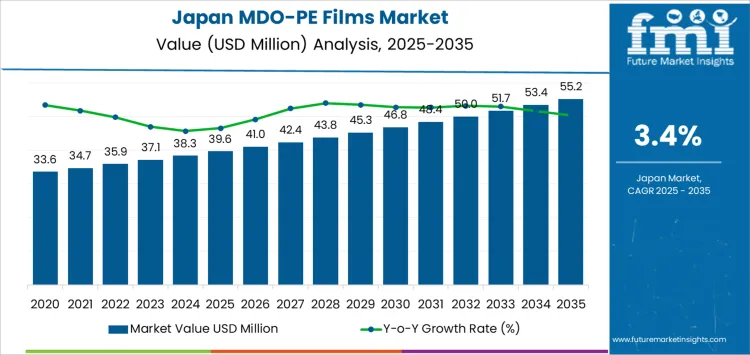
Demand for MDO-PE films in Japan is valued at USD 39.6 million in 2025 and is projected to reach USD 55.2 million by 2035 at a CAGR of 3.4%. The industry is driven by mono-material flexible packaging adoption across food, personal care, and homecare applications, where downgauged, recyclable structures are increasingly specified. Snack packaging, frozen food pouches, and dry food laminates remain the primary application segments, followed by refill packs for detergents and toiletries.
Polyethylene-based mono-oriented structures dominate material preference due to stiffness, sealability, and print compatibility. Kanto and Chubu represent the main demand hubs, supported by dense food processing, consumer goods manufacturing, and contract packaging activity. Key suppliers and technology participants serving the Japanese industry include Mitsui Chemicals, Toyobo, Toray Industries, Taghleef Industries, and domestic flexible packaging converters.
Quick Stats of the Demand for MDO-PE Films in Japan
- Demand for MDO-PE Films in Japan Value (2025): USD 39.6 million
- Demand for MDO-PE Films in Japan Forecast Value (2035): USD 55.2 million
- Demand for MDO-PE Films in Japan Forecast CAGR (2025 to 2035): 3.4%
- Leading Packaging Format in Japan (2025): Pouches (28%)
- Key Growth Regions in Japan: Kyushu & Okinawa, Kanto, Kinki, Chubu
- Top Players in Japan: Coveris Holdings, Avery Dennison, Saes Coated Films, Lenzing Plastics, RKW Group
What is the Demand Forecast for MDO-PE Films in Japan through 2035?
After 2030, growth in the MDO-PE films industry in Japan is shaped more by packaging conversion decisions and brand-level material standardization than by overall packaging volume expansion. Food companies continue to replace multi-layer laminates with mono-oriented polyethylene structures to simplify recycling streams, which sustains steady substrate substitution demand. Homecare and personal care packaging adds controlled incremental volume through refill formats and lightweight stand-up pouches.
Pharmaceutical use remains limited due to barrier performance requirements. Processing adoption remains tied to capital investment in MDO stretching lines at domestic film producers. Competitive positioning increasingly depends on film stiffness consistency, heat resistance during high-speed filling, and success rates in replacing PET and BOPP layers rather than short-term price competition.
The demand for MDO-PE films in Japan is valued at USD 39.6 million in 2025 and reaches USD 45.3 million by 2030, reflecting an absolute increase of USD 5.7 million during the first half of the forecast period. Historical movement from USD 33.6 million in 2020 to USD 39.6 million in 2025 shows that adoption has been gradual and converter-driven rather than brand-led.
The Japan MDO-PE films industry is shaped by replacement of conventional multilayer laminates in snack packaging, frozen foods, and dry grocery pouches where downgauging and mono-material alignment are operational priorities. Growth in this phase is linked to pilot-scale packaging conversions, incremental machine upgrades, and rising test adoption by large flexible packaging suppliers serving domestic food brands.
From 2030 to 2035, demand increases from USD 45.3 million to USD 55.2 million, adding USD 9.9 million in the second half of the forecast window. Annual value increments strengthen from roughly USD 1.5 million to about USD 1.8 million toward the end of the period, indicating wider commercial-scale penetration. This phase is supported by broader use in stand-up pouches, high-barrier snack packs, detergent refills, and export-grade flexible packaging where material simplification improves recyclability compliance. The demand outlook is further supported by brand-level targets for mono-PE structures and improved orientation line capacities within Japan. By 2035, MDO-PE film demand in Japan is driven more by industrial packaging redesign and regulatory alignment than by shifts in end-user consumption patterns.
MDO PE Films Industry in Japan Key Takeaways
| Metric | Value |
|---|---|
| Industry Value (2025) | USD 39.6 million |
| Forecast Value (2035) | USD 55.2 million |
| Forecast CAGR (2025 to 2035) | 3.4% |
What Factors Are Shaping the Demand for MDO PE Films in Japan Packaging Industry?
The demand for MDO PE films in Japan has emerged from structural changes in how the country manages flexible packaging waste and material recovery. For decades, Japanese packaging design prioritized barrier performance and visual precision, often relying on complex multilayer laminates that limited recyclability. As municipalities strengthened material sorting systems and retailers began enforcing packaging recyclability criteria, mono material solutions gained strategic importance.
MDO PE films entered commercial use as a way to achieve stiffness, durability, and high quality printing within a single polyethylene structure. Early demand developed in dry food packs, refill pouches, detergent sachets, and industrial liners where downgauging and material simplification could be implemented without compromising handling performance or shelf presentation.
Future demand for MDO PE films in Japan will be shaped by retailer led packaging audits, expansion of refill based consumption models, and corporate targets tied to recyclable packaging conversion. Food brands will increase adoption in snacks, frozen foods, and secondary wraps where existing laminate structures face recycling restrictions. Personal care and household product companies will continue shifting toward mono material pouch systems for logistics efficiency and return stream compatibility.
Barriers include limited domestic MDO stretching capacity, higher unit manufacturing cost than conventional PE films, and performance constraints in high moisture and oxygen sensitive applications. Long term demand will depend on how rapidly Japanese film producers expand orientation infrastructure and how consistently mono material standards are adopted across consumer packaging supply chains.
What Is the Structural Breakdown of the Demand for MDO PE Films in Japan by Packaging Format and Manufacturing Process?
The demand for MDO PE films in Japan is segmented by packaging format and manufacturing process. By packaging format, usage is classified into pouches, bags and sacks, tubes, liners and lidding films, and sachets and stick packs. By manufacturing process, production is divided into blown films and cast films. These segment divisions reflect Japans food packaging automation levels, portion control preferences, shelf life requirements, and downgauging targets.
Packaging format selection is shaped by retail logistics efficiency, sealing performance, and transport durability. Manufacturing process choice is driven by line speed, thickness control, orientation consistency, and energy efficiency across Japanese flexible packaging production facilities.
Why Do Pouches Lead the Demand for MDO PE Films in Japan by Packaging Format?
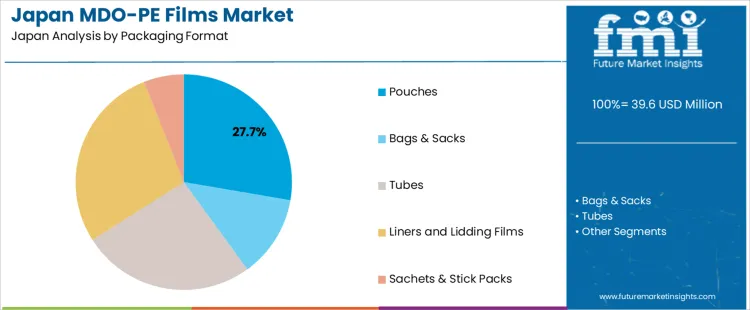
Pouches represent twenty-eight percent of the demand for MDO PE films in Japan, reflecting strong reliance on lightweight flexible packaging across food, personal care, and household product segments. Consumption intensity is driven by ready to eat meals, liquid condiments, refill packs, and single portion functional beverages. Usage remains stable through urban retail and e commerce distribution where space efficiency and transport durability matter. Procurement is contract based through packaging converters supplying national brand owners. Price sensitivity remains moderate because downgauging enabled by MDO orientation offsets resin cost volatility. Specification control remains strict for sealability, puncture resistance, and barrier performance.
Pouches contribute steadily to incremental MDO PE film demand in Japan due to downgauging targets and material reduction programs across consumer goods producers. Repeat purchase frequency remains high because pouch based packaging dominates short shelf life food and refill formats. Buyers favor long term sourcing to stabilize machine run speeds and sealing window consistency. Margin capture remains narrow due to converter competition. Certification dependence is elevated for food contact and migration compliance. Import reliance persists for specialty films. Lead time risk is managed through rolling production schedules. Substitution pressure from multilayer laminates remains limited where mono material recyclability targets apply.
What Is Driving Blown Films to Dominate the Demand for MDO PE Films in Japan by Manufacturing Process?
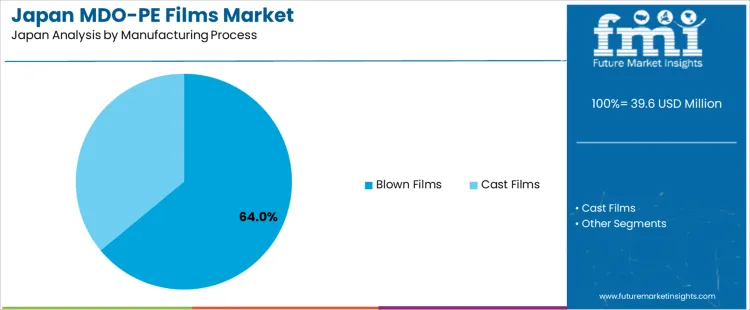
Blown films account for sixty-four percent of the demand for MDO PE films in Japan, reflecting dominance in high volume flexible packaging production. Consumption per line remains high due to continuous output for food pouches, industrial sacks, and lidding structures. Usage intensity is sustained by Japans strong snack food, frozen food, and convenience meal distribution. Procurement is tied to capital intensive extrusion assets with long depreciation cycles. Price sensitivity remains moderate because energy efficiency and yield stability outweigh resin cost swings. Specification control centers on orientation uniformity, gauge consistency, bubble stability, and surface treatment reliability under demanding commercial conditions.
Blown films contribute the majority of incremental MDO PE film capacity additions in Japan as converters pursue downgauging and higher line speeds. Repeat production runs remain high because pouch and lidding formats require consistent orientation behavior. Buyers favor inhouse blown film assets to control scheduling and minimize outsourcing risk. Margin structure remains compressed due to high capital cost recovery pressure. Certification exposure is elevated for food contact extrusion and recyclability labeling. Import reliance is limited for finished films but persists for specialty additives. Lead time risk is controlled through synchronized resin and extrusion planning. Substitution pressure from cast films continues.
What Is Driving the Demand for MDO-PE Films in Japan Flexible Packaging and Recycling Systems?
Demand for MDO-PE films in Japan is shaped by the transition toward mono-material packaging, recycling compliance, and high-performance food packaging requirements. Brand owners in prepared foods, frozen meals, and snack products are shifting away from complex laminates toward polyethylene-based structures that align with domestic recycling systems. Japan strict material separation standards and retailer-led packaging guidelines are accelerating qualification of MDO-PE films for barrier performance, heat resistance, and machinability. Demand is therefore guided by recyclability targets, high-speed packaging line compatibility, and shelf-life stability rather than experimental sustainability pilots.
How Is Mono-Material Packaging Policy Influencing Film Adoption?
Japan packaging policies emphasize material simplification to improve post-consumer sorting efficiency, directly supporting MDO-PE film adoption. Brand owners are redesigning pouches and flow wraps to eliminate multi-layer PET and aluminum structures in favor of all-PE formats. MDO orientation enables stiffness and printability close to PET while retaining PE recyclability. Retail-driven compliance audits and municipal waste handling rules reinforce this shift. As a result, demand is being driven by regulatory practicality and infrastructure compatibility rather than voluntary packaging redesign alone.
Why Are Food Processors and Retail Private Labels Creating Structural Demand?
Japan large volume of chilled, frozen, and ready-to-eat food production relies on packaging that balances barrier performance, puncture resistance, and sealing efficiency. MDO-PE films allow downgauging while maintaining stiffness for automated filling lines used in bento meals, frozen seafood, and snack foods. Retail private labels increasingly specify recyclable mono-material films across national distribution networks. This creates repeat demand anchored in standardized packaging specifications rather than short-run promotional packaging programs.
How Do Material Cost, Supply Availability, and Processing Limits Restrain Expansion?
Demand for MDO-PE films in Japan is restrained by higher resin conversion cost compared with conventional blown PE films and limited domestic orientation capacity. Import dependence for high-spec MDO film grades exposes converters to freight and currency volatility. Not all packaging lines support MDO stiffness and tear propagation behavior without equipment tuning. In addition, certain oxygen- and moisture-sensitive products still require aluminum or EVOH structures. These factors moderate the pace of full-scale replacement despite strong regulatory and retailer alignment.
What is the Demand for MDO-PE Films in Japan by Region?
| Region | CAGR (%) |
|---|---|
| Kyushu & Okinawa | 4.2% |
| Kanto | 3.9% |
| Kinki | 3.4% |
| Chubu | 3.0% |
| Tohoku | 2.6% |
| Rest of Japan | 2.5% |
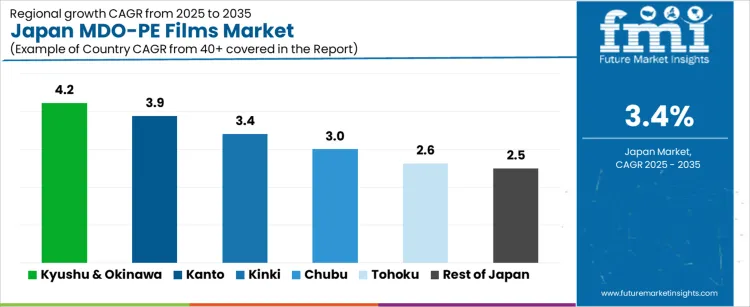
The demand for MDO-PE films in Japan is expanding at a steady pace across regions, with Kyushu and Okinawa leading at a 4.2% CAGR. Growth here is supported by flexible packaging conversion for food, personal care, and household products, alongside rising mono material laminate adoption on regional lines. Kanto follows at 3.9%, driven by high throughput packaging operations, private label output, and investments in downgauged film structures.
Kinki records 3.4% growth, reflecting stable demand from snack, dairy, and refill pouch applications. Chubu at 3.0% shows moderate uptake linked to automotive component packaging and industrial wraps. Tohoku and the Rest of Japan, at 2.6% and 2.5%, reflect slower growth shaped by smaller converter bases, conservative changeover cycles, and longer qualification timelines for recyclable film formats across food, beverage, and supply chains.
How Is Flexible Food Packaging Expansion in Kyushu and Okinawa Shaping MDO PE Film Demand?
Demand for MDO PE films in Kyushu and Okinawa is advancing at a CAGR of 4.2% through 2035, driven by rising seafood packaging, ready to eat meal production, and tourism linked food supply chains. Processing facilities in Fukuoka and Okinawa are increasing adoption of mono material barrier films for fresh proteins and chilled foods. This region contrasts with Tohoku by showing stronger pull from private food brands rather than municipal packaging programs. MDO PE films are used for vacuum packs, pouch laminates, and moisture barrier wraps across coastal food clusters.
- Seafood and frozen food packaging anchors regional demand
- Tourism driven food processing supports steady volume growth
- Mono material packaging adoption is rising across converters
- Coastal processing hubs dominate film procurement
What Is Driving MDO PE Film Consumption Across High Volume Retail Supply Chains in Kanto?

Demand for MDO PE films in Kanto is expanding at a CAGR of 3.9% through 2035, supported by dense supermarket networks, private label packaging, and large scale logistics driven food distribution. Tokyo and surrounding prefectures lead adoption in bakery goods, dairy packs, and snack food packaging requiring downgauged barrier films. Kanto differs from Kyushu and Okinawa through stronger emphasis on high turnover retail formats rather than export oriented food processing. MDO PE films are increasingly specified for recyclable primary packs across urban consumer goods channels.
- Supermarket private labels drive steady film offtake
- Bakery and dairy packs sustain recurring material usage
- Logistics efficiency supports downgauged film formats
- High turnover retail keeps replacement demand consistent
Why Is Regional Manufacturing Supporting Moderate MDO PE Film Growth in Kinki?
MDO PE film demand in Kinki is advancing at a CAGR of 3.4% through 2035, supported by regional food brands, industrial packaging, and specialty chemical pouches. Osaka and Kobe host a wide network of local converters supplying flexible packaging to mid scale processors. Kinki contrasts with Kanto through greater dependence on manufacturing supply chains rather than large retail consolidation. MDO PE films are applied in powder pouches, condiment sachets, frozen foods, and industrial liners where mono material compliance is increasingly specified.
- Regional food brands support steady flexible packaging demand
- Powder and condiment pouches sustain material throughput
- Industrial liner usage supports secondary application growth
- Converter clusters anchor procurement concentration
How Is Automotive and Industrial Packaging Activity Influencing MDO PE Film Adoption in Chubu?
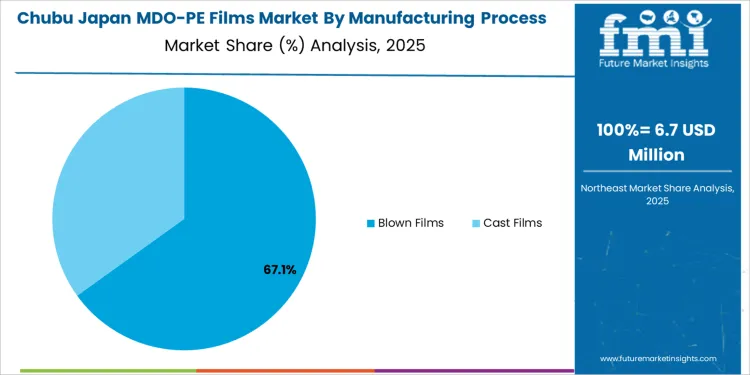
Demand for MDO PE films in Chubu is progressing at a CAGR of 3.0% through 2035, supported by industrial component packaging, electronics protection films, and growing food processing activity around Nagoya. Unlike Kinki, this region shows stronger linkage between manufacturing logistics and flexible packaging consumption. MDO PE films are used for stretch wraps, industrial barrier liners, moisture protection for components, and secondary food packs. Automotive supplier ecosystems continue to influence packaging material specifications and volume stability.
- Industrial component protection drives film demand
- Electronics moisture barriers add technical application usage
- Secondary food packaging supports baseline growth
- Automotive supply chains stabilize long term procurement
What Is Sustaining Gradual MDO PE Film Uptake in Tohoku Food and Agricultural Packaging?
MDO PE film demand in Tohoku is increasing at a CAGR of 2.6% through 2035, supported by agricultural produce packing, dairy processing, and regional frozen food distribution. This region contrasts with Kanto and Kyushu and Okinawa through lower converter density and smaller processing scale. MDO PE films are mainly used for vegetable pouches, rice packs, frozen seafood, and farm produce liners. Limited automation and cautious capital spending continue to restrain faster conversion to oriented barrier film formats.
- Agricultural produce packaging anchors primary usage
- Dairy and frozen foods sustain steady material demand
- Smaller converter base limits rapid adoption speed
- Regional distribution networks guide procurement volumes
How Do Low Density Manufacturing Zones Influence MDO PE Film Demand in the Rest of Japan?
Demand for MDO PE films in the Rest of Japan is advancing at a CAGR of 2.5% through 2035, shaped by small scale food processors, regional consumer goods packaging, and institutional supply chains. This region differs from Kanto and Chubu through lower industrial concentration and longer replacement cycles for packaging equipment. MDO PE films are primarily used in dry food packs, institutional meal kits, local beverage liners, and secondary wrapping applications. Procurement remains tied to cost sensitivity and distributor led supply agreements rather than direct converter contracts.
- Dry food packaging sustains baseline film consumption
- Institutional meal supply supports recurring usage
- Long replacement cycles limit rapid material changeovers
- Distributor networks guide regional sourcing decisions
What Is Driving the Demand for MDO PE Films in Japan and Which Producers Shape Packaging Conversion
The demand for MDO PE films in Japan is driven by lightweighting targets in flexible packaging, recycling compatibility requirements, and steady output from food, home care, and pharmaceutical sachet producers. Toyobo plays a central domestic role through biaxially oriented and specialty polyolefin film platforms supplied to Japanese converters serving snack foods, frozen meals, and liquid packaging. Mitsui Chemicals Tohcello supports demand through mono material film structures used in pouches and labels where down gauging and seal integrity are required. Toray Advanced Film participates through high clarity and barrier oriented films used in premium food and medical packaging. These domestic suppliers anchor local qualification cycles through established converter relationships and in house testing programs.
Coveris Holdings supplies selected grades into Japan through trading houses linked to multinational food brands seeking global packaging consistency. Avery Dennison participates where MDO PE films are used in pressure sensitive label constructions for logistics and retail packaging. Saes Coated Films serves niche applications tied to barrier enhancement for specialty foods and technical packaging. RKW Group supports demand through export oriented film supply for industrial and hygiene packaging formats used by Japanese OEM brands overseas. Procurement in Japan is guided by heat resistance, machine direction tear control, recyclability certification, and compatibility with high speed form fill seal lines. Buyer preference favors suppliers with domestic trial capability, tight thickness control, and stable long term supply programs.
Key Players in the MDO-PE Films Industry
- Coveris Holdings Inc
- Avery Dennison Corporation
- Saes Coated Films S.P.A
- Lenzing Plastics Gmbh & Co Kg
- Rkw Group
Scope of the report
| Items | Values |
|---|---|
| Quantitative Units (2025) | USD million |
| Material | High-density Polyethylene (HDPE), Low Density Polyethylene (LDPE), Linear-low Density Polyethylene (LLDPE) |
| Packaging Format | Pouches, Bags & Sacks, Tubes, Liners and Lidding Films, Sachets & Stick Packs |
| Manufacturing Process | Cast Films, Blown Films |
| End Use | Food, Hygiene, Beverages, Homecare, Personal Care |
| Regions Covered | Kyushu & Okinawa, Kanto, Kansai, Chubu, Tohoku, Rest of Japan |
| Key Companies Profiled | Coveris Holdings Inc, Avery Dennison Corporation, Saes Coated Films S.P.A, Lenzing Plastics GmbH & Co KG, RKW Group |
| Additional Attributes | Dollar by sales breakdown by region, material, packaging format, manufacturing process, and end use; growth projections through 2035; adoption of mono-material flexible packaging; downgauging and recyclability integration; machine direction orientation line capacity; heat resistance and seal integrity performance; high throughput form-fill-seal line compatibility; domestic MDO stretching capacity; brand-level packaging conversion mandates; compliance with Japanese recycling and waste management regulations; incremental uptake from industrial, food, and personal care packaging; supplier distribution stability and technical support |
MDO-PE Films Industry Segmentation
Packaging Format:
- Pouches
- Bags & Sacks
- Tubes
- Liners and Lidding Films
- Sachets & Stick Packs
Manufacturing Process:
- Cast Films
- Blown Films
Material:
- High-density Polyethylene (HDPE)
- Low Density Polyethylene (LDPE)
- Linear-low Density Polyethylene (LLDPE)
End Use:
- Food
- Hygiene
- Beverages
- Homecare
- Personal Care
Region
- Kyushu & Okinawa
- Kanto
- Kansai
- Chubu
- Tohoku
- Rest of Japan
Frequently Asked Questions
How big is the demand for MDO-PE films in Japan in 2025?
The demand for MDO-PE films in Japan is estimated to be valued at USD 39.6 million in 2025.
What will be the size of MDO-PE films in Japan in 2035?
The market size for the MDO-PE films in Japan is projected to reach USD 55.2 million by 2035.
How much will be the demand for MDO-PE films in Japan growth between 2025 and 2035?
The demand for MDO-PE films in Japan is expected to grow at a 3.4% CAGR between 2025 and 2035.
What are the key product types in the MDO-PE films in Japan?
The key product types in MDO-PE films in Japan are pouches, bags & sacks, tubes, liners and lidding films and sachets & stick packs.
Which manufacturing process segment is expected to contribute significant share in the MDO-PE films in Japan in 2025?
In terms of manufacturing process, blown films segment is expected to command 64.0% share in the MDO-PE films in Japan in 2025.
Preview the report firsthand - request a free sample
Get SampleGet the brochure for pricing and purchase details.
Get PDFTable of Content
- Executive Summary
- Japan Market Outlook
- Demand-side Trends
- Supply-side Trends
- Technology Roadmap Analysis
- Analysis and Recommendations
- Market Overview
- Market Coverage / Taxonomy
- Market Definition / Scope / Limitations
- Market Background
- Market Dynamics
- Drivers
- Restraints
- Opportunity
- Trends
- Scenario Forecast
- Demand in Optimistic Scenario
- Demand in Likely Scenario
- Demand in Conservative Scenario
- Opportunity Map Analysis
- Product Life Cycle Analysis
- Supply Chain Analysis
- Investment Feasibility Matrix
- Value Chain Analysis
- PESTLE and Porter’s Analysis
- Regulatory Landscape
- Regional Parent Market Outlook
- Production and Consumption Statistics
- Import and Export Statistics
- Market Dynamics
- Japan Market Analysis 2020 to 2024 and Forecast, 2025 to 2035
- Historical Market Size Value (USD Million) Analysis, 2020 to 2024
- Current and Future Market Size Value (USD Million) Projections, 2025 to 2035
- Y-o-Y Growth Trend Analysis
- Absolute $ Opportunity Analysis
- Japan Market Pricing Analysis 2020 to 2024 and Forecast 2025 to 2035
- Japan Market Analysis 2020 to 2024 and Forecast 2025 to 2035, By Packaging Format
- Introduction / Key Findings
- Historical Market Size Value (USD Million) Analysis By Packaging Format , 2020 to 2024
- Current and Future Market Size Value (USD Million) Analysis and Forecast By Packaging Format , 2025 to 2035
- Pouches
- Bags & Sacks
- Tubes
- Liners and Lidding Films
- Sachets & Stick Packs
- Y-o-Y Growth Trend Analysis By Packaging Format , 2020 to 2024
- Absolute $ Opportunity Analysis By Packaging Format , 2025 to 2035
- Japan Market Analysis 2020 to 2024 and Forecast 2025 to 2035, By Manufacturing Process
- Introduction / Key Findings
- Historical Market Size Value (USD Million) Analysis By Manufacturing Process, 2020 to 2024
- Current and Future Market Size Value (USD Million) Analysis and Forecast By Manufacturing Process, 2025 to 2035
- Blown Films
- Cast Films
- Y-o-Y Growth Trend Analysis By Manufacturing Process, 2020 to 2024
- Absolute $ Opportunity Analysis By Manufacturing Process, 2025 to 2035
- Japan Market Analysis 2020 to 2024 and Forecast 2025 to 2035, By Material
- Introduction / Key Findings
- Historical Market Size Value (USD Million) Analysis By Material, 2020 to 2024
- Current and Future Market Size Value (USD Million) Analysis and Forecast By Material, 2025 to 2035
- High-density Polyethylene (HDPE)
- Low Density Polyethylene (LDPE)
- Linear-low Density Polyethylene (LLDPE)
- Y-o-Y Growth Trend Analysis By Material, 2020 to 2024
- Absolute $ Opportunity Analysis By Material, 2025 to 2035
- Japan Market Analysis 2020 to 2024 and Forecast 2025 to 2035, By End Use
- Introduction / Key Findings
- Historical Market Size Value (USD Million) Analysis By End Use, 2020 to 2024
- Current and Future Market Size Value (USD Million) Analysis and Forecast By End Use, 2025 to 2035
- Food
- Hygiene
- Beverages
- Homecare
- Personal Care
- Y-o-Y Growth Trend Analysis By End Use, 2020 to 2024
- Absolute $ Opportunity Analysis By End Use, 2025 to 2035
- Market Structure Analysis
- Competition Dashboard
- Competition Benchmarking
- Market Share Analysis of Top Players
- By Regional
- By Packaging Format
- By Manufacturing Process
- By Material
- By End Use
- Competition Analysis
- Competition Deep Dive
- Coveris Holdings Inc
- Overview
- Product Portfolio
- Profitability by Market Segments (Product/Age /Sales Channel/Region)
- Sales Footprint
- Strategy Overview
- Marketing Strategy
- Product Strategy
- Channel Strategy
- Avery Dennison Corporation
- Saes Coated Films S.P.A
- Lenzing Plastics Gmbh & Co Kg
- Rkw Group
- Coveris Holdings Inc
- Competition Deep Dive
- Assumptions & Acronyms Used
- Research Methodology


