

- Industry Size (2025)
- USD 2.1 Bn
- Forecast (2035)
- USD 3.0 Bn
- CAGR (2025 to 2035)
- 4.0%
Demand for Technical Films in Japan Forecast and Outlook (2025-2035)
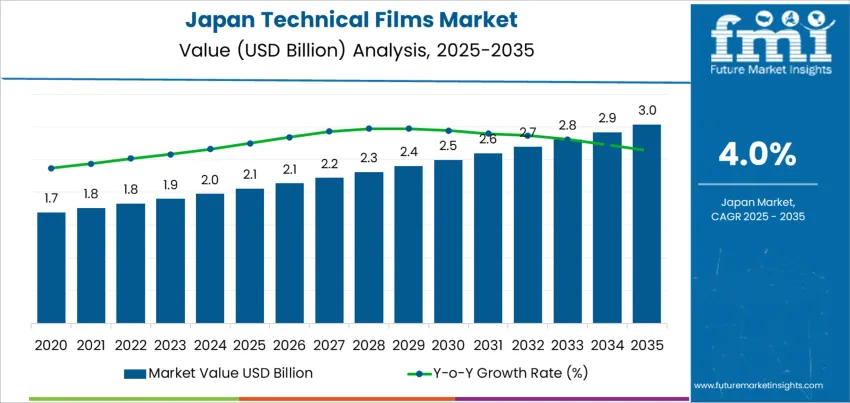
Technical film demand in Japan amounts to USD 2.1 billion in 2025 and is expected to reach USD 3.0 billion by 2035 at a CAGR of 4.0%. Early growth reflects stable usage across electronics, automotive components, industrial protection, and advanced packaging applications where functional performance outweighs commodity pricing. Stretch films account for 28% of total volume due to their continued role in pallet stabilization and industrial logistics. Polyethylene films represent the largest material group at 40% share, driven by versatility across LDPE, LLDPE, and HDPE grades. Electronics manufacturing supports steady demand for polyester and polyamide films used in insulation, display layers, and circuit protection within tightly controlled production environments.
After 2030, market expansion is shaped more by material performance upgrades than by volume scaling. Demand rises from about USD 2.5 billion in 2030 toward USD 3.0 billion by 2035 as fluoropolymers, polycarbonate, and multilayer engineered films gain higher adoption in battery systems, semiconductor fabrication, and mobility-related thermal management. Automotive electrification increases the use of high-dielectric and heat-resistant films, while industrial automation sustains demand for abrasion and chemical-resistant layers. Key suppliers active in Japan include Toray Industries, DuPont, Covestro AG, 3M Company, and Amcor Limited. Competitive strategy centers on thickness uniformity, surface treatment precision, and co-extrusion capability to meet tight tolerance requirements across advanced manufacturing supply chains.
Quick Stats of the Demand for Technical Films in Japan:
- Demand for Technical Films in Japan Value (2025): USD 2.1 billion
- Demand for Technical Films in Japan Forecast Value (2035): USD 3.0 billion
- Demand for Technical Films in Japan Forecast CAGR (2025-2035): 4.0%
- Demand for Technical Films in Japan Leading Film Type: Stretch Films (28%)
- Demand for Technical Films in Japan Key Growth Regions: Kyushu & Okinawa, Kanto, Kansai, Chubu, Tohoku, Rest of Japan
- Demand for Technical Films in Japan Top Players: Toray Industries, DuPont, Covestro AG, 3M Company, Amcor Limited
What is the Demand Forecast for Technical Films in Japan through 2035?
Technical films in Japan serve highly specialized manufacturing ecosystems where performance tolerances, optical clarity, barrier control, and thermal stability dictate procurement more than volume-driven packaging demand. Demand increases from USD 2.1 billion in 2025 to USD 2.5 billion by 2030, adding USD 0.4 billion in absolute value. This phase is shaped by steady expansion in electronics protection films, automotive interior laminates, display layers, and industrial insulation applications. Growth is closely linked to semiconductor production, battery module assembly, and high-precision component fabrication. Value expansion remains controlled because material specifications are mature and substitution cycles are gradual, with procurement governed by strict qualification and long-term supply agreements.
From 2030 to 2035, the market expands from USD 2.5 billion to USD 3.0 billion, adding USD 0.5 billion in the second half of the decade. This back weighted acceleration reflects rising use of high-performance films in advanced driver-assistance systems, next-generation display stacks, hydrogen and battery infrastructure insulation, and smart manufacturing environments. Higher multilayer complexity, tighter surface tolerances, and superior dielectric performance raise value per square meter. As Japan strengthens its position in precision electronics, mobility platforms, and advanced materials manufacturing, technical films shift from support materials to performance-critical system layers, sustaining long-term demand growth through 2035.
Technical Films Industry in Japan Key Takeaways
| Metric | Value |
|---|---|
| Industry Value (2025) | USD 2.1 billion |
| Forecast Value (2035) | USD 3.0 billion |
| Forecast CAGR (2025-2035) | 4.0% |
How Is Demand for Technical Films Evolving in Japan and What’s Driving It?
The demand for technical films in Japan has been rising as manufacturers across packaging, electronics, and automotive sectors seek high-performance materials that meet strict quality, barrier, and durability standards. Technical films such as polyester (PET), polypropylene (PP), and advanced multilayer laminates are increasingly used in food and beverage packaging, pharmaceutical packs, electronics films, and component protection layers. The need for lightweight, moisture- and oxygen-barrier packaging in processed foods, ready meals and pharmaceuticals drives film adoption over heavier rigid formats. In electronics and automotive sectors, films serve insulation, lamination, protection, and functional-coating roles, reinforcing demand as those industries modernize and expand.
Looking ahead, the Japanese market for technical films is set to grow further under pressure from sustainability requirements, evolving supply chains, and demand for advanced material performance. As food, pharmaceutical and consumer-goods producers look to reduce material weight while ensuring product protection and shelf life, multilayer films with barrier, printability and recyclability features will gain traction. Electronics miniaturization, rise of flexible displays, and automotive lightweighting will prompt use of high-specification films in functional and protective applications. At the same time, regulatory and circular-economy initiatives may push material suppliers and converters to adopt recyclable or bio-derived film blends, prompting innovation in film formulations and contributing to longer-term market growth.
How Are Film Type and Material Type Structuring the Demand for Technical Films in Japan?
The demand for technical films in Japan is structured by film type and material composition. Stretch films account for 28% of total demand, followed by other specialized films used in packaging, electronics, construction, automotive, and industrial protection applications. By material type, polyethylene including LDPE, LLDPE, and HDPE represents 40.0% of total consumption, followed by polyester, polyamide, polycarbonate, fluoropolymers, and other engineered polymers. Demand behavior is shaped by load stability needs, barrier performance requirements, heat resistance, optical clarity, and mechanical strength. These segments reflect how end user performance expectations and process compatibility define technical film selection across manufacturing, logistics, and high precision industrial operations in Japan.
Why Do Stretch Films Lead the Technical Film Type Demand in Japan?
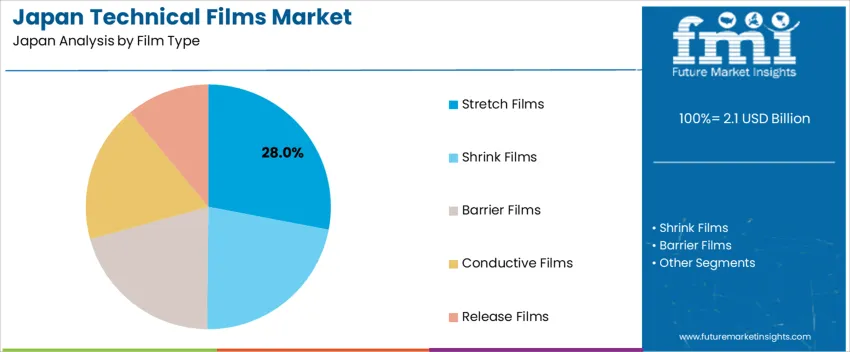
Stretch films account for 28% of total technical film demand in Japan due to their essential role in pallet stabilization, load containment, and transport protection across logistics intensive industries. These films are extensively used in food distribution, electronics manufacturing, pharmaceuticals, and automotive component shipping where secure wrapping is necessary to prevent load shifting and contamination during transit. The ability of stretch films to conform tightly around irregular loads improves wrapping efficiency while reducing material consumption per pallet. High puncture resistance and controlled elongation properties also support safe handling across automated and semi-automated wrapping systems.
Stretch films further benefit from steady usage across export oriented manufacturing sectors where outbound shipping volumes remain high. Automated stretch wrapping lines in distribution centers rely on consistent film performance for uninterrupted operations. Japan’s dense logistics network and frequent interfacility transport cycles reinforce continuous stretch film consumption. These logistics dependency, protection performance, and automation compatibility factors position stretch films as the leading film type in the Japan technical films demand structure.
Why Does Polyethylene Lead the Technical Film Material Demand in Japan?
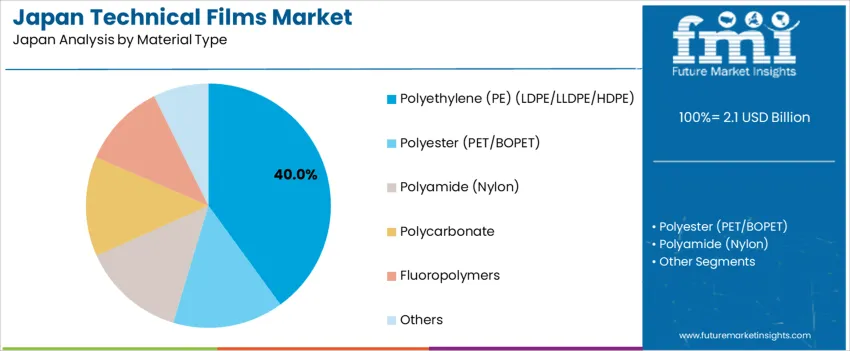
Polyethylene accounts for 40.0% of total technical film material demand in Japan due to its broad processability, mechanical flexibility, and cost efficiency across multiple industrial applications. LDPE, LLDPE, and HDPE grades are used in stretch films, protective covers, insulation layers, and barrier laminates where impact resistance and moisture protection are critical. Polyethylene films offer stable performance under varied temperature and humidity conditions, which supports use across refrigerated logistics, outdoor storage, and industrial wrapping environments.
Polyethylene further benefits from well-established domestic resin production and converting infrastructure that supports consistent film supply across packaging and industrial sectors. Compatibility with multi-layer extrusion technology allows producers to tailor strength, clarity, and sealing properties without changing base resin systems. Recycling compatibility under existing waste streams also supports regulatory alignment. These processing versatility, cost stability, and infrastructure maturity factors sustain polyethylene as the leading material type in the Japan technical films demand landscape.
Why Are Technical Films in Japan Treated as Functional Infrastructure Rather Than Surface Materials?
Demand for technical films in Japan is anchored in their role as invisible operating layers inside advanced manufacturing systems. These films are used to control light transmission, electrical insulation, surface protection, gas permeability, and thermal behavior across electronics, automotive, and industrial equipment. Their performance directly affects yield rates, defect levels, and equipment uptime. In highly automated production lines, film failure causes immediate process disruption. This operational dependency positions technical films as production infrastructure components rather than optional material upgrades driven by appearance or branding.
How Do Electronics Miniaturization and Automotive Electrification Shape Film Specifications?
Japanese electronics manufacturing drives demand for ultra-thin insulation films, optical films, and EMI shielding layers used in displays, sensors, and semiconductor packaging. Automotive electrification increases use of thermal interface films, battery insulation films, and protective laminates for power electronics. Compact device architecture requires films that maintain performance under extreme heat, vibration, and voltage stress. Tight tolerance engineering dominates material selection over cost alone. These application pressures create demand that is specification-driven and qualification-heavy rather than volume-driven by commodity conversion.
What Qualification Rigor and Supply Chain Conservatism Limit Rapid Market Entry?
Technical film demand in Japan is restrained by strict material qualification protocols and conservative supplier approval practices. OEMs require long-term performance testing under thermal cycling, chemical exposure, and mechanical fatigue. Switching suppliers carries production risk and triggers full revalidation. Many downstream manufacturers maintain long-standing supplier relationships to protect process stability. Domestic sourcing preference in critical electronics and automotive layers further limits entry. These structural behaviors slow abrupt market shifts and protect existing supply networks from rapid competitive disruption.
How Are Energy Devices, Robotics, and Smart Manufacturing Redefining Future Demand?
Future demand for technical films in Japan is shifting toward hydrogen systems, advanced batteries, robotics joints, and smart factory equipment. Energy storage and conversion platforms require new barrier films with precise gas control and dielectric strength. Robotics drives demand for low-friction, wear-resistant films in articulation and sensing zones. Smart manufacturing relies on protective and optical films for machine vision accuracy and sensor durability. These growth areas show technical films evolving from passive protection layers into active performance-enabling materials embedded deep within Japans next-generation industrial systems.
What is the Demand for Technical Films in Japan by Region?
| Region | CAGR (%) |
|---|---|
| Kyushu & Okinawa | 5.0% |
| Kanto | 4.6% |
| Kansai | 4.0% |
| Chubu | 3.5% |
| Tohoku | 3.1% |
| Rest of Japan | 2.9% |
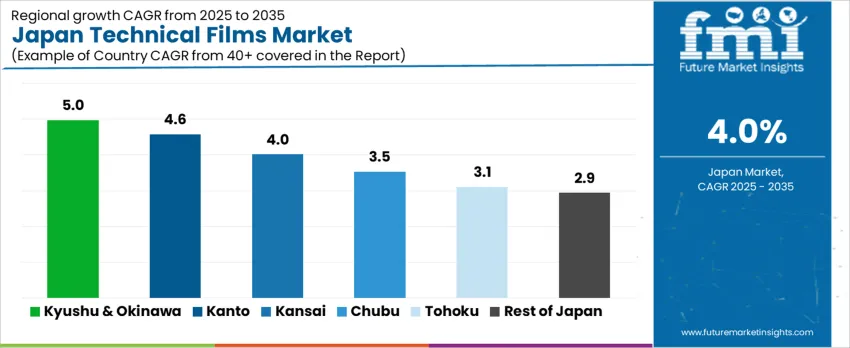
The demand for technical films in Japan is growing steadily across regions, with Kyushu & Okinawa leading at a 5.0% CAGR. Growth in this region is supported by expanding electronics manufacturing, packaging applications, and industrial film usage in automotive and insulation components. Kanto follows at 4.6%, driven by strong demand from electronics, semiconductor packaging, and high performance material users concentrated in urban industrial clusters. Kansai records 4.0% growth, supported by balanced demand from chemical processing, medical packaging, and flexible electronics. Chubu at 3.5% reflects moderate uptake linked to automotive manufacturing and industrial goods packaging. Tohoku and Rest of Japan, at 3.1% and 2.9%, show slower growth shaped by smaller industrial bases and limited large scale technical film production facilities.
How Is Industrial Packaging and Electronics Production Driving Demand in Kyushu And Okinawa?
Kyushu and Okinawa records a CAGR of 5.0% through 2035 for technical film demand, supported by expanding electronics manufacturing, food processing packaging, and medical device production. Barrier films, insulation films, and protective layers are widely used across semiconductor back end assembly and flexible electronics applications. Regional food processors rely on multilayer technical films for moisture and oxygen protection. Medical packaging also contributes steady volume. Demand remains application driven and production aligned, with procurement tied closely to industrial output rather than retail consumption trends across this manufacturing focused regional economy.
- Semiconductor assembly supports steady insulation film usage
- Food processing relies on multilayer barrier structures
- Medical packaging adds consistent base demand
- Industrial output guides predictable procurement cycles
What Is Sustaining Strong Technical Film Demand Across Kanto?
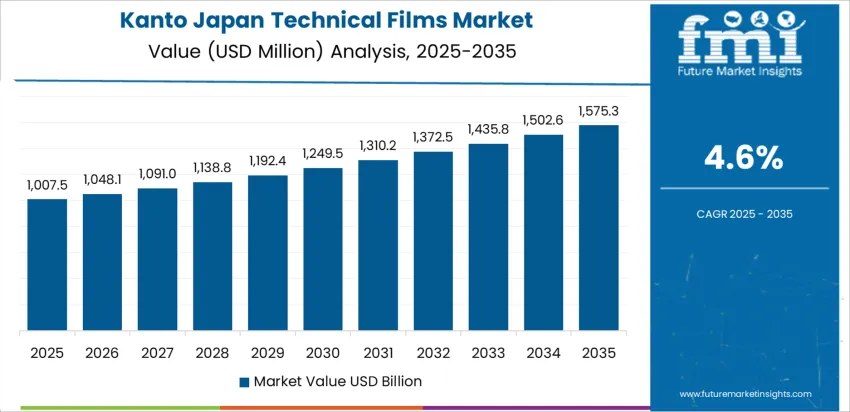
Kanto reflects a CAGR of 4.6% through 2035 for technical film demand, driven by dense concentration of electronics firms, automotive component producers, and pharmaceutical packaging operations. Display protection films, optical films, and high clarity barrier films dominate volume movement. Urban distribution hubs enable fast replenishment for manufacturers with high throughput production lines. Research driven product refinement supports steady upgrade cycles. Demand remains scale driven and specification heavy, shaped by continuous innovation in imaging, mobility electronics, and regulated medical packaging across metropolitan industrial clusters.
- Optical and display films anchor high value consumption
- Automotive interiors rely on functional surface films
- Fast logistics sustain high frequency material turnover
- Product refinement drives repeat specification upgrades
Why Is Kansai Showing Balanced Growth in Technical Film Applications?
Kansai posts a CAGR of 4.0% through 2035 for technical film demand, supported by mixed industrial activity across food packaging, industrial laminates, and consumer product manufacturing. Protective films for metal parts and industrial equipment remain core applications. Flexible packaging films for regional food brands also contribute steady volume. Small and mid sized converters dominate processing. Demand remains diversity driven rather than scale driven, with usage spread across several medium intensity end uses tied to stable production cycles in regional manufacturing and consumer goods supply chains.
- Industrial laminates support consistent protective film demand
- Regional food brands drive packaging film usage
- Equipment protection films serve machinery producers
- Mid sized converters anchor supply relationships
How Is Automotive and Machinery Production Supporting Demand in Chubu?
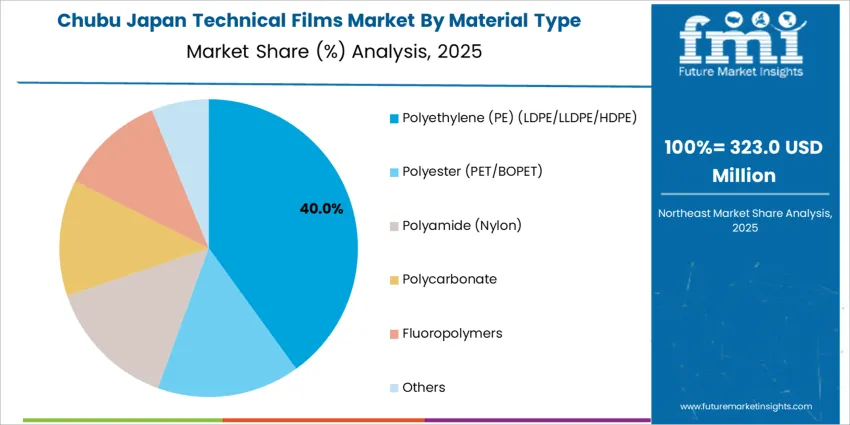
Chubu shows a CAGR of 3.5% through 2035 for technical film demand, supported by automotive manufacturing, precision machinery production, and industrial coating applications. Paint protection films, wire insulation films, and surface protection layers are widely used across assembly operations. Tier one automotive suppliers rely on consistent quality specifications. Export oriented component plants also contribute steady material movement. Demand remains engineering led and contract driven, with procurement closely aligned to long term automotive supply agreements and stable machinery production volumes across industrial manufacturing corridors.
- Automotive paint protection anchors major film consumption
- Wire insulation films support electrical component output
- Tier one suppliers rely on stable quality specifications
- Export components add steady application demand
What Is Guiding Measured Technical Film Growth in Tohoku?
Tohoku registers a CAGR of 3.1% through 2035 for technical film demand, shaped by regional industrial recovery, food preservation needs, and gradual uptake of industrial surface protection materials. Agricultural product packaging uses functional barrier films to extend shelf life. Light industrial parts utilize protective films against corrosion and abrasion. Limited large scale electronics manufacturing moderates high value film usage. Demand remains necessity driven and locally centered, with moderate volumes tied to food processing, machinery maintenance, and regional manufacturing recovery activity.
- Food preservation supports barrier film usage
- Corrosion protection films serve light industrial parts
- Limited electronics output restrains premium film demand
- Regional manufacturing recovery guides gradual growth
Why Does the Rest of Japan Maintain Stable but Slower Technical Film Demand?
Across the rest of Japan, growth reflects a CAGR of 2.9% through 2035 for technical film demand, supported by community level food packaging, institutional supply needs, and small scale industrial protection applications. Packaging films dominate overall usage, with limited penetration of advanced optical or electronic film categories. Local converters focus on cost efficient laminated structures. Short distribution distances reduce heavy protective wrapping needs. Demand remains stable and function focused, guided by daily food supply requirements and essential industrial protection rather than adoption of advanced specialty film technologies.
- Community packaging sustains base volume demand
- Cost efficiency guides local converter production choices
- Institutional supply supports consistent consumption
- Specialty film adoption remains limited outside major hubs
What Is Driving the Demand for Technical Films in Japan and Who Are the Key Companies Supplying Them?
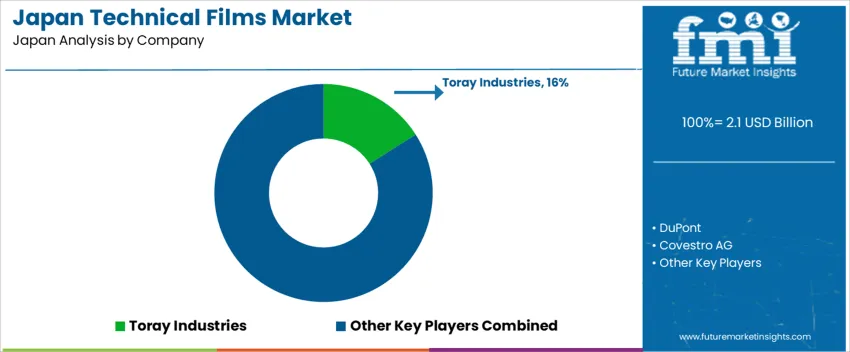
Demand for technical films in Japan is rising as manufacturers across packaging, electronics, automotive, medical devices, and industrial sectors seek high performance materials. These films offer barrier protection against moisture, gases, and UV radiation essential for food and pharmaceutical packaging to ensure shelf life and safety. In electronics, films provide optical clarity and scratch resistance, serving in displays, flexible electronics, and touch panels. Automotive applications benefit from lightweight, high strength films for glazing, interior trims and protective coatings. Rising demand also comes from growth in e commerce, logistics packaging needs, and increasing regulatory and consumer emphasis on product protection and durability. Technological advances in film manufacturing enable multilayer, composite, and functional coating films that meet diverse, high spec requirements.
Leading firms active in Japan’s technical films supply chain include Toray Industries, DuPont, Covestro AG, 3M Company and Amcor Limited. Toray offers a broad portfolio including polyester, polypropylene and specialty films used across electronics, packaging, and industrial applications. DuPont and Covestro supply high performance polymer films such as PVF, PET and multilayer composites for barrier, structural and specialty uses. 3M provides functional films with coatings or surface treatments suited for electronics, protective layers and automotive needs. Amcor supplies packaging grade films with barrier, sealability and flexibility — serving food, consumer goods and industrial packaging. Together, these companies ensure availability of advanced film materials that enable reliable, high spec manufacturing and support Japan’s demand across multiple end use sectors.
Key Players in Technical Films Industry in Japan
- Toray Industries
- DuPont
- Covestro AG
- 3M Company
- Amcor Limited
Scope of the Report
| Items | Values |
|---|---|
| Quantitative Units (2025) | USD billion |
| Film Type | Stretch Films, Shrink Films, Barrier Films, Conductive Films, Release Films, Others |
| Material Type | Polyethylene (LDPE/LLDPE/HDPE), Polyester (PET/BOPET), Polyamide (Nylon), Polycarbonate, Fluoropolymers, Others |
| Region | Kyushu & Okinawa, Kanto, Kansai, Chubu, Tohoku, Rest of Japan |
| Key Companies Profiled | Toray Industries, DuPont, Covestro AG, 3M Company, Amcor Limited |
| Additional Attributes | Dollar by sales by film type, material type, region, thickness uniformity, surface treatment, co-extrusion capability, barrier performance, heat resistance, dielectric properties, optical clarity, mechanical strength, industrial application compliance |
Technical Films Industry in Japan Segmentation
Film Type:
- Stretch Films
- Shrink Films
- Barrier Films
- Conductive Films
- Release Films
- Others
Material Type:
- Polyethylene (PE) (LDPE/LLDPE/HDPE)
- Polyester (PET/BOPET)
- Polyamide (Nylon)
- Polycarbonate
- Fluoropolymers
- Others
Region
- Kyushu & Okinawa
- Kanto
- Kansai
- Chubu
- Tohoku
- Rest of Japan
Frequently Asked Questions
How big is the demand for technical films in Japan in 2025?
The demand for technical films in Japan is estimated to be valued at USD 2.1 billion in 2025.
What will be the size of technical films in Japan in 2035?
The market size for the technical films in Japan is projected to reach USD 3.0 billion by 2035.
How much will be the demand for technical films in Japan growth between 2025 and 2035?
The demand for technical films in Japan is expected to grow at a 4.0% CAGR between 2025 and 2035.
What are the key product types in the technical films in Japan?
The key product types in technical films in Japan are stretch films, shrink films, barrier films, conductive films and release films.
Which material type segment is expected to contribute significant share in the technical films in Japan in 2025?
In terms of material type, polyethylene (pe) (ldpe/lldpe/hdpe) segment is expected to command 40.0% share in the technical films in Japan in 2025.
Preview the report firsthand - request a free sample
Get SampleGet the brochure for pricing and purchase details.
Get PDFTable of Content
- Executive Summary
- Japan Market Outlook
- Demand-side Trends
- Supply-side Trends
- Technology Roadmap Analysis
- Analysis and Recommendations
- Market Overview
- Market Coverage / Taxonomy
- Market Definition / Scope / Limitations
- Market Background
- Market Dynamics
- Drivers
- Restraints
- Opportunity
- Trends
- Scenario Forecast
- Demand in Optimistic Scenario
- Demand in Likely Scenario
- Demand in Conservative Scenario
- Opportunity Map Analysis
- Product Life Cycle Analysis
- Supply Chain Analysis
- Investment Feasibility Matrix
- Value Chain Analysis
- PESTLE and Porter’s Analysis
- Regulatory Landscape
- Regional Parent Market Outlook
- Production and Consumption Statistics
- Import and Export Statistics
- Market Dynamics
- Japan Market Analysis 2020 to 2024 and Forecast, 2025 to 2035
- Historical Market Size Value (USD Million) Analysis, 2020 to 2024
- Current and Future Market Size Value (USD Million) Projections, 2025 to 2035
- Y-o-Y Growth Trend Analysis
- Absolute $ Opportunity Analysis
- Japan Market Pricing Analysis 2020 to 2024 and Forecast 2025 to 2035
- Japan Market Analysis 2020 to 2024 and Forecast 2025 to 2035, By Film Type
- Introduction / Key Findings
- Historical Market Size Value (USD Million) Analysis By Film Type , 2020 to 2024
- Current and Future Market Size Value (USD Million) Analysis and Forecast By Film Type , 2025 to 2035
- Stretch Films
- Shrink Films
- Barrier Films
- Conductive Films
- Release Films
- Y-o-Y Growth Trend Analysis By Film Type , 2020 to 2024
- Absolute $ Opportunity Analysis By Film Type , 2025 to 2035
- Japan Market Analysis 2020 to 2024 and Forecast 2025 to 2035, By Material Type
- Introduction / Key Findings
- Historical Market Size Value (USD Million) Analysis By Material Type, 2020 to 2024
- Current and Future Market Size Value (USD Million) Analysis and Forecast By Material Type, 2025 to 2035
- Polyethylene (PE) (LDPE/LLDPE/HDPE)
- Polyester (PET/BOPET)
- Polyamide (Nylon)
- Polycarbonate
- Fluoropolymers
- Others
- Y-o-Y Growth Trend Analysis By Material Type, 2020 to 2024
- Absolute $ Opportunity Analysis By Material Type, 2025 to 2035
- Market Structure Analysis
- Competition Dashboard
- Competition Benchmarking
- Market Share Analysis of Top Players
- By Regional
- By Film Type
- By Material Type
- Competition Analysis
- Competition Deep Dive
- Toray Industries
- Overview
- Product Portfolio
- Profitability by Market Segments (Product/Age /Sales Channel/Region)
- Sales Footprint
- Strategy Overview
- Marketing Strategy
- Product Strategy
- Channel Strategy
- DuPont
- Covestro AG
- 3M Company
- Amcor Limited
- Toray Industries
- Competition Deep Dive
- Assumptions & Acronyms Used
- Research Methodology


