

- Industry Size (2025)
- USD 16.0 Bn
- Forecast (2035)
- USD 26.1 Bn
- CAGR (2025 to 2035)
- 5.0%
Demand for Technical Films in USA 2025 to 2035
The USA technical films demand landscape is positioned for steady expansion through 2035, supported by consistent industrial usage and rising adoption in high-performance applications. Demand valuation stands at USD 16.0 billion in 2025 and is projected to reach USD 26.1 billion by 2035, translating into a CAGR of 5.0%. Polyester based formats, particularly PET and BOPET films, remain dominant due to balanced strength, clarity, barrier control, and processing compatibility.
Consumption intensity remains highest across the West, South, and Northeast regions, where advanced manufacturing density, healthcare infrastructure, and packaging throughput remain concentrated. Procurement momentum is shaped by electronics insulation, automotive component protection, medical packaging compliance, and specialty labeling. Competitive supply is anchored by global material science leaders such as 3M Company, DuPont, Eastman Chemical Company, Avery Dennison, and Berry Global Inc.. Demand cycles show controlled variability, with innovation driven peaks and structurally stable baseline consumption sustaining long-term outlook.
Quick Stats for USA Technical Films Demand
- USA Technical Films Sales Value (2025): USD 16.0 billion
- USA Technical Films Forecast Value (2035): USD 26.1 billion
- USA Technical Films Forecast CAGR (2025 to 2035): 5.0%
- Leading Category in USA Technical Films Demand: Polyester (PET/BOPET) Films
- Key Growth Regions in USA Technical Films Demand: West USA, South USA, Northeast USA
- Top Players in USA Technical Films Demand: 3M Company, DuPont, Eastman Chemical Company, Avery Dennison, Berry Global Inc.
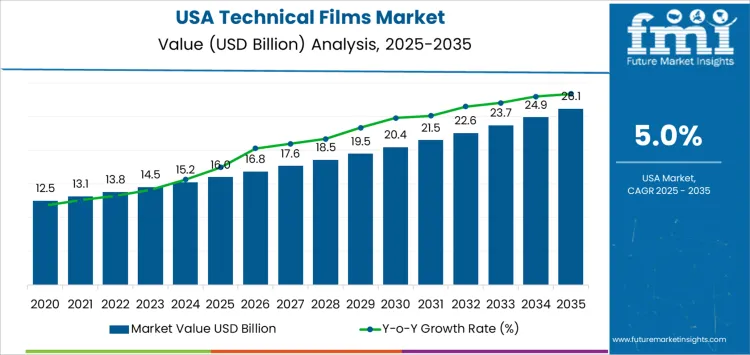
What is the Growth Forecast for Technical Films Industry in USA through 2035?
Demand is concentrated in the West, South, and Northeast, where large consumer bases, diversified retail networks, and higher penetration of premium packaged beverages contribute to wider product availability. Key suppliers include FPC Flexible Packaging Corporation, Cascades Inc., Sonoco Products Company, Huhtamaki Americas, and WestRock Company. Their focus areas include barrier enhancement, lighter packaging structures, and efficient forming and sealing integration for high-volume tea production lines.
Peaks in demand for technical films in the United States occur when industrial production cycles strengthen and new high-performance applications expand. Electronics, automotive components, and medical packaging drive procurement surges tied to product launches and regulatory upgrades. Increased investment in renewable-energy systems such as solar films also contributes to temporary acceleration. These peak intervals reflect strong alignment between manufacturing output and specialized material needs.
Troughs tend to appear during periods of slowed capital spending, particularly in automotive and consumer electronics. Inventory adjustments by large converters or downstream processors can temporarily reduce order volumes even when long-term consumption remains stable. Substitution by competing materials such as coated papers or molded plastics contributes to localized troughs without triggering structural decline. The pattern shows a controlled fluctuation range. Essential roles in insulation, barrier protection, and precision manufacturing prevent sharp downturns. Peaks are pronounced by innovation and high-value applications while troughs remain shallow due to consistent baseline requirements in industrial supply chains.
USA Technical Films Key Takeaways
| Metric | Value |
|---|---|
| USA Technical Films Sales Value (2025) | USD 16.0 billion |
| USA Technical Films Forecast Value (2035) | USD 26.1 billion |
| USA Technical Films Forecast CAGR (2025-2035) | 5.0% |
Why is the Demand for Technical Films in the USA Growing?
Demand for technical films in the USA is increasing because manufacturers across electronics, automotive, construction and medical sectors require engineered materials that provide barrier protection, electrical insulation and mechanical durability. Flexible films support lightweight product design, especially in electric vehicles and consumer electronics where space constraints and heat management are important. Packaging industries use technical films for moisture and oxygen control in foods, pharmaceuticals and sensitive industrial goods, strengthening product integrity throughout distribution networks.
Growth in clean energy and building improvements encourages adoption of films used for solar panel back sheets, window insulation and structural protection. Healthcare facilities rely on sterilizable films for medical device packaging and protective coverings used in procedural environments. Industrial automation supports demand for release films, surface protection films and micro layer composites that improve manufacturing efficiency. Constraints include volatility in raw material costs and the need for continuous innovation to meet recycling and environmental requirements. Smaller companies may delay switching to advanced films when standard materials already meet regulatory and performance needs. Supply chain planning influences timing of upgrades in fast moving consumer goods sectors.
Which Material Types and Applications Lead Demand for Technical Films in the USA?
Demand for technical films in the United States is driven by needs across high-performance industries including electronics, transport, and advanced packaging. USA manufacturers focus on barrier strength, precision coating, durability, heat resistance, and dimensional stability for complex end-use engineering. Functional films also support insulation, labeling, and protective interfaces in digital devices and industrial manufacturing. Growth aligns with semiconductor expansion, consumer electronics innovation, and adoption of lightweight materials in mobility sectors.
By Material Type, Polyester Films Lead USA Demand
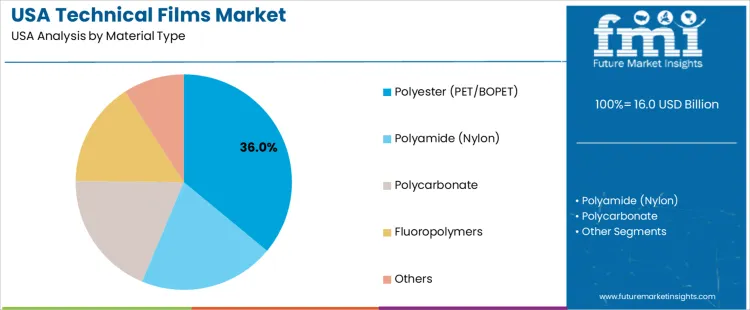
Polyester (PET/BOPET) films account for 36.0% due to their superior tensile strength, cost efficiency, high thermal resistance, and suitability for coating and lamination processes. They are widely used in electronics insulation, flexible displays, solar cells, and precision packaging barriers. Other material types, polyamide (nylon), polycarbonate, fluoropolymers, and specialty films, serve applications requiring chemical resistance, clarity, or high dielectric performance. In the USA, PET films benefit from strong integration in domestic manufacturing lines and advancements in thin-film innovation supporting next-generation flexible circuits and optoelectronic components. Reliability, scalability, and recyclability initiatives further sustain PET adoption in regulated sectors and high-volume production environments.
Key Points:
- PET leads due to performance balance and broad compatibility
- Extensive USA manufacturing supports cost-effective scaling
- Flex-electronics and coated films expand PET usage
By Application, Electronics & Electrical Uses Hold the Largest Share
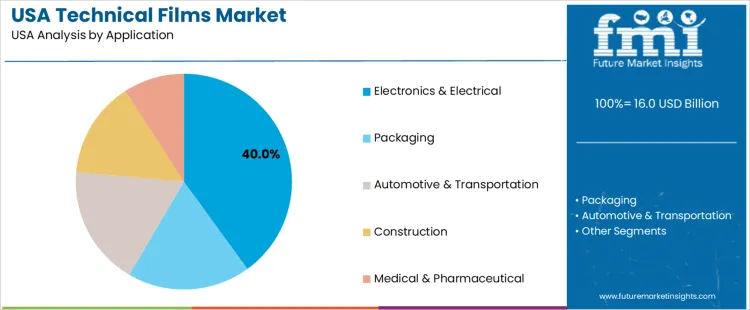
Electronics & electrical applications represent 40.0%, driven by rising consumption in insulating layers, printed circuitry, capacitor dielectrics, and protective films used in smart devices and consumer appliances. Technical films must maintain optical clarity, heat endurance, and dielectric stability within compact, high-efficiency components.
Packaging, automotive & transportation, construction, and medical segments continue to adopt high-strength films for sealing, surface protection, lightweight structural enhancement, and sterile-barrier performance. USA demand intensifies as domestic semiconductor investments increase, and sustainability goals shift industries toward polymer-based engineering films in place of heavier substrates. Technical films remain critical in supporting innovation across industrial automation, IoT hardware, and renewable power infrastructure.
Key Points:
- Electronic insulation and circuitry drive the largest share of demand
- High-performance films support miniaturization and durability
- Expansion of USA semiconductor capacity strengthens consumption
What are the Drivers, Restraints, and Key Trends of the Demand for Technical Films in the USA?
Growth of electronics manufacturing, increased demand for protective industrial films and expansion of high-performance packaging applications are driving demand.
In the United States, technical films gain adoption in semiconductor fabrication, display assembly and battery production where material purity and mechanical stability are critical. Automotive and aerospace suppliers use protective films during painting, assembly and transport to guard surfaces from scratches and contamination. Food and pharmaceutical companies require barrier films that maintain product integrity in refrigerated and ambient distribution systems. Construction and solar panel manufacturers rely on films for weather resistance and insulation performance. These varied end uses sustain steady procurement of specialty polyethylene, polyester and polyamide films that support advanced manufacturing and regulated packaging environments.
Price volatility in feedstocks, recycling challenges for multilayer films and long qualification cycles in regulated sectors restrain demand.
Technical films depend on petrochemical inputs with pricing sensitive to global supply fluctuations. Multilayer structures designed for barrier and mechanical performance are difficult to recycle, which creates compliance pressure from sustainability targets. Medical and aerospace customers require extensive testing and documentation before material changes can be approved, extending time-to-market for new formulations. Smaller converters may avoid frequent upgrades when validation costs outweigh short-term performance improvements. These financial and regulatory constraints lead to incremental rather than rapid product shifts.
Shift toward monomaterial recyclable designs, increased use in EV battery insulation and rising adoption of digital surface treatments define key trends.
Film producers expand monomaterial barrier solutions to align with USA packaging circular-economy goals and retailer recycling programs. Growth in electric vehicle production drives demand for thermal and electrical insulation films suitable for battery module assembly. Digital surface treatments improve printability and adhesion for converters serving flexible electronics, medical labeling and industrial marking. Domestic supply chain initiatives encourage regional production of high-performance films to enhance availability and reduce import dependency. These developments indicate sustained, innovation-oriented demand for technical films across the United States manufacturing and advanced packaging sectors.
Analysis of the Demand for Technical Films in the USA by Region
Demand for technical films in the United States is shaped by their application in electronics, automotive components, flexible packaging, solar panels, and industrial laminations requiring high tensile strength, chemical resistance, and barrier performance. Regulatory expectations for durability and sustainability influence material selection as converters optimize formulations for heat stability, clarity, and processing efficiency. Supply growth tracks regional manufacturing maturity and end-use innovation patterns. West USA leads at 5.8% CAGR, followed by South USA at 5.2%, Northeast USA at 4.6%, and Midwest USA at 4.0%. Strategic sourcing focuses on resin reliability, extrusion capacity, and coating capabilities matching advanced industrial needs.
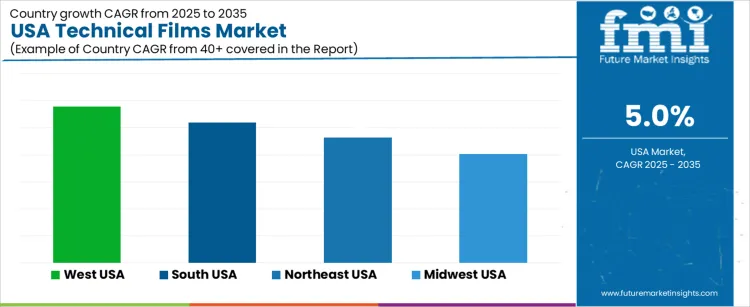
| Region | CAGR (2025-2035) |
|---|---|
| West USA | 5.8% |
| South USA | 5.2% |
| Northeast USA | 4.6% |
| Midwest USA | 4.0% |
How is the West USA driving demand for technical films?
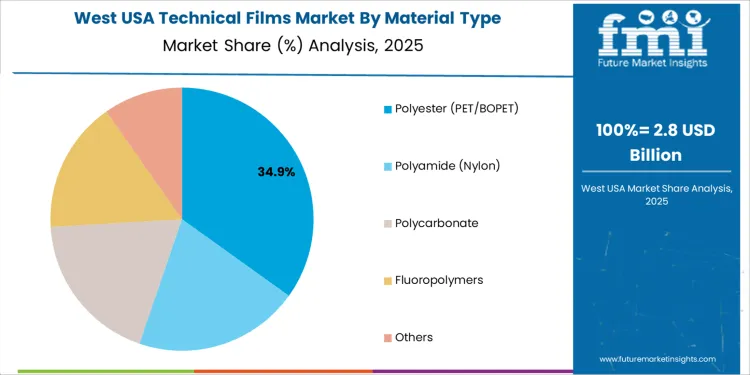
West USA expands at 5.8% CAGR, supported by strong semiconductor and consumer-electronics manufacturing bases across California and nearby hubs. Technical films incorporating precise dielectric properties, heat-shrink stability, and surface-treatment coatings are used in printed-circuit protection, battery insulation, and display assembly. Growth in solar energy installations requires PET and polyimide films that withstand UV and outdoor exposure.
Packaging converters adopt high-barrier films for specialty food and nutraceutical applications favored by health-driven consumers. Import access via Pacific ports strengthens supply chains for advanced resins and coating chemicals. Procurement teams evaluate film gauge accuracy, anti-static performance, and continuous-roll consistency for automated lamination lines operating at high throughput.
- Semiconductor and display manufacturing supporting specialty-film demand
- Solar-panel growth driving UV-resistant material sourcing
- Pacific-port logistics enabling stable resin access
- Converter investments improving barrier-film capabilities
How is the South USA shaping technical-film procurement?
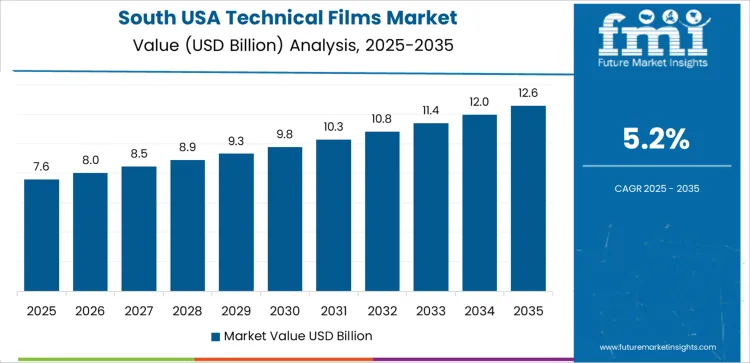
South USA demonstrates 5.2% CAGR, driven by automotive and industrial-equipment manufacturing across Texas, Alabama, and Georgia. Under-the-hood components require films with thermal and chemical durability for wire harnesses, insulation wraps, and adhesive-backed protective layers. Packaging for poultry, seafood, and frozen goods uses high-strength laminates capable of cold-chain performance and puncture resistance.
Resin-production clusters along the Gulf Coast support cost-efficient sourcing for PET, PP, and specialty urethane films. Fulfillment centers for e-commerce operations increase demand for tamper-evident labels and shipping-resistant film structures. Buyers emphasize roll-to-roll processing compatibility, die-cutting stability, and coating adhesion during converting.
- Automotive applications ensuring durability-focused procurement
- Cold-chain packaging requiring strong and shaped films
- Gulf Coast resin proximity reinforcing cost advantages
- Roll-handling reliability governing supplier selection
How is the Northeast USA influencing specialty-film innovation?
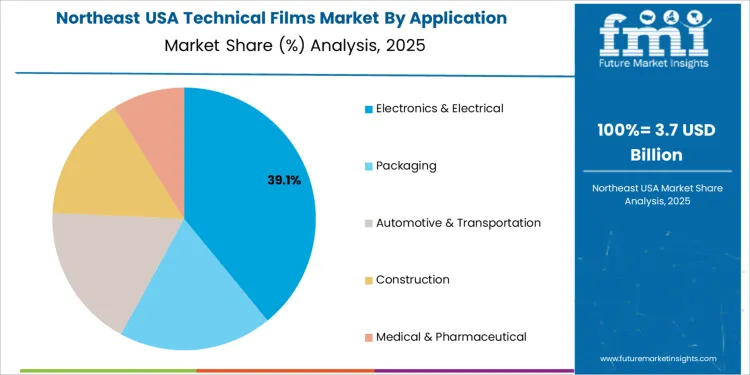
Northeast USA posts 4.6% CAGR, tied to medical-device manufacturing, pharmaceutical packaging, and diagnostic-product assembly across New York, New Jersey, and Massachusetts. Films used in sterile-barrier systems must preserve seal integrity, oxygen resistance, and biocompatibility. Electronics firms in the region require precision-coated films for sensors and laminated circuits. Food companies rely on high-barrier pouches supporting migration-control compliance for retail aisles. Procurement strategies prioritize validated regulatory dossiers, traceability of polymer sources, and repeatable surface-treatment properties required for adhesives and print coatings. Smaller-footprint converters support fast turnaround for multi-SKU material demands aligned with rapid product-development cycles.
- Healthcare compliance defining film specification standards
- Sensor-manufacturing growth boosting coated-film usage
- Multi-SKU retail packaging driving agile converting
- Strong traceability and QC frameworks shaping vendor approval
How is the Midwest USA maintaining structural demand for technical films?
Midwest USA achieves 4.0% CAGR, influenced by durable-goods production, agricultural packaging, and industrial supply shipments across Illinois, Ohio, and Michigan. Protective films secure metal parts, appliances, and automotive interiors during storage and transport, requiring abrasion-resistant surface layers. Food processors in the region adopt sealing-stable laminates for meat, dairy, and processed goods distributed nationwide. Stability of film USAge reflects long-established manufacturing where procurement focuses on long-run operational dependability. Buyers evaluate mechanical-strength consistency and waste-reduction outcomes on high-speed lines. Distribution corridors from Chicago hubs ensure steady access to standard and specialty films without rapid variability in demand.
- Durable-goods protection supporting baseline volumes
- Processed-food manufacturing sustaining lamination needs
- Cost-and-performance balance guiding purchases
- Logistics networks maintaining predictable regional supply
What does the competitive landscape for technical-film demand in the United States look like?
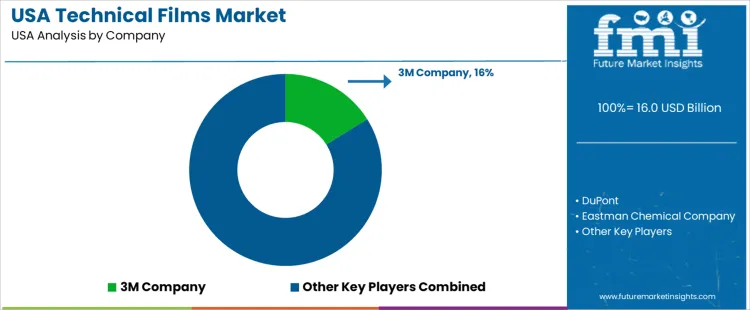
Technical films in the United States support protective laminates, industrial labeling, solar-control coatings, insulation layers, and component packaging used in electronics, automotive manufacturing, appliances, and building systems. Demand aligns with material performance requirements including chemical resistance, optical clarity, tensile strength, and controlled barrier transmission. Procurement teams evaluate long-term durability, conversion compatibility, and stable sourcing of engineered polymers required in regulated product categories such as medical equipment and electrical assemblies.
3M Company holds an estimated 16.1% share. Its portfolio includes specialty laminates, adhesive-backed films, optical enhancement layers, and insulation films widely integrated into USA manufactured goods. DuPont delivers high-performance polymer films with consistent use in flexible electronics, thermal insulation, and industrial processing systems.
Eastman Chemical Company supplies polyester-based films used for solar control, automotive glazing, and appliance protection. Avery Dennison contributes industrial labeling and pressure-sensitive film solutions supporting traceability and equipment safety compliance. Berry Global Inc. participates with protective packaging films and process films for OEM customers seeking scalable USA manufacturing options.
Competitive positioning in the United States depends on material science capability, customization of film structures for specific industrial functions, dependable regulatory compliance, and conversion efficiency. Growth continues as domestic manufacturers adopt lighter and more durable materials that support energy efficiency, extended equipment life, and advanced electronics integration.
Key Players in USA Technical Films Demand
- 3M Company
- DuPont
- Eastman Chemical Company
- Avery Dennison
- Berry Global Inc.
Scope of the Report
| Items | Values |
|---|---|
| Quantitative Units | USD billion |
| Material Type | Polyester (PET/BOPET), Polyamide (Nylon), Polycarbonate, Fluoropolymers, Others |
| Application | Electronics & Electrical, Packaging, Automotive & Transportation, Construction, Medical & Pharmaceutical |
| Regions Covered | West USA, South USA, Northeast USA, Midwest USA |
| Key Companies Profiled | 3M Company, DuPont, Eastman Chemical Company, Avery Dennison, Berry Global Inc. |
| Additional Attributes | Dollar sales by material type and application; regional adoption patterns for high-performance films; demand growth in electronic insulation, lightweight automotive components, and sterile pharmaceutical packaging; technical requirements including heat resistance, optical clarity, and chemical durability; product innovation trends in recyclable and high-barrier film structures across USA industrial sectors. |
USA Technical Films Demand by Segments
Material Type:
- Polyester (PET/BOPET)
- Polyamide (Nylon)
- Polycarbonate
- Fluoropolymers
- Others
Application:
- Electronics & Electrical
- Packaging
- Automotive & Transportation
- Construction
- Medical & Pharmaceutical
Region:
- West USA
- South USA
- Northeast USA
- Midwest USA
Frequently Asked Questions
How big is the demand for technical films in USA in 2025?
The demand for technical films in USA is estimated to be valued at USD 16.0 billion in 2025.
What will be the size of technical films in USA in 2035?
The market size for the technical films in USA is projected to reach USD 26.1 billion by 2035.
How much will be the demand for technical films in USA growth between 2025 and 2035?
The demand for technical films in USA is expected to grow at a 5.0% CAGR between 2025 and 2035.
What are the key product types in the technical films in USA?
The key product types in technical films in USA are polyester (pet/bopet), polyamide (nylon), polycarbonate, fluoropolymers and others.
Which application segment is expected to contribute significant share in the technical films in USA in 2025?
In terms of application, electronics & electrical segment is expected to command 40.0% share in the technical films in USA in 2025.
Preview the report firsthand - request a free sample
Get SampleGet the brochure for pricing and purchase details.
Get PDFTable of Content
- Executive Summary
- USA Market Outlook
- Demand-side Trends
- Supply-side Trends
- Technology Roadmap Analysis
- Analysis and Recommendations
- Market Overview
- Market Coverage / Taxonomy
- Market Definition / Scope / Limitations
- Market Background
- Market Dynamics
- Drivers
- Restraints
- Opportunity
- Trends
- Scenario Forecast
- Demand in Optimistic Scenario
- Demand in Likely Scenario
- Demand in Conservative Scenario
- Opportunity Map Analysis
- Product Life Cycle Analysis
- Supply Chain Analysis
- Investment Feasibility Matrix
- Value Chain Analysis
- PESTLE and Porter’s Analysis
- Regulatory Landscape
- Regional Parent Market Outlook
- Production and Consumption Statistics
- Import and Export Statistics
- Market Dynamics
- USA Market Analysis 2020 to 2024 and Forecast, 2025 to 2035
- Historical Market Size Value (USD Million) Analysis, 2020 to 2024
- Current and Future Market Size Value (USD Million) Projections, 2025 to 2035
- Y-o-Y Growth Trend Analysis
- Absolute $ Opportunity Analysis
- USA Market Pricing Analysis 2020 to 2024 and Forecast 2025 to 2035
- USA Market Analysis 2020 to 2024 and Forecast 2025 to 2035, By Material Type
- Introduction / Key Findings
- Historical Market Size Value (USD Million) Analysis By Material Type , 2020 to 2024
- Current and Future Market Size Value (USD Million) Analysis and Forecast By Material Type , 2025 to 2035
- Polyester (PET/BOPET)
- Polyamide (Nylon)
- Polycarbonate
- Fluoropolymers
- Others
- Y-o-Y Growth Trend Analysis By Material Type , 2020 to 2024
- Absolute $ Opportunity Analysis By Material Type , 2025 to 2035
- USA Market Analysis 2020 to 2024 and Forecast 2025 to 2035, By Application
- Introduction / Key Findings
- Historical Market Size Value (USD Million) Analysis By Application, 2020 to 2024
- Current and Future Market Size Value (USD Million) Analysis and Forecast By Application, 2025 to 2035
- Electronics & Electrical
- Packaging
- Automotive & Transportation
- Construction
- Medical & Pharmaceutical
- Y-o-Y Growth Trend Analysis By Application, 2020 to 2024
- Absolute $ Opportunity Analysis By Application, 2025 to 2035
- Market Structure Analysis
- Competition Dashboard
- Competition Benchmarking
- Market Share Analysis of Top Players
- By Regional
- By Material Type
- By Application
- Competition Analysis
- Competition Deep Dive
- 3M Company
- Overview
- Product Portfolio
- Profitability by Market Segments (Product/Age /Sales Channel/Region)
- Sales Footprint
- Strategy Overview
- Marketing Strategy
- Product Strategy
- Channel Strategy
- DuPont
- Eastman Chemical Company
- Avery Dennison
- Berry Global Inc.
- 3M Company
- Competition Deep Dive
- Assumptions & Acronyms Used
- Research Methodology


