

- Industry Size (2026)
- USD 398.2 Mn
- Forecast (2036)
- USD 563.5 Mn
- CAGR (2026 to 2036)
- 3.5%
USA Lawn Leaf Bags Market Forecast and Outlook By FMI
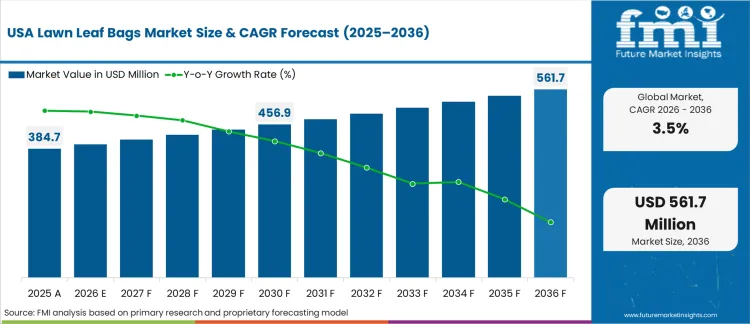
In 2025, the USA lawn leaf bags market was valued at USD 384.6 million. Based on Future Market Insights' analysis, demand for lawn leaf bags is estimated to grow to USD 398.2 million in 2026 and USD 563.5 million by 2036. FMI projects a CAGR of 3.5% during the forecast period.
The market is expected to generate an absolute dollar growth of USD 165.3 million between 2026 and 2036. This reflects steady, season-driven expansion supported by residential lawn care activity, municipal yard waste programs, and rising preference for biodegradable and paper-based disposal bags. Growth remains incremental rather than transformational, as demand is closely tied to housing trends and landscaping cycles. Plastic usage restrictions in several states and resin price volatility act as structural constraints, while composting initiatives support paper-based alternatives.
Biodegradable or reusable bags reduce plastic waste and can be composted with leaves to create nutrient-rich mulch. Dr. Sarah Evans, a sustainable gardening expert at Cornell University, notes, “Compostable lawn leaf bags are a game-changer, turning leaf waste into a resource for healthier gardens.”
Summary of USA Lawn Leaf Bags Market
- USA Lawn Leaf Bags Market Definition
- The USA lawn leaf bags market includes plastic and paper collection bags designed for yard waste disposal, landscaping activities, and seasonal outdoor cleanup applications.
- Demand Drivers in the Market
- Rising residential landscaping and home improvement activities are increasing demand for durable and high-capacity lawn leaf collection bags.
- Municipal composting and yard waste segregation regulations are supporting adoption of biodegradable and paper-based leaf bags.
- Growth in commercial landscaping services and property management is driving bulk procurement of high-strength plastic lawn bags.
- Key Segments Analyzed in the FMI Report
- By Material: Plastic, particularly HDPE and LDPE, leads due to durability, moisture resistance, and cost efficiency.
- By Capacity: The 15-30 gallon segment represents a dominant range as it balances volume capacity with ease of handling.
- By Geography: The Midwest and Northeast regions account for strong seasonal demand due to high autumn leaf fall and structured yard maintenance practices.
- Analyst Opinion at FMI
- Ismail Sutaria, Principal Consultant for Packaging Industry at Future Market Insights, opines, ‘CXOs will find in this report clear insight into how sustainability mandates, seasonal demand cycles, and retail channel expansion are influencing growth strategies in the USA lawn leaf bags market.’
- Strategic Implications / Executive Takeaways
- Expand biodegradable and compostable product lines to align with municipal environmental policies.
- Strengthen seasonal inventory planning to manage demand spikes during fall cleanup periods.
- Enhance retail partnerships across hypermarkets and online channels to improve consumer reach.
- Methodology
- Market estimates were validated through interviews with bag manufacturers and retail distributors.
- Secondary research included waste management statistics and landscaping industry data.
- Forecasts were developed using seasonal demand modeling and regulatory trend analysis.
Florida (4.2%) is projected to register the fastest growth, driven by year-round landscaping and hurricane-related debris management needs. Texas (4.0%) follows with strong residential construction and suburban expansion. North Carolina (3.8%) and Georgia (3.7%) benefit from population growth and active municipal waste programs. Ohio (3.6%) reflects steady but mature demand, where growth is largely replacement-driven and tied to seasonal yard maintenance patterns rather than structural market shifts.
USA Lawn Leaf Bags Market Definition
The USA lawn leaf bags market refers to the production and sale of disposable and reusable bags designed for collecting yard waste such as leaves, grass clippings, and garden debris. These bags are typically made from plastic materials such as HDPE and LDPE, or paper and compostable alternatives including cornstarch-based blends. They are used for residential, commercial landscaping, and municipal waste collection purposes. Their primary function is to enable convenient storage, transport, and disposal of organic yard waste. Key end users include households, landscaping contractors, commercial facilities, and outdoor recreational users across different USA regions.
USA Lawn Leaf Bags Market Inclusions
The report provides USA market size estimates for 2025 and 2026, with forecasts through 2036 and CAGR analysis. It includes segmentation by material type, closure type, capacity range, distribution channel, end use category, and sub-region. The study covers value-based market sizing, seasonal demand trends, retail channel performance, material substitution patterns, and regional consumption analysis.
USA Lawn Leaf Bags Market Exclusions
The scope excludes heavy-duty construction waste bags, indoor garbage bags not intended for yard waste, and rigid garden waste containers. It does not include municipal composting infrastructure or waste management services. Finished landscaping services are excluded, as the analysis focuses strictly on lawn and leaf bag manufacturing, materials, and distribution dynamics within the United States.
USA Lawn Leaf Bags Market Research Methodology
- Primary Research: Interviews were conducted with bag manufacturers, polymer suppliers, paper producers, retail buyers, and landscaping contractors. Material suppliers clarified HDPE and paper price trends, while retailers validated seasonal demand cycles and regional purchasing patterns.
- Desk Research: USA trade statistics, retail sales data, environmental agency publications, and company annual reports were reviewed to benchmark production volumes and regional demand.
- Market-Sizing and Forecasting: A hybrid top-down and bottom-up approach was applied. Demand was estimated from yard waste generation patterns and validated against manufacturer shipment data and retail distribution volumes.
- Data Validation and Update Cycle: Data was cross-verified across trade datasets, retail indicators, and stakeholder inputs, followed by structured expert review prior to final publication.
Segmental Analysis
USA Lawn Leaf Bags Market Analysis by Material
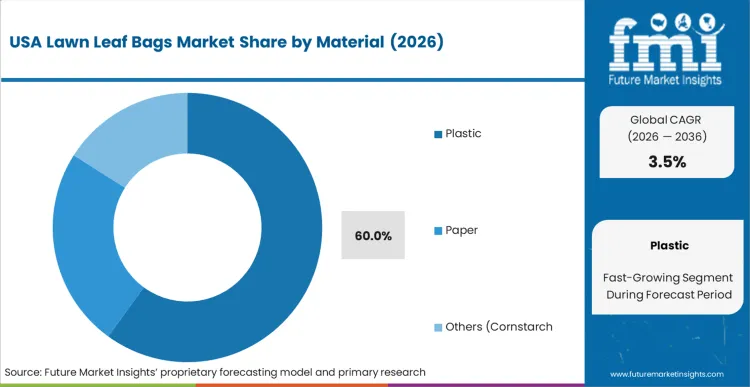
Based on FMI's USA Lawn Leaf Bags market report, consumption of Plastic is estimated to hold 60.0% share in 2026. Plastic dominates due to its superior tear resistance, moisture durability, and load-bearing strength required for yard waste collection. It addresses municipal and consumer needs for reliable containment of wet leaves, grass clippings, and mixed garden debris. Plastic bags are widely used in large-scale seasonal clean-up operations where durability and high weight tolerance are essential.
- Durability Advantage: Heavy-duty polyethylene bags withstand sharp twigs, moisture, and overfilling, making them suitable for municipal curbside collection programs.
- Weather Resistance: Plastic materials maintain structural integrity during rain exposure, which is critical for outdoor yard waste storage prior to pickup.
- Cost Efficiency: Mass production of polyethylene lawn bags enables affordable pricing for bulk purchase by commercial landscapers and municipalities.
USA Lawn Leaf Bags Market Analysis by End Use
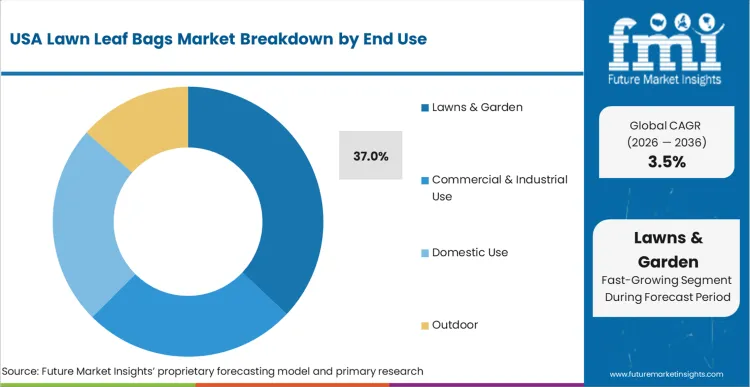
Based on FMI's USA Lawn Leaf Bags market report, consumption of Lawns & Garden applications is estimated to hold 37.0% share in 2026. This segment leads due to high seasonal demand from residential homeowners and landscaping services managing yard maintenance. Lawn leaf bags address requirements for efficient collection, transport, and disposal of organic waste during peak fall and spring seasons.
- Seasonal Clean-Up Demand: Increased landscaping activity during autumn leaf-fall periods drives large-volume usage across suburban and residential areas.
- Municipal Waste Programs: City-level yard waste collection mandates support consistent demand for standardized leaf disposal bags.
- Home Improvement Trends: Growth in DIY gardening and lawn care continues to sustain demand for convenient and durable leaf containment solutions.
USA Lawn Leaf Bags Market Drivers, Restraints, and Opportunities
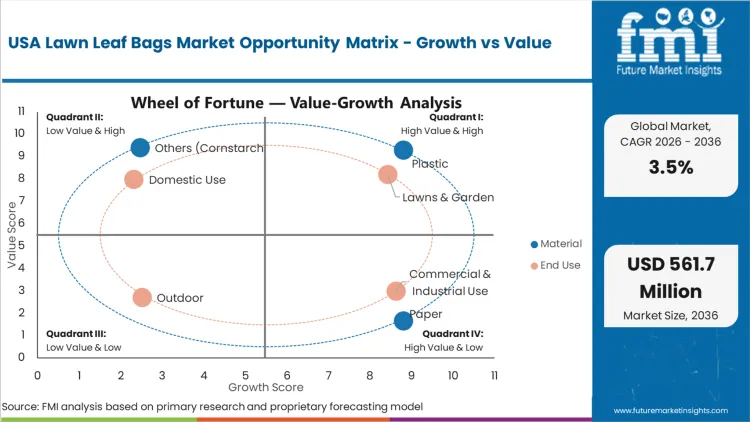
Future Market Insights analysis indicates that the USA lawn leaf bags market is structurally tied to seasonal yard maintenance activity and municipal solid waste management systems. The market exists at its current scale because residential landscaping, fall leaf collection, and community clean-up programs require durable, biodegradable collection solutions. Demand is closely linked to suburban housing density and local waste diversion policies, as many municipalities mandate or encourage the use of paper-based yard waste bags to support composting and landfill reduction efforts.
FMI analysts observe a transition from conventional plastic yard waste bags toward paper-based and certified compostable alternatives. While plastic bags historically offered durability and moisture resistance, increasing restrictions on single-use plastics at state and municipal levels are shifting procurement toward wet-strength kraft paper bags. These paper variants often carry slightly higher per-unit costs but qualify for curbside composting programs and municipal organic waste collection systems. As a result, value growth is supported by regulatory alignment and environmentally preferred purchasing policies, even though total seasonal volumes fluctuate based on weather patterns and housing activity.
- Municipal Composting Mandates:
Many USA cities and counties require yard waste to be collected in paper or certified compostable bags to facilitate organic diversion programs. These mandates structurally reinforce demand for biodegradable lawn leaf bags. - Suburban Housing Activity:
Lawn maintenance demand is directly influenced by single-family housing growth and homeownership trends. Regions with high suburban density sustain consistent seasonal purchasing cycles. - Plastic Reduction Policies:
State-level restrictions on single-use plastic bags are accelerating the shift toward recyclable and compostable paper yard waste bags, strengthening long-term adoption despite weather-driven volume variability.
Regional Analysis
The USA lawn leaf bags market is analyzed at the state level, covering Florida, Texas, North Carolina, Georgia, and Ohio. Growth differences are influenced by municipal yard waste regulations, landfill diversion targets, composting programs, and seasonal landscaping demand. The full report provides detailed state-wise market attractiveness analysis.
.webp "Top Country Growth Comparison Usa Lawn Leaf Bags Market Cagr (2026 2036)")
| Country | CAGR (2026-2036) |
|---|---|
| Florida | 4.2% |
| Texas | 4.0% |
| North Carolina | 3.8% |
| Georgia | 3.7% |
| Ohio | 3.6% |
Source: Future Market Insights (FMI) analysis, based on proprietary forecasting model and primary research
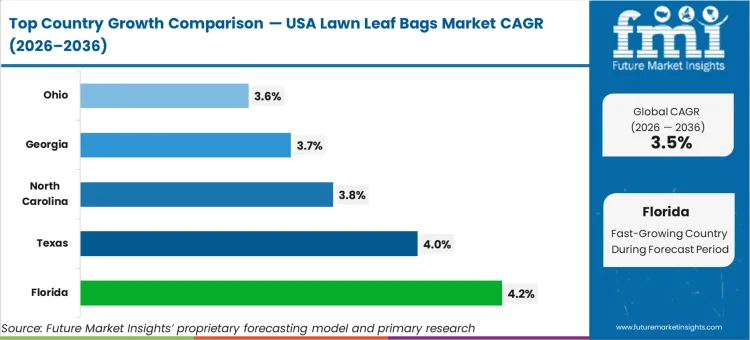
Southern United States - Municipal Composting and Landscaping Growth Belt
The Southern United States represents a municipal composting and landscaping growth belt, driven by year-round lawn maintenance activity and expanding yard waste diversion programs. Companies such as Novolex, Berry Global, and ProAmpac maintain strong manufacturing and distribution networks for paper and plastic yard waste bags. Competitive positioning is shaped by municipal procurement policies and sustainability-driven material shifts.
Florida
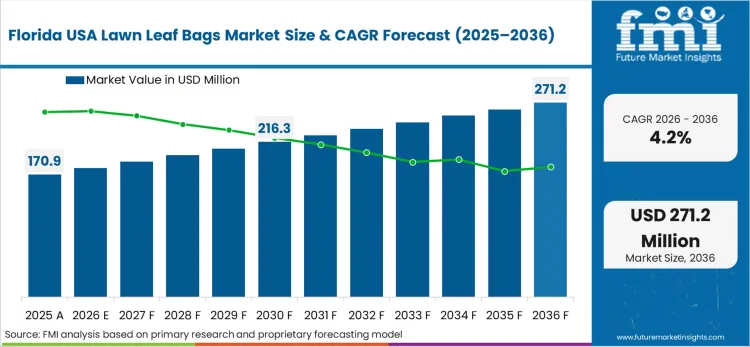
Demand for lawn leaf bags in Florida is projected to rise at 4.2% CAGR through 2036. Growth is supported by high residential landscaping activity and municipal yard waste collection programs. In 2024, several Florida counties continued implementation of solid waste management plans aligned with state recycling and landfill diversion targets, increasing curbside yard waste collection volumes. The Florida Department of Environmental Protection promotes composting and organic waste diversion under its waste reduction strategy, reinforcing demand for biodegradable and paper-based yard waste bags. Expansion of residential housing developments and homeowner association landscaping requirements further supports consistent seasonal consumption. Hurricane preparedness clean-up activities also contribute to periodic spikes in yard waste bag demand.
Texas
Demand for lawn leaf bags in Texas is projected to rise at 4.0% CAGR through 2036. Growth is linked to municipal solid waste diversion initiatives and rapid suburban expansion. In 2024, multiple Texas municipalities advanced organic waste collection programs under local solid waste management plans, encouraging use of approved paper yard waste bags. The Texas Commission on Environmental Quality continues to oversee municipal waste compliance standards, reinforcing structured yard waste handling practices. Rapid residential development in metropolitan areas such as Houston and Dallas is increasing landscaping waste volumes. Additionally, community-level composting and brush collection programs support steady bag consumption across suburban regions.
North Carolina
Demand for lawn leaf bags in North Carolina is projected to rise at 3.8% CAGR through 2036. Growth is influenced by structured yard waste collection policies and environmental management initiatives. The North Carolina Department of Environmental Quality continues to enforce solid waste rules that require municipalities to manage yard waste separately from landfill disposal. In 2024, several cities expanded curbside composting and yard debris pickup programs, reinforcing demand for biodegradable lawn bags. Growth in residential developments and landscaping services further contributes to steady bag usage. Public awareness campaigns promoting organic waste recycling continue to support paper-based bag adoption.
Georgia
Demand for lawn leaf bags in Georgia is projected to rise at 3.7% CAGR through 2036. The market benefits from ongoing suburban housing growth and municipal yard debris programs. In 2024, Georgia’s Environmental Protection Division continued oversight of solid waste handling regulations, reinforcing compliance in yard waste collection and disposal. Municipal composting initiatives in urban centers have strengthened demand for biodegradable yard waste bags. Landscaping services and seasonal storm cleanups also contribute to stable product demand. While regulatory pressure is moderate compared to some states, local government waste diversion strategies support gradual growth.
Ohio
Demand for lawn leaf bags in Ohio is projected to rise at 3.6% CAGR through 2036. Growth is supported by established municipal composting and yard waste diversion programs. The Ohio Environmental Protection Agency continues enforcement of solid waste regulations that restrict yard waste disposal in landfills. In 2024, multiple municipalities maintained seasonal yard waste pickup schedules and public composting facilities, reinforcing demand for paper lawn leaf bags. Ohio’s strong retail distribution network for seasonal lawn care products further supports consumer access and sales. While population growth remains stable, regulatory support for composting sustains consistent market demand.
FMI's analysis of USA lawn leaf bags market consists of state-wise assessment that includes Florida, Texas, North Carolina, Georgia, and Ohio. Readers can find insights on municipal waste policies, composting initiatives, seasonal landscaping demand, and sustainability-driven material transitions.
Competitive Aligners for Market Players
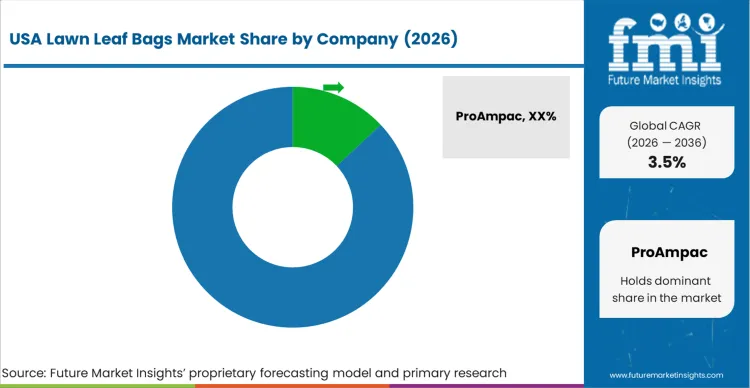
The USA lawn and leaf bags market is moderately fragmented, with a mix of large consumer products manufacturers and regional specialty bag producers. Companies such as Reynolds Consumer Products, Novolex, Berry Global, ProAmpac, Pactiv Evergreen, Inteplast Group, and Petoskey Plastics hold significant presence due to their national retail distribution networks and vertically integrated film production capabilities. At the same time, firms including DuraSack, Bio Bags, Plastic Bags Partners, ShopTough LLC, Shadow Plastics, Zee Green Bags, and other niche manufacturers compete through biodegradable, compostable, or contractor-grade heavy-duty bag offerings. Competition in this market is driven primarily by durability (tear and puncture resistance), capacity strength, compostability compliance, and retail shelf presence.
Structural advantages are concentrated among companies with upstream resin sourcing, in-house blown film extrusion, and established relationships with major retail chains such as Home Depot, Lowe’s, Walmart, and regional hardware distributors. Firms such as Reynolds Consumer Products and Novolex benefit from strong brand equity and national marketing reach, while Berry Global and Inteplast leverage large-scale polyethylene production capacity for cost efficiency. Companies offering certified compostable or paper-based lawn bags compliant with municipal yard waste programs gain additional competitive differentiation, particularly in states with landfill diversion mandates.
Buyer leverage varies by channel. Large retail chains exercise significant pricing pressure through private-label procurement and volume contracts, often dual-sourcing to maintain competitive discipline. However, during peak seasonal demand (spring and fall), suppliers with secured resin supply and strong inventory management retain improved pricing stability. Municipal composting regulations and state-level single-use plastic policies increasingly influence procurement preferences, shifting demand toward recyclable paper lawn bags and biodegradable alternatives, thereby reshaping competitive positioning across the industry.
Recent Developments
- In February 2025, Reynolds Consumer Products reported fiscal 2025 performance results highlighting growth across its Hefty® waste and outdoor bag portfolio, supported by expanded retail distribution and product innovation in durable and contractor-grade trash bags.
- Berry Global completed its combination with Amcor in April 2025, creating one of the world’s largest packaging companies. The transaction strengthens Berry’s position across consumer and industrial packaging, including trash and outdoor bag categories sold through major U.S. retailers.
Key Players
- ProAmpac
- Berry Global
- Bio Bags
- DS Smith
- Novolex
- DuraSack
- Pactiv Evergreen Inc.
- Reynolds Consumer Products LLC
- Petoskey Plastics
- Inteplast Group
- Plastic Bags Partners
- Zee Green Bags
Scope of Report
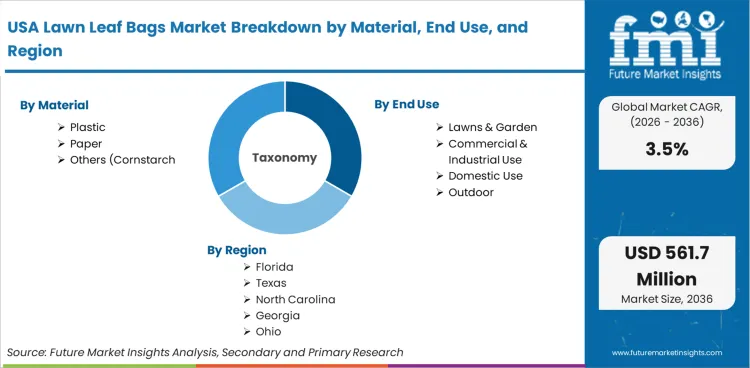
| Metric | Value |
|---|---|
| Quantitative Units | USD 384.6 million (2025); USD 398.2 million (2026) to USD 563.5 million (2036), at a CAGR of 3.5% |
| Market Definition | The USA lawn leaf bags market comprises the production and distribution of disposable and reusable bags designed for collection, storage, and transportation of yard waste including leaves, grass clippings, and garden debris, serving residential, commercial landscaping, and municipal waste management applications. |
| Form Segmentation | Plastic Lawn Leaf Bags (HDPE, LDPE); Paper Lawn Leaf Bags; Bio-based & Compostable Bags (Cornstarch, Composite Materials) |
| End Use Segmentation | Lawns & Garden; Commercial & Industrial Landscaping; Domestic / Residential Use; Outdoor Activities |
| Application Coverage | Residential Yard Waste Collection; Municipal Leaf Pickup Programs; Landscaping & Groundskeeping; Commercial Property Maintenance; Seasonal Outdoor Cleanup |
| Regions Covered | Northeast, Midwest, West, Southwest, Southeast |
| Countries Covered | United States |
| Key Companies Profiled | Berry Global; Novolex; ProAmpac; Reynolds Consumer Products LLC; Petoskey Plastics; Others |
| Forecast Period | 2026 to 2036 |
| Approach | Hybrid top-down and bottom-up market modeling validated through primary interviews with bag manufacturers, retail distributors, landscaping contractors, and municipal waste authorities, supported by resin consumption analysis, seasonal demand benchmarking, retail channel tracking, and regulatory assessment of compostability and plastic bag restrictions across U.S. states. |
USA Lawn Leaf Bags Market by Segments
By Material
- Plastic
- HDPE
- LDPE
- Paper
- Others (Cornstarch, Composite)
By Closure
- Drawstring Closure
- Zipper Closure
- Twist-tie Closure
- Adhesive strip Closure
- Elastic Closure
By Capacity
- 5 – 10 Gallon
- 10 -15 Gallon
- 15- 30 Gallon
- Above 30 Gallon
By Distribution Channel
- Manufacturers (Direct Sales)
- Bricks & Mortar Stores
- Hypermarket
- Supermarket
- Discount Stores
- Other Retail
- Distributors
- Online
By End Use
- Lawns & Garden
- Commercial & Industrial Use
- Domestic Use
- Outdoor Activities (Camping, Hiking etc.)
By Sub-Region
- Northeast
- Midwest
- West
- Southwest
- Southeast
Bibliography
- USA Environmental Protection Agency (EPA), Advancing Sustainable Materials Management: Facts and Figures Yard Trimmings in Municipal Solid Waste, December 2023.
- USA Environmental Protection Agency (EPA), Composting at Home Yard Waste Management Guidance, Updated March 2024.
- USA Department of Agriculture (USDA), National Agricultural Statistics Service (NASS), 2024 Floriculture Crops Summary, May 2024.
- ASTM International, ASTM D6400-23 Standard Specification for Labeling of Plastics Designed to be Aerobically Composted in Municipal or Industrial Facilities, April 2023.
- ASTM International, ASTM D6868-23 Standard Specification for Labeling of End Items that Incorporate Plastics and Polymers as Coatings or Additives with Paper and Other Substrates Designed to be Aerobically Composted, April 2023.
- Biodegradable Products Institute (BPI), BPI Certification Scheme for Compostable Products Updated Program Requirements, January 2024.
- American Forest & Paper Association (AF&PA), 2024 Paper Recycling and Recovery Data Report, June 2024.
- USA Census Bureau, 2023 Annual Survey of Manufactures Paper Bag and Coated/ Treated Paper Manufacturing (NAICS 322220), December 2024 Release.
This Report Addresses
- Strategic market intelligence supporting production planning and channel optimization across the U.S. lawn and yard waste bag ecosystem.
- U.S. market size estimation with 2026–2036 revenue forecasts validated through retail sell-through and manufacturer shipment benchmarking.
- Growth opportunity assessment across plastic, paper, and compostable lawn leaf bag materials aligned with municipal compliance shifts.
- Capacity and closure analysis covering 5–10 gallon to above 30 gallon formats and drawstring, twist-tie, and adhesive systems.
- End-use demand evaluation across residential lawns, commercial landscaping, municipal yard waste programs, and outdoor applications.
- Regulatory impact analysis addressing composting mandates, landfill diversion policies, ASTM compostability standards, and plastic reduction laws.
- Distribution channel assessment spanning direct manufacturer sales, brick-and-mortar retail, distributors, and expanding online platforms.
- Competitive benchmarking of national and regional suppliers based on resin access, paper sourcing, compostability certification, and retail partnerships.
Frequently Asked Questions
How large is the USA Lawn Leaf Bags Market in 2026?
The USA Lawn Leaf Bags Market is valued at 398.2 Mn in 2026.
What was the market size of the USA Lawn Leaf Bags Market in 2025?
The market was valued at 384.6 Mn in 2025.
What will be the market size of the USA Lawn Leaf Bags Market by 2036?
The market is projected to reach 563.5 Mn by 2036.
What is the expected CAGR of the USA Lawn Leaf Bags Market between 2026 and 2036?
The market is expected to grow at a CAGR of 3.5% from 2026 to 2036.
Which material segment is poised to lead the USA Lawn Leaf Bags Market?
Plastic is the dominant material segment, accounting for 60.0% of the market share, followed by paper at 29.0% and other materials at 11.0%.
Which capacity range holds the largest share in the market?
The 15–30 gallon capacity segment leads the market with a 43.3% share, driven by its suitability for residential and lawn maintenance applications.
How significant is the lawns & garden segment in driving demand?
The lawns & garden segment accounts for 37.0% of total demand, making it the largest end-use category in 2026.
Which U.S. states are projected to grow the fastest in this market?
Florida leads with a 4.2% CAGR, followed by Texas at 4.0%, North Carolina at 3.8%, Georgia at 3.7%, and Ohio at 3.6% during 2026-2036.
Preview the report firsthand - request a free sample
Get SampleGet the brochure for pricing and purchase details.
Get PDFTable of Content
- Executive Summary
- Global Market Outlook
- Demand-side Trends
- Supply-side Trends
- Technology Roadmap Analysis
- Analysis and Recommendations
- Market Overview
- Market Coverage / Taxonomy
- Market Definition / Scope / Limitations
- Research Methodology
- Chapter Orientation
- Analytical Lens and Working Hypotheses
- Market Structure, Signals, and Trend Drivers
- Benchmarking and Cross-market Comparability
- Market Sizing, Forecasting, and Opportunity Mapping
- Research Design and Evidence Framework
- Desk Research Programme (Secondary Evidence)
- Company Annual and Sustainability Reports
- Peer-reviewed Journals and Academic Literature
- Corporate Websites, Product Literature, and Technical Notes
- Earnings Decks and Investor Briefings
- Statutory Filings and Regulatory Disclosures
- Technical White Papers and Standards Notes
- Trade Journals, Industry Magazines, and Analyst Briefs
- Conference Proceedings, Webinars, and Seminar Materials
- Government Statistics Portals and Public Data Releases
- Press Releases and Reputable Media Coverage
- Specialist Newsletters and Curated Briefings
- Sector Databases and Reference Repositories
- FMI Internal Proprietary Databases and Historical Market Datasets
- Subscription Datasets and Paid Sources
- Social Channels, Communities, and Digital Listening Inputs
- Additional Desk Sources
- Expert Input and Fieldwork (Primary Evidence)
- Primary Modes
- Qualitative Interviews and Expert Elicitation
- Quantitative Surveys and Structured Data Capture
- Blended Approach
- Why Primary Evidence is Used
- Field Techniques
- Interviews
- Surveys
- Focus Groups
- Observational and In-context Research
- Social and Community Interactions
- Stakeholder Universe Engaged
- C-suite Leaders
- Board Members
- Presidents and Vice Presidents
- R&D and Innovation Heads
- Technical Specialists
- Domain Subject-matter Experts
- Scientists
- Physicians and Other Healthcare Professionals
- Governance, Ethics, and Data Stewardship
- Research Ethics
- Data Integrity and Handling
- Primary Modes
- Tooling, Models, and Reference Databases
- Desk Research Programme (Secondary Evidence)
- Data Engineering and Model Build
- Data Acquisition and Ingestion
- Cleaning, Normalisation, and Verification
- Synthesis, Triangulation, and Analysis
- Quality Assurance and Audit Trail
- Market Background
- Market Dynamics
- Drivers
- Restraints
- Opportunity
- Trends
- Scenario Forecast
- Demand in Optimistic Scenario
- Demand in Likely Scenario
- Demand in Conservative Scenario
- Opportunity Map Analysis
- Product Life Cycle Analysis
- Supply Chain Analysis
- Investment Feasibility Matrix
- Value Chain Analysis
- PESTLE and Porter’s Analysis
- Regulatory Landscape
- Regional Parent Market Outlook
- Production and Consumption Statistics
- Import and Export Statistics
- Market Dynamics
- Global Market Analysis 2021 to 2025 and Forecast, 2026 to 2036
- Historical Market Size Value (USD Million) Analysis, 2021 to 2025
- Current and Future Market Size Value (USD Million) Projections, 2026 to 2036
- Y-o-Y Growth Trend Analysis
- Absolute $ Opportunity Analysis
- Global Market Pricing Analysis 2021 to 2025 and Forecast 2026 to 2036
- Global Market Analysis 2021 to 2025 and Forecast 2026 to 2036, By Material
- Introduction / Key Findings
- Historical Market Size Value (USD Million) Analysis By Material , 2021 to 2025
- Current and Future Market Size Value (USD Million) Analysis and Forecast By Material , 2026 to 2036
- Plastic
- Paper
- Others (Cornstarch
- Plastic
- Y-o-Y Growth Trend Analysis By Material , 2021 to 2025
- Absolute $ Opportunity Analysis By Material , 2026 to 2036
- Global Market Analysis 2021 to 2025 and Forecast 2026 to 2036, By End Use
- Introduction / Key Findings
- Historical Market Size Value (USD Million) Analysis By End Use, 2021 to 2025
- Current and Future Market Size Value (USD Million) Analysis and Forecast By End Use, 2026 to 2036
- Lawns & Garden
- Commercial & Industrial Use
- Domestic Use
- Outdoor
- Lawns & Garden
- Y-o-Y Growth Trend Analysis By End Use, 2021 to 2025
- Absolute $ Opportunity Analysis By End Use, 2026 to 2036
- Global Market Analysis 2021 to 2025 and Forecast 2026 to 2036, By Region
- Introduction
- Historical Market Size Value (USD Million) Analysis By Region, 2021 to 2025
- Current Market Size Value (USD Million) Analysis and Forecast By Region, 2026 to 2036
- North America
- Latin America
- Western Europe
- Eastern Europe
- East Asia
- South Asia and Pacific
- Middle East & Africa
- Market Attractiveness Analysis By Region
- North America Market Analysis 2021 to 2025 and Forecast 2026 to 2036, By Country
- Historical Market Size Value (USD Million) Trend Analysis By Market Taxonomy, 2021 to 2025
- Market Size Value (USD Million) Forecast By Market Taxonomy, 2026 to 2036
- By Country
- USA
- Canada
- Mexico
- By Material
- By End Use
- By Country
- Market Attractiveness Analysis
- By Country
- By Material
- By End Use
- Key Takeaways
- Latin America Market Analysis 2021 to 2025 and Forecast 2026 to 2036, By Country
- Historical Market Size Value (USD Million) Trend Analysis By Market Taxonomy, 2021 to 2025
- Market Size Value (USD Million) Forecast By Market Taxonomy, 2026 to 2036
- By Country
- Brazil
- Chile
- Rest of Latin America
- By Material
- By End Use
- By Country
- Market Attractiveness Analysis
- By Country
- By Material
- By End Use
- Key Takeaways
- Western Europe Market Analysis 2021 to 2025 and Forecast 2026 to 2036, By Country
- Historical Market Size Value (USD Million) Trend Analysis By Market Taxonomy, 2021 to 2025
- Market Size Value (USD Million) Forecast By Market Taxonomy, 2026 to 2036
- By Country
- Germany
- UK
- Italy
- Spain
- France
- Nordic
- BENELUX
- Rest of Western Europe
- By Material
- By End Use
- By Country
- Market Attractiveness Analysis
- By Country
- By Material
- By End Use
- Key Takeaways
- Eastern Europe Market Analysis 2021 to 2025 and Forecast 2026 to 2036, By Country
- Historical Market Size Value (USD Million) Trend Analysis By Market Taxonomy, 2021 to 2025
- Market Size Value (USD Million) Forecast By Market Taxonomy, 2026 to 2036
- By Country
- Russia
- Poland
- Hungary
- Balkan & Baltic
- Rest of Eastern Europe
- By Material
- By End Use
- By Country
- Market Attractiveness Analysis
- By Country
- By Material
- By End Use
- Key Takeaways
- East Asia Market Analysis 2021 to 2025 and Forecast 2026 to 2036, By Country
- Historical Market Size Value (USD Million) Trend Analysis By Market Taxonomy, 2021 to 2025
- Market Size Value (USD Million) Forecast By Market Taxonomy, 2026 to 2036
- By Country
- China
- Japan
- South Korea
- By Material
- By End Use
- By Country
- Market Attractiveness Analysis
- By Country
- By Material
- By End Use
- Key Takeaways
- South Asia and Pacific Market Analysis 2021 to 2025 and Forecast 2026 to 2036, By Country
- Historical Market Size Value (USD Million) Trend Analysis By Market Taxonomy, 2021 to 2025
- Market Size Value (USD Million) Forecast By Market Taxonomy, 2026 to 2036
- By Country
- India
- ASEAN
- Australia & New Zealand
- Rest of South Asia and Pacific
- By Material
- By End Use
- By Country
- Market Attractiveness Analysis
- By Country
- By Material
- By End Use
- Key Takeaways
- Middle East & Africa Market Analysis 2021 to 2025 and Forecast 2026 to 2036, By Country
- Historical Market Size Value (USD Million) Trend Analysis By Market Taxonomy, 2021 to 2025
- Market Size Value (USD Million) Forecast By Market Taxonomy, 2026 to 2036
- By Country
- Kingdom of Saudi Arabia
- Other GCC Countries
- Turkiye
- South Africa
- Other African Union
- Rest of Middle East & Africa
- By Material
- By End Use
- By Country
- Market Attractiveness Analysis
- By Country
- By Material
- By End Use
- Key Takeaways
- Key Countries Market Analysis
- USA
- Pricing Analysis
- Market Share Analysis, 2025
- By Material
- By End Use
- Canada
- Pricing Analysis
- Market Share Analysis, 2025
- By Material
- By End Use
- Mexico
- Pricing Analysis
- Market Share Analysis, 2025
- By Material
- By End Use
- Brazil
- Pricing Analysis
- Market Share Analysis, 2025
- By Material
- By End Use
- Chile
- Pricing Analysis
- Market Share Analysis, 2025
- By Material
- By End Use
- Germany
- Pricing Analysis
- Market Share Analysis, 2025
- By Material
- By End Use
- UK
- Pricing Analysis
- Market Share Analysis, 2025
- By Material
- By End Use
- Italy
- Pricing Analysis
- Market Share Analysis, 2025
- By Material
- By End Use
- Spain
- Pricing Analysis
- Market Share Analysis, 2025
- By Material
- By End Use
- France
- Pricing Analysis
- Market Share Analysis, 2025
- By Material
- By End Use
- India
- Pricing Analysis
- Market Share Analysis, 2025
- By Material
- By End Use
- ASEAN
- Pricing Analysis
- Market Share Analysis, 2025
- By Material
- By End Use
- Australia & New Zealand
- Pricing Analysis
- Market Share Analysis, 2025
- By Material
- By End Use
- China
- Pricing Analysis
- Market Share Analysis, 2025
- By Material
- By End Use
- Japan
- Pricing Analysis
- Market Share Analysis, 2025
- By Material
- By End Use
- South Korea
- Pricing Analysis
- Market Share Analysis, 2025
- By Material
- By End Use
- Russia
- Pricing Analysis
- Market Share Analysis, 2025
- By Material
- By End Use
- Poland
- Pricing Analysis
- Market Share Analysis, 2025
- By Material
- By End Use
- Hungary
- Pricing Analysis
- Market Share Analysis, 2025
- By Material
- By End Use
- Kingdom of Saudi Arabia
- Pricing Analysis
- Market Share Analysis, 2025
- By Material
- By End Use
- Turkiye
- Pricing Analysis
- Market Share Analysis, 2025
- By Material
- By End Use
- South Africa
- Pricing Analysis
- Market Share Analysis, 2025
- By Material
- By End Use
- USA
- Market Structure Analysis
- Competition Dashboard
- Competition Benchmarking
- Market Share Analysis of Top Players
- By Regional
- By Material
- By End Use
- Competition Analysis
- Competition Deep Dive
- ProAmpac
- Overview
- Product Portfolio
- Profitability by Market Segments (Product/Age /Sales Channel/Region)
- Sales Footprint
- Strategy Overview
- Marketing Strategy
- Product Strategy
- Channel Strategy
- Berry Global
- Bio Bags
- DS Smith
- Novolex
- DuraSack
- Pactiv Evergreen Inc.
- Reynolds Consumer Products LLC
- Petoskey Plastics
- Inteplast Group
- Plastic Bags Partners
- Zee Green Bags
- ProAmpac
- Competition Deep Dive
- Assumptions & Acronyms Used


