

- Industry Size (2026)
- USD 15.6 Bn
- Forecast (2036)
- USD 24.0 Bn
- CAGR (2026 to 2036)
- 4.4%
USA Folding Carton Market Forecast and Outlook 2026 to 2036
Folding carton market in USA is estimated at USD 15.6 billion in 2026 and is projected to reach USD 24.1 billion by 2036, expanding at a CAGR of 4.4% during the forecast period. According to Future Market Insights, market evolution between 2026 and 2036 will be driven less by overall consumer goods volume growth and more by the structural repositioning of folding cartons within regulated, brand-sensitive product categories. FMI believes that folding cartons are increasingly being specified as integral elements of product safety, traceability, and brand presentation, fundamentally influencing board material choice, print technology adoption, and supplier qualification across the USA packaging value chain.
A key growth driver, as per FMI’s opinion, is the continued expansion of regulated end-use categories, particularly OTC healthcare, vitamins and supplements, medical devices, and pet health products. These segments demand cartons with tamper-evident features, child-resistant certification, serialization, and track-and-trace compatibility, driving adoption of higher-grade SBS, FBB, and specialty barrier-coated paperboards.
A second driver highlighted by FMI is the premiumization of consumer and personal care packaging, where folding cartons serve as primary brand carriers at retail. High-gloss finishes, soft-touch coatings, embossing, foil stamping, and variable-data digital printing are increasingly used to support brand differentiation, limited editions, and compliance labeling, particularly in beauty, fragrance, and specialty food categories.
A third structural driver is the sustainability-led shift toward fiber-based packaging solutions in the USA market. Brand owners are accelerating the transition from plastic-heavy secondary packaging to recyclable, renewable paperboard cartons, while incorporating recycled content, bio-based barrier coatings, and lightweighting strategies to meet corporate sustainability targets and regulatory expectations. “Like all sectors of the packaging industry, folding cartons have undergone an evolution in recent years sustainability has come to the forefront as the most urgent topic, meaning the need to produce zero-fault packaging without waste is greater than ever before.” Harold Leete, Director of Sales, Folding Carton, BOBST North America (on industry trends and the future of folding cartons).
FMI expects these regulation-driven, branding-focused, and sustainability-aligned trends to structurally elevate the functional and economic importance of folding cartons in the USA market over the coming decade. As consumer goods, healthcare, and specialty products increasingly rely on paperboard packaging for safety signaling and shelf impact, folding cartons are expected to transition permanently from secondary enclosures to strategic packaging platforms within the USA consumer and healthcare packaging ecosystem.
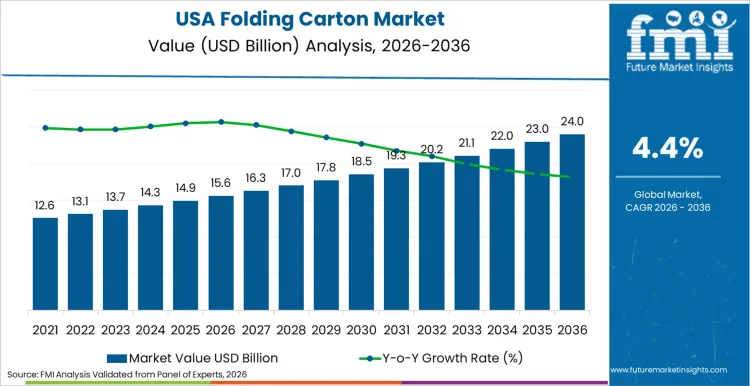
Summary of USA Folding Carton Market
What Is Growth Outlook for the USA Folding Carton Market as per Future Market Insights Projection?
Future Market Insights projects the USA folding carton market to expand at a CAGR of 4.4% from 2026 to 2036, increasing from USD 15.6 billion in 2026 to USD 24.0 billion by 2036. Market growth is driven by sustained demand from consumer healthcare, pharmaceuticals, beauty & personal care, specialty food, and pet care segments, where folding cartons play a critical role in product protection, branding, regulatory compliance, and retail presentation.
Rising consumption of OTC healthcare products, premium beauty packaging, and shelf-ready retail formats, alongside increasing regulatory and traceability requirements continues to support steady growth across the USA folding carton industry.
FMI Research Approach: FMI models market demand using historical carton shipment volumes, board material utilization rates, and end-use consumption trends across healthcare, consumer goods, and specialty retail categories. Forecasts integrate shifts toward higher-value printed cartons, regulatory-driven feature adoption, and regional manufacturing capacity trends, with sensitivity to sustainability requirements and retail format evolution through 2036.
How Do FMI Analysts Perceive the USA Folding Carton Market to Evolve?
FMI analysts observe that the USA folding carton market is evolving from standard commodity packaging toward higher-specification, feature-rich, and compliance-oriented carton solutions. Demand is increasingly shifting toward cartons with tamper-evident features, child-resistant certifications, serialized printing, and track-and-trace capabilities, particularly in healthcare, OTC, and regulated consumer product segments.
Print and decoration complexity is rising as brand owners compete on shelf differentiation, premium aesthetics, and short-run customization. Advanced finishes such as foil stamping, embossing, spot UV, soft-touch coatings, and digital variable data printing are becoming integral to carton value creation. At the same time, sustainability-driven material innovation such as recycled-content boards, bio-based coatings, and barrier-treated paperboard is reshaping board selection strategies.
FMI Research Approach: FMI evaluates market evolution by analyzing shifts in board material mix, closure and security feature adoption, print and decoration complexity, and manufacturing models (in-house versus contract). The analysis incorporates brand packaging strategies, regulatory requirements, and investment trends in digital and high-end printing technologies across USA converters.
Which Region Holds the Largest Share in the USA Folding Carton Market?
Future Market Insights notes that the Midwest and Northeast regions collectively hold the largest share of the USA folding carton market by value. Market leadership is supported by concentration of carton manufacturing facilities, proximity to major consumer goods and pharmaceutical customers, and established logistics infrastructure.
These regions benefit from strong demand across healthcare, personal care, food, and pet care applications, as well as early adoption of advanced printing, compliance features, and sustainability-driven carton solutions.
FMI Research Approach: Regional analysis incorporates folding carton production capacity, proximity to end-use industries, transportation and logistics efficiency, labour availability, and regional regulatory and sustainability initiatives across USA manufacturing hubs.
How Large Will the USA Folding Carton Market Be by 2036?
The USA folding carton market is projected to reach USD 24.0 billion by 2036, driven by continued expansion in regulated healthcare packaging, premium consumer goods, and retail-ready carton formats.
FMI Research Approach: FMI calculates long-term market size by modelling carton demand per finished product unit across key end-use segments, weighted by board grade, carton structure, print complexity, and compliance feature integration. Forecasts exclude corrugated boxes and rigid packaging to maintain strict scope alignment.
How Are Regulation, Premiumization, and Sustainability Fuelling Folding Carton Adoption in the USA?
According to FMI analysts, tightening regulatory requirements in healthcare and consumer protection, combined with premiumization trends in beauty, personal care, and specialty food are elevating the functional and aesthetic role of folding cartons. Features such as child resistance, tamper evidence, serialization, and easy-open structures are increasingly non-negotiable in regulated categories.
Simultaneously, sustainability commitments by USA brands and retailers are accelerating adoption of recyclable, recycled-content, and bio-coated paperboard solutions. Folding cartons are increasingly positioned as a preferred alternative to plastic packaging, reinforcing long-term demand stability.
FMI Research Approach: FMI incorporates regulatory updates, sustainability mandates, retail packaging standards, and brand ESG commitments into econometric demand models to assess their impact on carton design, material selection, and long-term market growth.
USA Folding Carton Market Key Takeaways
| Metric | Details |
|---|---|
| Market Size (2026) | USD 15.6 Billion |
| Market Value (2036) | USD 24.0 Billion |
| CAGR (2026-2036) | 4.4% |
Source: Future Market Insights (FMI) analysis, based on proprietary forecasting model and primary research.
Which Factors Drive Adoption of USA Folding Carton Market?
Adoption of folding cartons in the USA market is being driven by a structural shift in packaging toward sustainable, lightweight, and high-performance solutions that prioritize product protection, brand differentiation, and recyclability over single-use and non-renewable alternatives. Food & beverage, personal care, and pharmaceutical brands are increasingly favouring folding cartons as consumer preferences shift toward packaging that communicates quality, convenience, and environmental responsibility. According to the USA Environmental Protection Agency (EPA), paper and paperboard, which includes folding cartons, accounted for nearly 23.1% of total municipal solid waste recovery, driven by high recyclability rates and strong recycling infrastructure positioning folding cartons as a preferred choice for environmentally conscious packaging strategies. This transition is reinforced by rising consumer demand for sustainable packaging, stricter regulatory expectations around material recovery, and growth in e-commerce sales requiring robust yet lightweight shipping solutions. For example, International Paper integrates innovative folding carton designs with high-quality graphics and structural integrity to support brand storytelling while maintaining strength and performance across multiple end-use segments.
FMI analysis indicates that folding carton solutions supported by standardized fiber sourcing, recyclable material certifications, and compatibility with automated printing and finishing lines achieve higher adoption rates among manufacturers and brand owners. The expanding role of digital printing, improved barrier coatings for moisture and shelf-life protection and increasing use of post-consumer recycled (PCR) content is further accelerating uptake by enabling customization, reduced carbon footprint, and efficient life-cycle performance positioning folding cartons as essential components of sustainable packaging strategies rather than commodity boxes.
How is the USA Folding Carton Market Segmented?
The USA folding carton market has been segmented based on board material, closure type, manufacturing model, print and decoration technique, end-use application, carton structure or SKU format, and region. In terms of board material, the market is divided into solid bleached sulfate (SBS), coated unbleached kraft (CUK), folding boxboard (FBB), coated recycled board (CRB), unbleached natural kraft board, metalized or foil-laminate paperboard, and paperboard integrated with bio-based or functional barrier coatings. These materials are selected based on print quality, structural rigidity, regulatory compliance, and sustainability requirements across consumer and healthcare packaging applications.
By closure type, the market includes standard tuck closures, glue or seal-end closures, tamper-evident tear strip cartons, child-resistant certified cartons, serialized or track-and-trace printed cartons, and perforated easy-open formats. Additional segmentation includes manufacturing model, covering in-house and contract production, as well as print and decoration techniques such as offset printing, UV and matte coatings, embossing, foil stamping, spot varnishes, and digitally printed short-run cartons. The market further spans diverse end-use sectors including OTC healthcare, medical devices, beauty and personal care, specialty food and drink, and pet care, along with multiple carton structures designed for retail display, protection, and multipack bundling.
Why Does Solid Bleached Sulfate (SBS) Hold a Dominant Share?
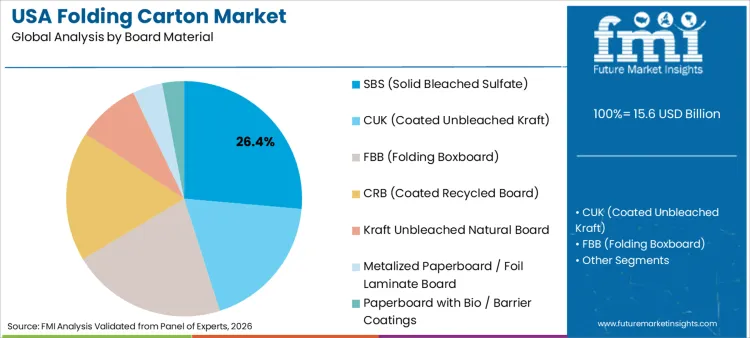
Solid bleached sulfate (SBS) holds a dominant 26.4% share of the USA folding carton market because it consistently meets the highest requirements for print quality, regulatory compliance, and premium brand presentation. SBS offers superior brightness, smooth surface consistency, and dimensional stability, which makes it the preferred substrate for OTC healthcare, pharmaceuticals, cosmetics, and personal care packaging where labeling accuracy and visual differentiation are non-negotiable. Its clean fiber composition supports strict regulatory scrutiny, while its compatibility with advanced finishing techniques such as embossing, foil stamping, and specialty coatings reinforces its use in value-added cartons. This combination of aesthetic performance and functional reliability protects SBS from displacement, as brand owners and converters prioritize substrates that reduce risk in regulated and premium packaging applications.
Why Do Standard Tuck Closures Dominate the Market?
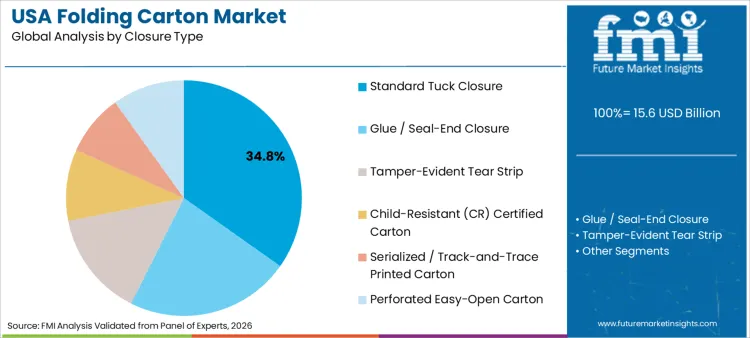
Standard tuck closures dominate the USA folding carton market with a 34.8% share because they balance structural simplicity, cost efficiency, and high-speed manufacturing compatibility. These closures integrate seamlessly with automated cartoning lines, minimizing downtime and tooling complexity while delivering consistent pack integrity. Standard tuck cartons provide adequate protection and convenient opening and reclosing, making them suitable across consumer healthcare, beauty, food, and pet care categories. Their widespread adoption is reinforced by predictable performance across a wide range of carton sizes and board grades, reducing operational risk for both brand owners and converters. As manufacturers prioritize throughput, cost control, and line efficiency, standard tuck closures continue to function as the default and most scalable closure format in the U.S. folding carton market.
What Trends Are Shaping Industry Evolution?
Beyond basic product containment, folding cartons in the USA are increasingly being engineered as multifunctional packaging systems that enhance sustainability, brand engagement, and supply chain efficiency. According to the USA Bureau of Economic Analysis, real output in manufacturing sectors reliant on consumer packaged goods has shown stable growth, reflecting resilience in food, beverage, cosmetics, and healthcare categories that drive demand for folding cartons. This performance underscores a shift in carton usage from simple protective shells to high-impact visual platforms that support retail appeal, product differentiation, and logistics performance.
Sustainability imperatives continue to shape material selection and design strategies across the USA folding carton market. Brand owners are prioritizing recyclable paperboard, post-consumer recycled content, and lightweight structural designs to meet corporate ESG objectives and align with evolving federal and state recycling mandates. These shifts are particularly pronounced as extended producer responsibility (EPR) frameworks expand in states like California and Oregon, prompting carton converters to innovate toward mono-material and recyclable constructions that reduce environmental impact without compromising strength or print quality.
Functional performance requirements are also evolving as e-commerce penetration accelerates in the USA retail landscape. Folding cartons are increasingly optimized for direct-to-consumer fulfilment, requiring enhanced crush resistance, stacking strength, and integrated cushioning features to protect products during complex last-mile journeys. This trend is elevating cartons from static retail packaging to dynamic components of the omni-channel supply chain — where durability, ease of assembly, and dimensional efficiency directly influence delivery outcomes and return rates.
Digital printing and personalization technologies are reshaping folding carton adoption by enabling on-demand customization, short-run production, and agile SKU management. Advances in digital presses allow USA converters to support variable data printing, seasonal promotions, and regionalized branding without the cost penalties of traditional plate-based methods. As a result, carton packaging is increasingly used to support localized marketing campaigns, limited-edition launches, and consumer engagement initiatives that extend beyond basic utility.
Material innovation is accelerating as converters and brand owners explore barrier coatings, aqueous inks, and fiber innovations that improve moisture resistance and product protection, particularly in food, beverage, and personal care segments. These enhancements are enabling cartons to compete more effectively with flexible and rigid plastic alternatives while maintaining strong recyclability credentials. Demand for barrier-enhanced board is especially evident where extended shelf-life and moisture control are critical, reinforcing folding cartons as competitive packaging solutions in performance-sensitive categories.
Regional production and supply chain resilience continue to influence the USA folding carton market as domestic converters respond to evolving logistics and trade dynamics. Investments in capacity expansion, lean manufacturing, and near-shoring are strengthening carton supply reliability amid global disruptions, while enabling closer alignment with brand owners’ time-to-market expectations. This trend supports faster SKU launches and faster replenishment cycles in an increasingly competitive retail environment.
As regulatory scrutiny around recyclability, material transparency, and chemical safety intensifies, folding cartons are transitioning from cost-driven structural materials to compliance-aligned packaging solutions. Brands and converters that can balance performance, sustainability, and cost efficiency are well-positioned to capture long-term value, as cartons continue to evolve into multifunctional elements of product protection, consumer engagement, and supply chain performance.
How Is the USA Folding Carton Market Evolving Across Key States?
The USA folding carton market is evolving steadily as demand increases from food, beverage, pharmaceutical, personal care, and e-commerce sectors that require lightweight, printable, and sustainable secondary packaging solutions. Growth is driven by brand emphasis on shelf appeal, regulatory compliance for food and pharma cartons, and the shift toward paperboard-based packaging aligned with recyclability goals. Folding cartons continue to replace plastic formats in many applications due to cost efficiency, design flexibility, and environmental positioning.
State-level market performance reflects variations in manufacturing concentration, consumer goods production, and logistics infrastructure. Texas records a 5.5% CAGR, Florida records 5.2% CAGR, California records 4.9% CAGR, North Carolina records 4.4% CAGR, and Georgia records 4.1% CAGR during the forecast period. Adoption remains driven by FMCG production scale, regional distribution hubs, and sustainability-driven packaging transitions rather than premium structural complexity alone.
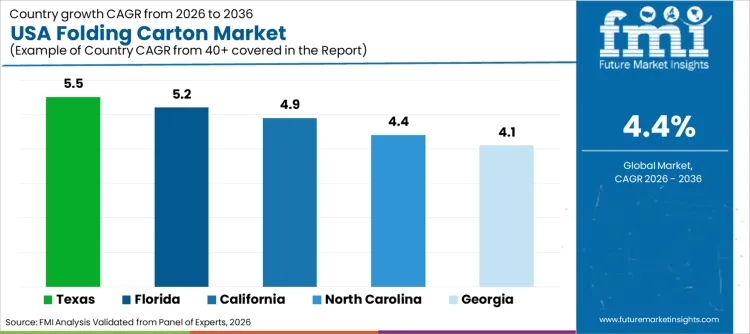
| State | CAGR (2026-36) |
|---|---|
| Texas | 5.5% |
| Florida | 5.2% |
| California | 4.9% |
| North Carolina | 4.4% |
| Georgia | 4.1% |
Texas: How Is Manufacturing Scale Driving Folding Carton Demand?
Texas represents the fastest-growing folding carton market in the USA, supported by its large manufacturing base, expanding food and beverage processing sector, and central logistics positioning. High volumes of packaged foods, household goods, and healthcare products are driving consistent demand for durable and cost-efficient folding carton solutions.
The Texas folding carton market is projected to grow at a 5.5% CAGR during the study period. Growth is reinforced by investments in high-speed carton converting equipment, regional distribution centers, and increased use of standardized carton formats for national and regional brands.
Florida: Is Population Growth Fueling Packaging Consumption?
Florida’s folding carton market is expanding as population growth, tourism-driven consumption, and food and beverage demand continue to rise. Folding cartons are widely used for beverages, frozen foods, personal care products, and pharmaceutical packaging across the state.
The Florida market is expected to grow at a 5.2% CAGR during the forecast period. Growth is supported by strong retail distribution networks, expanding private-label food brands, and increasing demand for moisture-resistant and visually appealing carton designs suited to high-turnover consumer goods.
California Folding Carton Market Shaped by Sustainability Leadership
California’s folding carton market is set to grow at a 4.9% CAGR during the study period, shaped by stringent environmental regulations and strong sustainability commitments from brand owners. Folding cartons benefit from California’s push toward recyclable, fiber-based packaging solutions across food, beauty, and wellness products.
Another factor influencing market adoption is the concentration of premium and health-focused brands that rely on high-quality printing, structural innovation, and compliant packaging formats to support brand differentiation and regulatory adherence.
North Carolina: Is Pharmaceutical and Consumer Goods Growth Supporting Demand?
North Carolina’s folding carton market is expanding due to the state’s strong pharmaceutical manufacturing presence and growing consumer goods production. Folding cartons are widely used for regulated pharmaceutical packaging, OTC products, and personal care items that require consistent quality and traceability.
The North Carolina market is projected to grow at a 4.4% CAGR during the forecast period. Growth is supported by investments in advanced carton converting facilities and increasing demand for compliant, high-precision packaging solutions from healthcare and life sciences manufacturers.
Georgia: Is Logistics Connectivity Strengthening Market Expansion?
Georgia’s folding carton market is expected to grow at a 4.1% CAGR during the study period, supported by its strategic logistics infrastructure and role as a distribution hub for the southeastern United States. Folding cartons are increasingly used in food, beverage, and household product packaging that flows through regional fulfillment centers.
Growth is reinforced by proximity to ports, strong transportation networks, and rising demand for efficient secondary packaging that supports rapid distribution and retail readiness.
What Strategic Moves Are Defining the Competitive Landscape?
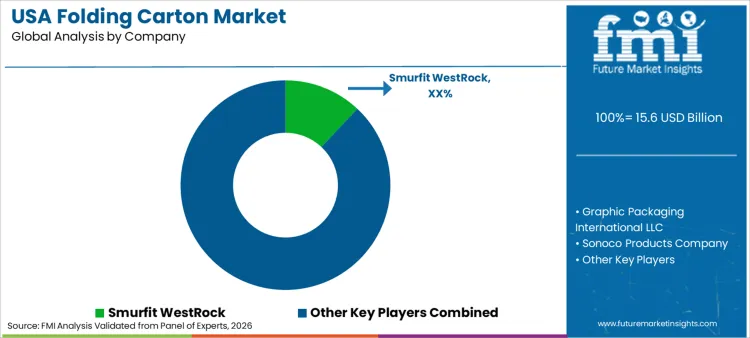
The competitive landscape of the USA folding carton market is increasingly defined by scale-driven integration, recycled paperboard capacity investment, and alignment with brand sustainability mandates rather than incremental capacity additions alone. Leading carton producers are repositioning folding cartons as critical brand-facing packaging formats that combine print quality, structural performance, and sustainability credentials, particularly for food, beverage, pharmaceutical, and consumer goods applications.
One of the most defining strategic moves shaping competition is industry consolidation to achieve integrated paperboard-to-carton control. By combining upstream paperboard manufacturing with downstream converting capabilities, leading players are improving cost stability, material availability, and responsiveness to large national brand owners. This consolidation trend is raising competitive entry barriers while strengthening supplier leverage with multinational FMCG customers.
Another major competitive lever is the expansion of recycled and sustainable paperboard capacity within the United States. Folding carton manufacturers are investing in coated recycled board (CRB) and sustainable fiber-based substrates to meet growing demand for recyclable, plastic-replacement packaging. These investments also reflect increasing regulatory and retailer pressure to improve packaging recyclability and reduce reliance on virgin materials.
The market is also witnessing greater emphasis on automation, digital printing, and short-run customization, particularly to support brand differentiation, regional product variations, and faster go-to-market timelines. USA carton converters are upgrading converting and printing technologies to balance high-volume national programs with flexible, value-added carton solutions.
Collectively, these strategic moves are shifting competition away from price-based carton supply toward integration depth, sustainability leadership, and operational resilience, redefining how leadership is established in the USA folding carton market.
Recent Developments:
- In April 2025, Sonoco Products Company completed the sale of its Thermoformed & Flexibles Packaging (TFP) business to TOPPAN Holdings, as part of its portfolio simplification strategy. The move allows Sonoco to sharpen its focus on core paper-based packaging operations, including rigid paper containers and folding carton-related packaging solutions serving food and consumer markets in the United States.
- In April 2024, Graphic Packaging International announced the start-up of its new recycled paperboard manufacturing machine in Waco, Texas, expanding USA capacity for coated recycled board used in folding cartons for food, beverage, and consumer goods brands.
Key Companies
- Smurfit WestRock
- Graphic Packaging International LLC
- Sonoco Products Company
- Nosco, Inc.
- Diamond Packaging
- Green Bay Packaging Inc.
- Belmark Corporation
- Meyers Printing & Packaging
- RoyerComm LLC
- Carton Service Inc.
- Deluxe Packaging
- Edco Supply Corporation
- Oliver Inc.
- Ibex Packaging
- Accord Carton
- CartonCraft Inc.
Market Definition
The USA folding carton market refers to the segment of paper-based packaging solutions comprising pre-formed cartons created by cutting, creasing, and folding paperboard to form protective enclosures for consumer goods. Folding cartons are used for branding, containment, and protection across multiple industries such as food & beverage, pharmaceuticals, personal care, and household products. According to the United States Census Bureau’s Annual Survey of Manufactures, shipments of paperboard packaging products, including folding cartons, have consistently demonstrated strong contribution to USA manufacturing output, underscoring the importance of folding cartons in domestic consumer goods packaging demand (USA Census Bureau, 2023).
The market includes folding cartons manufactured from virgin and recycled paperboard grades, including SBS (solid bleached sulfate), FBB (folding box board), and recycled board, offered in various thicknesses, printing qualities, and structural designs. It covers cartons used for primary packaging of products such as ready-to-eat foods, beverages, OTC drugs, cosmetics, electronics accessories, and household products, regardless of finishing effects, coatings, or end-use application.
On the other hand, the market excludes rigid set-up boxes, corrugated boxes, flexible pouches, bag-in-box solutions, and other non-carton packaging formats. Secondary shipping cartons, pallet wraps, and packaging substrates that serve exclusively for transportation and logistics are also outside the defined scope of the USA folding carton market.
Scope of the Report
| Items | Values |
|---|---|
| Quantitative Units | USD billion |
| By Board Material | SBS (Solid Bleached Sulfate); CUK (Coated Unbleached Kraft); FBB (Folding Boxboard); CRB (Coated Recycled Board); Kraft Unbleached Natural Board; Metallized Paperboard / Foil Laminate Board; Paperboard with Bio / Barrier Coatings |
| By Closure & Functional Features | Standard Tuck Closure; Glue / Seal-End Closure; Tamper-Evident Tear Strip; Child-Resistant (CR) Certified Cartons; Serialized / Track-and-Trace Printed Cartons; Perforated Easy-Open Cartons |
| End Use | OTC Health & Consumer Healthcare; Medical Devices & Home Healthcare; Beauty & Personal Care; Specialty Food & Drink; Pet Care & Pet Nutrition |
| Regions Covered | United States |
| Countries Covered | United States |
| Key Companies Profiled | Smurfit WestRock; Graphic Packaging International LLC; Sonoco Products Company; Nosco, Inc.; Diamond Packaging; Others |
| Additional Attributes | Revenue analysis by board material, carton structure, closure type, print & decoration, manufacturing model, and regional demand across USA zones; evaluation of carton performance in terms of print quality, shelf appeal, protection, and regulatory compliance; assessment of serialization, tamper-evidence, and child-resistant features for healthcare and regulated consumer products; analysis of sustainability trends including recycled content, bio-based coatings, lightweighting, and recyclability; procurement dynamics driven by brand differentiation, compliance requirements, supply reliability, lead times, and long-term partnerships between USA brand owners and folding carton converters. |
USA Folding Carton Market by Segments
By Board Material:
- Solid Bleached Sulfate (SBS)
- Coated Unbleached Kraft (CUK)
- Folding Boxboard (FBB)
- Coated Recycled Board (CRB)
- Unbleached Natural Kraft Board
- Metallized / Foil-Laminate Paperboard
- Paperboard with Bio-Based or Functional Barrier Coatings
By Closure & Functional Features:
- Standard Tuck Closure
- Glue / Seal-End Closure
- Tamper-Evident Tear Strip Cartons
- Child-Resistant (CR) Certified Cartons
- Serialized / Track-and-Trace Printed Cartons
- Perforated Easy-Open Cartons
By Manufacturing Model:
- In-House Carton Manufacturing
- Contract / Outsourced Carton Converting
By Print & Decoration Technique:
- Offset Printing
- Digital & Variable-Data Printing
- Embossing & Debossing
- Foil Stamping & Metallized Effects
- Spot UV, Matte & Soft-Touch Coatings
- Specialty Varnishes & Decorative Finishes
By End-Use Application:
- OTC Health & Consumer Healthcare
- Medical Devices & Home Healthcare
- Beauty & Personal Care
- Specialty Food & Drink
- Pet Care & Pet Nutrition
By Carton Structure / Format:
- Straight Tuck & Reverse Tuck Cartons
- Auto-Lock Bottom Cartons
- Seal-End Cartons
- Sleeve Cartons
- Windowed Cartons
- Display-Ready & Shelf-Ready Cartons
- Multipack & Wrap-Around Cartons
By Region (USA):
- Midwest
- Northeast
- South
- West
Bibliography
- Paperboard Packaging Council (PPC). (2024). Folding Cartons in the United States: Market Applications, Performance Requirements, and Sustainability Practices. PPC.
- American Forest & Paper Association (AF&PA). (2024). Paperboard Manufacturing and Packaging Applications in the USA Consumer Goods Sector. AF&PA.
- USA Environmental Protection Agency (EPA). (2024). Advancing Sustainable Materials Management: Paper and Paperboard Packaging in the United States. USA EPA.
- Food and Drug Administration (FDA). (2024). Food Contact Substances and Packaging Materials: Paper and Paperboard Applications (21 CFR Parts 176 and 177). USA Government Publishing Office.
- Sustainable Packaging Coalition (SPC). (2024). Design Guidelines for Recyclable and Fiber-Based Folding Carton Packaging in North America. SPC.
- Forest Stewardship Council (FSC). (2024). Chain of Custody and Certified Paperboard Use in Folding Carton Packaging. FSC International (USA Market Guidance).
- ASTM International. (2024). Standard Test Methods for Paperboard Stiffness, Compression Strength, and Print Performance (ASTM D3786, D642, and related methods). ASTM Committee D06 on Paper and Paper Products.
- Institute of Packaging Professionals (IoPP). (2024). Folding Carton Design, Converting, and Performance in Retail Packaging. IoPP Packaging Reference Series.
Frequently Asked Questions
How big is the USA folding carton market in 2026?
The USA folding carton market is estimated to be valued at USD 15.6 billion in 2026.
What will be the size of the USA folding carton market in 2036?
The USA folding carton market is projected to reach USD 24.0 billion by 2036.
How much will the USA folding carton market grow between 2026 and 2036?
The USA folding carton market is expected to grow at a 4.4% CAGR between 2026 and 2036.
What board materials are commonly used in the USA folding carton market?
Common board materials include SBS, CUK, FBB, CRB, unbleached kraft board, metallized paperboard, and paperboard with bio or functional barrier coatings, selected based on print quality and end-use performance.
Which end-use industries drive demand for folding cartons in the U.S.?
Demand is primarily driven by OTC healthcare, beauty & personal care, specialty food & beverage, medical devices, and pet care packaging, supported by regulatory compliance and branding requirements.
Which carton structures are widely used in the USA folding carton market?
Widely used carton structures include straight tuck and reverse tuck cartons, auto-lock bottom cartons, seal-end cartons, sleeve cartons, windowed cartons, display-ready cartons, and multi-pack wrap cartons.
Preview the report firsthand - request a free sample
Get SampleGet the brochure for pricing and purchase details.
Get PDFTable of Content
- Executive Summary
- Global Market Outlook
- Demand-side Trends
- Supply-side Trends
- Technology Roadmap Analysis
- Analysis and Recommendations
- Market Overview
- Market Coverage / Taxonomy
- Market Definition / Scope / Limitations
- Market Background
- Market Dynamics
- Drivers
- Restraints
- Opportunity
- Trends
- Scenario Forecast
- Demand in Optimistic Scenario
- Demand in Likely Scenario
- Demand in Conservative Scenario
- Opportunity Map Analysis
- Product Life Cycle Analysis
- Supply Chain Analysis
- Investment Feasibility Matrix
- Value Chain Analysis
- PESTLE and Porter’s Analysis
- Regulatory Landscape
- Regional Parent Market Outlook
- Production and Consumption Statistics
- Import and Export Statistics
- Market Dynamics
- Global Market Analysis 2021 to 2025 and Forecast, 2026 to 2036
- Historical Market Size Value (USD Million) Analysis, 2021 to 2025
- Current and Future Market Size Value (USD Million) Projections, 2026 to 2036
- Y-o-Y Growth Trend Analysis
- Absolute $ Opportunity Analysis
- Global Market Pricing Analysis 2021 to 2025 and Forecast 2026 to 2036
- Global Market Analysis 2021 to 2025 and Forecast 2026 to 2036, By Board Material
- Introduction / Key Findings
- Historical Market Size Value (USD Million) Analysis By Board Material , 2021 to 2025
- Current and Future Market Size Value (USD Million) Analysis and Forecast By Board Material , 2026 to 2036
- SBS (Solid Bleached Sulfate)
- CUK (Coated Unbleached Kraft)
- FBB (Folding Boxboard)
- CRB (Coated Recycled Board)
- Kraft Unbleached Natural Board
- Metalized Paperboard / Foil Laminate Board
- Paperboard with Bio / Barrier Coatings
- SBS (Solid Bleached Sulfate)
- Y-o-Y Growth Trend Analysis By Board Material , 2021 to 2025
- Absolute $ Opportunity Analysis By Board Material , 2026 to 2036
- Global Market Analysis 2021 to 2025 and Forecast 2026 to 2036, By Closure Type
- Introduction / Key Findings
- Historical Market Size Value (USD Million) Analysis By Closure Type, 2021 to 2025
- Current and Future Market Size Value (USD Million) Analysis and Forecast By Closure Type, 2026 to 2036
- Standard Tuck Closure
- Glue / Seal-End Closure
- Tamper-Evident Tear Strip
- Child-Resistant (CR) Certified Carton
- Serialized / Track-and-Trace Printed Carton
- Perforated Easy-Open Carton
- Standard Tuck Closure
- Y-o-Y Growth Trend Analysis By Closure Type, 2021 to 2025
- Absolute $ Opportunity Analysis By Closure Type, 2026 to 2036
- Global Market Analysis 2021 to 2025 and Forecast 2026 to 2036, By Print & Decoration Type
- Introduction / Key Findings
- Historical Market Size Value (USD Million) Analysis By Print & Decoration Type, 2021 to 2025
- Current and Future Market Size Value (USD Million) Analysis and Forecast By Print & Decoration Type, 2026 to 2036
- Standard Offset Printed Carton
- High-Gloss / UV Coated Carton
- Soft-Touch / Matte Coated Carton
- Embossed / Debossed Carton
- Foil Stamped Carton
- Spot UV / Raised Varnish
- Digital Short-Run / Variable Data Carton
- Standard Offset Printed Carton
- Y-o-Y Growth Trend Analysis By Print & Decoration Type, 2021 to 2025
- Absolute $ Opportunity Analysis By Print & Decoration Type, 2026 to 2036
- Global Market Analysis 2021 to 2025 and Forecast 2026 to 2036, By Region
- Introduction
- Historical Market Size Value (USD Million) Analysis By Region, 2021 to 2025
- Current Market Size Value (USD Million) Analysis and Forecast By Region, 2026 to 2036
- North America
- Latin America
- Western Europe
- Eastern Europe
- East Asia
- South Asia and Pacific
- Middle East & Africa
- Market Attractiveness Analysis By Region
- North America Market Analysis 2021 to 2025 and Forecast 2026 to 2036, By Country
- Historical Market Size Value (USD Million) Trend Analysis By Market Taxonomy, 2021 to 2025
- Market Size Value (USD Million) Forecast By Market Taxonomy, 2026 to 2036
- By Country
- USA
- Canada
- Mexico
- By Board Material
- By Closure Type
- By Print & Decoration Type
- By Country
- Market Attractiveness Analysis
- By Country
- By Board Material
- By Closure Type
- By Print & Decoration Type
- Key Takeaways
- Latin America Market Analysis 2021 to 2025 and Forecast 2026 to 2036, By Country
- Historical Market Size Value (USD Million) Trend Analysis By Market Taxonomy, 2021 to 2025
- Market Size Value (USD Million) Forecast By Market Taxonomy, 2026 to 2036
- By Country
- Brazil
- Chile
- Rest of Latin America
- By Board Material
- By Closure Type
- By Print & Decoration Type
- By Country
- Market Attractiveness Analysis
- By Country
- By Board Material
- By Closure Type
- By Print & Decoration Type
- Key Takeaways
- Western Europe Market Analysis 2021 to 2025 and Forecast 2026 to 2036, By Country
- Historical Market Size Value (USD Million) Trend Analysis By Market Taxonomy, 2021 to 2025
- Market Size Value (USD Million) Forecast By Market Taxonomy, 2026 to 2036
- By Country
- Germany
- UK
- Italy
- Spain
- France
- Nordic
- BENELUX
- Rest of Western Europe
- By Board Material
- By Closure Type
- By Print & Decoration Type
- By Country
- Market Attractiveness Analysis
- By Country
- By Board Material
- By Closure Type
- By Print & Decoration Type
- Key Takeaways
- Eastern Europe Market Analysis 2021 to 2025 and Forecast 2026 to 2036, By Country
- Historical Market Size Value (USD Million) Trend Analysis By Market Taxonomy, 2021 to 2025
- Market Size Value (USD Million) Forecast By Market Taxonomy, 2026 to 2036
- By Country
- Russia
- Poland
- Hungary
- Balkan & Baltic
- Rest of Eastern Europe
- By Board Material
- By Closure Type
- By Print & Decoration Type
- By Country
- Market Attractiveness Analysis
- By Country
- By Board Material
- By Closure Type
- By Print & Decoration Type
- Key Takeaways
- East Asia Market Analysis 2021 to 2025 and Forecast 2026 to 2036, By Country
- Historical Market Size Value (USD Million) Trend Analysis By Market Taxonomy, 2021 to 2025
- Market Size Value (USD Million) Forecast By Market Taxonomy, 2026 to 2036
- By Country
- China
- Japan
- South Korea
- By Board Material
- By Closure Type
- By Print & Decoration Type
- By Country
- Market Attractiveness Analysis
- By Country
- By Board Material
- By Closure Type
- By Print & Decoration Type
- Key Takeaways
- South Asia and Pacific Market Analysis 2021 to 2025 and Forecast 2026 to 2036, By Country
- Historical Market Size Value (USD Million) Trend Analysis By Market Taxonomy, 2021 to 2025
- Market Size Value (USD Million) Forecast By Market Taxonomy, 2026 to 2036
- By Country
- India
- ASEAN
- Australia & New Zealand
- Rest of South Asia and Pacific
- By Board Material
- By Closure Type
- By Print & Decoration Type
- By Country
- Market Attractiveness Analysis
- By Country
- By Board Material
- By Closure Type
- By Print & Decoration Type
- Key Takeaways
- Middle East & Africa Market Analysis 2021 to 2025 and Forecast 2026 to 2036, By Country
- Historical Market Size Value (USD Million) Trend Analysis By Market Taxonomy, 2021 to 2025
- Market Size Value (USD Million) Forecast By Market Taxonomy, 2026 to 2036
- By Country
- Kingdom of Saudi Arabia
- Other GCC Countries
- Turkiye
- South Africa
- Other African Union
- Rest of Middle East & Africa
- By Board Material
- By Closure Type
- By Print & Decoration Type
- By Country
- Market Attractiveness Analysis
- By Country
- By Board Material
- By Closure Type
- By Print & Decoration Type
- Key Takeaways
- Key Countries Market Analysis
- USA
- Pricing Analysis
- Market Share Analysis, 2025
- By Board Material
- By Closure Type
- By Print & Decoration Type
- Canada
- Pricing Analysis
- Market Share Analysis, 2025
- By Board Material
- By Closure Type
- By Print & Decoration Type
- Mexico
- Pricing Analysis
- Market Share Analysis, 2025
- By Board Material
- By Closure Type
- By Print & Decoration Type
- Brazil
- Pricing Analysis
- Market Share Analysis, 2025
- By Board Material
- By Closure Type
- By Print & Decoration Type
- Chile
- Pricing Analysis
- Market Share Analysis, 2025
- By Board Material
- By Closure Type
- By Print & Decoration Type
- Germany
- Pricing Analysis
- Market Share Analysis, 2025
- By Board Material
- By Closure Type
- By Print & Decoration Type
- UK
- Pricing Analysis
- Market Share Analysis, 2025
- By Board Material
- By Closure Type
- By Print & Decoration Type
- Italy
- Pricing Analysis
- Market Share Analysis, 2025
- By Board Material
- By Closure Type
- By Print & Decoration Type
- Spain
- Pricing Analysis
- Market Share Analysis, 2025
- By Board Material
- By Closure Type
- By Print & Decoration Type
- France
- Pricing Analysis
- Market Share Analysis, 2025
- By Board Material
- By Closure Type
- By Print & Decoration Type
- India
- Pricing Analysis
- Market Share Analysis, 2025
- By Board Material
- By Closure Type
- By Print & Decoration Type
- ASEAN
- Pricing Analysis
- Market Share Analysis, 2025
- By Board Material
- By Closure Type
- By Print & Decoration Type
- Australia & New Zealand
- Pricing Analysis
- Market Share Analysis, 2025
- By Board Material
- By Closure Type
- By Print & Decoration Type
- China
- Pricing Analysis
- Market Share Analysis, 2025
- By Board Material
- By Closure Type
- By Print & Decoration Type
- Japan
- Pricing Analysis
- Market Share Analysis, 2025
- By Board Material
- By Closure Type
- By Print & Decoration Type
- South Korea
- Pricing Analysis
- Market Share Analysis, 2025
- By Board Material
- By Closure Type
- By Print & Decoration Type
- Russia
- Pricing Analysis
- Market Share Analysis, 2025
- By Board Material
- By Closure Type
- By Print & Decoration Type
- Poland
- Pricing Analysis
- Market Share Analysis, 2025
- By Board Material
- By Closure Type
- By Print & Decoration Type
- Hungary
- Pricing Analysis
- Market Share Analysis, 2025
- By Board Material
- By Closure Type
- By Print & Decoration Type
- Kingdom of Saudi Arabia
- Pricing Analysis
- Market Share Analysis, 2025
- By Board Material
- By Closure Type
- By Print & Decoration Type
- Turkiye
- Pricing Analysis
- Market Share Analysis, 2025
- By Board Material
- By Closure Type
- By Print & Decoration Type
- South Africa
- Pricing Analysis
- Market Share Analysis, 2025
- By Board Material
- By Closure Type
- By Print & Decoration Type
- USA
- Market Structure Analysis
- Competition Dashboard
- Competition Benchmarking
- Market Share Analysis of Top Players
- By Regional
- By Board Material
- By Closure Type
- By Print & Decoration Type
- Competition Analysis
- Competition Deep Dive
- Smurfit WestRock
- Overview
- Product Portfolio
- Profitability by Market Segments (Product/Age /Sales Channel/Region)
- Sales Footprint
- Strategy Overview
- Marketing Strategy
- Product Strategy
- Channel Strategy
- Graphic Packaging International LLC
- Sonoco Products Company
- Nosco, Inc.
- Diamond Packaging
- Smurfit WestRock
- Competition Deep Dive
- Assumptions & Acronyms Used
- Research Methodology


