

- Industry Size (2026)
- USD 7.9 Bn
- Forecast (2036)
- USD 24.5 Bn
- CAGR (2026 to 2036)
- 12.0%
Circular Plastic Packaging Ecosystem Market Forecast and Outlook 2026 to 2036
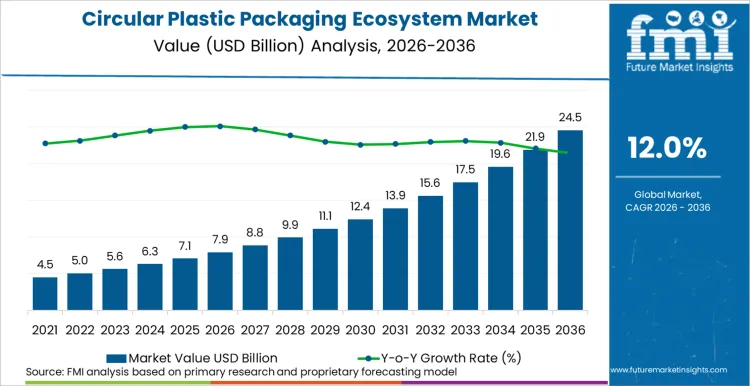
Spending across the circular plastic packaging ecosystem reaches USD 7.9 billion in 2026 and is projected to rise to USD 24.5 billion by 2036 at a 12.00% CAGR. Demand is shaped by regulatory frameworks, extended producer responsibility schemes, and brand-level commitments to closed-loop material use. Program scope covers collection systems, sorting capacity, recycled resin integration, and packaging redesign rather than isolated material substitution.
Brand owners and retailers define ecosystem participation through recovery targets, recycled content thresholds, and reporting obligations during portfolio planning. Once a packaging family is enrolled in a circular framework, later changes affect recovery contracts, compliance documentation, and public disclosures. Growth follows the expansion of mandated recovery programs and retailer-driven packaging standards.
Participation in the circular plastic packaging ecosystem market depends on inclusion within approved recovery schemes, material qualification lists, and compliance platforms maintained by brand groups, municipalities, and recycling operators. Entry requires documented traceability, mass-balance or material flow accounting, and performance against recovery targets. Program structures remain stable across extended cycles because regulatory filings and public commitments attach to defined systems rather than to individual packs. Supplier changes occur during framework renewals rather than routine sourcing. Revenue development reflects the number of packaging portfolios brought under formal circularity programs. Competitive position depends on early alignment with regulatory models and continued acceptance within multi-stakeholder governance structures.
Circular Plastic Packaging Ecosystem Market Quick Stats
- Circular Plastic Packaging Ecosystem Market Value (2026): USD 7.9 billion
- Circular Plastic Packaging Ecosystem Market Forecast Value (2036): USD 24.5 billion
- Circular Plastic Packaging Ecosystem Market Forecast CAGR 2026 to 2036: 12.0%
- Leading End Use in Circular Plastic Packaging Ecosystem Market: FMCG food and beverage
- Leading Ecosystem Model: Closed loop brand-converter-recycler networks
- Key Growth Regions in Circular Plastic Packaging Ecosystem Market: India, China, USA, Germany, Japan
- Top Players in Circular Plastic Packaging Ecosystem Market: Amcor, Veolia, Dow, WM (Waste Management), GEM, Kingfa Sci. & Tech., Toyo Seikan, JEPLAN
What is the Growth Forecast for the Circular Plastic Packaging Ecosystem Market through 2036?
Material circulation, collection yield, and reprocessing capacity define how this segment expands. The circular plastic packaging ecosystem market in 2026 stands near USD 7.9 billion, rising from USD 4.5 billion in 2021 as packaging portfolios move from linear supply chains to managed return loops. Buyers evaluate programs through bale quality, traceability depth, food contact compliance, and conversion yield into usable resin. Platform decisions sit with brand governance and packaging engineering councils, not with spot procurement. The value path reaches USD 12.4 billion in 2030 and USD 17.5 billion in 2033. The move to USD 24.5 billion in 2036 reflects a 12.00% growth rate supported by wider collection coverage, higher reuse rates, and deeper integration of recycled content into primary pack structures.
Operating economics shape commercial behavior in the circular plastic packaging ecosystem market. Volumes follow multi year agreements that link collection partners, sorters, reclaimers, and converters inside audited systems. Stock policy prioritizes feedstock continuity and grade stability across plants. Cost structure reflects sorting efficiency, washing loss, regranulation yield, quality screening, and documentation overhead. Converters track melt flow stability, contamination incidents, and downtime tied to feedstock variability. Annual values pass USD 15.6 billion in 2032 and USD 21.9 billion in 2035 as more categories migrate into closed loop formats. The rise to USD 24.5 billion in 2036 comes from broader category coverage, higher recycled content per pack, and longer contracts that lock circular pathways into standard packaging specifications.
Circular Plastic Packaging Ecosystem Market Key Takeaways
| Metric | Value |
|---|---|
| Market Value (2026) | USD 7.9 billion |
| Forecast Value (2036) | USD 24.5 billion |
| Forecast CAGR 2026 to 2036 | 12.0% |
Source: FMI analysis based on primary research and proprietary forecasting model
How Is the Circular Plastic Packaging Ecosystem Market Being Used to Govern Material Flows, Compliance, and Recovery Outcomes Across Packaging Value Chains?
Packaging owners treat the circular plastic packaging ecosystem market as an operating system for material governance rather than as a sustainability label. Programs specify design for recyclability packaging guidelines and mono material flexible packaging structures to keep sorting and reprocessing pathways open at scale. Qualification teams rely on post-consumer recycled resin certification schemes and packaging material traceability platforms to confirm that sourcing claims and content declarations remain auditable. Engineering groups evaluate recycling compatible barrier coatings and deinkable printing and coating systems to prevent contamination of recovery streams. The focus stays on seal integrity, shelf life stability, and machine runnability because packaging that performs in distribution but fails in sorting or reprocessing audits creates compliance exposure and claim withdrawal risk.
Release governance places extended producer responsibility compliance frameworks inside shipment approval rather than inside marketing review. Selection criteria for circular packaging material suppliers include feedstock governance, conversion stability, and documented performance in recovery systems. Life cycle assessment for circular plastic packaging systems is used to verify that design changes do not shift impact to other stages of the value chain. Waste stream compatibility for recyclable packaging formats shapes material choice because misrouted or non-sortable structures break recovery economics. Sorting and reprocessing performance validation protocols define acceptance gates for detection, separation, and yield. Audit readiness for circular packaging claims sets ongoing surveillance requirements. This makes packaging architecture a compliance and risk management decision rather than a short term cost or design optimization exercise.
How Do Traceability Obligations and Material Recirculation Economics Shape Demand in the Circular Plastic Packaging Ecosystem Market by End Use and Ecosystem Model in 2026?
In the Circular Plastic Packaging Ecosystem Market, participation decisions are driven by audit exposure, feedstock security, and long-term material yield rather than by short-term resin pricing. Brand owners coordinating FMCG packaging portfolios, retail packaging programs, and recycled content roadmaps require operating models that preserve chain-of-custody, stabilize quality, and keep recovery rates predictable across regions. By end use, demand spans FMCG food and beverage, retail and e-commerce, mass FMCG packaging, premium packaging, emerging circular packaging, and other uses. By ecosystem model, activity covers closed-loop brand-converter-recycler networks, brand-led circular programs, industrial circular parks, corporate closed loops, and other structures. Portfolio choices reflect data continuity, contamination risk, and scale-up feasibility.
Why Do FMCG Food and Beverage Applications Anchor Most Ecosystem Volume?
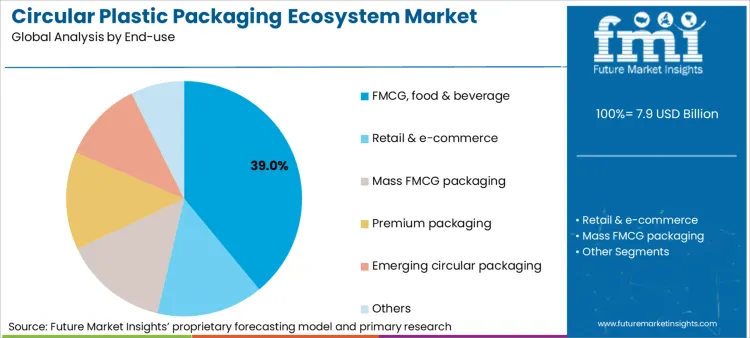
FMCG food and beverage represent about 39% share, placing this segment at the center of most circular packaging investments. High throughput, frequent packaging turnover, and strict food contact controls make material quality drift immediately visible. Retail and e-commerce follow, driven by standardized formats and growing recycled content commitments. Mass FMCG packaging emphasizes logistics efficiency and bale consistency, while premium packaging focuses on appearance and claim credibility. Emerging circular packaging remains experimental. Packaging engineers qualify end uses through contamination tolerance and mechanical property retention. Operations teams qualify through sorting yield and reprocessing loss. Quality teams qualify through color stability and odor carryover.
End-use focus fixes sorting specifications, reprocessing targets, and approval thresholds. Entering a new application class requires new test runs and updated risk assessments. Procurement aligns contracts to secure continuous access to compliant feedstock. Certification files and reporting templates follow the same mapping. Commercial planning expands volume within the same end-use class rather than rotating categories. Demand therefore concentrates in FMCG food and beverage flows where scale, regulatory oversight, and reputational exposure converge.
Why Do Closed-Loop and Brand-Led Models Lead Ecosystem Structuring?
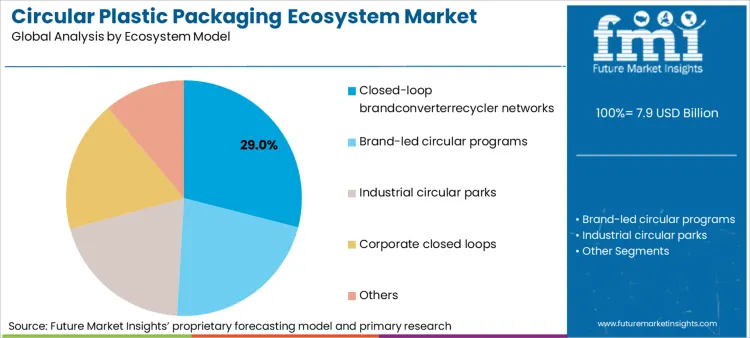
Closed-loop brand-converter-recycler networks account for about 29% share, reflecting their ability to control material identity and reduce quality variance across cycles. This structure simplifies mass balance accounting and claim substantiation. Brand-led circular programs follow where ownership of specifications and recovery contracts remains centralized. Industrial circular parks aggregate volume and infrastructure, though they introduce coordination complexity. Corporate closed loops serve internal packaging systems with stable formats. Other models remain situational. Strategy teams evaluate models through yield predictability and governance load. Operations teams evaluate through logistics stability. Compliance teams evaluate through audit traceability and reporting burden.
Ecosystem model selection fixes data sharing rules, quality gates, and dispute resolution processes. A change in model requires new contracts, new reporting workflows, and revised certification approaches. Planning then aligns collection, sorting, and reprocessing capacity to the chosen structure. Investment priorities and partner selection follow. Field quality monitoring and escalation paths also assume the same model. Growth occurs by adding volume and geographies within the same ecosystem logic rather than switching governance structures. Demand therefore concentrates in closed-loop and brand-led models that protect material quality, audit readiness, and long-term supply continuity.
Why Are Collection, Sorting, and Reuse Loops Reshaping Plastic Packaging System Design?
Across packaging value chains, pressure now comes from how waste collection networks and sorting infrastructure interact with reprocessing operations rather than from pack design alone. Packaging formats must be compatible with existing recovery flows while still running on high speed filling and sealing lines. At the same time, brand packaging programs and retail packaging standards increasingly specify material pathways beyond first use. These requirements converge at the system level, where pack structure, labeling, and material choice must align with downstream handling. Demand grows because companies need packaging systems that fit into real recovery loops without disrupting production or logistics performance.
What Is Preventing Fast Convergence Toward Standardized Circular Packaging Systems?
Fragmentation across municipal collection systems and recycling plant configurations creates inconsistent outcomes for the same packaging formats in different regions. Material choices that work well in one sorting setup may perform poorly in another. Differences in washing and reprocessing lines further limit reuse of a single pack architecture across markets. Qualification also depends on packaging test centers and brand approval processes, which slows system wide changes. These dependencies keep packaging design tied to local infrastructure realities. Companies face parallel systems, longer validation timelines, and limited ability to deploy one unified packaging model across all geographies.
How Are System-Level Design Approaches Changing Packaging Development?
Packaging development is shifting from single pack optimization toward coordination between material suppliers, converters, and reprocessing partners. Packaging process engineers and recycling operations teams are now involved earlier to define acceptable material combinations, labels, and construction methods. Testing and validation partners help verify how packs behave across collection, sorting, and reprocessing steps before scale rollout. The ecosystem is moving toward repeatable system templates supported by shared data and defined handling pathways. Competitive position depends on offering packaging solutions that work across production lines and recovery loops rather than only on shelf or in transport.
What is the Demand for Circular Plastic Packaging Ecosystem by Country?
| Country | CAGR (%) |
|---|---|
| Germany | 11.2% |
| USA | 11.6% |
| China | 14.0% |
| Japan | 10.0% |
| India | 15.4% |
Source: FMI analysis based on primary research and proprietary forecasting model
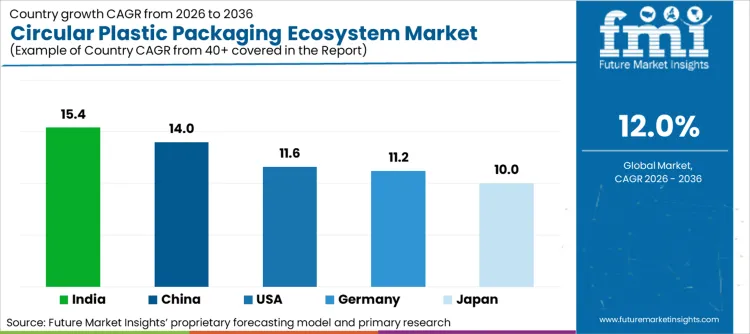
The demand for circular plastic packaging ecosystem solutions is rising across food, beverage, and consumer goods sectors where recycling, material reuse, and sustainability compliance are critical. India leads at 15.4% CAGR, supported by growing packaged goods production, regulatory mandates for recycling, and adoption of circular initiatives by domestic brands. China follows at 14.0%, driven by large scale packaging production, recycling infrastructure expansion, and brand commitments to closed-loop systems. The USA grows at 11.6%, shaped by corporate sustainability programs and consumer preference for recyclable packaging. Germany records 11.2%, reflecting strict environmental regulations and adoption of circular packaging solutions. Japan posts 10.0%, within a mature market emphasizing compliance, traceability, and responsible material use.
How Industrial Recycling Programs Influence the Circular Plastic Packaging Ecosystem Market in Germany
Growing adoption of closed-loop recycling in Germany is supporting an 11.2% CAGR for the circular plastic packaging ecosystem market. Materials are assessed for compatibility with collection and recycling processes, mechanical stability, and retention of barrier properties after multiple cycles. Technical evaluation includes dimensional consistency, sealing performance, and processing compatibility with existing laminating and filling equipment. Once validated, packaging solutions are implemented across multiple production lines and product categories. Volume growth follows adoption by retail chains, foodservice, and industrial programs prioritizing eco-friendly initiatives. Supplier participation depends on audit compliance, certification verification, and technical support. Commercial success relies on reproducible material performance, operational reliability, and consistent integration across manufacturing facilities.
How E-Commerce Logistics Drive the Circular Plastic Packaging Ecosystem Market in the USA
In the United States, the circular plastic packaging ecosystem market is expanding at an 11.6% CAGR due to increasing e-commerce shipments and corporate sustainability programs. Materials are selected for barrier retention, tensile strength, and recyclability in automated processing lines. Technical teams evaluate seal integrity, dimensional stability, and compatibility with automated laminating and filling systems. Once validated, packaging is deployed across multiple production lines and product categories. Supplier access depends on certification verification, audit compliance, and technical support for process integration. Volume growth aligns with expansion of retail and logistics programs and institutional sustainability initiatives. Commercial success relies on reproducible performance, operational reliability, and consistent quality across production environments.
How High-Volume Urban Distribution Networks Shape the Circular Plastic Packaging Ecosystem Market in China
Rapid expansion of urban e-commerce and logistics platforms is driving the circular plastic packaging ecosystem market in China at a 14% CAGR. Materials are evaluated for barrier performance, tensile strength, recyclability, and compatibility with high-speed automated packaging lines. Engineers assess dimensional consistency, sealing performance, and processing reliability for multi-layer laminates. Once approved, packaging solutions are deployed across multiple production lines and product categories. Supplier participation relies on audit compliance, documentation accuracy, and technical support for high-volume operations. Volume growth is linked to fleet expansion, retail adoption, and institutional packaging programs. Commercial advantage depends on reproducible performance, operational reliability, and integration support across manufacturing sites.
How Regulatory Compliance and Product Standards Guide the Circular Plastic Packaging Ecosystem Market in Japan
In Japan, the circular plastic packaging ecosystem market is growing at a 10% CAGR due to regulatory compliance and strict packaging standards. Materials are selected for recyclability, barrier efficiency, mechanical stability, and compatibility with automated filling and laminating equipment. Technical teams evaluate dimensional stability, seal integrity, and thermal performance. Once validated, packaging solutions are applied across multiple production lines for retail, foodservice, and institutional programs. Supplier participation depends on certification verification, audit compliance, and technical support. Volume growth follows adoption by packaged food companies, retail chains, and corporate sustainability initiatives. Commercial success relies on reproducible material performance, operational reliability, and consistent quality across production facilities.
How Platform Scaling and High-Volume E-Commerce Drive the Circular Plastic Packaging Ecosystem Market in India
India’s circular plastic packaging ecosystem market is expanding at a 15.4% CAGR due to large-scale e-commerce growth and expansion of retail and industrial packaging platforms. Materials are assessed for recyclability, barrier protection, tensile strength, and compatibility with high-speed laminating and filling lines. Engineers evaluate seal performance, dimensional stability, and thermal resilience. Once approved, solutions are deployed across multiple production lines and packaging programs. Supplier participation depends on certification documentation, audit compliance, and technical support. Volume growth is linked to platform scaling, retail adoption, and high-volume production programs. Commercial advantage relies on reproducible material performance, operational reliability, and process consistency across manufacturing facilities.
What Strategies Are Driving the Circular Plastic Packaging Ecosystem Market?
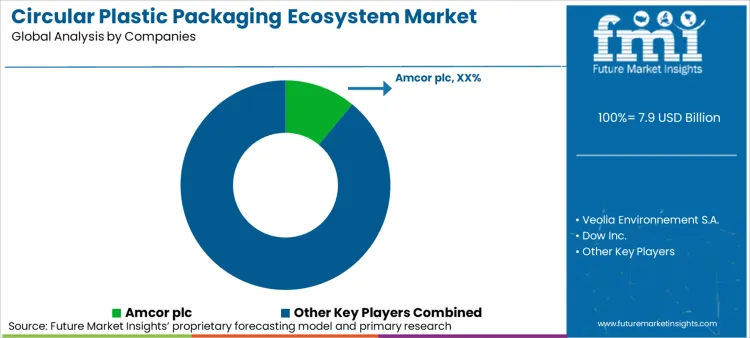
Recycled content, collection infrastructure, and material compatibility dictate adoption in the Circular Plastic Packaging Ecosystem Market. Amcor, Veolia, Dow, Waste Management, GEM, Kingfa Sci. & Tech., Toyo Seikan, and JEPLAN compete through material recovery trials, recycling process validation, and supply chain integration. Once integrated into packaging workflows, traceable recycled content, process consistency, and regulatory compliance anchor supplier selection. Amcor emphasizes modular packaging designs that facilitate circularity.
Veolia focuses on industrial-scale recycling and collection systems. Dow delivers polymer solutions optimized for repeated recycling cycles. Waste Management provides logistics and material handling for recovered plastics. GEM and Kingfa Sci. & Tech. supply high-performance recycled polymers. Toyo Seikan targets rigid packaging with circular compatibility. JEPLAN provides closed-loop recycling programs for branded consumer packaging.
Process reliability, material performance, and circularity certification shape competitive positioning in the Circular Plastic Packaging Ecosystem Market. Engineers evaluate polymer integrity, recyclability, processing compatibility, and compliance with circular economy standards during trials. Suppliers capable of reproducible material quality, scalable recycling integration, and technical guidance gain preference. Amcor maintains adoption through modular design and industrial validation. Veolia secures placements in large-scale recycling programs.
Dow competes in high-performance recycled polymer applications. Waste Management captures adoption in collection and logistics operations. GEM and Kingfa Sci. & Tech. provide industrial-scale recycled polymer supply. Toyo Seikan supports rigid packaging requiring circular compatibility. JEPLAN focuses on traceable closed-loop recycling programs. Market positions vary by polymer type, application, recycling infrastructure, production scale, and regional environmental regulations.
Key Players in Circular Plastic Packaging Ecosystem Market
- Amcor plc
- Veolia Environnement S.A.
- Dow Inc.
- WM (Waste Management, Inc.)
- GEM Co., Ltd.
- Kingfa Sci. & Tech. Co., Ltd.
- Toyo Seikan Group Holdings, Ltd.
- JEPLAN, Inc.
Scope of the Report
| Items | Values |
|---|---|
| Quantitative Units (2026) | USD billion |
| End-use | FMCG food and beverage, retail and e-commerce, mass FMCG packaging, premium packaging, emerging circular packaging, others |
| Ecosystem Model | Closed-loop brand-converter-recycler networks, brand-led circular programs, industrial circular parks, corporate closed loops, others |
| Material Scope | PET, PE, or PP, PCR plastics, mixed plastics, PET or engineering plastics, others |
| Integration Technology | Digital product passports and traceability, OEM-recycler data integration, high-scale recycling platforms, high-purity recovery systems, others |
| Regions Covered | Asia Pacific, Europe, North America, Latin America, Middle East & Africa |
| Countries Covered | United States, Canada, Mexico, Germany, United Kingdom, France, Italy, Spain, Nordics, BENELUX, China, Japan, South Korea, India, Australia & New Zealand, ASEAN, Brazil, Chile, Saudi Arabia, Turkey, South Africa, and other regional markets |
| Key Companies Profiled | Amcor, Veolia, Dow, WM (Waste Management), GEM, Kingfa Sci. & Tech., Toyo Seikan Group, JEPLAN |
| Additional Attributes | Dollar value of ecosystem programs by end-use, ecosystem model, material scope, and integration technology, extended producer responsibility and compliance governance frameworks, collection, sorting, and reprocessing yield management, mass-balance and chain-of-custody traceability systems, recycled content integration into primary packaging, audit and reporting obligations, multi-year recovery and supply agreements, quality stability across reuse cycles, and regional adoption patterns across FMCG, retail, and consumer packaging value chains |
Circular Plastic Packaging Ecosystem Market Segmentation
End-use:
- FMCG, food & beverage
- Retail & e-commerce
- Mass FMCG packaging
- Premium packaging
- Emerging circular packaging
- Others
Ecosystem Model:
- Closed-loop brand converter recycler networks
- Brand-led circular programs
- Industrial circular parks
- Corporate closed loops
- Others
Material Scope:
- PET, PE, or PP
- PCR plastics
- Mixed plastics
- PET or engineering plastics
- Others
Integration Technology:
- Digital product passports & traceability
- OEM recycler data integration
- High-scale recycling platforms
- High-purity recovery systems
- Others
Region
- Asia Pacific
- China
- Japan
- South Korea
- India
- Australia & New Zealand
- ASEAN
- Rest of Asia Pacific
- Europe
- Germany
- United Kingdom
- France
- Italy
- Spain
- Nordic
- BENELUX
- Rest of Europe
- North America
- United States
- Canada
- Mexico
- Latin America
- Brazil
- Chile
- Rest of Latin America
- Middle East & Africa
- Kingdom of Saudi Arabia
- Other GCC Countries
- Turkey
- South Africa
- Other African Union
- Rest of Middle East & Africa
Bibliography
- European Commission, Joint Research Centre. (2023). Plastics recycling and recycled plastics in the circular economy. Publications Office of the European Union.
- European Environment Agency. (2023). Plastics, the circular economy and Europe’s environment. European Environment Agency.
- International Organization for Standardization. (2020). ISO 22095: Chain of custody - General terminology and models. ISO.
- International Organization for Standardization. (2016). ISO 14021: Environmental labels and declarations - Self-declared environmental claims (Type II environmental labelling). ISO.
Frequently Asked Questions
How big is the circular plastic packaging ecosystem market in 2026?
The global circular plastic packaging ecosystem market is estimated to be valued at USD 7.9 billion in 2026.
What will be the size of circular plastic packaging ecosystem market in 2036?
The market size for the circular plastic packaging ecosystem market is projected to reach USD 24.5 billion by 2036.
How much will be the circular plastic packaging ecosystem market growth between 2026 and 2036?
The circular plastic packaging ecosystem market is expected to grow at a 12.0% CAGR between 2026 and 2036.
What are the key product types in the circular plastic packaging ecosystem market?
The key product types in circular plastic packaging ecosystem market are fmcg, food & beverage, retail & e-commerce, mass fmcg packaging, premium packaging, emerging circular packaging and others.
Which ecosystem model segment to contribute significant share in the circular plastic packaging ecosystem market in 2026?
In terms of ecosystem model, closed-loop brandconverterrecycler networks segment to command 29.0% share in the circular plastic packaging ecosystem market in 2026.
Preview the report firsthand - request a free sample
Get SampleGet the brochure for pricing and purchase details.
Get PDFTable of Content
- Executive Summary
- Global Market Outlook
- Demand-side Trends
- Supply-side Trends
- Technology Roadmap Analysis
- Analysis and Recommendations
- Market Overview
- Market Coverage / Taxonomy
- Market Definition / Scope / Limitations
- Market Background
- Market Dynamics
- Drivers
- Restraints
- Opportunity
- Trends
- Scenario Forecast
- Demand in Optimistic Scenario
- Demand in Likely Scenario
- Demand in Conservative Scenario
- Opportunity Map Analysis
- Product Life Cycle Analysis
- Supply Chain Analysis
- Investment Feasibility Matrix
- Value Chain Analysis
- PESTLE and Porter’s Analysis
- Regulatory Landscape
- Regional Parent Market Outlook
- Production and Consumption Statistics
- Import and Export Statistics
- Market Dynamics
- Global Market Analysis 2021 to 2025 and Forecast, 2026 to 2036
- Historical Market Size Value (USD Million) Analysis, 2021 to 2025
- Current and Future Market Size Value (USD Million) Projections, 2026 to 2036
- Y-o-Y Growth Trend Analysis
- Absolute $ Opportunity Analysis
- Global Market Pricing Analysis 2021 to 2025 and Forecast 2026 to 2036
- Global Market Analysis 2021 to 2025 and Forecast 2026 to 2036, By End-use
- Introduction / Key Findings
- Historical Market Size Value (USD Million) Analysis By End-use , 2021 to 2025
- Current and Future Market Size Value (USD Million) Analysis and Forecast By End-use , 2026 to 2036
- FMCG, food & beverage
- Retail & e-commerce
- Mass FMCG packaging
- Premium packaging
- Emerging circular packaging
- Others
- FMCG, food & beverage
- Y-o-Y Growth Trend Analysis By End-use , 2021 to 2025
- Absolute $ Opportunity Analysis By End-use , 2026 to 2036
- Global Market Analysis 2021 to 2025 and Forecast 2026 to 2036, By Ecosystem Model
- Introduction / Key Findings
- Historical Market Size Value (USD Million) Analysis By Ecosystem Model, 2021 to 2025
- Current and Future Market Size Value (USD Million) Analysis and Forecast By Ecosystem Model, 2026 to 2036
- Closed-loop brandconverterrecycler networks
- Brand-led circular programs
- Industrial circular parks
- Corporate closed loops
- Others
- Closed-loop brandconverterrecycler networks
- Y-o-Y Growth Trend Analysis By Ecosystem Model, 2021 to 2025
- Absolute $ Opportunity Analysis By Ecosystem Model, 2026 to 2036
- Global Market Analysis 2021 to 2025 and Forecast 2026 to 2036, By Material Scope
- Introduction / Key Findings
- Historical Market Size Value (USD Million) Analysis By Material Scope, 2021 to 2025
- Current and Future Market Size Value (USD Million) Analysis and Forecast By Material Scope, 2026 to 2036
- PET, PE, PP
- PCR plastics
- Mixed plastics
- PET & engineering plastics
- Others
- PET, PE, PP
- Y-o-Y Growth Trend Analysis By Material Scope, 2021 to 2025
- Absolute $ Opportunity Analysis By Material Scope, 2026 to 2036
- Global Market Analysis 2021 to 2025 and Forecast 2026 to 2036, By Integration Technology
- Introduction / Key Findings
- Historical Market Size Value (USD Million) Analysis By Integration Technology, 2021 to 2025
- Current and Future Market Size Value (USD Million) Analysis and Forecast By Integration Technology, 2026 to 2036
- Digital product passports & traceability
- OEMrecycler data integration
- High-scale recycling platforms
- High-purity recovery systems
- Others
- Digital product passports & traceability
- Y-o-Y Growth Trend Analysis By Integration Technology, 2021 to 2025
- Absolute $ Opportunity Analysis By Integration Technology, 2026 to 2036
- Global Market Analysis 2021 to 2025 and Forecast 2026 to 2036, By Region
- Introduction
- Historical Market Size Value (USD Million) Analysis By Region, 2021 to 2025
- Current Market Size Value (USD Million) Analysis and Forecast By Region, 2026 to 2036
- North America
- Latin America
- Western Europe
- Eastern Europe
- East Asia
- South Asia and Pacific
- Middle East & Africa
- Market Attractiveness Analysis By Region
- North America Market Analysis 2021 to 2025 and Forecast 2026 to 2036, By Country
- Historical Market Size Value (USD Million) Trend Analysis By Market Taxonomy, 2021 to 2025
- Market Size Value (USD Million) Forecast By Market Taxonomy, 2026 to 2036
- By Country
- USA
- Canada
- Mexico
- By End-use
- By Ecosystem Model
- By Material Scope
- By Integration Technology
- By Country
- Market Attractiveness Analysis
- By Country
- By End-use
- By Ecosystem Model
- By Material Scope
- By Integration Technology
- Key Takeaways
- Latin America Market Analysis 2021 to 2025 and Forecast 2026 to 2036, By Country
- Historical Market Size Value (USD Million) Trend Analysis By Market Taxonomy, 2021 to 2025
- Market Size Value (USD Million) Forecast By Market Taxonomy, 2026 to 2036
- By Country
- Brazil
- Chile
- Rest of Latin America
- By End-use
- By Ecosystem Model
- By Material Scope
- By Integration Technology
- By Country
- Market Attractiveness Analysis
- By Country
- By End-use
- By Ecosystem Model
- By Material Scope
- By Integration Technology
- Key Takeaways
- Western Europe Market Analysis 2021 to 2025 and Forecast 2026 to 2036, By Country
- Historical Market Size Value (USD Million) Trend Analysis By Market Taxonomy, 2021 to 2025
- Market Size Value (USD Million) Forecast By Market Taxonomy, 2026 to 2036
- By Country
- Germany
- UK
- Italy
- Spain
- France
- Nordic
- BENELUX
- Rest of Western Europe
- By End-use
- By Ecosystem Model
- By Material Scope
- By Integration Technology
- By Country
- Market Attractiveness Analysis
- By Country
- By End-use
- By Ecosystem Model
- By Material Scope
- By Integration Technology
- Key Takeaways
- Eastern Europe Market Analysis 2021 to 2025 and Forecast 2026 to 2036, By Country
- Historical Market Size Value (USD Million) Trend Analysis By Market Taxonomy, 2021 to 2025
- Market Size Value (USD Million) Forecast By Market Taxonomy, 2026 to 2036
- By Country
- Russia
- Poland
- Hungary
- Balkan & Baltic
- Rest of Eastern Europe
- By End-use
- By Ecosystem Model
- By Material Scope
- By Integration Technology
- By Country
- Market Attractiveness Analysis
- By Country
- By End-use
- By Ecosystem Model
- By Material Scope
- By Integration Technology
- Key Takeaways
- East Asia Market Analysis 2021 to 2025 and Forecast 2026 to 2036, By Country
- Historical Market Size Value (USD Million) Trend Analysis By Market Taxonomy, 2021 to 2025
- Market Size Value (USD Million) Forecast By Market Taxonomy, 2026 to 2036
- By Country
- China
- Japan
- South Korea
- By End-use
- By Ecosystem Model
- By Material Scope
- By Integration Technology
- By Country
- Market Attractiveness Analysis
- By Country
- By End-use
- By Ecosystem Model
- By Material Scope
- By Integration Technology
- Key Takeaways
- South Asia and Pacific Market Analysis 2021 to 2025 and Forecast 2026 to 2036, By Country
- Historical Market Size Value (USD Million) Trend Analysis By Market Taxonomy, 2021 to 2025
- Market Size Value (USD Million) Forecast By Market Taxonomy, 2026 to 2036
- By Country
- India
- ASEAN
- Australia & New Zealand
- Rest of South Asia and Pacific
- By End-use
- By Ecosystem Model
- By Material Scope
- By Integration Technology
- By Country
- Market Attractiveness Analysis
- By Country
- By End-use
- By Ecosystem Model
- By Material Scope
- By Integration Technology
- Key Takeaways
- Middle East & Africa Market Analysis 2021 to 2025 and Forecast 2026 to 2036, By Country
- Historical Market Size Value (USD Million) Trend Analysis By Market Taxonomy, 2021 to 2025
- Market Size Value (USD Million) Forecast By Market Taxonomy, 2026 to 2036
- By Country
- Kingdom of Saudi Arabia
- Other GCC Countries
- Turkiye
- South Africa
- Other African Union
- Rest of Middle East & Africa
- By End-use
- By Ecosystem Model
- By Material Scope
- By Integration Technology
- By Country
- Market Attractiveness Analysis
- By Country
- By End-use
- By Ecosystem Model
- By Material Scope
- By Integration Technology
- Key Takeaways
- Key Countries Market Analysis
- USA
- Pricing Analysis
- Market Share Analysis, 2025
- By End-use
- By Ecosystem Model
- By Material Scope
- By Integration Technology
- Canada
- Pricing Analysis
- Market Share Analysis, 2025
- By End-use
- By Ecosystem Model
- By Material Scope
- By Integration Technology
- Mexico
- Pricing Analysis
- Market Share Analysis, 2025
- By End-use
- By Ecosystem Model
- By Material Scope
- By Integration Technology
- Brazil
- Pricing Analysis
- Market Share Analysis, 2025
- By End-use
- By Ecosystem Model
- By Material Scope
- By Integration Technology
- Chile
- Pricing Analysis
- Market Share Analysis, 2025
- By End-use
- By Ecosystem Model
- By Material Scope
- By Integration Technology
- Germany
- Pricing Analysis
- Market Share Analysis, 2025
- By End-use
- By Ecosystem Model
- By Material Scope
- By Integration Technology
- UK
- Pricing Analysis
- Market Share Analysis, 2025
- By End-use
- By Ecosystem Model
- By Material Scope
- By Integration Technology
- Italy
- Pricing Analysis
- Market Share Analysis, 2025
- By End-use
- By Ecosystem Model
- By Material Scope
- By Integration Technology
- Spain
- Pricing Analysis
- Market Share Analysis, 2025
- By End-use
- By Ecosystem Model
- By Material Scope
- By Integration Technology
- France
- Pricing Analysis
- Market Share Analysis, 2025
- By End-use
- By Ecosystem Model
- By Material Scope
- By Integration Technology
- India
- Pricing Analysis
- Market Share Analysis, 2025
- By End-use
- By Ecosystem Model
- By Material Scope
- By Integration Technology
- ASEAN
- Pricing Analysis
- Market Share Analysis, 2025
- By End-use
- By Ecosystem Model
- By Material Scope
- By Integration Technology
- Australia & New Zealand
- Pricing Analysis
- Market Share Analysis, 2025
- By End-use
- By Ecosystem Model
- By Material Scope
- By Integration Technology
- China
- Pricing Analysis
- Market Share Analysis, 2025
- By End-use
- By Ecosystem Model
- By Material Scope
- By Integration Technology
- Japan
- Pricing Analysis
- Market Share Analysis, 2025
- By End-use
- By Ecosystem Model
- By Material Scope
- By Integration Technology
- South Korea
- Pricing Analysis
- Market Share Analysis, 2025
- By End-use
- By Ecosystem Model
- By Material Scope
- By Integration Technology
- Russia
- Pricing Analysis
- Market Share Analysis, 2025
- By End-use
- By Ecosystem Model
- By Material Scope
- By Integration Technology
- Poland
- Pricing Analysis
- Market Share Analysis, 2025
- By End-use
- By Ecosystem Model
- By Material Scope
- By Integration Technology
- Hungary
- Pricing Analysis
- Market Share Analysis, 2025
- By End-use
- By Ecosystem Model
- By Material Scope
- By Integration Technology
- Kingdom of Saudi Arabia
- Pricing Analysis
- Market Share Analysis, 2025
- By End-use
- By Ecosystem Model
- By Material Scope
- By Integration Technology
- Turkiye
- Pricing Analysis
- Market Share Analysis, 2025
- By End-use
- By Ecosystem Model
- By Material Scope
- By Integration Technology
- South Africa
- Pricing Analysis
- Market Share Analysis, 2025
- By End-use
- By Ecosystem Model
- By Material Scope
- By Integration Technology
- USA
- Market Structure Analysis
- Competition Dashboard
- Competition Benchmarking
- Market Share Analysis of Top Players
- By Regional
- By End-use
- By Ecosystem Model
- By Material Scope
- By Integration Technology
- Competition Analysis
- Competition Deep Dive
- Amcor plc
- Overview
- Product Portfolio
- Profitability by Market Segments (Product/Age /Sales Channel/Region)
- Sales Footprint
- Strategy Overview
- Marketing Strategy
- Product Strategy
- Channel Strategy
- Veolia Environnement S.A.
- Dow Inc.
- WM (Waste Management, Inc.)
- GEM Co., Ltd.
- Kingfa Sci. & Tech. Co., Ltd.
- Toyo Seikan Group Holdings, Ltd.
- JEPLAN, Inc.
- Amcor plc
- Competition Deep Dive
- Assumptions & Acronyms Used
- Research Methodology


